
Crystal structure of catena-poly-{diaqua-bis[μ-(((4-chlorophenyl)sulfonyl)glycinato-κO)](μ2-4, 4′-bipyridine-κ2N:N′)cobalt(II)} dihydrate, C26H30Cl2CoN4O12S2
-
Xiao-Miao Chen
 ,
Zheng-Jun Liu
,
Zheng-Jun Liu
 ,
Qing Liu
,
Qing Liu

Abstract
C26H30Cl2CoN4O12S2, monoclinic, P21/c (no. 14), a = 11.4094(5) Å, b = 14.2343(6) Å, c = 11.6775(4) Å, β = 114.3130(10)∘, V = 1728.28(12) Å3, Z = 2, R gt (F) = 0.0393, wR ref (F2) = 0.1046, T = 293(2) K.
Table 1 contains crystallographic data and Table 2 contains the list of the atoms including atomic coordinates and displacement parameters.
Data collection and handling.
| Crystal: | Colourless block |
| Size: | 0.44 × 0.43 × 0.23 mm |
| Wavelength: | Mo Kα radiation (0.71073 Å) |
| μ: | 0.84 mm−1 |
| Diffractometer, scan mode: | φ and ω |
| θmax, completeness: | 27.5°, >99 % |
| N(hkl)measured, N(hkl)unique, Rint: | 26,660, 3972, 0.025 |
| Criterion for Iobs, N(hkl)gt: | Iobs > 2 σ(Iobs), 3446 |
| N(param)refined: | 229 |
| Programs: | Bruker [1], Olex2 [2], SHELX [3, 4] |
Fractional atomic coordinates and isotropic or equivalent isotropic displacement parameters (Å2).
| Atom | x | y | z | Uiso*/Ueq |
|---|---|---|---|---|
| Co1 | 1.000000 | 0.500000 | 1.000000 | 0.02278 (11) |
| Cl1 | 0.34243 (10) | 0.68006 (9) | 0.69096 (12) | 0.1083 (4) |
| S1 | 0.76865 (7) | 0.65006 (5) | 0.48759 (5) | 0.05214 (18) |
| O1 | 0.81337 (19) | 0.74451 (14) | 0.48920 (19) | 0.0674 (6) |
| O2 | 0.7112 (2) | 0.60208 (17) | 0.37056 (16) | 0.0772 (7) |
| O3 | 0.92586 (13) | 0.51774 (10) | 0.80691 (12) | 0.0312 (3) |
| O4 | 0.86450 (16) | 0.37442 (11) | 0.72942 (14) | 0.0438 (4) |
| O5 | 0.97593 (16) | 0.35131 (11) | 0.97907 (16) | 0.0359 (3) |
| H5A | 0.937 (3) | 0.346 (2) | 0.907 (3) | 0.053 (8)* |
| H5B | 1.042 (3) | 0.317 (2) | 0.998 (3) | 0.057 (8)* |
| N1 | 0.8906 (2) | 0.59102 (16) | 0.58016 (19) | 0.0527 (5) |
| H1 | 0.945 (3) | 0.617 (2) | 0.644 (3) | 0.060 (8)* |
| N2 | 0.80841 (15) | 0.50532 (12) | 0.99410 (16) | 0.0309 (4) |
| C1 | 0.4279 (3) | 0.6641 (4) | 0.5096 (3) | 0.0999 (14) |
| H1A | 0.341678 | 0.665565 | 0.453740 | 0.120* |
| C2 | 0.4620 (3) | 0.6714 (2) | 0.6353 (3) | 0.0701 (8) |
| C3 | 0.5889 (3) | 0.6723 (2) | 0.7190 (3) | 0.0657 (8) |
| H3 | 0.610864 | 0.677778 | 0.804748 | 0.079* |
| C4 | 0.6833 (3) | 0.6650 (2) | 0.6749 (2) | 0.0585 (7) |
| H4 | 0.769527 | 0.666928 | 0.730652 | 0.070* |
| C5 | 0.6502 (2) | 0.65486 (18) | 0.5486 (2) | 0.0509 (6) |
| C6 | 0.5221 (3) | 0.6546 (3) | 0.4663 (3) | 0.0904 (13) |
| H6 | 0.499479 | 0.647819 | 0.380576 | 0.108* |
| C7 | 0.8822 (3) | 0.49040 (18) | 0.5928 (2) | 0.0602 (8) |
| H7A | 0.951181 | 0.460741 | 0.577862 | 0.072* |
| H7B | 0.801497 | 0.468563 | 0.528361 | 0.072* |
| C8 | 0.89033 (18) | 0.45854 (14) | 0.72029 (18) | 0.0314 (4) |
| C9 | 0.7102 (2) | 0.4597 (2) | 0.9075 (2) | 0.0526 (7) |
| H9 | 0.723886 | 0.428823 | 0.843912 | 0.063* |
| C10 | 0.5894 (2) | 0.4555 (2) | 0.9067 (2) | 0.0573 (8) |
| H10 | 0.524525 | 0.421791 | 0.844267 | 0.069* |
| C11 | 0.56436 (17) | 0.50136 (14) | 0.99863 (19) | 0.0312 (4) |
| C12 | 0.66514 (19) | 0.55045 (19) | 1.0865 (2) | 0.0449 (6) |
| H12 | 0.653359 | 0.583580 | 1.149583 | 0.054* |
| C13 | 0.78387 (18) | 0.55059 (18) | 1.0811 (2) | 0.0416 (5) |
| H13 | 0.850284 | 0.584296 | 1.141846 | 0.050* |
| O6 | 1.0687 (3) | 0.69088 (18) | 0.7901 (2) | 0.0978 (10) |
| H6A | 1.095896 | 0.674030 | 0.866518 | 0.147* |
| H6B | 1.015175 | 0.734563 | 0.782625 | 0.147* |
1 Source of material
Glycine (7.51 g, 100 mmol) and sodium hydroxide (8.00 g, 200 mmol) were dissolved in 100 mL water. Then, 4-chlorobenzenesulfonyl chloride (21.11 g, 0.5 mmol) was added to the mixture solution and stirred at room temperature for reaction. After 10 h of reaction, the pH of the reaction mixture was adjusted to 1 with 6 mol/L HCl solution to induce precipitation. The precipitate was filtered and washed with distilled water to obtain white solid ((4-chlorophenyl)sulfonyl)glycine.
A mixture of ((4-chlorophenyl)sulfonyl)glycine (249.7 mg, 1.0 mmol), Co(CH3COO)2·4H2O (124.6 mg, 0.5 mmol) and 4,4′-bipyridine (4,4′-bipy) (78.1 mg, 0.5 mmol) was stirred into 50 mL of 50 % methanolic solution at room temperature. Then the pH was adjusted to 7 with 2 mol L−1 NaOH solution. The reaction mixture was heated for 12 h at 80 °C in a Teflon-lined reaction vessel and then filtered. Colourless block-crystals of the title compound were obtained by slow evaporation at room temperature within 2 weeks.
2 Experimental details
Hydrogen atoms were added using riding models. Their Uiso values were set to 1.2Ueq of the parent atoms. The structure was solved with the ShelXT [3] structure solution program and refined with the ShelXL [4].
3 Comment
The design and synthesis of metal-organic coordination polymers is one of the hot spots in current chemical research [5], [6], [7], [8], [9]. Amino acids have more coordination modes after being protected by sulfonyl group (Ar–SO2–), and can form complexes with various structures through the coordination of carboxyl oxygen, amino nitrogen and even sulfonyl group oxygen [10], [11], [12], [13], [14]. Therefore, sulfonylated amino acids provide more possibilities for the design of metal-organic coordination polymers. This contribution is part of our ongoing interest in metal-organic coordination polymers.
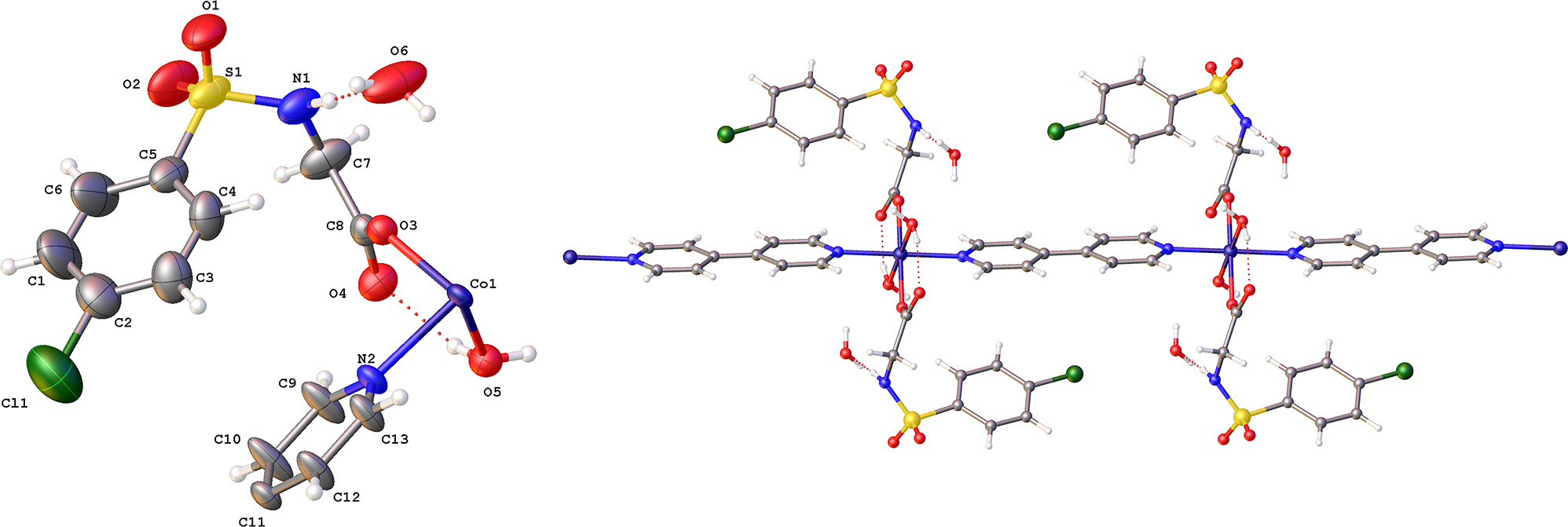
In this paper, the synthesis and crystal structure of a new cobalt(II) complex with ((4-chlorophenyl)sulfonyl)glycine and 4,4′-bipyridine were reported. The asymmetric unit is composed of half an independent Co(II) ion, one ((4-chlorophenyl)sulfonyl)glycine ligand, half a 4,4′-bipyridine ligand, one coordinated water molecule and one lattice water molecule. The crystallographically unique Co(II) ion of the title complex is six-coordinated by two N atoms (N2, N2′) from 4,4′-bipyridine group, two O atoms (O3, O3′) from ((4-chlorophenyl)sulfonyl)glycine group and two O atoms (O5, O5′) from water group, giving rise to an octahedron geometry. Co–O bond lengths fall in the range 2.0719(13)–2.1353(15) Å [15], and Co–N bond lengths are 2.1598(15) Å. The bond lengths are in the expected ranges. Each 4,4′-bipyridine adopts a μ2-coordination mode bridging Co atoms to form one one-dimensional chain along a direction. Furthermore, the extended three-dimensional supramolecular network is formed through O–H⋯O and N–H⋯O hydrogen bonds (O5⋯O1 a : 2.738(2) Å, O5–H5B⋯O1 a angle 170(3)∘; N1⋯O6: 2.838(3) Å, N1–H1⋯O6 angle 174(3)∘. a = −x + 2, −y, −z + 1/2).
-
Research ethics: Not applicable.
-
Author contributions: The authors have accepted responsibility for the entire content of this manuscript and approved its submission.
-
Competing interests: The authors state no conflict of interest.
-
Research funding: This work was financially supported by the Youth Growth S&T Personnel Foundation of Guizhou Education Department (KY[2020]132), Key Laboratory of Agricultural Resources and Environment in High Education Institute of Guizhou Province (Qianjiaoji[2023]025), and Porous Materials and Green Catalysis Innovation Team in High Education Institute of Guizhou Province (Qianjiaoji[2023]086).
-
Data availability: The raw data can be obtained on request from the corresponding author.
References
1. Bruker. SAINT, APEX2 and SADABS; Bruker AXS Inc: Madison, WI, USA, 2009.Search in Google Scholar
2. Dolomanov, O. V., Bourhis, L. J., Gildea, R. J., Howard, J. A. K., Puschmann, H. OLEX2: a complete structure solution, refinement and analysis program. J. Appl. Acta Crystallogr. 2009, 42, 339–341; https://doi.org/10.1107/s0021889808042726.Search in Google Scholar
3. Sheldrick, G. M. SHELXTL – integrated space-group and crystal-structure determination. Acta Crystallogr. 2015, A71, 3–8; https://doi.org/10.1107/s2053273314026370.Search in Google Scholar PubMed PubMed Central
4. Sheldrick, G. M. Crystal structure refinement with SHELXL. Acta Crystallogr. 2015, C71, 3–8; https://doi.org/10.1107/s2053229614024218.Search in Google Scholar
5. Zhang, J. Q., Hu, D. D., Wang, J. L., Ni, B. K., Ren, H. J. Bimetallic metal-organic coordination polymers facilitated the selective C—F cleavage of polyfluoroarenes. Org. Lett. 2022, 24, 7905–7911; https://doi.org/10.1021/acs.orglett.2c02918.Search in Google Scholar PubMed
6. López Molino, J., Amo Ochoa, P. Gas sensors based on xopper-containing metal-organic frameworks, coordination polymers, and complexes. Chempluschem 2020, 85, 1564–1579; https://doi.org/10.1002/cplu.202000428.Search in Google Scholar PubMed
7. Yang, H., Qi, X., Wang, X. Q., Qi, P., Wang, Z., Xu, X., Fu, Y., Yao, S. Regulating immobilization performance of metal-organic coordination polymers through pre-coordination for biosensing. Anal. Chim. Acta 2018, 1005, 27–33; https://doi.org/10.1016/j.aca.2017.11.011.Search in Google Scholar PubMed
8. Masoomi, M. Y., Morsali, A. Morphological study and potential applications of nano metal-organic coordination polymers. RSC Adv. 2013, 3, 19191–19218; https://doi.org/10.1039/c3ra43346c.Search in Google Scholar
9. Masoomi, M. Y., Morsali, A. Applications of metal–organic coordination polymers as precursors for preparation of nano-materials. Coord. Chem. Rev. 2012, 256, 2921–2943; https://doi.org/10.1016/j.ccr.2012.05.032.Search in Google Scholar
10. Chen, X. M., Liu, Z. J., Zhao, R. F., Cheng, J. S., Qin, L., Long, Z. D. Crystal structure of aqua-(2,2′-bipyridine-κ2N,N′)(((3-nitrophenyl)sulfonyl) glycine-κ2N,O)copper(II) dihydrate, C18H20CuN4O9S. Z. Kristallogr. N. Cryst. Struct. 2020, 235, 1141–1143; https://doi.org/10.1515/ncrs-2020-0206.Search in Google Scholar
11. Hou, H. W., Chen, S. H., Wang, L. Y., Ma, L. F. Syntheses, structures and luminescence of three new supramolecular complexes containing N–P-acetamidobenzenesulfonyl-glycine acid. J. Coord. Chem. 2008, 61, 2690–2702; https://doi.org/10.1080/00958970801975539.Search in Google Scholar
12. Fan, Y. T., Huo, X. K., Wang, L. Y., Ma, L. F. Syntheses, structures and luminescent properties of two Zn (II) complexes of N-2-nitrobenzenesulfonyl-glycine acid. J. Coord. Chem. 2007, 60, 1619–1627; https://doi.org/10.1080/00958970601099175.Search in Google Scholar
13. Ma, L., Wang, L., Wang, J., Wang, Y., Feng, X. Syntheses, structures and properties of Zn (II) and Co (II) complexes of N-benzesulfonyl-l-glutamic acid ligand. Inorg. Chim. Acta 2006, 359, 2241–2245; https://doi.org/10.1016/j.ica.2005.12.076.Search in Google Scholar
14. Menabue, L., Saladini, M. N-(arylsulfonyl)glycines as cyclometalating ligands. Crystal and molecular structures of disodium bis(μ-chloro)bis[μ-N-(phenylsulfonyl)glycinato-O,N,C]bis[μ-N-(phenylsulfonyl)glycinato-O,O′]tetrapalladate(II) hexahydrate and disodium bis(μ-chloro)bis(μ-N-tosylglycinato-O,N,C) bis(μ-N-tosylglycinato-O,O′)tetrapalladate(II)-4.5-water-2-N-tosylglycine. Inorg. Chem. 1991, 30, 1651–1655; https://doi.org/10.1021/ic00007a042.Search in Google Scholar
15. Wang, Y.-W. Crystal structure of diaquabis(4,4′-pyridine)bis(N-4-acetamidophenyl-sulfonylglycinato) copper(II), Cu(H2O)2(C10H8N2)2(C10H11N2O5S)2. Z. Kristallogr. N. Cryst. Struct. 2010, 225, 93–94; https://doi.org/10.1524/ncrs.2010.0039.Search in Google Scholar
© 2023 the author(s), published by De Gruyter, Berlin/Boston
This work is licensed under the Creative Commons Attribution 4.0 International License.
Articles in the same Issue
- Frontmatter
- New Crystal Structures
- Crystal structure of bis(dimethylammonium) poly[(μ4-1,1′-(1,4-phenylenebis(methylene))bis(1H-pyrazole-3,5-dicarboxylato))-κ6O1, N2:O2:O3:O1′,N2′]nickel (II)], C22H26N6NiO8
- Hydrothermal synthesis and crystal structure of catena-poly[diaqua-bis(μ2-4-((pyridin-4-ylmethyl)amino)benzoato-κ2N:O)cobalt(II)] – 4,4′-bipyridine – water (1/2/2)
- Crystal structure of (2S,3S,4S,5S, Z)-2,3,5,6-tetrakis(benzyloxy)-4-hydroxyhexanal oxime, C34H37NO6
- The crystal structure of hexakis(3-thiophenecarboxylato-κ2O,O″)-bis(1,10-phenanthroline-κ2N,N′) trimanganese(II), C54H34N4O12S6Mn3
- Crystal structure of catena-poly[(μ2-1,4-di(pyridin-4-yl)benzene-κ2N:N′)-(4-bromobenzoate-κ2O:O′)-(μ-2-bromobenzoate-κ2O,O′)nickel(II)] – water (2/1), C30H21Br2N2NiO4.5
- The crystal structure of poly[(μ3-1,3-phenylenedioxydiacetate-κ5O,O,O′,O″,O‴)-bis(4′-(4-(1H-imidazol-1-yl)phenyl)-4,2′:6′,4″-terpyridine-kN) cadmium(II)], C58H42CdN10O6
- The crystal structure of 5-chloro-6′-methyl-3-(4-(methylsulfonyl)phenyl)-[2,3′-bipyridin]-1′-ium 4-methylbenzenesulfonate
- Crystal structure of poly[(μ-benzoato)-(μ-cis-4–hydroxy-D-proline)lithium], C12H14LiNO5
- The crystal structure of catena-poly[aqua-(4-iodopyridine-2,6-dicarboxylato-κ3N,O,O′)-copper(II)] monohydrate, C7H6NO6ICu
- The crystal structure of catena-[diaqua-(4-acetylphenoxyacetato-κ2O,O)-bis(4-acetylphenoxyacetato-κ3O,O:O)-dihydrate-lanthanum(III)]–4,4′-bipyridine (2/1), C35H35NO14La
- The crystal structure of catena-poly[(4-iodopyridine-2,6-dicarboxylato-κ4 O,N,O′,O′′)(4-imidazol-1-yl-pyridine-κN)copper(II)], C15H9N4O4ICu
- Crystal structure of polybis(μ 4-3,5-dicarboxylatopyrazol-1-yl)-bis(N,N-dimethylformamide)tri-copper(II)–acetonitrile (1/2), C20H22Cu3N8O10
- Crystal structure of poly[(μ2-5-hydroxy-isophthalato-κ4O,O′:O″,O‴)-(μ2-1,5-bis(imidazol-2-methyl)pentane-κ2N:N′)cadmium(II)], C21H24CdN4O5
- The crystal structure of poly[bis(μ2-1,4-bi(1-imidazolyl)benzene-κ2N:N′)bis(μ2-4,4′-methylenebis(3-hydroxy-2-naphthoate)-κ2O:O′)cobalt(II)], C35H24CoN4O6
- The crystal structure of a cobalt-vanadium-oxido hydrate
- The crystal structure of catena-poly[(μ 2-2H-1,2,3-triazole-4,5-dicarboxylato-κ 2 O, O′)-(μ 2-1,3-bis((1H-imidazol-1-yl)methyl)benzene-κ 2 N,N′) zinc(II)], C18H15N7O4Zn
- Crystal structure of poly[diaqua-(bis(m2-1,4-bis(imidazol-1-ylmethyl)benzene)-κ2N,N′-manganese] dichloride, C28H32MnN8O2Cl2
- The crystal structure of 9,10-dimethoxy-5,6-dihydro-[1,3]dioxolo[4,5-g]isoquinolino [3,2-a]isoquinolin-7-ium (E)-3-(4-nitrophenyl)acrylate pentahydrate, C29H34N2O13
- Crystal structure of poly[(μ6-ammoniotris(methylene))tris(hydrogen phosphonato)cadmium(II)], C3H10CdNO9P3
- Crystal structure of Zn2[(1,1′-(hexane-1,6-diyl)bis(3-(pyridin-3-yl)urea))·(H2O)2·(DMF)2·(SO4)2], C24H50N8O18S2Zn2
- The crystal structure of 2-anilino-1,4-naphthoquinone, C10H11NO2
- Crystal structure of (E)-2-(2-(4-(diethylamino)styryl)-1-ethyl-1,4-dihydroquinolin-4-yl) malononitrile, C26H26N4
- Crystal structure of ethyl 2-((2,6-dichloro-4-(cyanomethyl)phenyl) amino)benzoate, C17H14Cl2N2O2
- Synthesis and crystal structure of 2-(3-oxo-3-phenylpropyl)isoindoline-1,3-dione, C17H13NO3
- The crystal structure of bis(acetonitrile-κ1N)tetrakis(μ2-2,6-difluorobenzoato-κ2O:O′)rhodium(II) (Rh–Rh), C32H18F8O8N2Rh2
- The crystal structure of a new polymorph of 6-hydroxy-2-naphthoic acid, C11H8O3
- The crystal structure of [(8-carboxymethoxy-quinoline-2-carboxylate-κ4N,O,O,O)-2,2′-bipyridine-κ2N-copper(II)] tetrahydrate, C22H23N3O9Cu
- The crystal structure of ethyl 4-hydroxy-2-(4-methoxyphenyl)-5-oxo-1-(2-oxo-2H-chromen-6-yl)-2,5-dihydro-1H-pyrrole-3-carboxylate, C23H19NO7
- Crystal structure of 7-hydroxy-3,4-dihydronaphthalen-1(2H)-one, C10H10O2
- Crystal structure of bis(tetrapropylammonium) dodecacarbonyltetratelluridotetraferrate(2-), (Pr4N)2[Fe4Te4(CO)12]
- The crystal structure of poly[bis(μ2−3−aminopyridine−4−carboxylato−κ2N:O)Zinc(II)], [Zn(C6H5N2O2)2] n
- The crystal structure of methyl 5-nitro-2-(tosyloxy)benzoate, C15H13NO7S
- The crystal structure of 18-crown-6 ― tetraaqua-dichlorido-di-μ2-chloridodicopper(II) (2/1), C12H32O10Cu2Cl4
- Crystal structure of 6,6a,7,8,9,10-hexahydro-5H-pyrazino [2,3-e]pyrido[1,2-a]pyrazine, C10H14N4
- Crystal structure of catena-poly-{diaqua-bis[μ-(((4-chlorophenyl)sulfonyl)glycinato-κO)](μ2-4, 4′-bipyridine-κ2N:N′)cobalt(II)} dihydrate, C26H30Cl2CoN4O12S2
- Crystal structure of bis{N′-[1,3-diphenylprop-2-en-1-ylidene]-N-phenylcarbamohydrazonothioato}zinc(II), C44H36N6S2Zn
- Crystal structure of tetraaqua-bis(((4-chlorophenyl)sulfonyl)glycinato-κO)cobalt(II) dihydrate, C16H26Cl2CoN2O14S2
- Crystal structure of 2-(5-phenyl-1-(quinolin-2-yl)-4,5-dihydro-1H-pyrazol-3-yl)phenol, C24H19N3O
- Crystal structure of 2-((2-fluoro-4-(trifluoromethyl)phenyl)(hydroxy)methyl)-7-methoxy-3,4-dihydronaphthalen-1((2H))-one, C19H16F4O3
- Crystal structure of 2-amino-4-(2-fluoro-3-(trifluoromethyl)phenyl)-9-methoxy-1,4,5,6-tetrahydrobenzo[h]quinazolin-3-ium chloride, C20H18ClF4N3O
- Crystal structure of (2-phenylimino methylquinoline-κ 2 N,N′)-bis(1–phenylpyrazole-κ 2 C,N)-iridium(III) hexafluorophosphate, C34H26F6IrN6P
- Crystal structure of (3-hydroxy-4-methoxyphenyl)(pyrrolidin-1-yl)methanone, C12H15NO3
- The crystal structure of bis(trimethylsulfoxonium) catena-poly[µ2-hexabromido-indium(III)sodium(I)] C6H18O2S2NaInBr6
- Crystal structure of N-cyclopropyl-3-hydroxy-4-methoxybenzamide, C11H13NO3
- The crystal structure of (bis(benzimidazol-2-yl-methyl)amine-κ3N,N′,N″ )-(dihydrogen L-malate-κ2O,O ′)copper(II) perchlorate dihydrate, CuC20H24ClN5O12
- Crystal structure of (1E,1′E)-4,4′-(9,9-diethyl-9H-fluorene-2,7-diyl)dibenzaldehyde dioxime, C31H28N2O2
- Crystal structure of diethyl 1,9-bis(4-fluorophenyl)-4,6-diphenylhexahydro-3H-2,7,3,5-(epimethanetriyliminomethanetriyl)cyclopenta [b]pyridine-3,7(2H)-dicarboxylate, C40H36F2N2O4
- Crystal structure of bis(benzene-1 carboxylato-O 3,5-carboxyl-κ1O)-[(5,5,7,12,12,14-hexamethyl-1,4,8,11-tetraazacyclotetradecane-κ4N,N′,N′′,N′′′)nickel(II) ─ benzene-1,3,5-tricarboxylic acid ─ water (1/2/4), C52H66N4NiO28
- Crystal structure of 1,4-dibromo-2,5-bis(2-methoxyethoxy)benzene-1,4-diol, C12H16Br2O4
- Crystal structure of dicarbonyl[N,N′-(1,2-dimethyl-1,2-ethanediylidene)bis[2,6-bis(1-methylethyl)benzenamine]-N,N′]nickel(0), C30H40N2NiO2
- Crystal structure of 1,4-dibromo-2,5-bis(prop-2-yn-1-yloxy)benzene, C12H8Br2O2
- Crystal structure of O-(3-(benzo[d]thiazol-2-yl)naphthalen-2-yl) O-phenyl carbonothioate, C24H15NO2S2
- The crystal structure of (E)-4-fluoro-N′-(1-(4-hydroxyphenyl)propylidene)benzohydrazide, C16H15FN2O2
- Crystal structure of (E)-1-(benzo[d]thiazol-2-yl)-N-(4,5-dihydropyren-2-yl)methanimine, C24H16N2S
- Crystal structure of 3-((4-bromophenyl)thio)-1H-indole, C14H10BrNS
- Synthesis and crystal structure of 1-((7-hydroxy-3-(4-hydroxy-3-nitrophenyl)-4-oxo-4H-chromen-8-yl)methyl)piperidin-1-ium-4-carboxylate monohydrate, C22H22N2O9
- Synthesis and crystal structure of (3E,5S,10S,13S,14S,17Z)-17-ethylidene-10,13-dimethylhexadecahydro-3H-cyclopenta[α]phenanthren-3-one O-(methacryloyl) oxime, C50H74N2O4
- Crystal structure of the hydrogen storage active phase La12Mg46LiMn
- The crystal structure of the salt: 4-((1,3-dioxoisoindolin-2-yl)carbamoyl)pyridine-1-ium 2-carboxybenzoate, C14H10N3O3·C8H5O4
- Crystal structure of (2-(2-pyridine)-benzimidazole-κ2 N,N′)-bis(1-phenylpyrazole-κ2 C,N)iridium(III) hexafluorophosphate, C30H22F6IrN7P
- Crystal structure of dichlorido-bis[2-(2,4-difluorophenyl)pyridine-κ1N]platinum(II), C22H14Cl2F4N2Pt
- Crystal structure of (5R,8R,9R,10R,12R,13R,14R, 17S,17Z)-2-((3-fluoropyridin-4-yl)methylene)-12-hydroxy-4,4,8,10,14-pentamethyl-17-((R)-2,6,6-trimethyltetrahydro-2H-pyran-2-yl)hexadecahydro-3H-cyclopenta[a]phenanthren-3-one, C36H52FNO3
Articles in the same Issue
- Frontmatter
- New Crystal Structures
- Crystal structure of bis(dimethylammonium) poly[(μ4-1,1′-(1,4-phenylenebis(methylene))bis(1H-pyrazole-3,5-dicarboxylato))-κ6O1, N2:O2:O3:O1′,N2′]nickel (II)], C22H26N6NiO8
- Hydrothermal synthesis and crystal structure of catena-poly[diaqua-bis(μ2-4-((pyridin-4-ylmethyl)amino)benzoato-κ2N:O)cobalt(II)] – 4,4′-bipyridine – water (1/2/2)
- Crystal structure of (2S,3S,4S,5S, Z)-2,3,5,6-tetrakis(benzyloxy)-4-hydroxyhexanal oxime, C34H37NO6
- The crystal structure of hexakis(3-thiophenecarboxylato-κ2O,O″)-bis(1,10-phenanthroline-κ2N,N′) trimanganese(II), C54H34N4O12S6Mn3
- Crystal structure of catena-poly[(μ2-1,4-di(pyridin-4-yl)benzene-κ2N:N′)-(4-bromobenzoate-κ2O:O′)-(μ-2-bromobenzoate-κ2O,O′)nickel(II)] – water (2/1), C30H21Br2N2NiO4.5
- The crystal structure of poly[(μ3-1,3-phenylenedioxydiacetate-κ5O,O,O′,O″,O‴)-bis(4′-(4-(1H-imidazol-1-yl)phenyl)-4,2′:6′,4″-terpyridine-kN) cadmium(II)], C58H42CdN10O6
- The crystal structure of 5-chloro-6′-methyl-3-(4-(methylsulfonyl)phenyl)-[2,3′-bipyridin]-1′-ium 4-methylbenzenesulfonate
- Crystal structure of poly[(μ-benzoato)-(μ-cis-4–hydroxy-D-proline)lithium], C12H14LiNO5
- The crystal structure of catena-poly[aqua-(4-iodopyridine-2,6-dicarboxylato-κ3N,O,O′)-copper(II)] monohydrate, C7H6NO6ICu
- The crystal structure of catena-[diaqua-(4-acetylphenoxyacetato-κ2O,O)-bis(4-acetylphenoxyacetato-κ3O,O:O)-dihydrate-lanthanum(III)]–4,4′-bipyridine (2/1), C35H35NO14La
- The crystal structure of catena-poly[(4-iodopyridine-2,6-dicarboxylato-κ4 O,N,O′,O′′)(4-imidazol-1-yl-pyridine-κN)copper(II)], C15H9N4O4ICu
- Crystal structure of polybis(μ 4-3,5-dicarboxylatopyrazol-1-yl)-bis(N,N-dimethylformamide)tri-copper(II)–acetonitrile (1/2), C20H22Cu3N8O10
- Crystal structure of poly[(μ2-5-hydroxy-isophthalato-κ4O,O′:O″,O‴)-(μ2-1,5-bis(imidazol-2-methyl)pentane-κ2N:N′)cadmium(II)], C21H24CdN4O5
- The crystal structure of poly[bis(μ2-1,4-bi(1-imidazolyl)benzene-κ2N:N′)bis(μ2-4,4′-methylenebis(3-hydroxy-2-naphthoate)-κ2O:O′)cobalt(II)], C35H24CoN4O6
- The crystal structure of a cobalt-vanadium-oxido hydrate
- The crystal structure of catena-poly[(μ 2-2H-1,2,3-triazole-4,5-dicarboxylato-κ 2 O, O′)-(μ 2-1,3-bis((1H-imidazol-1-yl)methyl)benzene-κ 2 N,N′) zinc(II)], C18H15N7O4Zn
- Crystal structure of poly[diaqua-(bis(m2-1,4-bis(imidazol-1-ylmethyl)benzene)-κ2N,N′-manganese] dichloride, C28H32MnN8O2Cl2
- The crystal structure of 9,10-dimethoxy-5,6-dihydro-[1,3]dioxolo[4,5-g]isoquinolino [3,2-a]isoquinolin-7-ium (E)-3-(4-nitrophenyl)acrylate pentahydrate, C29H34N2O13
- Crystal structure of poly[(μ6-ammoniotris(methylene))tris(hydrogen phosphonato)cadmium(II)], C3H10CdNO9P3
- Crystal structure of Zn2[(1,1′-(hexane-1,6-diyl)bis(3-(pyridin-3-yl)urea))·(H2O)2·(DMF)2·(SO4)2], C24H50N8O18S2Zn2
- The crystal structure of 2-anilino-1,4-naphthoquinone, C10H11NO2
- Crystal structure of (E)-2-(2-(4-(diethylamino)styryl)-1-ethyl-1,4-dihydroquinolin-4-yl) malononitrile, C26H26N4
- Crystal structure of ethyl 2-((2,6-dichloro-4-(cyanomethyl)phenyl) amino)benzoate, C17H14Cl2N2O2
- Synthesis and crystal structure of 2-(3-oxo-3-phenylpropyl)isoindoline-1,3-dione, C17H13NO3
- The crystal structure of bis(acetonitrile-κ1N)tetrakis(μ2-2,6-difluorobenzoato-κ2O:O′)rhodium(II) (Rh–Rh), C32H18F8O8N2Rh2
- The crystal structure of a new polymorph of 6-hydroxy-2-naphthoic acid, C11H8O3
- The crystal structure of [(8-carboxymethoxy-quinoline-2-carboxylate-κ4N,O,O,O)-2,2′-bipyridine-κ2N-copper(II)] tetrahydrate, C22H23N3O9Cu
- The crystal structure of ethyl 4-hydroxy-2-(4-methoxyphenyl)-5-oxo-1-(2-oxo-2H-chromen-6-yl)-2,5-dihydro-1H-pyrrole-3-carboxylate, C23H19NO7
- Crystal structure of 7-hydroxy-3,4-dihydronaphthalen-1(2H)-one, C10H10O2
- Crystal structure of bis(tetrapropylammonium) dodecacarbonyltetratelluridotetraferrate(2-), (Pr4N)2[Fe4Te4(CO)12]
- The crystal structure of poly[bis(μ2−3−aminopyridine−4−carboxylato−κ2N:O)Zinc(II)], [Zn(C6H5N2O2)2] n
- The crystal structure of methyl 5-nitro-2-(tosyloxy)benzoate, C15H13NO7S
- The crystal structure of 18-crown-6 ― tetraaqua-dichlorido-di-μ2-chloridodicopper(II) (2/1), C12H32O10Cu2Cl4
- Crystal structure of 6,6a,7,8,9,10-hexahydro-5H-pyrazino [2,3-e]pyrido[1,2-a]pyrazine, C10H14N4
- Crystal structure of catena-poly-{diaqua-bis[μ-(((4-chlorophenyl)sulfonyl)glycinato-κO)](μ2-4, 4′-bipyridine-κ2N:N′)cobalt(II)} dihydrate, C26H30Cl2CoN4O12S2
- Crystal structure of bis{N′-[1,3-diphenylprop-2-en-1-ylidene]-N-phenylcarbamohydrazonothioato}zinc(II), C44H36N6S2Zn
- Crystal structure of tetraaqua-bis(((4-chlorophenyl)sulfonyl)glycinato-κO)cobalt(II) dihydrate, C16H26Cl2CoN2O14S2
- Crystal structure of 2-(5-phenyl-1-(quinolin-2-yl)-4,5-dihydro-1H-pyrazol-3-yl)phenol, C24H19N3O
- Crystal structure of 2-((2-fluoro-4-(trifluoromethyl)phenyl)(hydroxy)methyl)-7-methoxy-3,4-dihydronaphthalen-1((2H))-one, C19H16F4O3
- Crystal structure of 2-amino-4-(2-fluoro-3-(trifluoromethyl)phenyl)-9-methoxy-1,4,5,6-tetrahydrobenzo[h]quinazolin-3-ium chloride, C20H18ClF4N3O
- Crystal structure of (2-phenylimino methylquinoline-κ 2 N,N′)-bis(1–phenylpyrazole-κ 2 C,N)-iridium(III) hexafluorophosphate, C34H26F6IrN6P
- Crystal structure of (3-hydroxy-4-methoxyphenyl)(pyrrolidin-1-yl)methanone, C12H15NO3
- The crystal structure of bis(trimethylsulfoxonium) catena-poly[µ2-hexabromido-indium(III)sodium(I)] C6H18O2S2NaInBr6
- Crystal structure of N-cyclopropyl-3-hydroxy-4-methoxybenzamide, C11H13NO3
- The crystal structure of (bis(benzimidazol-2-yl-methyl)amine-κ3N,N′,N″ )-(dihydrogen L-malate-κ2O,O ′)copper(II) perchlorate dihydrate, CuC20H24ClN5O12
- Crystal structure of (1E,1′E)-4,4′-(9,9-diethyl-9H-fluorene-2,7-diyl)dibenzaldehyde dioxime, C31H28N2O2
- Crystal structure of diethyl 1,9-bis(4-fluorophenyl)-4,6-diphenylhexahydro-3H-2,7,3,5-(epimethanetriyliminomethanetriyl)cyclopenta [b]pyridine-3,7(2H)-dicarboxylate, C40H36F2N2O4
- Crystal structure of bis(benzene-1 carboxylato-O 3,5-carboxyl-κ1O)-[(5,5,7,12,12,14-hexamethyl-1,4,8,11-tetraazacyclotetradecane-κ4N,N′,N′′,N′′′)nickel(II) ─ benzene-1,3,5-tricarboxylic acid ─ water (1/2/4), C52H66N4NiO28
- Crystal structure of 1,4-dibromo-2,5-bis(2-methoxyethoxy)benzene-1,4-diol, C12H16Br2O4
- Crystal structure of dicarbonyl[N,N′-(1,2-dimethyl-1,2-ethanediylidene)bis[2,6-bis(1-methylethyl)benzenamine]-N,N′]nickel(0), C30H40N2NiO2
- Crystal structure of 1,4-dibromo-2,5-bis(prop-2-yn-1-yloxy)benzene, C12H8Br2O2
- Crystal structure of O-(3-(benzo[d]thiazol-2-yl)naphthalen-2-yl) O-phenyl carbonothioate, C24H15NO2S2
- The crystal structure of (E)-4-fluoro-N′-(1-(4-hydroxyphenyl)propylidene)benzohydrazide, C16H15FN2O2
- Crystal structure of (E)-1-(benzo[d]thiazol-2-yl)-N-(4,5-dihydropyren-2-yl)methanimine, C24H16N2S
- Crystal structure of 3-((4-bromophenyl)thio)-1H-indole, C14H10BrNS
- Synthesis and crystal structure of 1-((7-hydroxy-3-(4-hydroxy-3-nitrophenyl)-4-oxo-4H-chromen-8-yl)methyl)piperidin-1-ium-4-carboxylate monohydrate, C22H22N2O9
- Synthesis and crystal structure of (3E,5S,10S,13S,14S,17Z)-17-ethylidene-10,13-dimethylhexadecahydro-3H-cyclopenta[α]phenanthren-3-one O-(methacryloyl) oxime, C50H74N2O4
- Crystal structure of the hydrogen storage active phase La12Mg46LiMn
- The crystal structure of the salt: 4-((1,3-dioxoisoindolin-2-yl)carbamoyl)pyridine-1-ium 2-carboxybenzoate, C14H10N3O3·C8H5O4
- Crystal structure of (2-(2-pyridine)-benzimidazole-κ2 N,N′)-bis(1-phenylpyrazole-κ2 C,N)iridium(III) hexafluorophosphate, C30H22F6IrN7P
- Crystal structure of dichlorido-bis[2-(2,4-difluorophenyl)pyridine-κ1N]platinum(II), C22H14Cl2F4N2Pt
- Crystal structure of (5R,8R,9R,10R,12R,13R,14R, 17S,17Z)-2-((3-fluoropyridin-4-yl)methylene)-12-hydroxy-4,4,8,10,14-pentamethyl-17-((R)-2,6,6-trimethyltetrahydro-2H-pyran-2-yl)hexadecahydro-3H-cyclopenta[a]phenanthren-3-one, C36H52FNO3
