Optimized power flow management based on Harris Hawks optimization for an islanded DC microgrid
-
Harin M. Mohan
Mr. Harin M. Mohan is presently pursuing Ph.D. in the area of Microgrid control and operations. The area of interest includes Power Electronics, Electric Vehicle charging, Automation, and the Internet of Things. Strong education professional with a Master of Technology (M.Tech.) focused in Power Electronics from AMRITA VISHWA VIDYAPEETHAM and UG in Electrical and Electronics from University of Kerala.
Dr. Santanu Kumar Dash has received PhD in Electrical Engineering from Department of Electrical Engineering, National Institute of Technology Rourkela in 2019. His research area includes power quality, grid connected systems, renewable energy, sustainable transportation and AC/DC Microgrid. He has published many research papers (20 SCI) in International Journals and International conferences. He is presently reviewer for IEEE Journals; IJEPES Elsevier; International Transactions on Electrical Energy Systems Wiley; International Journal of Electric Power Components and Systems, Taylor & Francis. Presently he is working as Senior Assistant Professor in TIFAC-CORE Research Center, Vellore Institute of Technology, Vellore, India.


Abstract
This article presents an energy management system (EMS) in a DC microgrid (MG) operating in an islanded mode to control the power flow in the distribution network. The microgrid system considered in this research consists of distributed generation sources like a solar photovoltaic system, a fuel cell energy system, and an energy storage system controlled by an optimized energy management system. As the distributed energy sources used are primarily renewable, unpredictable weather conditions may cause irregular energy generation. These variations impact the power flow in the DC bus, making it challenging to maintain a supply and demand balance. Therefore, an intelligent energy management system using the Harris Hawks Optimization (HHO) is implemented to enhance the microgrid’s performance and efficiency. The HHO algorithm is based on the hunting nature of the Harris Hawks, and the EMS is developed to maintain the optimal power flow and to handle the constraints. The performance of the presented system is analyzed with the particle swarm optimization (PSO) based Proportional Integral (PI) controller in different operating scenarios to validate the effectiveness of the DC microgrid system.
1 Introduction
Since the utilization of fossil fuels in the present era is in every sector, therefore it has reached the point of saturation towards depletion. The conventional method of fossil fuel utilization has a hazardous impact on environmental protection and leads to an energy crisis (Vujanoviá et al. 2021). The proper utilization of renewable energy resources is required to achieve the two main goals of minimizing carbon footprint and fulfilling the increasing energy needs. The share of renewable energy sources is anticipated to rise from 29% in 2022 to 35% in 2025 as a result of the faster rate of implementation, whereas the share of fossil fuel-based generation is declining. The significance of developing microgrids increases as more renewable energy sources are incorporated into the power grid. In the future, distribution networks will be made up of multiple interconnected smart microgrids with the potential to remotely generate, utilize, and store energy. The microgrid is a small-scale autonomous grid infrastructure that can accommodate various renewable energy sources to meet the load demand (Hossain et al. 2014).
The microgrids are of three types AC microgrid, DC Microgrid, and AC/DC Hybrid microgrid. DC microgrids are gaining popularity because of their inevitable advantages in control (Igualada et al. 2014). The critical concerns with renewable energy are the voltage variations occurring at the point of common coupling caused by unforeseen weather changes. For the power supply to remain continuous toward the load demand, the voltage at the PCC needs to be regulated and stable (Arefifar, Ordonez, and Mohamed 2017; Bihari et al. 2021). An islanded DC microgrid model with an energy management system is presented in this study. Solar energy is a popular and promising renewable source of energy that is successfully utilized all over the world. The unpredictable nature of the environment has an impact on PV generation (Ray and Dash 2022). The amount of power that can be extracted from a PV installation depends on parameters such as temperature, partial shade, and solar irradiation. The PV system experiences challenges because of these parameter fluctuations (Hofer, Svetozarevic, and Schlueter 2017). A maximum power point tracking (MPPT) is required to implement PV generation due to the nonlinear nature of the parameters. The researchers have developed several MPPT algorithms that can extract the most energy possible from a PV array; however, the hill climbing, perturb and observe, and incremental conductance algorithms are the most widely used (Kumar Dash, Garg, and Mishra 2022; Priyanka and Dash 2020). The energy management system is a software-oriented program, synchronises the operation of microgrid sources, storage devices and loads, ensuring reliability in operation. The steady-state operation of the microgrid necessitates an efficient energy management strategy. The energy management system (EMS) in the microgrid ensures that power is continuously delivered to load, regardless of generation discrepancy, by coordinating the operation of the heterogeneous energy sources and storage devices (Manandhar et al. 2019). Power management is vital for the transition of a microgrid for operation in grid-connected and islanded modes. Several studies have been conducted on microgrids’ power management and control (Jin et al. 2014). The main objective of installing a controller in a grid is to maintain the power flow within the nominal values. The control of the microgrid is mainly classified into Centralized, decentralized, and hierarchical control (Kumar Tiwari et al. 2018). There are three layers to the hierarchical control classified as primary, secondary, and tertiary. In this paper, an intelligent distributed decentralized control strategy is presented. In this study, a PI controller is implemented in a decentralized manner to stabilize the power flow in the microgrid during the various operating scenarios. The control approach using the PI controllers with fixed parameters is inefficient during the uncertainties caused due to load variations and climatic changes. In varying climatic conditions, an adaptive intelligent PI control having coefficient updating is effective (Merritt et al. 2020). Optimization is used in various engineering applications where optimal solutions are needed. Mainly the optimization algorithms are of two categories (a) deterministic algorithms and (b) stochastic algorithms (EI-Bidairi et al. 2018). The stochastic algorithms are again classified as heuristic and metaheuristic types. The nature-inspired metaheuristic algorithms are gaining popularity nowadays as they are more effective in finding optimum solutions for complex problems timely (Rodriguez-Diaz et al. 2017). An experimental platform has been created, and the energy management strategy has been integrated into the control procedure to achieve this system. The test data demonstrate that the proposed control method enhances DC microgrid performance in various operating scenarios.
The following are the significant contributions of this research work:
An energy management system based on optimization that regulates the DC bus voltage and maintains the terminal power of the components concerning load demand for an islanded DC microgrid.
A Harris Hawks Optimization (HHO)-based EMS for an islanded DC microgrid operation under challenging environmental events has been developed.
The effectiveness of the proposed HHO-based energy management system is verified and validated with simulation results of a PSO-based EMS.
The paper is organized as follows: The system configuration of the proposed islanded DC MG is shown in Section 2. Section 3 provides details on the design of the power-sharing control strategy. The simulation results of the developed MATLAB Simulink model are analyzed and evaluated in Section 4. Section 5 concludes the study.
2 System configuration
A microgrid is a robust, self-sufficient system having various energy sources. A DC microgrid system is modelled for this study. The planned DC microgrid’s architecture is illustrated in Figure 1. In this architecture, the energy sources used are solar photovoltaic arrays, Fuel cells, and Battery. For linking the solar photovoltaic system to the grid, a DC-DC boost converter is employed, and energy from the PV is harnessed using a Maximum PowerPoint Tracker. Connecting the fuel cell to the grid involves a DC-DC converter, while a DC-DC bidirectional converter links the battery. These converters provide an excellent energy conversion interface. In this study, the PI controller for the boost and bidirectional converters is developed, and the optimization algorithms are used to determine the controller’s constant coefficients. For testing purposes, two methods are considered: Harris Hawks Optimization and Particle Swarm Optimization (PSO).
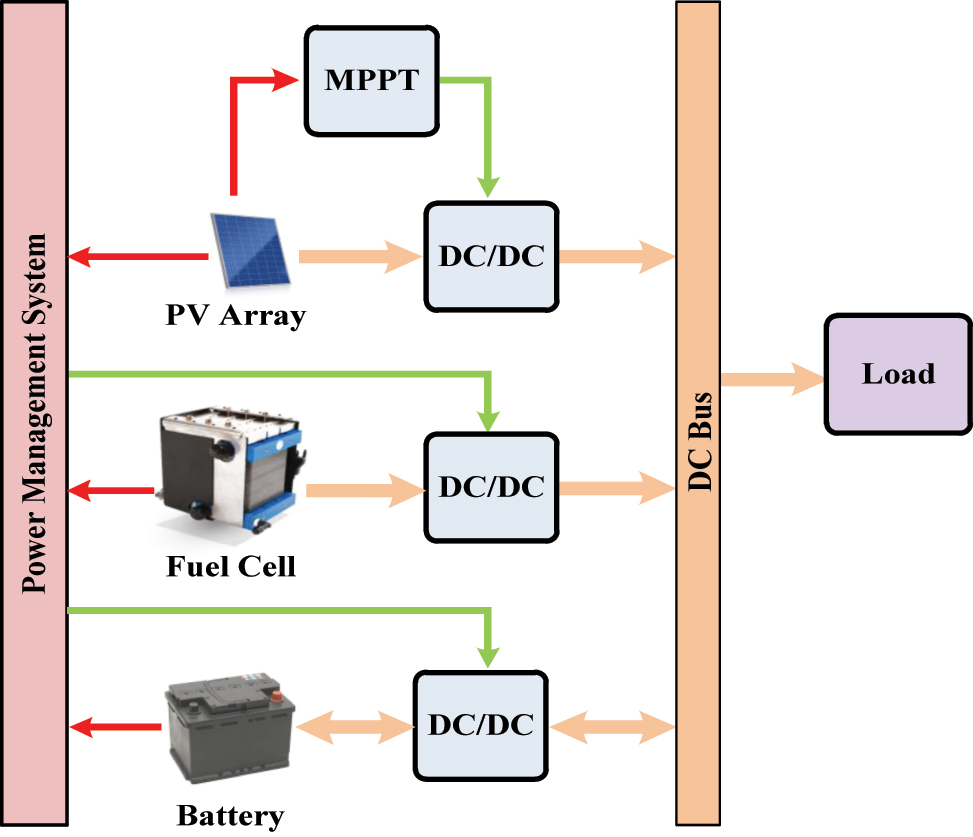
Block diagram of the DC microgrid.
3 Control strategy
The control strategy for the examined DC microgrid is shown in Figure 2. Different sources are involved in the power generation of this islanded microgrid. As renewable energy sources are used for powering the microgrid, variations in the sources will be present. Regardless of the changes in the sources, an effective control strategy should ensure power balance and system stability. Photovoltaic (PV) generation is taken as the primary source. The PV generation system is integrated into the grid with a DC-DC boost converter (Hsieh et al. 2013; Zubieta and Lehn 2015). The switching pulse is generated using MPPT techniques to extract the maximum power from the solar photovoltaic array. It is preferred to operate the photovoltaic system using the incremental conductance algorithm (INC) driven MPPT (Kjær 2012). To find the best operating point, INC compares its instantaneous power and incremental conductance to variations in the operating point (Batiyah et al. 2018; Mishra et al. 2022). The INC-based MPPT technique is faster and capable of effectively tracking the maximum power point in response to environmental variations over the other commonly used MPPT methods (Kumar, Srivastava, and Singh 2015). The battery source is integrated into the grid through a bidirectional converter. With a bidirectional converter, the power flows in both directions based on whether the battery is charged or discharged, depending on the operating circumstances. Bidirectional converters are integral due to their protective features and stability in power flow. A Proportional Integral (PI) controller is involved in controlling the bidirectional converter (Vivas, Segura, and Andujar 2022). The controllers are meant to reduce the error between the set point and the actual value. The PI controller should be finely tuned for proper operation. Fine-tuning means determining the best suitable values for the proportional constant (k p ) and integral constant (k i ). The battery operates in the charging as well as the discharging mode according to the availability of power in the grid. To generate the switching pulses, output current values of the PV, FC, and load are compared with the battery output and fed to the PI controller (Li et al. 2019). According to the k p and k i values, the duty cycle is generated and fed to the PWM generator for the switching pulse. The bidirectional converter has two switches where the second switch uses a complementary of the signal generated. Because of the versatile features, the Fuel cell (FC) generators are considered a preferable energy source in this proposed system. The fuel cell-based generation is environmentally friendly because of its low noise operation, absence of combustion-based procedure, reduced emissions, and scalability (Prabhakaran and Agarwal 2020; Ray and Dash 2022). The fuel cell is connected to the DC bus via a DC-DC boost converter. The PI control generates the switching pulses for the boost converter. The reference voltage and load voltage values are compared and fed to the PI controller, and the suitable proportional and integral constants are selected (Yousif et al. 2020). This study uses a conventional PI controller, a PSO-tuned PI-based controller, and a Harris Hawks Optimization (HHO) based controller (Heidari et al. 2019; Mohan et al. 2022). The power balance comparison is considered, and the optimum results of the PSO and HHO algorithms are applied as proportional and integral constant values.
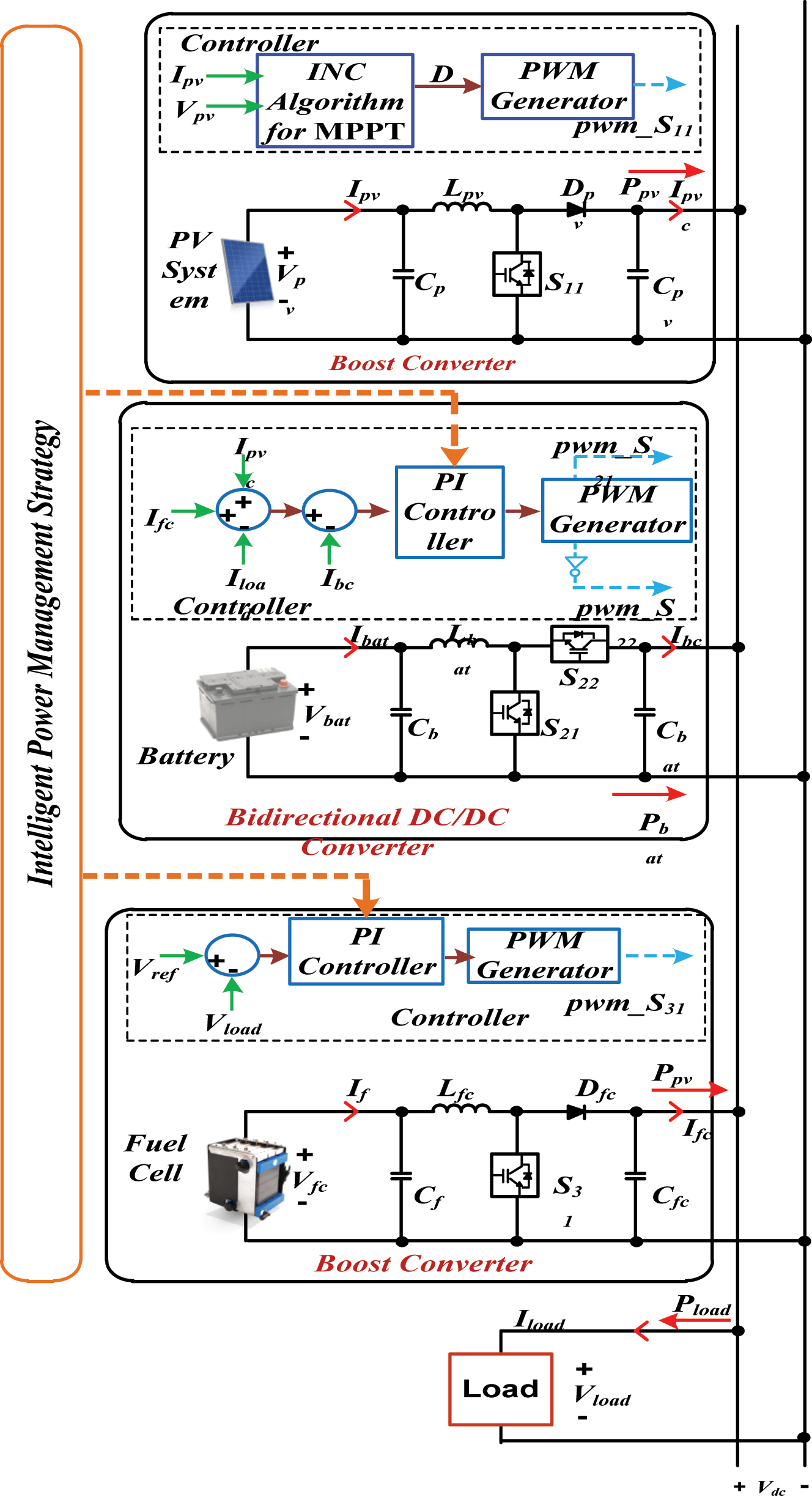
DC islanded microgrid circuit system and control.
3.1 Energy management using PSO
The PSO is a population-based stochastic search metaheuristic algorithm inspired by birds’ moving behaviour in a crowd. The optimal solution is found in the PSO by updating the generations. In this, the population of the particles (candidate solutions) whose movement is influenced by the local best-known position in search space. The search space represents the range in which the algorithm computes the optimal control value. If a value is found out of the search space limits, that value is reinitialized. The best search strategy in this algorithm is following the bird nearest to the food. The objective of an optimization algorithm is to find the optimum point where the best and most favourable value is. The steps are followed
Step 1-Initialization of parameters and population.
Step 2-Compute the Fitness value for each particle and choose the best value (global best).
Step 3-Update the velocity and position of each particle.
Step 4-Compute the current best fitness value and update until gbest is obtained.
3.2 Microgrid energy management with HHO
In 2019, Ali et al. proposed the HHO algorithm, a nature-inspired metaheuristic algorithm that mimics the cooperative foraging technique of Harris Hawks. The algorithm considers rabbits as prey and comprises two phases: exploration and exploitation. The input parameters for the algorithm include population size, while the output consists of the target location and corresponding fitness values. The HHO algorithm provides a novel approach to solving optimization problems and draws inspiration from the natural world to improve computational efficiency.
3.2.1 Exploration phase
This phase is known as the searching phase. Here the attacker is the Harris Hawks and the prey or the target is the rabbit. The attackers will be hunting in groups. The Harris Hawks will trace the prey. If the prey s not found, they will wait and monitor the location. Here the candidate solution is the Harris Hawks and the best candidate is the prey/Rabbit. For detecting the prey, the Harris hawks are taking into account two conditions. The first condition is checking the neighbourhood family members’ positions and the target position. A mathematical model is used in updating the position of the Harris Hawks. A randomised scaling coefficient is considered for the component to provide more diversification patterns to examine other sections of the subspace. The Harris Hawks hunt randomly based on the equal chance ‘p’, which are target positions and positions of family members. The eq. (1) updates the position where randomly selected hawks [H rand] from the current population, Hawks’ current position [H (t)], Target position [H target], the average position of the Harris Hawks population [H m ], the current iteration value (t) is considered for estimating the position vector and random numbers (r 1, r 2, r 3, r 4).
The average position of the current population (H
m
) is calculated using Eq. (2). Where N is the total population size and
3.2.2 Exploitation phase
This phase deals with the exploitation of the rabbit. The hawks can quickly attack the prey when rabbit energy is low. The rabbit’s energy decreases while trying to escape from the Hawk. To compute the energy level of the prey during the escape, use Eq. (3). The escaping energy level is calculated by taking the initial energy of the prey during the interval (−1, 1) and the number of iterations is taken into consideration. A decreasing initial energy state from 0 to −1 indicates that the rabbit is tired, while an increasing value from 0 to one suggests that the rabbit is becoming stronger. Eq. (3) E 0 is the initial energy state inside the interval (−1, 1), t represents the current iteration and MaxT is the maximum number of iterations. The rabbit’s position is updated in the search space by comparing the energy levels with the fitness values.
The escaping energy of prey,
In the exploitation phase, the energy level is checked if Energy is ≥ 1, then the rabbit’s energy level is high and can escape quickly and the Hawks have to search in different regions. Moreover, if the energy is ≤ 1, the rabbit is tired and has no energy to escape. The exploitation step is where the Hawk attacks the rabbits. Upon detecting prey, Harris Hawks can launch a sudden and unexpected attack. The rabbits will always try to escape from the attack. The attack by the Harris Hawks on the rabbit is represented by four strategizes in this algorithm. The Harris Hawks attack on the rabbits is given in four cases, where rg is the escaping chance.
Case 1:
Soft roundup (E g ≥ 0.5 and r g ≥ 0.5).
In this case, the rabbit possesses sufficient energy to evade the attack; the Harris Hawks employ a strategy of encircling the prey with varying degrees of intensity, depending on the prey’s energy level, to ultimately exhaust it and perform a surprise attack. The updated positions of the hawks during these manoeuvres are mathematically represented in Eq. (4), where ΔH represents the vector indicating the difference between the prey’s current position and its position vector. J denotes the random jump strength of the prey. These findings provide insights into predator–prey dynamics and highlight the adaptive strategies employed by both rabbits and Harris Hawks in their natural habitat.
Case 2:
Hard roundup (E g < 0.5 and r g ≥ 0.5).
In this scenario, where the rabbit’s energy level is low and cannot escape, Harris Hawks employ a strategy of launching a sudden and forceful attack, which is represented mathematically in Eq. (5).
Case 3:
Soft roundup with progressive rapid dives (E g ≥ 0.5 and r g ≤ 0.5).
In this instance, the rabbit has enough energy to escape that the Harris hawks can encircle and exhaust the prey before striking. Eq. (6) provides a mathematical representation of this behaviour. The algorithm makes use of optimum searching tactics, the levy flight (LF) principle which is to be calculated.
where,
Case 4:
Hard roundup with progressive rapid dives. (E g < 0.5 and r g < 0.5).
In this case, the energy level is low, so a sudden attack will be performed on the prey, represented mathematically as in Eq. (7).
Case 3 and Case 4 represent the most intelligent behaviour of the Harris Hawks when they are searching and attacking.
The Harris Hawks Optimization (HHO) pseudo-code is given below, and Figure 3. Represents the algorithm’s flowchart.

The flow chart of the HHO algorithm.
4 Result analysis
The MATLAB Simulink platform was utilized to develop and implement a PI-based energy management strategy for the island DC microgrid. The simulation considers two instances in which the generation output is varied. The results were analysed by comparing the outcomes with PSO-based EMS, and the system’s effectiveness was evaluated. In the first case, the fluctuation in solar irradiance at constant temperature is simulated. In the second mode of operation, the variation in the SoC of the battery storage system under continuous PV generation is considered. PSO and HHO-based EMS are used to evaluate the system performance in both scenarios. The MATLAB codes for generating the kp and ki values using the PSO and the HHO algorithm are generated and executed. Table 1. displays the design parameters used for the boost converters of solar PV systems and FC systems and the bi-directional converter parameters. A benchmark model is prepared for the simulation, where the performance is evaluated using the conventional PI controller, PSO-tuned PI and HHO-tuned PI. The results shown in Figures 4 –8. Represent the performance of the DC microgrid with PV, FC and Battery as sources in two operating scenarios when the k p & k i constant values are being determined by the optimal solutions of the HHO algorithm.
Simulation parameters of the proposed DC Microgrid.
| Component | Parameters | Value |
|---|---|---|
| Solar PV system | Temperature | 25 °C |
| Irradiance | 1000 | |
| Power | 1000 W | |
| DC DC boost input Capacitor | 0.24 µF | |
| DC DC boost input inductance | 0.6 mH | |
| Fuel cell boost converter | Input resistance | 1.31 Ω |
| Input capacitor | 0.14 µF | |
| Output capacitor | 0.8 µF | |
| Input inductance | 1.8 mH | |
| Inductance | 1.2 mH | |
| Bidirectional converter | Input capacitor | 1.01 µF |
| Capacity | 48 Ah | |
| Li ion battery | Terminal voltage | 250 V |
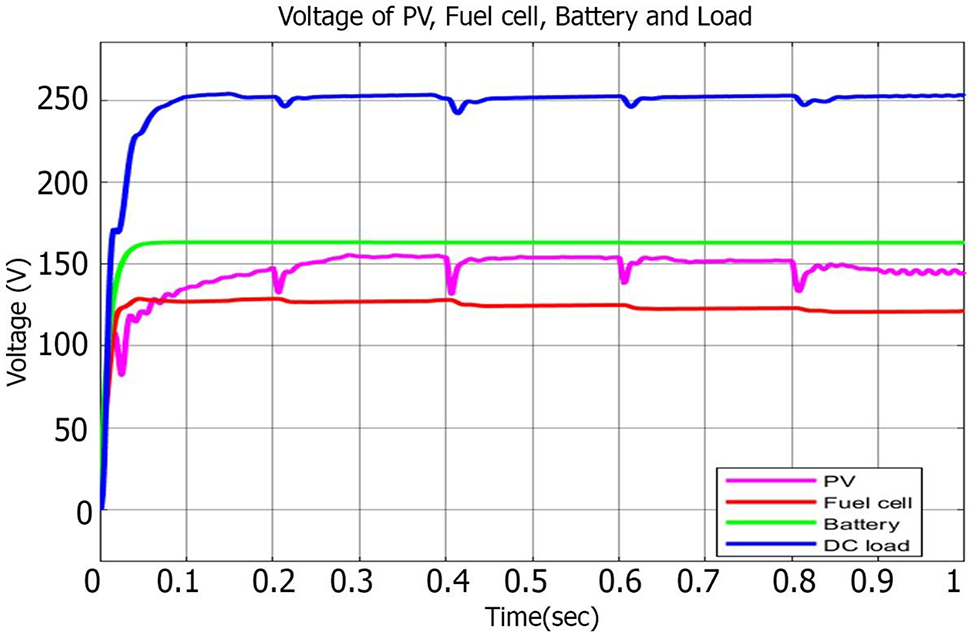
The Voltage of PV, FC, Battery during the variation of solar irradiance.
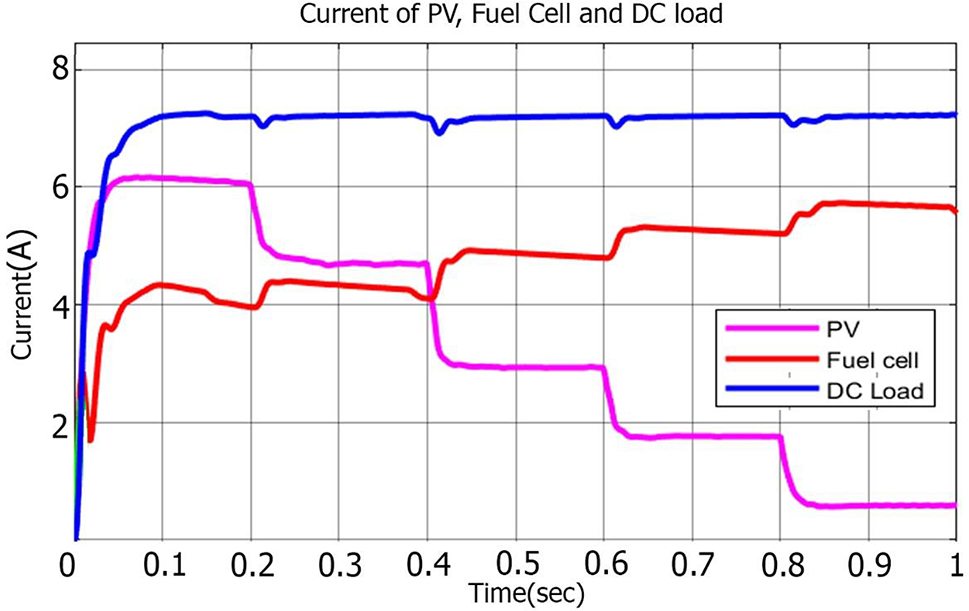
The variation in the current values of the PV, FC and the load bus during solar irradiance variation.
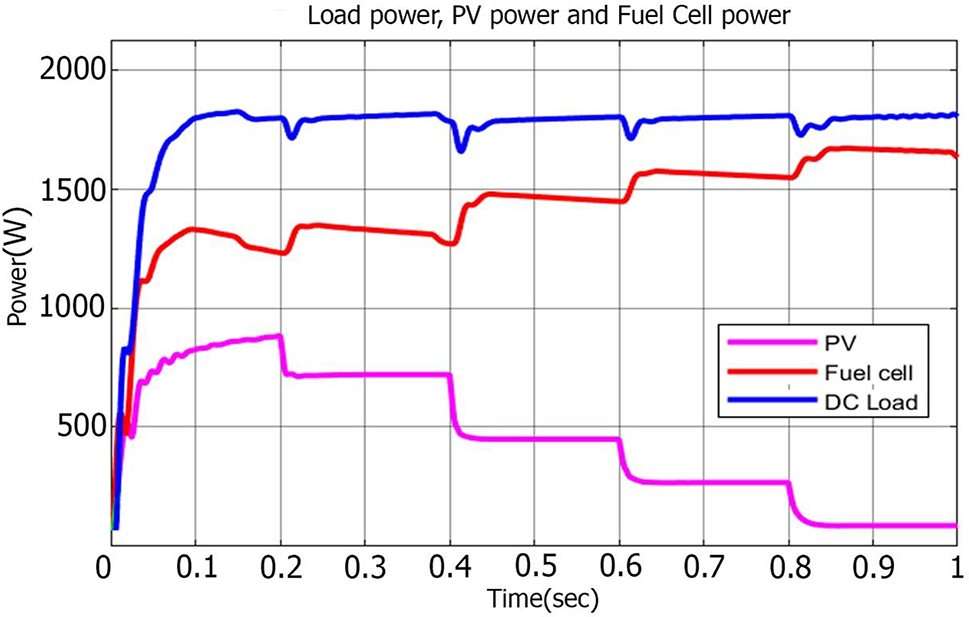
The Power of DC bus, PV and FC during the solar irradiance variation.
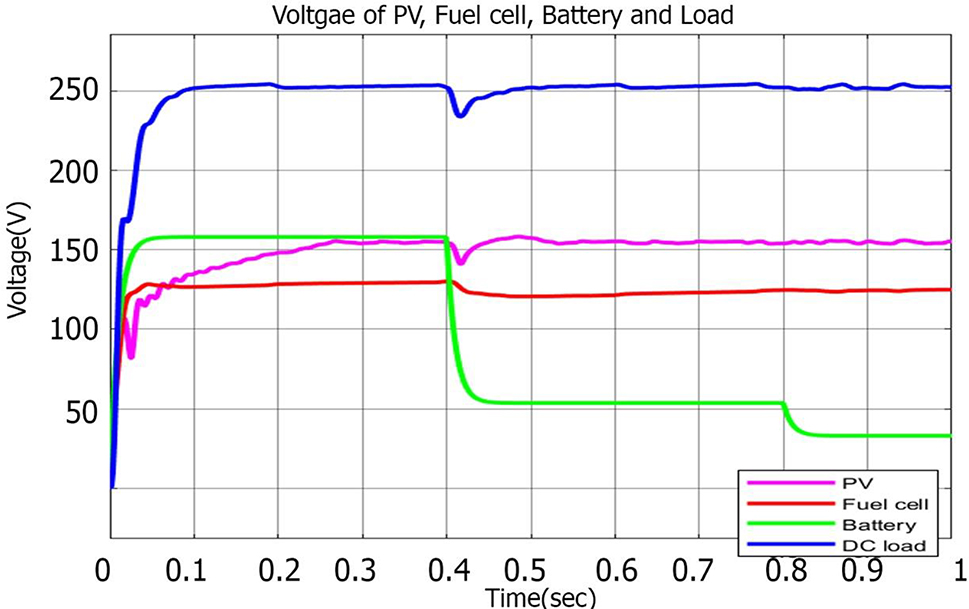
The voltage of PV, FC and battery during the variation of the battery SoC.
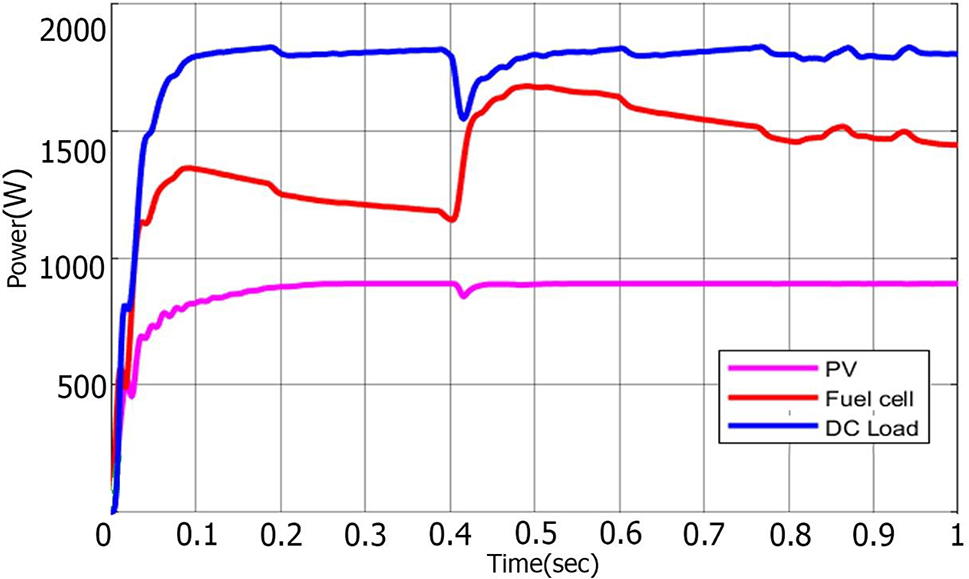
The Power of DC bus, PV and FC during the variation of the battery SoC.
Case 1:
Energy management with irradiance variation.
In this case, the solar irradiance values are varied by keeping the PV temperature constant at 25 °C. The irradiance values are varied at an interval of 0.2 s. Figure 4 shows the variation of the output voltage generated by PV, FC, Battery, and the DC load during the solar irradiance variation. The voltage value remains to be regulated at the rated values. The microgrid system is designed to operate at a DC Bus Voltage of 250 V. The voltage drops at an interval of 0.2 s are due to the switching of sources. Figure 5. Shows the variation of the output current values of the PV, Battery, FC, and dc load. In Figure 5. the solar irradiance value drops at t = 0.2 at this instant, and the fuel cell current increases to compensate for the output current value that is to be maintained at a constant value. At t = 0.4, when the irradiance value is again dropped by 200 W/m2, a decline in the output current value of the PV and the fuel cell current can be found increasing to maintain the required value of the current. At t = 0.6 and t = 0.8, the irradiance values are again dropped, and a corresponding increase in the current values for compensating the drop can be noted. Figure 6. The output power rating of the power components and the load is shown. The energy management system maintains the output power at a constant value rated at 1800 W, irrespective of the variations in the energy source.
Case 2:
The energy management with battery SoC change.
In this mode of operation, the solar PV is kept at constant irradiance and battery SoC is varied. Figure 7. Shows the voltage variations when the battery SoC is changed. The voltage of the battery drops at time t = 0.4, but the load voltage remains the same as the voltage is being regulated. In Figure 8, the power variations are analyzed; the overall load power shows some transient at the time t = 0.4 as the voltage drop occurs but still continues to be balanced and maintain the required power. The battery SoC is again dropped at the time period t = 0.8 to t = 1. The voltage value is also regulated during this variation, as in Figure 7. The power is maintained at the rated value as the fuel cell supplies the required deficit power. The power is maintained at 1800 W during the variations in the battery SoC Figure 9. Shows the current, voltage and power response comparison of the proposed system using the PSO and the HHO-tuned PI controllers. The proposed energy management system uses PSO and HHO based optimization algorithms to evaluate the optimal operation values. In Figure 9, it is evident that the HHO-based optimal solutions produce the required output in the islanded DC mode. The operating time using the HHO algorithm is less than that of PSO. The response of the proposed system with the HHO algorithm shows better steady-state performance, and the drop are less compared to the PSO-based EMS during the transition from one source to another. The efficiency of the system is also increased when compared to the PSO based energy management scheme.
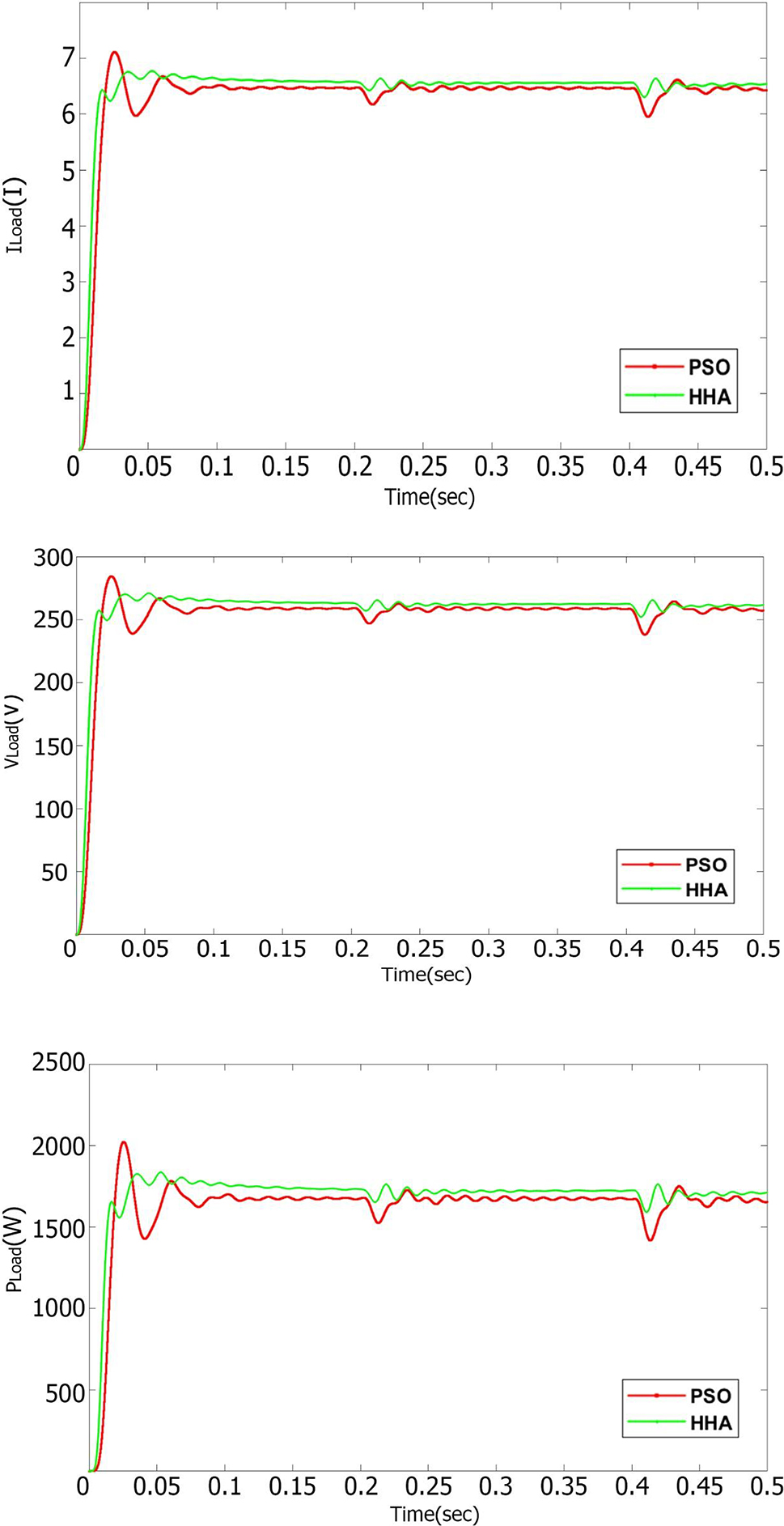
The response of the (a) current, (b) voltage, and (c) power of the load using the HHO and PSO algorithms.
5 Conclusions
This study proposes an islanded DC microgrid power flow management using Harris Hawks Optimization. The microgrid architecture consists of a PV system, Battery storage system, and a Fuel cell system as sources. The main challenge during the microgrid operation is to maintain stability during unexpected variations and the PI controllers effectively control the microgrid system’s performance. The intelligent PI-based energy management system presented by the authors in this paper operates effectively by choosing the optimal solution during the dynamic operation. The designed islanded microgrid system is implemented and simulated using the MATLAB Simulink environment. The operating parameters like solar irradiance variation and the battery SoC variastions are considered for testing the efficiency of the EMS. The results are analyzed and verified by comparing them with the PSO-based energy management approach.
Further evaluating the results, it can be found that the response obtained from the HHO-tuned PI controller is superior to that of the PSO-tuned PI controller. The power flow is maintained at the rated value with lower voltage drops and transients. The HHO-based EMS outperforms the PSO regarding convergence speed and will reduce operational costs. The HHO-based EMS is a promising approach for effective power management of an islanded DC microgrid.
About the authors

Mr. Harin M. Mohan is presently pursuing Ph.D. in the area of Microgrid control and operations. The area of interest includes Power Electronics, Electric Vehicle charging, Automation, and the Internet of Things. Strong education professional with a Master of Technology (M.Tech.) focused in Power Electronics from AMRITA VISHWA VIDYAPEETHAM and UG in Electrical and Electronics from University of Kerala.

Dr. Santanu Kumar Dash has received PhD in Electrical Engineering from Department of Electrical Engineering, National Institute of Technology Rourkela in 2019. His research area includes power quality, grid connected systems, renewable energy, sustainable transportation and AC/DC Microgrid. He has published many research papers (20 SCI) in International Journals and International conferences. He is presently reviewer for IEEE Journals; IJEPES Elsevier; International Transactions on Electrical Energy Systems Wiley; International Journal of Electric Power Components and Systems, Taylor & Francis. Presently he is working as Senior Assistant Professor in TIFAC-CORE Research Center, Vellore Institute of Technology, Vellore, India.
-
Author contributions: All the authors have contributed equally.
-
Research funding: None.
-
Conflict of interest statement: The Authors declare no conflicts of interest.
References
Arefifar, S. A., M. Ordonez, and Y. A. R. I. Mohamed. 2017. “Energy Management in Multi-Microgrid Systems—Development and Assessment.” IEEE Transactions on Power Systems 32: 910–22. https://doi.org/10.1109/tpwrs.2016.2568858.Suche in Google Scholar
Batiyah, S., N. Zohrabi, S. Abdelwahed, and R. Sharma. 2018. “An MPC-Based Power Management of a PV/Battery System in an Islanded DC Microgrid.” In 2018 IEEE Transportation Electrification Conference and Expo (ITEC), 231–6. Long Beach.10.1109/ITEC.2018.8450155Suche in Google Scholar
Bihari, S. P., P. K. Sadhu, K. Sarita, B. Khan, L. D. Arya, R. K. Saket, and D. P. Kothari. 2021. “A Comprehensive Review of the Microgrid Control Mechanism and Impact Assessment for Hybrid Renewable Energy Integration.” IEEE Access 9: 88942–58. https://doi.org/10.1109/access.2021.3090266.Suche in Google Scholar
EI-Bidairi, K. S., H. Duc Nguyen, S. D. G. Jayasinghe, and T. S. Mahmoud. 2018. “Multiobjective Intelligent Energy Management Optimization for Grid-Connected Microgrids.” In 2018 IEEE International Conference on Environment and Electrical Engineering and 2018 IEEE Industrial and Commercial Power Systems Europe (EEEIC/I&CPS Europe). Palermo.10.1109/EEEIC.2018.8493751Suche in Google Scholar
Heidari, A. A., S. Mirjalili, H. Faris, I. Aljarah, M. Mafarja, and H. Chen. 2019. “Harris Hawks Optimization: Algorithm and Applications.” Future Generation Computer Systems 97: 849–72. https://doi.org/10.1016/j.future.2019.02.028.Suche in Google Scholar
Hofer, J., B. Svetozarevic, and A. Schlueter. 2017. “Hybrid AC/DC Building Microgrid for Solar PV and Battery Storage Integration.” In 2017 IEEE Second International Conference on DC Microgrids (ICDCM), 188–91. IEEE.10.1109/ICDCM.2017.8001042Suche in Google Scholar
Hossain, E., E. Kabalci, R. Bayindir, and R. Perez. 2014. “Microgrid Testbeds Around the World: State of Art.” Energy Conversion and Management 86: 132–53. https://doi.org/10.1016/j.enconman.2014.05.012.Suche in Google Scholar
Hsieh, G. C., H. I. Hsieh, C. Y. Tsai, and C. H. Wang. 2013. “Photovoltaic Power-Increment-Aided Incremental-Conductance MPPT with Two-Phased Tracking.” IEEE Transactions on Power Electronics 28 (6): 2895–911. https://doi.org/10.1109/tpel.2012.2227279.Suche in Google Scholar
Igualada, L., C. Corchero, M. Cruz-Zambrano, and F. Heredia. 2014. “Optimal Energy Management for a Residential Microgrid Including a Vehicle-To-Grid System.” IEEE Transactions on Smart Grid 5: 2163–72. https://doi.org/10.1109/tsg.2014.2318836.Suche in Google Scholar
Jin, C., P. Wang, J. Xiao, Y. Tang, and F. H. Choo. 2014. “Implementation of Hierarchical Control in DC Microgrids.” IEEE Transactions on Industrial Electronics 61 (8): 4032–42. https://doi.org/10.1109/TIE.2013.2286563.Suche in Google Scholar
Kjær, S. B. 2012. “Evaluation of the “Hill Climbing” and the “Incremental Conductance” Maximum Power Point Trackers for Photovoltaic Power Systems.” IEEE Transactions on Energy Conversion 27 (4): 922–9. https://doi.org/10.1109/tec.2012.2218816.Suche in Google Scholar
Kumar, M., S. C. Srivastava, and S. N. Singh. 2015. “Control Strategies of a DC Microgrid for Grid Connected and Islanded Operations.” IEEE Transactions on Smart Grid 6 (4): 1588–601. https://doi.org/10.1109/tsg.2015.2394490.Suche in Google Scholar
Kumar Dash, S., P. Garg, S. Mishra, S. Chakraborty, and D. Elangovan. 2022. “Investigation of Adaptive Intelligent MPPT Algorithm for a Low-Cost IoT Enabled Standalone PV System.” Australian Journal of Electrical and Electronics Engineering 19 (3): 261–9. https://doi.org/10.1080/1448837x.2021.2023251.Suche in Google Scholar
Kumar Tiwari, S., B. Singh, and P. K. Goel. 2018. “Design and Control of Microgrid Fed by Renewable Energy Generating Sources.” IEEE Transactions on Industry Applications 54 (3): 2041–50. https://doi.org/10.1109/tia.2018.2793213.Suche in Google Scholar
Li, Z., Z. Zheng, L. Xu, and X. Lu. 2019. “A Review of the Applications of Fuel Cells in Microgrids: Opportunities and Challenges.” BMC Energy 1 (8), https://doi.org/10.1186/s42500-019-0008-3.Suche in Google Scholar
Manandhar, U., A. Ukil, H. B. Gooi, N. R. Tummuru, S. K. Kollimalla, B. Wang, and K. Chaudhari. 2019. “Energy Management and Control for Grid Connected Hybrid Energy Storage System under Different Operating Modes.” IEEE Transactions on Smart Grid 10 (2): 1626–36. https://doi.org/10.1109/tsg.2017.2773643.Suche in Google Scholar
Merritt, N. R., C. Chakraborty, P. Bajpai, and B. C. Pal. 2020. “A Unified Control Structure for Grid Connected and Islanded Mode of Operation of Voltage Source Converter Based Distributed Generation Units under Unbalanced and Non-linear Conditions.” IEEE Transactions on Power Delivery 35 (4): 1758–68. https://doi.org/10.1109/tpwrd.2019.2952692.Suche in Google Scholar
Mishra, S., S. Rajashekaran, P. K. Mohan, S. M. Lokesh, H. J. Ganiga, S. K. Dash, and M. Roccotelli. 2022. “Implementation of an ADALINE-Based Adaptive Control Strategy for an LCLC-PV-DSTATCOM in Distribution System for Power Quality Improvement.” Energies 16 (1): 323. https://doi.org/10.3390/en16010323.Suche in Google Scholar
Mohan, H. M., S. K. Dash, S. K. Ram, and W. Caesarendra. 2022. “Performance Assessment of Three-phase PV Tied NPC Multilevel Inverter Based UPQC.” In 2022 International Conference on Intelligent Controller and Computing for Smart Power (ICICCSP), 1–5.10.1109/ICICCSP53532.2022.9862340Suche in Google Scholar
Prabhakaran, P., and V. Agarwal. 2020. “Novel Four-Port DC–DC Converter for Interfacing Solar PV–Fuel Cell Hybrid Sources with Low-Voltage Bipolar DC Microgrids.” IEEE Journal of Emerging and Selected Topics in Power Electronics 8 (2): 1330–40. https://doi.org/10.1109/jestpe.2018.2885613.Suche in Google Scholar
Priyanka, G., and S. K. Dash. 2020. “A Detailed Review on Intelligent Maximum Power Point Tracking Algorithms.” In 2020 2nd International Conference on Innovative Mechanisms for Industry Applications (ICIMIA), 47–53.10.1109/ICIMIA48430.2020.9074861Suche in Google Scholar
Ray, P. K., and S. K. Dash. 2022. “Power Quality Enhancement and Power Flow Analysis of a PV Integrated UPQC System in a Distribution Network.” IEEE Transactions on Industry Applications 58 (1): 201–11, https://doi.org/10.1109/tia.2021.3131404.Suche in Google Scholar
Rodriguez-Diaz, E., E. J. Palacios-Garcia, A. Anvari-Moghaddam, J. C. Vasquez, and J. M. Guerrero. 2017. “Real-time Energy Management System for a Hybrid AC/DC Residential Microgrid.” In 2017 IEEE Second International Conference on DC Microgrids (ICDCM), 256–61.10.1109/ICDCM.2017.8001053Suche in Google Scholar
Vivas, F. J., F. Segura, and J. Andujar. 2022. “Fuzzy Logic-Based Energy Management System for Grid-Connected Residential DC Microgrids with Multi-Stack Fuel Cell Systems: A Multi-Objective Approach.” Sustainable Energy Grids and Networks 32 (100909): 100909. https://doi.org/10.1016/j.segan.2022.100909.Suche in Google Scholar
Vujanoviá, M., Q. Wang, M. Mohsen, N. Duiá, and J. Yan. 2021. “Recent Progress in Sustainable Energy-Efficient Technologies and Environmental Impacts on Energy Systems.” Applied Energy 283: 116280, https://doi.org/10.1016/j.apenergy.2020.116280.Suche in Google Scholar
Yousif, M., Q. Ai, Y. Gao, W. A. Wattoo, Z. Jiang, and R. Hao. 2020. “An Optimal Dispatch Strategy for Distributed Microgrids Using PSO.” CSEE Journal of Power and Energy Systems 6 (3): 724–34.10.17775/CSEEJPES.2018.01070Suche in Google Scholar
Zubieta, L. E., and P. W. Lehn. 2015. “A High Efficiency Unidirectional DC/DC Converter for Integrating Distributed Resources into DC Microgrids.” In 2015 IEEE First International Conference on DC Microgrids (ICDCM), 280–4: IEEE.10.1109/ICDCM.2015.7152054Suche in Google Scholar
© 2024 the author(s), published by De Gruyter, Berlin/Boston
This work is licensed under the Creative Commons Attribution 4.0 International License.
Artikel in diesem Heft
- Solar photovoltaic-integrated energy storage system with a power electronic interface for operating a brushless DC drive-coupled agricultural load
- Analysis of 1-year energy data of a 5 kW and a 122 kW rooftop photovoltaic installation in Dhaka
- Reviews
- Real yields and PVSYST simulations: comparative analysis based on four photovoltaic installations at Ibn Tofail University
- A comprehensive approach of evolving electric vehicles (EVs) to attribute “green self-generation” – a review
- Exploring the piezoelectric porous polymers for energy harvesting: a review
- A strategic review: the role of commercially available tools for planning, modelling, optimization, and performance measurement of photovoltaic systems
- Comparative assessment of high gain boost converters for renewable energy sources and electrical vehicle applications
- A review of green hydrogen production based on solar energy; techniques and methods
- A review of green hydrogen production by renewable resources
- A review of hydrogen production from bio-energy, technologies and assessments
- A systematic review of recent developments in IoT-based demand side management for PV power generation
- Research Articles
- Hybrid optimization strategy for water cooling system: enhancement of photovoltaic panels performance
- Solar energy harvesting-based built-in backpack charger
- A power source for E-devices based on green energy
- Theoretical and experimental investigation of electricity generation through footstep tiles
- Experimental investigations on heat transfer enhancement in a double pipe heat exchanger using hybrid nanofluids
- Comparative energy and exergy analysis of a CPV/T system based on linear Fresnel reflectors
- Investigating the effect of green composite back sheet materials on solar panel output voltage harvesting for better sustainable energy performance
- Electrical and thermal modeling of battery cell grouping for analyzing battery pack efficiency and temperature
- Intelligent techno-economical optimization with demand side management in microgrid using improved sandpiper optimization algorithm
- Investigation of KAPTON–PDMS triboelectric nanogenerator considering the edge-effect capacitor
- Design of a novel hybrid soft computing model for passive components selection in multiple load Zeta converter topologies of solar PV energy system
- A novel mechatronic absorber of vibration energy in the chimney
- An IoT-based intelligent smart energy monitoring system for solar PV power generation
- Large-scale green hydrogen production using alkaline water electrolysis based on seasonal solar radiation
- Evaluation of performances in DI Diesel engine with different split injection timings
- Optimized power flow management based on Harris Hawks optimization for an islanded DC microgrid
- Experimental investigation of heat transfer characteristics for a shell and tube heat exchanger
- Fuzzy induced controller for optimal power quality improvement with PVA connected UPQC
- Impact of using a predictive neural network of multi-term zenith angle function on energy management of solar-harvesting sensor nodes
- An analytical study of wireless power transmission system with metamaterials
- Hydrogen energy horizon: balancing opportunities and challenges
- Development of renewable energy-based power system for the irrigation support: case studies
- Maximum power point tracking techniques using improved incremental conductance and particle swarm optimizer for solar power generation systems
- Experimental and numerical study on energy harvesting performance thermoelectric generator applied to a screw compressor
- Study on the effectiveness of a solar cell with a holographic concentrator
- Non-transient optimum design of nonlinear electromagnetic vibration-based energy harvester using homotopy perturbation method
- Industrial gas turbine performance prediction and improvement – a case study
- An electric-field high energy harvester from medium or high voltage power line with parallel line
- FPGA based telecommand system for balloon-borne scientific payloads
- Improved design of advanced controller for a step up converter used in photovoltaic system
- Techno-economic assessment of battery storage with photovoltaics for maximum self-consumption
- Analysis of 1-year energy data of a 5 kW and a 122 kW rooftop photovoltaic installation in Dhaka
- Shading impact on the electricity generated by a photovoltaic installation using “Solar Shadow-Mask”
- Investigations on the performance of bottle blade overshot water wheel in very low head resources for pico hydropower
- Solar photovoltaic-integrated energy storage system with a power electronic interface for operating a brushless DC drive-coupled agricultural load
- Numerical investigation of smart material-based structures for vibration energy-harvesting applications
- A system-level study of indoor light energy harvesting integrating commercially available power management circuitry
- Enhancing the wireless power transfer system performance and output voltage of electric scooters
- Harvesting energy from a soldier's gait using the piezoelectric effect
- Study of technical means for heat generation, its application, flow control, and conversion of other types of energy into thermal energy
- Theoretical analysis of piezoceramic ultrasonic energy harvester applicable in biomedical implanted devices
- Corrigendum
- Corrigendum to: A numerical investigation of optimum angles for solar energy receivers in the eastern part of Algeria
- Special Issue: Recent Trends in Renewable Energy Conversion and Storage Materials for Hybrid Transportation Systems
- Typical fault prediction method for wind turbines based on an improved stacked autoencoder network
- Power data integrity verification method based on chameleon authentication tree algorithm and missing tendency value
- Fault diagnosis of automobile drive based on a novel deep neural network
- Research on the development and intelligent application of power environmental protection platform based on big data
- Diffusion induced thermal effect and stress in layered Li(Ni0.6Mn0.2Co0.2)O2 cathode materials for button lithium-ion battery electrode plates
- Improving power plant technology to increase energy efficiency of autonomous consumers using geothermal sources
- Energy-saving analysis of desalination equipment based on a machine-learning sequence modeling
Artikel in diesem Heft
- Solar photovoltaic-integrated energy storage system with a power electronic interface for operating a brushless DC drive-coupled agricultural load
- Analysis of 1-year energy data of a 5 kW and a 122 kW rooftop photovoltaic installation in Dhaka
- Reviews
- Real yields and PVSYST simulations: comparative analysis based on four photovoltaic installations at Ibn Tofail University
- A comprehensive approach of evolving electric vehicles (EVs) to attribute “green self-generation” – a review
- Exploring the piezoelectric porous polymers for energy harvesting: a review
- A strategic review: the role of commercially available tools for planning, modelling, optimization, and performance measurement of photovoltaic systems
- Comparative assessment of high gain boost converters for renewable energy sources and electrical vehicle applications
- A review of green hydrogen production based on solar energy; techniques and methods
- A review of green hydrogen production by renewable resources
- A review of hydrogen production from bio-energy, technologies and assessments
- A systematic review of recent developments in IoT-based demand side management for PV power generation
- Research Articles
- Hybrid optimization strategy for water cooling system: enhancement of photovoltaic panels performance
- Solar energy harvesting-based built-in backpack charger
- A power source for E-devices based on green energy
- Theoretical and experimental investigation of electricity generation through footstep tiles
- Experimental investigations on heat transfer enhancement in a double pipe heat exchanger using hybrid nanofluids
- Comparative energy and exergy analysis of a CPV/T system based on linear Fresnel reflectors
- Investigating the effect of green composite back sheet materials on solar panel output voltage harvesting for better sustainable energy performance
- Electrical and thermal modeling of battery cell grouping for analyzing battery pack efficiency and temperature
- Intelligent techno-economical optimization with demand side management in microgrid using improved sandpiper optimization algorithm
- Investigation of KAPTON–PDMS triboelectric nanogenerator considering the edge-effect capacitor
- Design of a novel hybrid soft computing model for passive components selection in multiple load Zeta converter topologies of solar PV energy system
- A novel mechatronic absorber of vibration energy in the chimney
- An IoT-based intelligent smart energy monitoring system for solar PV power generation
- Large-scale green hydrogen production using alkaline water electrolysis based on seasonal solar radiation
- Evaluation of performances in DI Diesel engine with different split injection timings
- Optimized power flow management based on Harris Hawks optimization for an islanded DC microgrid
- Experimental investigation of heat transfer characteristics for a shell and tube heat exchanger
- Fuzzy induced controller for optimal power quality improvement with PVA connected UPQC
- Impact of using a predictive neural network of multi-term zenith angle function on energy management of solar-harvesting sensor nodes
- An analytical study of wireless power transmission system with metamaterials
- Hydrogen energy horizon: balancing opportunities and challenges
- Development of renewable energy-based power system for the irrigation support: case studies
- Maximum power point tracking techniques using improved incremental conductance and particle swarm optimizer for solar power generation systems
- Experimental and numerical study on energy harvesting performance thermoelectric generator applied to a screw compressor
- Study on the effectiveness of a solar cell with a holographic concentrator
- Non-transient optimum design of nonlinear electromagnetic vibration-based energy harvester using homotopy perturbation method
- Industrial gas turbine performance prediction and improvement – a case study
- An electric-field high energy harvester from medium or high voltage power line with parallel line
- FPGA based telecommand system for balloon-borne scientific payloads
- Improved design of advanced controller for a step up converter used in photovoltaic system
- Techno-economic assessment of battery storage with photovoltaics for maximum self-consumption
- Analysis of 1-year energy data of a 5 kW and a 122 kW rooftop photovoltaic installation in Dhaka
- Shading impact on the electricity generated by a photovoltaic installation using “Solar Shadow-Mask”
- Investigations on the performance of bottle blade overshot water wheel in very low head resources for pico hydropower
- Solar photovoltaic-integrated energy storage system with a power electronic interface for operating a brushless DC drive-coupled agricultural load
- Numerical investigation of smart material-based structures for vibration energy-harvesting applications
- A system-level study of indoor light energy harvesting integrating commercially available power management circuitry
- Enhancing the wireless power transfer system performance and output voltage of electric scooters
- Harvesting energy from a soldier's gait using the piezoelectric effect
- Study of technical means for heat generation, its application, flow control, and conversion of other types of energy into thermal energy
- Theoretical analysis of piezoceramic ultrasonic energy harvester applicable in biomedical implanted devices
- Corrigendum
- Corrigendum to: A numerical investigation of optimum angles for solar energy receivers in the eastern part of Algeria
- Special Issue: Recent Trends in Renewable Energy Conversion and Storage Materials for Hybrid Transportation Systems
- Typical fault prediction method for wind turbines based on an improved stacked autoencoder network
- Power data integrity verification method based on chameleon authentication tree algorithm and missing tendency value
- Fault diagnosis of automobile drive based on a novel deep neural network
- Research on the development and intelligent application of power environmental protection platform based on big data
- Diffusion induced thermal effect and stress in layered Li(Ni0.6Mn0.2Co0.2)O2 cathode materials for button lithium-ion battery electrode plates
- Improving power plant technology to increase energy efficiency of autonomous consumers using geothermal sources
- Energy-saving analysis of desalination equipment based on a machine-learning sequence modeling
