Origin of carbonate cements in deep sandstone reservoirs and its significance for hydrocarbon indication: A case of Shahejie Formation in Dongying Sag
-
Tianjiao Zhang
 ,
Yuelin Feng
,
Yuelin Feng

Abstract
Carbonate cements are primary cement types formed in deep sandstone reservoirs of Dongying Sag. We have proposed three stages of carbonate cements with different origin and material sources: carbonate cements in early stage are rim-shaped high-Mg calcite, which is the product of quasi-contemporaneous period; and calcite filled with primary pores without obvious compaction and diagenetic transformation is mudstone compaction during the drainage process. Carbonate cements in middle stage are calcite and dolomite filled with feldspar secondary dissolved pores. The rich Ca2+, Mg2+, and
1 Introduction
Carbonate cements are important type of cement in sandstone diagenesis demonstrating multistage precipitation, complex and diverse genesis, and wide distribution and can be generated in different geochemical environments [1,2,3]. Carbonate cements have become vital for understanding fluid–rock reaction systems. Material sources and precipitation mechanisms of such systems have been investigated based on microscopic mineral characteristics, fluid inclusion temperature measurement, isotopes, and other methods [4,5,6,7,8]. On the one hand, due to differences in material sources and precipitation mechanisms, different oxygen isotope values during the precipitation of diverse carbonate cements indicate the presence of different fluid–rock interaction systems and strengths [9]. During the primitive deposition period, mainly precipitated entities include quasi-syngenetic micrites, dolomite formed by oolites or cuttings, and early continuous calcite that filled the primary pores of sandstone particles. The formation temperature of such carbonate cements is generally low [5,10]; carbonate cements in the middle and late stages have relatively high inclusion temperatures, indicating that they precipitate at elevated temperatures during diagenesis [5,9]. However, material sources involved in redeposition-diagenesis mainly determine carbonate cement formation, such as Ca2+, Mg2+, Fe2+,
In this work, we investigated the vertical distribution, stages, material composition, and carbonate cement sources in different layers of Dongying Sag in Bohai Bay Basin. The material sources and genesis of carbonate cements as well as their relationship with fluid inclusions are discussed based on carbonate cement petrology, mineralogy, carbon and oxygen isotopes, and homogenization temperature of inclusions using electron probe trace element analysis. The combined method is used to understand the relationship between the formation of carbonate cements in sandstone and fluid activities under deep burial conditions.
2 Geological settings
Dongying Sag is located in the southeast of Bohai Bay Basin, bordered by Chenjiazhuang uplift to the north, Binxian and Qingcheng uplifts to the west, Luxi and Guangrao uplifts to the south, and Qingtuozi uplift to the east (Figure 1a and b) with an area of 5,700 km2 and is a half graben-like fault basin, including Lijin Sub-sag, Dongying Sub-sag, Boxing Sub-sag, Minfeng Sub-sag, and the central fault belt (Figure 1c and d).
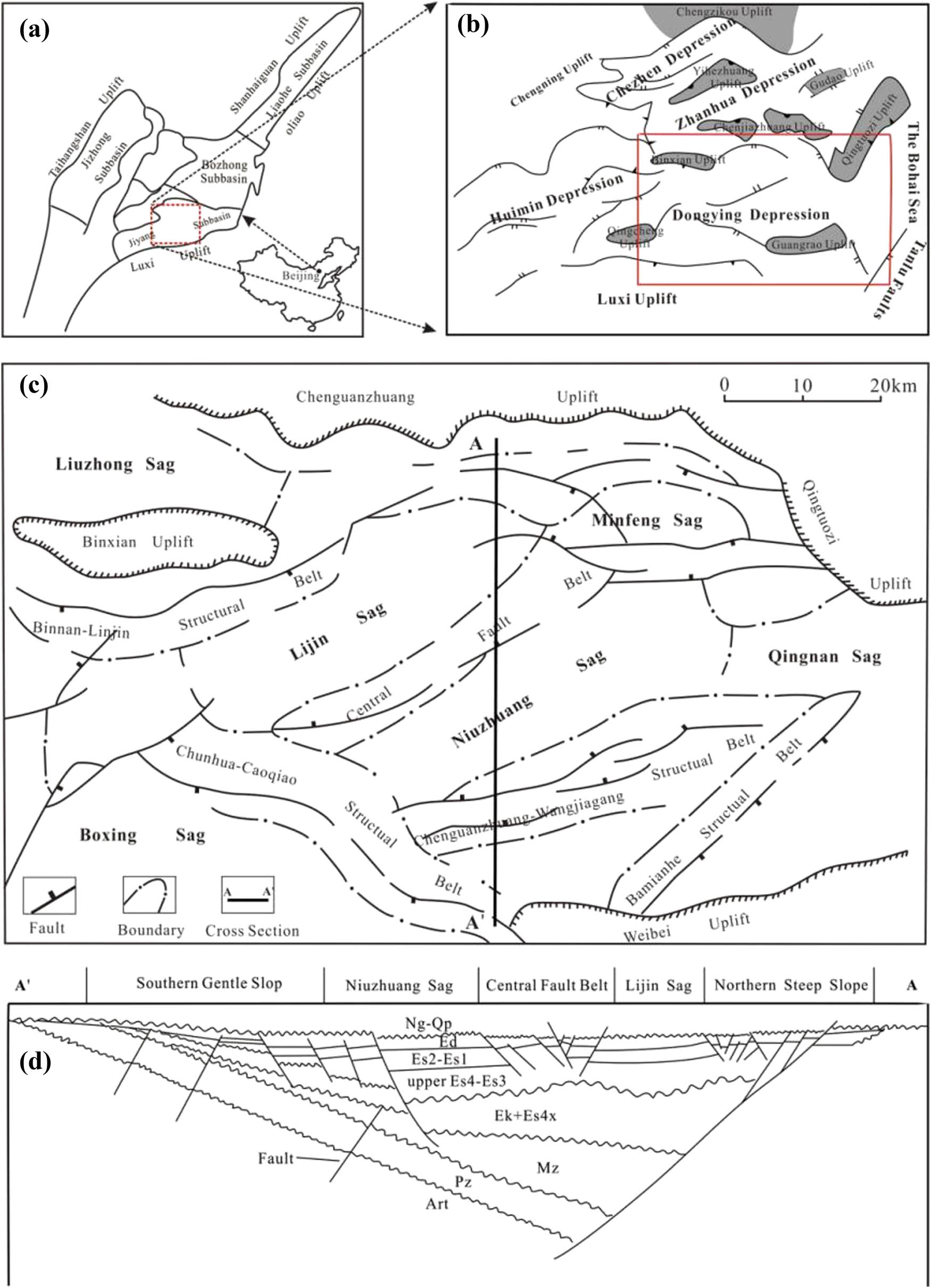
(a) Structural map of Bohai Bay Basin. (b) Tectonic setting of the Jiyang Depression. (c) Tectonic setting of Dongying Sag and the locations of sections AA′. (d) Cross section of sections AA′ showing the tectonostructural zones within Dongying Sag.
The Cenozoic is the main stage of the formation and evolution of Dongying Sag with intense structural activities and a set of thick continental clastic deposits [16,17,18,19], including Kongdian (Ek), Shahejie (Es), Dongying (Ed), Guantao (Ng), Minghuazhen (Nm), and Plain (Qp) Formations. Shahejie Formation can be further subdivided into four members from the top to the bottom: Es1, Es2, Es3, and Es4, respectively. In this work, we focused on Es4 and Es3.
The thickness of Es4 can reach 1,500–1,600 m, generally showing a complete coarse-fine-coarse cycle. The lower member of Es4 is composed of purple-red mudstone with brown siltstone, sandy mudstone, and thin carbonate rocks. The upper member of Es4 is composed of dark gray mudstone and shale. The thickness of Es3 is generally 700–1,000 m with the thickest part exceeding 1,200 m. It is mainly composed of gray and dark gray mudstone with sandstone, shale, and carbonaceous mudstone. Es2 is mainly composed of gray mudstone, sandstone, and gravel-bearing sandstone, while Es1 gray and dark gray mudstone, oil shale, and carbonate rock (Figure 2).
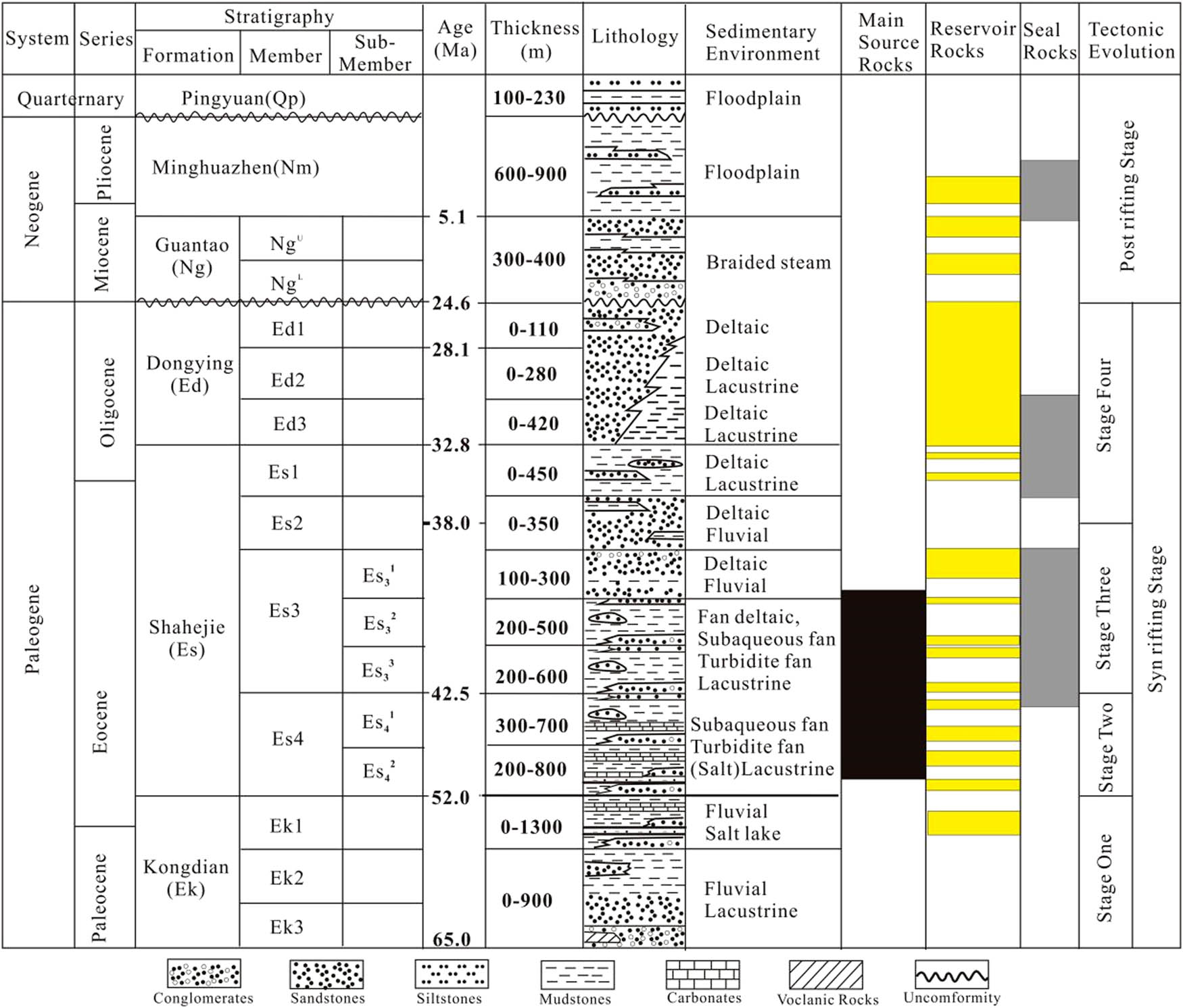
Generalized Cenozoic-Quaternary stratigraphy of Dongying Sag.
3 Methods
The samples were mainly collected from Shahejie Formation in Dongying Sag. Thin-section casting, quantitative statistics, cathodoluminescence, scanning electron microscopy, homogenization temperature testing, carbon and oxygen stable isotope testing, and electron probe analysis were used. All analyses and testing work were completed in the Petroleum Geology Testing Center of the Exploration and Development Research Institute of Sinopec Shengli Oilfield Co Ltd.
3.1 Type and occurrence analysis of carbonate cements
Two hundred and fifteen core samples from 60 wells in Dongying Sag were selected. Blue epoxy resin was used to polish cast sections stained with alizarin red, and the cast sections were identified by Leize polarized light microscope. At the same time, 63 typical samples were selected, and the thermal cathodoluminescence analysis and dyeing analysis of the cast thin sections were performed by cathodoluminescence (CL8200 MK5) to identify the types of carbonate cements in the core samples. The occurrence of carbonate cements and the contact accountability relationship were completed by a field emission environmental scanning electron microscope (Quanta450FEG/-J).
3.2 Electron probe analysis of carbonate cements
Sixty samples from 20 wells were selected. Electron probe microanalysis (JEOLJXA-8230) was performed to quantitatively test the chemical compositions of carbonate cements and conduct an elemental surface analysis. The main elements tested include four elements: Ca, Mg, Fe, and Mn. The analysis error was less than 3%.
3.3 Homogenization temperature testing of inclusions
Hundred core samples from 30 wells were selected to prepare double-polished slices with a thickness of 100 m to test the homogenization temperature of fluid inclusions and clarify the formation temperature and time of carbonate cements. The petrographic characteristics of fluid inclusions were observed using a polarized reflective fluorescent microscope (ZEISS DMR XP). The homogenization temperature measurement was performed on the cold and hot table (LinKam-THMS600). The refrigerant used in the test was liquid nitrogen, and standard sample calibration was performed at −196 to 600°C with an error of 0.1°C. The temperature control rate was 1–10°C/min, the room temperature was 25°C, and the humidity was 65%.
3.4 Carbon and oxygen stable isotope testing of carbonate cements
The corresponding carbonate cements from sandstone samples were dried in the air, grounded to 200 mesh, and reacted with 100% phosphoric acid, and the released CO2 was collected. A gas isotope mass spectrometer (MAT253) was used to test the stable isotopes of carbon and oxygen.
4 Results
4.1 Types and occurrence of carbonate cements
The morphological and geochemical characteristics of carbonate cements in the sandstone of Shahejie Formation in Dongying Sag were studied by thin-section casting, cathodoluminescence, backscattering, electron probe analysis, and isotope analysis. Optical microscopy and cathodoluminescence results indicated carbonate cementation in the sandstone of the deep Shahejie Formation in Dongying Sag, and mainly, early-stage calcite, middle-stage calcite and dolomite, and late-stage ferrocalcite and ankerite were found.
The carbonate cements in the early stage are mainly calcite, which can be divided into two types based on their production: the first type is mainly micritic high magnesium calcite, which usually has a good degree of automorphism, and is mostly in the form of micritic equal thickness rim, which is semi-basal-basal cementation and occurs on the surface of a small amount of clastic rock particles (Figure 3a). The second type is mainly microcrystalline calcite, mostly developed between clastic grains (Figure 3b), and the cathodoluminescence is orange (Figure 3c). Microscopic observation showed that the clastic particles were mainly distributed in the carbonate cements of this period in the form of point contact or floating, and no feldspar particles were dissolved or metasomatism clastic particles appeared. Meanwhile, the intergranular pores were relatively developed, indicating that the clastic particles had not been modified by compaction, so the formation time was earlier. The carbonate cements in the middle stage are mainly microcrystalline fine-grained calcite and dolomite. Different from carbonate cements in the early stage, carbonate cements in the middle stage are mostly dispersed and filled with pores, occupying the dissolution space of feldspar, and the secondary increased edge phenomenon of metasomatized feldspar grains and quartz can be seen (Figure 3d–f); the cathode luminescence is orange-yellow and dark red (Figure 3i). The clastic grains are mostly in point-line contact to lineal contact, which indicates that the sandstone has been strongly compacted and the cements precipitated after the dissolution of feldspar, and the precipitation time is later than that of carbonate cements in the early stage, indicating that this period is later than the formation period of carbonate cements in the early stage. The carbonate cements in the late stage are mainly fine-grained ferro-calcite and ankerite, which are porous cementation. The clastic particles are closely arranged and mostly in line contact, indicating that the sandstone has been strongly compacted and transformed; it mainly occupies the dissolution space of feldspar, carbonate cement in the early and middle stage, and some metasomatize feldspar particles and quartz enlarge edge (Figure 3e, g, and h); under cathodoluminescence, ferrocalcite is dark orange-yellow, while ankerite does not emit light (Figure 3i), indicating that it was formed later.
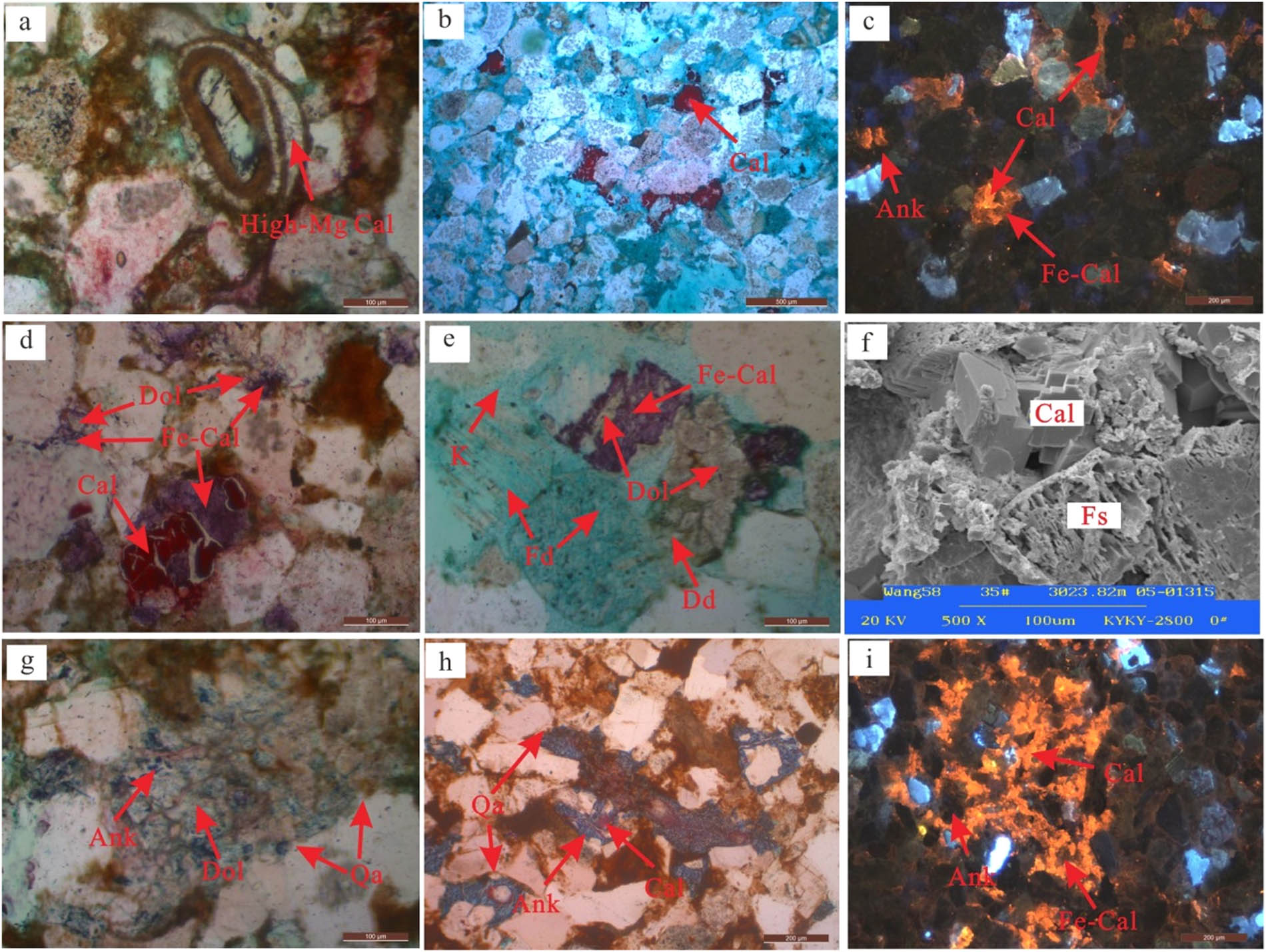
Diagenesis micrograph of carbonate cements in Dongying Sag. (a) N105, 3251.66 m, micritic high-Mg calcite in early stage; (b) X154, 2934.50 m, calcite in early stage filled primary pores; (c) X154, 2934.50 m, calcite in early stage, the cathodoluminescence was bright orange-yellow; (d) G110, 2671.93 m, ferro-calcite in late stage filled the dissolution pores of calcite and dolomite in middle stage; (e) W541, 3132.98 m, dolomite in middle stage filled dissolution pores of debris, and the later dissolution was filled by ferro-calcite in late stage; (f) W58, 3023.82 m, calcite in middle stage filled feldspar dissolution pores; (g) N21, 3431.50 m, dolomite in middle stage filled the dissolution pores of feldspar particles and metasomatized part of quartz secondary enlarged edge, later was metasomatized by ankerite in late stage; (h) N24, 3174.85 m, ankerite in late stage filled the dissolution pores of calcite in middle stage and metasomatizes quartz secondary enlarged edge; and (i) W631, 3243.80 m, the cathodoluminescence of ferro-calcite is dark orange red, while ankerite does not emit light.
4.2 Chemical composition of carbonate cements
Electron probe microanalysis and energy spectrum analysis were used to observe and identify different types of carbonate cements in the deep sandstone reservoirs of Dongying Sag and analyze their major element components. The results showed that calcite in the early stage is distributed in ring-shaped aggregates with a chlorite layer on the surface and demonstrated symbiosis with a small amount of authigenic early-stage pyrite particles (Figure 4a). The composition of carbonate cements in this stage is characterized by high-Ca, medium-Mg, and low-Fe (Figures 4b and 5): CaCO3 content was 65.35–75.15% with an average of 71.95%, MgCO3 content was 21.04–33.87% with an average of 27.11%, FeCO3 content was 0.46–1.47% with an average of 0.93%, and MnCO3 content was 0.00% (Table 1), indicating that this type of carbonate cement is micritic high-Mg calcite.

Electron microprobe backscatter images and energy spectrum characteristics of typical carbonate cements. (a–c) W7, 2595.5 m, characteristics of back scattering and energy spectrum of micritic high-Mg calcite and calcite in early stage; (d–f) W550, 3419.48 m, characteristics of back scattering and energy spectrum of calcite in middle stage and ferrocalcite in late stage; (g–i) W58, 3026.10 m, characteristics of back scattering and energy spectrum of dolomite in middle stage and ankerite in late stage.

Composition characteristics of carbonate cements in different stages.
Composition characteristics of carbonate cements in different stages
| Well | Depth (m) | Horizon | CaCO3 | FeCO3 | MgCO3 | MnCO3 | Mineral name period |
|---|---|---|---|---|---|---|---|
| W78 | 3426.18 | Es3 | 97.21 | 1.79 | 0.00 | 0.00 | Calcite middle stage |
| 3429.84 | Es3 | 98.50 | 0.17 | 1.12 | 0.21 | Calcite middle stage | |
| N876 | 3372.19 | Es3 | 90.55 | 8.40 | 1.06 | 0.00 | Ferro-calcite late stage |
| 3375.20 | Es3 | 84.59 | 15.41 | 0.00 | 0.00 | Ferro-calcite late stage | |
| N106 | 2595.21 | Es3 | 98.21 | 1.79 | 0.00 | 0.00 | Calcite middle stage |
| X154 | 2960.50 | Es3 | 90.15 | 0.98 | 8.87 | 0.10 | Calcite early stage |
| N105 | 3251.66 | Es3 | 65.35 | 0.78 | 33.87 | 0.00 | Calcite early stage |
| S127 | 2180.80 | Es3 | 86.75 | 0.48 | 12.77 | 0.12 | Calcite early stage |
| H144 | 2691.25 | Es3 | 77.49 | 1.47 | 21.04 | 0.00 | Calcite early stage |
| 2691.25 | Es3 | 69.27 | 0.46 | 30.27 | 0.00 | Calcite early stage | |
| S11 | 3041.20 | Es3 | 86.18 | 12.03 | 1.79 | 0.00 | Ferro-calcite late stage |
| 3080.50 | Es3 | 99.44 | 0.56 | 0.00 | 0.00 | Calcite middle stage | |
| H169 | 2840.90 | Es3 | 51.80 | 0.23 | 47.97 | 0.00 | Dolomite middle stage |
| 2945.00 | Es3 | 31.24 | 0.46 | 68.30 | 0.00 | Dolomite middle stage | |
| W631 | 2804.00 | Es3 | 59.42 | 15.07 | 24.18 | 1.34 | Ankerite late stage |
| N24 | 3042.50 | Es4 | 98.24 | 0.56 | 1.20 | 0.22 | Calcite middle stage |
| 3082.11 | Es4 | 87.49 | 11.47 | 1.04 | 0.00 | Ferro-calcite late stage | |
| N21 | 2987.20 | Es3 | 58.47 | 13.35 | 25.87 | 2.31 | Ankerite late stage |
| 3032.60 | Es3 | 86.23 | 12.13 | 1.63 | 0.00 | Ferro-calcite late stage | |
| W7 | 2616.10 | Es4 | 60.25 | 13.54 | 26.21 | 0.00 | Ankerite late stage |
| 2616.10 | Es4 | 50.68 | 15.73 | 32.43 | 1.16 | Ankerite late stage | |
| S126 | 2616.10 | Es4 | 51.81 | 11.27 | 36.92 | 0.00 | Ankerite late stage |
| N25 | 3274.10 | Es3 | 60.90 | 15.46 | 23.13 | 0.51 | Ankerite late stage |
| 3274.10 | Es3 | 51.70 | 1.03 | 47.27 | 0.00 | Dolomite middle stage | |
| 3283.80 | Es3 | 88.52 | 0.81 | 10.67 | 0.00 | Calcite early stage | |
| T174 | 2903.80 | Es4 | 57.26 | 13.84 | 28.17 | 0.73 | Ankerite late stage |
| W587 | 3456.40 | Es4 | 55.34 | 12.04 | 30.69 | 1.93 | Ankerite late stage |
| B656 | 3187.40 | Es4 | 95.71 | 2.17 | 2.12 | 0.00 | Calcite middle stage |
| Ch371 | 2693.85 | Es4 | 96.11 | 0.79 | 3.10 | 0.00 | Calcite early stage |
| FS6 | 3697.95 | Es4 | 75.70 | 1.03 | 23.27 | 0.00 | Calcite early stage |
The second type of carbonate cements in the early stage fills the primary pores without obvious compaction and diagenetic transformation (Figure 4d). The composition of this carbonate cement is characterized by high Ca, low Mg, and low Fe (Figures 4c and 5). The content of CaCO3 was 86.75–96.11% with an average of 90.38%; the content of MgCO3 was 3.10–12.77% with an average of 8.85%; the content of FeCO3 was 0.48–0.98% with an average of 0.77%; the content of MnCO3 was 0.1–0.12% with an average of 0.05% (Table 1), indicating that this type of carbonate cement is calcite.
The carbonate cements in the middle stage are mostly filled with feldspar dissolved and compacted in residual pores (Figure 4d and g); carbonate cements in this stage can be divided into two types. The first type is characterized by high Ca, medium-low Mg, and low Fe (Figures 4e and h and 5). The content of CaCO3 was 95.71–99.44% with an average of 97.89%, MgCO3 content was 0.00–2.12% with an average of 0.74%, FeCO3 content was 0.17–2.17% with an average of 1.17%, and MnCO3 content was 0–0.22% with an average of 0.07%, indicating that this type of carbonate cement is calcite. The second type is characterized by medium-low Ca, high Mg, and low Fe in which CaCO3 content was 31.24–51.80% with an average of 44.91%, MgCO3 content was 46.04–68.30% with an average of 54.51%, FeCO3 content was 0.23–1.03% with an average of 0.57%, and MnCO3 content was 0.00% (Table 1), indicating that the type of carbonate cement is dolomite.
The carbonate cements in the late stage are mainly filled with the dissolution pores of early- and middle-stage calcite and dolomite (Figure 4d and g), and the clay-mixed layer minerals of illite and montmorillonite and high automorphic silk illite are developed on their surface. Two types of carbonate cements were identified in this stage. The first type is characterized by high Ca, medium-low Mg, and high Fe (Figure 4f). The content of CaCO3 was 84.59–90.55% with an average of 87.01%; the content of MgCO3 was 0.00–1.79% with an average of 1.10%; the content of FeCO3 was 8.40–15.41% with an average of 11.89%; the content of MnCO3 was 0.00%, indicating that it is iron calcite. The second type is characterized by medium-low Ca, high Mg, and high Fe (Figures 4i and 5) in which CaCO3 content was 50.68–60.25% with an average of 56.77%; MgCO3 content was 23.13–36.92% with an average of 28.45%; FeCO3 content was 11.27–15.73% with an average of 13.78%; MnCO3 content was 0–1% with an average of 0.57% (Table 1), indicating that it is ankerite.
4.3 Distribution characteristics of carbonate cements
In the deep sandstone of Dongying Sag, the content of early-stage micritic high-Mg calcite is low, which is only developed in a small number of samples, but its depth varies, ranging from 1,600 to 4,000 m. The early calcite is also developed in the range of 1,600–3,600 m, but mainly distributed in the depth of 1,600–2,700 m in sandstone samples buried more than 2,700 m deep. This type of carbonate is dissolved; thus, its content decreased. Calcite and dolomite in the middle stage are developed in the range of 2,000–4,500 m, and their contents decrease with the increase in burial depth. Microscopic observations showed that carbonate cement dissolution occurs in the late stage mainly in the depth range of 2,100–2,900 m, and the content of these carbonates in sandstone decreases beyond 2,900 m. In the late stage, the ferrocalcite and ankerite are mainly developed in sandstone with a depth of <3,000 m, and the development degree increases with the increase in depth (Figure 6).

Vertical distribution characteristics of carbonate cements in different stages.
Carbon and oxygen isotope analysis is a widely used method to study the material source and genetic mechanism of carbonate cements in clastic rocks [20,21,22,23]. The carbon and oxygen isotopes of different types of carbonate cements in deep sandstone reservoirs in Dongying Sag showed the following characteristics: because of the low content of early-stage micritic high-Mg calcite cements, it is difficult to obtain sufficient samples for isotopic testing. The δ 13CV-PDB‰ of the medium-coarse-grained calcite cement filling the primary pores in the early stage was 1.3–2.1‰ with an average of 1.7‰, and δ 18OV-PDB‰ was −10.5 to −7.5‰ with an average of −9.1‰ (Table 2), showing positive carbon isotope characteristics. The δ 13CV-PDB‰ of the calcite cement filling the dissolved pores of feldspar and the remaining primary pores of compaction in the middle stage was −2.2 to 3.4‰ with an average of 1.9‰, and the δ 18OV-PDB‰ was −13.5 to –9.3‰ with an average of −12.2‰; the δ 13CV-PDB‰ of the dolomite cement was −1.0 to 4.3‰ with an average of 2.8‰, and the δ 18OV-PDB‰ was −11.2 to −7.1‰ with an average value of −9.7‰ (Table 2). The carbon isotope of dolomite shows a stronger positive drift than that of calcite in the same stage. The δ 13CV-PDB‰ of ferrocalcite in the late stage was −3.3 to −2.7‰ with an average of −0.6‰, the δ 18OV-PDB‰ was −15.9 to −13.3‰ with an average of −14.8‰, the δ 13CV-PDB‰ of ankerite was −1.2 to 4.3‰ with an average of 1.6‰, and the δ 18OV-PDB‰ was −13.8 to –11.5‰ with an average of −12.7‰ (Table 2). The carbon isotope of ankerite is higher than that of ferrocalcite in the same stage.
Carbon and oxygen isotope composition and oxygen isotope temperature test results of carbonate cements(a)
| Well | Depth (m) | Strata | Type | Stage | δ 13CPDB (‰) | δ 18OPDB (‰) | δ 18OSMOW (‰) | Temperature T (°C) |
|---|---|---|---|---|---|---|---|---|
| H155 | 2981.2 | Es3 | Calcite | Middle stage | 3.4 | −11.8 | 15.5 | 88.3 |
| H163 | 2833.4 | Es3 | Calcite | Middle stage | 2.1 | −12.1 | 15.1 | 91.5 |
| N22 | 3208.6 | Es3 | Ankerite | Late stage | −1.2 | −13.0 | 13.9 | 134.9 |
| S127 | 3214.5 | Es3 | Calcite | Middle stage | 2.8 | −9.3 | 18.7 | 64.2 |
| X154 | 2934.5 | Es3 | Calcite | Early stage | 1.5 | −7.5 | 21.1 | 38.7 |
| N28 | 3120.8 | Es3 | Ankerite | Late stage | 2.3 | −13.8 | 12.9 | 147.5 |
| H130 | 2780.4 | Es3 | Fe-Calcite | Late stage | 2.7 | −13.3 | 13.5 | 106.3 |
| 2781.6 | Es3 | Dolomite | Middle stage | 3.7 | −10.8 | 16.8 | 103.9 | |
| H156 | 2752.8 | Es3 | Dolomite | Middle stage | 4.3 | −11.2 | 16.2 | 109.7 |
| L881 | 2969.8 | Es3 | Ankerite | Late stage | 1.2 | −12.8 | 14.1 | 132.5 |
| W7 | 2597.5 | Es4 | Fe-Calcite | Late stage | −2.1 | −15.3 | 10.9 | 134.4 |
| 2597.5 | Es4 | Calcite | Late stage | 2.1 | −9.5 | 18.5 | 53.6 | |
| 2597.5 | Es4 | Calcite | Early stage | 1.3 | −10.5 | 17.2 | 62.0 | |
| L933 | 2908.7 | Es3 | Ankerite | Late stage | 4.3 | −13.0 | 13.9 | 134.9 |
| H159 | 2954.3 | Es3 | Dolomite | Middle stage | −1.0 | −10.1 | 17.7 | 95.6 |
| N301 | 2780.0 | Es3 | Calcite | Middle stage | 3.2 | −13.1 | 13.7 | 104.4 |
| 2786.5 | Es3 | Calcite | Middle stage | −2.2 | −12.5 | 14.5 | 97.0 | |
| HX108 | 3478.2 | Es3 | Dolomite | Middle stage | 3.9 | −10.5 | 17.1 | 101.1 |
| S106 | 3398.7 | Es3 | Fe-Calcite | Late stage | −3.3 | −15.9 | 10.1 | 144.4 |
| S121 | 3530.0 | Es3 | Calcite | Middle stage | 1.3 | −13.5 | 13.2 | 109.3 |
| S127 | 3162.8 | Es3 | Dolomite | Middle stage | 2.9 | −7.1 | 21.6 | 65.3 |
| Y67 | 3067.2 | Es3 | Calcite | Middle stage | 2.5 | −12.8 | 14.1 | 100.6 |
| 3072.0 | Es3 | Ankerite | Late stage | 1.6 | −12.3 | 14.8 | 124.4 | |
| HX108 | 3477.0 | Es3 | Dolomite | Middle stage | 2.8 | −8.2 | 20.1 | 76.1 |
| FS1 | 4322.4 | Es4 | Ankerite | Late stage | −0.4 | −11.5 | 15.8 | 113.8 |
| S106 | 3398.7 | Es3 | Ankerite | Late stage | 3.3 | −12.7 | 14.3 | 130.1 |
| 3410.1 | Es3 | Fe-Calcite | Late stage | −3.1 | −14.1 | 12.5 | 116.4 | |
| N21 | 2987.2 | Es3 | Fe-Calcite | Late stage | 2.2 | −14.7 | 11.6 | 126.2 |
| 3032.6 | Es3 | Fe-Calcite | Late stage | −0.3 | −15.4 | 10.7 | 136.9 |
(a) δ 13CPDB‰ is a stable carbon isotope (PDB standard); δ 18OPDB‰ is a stable oxygen isotope (PDB standard); δ 18OSMOW‰ is a stable oxygen isotope (SMOW standard). PDB is the abbreviation of Pee Dee belemnite in North America. SMOW is the standard mean seawater in Vienna. The conversion formula is δ 18OPDB = 1.03086 δ 18OSMOW – 30.86 [24]. Ferrocalcite is calculated using the formula 103ln α calcite-water = 2.78 * 106 * T −2 – 2.89 [25]; ankerite is calculated according to the formula 103 ln α calcite-water = 2.78 * 106 * T −2 + 0.11 [26].
4.4 Precipitation temperature of carbonate cement
Fluid inclusions can provide information on the precipitation temperature of authigenic minerals [10,27,28,29]. Due to the limited number of samples and inclusions in carbonate cements, the homogenization temperatures of fluid inclusions were detected from only a small number of middle- and late-stage carbonate cements (Figure 7a and c). The homogenization temperature of fluid inclusions in middle-stage carbonate cements mainly ranges from 95 to 120°C, while that in late-stage carbonate cements ranges from 135 to 150°C (Figure 8, Table 3). The homogenization temperature ranges of fluid inclusions in quartz grain healing fractures are mainly from 95 to 120°C and 135 to 155°C. The homogenization temperature ranges of aqueous inclusions in the enlarged edge of quartz are mainly from 100 to 115°C and 140 to 155°C (Figure 8, Table 3). According to the homogenization temperature distribution, two stages of hydrocarbon charging were identified in the deep sandstone reservoir of Dongying Sag: the precipitation temperatures of carbonate cements in the middle and late stages correspond to the two stages of hydrocarbon charging, respectively.

Inclusion characteristics of quartz and carbonate cements; (a and b) H169, 3026.50 m, hydrocarbon inclusions in carbonate cements in middle stage show yellow-white fluorescence; (c and d) N21, 2987.20 m, hydrocarbon inclusions in carbonate cements in late stage show blue-white fluorescence; (e) S136, 3214.50 m, aqueous inclusions in quartz grain healing fractures; and (f) L933, 2909.10 m, aqueous inclusions in the enlarged edge of quartz.
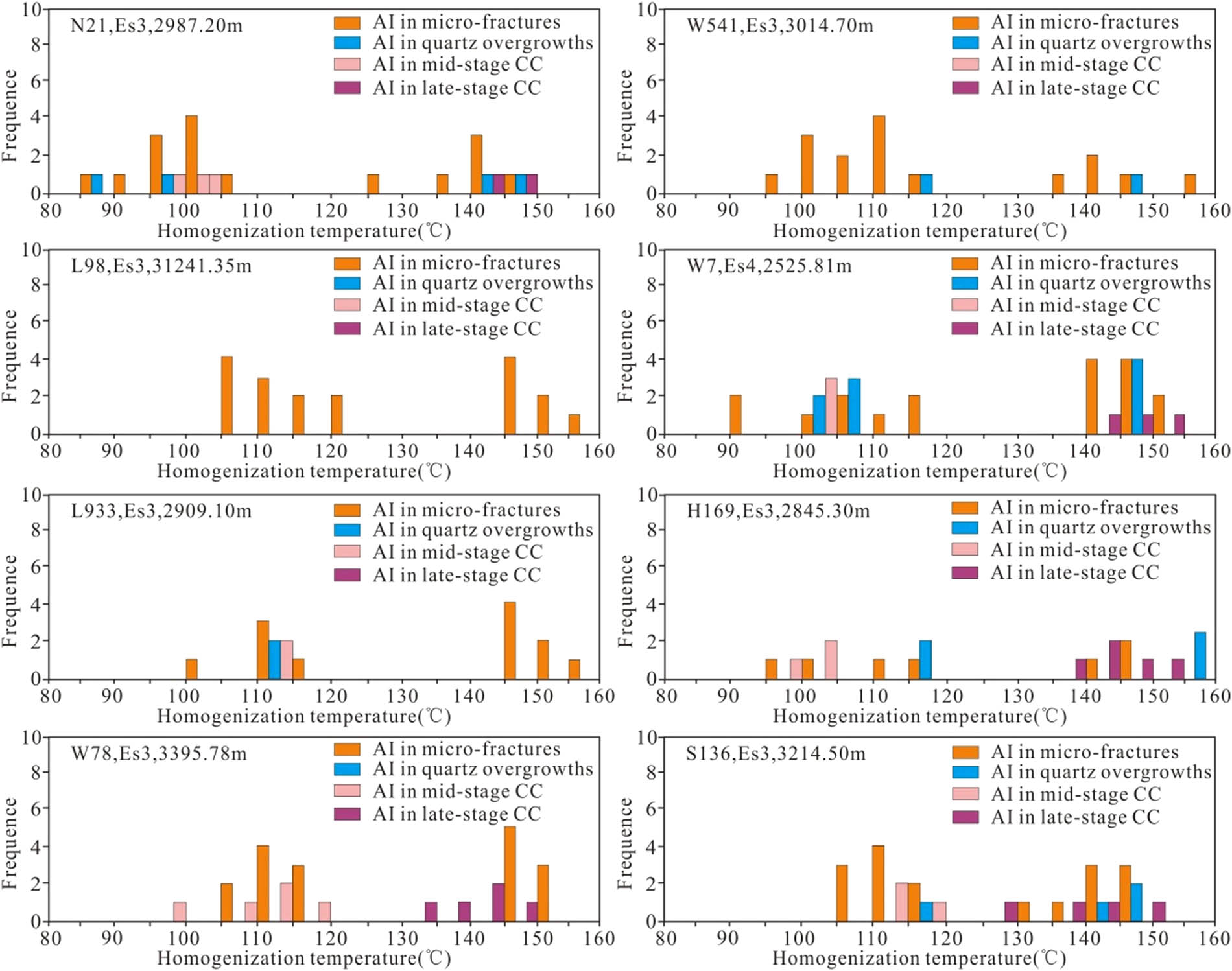
Characteristics of homogenization temperature distribution of inclusions in carbonate cements.
Homogenization temperature data of aqueous inclusions in quartz and carbonate cements
| Well | Depth (m) | Strata | Aqueous inclusions in microfractures in quartz | Aqueous inclusions in quartz overgrowth | Aqueous inclusions in carbonate cements |
|---|---|---|---|---|---|
| Th°C (Number) | Th°C (Number) | Th°C (Number) | |||
| N21 | 2987.20 | Es3 | 85–110(10), 129–146(6) | 89–105(3), 140–145(2) | 95–105(2), 140–150(2) |
| W541 | 3014.70 | Es3 | 95–120(11), 135–159(5) | 115(1), 145(1) | — |
| L98 | 3141.35 | Es3 | 105–125(11), 145–160(7) | — | — |
| W7 | 2525.81 | Es4 | 90–120(8), 140–155(10) | 100–110(5), 145–150(4) | 100–105(3), 140–155(3) |
| L933 | 2909.10 | Es4 | 100–120(5) | 110–115(2) | 110(2) |
| H169 | 2845.30 | Es3 | 98–118(4), 140–150(3) | 115–120(2), 155–160(3) | 95–105(3), 135–155(5) |
| W78 | 3395.93 | Es3 | 91–115(14), 145–155(8) | — | 99–119(5), 130–150(5) |
| S136 | 3214.50 | Es3 | 105–120(9), 131–149(8) | 115(1), 141–150(3) | 110–120(3), 128–155(4) |
Th: homogenization temperature; —: no available data.
5 Discussion
5.1 Formation period and diagenetic sequence of carbonate cements
The δ 18OSMOW‰ of carbonate cements is controlled by the δ 18OSMOW‰ of pore fluid and formation temperature. Determining the δ 18OSMOW‰ of pore fluid is necessary to calculate the formation temperature of carbonate cements in sandstone [25,30]. During diagenesis, the pore fluid from the sedimentary water exchanges material with clastic particles, making the δ 18OSMOW‰ of the pore fluid significantly heavier [31,32]. The δ 18OSMOW‰ of the original sedimentary water body in Dongying Sag was −4.8‰, and the δ 18OSMOW‰ of the pore fluid became −3‰ after feldspar dissolution [32,33,34].
The carbonate cements in the early stage developed in the deep sandstone reservoirs in Dongying Sag are high-Mg calcite developed in mudstone and calcite filled with early intergranular primary pores. High-Mg calcite is inferred to be a paracontemporaneous diagenetic product (Figure 5) according to its composition characteristics, and it was formed before the dissolution period of feldspar in the pore fluid with a δ 18OSMOW‰ of −4.8‰ (Figure 3a and b). The calcite in the early stage was also formed before feldspar dissolution in the pore fluid with a δ 18OSMOW‰ of −4.8‰ (Figure 3c and d). The δ 18OPDB‰ was −10.5 to −7.5‰. The calculated isotopic temperature (T°C) of carbonate cements in this stage was 38.7–62.0°C (Table 2). The carbonate cements in the middle stage are calcite and dolomite filled with feldspar dissolution pores and compacted residual pores. Because they were formed after feldspar dissolution, it was formed in the pore fluid with a δ 18OSMOW‰ of −3‰ (Figure 3e, g and h), and the δ 18OPDB‰ is −13.5 to −7.1‰. The calculated isotopic temperature (T°C) of carbonate cements was 64.2–109.7°C (Table 2), and the peak homogenization temperature of inclusions was 70–110°C (Figure 8). Combined with the research results of the burial history of Shahejie Formation in Dongying Sag [47], the carbonate cements in this stage are diagenetic products of the early Dongying Formation, and the temperature calculated by isotope is consistent with the measured homogenization temperature of inclusions. The carbonate cements in the late stage are ferrocalcite and ankerite, which are filled with feldspar dissolved in pores and metasomatized the secondary enlarged edges of quartz (Figure 3e, g, and h) formed in a pore fluid with a δ 18OSMOW‰ of −3‰ and δ 18OV-PDB‰ of −15.9 to −11.5‰. The calculated isotope temperature (T°C) of carbonate cements in this stage is 106.3–147.5°C (Table 2), and the peak homogenization temperature range of inclusions is 120–150°C (Figure 8), which coincides with each other, and they are mainly the diagenetic products of the late Guantao Formation to the present.
Therefore, our comprehensive analyses showed that the diagenetic sequence of carbonate cements and other cements in the deep sandstone reservoir of Dongying Sag is as follows: micritic high-Mg calcite in the early stage → calcite in the early stage filled with primary pores without obvious compaction and diagenetic transformation → feldspar dissolution/quartz secondary enlargement/authigenic kaolinite precipitation → calcite and dolomite in the middle stage filled with feldspar dissolved and compacted in residual pores → ferrocalcite and ankerite in the late stage filled with the dissolution pores of calcite and dolomite in the early stage and metasomatized the enlarged edge of quartz (Figure 9).

Sequence diagram of sandstone diagenesis in the deep Shahejie Formation of Dongying Sag (Paleogeothermal data were modified from Qiu et al., 2004; burial and thermal history were modified from Song et al., 2009).
5.2 Discussion on material source and genesis of carbonate cements
During the formation of carbonate cements, carbons in all types of organic sources are exchanged. Different types of carbon-rich acidic materials (organic acids, CO2) are formed in different evolutionary stages of source rocks. Therefore, the carbon isotope characteristics of carbonate cements can reflect the evolutionary stages of source rocks. Previous studies have shown that 60–90°C is the stage of organic acid mass formation, 90–120°C is the stage of organic acid preservation, and >120°C is the stage of organic acid destruction [35,36]. Different types of acid fluids control the geochemical properties of pore fluids and affect the formation and evolution of carbonate cements in different stages.
5.2.1 Carbonate cements in the early stage
The rim-shaped argillaceous high-Mg calcite directly precipitates from the sedimentary water in the early stage and is a product of the quasi-contemporaneous period. The isotopic temperature characteristics of calcite (Figure 11a) filled with primary pores after compaction in the early stage indicate that it was formed at 38.7–62.0°C (Table 2), and the main burial depth was about 1,600–2,700 m (Figure 6). Its δ 13CPDB‰ was 1.3–2.1‰ with an average of 1.7‰, and δ 18OV-PDB‰ was −10.5 to −7.5‰ with an average of −9.1‰ (Table 2), indicating that it is a typical lacustrine carbonate (Figure 10), that is, there is no external material supply, such as microbial activity, biological organisms, or mantle-derived materials. The shale experienced obvious mechanical compaction: the main material source of carbonate cements in this stage is Ca2+- and CO3 2–-rich pore fluid discharged from the sedimentary source during mudstone compaction.

Isotopic characteristics of carbonate cements.
5.2.2 Carbonate cements in the middle stage
The carbonate cements in the middle stage are mainly calcite and dolomite filled with feldspar dissolution pores and compacted residual pores (Figure 3e, g and h), indicating that they were formed after large-scale feldspar dissolution. Isotopic and inclusion homogenization temperature characteristics indicate that middle-stage carbonate cements were formed at 70–110°C (Figure 8). The distribution range of the δ 13CPDB‰ was −2.2 to 4.3‰, and that of δ 18OV-PDB‰ was −13.5 to −7.1‰ (Table 2). The δ 13CPDB‰ of some carbonate cements in this stage is significantly higher than that of early-stage carbonate cements. The carbon isotope of dolomite is higher than that of the calcite cement in the same stage (Figure 10, Table 2).
Previous studies have shown that bacterial activity, internal carbon isotope fractionation of organic acids, and evaporation of lake water can lead to positive carbon isotope migration of carbonate cements. Since the precipitation temperature of carbonate cement measured by fluid inclusion in the study area exceeds the maximum temperature limit of microbial activity (70°C), the influence of bacterial activity is excluded. Carbon isotope fractionation within organic acids is believed to be the reason for the high δ
13CPDB‰ value [37]. The carbon and oxygen isotope measurements of lacustrine carbonate in Shahejie Formation in Dongying Sag showed that the δ
13CPDB‰ values of carbonate rocks in Es3 are mostly negative, while the δ
13CPDB‰ values of saltwater lacustrine carbonate rocks in Es4 are 1.20–6.29‰ with an average value of 3.75‰ [33,34]. We conclude that the positive carbon isotope migration of calcite in carbonate cements is due to the isotopic fractionation effect of organic acids; the positive migration of dolomite carbon isotope is mainly affected by organic acid isotope fractionation and the upwelling of high-salinity fluid in Es4. The formation process of carbonate cements in this stage is as follows: a large amount of organic matter in mudstone is formed, and organic acid is discharged. The existence of organic acid causes the dissolution of potash feldspar and plagioclase, providing a partial material source for the formation of carbonate cement in this period. Meanwhile, the overpressure fluid rich in Ca2+, Mg+, and part of
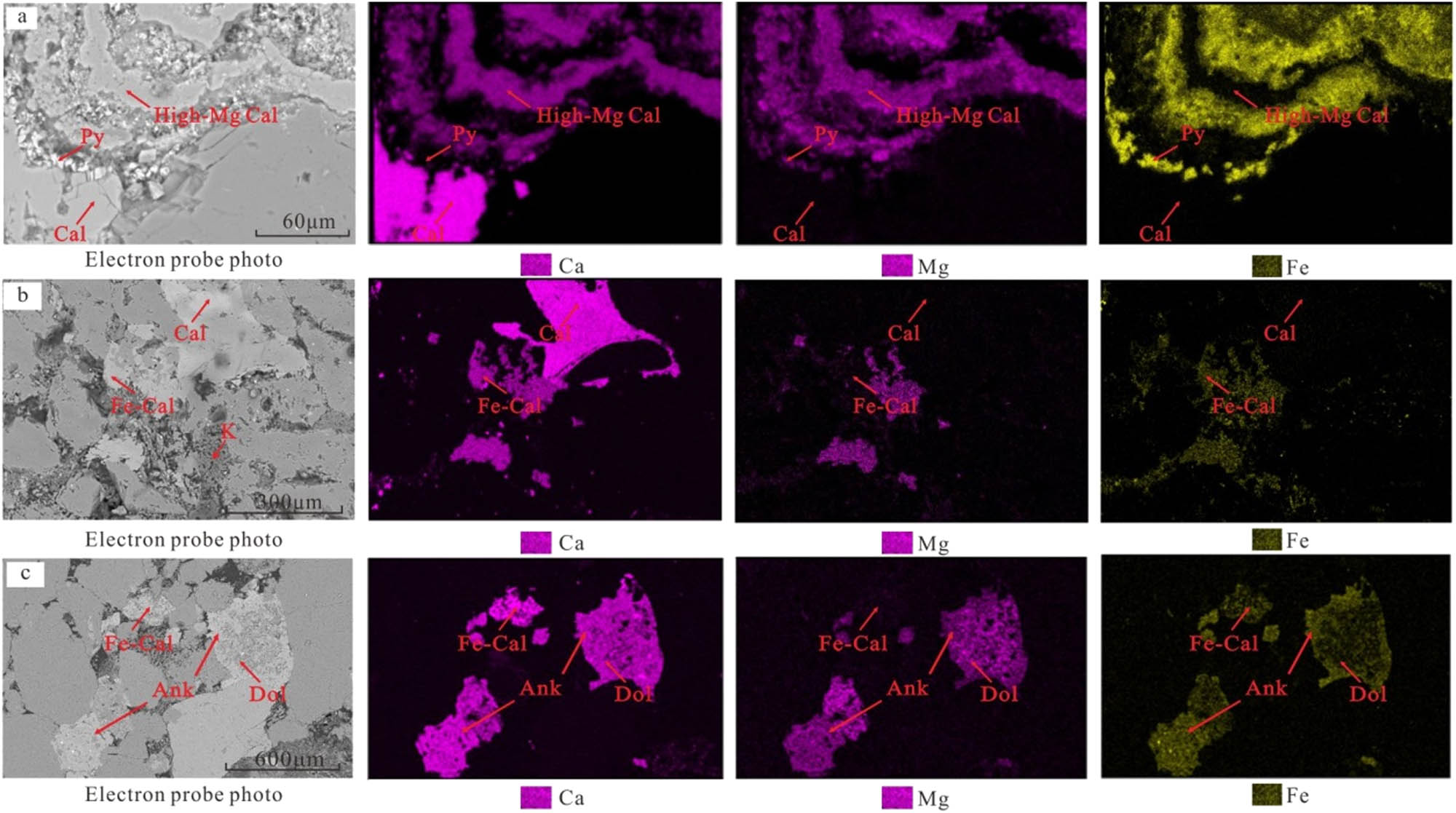
Electron microprobe element surface characteristics of different stages of carbonate cements. (a) W7, 2595.5 m, the micritic high-Mg calcite and calcite in early stage; (b) W550, 3419.48 m, calcite in the middle stage and ferrocalcite in the late stage filled the dissolved pores; and (c) W58, 3026.10 m, dolomite in middle stage and ankerite in the late stage filled the dissolved pores.
5.2.3 Carbonate cements in the late stage
Carbonate cements in the late stage are mainly ferrocalcite and ankerite (Figure 3e, g and h): the distribution range of the δ
13CPDB‰ was −3.3 to 4.3‰, and that of the δ
18OV-PDB‰ was −15.9 to −11.5‰ (Table 2): the precipitation temperature range was 131.6–144.1°C (Table 3), mainly developed in sandstone with a burial depth <3,000 m (Figure 6). In the geothermal range (>120°C) of this depth, organic acids and some organic matter cracked to form a large amount of CO2, which was transformed into
5.3 Material exchange of carbonate cement precipitation in pore fluid
Changes in the chemical composition of the pore fluid affect composition during carbonate cement precipitation. The mudstone adjacent to the carbonate cement precipitation strata has different geochemical properties discharged during the compaction process. Formation fluids and deep hydrothermal fluids flowing up into the pores along faults can affect the properties of pore fluids, leading to the precipitation of different types of carbonate cements. When the lake water of the Paleogene in Dongying Sag was in the quasi-contemporaneous period, the buried depth of the stratum was less than 500 m, the ground temperature was less than 40°C, the water itself involved a certain content of Ca2+, Mg2+, Fe3+, and
5.4 Hydrocarbon indicating the significance of carbonate cements
The thermal evolution and diagenesis of source rocks in sedimentary basins are interactive and organic processes. Organic acids produced during the thermal evolution of the source rock directly affect the stability of carbonate cements in the overlying reservoir sandstone [36]. Therefore, the charging of hydrocarbon fluids inevitably leads to secondary changes in the reservoir, and carbonate cements and hydrocarbon inclusions present in carbonate cements can well record these changes. The content of calcite in deep sandstone reservoirs in Dongying Sag is similar in sandstone samples with and without hydrocarbon display; the content of dolomite, ferrocalcite, and ankerite in sandstone samples with hydrocarbon display is much higher than that in sandstone samples without hydrocarbon display (Figure 12). In addition, the early micritic high-Mg calcite is a product of the concentration of sedimentary water and the product of the compression fluid of the calcite mudstone filling the dissolution pores in the early stage, both of which are not symbiotic with asphaltenes and have no relation with hydrocarbon fluids. The calcite and dolomite in the middle stage are associated with asphaltenes and precipitate in the pores after feldspar dissolution (Figure 13a and b); ferrocalcite and ankerite in the late stage are also associated with asphaltenes, filling the dissolution pores of carbonate cements in the early and middle stages (Figure 13c and d). Thus, carbonate cements in the two stages are all diagenetic products formed during the filling of hydrocarbon fluids: Dongying Sag has two periods of hydrocarbon charging, namely the early charging period of the Dongying Formation and the late Guantao Formation–the present charging period [45,46]. In this work, hydrocarbon inclusions in the early hydrocarbon charging period were recorded as yellow-brown fluorescence in middle-stage carbonate cements (Figure 7b), and the measured peak homogenization temperature range was 95–120°C (Figure 8). Combined with the research results of the burial history of Shahejie Formation in the study area [47], these results show that the carbonate cements in this stage are the early diagenetic products of Dongying Formation. It coincides with the early hydrocarbon charging period of the early Dongying Formation, proving that the carbonate cements in this stage represent the early hydrocarbon charging of Dongying Formation. During the late oil and gas charging period, the hydrocarbon inclusions were recorded in the form of blue-white fluorescence in the late carbonate cement (Figure 7d), and the measured peak homogenization temperature range was 135–150°C (Figure 8), indicating that the carbonate cements in this stage are a diagenetic product from the end of Guantao Formation to the present, indicating that the carbonate cements in this stage represent the end of Guantao Formation to the present. Hydrocarbon charging and the formation of carbonate cement precipitation in the late stage indicate continuous hydrocarbon accumulation.
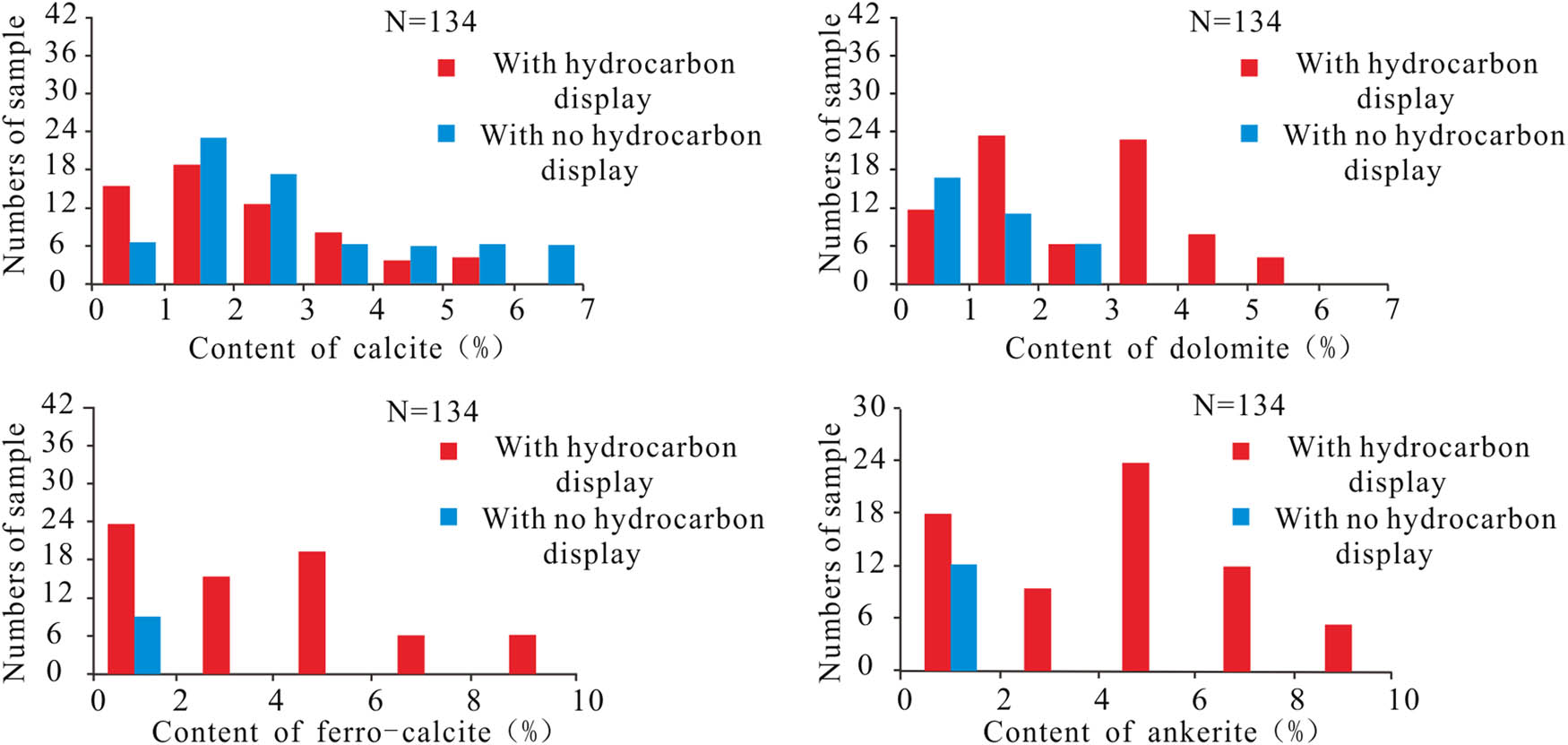
Relationship between the content of carbonate cements and the display of hydrocarbon.
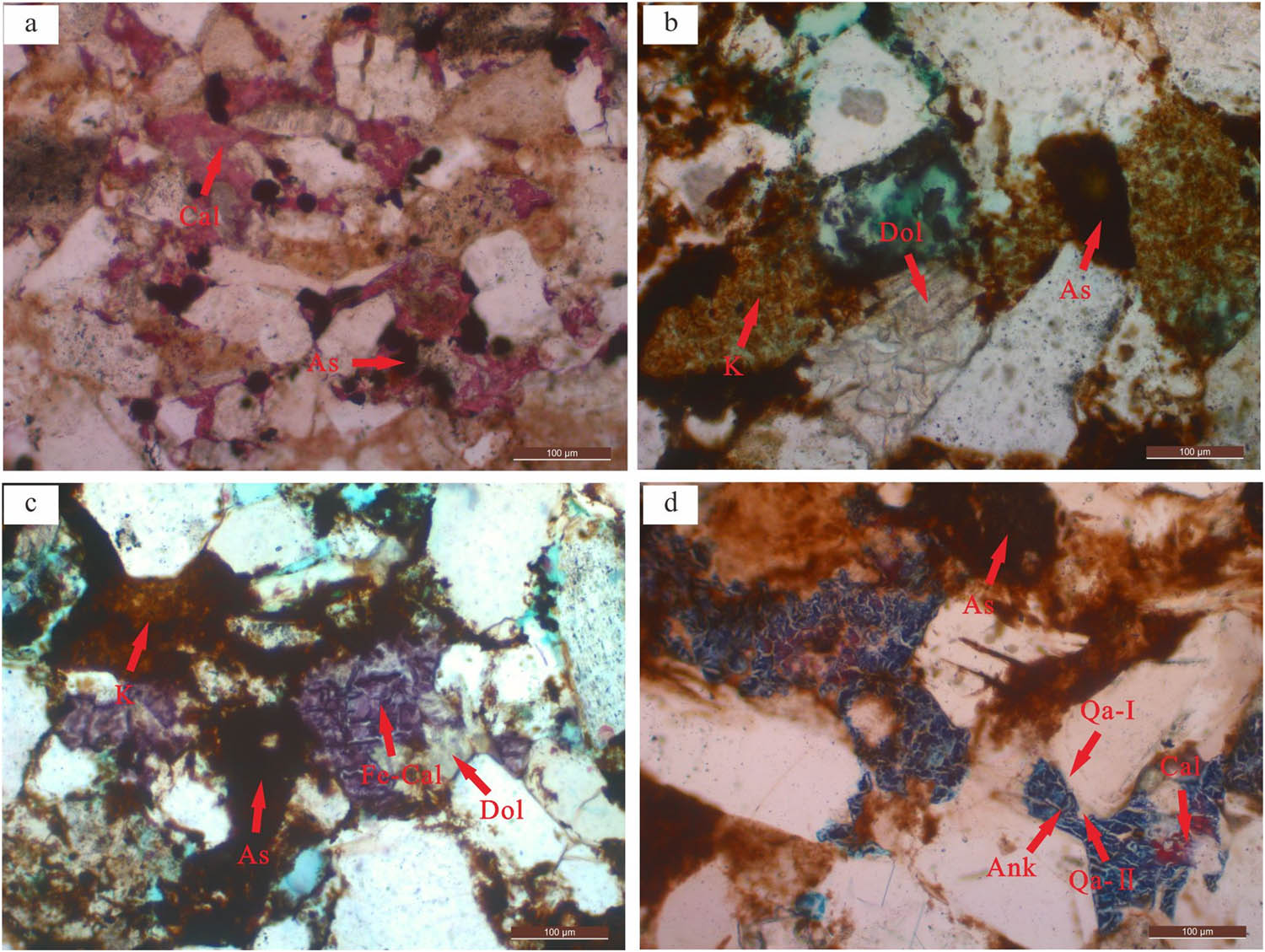
Relationship between carbonate cements in different stages and hydrocarbon charging; (a) H130, 2722.31 m, calcite in the middle stage associated with asphaltene; (b) W541, 3035.40 m, dolomite in the middle stage associated with asphaltene; (c) N116, 3091.64 m, ferrocalcite in the late stage associated with asphaltene; and (d) L65, 3219.20 m, ankerite in the late stage associated with asphaltene.
6 Conclusions
The deep sandstone reservoirs in Dongying Sag are mainly composed of three stages of carbonate cements. Carbonate cements in the early stage can be divided into two types: the first type is micritic high-Mg calcite, which is rim-shaped and coexists with a small amount of authigenic pyrite particles; the second type is medium-coarse-grained calcite filled with primary pores. The carbonate cements in the middle stage are calcite and dolomite filled with secondary dissolution pores of feldspar, and the carbonate cements in the late stage are ferrocalcite and ankerite filled with the dissolution pores of early and middle stage carbonate cements, respectively.
The formation stages of the three stages of carbonate cements are micritic high-Mg calcite in the early stage → calcite in the early stage filled with primary pores without obvious compaction and diagenetic transformation → feldspar dissolution/quartz secondary enlargement/authigenic kaolinite precipitation → calcite and dolomite in the middle stage filled with feldspar dissolved and compacted in residual pores → ferrocalcite and ankerite in the late stage filling the dissolved pores in calcite and dolomite, and metasomatic quartz secondary enlargement.
Ca2+, Mg2+, and
High-Mg calcite and calcite in the early stage did not coexist with asphaltenes and are not related to hydrocarbon fluids. The carbonate cements in the middle and late stages are both diagenetic products formed during the charging process of hydrocarbon fluids. The carbonate cements in the middle stage are the early diagenetic products of Dongying Formation; it coincides with the early hydrocarbon charging period of the early Dongying Formation, proving that the carbonate cements in this stage represent the early hydrocarbon charging of Dongying Formation. The carbonate cements in the late stage are diagenetic products from the end of Guantao Formation to the present, which coincides with the period of hydrocarbon charging since the end of the Guantao Formation, proving that carbonate cements of this stage represent the hydrocarbon charging at the end of Guantao Formation to the current.
Acknowledgments
This study was financially supported by the National Science and Technology Special Grant (No. 2016ZX05006-003). Thanks also go to the following individuals and institutions: Dr. Yuelin Feng and Dr. Wei Meng of Shengli Oilfield Exploration and Development Research Institute of Sinopec; Shengli Oilfield Company of Sinopec provided all the related core samples and some geological data of Dongying Sag.
-
Funding information: This study was financially supported by the National Science and Technology Special Grant (No. 2016ZX05006-003).
-
Author contributions: Yuelin Feng and Wei Meng designed the experiments; Hongwei Han, Jingqiang Yu, and Weizhong Zhang carried them out. Shuli Li and Xiaochen Li drew the figures and carried out the tables. Ping Gao reviewed and edited. Tianjiao Zhang offered the article thoughts and prepared the full manuscript with contributions from all co-authors. The authors applied the SDC approach for the sequence of authors.
-
Conflict of interest: Authors state no conflict of interest.
References
[1] Carlos R, Rafaela M, Karl R, Permanyer A. Facies-related diagenesis and multiphase siderite cementation and dissolution in the reservoir sandstones of the Khatatba Formation Egypt western desert. J Sediment Res. 2001;71:459–72.10.1306/2DC40955-0E47-11D7-8643000102C1865DSearch in Google Scholar
[2] Beavington-Penney SJ, Nadin P, Wright VP, Clarke E, McQuilken J, Bailey HW. Reservoir quality variation on an Eocene carbonate ramp El Garia formation offshore Tunisia: Structural control of burial corrosion and dolomitisation. Sediment Geol. 2008;209:42–57.10.1016/j.sedgeo.2008.06.006Search in Google Scholar
[3] Brigraud B, Durlet C, Deconinck J, Vincent B, Thierry J, Trouiller A. The origin and timing of multiphase cementation in carbonates: impact of regional scale geodynamic events on the middle Jurassic limestones diagenesis (Paris Basin France). Sediment Geol. 2009;222:161–80.10.1016/j.sedgeo.2009.09.002Search in Google Scholar
[4] Liu D, Sun X, Li Z, Tang N, Tan Y. Carbon and oxygen isotope analysis of fluid inclusions in Ordovician carbonate veins of Ordos Basin. Acta Pet Sin. 2007;28:68–72.Search in Google Scholar
[5] Sun ZX, Sun ZL, Lu HJ, Yin XJ. Characteristics of carbonate cements in sandstone reservoirs: a case from Yanchang formation middle and southern Ordos Basin China. Pet Explor Dev. 2010;37:543–51.10.1016/S1876-3804(10)60054-7Search in Google Scholar
[6] Yang Z, Zou CN, He S, Li QY, He ZL, Wu HZ, et al. Formation mechanism of carbonate cemented zones adjacent to the top overpressured surface in the central Junggar Basin NW China. Sci. China: Earth Sci. 2010;53:529–40.10.1007/s11430-010-0037-8Search in Google Scholar
[7] You L, Li C, Zhang Y. Distribution and genetic mechanism of carbonate cements in the Zhuhai formation reservoirs in Wenchang-A sag pear river mouth basin. Oil Gas Geol. 2012;33:883–2.Search in Google Scholar
[8] Guo J, Zeng J, Song G, Zhang Y, Meng W. Characteristics and origin of carbonate cements of Shahejie formation of central uplift belt in Dongying depression. China Earth Sci. 2014;39:565–76.Search in Google Scholar
[9] Liu SB, Huang SJ, Shen ZM, Lu ZX, Song RC. Diagenetic fluid evolution and water-rock interaction model of carbonate cements in sandstone: an example from the reservoir sandstone of the fourth member of the Xujiahe formation of the Xiaoquan-Fenggu area Sichuan Province. Sci China: Earth Sci. 2014;57:1077–92.10.1007/s11430-014-4851-2Search in Google Scholar
[10] Han YJ, He S, Song GQ, Luo SY. Origin of carbonate cements in the overpressured top seal and adjacent sandstones in Dongying depression. Acta Pet Sin. 2012;33:385–93.Search in Google Scholar
[11] Hao F, Sun YC, Li ST, Zhang QM. Overpressure retardation of organic-matter maturation and petroleum generation: a case study from the Yinggehai and Qiongdongnan Basins South China Sea. AAPG Bull. 1995;9:551–62.Search in Google Scholar
[12] Wang Q, Hao LW, Chen GJ, Zhang GC, Zhang R, Ma XF, et al. Forming mechanism of carbonate cements in siliciclastic sandstone of Zhuhai Formation in Baiyun Sag. Acta Pet Sin. 2010;1:553–2.Search in Google Scholar
[13] Bourdet J, Pironon J, Levresse G. Petroleum accumulation and leakage in a deeply burried carbonate reservoir nispero field (Mexico). Mar Pet Geol. 2010;27:126–42.10.1016/j.marpetgeo.2009.07.003Search in Google Scholar
[14] Baron M, Parnell J, Mark D, Carr A, Przyjalgowski M, Feely M. Evolution of hydrocarbon migration style in a fractured reservoir deduced from fluid inclusion data clair field west of Shetland UK. Mar Pet Geol. 2008;25:153–72.10.1016/j.marpetgeo.2007.05.010Search in Google Scholar
[15] Roedder E. Fluid inclusion. In: MSO America, editors. Reviews in Mineralogy. Washington: Mineralogical Society of America; 1984.10.1515/9781501508271Search in Google Scholar
[16] Liu Q, Zhang LY, Shen ZM, Kong XX, Li Z. Evolution of lake‑basin types and occurrence of hydrocarbon source rocks in Dongying depression. Acta Pet Sin. 2004;25:42–5.Search in Google Scholar
[17] Li L, Zhong DL, Shi XP. Cenozoic uplifting/subsidence coupling between the West Shandong Rise and the Jiyang Depression Northern China. Acta Geol Sin (Chin Ed). 2007;81:1215–28.Search in Google Scholar
[18] Yang HZ, Ren JY. Tectonic styles and kinematic characteristics of negative inversion structure in Dongying depression. China Earth Sci. 2009;29:2808–15.Search in Google Scholar
[19] Lu SQ, Chen GJ, Wu KY, Feng DY. Tectonic feature and evolution mechanism of central anticline belt of Dongying Sag Bohai Bay Basin. Pet Geol Exp. 2013;35:274–9.Search in Google Scholar
[20] Sun ZX, Sun ZL, Lu HJ. Characteristics of carbonate cements in sandstone reservoirs: a case from Yanchang Formationmiddle and southern Ordos Basin China. Pet Explor Dev. 2010;37:543–51.10.1016/S1876-3804(10)60054-7Search in Google Scholar
[21] Tian YM, Shi ZJ, Song JH, Wu XM, Hong CY. Characteristics of carbonate cements of Member 8 of Yanchang Formation in the Yichuan-Xunyi area Ordos Basin China. J Chengdu Univ Technol. 2011;38:378–84.Search in Google Scholar
[22] Tan XF, Huang JH, Li J, Gao HC, Kuang H, Jiang W. Origin of carbonate cements and the transformation of the reservoir in sandstone under the deep burial condition: a case study on Eocene Kongdian formation in Jiyang depression Bohai Bay Basin. Geol Rev (Beijing, China). 2015;61:1107–20.Search in Google Scholar
[23] Shen ZH, Yu BS, Han SY, Yang ZH, Huang ZH. Application of thermodynamic equilibrium of dissolution and precipitation of carbonate cement in prediction of clastic reservoir quality – a case study of Es3 in Bonan sag. J Northeast Pet Univ. 2018;5:63–72.Search in Google Scholar
[24] Qiang ZT. Carbonate Reservoirs Geology. Beijing, China: Petroleum University Publication; 1998.Search in Google Scholar
[25] Friedman I, O’Neil JR. Compilation of stable isotopic fractionation factors of geochemical interest. In: Fleischer M, editor. Data of Geochemistry. U.S. Geological Survey Professional Paper 440KK 12; 1977.10.3133/pp440KKSearch in Google Scholar
[26] Fisher SR, Land LS. Diagenetic history of the Ecocene Wilcox sandstones and associated formation waters south central texas. Geochim Cosmochim Acta. 1986;60(Suppl.):551–62.10.1016/0016-7037(86)90104-3Search in Google Scholar
[27] Parnell J, Carey PF, Monson B. Fluid inclusion constraints on temperatures of petroleum migration from authigenic quartz in Bitumen Veins. Chem Geol. 1996;129:217–26.10.1016/0009-2541(95)00141-7Search in Google Scholar
[28] Yu ZC, Liu KY, Zhao MJ, Liu SB, Zhuo QG, Lu XS. Characterization of diagenesis and the petroleum charge in Kela 2 Gas field Kuqa depression Tarim Basin. J China Univ Geosci. 2016;3:533–45.Search in Google Scholar
[29] Lu H, Xu CG, Wang QB, Du XF, Liu XJ. Genetic mechanism of carbonate cements and its impact on the Mesozoic clastic reservoir quality of the C12 and Q17 structures, Bohai Sea Area. Oil Gas Geol. 2019;40:1270–80.Search in Google Scholar
[30] Matthews A, Katz A. Oxygen isotope fractionation during the dolomitization of calcium carbonate. Geochim Cosmochim Acta. 1977;41:1431–8.10.1016/0016-7037(77)90249-6Search in Google Scholar
[31] Fayek M, Harrison TM, Grove M, Mckeegan KD, Coath CD, Boles JR. In situ stable isotopic evidence for protracted and complex carbonate cementation in a petroleum reservoir North Coles Levee San Joaquin Basin California USA. J Sediment Res. 2001;71:444–58.10.1306/2DC40954-0E47-11D7-8643000102C1865DSearch in Google Scholar
[32] Li XY, Yuan GH, Gluyas J, Xi KL, Cao YC, Norman O, et al. Diagenesis and reservoir quality evolution of the Eocene sandstones in the northern Dongying Sag Bohai Bay Basin East China. Mar Pet Geol. 2015;62:77–89.10.1016/j.marpetgeo.2015.01.006Search in Google Scholar
[33] Cai GQ, Guo F, Liu XT, Sui SL. Carbon and oxygen isotope characteristics and palaeoenvironmental implications of Lacustrine carbonate rocks from the Shahejie formation in the Dongying Sag. Ti Ch'iu Yu Huan Ching. 2009;37:347–54.Search in Google Scholar
[34] Liu CL. Carbon and oxygen isotopic compositions of lacustrine carbonates of the Shahejie formation in the Dongying depression and their Paleolimnological significance. Acta Sedimentol Sin. 1998;16:109–14.Search in Google Scholar
[35] Surdam RC, Boese SW, Crossey GJ. The chemistry of secondary porosity. AAPG Bull. 1984;37:127–51.10.1306/M37435C8Search in Google Scholar
[36] Surdam RC, Crossey LJ, Hagen ES. Organic-inorganic and sandstone diagenesis. AAPG Bull. 1989;73:1–23.10.1306/703C9AD7-1707-11D7-8645000102C1865DSearch in Google Scholar
[37] Franks SG, Diss RF, Freeman KH, Boles JR, Jordan ED. Carbon isotopic composition of organic acids in oil field waters San Joaquin Basin California USA. Geochim Cosmochim Acta. 2001;65:1301–10.10.1016/S0016-7037(00)00606-2Search in Google Scholar
[38] Lu XC, Hu WX, Fu Q, Zhang WL, Zhou GJ, Hong ZH, et al. Study of salinity evolution of geofluids during syngenesis and diagenesis using composition of carbonate minerals. Acta Sedimentol Sin. 1998;16:120–6.Search in Google Scholar
[39] Chen ZH, Zha M, Jin Q. Mineral elemental response to the evolution of terrestrial Brine faulted-basin: a case study in the Paleogene of well Haoke-1 Dongying Sag. Acta Sedimentol Sin. 2008;26:925–32.Search in Google Scholar
[40] Boetius A, Suess E. Hydrate ridge: a natural laboratory for the study of microbial life fueled by methane from near surface gas hydrates. Chem Geol. 2004;205:291–310.10.1016/j.chemgeo.2003.12.034Search in Google Scholar
[41] Teichert BMA, Torres ME, Bohrmann G, Eisenhauer A. Fluid sources fluid pathways and diagenetic reactions across an accretionary prism revealed by Sr and B geochemistry. Earth Planet Sci Let. 2005;239:106–21.10.1016/j.epsl.2005.08.002Search in Google Scholar
[42] Popp BN, Wilkinson BH. Holocene lacustrine ooids from Pyramid lake Nevada. In: Peryt T, editor. Coated grains. Heidelberg: Springer-Verlag; 1983. p. 141–53.10.1007/978-3-642-68869-0_12Search in Google Scholar
[43] Zhao J. Laws of mudstone compaction on the west slope of the Songliao Basin. Oil Gas Geol. 2010;31:486–92.Search in Google Scholar
[44] Goulty NR, Sargent C, Andras P, Aplin AC. Compaction of diagenetically altered mudstones – Part 1: Mechanical and chemical contributions. Mar Pet Geol. 2016;77:703–13.10.1016/j.marpetgeo.2016.07.015Search in Google Scholar
[45] Zhu GY, Jin Q, Dai JX, Zhang SC, Guo CC, Zhang LY, et al. A study on periods of hydrocarbon accumulation an distribution pattern of oil and gas pools in Dongying depression. Oil Gas Geol. 2004;25:209–15.Search in Google Scholar
[46] Li ZQ, Chen HH, Liu HM, Hao GL, Cai LM. Division of hydrocarbon charges and charging date determination of Sha 3 member Dongying depression by various aspects of fluid inclusions. Geol Sci Technol Inf. 2008;27:69–74.Search in Google Scholar
[47] Song GQ, Jiang YL, Liu H, Cai DM. Pooling history of cracked gas inmiddle-deep reservoirs in Lijin-Minfeng area of the Dongying Sag. Nat Gas Ind (Chengdu, China). 2009;29:14–7.Search in Google Scholar
© 2021 Tianjiao Zhang et al., published by De Gruyter
This work is licensed under the Creative Commons Attribution 4.0 International License.
Articles in the same Issue
- Regular Articles
- Lithopetrographic and geochemical features of the Saalian tills in the Szczerców outcrop (Poland) in various deformation settings
- Spatiotemporal change of land use for deceased in Beijing since the mid-twentieth century
- Geomorphological immaturity as a factor conditioning the dynamics of channel processes in Rządza River
- Modeling of dense well block point bar architecture based on geological vector information: A case study of the third member of Quantou Formation in Songliao Basin
- Predicting the gas resource potential in reservoir C-sand interval of Lower Goru Formation, Middle Indus Basin, Pakistan
- Study on the viscoelastic–viscoplastic model of layered siltstone using creep test and RBF neural network
- Assessment of Chlorophyll-a concentration from Sentinel-3 satellite images at the Mediterranean Sea using CMEMS open source in situ data
- Spatiotemporal evolution of single sandbodies controlled by allocyclicity and autocyclicity in the shallow-water braided river delta front of an open lacustrine basin
- Research and application of seismic porosity inversion method for carbonate reservoir based on Gassmann’s equation
- Impulse noise treatment in magnetotelluric inversion
- Application of multivariate regression on magnetic data to determine further drilling site for iron exploration
- Comparative application of photogrammetry, handmapping and android smartphone for geotechnical mapping and slope stability analysis
- Geochemistry of the black rock series of lower Cambrian Qiongzhusi Formation, SW Yangtze Block, China: Reconstruction of sedimentary and tectonic environments
- The timing of Barleik Formation and its implication for the Devonian tectonic evolution of Western Junggar, NW China
- Risk assessment of geological disasters in Nyingchi, Tibet
- Effect of microbial combination with organic fertilizer on Elymus dahuricus
- An OGC web service geospatial data semantic similarity model for improving geospatial service discovery
- Subsurface structure investigation of the United Arab Emirates using gravity data
- Shallow geophysical and hydrological investigations to identify groundwater contamination in Wadi Bani Malik dam area Jeddah, Saudi Arabia
- Consideration of hyperspectral data in intraspecific variation (spectrotaxonomy) in Prosopis juliflora (Sw.) DC, Saudi Arabia
- Characteristics and evaluation of the Upper Paleozoic source rocks in the Southern North China Basin
- Geospatial assessment of wetland soils for rice production in Ajibode using geospatial techniques
- Input/output inconsistencies of daily evapotranspiration conducted empirically using remote sensing data in arid environments
- Geotechnical profiling of a surface mine waste dump using 2D Wenner–Schlumberger configuration
- Forest cover assessment using remote-sensing techniques in Crete Island, Greece
- Stability of an abandoned siderite mine: A case study in northern Spain
- Assessment of the SWAT model in simulating watersheds in arid regions: Case study of the Yarmouk River Basin (Jordan)
- The spatial distribution characteristics of Nb–Ta of mafic rocks in subduction zones
- Comparison of hydrological model ensemble forecasting based on multiple members and ensemble methods
- Extraction of fractional vegetation cover in arid desert area based on Chinese GF-6 satellite
- Detection and modeling of soil salinity variations in arid lands using remote sensing data
- Monitoring and simulating the distribution of phytoplankton in constructed wetlands based on SPOT 6 images
- Is there an equality in the spatial distribution of urban vitality: A case study of Wuhan in China
- Considering the geological significance in data preprocessing and improving the prediction accuracy of hot springs by deep learning
- Comparing LiDAR and SfM digital surface models for three land cover types
- East Asian monsoon during the past 10,000 years recorded by grain size of Yangtze River delta
- Influence of diagenetic features on petrophysical properties of fine-grained rocks of Oligocene strata in the Lower Indus Basin, Pakistan
- Impact of wall movements on the location of passive Earth thrust
- Ecological risk assessment of toxic metal pollution in the industrial zone on the northern slope of the East Tianshan Mountains in Xinjiang, NW China
- Seasonal color matching method of ornamental plants in urban landscape construction
- Influence of interbedded rock association and fracture characteristics on gas accumulation in the lower Silurian Shiniulan formation, Northern Guizhou Province
- Spatiotemporal variation in groundwater level within the Manas River Basin, Northwest China: Relative impacts of natural and human factors
- GIS and geographical analysis of the main harbors in the world
- Laboratory test and numerical simulation of composite geomembrane leakage in plain reservoir
- Structural deformation characteristics of the Lower Yangtze area in South China and its structural physical simulation experiments
- Analysis on vegetation cover changes and the driving factors in the mid-lower reaches of Hanjiang River Basin between 2001 and 2015
- Extraction of road boundary from MLS data using laser scanner ground trajectory
- Research on the improvement of single tree segmentation algorithm based on airborne LiDAR point cloud
- Research on the conservation and sustainable development strategies of modern historical heritage in the Dabie Mountains based on GIS
- Cenozoic paleostress field of tectonic evolution in Qaidam Basin, northern Tibet
- Sedimentary facies, stratigraphy, and depositional environments of the Ecca Group, Karoo Supergroup in the Eastern Cape Province of South Africa
- Water deep mapping from HJ-1B satellite data by a deep network model in the sea area of Pearl River Estuary, China
- Identifying the density of grassland fire points with kernel density estimation based on spatial distribution characteristics
- A machine learning-driven stochastic simulation of underground sulfide distribution with multiple constraints
- Origin of the low-medium temperature hot springs around Nanjing, China
- LCBRG: A lane-level road cluster mining algorithm with bidirectional region growing
- Constructing 3D geological models based on large-scale geological maps
- Crops planting structure and karst rocky desertification analysis by Sentinel-1 data
- Physical, geochemical, and clay mineralogical properties of unstable soil slopes in the Cameron Highlands
- Estimation of total groundwater reserves and delineation of weathered/fault zones for aquifer potential: A case study from the Federal District of Brazil
- Characteristic and paleoenvironment significance of microbially induced sedimentary structures (MISS) in terrestrial facies across P-T boundary in Western Henan Province, North China
- Experimental study on the behavior of MSE wall having full-height rigid facing and segmental panel-type wall facing
- Prediction of total landslide volume in watershed scale under rainfall events using a probability model
- Toward rainfall prediction by machine learning in Perfume River Basin, Thua Thien Hue Province, Vietnam
- A PLSR model to predict soil salinity using Sentinel-2 MSI data
- Compressive strength and thermal properties of sand–bentonite mixture
- Age of the lower Cambrian Vanadium deposit, East Guizhou, South China: Evidences from age of tuff and carbon isotope analysis along the Bagong section
- Identification and logging evaluation of poor reservoirs in X Oilfield
- Geothermal resource potential assessment of Erdaobaihe, Changbaishan volcanic field: Constraints from geophysics
- Geochemical and petrographic characteristics of sediments along the transboundary (Kenya–Tanzania) Umba River as indicators of provenance and weathering
- Production of a homogeneous seismic catalog based on machine learning for northeast Egypt
- Analysis of transport path and source distribution of winter air pollution in Shenyang
- Triaxial creep tests of glacitectonically disturbed stiff clay – structural, strength, and slope stability aspects
- Effect of groundwater fluctuation, construction, and retaining system on slope stability of Avas Hill in Hungary
- Spatial modeling of ground subsidence susceptibility along Al-Shamal train pathway in Saudi Arabia
- Pore throat characteristics of tight reservoirs by a combined mercury method: A case study of the member 2 of Xujiahe Formation in Yingshan gasfield, North Sichuan Basin
- Geochemistry of the mudrocks and sandstones from the Bredasdorp Basin, offshore South Africa: Implications for tectonic provenance and paleoweathering
- Apriori association rule and K-means clustering algorithms for interpretation of pre-event landslide areas and landslide inventory mapping
- Lithology classification of volcanic rocks based on conventional logging data of machine learning: A case study of the eastern depression of Liaohe oil field
- Sequence stratigraphy and coal accumulation model of the Taiyuan Formation in the Tashan Mine, Datong Basin, China
- Influence of thick soft superficial layers of seabed on ground motion and its treatment suggestions for site response analysis
- Monitoring the spatiotemporal dynamics of surface water body of the Xiaolangdi Reservoir using Landsat-5/7/8 imagery and Google Earth Engine
- Research on the traditional zoning, evolution, and integrated conservation of village cultural landscapes based on “production-living-ecology spaces” – A case study of villages in Meicheng, Guangdong, China
- A prediction method for water enrichment in aquifer based on GIS and coupled AHP–entropy model
- Earthflow reactivation assessment by multichannel analysis of surface waves and electrical resistivity tomography: A case study
- Geologic structures associated with gold mineralization in the Kirk Range area in Southern Malawi
- Research on the impact of expressway on its peripheral land use in Hunan Province, China
- Concentrations of heavy metals in PM2.5 and health risk assessment around Chinese New Year in Dalian, China
- Origin of carbonate cements in deep sandstone reservoirs and its significance for hydrocarbon indication: A case of Shahejie Formation in Dongying Sag
- Coupling the K-nearest neighbors and locally weighted linear regression with ensemble Kalman filter for data-driven data assimilation
- Multihazard susceptibility assessment: A case study – Municipality of Štrpce (Southern Serbia)
- A full-view scenario model for urban waterlogging response in a big data environment
- Elemental geochemistry of the Middle Jurassic shales in the northern Qaidam Basin, northwestern China: Constraints for tectonics and paleoclimate
- Geometric similarity of the twin collapsed glaciers in the west Tibet
- Improved gas sand facies classification and enhanced reservoir description based on calibrated rock physics modelling: A case study
- Utilization of dolerite waste powder for improving geotechnical parameters of compacted clay soil
- Geochemical characterization of the source rock intervals, Beni-Suef Basin, West Nile Valley, Egypt
- Satellite-based evaluation of temporal change in cultivated land in Southern Punjab (Multan region) through dynamics of vegetation and land surface temperature
- Ground motion of the Ms7.0 Jiuzhaigou earthquake
- Shale types and sedimentary environments of the Upper Ordovician Wufeng Formation-Member 1 of the Lower Silurian Longmaxi Formation in western Hubei Province, China
- An era of Sentinels in flood management: Potential of Sentinel-1, -2, and -3 satellites for effective flood management
- Water quality assessment and spatial–temporal variation analysis in Erhai lake, southwest China
- Dynamic analysis of particulate pollution in haze in Harbin city, Northeast China
- Comparison of statistical and analytical hierarchy process methods on flood susceptibility mapping: In a case study of the Lake Tana sub-basin in northwestern Ethiopia
- Performance comparison of the wavenumber and spatial domain techniques for mapping basement reliefs from gravity data
- Spatiotemporal evolution of ecological environment quality in arid areas based on the remote sensing ecological distance index: A case study of Yuyang district in Yulin city, China
- Petrogenesis and tectonic significance of the Mengjiaping beschtauite in the southern Taihang mountains
- Review Articles
- The significance of scanning electron microscopy (SEM) analysis on the microstructure of improved clay: An overview
- A review of some nonexplosive alternative methods to conventional rock blasting
- Retrieval of digital elevation models from Sentinel-1 radar data – open applications, techniques, and limitations
- A review of genetic classification and characteristics of soil cracks
- Potential CO2 forcing and Asian summer monsoon precipitation trends during the last 2,000 years
- Erratum
- Erratum to “Calibration of the depth invariant algorithm to monitor the tidal action of Rabigh City at the Red Sea Coast, Saudi Arabia”
- Rapid Communication
- Individual tree detection using UAV-lidar and UAV-SfM data: A tutorial for beginners
- Technical Note
- Construction and application of the 3D geo-hazard monitoring and early warning platform
- Enhancing the success of new dams implantation under semi-arid climate, based on a multicriteria analysis approach: Case of Marrakech region (Central Morocco)
- TRANSFORMATION OF TRADITIONAL CULTURAL LANDSCAPES - Koper 2019
- The “changing actor” and the transformation of landscapes
Articles in the same Issue
- Regular Articles
- Lithopetrographic and geochemical features of the Saalian tills in the Szczerców outcrop (Poland) in various deformation settings
- Spatiotemporal change of land use for deceased in Beijing since the mid-twentieth century
- Geomorphological immaturity as a factor conditioning the dynamics of channel processes in Rządza River
- Modeling of dense well block point bar architecture based on geological vector information: A case study of the third member of Quantou Formation in Songliao Basin
- Predicting the gas resource potential in reservoir C-sand interval of Lower Goru Formation, Middle Indus Basin, Pakistan
- Study on the viscoelastic–viscoplastic model of layered siltstone using creep test and RBF neural network
- Assessment of Chlorophyll-a concentration from Sentinel-3 satellite images at the Mediterranean Sea using CMEMS open source in situ data
- Spatiotemporal evolution of single sandbodies controlled by allocyclicity and autocyclicity in the shallow-water braided river delta front of an open lacustrine basin
- Research and application of seismic porosity inversion method for carbonate reservoir based on Gassmann’s equation
- Impulse noise treatment in magnetotelluric inversion
- Application of multivariate regression on magnetic data to determine further drilling site for iron exploration
- Comparative application of photogrammetry, handmapping and android smartphone for geotechnical mapping and slope stability analysis
- Geochemistry of the black rock series of lower Cambrian Qiongzhusi Formation, SW Yangtze Block, China: Reconstruction of sedimentary and tectonic environments
- The timing of Barleik Formation and its implication for the Devonian tectonic evolution of Western Junggar, NW China
- Risk assessment of geological disasters in Nyingchi, Tibet
- Effect of microbial combination with organic fertilizer on Elymus dahuricus
- An OGC web service geospatial data semantic similarity model for improving geospatial service discovery
- Subsurface structure investigation of the United Arab Emirates using gravity data
- Shallow geophysical and hydrological investigations to identify groundwater contamination in Wadi Bani Malik dam area Jeddah, Saudi Arabia
- Consideration of hyperspectral data in intraspecific variation (spectrotaxonomy) in Prosopis juliflora (Sw.) DC, Saudi Arabia
- Characteristics and evaluation of the Upper Paleozoic source rocks in the Southern North China Basin
- Geospatial assessment of wetland soils for rice production in Ajibode using geospatial techniques
- Input/output inconsistencies of daily evapotranspiration conducted empirically using remote sensing data in arid environments
- Geotechnical profiling of a surface mine waste dump using 2D Wenner–Schlumberger configuration
- Forest cover assessment using remote-sensing techniques in Crete Island, Greece
- Stability of an abandoned siderite mine: A case study in northern Spain
- Assessment of the SWAT model in simulating watersheds in arid regions: Case study of the Yarmouk River Basin (Jordan)
- The spatial distribution characteristics of Nb–Ta of mafic rocks in subduction zones
- Comparison of hydrological model ensemble forecasting based on multiple members and ensemble methods
- Extraction of fractional vegetation cover in arid desert area based on Chinese GF-6 satellite
- Detection and modeling of soil salinity variations in arid lands using remote sensing data
- Monitoring and simulating the distribution of phytoplankton in constructed wetlands based on SPOT 6 images
- Is there an equality in the spatial distribution of urban vitality: A case study of Wuhan in China
- Considering the geological significance in data preprocessing and improving the prediction accuracy of hot springs by deep learning
- Comparing LiDAR and SfM digital surface models for three land cover types
- East Asian monsoon during the past 10,000 years recorded by grain size of Yangtze River delta
- Influence of diagenetic features on petrophysical properties of fine-grained rocks of Oligocene strata in the Lower Indus Basin, Pakistan
- Impact of wall movements on the location of passive Earth thrust
- Ecological risk assessment of toxic metal pollution in the industrial zone on the northern slope of the East Tianshan Mountains in Xinjiang, NW China
- Seasonal color matching method of ornamental plants in urban landscape construction
- Influence of interbedded rock association and fracture characteristics on gas accumulation in the lower Silurian Shiniulan formation, Northern Guizhou Province
- Spatiotemporal variation in groundwater level within the Manas River Basin, Northwest China: Relative impacts of natural and human factors
- GIS and geographical analysis of the main harbors in the world
- Laboratory test and numerical simulation of composite geomembrane leakage in plain reservoir
- Structural deformation characteristics of the Lower Yangtze area in South China and its structural physical simulation experiments
- Analysis on vegetation cover changes and the driving factors in the mid-lower reaches of Hanjiang River Basin between 2001 and 2015
- Extraction of road boundary from MLS data using laser scanner ground trajectory
- Research on the improvement of single tree segmentation algorithm based on airborne LiDAR point cloud
- Research on the conservation and sustainable development strategies of modern historical heritage in the Dabie Mountains based on GIS
- Cenozoic paleostress field of tectonic evolution in Qaidam Basin, northern Tibet
- Sedimentary facies, stratigraphy, and depositional environments of the Ecca Group, Karoo Supergroup in the Eastern Cape Province of South Africa
- Water deep mapping from HJ-1B satellite data by a deep network model in the sea area of Pearl River Estuary, China
- Identifying the density of grassland fire points with kernel density estimation based on spatial distribution characteristics
- A machine learning-driven stochastic simulation of underground sulfide distribution with multiple constraints
- Origin of the low-medium temperature hot springs around Nanjing, China
- LCBRG: A lane-level road cluster mining algorithm with bidirectional region growing
- Constructing 3D geological models based on large-scale geological maps
- Crops planting structure and karst rocky desertification analysis by Sentinel-1 data
- Physical, geochemical, and clay mineralogical properties of unstable soil slopes in the Cameron Highlands
- Estimation of total groundwater reserves and delineation of weathered/fault zones for aquifer potential: A case study from the Federal District of Brazil
- Characteristic and paleoenvironment significance of microbially induced sedimentary structures (MISS) in terrestrial facies across P-T boundary in Western Henan Province, North China
- Experimental study on the behavior of MSE wall having full-height rigid facing and segmental panel-type wall facing
- Prediction of total landslide volume in watershed scale under rainfall events using a probability model
- Toward rainfall prediction by machine learning in Perfume River Basin, Thua Thien Hue Province, Vietnam
- A PLSR model to predict soil salinity using Sentinel-2 MSI data
- Compressive strength and thermal properties of sand–bentonite mixture
- Age of the lower Cambrian Vanadium deposit, East Guizhou, South China: Evidences from age of tuff and carbon isotope analysis along the Bagong section
- Identification and logging evaluation of poor reservoirs in X Oilfield
- Geothermal resource potential assessment of Erdaobaihe, Changbaishan volcanic field: Constraints from geophysics
- Geochemical and petrographic characteristics of sediments along the transboundary (Kenya–Tanzania) Umba River as indicators of provenance and weathering
- Production of a homogeneous seismic catalog based on machine learning for northeast Egypt
- Analysis of transport path and source distribution of winter air pollution in Shenyang
- Triaxial creep tests of glacitectonically disturbed stiff clay – structural, strength, and slope stability aspects
- Effect of groundwater fluctuation, construction, and retaining system on slope stability of Avas Hill in Hungary
- Spatial modeling of ground subsidence susceptibility along Al-Shamal train pathway in Saudi Arabia
- Pore throat characteristics of tight reservoirs by a combined mercury method: A case study of the member 2 of Xujiahe Formation in Yingshan gasfield, North Sichuan Basin
- Geochemistry of the mudrocks and sandstones from the Bredasdorp Basin, offshore South Africa: Implications for tectonic provenance and paleoweathering
- Apriori association rule and K-means clustering algorithms for interpretation of pre-event landslide areas and landslide inventory mapping
- Lithology classification of volcanic rocks based on conventional logging data of machine learning: A case study of the eastern depression of Liaohe oil field
- Sequence stratigraphy and coal accumulation model of the Taiyuan Formation in the Tashan Mine, Datong Basin, China
- Influence of thick soft superficial layers of seabed on ground motion and its treatment suggestions for site response analysis
- Monitoring the spatiotemporal dynamics of surface water body of the Xiaolangdi Reservoir using Landsat-5/7/8 imagery and Google Earth Engine
- Research on the traditional zoning, evolution, and integrated conservation of village cultural landscapes based on “production-living-ecology spaces” – A case study of villages in Meicheng, Guangdong, China
- A prediction method for water enrichment in aquifer based on GIS and coupled AHP–entropy model
- Earthflow reactivation assessment by multichannel analysis of surface waves and electrical resistivity tomography: A case study
- Geologic structures associated with gold mineralization in the Kirk Range area in Southern Malawi
- Research on the impact of expressway on its peripheral land use in Hunan Province, China
- Concentrations of heavy metals in PM2.5 and health risk assessment around Chinese New Year in Dalian, China
- Origin of carbonate cements in deep sandstone reservoirs and its significance for hydrocarbon indication: A case of Shahejie Formation in Dongying Sag
- Coupling the K-nearest neighbors and locally weighted linear regression with ensemble Kalman filter for data-driven data assimilation
- Multihazard susceptibility assessment: A case study – Municipality of Štrpce (Southern Serbia)
- A full-view scenario model for urban waterlogging response in a big data environment
- Elemental geochemistry of the Middle Jurassic shales in the northern Qaidam Basin, northwestern China: Constraints for tectonics and paleoclimate
- Geometric similarity of the twin collapsed glaciers in the west Tibet
- Improved gas sand facies classification and enhanced reservoir description based on calibrated rock physics modelling: A case study
- Utilization of dolerite waste powder for improving geotechnical parameters of compacted clay soil
- Geochemical characterization of the source rock intervals, Beni-Suef Basin, West Nile Valley, Egypt
- Satellite-based evaluation of temporal change in cultivated land in Southern Punjab (Multan region) through dynamics of vegetation and land surface temperature
- Ground motion of the Ms7.0 Jiuzhaigou earthquake
- Shale types and sedimentary environments of the Upper Ordovician Wufeng Formation-Member 1 of the Lower Silurian Longmaxi Formation in western Hubei Province, China
- An era of Sentinels in flood management: Potential of Sentinel-1, -2, and -3 satellites for effective flood management
- Water quality assessment and spatial–temporal variation analysis in Erhai lake, southwest China
- Dynamic analysis of particulate pollution in haze in Harbin city, Northeast China
- Comparison of statistical and analytical hierarchy process methods on flood susceptibility mapping: In a case study of the Lake Tana sub-basin in northwestern Ethiopia
- Performance comparison of the wavenumber and spatial domain techniques for mapping basement reliefs from gravity data
- Spatiotemporal evolution of ecological environment quality in arid areas based on the remote sensing ecological distance index: A case study of Yuyang district in Yulin city, China
- Petrogenesis and tectonic significance of the Mengjiaping beschtauite in the southern Taihang mountains
- Review Articles
- The significance of scanning electron microscopy (SEM) analysis on the microstructure of improved clay: An overview
- A review of some nonexplosive alternative methods to conventional rock blasting
- Retrieval of digital elevation models from Sentinel-1 radar data – open applications, techniques, and limitations
- A review of genetic classification and characteristics of soil cracks
- Potential CO2 forcing and Asian summer monsoon precipitation trends during the last 2,000 years
- Erratum
- Erratum to “Calibration of the depth invariant algorithm to monitor the tidal action of Rabigh City at the Red Sea Coast, Saudi Arabia”
- Rapid Communication
- Individual tree detection using UAV-lidar and UAV-SfM data: A tutorial for beginners
- Technical Note
- Construction and application of the 3D geo-hazard monitoring and early warning platform
- Enhancing the success of new dams implantation under semi-arid climate, based on a multicriteria analysis approach: Case of Marrakech region (Central Morocco)
- TRANSFORMATION OF TRADITIONAL CULTURAL LANDSCAPES - Koper 2019
- The “changing actor” and the transformation of landscapes
