Nonlinear bridge deflection monitoring and prediction system based on network communication
-
Yanli Lei
 and
Zhiqiang Li
and
Zhiqiang Li

Abstract
In order to study the bridge deflection monitoring and prediction system based on network communication, first, the development status of the bridge deflection monitoring system, overall demand of the system, hardware composition of the system, realization of the system software, and the timely processing and analysis of monitoring data are discussed. Then, the dynamic prediction of the change trend of the external load and the decay information of the structural resistance contained in the deflection monitoring data is carried out, and the prediction function of the external effect of the structure is established at the same time. Finally, a rapid monitoring system specially designed to deal with accidental bridge disasters was developed, and it was installed and applied in the engineering experiment of Chongqing Gaojia Garden Bridge. The deflection data analysis of Gaojia Huayuan Bridge was carried out, and suggestions for the operation and maintenance of the bridge were put forward, and the safety status assessment of the bridge was realized. The results show that the system has strong practicability, real-time monitoring and accuracy. It provides a convenient and accurate way for bridge managers to supervise bridges and formulate specific bridge maintenance plans in a timely manner. During the radio frequency modulation of communication data, harmonic oscillations occur due to the nonlinear characteristics of oscillating data, so it is difficult to improve the wireless ability to modulate and demodulate transmitted data in communications. The traditional method uses neural network fuzzy control distribution estimation harmonic balance algorithm and nonlinear rolling. The performance of dynamic predictive control is poor in quality, harmonic balance, and stability control. An improved harmonic-based communication network is proposed to balance the stability control model of nonlinear communication system, construct nonlinear communication system model, and extract signal and channel characteristics of the communication system. The channel model is designed and the communication network control method is adopted to improve the control algorithm. The simulation results show that the proposed algorithm can be used to improve the stability of nonlinear communication system, reduce the bit error rate, overcome the interference of coherent component in sidelobe, and autocorrelated the impulse response of receiver. The stability of the cumulative output is good, which can overcome the communication error caused by the harmonic oscillation due to the nonlinear characteristics of the oscillating data, and improve the communication quality.
1 Introduction
In the modern society with rapid economic development, bridges, as one of the most important carriers of transportation, maintain the economic lifeline of the country. Since the last century, bridge construction with the characteristics of large scale, soft form, and complex function has increased. The bridges in our country have gradually shifted from the construction period to the construction and maintenance period [1]. In view of the important role of bridge engineering in economic construction and daily life, technicians not only focus on bridge construction and construction design but pay more attention to the daily maintenance and safety of the bridge structure. In order to ensure the safety and durability of bridge structures, inspection, maintenance and reinforcement are all necessary steps to prolong the service life of bridges. More importantly, the bridge structure health monitoring can determine in time the damage of the bridge structure and discover the potential safety hazards of the bridge as soon as possible, so as to ensure the safety of personal and property, and at the same time, it can improve the bridge data. Looking at the reasons for the collapse of the bridge, external factors such as heavy rain, overload, wind, earthquake, fire, corrosion, etc., coupled with internal factors such as the complex structure of the bridge itself and the continuous degradation of the performance of the material itself, the structures of various parts of the bridges are damaged to varying degrees well before the expected service life, leading to serious accidents in these bridges under extreme conditions. In the process of bridge construction and maintenance, it is far from enough to avoid bridge accidents by improving the management level, avoiding natural disasters, and paying attention to engineering quality, and this makes bridge structural health monitoring (SHM) and prediction of bridge safety accidents a research hotspot. The painful lessons of bridge collapse accidents have prompted researchers to find effective methods to maintain the operating conditions of bridges in service, which can predict the extent of bridge diseases in advance, and take countermeasures as soon as possible for bridge damage to avoid serious consequences [2].
There are various existing bridge structure monitoring methods, and the technology is relatively mature, for example, load test, micro-damage detection method, semi-damage detection method, non-damage detection method, etc., they have been applied to practical engineering applications many times. Among them, deflection monitoring is an important part of SHM and the most important indicator of structural safety assessment (Figure 1). It directly reflects whether the deformation of the bridge structure exceeds the safe range and is dangerous. It is necessary to accurately measure the static and dynamic deflection values of the bridge in the acceptance of new bridges, reconstruction of dangerous bridges, and bridge verification. However, practice has proved that these monitoring methods have obvious defects, and there are many problems that need to be improved: (i) Manpower, material resources, financial resources, etc., are expensive, and the cost is huge after multiple inspections; (ii) The monitoring cycle is long and the timeliness is poor, which is not conducive to the bridge emergency early warning plan after disasters; (iii) The monitoring results are usually subjective, and the data judged by human eyes and operating experience cannot truly ensure the safety of the bridge; (iv) For large-span bridges, traditional monitoring methods are difficult to diagnose inside the concrete, and it is even more difficult to control the overall situation, and local monitoring data cannot effectively reflect the overall level of the bridge; (v) Carrying out a load test after the bridge has suffered from external disasters will only increase the damage of the bridge whose safety status is not clear, and even cause unexpected accidents [3].
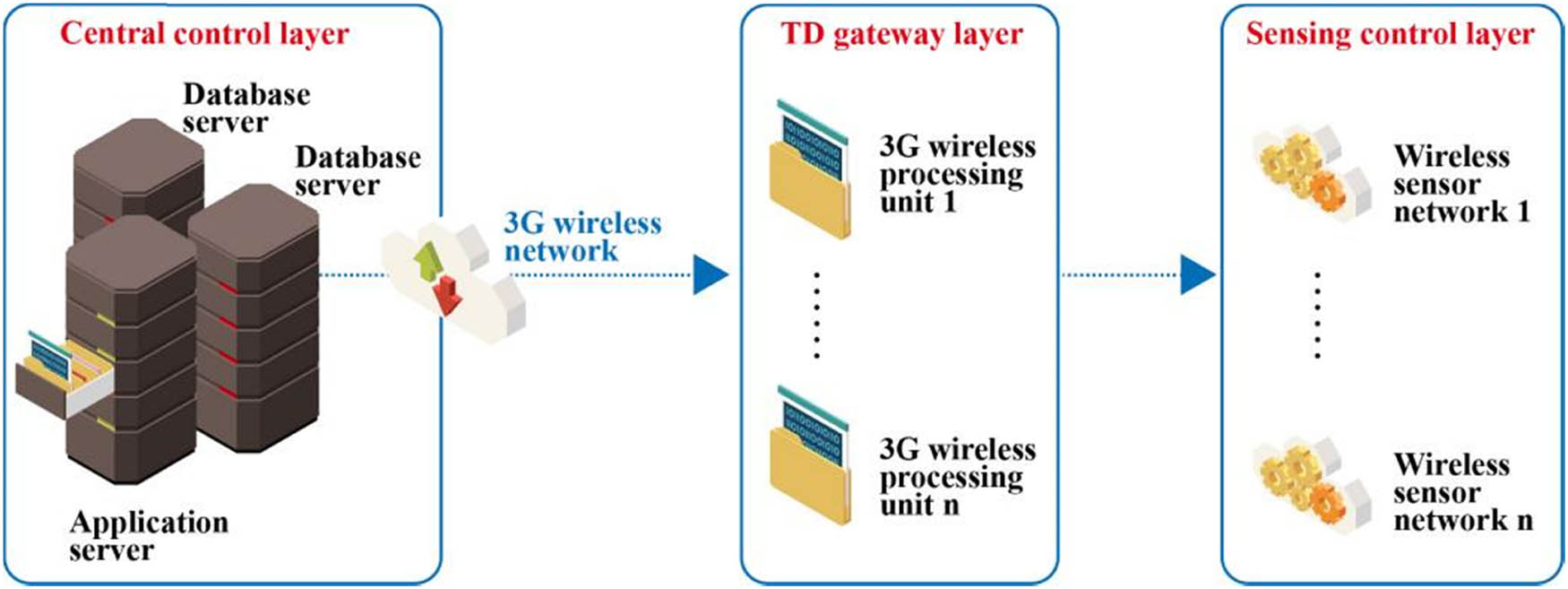
Bridge disturbance monitoring.
The communication system is subjected to harmonic oscillation, which is a kind of nonlinear strong coupling The stability control of the communication system is to ensure the wireless communication channel equalization is the key in the process of radio frequency modulation of wireless communication data as the nonlinear characteristics of oscillating data produce harmonic oscillations and it is difficult to improve wireless communication and the modulation and demodulation capability of transmitting data. Research on basic wireless communication transmission based on harmonic balance and stability control algorithm of nonlinear communication system has certain reference significance for high-performance wireless communication transmission data modulation and demodulation capability. The research on control algorithm has been paid more and more attention. Data mining algorithm and related signal processing algorithm were combined to ensure the influence of high order harmonics on the simulation results. In order to effectively apply the algorithm to the stability control of nonlinear communication systems, a distributed estimation algorithm of network control behavior is proposed, which enhances the ability of local distribution optimization in communication networks. The convergence speed is improved to some extent, but the algorithm has poor performance in the extraction and mining of nonlinear data features and nonlinear rolling predictive control quality. As the harmonic balance for nonlinear communication systems is limited to gradient information optimization, the result is bad.
In order to overcome the shortcomings of traditional monitoring methods, real-time, online, accurate, and objective structural monitoring methods are constantly being studied to provide reliable maintenance and management basis for bridges. In order to effectively deal with sudden disasters on bridges and ensure the safe operation of bridges, comprehensive structural monitoring of the bridge structure must be carried out in a timely manner after accidental damage, and harmful factors such as concrete cracks, steel fractures, and pier collapse that may cause bridge accidents must be checked. With the rapid development of transportation networks around the world, bridge experts use the monitoring data of bridge structures to evaluate the rationality of bridge design. According to the monitoring information, the ability of the bridge to bear static and dynamic loads, and the safety and reliability of each part of the bridge structure are evaluated. In a word, the research on the health monitoring of bridge structure is of great significance, the change in monitoring deflection can directly reflect the vertical displacement of the bridge caused by the weight of the bridge itself and the vertical pressure generated by the traveling vehicle, it is of great significance and value for bridge bearing capacity testing and bridge maintenance and repair [4].
2 Literature review
Wu and others believe that the early bridge detection methods are mainly visual inspection (visual inspective), also known as appearance inspection. The biggest disadvantage of visual inspection is that the inspector cannot provide objective and quantitative bridge component information, the rating is relatively arbitrary, and it is basically impossible to determine the degree of degradation of the physical and chemical properties of the structural materials, it is even more impossible to accurately locate the internal defect state of the structure, so that appropriate maintenance and reinforcement measures cannot be taken [5]. Shrestha et al. considered research on SHM systems in order to make up for the shortcomings of traditional bridge detection. The new monitoring system uses efficient test sensing instruments and fast information transmission system, real-time monitoring of bridge structure state response and its influencing factors are realized [6]. Li et al. found that SHM refers to the use of non-destructive sensing technology to obtain continuous state information of the structure, combined with structural theoretical characterization analysis to identify changes in the structural response under operating conditions, revealing possible damage or degradation therein [7]. Experts such as Zhao et al. established the health monitoring system of Runyang Yangtze River Bridge, which carried out in-depth and meticulous research on engineering early warning, and introduced the composition and objectives of the monitoring system, sensor layout plan, main subsystems, bridge safety assessment methods, and structural state identification, and they also promoted the development of domestic bridge health monitoring [8]. Gao et al. have analyzed and studied the SHM systems of three large bridges, namely, Hong Kong Tsing Ma Suspension Bridge, Kashuimen Cable-stayed Bridge, and Tingjiu Cable-stayed Bridge [9]. Zhou et al. believed that the deflection reflects the bending deformation of the structure, the displacement of the centroid of the cross section along the line perpendicular to the axis, the bridge is in the working state. The deflection deformation directly reflects the overall deformation and load-bearing capacity of the bridge. Through long-term observation of real-time measurement of bridges under dynamic load, the overall operational safety of bridges can be assessed through static and dynamic vertical deflection changes. Bridge deflection monitoring is an important indicator of bridge routine inspection and health monitoring in recent years [10]. Zhang and Woo believed that for a continuous steel bridge, the maximum mid-span deflection corresponding to a main span of 100 m is only about 10 cm, and the deflection is very small compared to the bridge itself, so the accuracy of the deflection measuring instrument is very high [11]. Bhat et al. believed that due to the importance of bridge safety, the development of structural deflection monitoring tends to be of high precision, fast, dynamic real-time, storable, wide signal range, networked, etc. [12].
3 Bridge deflection monitoring and prediction system
After the beam is deformed, its axis will bend, forming a deflection line, when the reinforced concrete beam is bent and deformed, each section of the pure bending section will rotate an angle
where
The above formula shows that the bending stiffness
In order to verify the performance of the algorithm, simulation experiments are carried out in the communication protocol set. The protocol consistency test of IEC61375-2 is carried out. The receiving and transmitting transducers of the wireless communication system are located in the receiving array terminal of multipath component in element, using frequency band of 2–10 kHz, duration was 4 ms, and the distance of data sender was 3.7 km. Based on the above simulation ring environment and parameter settings, stability control simulation of wireless communication system, and the autocorrelation accumulative output of channel impulse response of different receiving arrays are obtained.
This platform combines bridge managers and ordinary users to meet the needs of real-time management or supervision of bridges, through the combination of various modules, and provides a convenient and feasible way to regulate the bridge [14]. Mainly through the socket server module, the real-time deflection data from the single-chip microcomputer are received to judge and perform various database operations. Using Baidu map and the specific bridge deflection change information as the core of the Android terminal, in order to carry out information interaction with the web server module, real-time bridge information is provided to users at anytime and anywhere. The software system structure is shown in Figure 2.
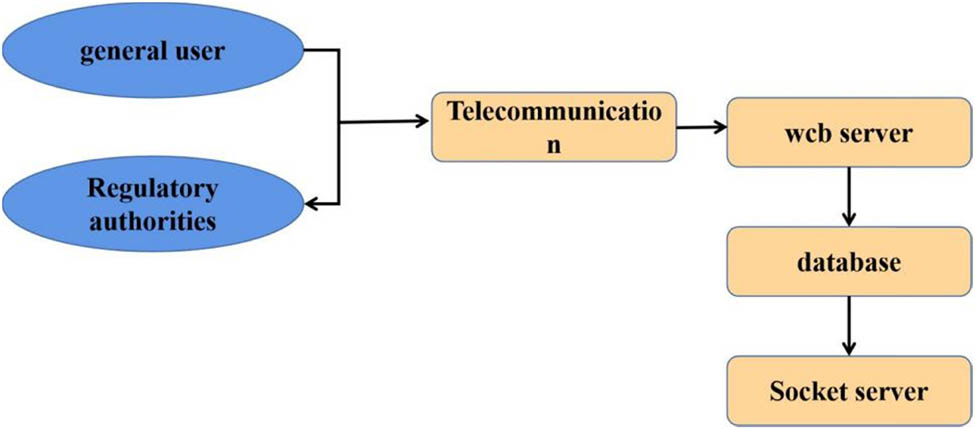
Software system structure diagram.
The prediction and evaluation of bridge health status is of great significance for the long-term use of bridges. At present, most of the evaluation algorithms for bridge health status at home and abroad are based on obtaining bridge information, and then using a variety of software for evaluation. There is usually a certain time difference between the acquisition of bridge information and the evaluation results, it can only judge the bridge state corresponding to the obtained data, the real-time performance is poor, and the evaluation algorithm is highly targeted, which is not suitable for most bridges [15]. The system selects the comprehensive scoring method and the optimized Markov chain algorithm to evaluate the bridge health status every 2 min, and finally selects the optimal algorithm.
The comprehensive scoring method is based on the quantitative and qualitative analysis of the data, an evaluation algorithm for scoring data to be evaluated. This system evaluates and scores the deflection data of all bridges, and determines the damage level of the bridge according to the score [16]. When the network communication module is on the map display page, it periodically extracts the latest 300 sets of deflection data of all bridges every 2 min, the traversal of all the deflection data of the specific bridge is performed on all the retrieved data, and the number of corresponding damage levels is counted. The deflection damage level is divided into five levels from one to five, and the corresponding deflection range is from the initial deflection
where
Comparison of damage grade, grade score, and weight
| Damage level | Level score | Weights |
|---|---|---|
| Level 1 | 0.143 | 0.17 |
| Level 2 | 0.165 | 0.18 |
| Level 3 | 0.208 | 0.19 |
| Level 4 | 0.215 | 0.20 |
| Level 5 | 0.248 | 0.23 |
Comparison of score and injury degree
| Score | Degree of damage |
|---|---|
| 50.76–61.28 | Intact |
| 61.29–71.45 | Better |
| 71.46–81.51 | There is obvious deformation, and the driving causes a little shock |
| 81.52–91.14 | There is obvious deformation, and the component has obvious deformation |
| ≥91.15 | Significant deformation occurs, seriously affecting driving safety |
The bridge icon is changed to be safe, dangerous, or alert according to different states, in which the bridge icon is set to be safe under the first and second damage levels, in the third degree of damage, the bridge icon is set as dangerous, and in the fourth and fifth degrees of damage, the corresponding bridge icon is in the alert state [18]. Doing this on all bridge data updates the short-term expected state of all bridges.
A Markov chain is a random process with Markov properties. Given the current data, the system can change from one state to another, or maintain the current state, the associated probabilities of these state changes are called transition probabilities [19]. The probability transition matrix obtained after one state transition is the one-step transition probability matrix
However, in practical applications, the data changes are sensitive, and the one-step transition probability matrix obtained at one time is used to calculate the subsequent
The system uses an optimized Markov chain to predict the expected deflection state of the bridge. First, obtain 300 sets of bridge deflection data through the Internet, divide the retrieved data into 2 groups, and divide the first group of data comparison status into 5 groups, create an array
According to this method, the one-step transition probability matrix
After the two-step transition probability matrices in the x and y directions are obtained, respectively, the future state of the last deflection data can be predicted.
After stability control by the method presented in this work, with less and less coherent components, the impulse response at the receiving end accumulates with autocorrelation, and the stability is better. In order to further test the proposed control model High communication system stability in terms of performance, using this algorithm and traditional The algorithm is used to control the stability of nonlinear communication system, and the output number is obtained Bit error rate (BER) comparison results of data.
4 Experimental analysis
The purpose of the system test is to verify the feasibility, reliability, and stability of the rapid deflection monitoring system. The testing process is carried out in the laboratory, so it is necessary to carry out a simulation of the monitoring within the deflection box girder of the bridge. With the help of the simulated bridge concrete structure of the experimental center, the following experiments were carried out.
In the static box girder of the simulated concrete bridge in the laboratory, an experimental platform is built, and a rapid deflection monitoring system is installed to monitor the real-time deflection change in the box girder online. According to the method described in the hardware design, two key measuring points are selected and a set of laser deflection instruments are installed, respectively. Then, the system controller, power manager, DTU wireless communicator, and UPS power regulator are installed.
In the whole set of experimental equipment, the server of the remote monitoring center is located in the laboratory. However, one difference that needs to be noted is that in order to simplify the construction of the experimental environment, the industrial computer is not installed in the simulated bridge box girder, instead, the industrial computer is replaced by the on-site master control manager, and the video capture card is replaced by the data collector. This experimental replacement is only low in data processing speed and throughput, and does not affect the quality of deflection acquisition. The working process of measuring deflection: (i) The server of the remote monitoring center sends an instruction to the deflection system on site through wireless transmission, and orders the deflection monitoring to start; (ii) The power manager energizes the data collector to start the collection work; (iii) The data collector remote control power manager turns on the laser transmitter to switch on the transmitter power and enable it to work; (iv) The collected deflection data are transmitted to the remote monitoring center through DTU; (v) When the collection work is over, the power manager turns off the power of the collector. After testing, the system works normally [21].
4.1 Analysis of deflection monitoring data
The monitoring process and the method of the static deflection monitoring system of the Gaojia Huayuan Bridge are as follows: The laser emission module is installed on the upstream side of the box girder of the main pier and the target is installed on the upstream side of the inner roof of the box girder in the middle of the main span. The spatial displacement of the bridge structure is obtained through detection, and the obtained original data is stored in the front-end database server. The measurement method also includes the adjustment of the sampling frequency. In order to obtain precise measurement results, the laser projection deflection sensor is set to automatically collect data every 2 min. Due to the huge amount of data collection, some data are at the risk of being inundated. Therefore, after many debugs of the data collection method, the sampling method is finally set to sample every 20 minutes, every second and every 5 points per second. The measurement of static deflection is the deflection of the bridge without dynamic load. In the actual measurement, the data of the collected deflection monitoring data in the open state are removed, and only the data in the non-open state are set as the static deflection data [22].
The monitoring process and the method of the dynamic deflection monitoring system require to arrange the dynamic deflection sensor in the midspan of the bridge. By collecting the deflection data in real time, the bridge space displacement is detected, and then the obtained original data are stored in the front-end database server. The laser emission module of the main span dynamic deflection sensing system is installed on the downstream side of the inner roof of the box girder in the main span, and the target is installed on the downstream side of the main pier box girder, it is used to monitor the actual change in the value of deflection at the mid-span, so as to grasp the stiffness and elastic recovery ability of the bridge in time.
The acquisition frequency of dynamic deflection is also determined through multiple debugging. Initially, the laser deflection sensor is set to automatically collect data every 2 min. In order to obtain precise measurement results, considering the sufficient operating capacity of the server, the data storage space can be buffered by reducing the frequency of static and dynamic deflection acquisition, then the sampling method was changed to 25 points every 20 min [22].
Since the laser is installed in the middle of the span and the target is installed on the top of the pier, it is easily affected by the reinforcement construction in the bridge, and there may be large errors in the dynamic monitoring data. The actual collection of the dynamic deflection monitoring data of right side of the Gaojia Huayuan Bridge is normalized, divided by week, and then the daily data changes are analyzed.
4.2 Dynamic deflection monitoring conclusion
The dynamic deflection change on the right side of Gaojia Garden Bridge is shown in Figure 3.
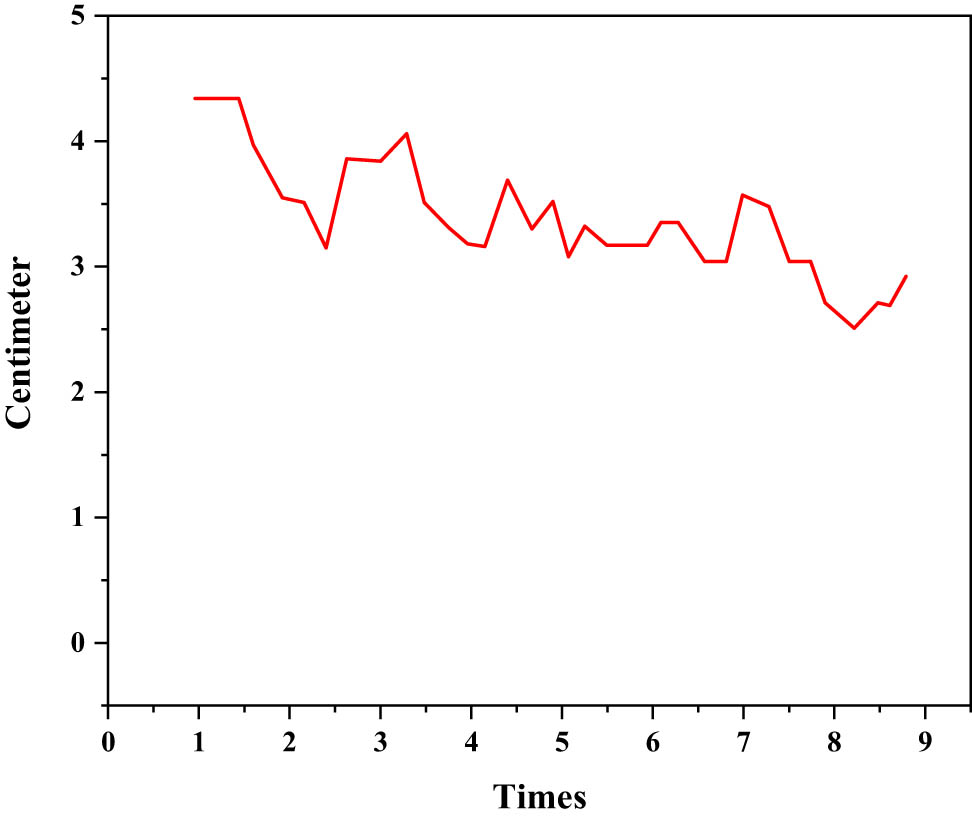
Data diagram of the dynamic deflection change in the right side of the Gaojia Garden Bridge.
From the start of remote monitoring, the mid-span dynamic deflection of the main bridge has changed, as can be seen from the right-hand dynamic deflection data map of the Gaojia Garden Bridge. The specific daily changes are shown in Table 3.
Dynamic deflection data of the right side of the Gaojia Garden Bridge
| Deflection | Data collection time | No traffic | Open to traffic | ||
|---|---|---|---|---|---|
| Dynamic | 10.00 | Routine changes | Biggest change | Routine changes | Biggest change |
| Dynamic | 11.00 | 1 | 1.4 | 2–3 | 6.5 |
| Dynamic | 12.00 | 2.5 | 2.3 | 3–5 | 6.7 |
| Dynamic | 13.00 | — | — | 4–6 | 7.12 |
| Dynamic | 14.00 | — | — | 4.5–7 | 8.7 |
| Dynamic | 15.00 | 1.5 | 2.4 | 3.1–5.5 | 6 |
| Dynamic | 16.00 | 1.8 | 2.7 | 2.5–4.6 | 7.23 |
| Dynamic | 17.00 | 1.56 | 3.1 | — | — |
| Dynamic | 18.00 | 1.68 | 2.9 | 3.1–5.4 | 8.23 |
The dynamic deflection monitoring system collects deflection data in real time through deflection sensors arranged in the mid-span of the bridge, and obtains the spatial displacement of the bridge through detection. Since the laser is installed in the middle of the span, the target is installed on the top of the pier, which is easily affected by the reinforcement construction in the bridge, and there may be large errors in the dynamic monitoring data. The actually collected dynamic deflection monitoring data are normalized in order to more clearly analyze the normal change range and maximum change amount of the bridge when it is open to traffic and not open to traffic. During the observation period, the maximum dynamic deflection in the open state fluctuated steadily from September 10 to 19, and fluctuated greatly from September 20 to 28, the volatility was relatively stable from September 29 to October 24. During the observation period, it was observed that the maximum measured dynamic deflection on September 27 was about 9 cm, which was larger than the theoretical dynamic deflection under specified load. This may be related to the increase in the dynamic deflection test value due to the reinforcement construction in the bridge. During the observation period, the static deflection was observed at 2:00 a.m. on October 5th, which was 2.369 cm higher than that at 2:00 a.m. on September 9th. During the 26 days of observation, no obvious downward deflection of the beam was found under the condition of no load. At this time, the maximum measured dynamic deflection was about 6 cm, and there was no obvious abnormality [23].
Generally speaking, during the observation period, it was observed that the static deflection gradually increased in the state of no traffic, there were certain fluctuations during the period, by 2 am on October 24, the static deflection increased by 2.860 cm compared with 2 am on September 9. During the 45 days of observation, no obvious downward deflection of the bridge was found under the condition of no load, and there was no obvious abnormality, as shown in Figure 4.
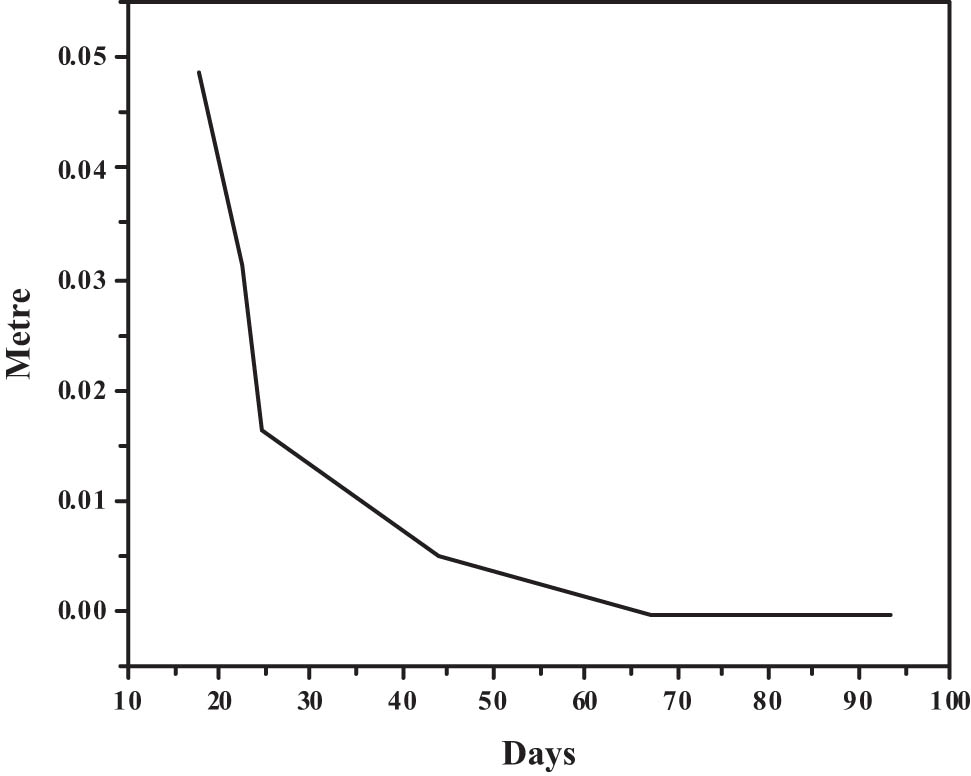
Communication system.
5 Conclusion
The bridge deflection monitoring and prediction system based on network communication can meet the design requirements of real-time performance, accuracy and practicability at the beginning of the design. Among them, in the running time of the whole software system, the receiving time of the socket server module is 3–4 sets of data per second. The main interface of AndroiApp loads Baidu map and obtains it, and the time for marking all registration information is 2–3 s. The bridge deflection display module updates the line graph at a fixed time and re-acquires the latest deflection data every 3 s, among which the time for obtaining the latest deflection and deflection information is 2–3 s. Regardless of the influence of personnel operation and network speed, the complete operation time of the system is 4–6 s (including data reception, sign marking, and bridge deflection display with time difference, does not include other features that have almost no time difference or run at a fixed time). And within the operating time range, through multiple simulation applications of the simulated bridges, the deflection prediction results are in line with the changes in the actual simulated bridges, and in the multiple detection results, the accuracy rate can reach 98%. The real-time performance of the system and the accuracy of operation ensure the practicability of the system.
This work presents an improved non-harmonic balance-based communication network. The stability control model of linear communication system is first constructed. The model extracts the signal, channel characteristics, channel model and communication network control method of the communication system, and obtains the harmonic balance nonlinear communication system based on the communication stability control algorithm. The results show that the proposed algorithm can effectively improve the non-linearity. The stability of the communication system reduces the BER, overcomes the coherence in the side lobe component interference and shows superior performance of the proposed algorithm.
In the era of mobile internet, the internet technology is applied to the real-time monitoring of bridge safety, and the bridge state is predicted by using a variety of algorithms, it injects new vitality into the monitoring technology of real-time change in bridge deflection, and also provides a new way to monitor bridges for management departments and ordinary users. The bridge deflection change monitoring platform has high real-time performance, low operating cost, and convenient operation. Real-time monitoring of bridge operation can be established to predict its short-term changes, which is of great help for users to monitor bridges and formulate reasonable and effective maintenance measures according to the changes, and save maintenance costs, and the purpose of extending the service life of the bridge and ensuring the safety of the bridge are achieved.
-
Funding information: The authors state no funding involved.
-
Author contributions: All authors have accepted responsibility for the entire content of this manuscript and approved its submission.
-
Conflict of interest: The authors state no conflict of interest.
References
[1] Guo A, Jiang A, Lin J, Li X. Data mining algorithms for bridge health monitoring: Kohonen clustering and LSTM prediction approaches. J Supercomput. 2020;76(2):932–47.10.1007/s11227-019-03045-8Search in Google Scholar
[2] Sarmah SS. An efficient IoT-based patient monitoring and heart disease prediction system using deep learning modified neural network. IEEE Access. 2020;8:135784–97.10.1109/ACCESS.2020.3007561Search in Google Scholar
[3] Chen JY, Zhuang JX, Huang MS. Monitoring, prediction and control of injection molding quality based on tie-bar elongation. J Manuf Process. 2019;46(Oct):159–69.10.1016/j.jmapro.2019.09.005Search in Google Scholar
[4] Villain J, Deniau V, Fleury A, Simon EP, Kousri R. EM monitoring and classification of IEMI and protocol-based attacks on IEEE 802.11n communication networks. IEEE Trans Electromagn Compat. 2019;61(6):1771–81.10.1109/TEMC.2019.2900262Search in Google Scholar
[5] Wu D, Hu M, Huang Y, Zhang P, Yu Z. In situ monitoring and penetration prediction of plasma arc welding based on welder intelligence-enhanced deep random forest fusion. J Manuf Process. 2021;66(9):153–65.10.1016/j.jmapro.2021.04.007Search in Google Scholar
[6] Shrestha A, Dang J, Wang X, Matsunaga S. Smartphone-based bridge seismic monitoring system and long-term field application tests. J Struct Eng. 2020;146(2):04019208.1–04019208.14.10.1061/(ASCE)ST.1943-541X.0002513Search in Google Scholar
[7] Li X, Liu X, Li CZ, Hu Z, Shen GQ, Huang Z. Foundation pit displacement monitoring and prediction using least squares support vector machines based on multi-point measurement. Struct Health Monit. 2019;18(3):715–24.10.1177/1475921718767935Search in Google Scholar
[8] Zhao J, Tian H, Li DA. Channel prediction based on BP neural network for backscatter communication networks. Sensors. 2020;20(1):300.10.3390/s20010300Search in Google Scholar PubMed PubMed Central
[9] Gao Q, Liu W, Li D, Wang Y, Xue T. Research and implementation of the roll position automatic adjustment system based on roller parameters prediction. J Adv Manuf Syst. 2019;18(2):273–92.10.1142/S0219686719500148Search in Google Scholar
[10] Zhou D, Li Z, Zhu J, Zhang H, Hou L. State of health monitoring and remaining useful life prediction of lithium-ion batteries based on temporal convolutional network. IEEE Access. 2020;8:53307–20.10.1109/ACCESS.2020.2981261Search in Google Scholar
[11] Zhang D, Woo SS. Real time localized air quality monitoring and prediction through mobile and fixed IoT sensing network. IEEE Access. 2020;8:89584–94.10.1109/ACCESS.2020.2993547Search in Google Scholar
[12] Ashraf M, Zaman M, Ahmed M. An intelligent prediction system for educational data mining based on ensemble and filtering approaches. Procedia Comput Sci. 2020;167:1471–83.10.1016/j.procs.2020.03.358Search in Google Scholar
[13] Yu J, Du S, Wu Y. Design and application of soil moisture content monitoring system based on cloud-native technology. Nongye Gongcheng Xuebao/Trans Chin Soc Agric Eng. 2020;36(13):165–72.Search in Google Scholar
[14] Li J, Gao F, Lu J, Tao T. Deformation monitoring and prediction for residential areas in the Panji mining area based on an InSAR time series analysis and the GM-SVR model. Open Geosci. 2019;11(1):738–49.10.1515/geo-2019-0058Search in Google Scholar
[15] Abdelnasser A, Rashad MZ, Hussein SE. A two-layer water demand prediction system in urban areas based on micro-services and LSTM neural networks. IEEE Access. 2020;8:147647–61.10.1109/ACCESS.2020.3015655Search in Google Scholar
[16] Yuan SL. High-rise building deformation monitoring based on remote wireless sensor network. IEEE Sens J. 2021;21(22):25133–41.10.1109/JSEN.2021.3067378Search in Google Scholar
[17] Wang Y, Jia P, Cui H, Peng X. A novel regression prediction method for electronic nose based on broad learning system. IEEE Sens J. 2021;21(17):19374–81.10.1109/JSEN.2021.3090449Search in Google Scholar
[18] Lu J, Zeng D, Zheng Y, Tang Y, Yan F. Fault prediction of electromagnetic launch system based on knowledge prediction time series. IEEE Trans Ind Appl. 2020;57(2):1830–9.10.1109/TIA.2020.3046705Search in Google Scholar
[19] Han C, Liu A, Huo L, Wang H, Liang XL. A prediction-based resource matching scheme for rentable leo satellite communication network. IEEE Commun Lett. 2019;24(2):414–7.10.1109/LCOMM.2019.2955469Search in Google Scholar
[20] Rosato A, Panella M, Araneo R, Andreotti A. A neural network based prediction system of distributed generation for the management of microgrids. IEEE Trans Ind Appl. 2019;55(6):7092–102.10.1109/TIA.2019.2916758Search in Google Scholar
[21] Liu S, Lyu Q, Liu X, Sun Y, Zhang X. A prediction system of burn through point based on gradient boosting decision tree and decision rules. ISIJ Int. 2019;59(12):2156–64.10.2355/isijinternational.ISIJINT-2019-059Search in Google Scholar
[22] Du Y, Li F. Intelligent multi-microgrid energy management based on deep neural network and model-free reinforcement learning. IEEE Trans Smart Grid. 2019;11(2):1066–76.10.1109/TSG.2019.2930299Search in Google Scholar
[23] Wang Z, Duan D, Yu H, Xin Y, Li F. Local bending deformation monitoring of bi-dimensional bridge deck based on the displacement–strain transfer matrix. J Civ Struct Health Monit. 2021;11(1):1–24.10.1007/s13349-021-00485-wSearch in Google Scholar
© 2023 the author(s), published by De Gruyter
This work is licensed under the Creative Commons Attribution 4.0 International License.
Articles in the same Issue
- Research Articles
- The regularization of spectral methods for hyperbolic Volterra integrodifferential equations with fractional power elliptic operator
- Analytical and numerical study for the generalized q-deformed sinh-Gordon equation
- Dynamics and attitude control of space-based synthetic aperture radar
- A new optimal multistep optimal homotopy asymptotic method to solve nonlinear system of two biological species
- Dynamical aspects of transient electro-osmotic flow of Burgers' fluid with zeta potential in cylindrical tube
- Self-optimization examination system based on improved particle swarm optimization
- Overlapping grid SQLM for third-grade modified nanofluid flow deformed by porous stretchable/shrinkable Riga plate
- Research on indoor localization algorithm based on time unsynchronization
- Performance evaluation and optimization of fixture adapter for oil drilling top drives
- Nonlinear adaptive sliding mode control with application to quadcopters
- Numerical simulation of Burgers’ equations via quartic HB-spline DQM
- Bond performance between recycled concrete and steel bar after high temperature
- Deformable Laplace transform and its applications
- A comparative study for the numerical approximation of 1D and 2D hyperbolic telegraph equations with UAT and UAH tension B-spline DQM
- Numerical approximations of CNLS equations via UAH tension B-spline DQM
- Nonlinear numerical simulation of bond performance between recycled concrete and corroded steel bars
- An iterative approach using Sawi transform for fractional telegraph equation in diversified dimensions
- Investigation of magnetized convection for second-grade nanofluids via Prabhakar differentiation
- Influence of the blade size on the dynamic characteristic damage identification of wind turbine blades
- Cilia and electroosmosis induced double diffusive transport of hybrid nanofluids through microchannel and entropy analysis
- Semi-analytical approximation of time-fractional telegraph equation via natural transform in Caputo derivative
- Analytical solutions of fractional couple stress fluid flow for an engineering problem
- Simulations of fractional time-derivative against proportional time-delay for solving and investigating the generalized perturbed-KdV equation
- Pricing weather derivatives in an uncertain environment
- Variational principles for a double Rayleigh beam system undergoing vibrations and connected by a nonlinear Winkler–Pasternak elastic layer
- Novel soliton structures of truncated M-fractional (4+1)-dim Fokas wave model
- Safety decision analysis of collapse accident based on “accident tree–analytic hierarchy process”
- Derivation of septic B-spline function in n-dimensional to solve n-dimensional partial differential equations
- Development of a gray box system identification model to estimate the parameters affecting traffic accidents
- Homotopy analysis method for discrete quasi-reversibility mollification method of nonhomogeneous backward heat conduction problem
- New kink-periodic and convex–concave-periodic solutions to the modified regularized long wave equation by means of modified rational trigonometric–hyperbolic functions
- Explicit Chebyshev Petrov–Galerkin scheme for time-fractional fourth-order uniform Euler–Bernoulli pinned–pinned beam equation
- NASA DART mission: A preliminary mathematical dynamical model and its nonlinear circuit emulation
- Nonlinear dynamic responses of ballasted railway tracks using concrete sleepers incorporated with reinforced fibres and pre-treated crumb rubber
- Two-component excitation governance of giant wave clusters with the partially nonlocal nonlinearity
- Bifurcation analysis and control of the valve-controlled hydraulic cylinder system
- Engineering fault intelligent monitoring system based on Internet of Things and GIS
- Traveling wave solutions of the generalized scale-invariant analog of the KdV equation by tanh–coth method
- Electric vehicle wireless charging system for the foreign object detection with the inducted coil with magnetic field variation
- Dynamical structures of wave front to the fractional generalized equal width-Burgers model via two analytic schemes: Effects of parameters and fractionality
- Theoretical and numerical analysis of nonlinear Boussinesq equation under fractal fractional derivative
- Research on the artificial control method of the gas nuclei spectrum in the small-scale experimental pool under atmospheric pressure
- Mathematical analysis of the transmission dynamics of viral infection with effective control policies via fractional derivative
- On duality principles and related convex dual formulations suitable for local and global non-convex variational optimization
- Study on the breaking characteristics of glass-like brittle materials
- The construction and development of economic education model in universities based on the spatial Durbin model
- Homoclinic breather, periodic wave, lump solution, and M-shaped rational solutions for cold bosonic atoms in a zig-zag optical lattice
- Fractional insights into Zika virus transmission: Exploring preventive measures from a dynamical perspective
- Rapid Communication
- Influence of joint flexibility on buckling analysis of free–free beams
- Special Issue: Recent trends and emergence of technology in nonlinear engineering and its applications - Part II
- Research on optimization of crane fault predictive control system based on data mining
- Nonlinear computer image scene and target information extraction based on big data technology
- Nonlinear analysis and processing of software development data under Internet of things monitoring system
- Nonlinear remote monitoring system of manipulator based on network communication technology
- Nonlinear bridge deflection monitoring and prediction system based on network communication
- Cross-modal multi-label image classification modeling and recognition based on nonlinear
- Application of nonlinear clustering optimization algorithm in web data mining of cloud computing
- Optimization of information acquisition security of broadband carrier communication based on linear equation
- A review of tiger conservation studies using nonlinear trajectory: A telemetry data approach
- Multiwireless sensors for electrical measurement based on nonlinear improved data fusion algorithm
- Realization of optimization design of electromechanical integration PLC program system based on 3D model
- Research on nonlinear tracking and evaluation of sports 3D vision action
- Analysis of bridge vibration response for identification of bridge damage using BP neural network
- Numerical analysis of vibration response of elastic tube bundle of heat exchanger based on fluid structure coupling analysis
- Establishment of nonlinear network security situational awareness model based on random forest under the background of big data
- Research and implementation of non-linear management and monitoring system for classified information network
- Study of time-fractional delayed differential equations via new integral transform-based variation iteration technique
- Exhaustive study on post effect processing of 3D image based on nonlinear digital watermarking algorithm
- A versatile dynamic noise control framework based on computer simulation and modeling
- A novel hybrid ensemble convolutional neural network for face recognition by optimizing hyperparameters
- Numerical analysis of uneven settlement of highway subgrade based on nonlinear algorithm
- Experimental design and data analysis and optimization of mechanical condition diagnosis for transformer sets
- Special Issue: Reliable and Robust Fuzzy Logic Control System for Industry 4.0
- Framework for identifying network attacks through packet inspection using machine learning
- Convolutional neural network for UAV image processing and navigation in tree plantations based on deep learning
- Analysis of multimedia technology and mobile learning in English teaching in colleges and universities
- A deep learning-based mathematical modeling strategy for classifying musical genres in musical industry
- An effective framework to improve the managerial activities in global software development
- Simulation of three-dimensional temperature field in high-frequency welding based on nonlinear finite element method
- Multi-objective optimization model of transmission error of nonlinear dynamic load of double helical gears
- Fault diagnosis of electrical equipment based on virtual simulation technology
- Application of fractional-order nonlinear equations in coordinated control of multi-agent systems
- Research on railroad locomotive driving safety assistance technology based on electromechanical coupling analysis
- Risk assessment of computer network information using a proposed approach: Fuzzy hierarchical reasoning model based on scientific inversion parallel programming
- Special Issue: Dynamic Engineering and Control Methods for the Nonlinear Systems - Part I
- The application of iterative hard threshold algorithm based on nonlinear optimal compression sensing and electronic information technology in the field of automatic control
- Equilibrium stability of dynamic duopoly Cournot game under heterogeneous strategies, asymmetric information, and one-way R&D spillovers
- Mathematical prediction model construction of network packet loss rate and nonlinear mapping user experience under the Internet of Things
- Target recognition and detection system based on sensor and nonlinear machine vision fusion
- Risk analysis of bridge ship collision based on AIS data model and nonlinear finite element
- Video face target detection and tracking algorithm based on nonlinear sequence Monte Carlo filtering technique
- Adaptive fuzzy extended state observer for a class of nonlinear systems with output constraint
Articles in the same Issue
- Research Articles
- The regularization of spectral methods for hyperbolic Volterra integrodifferential equations with fractional power elliptic operator
- Analytical and numerical study for the generalized q-deformed sinh-Gordon equation
- Dynamics and attitude control of space-based synthetic aperture radar
- A new optimal multistep optimal homotopy asymptotic method to solve nonlinear system of two biological species
- Dynamical aspects of transient electro-osmotic flow of Burgers' fluid with zeta potential in cylindrical tube
- Self-optimization examination system based on improved particle swarm optimization
- Overlapping grid SQLM for third-grade modified nanofluid flow deformed by porous stretchable/shrinkable Riga plate
- Research on indoor localization algorithm based on time unsynchronization
- Performance evaluation and optimization of fixture adapter for oil drilling top drives
- Nonlinear adaptive sliding mode control with application to quadcopters
- Numerical simulation of Burgers’ equations via quartic HB-spline DQM
- Bond performance between recycled concrete and steel bar after high temperature
- Deformable Laplace transform and its applications
- A comparative study for the numerical approximation of 1D and 2D hyperbolic telegraph equations with UAT and UAH tension B-spline DQM
- Numerical approximations of CNLS equations via UAH tension B-spline DQM
- Nonlinear numerical simulation of bond performance between recycled concrete and corroded steel bars
- An iterative approach using Sawi transform for fractional telegraph equation in diversified dimensions
- Investigation of magnetized convection for second-grade nanofluids via Prabhakar differentiation
- Influence of the blade size on the dynamic characteristic damage identification of wind turbine blades
- Cilia and electroosmosis induced double diffusive transport of hybrid nanofluids through microchannel and entropy analysis
- Semi-analytical approximation of time-fractional telegraph equation via natural transform in Caputo derivative
- Analytical solutions of fractional couple stress fluid flow for an engineering problem
- Simulations of fractional time-derivative against proportional time-delay for solving and investigating the generalized perturbed-KdV equation
- Pricing weather derivatives in an uncertain environment
- Variational principles for a double Rayleigh beam system undergoing vibrations and connected by a nonlinear Winkler–Pasternak elastic layer
- Novel soliton structures of truncated M-fractional (4+1)-dim Fokas wave model
- Safety decision analysis of collapse accident based on “accident tree–analytic hierarchy process”
- Derivation of septic B-spline function in n-dimensional to solve n-dimensional partial differential equations
- Development of a gray box system identification model to estimate the parameters affecting traffic accidents
- Homotopy analysis method for discrete quasi-reversibility mollification method of nonhomogeneous backward heat conduction problem
- New kink-periodic and convex–concave-periodic solutions to the modified regularized long wave equation by means of modified rational trigonometric–hyperbolic functions
- Explicit Chebyshev Petrov–Galerkin scheme for time-fractional fourth-order uniform Euler–Bernoulli pinned–pinned beam equation
- NASA DART mission: A preliminary mathematical dynamical model and its nonlinear circuit emulation
- Nonlinear dynamic responses of ballasted railway tracks using concrete sleepers incorporated with reinforced fibres and pre-treated crumb rubber
- Two-component excitation governance of giant wave clusters with the partially nonlocal nonlinearity
- Bifurcation analysis and control of the valve-controlled hydraulic cylinder system
- Engineering fault intelligent monitoring system based on Internet of Things and GIS
- Traveling wave solutions of the generalized scale-invariant analog of the KdV equation by tanh–coth method
- Electric vehicle wireless charging system for the foreign object detection with the inducted coil with magnetic field variation
- Dynamical structures of wave front to the fractional generalized equal width-Burgers model via two analytic schemes: Effects of parameters and fractionality
- Theoretical and numerical analysis of nonlinear Boussinesq equation under fractal fractional derivative
- Research on the artificial control method of the gas nuclei spectrum in the small-scale experimental pool under atmospheric pressure
- Mathematical analysis of the transmission dynamics of viral infection with effective control policies via fractional derivative
- On duality principles and related convex dual formulations suitable for local and global non-convex variational optimization
- Study on the breaking characteristics of glass-like brittle materials
- The construction and development of economic education model in universities based on the spatial Durbin model
- Homoclinic breather, periodic wave, lump solution, and M-shaped rational solutions for cold bosonic atoms in a zig-zag optical lattice
- Fractional insights into Zika virus transmission: Exploring preventive measures from a dynamical perspective
- Rapid Communication
- Influence of joint flexibility on buckling analysis of free–free beams
- Special Issue: Recent trends and emergence of technology in nonlinear engineering and its applications - Part II
- Research on optimization of crane fault predictive control system based on data mining
- Nonlinear computer image scene and target information extraction based on big data technology
- Nonlinear analysis and processing of software development data under Internet of things monitoring system
- Nonlinear remote monitoring system of manipulator based on network communication technology
- Nonlinear bridge deflection monitoring and prediction system based on network communication
- Cross-modal multi-label image classification modeling and recognition based on nonlinear
- Application of nonlinear clustering optimization algorithm in web data mining of cloud computing
- Optimization of information acquisition security of broadband carrier communication based on linear equation
- A review of tiger conservation studies using nonlinear trajectory: A telemetry data approach
- Multiwireless sensors for electrical measurement based on nonlinear improved data fusion algorithm
- Realization of optimization design of electromechanical integration PLC program system based on 3D model
- Research on nonlinear tracking and evaluation of sports 3D vision action
- Analysis of bridge vibration response for identification of bridge damage using BP neural network
- Numerical analysis of vibration response of elastic tube bundle of heat exchanger based on fluid structure coupling analysis
- Establishment of nonlinear network security situational awareness model based on random forest under the background of big data
- Research and implementation of non-linear management and monitoring system for classified information network
- Study of time-fractional delayed differential equations via new integral transform-based variation iteration technique
- Exhaustive study on post effect processing of 3D image based on nonlinear digital watermarking algorithm
- A versatile dynamic noise control framework based on computer simulation and modeling
- A novel hybrid ensemble convolutional neural network for face recognition by optimizing hyperparameters
- Numerical analysis of uneven settlement of highway subgrade based on nonlinear algorithm
- Experimental design and data analysis and optimization of mechanical condition diagnosis for transformer sets
- Special Issue: Reliable and Robust Fuzzy Logic Control System for Industry 4.0
- Framework for identifying network attacks through packet inspection using machine learning
- Convolutional neural network for UAV image processing and navigation in tree plantations based on deep learning
- Analysis of multimedia technology and mobile learning in English teaching in colleges and universities
- A deep learning-based mathematical modeling strategy for classifying musical genres in musical industry
- An effective framework to improve the managerial activities in global software development
- Simulation of three-dimensional temperature field in high-frequency welding based on nonlinear finite element method
- Multi-objective optimization model of transmission error of nonlinear dynamic load of double helical gears
- Fault diagnosis of electrical equipment based on virtual simulation technology
- Application of fractional-order nonlinear equations in coordinated control of multi-agent systems
- Research on railroad locomotive driving safety assistance technology based on electromechanical coupling analysis
- Risk assessment of computer network information using a proposed approach: Fuzzy hierarchical reasoning model based on scientific inversion parallel programming
- Special Issue: Dynamic Engineering and Control Methods for the Nonlinear Systems - Part I
- The application of iterative hard threshold algorithm based on nonlinear optimal compression sensing and electronic information technology in the field of automatic control
- Equilibrium stability of dynamic duopoly Cournot game under heterogeneous strategies, asymmetric information, and one-way R&D spillovers
- Mathematical prediction model construction of network packet loss rate and nonlinear mapping user experience under the Internet of Things
- Target recognition and detection system based on sensor and nonlinear machine vision fusion
- Risk analysis of bridge ship collision based on AIS data model and nonlinear finite element
- Video face target detection and tracking algorithm based on nonlinear sequence Monte Carlo filtering technique
- Adaptive fuzzy extended state observer for a class of nonlinear systems with output constraint
