Spacing strategies for enhancing drought resilience and yield in maize agriculture
-
Nicole Frantová
 ,
Lenka Porčová
,
Lenka Porčová

Abstract
This study investigates the impact of row spacing management on the yield, tillering, and water retention capacities of two maize varieties (F1 hybrids): Alombo (FAO 240) and SY Ignis (FAO 320). Through a comprehensive field experiment, we explored how varying inter-row and intra-row spacings influence plant physiological traits, including tillering frequency, relative water content (RWC), and yield components such as ear weight, seed number, and thousand kernel weight. Our findings demonstrate that narrower inter-row spacing (0.375 m) coupled with wider intra-row spacing (0.33 m) compared to inter-row spacing (0.75 m) with intra-row spacing (0.16 m) significantly enhances tillering, RWC, and grain yield, particularly for SY Ignis. The study reveals that tillering variability, influenced by spatial arrangement, serves as a potential indicator of yield outcomes, with increased tillering associated with higher biomass production and grain yield. Additionally, the research highlights the critical role of precise spatial arrangement in optimizing maize hydration, underscoring the strategic balance between inter-row and intra-row spacing for maintaining optimal moisture levels and supporting plant health. The results underscore the complexity of row spacing effects, which are not only variety-specific but also dependent on environmental and site-specific conditions, advocating for the adoption of tailored agricultural management practices to optimize crop production efficiency, especially under changing climate conditions.
1 Introduction
In an era characterized by climate fluctuations [1,2,3], farmers on a global scale encounter the formidable challenge of adjusting their agricultural practices to accommodate evolving environmental conditions, which encompass not only drought [4,5] but also various climate factors such as temperature [6]. Certain regions are anticipated to experience increasingly severe drought episodes [7]. In response to these changes, farmers have the opportunity to integrate their traditional agricultural wisdom with contemporary scientific methodologies such as different row spacing.
Row spacing in agriculture is a critical decision of farmers that can affect plant water [8] and nutrient competition [9], as well as their ability to tolerate biotic [10] and abiotic stresses [11]. Reducing the spacing between rows of plants may intensify competition for water resources. When plants are positioned closely together, nearby individuals can draw more water from the soil, which may, in turn, subject some plants to water stress [12]. Increased row spacing promotes more even water resource distribution, minimizing interplant competition. This can enhance individual plant water utilization, especially in regions with limited water availability [13,14].
The rationale behind this study is to explore how varying row spacing affects the water regime of maize plants and, consequently, impacts key agronomic parameters such as tiller count, aboveground biomass production, and grain yield and its components in maize. By looking into these relationships, the study hopes to offer practical advice to optimize maize cultivation practices, especially with the challenges posed by climate change.
The hypothesis suggested that differences in row spacing would lead to variations in the water regime, which in turn would influence yield and yield components.
2 Methods
2.1 Maize variety selection
The selection of maize varieties was guided by their earliness, a parameter often referred to as the FAO number. Optimal choices for field experiments tend to favour varieties with lower FAO numbers for early maturation and medium-to-late or late varieties with higher FAO numbers. Two specific maize varieties (F1 hybrids, single cross) were selected for the experiment: Alombo, originating from Oseva company (CZE), and SY Ignis, developed by Syngenta (CHE). As previous testing shows, these chosen varieties have demonstrated exceptional adaptability to the prevailing field conditions. Alombo, characterized by an FAO number of 240, stands out with its grain type, falling between flint and dent maize. Conversely, SY Ignis, with an FAO number of 320, belongs to the dent maize category. Particularly, both varieties can be grown for either silage or grain, making them ideal for this field experiment.
2.2 Examination area and field trial
In this experiment, maize plants were cultivated in the South Moravian Region, Czech Republic (49.023 N,16.618 E). The climatic conditions at this site are characterized by an average temperature of 10.3°C and an annual precipitation total of 491.1 mm [15]. Meteorological data, including precipitation measurements obtained through a Met One 370 rain gauge from Met One Instruments (USA) and temperature readings taken at a height of 2 m above ground using a Vaisala HMP155A Merici sensor manufactured by Vaisala (Finland), were recorded throughout the experiment.
2.3 Extreme weather events
For the optimal growth of maize, early May is crucial for the favourable conditions necessary for the germination of maize seeds. The period extending from late May to August significantly influences both vegetative and reproductive growth and the ripening stage. Despite meteorological data indicating sufficient rainfall in May (Figure 1), only a few days exhibited precipitation levels beneficial to growth. June and July presented challenging conditions for maize growth, characterized by above-normal temperatures in July and a notable lack of precipitation in both months, leading to drought stress on maize plants. August is represented by increased precipitation; however, it is essential to highlight that this heightened precipitation results from intense storms with substantial rainfall.
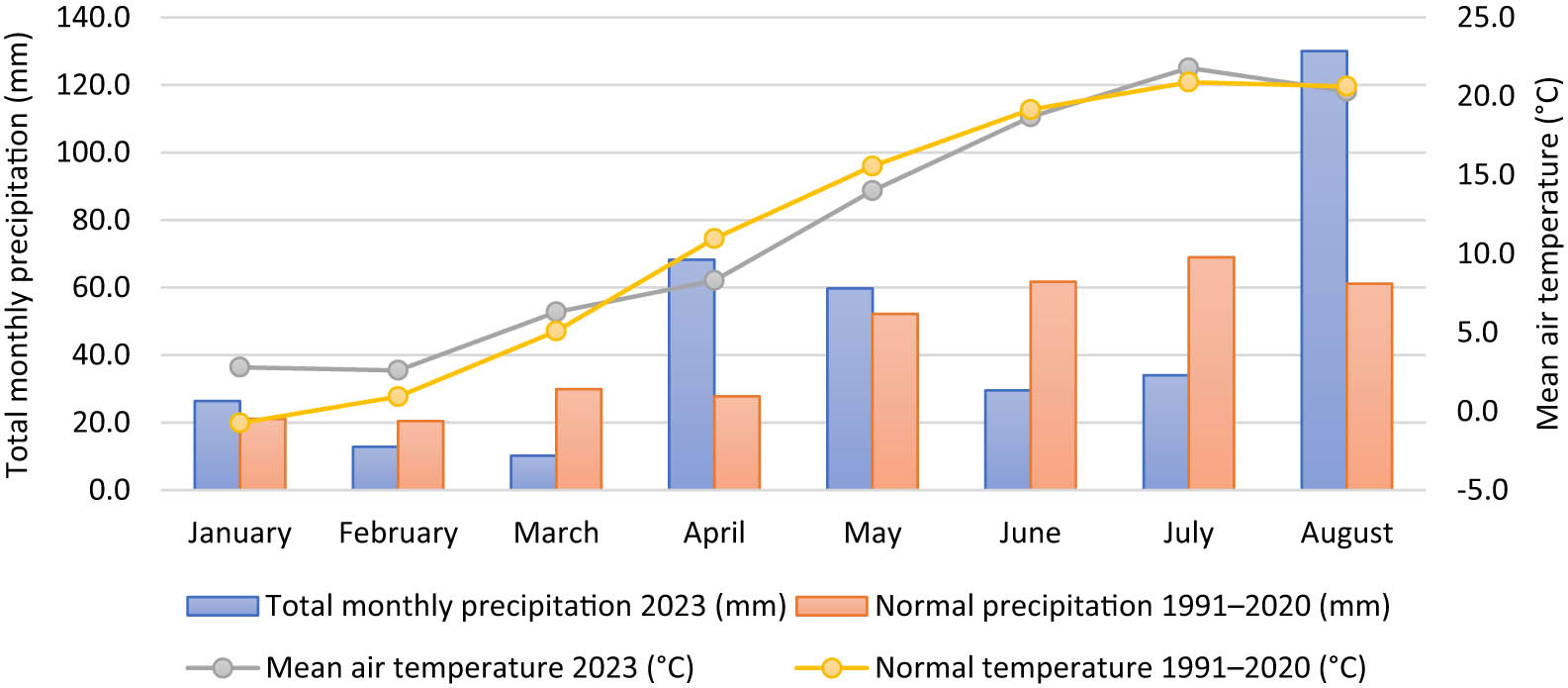
Weather conditions at the Žabčice locality, such as precipitation totals and average air temperatures.
2.4 Field trial
Regarding the agricultural practices used, the maize field was fertilized with 40 kg/ha of manure in November 2022 and with 120 kg/ha of urea before sowing in April. Prior to sowing, a total herbicide, Roundup Flex containing 450 g/L glyphosate, was applied at a rate of 3.5 L/ha. During growth, the herbicide Lumax, combining mesotrione (37.5 g/L), S-metolachlor (375 g/L), and terbuthylazine (125 g/L), was used at 3.5 L/ha, and the plants were treated against the European corn borer with the insecticide Voliam, which contains 200 g/L chlorantraniliprole, at a rate of 0.1 L/ha. The seeds were treated with Force 20 CS containing 200 g/L tefluthrin, recommended at 50 mL per 50,000 seeds. Throughout their growth, the maize plants were irrigated only by rainfall.
The design of experiment featured randomized plots of maize for cultivation, each covering an area of 21 m2. Each maize variety was cultivated in two independent replications. Sowing took place in May. Two distinct sowing spacings were selected, namely, 0.75 and 0.375 m (Figure 2), which were utilized to achieve an equal seed density of 80,000 seeds per hectare, which resulted in plants inside the row being further from each other when sown at a distance of 0.375 m. The proximate distance between plants within the row was 0.16 m for 0.75 m interrow spacing, and 0.33 m for 0.375 m interrow spacing. The sowing depth was maintained at 0.06–0.07 m to ensure uniformity and consistency in the planting process. The preceding crop species cultivated on the same site was sunflower.
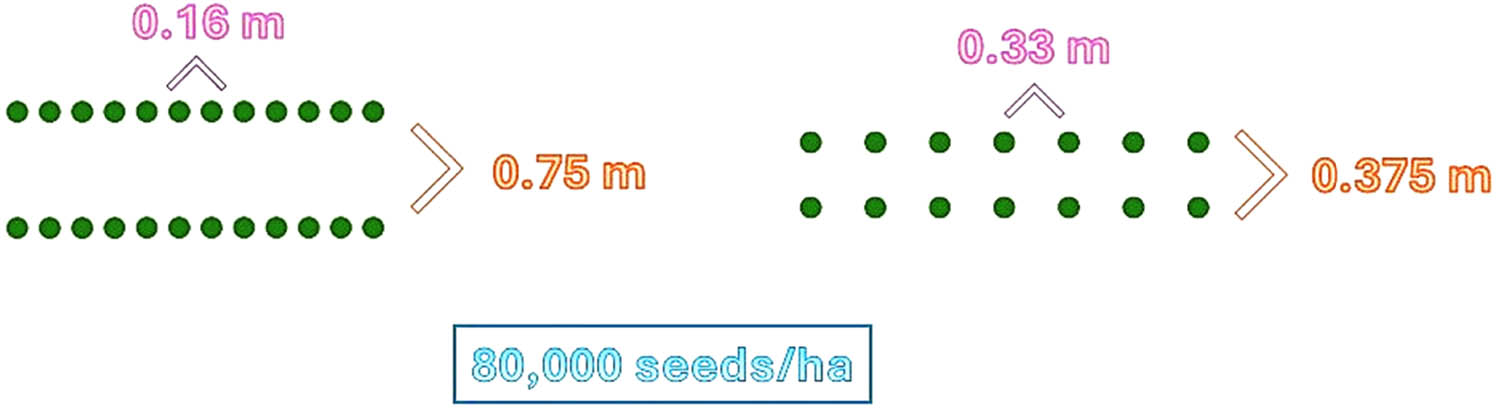
Row spacing scheme of the experiment for two maize varieties.
2.5 Relative water content (RWC)
Leaf RWC represents the percentage of water content at the sampling time relative to the water content observed at full turgor. A prerequisite for each sampling event was the absence of rainfall for a minimum of 3–4 days. Samples, consistent in size (approximately 1 cm × 5 cm), were collected from the third youngest and third oldest leaf on three specific dates: 20th June (48 days after sowing, BBCH 15), 12th July (70 days after sowing, BBCH 59), and 16th August (105 days after sowing, BBCH 77), and securely placed in sealed plastic tubes. Subsequently, these field samples were transported to the field station within cool boxes. Each sample was individually weighed to determine its fresh weight (on the scale with at least four decimal places). The leaves were then cut into approximately 1 cm × 1 cm pieces and returned to their tubes, into which water was added until complete submersion of all sample components was achieved. Following a 3-h interval, the tubes were emptied of water, and the samples were subjected to drying using filter paper. The saturated weight was measured, after which the samples were further dried in an oven (BMT Venticell ECO) set at 80°C for 1 h, then 103°C for 2 h (noting that both the drying time and temperature were modified from the original protocol) [16]. The samples were weighed again to determine their dry weight after this drying process. The RWC was subsequently calculated using the following formula:
2.6 Tiller abundance and maize yield quantification
The number of tillers was counted for all plants per plot prior to a harvest. The maize plants were harvested through a systematic procedure involving four replicates, guided by the dry matter content of the aboveground biomass, which typically accounts for approximately 33% of maize’s total biomass. Continuous sampling methods were employed to monitor and determine the optimal harvest timing. The plants were cut at a height of approximately 0.1 m above the ground. Harvesting was conducted by cutting ten consecutively growing plants for both row spacings in four replicates. After the harvest, the biomass was weighed, followed by crushing and homogenization to ensure uniformity. The collected material underwent a two-stage drying process within the drying oven. The initial drying stage spanned 24 h at a temperature of 65°C, followed by a subsequent 4-h drying stage at 105°C. Ultimately, the dry aboveground biomass was quantified in tonnes per hectare.
Harvesting of maize grain from the main stem for each replication was performed using a combine harvester. Manual harvesting of maize ears from the main stem depended on the ripening stage. Comprehensive analyses of ear and grain traits were conducted, covering parameters such as the weight of ears with and without grains, the number of rows on each ear, ear size (length and diameter at the middle), as well as grain count and weight, including the measurement of the thousand kernel weight (TKW). The ear yield was calculated as follows:
The calculation of the percentage of tillering plants was performed using the following formula:
2.7 Statistical analysis
Statistical analyses were conducted using XLSTAT, a software program that functions as an add-on to Microsoft Excel (Lumivero, USA). The observed data underwent analysis employing the Kruskal–Wallis test, a nonparametric statistical method. For subsequent post hoc testing involving multiple pairwise comparisons, the Steel–Dwass–Critchlow–Fligner test was employed. A significance level of p < 0.05 was chosen, indicating that results achieving this threshold were considered statistically significant. Additionally, principal component analysis (PCA) was performed to explore the variability within the dataset and to identify patterns among the variables related to maize tillering. This PCA was executed using Python and Matplotlib for visualizing the PCA results.
Furthermore, data values were depicted through violin plots, which are enhancements of box plots that show not only the summary statistics but also the distribution of the data. The broadest segment of a violin plot indicates the density of data points, offering a visual cue to the most common value ranges and making the data’s distribution and density immediately apparent. For these visualizations, Matplotlib was used, while Seaborn extended these with improved aesthetics and additional analytical features, thereby enhancing the overall representation of data. PCA findings were illustrated using box plots segmented into quadrants, effectively showcasing the variations and concentrations of data points across different principal components.
3 Results
3.1 Water content variability in maize foliage under different row spacing conditions
Our investigation into the effects of row spacing on the RWC of maize revealed significant findings, highlighting the intricate interplay between agricultural practices and plant physiological responses. The study differentiated the impacts by row spacing (0.75 m vs 0.375 m), maize variety (Alombo vs SY Ignis), and plant part (bottom vs top), providing a comprehensive understanding of RWC variations (Figure 3).
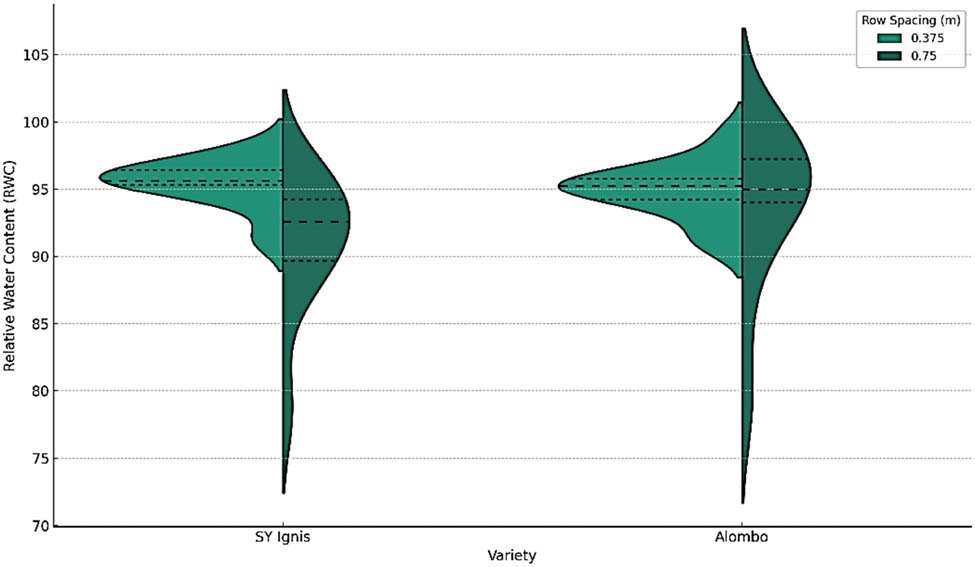
Distribution of RWC by maize variety and row spacing, indicated with median lines (dashed) and units (%).
The analysis revealed a clear distinction in RWC attributed to row spacing (Table 1). Plants cultivated at a closer row spacing of 0.375 m exhibited a higher mean RWC of 95.0%, compared to those at a wider spacing of 0.75 m, which showed a lower mean RWC of 92.5%. This difference was statistically significant (p = 0.044), underscoring the role of row spacing in optimizing maize hydration status. The narrower row spacing facilitated a more conducive microenvironment for moisture retention, as evidenced by the reduced standard deviation (SD) in RWC measurements (1.9 for 0.375 m spacing vs 5.3 for 0.75 m spacing), indicating a more uniform water content across samples.
Results of the Kruskal–Wallis and post hoc tests for RWC data
| Factor | Variety | Row spacing | Min. | Max. | Mean value | SD | P value |
|---|---|---|---|---|---|---|---|
| Row spacing | 0.75 | 78.6 | 99.4 | 92.5A | 5.3 | 0.044* | |
| 0.375 | 91.0 | 98.9 | 95.0B | 1.9 | |||
| Variety | Alombo | 0.75 | 79.3 | 99.4 | 93.8 | 5.7 | 0.854 |
| 0.375 | 91.0 | 98.9 | 94.9 | 2.1 | |||
| Part | Bottom | 79.3 | 99.4 | 93.6 | 5.6 | 0.806 | |
| Top | 91.0 | 98.9 | 95.0 | 2.2 | |||
| Variety | SY Ignis | 0.75 | 78.6 | 96.2 | 91.3A | 4.8 | 0.012* |
| 0.375 | 91.3 | 97.9 | 95.0B | 1.9 | |||
| Part | Bottom | 78.6 | 97.9 | 92.6A | 5.3 | 0.001*** | |
| Top | 89.3 | 96.4 | 93.5B | 2.3 |
The values marked with an asterisk (*) are statistically significant at p < 0.05 level, SD = standard deviation.
Groups marked with different letters (A, B) indicate statistically significant differences as determined by the Kruskal-Wallis test.
When examining the effect of maize variety, the differences in RWC between Alombo and SY Ignis varieties were influenced by row spacing. For the wider spacing of 0.75 m, SY Ignis variety showed a significantly lower mean RWC of 91.3% compared to Alombo, which was not statistically significant (p = 0.854), suggesting variety-specific responses to environmental conditions mediated by row spacing. However, at the narrower spacing of 0.375 m, both varieties achieved a comparable mean RWC of approximately 95.0%, highlighting the potential of row spacing optimization to mitigate variety-specific differences in water content retention.
The study further segmented the RWC analysis by plant parts, revealing a significant variation (p = 0.001) between the bottom (third oldest) and top (third youngest) leaf of the plants. The bottom leaf maintained a mean RWC of 92.6%, contrasting sharply with the top leaf’s mean of 95.0%. This delineation accentuates the physiological gradient within the plant structure, potentially reflective of water distribution efficiency and evapotranspirative demands.
3.2 Tillering responses to varied row spacing
The study investigated the influence of maize variety and row spacing on tillering dynamics to uncover patterns that could inform optimized agricultural practices. The analysis spanned several variables indicative of tillering vigour, such as the percentage of tillering plants, plants with one, two, or three tillers (Figure 4).
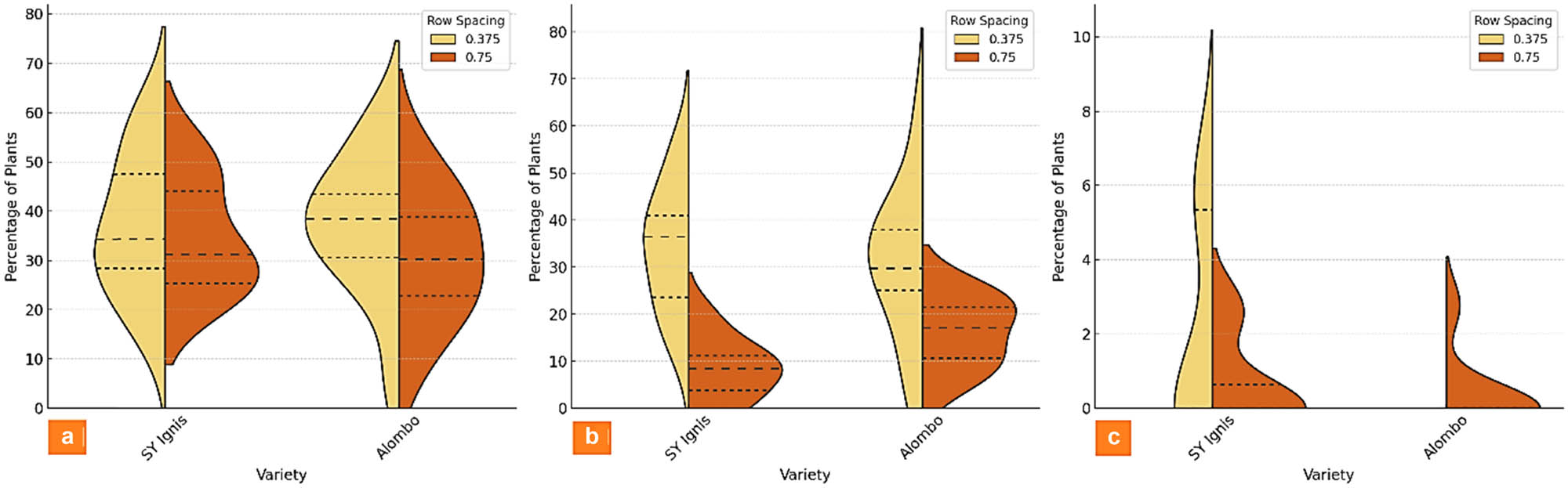
Distribution of maize plants with tillers per row: (a) one tiller, (b) two tillers, and (c) three tillers.
A significant effect of row spacing on the proportion of tillering plants was observed for both Alombo and SY Ignis varieties (Table 2). Specifically, the narrower row spacing of 0.375 m led to a higher mean percentage of tillering plants (67.8% for Alombo and 73.3% for SY Ignis) compared to the wider spacing of 0.75 m (47.4% for Alombo and 43.9% for SY Ignis), with the differences being statistically significant (p = 0.019 for Alombo and p = 0.002 for SY Ignis). This underscores the critical role of row spacing in promoting tillering, likely through altered microenvironmental conditions conducive to tiller initiation and development.
Results of the Kruskal–Wallis and post hoc tests for tillering data
| Factor | Variety | Row spacing | Variable | Min. | Max. | Mean value | SD | P value |
|---|---|---|---|---|---|---|---|---|
| Variety | Alombo | 0.75 | Tillering plants | 30.8 | 65.7 | 47.4A | 12.2 | 0.019* |
| 0.375 | 30.8 | 100.0 | 67.8B | 19.2 | ||||
| 0.75 | Plants-1 tiller | 10.3 | 51.4 | 30.9 | 13.2 | 0.279 | ||
| 0.375 | 5.6 | 57.1 | 37.4 | 14.3 | ||||
| 0.75 | Plants-2 tillers | 5.4 | 25.0 | 16.2A | 7.4 | 0.023* | ||
| 0.375 | 0.0 | 61.1 | 30.0B | 16.2 | ||||
| 0.75 | Plants-3 tillers | 0.0 | 2.8 | 0.3 | 1.0 | 0.221 | ||
| 0.375 | 0.0 | 0.0 | 0.0 | 0.0 | ||||
| SY Ignis | 0.75 | Tillering plants | 32.6 | 64.9 | 43.9A | 12.0 | 0.002** | |
| 0.375 | 38.9 | 100 | 73.3B | 16.8 | ||||
| 0.75 | Plants-1 tiller | 23.9 | 51.4 | 35 | 11.4 | 0.671 | ||
| 0.375 | 16.7 | 60.0 | 37.3 | 14.4 | ||||
| 0.75 | Plants-2 tillers | 0.0 | 20.0 | 8.2A | 6.7 | 0.001*** | ||
| 0.375 | 13.3 | 55.6 | 34.0B | 13.3 | ||||
| 0.75 | Plants-3 tillers | 0.0 | 2.7 | 0.7 | 1.2 | 0.447 | ||
| 0.375 | 0.0 | 6.7 | 1.9 | 2.9 |
The values marked with an asterisk (*) are statistically significant at the p < 0.05 level, SD = standard deviation.
Groups marked with different letters (A, B) indicate statistically significant differences as determined by the Kruskal-Wallis test.
The analysis further delineated the effects on the number of tillers per plant. For plants with one tiller, while an increase in tiller count was observed at the narrower spacing, the differences were not statistically significant. However, for plants with two tillers, both varieties exhibited a significant increase in the mean percentage of plants at the narrower spacing (30.0% for Alombo and 34.0% for SY Ignis) compared to the wider spacing (16.2% for Alombo with p = 0.023 and 8.2% for SY Ignis with p = 0.001), highlighting row spacing as a determinant factor in tiller proliferation.
Intriguingly, the occurrence of plants with three tillers was relatively rare and showed no significant response to row spacing in Alombo. In contrast, SY Ignis showed a slight increase in the mean percentage of plants with three tillers at the narrower spacing (1.9%), which was statistically significant (p = 0.001), suggesting variety-specific genetic predispositions influencing tillering capacity under varying spatial arrangements.
The PCA indeed indicates that the first two principal components (variety and row spacing) together explain approximately 77.55% of the variance which includes measurements related to the tillering of maize plants (Figure 5). Plants with three and two tillers being positioned in Quadrant I suggest that these plants exhibit higher tillering capacity. The presence of plants with more tillers in this quadrant can imply that the combination of variety and row spacing factors here promotes better tillering. This could be due to optimal spacing allowing for sufficient resources and space for tiller development, and/or specific variety traits that support multiple tillering.
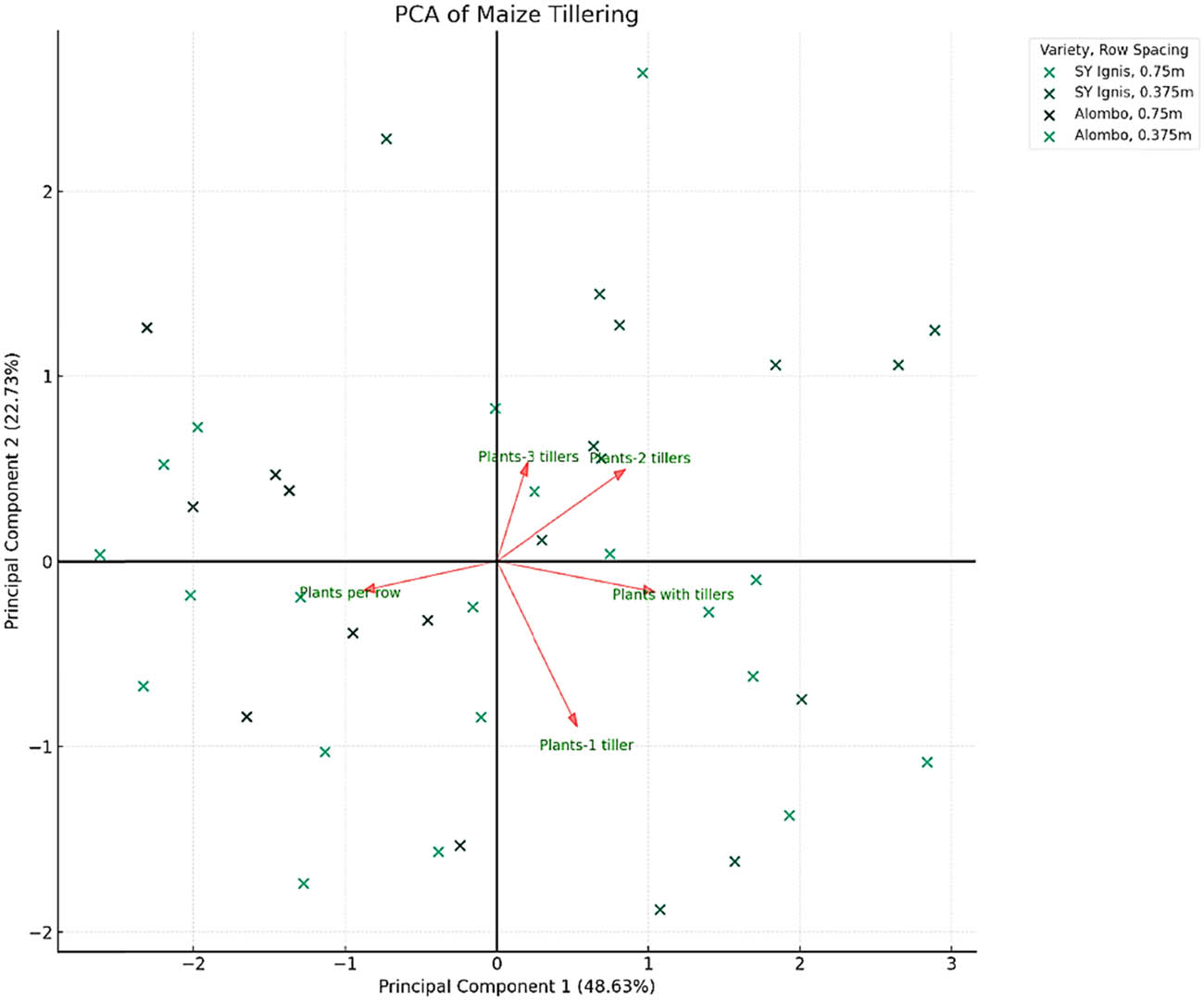
PCA of maize tillering.
On the other hand, plants with no tillers or only one tiller positioned in Quadrant IV indicate a lower tillering capacity. This quadrant is characterized by a positive score on one principal component and a negative score on the other, suggesting a negative correlation or an inverse relationship between the factors represented by these components and tillering capacity. The placement in Quadrant IV could imply that the specific combinations of variety and row spacing associated with this quadrant might restrict tillering, possibly due to competition for resources, less optimal genetic predisposition for tillering, or environmental factors not conducive to tiller development.
3.3 Row spacing’s dual impact on plant biomass (including tillers) and main stem grain yield
3.3.1 Dry biomass yield
Plants spaced at 0.375 m exhibited a higher mean value for dry biomass yield of 15.9 t/ha, compared to 13.1 t/ha for those at the wider spacing of 0.75 m (Figure 6). This difference was statistically significant (p = 0.036), suggesting that narrower row spacing favourably affects the dry biomass, possibly due to enhanced microclimatic conditions or resource availability that stimulates better performance (Table 3).
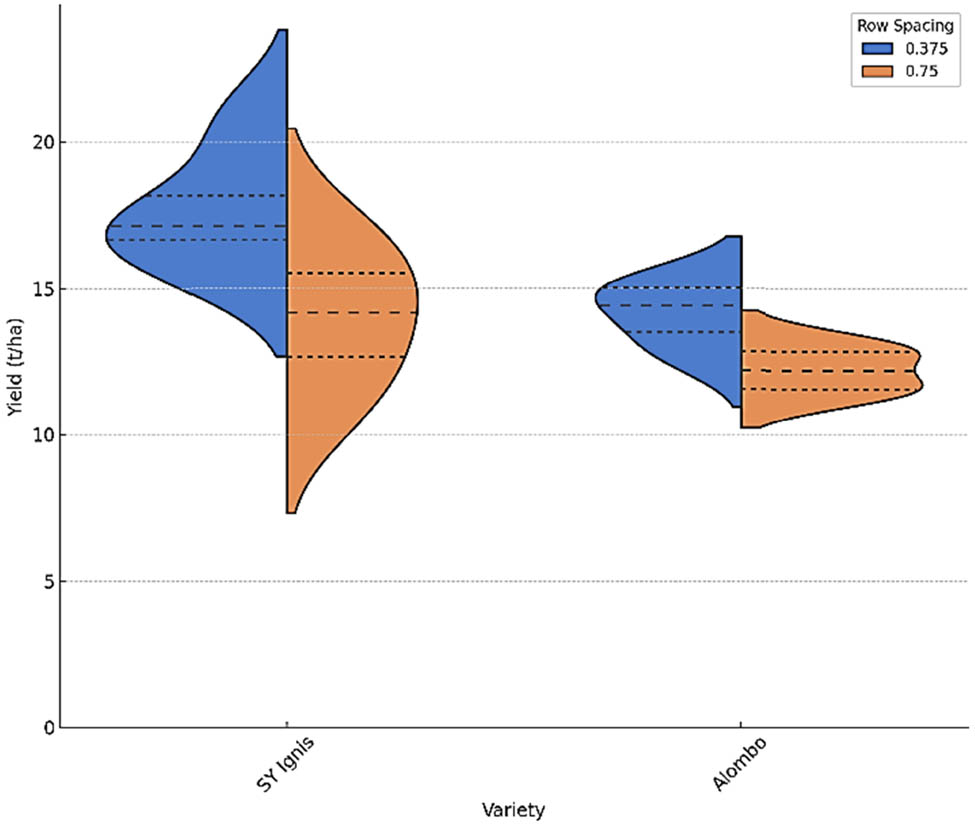
Distribution of dry aboveground biomass yield data.
Results of the Kruskal–Wallis and post hoc tests for biomass data
| Factor | Variety | Row spacing | Min. | Max. | Mean value | SD | P value |
|---|---|---|---|---|---|---|---|
| Row spacing | 0.75 | 11.0 | 16.7 | 13.1A | 1.9 | 0.036* | |
| 0.375 | 12.7 | 20.7 | 15.9B | 2.5 | |||
| Variety | Alombo | 11.5 | 15.1 | 13.2A | 1.4 | 0.027* | |
| SY Ignis | 11.0 | 20.7 | 15.9B | 2.9 | |||
| Within-Variety | Alombo | 0.75 | 11.5 | 13.0 | 12.2A | 0.8 | 0.023* |
| 0.375 | 12.7 | 15.1 | 14.1A | 1.1 | |||
| SY Ignis | 0.75 | 11.0 | 16.7 | 14.0A | 2.5 | ||
| 0.375 | 15.8 | 20.7 | 17.7B | 2.1 |
The values marked with an asterisk (*) are statistically significant at the p < 0.05 level, SD = standard deviation.
Groups marked with different letters (A, B) indicate statistically significant differences as determined by the Kruskal-Wallis test.
A further examination by variety exposed a differential response to the environmental conditions dictated by row spacing. The Alombo variety demonstrated a mean value of 13.2 t/ha, slightly lower than the SY Ignis variety, which achieved a mean value of 15.9 t/ha. This distinction was statistically supported (p = 0.027 for Alombo), indicating inherent varietal differences in reacting to the growing conditions and also their genetical predisposition to certain yield performance.
Looking more closely, the within-variety comparisons across row spacings showed important findings. For the Alombo variety, a shift from wider to narrower row spacing (from 0.75 to 0.375 m) led to an increase in the mean value from 12.2 to 14.1 t/ha, although this change was not statistically significant within this variety (p = 0.023, indicating a borderline significance due to the possibly small sample size or effect size). Conversely, the SY Ignis variety manifested a pronounced response to row spacing, with mean values escalating from 14.0 t/ha at the wider spacing to 17.7 t/ha at the narrower spacing, a difference that was statistically significant (p = 0.023), underscoring the critical role of genetic makeup in modulating the impact of cultivation practices.
3.4 Grain yield and grain yield components
Grain yield analysis revealed that SY Ignis significantly benefited from the narrower row spacing (0.375 m), exhibiting a marked increase in mean grain yield from 7.3 to 9.1 t/ha, a pattern not mirrored in Alombo (Figure 7). Specifically, the differences across spacing for Alombo did not reach statistical significance (p = 0.321), emphasizing the varietal sensitivity to cultivation spacing.
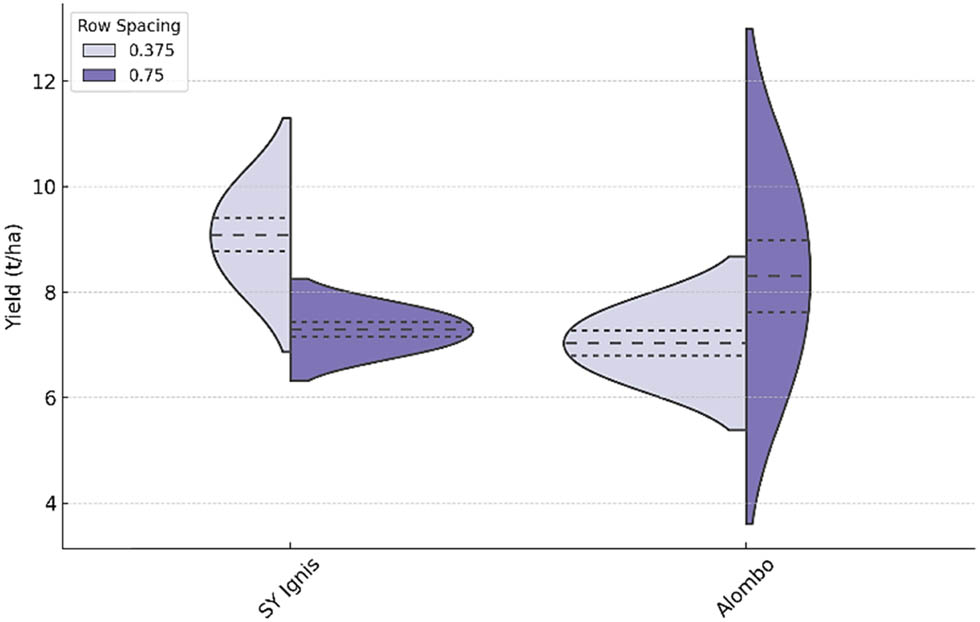
Distribution of maize grain yield data.
For ear weight and ear length, both varieties showed enhanced mean values at the narrower spacing, with SY Ignis displaying a particularly pronounced response in ear weight (Figure 8). The variation in ear length between row spacings was statistically significant for Alombo (p = 0.029), indicating that row spacing influences the physical dimensions of maize ears (Table 4). A significant finding was the increase in seed number and TKW for both varieties at the narrower spacing, with SY Ignis showcasing an exceptional rise in seed number from 525.3 to 641.5 (p = 0.021 for Alombo). This suggests that intra-row spacing may facilitate higher fertility in terms of seed production. Similarly, TKW improvements were observed at the narrower spacing, particularly for Alombo, which showed a statistically significant increase in TKW (p = 0.034), pointing to the potential for achieving grains of superior weight through strategic row spacing adjustments.
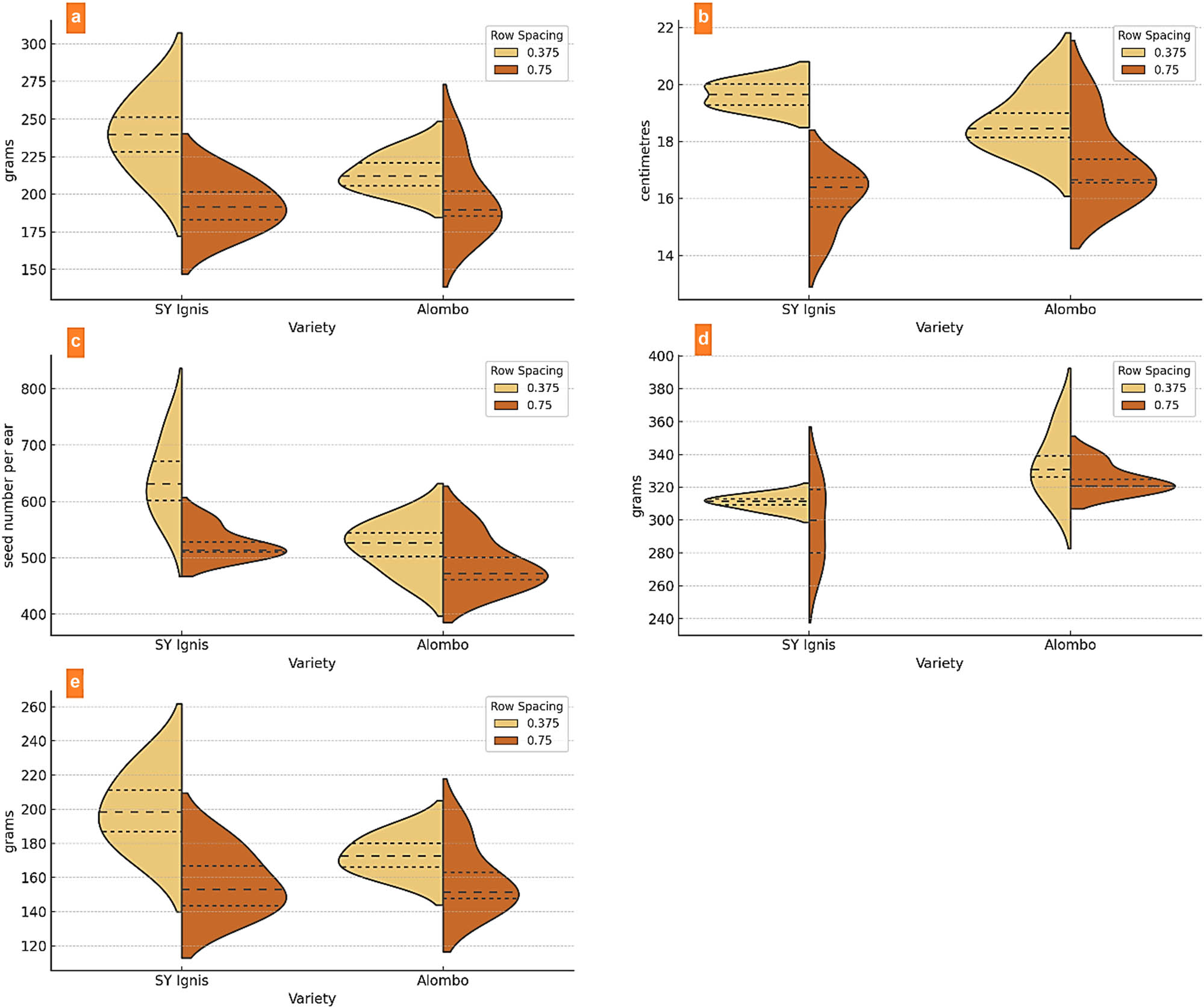
Distributions of maize grain yield components: (a) ear weight (g), (b) ear length (cm), (c) seed number per ear, (d) TKW (g), and (e) seed weight per ear (g).
Results of the Kruskal–Wallis and post hoc tests for grain yield and grain yield component data
| Variety | Row spacing | Variable | Min. | Max. | Mean value | SD | P value |
|---|---|---|---|---|---|---|---|
| Alombo | 0.75 | Grain yield (t/ha) | 7.0 | 9.7 | 8.3 | 1.9 | 0.321 |
| 0.375 | 6.6 | 7.5 | 7.0 | 0.7 | |||
| SY Ignis | 0.75 | 7.0 | 7.6 | 7.3 | 0.4 | ||
| 0.375 | 8.5 | 9.7 | 9.1 | 0.9 | |||
| Alombo | 0.75 | Ear weight (g) | 176.9 | 234.7 | 197.8 | 25.4 | 0.065 |
| 0.375 | 203.1 | 230.1 | 214.4 | 12.2 | |||
| SY Ignis | 0.75 | 173.3 | 214.2 | 192.8 | 17.3 | ||
| 0.375 | 219.8 | 269.7 | 239.8 | 24.9 | |||
| Alombo | 0.75 | Ear length (cm) | 16.4 | 19.4 | 17.3 | 1.42 | 0.029* |
| 0.375 | 17.7 | 20.2 | 18.7 | 1.07 | |||
| SY Ignis | 0.75 | 14.5 | 16.8 | 16.0 | 1.06 | ||
| 0.375 | 19.2 | 20.1 | 19.6 | 0.46 | |||
| Alombo | 0.75 | Ear perimeter middle (cm) | 13.5 | 14.5 | 14.2 | 0.46 | 0.424 |
| 0.375 | 14.0 | 14.6 | 14.3 | 0.27 | |||
| SY Ignis | 0.75 | 14.1 | 15.6 | 14.7 | 0.66 | ||
| 0.375 | 13.8 | 15.9 | 14.9 | 0.87 | |||
| Alombo | 0.75 | Ear row number | 14.0 | 18.0 | 16.0 | 1.63 | 0.079 |
| 0.375 | 14.0 | 16.0 | 15.0 | 1.15 | |||
| SY Ignis | 0.75 | 16.0 | 20.0 | 18.0 | 1.63 | ||
| 0.375 | 16.0 | 18.0 | 17.0 | 1.15 | |||
| Alombo | 0.75 | Ear seed number | 456.0 | 557.0 | 489.5 | 46.3 | 0.021* |
| 0.375 | 463.0 | 566.0 | 520.3 | 43.5 | |||
| SY Ignis | 0.75 | 509.0 | 566.0 | 525.3 | 27.3 | ||
| 0.375 | 571.0 | 732.0 | 641.5 | 68.6 | |||
| Alombo | 0.75 | TKW (g) | 320.1 | 337.9 | 324.8 | 8.7 | 0.034* |
| 0.375 | 313.2 | 361.8 | 334.2 | 20.2 | |||
| SY Ignis | 0.75 | 274.1 | 320.4 | 298.6 | 24.0 | ||
| 0.375 | 305.2 | 315.8 | 310.9 | 4.4 | |||
| Alombo | 0.75 | Ear yield (%) | 77.5 | 82.7 | 80.6 | 2.3 | 0.197 |
| 0.375 | 79.4 | 81.5 | 80.8 | 0.9 | |||
| SY Ignis | 0.75 | 75.8 | 84.7 | 81.4 | 3.9 | ||
| 0.375 | 81.4 | 84.3 | 83.2 | 1.3 |
The values marked with an asterisk (*) are statistically significant at the p < 0.05 level, SD = standard deviation.
The analyses of the perimeter at the middle of the ear, row number, and ear yield did not yield statistically significant differences that could be attributed directly to row spacing or variety, indicating a more complex interaction of these traits with environmental and genotype.
The post hoc testing, conducted a pairwise comparisons, did not reveal any statistically significant differences among the ear length, ear seed number, and TKW for the groups (Alombo 0.75, Alombo 0.375, SY Ignis 0.75, and SY Ignis 0.375). Although the Kruskal–Wallis test may indicate statistical significance overall, this significance may dissipate when the groups are analysed through pairwise comparisons.
3.5 Tillering variability affects yield outcomes
For Alombo, moving to a narrower inter-row and wider intra-row spacing increased the mean percentage of plants with two tillers significantly (from 16.2% at 0.75 m to 30.0% at 0.375 m, p = 0.023), and a similar pattern was observed for SY Ignis. Increased tillering might indicate a greater leaf area, possibly enhancing photosynthetic capacity and, consequently, biomass production. The grain yield for SY Ignis significantly increased at the narrower intra-row and wider intra-row spacing (from 7.3 to 9.1), indicating that the enhanced tillering associated with more spacing could be contributing to higher grain production. This effect was not as pronounced for Alombo, which may suggest varietal differences in how tillering translates to grain yield. Significant improvements in ear weight, ear length, and seed number at 0.375 m spacing for both varieties, especially for SY Ignis, suggest a positive correlation between tillering and these yield components. The increased ear weight and seed number at narrower spacing could be indicative of the positive impact of tillering on reproductive success and biomass accumulation.
4 Discussion
The findings of the first year of field experiment presented in this study point out the relationship between row spacing and its diverse effects on crucial agricultural traits.
4.1 Dual perspective on plant hydration of inter-row and intra-row spacing
The distinction between inter-row and intra-row spacing emerges as a critical factor in optimizing maize hydration. The closer inter-row spacing of 0.375 m, paired with wider intra-row spacing (0.33 m), facilitated a higher mean RWC of 95.0%, compared to the wider inter-row spacing of 0.75 m with narrower intra-row spacing (about 0.16 m), which yielded a lower mean RWC of 92.5%. This configuration likely influences microenvironmental conditions favourably, enhancing soil moisture conservation [17,18,19] and may reduce evaporative stress, thereby optimizing plant hydration, as spacing of plants affects evapotranspiration [20]. The statistical significance of this observation (p = 0.044) not only validates the role of spatial arrangement in water retention but also indicates a strategic balance between inter-row and intra-row spacing as important for maintaining optimal moisture levels within maize foliage.
The study’s insights into varietal responses – Alombo and SY Ignis – to these spacing configurations further illuminate the potential of row spacing optimization to reconcile inherent genetic predispositions with environmental management practices. The comparable mean RWC observed at the narrower inter-row spacing underscores the capacity of strategic spacing decisions to equilibrate varietal discrepancies in water retention [21], suggesting a harmonization of genotype with agronomic input to foster plant resilience against hydration stress.
Significantly, the vertical stratification of RWC across plant parts – from the bottom (third oldest) to the top (third youngest) leaves – reveals a physiological gradient within the maize plant, likely reflective of innate water allocation strategies and differential transpirational demands [22]. This internal modulation of water use underscores the adaptability of maize to varying water availabilities, highlighting the importance of considering both spatial arrangement and plant architectural characteristics in water management strategies.
Incorporating the interaction between inter-row and intra-row spacing into maize cultivation practices offers a promising avenue for enhancing RWC and, by extension, plant health and productivity. This study supports the use of a comprehensive approach to farming management that combines precise spacing with the characteristics of different crops to improve water use and promote sustainable farming. The aim is to provide practical advice that helps tailor farming methods to meet the unique needs of maize varieties, especially under varying climatic challenges.
4.2 Interpreting tillering responses to diverse row spacing
The observed increase in the proportion of tillering plants under narrower inter-row spacing yet wider intra-row spacing (0.375 m inter-row and 0.33 m intra-row) for both Alombo and SY Ignis varieties emphasizes the critical role of precise spatial arrangement in promoting tillering [23,24]. This configuration appears to offer an optimal balance between minimizing competition for light [14], nutrients [25], and water [13]. The statistical significance of these findings (p = 0.019 for Alombo and p = 0.002 for SY Ignis) not only highlights the importance of row spacing but also suggests that the interplay between inter-row and intra-row spacing is a determinant factor in enhancing plant hydration and tillering vigour.
The variance in tillering responses between the two maize varieties highlights the genetic predisposition’s role in environmental adaptability. Particularly, the variety SY Ignis exhibited a notable adaptability to the narrower inter-row but wider intra-row spacing, as evidenced by the significant increase in plants with three tillers (p = 0.001). This suggests that certain genetic traits may enhance responsiveness to optimized spatial configurations, presenting an opportunity for breeding programs to select for varieties with heightened adaptability to specific agronomic practices. These genetic traits include genes promoting tillering such as well studied tb1 [26], tin1 [27], and gt1 [28].
It is important to mention other factors affecting tillering in maize such as cumulative growing degree days, photothermal quotient, extremes in daily temperatures, cumulative vapour pressure deficit, soil nitrate and phosphorus [29], and shading [28].
4.3 Tillering as a biomass indicator
The data of this study suggest that increased tillering, particularly at 0.375 m row spacings, is associated with improved yield components such as ear weight, seed number, and potentially grain yield, especially in SY Ignis. Tillers can positively affect yield [24,30] and they may reduce dependence on a seasonally variable optimum plant density [31,32]. Our findings also indicate that tillering could serve as a valuable indicator of biomass accumulation and reproductive success in maize. The differential impact of tillering on the yield components between Alombo and SY Ignis highlights the need for variety-specific management practices. While increased tillering positively affects SY Ignis in terms of grain yield and other yield components, Alombo’s response suggests a more complex relationship that may not directly translate to increased grain yield.
4.4 Row spacing effecting maize production dynamics of aboveground biomass yield
Plants cultivated at a closer inter-row spacing of 0.375 m, with wider intra-row spacing of approximately 0.33 m, exhibited a significantly higher mean dry biomass yield of 15.9 t/ha, compared to 13.1 t/ha for those at the wider spacing of 0.75 m, with narrower intra-row spacing of about 0.16 m (p = 0.036). This finding suggests that narrower inter-row and wider intra-row spacing making more space for each plant positively influences dry biomass yield, potentially due to improved microclimatic conditions [33] or enhanced resource availability [34], fostering better crop performance and biomass accumulation [35].
A response to row spacing was observed across maize varieties. The Alombo variety demonstrated a mean dry biomass yield of 13.2 t/ha, slightly lower than the SY Ignis variety, which achieved a mean value of 15.9 t/ha (p = 0.027 for Alombo). This variance is the inherent varietal differences in their ability to adapt to environmental conditions and utilize available resources, reflecting their genetic predisposition to yield performance. Within-variety comparisons provided further insights into the relationship between row spacing and dry biomass yield. For the Alombo variety, transitioning from wider to narrower inter-row spacing led to a modest increase in mean yield from 12.2 to 14.1 t/ha, although this change did not reach statistical significance within this variety (p = 0.023). In contrast, the SY Ignis variety exhibited a more pronounced response to row spacing, with mean yields escalating from 14.0 t/ha at wider spacing to 17.7 t/ha at narrower inter-row spacing (p = 0.023), pinpointing the pivotal role of genetic factors in modulating the impact of cultivation practices.
4.5 Interplay between spacing strategies and maize grain production efficiency
Our study reveals that SY Ignis significantly benefits from narrower row spacing (0.375 m) and wider intra-row spacing (0.33 m), with a remarkable increase in grain yield from 7.3 to 9.1 t/ha. This improvement shows the potential of optimized spacing strategies to enhance grain productivity, echoing findings from previous research [36]. In contrast, Alombo’s grain yield did not exhibit a statistically significant variation with changes in row spacing, highlighting an aspect of varietal sensitivity to cultivation practices [37]. Both varieties demonstrated enhanced ear weight and length at 0.375 m spacing, with SY Ignis showing a notably pronounced response in ear weight. This finding is consistent with theories that suggest wider planting can influence not only the yield but also the physical attributes of crops, potentially due to altered competition for resources [38]. The statistically significant variation in ear length for Alombo further indicates that row spacing is a critical factor in determining the physical dimensions of maize ears. However, there are studies that conflict with our findings, suggesting that narrower spacing leads to an increase in grain yield in maize [39,40].
The substantial increase in seed number and TKW for both varieties at the narrower spacing further substantiates the argument for precision in planting density. Specifically, SY Ignis exhibited an exceptional rise in seed number, which, alongside the TKW improvements, particularly for Alombo, suggests that closer intra-row spacing may facilitate enhanced seed production and grain weight. However, the lack of statistically significant differences in the perimeter at the middle of the ear, row number, and ear yield between different row spacings or varieties points to a more complex relationship among these traits, environmental conditions, and genetic factors.
Incorporating narrow inter-row spacing (0.375 m), which adjusts intra-row spacing accordingly, presents a strategic approach to enhancing maize biomass and grain yield. Such precision in agricultural management can play a crucial role in meeting the growing demands for food production. However, the results of this study are not only variety-specific but also year/weather-specific and, most crucially, site-specific, highlighting that each site may yield different outcomes due to the unique reactions of the varieties to the dominant conditions.
5 Conclusion
This research highlights the interplay between row spacing and maize production dynamics, showing significant varietal responses in tillering, hydration, and yield components. The strategic adjustment of inter-row to 0.375 m and intra-row spacing demonstrated a clear benefit in enhancing tillering, RWC, and yield outcomes for the SY Ignis variety, suggesting that tailored spatial arrangements can optimize resource use efficiency and crop productivity. Moreover, the study confirms that agricultural practices, including row spacing strategies, must consider varietal characteristics, environmental conditions, and site-specific factors to maximize agricultural outputs.
Our findings stress the importance of integrating genetic traits (genotype) and agronomic practices to achieve sustainable crop production, advocating for future research to further refine these strategies across different environmental contexts and crop varieties. The complexity of interactions among physiological traits, environmental conditions, and genetic predispositions calls for a holistic approach in agricultural management to meet the global food production challenges.
Acknowledgement
The authors would like to express their gratitude to their colleagues at the Experimental Field Station in Žabčice for their invaluable support throughout the field trial. Special thanks are extended to Jan Syrový, Pavel Kirch, Monika Kirchová, Tomáš Rábek, and Vilém Sitte for their assistance and contributions.
-
Funding information: The funding for this article did not come from a specific project, but was provided by Mendel University in Brno, which supported the research and publication efforts.
-
Author contributions: All authors have accepted responsibility for the entire content of this manuscript and consented to its submission to the journal, reviewed all the results and approved the final version of the manuscript. NF: experiment design, sampling, data collection, statistical analysis, and writing the manuscript; LP: manuscript revision and data check-up; IJ and RC: manuscript revision; PE: experiment design, monitoring, and maize cultivation; MR: experiment design, monitoring, data collection, and maize cultivation.
-
Conflict of interest: Authors state no conflict of interest.
-
Data availability statement: All data generated or analysed during this study are included in this published article.
References
[1] Zurbenko IG, Cyr DD. Climate fluctuations in time and space. Clim Res. 2011;46(1):67–76. 10.3354/cr00956.Suche in Google Scholar
[2] Woodward G, Bonada N, Brown LE, Death RG, Durance I, Gray C, et al. The effects of climatic fluctuations and extreme events on running water ecosystems. Philos Trans R Soc B: Biol Sci. 2016;371(1694). 10.1098/rstb.2015.0274.Suche in Google Scholar PubMed PubMed Central
[3] Thirumalai K, DiNezio PN, Okumura Y, Deser C. Extreme temperatures in Southeast Asia caused by El Niño and worsened by global warming. Nat Commun. 2017;8(1):15531. 10.1038/ncomms15531.Suche in Google Scholar PubMed PubMed Central
[4] Cook BI, Mankin JS, Anchukaitis KJ. Climate change and drought: From past to future. Curr Clim Change Rep. 2018;4(2):164–79. 10.1007/s40641-018-0093-2.Suche in Google Scholar
[5] Jiménez S, Fattahi M, Bedis K, Nasrolahpour-moghadam S, Irigoyen JJ, Gogorcena Y. Interactional effects of climate change factors on the water status, photosynthetic rate, and metabolic regulation in peach. Front Plant Sci. 2020;11:43. 10.3389/fpls.2020.00043/full.Suche in Google Scholar
[6] Easterling DR, Wallis TWR, Lawrimore JH, Heim RR. Effects of temperature and precipitation trends on U.S. drought. Geophys Res Lett. 2007;34(20):L20709. 10.1029/2007GL031541.Suche in Google Scholar
[7] Spinoni J, Naumann G, Vogt JV, Barbosa P. The biggest drought events in Europe from 1950 to 2012. J Hydrol: Reg Stud. 2015;3:509–24. 10.1016/j.ejrh.2015.01.001.Suche in Google Scholar
[8] Barbieri P, Echarte L, Della Maggiora A, Sadras VO, Echeverria H, Andrade FH. Maize evapotranspiration and water‐use efficiency in response to row spacing. Agron J. 2012;104(4):939–44. 10.2134/agronj2012.0014.Suche in Google Scholar
[9] Bellaloui N, Bruns HA, Abbas HK, Mengistu A, Fisher DK, Reddy KN, et al. Effects of row-type, row-spacing, seeding rate, soil-type, and cultivar differences on soybean seed nutrition under US Mississippi Delta conditions. PLoS One. 2015;10(6):e0129913. 10.1371/journal.pone.0129913.Suche in Google Scholar PubMed PubMed Central
[10] Salgado JD, Lindsey LE, Paul PA. Effects of row spacing and nitrogen rate on wheat grain yield and profitability as influenced by diseases. Plant Dis. 2017;101(12):1998–2011. 10.1094/PDIS-03-17-0414-RE.Suche in Google Scholar PubMed
[11] Hussain M, Waqas-Ul-Haq M, Farooq S, Jabran K, Farroq M. The impact of seed priming and row spacing on the productivity of different cultivars of irrigated wheat under early season drought. Exp Agric. 2016;52(3):477–90. 10.1017/S0014479716000053.Suche in Google Scholar
[12] Chen J, Wang Y, Zhi X, Qiu Y, Han Y, Feng L, et al. Modifying the planting density to change water utilization in various soil layers and regulate plant growth and yield formation of cotton. Field Crop Res. 2022;289:108738. 10.1016/j.fcr.2022.108738.Suche in Google Scholar
[13] Ellsworth PZ, White PM. Row spacing and the use of plant-available water in sugarcane cultivation in water-abundant Louisiana. Agronomy. 2022;12(7):1586. 10.3390/agronomy12071586.Suche in Google Scholar
[14] Haarhoff SJ, Swanepoel PA. Plant population and row spacing affects growth and yield of rainfed maize in semi-arid environments. Front Plant Sci. 2022;13:761121. 10.3389/fpls.2022.761121/full.Suche in Google Scholar
[15] Orság M, Fischer M, Trnka M, Brotan J, Pozníková G, Žalud Z. Trends in air temperature and precipitation in Southeastern Czech Republic, 1961–2020. Acta Univ Agric Silvic Mendelianae Brun. 2022;70(4–5):283–94. 10.11118/actaun.2022.021.html.Suche in Google Scholar
[16] Gonzáles L, González-Vilar M. Determination of relative water content. In: Handbook of plant ecophysiology techniques. Netherlands: Kluwer Academic Publishers Group; 2001. p. 207–12.10.1007/0-306-48057-3_14Suche in Google Scholar
[17] Hu W, Schoenau JJ, Cutforth HW, Si BC. Effects of row-spacing and stubble height on soil water content and water use by canola and wheat in the dry prairie region of Canada. Agric Water Manag. 2015;153:77–85. 10.1016/j.agwat.2015.02.008.Suche in Google Scholar
[18] Sun T, Li Z. Row placement affects yield and water use efficiency of continuous corn. Agron J. 2020;112(4):2624–35. 10.1002/agj2.20217.Suche in Google Scholar
[19] Dhakal M, West CP, Deb SK, Villalobos C, Kharel G. Row spacing of alfalfa interseeded into native grass pasture influences soil‐plant‐water relations. Agron J. 2020;112(1):274–87. 10.1002/agj2.20012.Suche in Google Scholar
[20] Ukpoju A, Yuliawan T, Ichwan N, Oue H, Widodo, Triyono, et al. Effects of plant spacing on evapotranspiration for estimating crop coefficient of Japonica rice. E3S Web of Conferences. 2023;444:04040. 10.1051/e3sconf/202344404040.Suche in Google Scholar
[21] Bengough AG. Water dynamics of the root zone: Rhizosphere biophysics and its control on soil hydrology. Vadose Zone J. 2012;11(2):vzj2011.0111. 10.2136/vzj2011.0111.Suche in Google Scholar
[22] Veneklaas E, Van Den Boogaard R. Leaf age‐structure effects on plant water use and photosynthesis of two wheat cultivars. N Phytol. 1994;128(2):331–7. 10.1111/j.1469-8137.1994.tb04017.x.Suche in Google Scholar PubMed
[23] Hunter MC, Sheaffer CC, Culman SW, Jungers JM. Effects of defoliation and row spacing on intermediate wheatgrass I: Grain production. Agron J. 2020;112(3):1748–63. 10.1002/agj2.20128.Suche in Google Scholar
[24] Rotili DH, Abeledo LG, deVoil P, Rodríguez D, Maddonni GÁ. Exploring the effect of tillers on the water economy, plant growth and kernel set of low-density maize crops. Agric Water Manag. 2021;243:106424. 10.1016/j.agwat.2020.106424.Suche in Google Scholar
[25] Ma J, Wang Y, An Y, Zhang M, Wang X. The impact of plant spatial patterns on nitrogen removal in the Naolihe wetlands of Northeast China. Water. 2024;16(1):128. 10.3390/w16010128.Suche in Google Scholar
[26] Doebley J, Stec A, Gustus C. Teosinte branched1 and the origin of maize: Evidence for epistasis and the evolution of dominance. Genetics. 1995;141(1):333–46. 10.1093/genetics/141.1.333.Suche in Google Scholar PubMed PubMed Central
[27] Zhang X, Lin Z, Wang J, Liu H, Zhou L, Zhong S, et al. The tin1 gene retains the function of promoting tillering in maize. Nat Commun. 2019;10(1):5608. 10.1038/s41467-019-13425-6.Suche in Google Scholar PubMed PubMed Central
[28] Whipple CJ, Kebrom TH, Weber AL, Yang F, Hall D, Meeley R, et al. Grassy tillers1 promotes apical dominance in maize and responds to shade signals in the grasses. Proc Natl Acad Sci. 2011;108(33):E506-12. 10.1073/pnas.1102819108.Suche in Google Scholar PubMed PubMed Central
[29] Veenstra RL, Hefley TJ, Berning D, Messina CD, Haag LA, Prasad PVV, et al. Predicting corn tiller development in restrictive environments can be achieved to enhance defensive management decision tools for producers. Front Plant Sci. 2023;14:1223961. 10.3389/fpls.2023.1223961/full.Suche in Google Scholar
[30] Liu P, Yin B, Liu X, Gu L, Guo J, Yang M, et al. Optimizing plant spatial competition can change phytohormone content and promote tillering, thereby improving wheat yield. Front Plant Sci. 2023;14:1147711. 10.3389/fpls.2023.1147711/full.Suche in Google Scholar
[31] Massigoge I, Ross F, Fernández JA, Echarte L, Ciampitti IA, Cerrudo A. Contribution of tillers to maize yield stability at low plant density. Crop Sci. 2022;62(6):2451–61. 10.1002/csc2.20827.Suche in Google Scholar
[32] Veenstra RL, Messina CD, Berning D, Haag LA, Carter P, Hefley TJ, et al. Corn yield components can be stabilized via tillering in sub-optimal plant densities. Front Plant Sci. 2023;13:1047268. 10.3389/fpls.2022.1047268/full.Suche in Google Scholar
[33] Liu TD, Song FB. Maize photosynthesis and microclimate within the canopies at grain-filling stage in response to narrow-wide row planting patterns. Photosynthetica. 2012;50(2):215–22. 10.1007/s11099-012-0011-0.html.Suche in Google Scholar
[34] Wang S, Li L, Zhou D‐W. Root morphological responses to population density vary with soil conditions and growth stages: The complexity of density effects. Ecol Evol. 2021;11(15):10590–9. 10.1002/ece3.7868.Suche in Google Scholar PubMed PubMed Central
[35] Jiang X, Tong L, Kang S, Li F, Li D, Qin Y, et al. Planting density affected biomass and grain yield of maize for seed production in an arid region of Northwest China. J Arid Land. 2018;10(2):292–303. 10.1007/s40333-018-0098-7.Suche in Google Scholar
[36] Maddonni GÁ, Martínez-Bercovich J. Row spacing, landscape position, and maize grain yield. Int J Agron. 2014;2014:1–12. 10.1155/2014/195012.Suche in Google Scholar
[37] Farnham DE. Row spacing, plant density, and hybrid effects on corn grain yield and moisture. Agron J. 2001;93(5):1049–53. 10.2134/agronj2001.9351049x.Suche in Google Scholar
[38] Craine JM, Dybzinski R, Robinson D. Mechanisms of plant competition for nutrients, water and light. Funct Ecol. 2013;27(4):833–40. 10.1111/1365-2435.12081.Suche in Google Scholar
[39] Licht MA, Parvej MR, Wright EE. Corn yield response to row spacing and plant population in Iowa. Crop, Forage Turfgrass Manag. 2019;5:190032. 10.2134/cftm2019.05.0032.Suche in Google Scholar
[40] Bernhard BJ, Below FE. Plant population and row spacing effects on corn: Plant growth, phenology, and grain yield. Agron J. 2020;112(4):2456–65. 10.1002/agj2.20245.Suche in Google Scholar
© 2024 the author(s), published by De Gruyter
This work is licensed under the Creative Commons Attribution 4.0 International License.
Artikel in diesem Heft
- Regular Articles
- Supplementation of P-solubilizing purple nonsulfur bacteria, Rhodopseudomonas palustris improved soil fertility, P nutrient, growth, and yield of Cucumis melo L.
- Yield gap variation in rice cultivation in Indonesia
- Effects of co-inoculation of indole-3-acetic acid- and ammonia-producing bacteria on plant growth and nutrition, soil elements, and the relationships of soil microbiomes with soil physicochemical parameters
- Impact of mulching and planting time on spring-wheat (Triticum aestivum) growth: A combined field experiment and empirical modeling approach
- Morphological diversity, correlation studies, and multiple-traits selection for yield and yield components of local cowpea varieties
- Participatory on-farm evaluation of new orange-fleshed sweetpotato varieties in Southern Ethiopia
- Yield performance and stability analysis of three cultivars of Gayo Arabica coffee across six different environments
- Biology of Spodoptera frugiperda (Lepidoptera: Noctuidae) on different types of plants feeds: Potency as a pest on various agricultural plants
- Antidiabetic activity of methanolic extract of Hibiscus sabdariffa Linn. fruit in alloxan-induced Swiss albino diabetic mice
- Bioinformatics investigation of the effect of volatile and non-volatile compounds of rhizobacteria in inhibiting late embryogenesis abundant protein that induces drought tolerance
- Nicotinamide as a biostimulant improves soybean growth and yield
- Farmer’s willingness to accept the sustainable zoning-based organic farming development plan: A lesson from Sleman District, Indonesia
- Uncovering hidden determinants of millennial farmers’ intentions in running conservation agriculture: An application of the Norm Activation Model
- Mediating role of leadership and group capital between human capital component and sustainability of horticultural agribusiness institutions in Indonesia
- Biochar technology to increase cassava crop productivity: A study of sustainable agriculture on degraded land
- Effect of struvite on the growth of green beans on Mars and Moon regolith simulants
- UrbanAgriKG: A knowledge graph on urban agriculture and its embeddings
- Provision of loans and credit by cocoa buyers under non-price competition: Cocoa beans market in Ghana
- Effectiveness of micro-dosing of lime on selected chemical properties of soil in Banja District, North West, Ethiopia
- Effect of weather, nitrogen fertilizer, and biostimulators on the root size and yield components of Hordeum vulgare
- Effects of selected biostimulants on qualitative and quantitative parameters of nine cultivars of the genus Capsicum spp.
- Growth, yield, and secondary metabolite responses of three shallot cultivars at different watering intervals
- Design of drainage channel for effective use of land on fully mechanized sugarcane plantations: A case study at Bone Sugarcane Plantation
- Technical feasibility and economic benefit of combined shallot seedlings techniques in Indonesia
- Control of Meloidogyne javanica in banana by endophytic bacteria
- Comparison of important quality components of red-flesh kiwifruit (Actinidia chinensis) in different locations
- Efficiency of rice farming in flood-prone areas of East Java, Indonesia
- Comparative analysis of alpine agritourism in Trentino, Tyrol, and South Tyrol: Regional variations and prospects
- Detection of Fusarium spp. infection in potato (Solanum tuberosum L.) during postharvest storage through visible–near-infrared and shortwave–near-infrared reflectance spectroscopy
- Forage yield, seed, and forage qualitative traits evaluation by determining the optimal forage harvesting stage in dual-purpose cultivation in safflower varieties (Carthamus tinctorius L.)
- The influence of tourism on the development of urban space: Comparison in Hanoi, Danang, and Ho Chi Minh City
- Optimum intra-row spacing and clove size for the economical production of garlic (Allium sativum L.) in Northwestern Highlands of Ethiopia
- The role of organic rice farm income on farmer household welfare: Evidence from Yogyakarta, Indonesia
- Exploring innovative food in a developing country: Edible insects as a sustainable option
- Genotype by environment interaction and performance stability of common bean (Phaseolus vulgaris L.) cultivars grown in Dawuro zone, Southwestern Ethiopia
- Factors influencing green, environmentally-friendly consumer behaviour
- Factors affecting coffee farmers’ access to financial institutions: The case of Bandung Regency, Indonesia
- Morphological and yield trait-based evaluation and selection of chili (Capsicum annuum L.) genotypes suitable for both summer and winter seasons
- Sustainability analysis and decision-making strategy for swamp buffalo (Bubalus bubalis carabauesis) conservation in Jambi Province, Indonesia
- Understanding factors affecting rice purchasing decisions in Indonesia: Does rice brand matter?
- An implementation of an extended theory of planned behavior to investigate consumer behavior on hygiene sanitation-certified livestock food products
- Information technology adoption in Indonesia’s small-scale dairy farms
- Draft genome of a biological control agent against Bipolaris sorokiniana, the causal phytopathogen of spot blotch in wheat (Triticum turgidum L. subsp. durum): Bacillus inaquosorum TSO22
- Assessment of the recurrent mutagenesis efficacy of sesame crosses followed by isolation and evaluation of promising genetic resources for use in future breeding programs
- Fostering cocoa industry resilience: A collaborative approach to managing farm gate price fluctuations in West Sulawesi, Indonesia
- Field investigation of component failures for selected farm machinery used in small rice farming operations
- Near-infrared technology in agriculture: Rapid, simultaneous, and non-destructive determination of inner quality parameters on intact coffee beans
- The synergistic application of sucrose and various LED light exposures to enhance the in vitro growth of Stevia rebaudiana (Bertoni)
- Weather index-based agricultural insurance for flower farmers: Willingness to pay, sales, and profitability perspectives
- Meta-analysis of dietary Bacillus spp. on serum biochemical and antioxidant status and egg quality of laying hens
- Biochemical characterization of trypsin from Indonesian skipjack tuna (Katsuwonus pelamis) viscera
- Determination of C-factor for conventional cultivation and soil conservation technique used in hop gardens
- Empowering farmers: Unveiling the economic impacts of contract farming on red chilli farmers’ income in Magelang District, Indonesia
- Evaluating salt tolerance in fodder crops: A field experiment in the dry land
- Labor productivity of lowland rice (Oryza sativa L.) farmers in Central Java Province, Indonesia
- Cropping systems and production assessment in southern Myanmar: Informing strategic interventions
- The effect of biostimulants and red mud on the growth and yield of shallots in post-unlicensed gold mining soil
- Effects of dietary Adansonia digitata L. (baobab) seed meal on growth performance and carcass characteristics of broiler chickens: A systematic review and meta-analysis
- Analysis and structural characterization of the vid-pisco market
- Pseudomonas fluorescens SP007s enhances defense responses against the soybean bacterial pustule caused by Xanthomonas axonopodis pv. glycines
- A brief investigation on the prospective of co-composted biochar as a fertilizer for Zucchini plants cultivated in arid sandy soil
- Supply chain efficiency of red chilies in the production center of Sleman Indonesia based on performance measurement system
- Investment development path for developed economies: Is agriculture different?
- Power relations among actors in laying hen business in Indonesia: A MACTOR analysis
- High-throughput digital imaging and detection of morpho-physiological traits in tomato plants under drought
- Converting compression ignition engine to dual-fuel (diesel + CNG) engine and experimentally investigating its performance and emissions
- Structuration, risk management, and institutional dynamics in resolving palm oil conflicts
- Spacing strategies for enhancing drought resilience and yield in maize agriculture
- Composition and quality of winter annual agrestal and ruderal herbages of two different land-use types
- Investigating Spodoptera spp. diversity, percentage of attack, and control strategies in the West Java, Indonesia, corn cultivation
- Yield stability of biofertilizer treatments to soybean in the rainy season based on the GGE biplot
- Evaluating agricultural yield and economic implications of varied irrigation depths on maize yield in semi-arid environments, at Birfarm, Upper Blue Nile, Ethiopia
- Chemometrics for mapping the spatial nitrate distribution on the leaf lamina of fenugreek grown under varying nitrogenous fertilizer doses
- Pomegranate peel ethanolic extract: A promising natural antioxidant, antimicrobial agent, and novel approach to mitigate rancidity in used edible oils
- Transformative learning and engagement with organic farming: Lessons learned from Indonesia
- Tourism in rural areas as a broader concept: Some insights from the Portuguese reality
- Assessment enhancing drought tolerance in henna (Lawsonia inermis L.) ecotypes through sodium nitroprusside foliar application
- Edible insects: A survey about perceptions regarding possible beneficial health effects and safety concerns among adult citizens from Portugal and Romania
- Phenological stages analysis in peach trees using electronic nose
- Harvest date and salicylic acid impact on peanut (Arachis hypogaea L.) properties under different humidity conditions
- Hibiscus sabdariffa L. petal biomass: A green source of nanoparticles of multifarious potential
- Use of different vegetation indices for the evaluation of the kinetics of the cherry tomato (Solanum lycopersicum var. cerasiforme) growth based on multispectral images by UAV
- First evidence of microplastic pollution in mangrove sediments and its ingestion by coral reef fish: Case study in Biawak Island, Indonesia
- Physical and textural properties and sensory acceptability of wheat bread partially incorporated with unripe non-commercial banana cultivars
- Cereibacter sphaeroides ST16 and ST26 were used to solubilize insoluble P forms to improve P uptake, growth, and yield of rice in acidic and extreme saline soil
- Avocado peel by-product in cattle diets and supplementation with oregano oil and effects on production, carcass, and meat quality
- Optimizing inorganic blended fertilizer application for the maximum grain yield and profitability of bread wheat and food barley in Dawuro Zone, Southwest Ethiopia
- The acceptance of social media as a channel of communication and livestock information for sheep farmers
- Adaptation of rice farmers to aging in Thailand
- Combined use of improved maize hybrids and nitrogen application increases grain yield of maize, under natural Striga hermonthica infestation
- From aquatic to terrestrial: An examination of plant diversity and ecological shifts
- Statistical modelling of a tractor tractive performance during ploughing operation on a tropical Alfisol
- Participation in artisanal diamond mining and food security: A case study of Kasai Oriental in DR Congo
- Assessment and multi-scenario simulation of ecosystem service values in Southwest China’s mountainous and hilly region
- Analysis of agricultural emissions and economic growth in Europe in search of ecological balance
- Bacillus thuringiensis strains with high insecticidal activity against insect larvae of the orders Coleoptera and Lepidoptera
- Technical efficiency of sugarcane farming in East Java, Indonesia: A bootstrap data envelopment analysis
- Comparison between mycobiota diversity and fungi and mycotoxin contamination of maize and wheat
- Evaluation of cultivation technology package and corn variety based on agronomy characters and leaf green indices
- Exploring the association between the consumption of beverages, fast foods, sweets, fats, and oils and the risk of gastric and pancreatic cancers: Findings from case–control study
- Phytochemical composition and insecticidal activity of Acokanthera oblongifolia (Hochst.) Benth & Hook.f. ex B.D.Jacks. extract on life span and biological aspects of Spodoptera littoralis (Biosd.)
- Land use management solutions in response to climate change: Case study in the central coastal areas of Vietnam
- Evaluation of coffee pulp as a feed ingredient for ruminants: A meta-analysis
- Interannual variations of normalized difference vegetation index and potential evapotranspiration and their relationship in the Baghdad area
- Harnessing synthetic microbial communities with nitrogen-fixing activity to promote rice growth
- Agronomic and economic benefits of rice–sweetpotato rotation in lowland rice cropping systems in Uganda
- Response of potato tuber as an effect of the N-fertilizer and paclobutrazol application in medium altitude
- Bridging the gap: The role of geographic proximity in enhancing seed sustainability in Bandung District
- Evaluation of Abrams curve in agricultural sector using the NARDL approach
- Challenges and opportunities for young farmers in the implementation of the Rural Development Program 2014–2020 of the Republic of Croatia
- Yield stability of ten common bean (Phaseolus vulgaris L.) genotypes at different sowing dates in Lubumbashi, South-East of DR Congo
- Effects of encapsulation and combining probiotics with different nitrate forms on methane emission and in vitro rumen fermentation characteristics
- Phytochemical analysis of Bienertia sinuspersici extract and its antioxidant and antimicrobial activities
- Evaluation of relative drought tolerance of grapevines by leaf fluorescence parameters
- Yield assessment of new streak-resistant topcross maize hybrids in Benin
- Improvement of cocoa powder properties through ultrasonic- and microwave-assisted alkalization
- Potential of ecoenzymes made from nutmeg (Myristica fragrans) leaf and pulp waste as bioinsecticides for Periplaneta americana
- Analysis of farm performance to realize the sustainability of organic cabbage vegetable farming in Getasan Semarang, Indonesia
- Revealing the influences of organic amendment-derived dissolved organic matter on growth and nutrient accumulation in lettuce seedlings (Lactuca sativa L.)
- Identification of viruses infecting sweetpotato (Ipomoea batatas Lam.) in Benin
- Assessing the soil physical and chemical properties of long-term pomelo orchard based on tree growth
- Investigating access and use of digital tools for agriculture among rural farmers: A case study of Nkomazi Municipality, South Africa
- Does sex influence the impact of dietary vitD3 and UVB light on performance parameters and welfare indicators of broilers?
- Design of intelligent sprayer control for an autonomous farming drone using a multiclass support vector machine
- Deciphering salt-responsive NB-ARC genes in rice transcriptomic data: A bioinformatics approach with gene expression validation
- Review Articles
- Impact of nematode infestation in livestock production and the role of natural feed additives – A review
- Role of dietary fats in reproductive, health, and nutritional benefits in farm animals: A review
- Climate change and adaptive strategies on viticulture (Vitis spp.)
- The false tiger of almond, Monosteira unicostata (Hemiptera: Tingidae): Biology, ecology, and control methods
- A systematic review on potential analogy of phytobiomass and soil carbon evaluation methods: Ethiopia insights
- A review of storage temperature and relative humidity effects on shelf life and quality of mango (Mangifera indica L.) fruit and implications for nutrition insecurity in Ethiopia
- Green extraction of nutmeg (Myristica fragrans) phytochemicals: Prospective strategies and roadblocks
- Potential influence of nitrogen fertilizer rates on yield and yield components of carrot (Dacus carota L.) in Ethiopia: Systematic review
- Corn silk: A promising source of antimicrobial compounds for health and wellness
- State and contours of research on roselle (Hibiscus sabdariffa L.) in Africa
- The potential of phosphorus-solubilizing purple nonsulfur bacteria in agriculture: Present and future perspectives
- Minor millets: Processing techniques and their nutritional and health benefits
- Meta-analysis of reproductive performance of improved dairy cattle under Ethiopian environmental conditions
- Review on enhancing the efficiency of fertilizer utilization: Strategies for optimal nutrient management
- The nutritional, phytochemical composition, and utilisation of different parts of maize: A comparative analysis
- Motivations for farmers’ participation in agri-environmental scheme in the EU, literature review
- Evolution of climate-smart agriculture research: A science mapping exploration and network analysis
- Short Communications
- Music enrichment improves the behavior and leukocyte profile of dairy cattle
- Effect of pruning height and organic fertilization on the morphological and productive characteristics of Moringa oleifera Lam. in the Peruvian dry tropics
- Corrigendum
- Corrigendum to “Bioinformatics investigation of the effect of volatile and non-volatile compounds of rhizobacteria in inhibiting late embryogenesis abundant protein that induces drought tolerance”
- Corrigendum to “Composition and quality of winter annual agrestal and ruderal herbages of two different land-use types”
- Special issue: Smart Agriculture System for Sustainable Development: Methods and Practices
- Construction of a sustainable model to predict the moisture content of porang powder (Amorphophallus oncophyllus) based on pointed-scan visible near-infrared spectroscopy
- FruitVision: A deep learning based automatic fruit grading system
- Energy harvesting and ANFIS modeling of a PVDF/GO-ZNO piezoelectric nanogenerator on a UAV
- Effects of stress hormones on digestibility and performance in cattle: A review
- Special Issue of The 4th International Conference on Food Science and Engineering (ICFSE) 2022 - Part II
- Assessment of omega-3 and omega-6 fatty acid profiles and ratio of omega-6/omega-3 of white eggs produced by laying hens fed diets enriched with omega-3 rich vegetable oil
- Special Issue on FCEM - International Web Conference on Food Choice & Eating Motivation - Part II
- Special Issue on FCEM – International Web Conference on Food Choice & Eating Motivation: Message from the editor
- Fruit and vegetable consumption: Study involving Portuguese and French consumers
- Knowledge about consumption of milk: Study involving consumers from two European Countries – France and Portugal
Artikel in diesem Heft
- Regular Articles
- Supplementation of P-solubilizing purple nonsulfur bacteria, Rhodopseudomonas palustris improved soil fertility, P nutrient, growth, and yield of Cucumis melo L.
- Yield gap variation in rice cultivation in Indonesia
- Effects of co-inoculation of indole-3-acetic acid- and ammonia-producing bacteria on plant growth and nutrition, soil elements, and the relationships of soil microbiomes with soil physicochemical parameters
- Impact of mulching and planting time on spring-wheat (Triticum aestivum) growth: A combined field experiment and empirical modeling approach
- Morphological diversity, correlation studies, and multiple-traits selection for yield and yield components of local cowpea varieties
- Participatory on-farm evaluation of new orange-fleshed sweetpotato varieties in Southern Ethiopia
- Yield performance and stability analysis of three cultivars of Gayo Arabica coffee across six different environments
- Biology of Spodoptera frugiperda (Lepidoptera: Noctuidae) on different types of plants feeds: Potency as a pest on various agricultural plants
- Antidiabetic activity of methanolic extract of Hibiscus sabdariffa Linn. fruit in alloxan-induced Swiss albino diabetic mice
- Bioinformatics investigation of the effect of volatile and non-volatile compounds of rhizobacteria in inhibiting late embryogenesis abundant protein that induces drought tolerance
- Nicotinamide as a biostimulant improves soybean growth and yield
- Farmer’s willingness to accept the sustainable zoning-based organic farming development plan: A lesson from Sleman District, Indonesia
- Uncovering hidden determinants of millennial farmers’ intentions in running conservation agriculture: An application of the Norm Activation Model
- Mediating role of leadership and group capital between human capital component and sustainability of horticultural agribusiness institutions in Indonesia
- Biochar technology to increase cassava crop productivity: A study of sustainable agriculture on degraded land
- Effect of struvite on the growth of green beans on Mars and Moon regolith simulants
- UrbanAgriKG: A knowledge graph on urban agriculture and its embeddings
- Provision of loans and credit by cocoa buyers under non-price competition: Cocoa beans market in Ghana
- Effectiveness of micro-dosing of lime on selected chemical properties of soil in Banja District, North West, Ethiopia
- Effect of weather, nitrogen fertilizer, and biostimulators on the root size and yield components of Hordeum vulgare
- Effects of selected biostimulants on qualitative and quantitative parameters of nine cultivars of the genus Capsicum spp.
- Growth, yield, and secondary metabolite responses of three shallot cultivars at different watering intervals
- Design of drainage channel for effective use of land on fully mechanized sugarcane plantations: A case study at Bone Sugarcane Plantation
- Technical feasibility and economic benefit of combined shallot seedlings techniques in Indonesia
- Control of Meloidogyne javanica in banana by endophytic bacteria
- Comparison of important quality components of red-flesh kiwifruit (Actinidia chinensis) in different locations
- Efficiency of rice farming in flood-prone areas of East Java, Indonesia
- Comparative analysis of alpine agritourism in Trentino, Tyrol, and South Tyrol: Regional variations and prospects
- Detection of Fusarium spp. infection in potato (Solanum tuberosum L.) during postharvest storage through visible–near-infrared and shortwave–near-infrared reflectance spectroscopy
- Forage yield, seed, and forage qualitative traits evaluation by determining the optimal forage harvesting stage in dual-purpose cultivation in safflower varieties (Carthamus tinctorius L.)
- The influence of tourism on the development of urban space: Comparison in Hanoi, Danang, and Ho Chi Minh City
- Optimum intra-row spacing and clove size for the economical production of garlic (Allium sativum L.) in Northwestern Highlands of Ethiopia
- The role of organic rice farm income on farmer household welfare: Evidence from Yogyakarta, Indonesia
- Exploring innovative food in a developing country: Edible insects as a sustainable option
- Genotype by environment interaction and performance stability of common bean (Phaseolus vulgaris L.) cultivars grown in Dawuro zone, Southwestern Ethiopia
- Factors influencing green, environmentally-friendly consumer behaviour
- Factors affecting coffee farmers’ access to financial institutions: The case of Bandung Regency, Indonesia
- Morphological and yield trait-based evaluation and selection of chili (Capsicum annuum L.) genotypes suitable for both summer and winter seasons
- Sustainability analysis and decision-making strategy for swamp buffalo (Bubalus bubalis carabauesis) conservation in Jambi Province, Indonesia
- Understanding factors affecting rice purchasing decisions in Indonesia: Does rice brand matter?
- An implementation of an extended theory of planned behavior to investigate consumer behavior on hygiene sanitation-certified livestock food products
- Information technology adoption in Indonesia’s small-scale dairy farms
- Draft genome of a biological control agent against Bipolaris sorokiniana, the causal phytopathogen of spot blotch in wheat (Triticum turgidum L. subsp. durum): Bacillus inaquosorum TSO22
- Assessment of the recurrent mutagenesis efficacy of sesame crosses followed by isolation and evaluation of promising genetic resources for use in future breeding programs
- Fostering cocoa industry resilience: A collaborative approach to managing farm gate price fluctuations in West Sulawesi, Indonesia
- Field investigation of component failures for selected farm machinery used in small rice farming operations
- Near-infrared technology in agriculture: Rapid, simultaneous, and non-destructive determination of inner quality parameters on intact coffee beans
- The synergistic application of sucrose and various LED light exposures to enhance the in vitro growth of Stevia rebaudiana (Bertoni)
- Weather index-based agricultural insurance for flower farmers: Willingness to pay, sales, and profitability perspectives
- Meta-analysis of dietary Bacillus spp. on serum biochemical and antioxidant status and egg quality of laying hens
- Biochemical characterization of trypsin from Indonesian skipjack tuna (Katsuwonus pelamis) viscera
- Determination of C-factor for conventional cultivation and soil conservation technique used in hop gardens
- Empowering farmers: Unveiling the economic impacts of contract farming on red chilli farmers’ income in Magelang District, Indonesia
- Evaluating salt tolerance in fodder crops: A field experiment in the dry land
- Labor productivity of lowland rice (Oryza sativa L.) farmers in Central Java Province, Indonesia
- Cropping systems and production assessment in southern Myanmar: Informing strategic interventions
- The effect of biostimulants and red mud on the growth and yield of shallots in post-unlicensed gold mining soil
- Effects of dietary Adansonia digitata L. (baobab) seed meal on growth performance and carcass characteristics of broiler chickens: A systematic review and meta-analysis
- Analysis and structural characterization of the vid-pisco market
- Pseudomonas fluorescens SP007s enhances defense responses against the soybean bacterial pustule caused by Xanthomonas axonopodis pv. glycines
- A brief investigation on the prospective of co-composted biochar as a fertilizer for Zucchini plants cultivated in arid sandy soil
- Supply chain efficiency of red chilies in the production center of Sleman Indonesia based on performance measurement system
- Investment development path for developed economies: Is agriculture different?
- Power relations among actors in laying hen business in Indonesia: A MACTOR analysis
- High-throughput digital imaging and detection of morpho-physiological traits in tomato plants under drought
- Converting compression ignition engine to dual-fuel (diesel + CNG) engine and experimentally investigating its performance and emissions
- Structuration, risk management, and institutional dynamics in resolving palm oil conflicts
- Spacing strategies for enhancing drought resilience and yield in maize agriculture
- Composition and quality of winter annual agrestal and ruderal herbages of two different land-use types
- Investigating Spodoptera spp. diversity, percentage of attack, and control strategies in the West Java, Indonesia, corn cultivation
- Yield stability of biofertilizer treatments to soybean in the rainy season based on the GGE biplot
- Evaluating agricultural yield and economic implications of varied irrigation depths on maize yield in semi-arid environments, at Birfarm, Upper Blue Nile, Ethiopia
- Chemometrics for mapping the spatial nitrate distribution on the leaf lamina of fenugreek grown under varying nitrogenous fertilizer doses
- Pomegranate peel ethanolic extract: A promising natural antioxidant, antimicrobial agent, and novel approach to mitigate rancidity in used edible oils
- Transformative learning and engagement with organic farming: Lessons learned from Indonesia
- Tourism in rural areas as a broader concept: Some insights from the Portuguese reality
- Assessment enhancing drought tolerance in henna (Lawsonia inermis L.) ecotypes through sodium nitroprusside foliar application
- Edible insects: A survey about perceptions regarding possible beneficial health effects and safety concerns among adult citizens from Portugal and Romania
- Phenological stages analysis in peach trees using electronic nose
- Harvest date and salicylic acid impact on peanut (Arachis hypogaea L.) properties under different humidity conditions
- Hibiscus sabdariffa L. petal biomass: A green source of nanoparticles of multifarious potential
- Use of different vegetation indices for the evaluation of the kinetics of the cherry tomato (Solanum lycopersicum var. cerasiforme) growth based on multispectral images by UAV
- First evidence of microplastic pollution in mangrove sediments and its ingestion by coral reef fish: Case study in Biawak Island, Indonesia
- Physical and textural properties and sensory acceptability of wheat bread partially incorporated with unripe non-commercial banana cultivars
- Cereibacter sphaeroides ST16 and ST26 were used to solubilize insoluble P forms to improve P uptake, growth, and yield of rice in acidic and extreme saline soil
- Avocado peel by-product in cattle diets and supplementation with oregano oil and effects on production, carcass, and meat quality
- Optimizing inorganic blended fertilizer application for the maximum grain yield and profitability of bread wheat and food barley in Dawuro Zone, Southwest Ethiopia
- The acceptance of social media as a channel of communication and livestock information for sheep farmers
- Adaptation of rice farmers to aging in Thailand
- Combined use of improved maize hybrids and nitrogen application increases grain yield of maize, under natural Striga hermonthica infestation
- From aquatic to terrestrial: An examination of plant diversity and ecological shifts
- Statistical modelling of a tractor tractive performance during ploughing operation on a tropical Alfisol
- Participation in artisanal diamond mining and food security: A case study of Kasai Oriental in DR Congo
- Assessment and multi-scenario simulation of ecosystem service values in Southwest China’s mountainous and hilly region
- Analysis of agricultural emissions and economic growth in Europe in search of ecological balance
- Bacillus thuringiensis strains with high insecticidal activity against insect larvae of the orders Coleoptera and Lepidoptera
- Technical efficiency of sugarcane farming in East Java, Indonesia: A bootstrap data envelopment analysis
- Comparison between mycobiota diversity and fungi and mycotoxin contamination of maize and wheat
- Evaluation of cultivation technology package and corn variety based on agronomy characters and leaf green indices
- Exploring the association between the consumption of beverages, fast foods, sweets, fats, and oils and the risk of gastric and pancreatic cancers: Findings from case–control study
- Phytochemical composition and insecticidal activity of Acokanthera oblongifolia (Hochst.) Benth & Hook.f. ex B.D.Jacks. extract on life span and biological aspects of Spodoptera littoralis (Biosd.)
- Land use management solutions in response to climate change: Case study in the central coastal areas of Vietnam
- Evaluation of coffee pulp as a feed ingredient for ruminants: A meta-analysis
- Interannual variations of normalized difference vegetation index and potential evapotranspiration and their relationship in the Baghdad area
- Harnessing synthetic microbial communities with nitrogen-fixing activity to promote rice growth
- Agronomic and economic benefits of rice–sweetpotato rotation in lowland rice cropping systems in Uganda
- Response of potato tuber as an effect of the N-fertilizer and paclobutrazol application in medium altitude
- Bridging the gap: The role of geographic proximity in enhancing seed sustainability in Bandung District
- Evaluation of Abrams curve in agricultural sector using the NARDL approach
- Challenges and opportunities for young farmers in the implementation of the Rural Development Program 2014–2020 of the Republic of Croatia
- Yield stability of ten common bean (Phaseolus vulgaris L.) genotypes at different sowing dates in Lubumbashi, South-East of DR Congo
- Effects of encapsulation and combining probiotics with different nitrate forms on methane emission and in vitro rumen fermentation characteristics
- Phytochemical analysis of Bienertia sinuspersici extract and its antioxidant and antimicrobial activities
- Evaluation of relative drought tolerance of grapevines by leaf fluorescence parameters
- Yield assessment of new streak-resistant topcross maize hybrids in Benin
- Improvement of cocoa powder properties through ultrasonic- and microwave-assisted alkalization
- Potential of ecoenzymes made from nutmeg (Myristica fragrans) leaf and pulp waste as bioinsecticides for Periplaneta americana
- Analysis of farm performance to realize the sustainability of organic cabbage vegetable farming in Getasan Semarang, Indonesia
- Revealing the influences of organic amendment-derived dissolved organic matter on growth and nutrient accumulation in lettuce seedlings (Lactuca sativa L.)
- Identification of viruses infecting sweetpotato (Ipomoea batatas Lam.) in Benin
- Assessing the soil physical and chemical properties of long-term pomelo orchard based on tree growth
- Investigating access and use of digital tools for agriculture among rural farmers: A case study of Nkomazi Municipality, South Africa
- Does sex influence the impact of dietary vitD3 and UVB light on performance parameters and welfare indicators of broilers?
- Design of intelligent sprayer control for an autonomous farming drone using a multiclass support vector machine
- Deciphering salt-responsive NB-ARC genes in rice transcriptomic data: A bioinformatics approach with gene expression validation
- Review Articles
- Impact of nematode infestation in livestock production and the role of natural feed additives – A review
- Role of dietary fats in reproductive, health, and nutritional benefits in farm animals: A review
- Climate change and adaptive strategies on viticulture (Vitis spp.)
- The false tiger of almond, Monosteira unicostata (Hemiptera: Tingidae): Biology, ecology, and control methods
- A systematic review on potential analogy of phytobiomass and soil carbon evaluation methods: Ethiopia insights
- A review of storage temperature and relative humidity effects on shelf life and quality of mango (Mangifera indica L.) fruit and implications for nutrition insecurity in Ethiopia
- Green extraction of nutmeg (Myristica fragrans) phytochemicals: Prospective strategies and roadblocks
- Potential influence of nitrogen fertilizer rates on yield and yield components of carrot (Dacus carota L.) in Ethiopia: Systematic review
- Corn silk: A promising source of antimicrobial compounds for health and wellness
- State and contours of research on roselle (Hibiscus sabdariffa L.) in Africa
- The potential of phosphorus-solubilizing purple nonsulfur bacteria in agriculture: Present and future perspectives
- Minor millets: Processing techniques and their nutritional and health benefits
- Meta-analysis of reproductive performance of improved dairy cattle under Ethiopian environmental conditions
- Review on enhancing the efficiency of fertilizer utilization: Strategies for optimal nutrient management
- The nutritional, phytochemical composition, and utilisation of different parts of maize: A comparative analysis
- Motivations for farmers’ participation in agri-environmental scheme in the EU, literature review
- Evolution of climate-smart agriculture research: A science mapping exploration and network analysis
- Short Communications
- Music enrichment improves the behavior and leukocyte profile of dairy cattle
- Effect of pruning height and organic fertilization on the morphological and productive characteristics of Moringa oleifera Lam. in the Peruvian dry tropics
- Corrigendum
- Corrigendum to “Bioinformatics investigation of the effect of volatile and non-volatile compounds of rhizobacteria in inhibiting late embryogenesis abundant protein that induces drought tolerance”
- Corrigendum to “Composition and quality of winter annual agrestal and ruderal herbages of two different land-use types”
- Special issue: Smart Agriculture System for Sustainable Development: Methods and Practices
- Construction of a sustainable model to predict the moisture content of porang powder (Amorphophallus oncophyllus) based on pointed-scan visible near-infrared spectroscopy
- FruitVision: A deep learning based automatic fruit grading system
- Energy harvesting and ANFIS modeling of a PVDF/GO-ZNO piezoelectric nanogenerator on a UAV
- Effects of stress hormones on digestibility and performance in cattle: A review
- Special Issue of The 4th International Conference on Food Science and Engineering (ICFSE) 2022 - Part II
- Assessment of omega-3 and omega-6 fatty acid profiles and ratio of omega-6/omega-3 of white eggs produced by laying hens fed diets enriched with omega-3 rich vegetable oil
- Special Issue on FCEM - International Web Conference on Food Choice & Eating Motivation - Part II
- Special Issue on FCEM – International Web Conference on Food Choice & Eating Motivation: Message from the editor
- Fruit and vegetable consumption: Study involving Portuguese and French consumers
- Knowledge about consumption of milk: Study involving consumers from two European Countries – France and Portugal
