
Arbitrary polarization conversion for pure vortex generation with a single metasurface
-
Marco Piccardo

 und
Antonio Ambrosio
und
Antonio Ambrosio

Abstract
The purity of an optical vortex beam depends on the spread of its energy among different azimuthal and radial modes, also known as
1 Introduction
The characterizing feature of an optical vortex is a zero of intensity, which coincides with a phase singularity of the field. The phase circulates around this point of null intensity endowing the beam of light with orbital angular momentum (OAM) [1]. The OAM and the specific ring-shaped intensity distribution of these beams make them attractive for a number of applications [2], ranging from quantum information [3], [4] to super-resolution microscopy [5], [6], and have motivated the development of several techniques of optical vortex generation [7]. However, most of these methods, such as spiral phase plates [8], computer-generated holograms [9], [10], spatial light modulators [11], q-plates [12], [13], and J-plates [14], [15], rely on phase-only (PO) transformations. The azimuthal phase modulation imparted by these optical elements allows creation of an optical vortex, but the lack of amplitude modulation prevents the output beam from being a solution of the paraxial wave equation. The missing amplitude term is compensated by the spreading of the beam energy during propagation on high-order radial modes, thus leading to impure states consisting of a superposition of vortex modes [16].
There exist a few methods that can provide both the required phase and amplitude (PA) modulation for pure vortex generation, such as mode conversion in active resonators [17], [18], [19], but these require either specific input beams or rather complex cavity set-ups. Here, we introduce a method that allows conversion of an arbitrary input beam into a pure vortex mode using a single metasurface plate—called p-plate as it controls radial modes—which is easy to implement in practical optics experiments and could be of use in any vortex application, requiring that the beam power is contained within a specific p-mode.
2 Methods
After presenting our metasurface theory, we will prove the approach by applying it to the design of dielectric metasurfaces operating in the near-infrared region. This spectral range is only chosen for the sake of illustration, without loss of generality. We consider amorphous silicon nanopillars with a rectangular cross section lying on a silica substrate. The pillars have a height of 600 nm and are arranged in a hexagonal close packed lattice (600-nm pillar-to-pillar separation). The wavelength of the source is 1064 nm. A library of the transmission coefficients and phases imparted by the pillars as a function of their size Lx,y (in the 100- to 480-nm range) is constructed using the finite-difference time-domain (FDTD) module of Lumerical and selecting the elements with the best performance in terms of amplitude transmission and phase accuracy [20]. The average transmittance of the pillars chosen from the library to design the metasurfaces considered in this work is typically around 95%. The design code sets the sizes and orientation angles of the pillars according to our theory to produce a desired Laguerre–Gaussian (LG) beam. We validate the method by carrying out FDTD simulations of p-plates with 30-μm diameter, using plane wave or Gaussian sources with linear or elliptical polarizations. The beam waist of the designed LG modes is set to
3 Phase and amplitude control
The operation of a single birefringent nanopillar on an incident field can be represented in Jones calculus in the pillar frame of reference as
where the birefringence arises from the form factor of the pillar. We assume unity transmission; thus, M is unitary, and the pillar cannot modulate the amplitude of the field. Meta-atom geometries capable of controlling directly both the phase and amplitude of the field have been demonstrated [22], [23] but suffer in general from fabrication complexities as they rely on resonances, may be limited in efficiency, or may not allow full modulation ranges, i.e. from 0 to 1 in amplitude and from 0 to
The operation principle of the proposed scheme of PA control is shown in Figure 1A. Given an elliptically polarized input, the pillar dimensions and orientation angle α are designed so that the polarization-converted beam after passing through a polarizer has the desired phase and amplitude. The phase is determined by one of the two dimensions of the pillar, which sets ψ, while the amplitude can be controlled via a combination of

Mapping polarization to amplitude.
(A) An arbitrary input polarization state is converted by a birefringent nanopillar into a new polarization state that, after passing through a polarizer, is reduced in amplitude. This approach still allows the phase of the output state to be controlled independently. The nanopillar orientation angle and polarizer axis are α and
Now, we concentrate on the specific problem of finding analytically the exact conditions to obtain the extinction. This is much more important than determining the conditions for unity transmission as the extinction is critical to mask certain parts of the input beam. On the other hand, the conditions for unity transmission only influence the efficiency of the device and will be discussed later. The problem is illustrated in Figure 1C. We consider an incident elliptical state represented by the Jones vector
and a linear polarizer with angle
valid for an arbitrary polarization state. A closed-form expression can also be deduced for the phase retardance
Figure 1D and E represent the solutions for the extinction condition for all the possible input polarization states shown on the
4 Pure vortex generation
The principle of arbitrary polarization conversion illustrated above for the single nanopillar is now applied to the design of optical plates for pure vortex generation. The operation scheme is shown in Figure 2A. The input beam can be any wave of known PA distribution, such as a plane or Gaussian wave, and arbitrary polarization. In the case of a plane wave, the p-plate is designed to impart the PA profile of an LG mode [26]
where
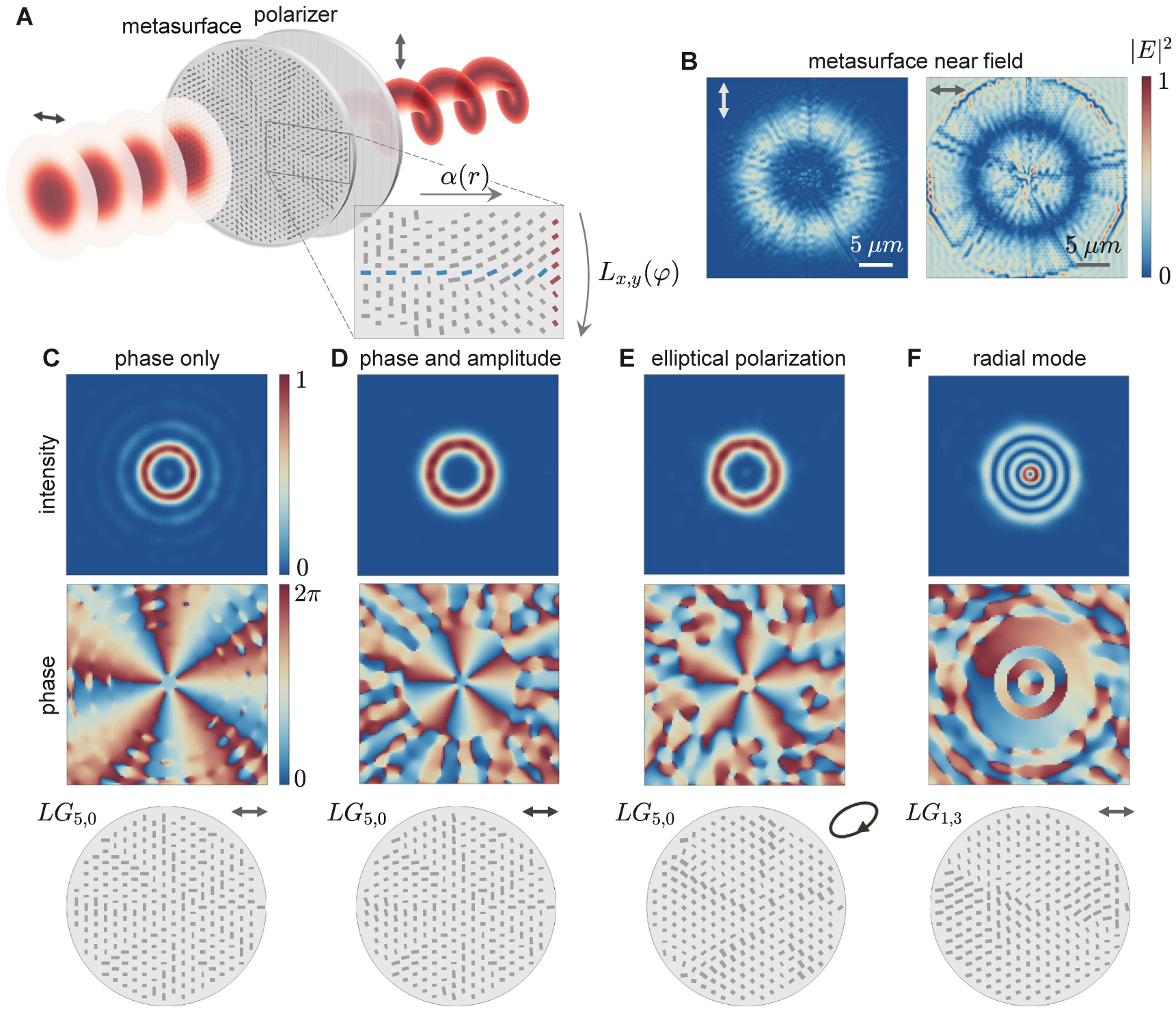
Pure vortex generation from a single metasurface.
(A) Schematic of the system implementation for pure vortex generation. An input wave of known amplitude, phase, and polarization, here represented as a linearly polarized Gaussian beam, propagates through the metasurface and polarizer and exits as a pure vortex beam. The angles of the nanopillars along the radial directions
The near-field intensity maps of an LG5,0 vortex generator obtained by FDTD simulations are shown in Figure 2B. The uniform intensity of the input plane wave is separated by the p-plate into a vertically polarized component, which is aligned with the polarizer axis and exhibits the characteristic ring-shaped distribution of a vortex mode, and a horizontally polarized component, which contains essentially the complementary intensity distribution and will be filtered by the polarizer. (A small fraction of light goes also into the longitudinal component, which is not shown here.) After propagating the component filtered by the polarizer to the far field, we obtain the intensity and phase distributions shown in Figure 2D, which can be compared with those obtained from a PO metasurface operating without a polarizer (Figure 2C). While in both cases, the phase shows an azimuthal modulation consisting of five sectors (
The purity of the intensity profile generated by the PA metasurface all originates from a proper use of the pillar angle degree of freedom, as highlighted by the comparison of the device designs (cf. Figure 2C and D). As described in our theory, the PA control works for any input polarization state. In Figure 2E, we show that also for elliptically polarized light, where we chose as an example
5 Discussion
After having demonstrated that PA metasurfaces perform better than PO metasurfaces in terms of pure vortex generation, we wish to compare their efficiencies. We define the efficiency as the fraction of power of the beam incident on the metasurface that is converted into the target
where U is the size of the unit cell of the metasurface. Thus, for any OAM charge and for a unit cell size fixed by the phase library, the phase sampling of the PA metasurface can be chosen arbitrarily large just by adjusting

Purity efficiency of phase-only and phase-amplitude transformations.
Fraction of the input beam power that is contained in the fundamental radial mode p = 0 (top) and distributed among all p-modes (bottom) for different values of orbital angular momentum
The PA metasurfaces called p-plates introduced here also present some limitations with respect to the existing approaches for optical vortex generation. Differently from J-plates [14], [15], which implement PO transformations, p-plates are not spin–orbit converters. In particular, they can operate only on a single input polarization state. The degree of freedom that is used in J-plates to achieve independent OAM conversion of two orthogonal input polarization states here is used to apply a desired amplitude modulation. In comparison with q-plate lasers [17] and J-plate lasers [19], which incorporate PO transformation optics in active resonator cavities, p-plates can neither convert all the input energy into a pure LG state nor generate a continuously variable superposition of OAM states [19], only a fixed one. In view of these differences, we do not expect that p-plates will replace the existing technologies for OAM beam generation but may represent a very convenient and powerful approach in several applications, thanks to their simple and compact implementation scheme, sizeable efficiency, and high purity.
Funding source: European Research Council
Award Identifier / Grant number: 817794
Acknowledgements
This work has been financially supported by the European Research Council (ERC) under the European Union’s Horizon 2020 research and innovation programme “METAmorphoses”, grant agreement no. 817794.
Author contribution: All the authors have accepted responsibility for the entire content of this submitted manuscript and approved submission.
Research funding: This work has been financially supported by the European Research Council (ERC) under the European Union’s Horizon 2020 research and innovation programme “METAmorphoses”, grant agreement no. 817794.
Conflict of interest statement: The authors declare no conflicts of interest regarding this article.
References
[1] L. Allen, M. W. Beijersbergen, R. J. C. Spreeuw, and J. P. Woerdman, “Orbital angular momentum of light and the transformation of Laguerre–Gaussian laser modes,” PRA, vol. 45, pp. 8185–8189, 1992. https://doi.org/10.1103/physreva.45.8185.Suche in Google Scholar
[2] S. Franke-Arnold, L. Allen, and M. Padgett, “Advances in optical angular momentum,” Laser Photon. Rev., vol. 2, pp. 299–313, 2020. https://doi.org/10.1002/lpor.200810007.Suche in Google Scholar
[3] A. Mair, A. Vaziri, G. Weihs, and A. Zeilinger, “Entanglement of the orbital angular momentum states of photons,” Nature, vol. 412, pp. 313–316, 2001. https://doi.org/10.1038/35085529.Suche in Google Scholar
[4] E. Nagali, F. Sciarrino, F. De Martini, et al., “Quantum information transfer from spin to orbital angular momentum of photons,” PRL, vol. 103, p. 013601, 2009. https://doi.org/10.1103/physrevlett.103.013601.Suche in Google Scholar
[5] S. Fürhapter, A. Jesacher, S. Bernet, and M. Ritsch-Marte, “Spiral phase contrast imaging in microscopy,” Opt. Express, vol. 13, pp. 689–694, 2005. https://doi.org/10.1364/opex.13.000689.Suche in Google Scholar
[6] L. Li and F. Li, “Beating the Rayleigh limit: orbital-angular-momentum-based superresolution diffraction tomography,” PRE, vol. 88, p. 033205, 2013. https://doi.org/10.1103/physreve.88.033205.Suche in Google Scholar
[7] X. Wang, Z. Nie, Y. Liang, et al., “Recent advances on optical vortex generation,” Nanophotonics, vol. 7, pp. 1533–1556, 2018. https://doi.org/10.1515/nanoph-2018-0072.Suche in Google Scholar
[8] M. W. Beijersbergen, R. P. C. Coerwinkel, M. Kristensen, and J. P. Woerdman, “Helicalwavefront laser beams produced with a spiral phaseplate,” Opt. Commun., vol. 112, pp. 321–327, 1994. https://doi.org/10.1016/0030-4018(94)90638-6.Suche in Google Scholar
[9] N. R. Heckenberg, R. McDuff, C. P. Smith, and A. G. White, “Generation of optical phase singularities by computer-generated holograms,” Opt. Lett., vol. 17, pp. 221–223, 1992. https://doi.org/10.1364/ol.17.000221.Suche in Google Scholar PubMed
[10] A. Ambrosio, L. Marrucci, F. Borbone, A. Roviello, and P. Maddalena, “Light-induced spiral mass transport in azo-polymer films under vortex-beam illumination,” Nat. Commun., vol. 3, p. 989, 2012. https://doi.org/10.1038/ncomms1996.Suche in Google Scholar PubMed PubMed Central
[11] S. Ngcobo, I. Litvin, L. Burger, and A. Forbes, “A digital laser for on-demand laser modes,” Nat. Commun., vol. 4, p. 2289, 2013. https://doi.org/10.1038/ncomms3289.Suche in Google Scholar PubMed
[12] R. C. Devlin, A. Ambrosio, D. Wintz, et al., “Spin-to-orbital angular momentum conversion in dielectric metasurfaces,” Opt. Express, vol. 25, pp. 377–393, 2017. https://doi.org/10.1364/oe.25.000377.Suche in Google Scholar PubMed
[13] A. Rubano, F. Cardano, B. Piccirillo, and L. Marrucci, “Q-plate technology: a progress review [Invited],” J. Opt. Soc. Am. B, vol. 36, pp. 70–87, 2019. https://doi.org/10.1364/josab.36.000d70.Suche in Google Scholar
[14] R. C. Devlin, A. Ambrosio, N. A. Rubin, J. P. B. Mueller, and F. Capasso, “Arbitrary spin-to-orbital angular momentum conversion of light,” Science, vol. 358, pp. 896–901, 2017. https://doi.org/10.1126/science.aao5392.Suche in Google Scholar PubMed
[15] Y.-W. Huang, et al., “Versatile total angular momentum generation using cascaded,” J Plates. Opt. Express, vol. 27, pp. 7469–7484, 2019. https://doi.org/10.1364/oe.27.007469.Suche in Google Scholar PubMed
[16] B. Sephton, A. Dudley, and A. Forbes, “Revealing the radial modes in vortex beams,” Appl. Optic., vol. 55, pp. 7830–7835, 2016. https://doi.org/10.1364/ao.55.007830.Suche in Google Scholar
[17] E. Maguid, et al., “Topologically controlled intracavity laser modes based on pancharatnam-berry phase,” ACS Photon., vol. 5, pp. 1817–1821, 2018. https://doi.org/10.1021/acsphotonics.7b01525.Suche in Google Scholar
[18] R. Uren, S. Beecher, C. R. Smith, and W. A. Clarkson, “Method for generating high purity Laguerre–Gaussian vortex modes,” IEEE J. Quant. Electron., vol. 55, pp. 1–9, 2019. https://doi.org/10.1109/jqe.2019.2931006.Suche in Google Scholar
[19] H. Sroor, Y.-W. Huang, B. Sephton, et al., “High-purity orbital angular momentum states from a visible metasurface laser,” Nat. Photon., vol. 14, pp. 498–503, 2020. https://doi.org/10.1038/s41566-020-0623-z.Suche in Google Scholar
[20] A. Arbabi, Y. Horie, M. Bagheri, and A. Faraon, “Dielectric metasurfaces for complete control of phase and polarization with subwavelength spatial resolution and high transmission,” Nat. Nanotechnol., vol. 10, pp. 937–943, 2015. https://doi.org/10.1038/nnano.2015.186.Suche in Google Scholar PubMed
[21] G. Vallone, “Role of beam waist in Laguerre–Gauss expansion of vortex beams,” Opt. Lett., vol. 42, pp. 1097–1100, 2017. https://doi.org/10.1364/ol.42.001097.Suche in Google Scholar
[22] Q. Wang, et al., “Broadband metasurface holograms: toward complete phase and amplitude engineering,” Sci. Rep., vol. 6, p. 32867, 2016. https://doi.org/10.1038/srep32867.Suche in Google Scholar PubMed PubMed Central
[23] S. L. Jia, X. Wan, P. Su, Y. J. Zhao, and T. J. Cui, “Broadband metasurface for independent control of reflected amplitude and phase,” AIP Adv., vol. 6, p. 045024, 2020. https://doi.org/10.1063/1.4948513.Suche in Google Scholar
[24] S. Divitt, W. Zhu, C. Zhang, H. J. Lezec, and A. Agrawal, “Ultrafast optical pulse shaping using dielectric metasurfaces,” Science, vol. 364, pp. 890–894, 2019. https://doi.org/10.1126/science.aav9632.Suche in Google Scholar PubMed PubMed Central
[25] A. C. Overvig, S. Shrestha, S. C. Malek, et al., “Dielectric metasurfaces for complete and independent control of the optical amplitude and phase,” Light Sci. Appl., vol. 8, p. 92, 2019. https://doi.org/10.1038/s41377-019-0201-7.Suche in Google Scholar PubMed PubMed Central
[26] B. E. Saleh and M. Teich, Fundamentals of Photonics, Hoboken, United States, Wiley, 2007.Suche in Google Scholar
Supplementary material
The online version of this article offers supplementary material (https://doi.org/10.1515/nanoph-2020-0332).
© 2020 Marco Piccardo and Antonio Ambrosio, published by De Gruyter.
This work is licensed under the Creative Commons Attribution 4.0 International License.
Artikel in diesem Heft
- Editorial
- Editorial
- Optoelectronics and Integrated Photonics
- Disorder effects in nitride semiconductors: impact on fundamental and device properties
- Ultralow threshold blue quantum dot lasers: what’s the true recipe for success?
- Waiting for Act 2: what lies beyond organic light-emitting diode (OLED) displays for organic electronics?
- Waveguide combiners for mixed reality headsets: a nanophotonics design perspective
- On-chip broadband nonreciprocal light storage
- High-Q nanophotonics: sculpting wavefronts with slow light
- Thermoelectric graphene photodetectors with sub-nanosecond response times at terahertz frequencies
- High-performance integrated graphene electro-optic modulator at cryogenic temperature
- Asymmetric photoelectric effect: Auger-assisted hot hole photocurrents in transition metal dichalcogenides
- Seeing the light in energy use
- Lasers, Active optical devices and Spectroscopy
- A high-repetition rate attosecond light source for time-resolved coincidence spectroscopy
- Fast laser speckle suppression with an intracavity diffuser
- Active optics with silk
- Nanolaser arrays: toward application-driven dense integration
- Two-dimensional spectroscopy on a THz quantum cascade structure
- Homogeneous quantum cascade lasers operating as terahertz frequency combs over their entire operational regime
- Toward new frontiers for terahertz quantum cascade laser frequency combs
- Soliton dynamics of ring quantum cascade lasers with injected signal
- Fiber Optics and Optical Communications
- Propagation stability in optical fibers: role of path memory and angular momentum
- Perspective on using multiple orbital-angular-momentum beams for enhanced capacity in free-space optical communication links
- Biomedical Photonics
- A fiber optic–nanophotonic approach to the detection of antibodies and viral particles of COVID-19
- Plasmonic control of drug release efficiency in agarose gel loaded with gold nanoparticle assemblies
- Metasurfaces for biomedical applications: imaging and sensing from a nanophotonics perspective
- Hyperbolic dispersion metasurfaces for molecular biosensing
- Fundamentals of Optics
- A Tutorial on the Classical Theories of Electromagnetic Scattering and Diffraction
- Reflectionless excitation of arbitrary photonic structures: a general theory
- Optimization Methods
- Multiobjective and categorical global optimization of photonic structures based on ResNet generative neural networks
- Machine learning–assisted global optimization of photonic devices
- Artificial neural networks for inverse design of resonant nanophotonic components with oscillatory loss landscapes
- Adjoint-optimized nanoscale light extractor for nitrogen-vacancy centers in diamond
- Topological Photonics
- Non-Hermitian and topological photonics: optics at an exceptional point
- Topological photonics: Where do we go from here?
- Topological nanophotonics for photoluminescence control
- Anomalous Anderson localization behavior in gain-loss balanced non-Hermitian systems
- Quantum computing, Quantum Optics, and QED
- Quantum computing and simulation
- NIST-certified secure key generation via deep learning of physical unclonable functions in silica aerogels
- Thomas–Reiche–Kuhn (TRK) sum rule for interacting photons
- Macroscopic QED for quantum nanophotonics: emitter-centered modes as a minimal basis for multiemitter problems
- Generation and dynamics of entangled fermion–photon–phonon states in nanocavities
- Polaritonic Tamm states induced by cavity photons
- Recent progress in engineering the Casimir effect – applications to nanophotonics, nanomechanics, and chemistry
- Enhancement of rotational vacuum friction by surface photon tunneling
- Plasmonics and Polaritonics
- Shrinking the surface plasmon
- Polariton panorama
- Scattering of a single plasmon polariton by multiple atoms for in-plane control of light
- A metasurface-based diamond frequency converter using plasmonic nanogap resonators
- Selective excitation of individual nanoantennas by pure spectral phase control in the ultrafast coherent regime
- Semiconductor quantum plasmons for high frequency thermal emission
- Origin of dispersive line shapes in plasmon-enhanced stimulated Raman scattering microscopy
- Epitaxial aluminum plasmonics covering full visible spectrum
- Metaoptics
- Metamaterials with high degrees of freedom: space, time, and more
- The road to atomically thin metasurface optics
- Active nonlocal metasurfaces
- Giant midinfrared nonlinearity based on multiple quantum well polaritonic metasurfaces
- Near-field plates and the near zone of metasurfaces
- High-efficiency metadevices for bifunctional generations of vectorial optical fields
- Printing polarization and phase at the optical diffraction limit: near- and far-field optical encryption
- Optical response of jammed rectangular nanostructures
- Dynamic phase-change metafilm absorber for strong designer modulation of visible light
- Arbitrary polarization conversion for pure vortex generation with a single metasurface
- Enhanced harmonic generation in gases using an all-dielectric metasurface
- Monolithic metasurface spatial differentiator enabled by asymmetric photonic spin-orbit interactions
Artikel in diesem Heft
- Editorial
- Editorial
- Optoelectronics and Integrated Photonics
- Disorder effects in nitride semiconductors: impact on fundamental and device properties
- Ultralow threshold blue quantum dot lasers: what’s the true recipe for success?
- Waiting for Act 2: what lies beyond organic light-emitting diode (OLED) displays for organic electronics?
- Waveguide combiners for mixed reality headsets: a nanophotonics design perspective
- On-chip broadband nonreciprocal light storage
- High-Q nanophotonics: sculpting wavefronts with slow light
- Thermoelectric graphene photodetectors with sub-nanosecond response times at terahertz frequencies
- High-performance integrated graphene electro-optic modulator at cryogenic temperature
- Asymmetric photoelectric effect: Auger-assisted hot hole photocurrents in transition metal dichalcogenides
- Seeing the light in energy use
- Lasers, Active optical devices and Spectroscopy
- A high-repetition rate attosecond light source for time-resolved coincidence spectroscopy
- Fast laser speckle suppression with an intracavity diffuser
- Active optics with silk
- Nanolaser arrays: toward application-driven dense integration
- Two-dimensional spectroscopy on a THz quantum cascade structure
- Homogeneous quantum cascade lasers operating as terahertz frequency combs over their entire operational regime
- Toward new frontiers for terahertz quantum cascade laser frequency combs
- Soliton dynamics of ring quantum cascade lasers with injected signal
- Fiber Optics and Optical Communications
- Propagation stability in optical fibers: role of path memory and angular momentum
- Perspective on using multiple orbital-angular-momentum beams for enhanced capacity in free-space optical communication links
- Biomedical Photonics
- A fiber optic–nanophotonic approach to the detection of antibodies and viral particles of COVID-19
- Plasmonic control of drug release efficiency in agarose gel loaded with gold nanoparticle assemblies
- Metasurfaces for biomedical applications: imaging and sensing from a nanophotonics perspective
- Hyperbolic dispersion metasurfaces for molecular biosensing
- Fundamentals of Optics
- A Tutorial on the Classical Theories of Electromagnetic Scattering and Diffraction
- Reflectionless excitation of arbitrary photonic structures: a general theory
- Optimization Methods
- Multiobjective and categorical global optimization of photonic structures based on ResNet generative neural networks
- Machine learning–assisted global optimization of photonic devices
- Artificial neural networks for inverse design of resonant nanophotonic components with oscillatory loss landscapes
- Adjoint-optimized nanoscale light extractor for nitrogen-vacancy centers in diamond
- Topological Photonics
- Non-Hermitian and topological photonics: optics at an exceptional point
- Topological photonics: Where do we go from here?
- Topological nanophotonics for photoluminescence control
- Anomalous Anderson localization behavior in gain-loss balanced non-Hermitian systems
- Quantum computing, Quantum Optics, and QED
- Quantum computing and simulation
- NIST-certified secure key generation via deep learning of physical unclonable functions in silica aerogels
- Thomas–Reiche–Kuhn (TRK) sum rule for interacting photons
- Macroscopic QED for quantum nanophotonics: emitter-centered modes as a minimal basis for multiemitter problems
- Generation and dynamics of entangled fermion–photon–phonon states in nanocavities
- Polaritonic Tamm states induced by cavity photons
- Recent progress in engineering the Casimir effect – applications to nanophotonics, nanomechanics, and chemistry
- Enhancement of rotational vacuum friction by surface photon tunneling
- Plasmonics and Polaritonics
- Shrinking the surface plasmon
- Polariton panorama
- Scattering of a single plasmon polariton by multiple atoms for in-plane control of light
- A metasurface-based diamond frequency converter using plasmonic nanogap resonators
- Selective excitation of individual nanoantennas by pure spectral phase control in the ultrafast coherent regime
- Semiconductor quantum plasmons for high frequency thermal emission
- Origin of dispersive line shapes in plasmon-enhanced stimulated Raman scattering microscopy
- Epitaxial aluminum plasmonics covering full visible spectrum
- Metaoptics
- Metamaterials with high degrees of freedom: space, time, and more
- The road to atomically thin metasurface optics
- Active nonlocal metasurfaces
- Giant midinfrared nonlinearity based on multiple quantum well polaritonic metasurfaces
- Near-field plates and the near zone of metasurfaces
- High-efficiency metadevices for bifunctional generations of vectorial optical fields
- Printing polarization and phase at the optical diffraction limit: near- and far-field optical encryption
- Optical response of jammed rectangular nanostructures
- Dynamic phase-change metafilm absorber for strong designer modulation of visible light
- Arbitrary polarization conversion for pure vortex generation with a single metasurface
- Enhanced harmonic generation in gases using an all-dielectric metasurface
- Monolithic metasurface spatial differentiator enabled by asymmetric photonic spin-orbit interactions
