Revisiting the Reynolds-averaged Navier–Stokes equations
-
Bohua Sun


Abstract
This study revisits the Reynolds-averaged Navier–Stokes (RANS) equations and finds that the existing literature is erroneous regarding the primary unknowns and the number of independent unknowns in the RANS. The literature claims that the Reynolds stress tensor has six independent unknowns, but in fact the six unknowns can be reduced to three that are functions of the three velocity fluctuation components, because the Reynolds stress tensor is simply an integration of a second-order dyadic tensor of flow velocity fluctuations rather than a general symmetric tensor. This difficult situation is resolved by returning to the time of Reynolds in 1895 and revisiting Reynolds’ averaging formulation of turbulence. The study of turbulence modeling could focus on the velocity fluctuations instead of the Reynolds stress. An advantage of modeling the velocity fluctuations is, from both physical and experimental perspectives, that the velocity fluctuation components are observable whereas the Reynolds stress tensor is not.
1 Introduction
Turbulence is one of the greatest unsolved mysteries of physics (as depicted in Figure 1). After more than a century of studying turbulence, only a few answers have been found regarding how it works and affects the world around us. Many scientists argue that future progress must rely on statistics and increased computing power: extremely fast computer simulations of turbulent flows may help to identify patterns that lead to a theory that organizes and unifies predictions for different situations. Other scientists argue that the phenomenon is so complex that such a fully fledged theory is impossible.

Turbulent smoke. Photograph by B. H. Sun.
Although different researchers might have different views about turbulence, there is consensus that the deterministic Navier–Stokes equations probably contain all the physics information about turbulence. Turbulence can be predicted by understanding and solving the Navier–Stokes equations. Navier [1] and Poisson [2] first introduced these equations, which were finally verified by de Saint-Venant [3] and Stokes [4] based on various considerations regarding the mutual action of the basic fluid molecules [5,6].
This article adopts Reynolds’ deterministic view of turbulence [5] and revisits the Reynolds-averaged Navier–Stokes (RANS) equations. This study addresses a basic problem in turbulence analysis, namely, the number of unknowns in the Reynolds stress tensor, which is obviously also a fundamental question in fluid mechanics. The research herein reveals that the Reynolds stress tensor has only three independent unknowns instead of the six stated in the existing literature, including textbooks. Although the RANS equations were formulated more than 120 years ago, much of the existing literature and standard turbulence textbooks are incorrect regarding the number of unknowns in the RANS, and this has prevented the turbulence problem from being solved. If the number of unknowns is incorrect, then no correct solutions can be possibly obtained, this situation should be corrected to let the turbulence studies not to be compromised.
Given that turbulence is yet to be defined in essence, it would be fitting to return to the beginning of turbulence research, namely, 1895, and consider Reynolds’ seminal studies to rediscover certain useful information. The aims herein are to revisit Reynolds’ averaging formulation of turbulence and clarify the number of independent unknowns in the Reynolds stress tensor and/or RANS equations.
This article is organized as follows. Following an introduction, we introduce Reynolds velocity decomposition and reformulate the RANS equations in tensorial form. We raise an important question about the number of independent unknowns in both the Reynolds stress tensor and RANS equations, and provide three mathematical lemmas and evidence about dyadic tensor. The critical Reynolds number of turbulence transition and other related formulations are derived as well. To demonstrate the Reynolds’ modeling, we quote some results from Reynolds’ paper [5]. Finally, we conclude with perspectives on future developments in turbulence research.
2 Reynolds turbulence equations and RANS equations
The study of the Navier–Stokes equations of incompressible flow is one of the central topics for both laminar and turbulent flows and can be expressed as follows:
Equation (1) is the momentum equation and equation (2) is the mass conservation equation, in which
Applying the divergence operation to both sides of the momentum equation (1) and using the mass conservation lead to a pressure equation:
where
Infinitesimal analysis reveals that the Navier–Stokes equations admit ten Lie groups, but none is suitable for solving the problem of turbulence. In ground-breaking research, Reynolds [5] considered turbulence from a different perspective and assuming that turbulent motion already exists, he sought to establish a criterion for whether the turbulent character will increase, diminish, or remain stationary [6]. From experiments, Reynolds [5] discovered that turbulence solution could be expressed as the sum of the mean and fluctuating parts of the velocity field, a form of solution not found by Lie group analysis [5]. Mathematically speaking, Reynolds’ solution method can be considered as a general approach to solve nonlinear partial differential equations (PDEs) by transforming them into integro-differential equations.
In 1895, Reynolds [5] proposed decomposing the flow velocity
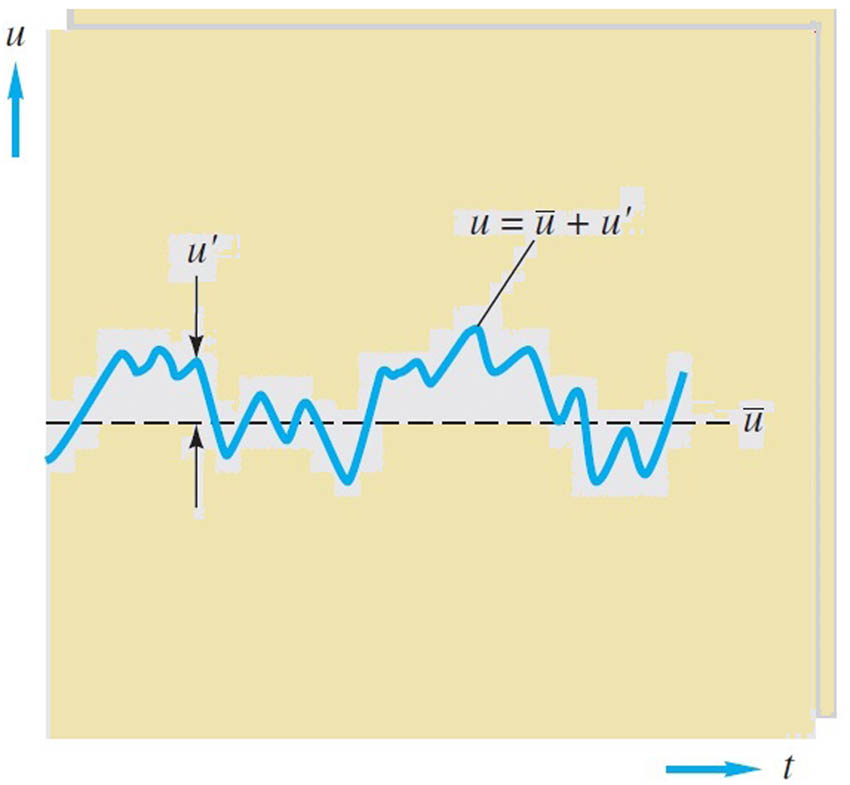
Velocity decomposition.

Pressure decomposition.
As such, the Reynolds decompositions are
Reynolds decomposition converts the four independent unknowns,
According to Reynolds [5],
or simply [6]
where
Reynolds decomposition transforms the Navier-Stokes equations into equations for the mean velocity
where
which shows that the Reynolds stress depends on the fluctuating velocity field
The definition of the Reynolds stress tensor can be written in component form as follows:
This expression provides a clear information that the three velocity fluctuations
To obtain more information about the Reynolds stress tensor, Reynolds [5] derived velocity-fluctuation equations, namely, equation (16) in ref. [5], which he referred to as the equations of momentum of the relative mean motion at each point. The velocity-fluctuation equations in boldface tensorial form are
These are integro-differential equations governing
From equation (3) and
and
Denoting the kinematic viscosity as
The integro-differential equations in equations (10), (11), (14), and (15) are known as the RANS equations formulated by Reynolds [5], who referred to them as the equations of mean motion and relative-to-mean equations at every point. Clearly, the RANS equations are deterministic, not statistical [5,6].
Although the Navier–Stokes equations have been transformed into averaged equations (RANS), such as equations (10), (11), (14), and (15), how to determine their eight unknowns, namely
The literature considers
Note that for the deterministic velocity field
3 Number of independent unknowns in Reynolds stress tensor and RANS equations
The existing literature, including textbooks, reports that the Reynolds stress
In his 1895 paper [5], Reynolds did not discuss the number of independent unknowns in the RANS equations. However, from the flow of his presentation we noted that he never considered the term
Due to limited source of references, the present author is unaware who was the first person to propose the ten unknown perception in equations (10) and (11) of the RANS equations. However, this mistake in classical physics has hampered the development of turbulence as a subject. The RANS equations in equations (10) and (11) comprise four independent equations that govern the mean velocity field, namely, the three components of the Reynolds equation (equation (10)) together with the mean continuity equation (equation (11)).
We show later that the Reynolds stress tensor
4 Lemmas
The following lemmas support the above statement.
Lemma 4.1
Given two vectors
In general, for
For
Lemma 4.2
Given three vectors
In general, for
For
Lemma 4.3
Given a vector
where
Although
Lemma 3 actually states that any (time) averaging operation is merely a method of data processing and does not change the number of unknowns within the problem. Clearly,
5 Two proofs
The number of independent unknowns in the Reynolds stress tensor and/or RANS equations should not be an issue at all because it can be found simply from Reynolds’ work [5]. However, the long-standing misconception in the turbulence research community has affected perception. For clarity, it is necessary to explain the issue from the following perspectives.
5.1 Direct proof by definition of Reynolds stress tensor
The lemmas show that the Reynolds stress tensor has three independent unknown components. This is proved by defining the Reynolds stress tensor as
and the fluctuation-velocity convective terms are
where the Reynolds stress tensor
The above indicates that any Reynolds stress tensor component
The formulation in equation (23) reveals that the Reynolds stress tensor
The misinterpretation in the literature regarding the number of independent unknown components may stem from considering the Reynolds stress tensor as a general second-order symmetric tensor with six independent components. However, the Reynolds stress tensor is not an arbitrary second-order tensor. In fact, its components are made by the binomial product of the fluctuation velocity components, which means that the Reynolds stress tensor is a dyadic tensor of the velocity fluctuation. The unknown components to construct the dyadic tensor are the three components of fluctuation velocity
5.2 Proof of a particular case
To construct a second-order tensor or matrix with four components, one can use two scalar functions
The above process shows that the independent unknowns are
It is proven once again that both the tensor
Independent unknowns in Reynolds stress tensor
| Existing literature | Present paper | |
|---|---|---|
| Number | 6 | 3 |
| Unknowns |
|
|
Although the RANS equations are not closed, the four RANS equations in equations (10) and (11) contain only seven independent unknowns instead of ten as stated in the existing literature. The differing views of the independent unknowns in the RANS equations are summarized in Table 2.
Independent unknowns in RANS equations
| Existing literature | Present paper | |
|---|---|---|
| Number | 10 | 7 |
| Unknowns |
|
|
|
|
|
|
|
|
|
6 Reynolds stress tensor transport equation
Right tensor multiplying from equations (14) by
Left tensor multiplying from equations (14) by
Noting the identities:
After rearranging we have
The existing literature claims that equation (30) has 27 independent unknowns. However, the present research leads to a different opinion, having shown that the Reynolds stress equation (equation (30)) has only seven independent unknowns. Accounting for all symmetries, they are listed in Table 3.
Independent unknowns in transport equation of Reynolds stress tensor
| Existing literature | Present paper | |
|---|---|---|
| Number | 27 | 7 |
| Unknowns |
|
|
|
|
|
|
|
|
|
|
|
|
||
|
|
The above statement is proven by the following:
Clearly, the mean values of
and the mean value of
The same can be done for fourth and higher orders as in ref. [7] and textbooks. However, regardless of the order, no additional independent unknowns can be created.
7 Turbulent kinetic energy transport equation
The contraction operation for indexes
where the kinetic energy
Independent unknowns in kinetic energy equation
| Existing literature | Present paper | |
|---|---|---|
| Number | 27 | 7 |
| Unknowns |
|
|
|
|
|
|
|
|
|
|
|
|
||
|
|
||
|
|
The underbrace term on the right gives zero on integration over the whole region
8 Critical Reynolds number of turbulence transition
Introducing dimensionless parameters as
The relation (34) can be rewritten as
where the Reynolds number
The relation (35) is the energy balance of turbulent flow, which reveals that the velocity fluctuation can only be maintained and sustained if the mean velocity can provide enough energy. In other words, the rate of transformation from energy of mean motion must be equal to the rate at which energy of fluctuation motion is converted into heat. Once the flow has the velocity fluctuation, it means that the flow is in the turbulent state.
Since the term
This limit of the Reynolds number can be viewed as the generalization of Reynolds’ estimation for 2D problems [5] and has not been reported in the literature.
9 Reynolds’ solution of pressure flow of turbulent fluid between two parallel surfaces and Reynolds computation strategy of the RANS
9.1 Reynolds’ solution of pressure flow of turbulent fluid between two parallel surfaces
As an application of the Reynolds’ decomposition strategy, Reynolds computed a turbulent flow between two parallel surfaces. The detailed calculations can be seen in his paper [5]. Herein, we took only some calculations from his paper as supporting materials for our academic statement on the number of unknowns. The purpose of taking some materials from Reynolds’ paper [5] is to show that Reynolds considered the velocity fluctuations as unknowns rather than the Reynolds stress tensor
The fluid is of constant density

Flow between two infinite parallel surfaces. Boundary conditions:
If the mean motion is steady and
The boundary condition
(38)The equation of continuity
(39)The first momentum equation becomes
(40)or putting
as in the singular solution, equation (40) becomes
(41)where
The integral of equation (41) over the section of which the left term is zero, and the mean value of
The components of relative-mean-motion (i.e., fluctuation) must satisfy the periodic conditions, putting 2c for the limit in direction
The equation
(42)The equation of continuity
The boundary conditions with which the continuity gives
(43)The condition imposed by symmetrical mean motion,
(44)
On page 158 of ref. [5] in the section entitled Expressions for the components of possible relative-mean-motion, Reynolds proposed
where
If the velocity fluctuation is restricted to motion parallel to the plane of
Reynolds also compiled integrations by using the above expressions, e.g., equation (58) on page 159 of ref. [5], which is shown as follows:
By giving the above expressions, Reynolds was regarding the velocity fluctuations in
Reynolds obtained the Reynolds number Re as shown in Figure 5.
which is minimum if
![Figure 5
Reynolds number [5].](/document/doi/10.1515/phys-2021-0102/asset/graphic/j_phys-2021-0102_fig_005.jpg)
Reynolds number [5].
9.2 Reynolds computation strategy of the RANS
Regarding the computational aspects of the RANS, we can learn from Reynolds [5]. The way Reynolds dealt with the turbulent flow between two parallel plates clearly shows his idea on the computation of the RANS. Based on Reynolds [5], Reynolds computation methodology can be briefly summarized as follows.
First, solve the corresponding laminar problem of the turbulent problem and use the laminar flow solutions as the mean solutions
10 Conclusion
This study revisited the RANS equations and studied the primary unknowns and number of independent unknowns in the Reynolds stress tensor and RANS. The present study found that there are three independent unknowns in the Reynolds stress tensor, namely, three velocity fluctuation components
In the future, the study of turbulence modeling could focus on the velocity fluctuations
It is clear that the present ideas and methods might be applicable to the compressible turbulent Navier–Stokes equations, where the mass density
The present investigation can be considered a renaissance of Reynolds’ study in 1895, which will assist with understanding the well-known problem of turbulence that has eluded scientists and mathematicians for more than a century.
Acknowledgements
The author wishes to express his appreciation to the anonymous reviewers for their high-level comments.
-
Funding information: The author wishes to express his appreciation to the Xi'an University of Architecture and Technology for financial support.
-
Author contributions: All authors have accepted responsibility for the entire content of this manuscript and approved its submission.
-
Conflict of interest: The authors state no conflict of interest.
-
Data availability statement: The data that support the findings of this study are available from the corresponding author upon reasonable request.
References
[1] Navier C. Mémoire sur les Lois du Mouvement des Fluides. Mém.delaAcad.des Sci. 1822;6:389. Search in Google Scholar
[2] Poisson SD . Mémoire sur les Équations géérales de laÉquilibre et du Mouvement des Corps solides élastiques et des fluides. Journ.de laÉcole Plytechn. 1829;13:1. Search in Google Scholar
[3] Saint-Venant AJCB de . Note á joindre au Mémoire sur la dynamique des fluides. Comptes Rendus Acad. sci. Paris. 1943;17:1240–3. Search in Google Scholar
[4] Stokes GG . On the theories of the internal friction of fluids in motion and of the equilibrium and motion of elastic solids. Trans Cambridge Philos Soc. 1845;8:287–319. 10.1017/CBO9780511702242.005Search in Google Scholar
[5] Reynolds O. On the dynamical theory of incompressible viscous fluids and the determination of the criterion. Philosoph Trans R Soc London. 1895;186:123–64. 10.1098/rsta.1895.0004. Search in Google Scholar
[6] Lamb HS . Hydrodynamics. 6th edition. Cambridge: Cambridge University Press; 1993. Search in Google Scholar
[7] Chou P-Y . On velocity correlations and the solutions of the equations of turbulent fluctuation. Q Appl Math. 1945;111(1):38–54. 10.1090/qam/11999Search in Google Scholar
[8] Lee CB , Wu JZ , Transition in wall-bounded flows. Appl Mech Rev. 2008;61(3):030802. 10.1115/1.2909605Search in Google Scholar
[9] Sun BH . Thirty years of turbulence study in China. Appl Math Mech. 2019;40(2):193–214. 10.1007/s10483-019-2427-9Search in Google Scholar
[10] Landau LD , Lifshitz EM . Mechanics. 3rd edition. Oxford: Butterworth-Heinemann; 1976. Search in Google Scholar
© 2021 Bohua Sun, published by De Gruyter
This work is licensed under the Creative Commons Attribution 4.0 International License.
Articles in the same Issue
- Regular Articles
- Circular Rydberg states of helium atoms or helium-like ions in a high-frequency laser field
- Closed-form solutions and conservation laws of a generalized Hirota–Satsuma coupled KdV system of fluid mechanics
- W-Chirped optical solitons and modulation instability analysis of Chen–Lee–Liu equation in optical monomode fibres
- The problem of a hydrogen atom in a cavity: Oscillator representation solution versus analytic solution
- An analytical model for the Maxwell radiation field in an axially symmetric galaxy
- Utilization of updated version of heat flux model for the radiative flow of a non-Newtonian material under Joule heating: OHAM application
- Verification of the accommodative responses in viewing an on-axis analog reflection hologram
- Irreversibility as thermodynamic time
- A self-adaptive prescription dose optimization algorithm for radiotherapy
- Algebraic computational methods for solving three nonlinear vital models fractional in mathematical physics
- The diffusion mechanism of the application of intelligent manufacturing in SMEs model based on cellular automata
- Numerical analysis of free convection from a spinning cone with variable wall temperature and pressure work effect using MD-BSQLM
- Numerical simulation of hydrodynamic oscillation of side-by-side double-floating-system with a narrow gap in waves
- Closed-form solutions for the Schrödinger wave equation with non-solvable potentials: A perturbation approach
- Study of dynamic pressure on the packer for deep-water perforation
- Ultrafast dephasing in hydrogen-bonded pyridine–water mixtures
- Crystallization law of karst water in tunnel drainage system based on DBL theory
- Position-dependent finite symmetric mass harmonic like oscillator: Classical and quantum mechanical study
- Application of Fibonacci heap to fast marching method
- An analytical investigation of the mixed convective Casson fluid flow past a yawed cylinder with heat transfer analysis
- Considering the effect of optical attenuation on photon-enhanced thermionic emission converter of the practical structure
- Fractal calculation method of friction parameters: Surface morphology and load of galvanized sheet
- Charge identification of fragments with the emulsion spectrometer of the FOOT experiment
- Quantization of fractional harmonic oscillator using creation and annihilation operators
- Scaling law for velocity of domino toppling motion in curved paths
- Frequency synchronization detection method based on adaptive frequency standard tracking
- Application of common reflection surface (CRS) to velocity variation with azimuth (VVAz) inversion of the relatively narrow azimuth 3D seismic land data
- Study on the adaptability of binary flooding in a certain oil field
- CompVision: An open-source five-compartmental software for biokinetic simulations
- An electrically switchable wideband metamaterial absorber based on graphene at P band
- Effect of annealing temperature on the interface state density of n-ZnO nanorod/p-Si heterojunction diodes
- A facile fabrication of superhydrophobic and superoleophilic adsorption material 5A zeolite for oil–water separation with potential use in floating oil
- Shannon entropy for Feinberg–Horodecki equation and thermal properties of improved Wei potential model
- Hopf bifurcation analysis for liquid-filled Gyrostat chaotic system and design of a novel technique to control slosh in spacecrafts
- Optical properties of two-dimensional two-electron quantum dot in parabolic confinement
- Optical solitons via the collective variable method for the classical and perturbed Chen–Lee–Liu equations
- Stratified heat transfer of magneto-tangent hyperbolic bio-nanofluid flow with gyrotactic microorganisms: Keller-Box solution technique
- Analysis of the structure and properties of triangular composite light-screen targets
- Magnetic charged particles of optical spherical antiferromagnetic model with fractional system
- Study on acoustic radiation response characteristics of sound barriers
- The tribological properties of single-layer hybrid PTFE/Nomex fabric/phenolic resin composites underwater
- Research on maintenance spare parts requirement prediction based on LSTM recurrent neural network
- Quantum computing simulation of the hydrogen molecular ground-state energies with limited resources
- A DFT study on the molecular properties of synthetic ester under the electric field
- Construction of abundant novel analytical solutions of the space–time fractional nonlinear generalized equal width model via Riemann–Liouville derivative with application of mathematical methods
- Some common and dynamic properties of logarithmic Pareto distribution with applications
- Soliton structures in optical fiber communications with Kundu–Mukherjee–Naskar model
- Fractional modeling of COVID-19 epidemic model with harmonic mean type incidence rate
- Liquid metal-based metamaterial with high-temperature sensitivity: Design and computational study
- Biosynthesis and characterization of Saudi propolis-mediated silver nanoparticles and their biological properties
- New trigonometric B-spline approximation for numerical investigation of the regularized long-wave equation
- Modal characteristics of harmonic gear transmission flexspline based on orthogonal design method
- Revisiting the Reynolds-averaged Navier–Stokes equations
- Time-periodic pulse electroosmotic flow of Jeffreys fluids through a microannulus
- Exact wave solutions of the nonlinear Rosenau equation using an analytical method
- Computational examination of Jeffrey nanofluid through a stretchable surface employing Tiwari and Das model
- Numerical analysis of a single-mode microring resonator on a YAG-on-insulator
- Review Articles
- Double-layer coating using MHD flow of third-grade fluid with Hall current and heat source/sink
- Analysis of aeromagnetic filtering techniques in locating the primary target in sedimentary terrain: A review
- Rapid Communications
- Nonlinear fitting of multi-compartmental data using Hooke and Jeeves direct search method
- Effect of buried depth on thermal performance of a vertical U-tube underground heat exchanger
- Knocking characteristics of a high pressure direct injection natural gas engine operating in stratified combustion mode
- What dominates heat transfer performance of a double-pipe heat exchanger
- Special Issue on Future challenges of advanced computational modeling on nonlinear physical phenomena - Part II
- Lump, lump-one stripe, multiwave and breather solutions for the Hunter–Saxton equation
- New quantum integral inequalities for some new classes of generalized ψ-convex functions and their scope in physical systems
- Computational fluid dynamic simulations and heat transfer characteristic comparisons of various arc-baffled channels
- Gaussian radial basis functions method for linear and nonlinear convection–diffusion models in physical phenomena
- Investigation of interactional phenomena and multi wave solutions of the quantum hydrodynamic Zakharov–Kuznetsov model
- On the optical solutions to nonlinear Schrödinger equation with second-order spatiotemporal dispersion
- Analysis of couple stress fluid flow with variable viscosity using two homotopy-based methods
- Quantum estimates in two variable forms for Simpson-type inequalities considering generalized Ψ-convex functions with applications
- Series solution to fractional contact problem using Caputo’s derivative
- Solitary wave solutions of the ionic currents along microtubule dynamical equations via analytical mathematical method
- Thermo-viscoelastic orthotropic constraint cylindrical cavity with variable thermal properties heated by laser pulse via the MGT thermoelasticity model
- Theoretical and experimental clues to a flux of Doppler transformation energies during processes with energy conservation
- On solitons: Propagation of shallow water waves for the fifth-order KdV hierarchy integrable equation
- Special Issue on Transport phenomena and thermal analysis in micro/nano-scale structure surfaces - Part II
- Numerical study on heat transfer and flow characteristics of nanofluids in a circular tube with trapezoid ribs
- Experimental and numerical study of heat transfer and flow characteristics with different placement of the multi-deck display cabinet in supermarket
- Thermal-hydraulic performance prediction of two new heat exchangers using RBF based on different DOE
- Diesel engine waste heat recovery system comprehensive optimization based on system and heat exchanger simulation
- Load forecasting of refrigerated display cabinet based on CEEMD–IPSO–LSTM combined model
- Investigation on subcooled flow boiling heat transfer characteristics in ICE-like conditions
- Research on materials of solar selective absorption coating based on the first principle
- Experimental study on enhancement characteristics of steam/nitrogen condensation inside horizontal multi-start helical channels
- Special Issue on Novel Numerical and Analytical Techniques for Fractional Nonlinear Schrodinger Type - Part I
- Numerical exploration of thin film flow of MHD pseudo-plastic fluid in fractional space: Utilization of fractional calculus approach
- A Haar wavelet-based scheme for finding the control parameter in nonlinear inverse heat conduction equation
- Stable novel and accurate solitary wave solutions of an integrable equation: Qiao model
- Novel soliton solutions to the Atangana–Baleanu fractional system of equations for the ISALWs
- On the oscillation of nonlinear delay differential equations and their applications
- Abundant stable novel solutions of fractional-order epidemic model along with saturated treatment and disease transmission
- Fully Legendre spectral collocation technique for stochastic heat equations
- Special Issue on 5th International Conference on Mechanics, Mathematics and Applied Physics (2021)
- Residual service life of erbium-modified AM50 magnesium alloy under corrosion and stress environment
- Special Issue on Advanced Topics on the Modelling and Assessment of Complicated Physical Phenomena - Part I
- Diverse wave propagation in shallow water waves with the Kadomtsev–Petviashvili–Benjamin–Bona–Mahony and Benney–Luke integrable models
- Intensification of thermal stratification on dissipative chemically heating fluid with cross-diffusion and magnetic field over a wedge
Articles in the same Issue
- Regular Articles
- Circular Rydberg states of helium atoms or helium-like ions in a high-frequency laser field
- Closed-form solutions and conservation laws of a generalized Hirota–Satsuma coupled KdV system of fluid mechanics
- W-Chirped optical solitons and modulation instability analysis of Chen–Lee–Liu equation in optical monomode fibres
- The problem of a hydrogen atom in a cavity: Oscillator representation solution versus analytic solution
- An analytical model for the Maxwell radiation field in an axially symmetric galaxy
- Utilization of updated version of heat flux model for the radiative flow of a non-Newtonian material under Joule heating: OHAM application
- Verification of the accommodative responses in viewing an on-axis analog reflection hologram
- Irreversibility as thermodynamic time
- A self-adaptive prescription dose optimization algorithm for radiotherapy
- Algebraic computational methods for solving three nonlinear vital models fractional in mathematical physics
- The diffusion mechanism of the application of intelligent manufacturing in SMEs model based on cellular automata
- Numerical analysis of free convection from a spinning cone with variable wall temperature and pressure work effect using MD-BSQLM
- Numerical simulation of hydrodynamic oscillation of side-by-side double-floating-system with a narrow gap in waves
- Closed-form solutions for the Schrödinger wave equation with non-solvable potentials: A perturbation approach
- Study of dynamic pressure on the packer for deep-water perforation
- Ultrafast dephasing in hydrogen-bonded pyridine–water mixtures
- Crystallization law of karst water in tunnel drainage system based on DBL theory
- Position-dependent finite symmetric mass harmonic like oscillator: Classical and quantum mechanical study
- Application of Fibonacci heap to fast marching method
- An analytical investigation of the mixed convective Casson fluid flow past a yawed cylinder with heat transfer analysis
- Considering the effect of optical attenuation on photon-enhanced thermionic emission converter of the practical structure
- Fractal calculation method of friction parameters: Surface morphology and load of galvanized sheet
- Charge identification of fragments with the emulsion spectrometer of the FOOT experiment
- Quantization of fractional harmonic oscillator using creation and annihilation operators
- Scaling law for velocity of domino toppling motion in curved paths
- Frequency synchronization detection method based on adaptive frequency standard tracking
- Application of common reflection surface (CRS) to velocity variation with azimuth (VVAz) inversion of the relatively narrow azimuth 3D seismic land data
- Study on the adaptability of binary flooding in a certain oil field
- CompVision: An open-source five-compartmental software for biokinetic simulations
- An electrically switchable wideband metamaterial absorber based on graphene at P band
- Effect of annealing temperature on the interface state density of n-ZnO nanorod/p-Si heterojunction diodes
- A facile fabrication of superhydrophobic and superoleophilic adsorption material 5A zeolite for oil–water separation with potential use in floating oil
- Shannon entropy for Feinberg–Horodecki equation and thermal properties of improved Wei potential model
- Hopf bifurcation analysis for liquid-filled Gyrostat chaotic system and design of a novel technique to control slosh in spacecrafts
- Optical properties of two-dimensional two-electron quantum dot in parabolic confinement
- Optical solitons via the collective variable method for the classical and perturbed Chen–Lee–Liu equations
- Stratified heat transfer of magneto-tangent hyperbolic bio-nanofluid flow with gyrotactic microorganisms: Keller-Box solution technique
- Analysis of the structure and properties of triangular composite light-screen targets
- Magnetic charged particles of optical spherical antiferromagnetic model with fractional system
- Study on acoustic radiation response characteristics of sound barriers
- The tribological properties of single-layer hybrid PTFE/Nomex fabric/phenolic resin composites underwater
- Research on maintenance spare parts requirement prediction based on LSTM recurrent neural network
- Quantum computing simulation of the hydrogen molecular ground-state energies with limited resources
- A DFT study on the molecular properties of synthetic ester under the electric field
- Construction of abundant novel analytical solutions of the space–time fractional nonlinear generalized equal width model via Riemann–Liouville derivative with application of mathematical methods
- Some common and dynamic properties of logarithmic Pareto distribution with applications
- Soliton structures in optical fiber communications with Kundu–Mukherjee–Naskar model
- Fractional modeling of COVID-19 epidemic model with harmonic mean type incidence rate
- Liquid metal-based metamaterial with high-temperature sensitivity: Design and computational study
- Biosynthesis and characterization of Saudi propolis-mediated silver nanoparticles and their biological properties
- New trigonometric B-spline approximation for numerical investigation of the regularized long-wave equation
- Modal characteristics of harmonic gear transmission flexspline based on orthogonal design method
- Revisiting the Reynolds-averaged Navier–Stokes equations
- Time-periodic pulse electroosmotic flow of Jeffreys fluids through a microannulus
- Exact wave solutions of the nonlinear Rosenau equation using an analytical method
- Computational examination of Jeffrey nanofluid through a stretchable surface employing Tiwari and Das model
- Numerical analysis of a single-mode microring resonator on a YAG-on-insulator
- Review Articles
- Double-layer coating using MHD flow of third-grade fluid with Hall current and heat source/sink
- Analysis of aeromagnetic filtering techniques in locating the primary target in sedimentary terrain: A review
- Rapid Communications
- Nonlinear fitting of multi-compartmental data using Hooke and Jeeves direct search method
- Effect of buried depth on thermal performance of a vertical U-tube underground heat exchanger
- Knocking characteristics of a high pressure direct injection natural gas engine operating in stratified combustion mode
- What dominates heat transfer performance of a double-pipe heat exchanger
- Special Issue on Future challenges of advanced computational modeling on nonlinear physical phenomena - Part II
- Lump, lump-one stripe, multiwave and breather solutions for the Hunter–Saxton equation
- New quantum integral inequalities for some new classes of generalized ψ-convex functions and their scope in physical systems
- Computational fluid dynamic simulations and heat transfer characteristic comparisons of various arc-baffled channels
- Gaussian radial basis functions method for linear and nonlinear convection–diffusion models in physical phenomena
- Investigation of interactional phenomena and multi wave solutions of the quantum hydrodynamic Zakharov–Kuznetsov model
- On the optical solutions to nonlinear Schrödinger equation with second-order spatiotemporal dispersion
- Analysis of couple stress fluid flow with variable viscosity using two homotopy-based methods
- Quantum estimates in two variable forms for Simpson-type inequalities considering generalized Ψ-convex functions with applications
- Series solution to fractional contact problem using Caputo’s derivative
- Solitary wave solutions of the ionic currents along microtubule dynamical equations via analytical mathematical method
- Thermo-viscoelastic orthotropic constraint cylindrical cavity with variable thermal properties heated by laser pulse via the MGT thermoelasticity model
- Theoretical and experimental clues to a flux of Doppler transformation energies during processes with energy conservation
- On solitons: Propagation of shallow water waves for the fifth-order KdV hierarchy integrable equation
- Special Issue on Transport phenomena and thermal analysis in micro/nano-scale structure surfaces - Part II
- Numerical study on heat transfer and flow characteristics of nanofluids in a circular tube with trapezoid ribs
- Experimental and numerical study of heat transfer and flow characteristics with different placement of the multi-deck display cabinet in supermarket
- Thermal-hydraulic performance prediction of two new heat exchangers using RBF based on different DOE
- Diesel engine waste heat recovery system comprehensive optimization based on system and heat exchanger simulation
- Load forecasting of refrigerated display cabinet based on CEEMD–IPSO–LSTM combined model
- Investigation on subcooled flow boiling heat transfer characteristics in ICE-like conditions
- Research on materials of solar selective absorption coating based on the first principle
- Experimental study on enhancement characteristics of steam/nitrogen condensation inside horizontal multi-start helical channels
- Special Issue on Novel Numerical and Analytical Techniques for Fractional Nonlinear Schrodinger Type - Part I
- Numerical exploration of thin film flow of MHD pseudo-plastic fluid in fractional space: Utilization of fractional calculus approach
- A Haar wavelet-based scheme for finding the control parameter in nonlinear inverse heat conduction equation
- Stable novel and accurate solitary wave solutions of an integrable equation: Qiao model
- Novel soliton solutions to the Atangana–Baleanu fractional system of equations for the ISALWs
- On the oscillation of nonlinear delay differential equations and their applications
- Abundant stable novel solutions of fractional-order epidemic model along with saturated treatment and disease transmission
- Fully Legendre spectral collocation technique for stochastic heat equations
- Special Issue on 5th International Conference on Mechanics, Mathematics and Applied Physics (2021)
- Residual service life of erbium-modified AM50 magnesium alloy under corrosion and stress environment
- Special Issue on Advanced Topics on the Modelling and Assessment of Complicated Physical Phenomena - Part I
- Diverse wave propagation in shallow water waves with the Kadomtsev–Petviashvili–Benjamin–Bona–Mahony and Benney–Luke integrable models
- Intensification of thermal stratification on dissipative chemically heating fluid with cross-diffusion and magnetic field over a wedge
