On solitons: Propagation of shallow water waves for the fifth-order KdV hierarchy integrable equation
-
Aly R. Seadawy
 ,
Shafiq U. Rehman
,
Shafiq U. Rehman

Abstract
This article studies the fifth-order KdV (5KdV) hierarchy integrable equation, which arises naturally in the modeling of numerous wave phenomena such as the propagation of shallow water waves over a flat surface, gravity–capillary waves, and magneto-sound propagation in plasma. Two innovative integration norms, namely, the
1 Introduction
The study of nonlinear phenomena is a glorious field for the researchers due to its significant applications in this advanced era of technology. The analytic solutions of nonlinear partial differential equations (NLPDEs) are the attractive and testing field of examination for mathematicians and researchers [1,2,3, 4,5,6]. For the investigation of exact wave structures, NLPDEs have a huge impact in diverse areas of nonlinear sciences like mathematical physics, mechanics, chemistry, thermodynamic, physical science, electromagnetism, bio-math, and vice versa. To extract and study the exact and solitary waves of complicated nonlinear problems apart from the mathematical perspective can be analyzed using different techniques. Therefore, the new techniques are developed and modified in recent times [7,8,9, 10,11,12, 13,14,20, 21,22,23, 24,25].
Moreover, solitons models are widely useful in the mechanism of solitary wave-based communications links, optical pulse compressors, fiber-optic amplifiers, and several others. The solitons can propagate in nonlinear dispersive media. Remarkably, the interest is growing steadily to the study of shock and solitary solitons in recent years. To extract the various type of solutions like soliton solutions, traveling wave solutions, cnoidal and snoidal waves, trigonometric wave solutions, and many more have been the challenging task for the researchers; for details, see also refs. [26,27,28, 29,30,31, 32,33,34]. In this article, our main purpose is to obtain diverse nonlionear dynamical wave structures such as hyperbolic, solitary, singular, shock, shock-singular soliton, singular periodic, and rational function solutions for the 5KdV hierarchy integrable equation with Lax operator.
This equation can be reduced to other equations, namely, Lax’s fifth-order KdV equation, Sawada–Kotera equation, and Kaup–Kupershmidt equation for different values of constants. It is the first equation in a hierarchy of integrable equations with Lax operator [35,36,37].
Consider the fifth-order KdV equation with constant-coefficients in the following form:
where
If we take
When
The 5KdV type equations is modeled to discuss the nonliner phenomenon in the propagation of shallow water waves over a flat surface, gravity–capillary waves, and magneto-sound propagation in plasmas [40,41].
The enduring article is organized as follows: Section 2 presents application of
2 Application of
G
′
G
2
-expansion function method
To solve the proposed system, the following wave hypothesis is used as follows:
On integrating Eq. (5) one time with respect to
where
where
Set-1:
Set-2:
Set-3:
where
For Set-1,
Trigonometric solutions:
Hyperbolic solution:
Setting,
Rational solution:
If we take

Simulations of Eq. (8).
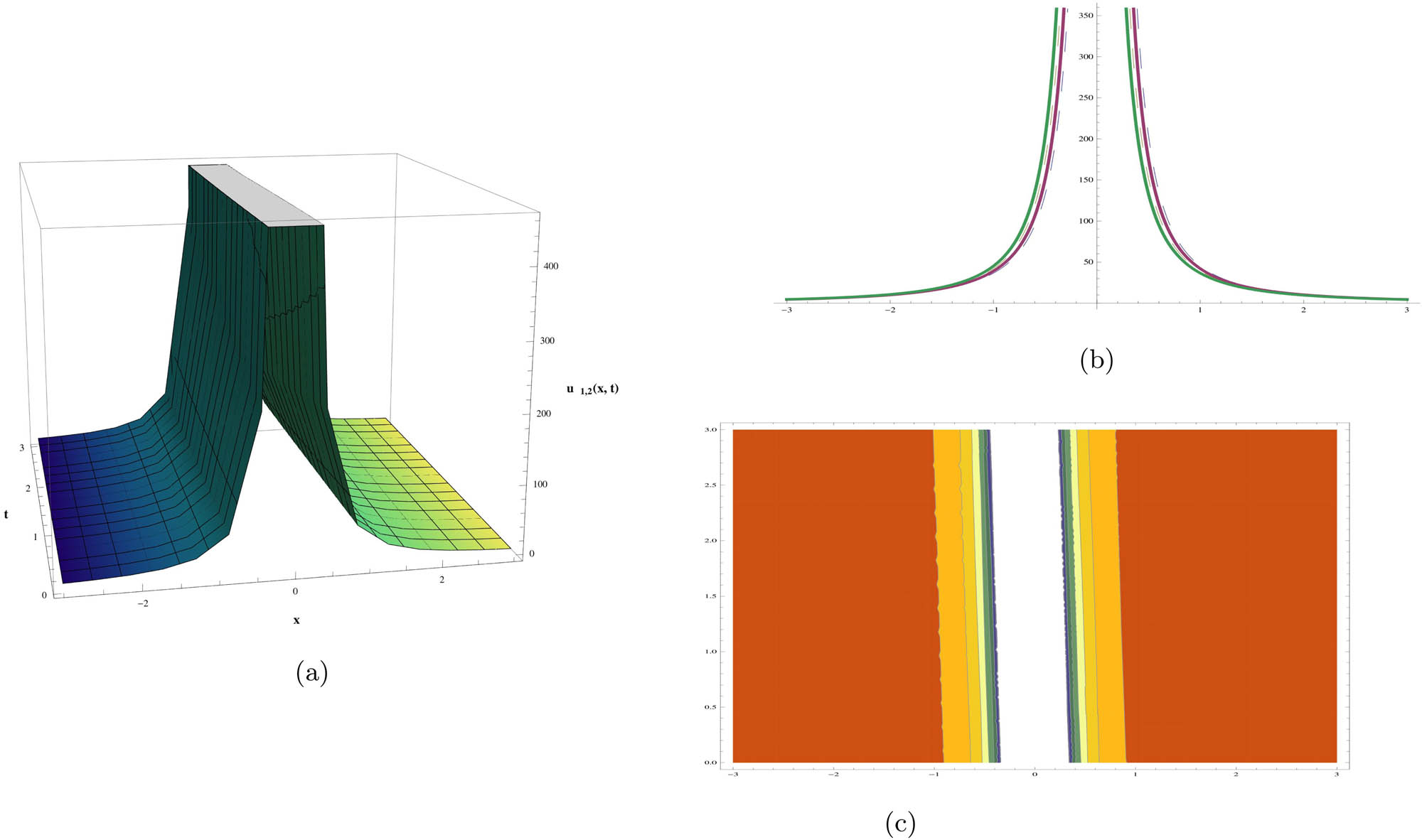
Simulations of Eq. (10).
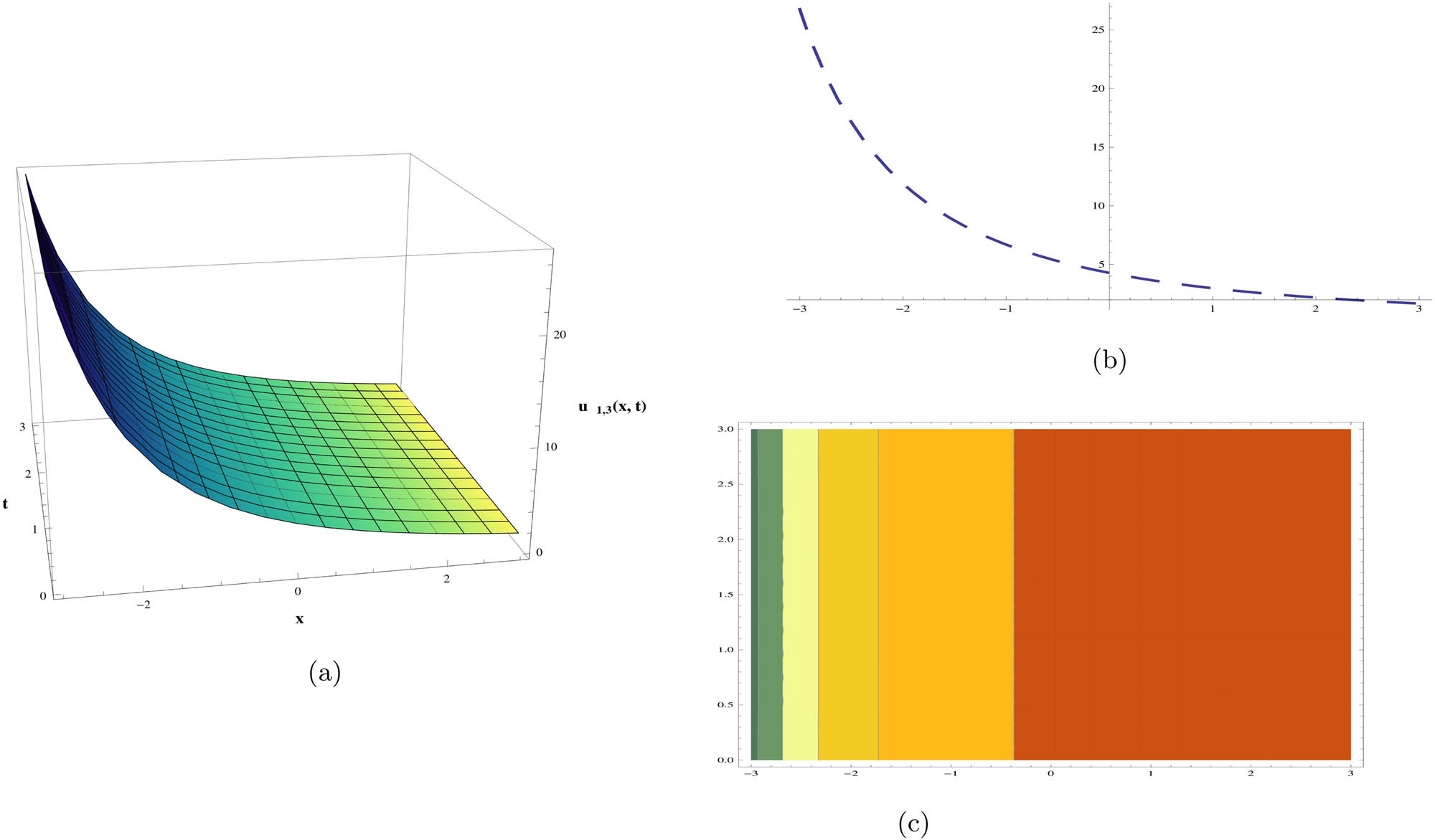
Simulations of Eq. (12).
For Set-2,
Trigonometric solutions:
Hyperbolic solution:
Setting,

Simulations of Eq. (13).
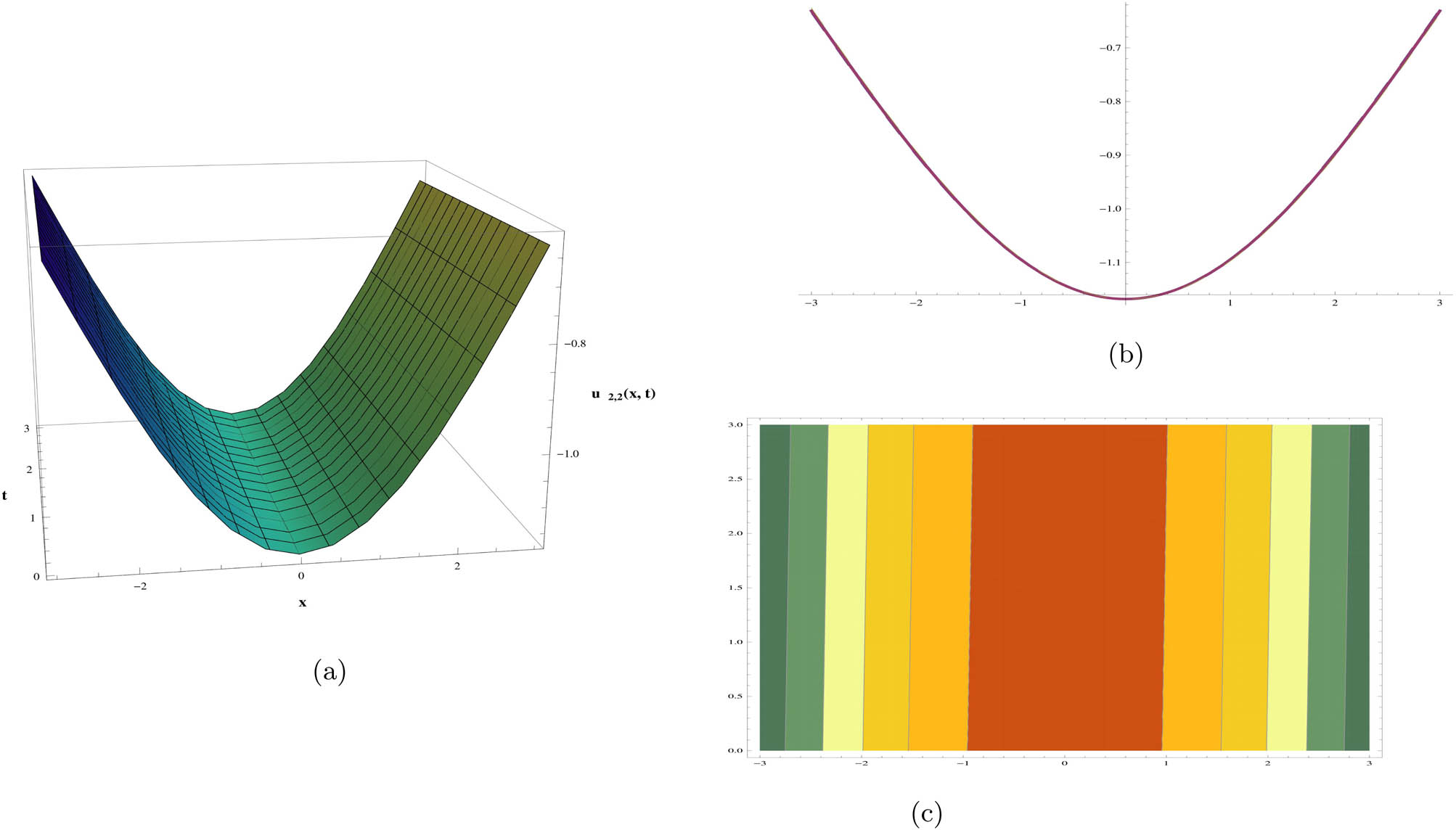
Simulations of Eq. (15).
For Set-3,
Trigonometric solutions:
For soliton solution, take
Hyperbolic solution:
Setting,
Rational solution:
If we take
For all solutions
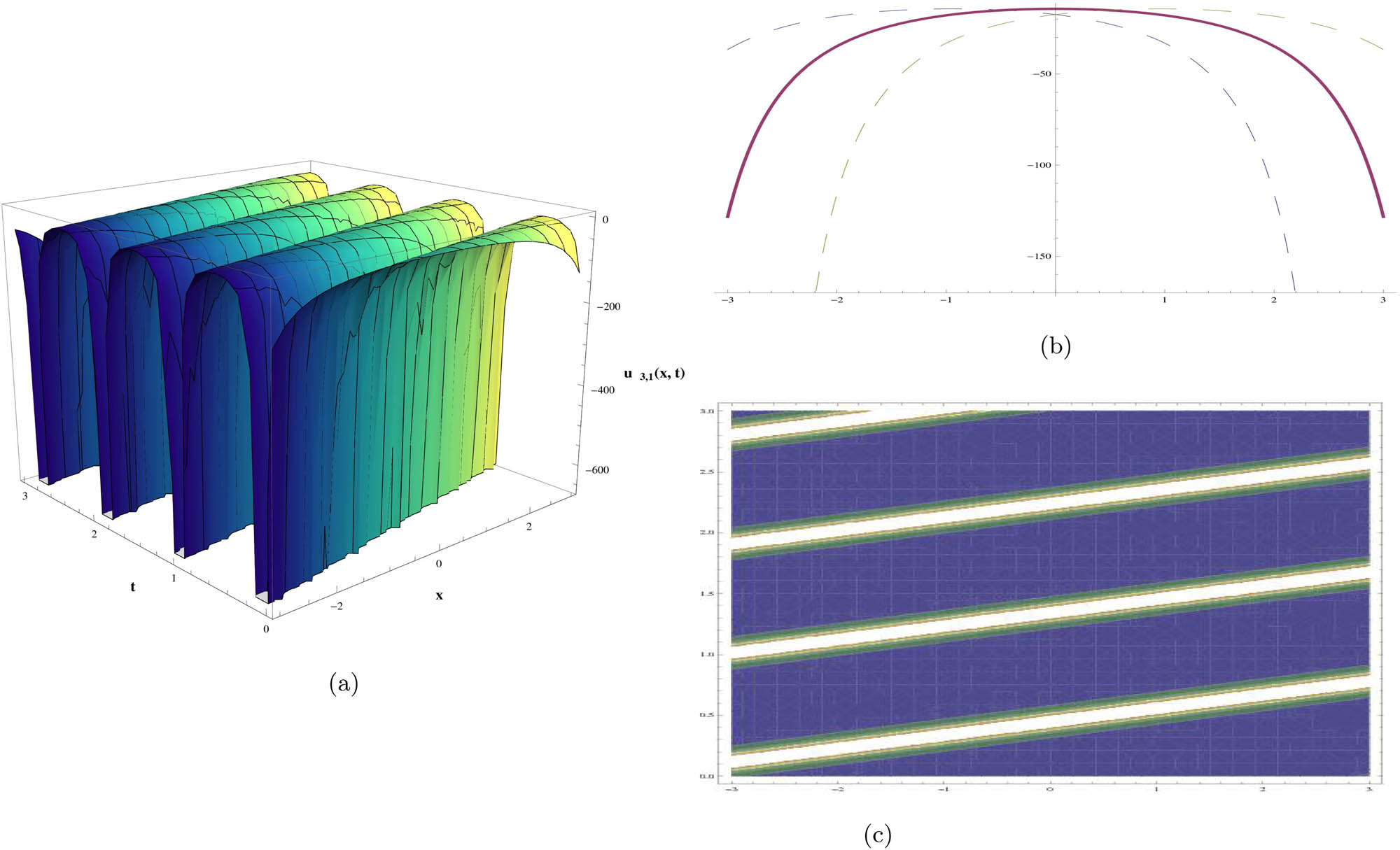
Simulations of Eq. (17).
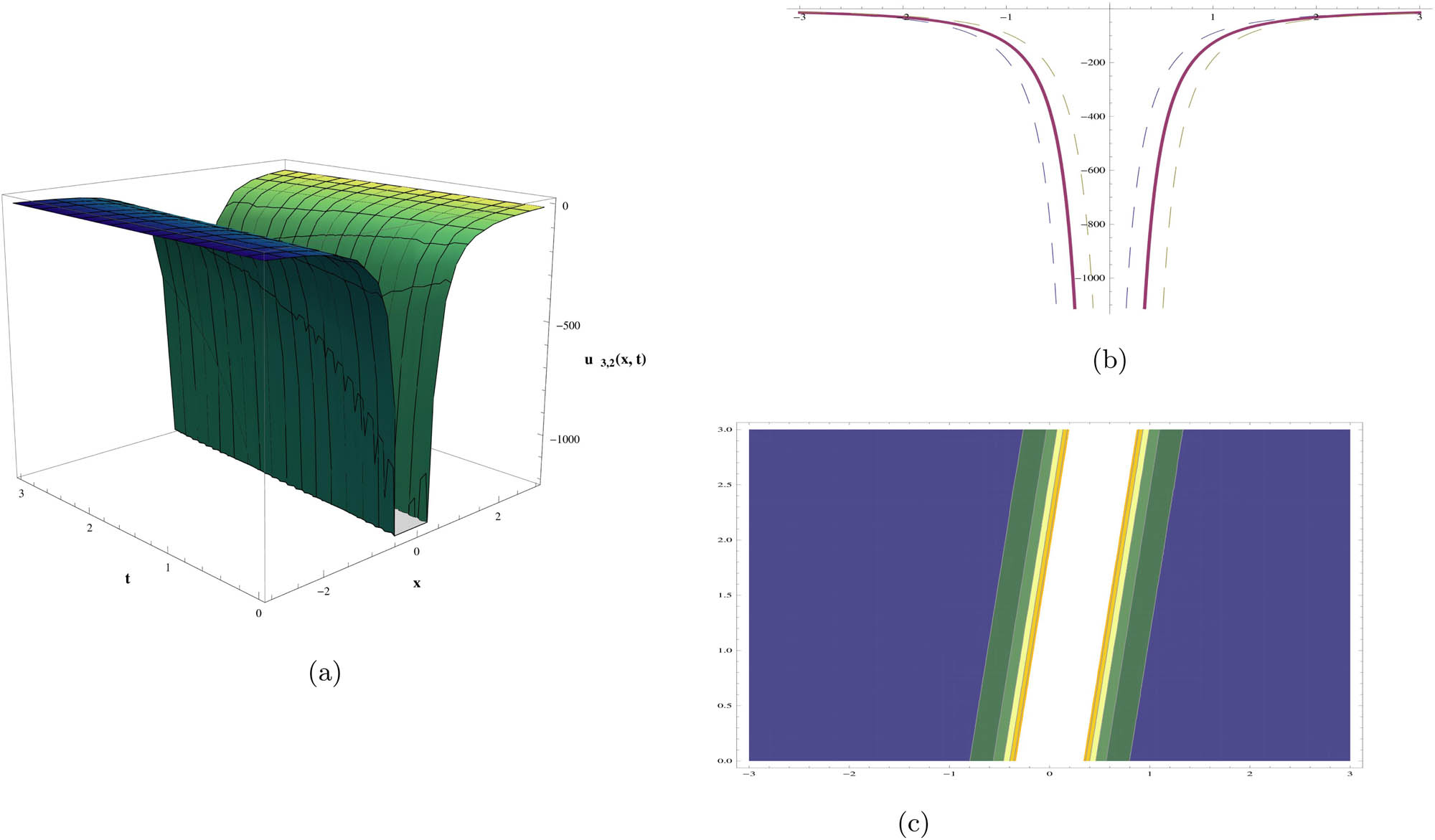
Simulations of Eq. (19).

Simulations of Eq. (21).
3 The solitary, singular, and shock wave solutions
To construct the solutions, the solitary wave ansatz method is used in the following sections.
3.1 Solitary wave
For solitary or nontopological wave solutions, we have
with the condition
Where the parameters
After substituting Eq. (23)–(27) into the Eq. (1), we have
From Eq. (28), we get
On inserting
Moreover, it is observed that the soliton width
Hence, the solitary wave solution of the 5KdV equation is written as follows (Figure 9):

Simulations of Eq. (29).
3.2 Shock wave
For shock or topological wave solutions, we have
where the parameters
After substituting Eq. (31)–(35) into Eq. (1), the following Eq. can be obtained:
From Eq. (36), we get
On inserting
Hence, the shock wave solution of the 5KdV equation is given by the following equation: (Figure 10)
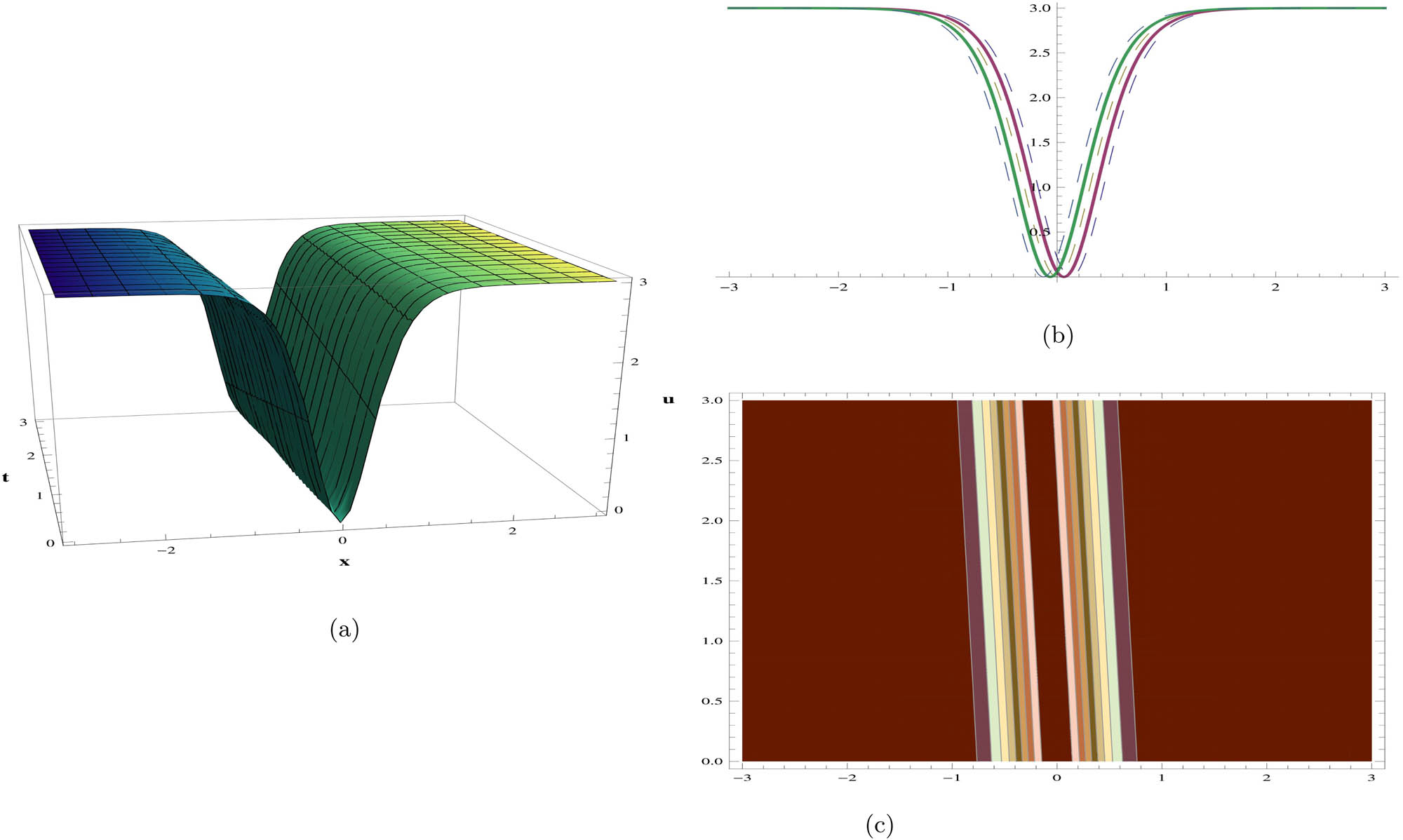
Simulations of Eq. (37).
3.3 Singular wave
For singular wave solution, we have
where the parameters
After inserting Eq. (39)–(43) into Eq. (1), the following equation is achieved:
From Eq. (44), we get
On inserting
Moreover, it may be noted that the soliton width
Hence, the singular wave solution of the 5KdV equation is given by (Figure 11)

Simulations of Eq. (45).
4 Concluding remarks
We retrieved the novel hyperbolic, trigonometric, shock, solitary, singular, shock-singular, singular periodic, and rational function solutions to the 5KdV equation. It is also noted that this equation can be reduced to other equations, namely, Lax’s fifth-order KdV equation, Sawada–Kotera equation, and Kaup–Kupershmidt equation for different values of parameters. Moreover the solitary wave ansatz method forms noteworthy highlights that make it reasonable for the acquiring of single soliton solutions for a wide class of NLPDEs and we obviously see that the consistency, which has been applied effectively. We also have depicted the graphical view of some wave structures of the studied system in this article. By implementing the proposed methodologies, the diverse exact wave structures are extracted and some of represented physically with different parameters. Compared with the solutions obtained by using other methods, our reported solutions are new ones. The results of this work will be a source of inspiration and motivation for future discussion in nonlinear physical sciences. The calculations also reveals us the importance of these methods to find the exact wave solutions in a more general way. The results obtained in this article enrich the analysis of 5KdV equations.
-
Funding information: Taif University Researchers Supporting Project number (TURSP-2020/326), Taif University, Taif, Saudi Arabia.
-
Author contributions: All authors have accepted responsibility for the entire content of this manuscript and approved its submission.
-
Conflict of interest: The authors state no conflict of interest.
References
[1] Abdel-Gawad HI , Osman MS . On shallow water waves in a medium with time-dependent dispersion and nonlinearity coefficients. J Adv Res. 2015;6(5):593–9. 10.1016/j.jare.2014.02.004Search in Google Scholar PubMed PubMed Central
[2] Osman MS , Abdel-Gawad HI , El Mahdy MA . Two-layer-atmospheric blocking in a medium with high nonlinearity and lateral dispersion. Result Phys. 2018;8:1054–60. 10.1016/j.rinp.2018.01.040Search in Google Scholar
[3] Osman MS . On multi-soliton solutions for the (2+1)-dimensional breaking soliton equation with variable coefficients in a graded-index waveguide. Comput Math Appl. 2018;75(1):1–6. 10.1016/j.camwa.2017.08.033Search in Google Scholar
[4] Mohapatra SC , Fonseca RB , Guedes Soares C . Comparison of analytical and numerical simulations of long nonlinear internal waves in shallow water. J Coastal Res. 2018;34(4):928–38. 10.2112/JCOASTRES-D-16-00193.1Search in Google Scholar
[5] Younas U , Seadawy AR , Younis M , Rizvi STR . Dispersive of propagation wave structures to the Dullin-Gottwald-Holm dynamical equation in a shallow water waves. Chin J Phys. 2020;68:348–64. 10.1016/j.cjph.2020.09.021Search in Google Scholar
[6] Sağlam Özkan Y , Seadawy AR , Yaşar E . Multi-wave, breather and interaction solutions to (3+1) dimensional Vakhnenko-Parkes equation arising at propagation of high-frequency waves in a relaxing medium. J Taibah Univ Sci. 2021;15(1):666–78. 10.1080/16583655.2021.1999053Search in Google Scholar
[7] Seadawy AR , Iqbal M , Lu D . Application of mathematical methods on the ion sound and Langmuir waves dynamical systems. Pramana - J Phys. 2019;93:10. 10.1007/s12043-019-1771-xSearch in Google Scholar
[8] El-Sheikh MMA , Seadawy AR , Ahmed HM , Arnous AH , Rabie WB . Dispersive and propagation of shallow water waves as a higher order nonlinear Boussinesq-like dynamical wave equations. Phys A Statist Mech Appl. 2020;537:122662. 10.1016/j.physa.2019.122662Search in Google Scholar
[9] Ahmed I , Seadawy AR , Lu D . M-shaped rational solitons and their interaction with kink waves in the Fokas-lenells equation. Phys Scr. 2019;94(055205):7. 10.1088/1402-4896/ab0455Search in Google Scholar
[10] Iqbal M , Seadawy AR , Khalil OH , Lu D . Propagation of long internal waves in density stratified ocean for the (2+1)-dimensional nonlinear Nizhnik-Novikov-Vesselov dynamical equation. Result Phys. 2020;16:102838. 10.1016/j.rinp.2019.102838Search in Google Scholar
[11] Seadawy A , Kumar D , Hosseini K , Samadani F . The system of equations for the ion sound and Langmuir waves and its new exact solutions. Result Phys. 2018;9:1631–4. 10.1016/j.rinp.2018.04.064Search in Google Scholar
[12] Yildirim Y . Optical solitons of Biswas-Arshed equation by trial equation technique. Optik. 2019;182:876–83. 10.1016/j.ijleo.2019.01.084Search in Google Scholar
[13] Younas B , Younis M . Chirped solitons in optical monomode fibres modelled with Chen-Lee-Liu equation. Pramana J Phys. 2020;94:3. 10.1007/s12043-019-1872-6. Search in Google Scholar
[14] Cheemaa N , Seadawy AR , Chen S . More general families of exact solitary wave solutions of the nonlinear Schrodinger equation with their applications in nonlinear optics. Europ Phys J Plus. 2018;133:547. 10.1140/epjp/i2018-12354-9Search in Google Scholar
[15] Seadawy AR , Cheemaa N . Applications of extended modified auxiliary equation mapping method for high order dispersive extended nonlinear schrodinger equation in nonlinear optics. Mod Phys Lett B. 2019;33(18):1950203. 10.1142/S0217984919502038Search in Google Scholar
[16] Ali I , Seadawy AR , Rizvi STR , Younis M , Ali K . Conserved quantities along with Painleve analysis and Optical solitons for the nonlinear dynamics of Heisenberg ferromagnetic spin chains model. Int J Mod Phys B. 2020;34(30):2050283, (15 pages). 10.1142/S0217979220502835Search in Google Scholar
[17] Rizvi STR , Seadawy AR , Ashraf F , Younis M , Iqbal H , Baleanu D . Lump and Interaction solutions of a geophysical Korteweg-de Vries equation. Result Phys. 2020;19:103661. 10.1016/j.rinp.2020.103661Search in Google Scholar
[18] Younas U , Younis M , Seadawy AR , Rizvi STR . Optical solitons and closed form solutions to (3+1)-dimensional resonant Schrodinger equation. Int J Mod Phys B. 2020;34(30):2050291, (16 pages). 10.1142/S0217979220502914Search in Google Scholar
[19] Younas U , Seadawy AR , Younis M , Rizvi STR . Dispersive of propagation wave structures to the Dullin-Gottwald-Holm dynamical equation in a shallow water waves. Chin J Phys. 2020;68:348–64. 10.1016/j.cjph.2020.09.021Search in Google Scholar
[20] Cheemaa N , Seadawy AR , Chen S . Some new families of solitary wave solutions of generalized Schamel equation and their applications in plasma physics. Europ Phys J Plus. 2019;134:117. 10.1140/epjp/i2019-12467-7Search in Google Scholar
[21] Arshed S . Soliton solutions of higher-order nonlinear Schrödinger equation (NLSE) and nonlinear Kudryashovas equation. Optik. 2020;209:164588. 10.1016/j.ijleo.2020.164588. Search in Google Scholar
[22] Iqbal M , Seadawy AR , Lu D , Xia X . Construction of bright-dark solitons and ion-acoustic solitary wave solutions of dynamical system of nonlinear wave propagation. Mod Phys Lett A. 2019;34(37):1950309. 10.1142/S0217732319503097Search in Google Scholar
[23] Lu D , Seadawy AR , Iqbal M . Mathematical physics via construction of traveling and solitary wave solutions of three coupled system of nonlinear partial differential equations and their applications. Result Phys. 2018;11:1161–71. 10.1016/j.rinp.2018.11.014Search in Google Scholar
[24] Younas U , Younis M , Seadawy AR , Rizvi STR , Althobaiti S , Sayed S . Diverse exact solutions for modified nonlinear Schrödinger equation with conformable fractional derivative. Result Phys. 2021;20:103766. 10.1016/j.rinp.2020.103766Search in Google Scholar
[25] Arshad M , Seadawy AR , Lu D . Study of soliton solutions of higher-order nonlinear Schrödinger dynamical model with derivative non-Kerr nonlinear terms and modulation instability analysis. Result Phys. 2019;13:102305. 10.1016/j.rinp.2019.102305Search in Google Scholar
[26] Rizvi STR Seadawy AR Ali I Bibi I , Younis M . Chirp-free optical dromions for the presence of higher order spatio-temporal dispersions and absence of self-phase modulation in birefringent fibers. Mod Phys Lett B. 2020;34(35):2050399, (15 pages). 10.1142/S0217984920503996Search in Google Scholar
[27] Seadawy AR , Ali A , Albarakati WA . Analytical wave solutions of the (2+1)-dimensional first integro-differential Kadomtsev-Petviashivili hierarchy equation by using modified mathematical methods. Result Phys. 2019;15:102775. 10.1016/j.rinp.2019.102775Search in Google Scholar
[28] Seadawy AR , Nasreen N , Lu D , Arshad M . Arising wave propagation in nonlinear media for the (2+1)-dimensional Heisenberg ferromagnetic spin chain dynamical model. Phys A Statist Mech Appl. 2020;538:122846. 10.1016/j.physa.2019.122846Search in Google Scholar
[29] Gao W , Ismael HF , Husien AM , Bulut H , Baskonus HM . Optical soliton solutions of the cubic-quartic nonlinear Schrödinger and resonant nonlinear Schrödinger equation with the parabolic law. Appl Sci. 2020;10(1):219. 10.3390/app10010219Search in Google Scholar
[30] Gao W , Rezazadeh H , Pinar Z , Baskonus HM , Sarwar S , Yel G . Novel explicit solutions for the nonlinear Zoomeron equation by using newly extended direct algebraic technique. Opt Quantum Electron. 2020;52(1):1–13. 10.1007/s11082-019-2162-8Search in Google Scholar
[31] Akram U , Seadawy AR , Rizvi STR , Younis M , Althobaiti S , Sayed S . Traveling wave solutions for the fractional Wazwaz-Benjamin-Bona-Mahony model in arising shallow water waves. Result Phys. 2021;20:103725. 10.1016/j.rinp.2020.103725Search in Google Scholar
[32] Jhangeer A , Seadawy AR , Ali F , Ahmed A . New complex waves of perturbed Shrödinger equation with Kerr law nonlinearity and Kundu-Mukherjee-Naskar equation. Result Phys. 2020;16:102816. 10.1016/j.rinp.2019.102816Search in Google Scholar
[33] Tariq KU , Seadawy AR . On the soliton solutions to the modified Benjamin-Bona-Mahony and coupled Drinfelad-Sokolov-Wilson models and its applications. J King Saud Univ Sci. 2020;32(1):156–62. 10.1016/j.jksus.2018.03.019Search in Google Scholar
[34] Seadawy AR , Cheemaa N . Some new families of spiky solitary waves of one-dimensional higher-order K-dV equation with power law nonlinearity in plasma physics. Indian J Phys. 2020;94(1):117–26. 10.1007/s12648-019-01442-6Search in Google Scholar
[35] Cole JD . On a quasilinear parabolic equation occurring in aerodynamics. Quart Appl Math. 1951;9:225–36. 10.1090/qam/42889Search in Google Scholar
[36] Fokas AS , Yortsos YC . On the exactly solvable equation St=[(βS+γ)−2Sx]x+α(βS+γ)−2Sx occurring in two-phase flow in porous media. SIAM J Appl Math. 1982;42:318–32. 10.1137/0142025Search in Google Scholar
[37] Fuchssteiner B . Integrable nonlinear evolution equations with time-dependent coefficients. J Math Phys. 1993;34:5140–58. 10.1063/1.530295Search in Google Scholar
[38] Lax PD . Integrals of nonlinear equations of evolution and solitary waves. Comm Pure Appl Math. 1968;21:467–90. 10.1002/cpa.3160210503Search in Google Scholar
[39] Sawada K , Kotera T . A method for finding N-soliton solutions of the K.d.V. equation and K.d.V.-like equation. Progr Theoret Phys. 1974;51:1355–67. 10.1143/PTP.51.1355Search in Google Scholar
[40] Caudrey PJ , Dodd RK , Gibbon JD . A new hierarchy of Korteweg-de Vries equations. Proc R Soc Lond A. 1976;351:407–22. 10.1098/rspa.1976.0149Search in Google Scholar
[41] Arshed S , Raza N . Optical solitons perturbation of Fokes-Lenells equation with full non linearity and dual dispersion. Chin J Phy. 2019;63:328–36. 10.1016/j.cjph.2019.12.004. Search in Google Scholar
© 2021 Aly R. Seadawy et al., published by De Gruyter
This work is licensed under the Creative Commons Attribution 4.0 International License.
Articles in the same Issue
- Regular Articles
- Circular Rydberg states of helium atoms or helium-like ions in a high-frequency laser field
- Closed-form solutions and conservation laws of a generalized Hirota–Satsuma coupled KdV system of fluid mechanics
- W-Chirped optical solitons and modulation instability analysis of Chen–Lee–Liu equation in optical monomode fibres
- The problem of a hydrogen atom in a cavity: Oscillator representation solution versus analytic solution
- An analytical model for the Maxwell radiation field in an axially symmetric galaxy
- Utilization of updated version of heat flux model for the radiative flow of a non-Newtonian material under Joule heating: OHAM application
- Verification of the accommodative responses in viewing an on-axis analog reflection hologram
- Irreversibility as thermodynamic time
- A self-adaptive prescription dose optimization algorithm for radiotherapy
- Algebraic computational methods for solving three nonlinear vital models fractional in mathematical physics
- The diffusion mechanism of the application of intelligent manufacturing in SMEs model based on cellular automata
- Numerical analysis of free convection from a spinning cone with variable wall temperature and pressure work effect using MD-BSQLM
- Numerical simulation of hydrodynamic oscillation of side-by-side double-floating-system with a narrow gap in waves
- Closed-form solutions for the Schrödinger wave equation with non-solvable potentials: A perturbation approach
- Study of dynamic pressure on the packer for deep-water perforation
- Ultrafast dephasing in hydrogen-bonded pyridine–water mixtures
- Crystallization law of karst water in tunnel drainage system based on DBL theory
- Position-dependent finite symmetric mass harmonic like oscillator: Classical and quantum mechanical study
- Application of Fibonacci heap to fast marching method
- An analytical investigation of the mixed convective Casson fluid flow past a yawed cylinder with heat transfer analysis
- Considering the effect of optical attenuation on photon-enhanced thermionic emission converter of the practical structure
- Fractal calculation method of friction parameters: Surface morphology and load of galvanized sheet
- Charge identification of fragments with the emulsion spectrometer of the FOOT experiment
- Quantization of fractional harmonic oscillator using creation and annihilation operators
- Scaling law for velocity of domino toppling motion in curved paths
- Frequency synchronization detection method based on adaptive frequency standard tracking
- Application of common reflection surface (CRS) to velocity variation with azimuth (VVAz) inversion of the relatively narrow azimuth 3D seismic land data
- Study on the adaptability of binary flooding in a certain oil field
- CompVision: An open-source five-compartmental software for biokinetic simulations
- An electrically switchable wideband metamaterial absorber based on graphene at P band
- Effect of annealing temperature on the interface state density of n-ZnO nanorod/p-Si heterojunction diodes
- A facile fabrication of superhydrophobic and superoleophilic adsorption material 5A zeolite for oil–water separation with potential use in floating oil
- Shannon entropy for Feinberg–Horodecki equation and thermal properties of improved Wei potential model
- Hopf bifurcation analysis for liquid-filled Gyrostat chaotic system and design of a novel technique to control slosh in spacecrafts
- Optical properties of two-dimensional two-electron quantum dot in parabolic confinement
- Optical solitons via the collective variable method for the classical and perturbed Chen–Lee–Liu equations
- Stratified heat transfer of magneto-tangent hyperbolic bio-nanofluid flow with gyrotactic microorganisms: Keller-Box solution technique
- Analysis of the structure and properties of triangular composite light-screen targets
- Magnetic charged particles of optical spherical antiferromagnetic model with fractional system
- Study on acoustic radiation response characteristics of sound barriers
- The tribological properties of single-layer hybrid PTFE/Nomex fabric/phenolic resin composites underwater
- Research on maintenance spare parts requirement prediction based on LSTM recurrent neural network
- Quantum computing simulation of the hydrogen molecular ground-state energies with limited resources
- A DFT study on the molecular properties of synthetic ester under the electric field
- Construction of abundant novel analytical solutions of the space–time fractional nonlinear generalized equal width model via Riemann–Liouville derivative with application of mathematical methods
- Some common and dynamic properties of logarithmic Pareto distribution with applications
- Soliton structures in optical fiber communications with Kundu–Mukherjee–Naskar model
- Fractional modeling of COVID-19 epidemic model with harmonic mean type incidence rate
- Liquid metal-based metamaterial with high-temperature sensitivity: Design and computational study
- Biosynthesis and characterization of Saudi propolis-mediated silver nanoparticles and their biological properties
- New trigonometric B-spline approximation for numerical investigation of the regularized long-wave equation
- Modal characteristics of harmonic gear transmission flexspline based on orthogonal design method
- Revisiting the Reynolds-averaged Navier–Stokes equations
- Time-periodic pulse electroosmotic flow of Jeffreys fluids through a microannulus
- Exact wave solutions of the nonlinear Rosenau equation using an analytical method
- Computational examination of Jeffrey nanofluid through a stretchable surface employing Tiwari and Das model
- Numerical analysis of a single-mode microring resonator on a YAG-on-insulator
- Review Articles
- Double-layer coating using MHD flow of third-grade fluid with Hall current and heat source/sink
- Analysis of aeromagnetic filtering techniques in locating the primary target in sedimentary terrain: A review
- Rapid Communications
- Nonlinear fitting of multi-compartmental data using Hooke and Jeeves direct search method
- Effect of buried depth on thermal performance of a vertical U-tube underground heat exchanger
- Knocking characteristics of a high pressure direct injection natural gas engine operating in stratified combustion mode
- What dominates heat transfer performance of a double-pipe heat exchanger
- Special Issue on Future challenges of advanced computational modeling on nonlinear physical phenomena - Part II
- Lump, lump-one stripe, multiwave and breather solutions for the Hunter–Saxton equation
- New quantum integral inequalities for some new classes of generalized ψ-convex functions and their scope in physical systems
- Computational fluid dynamic simulations and heat transfer characteristic comparisons of various arc-baffled channels
- Gaussian radial basis functions method for linear and nonlinear convection–diffusion models in physical phenomena
- Investigation of interactional phenomena and multi wave solutions of the quantum hydrodynamic Zakharov–Kuznetsov model
- On the optical solutions to nonlinear Schrödinger equation with second-order spatiotemporal dispersion
- Analysis of couple stress fluid flow with variable viscosity using two homotopy-based methods
- Quantum estimates in two variable forms for Simpson-type inequalities considering generalized Ψ-convex functions with applications
- Series solution to fractional contact problem using Caputo’s derivative
- Solitary wave solutions of the ionic currents along microtubule dynamical equations via analytical mathematical method
- Thermo-viscoelastic orthotropic constraint cylindrical cavity with variable thermal properties heated by laser pulse via the MGT thermoelasticity model
- Theoretical and experimental clues to a flux of Doppler transformation energies during processes with energy conservation
- On solitons: Propagation of shallow water waves for the fifth-order KdV hierarchy integrable equation
- Special Issue on Transport phenomena and thermal analysis in micro/nano-scale structure surfaces - Part II
- Numerical study on heat transfer and flow characteristics of nanofluids in a circular tube with trapezoid ribs
- Experimental and numerical study of heat transfer and flow characteristics with different placement of the multi-deck display cabinet in supermarket
- Thermal-hydraulic performance prediction of two new heat exchangers using RBF based on different DOE
- Diesel engine waste heat recovery system comprehensive optimization based on system and heat exchanger simulation
- Load forecasting of refrigerated display cabinet based on CEEMD–IPSO–LSTM combined model
- Investigation on subcooled flow boiling heat transfer characteristics in ICE-like conditions
- Research on materials of solar selective absorption coating based on the first principle
- Experimental study on enhancement characteristics of steam/nitrogen condensation inside horizontal multi-start helical channels
- Special Issue on Novel Numerical and Analytical Techniques for Fractional Nonlinear Schrodinger Type - Part I
- Numerical exploration of thin film flow of MHD pseudo-plastic fluid in fractional space: Utilization of fractional calculus approach
- A Haar wavelet-based scheme for finding the control parameter in nonlinear inverse heat conduction equation
- Stable novel and accurate solitary wave solutions of an integrable equation: Qiao model
- Novel soliton solutions to the Atangana–Baleanu fractional system of equations for the ISALWs
- On the oscillation of nonlinear delay differential equations and their applications
- Abundant stable novel solutions of fractional-order epidemic model along with saturated treatment and disease transmission
- Fully Legendre spectral collocation technique for stochastic heat equations
- Special Issue on 5th International Conference on Mechanics, Mathematics and Applied Physics (2021)
- Residual service life of erbium-modified AM50 magnesium alloy under corrosion and stress environment
- Special Issue on Advanced Topics on the Modelling and Assessment of Complicated Physical Phenomena - Part I
- Diverse wave propagation in shallow water waves with the Kadomtsev–Petviashvili–Benjamin–Bona–Mahony and Benney–Luke integrable models
- Intensification of thermal stratification on dissipative chemically heating fluid with cross-diffusion and magnetic field over a wedge
Articles in the same Issue
- Regular Articles
- Circular Rydberg states of helium atoms or helium-like ions in a high-frequency laser field
- Closed-form solutions and conservation laws of a generalized Hirota–Satsuma coupled KdV system of fluid mechanics
- W-Chirped optical solitons and modulation instability analysis of Chen–Lee–Liu equation in optical monomode fibres
- The problem of a hydrogen atom in a cavity: Oscillator representation solution versus analytic solution
- An analytical model for the Maxwell radiation field in an axially symmetric galaxy
- Utilization of updated version of heat flux model for the radiative flow of a non-Newtonian material under Joule heating: OHAM application
- Verification of the accommodative responses in viewing an on-axis analog reflection hologram
- Irreversibility as thermodynamic time
- A self-adaptive prescription dose optimization algorithm for radiotherapy
- Algebraic computational methods for solving three nonlinear vital models fractional in mathematical physics
- The diffusion mechanism of the application of intelligent manufacturing in SMEs model based on cellular automata
- Numerical analysis of free convection from a spinning cone with variable wall temperature and pressure work effect using MD-BSQLM
- Numerical simulation of hydrodynamic oscillation of side-by-side double-floating-system with a narrow gap in waves
- Closed-form solutions for the Schrödinger wave equation with non-solvable potentials: A perturbation approach
- Study of dynamic pressure on the packer for deep-water perforation
- Ultrafast dephasing in hydrogen-bonded pyridine–water mixtures
- Crystallization law of karst water in tunnel drainage system based on DBL theory
- Position-dependent finite symmetric mass harmonic like oscillator: Classical and quantum mechanical study
- Application of Fibonacci heap to fast marching method
- An analytical investigation of the mixed convective Casson fluid flow past a yawed cylinder with heat transfer analysis
- Considering the effect of optical attenuation on photon-enhanced thermionic emission converter of the practical structure
- Fractal calculation method of friction parameters: Surface morphology and load of galvanized sheet
- Charge identification of fragments with the emulsion spectrometer of the FOOT experiment
- Quantization of fractional harmonic oscillator using creation and annihilation operators
- Scaling law for velocity of domino toppling motion in curved paths
- Frequency synchronization detection method based on adaptive frequency standard tracking
- Application of common reflection surface (CRS) to velocity variation with azimuth (VVAz) inversion of the relatively narrow azimuth 3D seismic land data
- Study on the adaptability of binary flooding in a certain oil field
- CompVision: An open-source five-compartmental software for biokinetic simulations
- An electrically switchable wideband metamaterial absorber based on graphene at P band
- Effect of annealing temperature on the interface state density of n-ZnO nanorod/p-Si heterojunction diodes
- A facile fabrication of superhydrophobic and superoleophilic adsorption material 5A zeolite for oil–water separation with potential use in floating oil
- Shannon entropy for Feinberg–Horodecki equation and thermal properties of improved Wei potential model
- Hopf bifurcation analysis for liquid-filled Gyrostat chaotic system and design of a novel technique to control slosh in spacecrafts
- Optical properties of two-dimensional two-electron quantum dot in parabolic confinement
- Optical solitons via the collective variable method for the classical and perturbed Chen–Lee–Liu equations
- Stratified heat transfer of magneto-tangent hyperbolic bio-nanofluid flow with gyrotactic microorganisms: Keller-Box solution technique
- Analysis of the structure and properties of triangular composite light-screen targets
- Magnetic charged particles of optical spherical antiferromagnetic model with fractional system
- Study on acoustic radiation response characteristics of sound barriers
- The tribological properties of single-layer hybrid PTFE/Nomex fabric/phenolic resin composites underwater
- Research on maintenance spare parts requirement prediction based on LSTM recurrent neural network
- Quantum computing simulation of the hydrogen molecular ground-state energies with limited resources
- A DFT study on the molecular properties of synthetic ester under the electric field
- Construction of abundant novel analytical solutions of the space–time fractional nonlinear generalized equal width model via Riemann–Liouville derivative with application of mathematical methods
- Some common and dynamic properties of logarithmic Pareto distribution with applications
- Soliton structures in optical fiber communications with Kundu–Mukherjee–Naskar model
- Fractional modeling of COVID-19 epidemic model with harmonic mean type incidence rate
- Liquid metal-based metamaterial with high-temperature sensitivity: Design and computational study
- Biosynthesis and characterization of Saudi propolis-mediated silver nanoparticles and their biological properties
- New trigonometric B-spline approximation for numerical investigation of the regularized long-wave equation
- Modal characteristics of harmonic gear transmission flexspline based on orthogonal design method
- Revisiting the Reynolds-averaged Navier–Stokes equations
- Time-periodic pulse electroosmotic flow of Jeffreys fluids through a microannulus
- Exact wave solutions of the nonlinear Rosenau equation using an analytical method
- Computational examination of Jeffrey nanofluid through a stretchable surface employing Tiwari and Das model
- Numerical analysis of a single-mode microring resonator on a YAG-on-insulator
- Review Articles
- Double-layer coating using MHD flow of third-grade fluid with Hall current and heat source/sink
- Analysis of aeromagnetic filtering techniques in locating the primary target in sedimentary terrain: A review
- Rapid Communications
- Nonlinear fitting of multi-compartmental data using Hooke and Jeeves direct search method
- Effect of buried depth on thermal performance of a vertical U-tube underground heat exchanger
- Knocking characteristics of a high pressure direct injection natural gas engine operating in stratified combustion mode
- What dominates heat transfer performance of a double-pipe heat exchanger
- Special Issue on Future challenges of advanced computational modeling on nonlinear physical phenomena - Part II
- Lump, lump-one stripe, multiwave and breather solutions for the Hunter–Saxton equation
- New quantum integral inequalities for some new classes of generalized ψ-convex functions and their scope in physical systems
- Computational fluid dynamic simulations and heat transfer characteristic comparisons of various arc-baffled channels
- Gaussian radial basis functions method for linear and nonlinear convection–diffusion models in physical phenomena
- Investigation of interactional phenomena and multi wave solutions of the quantum hydrodynamic Zakharov–Kuznetsov model
- On the optical solutions to nonlinear Schrödinger equation with second-order spatiotemporal dispersion
- Analysis of couple stress fluid flow with variable viscosity using two homotopy-based methods
- Quantum estimates in two variable forms for Simpson-type inequalities considering generalized Ψ-convex functions with applications
- Series solution to fractional contact problem using Caputo’s derivative
- Solitary wave solutions of the ionic currents along microtubule dynamical equations via analytical mathematical method
- Thermo-viscoelastic orthotropic constraint cylindrical cavity with variable thermal properties heated by laser pulse via the MGT thermoelasticity model
- Theoretical and experimental clues to a flux of Doppler transformation energies during processes with energy conservation
- On solitons: Propagation of shallow water waves for the fifth-order KdV hierarchy integrable equation
- Special Issue on Transport phenomena and thermal analysis in micro/nano-scale structure surfaces - Part II
- Numerical study on heat transfer and flow characteristics of nanofluids in a circular tube with trapezoid ribs
- Experimental and numerical study of heat transfer and flow characteristics with different placement of the multi-deck display cabinet in supermarket
- Thermal-hydraulic performance prediction of two new heat exchangers using RBF based on different DOE
- Diesel engine waste heat recovery system comprehensive optimization based on system and heat exchanger simulation
- Load forecasting of refrigerated display cabinet based on CEEMD–IPSO–LSTM combined model
- Investigation on subcooled flow boiling heat transfer characteristics in ICE-like conditions
- Research on materials of solar selective absorption coating based on the first principle
- Experimental study on enhancement characteristics of steam/nitrogen condensation inside horizontal multi-start helical channels
- Special Issue on Novel Numerical and Analytical Techniques for Fractional Nonlinear Schrodinger Type - Part I
- Numerical exploration of thin film flow of MHD pseudo-plastic fluid in fractional space: Utilization of fractional calculus approach
- A Haar wavelet-based scheme for finding the control parameter in nonlinear inverse heat conduction equation
- Stable novel and accurate solitary wave solutions of an integrable equation: Qiao model
- Novel soliton solutions to the Atangana–Baleanu fractional system of equations for the ISALWs
- On the oscillation of nonlinear delay differential equations and their applications
- Abundant stable novel solutions of fractional-order epidemic model along with saturated treatment and disease transmission
- Fully Legendre spectral collocation technique for stochastic heat equations
- Special Issue on 5th International Conference on Mechanics, Mathematics and Applied Physics (2021)
- Residual service life of erbium-modified AM50 magnesium alloy under corrosion and stress environment
- Special Issue on Advanced Topics on the Modelling and Assessment of Complicated Physical Phenomena - Part I
- Diverse wave propagation in shallow water waves with the Kadomtsev–Petviashvili–Benjamin–Bona–Mahony and Benney–Luke integrable models
- Intensification of thermal stratification on dissipative chemically heating fluid with cross-diffusion and magnetic field over a wedge
