Strong edge geodetic problem in networks
-
Paul Manuel
 ,
Sandi Klavžar
,
Sandi Klavžar

Abstract
Geodesic covering problems form a widely researched topic in graph theory. One such problem is geodetic problem introduced by Harary et al. [Math. Comput. Modelling, 1993, 17, 89-95]. Here we introduce a variation of the geodetic problem and call it strong edge geodetic problem. We illustrate how this problem is evolved from social transport networks. It is shown that the strong edge geodetic problem is NP-complete. We derive lower and upper bounds for the strong edge geodetic number and demonstrate that these bounds are sharp. We produce exact solutions for trees, block graphs, silicate networks and glued binary trees without randomization.
1 Introduction
Covering problems are among the fundamental problems in graph theory, let us mention the vertex cover problem, the edge cover problem, and the clique cover problem. An important subclass of covering problems is formed by path coverings that include the edge covering problem, the geodesic covering problem, the induced path covering problem and the path covering problem. Of a particular importance are coverings with shortest paths (also known as geodesics), e.g. in the analysis of structural behavior of social networks. In particular, the optimal transport flow in social networks requires an intensive study of geodesics [2–4]. In this paper we introduce and study a related problem that we call strong edge geodetic problem. This problem is in part motivated by the following application to social transport networks.
Urban road network is modeled by a graph whose vertices are bus stops or junctions. The urban road network is patrolled and maintained by road inspectors, see Fig. 1 for an example of a network with road inspectors I1, I2, I3, and I4.
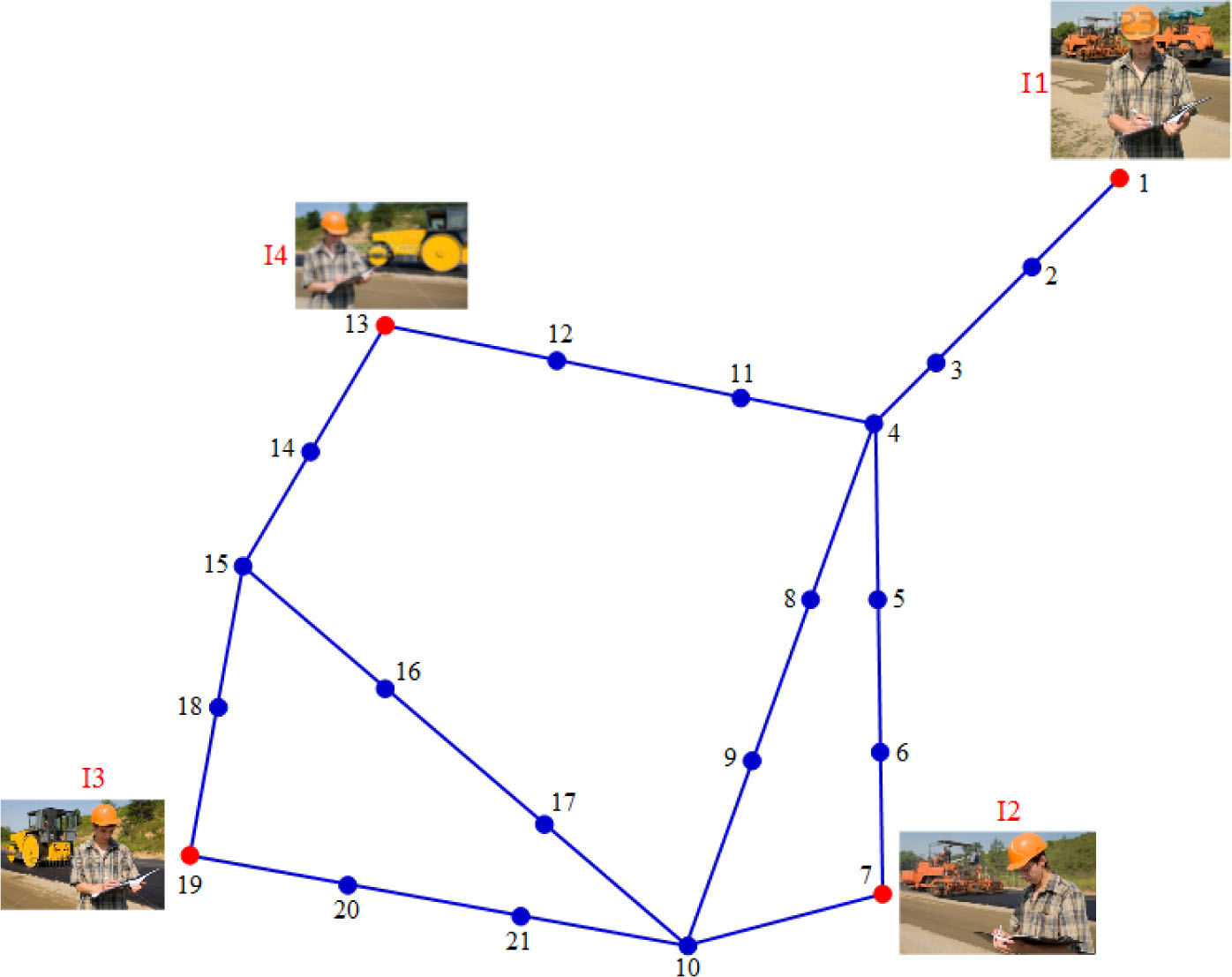
Urban road network patrolled by road inspectors I1, I2, I3, and I4.
A road patrolling scheme is prepared satisfying the following conditions:
A road segment is a geodesic in the road network. It is patrolled by a pair of road inspectors by stationing one inspector at each end.
One pair of road inspectors is not assigned to more than one road segment. However, one road inspector is assigned to patrol other road segments with other inspectors.
We point out that, under the assumption that the distances in a network between bus stops/junctions are integral, we may without loss of generality assume the network to be a simple graph. Indeed, to obtain an equivalent graph from the network, each edge may be subdivided by an appropriate number of times. From this reason, we are restricting ourselves in this paper to simple graphs.
An example of a patrolling scheme for the network of Fig. 1 is given below:
By condition 2., the restriction is that one pair of inspectors is assigned at most one road segment. For example, there are two road segments of equal length between inspectors I2 and I4, however these two inspectors are assigned a single road segment in the patrolling scheme. The strong edge geodetic problem is to identify a minimum number of road inspectors to patrol the urban road network.
We proceed as follows. In the next section we state definitions and notions needed in this paper, and formally introduce the strong edge geodetic problem as well as two closely related problems. Then, in Section 3, we prove that the strong edge geodetic problem is NP-complete. In the subsequent section we discuss upper bounds on the strong edge geodetic number and show that it can be bounded from above by the edge isometric path number. In Section 5, we observe that simplicial vertices are intimately related to the strong edge geodetic problem and deduce several consequences, in particular determine exactly the strong edge geodetic number of block graphs and silicate networks. In Section 6, we introduce non-geodesic edges and use them to prove another lower bound on the strong edge geodetic number. The bound is shown to be in particular exact on glued binary trees without randomization.
2 Preliminaries
Let x and y be vertices of a graph G. Then the interval I(G; x, y) (or I(x, y) for short if G is clear from the context) between x and y is the set of vertices u such that u lies of some shortest x, y-path. In addition, for S ⊆ V(G) the geodetic closure I(S) of S is
S is called a geodetic set if I(S) = V(G). The geodetic problem, introduced by Harary et al. [1], is to find a geodetic set of G of minimum cardinality; this graph invariant is denoted with g(G). Since then the problem has attracted several researchers and has been studied from different perspectives [5–10].
If x and y are vertices of a graph G, then let Ie(G;x, y) denote the set of the edges e such that e lies on at least one shortest x, y-path. Again we will simply write Ie(x, y) when there is no danger of confusion. For a set S ⊆ V(G), the edge geodetic closure Ie(S) is the set of edges defined as
A set S is called an edge geodetic set if Ie(S) = E(G). The edge geodetic problem, introduced and studied by Santhakumaran et al. [11], is to find a minimum edge geodetic set of G. The size of such a set is denoted with ge(G). Note that g(G) ≤ ge(G) holds for any graph G. As far as we know, the complexity status of the edge geodetic problem is unknown for the general case. On the other hand there are a significant number of theoretical results of the edge geodetic problem [12–14].
We now formally introduce the strong edge geodetic problem. If G is a graph, then S ⊆ V(G) is called a strong edge geodetic set if to any pair x, y ∈ S one can assign a shortest x, y-path Pxy such that
By definition, in a strong edge geodetic set S there are
The Cartesian product G1 □ ⋯ □ Gk of graphs G1, …, Gk has the vertex set V(G1) × ⋯ × V(Gk), vertices (g1, …, gk) and
3 Strong edge geodetic problem is NP-complete
In this section we prove:
Theorem 3.1
The strong edge geodetic problem is NP-complete.
If G is a graph, then a set S of its vertices is called a shortest path union cover if the shortest paths that start at the vertices of S cover all the edges of G. Here, we consider all the shortest paths that start at v for each v ∈ S. The shortest path union cover problem is to find a shortest path union cover of minimum cardinality. Boothe et al. [16] proved that the shortest path union cover problem is NP-complete. Now we show that the strong edge geodetic problem is NP-complete by a reduction from the shortest path union cover problem.
Given a graph G = (V, E), we construct a graph G′ = (V′, E′) with the vertex set V′ = V ∪ V1 ∪ V2 and the edge set E′ = E ∪ E1 ∪ E2 ∪ E3. The vertex set V1 is {ui : u ∈ V, i ∈[deg(u)]} and V2 is {

Graphs G and G′.
In the above construction, we thus create vertices

The reason for constructing
Here is a simple observation on the graph G′(V′, E′).
Observation 3.2
The vertex set V2 is a subset of any strong edge geodetic set Y of G′.
Proof
Suppose a vertex
Property 3.3
For each strong edge geodetic set Y of G′, there exists a strong edge geodetic set Y′ of G′ such that Y′ ⊆ Y and Y′ = X ∪ V2 where X is a subset of V.
Proof
Suppose that Y contains a member ui of V1. By Observation 3.2, its corresponding vertex
Property 3.4
X is a shortest path union cover of G if and only if X ∪ V2 is a strong edge geodetic set of G′.
Proof
Assuming that X is a shortest path union cover of G, we will prove that X ∪ V2 is a strong edge geodetic set of G′. First we cover an edge uivj of E2 by the shortest path
Conversely, suppose that X ∪ V2 is a strong edge geodetic set of G′. Then, for each edge e of E, there exists a shortest path Pxy where x, y ∈ X ∪ V2 such that Pxy covers e. By the structure of graph G′, for any shortest path Puv, if both u and v are not in V, then Puv will not cover any edge of E. Thus either x or y is in V. Say x ∈ V. Thus a sub path of Pxy starting at x which is also a shortest path indeed covers e. Hence, X is a shortest path union cover of G. □
By Property 3.3 and 3.4, we have thus proved that a minimum shortest path union cover of G can be determined by finding a strong edge geodetic set of G′. Since G′ can clearly be constructed from G in polynomial time, the argument is complete.
4 Upper bounds of sge(G)
In this section an upper bound on sge(G) is given and another possible upper bound discussed. The upper bound given is in terms of (edge) isometric path covers, where an isometric path has the same meaning as a geodesic (alias a shortest path). Since the term isometric path cover is well-established, we use this terminology here.
Let G = (V, E) be a graph. A set S of isometric paths of G is said to be an isometric path cover of G if every vertex v ∈ V belongs to at least one path from S. The cardinality of a minimum isometric path cover is called the isometric path number of G and denoted by ip(G)[17, 18]. We now introduce the edge version of the isometric path cover in the natural way. A set S of isometric paths of a graph G = (V, E) is an edge isometric path cover of G if every edge e ∈ E belongs to at least one path from S. The cardinality of a minimum edge isometric path cover is called the edge isometric path number and denoted by ipe(G). With this concept we have the following bounds.
Theorem 4.1
If G is a connected graph, then
Proof
A strong edge geodetic cover S generates
The inequality sge(G) ≤ 2 × ipe(G) follows from the fact that an edge isometric path cover of cardinality ipe(G) contains at most 2 × ipe(G) end-vertices. □
Remark 4.2
The upper bound of sge(G) ≤ 2 × ipe(G) is sharp. For instance, for the star graphs K1,2r, it is easy to veriffi that sge(K1,2r) = 2r = 2 × ipe(K1,2r). Additional sharpness examples can be constructed using tree-like graphs.
To conclude the section we note that the bound sge(G) ≤ |V(G)|–diam(G)+1 which one would be tempted to conjecture does not hold. For this sake consider the graph G obtained from the 6-cycle on the vertices v1, …, v6 with natural adjacencies, by adding the edges v1 V3 and v4v6. Then diam (G) = 3 yet it can be verified that sge(G) = 5.
5 Lower bound using simplicial vertices
In view of Theorem 3.1 it is natural to derive upper and lower bounds for the strong edge geodetic number. In this section we use simplicial vertices for this purpose and derive some related consequences.
Clearly, every simplicial vertex u belongs to every geodetic set, to every edge geodetic set, as well as to every strong edge geodetic set because u cannot be an inner vertex of a geodesic. We have already observed that g(G) ≤ ge(G) holds for any graph G. In addition, we also have ge(G) ≤ sge(G). In the next result we collect these observations for the latter use.
Lemma 5.1
Let X be the set of simplicial vertices of a graph G. Then
Using Lemma 5.1, we compute strong edge geodetic number for certain graphs. First we proceed with block graphs and trees. Recall that a graph G is a block graph if every block of G is a clique.
Proposition 5.2
The set of simplicial vertices of a block graph G on at least two vertices is a sge(G)-set of G.
Proof
Let X be the set of simplicial vertices of a block graph G. By Lemma 5.1, sge(G) ≤ |X|.
It remains to prove that X is a strong edge geodetic set of G. We proceed by induction on the number b of blocks of G. If b = 1 then G is a complete graph on at least two vertices, and the assertion clearly holds. Suppose now that b ≤ 2. Let Q be a pendant block of G and let V(Q) = {x1, …, xk}, k ≤ 2. We may without loss of generality assume that xk is the cut vertex of Q. Then xi, i ∈ [k−1], are simplicial vertices of G. The graph G′ induced by the vertices (V(G) ∖ V(Q)) ∪ {xk} is a block graph (on at least two vertices) with one block less than G, hence by the induction hypothesis the set of its simplicial vertices forms a sge(G)-set of G′. Let Y′ be the set of geodesics that correspond to a sge(G′)-set. Suppose first that xk is a simplicial vertex of G′. Then the set of paths {Pxi : P ∈ Y′,P = xkP′,i ∈ [k−1]} ∪ { P : P ∈ Y′ ,xk is not end vertex of P} ∪ {xixj : i,j ∈ [k−1],i ≠ j} forms a required strong edge geodetic set of G. Similarly, if xk is not a simplicial vertex of G′, then we replace every shortest path from Y′ that is of the form PxkR with shortest paths Pxkxi and xixkR for all i ∈ [k−1] to find a required strong edge geodetic set of G also in this case. □
Proposition 5.2 immediately implies:
Corollary 5.3
The set of leaves of a tree T is a unique sge(G)-set of T.
Next we determine the strong edge geodetic number of hexagonal silicate networks which are well-known chemical networks. A hexagonal silicate network [19] is shown in Fig. 4.
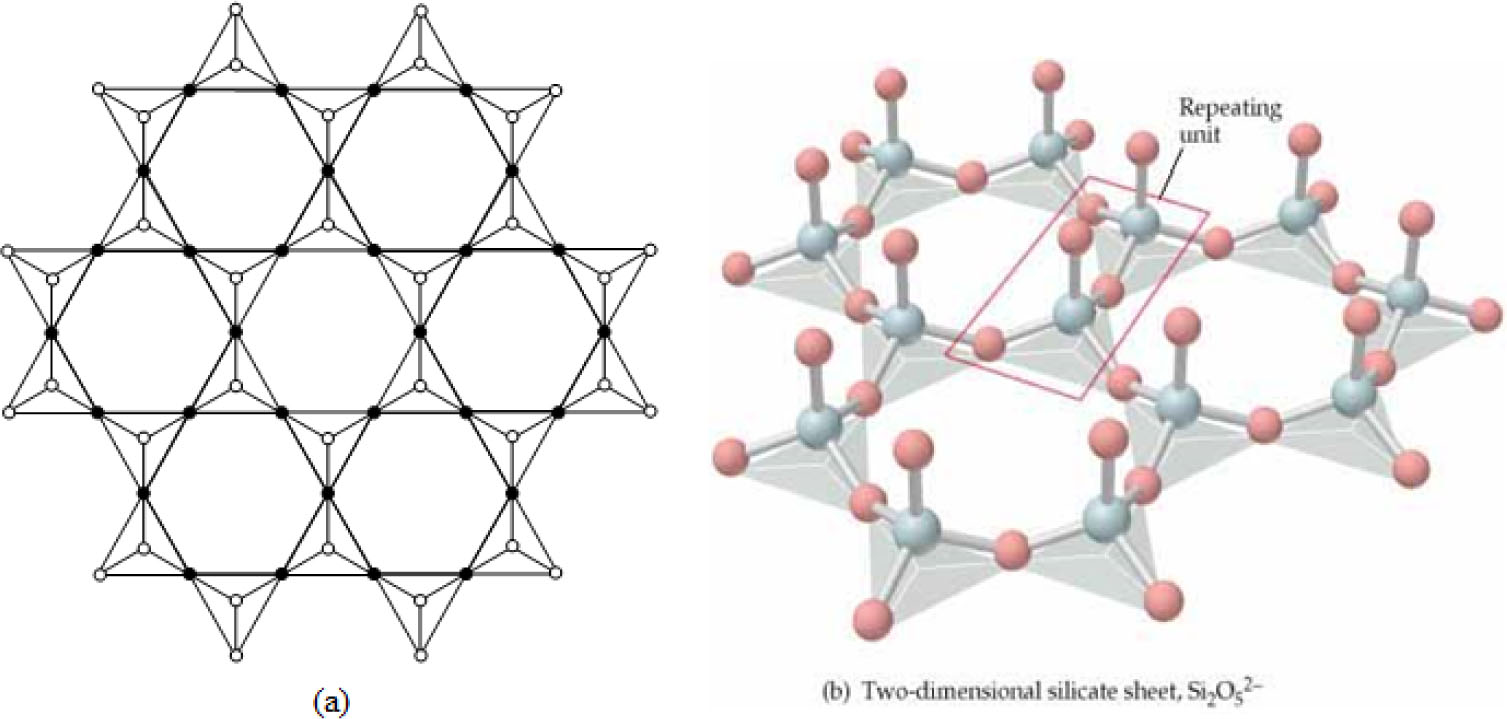
Silicate network.
Corollary 5.4
The simplicial vertices of the hexagonal silicate network G form a sge(G)-set of G.
Proof
The simplicial vertices of G are marked by white bullets in Fig. 4. It is easy to verify that the set of simplicial vertices forms a strong edge geodetic set of G. The result follows from Lemma 5.1. □
Corollary 5.4 considers only silicate networks of hexagonal type. This result can be extended to any type of silicate sheets. The verification is left to the reader.
6 Lower bound using convex components
For a different kind of a lower bound we introduce the following concept. We say that edges e and f of a graph G form a geodesic pair if they belong to some shortest path of G. Otherwise, e and f form a non-geodesic pair. Since (non)-geodesic pairs play a key role in Theorem 6.2, we next characterize such edges in the following result that might be of independent interest.
Proposition 6.1
Let e = uv and f = xy be edges of a connected graph G. Then e and f are geodesic if and only if|{d(u, x),d(u,y),d(v,x),d(v,y}| = 3.
Proof
Suppose that e and f are geodesic edges and let P be a shortest path containing these two edges. We may without loss of generality assume that d(v,x) = d(u,y)+2 and set d(v,x) = k. Then d(u,x) = d(v,y) = k+1, so that
Conversely, suppose that |{d(u, x),d(u,y),d(v,x),d(v,y}| = 3. We may without loss of generality assume that k = d(u,x) is the minimal among the four distances. If also d(v,x) = k, then d(u,y) ≤ k+1 and d(v,y) ≤ k+1 which is not possible. Therefore, d(v,x) = k+1. Since d(u,y) ≤ k+1 it follows that d(v,y) = k+2. It now readily follows that e and f are geodesic edges. □
We recall that a subgraph H of a graph G is convex, if for any vertices x, y ∈ V(H), every shortest x, y-path in G lies completely in H.
Theorem 6.2
Let F be a set of pairwise non-geodesic edges of a graph G. If G– F consists of t ≥ 2 convex components, then
Proof
Let G[X1], …, G[Xt] be the convex components of G – F. Let U be an arbitrary strong edge geodetic set of G and set Ui = U ∩ Xi, i ∈ [t]. Clearly,
Using the fact that for any non-negative real numbers their arithmetic mean is at least as large as their geometric mean, we get
Since |Uk| ≤ 1 for k ∈ [t], the following inequality is straightforward:
Applying Inequality (3) for all
Using (2), (4), and (1) in that order, we can now estimate as follows:
Since U is an arbitrary strong edge geodetic set we conclude that
Since sge(G) is an integral, the result follows. □
To show that the bound of Theorem 6.2 is sharp, let us say that a graph G is r-good if it contains vertices u and v such that I(u,v) contains r shortest u, v-paths which cover all the edges of G. For example, uniform theta graphs [20] are r-good graphs. To specify the vertices u and v we will denote such a graph with
Proposition 6.3
Let
Proof
Clearly, a strong edge geodetic set of X must contain at least one vertex from each of the subgraphs
To prove the other inequality it suffices to show that {vi : i ∈ [n]} is a sge(G)-set of X. Let
Consider the graph X of Proposition 6.3 and let F = E(Kn). Then F is a set of pairwise non-geodesic edges and X – F consists of n convex components. Since |F| =
An important special case of Theorem 6.2 is the following. A set F of edges of a connected graph G is a convex edge-cut if G – F consists of two convex components. Note that the edges of a convex edge-cut are pairwise non-geodesic for otherwise at least one of the components of G – F would not be convex. Hence Theorem 6.2 immediately implies:
Corollary 6.4
If F is a convex edge-cut of a graph G, then
We next give an application of Corollary 6.4. Glued binary trees were introduced by physicists as a tool to design quantum algorithms [21] and quantum circuits [22]. It plays a significant role in Quantum Information Theory [23]. It is also used to study the transmission properties of continuous time quantum walks in quantum physics [24, 25]. Lockhart et al. [26] designed glued tree algorithm using glued binary trees.
An r-level complete binary tree T(r) has 2r leaves. An r-level glued binary tree GT(r) is formed by connecting the leaves of two r-level complete binary trees T1(r) and T2(r). Fig. 5 displays two 3-level glued binary trees GT(3). In general, the vertex set of GT(r) is the union of the vertex sets of complete binary trees T1(r) and T2(r). Let L1 and L2 denote the vertex sets of leaves of T1(r) and T2(r) respectively. Notice that each set L1 and L2 is an independent set. The sets L1 and L2 induce a bipartite graph in GT(r). Feder [23] classifies glued binary trees into those without randomization and those with randomization. If the edges of the bipartite subgraph induced by the sets L1 and L2 are in some fixed order, then they are called the glued binary trees without randomization, while if the sets L1 and L2 induce an arbitrary bipartite graph, then they are called the glued binary trees with randomization. Fig. 5(a) shows a 3-level glued binary tree without randomization. Fig. 5(b) displays a 3-level glued binary tree with randomization.

(a) Glued binary trees without randomization GTc(r) and (b) glued binary trees with randomization.
Using Corollary 6.4, we can solve the strong edge geodetic problem for certain classes of glued binary trees without randomization. We define two graphs GTp(r) and GTc(r) which are glued binary trees without randomization. The graph GTp(r) is obtained from T1(r) and T2(r) by adding straight edges between the corresponding leaves, see Fig. 6(a) for GTp(4). The graph GTc(r) is obtained from GTp(r) by adding additional cross edges between the leaves as shown in Fig. 5(a) for the case GTc(3).

Glued binary tree GTp(4).
Theorem 6.5
sge(GTp(r)) =
Proof
The set of straight edges (dotted edges in Fig. 6(b)) between the leaves forms a convex edge-cut of cardinality 2r. By Corollary 6.4, sge(GTp(r)) ≤
Let k =
Using an approach from the proof of Theorem 6.5 we can also deduce the following result.
Theorem 6.6
Further research is to identify the classes of glued binary trees without randomization for which the strong edge geodetic problem can be solved. The strong edge geodetic problem for glued binary trees with randomization is left as an open problem.
7 Further research
The vertex version of the strong edge geodetic problem is the strong geodetic problem defined analogously as follows. A set S ⊆ V(G) is a strong geodetic set if for any pair x, y ∈ S there exists a shortest x, y-path Pxy such that
The strong geodetic problem is to find a smallest strong geodetic set of G. To our knowledge, there is no literature yet on the strong geodetic problem. We believe it is also NP-complete, similar to the edge version of the problem. As already mentioned in Section 4, Fitzpatrick et al. [17] have studied the isometric path problem. It would be interesting to investigate relationships between the strong geodetic problem and the isometric path problem. Fitzpatrick et al. [17] have derived the isometric path number for two dimensional grids. Further research would be to design techniques to derive the strong geodetic number for grid-like architectures and similar architectures.
8 Conclusion
By modeling the urban road network problem as a graph combinatorial problem we proved that the urban road network problem is NP-complete. Naming this problem as the strong edge geodetic problem, we have studied the properties and characteristics of the strong edge geodetic problem from the perspectives of graph theory. We have derived some sharp lower bounds for strong edge geodetic number. Using these lower bounds, we have computed the strong edge geodetic number of certain classes of graphs such as trees, block graphs, silicate networks and some glued binary trees without randomization. The complexity of the problem is unknown for other graphs such as gridlike architectures, intersection graphs, Cayley graphs, chordal graphs and some of their subclasses (interval graphs, split graphs, k-tree, …), bipartite graphs and planar graphs.
Acknowledgements
This work was supported and funded by Kuwait University, Research Project No. (QI 01/16). We thank Xuding Zhu for suggesting the term “strong edge geodetic problem”.
References
[1] Harary F., Loukakis E., Tsouros C., The geodetic number of a graph, Math. Comput. Modelling, 1993, 17, 89–95.10.1016/0895-7177(93)90259-2Search in Google Scholar
[2] Appert M., Laurent C., Measuring urban road network vulnerability using graph theory : the case of Montpellier’s road network, HAL Archives-Ouvertes, 2007, HAL Id : halshs-00841520, 89p.Search in Google Scholar
[3] Jiang B., Claramunt C., A structural approach to the model generalization of an urban street network, GeoInformatica, 2004, 8, 157–171.10.1023/B:GEIN.0000017746.44824.70Search in Google Scholar
[4] Thomson R.C., Richardson D.E., A graph theory approach to road network generalization, in: Proceedings of the 16th International Cartographic Conference, Barcelona, Spain, 3–9 September 1995 (Ed. by the Institut Cartogràfic de Cataluny), 1871–1880.Search in Google Scholar
[5] Ahangar H.A., Samodivkin V., Sheikholeslami S.M., Khodkar A., The restrained geodetic number of a graph, Bull. Malays. Math. Sci. Soc. 2015, 38, 1143–1155.10.1007/s40840-014-0068-ySearch in Google Scholar
[6] Brešar B., Klavžar S., Tepeh Horvat A., On the geodetic number and related metric sets in Cartesian product graphs, Discrete Math. 2008, 308, 5555–5561.10.1016/j.disc.2007.10.007Search in Google Scholar
[7] Chartrand G., Harary F., Zhang P., Geodetic sets in graphs, Discuss. Math. Graph Theory, 2000, 20, 129–138.10.7151/dmgt.1112Search in Google Scholar
[8] Chartrand G., Harary F., Zhang P., On the geodetic number of a graph, Networks, 2002, 39, 1–6.10.1002/net.10007Search in Google Scholar
[9] Dourado M.C., Protti F., Rautenbach D., Szwarcfiter J.L., Some remarks on the geodetic number of a graph, Discrete Math. 2010, 310, 832–837.10.1016/j.disc.2009.09.018Search in Google Scholar
[10] Tong L.-D., Geodetic sets and Steiner sets in graphs, Discrete Math. 2009, 309, 4205–4207.10.1016/j.disc.2008.10.010Search in Google Scholar
[11] Santhakumaran A.P., John J., Edge geodetic number of a graph, J. Discrete Math. Sci. Cryptogr. 2007, 10, 415–432.10.1080/09720529.2007.10698129Search in Google Scholar
[12] Raj S.A.A., Victor S.P., Algorithms to find geodetic numbers and edge geodetic numbers in graphs, Indian J. Sci. Tech. 2015, 8(13), 5pp.10.17485/ijst/2015/v8i13/53160Search in Google Scholar
[13] Santhakumaran A.P., Ullas Chandran S.V., The edge geodetic number and Cartesian product of graphs, Discuss. Math. Graph Theory, 2010, 30, 55–73.10.7151/dmgt.1476Search in Google Scholar
[14] Santhakumaran A.P., Ullas Chandran S.V., The 2-edge geodetic number and graph operations, Arabian J. Math. 2012, 1, 241–249.10.1007/s40065-012-0016-3Search in Google Scholar
[15] Hammack R., Imrich W., Klavžar S., Handbook of Product Graphs. Second Edition, CRC Press, Boca Raton, 2011.10.1201/b10959Search in Google Scholar
[16] Boothe P., Dvořák Z., Farley A., Proskurowski A., Graph covering via shortest paths, Congr. Numer. 2007, 87, 145–155.Search in Google Scholar
[17] Fitzpatrick S.L., The isometric path number of the Cartesian product of paths, Congr. Numer. 1999, 137, 109–119.Search in Google Scholar
[18] Pan J.-J., Chang G.J., Isometric path numbers of graphs, Discrete Math. 2006, 306, 2091–2096.10.1016/j.disc.2006.04.003Search in Google Scholar
[19] Manuel P., Rajasingh I., Minimum metric dimension of silicate networks, Ars Combin. 2011, 98, 501–510.Search in Google Scholar
[20] Carraher J.M., Mahoney T., Puleo G.J., West D.B., Sum-paintability of generalized theta-graphs, Graphs Combin. 2015, 31, 1325–1334.Search in Google Scholar
[21] Childs A.M., Cleve R., Deotto E., Farhi E., Gutmann S., Spielman D.A., Exponential algorithmic speedup by quantum walk, Proc. 35th ACM Symposium on Theory of Computing (STOC 2003), 59–68.10.1145/780542.780552Search in Google Scholar
[22] Ide Y., Konno N., Segawa E., Xu X.-P., Localization of discrete time quantum walks on the glued trees, Entropy, 2014, 16, 1501–1514.10.3390/e16031501Search in Google Scholar
[23] Feder D., Graphs in Quantum Information Theory, Manuscript, University of Calgary, Alberta, Canada, 2015.Search in Google Scholar
[24] Douglas B.J., Wang J.B., Efficient quantum circuit implementation of quantum walks, Phys. Rev. A, 2009, 79, 052335, 5pp.10.1103/PhysRevA.79.052335Search in Google Scholar
[25] Li Z.-J., Wang J.B., An analytical study of quantum walk through glued-tree graphs, J. Phys. A, 2015, 48, 355301, 15 pp.10.1088/1751-8113/48/35/355301Search in Google Scholar
[26] Lockhart J., Di Franco C., Paternostro M., Glued trees algorithm under phase damping, Physics Lett, A, 2014, 378, 338–343.10.1016/j.physleta.2013.11.034Search in Google Scholar
© 2017 Manuel et al.
This work is licensed under the Creative Commons Attribution-NonCommercial-NoDerivatives 3.0 License.
Articles in the same Issue
- Regular Articles
- Integrals of Frullani type and the method of brackets
- Regular Articles
- Edge of chaos in reaction diffusion CNN model
- Regular Articles
- Calculus using proximities: a mathematical approach in which students can actually prove theorems
- Regular Articles
- An investigation on hyper S-posets over ordered semihypergroups
- Regular Articles
- The Leibniz algebras whose subalgebras are ideals
- Regular Articles
- Fixed point and multidimensional fixed point theorems with applications to nonlinear matrix equations in terms of weak altering distance functions
- Regular Articles
- Matrix rank and inertia formulas in the analysis of general linear models
- Regular Articles
- The hybrid power mean of quartic Gauss sums and Kloosterman sums
- Regular Articles
- Tauberian theorems for statistically (C,1,1) summable double sequences of fuzzy numbers
- Regular Articles
- Some properties of graded comultiplication modules
- Regular Articles
- The characterizations of upper approximation operators based on special coverings
- Regular Articles
- Bi-integrable and tri-integrable couplings of a soliton hierarchy associated with SO(4)
- Regular Articles
- Dynamics for a discrete competition and cooperation model of two enterprises with multiple delays and feedback controls
- Regular Articles
- A new view of relationship between atomic posets and complete (algebraic) lattices
- Regular Articles
- A class of extensions of Restricted (s, t)-Wythoff’s game
- Regular Articles
- New bounds for the minimum eigenvalue of 𝓜-tensors
- Regular Articles
- Shintani and Shimura lifts of cusp forms on certain arithmetic groups and their applications
- Regular Articles
- Empirical likelihood for quantile regression models with response data missing at random
- Regular Articles
- Convex combination of analytic functions
- Regular Articles
- On the Yang-Baxter-like matrix equation for rank-two matrices
- Regular Articles
- Uniform topology on EQ-algebras
- Regular Articles
- Integrations on rings
- Regular Articles
- The quasilinear parabolic kirchhoff equation
- Regular Articles
- Avoiding rainbow 2-connected subgraphs
- Regular Articles
- On non-Hopfian groups of fractions
- Regular Articles
- Singularly perturbed hyperbolic problems on metric graphs: asymptotics of solutions
- Regular Articles
- Rings in which elements are the sum of a nilpotent and a root of a fixed polynomial that commute
- Regular Articles
- Superstability of functional equations related to spherical functions
- Regular Articles
- Evaluation of the convolution sum involving the sum of divisors function for 22, 44 and 52
- Regular Articles
- Weighted minimal translation surfaces in the Galilean space with density
- Regular Articles
- Complete convergence for weighted sums of pairwise independent random variables
- Regular Articles
- Binomials transformation formulae for scaled Fibonacci numbers
- Regular Articles
- Growth functions for some uniformly amenable groups
- Regular Articles
- Hopf bifurcations in a three-species food chain system with multiple delays
- Regular Articles
- Oscillation and nonoscillation of half-linear Euler type differential equations with different periodic coefficients
- Regular Articles
- Osculating curves in 4-dimensional semi-Euclidean space with index 2
- Regular Articles
- Some new facts about group 𝒢 generated by the family of convergent permutations
- Regular Articles
- lnfinitely many solutions for fractional Schrödinger equations with perturbation via variational methods
- Regular Articles
- Supersolvable orders and inductively free arrangements
- Regular Articles
- Asymptotically almost automorphic solutions of differential equations with piecewise constant argument
- Regular Articles
- Finite groups whose all second maximal subgroups are cyclic
- Regular Articles
- Semilinear systems with a multi-valued nonlinear term
- Regular Articles
- Positive solutions for Hadamard differential systems with fractional integral conditions on an unbounded domain
- Regular Articles
- Calibration and simulation of Heston model
- Regular Articles
- One kind sixth power mean of the three-term exponential sums
- Regular Articles
- Cyclic pairs and common best proximity points in uniformly convex Banach spaces
- Regular Articles
- The uniqueness of meromorphic functions in k-punctured complex plane
- Regular Articles
- Normalizers of intermediate congruence subgroups of the Hecke subgroups
- Regular Articles
- The hyperbolicity constant of infinite circulant graphs
- Regular Articles
- Scott convergence and fuzzy Scott topology on L-posets
- Regular Articles
- One sided strong laws for random variables with infinite mean
- Regular Articles
- The join of split graphs whose completely regular endomorphisms form a monoid
- Regular Articles
- A new branch and bound algorithm for minimax ratios problems
- Regular Articles
- Upper bound estimate of incomplete Cochrane sum
- Regular Articles
- Value distributions of solutions to complex linear differential equations in angular domains
- Regular Articles
- The nonlinear diffusion equation of the ideal barotropic gas through a porous medium
- Regular Articles
- The Sheffer stroke operation reducts of basic algebras
- Regular Articles
- Extensions and improvements of Sherman’s and related inequalities for n-convex functions
- Regular Articles
- Classification lattices are geometric for complete atomistic lattices
- Regular Articles
- Possible numbers of x’s in an {x, y}-matrix with a given rank
- Regular Articles
- New error bounds for linear complementarity problems of weakly chained diagonally dominant B-matrices
- Regular Articles
- Boundedness of vector-valued B-singular integral operators in Lebesgue spaces
- Regular Articles
- On the Golomb’s conjecture and Lehmer’s numbers
- Regular Articles
- Some applications of the Archimedean copulas in the proof of the almost sure central limit theorem for ordinary maxima
- Regular Articles
- Dual-stage adaptive finite-time modified function projective multi-lag combined synchronization for multiple uncertain chaotic systems
- Regular Articles
- Corrigendum to: Dual-stage adaptive finite-time modified function projective multi-lag combined synchronization for multiple uncertain chaotic systems
- Regular Articles
- Convergence and stability of generalized φ-weak contraction mapping in CAT(0) spaces
- Regular Articles
- Triple solutions for a Dirichlet boundary value problem involving a perturbed discrete p(k)-Laplacian operator
- Regular Articles
- OD-characterization of alternating groups Ap+d
- Regular Articles
- On Jordan mappings of inverse semirings
- Regular Articles
- On generalized Ehresmann semigroups
- Regular Articles
- On topological properties of spaces obtained by the double band matrix
- Regular Articles
- Representing derivatives of Chebyshev polynomials by Chebyshev polynomials and related questions
- Regular Articles
- Chain conditions on composite Hurwitz series rings
- Regular Articles
- Coloring subgraphs with restricted amounts of hues
- Regular Articles
- An extension of the method of brackets. Part 1
- Regular Articles
- Branch-delete-bound algorithm for globally solving quadratically constrained quadratic programs
- Regular Articles
- Strong edge geodetic problem in networks
- Regular Articles
- Ricci solitons on almost Kenmotsu 3-manifolds
- Regular Articles
- Uniqueness of meromorphic functions sharing two finite sets
- Regular Articles
- On the fourth-order linear recurrence formula related to classical Gauss sums
- Regular Articles
- Dynamical behavior for a stochastic two-species competitive model
- Regular Articles
- Two new eigenvalue localization sets for tensors and theirs applications
- Regular Articles
- κ-strong sequences and the existence of generalized independent families
- Regular Articles
-
Commutators of Littlewood-Paley
- Regular Articles
- On decompositions of estimators under a general linear model with partial parameter restrictions
- Regular Articles
- Groups and monoids of Pythagorean triples connected to conics
- Regular Articles
- Hom-Lie superalgebra structures on exceptional simple Lie superalgebras of vector fields
- Regular Articles
- Numerical methods for the multiplicative partial differential equations
- Regular Articles
-
Solvable Leibniz algebras with NFn⊕
- Regular Articles
- Evaluation of the convolution sums ∑al+bm=n lσ(l) σ(m) with ab ≤ 9
- Regular Articles
- A study on soft rough semigroups and corresponding decision making applications
- Regular Articles
- Some new inequalities of Hermite-Hadamard type for s-convex functions with applications
- Regular Articles
- Deficiency of forests
- Regular Articles
- Perfect codes in power graphs of finite groups
- Regular Articles
- A new compact finite difference quasilinearization method for nonlinear evolution partial differential equations
- Regular Articles
- Does any convex quadrilateral have circumscribed ellipses?
- Regular Articles
- The dynamic of a Lie group endomorphism
- Regular Articles
- On pairs of equations in unlike powers of primes and powers of 2
- Regular Articles
- Differential subordination and convexity criteria of integral operators
- Regular Articles
- Quantitative relations between short intervals and exceptional sets of cubic Waring-Goldbach problem
- Regular Articles
- On θ-commutators and the corresponding non-commuting graphs
- Regular Articles
- Quasi-maximum likelihood estimator of Laplace (1, 1) for GARCH models
- Regular Articles
- Multiple and sign-changing solutions for discrete Robin boundary value problem with parameter dependence
- Regular Articles
- Fundamental relation on m-idempotent hyperrings
- Regular Articles
- A novel recursive method to reconstruct multivariate functions on the unit cube
- Regular Articles
- Nabla inequalities and permanence for a logistic integrodifferential equation on time scales
- Regular Articles
- Enumeration of spanning trees in the sequence of Dürer graphs
- Regular Articles
- Quotient of information matrices in comparison of linear experiments for quadratic estimation
- Regular Articles
- Fourier series of functions involving higher-order ordered Bell polynomials
- Regular Articles
- Simple modules over Auslander regular rings
- Regular Articles
- Weighted multilinear p-adic Hardy operators and commutators
- Regular Articles
- Guaranteed cost finite-time control of positive switched nonlinear systems with D-perturbation
- Regular Articles
- A modified quasi-boundary value method for an abstract ill-posed biparabolic problem
- Regular Articles
- Extended Riemann-Liouville type fractional derivative operator with applications
- Topical Issue on Topological and Algebraic Genericity in Infinite Dimensional Spaces
- The algebraic size of the family of injective operators
- Topical Issue on Topological and Algebraic Genericity in Infinite Dimensional Spaces
- The history of a general criterium on spaceability
- Topical Issue on Topological and Algebraic Genericity in Infinite Dimensional Spaces
- On sequences not enjoying Schur’s property
- Topical Issue on Topological and Algebraic Genericity in Infinite Dimensional Spaces
- A hierarchy in the family of real surjective functions
- Topical Issue on Topological and Algebraic Genericity in Infinite Dimensional Spaces
- Dynamics of multivalued linear operators
- Topical Issue on Topological and Algebraic Genericity in Infinite Dimensional Spaces
- Linear dynamics of semigroups generated by differential operators
- Special Issue on Recent Developments in Differential Equations
- Isomorphism theorems for some parabolic initial-boundary value problems in Hörmander spaces
- Special Issue on Recent Developments in Differential Equations
- Determination of a diffusion coefficient in a quasilinear parabolic equation
- Special Issue on Recent Developments in Differential Equations
- Homogeneous two-point problem for PDE of the second order in time variable and infinite order in spatial variables
- Special Issue on Recent Developments in Differential Equations
- A nonlinear plate control without linearization
- Special Issue on Recent Developments in Differential Equations
- Reduction of a Schwartz-type boundary value problem for biharmonic monogenic functions to Fredholm integral equations
- Special Issue on Recent Developments in Differential Equations
- Inverse problem for a physiologically structured population model with variable-effort harvesting
- Special Issue on Recent Developments in Differential Equations
- Existence of solutions for delay evolution equations with nonlocal conditions
- Special Issue on Recent Developments in Differential Equations
- Comments on behaviour of solutions of elliptic quasi-linear problems in a neighbourhood of boundary singularities
- Special Issue on Recent Developments in Differential Equations
- Coupled fixed point theorems in complete metric spaces endowed with a directed graph and application
- Special Issue on Recent Developments in Differential Equations
- Existence of entropy solutions for nonlinear elliptic degenerate anisotropic equations
- Special Issue on Recent Developments in Differential Equations
- Integro-differential systems with variable exponents of nonlinearity
- Special Issue on Recent Developments in Differential Equations
- Elliptic operators on refined Sobolev scales on vector bundles
- Special Issue on Recent Developments in Differential Equations
- Multiplicity solutions of a class fractional Schrödinger equations
- Special Issue on Recent Developments in Differential Equations
- Determining of right-hand side of higher order ultraparabolic equation
- Special Issue on Recent Developments in Differential Equations
- Asymptotic approximation for the solution to a semi-linear elliptic problem in a thin aneurysm-type domain
- Topical Issue on Metaheuristics - Methods and Applications
- Learnheuristics: hybridizing metaheuristics with machine learning for optimization with dynamic inputs
- Topical Issue on Metaheuristics - Methods and Applications
- Nature–inspired metaheuristic algorithms to find near–OGR sequences for WDM channel allocation and their performance comparison
- Topical Issue on Cyber-security Mathematics
- Monomial codes seen as invariant subspaces
- Topical Issue on Cyber-security Mathematics
- Expert knowledge and data analysis for detecting advanced persistent threats
- Topical Issue on Cyber-security Mathematics
- Feedback equivalence of convolutional codes over finite rings
Articles in the same Issue
- Regular Articles
- Integrals of Frullani type and the method of brackets
- Regular Articles
- Edge of chaos in reaction diffusion CNN model
- Regular Articles
- Calculus using proximities: a mathematical approach in which students can actually prove theorems
- Regular Articles
- An investigation on hyper S-posets over ordered semihypergroups
- Regular Articles
- The Leibniz algebras whose subalgebras are ideals
- Regular Articles
- Fixed point and multidimensional fixed point theorems with applications to nonlinear matrix equations in terms of weak altering distance functions
- Regular Articles
- Matrix rank and inertia formulas in the analysis of general linear models
- Regular Articles
- The hybrid power mean of quartic Gauss sums and Kloosterman sums
- Regular Articles
- Tauberian theorems for statistically (C,1,1) summable double sequences of fuzzy numbers
- Regular Articles
- Some properties of graded comultiplication modules
- Regular Articles
- The characterizations of upper approximation operators based on special coverings
- Regular Articles
- Bi-integrable and tri-integrable couplings of a soliton hierarchy associated with SO(4)
- Regular Articles
- Dynamics for a discrete competition and cooperation model of two enterprises with multiple delays and feedback controls
- Regular Articles
- A new view of relationship between atomic posets and complete (algebraic) lattices
- Regular Articles
- A class of extensions of Restricted (s, t)-Wythoff’s game
- Regular Articles
- New bounds for the minimum eigenvalue of 𝓜-tensors
- Regular Articles
- Shintani and Shimura lifts of cusp forms on certain arithmetic groups and their applications
- Regular Articles
- Empirical likelihood for quantile regression models with response data missing at random
- Regular Articles
- Convex combination of analytic functions
- Regular Articles
- On the Yang-Baxter-like matrix equation for rank-two matrices
- Regular Articles
- Uniform topology on EQ-algebras
- Regular Articles
- Integrations on rings
- Regular Articles
- The quasilinear parabolic kirchhoff equation
- Regular Articles
- Avoiding rainbow 2-connected subgraphs
- Regular Articles
- On non-Hopfian groups of fractions
- Regular Articles
- Singularly perturbed hyperbolic problems on metric graphs: asymptotics of solutions
- Regular Articles
- Rings in which elements are the sum of a nilpotent and a root of a fixed polynomial that commute
- Regular Articles
- Superstability of functional equations related to spherical functions
- Regular Articles
- Evaluation of the convolution sum involving the sum of divisors function for 22, 44 and 52
- Regular Articles
- Weighted minimal translation surfaces in the Galilean space with density
- Regular Articles
- Complete convergence for weighted sums of pairwise independent random variables
- Regular Articles
- Binomials transformation formulae for scaled Fibonacci numbers
- Regular Articles
- Growth functions for some uniformly amenable groups
- Regular Articles
- Hopf bifurcations in a three-species food chain system with multiple delays
- Regular Articles
- Oscillation and nonoscillation of half-linear Euler type differential equations with different periodic coefficients
- Regular Articles
- Osculating curves in 4-dimensional semi-Euclidean space with index 2
- Regular Articles
- Some new facts about group 𝒢 generated by the family of convergent permutations
- Regular Articles
- lnfinitely many solutions for fractional Schrödinger equations with perturbation via variational methods
- Regular Articles
- Supersolvable orders and inductively free arrangements
- Regular Articles
- Asymptotically almost automorphic solutions of differential equations with piecewise constant argument
- Regular Articles
- Finite groups whose all second maximal subgroups are cyclic
- Regular Articles
- Semilinear systems with a multi-valued nonlinear term
- Regular Articles
- Positive solutions for Hadamard differential systems with fractional integral conditions on an unbounded domain
- Regular Articles
- Calibration and simulation of Heston model
- Regular Articles
- One kind sixth power mean of the three-term exponential sums
- Regular Articles
- Cyclic pairs and common best proximity points in uniformly convex Banach spaces
- Regular Articles
- The uniqueness of meromorphic functions in k-punctured complex plane
- Regular Articles
- Normalizers of intermediate congruence subgroups of the Hecke subgroups
- Regular Articles
- The hyperbolicity constant of infinite circulant graphs
- Regular Articles
- Scott convergence and fuzzy Scott topology on L-posets
- Regular Articles
- One sided strong laws for random variables with infinite mean
- Regular Articles
- The join of split graphs whose completely regular endomorphisms form a monoid
- Regular Articles
- A new branch and bound algorithm for minimax ratios problems
- Regular Articles
- Upper bound estimate of incomplete Cochrane sum
- Regular Articles
- Value distributions of solutions to complex linear differential equations in angular domains
- Regular Articles
- The nonlinear diffusion equation of the ideal barotropic gas through a porous medium
- Regular Articles
- The Sheffer stroke operation reducts of basic algebras
- Regular Articles
- Extensions and improvements of Sherman’s and related inequalities for n-convex functions
- Regular Articles
- Classification lattices are geometric for complete atomistic lattices
- Regular Articles
- Possible numbers of x’s in an {x, y}-matrix with a given rank
- Regular Articles
- New error bounds for linear complementarity problems of weakly chained diagonally dominant B-matrices
- Regular Articles
- Boundedness of vector-valued B-singular integral operators in Lebesgue spaces
- Regular Articles
- On the Golomb’s conjecture and Lehmer’s numbers
- Regular Articles
- Some applications of the Archimedean copulas in the proof of the almost sure central limit theorem for ordinary maxima
- Regular Articles
- Dual-stage adaptive finite-time modified function projective multi-lag combined synchronization for multiple uncertain chaotic systems
- Regular Articles
- Corrigendum to: Dual-stage adaptive finite-time modified function projective multi-lag combined synchronization for multiple uncertain chaotic systems
- Regular Articles
- Convergence and stability of generalized φ-weak contraction mapping in CAT(0) spaces
- Regular Articles
- Triple solutions for a Dirichlet boundary value problem involving a perturbed discrete p(k)-Laplacian operator
- Regular Articles
- OD-characterization of alternating groups Ap+d
- Regular Articles
- On Jordan mappings of inverse semirings
- Regular Articles
- On generalized Ehresmann semigroups
- Regular Articles
- On topological properties of spaces obtained by the double band matrix
- Regular Articles
- Representing derivatives of Chebyshev polynomials by Chebyshev polynomials and related questions
- Regular Articles
- Chain conditions on composite Hurwitz series rings
- Regular Articles
- Coloring subgraphs with restricted amounts of hues
- Regular Articles
- An extension of the method of brackets. Part 1
- Regular Articles
- Branch-delete-bound algorithm for globally solving quadratically constrained quadratic programs
- Regular Articles
- Strong edge geodetic problem in networks
- Regular Articles
- Ricci solitons on almost Kenmotsu 3-manifolds
- Regular Articles
- Uniqueness of meromorphic functions sharing two finite sets
- Regular Articles
- On the fourth-order linear recurrence formula related to classical Gauss sums
- Regular Articles
- Dynamical behavior for a stochastic two-species competitive model
- Regular Articles
- Two new eigenvalue localization sets for tensors and theirs applications
- Regular Articles
- κ-strong sequences and the existence of generalized independent families
- Regular Articles
-
Commutators of Littlewood-Paley
- Regular Articles
- On decompositions of estimators under a general linear model with partial parameter restrictions
- Regular Articles
- Groups and monoids of Pythagorean triples connected to conics
- Regular Articles
- Hom-Lie superalgebra structures on exceptional simple Lie superalgebras of vector fields
- Regular Articles
- Numerical methods for the multiplicative partial differential equations
- Regular Articles
-
Solvable Leibniz algebras with NFn⊕
- Regular Articles
- Evaluation of the convolution sums ∑al+bm=n lσ(l) σ(m) with ab ≤ 9
- Regular Articles
- A study on soft rough semigroups and corresponding decision making applications
- Regular Articles
- Some new inequalities of Hermite-Hadamard type for s-convex functions with applications
- Regular Articles
- Deficiency of forests
- Regular Articles
- Perfect codes in power graphs of finite groups
- Regular Articles
- A new compact finite difference quasilinearization method for nonlinear evolution partial differential equations
- Regular Articles
- Does any convex quadrilateral have circumscribed ellipses?
- Regular Articles
- The dynamic of a Lie group endomorphism
- Regular Articles
- On pairs of equations in unlike powers of primes and powers of 2
- Regular Articles
- Differential subordination and convexity criteria of integral operators
- Regular Articles
- Quantitative relations between short intervals and exceptional sets of cubic Waring-Goldbach problem
- Regular Articles
- On θ-commutators and the corresponding non-commuting graphs
- Regular Articles
- Quasi-maximum likelihood estimator of Laplace (1, 1) for GARCH models
- Regular Articles
- Multiple and sign-changing solutions for discrete Robin boundary value problem with parameter dependence
- Regular Articles
- Fundamental relation on m-idempotent hyperrings
- Regular Articles
- A novel recursive method to reconstruct multivariate functions on the unit cube
- Regular Articles
- Nabla inequalities and permanence for a logistic integrodifferential equation on time scales
- Regular Articles
- Enumeration of spanning trees in the sequence of Dürer graphs
- Regular Articles
- Quotient of information matrices in comparison of linear experiments for quadratic estimation
- Regular Articles
- Fourier series of functions involving higher-order ordered Bell polynomials
- Regular Articles
- Simple modules over Auslander regular rings
- Regular Articles
- Weighted multilinear p-adic Hardy operators and commutators
- Regular Articles
- Guaranteed cost finite-time control of positive switched nonlinear systems with D-perturbation
- Regular Articles
- A modified quasi-boundary value method for an abstract ill-posed biparabolic problem
- Regular Articles
- Extended Riemann-Liouville type fractional derivative operator with applications
- Topical Issue on Topological and Algebraic Genericity in Infinite Dimensional Spaces
- The algebraic size of the family of injective operators
- Topical Issue on Topological and Algebraic Genericity in Infinite Dimensional Spaces
- The history of a general criterium on spaceability
- Topical Issue on Topological and Algebraic Genericity in Infinite Dimensional Spaces
- On sequences not enjoying Schur’s property
- Topical Issue on Topological and Algebraic Genericity in Infinite Dimensional Spaces
- A hierarchy in the family of real surjective functions
- Topical Issue on Topological and Algebraic Genericity in Infinite Dimensional Spaces
- Dynamics of multivalued linear operators
- Topical Issue on Topological and Algebraic Genericity in Infinite Dimensional Spaces
- Linear dynamics of semigroups generated by differential operators
- Special Issue on Recent Developments in Differential Equations
- Isomorphism theorems for some parabolic initial-boundary value problems in Hörmander spaces
- Special Issue on Recent Developments in Differential Equations
- Determination of a diffusion coefficient in a quasilinear parabolic equation
- Special Issue on Recent Developments in Differential Equations
- Homogeneous two-point problem for PDE of the second order in time variable and infinite order in spatial variables
- Special Issue on Recent Developments in Differential Equations
- A nonlinear plate control without linearization
- Special Issue on Recent Developments in Differential Equations
- Reduction of a Schwartz-type boundary value problem for biharmonic monogenic functions to Fredholm integral equations
- Special Issue on Recent Developments in Differential Equations
- Inverse problem for a physiologically structured population model with variable-effort harvesting
- Special Issue on Recent Developments in Differential Equations
- Existence of solutions for delay evolution equations with nonlocal conditions
- Special Issue on Recent Developments in Differential Equations
- Comments on behaviour of solutions of elliptic quasi-linear problems in a neighbourhood of boundary singularities
- Special Issue on Recent Developments in Differential Equations
- Coupled fixed point theorems in complete metric spaces endowed with a directed graph and application
- Special Issue on Recent Developments in Differential Equations
- Existence of entropy solutions for nonlinear elliptic degenerate anisotropic equations
- Special Issue on Recent Developments in Differential Equations
- Integro-differential systems with variable exponents of nonlinearity
- Special Issue on Recent Developments in Differential Equations
- Elliptic operators on refined Sobolev scales on vector bundles
- Special Issue on Recent Developments in Differential Equations
- Multiplicity solutions of a class fractional Schrödinger equations
- Special Issue on Recent Developments in Differential Equations
- Determining of right-hand side of higher order ultraparabolic equation
- Special Issue on Recent Developments in Differential Equations
- Asymptotic approximation for the solution to a semi-linear elliptic problem in a thin aneurysm-type domain
- Topical Issue on Metaheuristics - Methods and Applications
- Learnheuristics: hybridizing metaheuristics with machine learning for optimization with dynamic inputs
- Topical Issue on Metaheuristics - Methods and Applications
- Nature–inspired metaheuristic algorithms to find near–OGR sequences for WDM channel allocation and their performance comparison
- Topical Issue on Cyber-security Mathematics
- Monomial codes seen as invariant subspaces
- Topical Issue on Cyber-security Mathematics
- Expert knowledge and data analysis for detecting advanced persistent threats
- Topical Issue on Cyber-security Mathematics
- Feedback equivalence of convolutional codes over finite rings
