Information technology adoption in Indonesia’s small-scale dairy farms
-
Sofiyanti Indriasari
 ,
Dana Indra Sensuse
and
Yuni Resti
,
Dana Indra Sensuse
and
Yuni Resti

Abstract
The use of modern digital technologies contributes to small-scale dairy farmers enhancing their business processes, increasing productivity, and addressing challenges related to sustainability. Small-scale dairy farmers are the ones most left behind in the process of implementing information technology. Therefore, there is a need to implement information technology that pays attention to the beneficial aspects seen from the aspect of small-scale farmers. The level of information technology application and human resource readiness can be measured as a basis for formulating strategies for implementing information technology. This research aims to assess the factors that affect information technology adoption among small-scale dairy farmers in Indonesia. The factors that influence the level of adoption of new information technology for small-scale dairy farmers were identified by literature studies, surveys, data analysis carried out using the Partial Least Squares-Structural Equation Modelling approach, and patterns related to aspects of technology application for small-scale dairy farmers. The findings in this research show that the factors that influence information technology adoption for small-scale dairy farmers consist of Digital Skill, Supporting, Perceived Ease of Use, Perceived Usefulness, Attitude Toward Use, and Behavioral Intention to Use. This research identified the pattern that the more complete the recording habits, the higher the level of farmer adoption of the use of new information technology. Apart from that, farmers with moderate incomes show a higher readiness to embrace technology, possibly driven by their aspiration to advance their businesses. Contrastingly, higher-income farmers exhibit less enthusiasm, potentially due to contentment with their current status and apprehension towards new risks. By offering a nuanced analysis of these factors, this study contributes significantly to the literature on agricultural information technology adoption, particularly within the context of small-scale dairy farming. It presents a novel understanding of the barriers and enablers to technology adoption, advocating for more personalized and contextually relevant support strategies. Furthermore, this research provides valuable insights for policymakers, extension agents, and technology developers on designing and implementing information technology adoption strategies that are not only technically viable but also socially and culturally acceptable.
1 Introduction
The digitalization of dairy farming is developing quite rapidly. The digitalization process is starting to be widely carried out in the dairy farming sector. Information technology has an important role in improving dairy farming business processes. However, there is a gap in the process of adopting new technology between small-medium companies and large players in the agricultural sector [1]. Efforts to promote agricultural technology in developing countries must be adapted to local agricultural and cultural contexts [2]. Moreover, understanding of digital agriculture in developing countries is at an early stage [3]. Therefore, the new technology implemented has quite big challenges related to farmers’ knowledge of the use of technology.
Improving small-scale dairy farming business processes can be achieved through the implementation of information technology [4, 5, 6, 7]. The lack of usage of contemporary information technology solutions by small-scale farms is a major hurdle, mainly due to high costs, complexity, and the level of computer literacy needed [8]. However, the introduction of simple and easy-to-use computerized data recording and analysis systems can provide a new approach to record-keeping methods among small and medium-scale dairy farmers. Integrating and homogenizing data from different sources through a centralized hub can enrich analyses and improve farm management decisions. The use of modern digital technologies and mechanization means can also contribute to the efficiency and competitiveness of small-scale dairy enterprises. By leveraging information technology, small-scale dairy farmers can enhance their business processes, increase productivity, and address challenges related to sustainability and competitiveness in the industry.
The digitalization process for dairy farmers is not only about technology but also about human adoption. The introduction of modern digital technologies in dairy farming aims to improve efficiency, sustainability, and animal health monitoring [9]. However, the low rate of digitalization in dairy farming can be attributed to a lack of understanding among top executives on how to transform their organizations using information technologies [10]. To address this, the creation of a perspective enterprise architecture model that incorporates modern digital technologies is suggested [11]. The use of digital technologies, such as IoT, intelligent sensors, and AI, has shown significant improvements in the automation of production, farm management systems, and data processing [11]. Adoption rates of digital technologies vary among different agricultural enterprises, with dairy farming being the most common [12]. The adoption of digital technologies is influenced by factors such as farm characteristics. Generally, small-scale dairy farmers are the ones most left behind by the digitalization process. Digitalization is at the level of cooperatives or middlemen who cover it. Digitization is also carried out by government institutions as well as researchers to obtain data and build databases for new systems. However, many of these digitization activities cannot be accessed by smallholder farmers. Therefore, there is a need for digitization that pays attention to the beneficial aspects seen from the aspect of smallholder farmers.
Several studies have used the Technology Acceptance Model (TAM) and Partial Least Squares-Structural Equation Modelling (PLS-SEM) approaches to study technology adoption models in various agricultural contexts. This is important for identifying technology adoption among farmers [13,14]. The TAM helps in understanding and analysing users’ needs and technology requirements, which is crucial for the success of interactive systems and the design of information systems [15]. It aids in forecasting understanding, technology acceptance, and improving the quality of work, reducing training and support costs, and enhancing customer or user satisfaction [16]. The PLS-SEM has been used in several studies to examine the adoption of information and communication technologies (ICTs) in the agricultural sector. The studies have explored the factors influencing ICT adoption in different contexts, such as wholesale electronic trading in agriculture in India [17], ICT adoption and utilization by smallholder farmers in Indonesia [16], and the use of PLS-SEM in information systems research design [18]. PLS-SEM has proven to be a valuable tool for understanding and modelling the adoption of ICTs in the agricultural sector, particularly in small populations [18].
Small-scale dairy farmers face several problems when it comes to digitalization. One of the main issues is the lack of clear understanding among top executives on how to transform their organizations using modern information technologies [4]. Additionally, small-scale farmers often have inadequate access to resources necessary for practicing dairy farming, which poses a challenge to digitalization efforts [19]. These challenges highlight the need for small-scale farmers to receive adequate knowledge on environmental conservation and proper dairy farming methods to maintain sustainable livelihoods [20]. Overall, the adoption of digital technologies in small-scale dairy farming can help improve productivity, fresh milk quality, and farmers’ income, but it requires addressing the barriers and challenges specific to this sector [21].
This research aims to assess the factors that affect information technology adoption among small-scale dairy farmers in Indonesia. Looking at information technology adoption prior to implementation provides organizations with important insights into the potential benefits, risks, and level of preparedness. This data-driven approach leads to more informed decisions, increased chances of successful implementation, and better results. This research offers a significant contribution by developing a model to assess information technology (IT) adoption levels among small-scale dairy farmers, utilizing (PLS-SEM). It sheds light on the factors that influence technology adoption and readiness, providing insights for enhancing IT implementation in dairy farming business processes. This study enriches the academic discourse on agricultural technology adoption and presents a practical approach to improve efficiency and productivity in the small-scale dairy sector.
2 Materials and methods
Digitalization does not only pay attention to the technological aspects implemented. Another aspect that must be considered for successful digitalization is human resources. How ready they are to make changes due to the implementation of new technology? What strategies are carried out so that the implementation of this technology can be successful? Therefore, the level of technology adoption and the readiness of human resources can be measured as a basis for developing strategies for digitalization. The main activity in this research is to build a model that can later be used to measure the level of adoption of technology for small-scale dairy farmers in the use of information technology. The adoption of modern technology in agriculture can be very important for increasing the productivity and welfare of poor farmers in developing countries [22].
2.1 Research methodology
The research stages for IT adoption model identification for small-scale dairy farming can be seen in Figure 1. This research identifies factors through literature studies and interviews with experts. The results of identifying success factors for the adoption of information technology on small-scale dairy farms are used to create a hypothesis model that must be tested through surveys and quantitative analysis. Data were collected through a survey by distributing questionnaires with research instruments that had been designed based on hypotheses. Quantitative analysis was carried out using the (PLS-SEM) and statistic descriptive technique. SEM is a set of statistical techniques used to measure and analyse the relationship between unobserved variables (latent variables) and manifest variables or observed variables (indicators) [23]. Data preprocessing is rechecking the data collected from the survey results. If there are any blanks, they are immediately confirmed by the respondent. Thus, the data do not have missing values. Data from the questionnaire survey results are ready to be analysed. Data analysis was performed using PLS-SEM modelling.
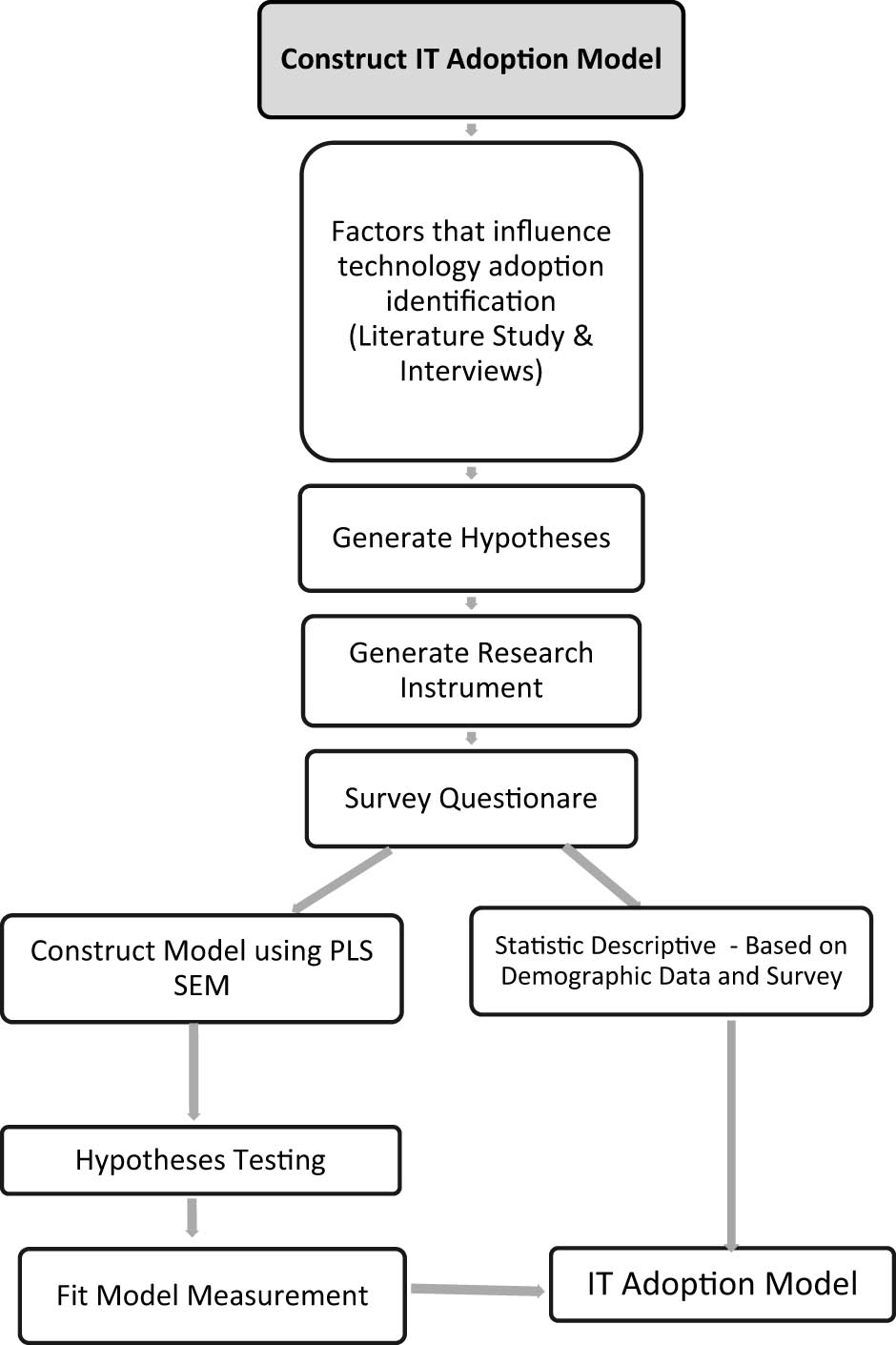
Research stages.
There are five steps in SEM: model specification, identification, parameter estimation, model evaluation, and model modification [24]. The model evaluated looks at its reliability value. The acceptable reliability value based on Cronbach’s Alpha is >0.7. According to ref. [35], they stated that Cronbach’s Alpha value <0.5 has low reliability, Cronbach’s Alpha values 0.5–0.7 have moderate reliability, 0.7 to 0.9 have high reliability, and Cronbach’s Alpha values >0.9 have perfect reliability. Reliability can also be seen from Composite reliability. The acceptable composite reliability value is >0.7. The inner model is evaluated by looking at the R-square value and the effect size (f-square). According to [25], if the R-square value is 0.67, it indicates that it is strong, an R-square value of 0.33 indicates a moderate model and an R-square value of 0.19 indicates that the model is weak. In addition, the f-square value measures the effect of the independent variable on the dependent variable, which is independent of the influence of sample size. The results of the f-square calculation are given a rating to make it easier to read the interpretation of the f-square calculation. The f-square rating used is based on [26] if the value is ≥ 0.02, small; ≥ 0.15, medium; ≥ 0.35, large.
The hypothesis is tested by looking at the significance value. The model formed as a result of hypothesis testing is then tested by looking at the overall fit of the model. Quality indexed is used to measure model fit from Goodness of Fit (GoF). Apart from that, the descriptive statistics that have been carried out in this research are looking at the trends in answers to the results of the questionnaire survey. We looked at trends in respondents’ answers associated with demographic data. We calculate the frequency of answers, for certain demographic data variables to identify patterns. We determine the demographic data variables that we observe are the farmer’s recording habits and the farmer’s income level.
2.2 Hypotheses
Small-scale dairy farming involves various business processes that contribute to the production and sustainability of the dairy industry. These processes include milk production, feeding, breeding, housing, milking, waste management, and resource utilization [27, 28, 29]. Small-scale dairy farmers, who are predominantly smallholder farmers, play a significant role in milk production in developing countries [30]. They generate the majority of milk supply and contribute to household income, poverty alleviation, and economic growth [31]. However, small-scale dairy farming faces challenges such as scarcity of feeds and fodder, high costs of cattle, lack of technical knowledge, and decreasing interest of future generations. To address these challenges and promote sustainable small-scale dairy farming, interventions, and support are needed, including access to land, provender, subsidies, and awareness about the potential of small-scale dairy farming as a stable career opportunity. The application of information technology can be a solution to facilitate access to information and knowledge. Apart from that, information technology can make communication and education easier. However, the application of advanced technology cannot be implemented immediately. There needs to be consideration regarding the level of adoption. Previous studies have explained several findings related to indicators that influence information technology adoption (Table 1). Initially, the literature studied was research in the scope of agriculture in general, dairy farming, plantations, and other ruminants.
Factors affecting IT adoption in agriculture
| Factors | Sources |
|---|---|
| Education | [1,2,32,33,34,35,36] |
| Income | [2,34,35] |
| Access to credit | [2,34,35,38] |
| Access to extension services | [2,34,35,38] |
| Membership (Cooperative/Organization) | [2,35,36,37] |
| Age | [1,2,32,33,34,35,36,39] |
| Gender | [1,2,32,33,34,35,36] |
| Experience | [2,34,39] |
| Farm size | [1,12,33,35,37,38] |
| Distance to market | [35,37,39,40] |
| Fulltime farming | [37,39,41] |
| Herd size | [12,33] |
| Familiarity with computer/userskill | [1,33] |
| Perception (relative advantages/reward) | [1,33] |
| Belief | [1] |
| Training | [1] |
| Possibility customize | [1] |
| Interoperability (user friendly) | [1,12] |
| Cost | [1] |
| Complexity | [1] |
| Data ownership | [1] |
| Privacy and security | [1] |
| Data standard | [1] |
| Time consumption | [1] |
Many studies reveal that education is the main aspect that influences technology adoption [1,2,32, 33, 34,35, 36]. A study in the United States found that increasing farm size as well as dairy operators having a college education were factors associated with the adoption of technology, management practices and production systems that affected productivity [33]. The study by Giua et al. [1] states that the driving factors for technology adoption are usability, land size, and level of education. In addition, technological adaptation can be improved by providing vocational training to business owners who start businesses at a young age [34]. Membership in cooperatives also has an important role in technology adoption. Cooperatives can promote the adoption of technology in production, thereby increasing productivity and income [37].
The factors that have been identified and accepted will be further processed as a basis for developing a model for measuring the level of technology adoption in smallholder dairy farms. The proposed technology adoption rate measurement model is based on the theoretical concept of the TAM. TAM is a model that can be used to analyse the factors that influence the acceptance of an information technology-based system. Tam was first proposed by Fred Davis in 1989 and there have been several revisions to the proposed model. The revision of the TAM model by Vekantesh and Davis in 1996 (Figure 2) was referred to in research by [42]. Alharbi and Drew [42] adopted TAM to see the desire of academic actors to use the Learning Management System. So, the research [42] tries to propose a technology adoption model that can be identified before the technology is fully implemented. Thus, the TAM model that is closest to the scope of the research is the model proposed in the research [42] (Figure 3). The model will be adopted as a framework with some adjustments according to the relevance of this research.
![Figure 2
The Technology Acceptance Model (TAM) was originally developed by Fred D. Davis in 1989 and updated by Vekantesh & Davis in 2000. The image has been adopted from Vekantesh & Davis [43].](/document/doi/10.1515/opag-2022-0304/asset/graphic/j_opag-2022-0304_fig_002.jpg)
The Technology Acceptance Model (TAM) was originally developed by Fred D. Davis in 1989 and updated by Vekantesh & Davis in 2000. The image has been adopted from Vekantesh & Davis [43].
![Figure 3
TAM in understanding academics’ BIU learning management systems [30].](/document/doi/10.1515/opag-2022-0304/asset/graphic/j_opag-2022-0304_fig_003.jpg)
TAM in understanding academics’ BIU learning management systems [30].
The TAM model was adopted and adapted for preparing hypotheses and models for this research. TAM is used as the main framework, but the indicators used are adapted to the context of the dairy farming sector. Therefore, a literature study is carried out to identify various factors as indicators that influence the adoption of information technology that is relevant to research. Validation from experts is required for approval that the indicators of the results of the literature study are relevant, or irrelevant, and/or there are additional indicators recommended based on experts’ experience.
Based on the results of interviews with experts regarding the TAM model and its indicators, some experts say that external factors can be adapted to smallholder dairy farming. What experts recommend are external factors in the TAM model. External factors in TAM should be given consideration to see that extension support and cooperative membership affect the rate of technology adoption. In addition, experts also suggest that basic skills in using technology are also likely to affect the acceptance of farmers in using information technology to help their work.
The results of mapping the identified indicators into the TAM model are listed in Table 2. Thus, a hypotheses model is proposed based on modifications to the TAM model and adjustments based on expert recommendations created as an initial model of technology adoption in Figure 4. Demographic aspects identified in Previous research were also taken into consideration in data collection in this study. This research divided the level of adoption based on the five Linkert scales that were used for the survey. If the respondent answered strongly agree with a score of 5, it indicates that the respondent is more ready to adopt new technology compared to respondents who answered with a score below 5. Based on the Livestock and Animal Health Statistics Book – Ministry of Agriculture of the Republic of Indonesia in 2022, the number of small-scale or household-scale dairy farming businesses is mostly spread across the island of Java, namely more than 90% [44]. This research has conducted a survey by sampling the island of Java. This sample represents small-scale dairy farmers in Indonesia. An explanation about sampling was added so that it can be used as a consideration for generalization. Population data are based on data from the government of the Republic of Indonesia
Factors and indicators of TAM in dairy farms
| Factors | Indicators | Sources | |
|---|---|---|---|
| PEU | Interoperability | A1 | [1,12] |
| Interactivity | A2 | [42] | |
| Expertise | A3 | [42] | |
| Flexibility | A4 | [42] | |
| Learning | A5 | [42] | |
| Requirements (Possibility Customize) | A6 | [1] | |
| Experience using IT | A7 | [1,33] | |
| PU | Efficiency | B1 | [42] |
| Performance | B2 | [42] | |
| Productivity | B3 | [42] | |
| Effectiveness | B4 | [42] | |
| Easiness | B5 | [42] | |
| ATU | Belief | C1 | [1] |
| Satisfy | C2 | [42] | |
| Usability | C3 | [42] | |
| BIU | Planning | D1 | [42] |
| Intention | D2 | [42] | |
| Interest | D3 | [42] | |
| Relevancy | D4 | [42] | |
| DS | Information management | E1 | [1,45] |
| Technical operation | E2 | [37,13,46] | |
| Social | E3 | [46] | |
| Creative | E4 | [46] | |
| Security | E5 | [37,46] | |
| Critical thinking | E6 | [46] | |
| SUP | Access to extension services | F1 | [2,34,35] |
| Reward | F2 | [1,22,33] | |
| Training | F3 | [1] | |
| Access to credit | F4 | [2,34,35,38] | |
| Membership Cooperation | F5 | [2,35,37,40] |
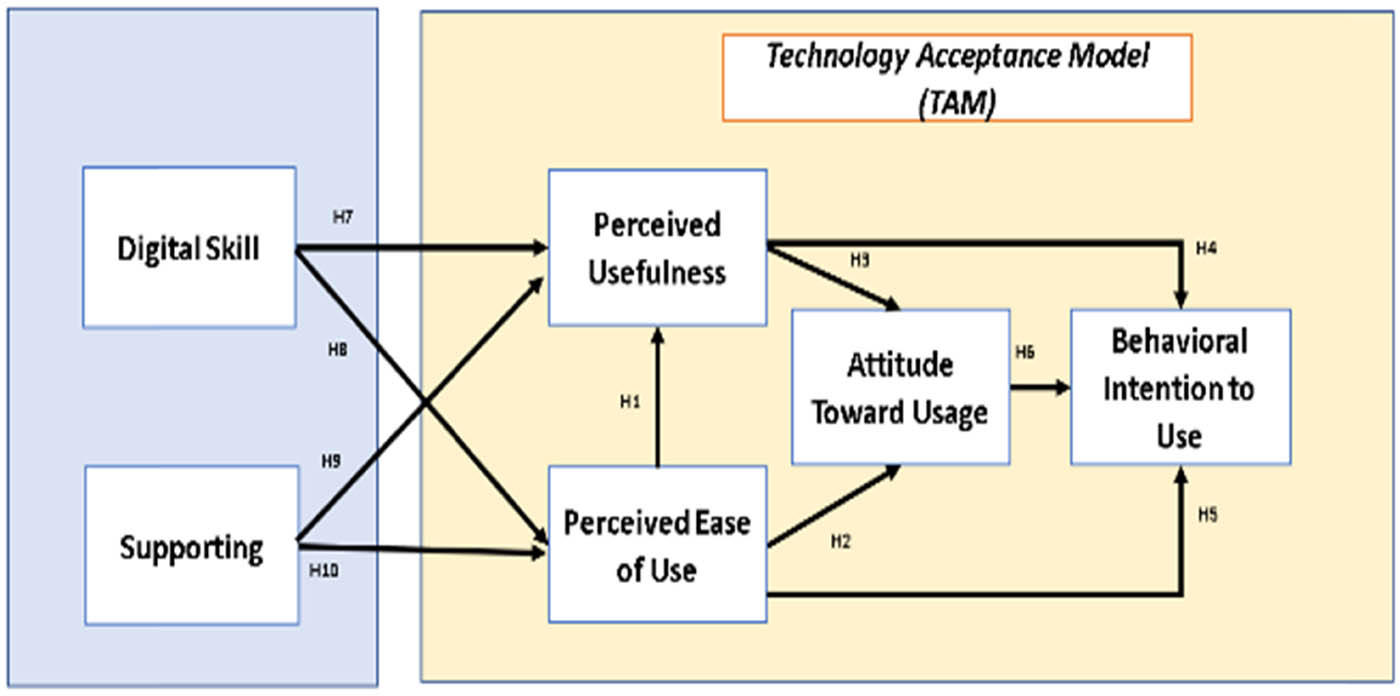
Initial model as hypotheses model.
3 Results
3.1 Statistic descriptive and demographic data
Based on the hypotheses model related to technology adoption, a research instrument prepared in a questionnaire was used to survey. The survey was conducted by sampling traditional dairy farmers in Java. The sampling technique is purposive sampling. Respondents were selected based on recommendations from cooperative managers, village managers, or heads of farmer groups. Respondents involved 116 traditional dairy farmers. Respondent demographics are given in Table 3.
Demographic data
| Demographic criteria | Amount |
|---|---|
| Gender | |
| Man | 48 |
| Woman | 68 |
| Age (year) | |
| <20 | 4 |
| 20–30 | 24 |
| 30–40 | 48 |
| 40–50 | 28 |
| >60 | 12 |
| Education | |
| No school | 0 |
| Elementary school | 52 |
| Junior high school | 48 |
| Senior high school | 16 |
| Bachelor | 0 |
| Income per month (Million -IDR) | |
| <1 | 20 |
| 1–3 | 68 |
| 2–3 | 16 |
| 3–4 | 8 |
| >4 | 4 |
| Milk production per day (liters) | |
| <10 | 24 |
| 10–20 | 40 |
| 20–30 | 22 |
| 30–40 | 14 |
| 40–50 | 8 |
| >50 | 8 |
| Experience in dairy farm (year) | |
| <10 | 24 |
| 10–20 | 48 |
| 20–30 | 28 |
| 30–40 | 12 |
| >40 | 4 |
| Farm area (m 2 ) | |
| <20 | 20 |
| 20–30 | 16 |
| 30–40 | 24 |
| 40–50 | 24 |
| 50–60 | 8 |
| 60–70 | 20 |
| >70 | 4 |
| Number of cows | |
| <3 | 12 |
| 3–6 | 64 |
| 6–10 | 32 |
| >10 | 8 |
| Distance to market (m) | |
| <500 | 76 |
| 500–1,000 | 16 |
| >1,000 | 24 |
Demographic data, such as gender distribution among participants, is crucial for understanding the generalizability and applicability of research findings. Knowing the number of participants per gender can shed light on whether the technology adoption behaviours observed in the study are representative across genders or if there are specific trends and preferences unique to one gender. This is particularly important in sectors like agriculture, where gender roles might influence access to resources, decision-making, and attitudes towards technology, thus impacting the effectiveness of technology adoption strategies.
Understanding income levels and current record-keeping habits is essential in this research as it provides insights into the economic background and operational practices of the participants. This information can help assess how economic factors and existing management practices influence the adoption of new technologies. For instance, income levels may affect the ability to invest in new technologies, while existing record-keeping habits could indicate the readiness to adopt digital tools for farm management. This context is crucial for tailoring technology adoption strategies to the specific needs and capacities of the farmers.
The answers from these respondents are then linked to demographic data related to income and recording habits that have been carried out by small-scale dairy farmers to carry out their farms. The results can be seen in Figure 5 and Table 4. Figure 5 shows the level of responsiveness of the response to answers to questionnaire survey questions that look at their readiness to adopt technology. Those who are better prepared to implement new technology are dairy farmers whose income is IDR 3–4 million per month. The dairy farmers in this group are quite established farmers and are still enthusiastic about improving their livestock business. However, dairy farmers in the highest income group actually had lower readiness scores. This can be because they are already in a comfort zone in their business so they avoid the risk of losses because processes have changed with the presence of technology. Apart from that, this research also found habitual patterns in carrying out daily records on small-scale farms. Records carried out traditionally include milk production, reproduction, feed, and medical records. The small-scale dairy farmers surveyed had varying record-keeping habits. Some people record everything, but some don’t record anything at all. The results show that the more complete the records are, the more enthusiastic dairy farmers are in adopting technology to help their work, and conversely, the fewer records they have, the more they feel that technology is not needed.
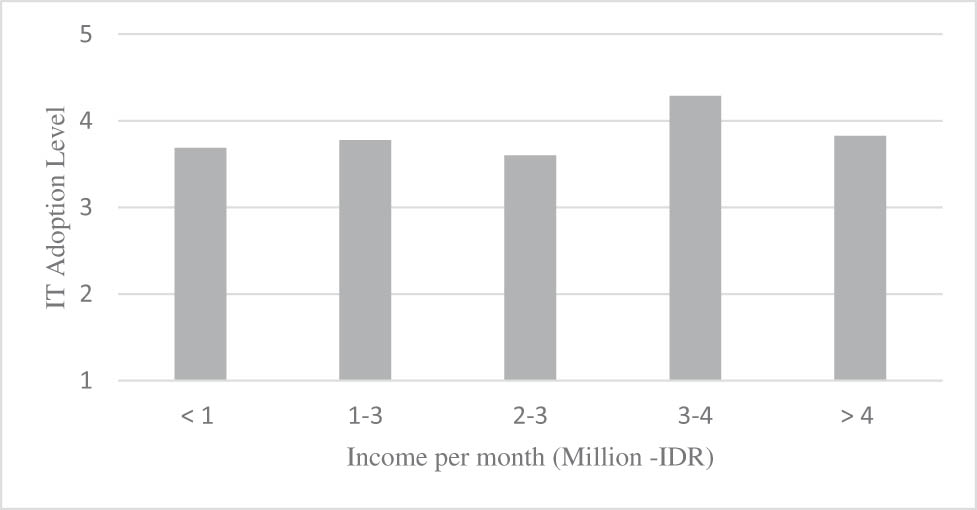
IT adoption level and income per month.
Small-scale farmer record-keeping habits mapped to IT adoption level
| IT adoption level | Recording | |||||
|---|---|---|---|---|---|---|
| Milk production | Reproduction | Feed | Medical record | |||
| Insemination (Estruss) | Birth | cow’s dry period | ||||
| 1 | ||||||
| 2 | √ | |||||
| 3 | √ | √ | ||||
| 4 | √ | √ | √ | √ | ||
| 5 | √ | √ | √ | √ | √ | √ |
This study also saw that based on level, the profiles of respondents at each level could also be studied. The survey results in this study showed that most of the respondents were at level 3. At level 3, most of the respondents were aware of taking notes. Recording was carried out including the results of milk every day and the time of artificial insemination. Recording is mostly done in books. Other recording media used are on sheets of paper and barn housing walls. At level 3, respondents have dairy cows with milking status with an average of three cows and an income of 1 to 3 million per month. In the second rank, respondents are at level 5. Level 5 is a respondent who also keeps records. Record keeping is more complete. Level 5, the farmer has not only recorded milk yield and reproduction but has also recorded feed and health care records (medical record). The ranking of the three respondents is at level 4. Level 4 is the respondent who recorded milk yield, time of artificial insemination, time of birth, and time of cows in dry period. Respondents at level 2 recorded only milk results. Meanwhile, respondents at level 1 are farmers who do not record.
3.2 Construct IT adoption model
The initial model was formed based on identifying latent variables and relevant indicators. There are 6 latent variables and 30 indicators. Table 5 shows the results of executing the loading factor or outer loading calculation. The relationship between factors and indicators is calculated to determine the strength of the relationship. The greater the outer loading value, the stronger the indicator makes up the factor. In addition, the strength of the relationship between factors (inner model), depicted using blue-to-blue notation with lines, is also calculated. How significant a factor is can influence other factors. The outer and inner model testing sections will present more detailed calculations.
The results of initial model’s outer loading
| Variables | Indicators | Outer loading |
|---|---|---|
| PEU | A1 | 0.704 |
| A2 | 0.888 | |
| A3 | 0.843 | |
| A4 | 0.882 | |
| A5 | 0.867 | |
| A6 | 0.857 | |
| A7 | 0.811 | |
| PU | B1 | 0.844 |
| B2 | 0.780 | |
| B3 | 0.613 | |
| B4 | 0.933 | |
| B5 | 0.858 | |
| ATU | C1 | 0.879 |
| C2 | 0.944 | |
| C3 | 0.880 | |
| BIU | D1 | 0.870 |
| D2 | 0.963 | |
| D3 | 0.958 | |
| D4 | 0.878 | |
| DS | E1 | 0.799 |
| E2 | 0.882 | |
| E3 | 0.921 | |
| E4 | 0.747 | |
| E5 | 0.919 | |
| E6 | 0.755 | |
| SUP | F1 | 0.863 |
| F2 | 0.232 | |
| F3 | 0.731 | |
| F4 | 0.030 | |
| F5 | 0.769 |
3.2.1 Outer model evaluation
Evaluation of the outer model looks at the value criteria for convergent validity, discriminant validity, and reliability tests. The validation values for the latent variables and indicators in the model are determined using convergent validity. The validation value between unrelated indicators will be seen using discriminant validity. Furthermore, Cronbach’s Alpha or Composite reliability value is used for reliability tests. Convergent validity looks at the outer loadings value, which shows the correlation between the indicator and the construct. An indicator with a low loading value indicates that the indicator does not work in the measurement model. We have expected a loading value >0.7. In the outer model, we know cross-loading. This value is another measure of discriminant validity. The expected value is that each indicator has a higher loading for the measured construct compared to the other constructs’ loading value. In the outer model, we know Composite Reliability. This value indicates internal consistency. That is, a high composite reliability value indicates the consistency value of each indicator in measuring its construct. The CR value is expected to be >0.7.
The results of the initial model execution will show the outer model value. Based on the values resulting from the initial model execution, several values in bold in Table 5 do not meet the requirement >0.7. In this research, two iterations were carried out to obtain a model with an outer loading value >0.7 for all indicators. The final results of the evaluated model show that four indicators were eliminated, namely productivity (B3), reward (F2), and access to credit (F4). These results state that the indicators related to Outer loading in the model that have been evaluated can be seen Figure 6.
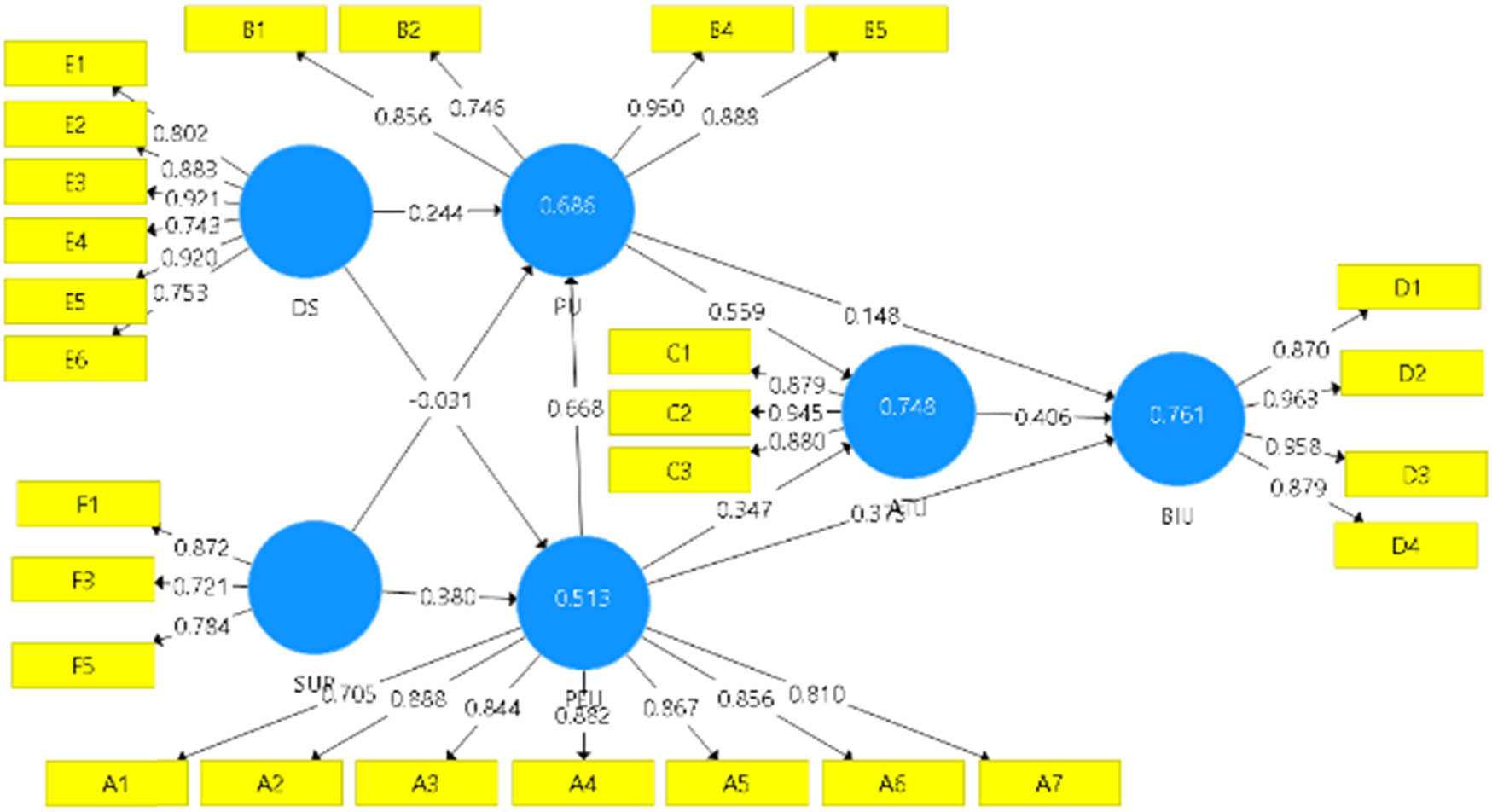
Evaluated model.
3.2.2 Construct reliability analysis
This step measures the reliability of latent variable constructs. This value is seen from the Cronbach’s Alpha value. The Cronbach’s Alpha and Composite reliability values in this research are shown in Table 6.
Cronbach’s alpha and composite reliability
| Variables | Cronbach’s alpha | Composite reliability | ||
|---|---|---|---|---|
| PEU | 0.929 | Perfect | 0.943 | Reliable |
| PU | 0.883 | High | 0.921 | Reliable |
| ATU | 0.884 | High | 0.929 | Reliable |
| BIU | 0.937 | Perfect | 0.956 | Reliable |
| DS | 0.936 | Perfect | 0.935 | Reliable |
| SUP | 0.710 | High | 0.836 | Reliable |
3.2.3 Inner model evaluation
The inner model is evaluated by looking at the R-square value and the effect size (f-square). The R-square value indicates the amount of variance in the construct described by the model. R-square is used to see the proportion or percentage of the independent variable’s ability to explain the dependent variable’s variance. The R-square value is also called the coefficient of determination, calculated by squaring the correlation coefficient (R) value. The R-square value and effect size (f-square) results can be seen in Tables 7 and 8.
R-Square values
| Variables | R-square | Rate |
|---|---|---|
| PEU | 0.513 | Moderate |
| PU | 0.686 | Strong |
| ATU | 0.748 | Strong |
| BIU | 0.761 | Strong |
| Average R-Square | 0.677 |
F-square results
| Variable | F-Square | Rate |
|---|---|---|
| PEU → PU | 0.694 | Large |
| PEU → ATU | 0.164 | Large |
| PU → ATU | 0.426 | Large |
| PU → BIU | 0.022 | Small |
| PEU → BIU | 0.173 | Medium |
| ATU → BIU | 0.174 | Medium |
| DS → PU | 0.075 | Small |
| DS → PEU | 0.139 | Medium |
| SUP → PU | 0.001 | Small |
| SUP → PEU | 0.134 | Small |
3.3 Hypotheses test
The suggested research model was evaluated by looking at the significance value. The significance value is obtained by resampling using the Bootstrapping method. Bootstrapping treats the observed sample as if it represents the population [47]. The significance value used is 5%; thus, the t-value taken as a reference is 1.96 and p-values <0.005. The results of hypothesis testing show that two hypotheses are rejected. Overall results are shown in Table 9. The values in bold in Table 9 do not meet the requirements so several hypotheses are rejected.
Hypotheses testing results
| # | Hypotheses | P-Values | T-Statistic | Status | |
|---|---|---|---|---|---|
| H1 | PEU positively affects PU of an Information Technology | PEU → PU | 0.000 | 6,170 | Accepted |
| H2 | PEU positively affects attitudes towards using an Information Technology | PEU → ATU | 0.000 | 3.776 | Accepted |
| H3 | PU positively affects attitudes towards using an Information Technology | PU → ATU | 0.000 | 5.982 | Accepted |
| H4 | PU positively affects intention to behavioural use Information Technology | PU → BIU | 0.208 | 1.259 | Rejected |
| H5 | PEU positively affects intention to behavioural use Information Technology | PEU → BIU | 0.002 | 3.057 | Accepted |
| H6 | Attitude towards using positively affects BIU Information Technology | ATU → BIU | 0.005 | 2.875 | Accepted |
| H7 | Digital positively affects PU | DS → PU | 0.037 | 2.043 | Accepted |
| H8 | Digital positively affects PEU | DS → PEU | 0.002 | 3.073 | Accepted |
| H9 | SUP positively affects PU | SUP → PU | 0.751 | 0.305 | Rejected |
| H10 | SUP positively affects PEU | SUP → PEU | 0.001 | 3.265 | Accepted |
3.4 Quality index testing
The model formed as a result of hypothesis testing must be tested by looking at the model’s overall fit. Quality indexing measures model fit from GoF. According to the study by Barrios et al. [39], if the GoF value is 0.10, then a small fit model, a GoF value of 0.25, means a medium fit model, and a GoF value of 0.36 indicates a large fit model. The GoF value is calculated by the root of the average communality value multiplied by the average R-square [48, 49]. The average communality calculated using the average of Average Variance Extracted (AVE) results is 0.740. The average R-squared value in this model is 0.677. Thus, the square root result of multiplying the Communality average by the R-square average produces a GoF value of 0.708. Based on the GoF value obtained, the Large Fit Model is formed. The final model is shown in Figure 7.
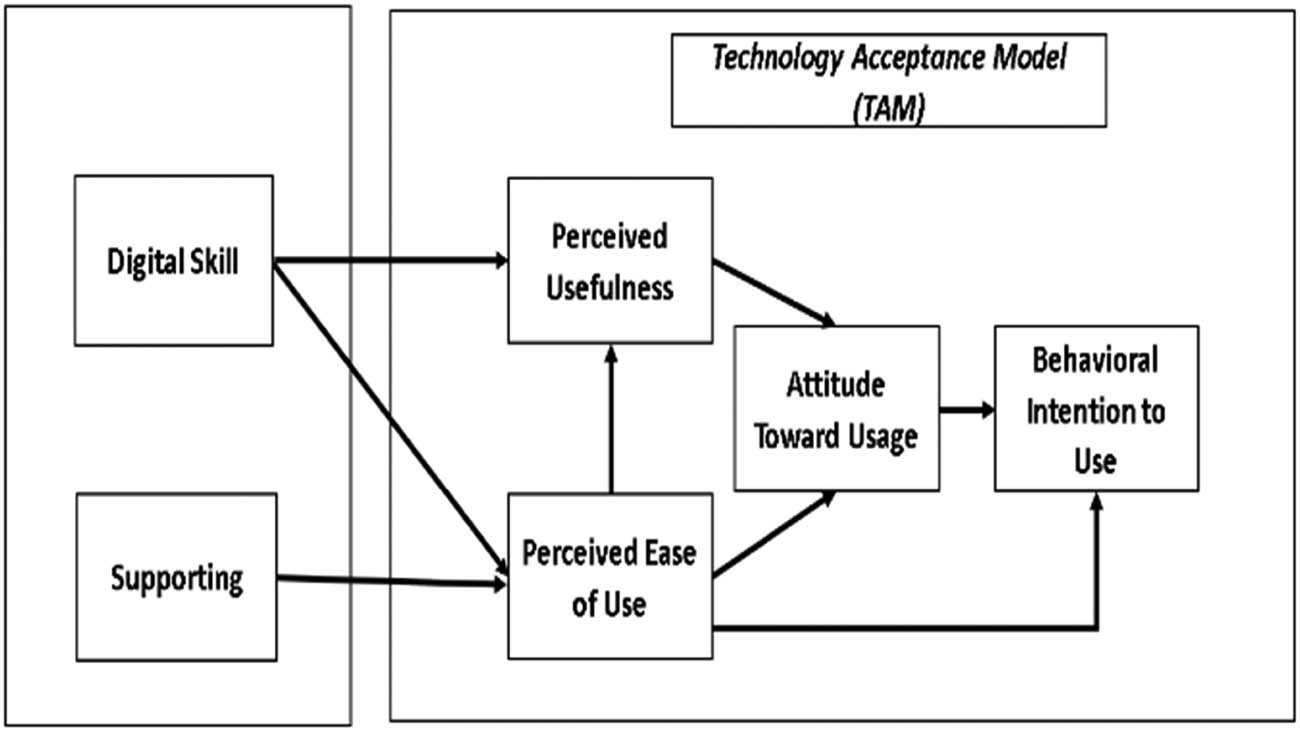
Information technology adoption model for smallholder dairy farmers.
4 Discussion
The results of this research analysis indicate that the factors that influence the adoption of technology for smallholder dairy farmers consist of external factors, namely DS and Supporting (SUP) and internal factors in the technology adoption model, namely Perceived Ease of Use (PEU), Perceived Usefulness (PU), Attitude Toward Usage (ATU) and Behavioral Intention to Use (BIU). The hypothetical model is structured to see the interrelationships between factors. The results of hypothesis testing show that SUP is not correlated with PU. This shows that the support given to farmers does not directly correlate with the performance of farmers. However, SUP remains positively correlated with PEU. PEU is represented by interoperability, interactivity, expertise, flexibility, learning, and using IT. This shows that good support for farmers will facilitate the application of new technology. This finding is in line with previous studies. Several studies explain the application of knowledge and technology-based agriculture which makes agricultural extension agents the main element in implementing digitalization. Knowledge in the field of agriculture and its extension communication network is an important component of an agricultural innovation system that has the potential for digital disruption [50]. Extensionists can act as data analysts and even expert software users. They also combine their knowledge of the agricultural context with data collected through smart technologies in agricultural knowledge [51]. Besides that, research [52] demonstrated that the co-design process supported agricultural extension agents to enhance their digital agency. The hypothesis regarding PEU and BIU also does not show a correlation. Farmers who already feel that they have a perception of the ease of use of technology do not necessarily mean that they will plan to use the technology directly. This is influenced by their belief in the use of technology that technology can help their work. The sustainability of the use of technology is also a problem in itself related to the trust of farmers in the use of technology. Even though the new technology presented is easy to use, certainty about the sustainability of this technology needs to be ensured. On the other hand, the ease of use of new technology is also a consideration for small-scale dairy farmers.
The lack of a direct influence of support on farmers’ perceptions of technology’s usefulness might point to gaps in how support is structured or communicated. This discrepancy suggests that the form of support provided may not effectively address the specific needs or concerns of farmers regarding technology or that there might be a misalignment between the support offered and the perceived benefits by the farmers. It highlights the need for a deeper understanding of farmers’ expectations and the context in which they operate, suggesting that support mechanisms need to be more tailored and responsive to the farmers’ actual experiences and perceived value of technological solutions.
The lack of a significant correlation between support (SUP) and PU in this study suggests that the type or quality of support provided to smallholder dairy farmers may not effectively enhance their perceptions of technology’s practical benefits. This could indicate that while support initiatives are in place, they may not be adequately tailored to address the specific performance-related needs or fail to demonstrate the direct impact of technology on farming outcomes. This misalignment could lead to underutilization of available technological resources, emphasizing the need for support services to closely align with the farmers’ operational realities and expectations to improve technology adoption outcomes.
These findings suggest implications for policy, training, and technology design. For instance, the lack of correlation between support and PU might indicate a need for more targeted or contextually relevant support mechanisms. This could imply that policymakers and extension services need to develop more personalized support strategies that directly address the perceived benefits of technology. The disconnect between ease of use and intention to use suggests that merely simplifying technology may not be enough. There may be underlying issues of trust, relevance, or perceived long-term value that need to be addressed through community engagement and education. This could involve creating more opportunities for farmers to see and experience the tangible benefits of technology in their operations before they decide to adopt it.
Given the complexities in technology adoption, another layer to consider is the social and cultural context within which small-scale dairy farmers operate. The effectiveness of support (SUP) and its relation to PEU could be significantly influenced by social norms, the collective experiences of the community, and the prevailing attitudes towards technology. This suggests that interventions aimed at improving technology adoption should not only provide technical support but also address social and cultural barriers. Encouraging a culture of innovation and technology acceptance among small-scale farmers could enhance the perceived value and ease of adopting new technologies.
This study reveals intriguing insights into technology adoption among small-scale dairy farmers, highlighting the nuanced relationship between income levels, record-keeping habits, and technology readiness. Income levels influence technology adoption, as wealthier farmers often have better access to capital and information but may not adopt due to risk aversion [53]. This research found that the farmers with moderate incomes show a higher readiness to embrace technology, possibly driven by their aspiration to advance their businesses. Contrastingly, higher-income farmers exhibit less enthusiasm, potentially due to contentment with their current status and apprehension towards new risks. Furthermore, comprehensive record-keeping correlates with a greater inclination towards technology adoption, emphasizing the importance of organizational practices in facilitating technological transitions. This nuanced understanding underscores the need for tailored approaches in promoting technology adoption, considering the diverse backgrounds and operational habits of small-scale dairy farmers. A study by Aker [54]indicates that good record-keeping practices can significantly aid in the adoption of new technologies by providing accurate data for decision-making.
5 Conclusion
The aspect of human resources is also an important concern in the digitalization process. Generally, smallholder dairy farmers are the ones most left behind by the digitalization process. Therefore, there is a need for digitization that pays attention to the beneficial aspects seen from the aspect of smallholder farmers. The level of technology adoption and readiness of human resources can be measured as a basis for developing strategies for digitalization. This research has identified the factors that influence the rate of adoption of new technology by smallholder dairy farmers. The results of this research analysis indicate that the factors that influence the adoption of technology for smallholder dairy farmers consist of external factors, namely, DS and SUP, and internal factors in the technology adoption model, namely, PEU, PU, ATU, and BIU. The hypothetical model is structured to see the interrelationships between factors. The results of hypothesis testing show that SUP is not correlated with PU. This shows that the support given to farmers does not directly correlate with the performance of farmers. However, SUP remains positively correlated with PEU. PEU is represented by interoperability, interactivity, expertise, flexibility, learning, and using IT. This shows that good support for farmers will facilitate the application of new technology. Apart from that, farmers with moderate incomes show a higher readiness to embrace technology, possibly driven by their aspiration to advance their businesses. Contrastingly, higher-income farmers exhibit less enthusiasm, potentially due to contentment with their current status and apprehension towards new risks. Furthermore, comprehensive record-keeping correlates with a greater inclination towards technology adoption, emphasizing the importance of organizational practices in facilitating technological transitions. This nuanced understanding underscores the need for tailored approaches in promoting technology adoption, considering the diverse backgrounds and operational habits of small-scale dairy farmers.
By offering a nuanced analysis of these factors, this study contributes significantly to the literature on agricultural technology adoption, particularly within the context of small-scale dairy farming. It presents a novel understanding of the barriers and enablers to technology adoption, advocating for more personalized and contextually relevant support strategies. Furthermore, this research provides valuable insights for policymakers, extension agents, and technology developers on designing and implementing technology adoption strategies that are not only technically viable but also socially and culturally acceptable. The model developed and the insights gained from this study pave the way for enhancing digitalization efforts in the agricultural sector, potentially leading to increased productivity and sustainability among small-scale dairy farmers.
Acknowledgement
Thank you to Dr. Maria Wurzinger from The University of Natural Resources and Life Sciences, Vienna, Austria for supporting this research. And colleagues who have helped during this research process from College Vocational Studies – IPB University, Bogor, Indonesia.
-
Funding information: The APC was funded by the Directorate of Research and Development, University of Indonesia under Hibah PUTI 2023 (Grant No. NKB-567/UN2. RST/HKP. 05 00/2023).
-
Author contributions: All authors have accepted responsibility for the entire content of this manuscript and consented to its submission to the journal, reviewed all the results and approved the final version of the manuscript. SI: conceptualization, methodology, investigation, formal analysis, writing, and editing; DIS: conceptualization, methodology, supervision, validation, and review; YR: data collection, data input, analysis, and validation.
-
Conflict of interest: Authors state no conflict of interest.
-
Data availability statement: The datasets generated during and/or analysed during the current study are available from the corresponding author upon reasonable request.
References
[1] Giua C, Materia VC, Camanzi L. Management information system adoption at the farm level: evidence from the literature. Br Food J. Feb. 2021;123(3):884–909. 10.1108/BFJ-05-2020-0420. Emerald Group Holdings Ltd.Search in Google Scholar
[2] Ruzzante S, Labarta R, Bilton A. Adoption of agricultural technology in the developing world: A meta-analysis of the empirical literature. World Dev. 2021;146:105599. 10.1016/j.worlddev.2021.105599.Search in Google Scholar
[3] Rijswijk K, Klerkx L, Turner JA. Digitalisation in the New Zealand agricultural knowledge and innovation system: initial understandings and emerging organisational responses to digital agriculture. NJAS - Wagening J Life Sci. January. 2019;90–91:100313. 10.1016/j.njas.2019.100313.Search in Google Scholar
[4] Kochetkova O, Shiryaeva EV. Perspective architecture of dairy farming enterprises, using modern digital technologies for sustainable development. IOP Conf Ser Earth Env Sci. 2022;965(1):12062. 10.1088/1755-1315/965/1/012062.Search in Google Scholar
[5] Papageorgiou G, Porgouris K, Efstathiades A, Papageorgiou GA. Evaluating the development of activity monitoring systems for small scale dairy farms. 2020 7th International Conference on Energy Efficiency and Agricultural Engineering (EE&AE). IEEE; Nov. 2020. p. 1–4. 10.1109/EEAE49144.2020.9278987.Search in Google Scholar
[6] Wangen SR, Zhang F, Fadul-Pacheco L, da Silva TE, Cabrera VE. Improving farm decisions: The application of data engineering techniques to manage data streams from contemporary dairy operations. Livest Sci. 2021;250:104602. 10.1016/J.LIVSCI.2021.104602.Search in Google Scholar
[7] Walse RS. Business applications of information technology in dairy industry. Int J Comput Sci Inf Technol. 2016;7(5):2281–6.Search in Google Scholar
[8] Ivanov Y, Tikhomirov I. Promising directions of technological development and the use of digital technologies in dairy farming. 2020;27:00147. 10.1051/BIOCONF/20202700147.Search in Google Scholar
[9] Markov N, et al. Smart dairy farm - digitalization and innovation. 2022 8th International Conference on Energy Efficiency and Agricultural Engineering (EE&AE). IEEE; Jun. 2022. p. 1–4. 10.1109/EEAE53789.2022.9831220.Search in Google Scholar
[10] Kochetkova OV, Shiryaeva EV. Perspective architecture of dairy farming enterprises, using modern digital technologies for sustainable development. IOP Conf Ser Earth Env Sci. Jan. 2022;965(1):012062. 10.1088/1755-1315/965/1/012062.Search in Google Scholar
[11] Okano MT, Vendrametto O, Langhi C. Digital transformation in the milk production chain. IFIP Adv Inf Commun Technol. 2022;664:83–91. 10.1007/978-3-031-16411-8_11. IFIP.Search in Google Scholar
[12] Groher T, Heitkämper K, Umstätter C. Digital technology adoption in livestock production with a special focus on ruminant farming. Animal. 2020;14(11):2404–13. 10.1017/S1751731120001391.Search in Google Scholar PubMed PubMed Central
[13] Kamarudin N, Yusoff A, Basari ASH, bin NZ, Safar M, Hussin MH. Technology acceptance model (TAM) for mobile durian plantation apps(Pro Durian); the analysis for Malaysian farmers. 2023 5th International Congress on Human-Computer Interaction, Optimization and Robotic Applications (HORA). IEEE; Jun. 2023. p. 1–5. 10.1109/HORA58378.2023.10156806.Search in Google Scholar
[14] Wang B, Dong H. Research on the farmers’ agricultural digital service use behavior under the rural revitalization strategy—Based on the extended technology acceptance model. Front Env Sci. May 2023;11:1–11. 10.3389/fenvs.2023.1180072.Search in Google Scholar
[15] Jain M, Soni G, Verma D, Baraiya R, Ramtiyal B. Selection of technology acceptance model for adoption of industry 4.0 technologies in agri-fresh supply chain. Sustainability. Mar. 2023;15(6):4821. 10.3390/su15064821.Search in Google Scholar
[16] Hendrawan SA, Trihandoyo A, Saroso DS. Implementing technology acceptance model to measure ICT usage by smallholder farmers. SINERGI. Jan. 2023;27(1):123. 10.22441/sinergi.2023.1.014.Search in Google Scholar
[17] Chaudhary S. A multivariate analysis of agricultural electronic trading adoption. J Sci Ind Res (India). Sep. 2022;81(9). 10.56042/jsir.v81i09.59538.Search in Google Scholar
[18] Bayaga A, Kyobe M. PLS-SEM modelling in information systems. 2022 Conference on Information Communications Technology and Society (ICTAS). IEEE; Mar. 2022. p. 1–6. 10.1109/ICTAS53252.2022.9744685.Search in Google Scholar
[19] Erwidodo E, Purwantini TB, Anugrah IS, Ariningsih E, Saliem HP, Suryani E. The role of the digitized milk collection point in increasing milk quality and income of smallholder dairy farmers in Pangalengan-Bandung. J Ilmu-ilmu Peternak. 2022;32(2):192–201. 10.21776/ub.jiip.2022.032.02.05.Search in Google Scholar
[20] Beru MK, Kiptui M, Cheserek G. Integrating information and communication technology use and environmental conservation in livelihoods of small scale dairy farmers of nandi and uasin gishu counties. 2018;3(1):153–62. http://www.aer-journal.info/index.php/journals/article/download/60/100.Search in Google Scholar
[21] Kedari S, Vuppalapati JS, Ilapakurti A, Kedari S, Vuppalapati R, Vuppalapati C. The role of supervised climate data models and dairy iot edge devices in democratizing artificial intelligence to small scale dairy farmers worldwide. 2020;1027:383–404. 10.1007/978-981-32-9343-4_31.Search in Google Scholar
[22] Janssen E, Swinnen J. Technology adoption and value chains in developing countries: Evidence from dairy in India. Food Policy. August 2017;83:327–36. 10.1016/j.foodpol.2017.08.005.Search in Google Scholar
[23] Ghozali I, Latan H. Partial least squares: Konsep. Teknik dan Aplikasi Menggunakan SmartPLS 3.0. Semarang: Universitas Diponegoro; 2014.Search in Google Scholar
[24] Byrne B. Structural equation modeling with AMOS: basic concepts,applications, and programming. New York: Routledge; 2013.10.4324/9781410600219Search in Google Scholar
[25] Chin WW. The partial least squares approach to structural equation modeling the proactive technology project recovery function: a methodological analysis view project research methods view project; 1998. https://www.researchgate.net/publication/311766005.Search in Google Scholar
[26] Cohen J. Statistical Power Analysis for the Behavioral Sciences. 2nd edn. New Jersey: Lawrence Erlbaum Associates.Search in Google Scholar
[27] Bennett A, Lhoste F, Crook J, Phelan J. The future of small scale dairying. Global perspective. FAO Livestock report 2006.Search in Google Scholar
[28] Shamsuddoha M, Nasir T, Hossain NUI. A sustainable supply chain framework for dairy farming operations: a system dynamics approach. Sustainability. 2023;15(10):8417. 10.3390/su15108417.Search in Google Scholar
[29] Axtell B, Fellows P. Setting up and running a small-scale dairy processing business. Netherlands: CTA; 2008.Search in Google Scholar
[30] Hossain MM, Rashid MM, Asaduzzaman M, Rahman M. Small scale dairy farming practice in a selective area of Bangladesh. Pak J Nutr. 2005;4(4):215–21. 10.3923/PJN.2005.215.221.Search in Google Scholar
[31] Jatwani M, Swain S. Is small scale dairy farming dying out? an in-depth study. Indian J Community Med. 2020;45(Suppl 1):S47–S51. 10.4103/IJCM.IJCM_385_19.Search in Google Scholar PubMed PubMed Central
[32] Zhang Q, Hussain I, Akram S, Afaq A. Sustainable innovation in small medium enterprises: the impact of knowledge management on organizational innovation through a mediation analysis by using sem approach. Sustainability. 2020;12(6):2407.10.3390/su12062407Search in Google Scholar
[33] Jelinski MD, Kelton DF, Luby C, Waldner C. Factors associated with the adoption of technologies by the Canadian dairy industry. Can Vet. J. 2020;61(10):1065–72.Search in Google Scholar
[34] Ögür AY. Factors affecting the adoption of technology in dairy farms in the konya region of Turkey. N Medit. 2021;20(3):145–57. 10.30682/NM2103J.Search in Google Scholar
[35] Feyissa AA, Senbeta F, Tolera A, Guta DD. Unlocking the potential of smallholder dairy farm: Evidence from the central highland of Ethiopia. J Agric Food Res. December 2022, 2023;11:100467. 10.1016/j.jafr.2022.100467.Search in Google Scholar
[36] Adamsone-Fiskovica A, Grivins M, Burton RJ, Elzen B, Flanigan S, Frick R, et al. Disentangling critical success factors and principles of on-farm agricultural demonstration events. J Agric Educ Ext. 2021;27(5):639–56. 10.1080/1389224X.2020.1844768.Search in Google Scholar
[37] Zhang S, Sun Z, Ma W, Valentinov V. The effect of cooperative membership on agricultural technology adoption in Sichuan, China. China Econ Rev. August 2019 & 2020;62:101334. 10.1016/j.chieco.2019.101334.Search in Google Scholar
[38] Afodu OJ, Akinboye OE, Akintunde AO, Ndubuisi-Ogbonna LC, Shobo BA, Oyewumi OS. Assessing the impact of technology adoption on productivity of plantain farmers in Nigeria. Agric Soc Econ. J. 2021;21(4):319–24. 10.21776/ub.agrise.2020.021.4.8.Search in Google Scholar
[39] Barrios D, Restrepo-Escobar FJ, Cerón-Muñoz M. Factors associated with the technology adoption in dairy agribusiness. Rev Fac Nac Agron Medellin. 2020;73(2):9221–6. 10.15446/rfnam.v73n2.82169.Search in Google Scholar
[40] Adams A, Jumpah ET. Agricultural technologies adoption and smallholder farmers’ welfare: Evidence from Northern Ghana. Cogent Econ Financ. 2021;9(1):2006905. 10.1080/23322039.2021.2006905.Search in Google Scholar
[41] Gerritsen AL, Stuiver M, Termeer CJAM. Knowledge governance: An exploration of principles, impact, and barriers. Sci Public Policy. 2013;40(5):604–15. 10.1093/scipol/sct012.Search in Google Scholar
[42] Alharbi S, Drew S. Using the technology acceptance model in understanding academics’ behavioural intention to use learning management systems; 2014. www.ijacsa.thesai.org.10.14569/IJACSA.2014.050120Search in Google Scholar
[43] Venkatesh V, Davis FD. A theoretical extension of the technology acceptance model: Four longitudinal field studies, Manage Sci. 2000;46(2):186–204.10.1287/mnsc.46.2.186.11926Search in Google Scholar
[44] Direktorat Statistik Peternakan, Perikanan, dan Kehutanan. Peternakan Dalam Angka. Badan Pusat Statistik. Indonesia. Vol. 8; 2023.Search in Google Scholar
[45] Angeline M, Luthfia A, Safitri Y, Widyakusumastuti MA, Wibowo D. Towards digital equality: Assessing youths’ digital literacy capabilities. Proceedings of 2021 International Conference on Information Management and Technology, ICIMTech 2021. Institute of Electrical and Electronics Engineers Inc.; Aug. 2021. p. 282–6. 10.1109/ICIMTech53080.2021.9534938.Search in Google Scholar
[46] Giua C, Materia VC, Camanzi L. Management information system adoption at the farm level: evidence from the literature. Br Food J. 2021;123(3):884–909. 10.1108/BFJ-05-2020-0420.Search in Google Scholar
[47] Henseler J, Ringle CM, Sinkovics RR. The use of partial least squares path modeling in international marketing. Adv Int Mark. 2009;20:277–319. 10.1108/S1474-7979(2009)0000020014.Search in Google Scholar
[48] Tenenhaus M, Vinzi VE, Chatelin Y-M, Lauro C. PLS path modeling. Comput Stat Data Anal. 2005;48(1):159–205. 10.1016/j.csda.2004.03.005.Search in Google Scholar
[49] Ghozali I. Aplikasi Analisis Multivariete Dengan Program IBM SPSS 23. 8th edn. Semarang: Badan Penerbit Universitas Diponegoro; 2016.Search in Google Scholar
[50] Fielke S, Taylor B, Jakku E. Digitalisation of agricultural knowledge and advice networks: A state-of-the-art review. Agric Syst. 2020;180:102763. 10.1016/j.agsy.2019.102763.Search in Google Scholar
[51] Eastwood C, Ayre M, Nettle R, Dela Rue B. Making sense in the cloud: Farm advisory services in a smart farming future. NJAS - Wagening J Life Sci. December 2018 & 2019;90–91:100298. 10.1016/j.njas.2019.04.004.Search in Google Scholar
[52] Ayre M, Mc Collum V, Waters W, Samson P, Curro A, Nettle R, et al. Supporting and practising digital innovation with advisers in smart farming. NJAS – Wagening J Life Sci. November 2018;90–91:100302. 10.1016/j.njas.2019.05.0012019.Search in Google Scholar
[53] Doss CR. Designing agricultural technology for african women farmers: lessons from 25 years of experience. World Dev. Dec. 2001;29(12):2075–92. 10.1016/S0305-750X(01)00088-2.Search in Google Scholar
[54] Aker JC. Dial ‘A’ for agriculture: a review of information and communication technologies for agricultural extension in developing countries. Agric Econ. Nov. 2011;42(6):631–47. 10.1111/j.1574-0862.2011.00545.xno.Search in Google Scholar
© 2024 the author(s), published by De Gruyter
This work is licensed under the Creative Commons Attribution 4.0 International License.
Articles in the same Issue
- Regular Articles
- Supplementation of P-solubilizing purple nonsulfur bacteria, Rhodopseudomonas palustris improved soil fertility, P nutrient, growth, and yield of Cucumis melo L.
- Yield gap variation in rice cultivation in Indonesia
- Effects of co-inoculation of indole-3-acetic acid- and ammonia-producing bacteria on plant growth and nutrition, soil elements, and the relationships of soil microbiomes with soil physicochemical parameters
- Impact of mulching and planting time on spring-wheat (Triticum aestivum) growth: A combined field experiment and empirical modeling approach
- Morphological diversity, correlation studies, and multiple-traits selection for yield and yield components of local cowpea varieties
- Participatory on-farm evaluation of new orange-fleshed sweetpotato varieties in Southern Ethiopia
- Yield performance and stability analysis of three cultivars of Gayo Arabica coffee across six different environments
- Biology of Spodoptera frugiperda (Lepidoptera: Noctuidae) on different types of plants feeds: Potency as a pest on various agricultural plants
- Antidiabetic activity of methanolic extract of Hibiscus sabdariffa Linn. fruit in alloxan-induced Swiss albino diabetic mice
- Bioinformatics investigation of the effect of volatile and non-volatile compounds of rhizobacteria in inhibiting late embryogenesis abundant protein that induces drought tolerance
- Nicotinamide as a biostimulant improves soybean growth and yield
- Farmer’s willingness to accept the sustainable zoning-based organic farming development plan: A lesson from Sleman District, Indonesia
- Uncovering hidden determinants of millennial farmers’ intentions in running conservation agriculture: An application of the Norm Activation Model
- Mediating role of leadership and group capital between human capital component and sustainability of horticultural agribusiness institutions in Indonesia
- Biochar technology to increase cassava crop productivity: A study of sustainable agriculture on degraded land
- Effect of struvite on the growth of green beans on Mars and Moon regolith simulants
- UrbanAgriKG: A knowledge graph on urban agriculture and its embeddings
- Provision of loans and credit by cocoa buyers under non-price competition: Cocoa beans market in Ghana
- Effectiveness of micro-dosing of lime on selected chemical properties of soil in Banja District, North West, Ethiopia
- Effect of weather, nitrogen fertilizer, and biostimulators on the root size and yield components of Hordeum vulgare
- Effects of selected biostimulants on qualitative and quantitative parameters of nine cultivars of the genus Capsicum spp.
- Growth, yield, and secondary metabolite responses of three shallot cultivars at different watering intervals
- Design of drainage channel for effective use of land on fully mechanized sugarcane plantations: A case study at Bone Sugarcane Plantation
- Technical feasibility and economic benefit of combined shallot seedlings techniques in Indonesia
- Control of Meloidogyne javanica in banana by endophytic bacteria
- Comparison of important quality components of red-flesh kiwifruit (Actinidia chinensis) in different locations
- Efficiency of rice farming in flood-prone areas of East Java, Indonesia
- Comparative analysis of alpine agritourism in Trentino, Tyrol, and South Tyrol: Regional variations and prospects
- Detection of Fusarium spp. infection in potato (Solanum tuberosum L.) during postharvest storage through visible–near-infrared and shortwave–near-infrared reflectance spectroscopy
- Forage yield, seed, and forage qualitative traits evaluation by determining the optimal forage harvesting stage in dual-purpose cultivation in safflower varieties (Carthamus tinctorius L.)
- The influence of tourism on the development of urban space: Comparison in Hanoi, Danang, and Ho Chi Minh City
- Optimum intra-row spacing and clove size for the economical production of garlic (Allium sativum L.) in Northwestern Highlands of Ethiopia
- The role of organic rice farm income on farmer household welfare: Evidence from Yogyakarta, Indonesia
- Exploring innovative food in a developing country: Edible insects as a sustainable option
- Genotype by environment interaction and performance stability of common bean (Phaseolus vulgaris L.) cultivars grown in Dawuro zone, Southwestern Ethiopia
- Factors influencing green, environmentally-friendly consumer behaviour
- Factors affecting coffee farmers’ access to financial institutions: The case of Bandung Regency, Indonesia
- Morphological and yield trait-based evaluation and selection of chili (Capsicum annuum L.) genotypes suitable for both summer and winter seasons
- Sustainability analysis and decision-making strategy for swamp buffalo (Bubalus bubalis carabauesis) conservation in Jambi Province, Indonesia
- Understanding factors affecting rice purchasing decisions in Indonesia: Does rice brand matter?
- An implementation of an extended theory of planned behavior to investigate consumer behavior on hygiene sanitation-certified livestock food products
- Information technology adoption in Indonesia’s small-scale dairy farms
- Draft genome of a biological control agent against Bipolaris sorokiniana, the causal phytopathogen of spot blotch in wheat (Triticum turgidum L. subsp. durum): Bacillus inaquosorum TSO22
- Assessment of the recurrent mutagenesis efficacy of sesame crosses followed by isolation and evaluation of promising genetic resources for use in future breeding programs
- Fostering cocoa industry resilience: A collaborative approach to managing farm gate price fluctuations in West Sulawesi, Indonesia
- Field investigation of component failures for selected farm machinery used in small rice farming operations
- Near-infrared technology in agriculture: Rapid, simultaneous, and non-destructive determination of inner quality parameters on intact coffee beans
- The synergistic application of sucrose and various LED light exposures to enhance the in vitro growth of Stevia rebaudiana (Bertoni)
- Weather index-based agricultural insurance for flower farmers: Willingness to pay, sales, and profitability perspectives
- Meta-analysis of dietary Bacillus spp. on serum biochemical and antioxidant status and egg quality of laying hens
- Biochemical characterization of trypsin from Indonesian skipjack tuna (Katsuwonus pelamis) viscera
- Determination of C-factor for conventional cultivation and soil conservation technique used in hop gardens
- Empowering farmers: Unveiling the economic impacts of contract farming on red chilli farmers’ income in Magelang District, Indonesia
- Evaluating salt tolerance in fodder crops: A field experiment in the dry land
- Labor productivity of lowland rice (Oryza sativa L.) farmers in Central Java Province, Indonesia
- Cropping systems and production assessment in southern Myanmar: Informing strategic interventions
- The effect of biostimulants and red mud on the growth and yield of shallots in post-unlicensed gold mining soil
- Effects of dietary Adansonia digitata L. (baobab) seed meal on growth performance and carcass characteristics of broiler chickens: A systematic review and meta-analysis
- Analysis and structural characterization of the vid-pisco market
- Pseudomonas fluorescens SP007s enhances defense responses against the soybean bacterial pustule caused by Xanthomonas axonopodis pv. glycines
- A brief investigation on the prospective of co-composted biochar as a fertilizer for Zucchini plants cultivated in arid sandy soil
- Supply chain efficiency of red chilies in the production center of Sleman Indonesia based on performance measurement system
- Investment development path for developed economies: Is agriculture different?
- Power relations among actors in laying hen business in Indonesia: A MACTOR analysis
- High-throughput digital imaging and detection of morpho-physiological traits in tomato plants under drought
- Converting compression ignition engine to dual-fuel (diesel + CNG) engine and experimentally investigating its performance and emissions
- Structuration, risk management, and institutional dynamics in resolving palm oil conflicts
- Spacing strategies for enhancing drought resilience and yield in maize agriculture
- Composition and quality of winter annual agrestal and ruderal herbages of two different land-use types
- Investigating Spodoptera spp. diversity, percentage of attack, and control strategies in the West Java, Indonesia, corn cultivation
- Yield stability of biofertilizer treatments to soybean in the rainy season based on the GGE biplot
- Evaluating agricultural yield and economic implications of varied irrigation depths on maize yield in semi-arid environments, at Birfarm, Upper Blue Nile, Ethiopia
- Chemometrics for mapping the spatial nitrate distribution on the leaf lamina of fenugreek grown under varying nitrogenous fertilizer doses
- Pomegranate peel ethanolic extract: A promising natural antioxidant, antimicrobial agent, and novel approach to mitigate rancidity in used edible oils
- Transformative learning and engagement with organic farming: Lessons learned from Indonesia
- Tourism in rural areas as a broader concept: Some insights from the Portuguese reality
- Assessment enhancing drought tolerance in henna (Lawsonia inermis L.) ecotypes through sodium nitroprusside foliar application
- Edible insects: A survey about perceptions regarding possible beneficial health effects and safety concerns among adult citizens from Portugal and Romania
- Phenological stages analysis in peach trees using electronic nose
- Harvest date and salicylic acid impact on peanut (Arachis hypogaea L.) properties under different humidity conditions
- Hibiscus sabdariffa L. petal biomass: A green source of nanoparticles of multifarious potential
- Use of different vegetation indices for the evaluation of the kinetics of the cherry tomato (Solanum lycopersicum var. cerasiforme) growth based on multispectral images by UAV
- First evidence of microplastic pollution in mangrove sediments and its ingestion by coral reef fish: Case study in Biawak Island, Indonesia
- Physical and textural properties and sensory acceptability of wheat bread partially incorporated with unripe non-commercial banana cultivars
- Cereibacter sphaeroides ST16 and ST26 were used to solubilize insoluble P forms to improve P uptake, growth, and yield of rice in acidic and extreme saline soil
- Avocado peel by-product in cattle diets and supplementation with oregano oil and effects on production, carcass, and meat quality
- Optimizing inorganic blended fertilizer application for the maximum grain yield and profitability of bread wheat and food barley in Dawuro Zone, Southwest Ethiopia
- The acceptance of social media as a channel of communication and livestock information for sheep farmers
- Adaptation of rice farmers to aging in Thailand
- Combined use of improved maize hybrids and nitrogen application increases grain yield of maize, under natural Striga hermonthica infestation
- From aquatic to terrestrial: An examination of plant diversity and ecological shifts
- Statistical modelling of a tractor tractive performance during ploughing operation on a tropical Alfisol
- Participation in artisanal diamond mining and food security: A case study of Kasai Oriental in DR Congo
- Assessment and multi-scenario simulation of ecosystem service values in Southwest China’s mountainous and hilly region
- Analysis of agricultural emissions and economic growth in Europe in search of ecological balance
- Bacillus thuringiensis strains with high insecticidal activity against insect larvae of the orders Coleoptera and Lepidoptera
- Technical efficiency of sugarcane farming in East Java, Indonesia: A bootstrap data envelopment analysis
- Comparison between mycobiota diversity and fungi and mycotoxin contamination of maize and wheat
- Evaluation of cultivation technology package and corn variety based on agronomy characters and leaf green indices
- Exploring the association between the consumption of beverages, fast foods, sweets, fats, and oils and the risk of gastric and pancreatic cancers: Findings from case–control study
- Phytochemical composition and insecticidal activity of Acokanthera oblongifolia (Hochst.) Benth & Hook.f. ex B.D.Jacks. extract on life span and biological aspects of Spodoptera littoralis (Biosd.)
- Land use management solutions in response to climate change: Case study in the central coastal areas of Vietnam
- Evaluation of coffee pulp as a feed ingredient for ruminants: A meta-analysis
- Interannual variations of normalized difference vegetation index and potential evapotranspiration and their relationship in the Baghdad area
- Harnessing synthetic microbial communities with nitrogen-fixing activity to promote rice growth
- Agronomic and economic benefits of rice–sweetpotato rotation in lowland rice cropping systems in Uganda
- Response of potato tuber as an effect of the N-fertilizer and paclobutrazol application in medium altitude
- Bridging the gap: The role of geographic proximity in enhancing seed sustainability in Bandung District
- Evaluation of Abrams curve in agricultural sector using the NARDL approach
- Challenges and opportunities for young farmers in the implementation of the Rural Development Program 2014–2020 of the Republic of Croatia
- Yield stability of ten common bean (Phaseolus vulgaris L.) genotypes at different sowing dates in Lubumbashi, South-East of DR Congo
- Effects of encapsulation and combining probiotics with different nitrate forms on methane emission and in vitro rumen fermentation characteristics
- Phytochemical analysis of Bienertia sinuspersici extract and its antioxidant and antimicrobial activities
- Evaluation of relative drought tolerance of grapevines by leaf fluorescence parameters
- Yield assessment of new streak-resistant topcross maize hybrids in Benin
- Improvement of cocoa powder properties through ultrasonic- and microwave-assisted alkalization
- Potential of ecoenzymes made from nutmeg (Myristica fragrans) leaf and pulp waste as bioinsecticides for Periplaneta americana
- Analysis of farm performance to realize the sustainability of organic cabbage vegetable farming in Getasan Semarang, Indonesia
- Revealing the influences of organic amendment-derived dissolved organic matter on growth and nutrient accumulation in lettuce seedlings (Lactuca sativa L.)
- Identification of viruses infecting sweetpotato (Ipomoea batatas Lam.) in Benin
- Assessing the soil physical and chemical properties of long-term pomelo orchard based on tree growth
- Investigating access and use of digital tools for agriculture among rural farmers: A case study of Nkomazi Municipality, South Africa
- Does sex influence the impact of dietary vitD3 and UVB light on performance parameters and welfare indicators of broilers?
- Design of intelligent sprayer control for an autonomous farming drone using a multiclass support vector machine
- Deciphering salt-responsive NB-ARC genes in rice transcriptomic data: A bioinformatics approach with gene expression validation
- Review Articles
- Impact of nematode infestation in livestock production and the role of natural feed additives – A review
- Role of dietary fats in reproductive, health, and nutritional benefits in farm animals: A review
- Climate change and adaptive strategies on viticulture (Vitis spp.)
- The false tiger of almond, Monosteira unicostata (Hemiptera: Tingidae): Biology, ecology, and control methods
- A systematic review on potential analogy of phytobiomass and soil carbon evaluation methods: Ethiopia insights
- A review of storage temperature and relative humidity effects on shelf life and quality of mango (Mangifera indica L.) fruit and implications for nutrition insecurity in Ethiopia
- Green extraction of nutmeg (Myristica fragrans) phytochemicals: Prospective strategies and roadblocks
- Potential influence of nitrogen fertilizer rates on yield and yield components of carrot (Dacus carota L.) in Ethiopia: Systematic review
- Corn silk: A promising source of antimicrobial compounds for health and wellness
- State and contours of research on roselle (Hibiscus sabdariffa L.) in Africa
- The potential of phosphorus-solubilizing purple nonsulfur bacteria in agriculture: Present and future perspectives
- Minor millets: Processing techniques and their nutritional and health benefits
- Meta-analysis of reproductive performance of improved dairy cattle under Ethiopian environmental conditions
- Review on enhancing the efficiency of fertilizer utilization: Strategies for optimal nutrient management
- The nutritional, phytochemical composition, and utilisation of different parts of maize: A comparative analysis
- Motivations for farmers’ participation in agri-environmental scheme in the EU, literature review
- Evolution of climate-smart agriculture research: A science mapping exploration and network analysis
- Short Communications
- Music enrichment improves the behavior and leukocyte profile of dairy cattle
- Effect of pruning height and organic fertilization on the morphological and productive characteristics of Moringa oleifera Lam. in the Peruvian dry tropics
- Corrigendum
- Corrigendum to “Bioinformatics investigation of the effect of volatile and non-volatile compounds of rhizobacteria in inhibiting late embryogenesis abundant protein that induces drought tolerance”
- Corrigendum to “Composition and quality of winter annual agrestal and ruderal herbages of two different land-use types”
- Special issue: Smart Agriculture System for Sustainable Development: Methods and Practices
- Construction of a sustainable model to predict the moisture content of porang powder (Amorphophallus oncophyllus) based on pointed-scan visible near-infrared spectroscopy
- FruitVision: A deep learning based automatic fruit grading system
- Energy harvesting and ANFIS modeling of a PVDF/GO-ZNO piezoelectric nanogenerator on a UAV
- Effects of stress hormones on digestibility and performance in cattle: A review
- Special Issue of The 4th International Conference on Food Science and Engineering (ICFSE) 2022 - Part II
- Assessment of omega-3 and omega-6 fatty acid profiles and ratio of omega-6/omega-3 of white eggs produced by laying hens fed diets enriched with omega-3 rich vegetable oil
- Special Issue on FCEM - International Web Conference on Food Choice & Eating Motivation - Part II
- Special Issue on FCEM – International Web Conference on Food Choice & Eating Motivation: Message from the editor
- Fruit and vegetable consumption: Study involving Portuguese and French consumers
- Knowledge about consumption of milk: Study involving consumers from two European Countries – France and Portugal
Articles in the same Issue
- Regular Articles
- Supplementation of P-solubilizing purple nonsulfur bacteria, Rhodopseudomonas palustris improved soil fertility, P nutrient, growth, and yield of Cucumis melo L.
- Yield gap variation in rice cultivation in Indonesia
- Effects of co-inoculation of indole-3-acetic acid- and ammonia-producing bacteria on plant growth and nutrition, soil elements, and the relationships of soil microbiomes with soil physicochemical parameters
- Impact of mulching and planting time on spring-wheat (Triticum aestivum) growth: A combined field experiment and empirical modeling approach
- Morphological diversity, correlation studies, and multiple-traits selection for yield and yield components of local cowpea varieties
- Participatory on-farm evaluation of new orange-fleshed sweetpotato varieties in Southern Ethiopia
- Yield performance and stability analysis of three cultivars of Gayo Arabica coffee across six different environments
- Biology of Spodoptera frugiperda (Lepidoptera: Noctuidae) on different types of plants feeds: Potency as a pest on various agricultural plants
- Antidiabetic activity of methanolic extract of Hibiscus sabdariffa Linn. fruit in alloxan-induced Swiss albino diabetic mice
- Bioinformatics investigation of the effect of volatile and non-volatile compounds of rhizobacteria in inhibiting late embryogenesis abundant protein that induces drought tolerance
- Nicotinamide as a biostimulant improves soybean growth and yield
- Farmer’s willingness to accept the sustainable zoning-based organic farming development plan: A lesson from Sleman District, Indonesia
- Uncovering hidden determinants of millennial farmers’ intentions in running conservation agriculture: An application of the Norm Activation Model
- Mediating role of leadership and group capital between human capital component and sustainability of horticultural agribusiness institutions in Indonesia
- Biochar technology to increase cassava crop productivity: A study of sustainable agriculture on degraded land
- Effect of struvite on the growth of green beans on Mars and Moon regolith simulants
- UrbanAgriKG: A knowledge graph on urban agriculture and its embeddings
- Provision of loans and credit by cocoa buyers under non-price competition: Cocoa beans market in Ghana
- Effectiveness of micro-dosing of lime on selected chemical properties of soil in Banja District, North West, Ethiopia
- Effect of weather, nitrogen fertilizer, and biostimulators on the root size and yield components of Hordeum vulgare
- Effects of selected biostimulants on qualitative and quantitative parameters of nine cultivars of the genus Capsicum spp.
- Growth, yield, and secondary metabolite responses of three shallot cultivars at different watering intervals
- Design of drainage channel for effective use of land on fully mechanized sugarcane plantations: A case study at Bone Sugarcane Plantation
- Technical feasibility and economic benefit of combined shallot seedlings techniques in Indonesia
- Control of Meloidogyne javanica in banana by endophytic bacteria
- Comparison of important quality components of red-flesh kiwifruit (Actinidia chinensis) in different locations
- Efficiency of rice farming in flood-prone areas of East Java, Indonesia
- Comparative analysis of alpine agritourism in Trentino, Tyrol, and South Tyrol: Regional variations and prospects
- Detection of Fusarium spp. infection in potato (Solanum tuberosum L.) during postharvest storage through visible–near-infrared and shortwave–near-infrared reflectance spectroscopy
- Forage yield, seed, and forage qualitative traits evaluation by determining the optimal forage harvesting stage in dual-purpose cultivation in safflower varieties (Carthamus tinctorius L.)
- The influence of tourism on the development of urban space: Comparison in Hanoi, Danang, and Ho Chi Minh City
- Optimum intra-row spacing and clove size for the economical production of garlic (Allium sativum L.) in Northwestern Highlands of Ethiopia
- The role of organic rice farm income on farmer household welfare: Evidence from Yogyakarta, Indonesia
- Exploring innovative food in a developing country: Edible insects as a sustainable option
- Genotype by environment interaction and performance stability of common bean (Phaseolus vulgaris L.) cultivars grown in Dawuro zone, Southwestern Ethiopia
- Factors influencing green, environmentally-friendly consumer behaviour
- Factors affecting coffee farmers’ access to financial institutions: The case of Bandung Regency, Indonesia
- Morphological and yield trait-based evaluation and selection of chili (Capsicum annuum L.) genotypes suitable for both summer and winter seasons
- Sustainability analysis and decision-making strategy for swamp buffalo (Bubalus bubalis carabauesis) conservation in Jambi Province, Indonesia
- Understanding factors affecting rice purchasing decisions in Indonesia: Does rice brand matter?
- An implementation of an extended theory of planned behavior to investigate consumer behavior on hygiene sanitation-certified livestock food products
- Information technology adoption in Indonesia’s small-scale dairy farms
- Draft genome of a biological control agent against Bipolaris sorokiniana, the causal phytopathogen of spot blotch in wheat (Triticum turgidum L. subsp. durum): Bacillus inaquosorum TSO22
- Assessment of the recurrent mutagenesis efficacy of sesame crosses followed by isolation and evaluation of promising genetic resources for use in future breeding programs
- Fostering cocoa industry resilience: A collaborative approach to managing farm gate price fluctuations in West Sulawesi, Indonesia
- Field investigation of component failures for selected farm machinery used in small rice farming operations
- Near-infrared technology in agriculture: Rapid, simultaneous, and non-destructive determination of inner quality parameters on intact coffee beans
- The synergistic application of sucrose and various LED light exposures to enhance the in vitro growth of Stevia rebaudiana (Bertoni)
- Weather index-based agricultural insurance for flower farmers: Willingness to pay, sales, and profitability perspectives
- Meta-analysis of dietary Bacillus spp. on serum biochemical and antioxidant status and egg quality of laying hens
- Biochemical characterization of trypsin from Indonesian skipjack tuna (Katsuwonus pelamis) viscera
- Determination of C-factor for conventional cultivation and soil conservation technique used in hop gardens
- Empowering farmers: Unveiling the economic impacts of contract farming on red chilli farmers’ income in Magelang District, Indonesia
- Evaluating salt tolerance in fodder crops: A field experiment in the dry land
- Labor productivity of lowland rice (Oryza sativa L.) farmers in Central Java Province, Indonesia
- Cropping systems and production assessment in southern Myanmar: Informing strategic interventions
- The effect of biostimulants and red mud on the growth and yield of shallots in post-unlicensed gold mining soil
- Effects of dietary Adansonia digitata L. (baobab) seed meal on growth performance and carcass characteristics of broiler chickens: A systematic review and meta-analysis
- Analysis and structural characterization of the vid-pisco market
- Pseudomonas fluorescens SP007s enhances defense responses against the soybean bacterial pustule caused by Xanthomonas axonopodis pv. glycines
- A brief investigation on the prospective of co-composted biochar as a fertilizer for Zucchini plants cultivated in arid sandy soil
- Supply chain efficiency of red chilies in the production center of Sleman Indonesia based on performance measurement system
- Investment development path for developed economies: Is agriculture different?
- Power relations among actors in laying hen business in Indonesia: A MACTOR analysis
- High-throughput digital imaging and detection of morpho-physiological traits in tomato plants under drought
- Converting compression ignition engine to dual-fuel (diesel + CNG) engine and experimentally investigating its performance and emissions
- Structuration, risk management, and institutional dynamics in resolving palm oil conflicts
- Spacing strategies for enhancing drought resilience and yield in maize agriculture
- Composition and quality of winter annual agrestal and ruderal herbages of two different land-use types
- Investigating Spodoptera spp. diversity, percentage of attack, and control strategies in the West Java, Indonesia, corn cultivation
- Yield stability of biofertilizer treatments to soybean in the rainy season based on the GGE biplot
- Evaluating agricultural yield and economic implications of varied irrigation depths on maize yield in semi-arid environments, at Birfarm, Upper Blue Nile, Ethiopia
- Chemometrics for mapping the spatial nitrate distribution on the leaf lamina of fenugreek grown under varying nitrogenous fertilizer doses
- Pomegranate peel ethanolic extract: A promising natural antioxidant, antimicrobial agent, and novel approach to mitigate rancidity in used edible oils
- Transformative learning and engagement with organic farming: Lessons learned from Indonesia
- Tourism in rural areas as a broader concept: Some insights from the Portuguese reality
- Assessment enhancing drought tolerance in henna (Lawsonia inermis L.) ecotypes through sodium nitroprusside foliar application
- Edible insects: A survey about perceptions regarding possible beneficial health effects and safety concerns among adult citizens from Portugal and Romania
- Phenological stages analysis in peach trees using electronic nose
- Harvest date and salicylic acid impact on peanut (Arachis hypogaea L.) properties under different humidity conditions
- Hibiscus sabdariffa L. petal biomass: A green source of nanoparticles of multifarious potential
- Use of different vegetation indices for the evaluation of the kinetics of the cherry tomato (Solanum lycopersicum var. cerasiforme) growth based on multispectral images by UAV
- First evidence of microplastic pollution in mangrove sediments and its ingestion by coral reef fish: Case study in Biawak Island, Indonesia
- Physical and textural properties and sensory acceptability of wheat bread partially incorporated with unripe non-commercial banana cultivars
- Cereibacter sphaeroides ST16 and ST26 were used to solubilize insoluble P forms to improve P uptake, growth, and yield of rice in acidic and extreme saline soil
- Avocado peel by-product in cattle diets and supplementation with oregano oil and effects on production, carcass, and meat quality
- Optimizing inorganic blended fertilizer application for the maximum grain yield and profitability of bread wheat and food barley in Dawuro Zone, Southwest Ethiopia
- The acceptance of social media as a channel of communication and livestock information for sheep farmers
- Adaptation of rice farmers to aging in Thailand
- Combined use of improved maize hybrids and nitrogen application increases grain yield of maize, under natural Striga hermonthica infestation
- From aquatic to terrestrial: An examination of plant diversity and ecological shifts
- Statistical modelling of a tractor tractive performance during ploughing operation on a tropical Alfisol
- Participation in artisanal diamond mining and food security: A case study of Kasai Oriental in DR Congo
- Assessment and multi-scenario simulation of ecosystem service values in Southwest China’s mountainous and hilly region
- Analysis of agricultural emissions and economic growth in Europe in search of ecological balance
- Bacillus thuringiensis strains with high insecticidal activity against insect larvae of the orders Coleoptera and Lepidoptera
- Technical efficiency of sugarcane farming in East Java, Indonesia: A bootstrap data envelopment analysis
- Comparison between mycobiota diversity and fungi and mycotoxin contamination of maize and wheat
- Evaluation of cultivation technology package and corn variety based on agronomy characters and leaf green indices
- Exploring the association between the consumption of beverages, fast foods, sweets, fats, and oils and the risk of gastric and pancreatic cancers: Findings from case–control study
- Phytochemical composition and insecticidal activity of Acokanthera oblongifolia (Hochst.) Benth & Hook.f. ex B.D.Jacks. extract on life span and biological aspects of Spodoptera littoralis (Biosd.)
- Land use management solutions in response to climate change: Case study in the central coastal areas of Vietnam
- Evaluation of coffee pulp as a feed ingredient for ruminants: A meta-analysis
- Interannual variations of normalized difference vegetation index and potential evapotranspiration and their relationship in the Baghdad area
- Harnessing synthetic microbial communities with nitrogen-fixing activity to promote rice growth
- Agronomic and economic benefits of rice–sweetpotato rotation in lowland rice cropping systems in Uganda
- Response of potato tuber as an effect of the N-fertilizer and paclobutrazol application in medium altitude
- Bridging the gap: The role of geographic proximity in enhancing seed sustainability in Bandung District
- Evaluation of Abrams curve in agricultural sector using the NARDL approach
- Challenges and opportunities for young farmers in the implementation of the Rural Development Program 2014–2020 of the Republic of Croatia
- Yield stability of ten common bean (Phaseolus vulgaris L.) genotypes at different sowing dates in Lubumbashi, South-East of DR Congo
- Effects of encapsulation and combining probiotics with different nitrate forms on methane emission and in vitro rumen fermentation characteristics
- Phytochemical analysis of Bienertia sinuspersici extract and its antioxidant and antimicrobial activities
- Evaluation of relative drought tolerance of grapevines by leaf fluorescence parameters
- Yield assessment of new streak-resistant topcross maize hybrids in Benin
- Improvement of cocoa powder properties through ultrasonic- and microwave-assisted alkalization
- Potential of ecoenzymes made from nutmeg (Myristica fragrans) leaf and pulp waste as bioinsecticides for Periplaneta americana
- Analysis of farm performance to realize the sustainability of organic cabbage vegetable farming in Getasan Semarang, Indonesia
- Revealing the influences of organic amendment-derived dissolved organic matter on growth and nutrient accumulation in lettuce seedlings (Lactuca sativa L.)
- Identification of viruses infecting sweetpotato (Ipomoea batatas Lam.) in Benin
- Assessing the soil physical and chemical properties of long-term pomelo orchard based on tree growth
- Investigating access and use of digital tools for agriculture among rural farmers: A case study of Nkomazi Municipality, South Africa
- Does sex influence the impact of dietary vitD3 and UVB light on performance parameters and welfare indicators of broilers?
- Design of intelligent sprayer control for an autonomous farming drone using a multiclass support vector machine
- Deciphering salt-responsive NB-ARC genes in rice transcriptomic data: A bioinformatics approach with gene expression validation
- Review Articles
- Impact of nematode infestation in livestock production and the role of natural feed additives – A review
- Role of dietary fats in reproductive, health, and nutritional benefits in farm animals: A review
- Climate change and adaptive strategies on viticulture (Vitis spp.)
- The false tiger of almond, Monosteira unicostata (Hemiptera: Tingidae): Biology, ecology, and control methods
- A systematic review on potential analogy of phytobiomass and soil carbon evaluation methods: Ethiopia insights
- A review of storage temperature and relative humidity effects on shelf life and quality of mango (Mangifera indica L.) fruit and implications for nutrition insecurity in Ethiopia
- Green extraction of nutmeg (Myristica fragrans) phytochemicals: Prospective strategies and roadblocks
- Potential influence of nitrogen fertilizer rates on yield and yield components of carrot (Dacus carota L.) in Ethiopia: Systematic review
- Corn silk: A promising source of antimicrobial compounds for health and wellness
- State and contours of research on roselle (Hibiscus sabdariffa L.) in Africa
- The potential of phosphorus-solubilizing purple nonsulfur bacteria in agriculture: Present and future perspectives
- Minor millets: Processing techniques and their nutritional and health benefits
- Meta-analysis of reproductive performance of improved dairy cattle under Ethiopian environmental conditions
- Review on enhancing the efficiency of fertilizer utilization: Strategies for optimal nutrient management
- The nutritional, phytochemical composition, and utilisation of different parts of maize: A comparative analysis
- Motivations for farmers’ participation in agri-environmental scheme in the EU, literature review
- Evolution of climate-smart agriculture research: A science mapping exploration and network analysis
- Short Communications
- Music enrichment improves the behavior and leukocyte profile of dairy cattle
- Effect of pruning height and organic fertilization on the morphological and productive characteristics of Moringa oleifera Lam. in the Peruvian dry tropics
- Corrigendum
- Corrigendum to “Bioinformatics investigation of the effect of volatile and non-volatile compounds of rhizobacteria in inhibiting late embryogenesis abundant protein that induces drought tolerance”
- Corrigendum to “Composition and quality of winter annual agrestal and ruderal herbages of two different land-use types”
- Special issue: Smart Agriculture System for Sustainable Development: Methods and Practices
- Construction of a sustainable model to predict the moisture content of porang powder (Amorphophallus oncophyllus) based on pointed-scan visible near-infrared spectroscopy
- FruitVision: A deep learning based automatic fruit grading system
- Energy harvesting and ANFIS modeling of a PVDF/GO-ZNO piezoelectric nanogenerator on a UAV
- Effects of stress hormones on digestibility and performance in cattle: A review
- Special Issue of The 4th International Conference on Food Science and Engineering (ICFSE) 2022 - Part II
- Assessment of omega-3 and omega-6 fatty acid profiles and ratio of omega-6/omega-3 of white eggs produced by laying hens fed diets enriched with omega-3 rich vegetable oil
- Special Issue on FCEM - International Web Conference on Food Choice & Eating Motivation - Part II
- Special Issue on FCEM – International Web Conference on Food Choice & Eating Motivation: Message from the editor
- Fruit and vegetable consumption: Study involving Portuguese and French consumers
- Knowledge about consumption of milk: Study involving consumers from two European Countries – France and Portugal
