Is spectrophotometric enzymatic method a cost-effective alternative to indirect Ion Selective Electrode based method to measure electrolytes in small clinical laboratories?
-
Paulin A. Gandhi

 ,
Aruna V. Vanikar
,
Aruna V. Vanikar

Abstract
Aim
Our study was aimed to compare two different laboratory methods used to measure serum sodium and serum potassium level i.e. between the indirect Ion Selective Electrode (ISE) based and Enzymatic based method in Beckman Coulter AU-480, USA, in serum samples.
Materials and methods
This was a cross sectional single center study carried out from September’16 to January’17 on 130 serum samples, to compare the result of serum sodium (S. Na+) and serum potassium (S. K+) level by indirect ISE and Enzymatic method in fully automated biochemistry analyzer (Beckman Coulter AU-480, USA).
Results
To validate new enzymatic method bias, CV% and correlation coefficient were measured for S. Na+ and S. K+. The study has drawn a considerable agreement for measurement of S. K+ level between two methods with mean ± SD of difference was 0.14 ± 0.22 (p = 0.2242), CV% 2.7% and r2 value of 0.94, whereas disagreement for measurement of S. Na+ level with mean ± SD of difference was 2.38 ± 2.36 (p < 0.01), CV% 0.5% and r2 value of 0.82. Bias, CV% and correlation coefficient are acceptable for S. K+, whereas nonacceptable for S. Na+ level measurement as per Clinical Laboratory Improvement Amendments (CLIA) guidelines.
Conclusion
There was a good correlation in S. K+ between both methods whereas values were not correlated well with S. Na+ level. So, enzymatic method can be used as an alternative to indirect ISE method for estimation of S. K+ in small laboratories due to its cost effectiveness, but still intense workout is required for estimation of S. Na+.
Öz
Amaç
Çalışmamızın iki farklı laboratuarı karşılaştırması amaçlandı. serum sodyum ve serumu ölçmede kullanılan yöntemler potasyum seviyesi yani dolaylı İyon Seçmeli Elektrot (ISE) tabanlı ve Enzimatik tabanlı yöntem Beckman Coulter AU-480, ABD serum örneklerinde.
Gereç ve yöntem
Bu kesitsel bir single idi 16 Eylül ile 17 Ocak arasında yapılan merkezi çalışma Serum sonuçlarını karşılaştırmak için 130 serum örneğinde sodyum (S. Na+) ve serum potasyum (S. K+) seviyesini dolaylı olarak Tam otomatik biyokimyada İMKB ve Enzimatik yöntem Analizör (Beckman Coulter AU-480, ABD).
Sonuçlar
Yeni enzimatik yöntem yanlılığını doğrulamak, % CV ve korelasyon katsayısı, S. Na+ ve S. K+. Çalışma için kayda değer bir anlaşma yapıldı İki yöntem arasında S. K+ seviyesinin ölçümü ile farkın ortalama ± SD'si 0.14 ± 0.22 (p = 0.2242), % CV idi. % 2,7 ve r2 değeri 0,94 iken, ölçüm için anlaşmazlık S. Na+ seviyesinin ortalama ± SD fark ile 2.38 ± 2.36 (p < 0.01), % CV% 0.5 ve r2 değeri 0.82. Önyargı, % CV% ve korelasyon katsayısı S. K+ için kabul edilebilir, S. Na+ seviye ölçümü için kabul edilemez Klinik Laboratuvar İyileştirme Değişiklikleri (CLIA) kılavuzlar.
Sonuç
S. K+ arasında iyi bir korelasyon vardı. Her iki yöntem de değerler arasında iyi bir korelasyon yoktu. S. Na+ seviyesi ile. Böylece, enzimatik yöntem bir S. K+ 'nın tahmini için dolaylı İMKB yöntemine alternative Küçük laboratuvarlarda maliyet etkinliği nedeniyle S. Na+ 'nın tahmini için yoğun egzersiz gereklidir.
Introduction
Kidney Disease patients and critically ill patients undergo frequent measurements of serum electrolytes and their results are very important for medical decision. In most routine diagnostic laboratories, Ion Selective Electrode (ISE) is the method of choice for determining serum electrolytes level [1]. Nowadays ISE is a reference method to measure the activity of the electrolytes. It uses specific membrane for specific ions and not interfered by colour of the sample (though affected by haemolysis). Hence it is believed to be most precise and accurate method for estimation of electrolytes. Despite of many advantages, it can’t be used by small and medium workload laboratories due to higher maintenance like cost of electrodes, tubing, sensors, cleanser and other consumables. Hence in the last few years, enzymatic method have been introduced into the clinical market for testing sodium (Na+) and potassium (K+) in fully automatic biochemistry analyzer which is believed to assist in improving patient care by their simple, rapid, low cost and fully automated user interface [2], [3]. Method validation is one of the essential components in achieving Total Quality Management before introducing any new method in a clinical laboratory [4].
We carried out a cross-sectional study to compare two different analytical methods for measurement S. sodium (S. Na+) and S. potassium (S. K+) level from sera of patients subjected for routine biochemistry evaluation.
Materials and methods
The study was carried out from September’16 to January’17 on 130 serum samples in a tertiary care center. Sera received in the lab for routine biochemistry evaluation were included in the study. Hemolyzed, lipemic and hyperbilirubinemic samples were excluded from the study. Normal samples were taken from healthy staff members who volunteered to donate sera for routine testing. Each sample was tested by two methods, the traditional method of indirect ISE and the new enzymatic method for measurement of S. Na+ and S. K+ level in fully automated biochemistry analyzer (Beckman AU-480, USA). Sera were separated from venous blood samples collected in gel vacutainers centrifuged at room temperature at 3500 rpm for 10 min after proper clotting.
Beckman Coulter indirect ISE method measures the activity of ions in water is directly proportional to their concentration. The sample is diluted with a ionic strength ISE electrolyte buffer, the diluted sample passes through the flow cell and a potential is generated at the surface of ISE. The magnitude of potential change will calculate the concentration of sodium or potassium in sample using the Nernst equation [3], [5].
In enzymatic method, S. Na+ is determined enzymatically via sodium dependent β-galactosidase activity with ONPG as substrate. The absorbance at 405 nm of the product O-nitrophenyl is proportional to the sodium concentration [6]. S. K+ is determined spectrophotometrically through a kinetic coupling assay system using potassium dependent pyruvate kinase. Pyruvate generated is converted to lactate accompanying conversion of NADH analog to NAD analog. The corresponding decrease of optical density at 380 nm is proportional to the potassium concentration in the serum [7].
Statistical analysis
Comparison and validation of new method requires checking for accuracy, precision, correlation and agreement between two methods as per Clinical and Laboratory Standards Institute (CLSI) guidelines [8], [9]. The accuracy was assessed by calculating the bias. Bias is the systematic difference between the results obtained by the new method and old accepted method. The bias was calculated for individual samples run by both methods and the mean bias obtained was compared using paired t-test and checked with the allowable error as per Clinical Laboratory Improvement Amendments (CLIA) guidelines [10]. Total Allowable error taken into consideration was CLIA/3 as to make study more accurate. Precision was assessed by calculating the coefficient of variance (CV%). CV% was calculated by running same sample for 20 times by new enzymatic method [9]. Correlations between two methods were established by linear regression analysis [11]. Agreement between the two methods was assessed using Bland-Altman plot approach [8], [9]. A p-value<0.05 was considered as statistically significant.
Results
A total of 130 blood samples of patients with mean age of 36.7±9.4 years were analyzed.
We compared Mean±SD of S. Na+ and S. K+ (Table 1) by both methods (Table 1).
Mean comparison of S. Na+ and S. K+ using indirect Ion Selective Electrode and enzymatic method.
| Methods | S. Sodium (Mean±SD) (n=130) (mmol/L) | S. Potassium (Mean±SD) (n=130) (mmol/L) | Biological reference interval (mmol/L) |
|---|---|---|---|
| ISE method | 134.81±5.49 | 4.41±0.92 | 135–145 |
| Enzymatic Method | 137.20±5.31 | 4.55±0.89 | 3.5–5.5 |
| p-Value | <0.01 | >0.05 | – |
ap<0.05: Statistically significant difference.
Ta assess the accuracy of new method, average bias were calculated for both parameters and compared with allowable bias as per CLIA guidelines. The observed bias and allowable bias (CLIA/3) for the S. Na+ and S. K+ are given in (Table 2).
Average bias and allowable bias (CLIA/3) of parameters studied.
| Parameters | Average bias (mmol/L) | Allowable bias (CLIA/3) [10] (mmol/L) |
|---|---|---|
| S. Sodium | 2.38 | 1.33 |
| S. Potassium | 0.14 | 0.17 |
The CV% for precision was 0.5% and 2.7% for S. Na+ and S. K+, respectively. The CV% values for both parameters were within 3% indicating good reproducibility of new method. Regression study between two methods showed correlation coefficient (r2) of 0.82 and 0.94 for S. Na and S. K+, respectively (Figure 1).
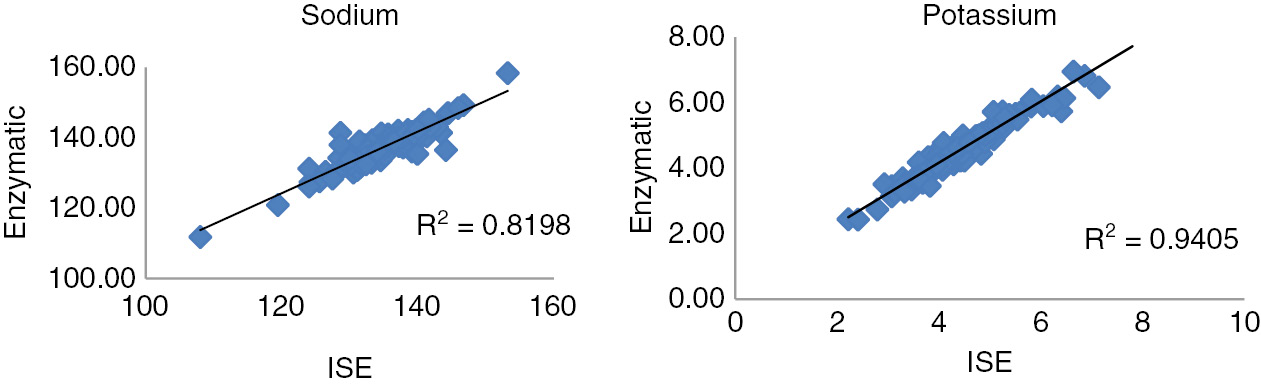
Linear regression correlation of S. Na+ and S. K+ between ISE and enzymatic method.
To determine agreement between two methods, difference between two methods were calculated (old method minus test method). The mean difference for S. Na+ concentrations in serum was found to be 2.38, standard deviation was 2.36, and similarly for S. K+ concentrations the mean difference was 0.14, standard deviation was 0.22. These values were plotted against the mean of the two measurements using Bland and Altman method. The Bland Altman plot for S. Na+ and S. K+ is illustrated in (Figures 2 and 3).
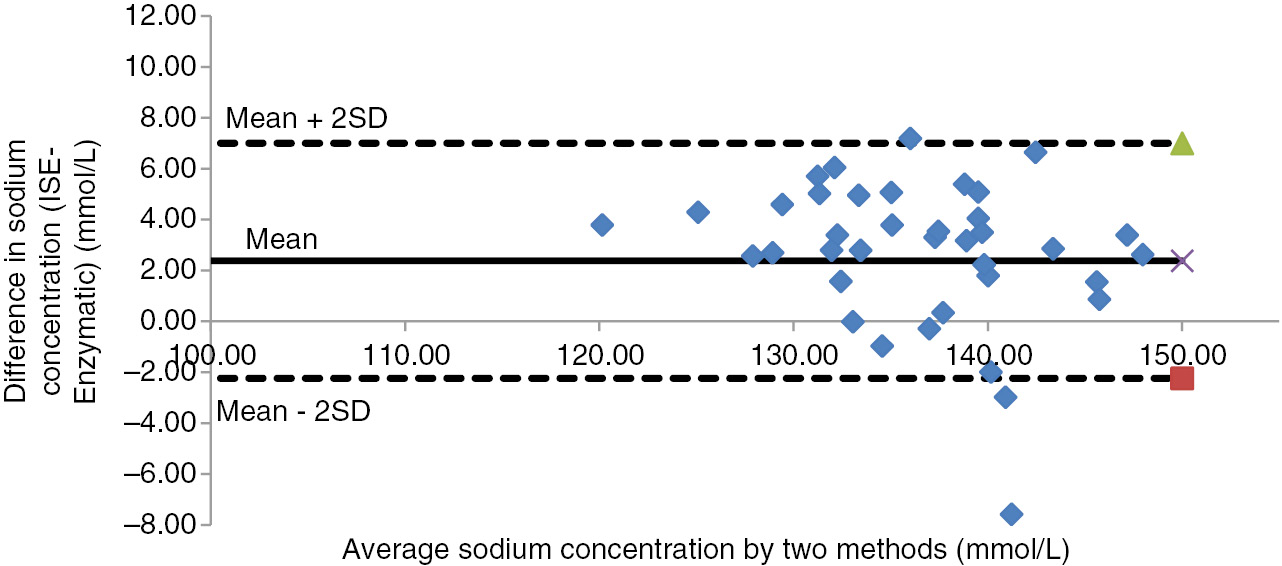
Bland Altman plot – Na+.
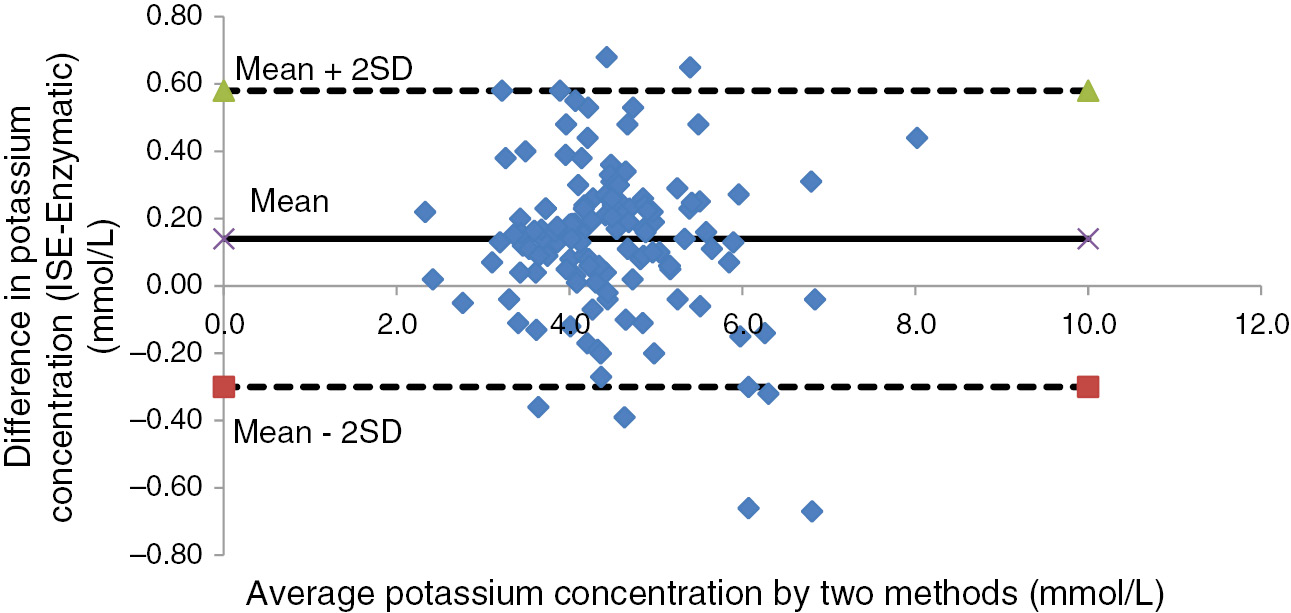
Bland Altman plot – K+.
Discussion
Beckman Coulter indirect ISE method measures the activity of ions in water is directly proportional to their concentration. ISE is the standard reference method for measurement of electrolytes in serum [5]. It uses elective membrane for specific ions. Moreover it is not interfered by colour of the sample. Despite good accuracy and precision, its maintenance including cost of electrodes, tubing, cleanser etc. becomes expensive especially for a laboratory setup with low to medium sample workload. This has led to the search of a relatively less expensive yet reliable electro-photometric technique. Over the last few years, modified enzymatic method has been introduced into the clinical market for testing electrolytes in fully automated biochemistry analyzer. This technique has claimed to improve patient care by simple, rapid, low cost and fully automated user interface.
Hence in present study we tried to compare new method with traditional ISE method which may be useful for small laboratories. Documentation of laboratory methods, particularly method selection, method performance and validation has assumed a new significance with the introduction of ISO/IEC 17025. Accreditation bodies like College of American Pathologists (CAP) and National Accreditation Board for Testing and Calibration Laboratories (NABL), India require that laboratories validate the performance of tests regularly [12]. Method validations is one of the essential components in achieving Total Quality Management in a new clinical laboratory. Validation ensures that accurate and precise results will be produced at laboratory level. Each laboratory is responsible for validating the new test methods being introduced in their laboratory [12]. In this study method comparison and validation was done by measuring accuracy, precision, correlation and agreement between two methods as per CLSI guidelines [9]. A significant difference was observed between the two methods for S. Na+ however there was no significant difference for S. K+ method. To validate the accuracy of newly introduced method we derived bias by calculating mean of difference between the two methods. Bias reflects the systematic error of new method and it should be within allowable range as per CLIA guidelines [13]. It was considered as within-day run so we took allowable limit for acceptance of bias was CLIA/3 to make study more accurate. So in our study bias for S. Na+ and S. K+ were 2.38 mmol/L and 0.14 mmol/L, respectively which were acceptable for potassium but higher for sodium as per guideline.
For precision, coefficient of variance (CV%) was calculated by running the same sample for 20 times. CV is used as an indicator of random error of a particular method [14]. Both parameters showed CV<3%, indicating good precision of test method for both parameters.
To compare correlation between old and new method, the degree of linear correlation of variables was determined by coefficient of correlation. The correlation coefficients close to 1 indicates good correlation between two methods. In our method validation study for S. Na+ and S. K+, r2 observed was 0.81 and 0.94, respectively indicating high degree of linear correlation for S. K+ whereas low correlation was found for S. Na+ [12]. This means potassium is correlating well with old method whereas less in sodium.
In method validation, agreement between two methods is critical part for the evaluation. Agreement analysis was evaluated by applying Bland and Altman agreement analysis as per CLSI guideline [9]. The differences observed in Bland and Altman spot for S. K+ were small, within the clinical tolerance interval and within acceptable criteria of CLIA/3 guidelines whereas non-acceptable for S. Na+ as per CLIA/3 guidelines. That concluded better agreement lie between two methods for S. K+ compared to S. Na+.
We also compared the cost effectiveness of S. Na+ and S. K+ by both the methods. If we assume medium workload (80–100 samples/day, High workload), cost per test in ISE was Rs. 18/- test whereas in enzymatic method it was approx. Rs. 16/- test. This cost of ISE would increase with decreasing laboratory workload. Hence, except very few laboratories most of the laboratories have higher cost per test than this. Moreover there is extra cost of replacement of electrode and tubing almost every year in ISE method. There is no extra cost for enzymatic method apart from its reagent cost and calibrator cost and it remained same with low to medium workload.
Conclusion
Based on the validation carried out between old and new methods in the form of Accuracy, Precision, correlation coefficient and agreement (Bland and Altman plot) for S. Na+ and S. K+, it can be concluded that the new spectrophotometric enzymatic method correlated well with the accepted ISE method for S. K+ but however more continuous monitoring is required for S. Na+. So as per now, enzymatic method can be used as a cost effective alternative to indirect ISE method for estimation of S. K+, but still it isn’t reliable for estimation of S. Na+. If we can establish this new enzymatic method as alternative method to ISE method, it can be a good cost-effective alternative for small clinical laboratories in future.
Conflict of interest: None of the authors have any conflict of interest.
References
1. Morimatsu H, Rocktäschel J, Bellomo R, Uchino S, Goldsmith D, Gutteridge G. Comparison of point-of-care versus central laboratory measurement of electrolyte concentrations on calculations of the anion gap and the strong ion difference. Anesthesiology 2003;98:1077–84.10.1097/00000542-200305000-00009Suche in Google Scholar PubMed
2. Hübl W, Wejbora R, Shafti-Keramat I, Haider A, Hajdusich P, BayerPM. Enzymatic determination of sodium, potassium, and chloride in abnormal (hemolyzed, icteric, lipemic, paraproteinemic, or uremic) serum samples compared with indirect determination with ion-selective electrodes. Clin Chem 1994;40:1528–31.10.1093/clinchem/40.8.1528Suche in Google Scholar
3. Albert V, Subramanian A, Rangarajan K, Mohan Pandey R. Agreement of two different laboratory methods used to measure electrolytes. J Lab Phys 2011;3:104–9.10.4103/0974-2727.86843Suche in Google Scholar PubMed PubMed Central
4. Nanda S, Ray L, Dinakaran A. Validation of method performance of pH, PCO2, PO2, Na+, K+ of cobas b121 ABG analyser. J Clin Diagn Res 2014;8:CC05–7.10.7860/JCDR/2014/9218.4442Suche in Google Scholar PubMed PubMed Central
5. USA: Beckman Coulter Inc; 2003. User manual Beckman coulter AU-480 page 12.Suche in Google Scholar
6. Berry MN, Mazzachi RD, Pejakovic M, Peake MJ. Enzymatic determination of sodium in serum. Clin Chem 1988;34:2295–8.10.1093/clinchem/34.11.2295Suche in Google Scholar
7. Berry MN, Mazzachi RD, Pejakovic M, Peake MJ. Enzymatic determination of potassium in serum. Clin Chem 1989;35:2295–8.10.1093/clinchem/35.5.817Suche in Google Scholar
8. Bland JM, Altman DG. Measuring agreement in method comparison studies. Stat Methods Med Res 1999;8:135–160.10.1177/096228029900800204Suche in Google Scholar PubMed
9. CLSI. Measurement procedure comparison and bias estimation using patient samples; approved guideline – 3rd ed. CLSI document EP09-A3. Wayne, PA: Clinical and Laboratory Standards Institute, 2013.Suche in Google Scholar
10. Smolcic V, BilicZulle L, Fisic E. Validation of methods performance for routine biochemistry analytes at Cobas 6000 analyzer series module c501. Biochemia Medica 2011;21:182–90.10.11613/BM.2011.028Suche in Google Scholar
11. Federal Register. CLIA proficiency testing criteria 1992;57:7002–186.Suche in Google Scholar
12. Barnali D. Validation protocol: first step of a lean-total quality management principle in a new laboratory set-up in a tertiary care hospital in India. Ind J Clin Biochem 2011;26:235–43.10.1007/s12291-011-0110-xSuche in Google Scholar PubMed PubMed Central
13. Westgard JO, Darcy T. The truth about quality: medical usefulness and analytical reliability of laboratory tests. Clin Chim Acta 2004;346:3–11.10.1016/j.cccn.2003.12.034Suche in Google Scholar PubMed
14. Westgard JO, Seehafer JJ, Barry PL. Allowable imprecision for laboratory tests based on clinical and analytical test outcome criteria. Clin Chem 1994;40:1909–14.10.1093/clinchem/40.10.1909Suche in Google Scholar
©2019 Walter de Gruyter GmbH, Berlin/Boston
Artikel in diesem Heft
- Frontmatter
- Research Articles
- Investigating the impact of polysomy 17 in breast cancer patients with HER2 amplification through meta-analysis
- Diagnostic performance of microRNAs in the circulation in differential diagnosis of BPH, chronic prostatitis and prostate cancer
- Enhanced anticancer effect of cetuximab combined with stabilized silver ion solution in EGFR-positive lung cancer cells
- CA125, YKL-40, HE-4 and Mesothelin: a new serum biomarker combination in discrimination of benign and malign epithelial ovarian tumor
- Paricalcitol pretreatment attenuates renal ischemia/reperfusion injury by inhibiting p38 MAPK and activating PI3K/Akt signaling pathways
- Identification of cytoplasmic sialidase NEU2-associated proteins by LC-MS/MS
- Investigation of tyrosinase inhibition by some 1,2,4 triazole derivative compounds: in vitro and in silico mechanisms
- Investigation of alanine, propionylcarnitine (C3) and 3-hydroxyisovalerylcarnitine (C5-OH) levels in patients with partial biotinidase deficiency
- The expression levels of miR-655-3p, miR127-5p, miR-369-3p, miR-544a in gastric cancer
- Evaluation of the JAK2 V617F gene mutation in myeloproliferative neoplasms cases: a one-center study from Eastern Anatolia
- Effects of Rituximab on JAK-STAT and NF-κB signaling pathways in acute lymphoblastic leukemia and chronic lymphocytic leukemia
- Analysis of the effect of DEK overexpression on the survival and proliferation of bone marrow stromal cells
- Serum fetuin-A levels and association with hematological parameters in chronic kidney disease and hemodialysis patients
- Investigation of relaxation times in 5-fluorouracil and human serum albumin mixtures
- Oxydative stress markers and cytokine levels in rosuvastatin-medicated hypercholesterolemia patients
- The protective effects of urapidil on lung tissue after intestinal ischemia-reperfusion injury
- Effects of SR-BI rs5888 and rs4238001 variations on hypertension
- Antioxidant and cytotoxic activity of three Turkish marine-derived fungi
- Is spectrophotometric enzymatic method a cost-effective alternative to indirect Ion Selective Electrode based method to measure electrolytes in small clinical laboratories?
- Plasma presepsin in determining gastric leaks following bariatric surgery
Artikel in diesem Heft
- Frontmatter
- Research Articles
- Investigating the impact of polysomy 17 in breast cancer patients with HER2 amplification through meta-analysis
- Diagnostic performance of microRNAs in the circulation in differential diagnosis of BPH, chronic prostatitis and prostate cancer
- Enhanced anticancer effect of cetuximab combined with stabilized silver ion solution in EGFR-positive lung cancer cells
- CA125, YKL-40, HE-4 and Mesothelin: a new serum biomarker combination in discrimination of benign and malign epithelial ovarian tumor
- Paricalcitol pretreatment attenuates renal ischemia/reperfusion injury by inhibiting p38 MAPK and activating PI3K/Akt signaling pathways
- Identification of cytoplasmic sialidase NEU2-associated proteins by LC-MS/MS
- Investigation of tyrosinase inhibition by some 1,2,4 triazole derivative compounds: in vitro and in silico mechanisms
- Investigation of alanine, propionylcarnitine (C3) and 3-hydroxyisovalerylcarnitine (C5-OH) levels in patients with partial biotinidase deficiency
- The expression levels of miR-655-3p, miR127-5p, miR-369-3p, miR-544a in gastric cancer
- Evaluation of the JAK2 V617F gene mutation in myeloproliferative neoplasms cases: a one-center study from Eastern Anatolia
- Effects of Rituximab on JAK-STAT and NF-κB signaling pathways in acute lymphoblastic leukemia and chronic lymphocytic leukemia
- Analysis of the effect of DEK overexpression on the survival and proliferation of bone marrow stromal cells
- Serum fetuin-A levels and association with hematological parameters in chronic kidney disease and hemodialysis patients
- Investigation of relaxation times in 5-fluorouracil and human serum albumin mixtures
- Oxydative stress markers and cytokine levels in rosuvastatin-medicated hypercholesterolemia patients
- The protective effects of urapidil on lung tissue after intestinal ischemia-reperfusion injury
- Effects of SR-BI rs5888 and rs4238001 variations on hypertension
- Antioxidant and cytotoxic activity of three Turkish marine-derived fungi
- Is spectrophotometric enzymatic method a cost-effective alternative to indirect Ion Selective Electrode based method to measure electrolytes in small clinical laboratories?
- Plasma presepsin in determining gastric leaks following bariatric surgery
