A Glimpse at Raw Material Economy and Production of Chipped Stones at the Neolithic (Starčevo) Site of Svinjarička Čuka, South Serbia
-
Michael Brandl
 ,
Bogdana Milić
,
Bogdana Milić

Abstract
In this contribution, we present new data from the multi-layered Starčevo site of Svinjarička Čuka in southern Serbia, highlighting its key role in reconstructing processes involved in the dispersal of the Neolithic way of life from Anatolia into Central Europe from the perspective of the chipped stone assemblage. This case study explores factors such as deliberate choices of raw material procurement and the occasional resilience to innovations shaped by local traditions resulting from the ease of access to specific resources versus openness to interconnectivity on a local, regional, and supra-regional scale. In-depth raw material and technological analyses of the chipped stone assemblage from Svinjarička Čuka, which were recovered from three out of altogether six Starčevo occupation phases dating to the middle of the sixth millennium calBC, provide insights into the development of early Neolithic resource management and socio-cultural and economic behavior. The results of our study can be regarded as a reflection of key mechanisms involved in the Neolithization of the central Balkans.
1 Introduction
This study was conducted within the framework of a collaborative effort between the Austrian Archaeological Institute of the Austrian Academy of Sciences (Vienna) and the independent Institute of Archaeology (Belgrade), striving to investigate all aspects relating to Neolithization processes within the central Balkans, the NEOTECH project. The Neolithization process commenced approximately between 6200 and 6000 BC in the Balkan region (e.g. Gronenborn et al., 2021; Haak et al., 2015; Hofmanová et al., 2016; Krauß et al., 2017; Marchi et al., 2022; Shennan, 2018; Stefanović et al., 2020; Whittle et al., 2002), marked by distinct regional patterns observed at notable sites such as Starčevo, Karanovo, and Amzabegovo (Garašanin, 1979; Gimbutas, 1976; Horejs et al., 2022, p. 257; Manson, 2008; Milojčić, 1950; Naumov, 2015; Nikolov, 2007; Pavúk, 2014; Perić, 2001; Porčić et al., 2020a). Although ancient DNA and archaeological research have provided overarching insights into the general trajectories of Neolithization, our comprehension of the intricate social, cultural, and economic processes guiding these developments is still in its incipient stage (e.g., Mathieson et al., 2018; Porčić et al., 2020b; Vitezović, 2023).
Strategically located along one of the primary communication routes following the Axios–Vardar–Morava Rivers connecting the Aegean and Central Europe at a location rich in siliceous raw materials useful for chipped stone production, the site of Svinjarička Čuka in southern Serbia has been the focus of this endeavor and has been under excavation since 2018 (Figure 1). This multi-layered Neolithic site holds particular importance due to the wealth of archaeological data that has been collected thus far, shedding light on the complex socio-economic dynamics that shaped this transformative period during which important changes took place (Dietrich et al., 2022; Horejs et al., 2019, 2022, 2025).

Location of Svinjarička Čuka in relation to other Early Neolithic settlements in the south Balkan region. Graphic: M. Börner, OeAI/OeAW.
The present study offers an initial overview of the lithic assemblage from Svinjarička Čuka, focusing on identifying broader trends in lithic raw material economy rather than offering a comprehensive technological analysis. Its primary objective is to explore the relationship between chipped stone production and the lithic raw materials employed by the Neolithic community. A more detailed technological study is currently in preparation and will follow in due course. Given this scope, the analytical framework and recording system (Figure 4) have been adapted to address specific questions concerning raw material procurement and use strategies.
The scope of this paper is not to document all technological attributes in full detail but to contextualize and place lithic production within broader patterns of resource management. This investigation concentrates on a relatively brief yet informative segment of the site’s overall occupation sequence, more precisely, the most recent part of the Starčevo horizon. Although temporally limited, this phase yields valuable insights into economic behavior related to lithic raw material exploitation. The findings presented here are considered preliminary and will serve as a foundation for comparative analysis once the full excavation sequence is completed. For the present study, two occupation phases were selected for detailed examination due to the availability of the most robust datasets. Earlier Starčevo occupation phases remain only partially excavated and are expected to provide additional information as the project progresses.
At Svinjarička Čuka, 5,379 chipped stone tools, with a total weight of just over 72 kg, have so far been recorded from six occupation phases dating between 6100 and 5500 cal BC. (Horejs et al., 2025, p. 1). Excavations were conducted using a systematic grid and unit system, and all excavated sediment was subjected to dry sieving. Additionally, flotation samples were taken from every unit, with complete flotation of all sediment from closed contexts and subsequent sorting of the heavy fraction (Horejs et al., 2019, p. 179). Archaeological features such as hearth installations and stone and burnt daub accumulations were defined as “complexes” when it became apparent that they structurally belonged together (e.g., house structures; Horejs et al., 2025, p. 5, Figure 4). The majority of all lithics was recovered from filling and leveling horizons, also containing chronologically mixed materials in the upper levels. Only those coming from secured archaeological contexts, attributed to the latest Starčevo phases from the site, NEO 1-3, dating to the middle of the 6th millennium cal. BCE, were used for this study. Secured contexts are defined as using horizons (UH) and stratigraphic units (SU) undisturbed by later intrusions, allowing for unambiguous assessments regarding the material culture. Based on these criteria, 2,189 lithics were selected for in-depth analyses from six stratigraphically distinct occupation phases dating to the Starčevo period identified at the end of the 2023 fieldwork season from two excavation trenches, S1 and N1, of which selected features of the phases NEO 1, NEO 2, and NEO 3 will be discussed in detail, which have already been published with their stratigraphy, styles of deposits, and radiocarbon dates (Horejs et al., 2022, pp. 266 Table 1 and 267, Figure 10).
From the most recent Neolithic phase, NEO 1 (for the dates, refer to Figure 2), a domestic structure comprising stamped clay floors associated with a rich accumulation of various artifacts (pottery, bones, and lithics) was identified and interpreted as a collapsed building best described as a hut. Several using horizons are associated with this “Starčevo hut,” which covers an inside space of ca. 2 m × 3 m. These using horizons extend also outside of the building. Radiocarbon data revealed an age of approximately 5500 cal BC for these late Starčevo features (Figure 2). NEO 2 is a large pit close to the hut feature at the bottom of which two using horizons (“floors”) were discovered, which are also included in this discussion. Chronologically, it is situated very close to the phase NEO 1, which is why we generally refer to the two main phases under discussion for the current study; however, we display the lithic assemblages individually for a better overview.

Secured Neolithic archaeological contexts at Svinjarička Cuka from the different occupation phases NEO 1/NEO 2 and NEO 3 selected for detailed lithic analyses. Graphic: M. Brandl, OeAI/OeAW.
The occupation phase NEO 3 yielded radiocarbon dates calibrated to 5600 cal BC (Horejs et al., 2022, pp. 26–268) and produced lithic artifacts suitable for further technological and raw material analyses. The archaeological features represent an extensively utilized domestic structure approximately covering an area of at least 7.50 m by 4.30 m and interpreted as the remains of a “Starčevo house,” revealing several using horizons with particular installations such as a hearth, a platform, and storage pits, and evidence of repeated phases of restoration (Horejs et al., 2022) (Figure 2).
2 Materials and Methods
The dominating raw material type found within the chipped stone assemblage from Svinjarička Čuka is Neogene chert formed under lacustrine (i.e., freshwater) conditions.
The site and geological study area are located within the Neogene Niš-Dobrič and Leskovac Basin complexes and positioned between the Carpatho–Balkanides to the east and the Serbo-Macedonian Massif to the west and south. These basins, shaped by complex Neoalpine tectonics, were sites of significant subsidence from the Ottnangian–Carpathian through the Late Pleistocene. During the Early to Middle Miocene, the Serbian Lake System developed across this region, initiating lacustrine sedimentation. Within this setting, prolonged volcanic and hydrothermal activity in the broader catchment led to the silicification of freshwater limestones, resulting in the formation of Neogene Lacustrine Silicites (NLS; Brandl & Hauzenberger, 2018, p. 59). These cryptocrystalline silica deposits, including hydrothermally formed chalcedonies and jaspers, are found in residual deposits along basin margins and within alluvial fills (Dimitrijević, 1997; Obradović & Goričan, 1988; Pavlović et al., 2012, pp. 349‒350; Sant et al., 2017). Based on this geological information, we systematically surveyed the catchment area of the site for suitable lithic raw material deposits (Figure 3).

Secondary and residual deposits (black dots) of lithic raw materials for chipped stone production in the vicinity of S. Čuka. Adapted from the Geological Institute Beograd 1969, Leskovac 1:100.000. Graphic: M. Brandl, OeAI/OeAW.
The terminology employed in our study adheres to the classification system introduced by Brandl (2014) and Brandl and Hauzenberger (2018). However, different definitions for these raw material varieties exist in the archaeological literature, especially in Eastern European countries, where terms like “limnic quartzite” or “hydroquartzite” are used, implying an origin from freshwater environments (i.e., limnic/lacustrine). However, this terminology can be misleading, as the term “quartzite” traditionally applies exclusively to clastic (ortho-) or metamorphic (metaquartzite) rocks. A more neutral classification suggestion is to use the term “perivolcanic limnic silcrete” (silcrete being silica-cemented sediment). Given that this specific sedimentary siliceous rock type frequently contains microfossil inclusions, it can also be classified as “silicite.” To encompass these materials, particularly of Neogene age, the proposed inclusive term is “Neogene Lacustrine Silicites” (NLS). They can be further subdivided into clearly fossiliferous types and NLS with heavily dissolved fossil inclusions or entirely lacking fossils (e.g., Biró 2010; Brandl & Hauzenberger 2018, pp. 56–57; Přichystal 2010, p. 178; Ullyott et al., 2004).
For lithic raw material analysis, stereomicroscopic microfacies analysis was employed. This is a versatile technique applicable to all organogenic lithic materials, focusing on identifying characteristics such as microstructure – comprising size, shape, and spatial arrangement of rock-building components – and bioclasts as well as inorganic inclusions. Combined, the results of the microscopic examination reveal crucial information regarding specific formation environments, i.e., the microfacies, of siliceous rocks. Using this information helps narrow down the potential source region of the materials.
The main goal of the study was a clear identification and preliminary assessment of the potential origin of particular elements within Svinjarička Čuka’s lithic assemblage. At this stage of the project, it was sufficient to investigate every individual lithic find via stereomicroscopic microfacies analysis to identify the main raw material types and achieve a differentiation between local and non-local resources for litho-economic considerations.
Once the geological origin (i.e., in this case, local versus non-local) of the raw materials used for chipped stone production was established, technological analyses were performed as the second component of the investigation of the lithic economy. Technological investigations follow the chaîne opératoire concept to capture the full sequence of production stages from the raw, unworked nodule to the finished (and discarded) end products. The entire assemblage was recorded using a standardized system specifically designed for the lithic assemblage under investigation, as illustrated in Figure 4.

Recording system for assessing the main categories of the lithic assemblage. Graphic: M. Brandl, OeAI/OeAW.
Beyond the general technological classification applied to the entire assemblage (as presented in the figure above) primarily used in this paper, a more detailed technological characterization was conducted on a selected sample, focusing on five main categories within the core reduction sequence: cores, core preparation and rejuvenation elements, blades,[1] flakes,[2] and debris[3] (mainly used from the methodology developed in Milić, 2018). Characteristic features on cores and blanks (flakes and blades) were used to assess particular knapping techniques, such as direct hard or soft percussion, indirect percussion or punch technique, and finally pressure flaking. The examination of secondary modifications of blanks involves a comprehensive exploration of retouch patterns, including their position and type, and traces of use, studied at both macroscopic and microscopic levels. Targeted analysis in this paper therefore aimed to highlight principal technological tendencies within specific phases and was not intended to represent the full assemblage. A broader, statistically supported technological study will be addressed in a separate publication.
3 Results
Based on systematic geo-archaeological surveys and a geochemical pilot study (Brandl & Hauzenberger, 2018), it was possible to securely identify the local components of the lithic assemblage and distinguish it from the certainly non-local elements. In this regard, we will discuss the results of our study through two analytical lenses: a general overviewing perspective and the viewpoint of in-depth investigations using only specific components, which allow for further interpretations.
3.1 The Complete Assemblage – An Overview
Although we will only use selected elements of the assemblage from Svinjarička Čuka for detailed raw material and technological assessments, all lithics from the site pre-dating the Bronze Age, regardless of the specific context, were recorded. A brief overview is provided here to demonstrate the overall composition of the lithic industry, especially signifying the relation between particular raw material types with different origins and tool categories.
As shown in Figure 5, the assemblage is dominated by local materials, above all chert (NLS), which is available directly at the archaeological site and the immediate catchment area (Figures 3 and 12–14). In fact, the site is located on a river terrace containing abundant chert cobbles. This favorable situation might have been one of the reasons for the choice of the settlement location, besides the availability of water and arable land. Quartz and jasper are the next most common materials. Both are also locally available from gravels of the Svinjarica River, on which the site is located, as well as from surface deposits in the close vicinity (within a distance between 100 m and 5 km). While quartz may have been deliberately selected to perform specific tasks due to its durability (mainly the production of flakes), the local jasper varieties are of minor quality and were probably collected in the course of the procurement of NLS. The fact that both lithic material types can be found within the same secondary and residual deposits in the close catchment area of Svinjarička Čuka also speaks in favor of this interpretation.

Raw materials and technology within the overall lithic assemblage from Neolithic Svinjarička Čuka. Graphic: M. Brandl, OeAI/OeAW.
Non-local raw materials are predominantly represented by various types of “Balkan Flint,” which include the Kriva Reka and other not yet identified varieties,[4] and are characterized by a high degree of standardization of the implements. Clear quartz is also evident in very low numbers. Obsidian was also identified in the assemblage, so far only in the later phases of the occupation. It is represented by one bladelet proximal fragment, two micro-blades, and a mini debitage. Based on color and translucency, a Carpathian source is likely, although this still requires confirmation through pXRF analysis. Furthermore, less common chert varieties of yet undetermined origin, which are not part of the local chert types found in the deposits within a radius of ca. 20 km around the site, are also present. Indeterminable pieces, mainly due to heavy fire influence,[5] do occur; however, they are not very frequent.
The dominant knapping technique in the assemblage is hard direct percussion, applied to cores with minimal or no platform preparation. Hard stone percussion is also evident from the typical features observed on the ventral sides of blanks, both flakes and blades. However, based on the technological attributes observed in the blade and bladelet assemblage from various early to late Starčevo occupation phases, it is clear that multiple techniques were employed, including soft direct percussion and indirect percussion (punch technique). Pressure blade making may also have been used, although its presence and origin, whether local or introduced, remain to be confirmed. Overall, the assemblage reflects a predominantly flake-based technology; however, although the number of blades seems disproportionately low, the ratio of modified blades and flakes appears to be roughly equivalent (Figure 5). This trend, however, applies only to the general comparison and differs significantly across particular raw material categories. For example, Balkan Flint is almost exclusively used for blades. These include glossed pieces, the majority of which are sickle implements used in cereal harvesting, as well as laterally retouched blades, often showing signs of resharpening, and occasional endscrapers on blades. In contrast, the high amount of local raw materials, for which all stages of the reduction process from decortification flakes to finished and discarded products are present, clearly attests to chipped stone tool production on-site. Many blanks, especially flakes, seem to have been used in a highly opportunistic manner, while the number of retouched tools such as endscrapers, truncated pieces, or pieces with a regular lateral are relatively scarce (Figure 5).
3.2 The Later Starčevo Assemblage (5600–5500 cal BC)
As initially outlined, altogether six Neolithic occupation phases were recognized at Svinjarička Čuka, spanning a sequence between 6100 and 5500 cal BC and representing different subphases associated with Starčevo horizons, which were stratigraphically analyzed and radiocarbon dated. However, only the phases NEO 1 and NEO 3 are fully excavated and analyzed, which is the reason why our in-depth lithic analysis will only focus on the assemblages from these two contexts and discuss the findings based on this chronological division from a diachronic perspective.
An overview of all lithic raw materials determined within Starčevo phases NEO 1/NEO 2 and NEO 3 is provided in Figure 6. As indicated in the general overview at the beginning of this section, local Neogene chert (NLS) remains the predominant identified raw material type. The other two local elements – quartz and jasper – follow the same pattern as observed for the overall collection. A clear difference when compared to the full assemblage is the significantly lower number of Balkan Flint artifacts. This is the result of the nature of the selected archaeological contexts we analyzed, since most BF specimens are contained in mixed layers. The number of burnt lithics is also very low (Figure 6).

All lithic raw materials from Starčevo phases NEO 1 – NEO 3 determined within the assemblage. Graphic: M. Brandl, OeAI/OeAW.
The proportional distribution of all raw materials from the selected contexts of NEO 1/NEO 2 and NEO 3 is visualized in Figure 7 and normalized to 100%.

Diachronic overview of the lithic raw material distribution in the analyzed Starčevo contexts. Graphic: M. Brandl, OeAI/OeAW.
Delving deeper into the individual contexts we investigated (i.e., only using horizons and undisturbed stratigraphic units), it becomes apparent that the feature interpreted as a hut dating to the late Starčevo phase NEO 1 (ca. 5500 cal BC) produced 666 lithic artifacts, while the Starčevo house of phase NEO 3 belonging to an older occupation stage (ca. 5600 cal BC) contained over 800 specimens (Figure 8a and b). This, however, is simply an effect of the size of these buildings and their intensity of use and does not indicate a change in the lithic economic behavior of the inhabitants. The distribution pattern of all raw material varieties in both phases follows the general trends that are visible from these domestic as well as outside (open space) areas.

(a) Detailed analytical results from phases NEO 1 and NEO 2. Graphic: M. Brandl, OeAI/OeAW. (b) Detailed analytical results from phase NEO 3. Graphic: M. Brandl, OeAI/OeAW.
Combining the lithic raw material data with the technological information, the diachronic comparison between the NEO 1/NEO 2 and NEO 3 Starčevo contexts shows a homogeneous picture of raw material use for specific tool types, indicating no major changes in raw material procurement and production (Figure 9a–c). There are, however, certain subtle but noteworthy differences.
The NEO 3 Starčevo assemblage, depicted in Figure 9c, yielded three obsidian pieces, two in the form of mini-debitage (smaller than 10 mm in length), and one micro-blade from the Starčevo house context. They were most likely linked to on-site activities and may reflect the full or supplementary reduction of introduced blanks or cores originating from long-distance exchange networks. Six Balkan flints come from the same context, with three pieces representing blade tools (two of which are shown on Figure 11: no. 11, 12), one unretouched blade, and two flakes. This indicates the potential working of rare exogenous materials within the domestic space of the site itself. While it remains to be clarified whether Balkan Flint was additionally knapped on-site beyond tool maintenance, the frequent reparation and resharpening of blades made from this material strongly suggests repeated cycles of use and reuse within the settlement after the introduction of blade blanks or initially retouched blade tools. This is visible both macroscopically and microscopically, as seen in edge modifications and the type and position of retouch, pointing to potentially specialized activities and undoubtedly the value of the material. The NEO 3 Starčevo assemblage reveals a higher diversity of chert varieties compared to the later phase (NEO 1 and NEO 2). Caution is warranted, however, as this pattern may partly reflect the overall higher number of lithics in the earlier phase.

(a) The relationship between raw materials and techno-typological categories in NEO 1. Graphic: M. Brandl, OeAI/OeAW. (b) The relationship between raw materials and techno-typological categories in NEO 2. Graphic: M. Brandl, OeAI/OeAW. (c) The relationship between raw materials and techno-typological categories in NEO 3. Graphic: M. Brandl, OeAI/OeAW.
From a technological viewpoint, no major differences were observed throughout all the assemblages retrieved from the investigated phases. The primary technological strategy of the late Starčevo assemblage of NEO 1/NEO 2 relates to the production of flakes, mainly from uncurated uni- and multidirectional cores. Hard hammer percussion is the dominating production method within this assemblage. Some cores show both blade and flake negatives, likely reflecting the final stages of blade core exploitation, where remaining volumes were used to produce small flakes – particularly when the raw material was of suitable quality. Additionally, the presence of burin-style cores, bipolar anvil cores, and some cores on flakes indicates that high-quality raw materials, which are not very common amongst the local raw material spectrum, were heavily exploited, and old pieces were recycled. This is well observed in NEO 2, for instance, particularly in the context of the Neolithic house. Blade production predominantly relies on the high-quality end of the local raw material spectrum, Balkan Flint, and yet unprovenanced non-local high-quality chert types. The few bladelets (altogether 5) were predominantly made from local chert (Figure 9c).
Both flakes and blades were modified, while bladelets show use in two cases but no retouching. The proportion of retouched blades in relation to flakes is exceedingly higher, with 52% modified tools of blades and 10% of flakes. In the late Starčevo NEO 1/NEO 2 assemblage, 56 modified tools were documented (Figure 8). Of those, lateral retouching is most commonly observed at both blade and flake blanks, only surpassed by pieces that show use traces (macroscopic edge scaling different from damage) without being previously retouched. Within the laterally retouched and used pieces, only a few display gloss (Figure 10) from use as sickle implements. This is also in line with the observation that, except for one, all of the sickle elements are blades (i.e., segmented pieces). Other retouched tool types are scarce in the assemblage and comprise only a few endscrapers, truncated and notched pieces, and rare drills.

Tool types in relation to raw materials, comparing contexts NEO 1, 2, and 3. Graphic: M. Brandl, OeAI/OeAW.
Technological traits of the NEO 3 Starčevo assemblage illustrate a basic core reduction strategy, mainly aiming at the production of flakes varying in size and shape from uni- and multidirectional cores. For this technological string, predominantly local materials, mainly NLS, were employed. Regular blade production is attested to a far lesser degree from either mixed flake-blade cores or more carefully curated and maintained small cores of high-quality raw materials of either local origin or from “Balkan Flint” sensu lato, also one particular white non-translucent chert of yet unknown origin. Both flakes and blades were targeted products, as indicated by the frequency of retouched tools from both categories. Within this generally expedient technology, hard hammer percussion represents the most common production technique, with some indications of soft hammer percussion suggested by the flake scar patterns on cores and features on the debitage.
Recycling is also attested by a number of exhausted cores (n = 15) that had often undergone rejuvenation and adjustments, despite a minimal initial preparation and the frequent occurrence of bipolar anvil cores (N = 17), often on previously used flakes and sometimes blades. Notably, in the NEO 3 house context, a range of core types has already been documented – including bladelet, mixed blade-flake, and bipolar-on-anvil cores – from both the inner and exterior areas of the house structure (Horejs et al., 2022, p. 279, Figure 27).
In the NEO 3 Starčevo horizon, 46% of all blades and 11% of all flakes were modified or used (i.e., retouched and/or display clear use-wear). Of the three bladelets, one shows traces of use, however, without retouch. Altogether, 118 used and/or modified tools are present (Figure 10). As in the later phase NEO 1, laterally retouched and unmodified used tools make up the majority of this category. Interestingly, more blade blanks were used in an unmodified state, whereas more flakes were laterally retouched. Retouched pieces bearing sickle gloss are found amongst both blades and flakes; however, only blades show gloss without being retouched before use. It appears that most were hafted obliquely; however, a few pieces also display parallel sickle gloss along one or both entire lateral edges.
The tool variety in phase NEO 3 appears more diverse than in the late Starčevo assemblages of NEO 1 and NEO 2, which again might rather be related to the type of the analyzed contexts, reflecting a larger variety of activities than those recorded in the later phase. This could also explain the larger number of lithics in NEO 3 (Figure 6). This difference is also observed in the use of local and non-local raw materials across all tool types (Figure 11). Ongoing use-wear and technological analyses are expected to further clarify these patterns and contribute to a more comprehensive understanding of technological strategies across the phases.
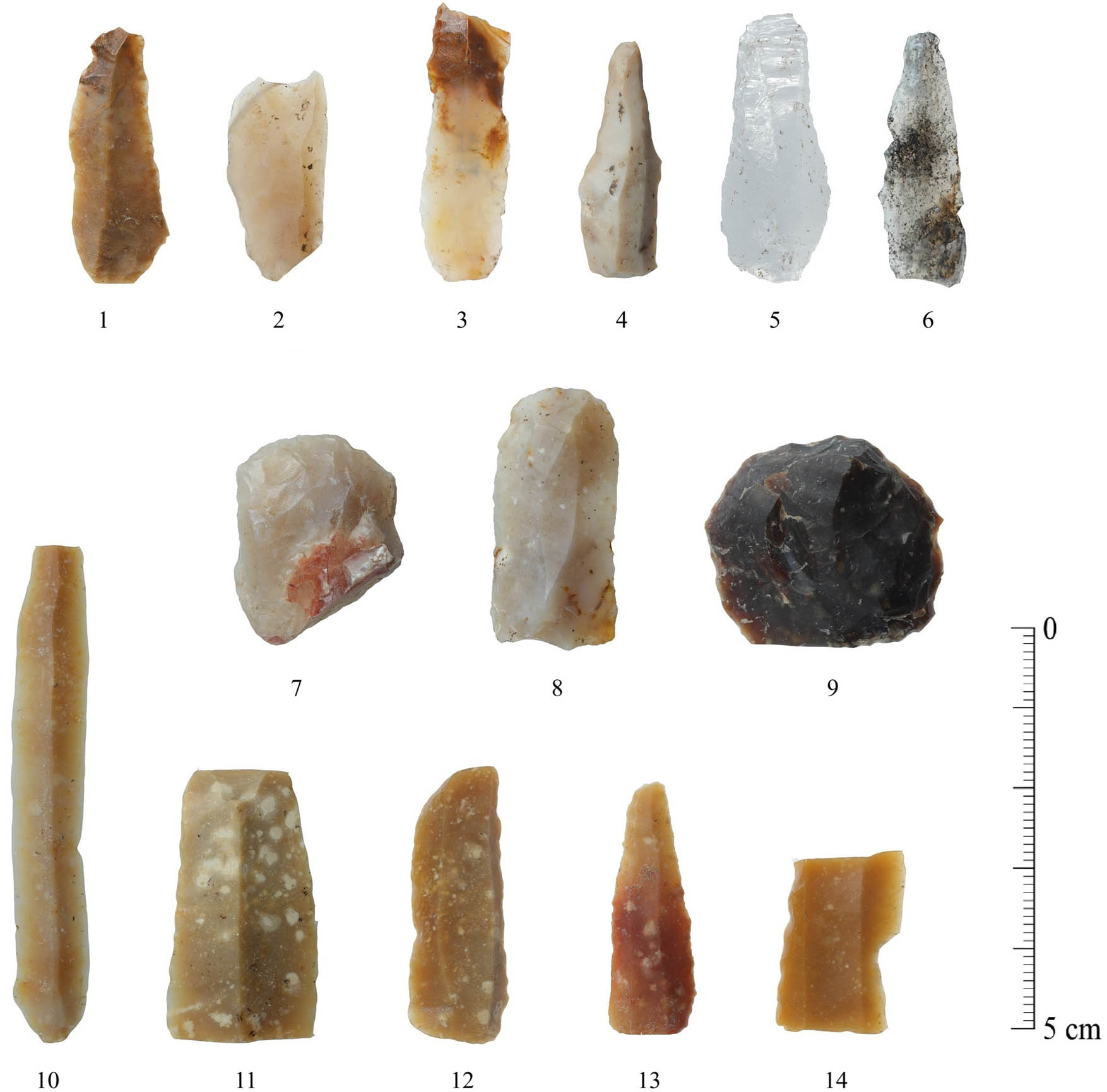
Tool type and raw material variety selection (retouched and used blanks) from the phases NEO 1 (artifacts nos. 2 and 4), NEO 2 (nos. 6, 9, 10, 13, and 14), and NEO 3 (nos. 1, 3, 5, 7, 8, 11, and 12). 1-Glossed (sickle) bladelet (NLS local); 2-laterally retouched (backed) blade (NLS local); 3-glossed (sickle) bladelet (NLS local); 4-drill (NLS prov. indet.); 5-used blade (clear quartz); 6-glossed (sickle) bladelet (NLS prov. indet.); 7-endscraper on flake (NLS local); 8-endscraper on blade (NLS local); 9-end/round-scraper (NLS local); 10-usued bladelet (Balkan Flint); 11-aterally retouched blade (Balkan Flint); 12-laterally retouched blade (Balkan Flint); 13-endscraper on blade (laterally retouched) (Balkan Flint); 14-glossed (sickle) blade (Balkan Flint). Photos: F. Ostmann – B. Milić, OeAI/OeAW.
4 Discussion and Conclusion
The results of our study show that the lithic raw material economy at Svinjarička Čuka predominantly relied on locally available resources for chipped stone tool production. This observation can be made in the overall assemblage and is equally reflected in the assemblages from selected contexts from the two chronologically distinct Starčevo occupation phases, NEO 1/NEO 2 (c. 5500 cal BC) and NEO 3 (c. 5600 cal BC; Horejs et al., 2022, p. 267). This is due to the fact that the site is situated directly on a Neogene chert outcrop with accompanying materials such as jasper and quartz, and in close proximity to further deposits carrying these raw material types. This understanding was informed by systematic geoarchaeological surveys covering an area of approximately 50 km around the site, allowing us to define the local supply zone for lithic materials. Based on previous studies, we assume that each Neolithic settlement was surrounded by a local supply zone – an area habitually exploited by its inhabitants. Drawing on site catchment analysis (Roper, 1979; Vita-Finzi et al., 1970), this zone is defined as the territory accessible for daily use. Amongst sedentary farming and herding societies, a 10-km radius, or a 2–3-h walk, depending on the terrain, has been established as a likely local exploitation zone (Allard & Denis 2021, pp. 8–10; Dubouloz et al., 2012; Jarman et al., 1982, p. 32). Resources obtained from within this area are considered “local.”
Additionally, a geochemical pilot study (Brandl & Hauzenberger, 2018) and the stereomicroscopic examination of nearly 6,000 lithic artifacts enable us to characterize the materials contained within the lithic assemblage and determine the provenance of the majority of them. This allowed a differentiation within the assemblage in “local” and “non-local” types, which is a necessary precondition for litho-economic considerations, especially regarding raw material procurement strategies. In the current contribution, our aim was to achieve the first step towards this larger goal, to present the primary dataset and first results of combined raw material and technological investigations.
Within the Neolithic assemblages analyzed, several clearly non-local chert varieties occur alongside the local raw material spectrum. Some of these varieties are of very high quality and were used exclusively for blade production. They were most likely brought to the site in a finished state, as suggested by the absence of cores and the near-complete lack of knapping debris. Among them is a white, non-translucent, high-quality chert variety of yet unknown origin. Balkan Flint also belongs to this category, for which, based on current knowledge, the most likely sources are found in northern Bulgaria (e.g., Gurova, 2008, 2012, 2016; Gurova & Nachev, 2008; Gurova et al., 2016). Of particular interest is the presence of a few pieces of obsidian, visually attributed to Carpathian sources (most likely type I). Rather than appearing as imported finished tools or blade blanks – which might be expected given the rarity of the material – these consist of a small bladelet fragment (NEO 2), micro-blades (NEO 1 and NEO 3), and a mini debitage (NEO 3). Currently, these obsidian finds can be best interpreted as potential by-products of blank recycling and waste materials (perhaps from reshaping older implements). The small size and morphology of the fragments suggest they were likely produced on site, supporting the interpretation that obsidian was a curated material, introduced in limited quantities, and worked as needed. Both obsidian and Balkan flint are widely recognized as markers of long-distance networks involved in the spread of the Neolithic way of life in the Balkans, and their presence in the Svinjarička Cuka assemblage corresponds with patterns documented in other Starčevo lithic assemblages. This is also in line with broader interpretations of obsidian and Balkan flint as indicators of long-distance exchange and identity of Neolithic societies (Barfield, 2006; Biagi & Starnini, 2010, 2013). This was also exemplified by Milić and Brandl (2024) through the analysis of a small Early Neolithic chipped stone assemblage from Bucova Pusta IV in Romania, which attests to the circulation of extra-local raw materials, including “Balkan Flint.”
Technologically, two on-site core reduction strategies can be identified within the lithic assemblage of Svinjarička Cuka, largely determined by raw material quality. Within the local raw material spectrum (Figures 12–14), two core reduction strategies appear to be present. Medium – low quality materials were typically knapped by hard direct percussion using hammerstones to reduce multi- and unidirectional flake or mixed flake-blade cores. They rarely show platform preparation, and debitage was often detached directly from the natural surface of the raw pieces, e.g., nodules. This is also evidenced by characteristic knapping features on flakes, such as wide, long, flat platforms and pronounced flake scars. Recycled old cores were often used as hammer stones. Within this category, many tested nodules, which were discarded due to the low quality of the material, occur, and the complete exhaustion of cores of low- to medium-grade local raw material is very rare. Additionally, bipolar cores knapped on an anvil occur frequently, which indicates the attempts and efforts of the local community to fully exploit flakes or knapping debris of slightly better quality.

(a) Local raw material varieties from the lithic assemblage of Svinjarička Čuka; (b) lithic raw materials (NLS) from the deposit S. Čuka is situated on. Photos: F. Ostmann – M. Brandl, OeAI/OeAW.

NLS Specimen from the lithic raw material deposit at S. Čuka with macroscopically visible remains (i.e. stems) of charophyta (freshwater algae). Photo: M. Brandl, OeAI/OeAW.

Microphotographs of lacustrine bioclasts in NLS from the catchment area of S. Čuka. Photos: M. Brandl, OeAI/OeAW.
High-quality raw materials of local origin, which only occur rarely in the deposits near the site (most of the material is of medium to poor quality), are typically worked more carefully, also into multi- and unidirectional flake or mixed flake-blade cores. However, in contrast to those of medium-low raw material quality, they display prepared knapping platforms achieved through rubbing, chipping, rejuvenation, and surface corrections. They were likely exploited using a combination of hard hammer and soft direct or indirect percussion using antler billets, as suggested by characteristic features on cores (e.g., striking angle, type of flake scars) and debitage (striking platform remains, bulbs of percussion, and ripples). Such cores were exploited to a high degree and discarded in a much smaller state than those of medium–low quality. At present, there is no secure evidence for the local production of the pressure technique for blade making. Moreover, further investigations are needed to clarify the role of indirect percussion in blade production at Svinjarička Čuka, particularly in comparison to the predominant use of direct percussion. Although flakes make up the vast majority of all lithics in the assemblage, modified tools are generally scarce, and the tool variety appears to be limited. The most frequent types are laterally retouched flakes and blades as well as endscrapers, representing the most frequent types. Sickle implements are present as both blades and flakes, sometimes retouched and in some cases used as simple unmodified blanks.
Non-local materials appear to have been brought to the site primarily as finished or half-finished products, as evidenced by the absence of cores and significant quantities of waste material from, for example, Balkan flint or obsidian. There is, however, evidence of reworking of these materials as noted above. Other chert types of yet unknown provenance are in most cases too uncharacteristic (i.e., simple flakes and rarely unretouched blade products) and too scarce to allow secure technological assessments (Figure 10).
Published data enable the contextualization of our results within the broader framework of the Starčevo phenomenon. The 14C results obtained from the analyzed contexts (Horejs et al., 2022, p. 267) indicate that the lithic assemblage from Svinjarička Čuka is best comparable to sites dating to advanced phases of the Starčevo horizon, among which are Blagotin, Šalitrena pećina, and Donja Branjevina (Starčevo II), as well as Ušće Kameničkog potoka and Knjepište (Starčevo III) (Bogosavljević Petrović & Starović, 2016; Šarić, 2005, 2006, 2014).
From a diachronic perspective of the entire Starčevo horizon, i.e., between ca. 6100 and 5500 BC (Horejs et al., 2025, p. 1), lithic studies unveil a discernible trend. From the earliest to the latest phases, there is a general decrease in unretouched flakes, accompanied by a corresponding increase in diverse retouched tool types. Although the quality of tool manufacture appears to improve, the fundamental characteristics of debitage production remain relatively constant throughout the various stages of the Starčevo horizon. According to Šarić, “typical” Starčevo chipped stone tool assemblages are characterized by blades that were sometimes retouched and sometimes used as simple blanks, geometric microliths, and other tool types like scrapers, sidescrapers, perforators, and burin-like tools. A distinctive feature of Starčevo lithic industries is the presence of long, regular blades, predominantly produced using the pressure technique (Šarić, 2014, pp. 184–186). This has been interpreted as an indication of advanced developments in agricultural practices, particularly the increased demand for standardized sickle blades (Šarić, 2014, p. 186). However, not all Starčevo assemblages are blade-dominated. Examples such as Ušće Kameničkog potoka and Knjepište, both assigned to a late phase of this cultural horizon according to Šarić (2005, 2006, 2014), diverge from this pattern. Such local variations have been interpreted based on the idea that certain sites may not have prioritized agriculture to the same extent as others (e.g., Blagotin). This could be attributed to specialization in specific goods production or an unfavorable settlement location (Šarić, 2006, p. 18; 2014, p. 186).
The Starčevo chipped stone assemblage from Svinjarička Cuka’s is clearly dominated by a flake-based technology (44% of the entire assemblage) with a smaller emphasis on blade and bladelet production (8% of the assemblage), mainly relying on locally available resources. Exogenous materials such as Balkan Flint, however, demonstrate the targeted procurement of specific implements, predominantly blade products, through the wider networks the site was integrated into. The relative scarcity of sickle blades – 52 retouched and unretouched specimens in the overall assemblage and 13 in the contexts selected for in-depth analysis – together with the general paucity of modified tool types, appears to contrast with published results from other comparable sites. However, it has to be considered that Svinjarička Cuka is located directly on a rich source of lithic raw materials, which could be extensively worked in a more opportunistic manner than at sites without direct raw material access. If access to raw materials was uncertain and procurement difficult, communities were compelled to apply more rigorous criteria in selecting materials, which had to be obtained either directly from more distant sources or through social networks. This circumstance, on the other hand, may have resulted in what appears to be resilient behavior at Svinjarička Cuka regarding the local raw material economy. However, the community was at the same time well integrated into the wider procurement networks, providing “prestigious” materials such as Balkan flint and obsidian, which demonstrates that Svinjarička Cuka’s inhabitants were not that entirely resistant to innovation in the lithic economy as it may appear, but open to interconnectivity despite their obvious ability to self-supply with resources technologically satisfying all their needs. This, again, places the site well into the overall idea of the Starčevo phenomenon.
Acknowledgments
This research has been conducted within the framework of the NEOTECH project – Neolithic technological trajectories in the Balkans (Project P32096), funded by the Austrian Science Fund (FWF). We are grateful to all excavation participants for their contributions and commitment throughout the fieldwork, which made this study possible. We extend our gratitude to Dragana Perovanović for her dedicated work in heavy fraction sorting, which significantly contributed to the identification of micro-specimens. Special thanks go to our collaboration partners, Vladimir Stevanović from the National Museum Leskovac, as well as Aleksandar Bulatović and Ognjen Mladenović from the Institute of Archaeology, Belgrade, for their continued support in our studies.
-
Funding information: This study was conducted within the framework of the NEOTECH project (Project P32096), funded by the Austrian Science Fund (FWF). The funding body had no role in the study design, data collection, analysis, or interpretation, nor in the writing of this manuscript or the decision to submit it for publication.
-
Author contributions: All authors have accepted responsibility for the entire content of this manuscript and approved its submission. M.B. conducted the raw material and overall technological analyses, conceptualized the paper, and wrote the majority of the manuscript. B.M. carried out the detailed technological study of selected contexts and contributed to draft editing. B.H., Principal Investigator of the NEOTECH project and excavation director of the site of Svinjarička Čuka, provided the site’s stratigraphy and dating and revised the manuscript accordingly.
-
Conflict of interest: The authors declare no conflicts of interest.
-
Data availability statement: The data supporting this study are available from the corresponding author upon reasonable request.
References
Allard, P., & Denis, S. (2021). Lithic industries, territory and mobility in the western Linear Pottery Culture. Journal of Lithic Studies, 8(1), 1–24. doi: 10.2218/jls.4444.Suche in Google Scholar
Barfield, L. (2006). Lithics, culture and ethnic identity. Lithics, 25, 65–77.Suche in Google Scholar
Biagi, P., & Starnini, E. (2010). The Early Neolithic chipped stone assemblages of the Carpathian Basin: Typology and raw material circulation. In Neolithization of the Carpathian Basin: Northernmost distribution of the Starčevo/Körös culture (pp. 119–136).Suche in Google Scholar
Biagi, P., & Starnini, E. (2013). Pre-Balkan platform flint in the Early Neolithic sites of the Carpathian Basin: Its occurrence and significance. In A. Anders & G. Kulcsár (Eds.), Moments in time. Papers presented to Pál Raczky on his 60th birthday (pp. 47–60). Prehistoric Society, Eötvös Loránd University, L’Harmattan.Suche in Google Scholar
Biró, K. (2010). Terminological practice for siliceous rocks in Hungary from petroarchaeological point of view. Archeometriai Műhely, 2010(3), 195–202.Suche in Google Scholar
Bogosavljević Petrović, V., & Starović, A. (2016). The context of the early Neolithic in Serbia: Hidden reflections of Mesolithic continuity? Glasnik Srpskog Arheološkog Društva, 32, 7–50.Suche in Google Scholar
Brandl, M. (2014). Genesis, provenance and classification of rocks within the chert group in Central Europe. Archaeologia Austriaca, 97–98, 33–58. doi: 10.1553/archaeologia97-98s33.Suche in Google Scholar
Brandl, M., & Hauzenberger, C. (2018). Geochemical sourcing of lithic raw materials from secondary deposits in south Serbia: Implications for early Neolithic resource management strategies. Archaeologia Austriaca, 102, 55–70.10.1553/archaeologia102s55Suche in Google Scholar
Dietrich, L., Brandl, M., & Horejs, B. (2022). Neolithic grinding practices at Svinjarička Čuka, Serbia. Studia Praehistorica, 16, 93–116.Suche in Google Scholar
Dimitrijević, M. D. (1997). Geology of Yugoslavia. Geological Institute GEMINI, Special Publications, Monograph 1.Suche in Google Scholar
Dubouloz, G., Chartier, M., Hachem, L., & Ilett, M. (2012). Interdépendance et cohésion des différents niveaux de territorialité au Néolithique Rubané en Bassin parisien. In V. Carpentier & C. Marcigny (Eds.), Des Hommes aux Champs (pp. 21–32). Presses Universitaires de Rennes.Suche in Google Scholar
Garašanin, M. (1979). Centralnobalkanska zona. In A. Benac (Ed.), Praistorija Jugoslavenskih Zemalja, Tom II. Vol. 2 (pp. 79–212). Sarajevo: Svjetlost.Suche in Google Scholar
Gimbutas, M. (1976). Neolithic Macedonia as Reflected by Excavations at Anza, southeast Yugoslavia. Los Angeles (UCLA): Archaeology at the University of California.Suche in Google Scholar
Gronenborn, D., Horejs, B., Börner, M., & Ober, M. (2021). Expansion of farming in western Eurasia, 9600–4000 Cal BC (Update Version 2021.2). doi: 10.5281/zenodo.5903164.Suche in Google Scholar
Gurova, M. (2008). Towards an understanding of early Neolithic populations: A flint perspective from Bulgaria. Documenta Praehistorica, 35, 111–129.Suche in Google Scholar
Gurova, M. (2012). Balkan flint: Fiction and/or trajectory to Neolithization? Evidence from Bulgaria. Bulgarian e-Journal of Archaeology/Бългapcкo e-Cпиcaниe зa Apxeoлoгия, 2(1), 15–49. http://be-ja.org/index.php/Be-JA/article/view/56/45.Suche in Google Scholar
Gurova, M. (2016). Chipped-stone assemblages from the prehistoric site of Drenovac (Serbia). In S. Perić (Ed.), The Neolithic in the Middle Morava Valley (pp. 29–58). Belgrade, Regional Museum, Paraćin: Institute of Archaeology.Suche in Google Scholar
Gurova, M., Andreeva, P., Stefanova, E., Stefanov, Y., Kočić, M., & Borić, D. (2016). Flint raw material transfers in the prehistoric Lower Danube Basin: An integrated analytical approach. Journal of Archaeological Science: Reports, 5, 422–441.10.1016/j.jasrep.2015.12.014Suche in Google Scholar
Gurova, M., & Nachev, C. (2008). Formal early Neolithic flint toolkits: Archaeological and sedimentological aspects. In R. I. Kostov, B. Gaydarska, & M. Gurova (Eds.), Geoarchaeology and Archaeomineralogy: Proceedings of the International Conference, Sofia, October 29–30, 2008 (pp. 29–35). Publishing House “St. Ivan Rilski.”10.4312/dp.35.8Suche in Google Scholar
Haak, W., Lazaridis, I., Patterson, N., Rohland, N., Mallick, S., Llamas, B., Brandt, G., Nordenfelt, S., Harney, E., Stewardson, K., & Fu, Q. (2015). Massive migration from the steppe was a source for Indo-European languages in Europe. Nature, 522(7555), 207–211. doi: 10.1038/nature14317.Suche in Google Scholar
Hofmanová, Z., Kreutzer, S., Hellenthal, G., Sell, C., Diekmann, Y., Díez-del-Molino, D., Van Dorp, L., López, S., Kousathanas, A., Link, V., & Kirsanow, K. (2016). Early farmers from across Europe directly descended from Neolithic Aegeans. Proceedings of the National Academy of Sciences, 113(25), 6886–6891. doi: 10.1073/pnas.1523951113.Suche in Google Scholar
Horejs, B., Bulatović, A., Brandl, M., Dietrich, L., Milić, M., Mladenović, O., Waltenberger, L., & Webster, L. (2025). Fresh light on Balkan prehistory: Highlights from Svinjarička Čuka (Serbia). Antiquity, 99(406), e29. doi: 10.15184/aqy.2025.34.Suche in Google Scholar
Horejs, B., Bulatović, A., Bulatović, J., Brandl, M., Burke, C., Filipović, D., & Milić, B. (2019). New insights into the later stage of the Neolithisation process of the central Balkans: First excavations at Svinjarička Čuka, 2018. Archaeologia Austriaca, 103, 175–226.10.1553/0x003b1247Suche in Google Scholar
Horejs, B., Bulatović, A., Bulatović, J., Burke, C., Brandl, M., Dietrich, L., Filipović, D., Milić, B., Mladenović, O., Schinnerl, N., Schroedter, T. M., & Webster, L. (2022). New multi-disciplinary data from the Neolithic in Serbia: The 2019 and 2021 excavations at Svinjarička Čuka. Archaeologia Austriaca, 106, 255–317.10.1553/archaeologia106s255Suche in Google Scholar
Jarman, M. R., Nailey, G. N., & Jarman, H. N. (Eds.). (1982). Early European agriculture: Its foundation and development. Written in honour of Eric Higgs (Vol. 3). Cambridge University Press.Suche in Google Scholar
Krauß, R., Marinova, E., de Brue, H., & Weninger, B. (2017). The rapid spread of early farming from the Aegean into the Balkans via the Submediterranean-Aegean vegetation zone. Quaternary International, 496, 24–41.10.1016/j.quaint.2017.01.019Suche in Google Scholar
Manson, J. L. (2008). Approaches to Starčevo culture chronology. In C. Bonsall, V. Boroneanţ, & I. Radovanović (Eds.), The iron gates in prehistory. New perspectives, BAR International Series 1893 (pp. 89–101). Oxford: Archaeopress.Suche in Google Scholar
Marchi, N., Winkelbach, L., Schulz, I., Brami, M., Hofmanová, Z., Blöcher, J., Reyna-Blanco, C. S., Diekmann, Y., Thiery, A., Kapopoulou, A., Link, V., Piuz, V., Kreutzer, S., Figarska, S. M., Ganiatsou, E., Pukaj, A., Struck, T. J., Blöcher, J., Gutenkunst, R. N., Karul, N.,…Excoffier, L. 2022, The genomic origins of the world’s first farmers. Cell, 185(11), 1842–1859. doi: 10.1016/j.cell.2022.04.008.Suche in Google Scholar
Mathieson, I., Alpaslan-Roodenberg, S., Posth, C., Szécsényi-Nagy, A., Rohland, N., Mallick, S., Olalde, I., Broomandkhoshbacht, N., Candilio, F., Cheronet, O., & Fernandes, D. (2018). The genomic history of Southeastern Europe. Nature, 555, 197–203. doi: 10.1038/nature25778.Suche in Google Scholar
Milić, B. (2018). Lithics and Neolithisation: Çukuriçi Höyük in Anatolia and the Aegean. (Unpublished PhD thesis). Institute for Pre- and Proto-History, University of Tübingen.Suche in Google Scholar
Milić, B., & Brandl, M. (2024). Chipped stones of Bucova Pusta IV. In Krauß, R. & D. Ciobotaru, (Eds.), Stone Age without Stones. The Early Neolithic Site of Bucova Pusta IV in northwestern Banat (Romania) (pp. 337–357). Archaeology in Banat I, Tübingen University Press.Suche in Google Scholar
Milojčić, V. (1950). Körös-Starčevo-Vinča (pp. 108–120). Schneider, Mainz: Reinecke – Festschrift.Suche in Google Scholar
Naumov, G. (2015). The Early Neolithic communities in Macedonia. Časně neolitické komunity v Makedonii. Archeologické rozhledy, 67, 331–355.10.35686/AR.2015.18Suche in Google Scholar
Nikolov, V. (2007). Problems of the early stages of the Neolithization in the southeast Balkans. In M. Spataro & P. Biagi (Eds.), A Short Walk through the Balkans: The first farmers of the Carpathian basin and adjacent regions, Quaderno 12, Società per la Preistoria e Protostoria della Regione Friuli-Venezia Giulia (pp. 183–188). Trieste: Società preistoria protostoria Friuli-V.g.Suche in Google Scholar
Obradović, J., & Goričan, Š. (1988). Siliceous deposits in Yugoslavia: Occurrences, types, and ages. In J. R. Hein & J. Obradović (Eds.), Siliceous deposits of the Tethys and Pacific regions (pp. 51–64). New York: Springer.10.1007/978-1-4612-3494-4_4Suche in Google Scholar
Pavlović, R., Ćalić, J., Djurović, P., Trivić, B., & Jemcov, I. (2012). Recent landform evolution in Serbia. In D. Lóczy, M. Stankoviansky, & A. Kotarba (Eds.), Recent landform evolution: The Carpatho-Balkan-Dinaric region (pp. 345–375). Dordrecht: Springer.10.1007/978-94-007-2448-8_13Suche in Google Scholar
Pavúk, J. (2014). Typologie und Chronologie der Neolitischen Altärchen auf dem Balkan. Slovenská Archeológia, 62, 1–82.Suche in Google Scholar
Perić, S. (2001). Die kulturele Charakter und die Chronologie der Starčevo-Elemente im Neolithikum der westlichen Balkanregionen. Starinar, LI, 9–39.Suche in Google Scholar
Porčić, M., Blagojević, T., Pendić, J., & Stefanović, S. (2020a). The timing and tempo of the Neolithic expansion across the central Balkans in the light of the new radiocarbon evidence. Journal of Archaeological Science: Reports, 33, 102528. doi: 10.1016/j.jasrep.2020.102528.Suche in Google Scholar
Porčić, M., Blagojević, T., Pendić, J., & Stefanović, S. (2020b). The Neolithic demographic transition in the Central Balkans: Population dynamics reconstruction based on new radiocarbon evidence. Philosophical Transactions of the Royal Society B: Biological Sciences, 376(1816), 20190712. doi: 10.1098/rstb.2019.0712.Suche in Google Scholar
Přichystal, A. (2010). Classification of lithic raw materials used for prehistoric chipped artefacts in general and siliceous sediments (silicites) in particular: The Czech proposal. Archeometriai Műhely, 2010(3), 177–182.Suche in Google Scholar
Roper, D. C. (1979). The method and theory of site catchment analysis: A review. Advances in Archaeological Method and Theory, 2, 119–140.Suche in Google Scholar
Sant, K., Mandic, O., Rundić, L., Kuiper, K. F., & Krijgsman, W. (2017). Age and evolution of the Serbian lake system: Integrated results from Middle Miocene Lake Popovac. Newsletters on Stratigraphy, 51(1), 117–143. doi: 10.1127/nos/2016/0360.Suche in Google Scholar
Šarić, J. (2005). The chipped stone assemblage. In S. Karmanski (Ed.), Donja Branjevina: A Neolithic settlement near Deronje in the Vojvodina (Serbia) (pp. 57–65). Società per la Preistoria e Protostoria della Regione Friuli-Venezia Giulia, Quaderno 10, Museo Civico di Storia Naturale.Suche in Google Scholar
Šarić, J. (2006). Typology of chipped stone artefacts in the early and middle Neolithic in Serbia. Starinar, 56, 9–45.10.2298/STA0656009SSuche in Google Scholar
Šarić, J. (2014). Early and middle Neolithic chipped stone artefacts from Serbia. Institute of Archaeology.Suche in Google Scholar
Shennan, S. (2018). The first farmers of Europe: An evolutionary perspective. Cambridge: Cambridge University Press.10.1017/9781108386029Suche in Google Scholar
Stefanović, S., Porčić, M., Blagojević, T., & Jovanović, J. (2020). Neolithic settlements in the central Balkans between 6200 and 5300 cal BC: Issues of duration and continuity of occupation. In N. N. Tasić, D. Urem-Kotsou, & M. Burić (Eds.), Making spaces into places: The North Aegean, the Balkans and Western Anatolia in the Neolithic, BAR International Series 3001 (pp. 191–199). Oxford.Suche in Google Scholar
Ullyott, J. S., Nash, D. J., Whiteman, C. A., & Mortimore, R. N. (2004). Distribution, petrology and mode of development of silcretes (sarsens and puddingstones) on the eastern South Downs, UK. Earth Surface Processes and Landforms, 29, 1509–1539.10.1002/esp.1136Suche in Google Scholar
Vita-Finzi, C., Higgs, E. S., Sturdy, D., Harriss, J., Legge, A. J., & Tippett, H. (1970). Prehistoric economy in the Mount Carmel area of Palestine: Site catchment analysis. Proceedings of the Prehistoric Society, 36, 1–37. doi: 10.1017/S0079497X00013074.Suche in Google Scholar
Vitezović, S. (2023). Neolithisation of the Balkans: One hundred years of research. In S. Babić & M. Milosavljević (Eds.), Archaeological theory at the edge(s) (pp. 33–54). Faculty of Philosophy, University of Belgrade.Suche in Google Scholar
Whittle, A., Bartosiewicz, L., Borić, D., Pettitt, P., & Richards, M. (2002). In the beginning: New radiocarbon dates for the Early Neolithic in northern Serbia and south-east Hungary, Antaeus, 25, 63–117.Suche in Google Scholar
© 2025 the author(s), published by De Gruyter
This work is licensed under the Creative Commons Attribution 4.0 International License.
Artikel in diesem Heft
- Research Articles
- Etched in Stone: The Kevermes Stone Stela From the Great Hungarian Plain
- Waste Around Longhouses: Taphonomy on LBK Settlement in Hlízov
- Raw Materials and Technological Choices: Case Study of Neolithic Black Pottery From the Middle Yangtze River Valley of China
- Disentangling Technological Traditions: Comparative Analysis of Chaînes Opératoires of Painted Pre-Hispanic Ceramics From Nariño, Colombia
- Ancestral Connections: Re-Evaluating Concepts of Superimpositioning and Vandalism in Rock Art Studies
- Disability and Care in Late Medieval Lund, Sweden: An Analysis of Trauma and Intersecting Identities, Aided by Photogrammetric Digitization and Visualization
- Assessing the Development in Open Access Publishing in Archaeology: A Case Study From Norway
- Decorated Standing Stones – The Hagbards Galge Monument in Southwest Sweden
- Geophysical Prospection of the South-Western Quarter of the Hellenistic Capital Artaxata in the Ararat Plain (Lusarat, Ararat Province, Armenia): The South-West Quarter, City Walls and an Early Christian Church
- Lessons From Ceramic Petrography: A Case of Technological Transfer During the Transition From Late to Inca Periods in Northwestern Argentina, Southern Andes
- An Experimental and Methodological Approach of Plant Fibres in Dental Calculus: The Case Study of the Early Neolithic Site of Cova del Pasteral (Girona, Spain)
- Bridging the Post-Excavation Gaps: Structured Guidance and Training for Post-Excavation in Archaeology
- Everyone Has to Start Somewhere: Democratisation of Digital Documentation and Visualisation in 3D
- The Bedrock of Rock Art: The Significance of Quartz Arenite as a Canvas for Rock Art in Central Sweden
- The Origin, Development and Decline of Lengyel Culture Figurative Finds
- New “Balkan Fashion” Developing Through the Neolithization Process: The Ceramic Annulets of Amzabegovo and Svinjarička Čuka
- From a Medieval Town to the Modern Fortress of Rosas (Girona-Spain). Combining Geophysics and Archaeological Excavation to Understand the Evolution of a Strategic Coastal Settlement
- Technical Transfers Between Chert Knappers: Investigating Gunflint Manufacture in the Eastern Egyptian Desert (Wadi Sannur, Northern Galala, Egypt)
- Early Neolithic Pottery Production in the Maltese Islands: Initiating a Għar Dalam and Skorba Pottery Fabric Classification
- Revealing the Origins: An Interdisciplinary Study Into the Provenance of Sacral Microarchitecture–The Unique Case of the Church Model From Žatec in Bohemia
- An Analogical and Analytical Approach to the Burçevi Monumental Tomb
- A Glimpse at Raw Material Economy and Production of Chipped Stones at the Neolithic (Starčevo) Site of Svinjarička Čuka, South Serbia
- Archaeological Lithotheques of Siliceous Rocks in Spain: First Diagnosis of the Lithotheque Thematic Network
- Mapping Changes in Settlement Number and Demography in the South of Israel from the Hellenistic to the Early Islamic Period
- Review Article
- Structural Measures Against the Risks of Flash Floods in Patara and Consequent Considerations Regarding the Location of the Oracle Sanctuary of Apollo
- Commentary Article
- A Framework for Archaeological Involvement with Human Genetic Data for European Prehistory
- Special Issue on Digital Religioscapes: Current Methodologies and Novelties in the Analysis of Sacr(aliz)ed Spaces, edited by Anaïs Lamesa, Asuman Lätzer-Lasar - Part II
- Goats and Goddesses. Digital Approach to the Religioscapes of Atargatis and Allat
- Conceiving Elements of Divinity: The Use of the Semantic Web for the Definition of Material Religiosity in the Levant During the Second Millennium BCE
- Deep Mapping the Asklepieion of Pergamon: Charting the Path Through Challenges, Choices, and Solutions
- Special Issue on Engaging the Public, Heritage and Educators through Material Culture Research, edited by Katherine Anne Wilson, Christina Antenhofer, & Thomas Pickles
- Inventories as Keys to Exploring Castles as Cultural Heritage
- Hohensalzburg Digital: Engaging the Public via a Local Time Machine Project
- Monastic Estates in the Wachau Region: Nodes of Exchange in Past and Present Days
- “Meitheal Adhmadóireachta” Exploring and Communicating Prehistoric Irish Woodcraft Through Remaking and Shared Experience
- Community, Public Archaeology, and Co-construction of Knowledge Through the Educational Project of a Rural Mountain School
- Valuing Material Cultural Heritage: Engaging Audience(s) Through Development-Led Archaeological Research
- Engaging the Public Through Prehistory: Experiences From an Inclusive Perspective
- Material Culture, the Public, and the Extraordinary – “Unloved” Museums Objects as the Tool to Fascinate
- Archaeologists on Social Media and Its Benefits for the Profession. The Results and Lessons Learnt from a Questionnaire
- Special Issue on Network Perspectives in the Archaeology of the Ancient Near East and Eastern Mediterranean, edited by Maria Gabriella Micale, Helen Dawson, & Antti A. Lahelma
- Networks of Pots: The Usage of Ceramics in Network Analysis in Mediterranean Archaeology
- Networks of Knowledge, Materials, and Practice in the Neolithic Zagros
- Weak Ties on Old Roads: Inscribed Stopping-Places and Complex Networks in the Eastern Desert of Graeco-Roman Egypt
- Mediterranean Trade Networks and the Diffusion and Syncretism of Art and Architecture Styles at Delos
- People and Things on the Move: Tracking Paths With Social Network Analysis
- Networks and the City: A Network Perspective on Procopius De Aed. I and the Building of Late Antique Constantinople
Artikel in diesem Heft
- Research Articles
- Etched in Stone: The Kevermes Stone Stela From the Great Hungarian Plain
- Waste Around Longhouses: Taphonomy on LBK Settlement in Hlízov
- Raw Materials and Technological Choices: Case Study of Neolithic Black Pottery From the Middle Yangtze River Valley of China
- Disentangling Technological Traditions: Comparative Analysis of Chaînes Opératoires of Painted Pre-Hispanic Ceramics From Nariño, Colombia
- Ancestral Connections: Re-Evaluating Concepts of Superimpositioning and Vandalism in Rock Art Studies
- Disability and Care in Late Medieval Lund, Sweden: An Analysis of Trauma and Intersecting Identities, Aided by Photogrammetric Digitization and Visualization
- Assessing the Development in Open Access Publishing in Archaeology: A Case Study From Norway
- Decorated Standing Stones – The Hagbards Galge Monument in Southwest Sweden
- Geophysical Prospection of the South-Western Quarter of the Hellenistic Capital Artaxata in the Ararat Plain (Lusarat, Ararat Province, Armenia): The South-West Quarter, City Walls and an Early Christian Church
- Lessons From Ceramic Petrography: A Case of Technological Transfer During the Transition From Late to Inca Periods in Northwestern Argentina, Southern Andes
- An Experimental and Methodological Approach of Plant Fibres in Dental Calculus: The Case Study of the Early Neolithic Site of Cova del Pasteral (Girona, Spain)
- Bridging the Post-Excavation Gaps: Structured Guidance and Training for Post-Excavation in Archaeology
- Everyone Has to Start Somewhere: Democratisation of Digital Documentation and Visualisation in 3D
- The Bedrock of Rock Art: The Significance of Quartz Arenite as a Canvas for Rock Art in Central Sweden
- The Origin, Development and Decline of Lengyel Culture Figurative Finds
- New “Balkan Fashion” Developing Through the Neolithization Process: The Ceramic Annulets of Amzabegovo and Svinjarička Čuka
- From a Medieval Town to the Modern Fortress of Rosas (Girona-Spain). Combining Geophysics and Archaeological Excavation to Understand the Evolution of a Strategic Coastal Settlement
- Technical Transfers Between Chert Knappers: Investigating Gunflint Manufacture in the Eastern Egyptian Desert (Wadi Sannur, Northern Galala, Egypt)
- Early Neolithic Pottery Production in the Maltese Islands: Initiating a Għar Dalam and Skorba Pottery Fabric Classification
- Revealing the Origins: An Interdisciplinary Study Into the Provenance of Sacral Microarchitecture–The Unique Case of the Church Model From Žatec in Bohemia
- An Analogical and Analytical Approach to the Burçevi Monumental Tomb
- A Glimpse at Raw Material Economy and Production of Chipped Stones at the Neolithic (Starčevo) Site of Svinjarička Čuka, South Serbia
- Archaeological Lithotheques of Siliceous Rocks in Spain: First Diagnosis of the Lithotheque Thematic Network
- Mapping Changes in Settlement Number and Demography in the South of Israel from the Hellenistic to the Early Islamic Period
- Review Article
- Structural Measures Against the Risks of Flash Floods in Patara and Consequent Considerations Regarding the Location of the Oracle Sanctuary of Apollo
- Commentary Article
- A Framework for Archaeological Involvement with Human Genetic Data for European Prehistory
- Special Issue on Digital Religioscapes: Current Methodologies and Novelties in the Analysis of Sacr(aliz)ed Spaces, edited by Anaïs Lamesa, Asuman Lätzer-Lasar - Part II
- Goats and Goddesses. Digital Approach to the Religioscapes of Atargatis and Allat
- Conceiving Elements of Divinity: The Use of the Semantic Web for the Definition of Material Religiosity in the Levant During the Second Millennium BCE
- Deep Mapping the Asklepieion of Pergamon: Charting the Path Through Challenges, Choices, and Solutions
- Special Issue on Engaging the Public, Heritage and Educators through Material Culture Research, edited by Katherine Anne Wilson, Christina Antenhofer, & Thomas Pickles
- Inventories as Keys to Exploring Castles as Cultural Heritage
- Hohensalzburg Digital: Engaging the Public via a Local Time Machine Project
- Monastic Estates in the Wachau Region: Nodes of Exchange in Past and Present Days
- “Meitheal Adhmadóireachta” Exploring and Communicating Prehistoric Irish Woodcraft Through Remaking and Shared Experience
- Community, Public Archaeology, and Co-construction of Knowledge Through the Educational Project of a Rural Mountain School
- Valuing Material Cultural Heritage: Engaging Audience(s) Through Development-Led Archaeological Research
- Engaging the Public Through Prehistory: Experiences From an Inclusive Perspective
- Material Culture, the Public, and the Extraordinary – “Unloved” Museums Objects as the Tool to Fascinate
- Archaeologists on Social Media and Its Benefits for the Profession. The Results and Lessons Learnt from a Questionnaire
- Special Issue on Network Perspectives in the Archaeology of the Ancient Near East and Eastern Mediterranean, edited by Maria Gabriella Micale, Helen Dawson, & Antti A. Lahelma
- Networks of Pots: The Usage of Ceramics in Network Analysis in Mediterranean Archaeology
- Networks of Knowledge, Materials, and Practice in the Neolithic Zagros
- Weak Ties on Old Roads: Inscribed Stopping-Places and Complex Networks in the Eastern Desert of Graeco-Roman Egypt
- Mediterranean Trade Networks and the Diffusion and Syncretism of Art and Architecture Styles at Delos
- People and Things on the Move: Tracking Paths With Social Network Analysis
- Networks and the City: A Network Perspective on Procopius De Aed. I and the Building of Late Antique Constantinople
