“Meitheal Adhmadóireachta” Exploring and Communicating Prehistoric Irish Woodcraft Through Remaking and Shared Experience
-
 ,
,

Abstract
This article discusses the Pallasboy Project, an exploration of prehistoric woodworking, based around the “experimental” crafting of replicas of artefacts preserved in waterlogged deposits. These artefacts included the eponymous Pallasboy vessel, an Iron age alder wood trough from Toar Bog, Co. Westmeath, Ireland; the Bronze Age “Red Man of Kilbeg” anthropomorphic figurine; the Lees Island 5 Iron Age log boat; and the Iron Age Ballachulish Goddess, another anthropomorphic figurine, from Scotland. We sketch how the project developed, in an organic way, from small-scale informal interactions with archaeologists and woodworkers, to the involvement of artists, musicians, and diverse members of the “general public.” Some of these connections were fleeting and momentary, others in-depth and extended, but all resulted in equitable exchanges between different individuals, communities of practice, and the core project team. We consider the process in relation to the Irish concept of Meitheal, a practice of reciprocal exchange of labour, for and on behalf of the community. We also reflect on the importance of different spaces and places for the process of re-making and other interactions, and consider the importance of engagements that are unknowable and thus escape our attempts to capture or “archive.”
1 Introduction
Whilst there is a complex of questions and issues around the epistemology and definition of the term (e.g. Cunningham et al., 2008; Reynolds, 1999), “experimental archaeology” has a long history and connection with the illustration and communication of archaeological knowledge to different “public audiences” across a range of contexts (e.g. Planel & Stone, 1999) and for specific educational purposes (e.g. Clarkson & Shipton, 2015). As Souyoudzoglou-Haywood and O’Sullivan (2019, p. 2) observed, experimental and ‘experiential’ archaeology (e.g. Garland, 2023) have the potential to engage: “[…] all the senses in the demonstrations of crafts and technologies […]”. Whilst questions of what forms of information experiment in the present might shed on understanding of the past, and associated debates concerning practices and forms of the subject continue (e.g. Bell, 2014), both “experimental” and “experiential” archaeologies present clear opportunities for engagements from the individual, to the group and beyond, from the visceral to the intellectual. The opportunity for such latter forms of engagement apply equally to those people/s undertaking the “experiments” as well as those who may be observing, spectating from near or far: the conventional “audience/s.” If the latter becomes involved in the “experiments,” formally or informally, then the boundary between practitioner and audience may become blurred. In these conceptual spaces, we might think in terms of reflexive and multi-focal perspectives, opportunities for recursive knowledge creation where novel forms of “experiment,” interchange, and exchange could emerge.
In this article, we consider these themes and related issues associated with the Pallasboy Project (PP) which began in 2015, and was concerned with the “recrafting” of selected prehistoric wooden artefacts, that had previously been recovered from Irish and European wetland contexts. Each member of our collective came from alternative, yet related, professional backgrounds enabling an essential, multifocal perspective to our approach. The initial team comprised of archaeologists (Benjamin Gearey, Cathy Moore), a master craftsperson with experience in reconstructing historical wooden artefacts (Mark Griffiths), an artist and photographer (Brian Mac Domhnaill) who documented the entire project from start to finish, employing both photographic and video recording, and a digital heritage specialist (Orla-Peach Power), who laser scanned a number of original and “recrafted” artefacts throughout the project (Gearey et al., 2019, p. 3). Other individuals and organisations (see below) also contributed to the project, in different ways, as the work developed and in so doing took the PP in some unexpected directions.
The choice of wooden artefacts was related to several issues that were from the outset at least, situated within essentially academic archaeological contexts: firstly, wooden archaeological material preserved in the anoxic conditions of wetland environments tends to be very fragile even after conservation (Gearey & Chapman, 2022). Hence, these artefacts cannot readily be handled or even examined closely, unless under controlled conditions in laboratory or museum settings, and very rarely if at all, by the “general public.” The creation of replicas provided the opportunity to investigate practical aspects of crafting and to provide “facsimile” artefacts for discussion, display, and related aspects of collaboration, communication, and outreach/education.
In this article, we summarise eight selected “events” (there were more, see the blog) based on the crafting of replicas of prehistoric wooden artefacts (Table 1), and their subsequent display, presentation, and other interactions of various “audiences” with these replicas. The events took a range of contrasting formats, locations, and environments, with the composition, number, and “direction” of the audiences also taking different forms. The events were loosely planned to display and encourage different contacts with the recrafted objects, but we had never intended to collect “metrics” concerning audiences or to gather people’s opinions of the process, although this happened as we asked people to contribute to the project blog. Furthermore, we had no clear plan at the start, for how we would communicate or engage with anyone who asked or watched, or even if the project would be of any wider interest. Whilst the PP included what might be defined as narrowly “experimental archaeological” components (sensu Reynolds, 1999), such as testing the use of replica Bronze Age tools for cutting different species of wood and shaping specific features of replica archaeological artefacts, in this article, we focus on the wider engagements that grew and developed beyond these more technical aspects.
Three phases of the PP
| Phase | Archaeological focus | Recrafted artefact |
|---|---|---|
| Phase 1 (2015–2016) | Prehistoric vessels/containers | The Pallasboy Vessel |
| Phase 2 (2016–2017) | Prehistoric anthropomorphic wooden Figures |
|
| Phase 3 (2017–2019) | Prehistoric water craft | Lees Island 5 Logboat |
Note: there were various different events and interactions within these phases, see blog for further information.
We attempt to track this process, incompletely and selectively, and to reflect on certain questions concerning audience/s, engagements, and the creation of knowledge. We briefly touch on the problem of defining “audiences” in this context, and the associated challenges of determining where “value” resides or how it should be measured beyond metrics. In particular, we highlight the way in which the PP project team equally became an audience to the interactions between people and the re-crafted artefacts. Finally, we follow this thread and draw on the Irish concept of the Meitheal to frame and reflect on equitable, collaborative, and open exchanges between different communities of practice.
2 Outline and Approach
2.1 The Pallasboy Project
The PP took place over three phases, with each phase focusing on a key aspect of woodcraft as revealed by a specific artefact; all but one of which had previously been excavated (Table 1). Whilst we can describe the PP as “experimental archaeology” our theoretical armature was slightly vague, especially as it concerned our expressed aim/method to investigate: “the experience or process of crafting [replicas of archaeological artefacts]. Using a detailed and thorough recording strategy, this project will reveal and document a contemporary experience of craft and in doing so provide a new perspective on an ancient creative process […]” We will return to discuss these aims in the context of the outcomes of the PP to date below.
In Phase 1 of the project, a website was launched to act as a repository of information relating to each phase (although at the start we planned only one phase). Initially, the website mapped the technical crafting process of the Pallasboy Vessel, from an initial survey in the National Museum of Ireland (NMI), through to the carving of the replica. As the project extended and evolved in Phase 2, so too did the role of the website which moved from a repository of descriptive and technical information, to one that included participant perceptions, observations, and reflections on the practical exploration of woodcraft in various contexts, the personal exploration of artistic imaginings and social engagement with material culture and further themes besides. These responses were collected and published as blog posts on the website.
2.2 Approach
The events are described using the written thoughts of attendees and our own observations, some of which are drawn from the project blog. The reflections came from various people who engaged in the physical, practical act of experimentation, and others who attended as “audience” participants, observing the recrafting and/or experimental explorations. The description of these events is largely narrative and selective and is followed by a discussion of aspects of the project as an open process of exploration and engagement.
3 Eight Events; Multiple Audiences
3.1 The Museum: Pallasboy Vessel, Heritage Week and The Sounding, Cork City, Ireland
The first phase of the project focussed on the Iron Age wooden artefact discovered during peat cutting in 2000 in Toar Bog, Co. Westmeath, which gave its name to the project: “The Pallasboy Vessel,” named for the Townland in which it was found. The original function or purpose of the vessel is unknown but had been the subject of some speculation (Van de Noort & O’Sullivan, 2006). Following a viewing of the conserved artefact at the NMI, Mark Griffiths (MG) crafted a replica (Figure 1) while Brian MacDomhnaill (BMD) recorded the process using photography with additional video and sound recording. The crafting took place at Meitheal Mara, a community boatyard in Cork City.
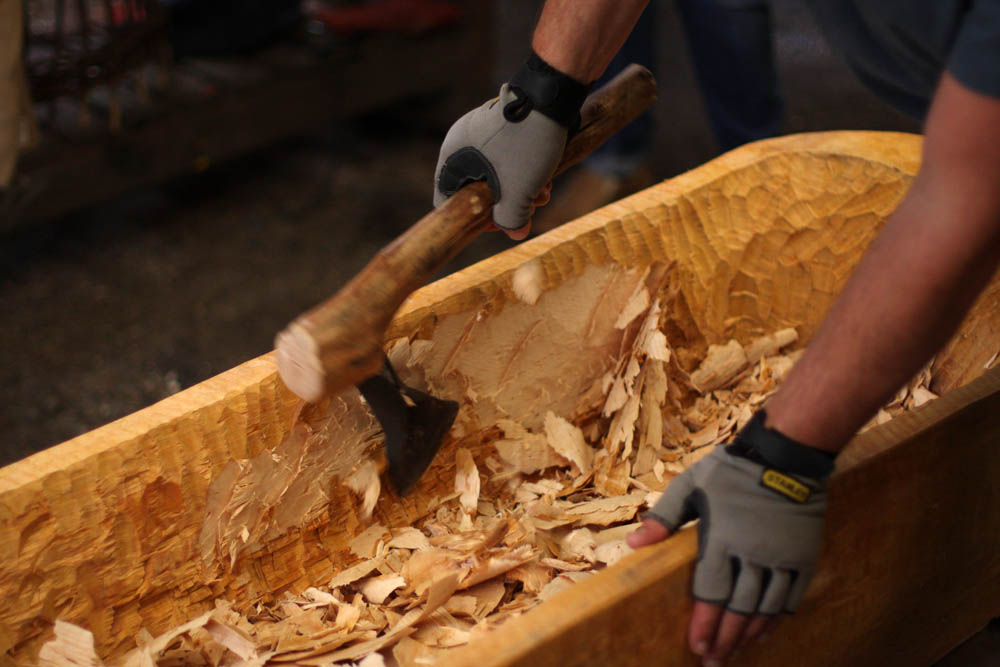
Mark Griffiths hard at work on the Pallasboy Vessel (Credit: Brian Mac Domhnaill, PP).
As mentioned above, we had little clear plan as to what we might do with the new artefact, although it became apparent during the crafting that MG’s work was attracting something of an audience; ranging from other woodworkers, casual visitors, archaeologists with a particular interest in prehistoric woodworking, and students from University College Cork’s archaeology department, following discussion of the work by BG in a lecture. The opportunity to display the newly completed vessel at Cork Public Museum subsequently arose, and this was followed by a public event during Heritage Week. This event took the form of an exhibition where members of the public were invited to touch and engage with the replica, and the new vessel was contextualised using video footage (including audio) of the carving process captured by BMD. We also asked for the help of visiting children to express their thoughts concerning the original Pallasboy Vessel using a blank sheet of paper with a simple outline of the vessel, and a selection of colouring pencils (Figure 2). The outcomes included a wonderful range of colourings and imaginings of the Pallasboy vessel in the past. We did not collect audience numbers for this event, but an estimated 200 people attended.
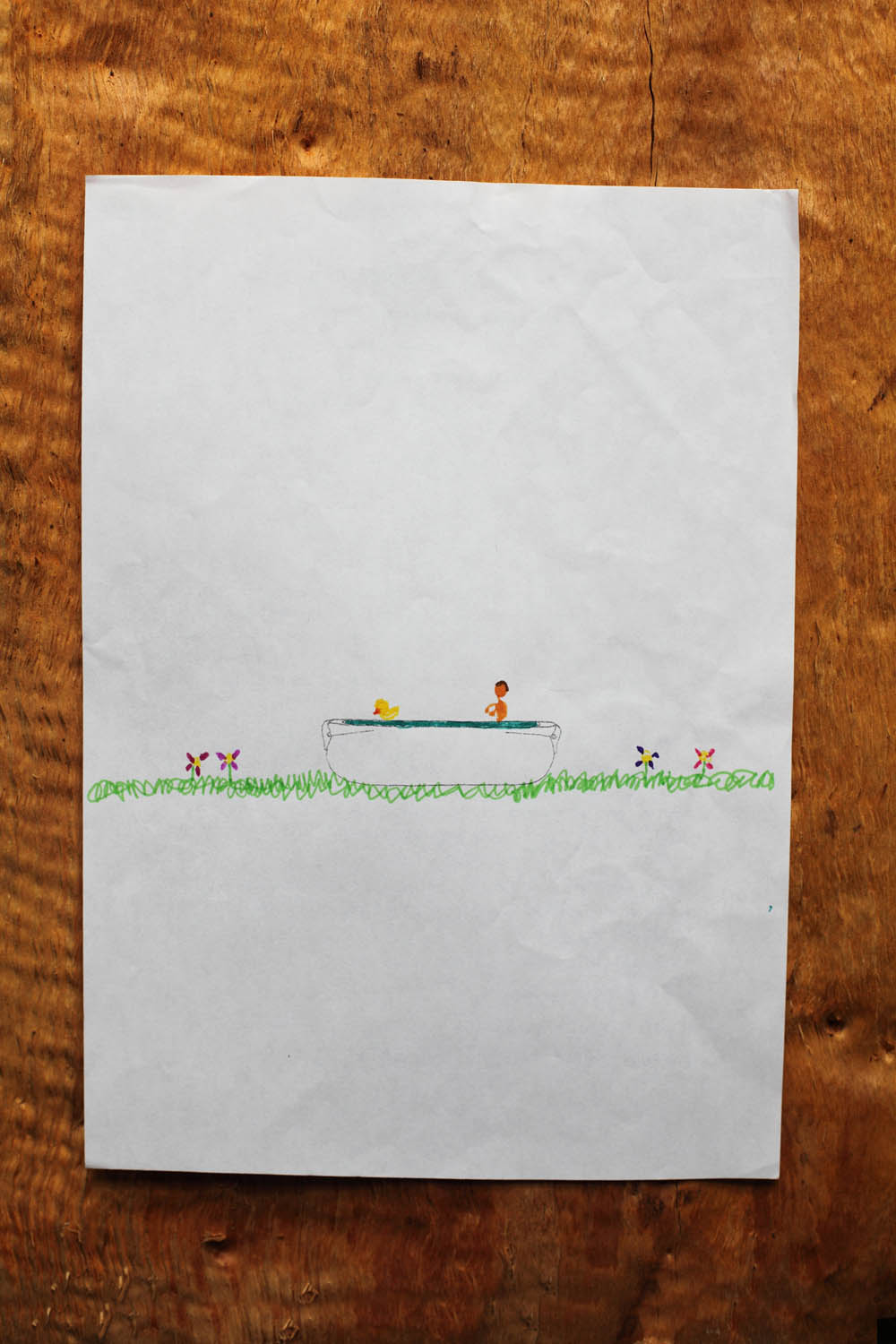
Creative responses to the question: how do you think the Pallasboy vessel might have been used? (Credit: Brian Mac Domhnaill, PP).
During the original carving of the Pallasboy Vessel, BMD became interested in the acoustics of the process, in particular, the changing resonance of the wood as the carving progressed. This led to a subsequent invitation to three Cork City-based sound artists (Mirco Gargioni, Katie O’Looney, and artist Angelika Höger) to “play” the completed vessel at an open event held in Cork Public Museum (Figure 3). BMD recorded the reactions of the artists and the audience as follows:
Invited sound artists were pensive and attentive. One chose to look at the museum exhibits and she later remarked that the unusual soundscape enhanced the experience. Another chose to cover his eyes to focus on the sounds rather than be distracted by the sight of our artists at work. Archaeologists were baffled but engaged. One audience member sketched the vessel. Two more took notes. Museum visitors didn’t know what they had stumbled upon and I even saw some retreat to reception to make urgent enquiries rather than approach the strange folk involved.
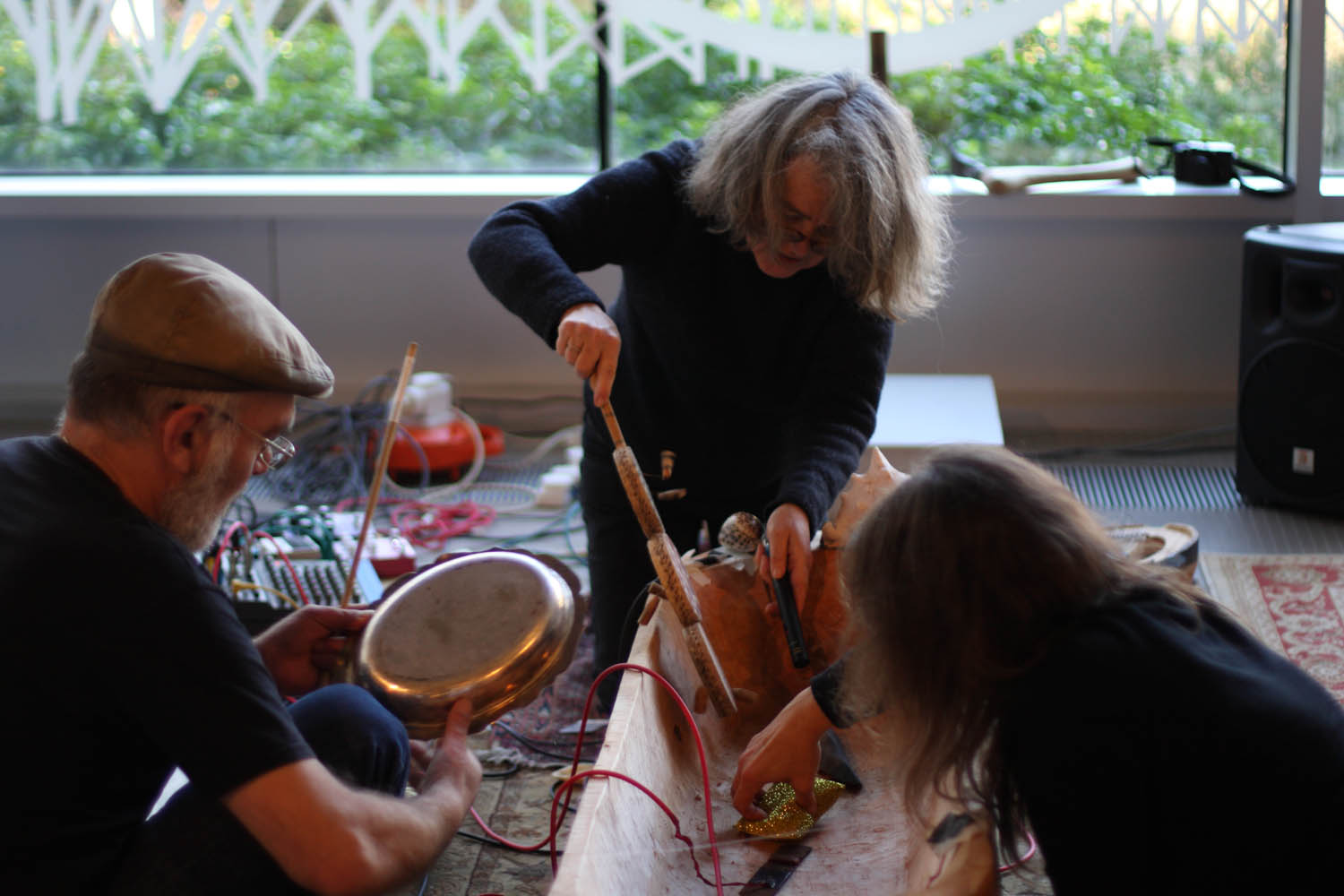
Sound artists Mirco Gargioni, Katie O’Looney, and Angelika Höger playing the Pallasboy vessel in Cork Public Museum (Credit: Brian Mac Domhnaill, PP).
The sounding therefore provided another, slightly random and unusual audience engagement; although as was the case with other such events, the project team ended up as the audience to the artists’ own approach to the replica. Increasingly, it appeared the interaction of different communities of practice with the replica artefacts was taking the project in unexpected and unplanned directions.
3.2 The Figurine Workshops
The second phase of the PP focussed on prehistoric wooden anthropomorphic figurines, and in particular the “Red Man of Kilbeg,” a Bronze Age alderwood figure exposed by industrial peat extraction in 2003 in Kilbeg townland, Ballykean Bog, Co. Offaly. It was excavated by the Irish Archaeological Wetland Unit and recovered for conservation by the NMI. Following a viewing of the artefact at the NMI stores, a full-scale replica of the “Red Man of Kilbeg” was carved by MG, again using a set of replica Bronze Age tools, crafted by Billy Mag Fhloinn (BMF). This initial carving is not our focus here; instead, we consider two workshops held later: the first at the Meitheal Mara community boatyard and attended by invited artists from Cork City and the United Kingdom. The second workshop took place at the Centre for Experimental Archaeology, University College Dublin, and was attended by both students and staff from the Archaeology Department.
The attendees at both were invited to craft their own anthropomorphic figurines, inspired or influenced by ‘the ‘Red Man of Kilbeg’, and other archaeological examples discussed on the day (e.g. Coles, 1990). There were six participants including two project team members (BG and OPP). The invited artists were asked to reflect on their experiences and impressions, both informally during carving and later in writing (although there was no obligation to do so). The only direction given to participants was a health and safety briefing concerning the use of sharp-edged tools, and an introduction to a pile of different pieces of wood. A short “toolbox” description of anthropomorphic figurines found in peatlands ensued, followed by a brief discussion of the theories around their meaning and cultural significance.
The Cork City workshop was attended by Mike Groves (Skapa Woodcrafts, also a woodworker), ceramicist Cat Gambel, writer Fergal Gaynor, artist and curator Padraig Spillane, and Pallasboy project team members. Before work commenced MG shared his own experience of crafting his version of the “Red Man of Kilbeg,” taking inspiration from the close relationship he had with his late grandfather:
I was surprised at the strength of emotion and memory raised by focusing on one individual as I was absorbed in the sculpting process. It left me with an appreciation of the power these carvings could evoke, carrying as they may have done a physical representation of a personal memory.
Following his experience of working wood, Fergal Gaynor suggested:
I reckon the original wood figures were the work of woodworkers, rather than artisans – it was part of the whole job of building a wood trackway, or a boundary, or the like, and not a passed-down, gradually refined art of making particular objects…
Ceramicist Cat Gambel offered the following insight on the process from a practical creative perspective (Figure 4):
I became very aware of the grain of the wood and the time needed to create a smooth curve, a process which in my studio working with clay would take only moments. The crude shape emerging from hours of work bore almost no resemblance to the sketches in my head when I left home that morning, and I began to understand the recurrence of basic elements in representative art. Slashes for mouths, slits for eyes, big blocky triangle noses all made much more sense to me, driven by skill level rather than aesthetic choice.
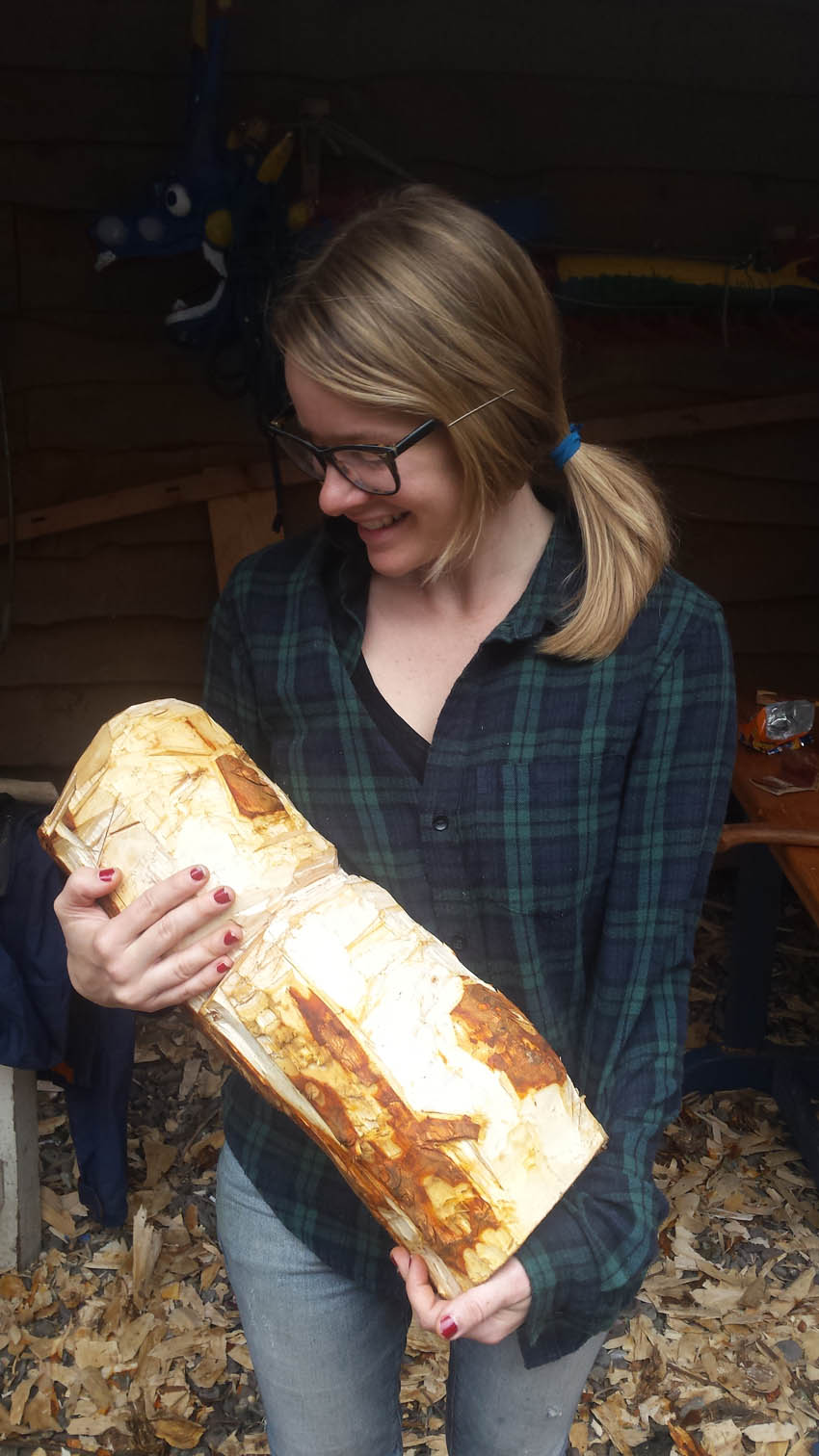
Ceramic artist Cat Gambel with her completed figurine (Credit: Brian Mac Domhnaill, PP).
Although somewhat of a subjective judgement, the figurines produced by those of a more artistic persuasion tended also to be more aesthetically pleasing!
Some of the participants at the UCD workshop were experienced woodworkers, so needed little input, encouragement, or guidance. Professor Aidan O’Sullivan pioneered the analysis of archaeological wood in Ireland and previously assisted on a major historical boat-building project in the United Kingdom; kindly facilitated the UCD workshop. Also taking part were archaeologists Conor Mc Dermott, Michael Stanley (excavator of the original “Red Man of Kilbeg”; Stanley, 2006, 2012), Dr Brendan O’Neill, and three postgraduate students. The wood available included curved and forked pieces, contrasting with the straighter timber that had been used for the Cork City workshop. The participants were asked to select one piece that “spoke” to them and carving commenced using the replica Bronze Age tools (BMF). Michael Stanley decided:
My figure must be a replica of the Kilbeg Man, or some approximation thereof. As one of the small team of archaeologists who had discovered the figure thirteen years previously, I had been researching this and other anthropomorphic artefacts from Offaly and elsewhere ever since. The workshop was a chance to learn more about such objects and how they might have been made.
Michael’s final version of the “Red Man of Kilbeg” took its place alongside the other five completed figurines (Figure 5) close to the entrance to the Centre for Experimental Archaeology, with the following conclusion from Michael Stanley:
As the day closed and the figures were set in the ground, nearby lamplight filtered through the trees and played on the alderwood surfaces. A vision of malign entities writhing as they emerged from the soil was the unnerving result. We can only ponder as to the benevolence or otherwise of similar prehistoric figures, but I left with the distinct impression that they were not necessarily friendly.
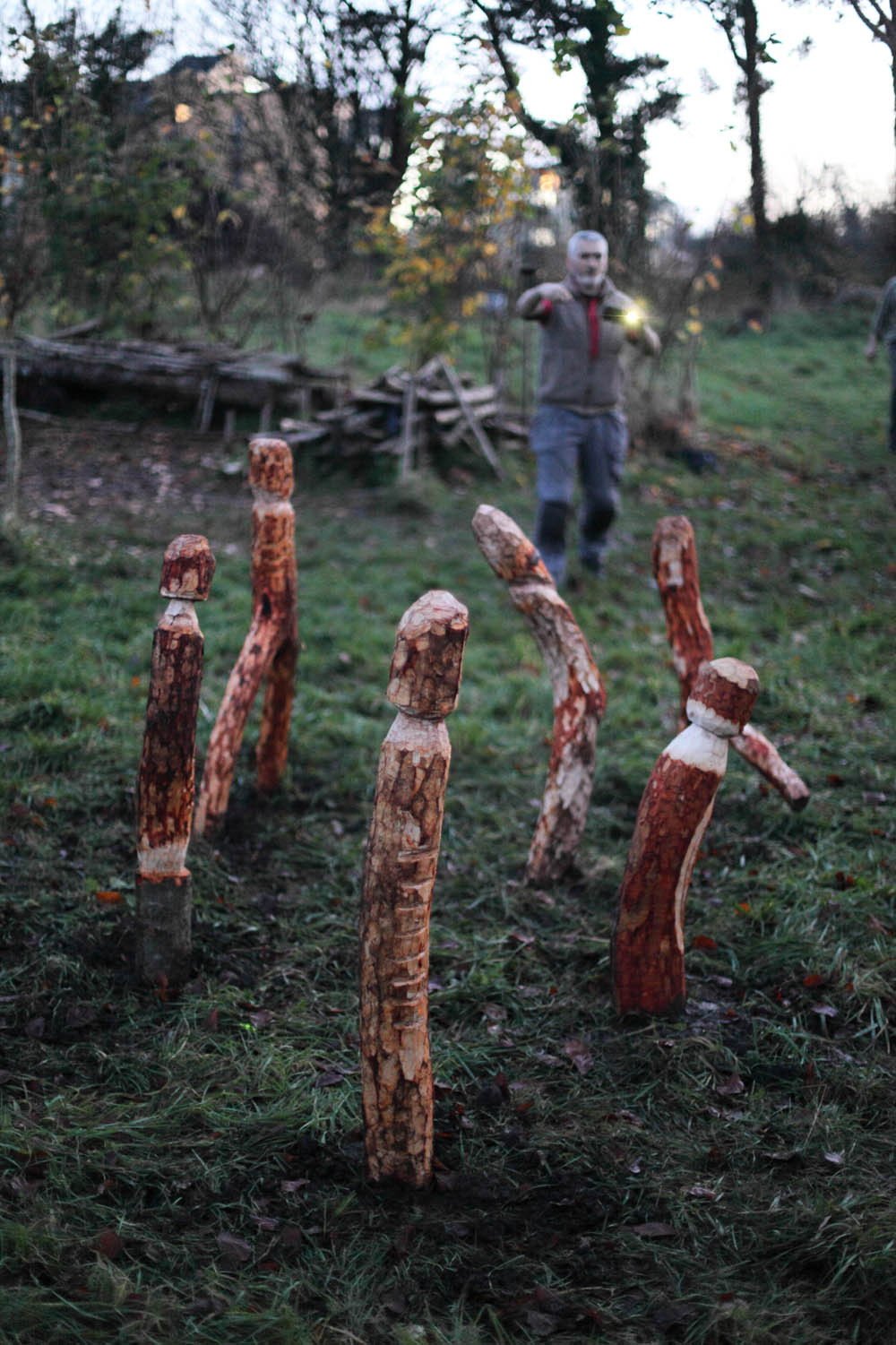
Conor McDermott (UCD) and the completed figurines take root in the soil at UCD’s Experimental Archaeology Centre (Credit: Brian Mac Domhnaill, PP).
As of the time of writing, the figurines remain standing in their original positions: they have been viewed numerous times by visitors to the centre and were the focus of an academic presentation given by Professor O’ Sullivan at the Experimental Archaeology Conference, held on 30 March 2021.
3.3 The “Guerilla Installation”; Somewhere in the Woods, West Cork, Ireland
The wooden figurines carved by the participants at the Cork City workshop (see above, Figure 4) ended up with their own particular “audience” and one we could not control or direct in any way, via an act of “guerrilla deposition.” Following some discussion as to the optimal location for “releasing” wooden carvings into the wild, and the legality of leaving figurines lying around the place, we settled on a location in publicly accessible woodland in West Cork. Originally, we had thought of placing them deep in these woods, but following discussion on location, they were left where they would hopefully catch the eye of anyone half alert heading up a nearby track. We had no idea how long they might survive on their own, but as of 2021, they were largely still in place (however one of the smaller figurines had gone). It is impossible to know how many people have viewed these figurines, or what discussions and conversations presumably ensued as a result of their discovery. However, a “desire path” (Figure 6) has been trampled through the briars, signalling quite a significant fall of the foot to view them closer up.
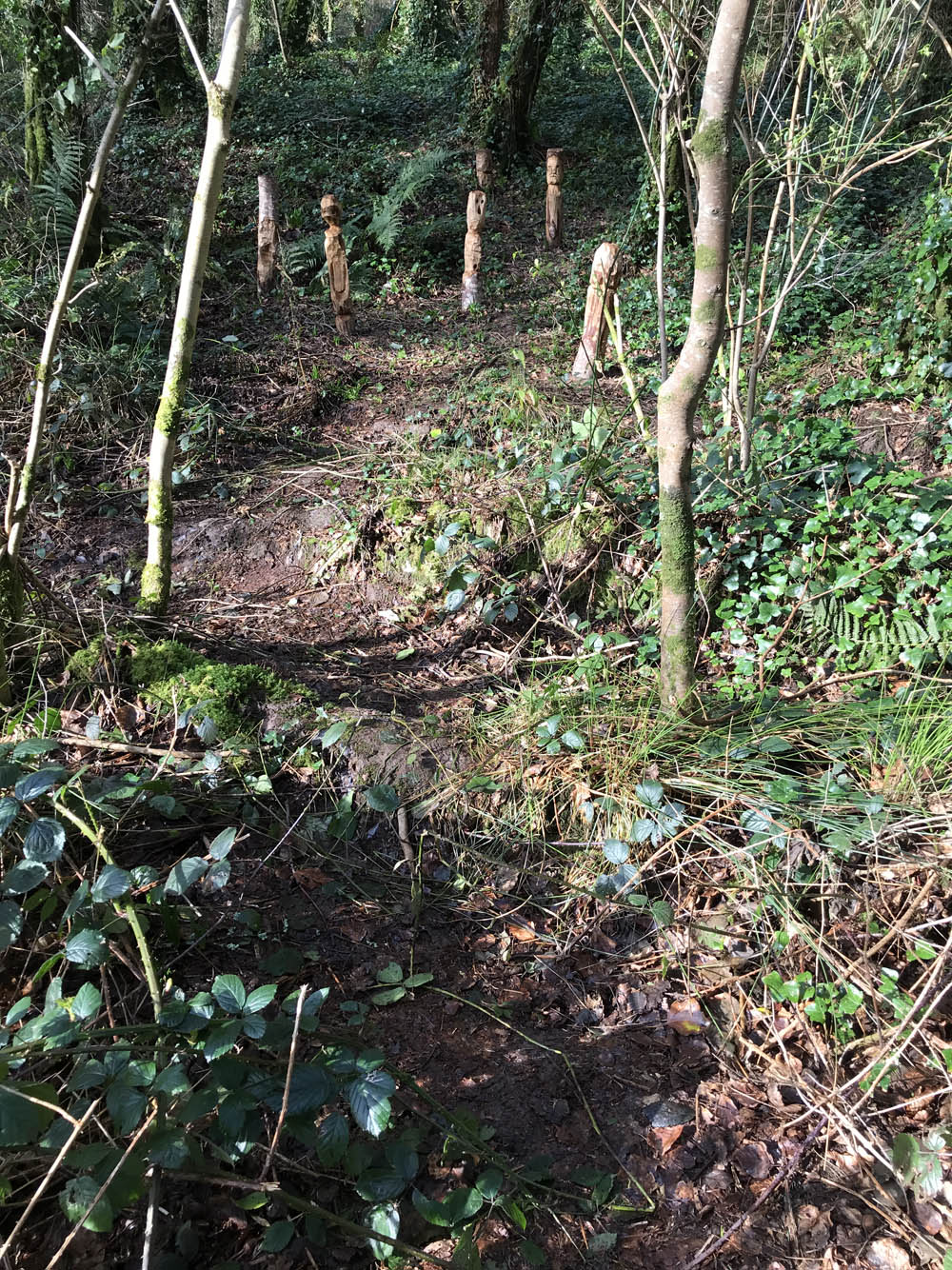
Somewhere in a woodland in West Cork, Ireland: a desire line showing footfall to the figurines (Credit: Ben Gearey, PP).
3.4 The Lee’s Island Launching, Lough Corrib, Ireland
The third phase of the project focused on the Lees Island 5 Iron Age logboat: this artefact has the distinction of being entirely out of sight of anyone who is not a trained diver, as it lies on the bottom of Lough Corrib, Co. Galway. It has been documented, and radiocarbon dated, thanks to the work of Karl Brady and Ireland’s Underwater Archaeology Unit. Lees Island 5 was built from single oak timber and is some 7.5 m long, 0.61 m wide, and 0.4 m deep. MG carved a replica of the vessel based on plans provided by Dr Karl Brady, using a combination of replica Bronze Age (BMF) and modern tools, which was again completed at Meitheal Mara, Cork City. It seemed appropriate to us afterwards, that the replica vessel should take to the waters of Lough Corrib itself, as a test of its waterworthiness and if possible, for it to be navigated above the resting place of the original on the lough bed.
Transporting the boat from Cork City to Knockferry Pier on Lough Corrib was a problem all of its own: the main concern ended up dispersing like an autumn mist over the Lough, and this was largely due to the remarkable efforts of Dr Paul Naessens (NUIG) and his colleagues in Oughterard and Moycullen Heritage groups. Their enthusiasm and persistence in the face of recurring obstacles and difficulties were truly inspiring and genuinely touching, especially because other than a series of phone calls, none of us had ever met Paul or anyone from either of the heritage groups.
Every launch needs a VIP: in this case, Teachta Dála (Member of the Irish Parliament) Sean Kyne had kindly agreed to do the honours. A few short speeches later a JCB hoisted the vessel up in the air and down into the water. There were some nerves, especially because visions of Youtube immortality for all the wrong reasons sprung up as many of the crowd of 200 or so people, raised their camera phones to capture the moment the boat was released into the water. But float she did (Figure 7) perhaps not the most elegant or lithe vessel across the Lough, but a remarkably moving sight after so much effort by MG and from Moycullen and Oughterard Heritage Groups. Musician Ciara Finan played the appropriate “Launching the boat” and other reels on her fiddle, as musical accompaniment to the maiden voyage. A presentation by MG, BG, and Karl Brady at the appropriately named Boat Inn, Oughterard, on the evening of the launch, drew around 100 people. Later media interest included a report of the launching in the Irish press and Oughterard Heritage and Moycullen Heritage reported the project on their websites with the short film of the launch available on the former.
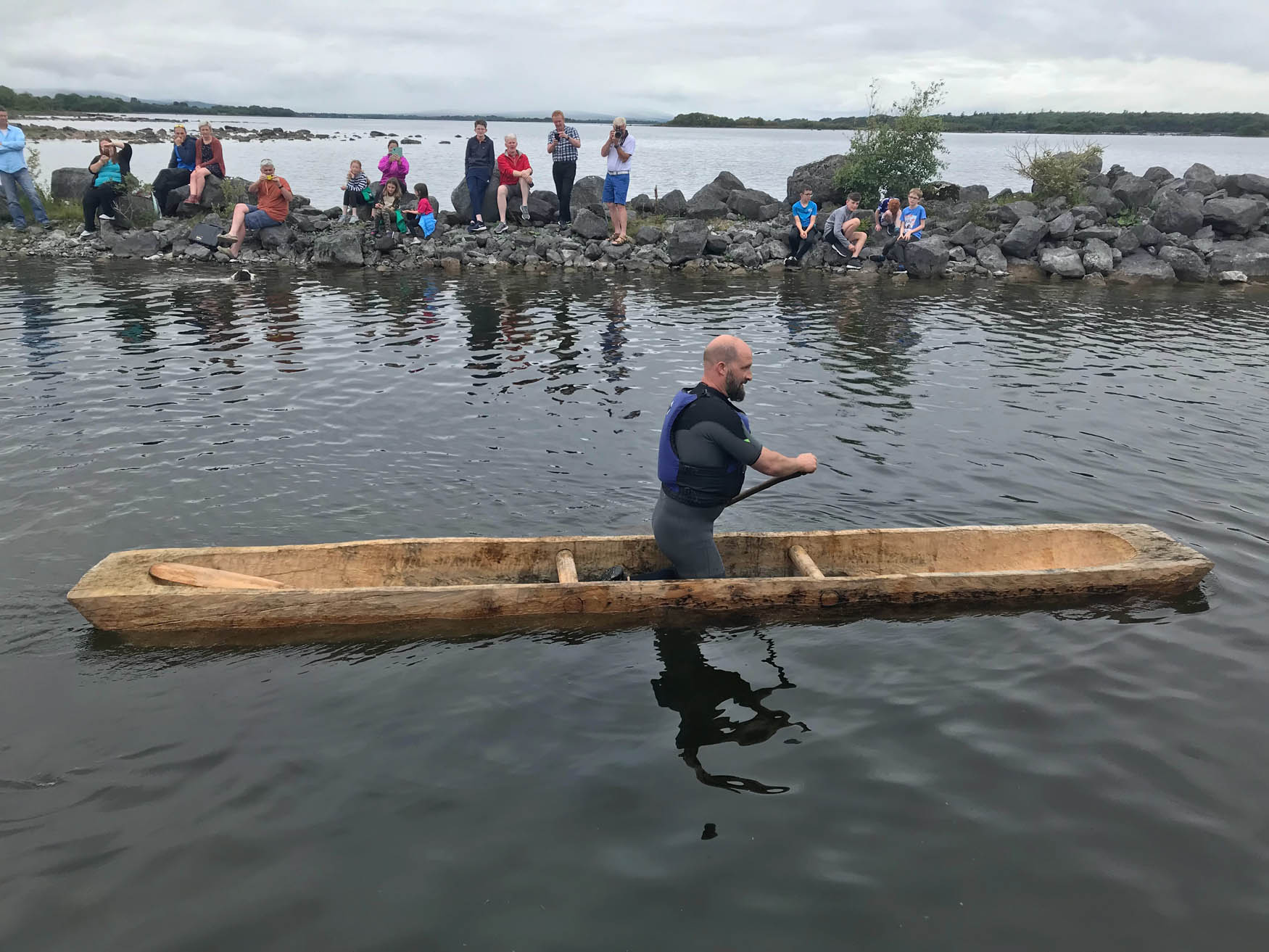
Lees Island 5 replica log boat’s maiden voyage on Lough Corrib (Credit: Benjamin Gearey, PP).
3.5 The Ballachulish Carving, Touring and Burying, Glencoe, Scotland
The success of the work around the “Red Man of Kilbeg” (described above) led us directly to another later prehistoric wooden figurine: the iconic “Ballachulish Goddess,” discovered in the late 19th century during drain excavations at the edge of a peatland at North Ballachulish, Glencoe, Scotland. This Iron Age figurine of a young girl/woman was carved from a single piece of alder wood and has two quartzite pebbles for eyes. The original artefact had been transported shortly after discovery, to the National Museum of Scotland in Edinburgh, drying out and distorting in the process. Only a black-and-white photograph and a rough sketch of the figurine provide evidence of its original form.
The PP team travelled to Ballachulish and MG carved a replica from birch wood, as alder could not be sourced by the local contact. There are some differences in terms of the properties of these woods, with the behaviour of alder, in particular, a subject of discussion in an earlier phase of the project. An unveiling event was subsequently held at the local community centre, followed by a visit by the ‘new goddess’ to the peatland where the original had been found (Figure 8). The unveiling attracted around 30 people, largely from the local community. The “new” goddess was left with the people of Ballachulish, with the suggestion they might want to display it for a while, then perhaps think of interring it in a peaty grave. Rob Malpas, chair of the Ballachulish Community Group, picks up the story of the tour that took their goddess to a younger audience in particular:
Two weeks later [following the carving] as the schools went back, the goddess went on a wee tour before she was buried in peat to preserve her. First stop was Glencoe Primary, where Morag Watt, a trustee at Glencoe Museum, and I introduced the goddess to the pupils. The children listened intently as we presented a slideshow giving some background both to the work of the experimental archaeologists and the goddess, asking some pertinent questions when given the opportunity.
After about 10 minutes, the goddess was revealed to stifled gasps, and even a little scream from one of the younger children! Although initially slightly awestruck by the figure, when prompted, they all came forward to touch her and even cuddle her. Photos were taken, and there were many more questions, some of which were easy to answer, others a little more difficult – as so many questions from young children can be when you are unprepared!
With a tight schedule to get round all of the schools, after just 25 minutes we had to say goodbye, and head across the loch to St Brides School. The school here has a closer connection than most to the goddess, as it is sited less than quarter of a mile from the original find site. The staff, therefore, had already briefed their pupils more thoroughly on the goddess, and so combined with experience gained at Glencoe, there were fewer questions from the children, although the staff had a few of their own! We also took the goddess through to the school hall to get a photo of all of the pupils with their new colleague!

A new goddess for Ballachulish, on Ballachulish Moss close to the find spot of the Iron Age original (credit: Brian Mac Domhnaill, PP).
The “new goddess” was subsequently re-buried by Rob and volunteers in peaty soil, up the side of a mountain close to Ballachulish. It remained undisturbed until it was re-excavated by the local Scout Group for filming as part of the BBC Scotland TV series “Grand Tours of Scotland's Lochs,” in which it subsequently made a brief appearance. As of the time of writing, the replica resides back in the peat, although we have no idea of its current condition.
4 Discussion
The PP developed somewhat organically as a loosely “experimental” project, based around wooden prehistoric artefacts, and developed via exchanges, into what might arguably be described as more “experiential” archaeology (Garland, 2023) involving a diverse range of individuals, groups, and audiences, across a range of contexts and environments, from community workshops and heritage groups, museums, universities, schools, a lake, and a woodland. To be clear, the PP did not begin with any defined, quantitative outcome in mind, nor did we intend to explore or develop interactions with diverse “audiences,” but the process and framework such as it emerged, enabled us to engage in this reflexive process of interaction with these communities of practice. This was facilitated in part, by the generous and open funding of the World Wood Day Fund, which enabled a loosely “experimental archaeological” process that was not bound by the necessity of collecting qualitative/quantitative data sets, but placed emphasis on the process of exploration, practice, and making.
Carrying out the recrafting in open, accessible locations, both inspired and created the Pallasboy “aesthetic,” evident in the photography, film, and soundscapes however it also perhaps unintentionally dismantled, partially at least, the barrier between the “professionals” and those who engaged, interacted, and ultimately gave the project its greater worth. Serendipity also played something of a role: for example, the initial location we had selected for the re-crafting but which was unavailable in the event now seems far too sterile compared to the vibrant, open location offered by the Meitheal Mara community boatyard. The artefacts we selected were those of uncertain function or “meaning”: had they originally been created to be engaged with by the community, or by specific individuals; and if so in what way: quotidian, ritual, artistic ceremonial, celebratory or a combination of these and other unknown affordances?
Our framework perhaps helped create a space where contemporary audiences could reflect, interact, explore, and reinterpret the “remade” objects, and if appropriate, assign purpose, meaning, and function freely, without restriction or deliberate censure. Moshenska’s (2006, p. 92) reflections on “archaeoappeal” is a potential touchtone: “Archaeology in popular culture creates a dichotomy between the archaeologists/performers/producers and the public/audience/consumers of archaeological images and experiences […]”, pushing back on this alienation in small but persistent ways through different forms of dialogue and collaboration.
We can also turn to different theories to describe the manifold relationships between people, things, past and present. Ultimately this is a highly individual concern: one of us (BG) was drawn to the concept of a “meshwork” (Lefebvre, 1991), which simply stated, reflects the concept that humans and the material world are not bounded or separate but “flow into each other” and thus: “[…] meaning and symbolism are not merely attributed or imposed on objects and the material world, but rather these emerge through assemblages or meshworks of people and things.” (Chadwick, 2016, p. 3). Whether or not different theoretical lenses help in our framing, observing people’s interactions with the recrafted versions and hence indirectly with the original artefacts, reminds us that posing the simple question “what was this thing for?” is only partly to reflect on practical function (a boat, a cooking pot, a cradle, a god, a goddess…?). It also necessitates that we consider the entanglement of materials, people, and thoughts that gave “things” meaning and purpose in the present as much as in the past.
It is difficult to view some of the original artefacts, especially the figurines, and not want to invent a story around them, such as a contrived “authentic” ritual ceremony. If we understand ritual to be the coming together of people to witness, participate, and share in an act that has some kind of personal significance, then unintentionally, our collective events had “ritualistic” elements. However, these were rooted in an avowedly contemporary context. Whilst the recreations are at the end of the day only facsimiles, embedded in the timber are traces that speak of the human experiences associated with the creation, display, and other experiences. Those watching, and hearing, the slow, rhythmic axe blows, were offered a moment open to personal interpretation and reflection on the object taking shape. The intimacy and honesty of these experiential moments, and the collective work in making them happen, may in some way echo the social capital channelled into the crafting of the original artefacts.
An additional aspect was the choice of artefacts, with one exception, that were preserved in the waterlogged, anoxic, acidic conditions of peat. The destruction of peatland environments and related processes such as drainage and agriculture, has led to the loss and damage to archaeological sites and deposits across northwest Europe (Gearey & Chapman, 2022). Our focus was on archaeological finds, that with one exception (The Ballachulish “Goddess,” see above, on display at the National Museum of Scotland) were not on public view, but that had only been discovered during anthropogenic activities such as peat cutting and drainage.
The irony of wetland archaeology is that the discovery of remarkable sites and artefacts is invariably due to processes that in turn contribute to ecosystem degradation, the loss of surviving archaeological preservation potential in the context of spiralling biodiversity losses (Gearey & Everett, 2021). This connection between the fragile but exceptional preservation potential of peatlands opened a conceptual space for interactions with the audiences at the museum in particular, that allowed for discussion of the relationship between archaeological discovery, the biodiversity crisis, and the broader importance of wetland and peatland restoration for heritage and culture (Gearey & Chapman, 2022). Archaeological artefacts can thus play a role in broader issues associated with these pressing problems, although further work and thought is required to develop theoretical and practical approaches. Another relevant line of enquiry would be the role and perception of the “replicas” in relation to the “authentic” artefacts (e.g. Tissen & van Veldhuizen, 2022).
As far as we can recognise, the form of the “audience/s” connections (Table 2) can be divided into two very general and not necessarily mutually exclusive: the direct interactions (viewing the process of crafting and the replicas, contributing in other ways) and the indirect interactions (engaging via the project blog or chancing across the figurines in the woodland). The second group is in many ways an “invisible” audience; we have metrics for the number of digital contacts via the blog data (c. 15,000 total visitors, 48,000 views relating to a total of 50 posts, 2015 to present), although we do not know anything about the nature of these virtual contacts/engagements, fleeting or more focussed. The people who discovered and viewed the figurines in the woodland in west Cork were or are an entirely “invisible” audience – we have recorded nothing of them, other than the “desire path” through the undergrowth (Figure 6). Such interactions that “escape” formal metrics or attempts to record/document might be described as “anti-archival” (Gearey & Gearey, 2021), although perhaps to be entirely so, these undertakings should remain undocumented and unreported.
The artefacts selected for recrafting, associated archaeological information, event, and audience summaries
| Artefact | Find site | Date/Period | Posited archaeological interpretations | Event | Event location | Audience and contributors |
|---|---|---|---|---|---|---|
| The Pallasboy Vessel | Toar Bog, Co. Westmeath Ireland | Iron age 200–70 BCE | Boat, Brewing vessel, Cradle, Coffin, Dough trough | Crafting | Meitheal Mara, Cork City, Ireland | Woodworkers, visitors to MM, students, archaeologists |
| Museum Display, Heritage Week and “The Sounding” | Cork Public Museum, Cork City, | Sound artists, Museum visitors | ||||
| The “Red Man of Kilbeg” | Ballykean Bog, Kilbeg, Co. Offaly, Ireland | Bronze age 1740–1530 BCE | Fertility, apotropaic, guardian, representation of actual person | Figurine Workshop (University College Dublin) | University College Dublin, Dublin, Ireland | Academic and professional archaeologists, postgraduate students |
| Figurines from MM Workshop | NA | NA | NA | Guerilla deposition | West Cork woodland | Unknown |
| Lee’s Island 5 Iron Age Logboat | Lough Corrib, Co. Galway, Ireland | Iron age 750–410 BCE | Logboat; potentially never intended for a long water journey? | The Lee’s Island Launching | Lough Corrib, Galway, Ireland | Moycullen and Oughterard Heritage groups, interested and passing public, press/media |
| The “Ballachulish Goddess” | Loch Leven, North Ballachulish, Scotland | 730–520 BCE | Young Girl, Fertility Goddess, Celtic Figure, Ancient Scandinavian Deity, Figurehead for prow of a boat | The Ballachulish Crafting, The Touring, The Burying | Ballachulish, Scotland, Local schools (Glencoe) | Visitors, local community group, school children, and teachers |
Dates are calibrated radiocarbon determinations given at 2 sigma, full details given in related documentation and publications.
This does not make these interactions valueless, although it does highlight the tension between the significance or importance of attracting an audience and the commonly associated requirement to capture data that encapsulates and demonstrates “value” within the wider arena for justifying funding. The constant fight for “public” interest and significance and hence finances for archaeological audience development, must therefore always situate itself in some form of market valuation: qualitative and quantitative metrics. Arguments for the emancipatory or transformative power of “public” archaeology (e.g. Richardson & Almansa-Sánchez, 2015) ironically expose archaeology to the logic of the “cultural marketplace” with all its inherent tensions and contradictions. As Hadley (2021; see also Hadley & Gray, 2017) has argued in relation to the subsidised arts sector, such processes of quantification are inevitably framed within an instrumental policy logic which inherits a hierarchy of methodological value and ultimately fails to capture the motivations driving audience engagement. There is clearly more work and thought that needs to be done at this interface in the context of public archaeologies.
In terms of particular engagements, the Heritage Week open day was enormously enjoyable and rewarding, especially the response of the children, their drawings and imaginings of the Pallasboy vessel. The pictures might have begun with seeing and touching the vessel but took them wherever their creators’ imagination allowed. We did not seek to record or “archive” all these thoughts: at times as mentioned above, the project team (the archaeologists, woodworkers, etc.) took on the role of audience ourselves – watching engagements and interactions unfold, often without much prompt or guidance. Related to this, the one thing that struck us was the response and attitude of almost everyone involved: positive, enthusiastic, interested, intrigued; slightly mystified perhaps on occasion, but never dismissive (at least, not to our faces…). This was the case from our initial approach to Meitheal Mara for a working venue, to the extended odyssey of sourcing the appropriately sized alder timber and its delivery for the Pallasboy Vessel. The Ballachulish Touring was organised by Rob Malpas following a discussion with the local schools but without any particular suggestion as to how this might work or what it would achieve. As mentioned, the recrafted “goddess” was subsequently buried up a mountain, and aside from exhumation for a passing appearance on a BBC TV programme, now has no audience apart from the peat and the non-humans who occupy this dark place.
The other human “audiences” seemed to find interest and engagement in one way or another, although this clearly varied from person to person. For those of an archaeological background, this included a disciplinary context, the components of the work that might be described more precisely as “experimental archaeology” for example: what aspect of the crafting was the most difficult, how long had it taken, how had the green wood behaved etc.? Other people with little or no such background brought and perhaps took something different away: the professional woodworkers and boat builders at Meitheal Mara were drawn largely (but not exclusively) to the practical aspects, the performance of the replica prehistoric tools compared to modern equivalents, and shared their knowledge and assistance freely. The sound artists were drawn to the resonances of the vessel and the tones that could be created through their physical interactions. Some spectators seemed to revel in the simple observation of the act of woodworking, a practical mastery that is unambiguously joyous to watch. Yet others, such as the crowd that gathered for the Lees Island launch, might just have been drawn to the unusual spectacle, or to the possibility of an amusing sinking, rather than a grand floating.
4.1 Meitheal Adhmadóireachta: The Community of Builders?
It is difficult therefore to generalise about audiences and probably not hugely useful. We were surprised at times by the generosity of responses and engagements, and have previously mused that “flattening out” our approach acted in a positive way to “involve and engage people within the process of knowledge production and exchange, rather than sustaining a producer/consumer approach and casting a hierarchy of expert versus non-expert, valid versus invalid interpretations.” (Gearey et al., 2019, p. 10). In retrospect, this is highly speculative (see also Bell, 2014, p. 45). We did not at the time, nor have we since, sought direct opinions or comments from those who attended and contributed, as to whether such factors were at all relevant or even apparent. It is easy to exaggerate the value or worth of the PP in this sense although anecdotally, most people just seemed to engage without much explanation as to why we were bothering crafting replicas of prehistoric artefacts.
Another way to frame the process we have incompletely described in this article is via the concept of the Meitheal: “meitheal, -thle, pl. id. and -thleacha, f., a band of reapers; a concourse; a number of men employed at any special work, as haymaking, turf-cutting, etc.” (Dineen, 1904, p. 447). Within the Irish folk and cultural tradition, this word referred to a working party or group that participated in cooperative labour exchanges, fundamentally for communal benefit. It encapsulates a reciprocal process of labour between neighbours and communities that originally related particularly to farming, the harvesting season, and turf (peat) cutting.
In contemporary contexts, the concept has expanded to refer to rural support networks and labour exchanges, and speaks to the broader Irish tradition of coming together for the mutual benefit of a community. While the meitheal practice has anecdotally diminished somewhat in rural communities in recent years, the concept still lives and recently found a new place in many participatory, co-production practices and initiatives. During the COVID pandemic, it emerged as a guiding principle in the development of digital communities of practice (Stone et al., 2017) and in related forms in the cultural and heritage sectors (i.e. CINE Project, Digital Counties Initiative – Dempsey & Power, 2020, Dúchas - Bailiúchán na Scol). We might situate the open ethos that emerged and helped carry the PP along within this contemporary, collaborative framing.
5 Conclusions
We can place the PP within a broader tradition of experimental/experiential archaeology, linked specifically in this article, to public engagement, involvement, interaction, and communication. Most of the locations for the crafting and associated events were unapologetically contemporary. An open question would be the extent to which situating events and interactions within more traditional or “authentic” locations, such as open-air museums (e.g. Mikešová & Maršálek, 2017), might shift or alter the perception or impact of the engagements. The contemporary ethos extended to the use of modern tools for certain stages of the work. Whilst the re-crafings generated information that can be described as “experimental” in the definition of testing of formal hypotheses regarding artefacts or the tools used to create them, we have not discussed these data in any depth. In this article, we have mainly focussed on the engagements with different groups and individuals who interacted in various ways with the processes of crafting and “testing” selected prehistoric wooden archaeological artefacts. Whilst some of these engagements meet a conventional if simple, definition of “audience,” as observers are drawn from outside the event, work or performance, other interactions blurred this boundary, as people took on closer involvements. The latter were sometimes fleeting and temporary, whilst others were rather more focussed or deliberate: the crafters of the wooden figurines, the children who drew pictures of the Pallasboy vessel, the musicians who “played” the vessel, the canoeists who tested the Pallasboy and Lees Island water-worthiness.
In these cases, the audience/performer roles were reversed or at least shifted sideways, albeit temporarily. Another unusual audience remains entirely invisible and is represented by a “desire” path beaten through woodland undergrowth: data that remains stubbornly and permanently outside any archival urges. Whilst recording audience numbers or blog engagements provide quantitative metrics, capturing or recording the impact or success of engagements and interactions is problematic. We have suggested further theoretical consideration is also required to query how attempts to measure or “develop” archaeological audiences may unwittingly, inherit tensions and contradictions derived from overarching conceptual frameworks, whether these are derived from funding bodies or related policies.
Finally, we have drawn on the Irish concept of the meitheal, to frame the open and collaborative approach that the PP, rather unwittingly at first, developed through the involvement and support of different communities of practice. All but one of the artefacts discussed above were unearthed and exposed by extraction of peat, a destructive process for cultural heritage. Encoded in the original definition of meitheal is mutual labour for this archaeological “harvest.” The meitheal adhmadóireachta: the community of builders, collaborators whose labour helped shape, build, and develop the PP and in turn help expose the rich and fragile, prehistoric archaeological record of peatlands.
Acknowledgements
The authors thank Brian MacDomhnaill for permission to reproduce photographs for this article and the anonymous referees for their helpful and constructive comments.
-
Funding information: We wish to acknowledge the generous financial support of the World Wood Day Fund.
-
Author contributions: All authors have accepted responsibility for the entire content of this manuscript and approved its submission. MG carried out all the woodwork described in this article, unless otherwise stated. BG drafted the manuscript with assistance from both co-authors.
-
Conflict of interest: Authors state no conflict of interest.
-
Data availability statement: The datasets generated during and/or analysed during the current study are available from the corresponding author on reasonable request.
References
Bell, M. (2014). Experimental archaeology at the crossroads: A contribution to knowledge or evidence of Xeroxing? In R. Chapman & R. A. Wylie (Eds.), Material evidence: Learning from archaeological practice (p. 42). Routledge.Search in Google Scholar
Chadwick, A. (2016). The stubborn light of things: Landscape, relational agency and linear earthworks in later prehistory. European Journal of Archaeology, 19(2), 245–278. doi: 10.1080/14619571.2015.1102006.Search in Google Scholar
Clarkson, C., & Shipton, C. (2015). Teaching ancient technology using “hands-on” learning and experimental archaeology. Ethnoarchaeology, 7(2), 157–172.10.1179/1944289015Z.00000000032Search in Google Scholar
Coles, B. (1990). Anthropomorphic wooden figures from Britain and Ireland. Proceedings of the Prehistoric Society, 56, 315–333.10.1017/S0079497X0000517XSearch in Google Scholar
Cunningham, P., Heeb, J., & Paardekooper, R. (Eds.). (2008). Experiencing archaeology by experiment. Proceedings of the Experimental Archaeology Conference, Exeter 2007 (pp. v–ix). Oxbow Books.Search in Google Scholar
Dempsey, G., & Power, O.-P. (2020). Digital counties: Building a framework for community-focused 3D digital heritage projects. In C. Baker (Ed.), Partnership & participation: Community archaeology in Ireland (pp. 15–25). Wordwell.Search in Google Scholar
Dineen, P. S. (1904). Foclóir Gaedhilge agus Béarla: An Irish-English dictionary, being a thesaurus of the words, phrases and idioms of the modern Irish language, with explanations in English. https://celt.ucc.ie/Dinneen1.pdf.Search in Google Scholar
Garland, N. (2023). Experimental and experiential approaches to the past: Reconstructing and understanding Roman domesticity through recreated places. Theoretical Roman Archaeology Journal, 6(1), 1–28. doi: 10.16995/traj.9548.Search in Google Scholar
Gearey, B., & Chapman, H. (2022). An Introduction to peatland archaeology and palaeoenvironments. Oxbow Books.10.2307/j.ctv371cp1fSearch in Google Scholar
Gearey, B. R., & Everett, R. (2021). Running out of time? Peatland rehabilitation, archaeology and cultural ecosystem services. Mires and Peat, 27(31), 6. http://www.mires-and-peat.net/pages/volumes/map27/map273.10.19189/MAP.2021.KHR.STA.2195Search in Google Scholar
Gearey, A., & Gearey, B. (2021). Morissey, memory and traces of lost time in Manchester: From the archive to the anti-archive. In J. Schofield & L. Maloney (Eds.), Music and heritage: New perspectives on place making and sonic identity (pp. 160–171). Routledge.10.4324/9780429343049-18Search in Google Scholar
Gearey, B., Griffiths, M., Mac Domhnaill, B., Moore, C., & Power, O.-P. (2019). Making, multi-vocality and experimental archaeology: The Pallasboy project. EXARC, 2019(4). https://exarc.net/issue-2019-4/ea/pallasboy-project.Search in Google Scholar
Hadley, S. (2021). Audience development and cultural policy. Palgrave Macmillan.10.1007/978-3-030-62970-0Search in Google Scholar
Hadley, S., & Gray, C. (2017). Hyper Instrumentalism and cultural policy: Means to an end or an end to meaning? Cultural Trends, 26(2), 95–106. doi: 10.1080/09548963.2017.1323836.Search in Google Scholar
Lefebvre, H. (1991). The production of space. Blackwell.Search in Google Scholar
Mikešová, V., & Maršálek, D. (2017). A course in experiential archaeology at an archaeopark as part of active university education. EXARC, 2017(1). https://exarc.net/issue-2017-1/aoam/course-experiential-archaeology-archeopark-part-active-university-education.Search in Google Scholar
Moshenska, G. (2006). The archaeological uncanny. Public Archaeology, 5(2), 91–99. doi: 10.1179/pua.2006.5.2.91.Search in Google Scholar
Planel, P., & Stone, P. G. (Eds.). (1999). The constructed past: Experimental archaeology, education and the public. Routledge.Search in Google Scholar
Reynolds, P. J. (1999). The nature of experiment in archaeology. In A. F. Harding (Ed.), Experiment and design in archaeology (pp. 156–161). Oxbow Books.Search in Google Scholar
Richardson, L. J., & Almansa-Sánchez, J. (2015). Do you even know what public archaeology is? Trends, theory, practice, ethics. World Archaeology, 47(2), 194–211. doi: 10.1080/00438243.2015.1017599.Search in Google Scholar
Souyoudzoglou-Haywood, C., & O’Sullivan, A. (Eds.). (2019). Experimental archaeology: Making, understanding, story-telling. Proceedings of a Workshop in Experimental Archaeology. Archaeopress.10.2307/j.ctvpmw4g8Search in Google Scholar
Stanley, M. (2006). The ‘red man’ of Kilbeg: An early Bronze Age idol from county offaly. PAST: The Newsletter of the Prehistoric Society, 52, 5–7.Search in Google Scholar
Stanley, M. (2012). The ‘red man’ of war and death? Archaeology Ireland, 26(2), 34–37.Search in Google Scholar
Stone, S., Doyle, P., Donlon, E., Gormley, C., Walsh, E., O’Keefe, N., O’Keefe, M., Crean, A., & Ferguson, P. B. (2017). Meitheal: An Irish case study in building a virtual community of practice in transitional times. In J. McDonald & A. Cater-Steel (Eds.), Implementing communities of practice in higher education (p. 20). Springer. doi: 10.1007/978-981-10-2866-3_20.Search in Google Scholar
Tissen, L. N., & van Veldhuizen, M. (2022). Picture-perfect: The perception and applicability of facsimiles in museums. Art & Perception, 11(1), 1–53.10.1163/22134913-bja10043Search in Google Scholar
Van de Noort, R., & O’Sullivan, A. (2006). Rethinking wetland archaeology. Duckworth.Search in Google Scholar
© 2025 the author(s), published by De Gruyter
This work is licensed under the Creative Commons Attribution 4.0 International License.
Articles in the same Issue
- Research Articles
- Etched in Stone: The Kevermes Stone Stela From the Great Hungarian Plain
- Waste Around Longhouses: Taphonomy on LBK Settlement in Hlízov
- Raw Materials and Technological Choices: Case Study of Neolithic Black Pottery From the Middle Yangtze River Valley of China
- Disentangling Technological Traditions: Comparative Analysis of Chaînes Opératoires of Painted Pre-Hispanic Ceramics From Nariño, Colombia
- Ancestral Connections: Re-Evaluating Concepts of Superimpositioning and Vandalism in Rock Art Studies
- Disability and Care in Late Medieval Lund, Sweden: An Analysis of Trauma and Intersecting Identities, Aided by Photogrammetric Digitization and Visualization
- Assessing the Development in Open Access Publishing in Archaeology: A Case Study From Norway
- Decorated Standing Stones – The Hagbards Galge Monument in Southwest Sweden
- Geophysical Prospection of the South-Western Quarter of the Hellenistic Capital Artaxata in the Ararat Plain (Lusarat, Ararat Province, Armenia): The South-West Quarter, City Walls and an Early Christian Church
- Lessons From Ceramic Petrography: A Case of Technological Transfer During the Transition From Late to Inca Periods in Northwestern Argentina, Southern Andes
- An Experimental and Methodological Approach of Plant Fibres in Dental Calculus: The Case Study of the Early Neolithic Site of Cova del Pasteral (Girona, Spain)
- Bridging the Post-Excavation Gaps: Structured Guidance and Training for Post-Excavation in Archaeology
- Everyone Has to Start Somewhere: Democratisation of Digital Documentation and Visualisation in 3D
- The Bedrock of Rock Art: The Significance of Quartz Arenite as a Canvas for Rock Art in Central Sweden
- The Origin, Development and Decline of Lengyel Culture Figurative Finds
- New “Balkan Fashion” Developing Through the Neolithization Process: The Ceramic Annulets of Amzabegovo and Svinjarička Čuka
- From a Medieval Town to the Modern Fortress of Rosas (Girona-Spain). Combining Geophysics and Archaeological Excavation to Understand the Evolution of a Strategic Coastal Settlement
- Technical Transfers Between Chert Knappers: Investigating Gunflint Manufacture in the Eastern Egyptian Desert (Wadi Sannur, Northern Galala, Egypt)
- Early Neolithic Pottery Production in the Maltese Islands: Initiating a Għar Dalam and Skorba Pottery Fabric Classification
- Revealing the Origins: An Interdisciplinary Study Into the Provenance of Sacral Microarchitecture–The Unique Case of the Church Model From Žatec in Bohemia
- An Analogical and Analytical Approach to the Burçevi Monumental Tomb
- A Glimpse at Raw Material Economy and Production of Chipped Stones at the Neolithic (Starčevo) Site of Svinjarička Čuka, South Serbia
- Archaeological Lithotheques of Siliceous Rocks in Spain: First Diagnosis of the Lithotheque Thematic Network
- Mapping Changes in Settlement Number and Demography in the South of Israel from the Hellenistic to the Early Islamic Period
- Review Article
- Structural Measures Against the Risks of Flash Floods in Patara and Consequent Considerations Regarding the Location of the Oracle Sanctuary of Apollo
- Commentary Article
- A Framework for Archaeological Involvement with Human Genetic Data for European Prehistory
- Special Issue on Digital Religioscapes: Current Methodologies and Novelties in the Analysis of Sacr(aliz)ed Spaces, edited by Anaïs Lamesa, Asuman Lätzer-Lasar - Part II
- Goats and Goddesses. Digital Approach to the Religioscapes of Atargatis and Allat
- Conceiving Elements of Divinity: The Use of the Semantic Web for the Definition of Material Religiosity in the Levant During the Second Millennium BCE
- Deep Mapping the Asklepieion of Pergamon: Charting the Path Through Challenges, Choices, and Solutions
- Special Issue on Engaging the Public, Heritage and Educators through Material Culture Research, edited by Katherine Anne Wilson, Christina Antenhofer, & Thomas Pickles
- Inventories as Keys to Exploring Castles as Cultural Heritage
- Hohensalzburg Digital: Engaging the Public via a Local Time Machine Project
- Monastic Estates in the Wachau Region: Nodes of Exchange in Past and Present Days
- “Meitheal Adhmadóireachta” Exploring and Communicating Prehistoric Irish Woodcraft Through Remaking and Shared Experience
- Community, Public Archaeology, and Co-construction of Knowledge Through the Educational Project of a Rural Mountain School
- Valuing Material Cultural Heritage: Engaging Audience(s) Through Development-Led Archaeological Research
- Engaging the Public Through Prehistory: Experiences From an Inclusive Perspective
- Material Culture, the Public, and the Extraordinary – “Unloved” Museums Objects as the Tool to Fascinate
- Archaeologists on Social Media and Its Benefits for the Profession. The Results and Lessons Learnt from a Questionnaire
- Special Issue on Network Perspectives in the Archaeology of the Ancient Near East and Eastern Mediterranean, edited by Maria Gabriella Micale, Helen Dawson, & Antti A. Lahelma
- Network Perspectives in the Archaeology of the Ancient Near East and Eastern Mediterranean
- Networks of Pots: The Usage of Ceramics in Network Analysis in Mediterranean Archaeology
- Networks of Knowledge, Materials, and Practice in the Neolithic Zagros
- Weak Ties on Old Roads: Inscribed Stopping-Places and Complex Networks in the Eastern Desert of Graeco-Roman Egypt
- Mediterranean Trade Networks and the Diffusion and Syncretism of Art and Architecture Styles at Delos
- People and Things on the Move: Tracking Paths With Social Network Analysis
- Networks and the City: A Network Perspective on Procopius De Aed. I and the Building of Late Antique Constantinople
Articles in the same Issue
- Research Articles
- Etched in Stone: The Kevermes Stone Stela From the Great Hungarian Plain
- Waste Around Longhouses: Taphonomy on LBK Settlement in Hlízov
- Raw Materials and Technological Choices: Case Study of Neolithic Black Pottery From the Middle Yangtze River Valley of China
- Disentangling Technological Traditions: Comparative Analysis of Chaînes Opératoires of Painted Pre-Hispanic Ceramics From Nariño, Colombia
- Ancestral Connections: Re-Evaluating Concepts of Superimpositioning and Vandalism in Rock Art Studies
- Disability and Care in Late Medieval Lund, Sweden: An Analysis of Trauma and Intersecting Identities, Aided by Photogrammetric Digitization and Visualization
- Assessing the Development in Open Access Publishing in Archaeology: A Case Study From Norway
- Decorated Standing Stones – The Hagbards Galge Monument in Southwest Sweden
- Geophysical Prospection of the South-Western Quarter of the Hellenistic Capital Artaxata in the Ararat Plain (Lusarat, Ararat Province, Armenia): The South-West Quarter, City Walls and an Early Christian Church
- Lessons From Ceramic Petrography: A Case of Technological Transfer During the Transition From Late to Inca Periods in Northwestern Argentina, Southern Andes
- An Experimental and Methodological Approach of Plant Fibres in Dental Calculus: The Case Study of the Early Neolithic Site of Cova del Pasteral (Girona, Spain)
- Bridging the Post-Excavation Gaps: Structured Guidance and Training for Post-Excavation in Archaeology
- Everyone Has to Start Somewhere: Democratisation of Digital Documentation and Visualisation in 3D
- The Bedrock of Rock Art: The Significance of Quartz Arenite as a Canvas for Rock Art in Central Sweden
- The Origin, Development and Decline of Lengyel Culture Figurative Finds
- New “Balkan Fashion” Developing Through the Neolithization Process: The Ceramic Annulets of Amzabegovo and Svinjarička Čuka
- From a Medieval Town to the Modern Fortress of Rosas (Girona-Spain). Combining Geophysics and Archaeological Excavation to Understand the Evolution of a Strategic Coastal Settlement
- Technical Transfers Between Chert Knappers: Investigating Gunflint Manufacture in the Eastern Egyptian Desert (Wadi Sannur, Northern Galala, Egypt)
- Early Neolithic Pottery Production in the Maltese Islands: Initiating a Għar Dalam and Skorba Pottery Fabric Classification
- Revealing the Origins: An Interdisciplinary Study Into the Provenance of Sacral Microarchitecture–The Unique Case of the Church Model From Žatec in Bohemia
- An Analogical and Analytical Approach to the Burçevi Monumental Tomb
- A Glimpse at Raw Material Economy and Production of Chipped Stones at the Neolithic (Starčevo) Site of Svinjarička Čuka, South Serbia
- Archaeological Lithotheques of Siliceous Rocks in Spain: First Diagnosis of the Lithotheque Thematic Network
- Mapping Changes in Settlement Number and Demography in the South of Israel from the Hellenistic to the Early Islamic Period
- Review Article
- Structural Measures Against the Risks of Flash Floods in Patara and Consequent Considerations Regarding the Location of the Oracle Sanctuary of Apollo
- Commentary Article
- A Framework for Archaeological Involvement with Human Genetic Data for European Prehistory
- Special Issue on Digital Religioscapes: Current Methodologies and Novelties in the Analysis of Sacr(aliz)ed Spaces, edited by Anaïs Lamesa, Asuman Lätzer-Lasar - Part II
- Goats and Goddesses. Digital Approach to the Religioscapes of Atargatis and Allat
- Conceiving Elements of Divinity: The Use of the Semantic Web for the Definition of Material Religiosity in the Levant During the Second Millennium BCE
- Deep Mapping the Asklepieion of Pergamon: Charting the Path Through Challenges, Choices, and Solutions
- Special Issue on Engaging the Public, Heritage and Educators through Material Culture Research, edited by Katherine Anne Wilson, Christina Antenhofer, & Thomas Pickles
- Inventories as Keys to Exploring Castles as Cultural Heritage
- Hohensalzburg Digital: Engaging the Public via a Local Time Machine Project
- Monastic Estates in the Wachau Region: Nodes of Exchange in Past and Present Days
- “Meitheal Adhmadóireachta” Exploring and Communicating Prehistoric Irish Woodcraft Through Remaking and Shared Experience
- Community, Public Archaeology, and Co-construction of Knowledge Through the Educational Project of a Rural Mountain School
- Valuing Material Cultural Heritage: Engaging Audience(s) Through Development-Led Archaeological Research
- Engaging the Public Through Prehistory: Experiences From an Inclusive Perspective
- Material Culture, the Public, and the Extraordinary – “Unloved” Museums Objects as the Tool to Fascinate
- Archaeologists on Social Media and Its Benefits for the Profession. The Results and Lessons Learnt from a Questionnaire
- Special Issue on Network Perspectives in the Archaeology of the Ancient Near East and Eastern Mediterranean, edited by Maria Gabriella Micale, Helen Dawson, & Antti A. Lahelma
- Network Perspectives in the Archaeology of the Ancient Near East and Eastern Mediterranean
- Networks of Pots: The Usage of Ceramics in Network Analysis in Mediterranean Archaeology
- Networks of Knowledge, Materials, and Practice in the Neolithic Zagros
- Weak Ties on Old Roads: Inscribed Stopping-Places and Complex Networks in the Eastern Desert of Graeco-Roman Egypt
- Mediterranean Trade Networks and the Diffusion and Syncretism of Art and Architecture Styles at Delos
- People and Things on the Move: Tracking Paths With Social Network Analysis
- Networks and the City: A Network Perspective on Procopius De Aed. I and the Building of Late Antique Constantinople
