Synthesis of MPAA based on polyacrylamide and gossypol resin and applications in the encapsulation of ammophos
-
 ,
,

Abstract
This study investigates the synthesis of a modified polymer based on polyacrylamide and gossypol resin in the presence of formalin. The methodology for the synthesis of fatty acids from gossypol resin is presented, and the physicochemical properties of fatty acids for the synthesis of the modified polymer are determined. The elemental and structural features of the polyacrylamide, hydrolyzed polyacrylamide, and modified polyacrylamide were studied using modern instrumental equipment. The physicochemical and rheological properties of the modified polymer were determined, and the optimal technological parameters of the process were established. The results of the experimental work were processed using the integrated programs Statistica-10 and show a 3D simulation of the process. Aqueous solutions of the synthesized modified polymer at low concentrations have a structure-forming effect; in more concentrated solutions, they have a stabilizing effect. The developed modified polymer MPAA is in demand in agrochemistry for encapsulating ammophos granules as an encapsulating reagent to impart strength to the granules.
1 Introduction
Due to their unique set of properties, polyacrylamide and its copolymers are widely used as thickeners, film formers, suspension stabilizers that reduce hydraulic resistance, soil structure formers, and protective reagents in drilling equipment. First, this is due to their ability to gel, owing to which these polymers are in demand in the oil refining industry [1,2,3].
The synthesis of water-soluble polymers by polymerization in concentrated and weak aqueous solutions of monomers is a highly efficient and environmentally friendly process [4,5,6,7].
The synthesis of polyacrylamide has already been the subject of many studies; however, the results of the experiments carried out in the classical form cannot always be applied to the conditions of real technology when the process is carried out in an aggressive environment. To increase the resistance of polymers to aggressive environments, a more modified composite polymer composition is required [7,8,9].
The authors synthesized multifunctional polymers containing sulfone groups that demonstrate improved thermal and salt resistance, ensuring the stability and performance of drilling fluids under real conditions [10,11,12].
Gossypol resin is tons of waste from oil and fat factories, occupying a huge area near the industrial site. Accumulated industrial waste, in turn, has a negative impact on the environment. Environmental degradation is especially evident in places where industrial enterprises are concentrated, and these industrial regions are turning into focal zones of profound changes in the lithosphere and biosphere [13,14,15].
Scientists have found that gossypol resin contains 55–65% fatty acids. Many scientists have used gossypol resin as a binder to produce composite asphalt concrete materials. Technologies and methods of processing gossypol resin have been developed, but the problem of its widespread use has not yet been solved [16,17,18,19].
Taking into account the above-mentioned physicochemical properties of polyacrylamide and gossypol resin, we carried out experimental work on the synthesis of modified polyacrylamide. Modified polymers have unique complex properties that depend on the concentration in the system; at low concentrations, they have a structure-forming effect; in more concentrated solutions, they have a pronounced stabilizing effect.
The work focuses on the evaluation of a new slow-release fertilizer encapsulated by a combination of carboxymethylcellulose (CMC) and humic acid (HA). The purpose of this study was to study the release of essential plant nutrients: phosphorus, nitrogen, and potassium. This study investigated the material composition and nutrient release properties of a novel prolonged action fertilizer encapsulated by CMC and HA [20].
In this work, the synthesis of EPAN based on the waste of nitron and its use in the encapsulation of granulated potassium humates was carried out. The authors studied the process of encapsulation, that is, the formation of a thin film around potassium humate using a concentration of 0.5% EPAN and at a temperature of 75°C, and the static strength of the encapsulated potassium humate reached 17.3 kg [21,22].
The scientific novelty of this research lies in the two-stage synthesis of a modified composite polymer based on polyacrylamide with saponification of sodium hydroxide, with the subsequent addition of fatty acids obtained from gossypol resin in the presence of formaldehyde as an encapsulating reagent to increase the strength of granules and the prolongation of ammophos.
The practical significance of the research lies in the use of the synthesized modified polymer in agrochemistry as an encapsulating reagent for the production of durable granules of mineral fertilizers [23].
When encapsulating MPAA mineral fertilizers, the granules are covered with protective films that have low permeability to aqueous solutions. This results in the formation of a type of slow-acting encapsulated fertilizer. The encapsulation technology not only extends the availability of nutrients to crops by minimizing nutrient losses through leaching and volatilization but also modulates the release dynamics, potentially leading to enhanced nutrient uptake and crop productivity [24,25].
2 Materials and methods
2.1 Experimental materials
Polyacrylamide (C3H5NO) n is a water-soluble polymer synthesized with a high degree of polymerization, easily soluble in water, insoluble in benzene, ether, lipids, and other common organic solvents. The appearance is a white powder that decomposes at 120°C.
Gossypol resin (C30H30O8) is a black-brown mass consisting of fatty acids of uniform viscosity, with a molecular mass Mr = 518.563 g·mol−1, density ρ = 1.4 g·cm−3, melting point t = 177°C, and boiling point t = 707°C. The mass fraction of the acid during synthesis is 70–80 mg, the degree of saponification in the calculation of NaOH ranges from 80–130 mg, humidity is 4.0%, solubility in acetone is 75%, specific gravity is 0.98–0.99 g·cm−3, and fatty acids (C11–C17–COOH) during synthesis is 55–65%.
Formalin (CH2O) is a colorless, transparent liquid. During storage, turbidity or a white precipitate appears and melts at a temperature not exceeding 40°C. It has a molecular weight Mr = 30.03 g·mol−1, density ρ = 1,110–1,120 kg·m−3, boiling point t = 99°C, and specific heat cm = 2.5 kJ·kg−1·K−1.
Sodium hydroxide (NaOH) – State Standard 4,328-77. The molar mass = 39.997 g·mol−1, melting point = 323°C, boiling point = 1,403°C, and density= 2.13 g·cm−3.
Ammophos, also known as monoammonium phosphate (MAP), is a highly concentrated nitrogen-phosphorus fertilizer used in agriculture. Chemical formula: mixture of NH4H2PO4 + (NH4)2HPO4, and appears as a light-grey granule, soluble in water. Used in agriculture as a concentrated granulated NP fertilizer. Mass share of assimilable phosphates (%): 46 ± 1, mass share of nitrogen in total( %): 10 ± 1, static strength of granules (MPa (kg·cm−2)), min: 3.0 (30).
2.2 Instrumental methods of analysis
In conducting this work, the following analysis techniques were used: a scanning electron microscope JSM-6390LV (Jeol, Japan) integrated with an Oxford INCAEnergy energy-dispersive X-ray microanalyzer (Oxford Instrument, UK) was used to determine the elemental composition and microstructure of the sample under investigation; a capillary viscometer VPL-3 (viscosity of transparent liquids) with a caliber of 1.2 mm was used for determining the kinematic viscosity of polymers; an IR Fourier spectrometer Zhimadzu IR Prestige-21 with an attenuated total internal reflection attachment (Miracle Pike Technologies, Tokyo, Japan) was used to study the structural features of the studied sample.
2.3 Synthesis of gossypol resin
Gossypol resin contains 55–65% derivatives of fatty acids, while the fatty acids are released as a bottom residue during simple distillation. Gossypol resin is isolated as a distillate, then condensed and polymerized. Fatty acids obtained by simple distillation in a bottom residue are the main raw materials for the production of modified polymers. Gossypol resin is saponified with a 20% sodium hydroxide solution at a temperature of 90°C for 90 min. In this case, polycondensation and saponification of naphthenic hydrocarbons and gossypol resin occur simultaneously. To extract unsaponifiable fractions, white spirit is introduced through a vacuum evaporator, followed by the draining of these fractions. The resulting semi-product consists of 60–70% sodium salt, mainly unsaturated fatty acids with a predominant fraction of C11–C17–COOH. Esterification of fatty acids of gossypol resin is carried out with hexyl alcohol in the temperature range of 70–80°C for 30–40 min (R–COO). The resulting gossypol and its derivatives are used to produce a modified polymer.
2.4 Synthesis of the modified polymer
The synthesis of the modified polymer is carried out in two stages: heterophasic hydrolysis of PAA with a solution of sodium hydroxide in the presence of formalin and gossypol resin. Under laboratory conditions, a three-neck flask with a capacity of 0.5 L equipped with a stirrer, a reflux condenser, and a dropping funnel was used. Then, to 10 g of PAA, 90 ml of a 2% aqueous solution of sodium hydroxide was added, and the mixture was heated with stirring to 80–90°C for 90 min. With the formation of a number of carboxylate groups, the further development of the saponification reaction in the macromolecule chain created difficulties for the hydrolysis process in space due to the negative influence of negatively charged anionic groups and amide groups. The duration of the hydrolysis process was regulated by a certain ratio of carboxyl and amide groups in the polymer macromolecule. The (–COO–) and (–CO–NH2–) groups are polar, and the total hydrophilicity of the reaction mass increases and passes from the gel state to the homogeneous state. In this case, the resulting intermediate is a viscous liquid mass that is highly soluble in water.
During the process, the polyacrylamide particles swell, and the reaction mass gradually turns from light yellow to yellow. Then, while stirring, 5 ml of 40% formalin solution and 4 g of gossypol were added dropwise. The temperature of the medium was raised to 80–90°C for 90 min with the release of ammonia. The mechanism of the process is as follows.
Polyacrylamide is easily hydrolyzed in the presence of alkaline compounds. Alkaline hydrolysis is carried out under the action of hydroxides. As a result of the partial conversion of amide groups into carboxylate groups (reaction 1), as well as an increase in the size of macromolecular compounds and the viscosity of the solution due to electrostatic repulsion of like charges of the chain, the thickening and structuring properties of polymers are enhanced [26,27].
Methylation of hydrolyzed polyacrylamide occurs in an alkaline medium using formalin (reaction 2), followed by the formation of polymethylolacrylamide. Carboxylate groups, resulting from the hydrolysis of polyacrylamide, easily react with fatty acids (reaction 3) of gossypol resin to form macromolecular compounds of polyacrylamide. When the polymethylolacrylamide formed is heated, the chains in the molecule are cross-linked to form an oxygen bridge (reaction 4), followed by doubling of the structure of the polymethylolacrylamide in the high-molecular-modified polymer. The chemistry of the process is as follows:
 (1)
(1)
 (2)
(2)
 (3)
(3)

 (4)
(4)
where R1 is the fatty acids of gossypol resin (C11–C17–COOH).
2.5 Methods for the determination and encapsulation of ammophos using MPAA
The microstructure and the polymer film layer around potassium humate were determined with a JSM-6490LV scanning electron microscope (Jeol, Japan) using the energy dispersive method. The essence of the electron microscopy method is that an electron beam of different energies is fed through the sample under study. Under the influence of an electromagnetic field, it is focused on the surface in the form of a spot with a diameter not exceeding 5 nm. As a result, the elemental composition and microstructure of the sample under study are recorded. The sensitivity of the method for an individual component is 0.1 wt%, and the range of elements determined is from beryllium (B) to uranium (U). The spectra were obtained in the range of 0–20 keV. The voltage at the accelerating electrode was 15 kV.
To obtain encapsulated fertilizers, the obtained ammophos was soaked in a 0.25–0.75% solution of water-soluble organic polymers and further dried at 25–75°C. Granulation in a plate granulator was performed. Modified derivatives of polyacrylamide (MPAA) were used as water-soluble polymers.
2.6 Determination of static strength and study of the granule structure
The measurement of the static strength of sample granules was carried out on an IPG-1M device (fracture force: up to 200 N, punch speed: 0.8–1.2 mm·s−1). In addition, the static strength of the granules was determined using a TAXTplus texture analyzer (Stable Microsystems, UK). This device allows one to vary the load feed rate from 0.01 to 40 mm·s−1 and has a force resolution of 0.001 N. The static strength was determined for 40 granules (according to the method, 20 granules are enough) of 3.0–3.15 mm and 3.0–3.35 mm fractions. The structure of the granules was studied using an SEM JSM-6490LV (Jeol, Japan). The spectra were obtained in the range of 0–20 keV. The voltage at the accelerating electrode was 15 kV. The sensitivity of the method for an individual component is 0.1 wt%.
3 Results
3.1 Elemental and IR spectrum analysis of polyacrylamide
Scanning electron microscopy was performed to determine the elemental composition and microstructure of polyacrylamide (Figure 1). The main chemical composition of polyacrylamide is 98.0%, including carbon (C) content of 73.26% and oxygen (O) of 24.74%, and the remaining 2.0% is chlorine (Cl) – 1.21%, magnesium (Mg) – 0.43%, and sulfur (S) – 0.36%.

Microstructure of polyacrylamide.
From Figure 1, it follows that the microstructure of polyacrylamide is composed of macromolecules of hydrocarbon compounds and amide groups, which have crystalline and insignificant amorphous forms.
To determine the structural features of polyacrylamide, IR spectral studies were carried out. The results are shown in Figure 2.

IR spectrum of polyacrylamide.
Figure 2 shows the IR spectrum of polyacrylamide, from which it follows that:
absorption spectra with a wavelength of 3,371.57 cm−1 characterize the presence of RC–NH bonds of the amide group;
absorption spectra with wavelengths of 1,481.33–1,400.32 cm−1 characterize the presence of the C–C bonds between the carbons groups in polyacrylamide;
absorption spectra with wavelengths of 1,249.87–1,026.13 cm−1 characterize the presence of C–H bonds between the hydrocarbon groups in polyacrylamide.
3.2 Elemental and IR spectrum analysis of the hydrolyzed polyacrylamide
Scanning electron microscopy was performed to determine the elemental composition and microstructure of the hydrolyzed polyacrylamide (Figure 3). The hydrolyzed polyacrylamide has the following chemical composition: carbon (C) – 71.21%, oxygen (O) – 22.34%, sodium (Na) – 4.7%, chlorine (Cl) – 1.02%, magnesium (Mg) – 0.42%, and sulfur (S) – 0.31%.

Microstructure of the hydrolyzed polyacrylamide.
From Figure 3, it follows that during the hydrolysis of polyacrylamide with sodium hydroxide, the transition of the amide group to the carboxyl group occurs due to hydrophilization and dispersion of the system, and the microstructure of the polyacrylamide changes to a homogeneous amorphous system [27,28,29].
Figure 4 shows the IR spectrum of hydrolyzed polyacrylamide, from which it follows that:
absorption spectra with a wavelength of 3,360.0 cm−1 characterize the presence of RC–NH bonds of the amide group;
absorption spectra with a wavelength of 2,360.87 cm−1 characterize the presence of RC–N bonds of the nitrile group;
absorption spectra with wavelengths of 1,724.36–1,631.78 cm−1 characterize the presence of RC–OH bonds for the carbonyl group of the amide;
absorption spectra of deformation vibrations in the region of 1,543.05–1,481.33 cm−1 characterizing imide cycles as they are covered by absorption spectra of stretching vibrations of the carboxylate (C–ONa) groups;
absorption spectra with wavelengths of 1,384.33–1,045.42 1 cm−1 characterize the presence of C–C bonds between the carbons and (C–H) hydrocarbon groups in the hydrolyzed polyacrylamide.

IR spectrum of the hydrolyzed polyacrylamide with sodium hydroxide.
3.3 Elemental and IR spectra of the modified polymer MPAA
Scanning electron microscopy was performed to determine the elemental composition and microstructure of the modified polymer (Figure 5).

Microstructure of the modified polymer.
From Figure 5, it follows that its microstructure changes during the stepwise modification of hydrolyzed polyacrylamide; the possibility of the formation of branched bonds of methylol groups via formalin has also been determined. It was observed that gossypol resin prevents the preservation of its amorphous state as a result of the penetration of fatty acids into macromolecules, resulting in the hydrophilization of the overall system.
Figure 6 shows the IR spectrum of the modified polymer MPAA, from which it follows that:
absorption spectra with wavelengths of 3,371.57–3,263.56 cm−1 characterize the presence of RC–NH bonds of the amide group;
absorption spectra with wavelengths of 2,889.37–2,816.07 cm−1 characterize the presence of RC–NH–CH2O bonds of the methylamide groups in the chain of the modified polyacrylamide;
absorption spectra with wavelengths of 2,360.87–2,330.01 cm−1 characterize the presence of RC–N bonds of the nitrile group;
absorption spectra with a wavelength of 1,724.36 cm−1 characterize the presence of RC–OH bonds for the carbonyl group in modified polyacrylamide;
absorption spectra of deformation vibrations in the region of 1,543.05 cm−1 characterize imide cycles since they are covered by the absorption spectra of stretching vibrations of the carboxylate (C–O–Na) groups;
absorption spectra with a wavelength of 1,505.06 cm−1 characterize the presence of RC–OOH bonds for the carboxyl groups in modified polyacrylamide;
absorption spectra with wavelengths of 1,404.18 cm−1 characterize the presence of the (C═O) bonds of a carbonyl group in modified polyacrylamide;
absorption spectra with wavelengths of 1,384.33–1,045.42 1 cm−1 characterize the presence of C–C bonds between carbons and (C–H) hydrocarbon groups in modified polyacrylamide.

IR spectrum of the modified polymer MPAA.
3.4 Physicochemical properties of the modified polymer MPAA
Experimental work was carried out to determine the specific viscosity of solutions of modified MPAA polyacrylamides in a wide range of concentrations (0.01–1.0%). This is consistent with the fact that polymer solutions obey general laws characteristic of polymer solutions with dissociating functional groups [30,31,32].
The kinematic viscosity of the modified polymer was calculated according to GOST 33-2000 using a VPL-3 capillary viscometer with a diameter of 1.2 mm. When polyacrylamide is modified in the presence of formaldehyde with the addition of fatty acids from gossypol resin, the kinematic viscosity decreases at a temperature of 25°C from 16.22 to 15.95 mm2·s−1. This is explained by the fact that the polymer composition of the modified polyacrylamide is composite. The results obtained are shown in Table 1.
Kinematic viscosities of polymers at 25°C
| No. | Polymer composition | Polymer concentration (%) | ||||
|---|---|---|---|---|---|---|
| 0.05% | 0.1% | 0.2% | 0.3% | 0.4% | ||
| 1 | PAA + NaOH + C11–C17–COOH | 15.63 | 15.86 | 15.89 | 16.15 | 16.22 |
| 2 | PAA + NaOH + CH2O + C11–C17–COOH | 15.61 | 15.73 | 15.77 | 15.82 | 15.95 |
The molecular weight of the modified polyacrylamide MPAA was calculated using the Mark–Houwink–Kuhn Eq. 5:
where [η] is the specific viscosity; M is the molecular weight; K is the stability of the polymer–water system, K = 0.631 × 10⁻⁴; and α (= 0.80) is the polyacrylamide indicator. The molecular weight is calculated using Eq. 5 (M = 19.0366·105 Da).
To determine the surface tension of a modified polymer, the presence of high molecular weight surfactants at the polymer–water interface leads to a decrease in the surface tension of water. This decrease in surface tension can be explained by the orientation ability of the macromolecules associated with the adsorption layer. With increasing concentration of the modified polymer, the pH values of aqueous solutions increase. At a concentration of C-0.4%, the surface tension of PAA is 55.8 N·m−1 and that of the modified polymer is 43.6 N·m−1. This is explained by the peculiarities of the composition of the modified polyacrylamide.
3.5 Mathematical modeling of the process of the modified polymer
For the reliability [33] of the experimental data obtained, mathematical methods of processing were carried out. For processing, the methods of mathematical planning of the experiment according to the orthogonal plan of the second order for k = 4 were used. The number of experiments in the center of the plan was 4, and the stellar arm α = ±1.61 when N = 28. The experimental conditions are listed in Table 2.
Experimental conditions
| Factors | Main level
|
Interval ΔX j | Level | |
|---|---|---|---|---|
| X j = +1 (1.61) | X j = −1 (1.61) | |||
| X 1 | 90 | 10 | 100 | 80 |
| X 2 | 3 | 1 | 4 | 2 |
| X 3 | 0.4 | 0.4 | 0.8 | 0 |
| X 4 | 0.4 | 0.4 | 0.8 | 0 |
X 1 – temperature (80–100°C), X 2 – time (0–4 h), X 3 – ratio of polyacrylamide and sodium hydroxide W 1:W 2, X 4 – ratio of sodium hydroxide and gossypol resin W 2:W 3, and +1 and −1 are upper and lower values of the parameters, and Y is the surface tension of the modified polymer, N·m−1.
The significance of the coefficients of the regression equations was verified (9) by the Student’s criterion. For the significance level, the tabulated values of Student’s measurement p = 0.05 and the number of degrees of freedom f = n 0 – 1 = 4 − 1 = 3 have a value of t 0.05(3) = 3.18. The adequacy of the regression equation to the experiment was verified by the Fisher criterion. After excluding insignificant coefficients of regression equations, the regression equations adequate to the experiment have the form:
This equation must be reduced to canonical form. The coordinates of the center of the surface S are equal to
Eq. 13 is as follows:
After transformation, Eq. 14 takes the following form:
As a result of identifying Eqs. 12–15, the following conclusion is obtained:
Using the equation, we calculate the value of Y = 127 N·m−1, which is the surface tension of the modified polymer. The ratios of the mass fractions of the initial components,
By solving Eq. 17, we find the ratio of the mass fraction of the initial components for obtaining the modified polyacrylamide.
The results of modified polymer MPAA are shown in Figure 7(a) and (b) by 3D mathematical modeling.
From Figure 7(a) and Eqs. 10 and 16, it follows that when mathematically processing the technological parameters using mathematical equations, the optimal temperature T = 90°C and time t = 2 h = 120 min for the process of obtaining the modified polyacrylamide MPAA. From Figure 7(b) and Eqs. 11 and 17, it follows that when processing the initial raw materials, the optimal ratio of the initial components was established, that is, for obtaining the modified polymer, polyacrylamide (62.5%), gossypol resin (25%), and sodium hydroxide (12.5%) = 5:2:1.
3.6 Heat treatment of the modified polymer MPAA
To determine the thermal stability of the modified PAA, studies were conducted using DTA. During dynamic heating of the polymer reagent in the temperature range from 20 to 1,000°C, thermal curves associated with the decomposition of its structure and a number of endothermic and exothermic effects were investigated. The derivatogram of modified MPAA with fatty acids in the presence of formalin is shown in Figure 9.

Dependence of the modified mass yield of the polymer on the ratio of the starting substances, time, and temperature.
Differential thermal analysis (DTA) and thermogravimetric (DTG) curves show the peaks at temperatures below 100°C, which are associated with the release of significant amounts of aromatic substances in this temperature range. The thermal decomposition of modified polyacrylamide in the temperature range of 185–280°C causes the decomposition of the binding compounds, while the mass of COorg gradually decreases. The specified value does not exceed 1.25% of the initial mass of the sample. The remaining residues (Δm 1, Δm 2, and Δm 3) at temperatures of 330, 385, 430, and 555°C exhibit small, but clearly visible exothermic effects on the DTA curve, which is associated with the combustion of the relatively “heavy” part of the organic matter. The thermogravimetric properties of MPAA in the range of 20–1,000°C are listed in Table 5.
Experimental plan and research for optimization of the modified polymer MPAA
| No | X 1 | X 2 | X 3 | X 4 | Y | No | X 1 | X 2 | X 3 | X 4 | Y |
|---|---|---|---|---|---|---|---|---|---|---|---|
| 1 | +1 | +1 | +1 | +1 | 154 | 15 | −1 | +1 | −1 | −1 | 149 |
| 2 | −1 | −1 | +1 | +1 | 186 | 16 | +1 | −1 | −1 | −1 | 152 |
| 3 | −1 | +1 | +1 | +1 | 171 | 17 | 0 | 0 | 0 | 0 | 167 |
| 4 | +1 | −1 | +1 | +1 | 193 | 18 | 0 | 0 | 0 | 0 | 146 |
| 5 | +1 | +1 | −1 | +1 | 162 | 19 | 0 | 0 | 0 | 0 | 153 |
| 6 | −1 | −1 | −1 | +1 | 143 | 20 | 0 | 0 | 0 | 0 | 141 |
| 7 | −1 | +1 | −1 | +1 | 174 | 21 | +1.61 | 0 | 0 | 0 | 138 |
| 8 | +1 | −1 | −1 | +1 | 196 | 22 | −1.61 | 0 | 0 | 0 | 185 |
| 9 | +1 | +1 | +1 | −1 | 175 | 23 | 0 | +1.61 | 0 | 0 | 136 |
| 10 | −1 | −1 | +1 | −1 | 192 | 24 | 0 | −1.61 | 0 | 0 | 127 |
| 11 | −1 | +1 | +1 | −1 | 176 | 25 | 0 | 0 | +1.61 | 0 | 158 |
| 12 | +1 | −1 | +1 | −1 | 168 | 26 | 0 | 0 | −1.61 | 0 | 180 |
| 13 | +1 | +1 | −1 | −1 | 182 | 27 | 0 | 0 | 0 | +1.61 | 171 |
| 14 | −1 | −1 | −1 | −1 | 157 | 28 | 0 | 0 | 0 | −1.61 | 183 |
Coefficients of regression equations
| b 0 = 121.32 | b 23 = 0.38 | S bjj = 0.44 | t 22 = 2.68 |
| b 4 = − 1.58 | b 11 = − 3.40 | b 3 = −3.41 | t 3 = 6.98 |
| b 14 = 0.65 | b 44 = 2.36 | t 1 = 14.32 | t 13 = 1.22 |
| b 34 = − 2.62 | S buj = 0.38 | t 4 = 3.69 | t 34 = 3.25 |
| b 33 = 1.40 | b 2 = 0.97 | t 23 = 0.79 | t 33 = 5.81 |
| S bj = 0.52 | b 13 = 0.49 | t 11 = 2.81 | t 14 = 0.71 |
| b 1 = 6.93 | b 24 = −0.31 | t 2 = 3.26 | t 44 = 6.21 |
| b 12 = 0.80 | b 22 = −2.52 | t 24 = 0.81 | – |
Heat treatment results of MPAA
| Order of mass loss | Amount of mass loss (%) | Volatile components of the heated sample | Heat treatment interval (°C) |
|---|---|---|---|
| Δm 1 | 91.7 | L.F. | 20–185 |
| Δm 2 | 1.25 | COorg | 185–280 |
| Δm 3 | 3.45 | COorg | 280–400 |
| Δm 4 | 1.65 | COorg | 400–445 |
| Δm 5 | 1.25 | COorg | 445–670 |
| Δm 6 | 0.70 | CO2 | 670–855 |
| ∑Δm 1,000°C | 100 | L.F., COorg, CO2 | 20–1,000 |
Note: L.F.: light fraction.
In the last part of thermal decomposition (670–855°C), a weak endothermic effect is observed on the DTA curve, associated with the release of carbon dioxide (CO2) to the atmosphere. The results show that the modified polymer is stable up to a temperature of 185°C; however, above 200°C, the polymer is subject to destruction.
3.7 MPAA application in the encapsulation of ammophos
Based on the results of the studies, it was determined that during encapsulation, an increase in the concentration of MPAA and the process temperature positively affects the strength of the granules. This is evidenced by numerous experimental works on the encapsulation of mineral fertilizers. In the encapsulation process, the concentration of the organic polymer MPAA plays the main role in the strength of granular ammophos, and the temperature of the process plays an auxiliary role. Therefore, we focus on the concentration of the organic polymer. The process of encapsulation of ammophos using the MPAA polymer agrees with the results of previous published works [24,34,35,36].
In the process of encapsulation of ammophos with a temperature change from 25 to 75°C, in the absence of MPAA, the static strength of ammophos granules reaches 1.5–1.81 kg. An increase in the temperature in the range of 25–75°C leads to the strengthening of the initial structure of the granules.
An increase in the concentration of organic polymer in the system leads to a change in the structure of the fertilizer. The influence of the concentration of MPAA and temperature on the strength of ammophos in the process of encapsulation by MPAA is presented in Table 6.
Influence of MPAA concentration and temperature on the strength of granules
| Capsulation mode | Temperature (°C) | ||
|---|---|---|---|
| 25 | 50 | 75 | |
| Capsulation with a 0.25% MPAA solution | |||
| Static strength of granules (MPa) | 3.11 | 5.88 | 10.7 |
| Capsulation with a 0.5% MPAA solution | |||
| Static strength of granules (MPa) | 4.42 | 8.46 | 18.4 |
| Capsulation with a 0.75% MPAA solution | |||
| Static strength of granules (MPa) | 5.18 | 5.36 | 12.7 |
From Table 3 it follows that with an increase in the MPAA concentration from 0 to 0.25%, the static strength of encapsulated granulated ammophos increases from 3.11 to 10.7 MPa in the temperature range of 25–75°C. Next, with an increase in the concentration of MPAA by 0.5%, the static strength of encapsulated granulated ammophos increases from 4.42 to 18.4 MPa in the temperature range of 25–75°C. Due to the increase in the concentration, a protective film is formed around the granules, and a strong capsule layer appears due to the organic functional groups of the MPAA. This layer has a stable shape and provides strength to the granules (Figure 9 and Table 4).
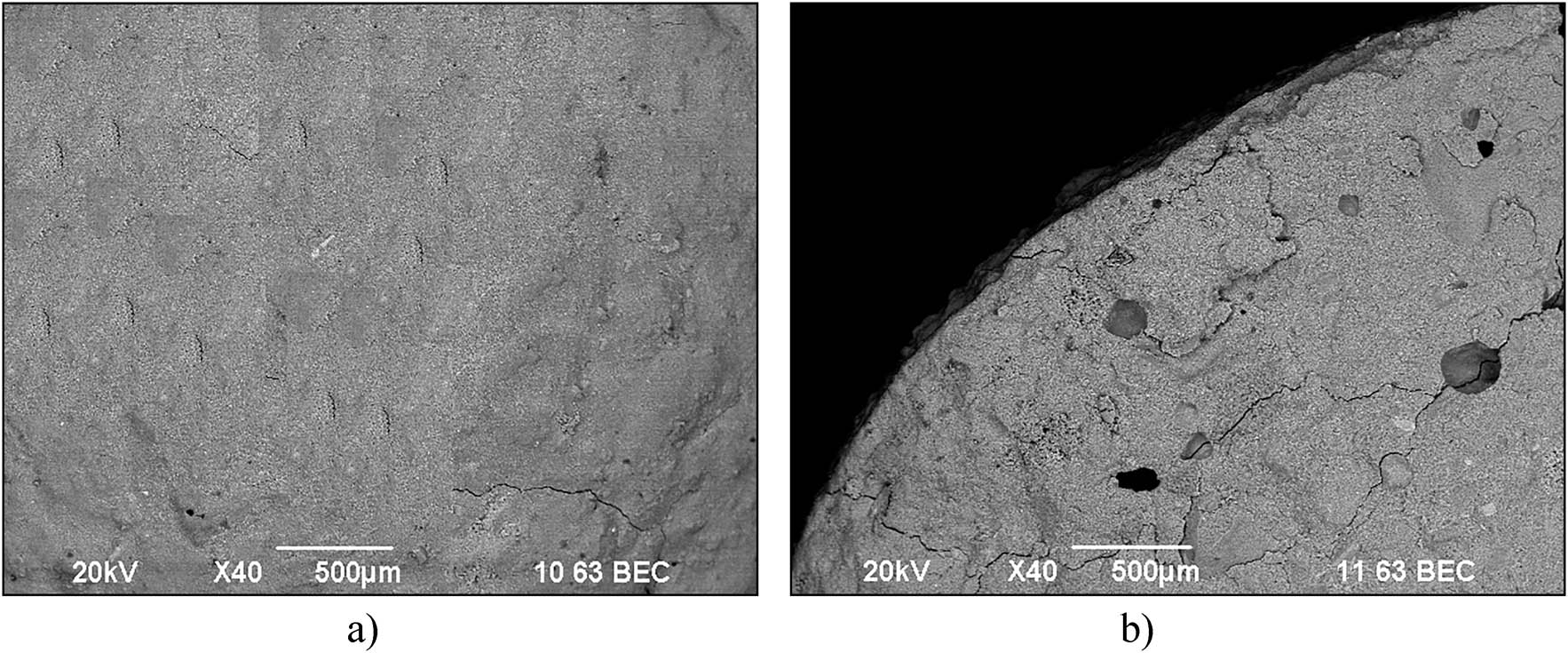
Microstructure (a) and a cut of the sample (b) of the encapsulated and granulated ammophos at 75°C in the presence of 0.5% water solution of MPAA.
Next, with an increase in the concentration to 0.75%, MPAA does not have a positive effect on the strength and decreases to 12.7 MPa in the temperature range of 25–75°C. With an increase in the concentration, the viscosity of the organic polymer increases, and further use is not favorable; that is, the consumption of the polymer increases, while the strength of the granules does not increase (Figure 8).

Derivatogram of the modified polymer MPAA.
4 Discussion
This work focuses on the evaluation of a new slow-release fertilizer encapsulated by a combination of CMC and HA. The purpose of this study was to study the release of essential plant nutrients: phosphorus, nitrogen, and potassium. This study investigated the material composition and nutrient release properties of a novel prolonged action fertilizer encapsulated by CMC and HA [20].
In this work, studies were conducted using a styrene–acrylic polymer as a capsulant in the form of an aqueous dispersion with the subsequent production of mineral fertilizers with different intensities of nutrient release, taking into account the biological requirements of agricultural crops [22].
The strength of conventional mineral fertilizers is from 2.0 to 3.5 MPa. The obtained encapsulated potassium humate differs from modern analogues in terms of high strength characteristics and durability. The encapsulated potassium humate’s strength is 17.3 kg. High strength has a positive effect on maintaining its granulometric composition and prolonged action use EPAN [23].
As a result of the synthesis, a useful model of a modified polymer based on polyacrylamide and fatty acids from gossypol resin in the presence of formalin for encapsulation of mineral fertilizers was obtained. When encapsulating granules of ammophos mineral fertilizers, a 0.5% aqueous solution of modified polyacrylamide was used at a temperature of 75°C, and the strength of the granule reached 18.4 MPa.
Encapsulated durable ammophos granules provide longer-term nutrition, that is, a slow, gradual release of plant nutrients into the soil. Also, the improved mechanical properties of ammophos have a positive effect on the efficiency of fertilizing. Thus, due to its greater strength, there is no dusting effect during use; it is better stored and is suitable for long-term storage. Because the granules are more durable, they are less susceptible to caking and crumbling.
5 Conclusions
A modified polymer based on polyacrylamide and gossypol resin was synthesized in the presence of formalin. A method for the synthesis of fatty acids from gossypol resin is presented, and the physicochemical properties of fatty acids for the synthesis of modified polymer are determined.
The elemental and structural features of the polyacrylamide, hydrolyzed polyacrylamide, and modified polyacrylamide were studied using a scanning electron microscope (JSM-6390LV) integrated with an Oxford INCA Energy energy-dispersive microanalyzer and an IR Fourier spectrometer (Zhimadzu IR Prestige-21) with an attenuated total internal reflection attachment (Miracle Pike Technologies). The rheological properties of MPAA were determined using a capillary viscometer VPL-3 with a caliber of 1.2 mm.
The optimal ratios of the starting raw materials were determined, and the synthesis of the modified polymer occurred at a temperature of T = 90°C for 120 min. The results of the experimental work were processed using the integrated programs Statistica-10 and show a 3D simulation of the process. A synthesized modified polymer based on polyacrylamide and gossypol resin was used for multi-purpose purposes [37,38]. Aqueous solutions with a concentration of 0.5% of the modified polymer were used in agrochemistry as an encapsulating reagent when encapsulating mineral fertilizer granules to impart strength to the granules [37,39].
-
Funding information: This research was funded by the Science Committee of the Ministry of Science and Higher Education of the Republic of Kazakhstan, Grant No. BR 21882181.
-
Author contributions: Bakyt Smailov: investigation, data writing – original draft preparation, writing – review and editing, funding acquisition, and project administration. Aziza Issa: conceptualization, validation, formal analysis, resources, software, and visualization. Oral Beisenbayev: methodology, validation, software, and supervision. All authors have read and agreed to the published version of the manuscript.
-
Conflict of interest: The authors state no conflict of interest.
-
Data availability statement: All data generated or analyzed during this study are included in this published article.
References
[1] Artykova ZhK, Beisenbayev OK, Kadyrov AA, Sakibayeva SA. Synthesis and preparation of polyacrylonitrile and vinyl sulfonic acid in the presence of gossypol resin for drilling fluids. Rasayan J Chem. 2023;16(4):2313–20. 10.31788/RJC.2023.1618497.Search in Google Scholar
[2] Gaillard N, Giovannetti B, Favero C. Improved oil recovery using thermally and chemically protected compositions based on co- and ter-polymers containing acrylamide. Paper presented at the SPE Improved Oil Recovery Symposium, Tulsa, Oklahoma, USA; April 2010. 10.2118/129756-MS.Search in Google Scholar
[3] Ye Z, Gou G, Gou S, Jiang W, Liu T. Synthesis and characterization of a water-soluble sulfonates copolymer of acrylamide and N-allylbenzamide as enhanced oil recovery chemical. J Appl Polym Sci. 2013;128(3):2003–11. 10.1002/app.38385.Search in Google Scholar
[4] Viken AL, Skauge T, Spildo K. Rheological properties of a hydrophobically modified anionic polymer: effect of varying salinity and amount of hydrophobic moieties. J Appl Polym Sci. 2016;133(23):914–21. 10.1002/app.43520.Search in Google Scholar
[5] Chen W, Li Q, Chen Y, Jian G, Wang CA. Development and performance of water soluble salt-resistant polymers for chemical flooding. Adv Mater Res. 2012;476:227–35. 10.4028/www.scientific.net/AMR.476-478.227.Search in Google Scholar
[6] Gao B, Jiang L, Kong D. Studies on rheological behaviour of hydrophobically associating polyacrylamide with strong positive salinity sensitivity. Colloid Polym Sci. 2007;41(8):839–46. 10.1007/s00396-006-1613-5.Search in Google Scholar
[7] Zhu Y, Lei M, Zhuoyan Z. Development and performance of salt-resistant polymers for chemical flooding. Paper presented at the SPE Middle East Oil & Gas Show and Conference, Manama, Bahrain; March 2015. SPE-172784-MS.10.2118/172784-MSSearch in Google Scholar
[8] Gao B, Jiang L, Kong D. Microstructure and association property of hydrophobically modified polyacrylamide of a new family. Eur Polym J. 2007;43(10):4530–40. 10.1016/j.eurpolymj.2007.03.049.Search in Google Scholar
[9] Beija M, Marty JD, Destarac M. RAFT/MADIX polymers for the preparation of polymer/inorganic nanohybrids. Prog Polym Sci. 2011;36(7):845–86. 10.1016/j.progpolymsci.2011.01.002.Search in Google Scholar
[10] Artykova Zh, Beisenbayev OK, Issa AB, Kydyraliyeva A. Modification of polymers to synthesize thermo-salt-resistant stabilizers of drilling fluids. Open Eng. 2025;15(1):20240097. 10.1515/eng-2024-0097.Search in Google Scholar
[11] Xu JG, Qiu Z, Zhao X. Hydrophobic modified polymer-based silica nanocomposite for improving shale stability in water-based drilling fluids. J Pet Sci Eng. 2017;157:33–8. 10.1016/j.petrol.2017.04.013.Search in Google Scholar
[12] Artykova ZK, Beisenbayev OK, Kadyrov AA, Sakibayeva SA, Smailov BM. Synthesis and preparation polyacrylonitrile and vinyl sulfonic acid in the presence of gossypol resin for drilling fluids. Rasayan J Chem. 2023;16(4):2313–20. 10.31788/RJC.2023.1618497.Search in Google Scholar
[13] Smailov B, Ismailov B, Zakirov B, Turakulov B, Tursynbay L, Aimenova Z. Study and mechanism of formation of phosphorus production waste in Kazakhstan. Green Process Synth. 2024;13:20240023. 10.1515/gps-2024-0023.Search in Google Scholar
[14] Smailov BM, Zharkinbekov MA, Tuleshova KT, Issabayev NN, Tleuov AS, Beisenbayev OK, et al. Kinetic research and mathematical planning on the obtaining of potassium humate from brown coal of the Lenger deposit. Rasayan J Chem. 2021;14(3):1899–905. 10.31788/RJC.2021.1436391.Search in Google Scholar
[15] Ismailov B, Zakirov B, Kadirbayeva A, Koshkarbayeva Sh, Smailov B, Azimov A. Methods for obtaining phosphorus-containing fertilizers based on industrial waste. Inorganics. 2023;11:224. inorganics11060224.Search in Google Scholar
[16] Wang S, Alagha L, Xu Z. Adsorption of organic–inorganic hybrid polymers on kaolin from aqueous solutions. Colloids Surf A: Physicochem Eng Asp. 2014;453:13–20. 0.1016/j.colsurfa.2014.03.069.Search in Google Scholar
[17] Zhu H, Luo J, Klaus O, Fan Y. The impact of extensional viscosity on oil displacement efficiency in polymer flooding. Colloids Surf A: Physicochem Eng Asp. 2012;414(5):498–503. 10.1016/j.colsurfa.2012.08.005.Search in Google Scholar
[18] Nadirov KS, Otarbaev NSh, Nadirov RK, Kapustin VM, Sadyrbaeva AS, Bimbetova GZh. Separation of free fatty acids from cotton tar. News Natl Acad Sci Repub Kazakhstan. 2019;4(438):70–8. 10.32014/2019.2518-170X.99.Search in Google Scholar
[19] Dodou K, Anderson RJ, Lough WJ, Small DAP, Shelley MD, Groundwater PW. Synthesis of gossypol atropisomers and derivatives and evaluation of their anti-proliferative and anti-oxidant activity. Bioorg Med Chem. 2005 Jul;13(13):4228–37. 10.1016/j.bmc.2005.04.026.Search in Google Scholar PubMed
[20] Ulzhalgas N, Saule N, Yerkebulan R, Maksat K, Perizat A. Prolonged action fertilizer encapsulated by CMC. e-Polymers. 2023;23:20230013. 10.1515/epoly-2023-0013.Search in Google Scholar
[21] Smailov BM, Aravind U. Synthesis of humic acid with the obtaining of potassium humate based on coal waste from the Lenger deposit, Kazakhstan. Green Process Synth. 2024;13:20230150. 10.1515/gps-2023-0150.Search in Google Scholar
[22] Smailov B, Aravind U, Kadirbayeva A, Sarypbekova N, Azimov A, Issabayev N. Synthesis of EPAN and applications in the encapsulation of potassium humate. Green Process Synth. 2024;13:20240004. 10.1515/gps-2024-0004.Search in Google Scholar
[23] Beysenbayev OK, Ahmedov UK, Issa AB, Smailov BM, Esirkepova MM, Artykova ZhK. Receiving and research of the mechanism of capsulation of superphosphate and double superphosphate for giving of strength properties. News Natl Acad Sci Repub Kazakhstan. 2019;6:36–45. 10.32014/2019.2518-170X.153.Search in Google Scholar
[24] Aboudzadeh MA, Hamzehlou S. Special issue on function of polymers in encapsulation process. Polymers. 2022;14(6):1178. 10.3390/polym14061178.Search in Google Scholar PubMed PubMed Central
[25] Beysenbayev OК, Tleuov AS, Smailov BM, Zakirov BS. Obtaining and research of physical and chemical properties of chelated polymer-containing microfertilizers on the basis of technogenic waste for rice seed biofortification. News Natl Acad Sci Repub Kazakhstan. 2019;438:80–9. 10.32014/2019.2518-170X.10.Search in Google Scholar
[26] Jonson B, Lindman B, Holmberg К. Surfactants and polymers in aqueous solutions. New York: Wiley; 2002. 10.1002/0470856424.Search in Google Scholar
[27] Jin H, Wang X, Yang H, He G, Li X, Guo X, et al. Preparation, characterization, and performance of a modified polyacrylamide-sericite gel. Materials. 2023;16(6):2524. 10.3390/ma16062524.Search in Google Scholar PubMed PubMed Central
[28] Silverstein RM, Kiemle DJ, Bryce Éditeur DL. Spectrometric identification of organic compounds. Elsevier; 2005. p. 464.Search in Google Scholar
[29] Pavia DL, Lampman GM, Kriz GS, Vyvyan JA. Introduction to spectroscopy. Cengage Learning. 2014;(5):784.Search in Google Scholar
[30] Zhu H, Luo J, Klaus O, Fan Y. The impact of extensional viscosity on oil displacement efficiency in polymer flooding. Colloids Surf A: Physicochem Eng Asp. 2012;414(5):498–503. 10.1016/j.colsurfa.2012.08.005.Search in Google Scholar
[31] Bittermann M, Grzelka M, Woutersen S, Brouwer AM, Bonn D. Disentangling nano- and macroscopic viscosities of aqueous polymer solutions using a fluorescent molecular rotor. J Phys Chem Lett. 2021;12(12):3182–6. 10.1021/acs.jpclett.1c00512.Search in Google Scholar PubMed PubMed Central
[32] Panwar P, Schweissinger E, Maier S, Hilf S, Sirak S, Martini A. Effect of polymer structure and chemistry on viscosity index, thickening efficiency, and traction coefficient of lubricants. J Mol Liq. 2022;359:119215. 10.1016/j.molliq.2022.119215.Search in Google Scholar
[33] Roine A. Outokumpu HSC-6 chemistry for Windows. Chemical reaction and equilibrium software with extensive thermochemical database. Pori: Outokumpu Research; 2016. Su D, Yang J, Liu S, Ren L, Qin S. Preparation of polyamide 12 powder for additive manufacturing applications via thermally induced phase separation. June 2022;22:553–65. 10.1515/epoly-2022-0050.10.1515/epoly-2022-0050Search in Google Scholar
[34] Smailov BM, Beisenbayev OK, Tleuov AS, Kadirbaeva AA, Zakirov BS, Mirzoyev B. Production of chelate polymer-containing microfertilizers based on humic acid and ammophos. Rasayan J Chem. 2020;13(3):1372–9. 10.31788/RJC.2020.1335726.Search in Google Scholar
[35] Smailov BM, Aravind U, Zakirov BS, Azimov AM, Tleuov AS, Beisenbayev OK, et al. Technology for obtaining chelated organic and mineral microfertilizers based on humate-containing components. Rasayan J Chem. 2023;16(1):428–33. 10.31788/RJC.2023.1618007.Search in Google Scholar
[36] Lipin A, Nebukin V, Lipin A. The encapsulation of granules in a polymer shells as a method of creation of mineral fertilizers with controlled speed of liberation of nutrients. Modern science-intensive technologies. Regional Suppl. 2017;3(51):86–91.Search in Google Scholar
[37] Ostroha R, Yukhymenko M, Lytvynenko O, Lytvynenko A. Production of encapsulated organo-mineral fertilizers in a fluidized bed granulator. Acta Mech Slov. 2020;24(2):50–5. 10.21496/ams.2020.031.Search in Google Scholar
[38] Abd El-Aziz M, Salama D, Morsi S, Youssef A, El-Sakhawy M. Development of polymer composites and encapsulation technology for slow-release fertilizers. Rev Chem Eng. 2022;38(5):603–16. 10.1515/revce-2020-0044.Search in Google Scholar
[39] Jíménez-Arias D, Morales-Sierra S, Silva P, Carrêlo H, Gonçalves A, Ganança JFT, et al. Encapsulation with natural polymers to improve the properties of biostimulants in agriculture. Plants. 2023;2(1):55. 10.3390/plants12010055.Search in Google Scholar PubMed PubMed Central
© 2025 the author(s), published by De Gruyter
This work is licensed under the Creative Commons Attribution 4.0 International License.
Articles in the same Issue
- Synthesis of N,S co-doped carbon quantum dots – metal complex for the detection of fluoride (F−) ion in adults and Children’s toothpastes
- Research Articles
- Optimized green synthesis of silver nanoparticles from guarana seed skin extract with antibacterial potential
- Green adsorbents for water remediation: Removal of Cr(vi) and Ni(ii) using Prosopis glandulosa sawdust and biochar
- Green approach for the synthesis of zinc oxide nanoparticles from methanolic stem extract of Andrographis paniculata and evaluation of antidiabetic activity: In silico GSK-3β analysis
- Development of a green and rapid ethanol-based HPLC assay for aspirin tablets and feasibility evaluation of domestically produced bioethanol in Thailand as a sustainable mobile phase
- A facile biodegradation of polystyrene microplastic by Bacillus subtilis
- Enhanced synthesis of fly ash-derived hydrated sodium silicate adsorbents via low-temperature alkaline hydrothermal treatment for advanced environmental applications
- Impact of metal nanoparticles biosynthesized using camel milk on bacterial growth and copper removal from wastewater
- Preparation of Co/Cr-MOFs for efficient removal of fleroxacin and Rhodamine B
- Applying nanocarbon prepared from coal as an anode in lithium-ion batteries
- Improved electrochemical synthesis of Cu–Fe/brass foil alloy followed by combustion for high-efficiency photoelectrodes and hydrogen production in alkaline solutions
- Precipitation of terephthalic acid from post-consumer polyethylene terephthalate waste fractions
- Biosynthesized zinc oxide nanoparticles: Multifunctional potential applications in anticancer, antibacterial, and B. subtilis DNA gyrase docking
- Anticancer and antimicrobial effects of green-synthesized silver nanoparticles using Teucrium polium leaves extract
- Green synthesis of eco-friendly bioplastics from Chlorella and Lithothamnion algae for safe and sustainable solutions for food packaging
- Optimizing coal water slurry concentration via synergistic coal blending and particle size distribution
- Green synthesis of Ag@Cu and silver nanowire using Pterospermum heterophyllum extracts for surface-enhanced Raman scattering
- Green synthesis of copper oxide nanoparticles from Algerian propolis: Exploring biochemical, structural, antimicrobial, and anti-diabetic properties
- Simultaneous quantification of mefenamic acid and paracetamol in fixed-dose combination tablet dosage forms using the green HPTLC method
- Green synthesis of titanium dioxide nanoparticles using green tea (Camellia sinensis) extract: Characteristics and applications
- Pharmaceutical properties for green fabricated ZnO and Ag nanoparticle-mediated Borago officinalis: In silico predications study
- Synthesis and optimization of gemcitabine-loaded nanoparticles by using Box–Behnken design for treating prostate cancer: In vitro characterization and in vivo pharmacokinetic study
- A comparative analysis of single-step and multi-step methods for producing magnetic activated carbon from palm kernel shells: Adsorption of methyl orange dye
- Sustainable green synthesis of silver nanoparticles using walnut septum waste: Characterization and antibacterial properties
- Efficient electrocatalytic reduction of CO2 to CO over Ni/Y diatomic catalysts
- Greener and magnetic Fe3O4 nanoparticles as a recyclable catalyst for Knoevenagel condensation and degradation of industrial Congo red dye
- Recycling of HDPE-giant reed composites: Processability and performance
- Fabrication of antibacterial chitosan/PVA nanofibers co-loaded with curcumin and cefadroxil for wound healing
- Cost-effective one-pot fabrication of iron(iii) oxychloride–iron(iii) oxide nanomaterials for supercapacitor charge storage
- Novel trimetallic (TiO2–MgO–Au) nanoparticles: Biosynthesis, characterization, antimicrobial, and anticancer activities
- Green-synthesized chromium oxide nanoparticles using pomegranate husk extract: Multifunctional bioactivity in antioxidant potential, lipase and amylase inhibition, and cytotoxicity
- Therapeutic potential of sustainable zinc oxide nanoparticles biosynthesized using Tradescantia spathacea aqueous leaf extract
- Chitosan-coated superparamagnetic iron oxide nanoparticles synthesized using Carica papaya bark extract: Evaluation of antioxidant, antibacterial, and anticancer activity of HeLa cervical cancer cells
- Antioxidant potential of peptide fractions from tuna dark muscle protein isolate: A green enzymatic approach
- Clerodendron phlomoides leaf extract-mediated synthesis of selenium nanoparticles for multi-applications
- Optimization of cellulose yield from oil palm trunks with deep eutectic solvents using response surface methodology
- Nitrogen-doped carbon dots from Brahmi (Bacopa monnieri): Metal-free probe for efficient detection of metal pollutants and methylene blue dye degradation
- High energy density pseudocapacitor based on a nanoporous tungsten(VI) oxide iodide/poly(2-amino-1-mercaptobenzene) composite
- Green synthesized Ag–Cu nanocomposites as an improved strategy to fight multidrug-resistant bacteria by inhibition of biofilm formation: In vitro and in silico assessment study
- In vitro evaluation of antibacterial activity and associated cytotoxicity of biogenic silver nanoparticles using various extracts of Tabernaemontana ventricosa
- Fabrication of novel composite materials by impregnating ZnO particles into bacterial cellulose nanofibers for antimicrobial applications
- Solidification floating organic drop for dispersive liquid–liquid microextraction estimation of copper in different water samples
- Kinetics and synthesis of formation of phosphate composites from low-grade phosphorites in the presence of phosphate–siliceous shales and oil sludge
- Removal of minocycline and terramycin by graphene oxide and Cr/Mn base metal–organic framework composites
- Microfluidic preparation of ceramide E liposomes and properties
- Therapeutic potential of Anamirta cocculus (L.) Wight & Arn. leaf aqueous extract-mediated biogenic gold nanoparticles
- Antioxidant-rich Micromeria imbricata leaf extract as a medium for the eco-friendly preparation of silver-doped zinc oxide nanoparticles with antibacterial properties
- Influence of different colors with light regime on Chlorella sp., biomass, pigments, and lipids quantity and quality
- Experimental vibrational analysis of natural fiber composite reinforced with waste materials for energy absorbing applications
- Green synthesis of sea buckthorn-mediated ZnO nanoparticles: Biological applications and acute nanotoxicity studies
- Production of liquid smoke by consecutive electroporation and microwave-assisted pyrolysis of empty fruit bunches
- Synthesis of MPAA based on polyacrylamide and gossypol resin and applications in the encapsulation of ammophos
- Application of iron-based catalysts in the microwave treatment of environmental pollutants
- Enhanced adsorption of Cu(ii) from wastewater using potassium humate-modified coconut husk biochar
- Adsorption of heavy metal ions from water by Fe3O4 nano-particles
- Green synthesis of parsley-derived silver nanoparticles and their enhanced antimicrobial and antioxidant effects against foodborne resistant bacteria
- Unwrapping the phytofabrication of bimetallic silver–selenium nanoparticles: Antibacterial, Anti-virulence (Targeting magA and toxA genes), anti-diabetic, antioxidant, anti-ovarian, and anti-prostate cancer activities
- Optimizing ultrasound-assisted extraction process of anti-inflammatory ingredients from Launaea sarmentosa: A novel approach
- Eggshell membranes as green carriers for Burkholderia cepacia lipase: A biocatalytic strategy for sustainable wastewater bioremediation
- Research progress of deep eutectic solvents in fuel desulfurization
- Enhanced electrochemical synthesis of Ni–Fe/brass foil alloy with subsequent combustion for high-performance photoelectrode and hydrogen production applications
- Valorization of baobab fruit shell as a filler fiber for enhanced polyethylene degradation and soil fertility
- Valorization of Agave durangensis bagasse for cardboard-type paper production circular economy approach
- Green priming strategies using seaweed extract and citric acid to improve early growth and antioxidant activity in lentil
- Gold extraction from oxide ore using iron ion-thiourea-additive
- Development of loess-derived P-type molecular sieve as a sustainable antibacterial agent
- Review Article
- Sustainable innovations in garlic extraction: A comprehensive review and bibliometric analysis of green extraction methods
- Natural sustainable coatings for marine applications: advances, challenges, and future perspectives
- Integration of traditional medicinal plants with polymeric nanofibers for wound healing
- Rapid Communication
- In situ supported rhodium catalyst on mesoporous silica for chemoselective hydrogenation of nitriles to primary amines
- Special Issue: Valorisation of Biowaste to Nanomaterials for Environmental Applications
- Valorization of coconut husk into biochar for lead (Pb2+) adsorption
- Corrigendum
- Corrigendum to “An updated review on carbon nanomaterials: Types, synthesis, functionalization and applications, degradation and toxicity”
Articles in the same Issue
- Synthesis of N,S co-doped carbon quantum dots – metal complex for the detection of fluoride (F−) ion in adults and Children’s toothpastes
- Research Articles
- Optimized green synthesis of silver nanoparticles from guarana seed skin extract with antibacterial potential
- Green adsorbents for water remediation: Removal of Cr(vi) and Ni(ii) using Prosopis glandulosa sawdust and biochar
- Green approach for the synthesis of zinc oxide nanoparticles from methanolic stem extract of Andrographis paniculata and evaluation of antidiabetic activity: In silico GSK-3β analysis
- Development of a green and rapid ethanol-based HPLC assay for aspirin tablets and feasibility evaluation of domestically produced bioethanol in Thailand as a sustainable mobile phase
- A facile biodegradation of polystyrene microplastic by Bacillus subtilis
- Enhanced synthesis of fly ash-derived hydrated sodium silicate adsorbents via low-temperature alkaline hydrothermal treatment for advanced environmental applications
- Impact of metal nanoparticles biosynthesized using camel milk on bacterial growth and copper removal from wastewater
- Preparation of Co/Cr-MOFs for efficient removal of fleroxacin and Rhodamine B
- Applying nanocarbon prepared from coal as an anode in lithium-ion batteries
- Improved electrochemical synthesis of Cu–Fe/brass foil alloy followed by combustion for high-efficiency photoelectrodes and hydrogen production in alkaline solutions
- Precipitation of terephthalic acid from post-consumer polyethylene terephthalate waste fractions
- Biosynthesized zinc oxide nanoparticles: Multifunctional potential applications in anticancer, antibacterial, and B. subtilis DNA gyrase docking
- Anticancer and antimicrobial effects of green-synthesized silver nanoparticles using Teucrium polium leaves extract
- Green synthesis of eco-friendly bioplastics from Chlorella and Lithothamnion algae for safe and sustainable solutions for food packaging
- Optimizing coal water slurry concentration via synergistic coal blending and particle size distribution
- Green synthesis of Ag@Cu and silver nanowire using Pterospermum heterophyllum extracts for surface-enhanced Raman scattering
- Green synthesis of copper oxide nanoparticles from Algerian propolis: Exploring biochemical, structural, antimicrobial, and anti-diabetic properties
- Simultaneous quantification of mefenamic acid and paracetamol in fixed-dose combination tablet dosage forms using the green HPTLC method
- Green synthesis of titanium dioxide nanoparticles using green tea (Camellia sinensis) extract: Characteristics and applications
- Pharmaceutical properties for green fabricated ZnO and Ag nanoparticle-mediated Borago officinalis: In silico predications study
- Synthesis and optimization of gemcitabine-loaded nanoparticles by using Box–Behnken design for treating prostate cancer: In vitro characterization and in vivo pharmacokinetic study
- A comparative analysis of single-step and multi-step methods for producing magnetic activated carbon from palm kernel shells: Adsorption of methyl orange dye
- Sustainable green synthesis of silver nanoparticles using walnut septum waste: Characterization and antibacterial properties
- Efficient electrocatalytic reduction of CO2 to CO over Ni/Y diatomic catalysts
- Greener and magnetic Fe3O4 nanoparticles as a recyclable catalyst for Knoevenagel condensation and degradation of industrial Congo red dye
- Recycling of HDPE-giant reed composites: Processability and performance
- Fabrication of antibacterial chitosan/PVA nanofibers co-loaded with curcumin and cefadroxil for wound healing
- Cost-effective one-pot fabrication of iron(iii) oxychloride–iron(iii) oxide nanomaterials for supercapacitor charge storage
- Novel trimetallic (TiO2–MgO–Au) nanoparticles: Biosynthesis, characterization, antimicrobial, and anticancer activities
- Green-synthesized chromium oxide nanoparticles using pomegranate husk extract: Multifunctional bioactivity in antioxidant potential, lipase and amylase inhibition, and cytotoxicity
- Therapeutic potential of sustainable zinc oxide nanoparticles biosynthesized using Tradescantia spathacea aqueous leaf extract
- Chitosan-coated superparamagnetic iron oxide nanoparticles synthesized using Carica papaya bark extract: Evaluation of antioxidant, antibacterial, and anticancer activity of HeLa cervical cancer cells
- Antioxidant potential of peptide fractions from tuna dark muscle protein isolate: A green enzymatic approach
- Clerodendron phlomoides leaf extract-mediated synthesis of selenium nanoparticles for multi-applications
- Optimization of cellulose yield from oil palm trunks with deep eutectic solvents using response surface methodology
- Nitrogen-doped carbon dots from Brahmi (Bacopa monnieri): Metal-free probe for efficient detection of metal pollutants and methylene blue dye degradation
- High energy density pseudocapacitor based on a nanoporous tungsten(VI) oxide iodide/poly(2-amino-1-mercaptobenzene) composite
- Green synthesized Ag–Cu nanocomposites as an improved strategy to fight multidrug-resistant bacteria by inhibition of biofilm formation: In vitro and in silico assessment study
- In vitro evaluation of antibacterial activity and associated cytotoxicity of biogenic silver nanoparticles using various extracts of Tabernaemontana ventricosa
- Fabrication of novel composite materials by impregnating ZnO particles into bacterial cellulose nanofibers for antimicrobial applications
- Solidification floating organic drop for dispersive liquid–liquid microextraction estimation of copper in different water samples
- Kinetics and synthesis of formation of phosphate composites from low-grade phosphorites in the presence of phosphate–siliceous shales and oil sludge
- Removal of minocycline and terramycin by graphene oxide and Cr/Mn base metal–organic framework composites
- Microfluidic preparation of ceramide E liposomes and properties
- Therapeutic potential of Anamirta cocculus (L.) Wight & Arn. leaf aqueous extract-mediated biogenic gold nanoparticles
- Antioxidant-rich Micromeria imbricata leaf extract as a medium for the eco-friendly preparation of silver-doped zinc oxide nanoparticles with antibacterial properties
- Influence of different colors with light regime on Chlorella sp., biomass, pigments, and lipids quantity and quality
- Experimental vibrational analysis of natural fiber composite reinforced with waste materials for energy absorbing applications
- Green synthesis of sea buckthorn-mediated ZnO nanoparticles: Biological applications and acute nanotoxicity studies
- Production of liquid smoke by consecutive electroporation and microwave-assisted pyrolysis of empty fruit bunches
- Synthesis of MPAA based on polyacrylamide and gossypol resin and applications in the encapsulation of ammophos
- Application of iron-based catalysts in the microwave treatment of environmental pollutants
- Enhanced adsorption of Cu(ii) from wastewater using potassium humate-modified coconut husk biochar
- Adsorption of heavy metal ions from water by Fe3O4 nano-particles
- Green synthesis of parsley-derived silver nanoparticles and their enhanced antimicrobial and antioxidant effects against foodborne resistant bacteria
- Unwrapping the phytofabrication of bimetallic silver–selenium nanoparticles: Antibacterial, Anti-virulence (Targeting magA and toxA genes), anti-diabetic, antioxidant, anti-ovarian, and anti-prostate cancer activities
- Optimizing ultrasound-assisted extraction process of anti-inflammatory ingredients from Launaea sarmentosa: A novel approach
- Eggshell membranes as green carriers for Burkholderia cepacia lipase: A biocatalytic strategy for sustainable wastewater bioremediation
- Research progress of deep eutectic solvents in fuel desulfurization
- Enhanced electrochemical synthesis of Ni–Fe/brass foil alloy with subsequent combustion for high-performance photoelectrode and hydrogen production applications
- Valorization of baobab fruit shell as a filler fiber for enhanced polyethylene degradation and soil fertility
- Valorization of Agave durangensis bagasse for cardboard-type paper production circular economy approach
- Green priming strategies using seaweed extract and citric acid to improve early growth and antioxidant activity in lentil
- Gold extraction from oxide ore using iron ion-thiourea-additive
- Development of loess-derived P-type molecular sieve as a sustainable antibacterial agent
- Review Article
- Sustainable innovations in garlic extraction: A comprehensive review and bibliometric analysis of green extraction methods
- Natural sustainable coatings for marine applications: advances, challenges, and future perspectives
- Integration of traditional medicinal plants with polymeric nanofibers for wound healing
- Rapid Communication
- In situ supported rhodium catalyst on mesoporous silica for chemoselective hydrogenation of nitriles to primary amines
- Special Issue: Valorisation of Biowaste to Nanomaterials for Environmental Applications
- Valorization of coconut husk into biochar for lead (Pb2+) adsorption
- Corrigendum
- Corrigendum to “An updated review on carbon nanomaterials: Types, synthesis, functionalization and applications, degradation and toxicity”
