Hydrogen bonding in the crystal structure of nicotin-1,1′-dium tetrabromidomanganate(II)
-
Guido J. Reiss

 und
Marie Barbara Wolke
und
Marie Barbara Wolke

Abstract
C10H16Br4MnN2 monoclinic, P21 (no. 4), a = 7.4144(4) Å, b = 13.7490(8) Å, c = 8.3011(5) Å, β = 96.209(4)°, Z = 2, V = 841.26(8) Å3, Rgt(F) = 0.0458, wRref = 0.1245, Flack–Parsons-parameter: −0.02(2) [6], T = 293(2) K.
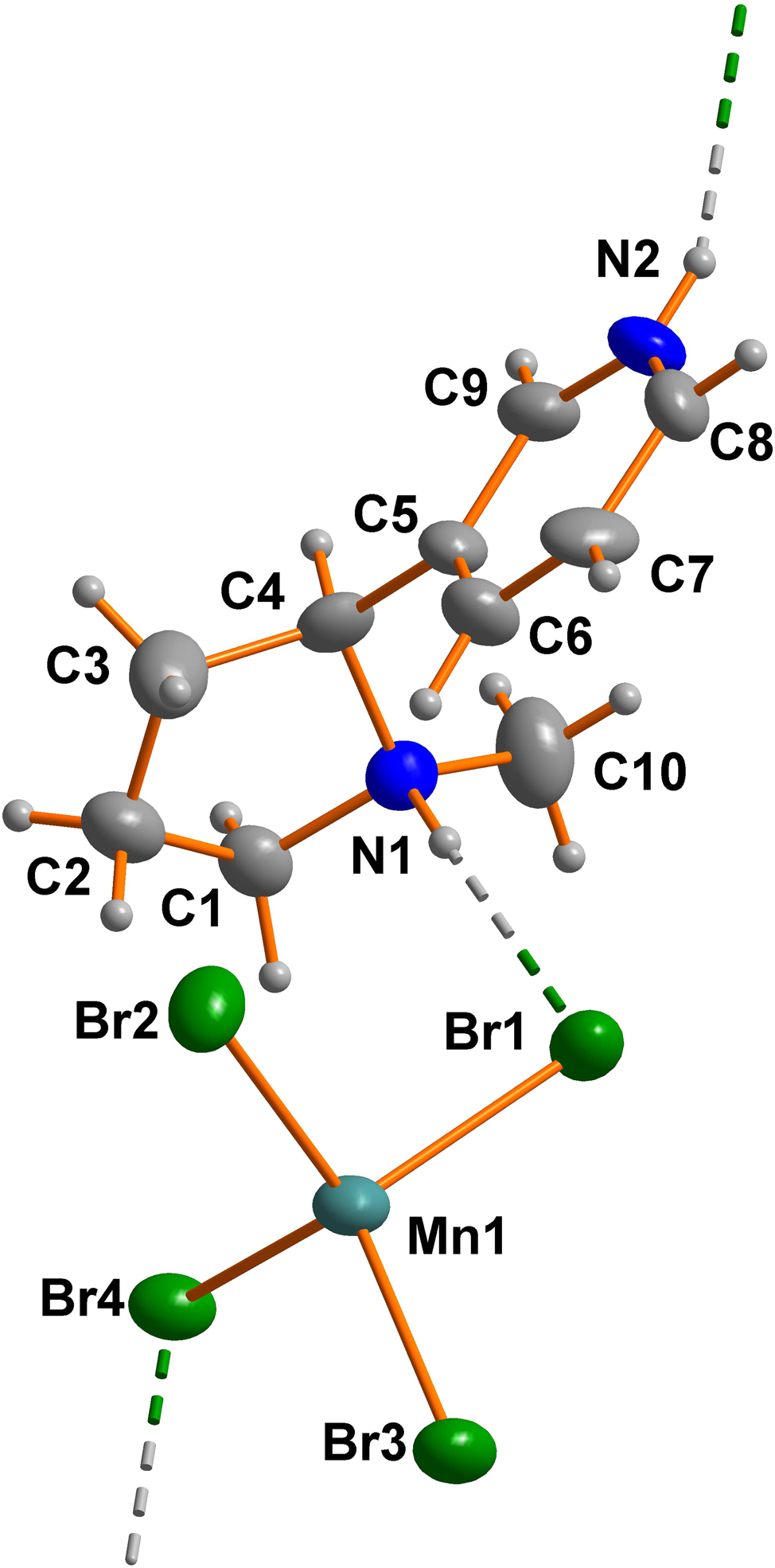
A selected region of the hydrogen bonded chained title crystal structure is shown in the figure.
Table 1 containing crystallographic data and the list of the atoms including atomic coordinates and displacement parameters can be found in the cif-file attached to this article.
Data collection and handling.
| Crystal: | yellow-orange blocks |
| Size: | 0.20 × 0.25 × 0.30 mm |
| Wavelength: | Mo Kα radiation (0.71073 Å) |
| μ: | 10.3 mm−1 |
| Diffractometer, scan mode: | STOE IPDS-2T, φ and ω scans |
| θmax, completeness: | 27.5°, 99 % |
| N(hkl)measured, N(hkl)unique, Rint: | 8179, 3843, 0.093 |
| Criterion for Iobs, N(hkl)gt: | Iobs > 2 σ(Iobs), 3,482 |
| N(param)refined: | 162 |
| Programs: | STOE, 1 SHELX, 2 , 3 ShelXle, 4 Diamond 5 |
1 Source of material
All reagents were obtained from commercial suppliers and used without further purification. The title compound was synthesized by dissolving nicotine in an aqueous solution of manganese(II) bromide prepared using concentrated hydrobromic acid (48 % HBr). The mixture was briefly heated to ensure complete dissolution of the nicotine. Upon standing at ambient temperature, orange block crystals of the title compound nicotin-1,1-dium tetrachloridomanganate(II) (systematic name: 3-((1R,2S)-1-methylpyrrolidin-1-ium-2-yl)pyridin-1-ium) tetrachloridomanganate(II) formed over the course of several days.
2 Experimental details
A crystal of the title compound was directly selected from the mother liquor and transferred to an IPDS-2T two-circle diffractometer. 1 An absorption correction (Multi–Scan method) was applied. 1
The structure solution and the refinement were successfully carried out using the SHELX program system. 3 , 4 , 5
All hydrogen atoms were seen in the difference electron density map after all non-hydrogen atoms were located. The figure was created using the Diamond software. 6
3 Introduction
A recent survey of the Cambridge Structural Database (CSD) 7 identified over 2 crystal structures containing doubly protonated nicotine. As previously reported and summarized by one of the authors, 8 structural data are also available for (a) metal complexes incorporating neutral nicotine ligands (b) a small number of co-crystals where nicotine is present as a neutral component (c) several pyrrolidinyl-monoprotonated nicotinium salts and (d) mono-protonated nicotinium acting as a cationic ligand. A recent report discusses the stabilization of [Pb3I11]5−-clusters and [PbI3]−-polymers by protonated nicotinium cations. 9 This work is part of our ongoing research into the synthesis, structural characterization, and hydrogen-bonding patterns in salts derived from natural products such as nicotine, 10 , 11 as well as other commonly used everyday drugs. 13 , 14
4 Molecular structure description
The asymmetric unit of the reported structure contains one nicotin-1,1′-dium dication (3-((1R,2S)-1-methylpyrrolidin-1-ium-2-yl)pyridin-1-ium, abbreviated as nicH2+) and one tetrabromidomanganate(II) dianion (see the figure). As discussed in previous studies, 8 , 10 , 11 , 12 protonation at the nitrogen atom of the pyrrolidinyl ring introduces a second chiral center at N1 (see the figure), which consistently adopts the R configuration in all reliable entries in the Cambridge Structural Database. 7 The four carbon atoms of the pyrrolidinyl ring (C1–C4) of the nicH2+ dication are nearly planar, with a root-mean-square deviation (RMSD) of 0.021 Å, while the N1 atom is displaced by 0.56(2) Å from this plane. The defined plane formed by C1–C4 shows an angle of 66.0(6)° with the mean plane of the pyridinylium moiety (see the figure). The bond lengths and angles within the nicH2+ dication 8 , 10 , 11 as well as in the [MnBr4]2− anion 15 , 16 are within the expected ranges. In detail the Mn–Br bond lengths in the complex are consistent, ranging from 2.498(2) Å to 2.514(2) Å.
5 Supramolecular aspects
The nicH2+ dication participates in two N–H⋯Br hydrogen bonds that connects the cation to two neighboring [MnBr4]2− anions [N1⋯Br1 = 3.241(11) Å N2…Br4# = 3.368(11) Å(# = x-1, y, z+1)]. By this connection a hydrogen bonded chain along [10–1] is created (see the figure).
Acknowledgements
We thank Eleonore Hammes for the data collection using the STOE–IPDS2T diffractometer.
-
Conflict of interest: The authors declare no conflicts of interest regarding this article.
-
Author contribution: Both authors have accepted responsibility for the entire content of this submitted manuscript and approved submission.
References
1. STOE et Cie., X–Area–Software: Darmstadt, 2012.Suche in Google Scholar
2. Sheldrick, G. M. A Short History of SHELX. Acta Crystallogr. 2008, A64, 112–122. https://doi.org/10.1107/S0108767307043930.Suche in Google Scholar PubMed
3. Sheldrick, G. M. Crystal Structure Refinement with SHELXL. Acta Crystallogr. 2015, C71, 3–8. https://doi.org/10.1107/S2053229614024218.Suche in Google Scholar PubMed PubMed Central
4. Hübschle, C. B.; Sheldrick, G. M.; Dittrich, B. ShelXle: A Qt Graphical User Interface for SHELXL. J. Appl. Crystallogr. 2011, 44, 1281–1284. https://doi.org/10.1107/S0021889811043202.Suche in Google Scholar PubMed PubMed Central
5. Brandenburg, K. DIAMOND. Visual Crystal Structure Information System. Ver. 4.5.2; Crystal Impact: Bonn, Germany, 2018.Suche in Google Scholar
6. Parsons, S.; Flack, H. D.; Wagner, T. Use of Intensity Quotients and Differences in Absolute Structure Refinement. Acta Crystallogr. 2013, B69, 249–259. https://doi.org/10.1107/S2052519213010014.Suche in Google Scholar PubMed PubMed Central
7. Groom, C. R.; Allen, F. H. The Cambridge Structural Database in Retrospect and Prospect. Angew. Chem. Int. Ed. 2014, 53, 662–671. https://doi.org/10.1002/anie.201306438.Suche in Google Scholar PubMed
8. Reiss, G. J. The Crystal Structure of 3-((1R,2S)-1-Methylpyrrolidin-1-ium-2-yl)pyridin-1-ium tetrachloridomanganate(II), C10H16Cl4MnN2. Z. Kristallogr. – N. Cryst. Struct. 2020, 235, 415–417. https://doi.org/10.1515/ncrs-2019–0717.10.1515/ncrs-2019-0717Suche in Google Scholar
9. Fletcher, J. D.; Nag, J.; Yazdaanpanah, R.; Sarker, S.; Kulkarni, S.; Gilley, I. W.; Aydin, K.; Gopalan, V.; Kanatzidis, M. G. Mixed 1D/0D Structures of Chiral Hybrid Lead Halides with an l–Nicotinium Spacer Exhibit Broadband Photoluminescence and Polarized Emission. J. Am. Chem. Soc. 2025, 147, 8820–8831. https://doi.org/10.1021/jacs.5c00234.Suche in Google Scholar PubMed
10. Reiss, G. J.; Sergeeva, A. The Crystal Structure of 3-((1R,2S)-1-Methylpyrrolidin-1-ium-2-yl)pyridin-1-ium tetrachloridocobaltate(II) Monohydrate, C10H18Cl4CoN2O. Z. Kristallogr. – N. Cryst. Struct. 2017, 232, 159–161. https://doi.org/10.1515/ncrs-2016–0245.10.1515/ncrs-2016-0245Suche in Google Scholar
11. Reiss, G. J. I5-Polymers with a Layered Arrangement: Synthesis, Spectroscopy and Structure of a New Polyiodide Salt in the Nicotine/HI/I2 System. Z. Naturforsch. 2015, B70, 735–739. https://doi.org/10.1515/znb-2015–0092.10.1515/znb-2015-0092Suche in Google Scholar
12. Reiss, G. J.; Wyshusek, M.; Rheinländer, J. C.; Konovalova, I. S. Hydrogen Bonding and π-Halogen Interactions in the Crystal Structure of Bis(Theophyllinium) Hexachloridoplatinate(IV) Monohydrate. Z. Kristallogr. – N. Cryst. Struct. 2024, 239, 813–816. https://doi.org/10.1515/ncrs-2024–0206.10.1515/ncrs-2024-0206Suche in Google Scholar
13. Konovalova, I. S.; Shishkina, S. V.; Wyshusek, M.; Patzer, M.; Reiss, G. J. Supramolecular Architecture of Theophylline Polymorphs, Monohydrate and Co-crystals with Iodine: Study from the Energetic Viewpoint. RSC Adv. 2024, 14, 29774–29788. https://doi.org/10.1039/d4ra04368e.Suche in Google Scholar PubMed PubMed Central
14. Reiss, G. J. A Cyclic I102− Anion in the Layered Crystal Structure of Theophyllinium Pentaiodide, C7H9I5N4O2. Z. Kristallogr. – N. Cryst. Struct. 2019, 234, 737–739. https://doi.org/10.1515/ncrs-2019–0082.10.1515/ncrs-2019-0082Suche in Google Scholar
15. Rok, M.; Zarychta, B.; Janicki, R.; Witwicki, M.; Bieńko, A.; Bator, G. Dielectric–Optical Switches: Photoluminescent, EPR, and Magnetic Studies on Organic–Inorganic Hybrid (Azetidinium)2 MnBr4. Inorg. Chem. 2022, 61, 5626–5636. https://doi.org/10.1021/acs.inorgchem.2c00363.Suche in Google Scholar PubMed PubMed Central
16. Mao, L.; Guo, P.; Wang, S.; Cheetham, A. K.; Seshadri, R. Design Principles for Enhancing Photoluminescence Quantum Yield in Hybrid Manganese Bromides. J. Am. Chem. Soc. 2020, 142, 13582–13589. https://doi.org/10.1021/jacs.0c06039.Suche in Google Scholar PubMed
© 2025 the author(s), published by De Gruyter, Berlin/Boston
This work is licensed under the Creative Commons Attribution 4.0 International License.
Artikel in diesem Heft
- Frontmatter
- New Crystal Structures
- Crystal structure of (S)-N-(10-((2,2-dimethoxyethyl)amino)-1,2,3-trimethoxy-9-oxo-5,6,7,9-tetrahydrobenzo[a]heptalen-7-yl)acetamide, C25H32N2O7
- The crystal structure of 6,6′-difluoro-3,3′-dimethyl-5,5′-di(10H-phenoxazin-10-yl)- [1,1′-biphenyl]-2,2′-dicarbonitrile, C40H24F2N4O2
- Crystal structure of poly[(di-ethylenediamine-κ2N,N′)cadmium(II) tetradedocyloxidohexavanadate] (V4+/V5+ = 2/1), C4H16CdN4O14V6
- The crystal structure of poly[bis(dimethylformamide-κ1N)-(μ4-2′,3,3″,5′-tetrakis(trifluoromethyl)-[1,1′:4′,1″-terphenyl]-4,4″-dicarboxylato-κ4 O,O′: O″,O‴)dicadmium(II)], C27H15CdF12NO5
- Crystal structure of bis(μ2-ferrocenylcarboxylato-O,O′)-(μ3-oxido-κ3O:O:O)-bis(μ2-salicyladoximato-κ2N,O,O′)-(μ2-isopropoxo)-tris(isopropoxy-κ1O trititanium(IV)), C48H55N2O13Fe2Ti3
- Crystal structure of 3-(diethylamino)-7,9,11-trimethyl-8-phenyl-6H,13H-12λ4,13λ4-chromeno[3′,4′:4,5]pyrrolo[1,2-c]pyrrolo[2,1-f][1,3,2]diazaborinin-6-one, C28H26BF2N3O2
- The crystal structure of catena-poly[aqua-μ2-2-nitro-benzene-1,3-dicarboxylato-κ2O,O′)-(1,10-phenanthroline-κ2N,N′)-zinc(II)], C20H13N3O7Zn
- Crystal structure of poly[diaqua-{μ3-1-(3-carboxylatophenyl)-4-oxo-1,4-dihydropyridazine-3-carboxylato-κ4O,O′:O′′:O′′′′}manganese(II)] hydrate
- Crystal structure of N′-((1-hydroxycyclohexyl)(phenyl)methyl)-2-methoxybenzohydrazide methanol solvate, C22H28N2O4
- The cocrystal of caffeic acid — progesterone — water (1/2/1), C51H70O9
- Crystal structure of (((oxido(quinolin-6-yl)methoxy)triphenyl-λ5-stibanyl)oxy)(quinolin-7-yl)methanolate
- Crystal structure of [(E)-6′-(diethylamino)-2-(2-(((E)-pyren-1-ylmethylene)amino)ethyl)-4′-(2-((E)-1,3,3-trimethylindolin-2-ylidene)ethylidene)-1′,2′,3′,4′-tetrahydrospiro[isoindoline-1,9′-xanthen]-3-one]-methanol, solvate C57H56N4O3
- The crystal structure of 1-(acridin-9-yl)pyrrolidine-2,5-dione, C17H22N2O2
- Crystal structure of N-(4-acetylphenyl)-2-(6-methoxynaphthalen-2-yl)propanamide, C22H21NO3
- The crystal structure of 5,10,15,20-tetrakis(4-(1H-1,2,4-triazol-1-yl)phenyl)porphyrin, C52H34N16
- Crystal structure of hexacarbonyl-μ2-[phenylmethanedithiolato-κ4S:S,S′:S′]diiron (Fe–Fe) C13H6Fe2O6S2
- Crystal structure of diiodo-bis(1-((2-propyl-1H-benzo[d]imidazol-1-yl)methyl)-1H-benzo[d][1,2,3]triazole-κ1N)cadmium(II), C34H34CdI2N10
- Crystal structure of (E)-(3-(3-bromophenyl)acryloyl)ferrocene, C19H15BrFeO
- Crystal structure of catena-poly(μ2-6-chloropyridine-2-carboxylato-κ3N,O:O′)(6-chloropyridine-2-carboxylato-κ2O,N)copper(II), C12H6Cl2N2O4Cu
- Crystal structure of poly[diaqua-μ 3-(5-(3,5-dicarboxy-2,4,6-trimethylbenzyl)-2,4,6-trimethylisophthalato)-κ 6O,O′:O″,O‴:O‴′,O‴″) terbium(III)-monohydrate], C23H28TbO12
- Crystal structure of (E)-2-(((5-chloro-3-methyl-1-phenyl-1H-pyrazol-4-yl)methylene)amino)-3′,6′-dihydroxyspiro[isoindoline-1,9′-xanthen]-3-one – ethanol (1/2), C35H33ClN4O6
- The crystal structure of 3-(5-amino-3-phenylisoxazol-4-yl)-4-chloro-3-hydroxyindolin-2-one, C17H12ClN3O3
- The crystal structure of dimethylammonium 4-[2-(4-fluorophenyl)-4, 5-diphenyl-1H-imidazol-1-yl]benzenesulfonate, C29H26FN3O3S
- Crystal structure of (R)-2-ammonio-3-((5-carboxypentyl)thio)propanoate
- Crystal structure of 4-cyclohexyl-5-(thiophen-2-yl)-2,4-dihydro-3H-1,2,4-triazole-3-thione, C12H15N3S2
- The crystal structure of 4,6-bis(dimethylamino)-2-fluoroisophthalonitrile, C12H13FN4
- Hydrogen bonding in the crystal structure of nicotin-1,1′-dium tetrabromidomanganate(II)
- The crystal structure of bis(2-bromobenzyl)(2-((2-oxybenzylidene)amino)-4-methylpentanoato-κ3N, O,O′)tin(IV), C27H27Br2NO3Sn
- Crystal structure of (E)-(3-(p-tolyl)acryloyl)ferrocene, C20H18FeO
- Crystal structure of (E)-7-fluoro-2-((5-(4-methylpiperazin-1-yl)pyridin-2-yl)methylene)-3,4-dihydronaphthalen-1(2H)-one, C21H22FN3O
- Crystal structure of (E)-7-methoxy-2-((5-(4-methylpiperazin-1-yl)pyridin-2-yl)methylene)-3,4-dihydronaphthalen-1(2H)-one, C22H25N3O2
- The crystal structure of poly(bis(μ2-1,3,5-tri(1H-imidazol-1-yl)benzene-κ2N:N′)-(μ2-2,3,5,6-tetrafluoroterephthalato-κ2O:O′)-manganese(II), C38H24F4N12O4Mn
- Crystal structure of (3,4-dimethoxybenzyl)triphenylphosphonium bromide ethanol solvate, C29H32BrO3P
- Crystal structure of tetraethylammonium hydrogencarbonate – (diaminomethylene)thiourea – water (2/1/3)
- Crystal structure of N, N-Dimethyl-N′-tosylformimidamide, C10H14N2O2S
- The crystal structure of ethyl 2-methyl-5-oxo-4-(2-methoxyphenyl)-1,4,5,6,7,8-hexahydroquinoline-3-carboxylate, C20H23N2O4
- Crystal structure of bis(μ2-1,5-bis[(E)-1-(2-hydroxyphenyl)ethylidene] thiocarbonohydrazide)-bis(dimethylformamide)-dizinc(II) dimethylformamide solvate, C40H46N10O6S2Zn2⋅C3H7NO
- Crystal structure of azido-κ1N{hydridotris(3-tert-butyl-5-methylpyrazol-1-yl)borato-κ3N,N′,N″}copper(II), C24H40BCuN9
- The crystal structure of fac-tricarbonyl(1,10-phenanthroline-κ2N,N′)-(azido-κ1N)rhenium(I), C15H8N5O3Re
- Crystal structure of 4-((triphenylphosphonio)methyl)pyridin-1-ium tetrachloridozincate(II), C24H22Cl4NPZn
Artikel in diesem Heft
- Frontmatter
- New Crystal Structures
- Crystal structure of (S)-N-(10-((2,2-dimethoxyethyl)amino)-1,2,3-trimethoxy-9-oxo-5,6,7,9-tetrahydrobenzo[a]heptalen-7-yl)acetamide, C25H32N2O7
- The crystal structure of 6,6′-difluoro-3,3′-dimethyl-5,5′-di(10H-phenoxazin-10-yl)- [1,1′-biphenyl]-2,2′-dicarbonitrile, C40H24F2N4O2
- Crystal structure of poly[(di-ethylenediamine-κ2N,N′)cadmium(II) tetradedocyloxidohexavanadate] (V4+/V5+ = 2/1), C4H16CdN4O14V6
- The crystal structure of poly[bis(dimethylformamide-κ1N)-(μ4-2′,3,3″,5′-tetrakis(trifluoromethyl)-[1,1′:4′,1″-terphenyl]-4,4″-dicarboxylato-κ4 O,O′: O″,O‴)dicadmium(II)], C27H15CdF12NO5
- Crystal structure of bis(μ2-ferrocenylcarboxylato-O,O′)-(μ3-oxido-κ3O:O:O)-bis(μ2-salicyladoximato-κ2N,O,O′)-(μ2-isopropoxo)-tris(isopropoxy-κ1O trititanium(IV)), C48H55N2O13Fe2Ti3
- Crystal structure of 3-(diethylamino)-7,9,11-trimethyl-8-phenyl-6H,13H-12λ4,13λ4-chromeno[3′,4′:4,5]pyrrolo[1,2-c]pyrrolo[2,1-f][1,3,2]diazaborinin-6-one, C28H26BF2N3O2
- The crystal structure of catena-poly[aqua-μ2-2-nitro-benzene-1,3-dicarboxylato-κ2O,O′)-(1,10-phenanthroline-κ2N,N′)-zinc(II)], C20H13N3O7Zn
- Crystal structure of poly[diaqua-{μ3-1-(3-carboxylatophenyl)-4-oxo-1,4-dihydropyridazine-3-carboxylato-κ4O,O′:O′′:O′′′′}manganese(II)] hydrate
- Crystal structure of N′-((1-hydroxycyclohexyl)(phenyl)methyl)-2-methoxybenzohydrazide methanol solvate, C22H28N2O4
- The cocrystal of caffeic acid — progesterone — water (1/2/1), C51H70O9
- Crystal structure of (((oxido(quinolin-6-yl)methoxy)triphenyl-λ5-stibanyl)oxy)(quinolin-7-yl)methanolate
- Crystal structure of [(E)-6′-(diethylamino)-2-(2-(((E)-pyren-1-ylmethylene)amino)ethyl)-4′-(2-((E)-1,3,3-trimethylindolin-2-ylidene)ethylidene)-1′,2′,3′,4′-tetrahydrospiro[isoindoline-1,9′-xanthen]-3-one]-methanol, solvate C57H56N4O3
- The crystal structure of 1-(acridin-9-yl)pyrrolidine-2,5-dione, C17H22N2O2
- Crystal structure of N-(4-acetylphenyl)-2-(6-methoxynaphthalen-2-yl)propanamide, C22H21NO3
- The crystal structure of 5,10,15,20-tetrakis(4-(1H-1,2,4-triazol-1-yl)phenyl)porphyrin, C52H34N16
- Crystal structure of hexacarbonyl-μ2-[phenylmethanedithiolato-κ4S:S,S′:S′]diiron (Fe–Fe) C13H6Fe2O6S2
- Crystal structure of diiodo-bis(1-((2-propyl-1H-benzo[d]imidazol-1-yl)methyl)-1H-benzo[d][1,2,3]triazole-κ1N)cadmium(II), C34H34CdI2N10
- Crystal structure of (E)-(3-(3-bromophenyl)acryloyl)ferrocene, C19H15BrFeO
- Crystal structure of catena-poly(μ2-6-chloropyridine-2-carboxylato-κ3N,O:O′)(6-chloropyridine-2-carboxylato-κ2O,N)copper(II), C12H6Cl2N2O4Cu
- Crystal structure of poly[diaqua-μ 3-(5-(3,5-dicarboxy-2,4,6-trimethylbenzyl)-2,4,6-trimethylisophthalato)-κ 6O,O′:O″,O‴:O‴′,O‴″) terbium(III)-monohydrate], C23H28TbO12
- Crystal structure of (E)-2-(((5-chloro-3-methyl-1-phenyl-1H-pyrazol-4-yl)methylene)amino)-3′,6′-dihydroxyspiro[isoindoline-1,9′-xanthen]-3-one – ethanol (1/2), C35H33ClN4O6
- The crystal structure of 3-(5-amino-3-phenylisoxazol-4-yl)-4-chloro-3-hydroxyindolin-2-one, C17H12ClN3O3
- The crystal structure of dimethylammonium 4-[2-(4-fluorophenyl)-4, 5-diphenyl-1H-imidazol-1-yl]benzenesulfonate, C29H26FN3O3S
- Crystal structure of (R)-2-ammonio-3-((5-carboxypentyl)thio)propanoate
- Crystal structure of 4-cyclohexyl-5-(thiophen-2-yl)-2,4-dihydro-3H-1,2,4-triazole-3-thione, C12H15N3S2
- The crystal structure of 4,6-bis(dimethylamino)-2-fluoroisophthalonitrile, C12H13FN4
- Hydrogen bonding in the crystal structure of nicotin-1,1′-dium tetrabromidomanganate(II)
- The crystal structure of bis(2-bromobenzyl)(2-((2-oxybenzylidene)amino)-4-methylpentanoato-κ3N, O,O′)tin(IV), C27H27Br2NO3Sn
- Crystal structure of (E)-(3-(p-tolyl)acryloyl)ferrocene, C20H18FeO
- Crystal structure of (E)-7-fluoro-2-((5-(4-methylpiperazin-1-yl)pyridin-2-yl)methylene)-3,4-dihydronaphthalen-1(2H)-one, C21H22FN3O
- Crystal structure of (E)-7-methoxy-2-((5-(4-methylpiperazin-1-yl)pyridin-2-yl)methylene)-3,4-dihydronaphthalen-1(2H)-one, C22H25N3O2
- The crystal structure of poly(bis(μ2-1,3,5-tri(1H-imidazol-1-yl)benzene-κ2N:N′)-(μ2-2,3,5,6-tetrafluoroterephthalato-κ2O:O′)-manganese(II), C38H24F4N12O4Mn
- Crystal structure of (3,4-dimethoxybenzyl)triphenylphosphonium bromide ethanol solvate, C29H32BrO3P
- Crystal structure of tetraethylammonium hydrogencarbonate – (diaminomethylene)thiourea – water (2/1/3)
- Crystal structure of N, N-Dimethyl-N′-tosylformimidamide, C10H14N2O2S
- The crystal structure of ethyl 2-methyl-5-oxo-4-(2-methoxyphenyl)-1,4,5,6,7,8-hexahydroquinoline-3-carboxylate, C20H23N2O4
- Crystal structure of bis(μ2-1,5-bis[(E)-1-(2-hydroxyphenyl)ethylidene] thiocarbonohydrazide)-bis(dimethylformamide)-dizinc(II) dimethylformamide solvate, C40H46N10O6S2Zn2⋅C3H7NO
- Crystal structure of azido-κ1N{hydridotris(3-tert-butyl-5-methylpyrazol-1-yl)borato-κ3N,N′,N″}copper(II), C24H40BCuN9
- The crystal structure of fac-tricarbonyl(1,10-phenanthroline-κ2N,N′)-(azido-κ1N)rhenium(I), C15H8N5O3Re
- Crystal structure of 4-((triphenylphosphonio)methyl)pyridin-1-ium tetrachloridozincate(II), C24H22Cl4NPZn
