Hybrid material performance assessment for rocket propulsion
-
Faris M. AL-Oqla

 and
Mohammed T. Hayajneh
and
Mohammed T. Hayajneh

Abstract
Fuel based on hybrid green material is of paramount importance for various military and civilian purposes. This work presents a novel expert-based multi-criteria hierarchy and decision-making model to evaluate various chemical rocket propulsion technologies with different fuel material types under an uncertain environment. This helps select the most appropriate fuel material types according to the performance requirements considering various evaluation criteria toward achieving better performance economic benefits of the sustainable hybrid green material-based fuel for various applications. Here, the analytical hierarchy process model was utilized to enhance more informative decisions from both numerical and linguistics information regarding the performance of the fuel based on hybrid green material under an uncertain environment. The model considers various simultaneous evaluations and conflicting criteria to practically demonstrate economic, technical, and sustainable issues for the decision makers in this field. Results demonstrate that cost and size criteria are the most important in the evaluation process from experts’ points of view for the rocket propulsion technology. The fuel based on hybrid green material has the highest priority regarding the whole evaluation criteria. The sensitivity analysis illustrates the robustness of the model as well as the reliability of the drawn decisions.
1 Introduction
Significant efforts have been made worldwide to practically prepare green propellants for rockets to replace hydrazine. These hybrid green materials have the potential to provide high-density impulse surpassing the performance of the most commonly used toxic monopropellants [1–4]. In the last four decades, rockets have been utilized increasingly to explore our atmosphere as well as outer space. Many of such uses have been beneficial for civilization, such as placing satellites and tethered satellite systems into orbit [3,5–7]. These satellites have been used for various scientific investigations, communication weather monitoring, and the investigation of the solar system, whereas other types of rockets have been used to explore asteroids, planets, and outer space. Different models and computer calculations are utilized by rocket scientists to predict rocket performance. Simulating launches to test ideas is considered much cheaper and faster than building a new rocket each time. Several factors and criteria can influence the performance of rockets, which is a kind of multi-criteria problem. One of the major criteria that influence chemical rocket technology as well as their overall performance is the type of fuel used whether it is liquid, solid, or hybrid [7,8].
Chemical rocket engines use fuel and an oxidizer that reacts with the fuel to form the propellant. Once the propellant reacts inside the combustion chamber, hot gasses are produced and utilized to create the rocket [1,2,9,10]. The fuel and oxidizers can be kept in different forms such as solids, liquids, or a mixture of both as a hybrid. The main three types of chemical rocket propellants are shown in Figure 1, which shows how the fuel and oxidizer are pumped together into the combustion chamber. Hybrid solid fuel grains are typically produced in the shapes of long cylinders with internal ports that run the length of the grain. The liquid oxidizer then runs through these ports to balance the fuel and oxidizer like nitrous oxide. Then the produced heat makes the mixture produce high chamber pressures to yield thrust. The two different states of the liquid oxidizer and solid fuel make a hybrid rocket, which is much safer than other rocket types. Recent research focuses on producing and developing new material types suitable for high-tech applications including hybrid rocket propulsion. Serving this objective, natural fiber composites are one potential alternative not only for automotive, green factories, and aerospace structure [11–20], but also may be very attractive for the fuel of hybrid rockets, particularly those produced from polypropylene/natural fibers such as the core of rocket’s solid-type fuel [21–29].
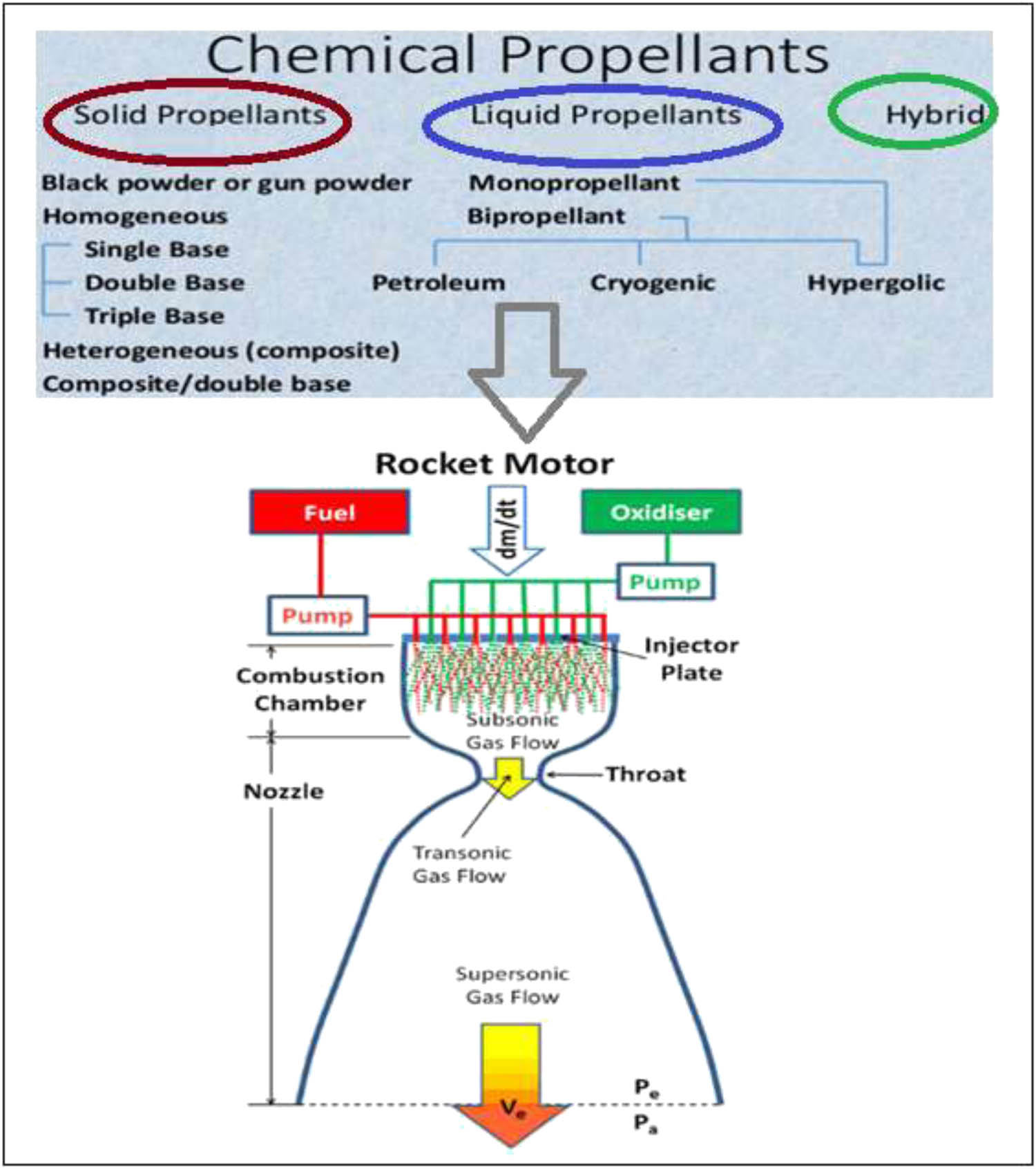
Classification and schematic diagram of rocket propellants.
There are various advantages and disadvantages of these different propellant rockets. For instance, according to typical data that were taken from existing engine [16,25,30–33], the high-performance liquid rockets offer a sea-level specific impulse in the range 270–360 s, whereas hybrid and solid rocket motors offer a specific impulse in the range of 230–270 and 210–265 s, respectively. On the other hand, from a flexibility standpoint, for the solid type, the extinction and re-ignition are hard to realize whereas hybrid and liquid rocket types are much easier to shut down and re-start. On the other hand, the selection of proper fuel was found in the literature using decision-making tools. For instance, Ren and Liang [34] have performed measuring for the sustainability of marine fuels using a fuzzy group multi-criteria decision-making (MCDM) approach. However, other related aspects like gas stations, renewable energy systems, and automotive-related applications were also reported in the literature [35–39].
Thus, it can be deduced that each type of rocket propulsion technology has various responses and characteristics regarding different performance criteria, such as size, range of specific impulse, stability, safety, etc., which affect its overall desired performance. Therefore, this work aimed to implement the analytical hierarchy process (AHP) as an MCDM tool to select the most appropriate rocket propulsion technology in a fairly optimized manner regarding various evaluation criteria.
2 Methodology
This work introduces a multi-criteria hierarchy model that assists in the selection of the most applicable rocket propulsion technology according to the performance requirement regarding various evaluation criteria. Here, the AHP as a tool designed to solve the MCDM problems is utilized.
In decision-making problems, it is common that the information is provided by humans, which is inherently non-numeric. Preferences, partial evaluations, and weights are usually expressed linguistically. Linguistic terms like high and medium are commonly used. It is not clear, however, the way they have to be explained into the entities that can be more flawlessly treated using the formalisms of sets, fuzzy sets, rough sets, and alike. Also, it is not clear what optimization criterion can be intended when reaching the formalization of the linguistic terms through information granules. Here, the AHP model was utilized to enhance more informative decisions from both numerical and linguistics information regarding the performance of the fuel based on hybrid green material under uncertain environment.
2.1 AHP
AHP is a widely used MCDM tool. Unlike the conventional techniques, AHP uses pairwise comparisons which allow verbal judgments that enhance the precision of the result by deriving accurate ratios and scales [40–43]. The AHP method can analyze both personal and impartial assessment methods to enhance the evaluation consistency and minimize bias in decisions [41–46]. For creating complex decisions with multiple criteria, the goal has to be divided into various sub-goals. Therefore, the model has to have at least a goal, evaluation criteria, and various alternatives in three hierarchy levels.
The relative weights in a certain level lead in fact to a matrix of scores a(i, j) that contains the judgment of the pairwise comparisons. Such a matrix must be consistent [43]. Accordingly, a test for ensuring such consistency has to be performed before accepting the matrix to validate the expert knowledge in what is called an inconsistency test. Such a test is valuable for recognizing possible errors in judgments. A matrix a(i, j) is believed to be reliable with no high inconsistencies if all its elements attain the transitivity and reciprocity rules given as follows:
where i, j, and k are any options in the judgment in the matrix.
The pairwise comparison matrices can also be represented as:
A consistent matrix can be shown to satisfy that:
where A is the evaluation matrix, w is the eigenvector, and n is the size of the matrix. Eq. (4) is a typical eigenvalue problem. For such gained reciprocal matrix, the consistency can be attained if the maximum eigenvalue equals the number of comparisons, i.e., λ max = n [43,47]. Accordingly, a Consistency Index was introduced to measure the deviation from consistency as in Eq. (5):
A comparison between the judgment consistency generated from Eq. (6) and the random index leads to the Consistency Ratio as in formula (6):
If the CR value is less than or at a maximum of 0.1, then the judgment inconsistency is acceptable. But, if it is greater than 0.1, the subjective judgment should be revised.
3 Results and discussion
For conducting pairwise comparisons between the alternative rocket types considered in this study, the criteria affecting the rocket performance from different standpoints were determined. The used criteria in this study were namely: the performance (specific impulse [range in a s]), the size (mass density kg/m3), the stability (ease of starting and steering), the safety, the cost, and operability. The primary information utilized for generating a judgment matrix of the rocket substitutions is demonstrated in Table 1. To ensure the relevance of the evaluation criteria used in the model, a pilot questionnaire was built and sent to 15 experts in the world to be evaluated. For the hybrid fuel performance evaluation, the generalized performance gain of hybrid fuel is usually unlike solid propellants, since it is not achieved when a polymeric hybrid fuel is improved by hydrides. Best configurations that maximize specific impulses are found in many works in the literature [9,24]. However, to generate a baseline for the experts to compare hybrid and traditional solid fuel performance, the flame temperature, and molar mass that are interpreted in ref. [24] were utilized taking into account the particular ingredients that may be involved for certain details according to testing issues.
Primary information utilized for generating judgment matrix of the rocket substitutions
| Rockets with solid propellants | Rockets with liquid propellants | Rockets with hybrid propellants | ||
|---|---|---|---|---|
| Performance (specific impulse range in a s) | 210–265 | 270–360 | 230–270 | |
| Size (mass density kg/m3) | 1,500–1,900 | 1,000–1,350 | 1,000–1,200 | |
| Stability (ease of starting and steering) | Moderate–difficult | Easy–easy | Easy–difficult | |
| Safety | Explosion sensitivity | Moderate | High | Low |
| Controlling the ignition | Difficult | Easy | Easy | |
| Toxicity | Less harmful | Sever | Moderate | |
| Cost | Cheap | Costly | Moderate | |
| Operability | Needs short time operation | Needs long time operation | Needs moderate operation |
In the questionnaire, experts were kindly asked to suggest comments regarding the proposed criteria and to rank their importance in the evaluation process according to their best knowledge. Comments of eleven filled questionnaires were returned. After carrying out the inconsistency assessments, only nine were used in the further calculation for the current model since they demonstrated a high level of consistency. Several considered feedbacks were found sufficient to conduct the analysis using the AHP approach [42,48]. The weight of the evaluation criteria was calculated as shown in Figure 2. It can be seen that the cost criterion has the highest weight in the selection process with a weight of 26.2% followed by the size with a weight of 19.7%, whereas the operability criterion has the lowest weight of 7.5% leaving only the performance, safety, and stability in intermediate priorities.
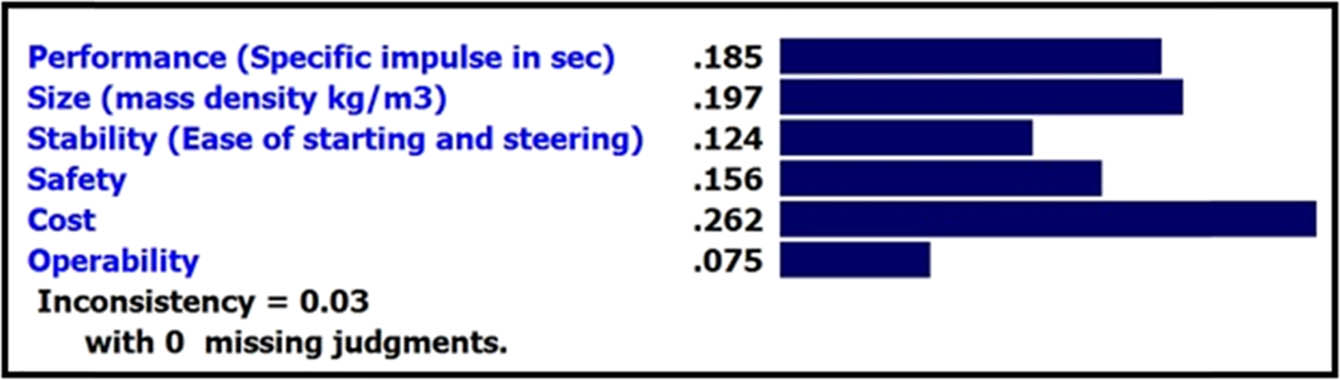
Weights of the main factors with respect to the main goal with inconsistency values.
The hierarchy model of the current problem with the main goal, criteria, and alternatives is illustrated in Figure 3.
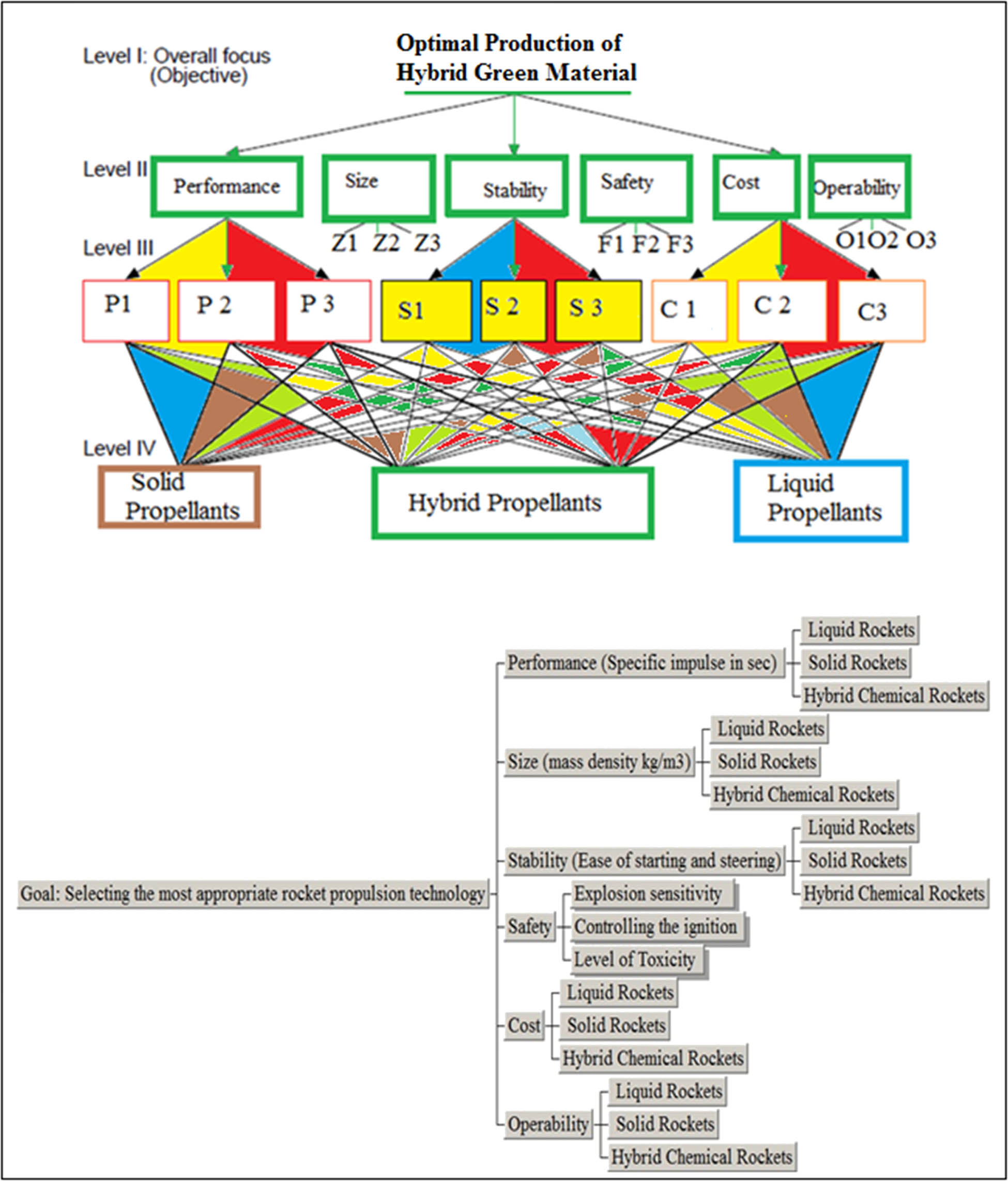
The structure of the model with a tree hierarchy nature.
After that, the alternatives were compared with each other for every single criterion used in the hierarchy model as a pairwise comparison scheme. This was performed with the help of typical data that were taken from the existing engines found in the literature [24,25,30–33]. It can be noticed here that 15 judgments wanted to complete the pairwise comparison for major evaluation factors according to the goal for the main six criteria.
The pairwise comparison of the main criteria concerning the goal is illustrated in Figure 4. It can be noticed here that 15 judgments are needed to fill this pairwise comparison matrix for the main six criteria. It can be demonstrated that the judgment matrix used in the evaluation process was consistent with an inconsistent value of 0.03. This value is still less than 0.1, and thus the judgment is acceptable.
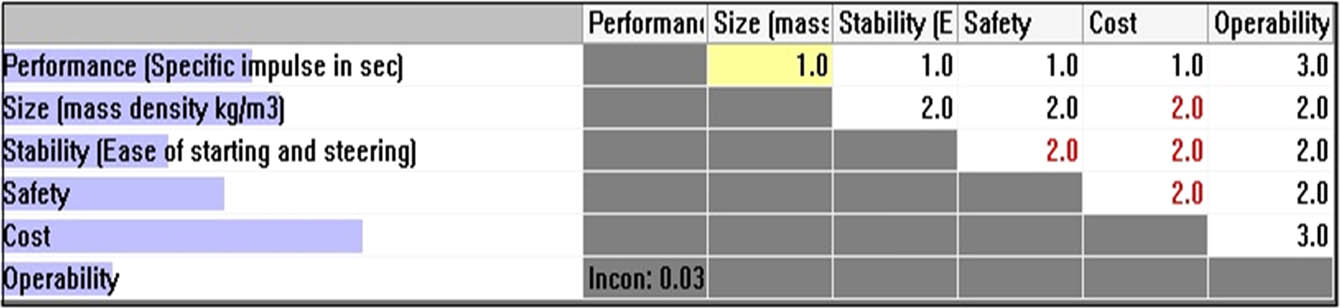
Judgment matrix of the main criteria with respect to the goal (Red values mean reciprocals, i.e., the value of 2 in red color means ½.).
Figure 5 demonstrates the priorities of the rocket alternatives regarding the expulsion sensitivity sub-criterion, which contributes immediately to the safety main criterion with 25% and to the whole model with a global priority of 3.4%. Hybrid-type rockets are the most preferable among others with a priority of 48.46% from the explosion sensitivity standpoint, whereas the liquid rocket types have the least priority of 12.55% only. This in order indicates that hybrid types have major advantages regarding not being easily explosive in harsh environments compared to other types.
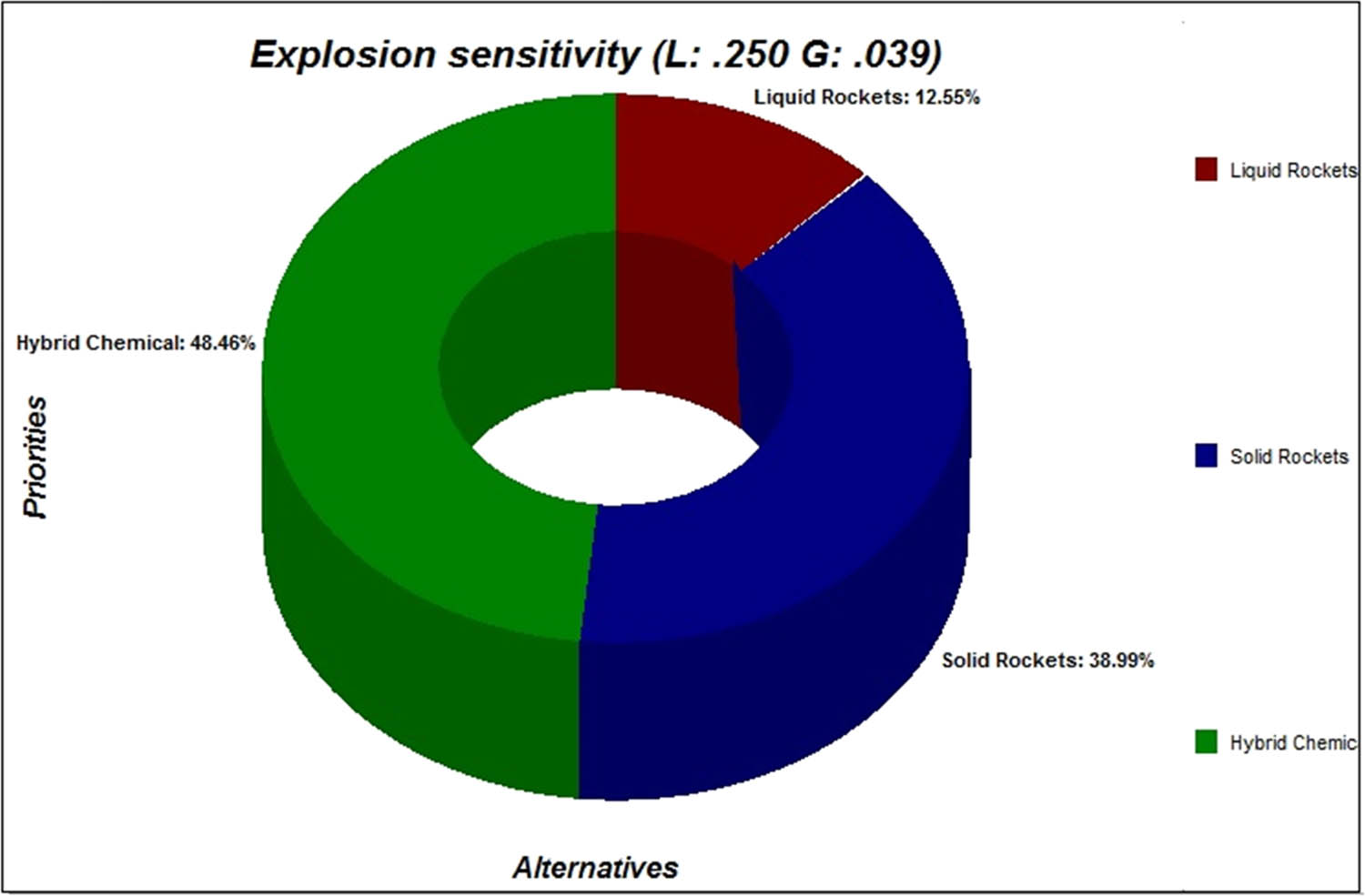
Priorities of the alternatives with respect to the expulsion sensitivity sub-criterion.
The relative priorities of the rocket types regarding each criterion used in the model are similarly established in Figure 6. It can be seen that the liquid rocket type is the preferable one regarding the performance, stability, and controlling of the ignition criteria, but the least important one regarding explosive sensitivity, level of toxicity, and operability. Moreover, the solid rocket kind is the best concerning the level of toxicity, cost, and operability criteria but it is the worst regarding the performance, size, stability, and the controlling of the ignition criteria. Furthermore, the hybrid rocket type is the best regarding size and explosion sensitivity but not the worst of any.
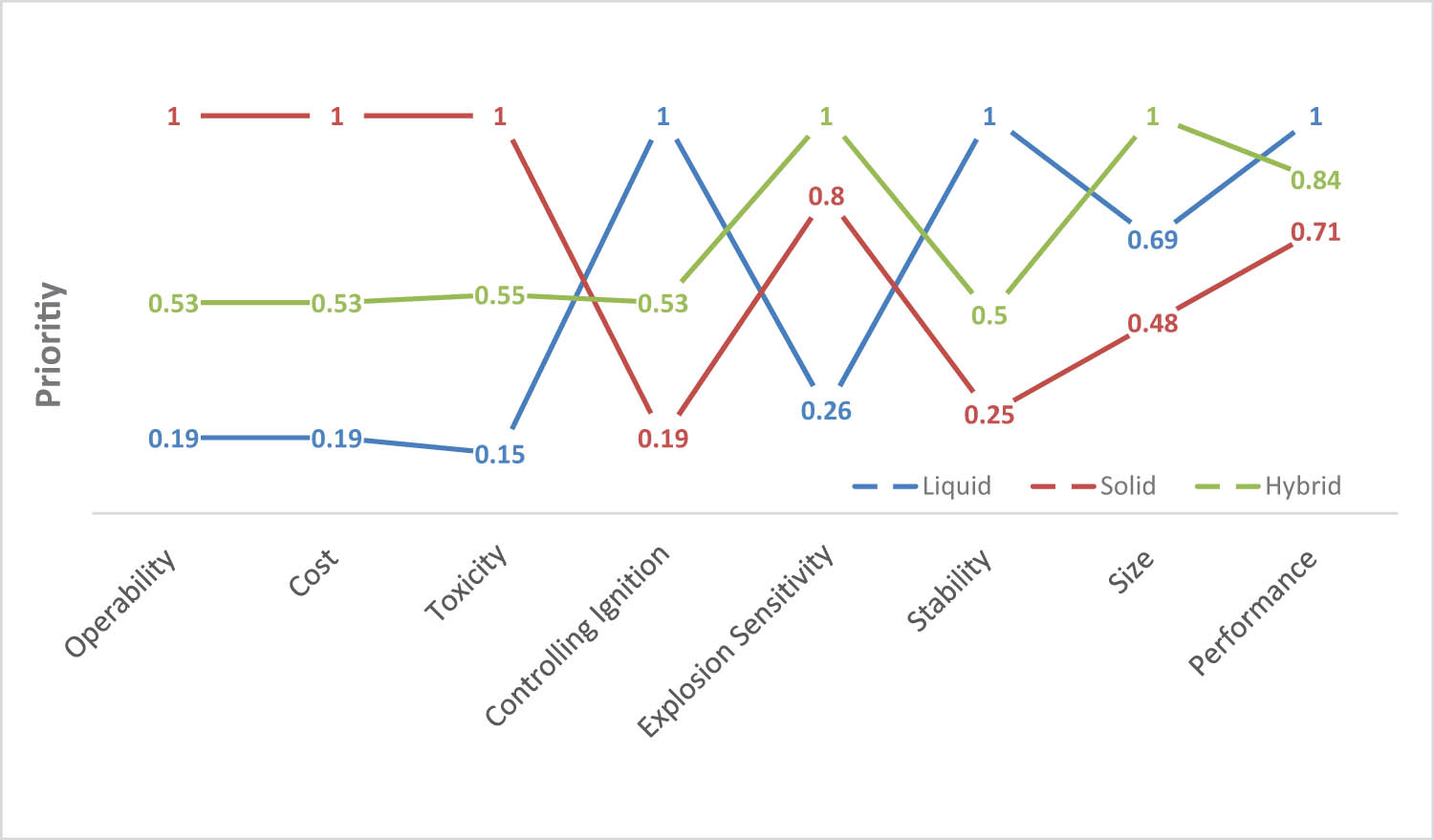
Relative priorities of the alternatives with respect to all criteria in the model.
In addition, the local (weight of each criterion concerning its direct parent criterion) as well as the global contributions of each property of the model and their overall sums are demonstrated in Table 2.
The local and global contributions of each property of the model and their sums
| Alt. | Level 1 | Total weight | Alt. | Level 1 | Total weight | Alt. | Level 1 | Total weight |
|---|---|---|---|---|---|---|---|---|
| HC | Co. | 0.07 | LR | Co. | 0.025 | SR | Co. | 0.133 |
| Oper. | 0.02 | Oper. | 0.007 | Oper. | 0.038 | |||
| Perf. | 0.079 | Perf. | 0.094 | Perf. | 0.066 | |||
| Saf. | 0.052 | Saf. | 0.047 | Saf. | 0.043 | |||
| S | 0.1 | S | 0.069 | S | 0.048 | |||
| Sta. | 0.031 | Sta. | 0.062 | Sta. | 0.016 |
The final ranking of the alternatives is illustrated in Figure 7. It can be clearly shown that the best choice is in favor of the hybrid chemical rockets with an overall aggregated weight of 35.2% leaving other alternatives behind with weights of 34.3 and 30.5% for both the solid and liquid rockets, respectively. It is a worthy noting here that the closeness of the substitutions of the final imports proves that selecting the most appropriate rocket type considering the whole criteria simultaneously is a complex matter and is not an easy job without using such a decision-making model that can reduce error as well as bias in the final decision.
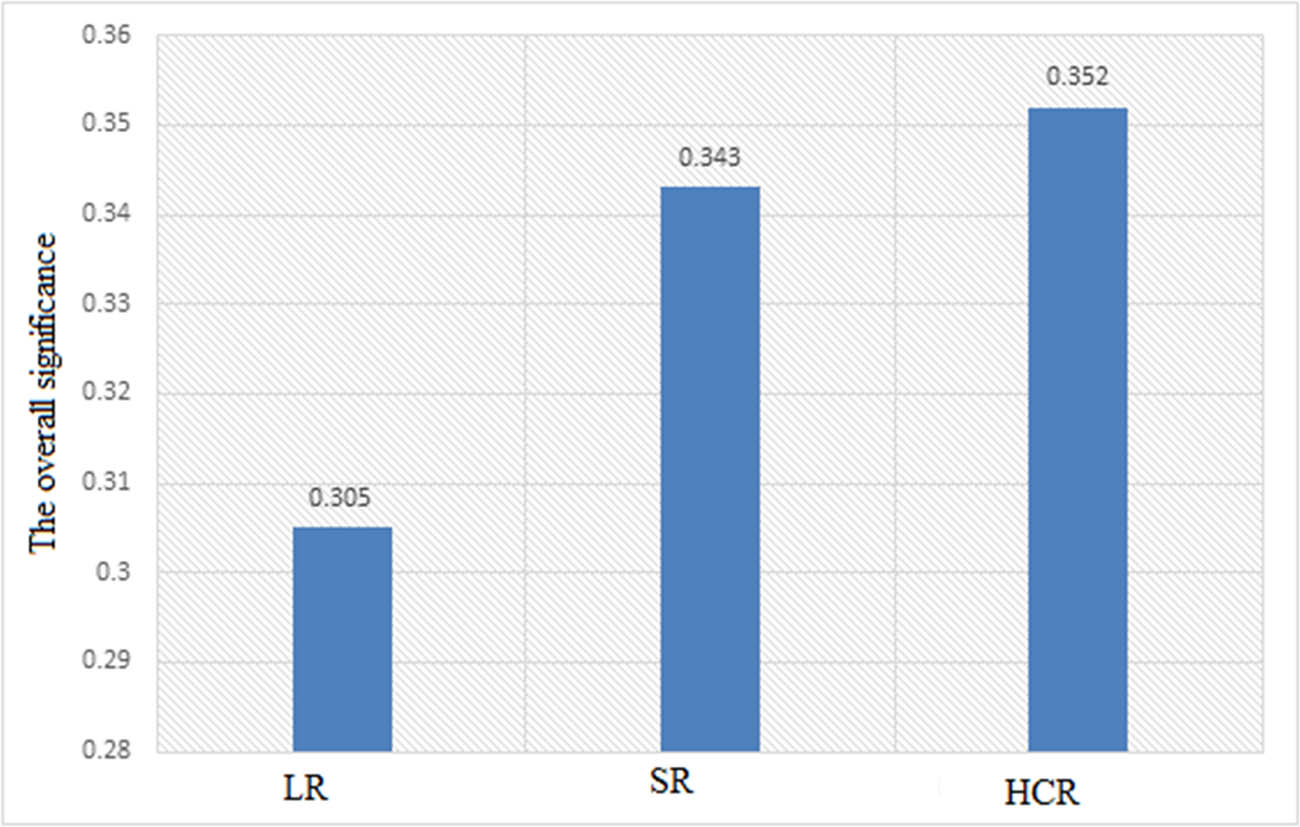
The overall significance of the alternatives regarding the goal.
To demonstrate the reliability of the used expert-DM model, a sensitivity analysis was performed. This analysis can answer a systematic question of how will the model respond if the importance of the assessment elements were slightly changed. Performing such sensitivity will start with the current priorities resulting from the expert’s feedback on the evaluation criteria. This is illustrated in Figure 8a where the hybrid type is the preferable choice. In a scenario of making the whole evaluation criteria have the same weights (which demonstrates unreasonable changes), the response of the model was stable and kept the hybrid type as the most preferable choice (although the priority values were changed as a response to weigh changing) as seen in Figure 8b. Such response demonstrates that the drawn decisions are reliable and the model is insensitive to a slight change in the criteria weights. Another scenario is illustrated in shifting the importance of both the cost and safety main criteria to exaggerated values (unreasonable change). This is demonstrated in Figure 8c. The hybrid rocket type is still the best choice with a weight of 34.9%. This demonstrates that the gained results are reliable and the decision was consistent.
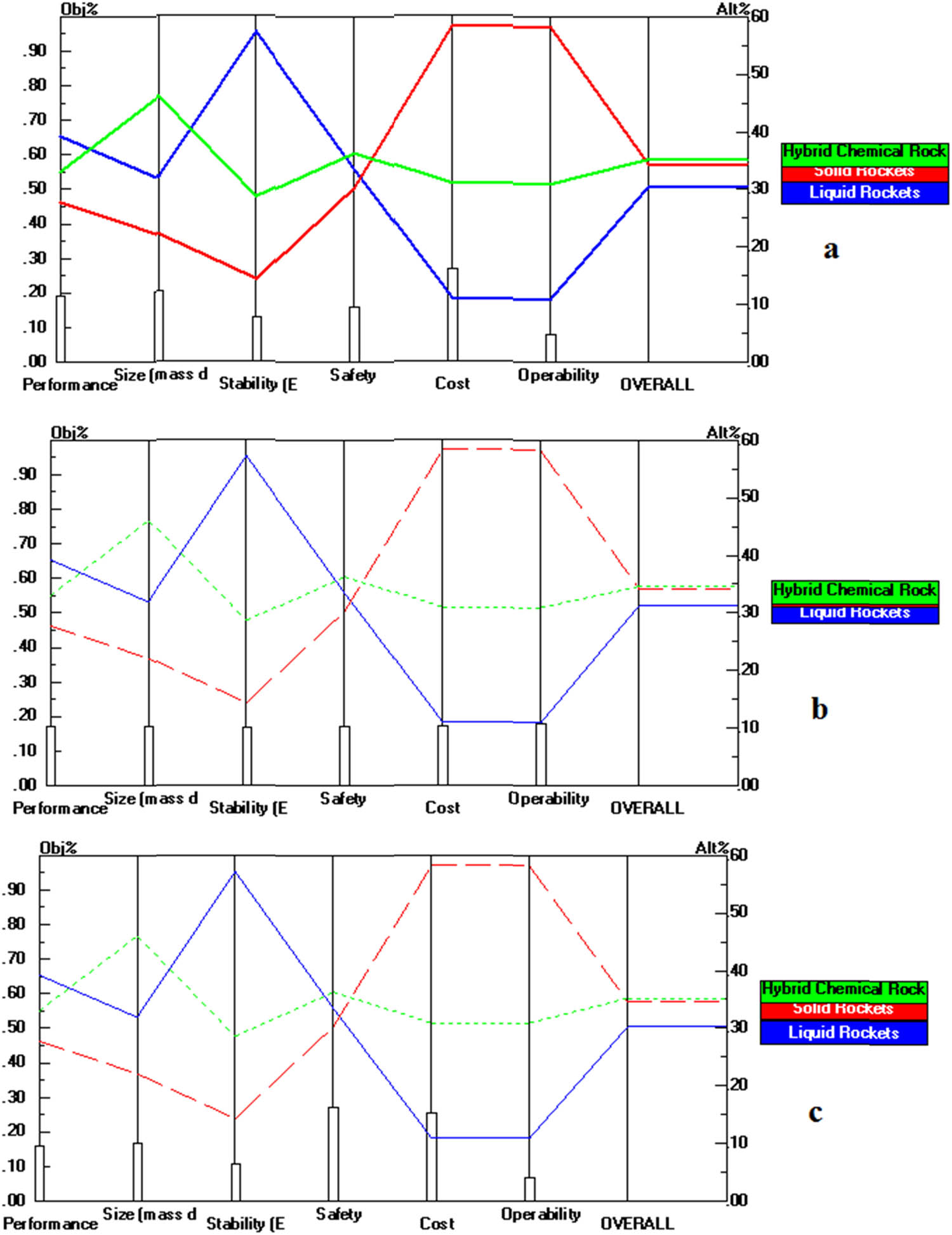
Sensitivity analysis after changing the weights.
4 Conclusions
The built hierarchy decision-making model was capable of better evaluating the performance of various types of fuel materials as well as selecting the most appropriate one for the rocket propulsion technology. The model considered various simultaneous evaluations and conflicting criteria to practically demonstrate economic, technical, and sustainable issues for the decision maker in this field. Expert feedback was an extra outcome of this study by capturing the weight of each evaluation criterion. Chemical rocket type with hybrid fuel materials was illustrated to be a potential alternative to the current solid and liquid ones due to its various advantages that were expressed here in a rational base scheme. That is, it was demonstrated by the current expert decision-making model that the hybrid rocket type is the best regarding size and explosion sensitivity but not the worst regarding any of the considered criteria. Moreover, it was shown that the liquid rocket type is the preferable one regarding the performance, stability, and controlling the ignition criteria, but the worst regarding explosive sensitivity, level of toxicity, and operability. Furthermore, the solid rocket type is the best regarding the level of toxicity, cost, and operability criteria but it is the worst regarding the performance, size, stability, and controlling of the ignition criteria. The proposed hierarchy model was successfully implemented to solve the current conflict multi-criteria problem as well as providing a valuable instrument for testing the consistency of the assessment and alternatives, thus, reducing the bias in decision making regarding evaluating different propulsion technologies for chemical rockets.
-
Funding information: No funding was received to perform this work.
-
Author contributions: Conceptualization: Faris M. AL-Oqla, Formal analysis: Faris M. AL-Oqla, Investigation: Faris M. AL-Oqla, Mohammed T. Hayajneh, Methodology: Faris M. AL-Oqla, Resources: Faris M. AL-Oqla, Mohammed T. Hayajneh, Validation: Faris M. AL-Oqla, Mohammed T. Hayajneh, Writing – original draft: Faris M. AL-Oqla, Writing – review & editing: Faris M. AL-Oqla, Mohammed T. Hayajneh.
-
Conflict of interest: Authors state no conflict of interest.
References
[1] Carmicino C, Scaramuzzino F, Sorge AR. Trade-off between paraffin-based and aluminium-loaded HTPB fuels to improve performance of hybrid rocket fed with N2O. Aerosp Sci Technol. 2014;37:81–92.10.1016/j.ast.2014.05.010Search in Google Scholar
[2] Cardoso KP, Ferrão LF, Kawachi EY, Araújo TB, Nunes RF, Nagamachi MY. Preparation of paraffin-based solid combustible for hybrid propulsion rocket motor. J Propuls Power. 2016;33(2):448–55.10.2514/1.B36197Search in Google Scholar
[3] Sutton GP, Biblarz O. Rocket propulsion elements. New Jersey, USA: John Wiley & Sons; 2010.Search in Google Scholar
[4] AL-Oqla FM, Hayajneh MT, Fares O. Investigating the mechanical thermal and polymer interfacial characteristics of Jordanian lignocellulosic fibers to demonstrate their capabilities for sustainable green materials. J Clean Prod. 2019;241:118256.10.1016/j.jclepro.2019.118256Search in Google Scholar
[5] Asfar KR, AL-Oqla FM. Stabilization of tethered satellites by tether manipulation techniques. The 54th International Astronautical Congress. Sept. 29–Oct. 3, 2003. Bremen, Germany: International Astronautical Federation (I.A.F.); 2003.Search in Google Scholar
[6] Asfar KR, AL-Oqla FM, editors. Controlling Pendulations of Tethered Satellites Using Tether Manipulation Technique. The 54th International Astronautical Congress. Sept. 29–Oct. 3, 2003. Bremen, Germany: International Astronautical Federation (I.A.F.); 2003.Search in Google Scholar
[7] Zhu H, Tian H, Cai G. Hybrid uncertainty-based design optimization and its application to hybrid rocket motors for manned lunar landing. Chin J Aeron. 2017;30(2):719–25.10.1016/j.cja.2017.02.009Search in Google Scholar
[8] Rajesh S, Suresh G, Mohan RC. A review on material selection and fabrication of composite solid rocket motor (SRM) casing. Int J Mech Solids. 2017;9(1):125–38.Search in Google Scholar
[9] Ciottoli PP, Malpica Galassi R, Lapenna PE, Leccese G, Bianchi D, Nasuti F, et al. CSP-based chemical kinetics mechanisms simplification strategy for non-premixed combustion: an application to hybrid rocket propulsion. Combust Flame. 2017;186:83–93.10.1016/j.combustflame.2017.07.035Search in Google Scholar
[10] Kobald M, Schmierer C, Ciezki H, Schlechtriem S, Toson E, De Luca L. Viscosity and regression rate of liquefying hybrid rocket fuels. J Propuls Power. 2017;33(5):1245–51.10.2514/1.B36207Search in Google Scholar
[11] AL-Oqla FM, Sapuan MS, Ishak MR, Aziz NA. Combined multi-criteria evaluation stage technique as an agro waste evaluation indicator for polymeric composites: date palm fibers as a case study. BioResources. 2014;9(3):4608–21.10.15376/biores.9.3.4608-4621Search in Google Scholar
[12] AL-Oqla FM, Sapuan SM. Natural fiber reinforced polymer composites in industrial applications: feasibility of date palm fibers for sustainable automotive industry. J Clean Prod. 2014;66:347–54.10.1016/j.jclepro.2013.10.050Search in Google Scholar
[13] AL-Oqla FM, Sapuan SM, editors. Enhancement selecting proper natural fiber composites for industrial applications. Postgraduate Symposium on Composites Science and Technology 2014 & 4th Postgraduate Seminar on Natural Fibre Composites 2014, 28/01/2014. Putrajaya, Selangor, Malaysia; 2014.Search in Google Scholar
[14] AL-Oqla FM, Sapuan SM, editors. Date Palm Fibers and Natural Composites. Postgraduate Symposium on Composites Science and Technology 2014 & 4th Postgraduate Seminar on Natural Fibre Composites 2014, 28/01/2014. Putrajaya, Selangor, Malaysia; 2014.Search in Google Scholar
[15] Sapuan SM, Pua F-L, El-Shekeil YA, AL-Oqla FM. Mechanical properties of soil buried kenaf fibre reinforced thermoplastic polyurethane composites. Mat Des. 2013;50:467–70.10.1016/j.matdes.2013.03.013Search in Google Scholar
[16] Guerrieri DC, Silva MA, Cervone A, Gill E. Selection and characterization of green propellants for micro-resistojets. J Heat Transf. 2017;139(10):102001.10.1115/1.4036619Search in Google Scholar
[17] AL-Oqla FM, Salit MS. Materials selection for natural fiber composites. Cambridge, USA: Woodhead Publishing, Elsevier; 2017. p. 286.10.1016/B978-0-08-100958-1.00002-5Search in Google Scholar
[18] AL-Oqla FM. Investigating the mechanical performance deterioration of Mediterranean cellulosic cypress and pine/polyethylene composites. Cellulose. 2017;24(6):2523–30.10.1007/s10570-017-1280-3Search in Google Scholar
[19] AL-Oqla FM, Hayajneh MT, Al-Shrida MaM. Mechanical performance, thermal stability and morphological analysis of date palm fiber reinforced polypropylene composites toward functional bio-products. Cellulose. 2022;29:3293–309.10.1007/s10570-022-04498-6Search in Google Scholar
[20] Al-Jarrah R, AL-Oqla FM. A novel integrated BPNN/SNN artificial neural network for predicting the mechanical performance of green fibers for better composite manufacturing. Composite Struct. 2022;289:115475.10.1016/j.compstruct.2022.115475Search in Google Scholar
[21] Cai Y, Ke H, Dong J, Wei Q, Lin J, Zhao Y, et al. Effects of nano-SiO2 on morphology, thermal energy storage, thermal stability, and combustion properties of electrospun lauric acid/PET ultrafine composite fibers as form-stable phase change materials. Appl Energy. 2011;88(6):2106–12.10.1016/j.apenergy.2010.12.071Search in Google Scholar
[22] Yao F, Wu Q, Lei Y, Guo W, Xu Y. Thermal decomposition kinetics of natural fibers: activation energy with dynamic thermogravimetric analysis. Polym Degrad Stab. 2008;93(1):90–8.10.1016/j.polymdegradstab.2007.10.012Search in Google Scholar
[23] Wielage B, Lampke T, Marx G, Nestler K, Starke D. Thermogravimetric and differential scanning calorimetric analysis of natural fibres and polypropylene. Thermochim Acta. 1999;337(1):169–77.10.1016/S0040-6031(99)00161-6Search in Google Scholar
[24] Maggi F, Gariani G, Galfetti L, DeLuca LT. Theoretical analysis of hydrides in solid and hybrid rocket propulsion. Int J Hydrog Energy. 2012;37(2):1760–9.10.1016/j.ijhydene.2011.10.018Search in Google Scholar
[25] Karabeyoglu A. Hybrid rocket propulsion for future space launch. Department of Aeronautics and Astronautics, Stanford University, Aero/Astro 50th Year Anniversary; 2008.Search in Google Scholar
[26] Fry R, DeLuca L, Frederick R, Gadiot G, Strecker R. Evaluation of methods for solid propellant burning rate measurement. DTIC Document; 2002.10.21236/ADA405711Search in Google Scholar
[27] AL-Oqla FM, Sapuan S. Investigating the inherent characteristic/performance deterioration interactions of natural fibers in bio-composites for better utilization of resources. J Polym Environ. 2017;26:1290–6.10.1007/s10924-017-1028-zSearch in Google Scholar
[28] AL-Oqla FM, El-Shekeil Y. Investigating and predicting the performance deteriorations and trends of polyurethane bio-composites for more realistic sustainable design possibilities. J Clean Prod. 2019;222:865–70.10.1016/j.jclepro.2019.03.042Search in Google Scholar
[29] El-Shekeil Y, AL-Oqla F, Sapuan S. Performance tendency and morphological investigations of lignocellulosic tea/polyurethane bio-composite materials. Polym Bull. 2019;77:3907–20.10.1007/s00289-019-02947-0Search in Google Scholar
[30] Andrews WG, Haberman E. Solids virtues a solid bet. Aerosp Am. 1991;29(6):24–7.Search in Google Scholar
[31] McDonald A, Bennett R, Hinshaw J, Barnes M. Chemical rockets and the environment. Aerosp Am. 1991;29(5):32–6.Search in Google Scholar
[32] D’Andrea B, Lillo F, Faure A, Perut C. A new generation of solid propellants for space launchers. Acta Astronaut. 2000;47(2):103–2.10.1016/S0094-5765(00)00049-7Search in Google Scholar
[33] Yang L, Guoqiang H, Jiang L, Jian C, Yongchun L. Experimental analysis of characteristic of SRM insulator eroded by highly concentrated particles. J Northwestern Polytechnical Univ. 2005;23(6):746.Search in Google Scholar
[34] Ren J, Liang H. Measuring the sustainability of marine fuels: a fuzzy group multi-criteria decision making approach. Transp Res Part D: Transp Environ. 2017;54:12–29.10.1016/j.trd.2017.05.004Search in Google Scholar
[35] Ghenai C, Albawab M, Bettayeb M. Sustainability indicators for renewable energy systems using multi-criteria decision-making model and extended SWARA/ARAS hybrid method. Renew Energy. 2020;146:580–97.10.1016/j.renene.2019.06.157Search in Google Scholar
[36] Ren J, Lützen M. Selection of sustainable alternative energy source for shipping: multi-criteria decision making under incomplete information. Renew Sustain Energy Rev. 2017;74:1003–19.10.1016/j.rser.2017.03.057Search in Google Scholar
[37] Ullah K, Hamid S, Mirza FM, Shakoor U. Prioritizing the gaseous alternatives for the road transport sector of Pakistan: a multi criteria decision making analysis. Energy. 2018;165:1072–84.10.1016/j.energy.2018.10.055Search in Google Scholar
[38] Durairaj S, Sathiyasekar K, Ilangkumaran M. Selection of alternate fuel for electrical power generator using hybrid multi criteria decision making technique. Sci Bulletin-Univ Politehnica Bucharest, Ser C. 2016;78(1):247–58.Search in Google Scholar
[39] Kaviani MA, Yazdi AK, Ocampo L, Kusi-Sarpong S. An integrated grey-based multi-criteria decision-making approach for supplier evaluation and selection in the oil and gas industry. Kybernetes. 2019;49:406–41.10.1108/K-05-2018-0265Search in Google Scholar
[40] AL-Oqla FM, Hayajneh MT. A design decision-making support model for selecting suitable product color to increase probability. Design Challenge Conference: Managing Creativity, Innovation, and Entrepreneurship. Amman, Jordan: Yarmouk University; 2007.Search in Google Scholar
[41] Al-Oqla FM, Omar AA. A decision-making model for selecting the GSM mobile phone antenna in the design phase to increase over all performance. Prog Electromagn Res C. 2012;25:249–69.10.2528/PIERC11102702Search in Google Scholar
[42] Al-Widyan MI, Al-Oqla FM. Selecting the most appropriate corrective actions for energy saving in existing buildings A/C in hot arid regions. Build Simul. 2014;7(5):537–45.10.1007/s12273-013-0170-3Search in Google Scholar
[43] AL-Oqla FM, Omar AA, Fares O. Evaluating sustainable energy harvesting systems for human implantable sensors. Int J Electron. 2018;105(3):504–17.10.1080/00207217.2017.1378377Search in Google Scholar
[44] Al-Widyan MI, Al-Oqla FM. Utilization of supplementary energy sources for cooling in hot arid regions via decision-making model. Int J Eng Res Appl. 2011;1(4):1610–22.Search in Google Scholar
[45] Dweiri F, Al-Oqla FM. Material selection using analytical hierarchy process. Int J Comput Appl Technol. 2006;26(4):182–9.10.1504/IJCAT.2006.010763Search in Google Scholar
[46] Dalalah D, Al-Oqla F, Hayajneh M. Application of the analytic hierarchy process (AHP) in multi-criteria analysis of the selection of cranes. Jordan J Mech Ind Eng put the abbreviation in the bracket (JJMIE). 2010;4(5):567–78.Search in Google Scholar
[47] AL-Oqla FM, Salit MS. Material selection of natural fiber composites using the analytical hierarchy process. Materials selection for natural fiber composites. 1. Cambridge, USA: Woodhead Publishing, Elsevier; 2017. p. 169–234.10.1016/B978-0-08-100958-1.00006-2Search in Google Scholar
[48] Wong JK, Li H. Application of the analytic hierarchy process (AHP) in multi-criteria analysis of the selection of intelligent building systems. Build Environ. 2008;43(1):108–25.10.1016/j.buildenv.2006.11.019Search in Google Scholar
© 2022 Faris M. AL-Oqla and Mohammed T. Hayajneh, published by De Gruyter
This work is licensed under the Creative Commons Attribution 4.0 International License.
Articles in the same Issue
- Research Articles
- Calcium carbonate nanoparticles of quail’s egg shells: Synthesis and characterizations
- Effect of welding consumables on shielded metal arc welded ultra high hard armour steel joints
- Stress-strain characteristics and service life of conventional and asphaltic underlayment track under heavy load Babaranjang trains traffic
- Corrigendum to: Statistical mechanics of cell decision-making: the cell migration force distribution
- Prediction of bearing capacity of driven piles for Basrah governatore using SPT and MATLAB
- Investigation on microstructural features and tensile shear fracture properties of resistance spot welded advanced high strength dual phase steel sheets in lap joint configuration for automotive frame applications
- Experimental and numerical investigation of drop weight impact of aramid and UHMWPE reinforced epoxy
- An experimental study and finite element analysis of the parametric of circular honeycomb core
- The study of the particle size effect on the physical properties of TiO2/cellulose acetate composite films
- Hybrid material performance assessment for rocket propulsion
- Design of ER damper for recoil length minimization: A case study on gun recoil system
- Forecasting technical performance and cost estimation of designed rim wheels based on variations of geometrical parameters
- Enhancing the machinability of SKD61 die steel in power-mixed EDM process with TGRA-based multi criteria decision making
- Effect of boron carbide reinforcement on properties of stainless-steel metal matrix composite for nuclear applications
- Energy absorption behaviors of designed metallic square tubes under axial loading: Experiment-based benchmarking and finite element calculation
- Synthesis and study of magnesium complexes derived from polyacrylate and polyvinyl alcohol and their applications as superabsorbent polymers
- Artificial neural network for predicting the mechanical performance of additive manufacturing thermoset carbon fiber composite materials
- Shock and impact reliability of electronic assemblies with perimeter vs full array layouts: A numerical comparative study
- Influences of pre-bending load and corrosion degree of reinforcement on the loading capacity of concrete beams
- Assessment of ballistic impact damage on aluminum and magnesium alloys against high velocity bullets by dynamic FE simulations
- On the applicability of Cu–17Zn–7Al–0.3Ni shape memory alloy particles as reinforcement in aluminium-based composites: Structural and mechanical behaviour considerations
- Mechanical properties of laminated bamboo composite as a sustainable green material for fishing vessel: Correlation of layer configuration in various mechanical tests
- Singularities at interface corners of piezoelectric-brass unimorphs
- Evaluation of the wettability of prepared anti-wetting nanocoating on different construction surfaces
- Review Article
- An overview of cold spray coating in additive manufacturing, component repairing and other engineering applications
- Special Issue: Sustainability and Development in Civil Engineering - Part I
- Risk assessment process for the Iraqi petroleum sector
- Evaluation of a fire safety risk prediction model for an existing building
- The slenderness ratio effect on the response of closed-end pipe piles in liquefied and non-liquefied soil layers under coupled static-seismic loading
- Experimental and numerical study of the bulb's location effect on the behavior of under-reamed pile in expansive soil
- Procurement challenges analysis of Iraqi construction projects
- Deformability of non-prismatic prestressed concrete beams with multiple openings of different configurations
- Response of composite steel-concrete cellular beams of different concrete deck types under harmonic loads
- The effect of using different fibres on the impact-resistance of slurry infiltrated fibrous concrete (SIFCON)
- Effect of microbial-induced calcite precipitation (MICP) on the strength of soil contaminated with lead nitrate
- The effect of using polyolefin fiber on some properties of slurry-infiltrated fibrous concrete
- Typical strength of asphalt mixtures compacted by gyratory compactor
- Modeling and simulation sedimentation process using finite difference method
- Residual strength and strengthening capacity of reinforced concrete columns subjected to fire exposure by numerical analysis
- Effect of magnetization of saline irrigation water of Almasab Alam on some physical properties of soil
- Behavior of reactive powder concrete containing recycled glass powder reinforced by steel fiber
- Reducing settlement of soft clay using different grouting materials
- Sustainability in the design of liquefied petroleum gas systems used in buildings
- Utilization of serial tendering to reduce the value project
- Time and finance optimization model for multiple construction projects using genetic algorithm
- Identification of the main causes of risks in engineering procurement construction projects
- Identifying the selection criteria of design consultant for Iraqi construction projects
- Calibration and analysis of the potable water network in the Al-Yarmouk region employing WaterGEMS and GIS
- Enhancing gypseous soil behavior using casein from milk wastes
- Structural behavior of tree-like steel columns subjected to combined axial and lateral loads
- Prospect of using geotextile reinforcement within flexible pavement layers to reduce the effects of rutting in the middle and southern parts of Iraq
- Ultimate bearing capacity of eccentrically loaded square footing over geogrid-reinforced cohesive soil
- Influence of water-absorbent polymer balls on the structural performance of reinforced concrete beam: An experimental investigation
- A spherical fuzzy AHP model for contractor assessment during project life cycle
- Performance of reinforced concrete non-prismatic beams having multiple openings configurations
- Finite element analysis of the soil and foundations of the Al-Kufa Mosque
- Flexural behavior of concrete beams with horizontal and vertical openings reinforced by glass-fiber-reinforced polymer (GFRP) bars
- Studying the effect of shear stud distribution on the behavior of steel–reactive powder concrete composite beams using ABAQUS software
- The behavior of piled rafts in soft clay: Numerical investigation
- The impact of evaluation and qualification criteria on Iraqi electromechanical power plants in construction contracts
- Performance of concrete thrust block at several burial conditions under the influence of thrust forces generated in the water distribution networks
- Geotechnical characterization of sustainable geopolymer improved soil
- Effect of the covariance matrix type on the CPT based soil stratification utilizing the Gaussian mixture model
- Impact of eccentricity and depth-to-breadth ratio on the behavior of skirt foundation rested on dry gypseous soil
- Concrete strength development by using magnetized water in normal and self-compacted concrete
- The effect of dosage nanosilica and the particle size of porcelanite aggregate concrete on mechanical and microstructure properties
- Comparison of time extension provisions between the Joint Contracts Tribunal and Iraqi Standard Bidding Document
- Numerical modeling of single closed and open-ended pipe pile embedded in dry soil layers under coupled static and dynamic loadings
- Mechanical properties of sustainable reactive powder concrete made with low cement content and high amount of fly ash and silica fume
- Deformation of unsaturated collapsible soils under suction control
- Mitigation of collapse characteristics of gypseous soils by activated carbon, sodium metasilicate, and cement dust: An experimental study
- Behavior of group piles under combined loadings after improvement of liquefiable soil with nanomaterials
- Using papyrus fiber ash as a sustainable filler modifier in preparing low moisture sensitivity HMA mixtures
- Study of some properties of colored geopolymer concrete consisting of slag
- GIS implementation and statistical analysis for significant characteristics of Kirkuk soil
- Improving the flexural behavior of RC beams strengthening by near-surface mounting
- The effect of materials and curing system on the behavior of self-compacting geopolymer concrete
- The temporal rhythm of scenes and the safety in educational space
- Numerical simulation to the effect of applying rationing system on the stability of the Earth canal: Birmana canal in Iraq as a case study
- Assessing the vibration response of foundation embedment in gypseous soil
- Analysis of concrete beams reinforced by GFRP bars with varying parameters
- One dimensional normal consolidation line equation
Articles in the same Issue
- Research Articles
- Calcium carbonate nanoparticles of quail’s egg shells: Synthesis and characterizations
- Effect of welding consumables on shielded metal arc welded ultra high hard armour steel joints
- Stress-strain characteristics and service life of conventional and asphaltic underlayment track under heavy load Babaranjang trains traffic
- Corrigendum to: Statistical mechanics of cell decision-making: the cell migration force distribution
- Prediction of bearing capacity of driven piles for Basrah governatore using SPT and MATLAB
- Investigation on microstructural features and tensile shear fracture properties of resistance spot welded advanced high strength dual phase steel sheets in lap joint configuration for automotive frame applications
- Experimental and numerical investigation of drop weight impact of aramid and UHMWPE reinforced epoxy
- An experimental study and finite element analysis of the parametric of circular honeycomb core
- The study of the particle size effect on the physical properties of TiO2/cellulose acetate composite films
- Hybrid material performance assessment for rocket propulsion
- Design of ER damper for recoil length minimization: A case study on gun recoil system
- Forecasting technical performance and cost estimation of designed rim wheels based on variations of geometrical parameters
- Enhancing the machinability of SKD61 die steel in power-mixed EDM process with TGRA-based multi criteria decision making
- Effect of boron carbide reinforcement on properties of stainless-steel metal matrix composite for nuclear applications
- Energy absorption behaviors of designed metallic square tubes under axial loading: Experiment-based benchmarking and finite element calculation
- Synthesis and study of magnesium complexes derived from polyacrylate and polyvinyl alcohol and their applications as superabsorbent polymers
- Artificial neural network for predicting the mechanical performance of additive manufacturing thermoset carbon fiber composite materials
- Shock and impact reliability of electronic assemblies with perimeter vs full array layouts: A numerical comparative study
- Influences of pre-bending load and corrosion degree of reinforcement on the loading capacity of concrete beams
- Assessment of ballistic impact damage on aluminum and magnesium alloys against high velocity bullets by dynamic FE simulations
- On the applicability of Cu–17Zn–7Al–0.3Ni shape memory alloy particles as reinforcement in aluminium-based composites: Structural and mechanical behaviour considerations
- Mechanical properties of laminated bamboo composite as a sustainable green material for fishing vessel: Correlation of layer configuration in various mechanical tests
- Singularities at interface corners of piezoelectric-brass unimorphs
- Evaluation of the wettability of prepared anti-wetting nanocoating on different construction surfaces
- Review Article
- An overview of cold spray coating in additive manufacturing, component repairing and other engineering applications
- Special Issue: Sustainability and Development in Civil Engineering - Part I
- Risk assessment process for the Iraqi petroleum sector
- Evaluation of a fire safety risk prediction model for an existing building
- The slenderness ratio effect on the response of closed-end pipe piles in liquefied and non-liquefied soil layers under coupled static-seismic loading
- Experimental and numerical study of the bulb's location effect on the behavior of under-reamed pile in expansive soil
- Procurement challenges analysis of Iraqi construction projects
- Deformability of non-prismatic prestressed concrete beams with multiple openings of different configurations
- Response of composite steel-concrete cellular beams of different concrete deck types under harmonic loads
- The effect of using different fibres on the impact-resistance of slurry infiltrated fibrous concrete (SIFCON)
- Effect of microbial-induced calcite precipitation (MICP) on the strength of soil contaminated with lead nitrate
- The effect of using polyolefin fiber on some properties of slurry-infiltrated fibrous concrete
- Typical strength of asphalt mixtures compacted by gyratory compactor
- Modeling and simulation sedimentation process using finite difference method
- Residual strength and strengthening capacity of reinforced concrete columns subjected to fire exposure by numerical analysis
- Effect of magnetization of saline irrigation water of Almasab Alam on some physical properties of soil
- Behavior of reactive powder concrete containing recycled glass powder reinforced by steel fiber
- Reducing settlement of soft clay using different grouting materials
- Sustainability in the design of liquefied petroleum gas systems used in buildings
- Utilization of serial tendering to reduce the value project
- Time and finance optimization model for multiple construction projects using genetic algorithm
- Identification of the main causes of risks in engineering procurement construction projects
- Identifying the selection criteria of design consultant for Iraqi construction projects
- Calibration and analysis of the potable water network in the Al-Yarmouk region employing WaterGEMS and GIS
- Enhancing gypseous soil behavior using casein from milk wastes
- Structural behavior of tree-like steel columns subjected to combined axial and lateral loads
- Prospect of using geotextile reinforcement within flexible pavement layers to reduce the effects of rutting in the middle and southern parts of Iraq
- Ultimate bearing capacity of eccentrically loaded square footing over geogrid-reinforced cohesive soil
- Influence of water-absorbent polymer balls on the structural performance of reinforced concrete beam: An experimental investigation
- A spherical fuzzy AHP model for contractor assessment during project life cycle
- Performance of reinforced concrete non-prismatic beams having multiple openings configurations
- Finite element analysis of the soil and foundations of the Al-Kufa Mosque
- Flexural behavior of concrete beams with horizontal and vertical openings reinforced by glass-fiber-reinforced polymer (GFRP) bars
- Studying the effect of shear stud distribution on the behavior of steel–reactive powder concrete composite beams using ABAQUS software
- The behavior of piled rafts in soft clay: Numerical investigation
- The impact of evaluation and qualification criteria on Iraqi electromechanical power plants in construction contracts
- Performance of concrete thrust block at several burial conditions under the influence of thrust forces generated in the water distribution networks
- Geotechnical characterization of sustainable geopolymer improved soil
- Effect of the covariance matrix type on the CPT based soil stratification utilizing the Gaussian mixture model
- Impact of eccentricity and depth-to-breadth ratio on the behavior of skirt foundation rested on dry gypseous soil
- Concrete strength development by using magnetized water in normal and self-compacted concrete
- The effect of dosage nanosilica and the particle size of porcelanite aggregate concrete on mechanical and microstructure properties
- Comparison of time extension provisions between the Joint Contracts Tribunal and Iraqi Standard Bidding Document
- Numerical modeling of single closed and open-ended pipe pile embedded in dry soil layers under coupled static and dynamic loadings
- Mechanical properties of sustainable reactive powder concrete made with low cement content and high amount of fly ash and silica fume
- Deformation of unsaturated collapsible soils under suction control
- Mitigation of collapse characteristics of gypseous soils by activated carbon, sodium metasilicate, and cement dust: An experimental study
- Behavior of group piles under combined loadings after improvement of liquefiable soil with nanomaterials
- Using papyrus fiber ash as a sustainable filler modifier in preparing low moisture sensitivity HMA mixtures
- Study of some properties of colored geopolymer concrete consisting of slag
- GIS implementation and statistical analysis for significant characteristics of Kirkuk soil
- Improving the flexural behavior of RC beams strengthening by near-surface mounting
- The effect of materials and curing system on the behavior of self-compacting geopolymer concrete
- The temporal rhythm of scenes and the safety in educational space
- Numerical simulation to the effect of applying rationing system on the stability of the Earth canal: Birmana canal in Iraq as a case study
- Assessing the vibration response of foundation embedment in gypseous soil
- Analysis of concrete beams reinforced by GFRP bars with varying parameters
- One dimensional normal consolidation line equation
