Analysis of concrete beams reinforced by GFRP bars with varying parameters
-
Shaysh Aziz Mohammed
 and
AbdulMuttailb I. Said
and
AbdulMuttailb I. Said

Abstract
Structural buildings consist of concrete and steel, and these buildings have confronted many challenges from various aggressive environments against the materials manufactured from them. It contains high water levels and buildings whose concrete cover may be damaged and thus lead to the deterioration and corrosion of steel. It was important to have an alternative to steel, such as the glass fiber reinforced polymer (GFRP), which is distinguished by its great effectiveness in resisting corrosion, as well as its strong tensile resistance. Still, one of its drawbacks is that it has a low modulus of elasticity. This research article aims to conduct a numerical study using the nonlinear finite element ABAQUS program on eight beam models with various parameters such as stirrup spacing, compressive strength, reinforcement layer, and type of bar reinforcement under four-point bending. The result shows that the ultimate load capacity of the GFRP beam is higher than that of a beam reinforced with steel and the number and width of cracks are greater in the GFRP-reinforced beam than in the steel-reinforced beam. In general, the serviceability reflected by cracks and deflection is lower in GFRP-reinforced beams than in steel-reinforced beams with higher serviceability. The results, on either hand, showed the expected behavior of GFRP, which is linear elastic to the failure stage. These beams are divided into four groups of beams with different variables studied to understand GFRP bars’ behavior under static loading. The variables taken in this study are the spacing between the stirrups, the compressive strength of concrete, the effect of the number of layers of reinforcement, and the type of reinforcement bar.
1 Introduction
Steel and concrete are basic and commonly used materials in several buildings. Due to the plenty of use of these materials in construction, it was necessary to work on finding alternatives with better properties at all levels. Steel was one of these essential elements that were the focus of attention of engineers and researchers. The previous researchers explained that a fiber-reinforced polymer (FRP) was one of the appropriate materials to give better properties than steel in several aspects, including lightweight compared to steel, higher tensile strength than steel [1–4], and not affected by electric and magnetic fields which are advantageous for their use in civil infrastructure. Furthermore, since they are non-conductive, they are suitable for medical applications that are highly sensitive to electromagnetic fields, including magnetic resonance imaging facilities [5]. Also, most importantly, it does not cause corrosion or be affected by moisture, as is the case in steel or concrete buildings. According to the ACI 440 guide [6], over-reinforcing glass fiber reinforced polymer (GFRP)-reinforced concrete beams are required so that they fail due to concrete crushing rather than rebar rupture. The flexural behavior of GFRP of reinforced concrete beams exhibits negligible ductility due to the linear elastic brittle behavior of GFRP bars. A beam or structural member can sustain inelastic deformation without losing its ability to resist loads before failure is known as ductility [7]. The beams were chosen as one of the essential parts of the building whose behavior must be studied during the use GFRP bars as a substitute for steel and to know the extent to which they are affected by the direction of flexural behavior and stresses. Nonlinear finite element analysis will be carried out using the ABAQUS computer program to simulate the behavior of such beams under four-point bending.
1.1 Modeling of beams
The beams were modeled under four-point bending using the ABAQUS program and using different theories to understand the behavior of GFRP and introduce the program for it to reach convincing scientific results. The models of the materials utilized are determined by their qualities and theories adopted which are divided into two parts. The first part of the theory of concrete representation is the use of the common model, which is concrete damaged plasticity, which is close to the smeared cracking model, but is closer to reality. The second part is concerned with the representation of steel, where the classical metal plasticity theory was used [8]. This theory is based on a standard Mises model with associated plastic flow known as von Mises yield surface. The beam parts consist of GFRP and steel bars, stirrups, and bearing plates (Figure 1).

Parts of beam model.
These parts are defined according to the materials manufactured in the property field, where the concrete properties of elastic behavior and plasticity parameters of concrete damage were defined [9]. After concrete, the properties of GFRP and steel are defined, which are elasticity and plasticity parameters, the Young’s modulus and Poisson’s ratio. Finally, bearing and support plates defined as steel materials with the properties of elastic steel. In the next stage of the modeling, the beam parts are assembled, then the nature of the loads applied to the beams are defined, which are static loads. Figure 2 shows the beam after assembly.
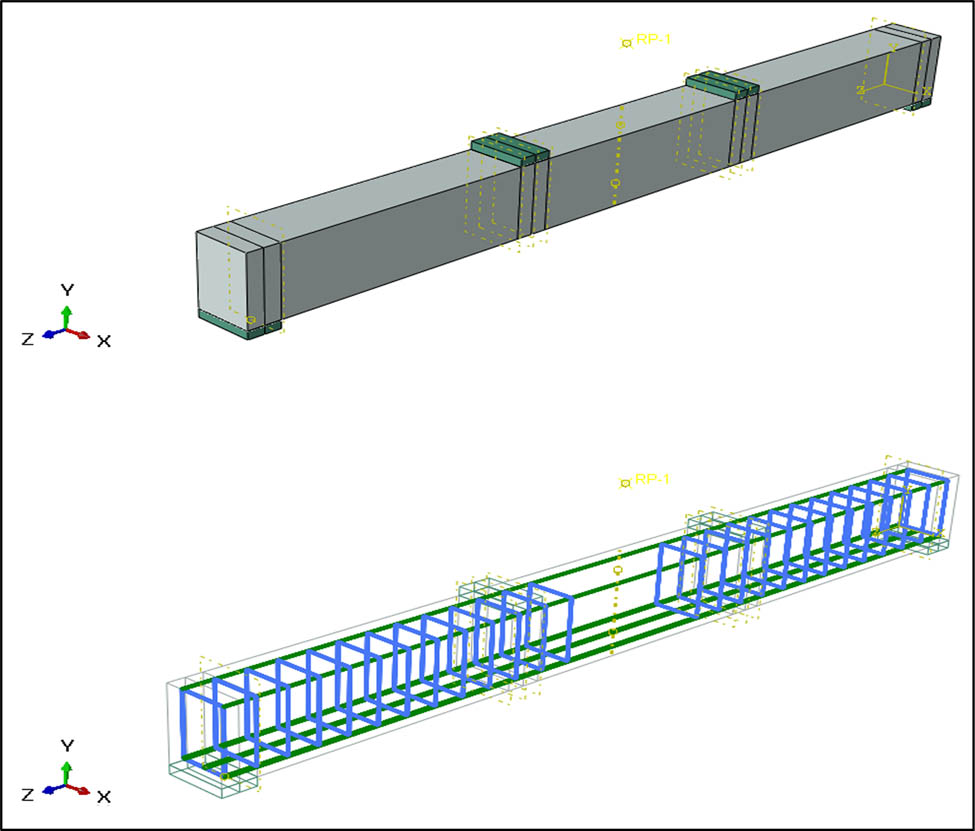
Assembly of beam.
The interaction between all sections of the beams is described, and one of the most important parts is the nature of the relationship between concrete and GFRP, which is a perfect bonding relationship. Figure 3 shows the beam interaction. The next stage defines the loads and the boundary conditions represented by the hinge and roller. To obtain acceptable and good results, several attempts are made to reach the appropriate mesh size in the meshing stage. Figure 4 shows the beam meshing.

Interaction of beam.

Meshing of beam.
1.2 Case study
In this study, a group of beams with different variables were studied to understand the behavior of GFRP bars under static loading. The variables taken in this study are the spacing between the stirrup, the compressive strength of concrete, the effect of the number of layers of reinforcement, and the type of reinforcement bar. The dimensions of the beams are the length of the beams is 2,700 mm, the clear span is 2,500 mm, the width of the beams is 180 mm, and the depth is 260 mm. These models are divided into four groups, each group consists of two beams, and the variables taken in this study are different for each group, the first group consists of two beams, and the spacing was changed between stirrup at different values of 90 and 150 mm. The second group consists of two beams and the compressive strength of the concrete was changed at different values of 35 and 70 MPa. In the third group, there are also two beams, and the reinforcement layers changed, once one layer (3 Ø 12 mm) and once two layers (4 Ø 10 mm). The fourth group consists of two beams, the first beam is reinforced with GFRP bars and the second beam is reinforced with steel bars. Figure 4 and Table 1 show beam’s details (Figure 5).
The specifics of modeling beams
| Groups | Sample | Spacing (mm) | Compressive strength (MPa) | Bar top (mm) | Bar bottom (mm) |
|---|---|---|---|---|---|
| Group 1 | A1 | 90 | 50 | 2 Ø 8 | 3 Ø 12 |
| A2 | 150 | 50 | 2 Ø 8 | 3 Ø 12 | |
| Group 2 | B3 | 90 | 35 | 2 Ø 8 | 3 Ø 12 |
| B4 | 90 | 70 | 2 Ø 8 | 3 Ø 12 | |
| Group 3 | C5 | 90 | 40 | 2 Ø 8 | 3 Ø 12 |
| C6 | 90 | 40 | 2 Ø 8 | 4 Ø 10 | |
| Group 4 | GFRP | 90 | 50 | 2 Ø 8 | 3 Ø 12 |
| Steel | 90 | 50 | 2 Ø 8 | 3 Ø 12 |

Beam details.
1.3 Properties of bars
GFRP bars are characterized by high tensile strength and low modulus of elasticity, which gives them a brittle behavior that leads to sudden failure, unlike steel, which has a high modulus of elasticity and has a higher ductility behavior. Table 2 shows the manufacturer’s properties of GFRP and steel bars.
The properties of bars
| Type of bars | Tensile strength, f y (MPa) | Rupture strain, ε | Modulus of elasticity, E (MPa) |
|---|---|---|---|
| GFRP | 850 | 0.017 | 50,000 |
| Steel | 420 | 0.0021 | 200,000 |
1.4 ABAQUS parameters
These parameters with these values came as a result of many previous research and studies in the field of the general behavior of concrete in its usual form in the theories of finite elements [10,11]. Table 3 shows the damage of plasticity data used in the models.
Damage of plasticity data
| Parameter | ψ | ϵ | fb0/fc0 | K | µ |
|---|---|---|---|---|---|
| Value | 31 | 0.1 | 1.16 | 0.667 | 0.0001 |
2 Results
After analyzing the beams using the ABAQUS 2019 software, and as expected, the results showed the behavior of the linear elastic GFRP rebar until the failure stage. In addition, there is no yielding point as in the case of steel rebar, and this is due to the characteristics of the FRP characterized as brittle, which leads to a sudden rupture in the bar, unlike the high ductility of steel. Accordingly, the results of the analysis were as follows:
In this group, it is noted that the effect of changing the spacing between stirrups on the load capacity of the beams was not very noticeable. The A1 model failed at a load of 151 kN and the A2 model at 150 kN, though the amount of deflection was slightly less in the A1 model by 2.7% than in the A2 model, with values of 71 and 73 mm, respectively (Figure 6). In terms of strains, the concrete strain in the compression zone of the A1 model approached the ultimate by an amount of 0.0029. Still, this value decreased by 29% in the A2 model to become 0.0023 (Figure 7). As for the strain values in the GFRP bar in the tension region, the strain values were close and with a difference in the A2 model from the A1 by about 3.25%, with values of 0.0016 and 0.00155, respectively (Figure 8).
In the second group, the change in the ultimate load capacity was straightforward and relatively more. The effect of changing the compressive strength of concrete from 35 to 70 MPa led to an increase in the final load capacity of the B4 model by 8.4% compared to the B3 model from 143 to 155 kN. The percentage of deflection in the B4 model also decreased by 15.15% compared to the B3 model and by an amount of deflection from 76 to 66 mm, respectively, due to the increase in the compressive strength of concrete (Figure 9). In the strains, the concrete in the compression zone had another opinion, where the difference was somewhat significant due to the doubled increase in the compressive strength of the concrete, where the strain rate decreased in the B4 model by 58% from the B3 model, with strain values 0.005 and 0.0021, respectively (Figure 10). Regarding the GFRP bar in the tensile region, the rate of change in the strain of the two beams was very close, as is the case in the first group, with a difference of 1.9% and with values of 0.0016 and 0.00157, respectively (Figure 11).
In the third group, the variables were in the reinforcing layers. The results were different in the load capacity between the two beams, where the load capacity of the C6 model decreased from the C5 model by 17.75% by 146 kN for the C5 model and 124 kN for the C6 model. Still, the amount of deflection was equal at that point for the two beams and was 73 mm (Figure 12). As for the concrete strain in the compression zone, its value decreased in the C6 model by 33.34% from the C5 model with values of 0.0039 and 0.0026, respectively (Figure 13). As for the strain in the bars of the GFRP in the tension zone, it is noted that the strain in the C6 model has increased by a simple 3.6% to the C5 model with values of 0.016 and 0.0166, respectively (Figure 14).

Load–deflection curve for specimens beams A1 and A2.

Strain in top concrete fiber for specimens beams A1 and A2.

Strain of the bottom bar for specimens beams A1 and A2.

Load–deflection curve for specimens beams B3 and B4.

Strain in top concrete fiber for specimens beams B3 and B4.

Strain of the bottom bar for specimens beams B3 and B4.

Load–deflection curve for specimens beams C5 and C6.

Strain in top concrete fiber for specimens beams C5 and C6.

Strain of the bottom bar for specimens beams C5 and C6.
In the fourth group, the modeling and analysis process took place differently from the previous three groups, where a direct comparison was made between a beam reinforced with steel and a beam reinforced with GFRP to understand the general behavior of the GFRP bar against the behavior of steel bar. As expected, the load capacity of the beam reinforced with steel is 30% less than that reinforced with GFRP (105 and 151 kN, respectively). Still, the deflection percentage in the steel model is 83.8% less than the GFRP model (11.5 and 71 mm, respectively), and this difference is due to the low modulus of elasticity that GFRP possesses compared to steel (Figure 15). In terms of strain, both steel and GFRP have reached the ultimate strain. It is noted that the steel strain continues until rupture (Figure 16).

Load–deflection curve for specimens beams steel and GFRP.

Strain of the bottom bar for specimens beams steel and GFRP.
On the other hand, GFRP-reinforced concrete beams had substantially larger cracks before the collapse but were less ductile than steel-reinforced concrete beams, which showed fewer cracks as shown in Figures 17 and 18.

Cracks’ pattern.

Cracks’ pattern.
3 Conclusion
Reducing the spacing between the stirrups from the design spacing approved for the resistance of the shear does not lead to an increase in the ultimate load capacity, but it has the effect of increasing the number of cracks and reducing their width.
Increasing the compressive strength of concrete leads to an increase in the ultimate load capacity of the beams by up to twice as much from 143 to 155 kN an increase of about 8.4%. In contrast, the percentage of strains decreases in the high compressive strength of concrete.
Increasing the number of reinforcing layers does not lead to an increase in the ultimate load capacity of the beams and does not affect the percentage of deflection at equal reinforcement values. However, the amount of strain decreases in the beam with two layers of reinforcement in the C6 model by 33.34% from the C5 model.
The ultimate load capacity of the GFRP beam is higher than that of a beam reinforced with steel, but the amount of deflection is higher in GFRP compared to steel, so the load capacity of the beam reinforced with steel is 30% less than that reinforced with GFRP (105 and 151 kN, respectively). Still, the deflection percentage in the steel model is 83.8% less than the GFRP model (11.5 and 71 mm, respectively).
The number and width of cracks are more significant in the beam reinforced by GFRP than in the beam reinforced by steel. In general, the serviceability represented by cracks and deflection is less in the beam reinforced by GFRP than the beam reinforced by steel with higher serviceability. On the other hand, the results showed the expected behavior of GFRP which is linear elastic to the failure stage. In addition, there is no yielding point.
-
Funding information: The authors state no funding involved.
-
Author contributions: All authors have accepted responsibility for the entire content of this manuscript and approved its submission.
-
Conflict of interest: The authors state no conflict of interest.
References
[1] Said AbdulMuttalib I, Abbas OM. Evaluation of deflection in high strength concrete (HSC) I-beam reinforced with carbon fiber reinforced polymer (CFRP) bars. The 7th Asia Pacific Young Researchers and Graduates Symposium. Innovations in Materials and Structural Engineering Practices; 2018. p. 519–33.Search in Google Scholar
[2] Said AbdulMuttalib I, Tu’ma NH. Numerical modeling for flexural behavior of UHPC beams reinforced with steel and sand-coated CFRP bars. IOP Conf Series Earth Environ Sci. 2021;856:012003. 10.1088/1755-1315/856/1/012003.Search in Google Scholar
[3] Said AbdulMuttalib I, Abbas OM. Serviceability behavior of high strength concrete I-beams reinforced with carbon fiber reinforced polymer bars. J Eng. 2013;19(11):1515–30.10.31026/j.eng.2013.11.10Search in Google Scholar
[4] Dybel P, Kucharska M, Rzadzka I. Analysis of flexural strength of beam elements reinforced with GFRP bars. IOP Conf Series Mater Sci Eng. 2020;960:032068. 10.1088/1757-899X/960/3/032068.Search in Google Scholar
[5] Ramachandra Murthy A, Pukazhendhi DM, Vishnuvardhan S, Saravanan M, Gandhi P. Performance of concrete beams reinforced with GFRP bars under monotonic loading. Structures. 2020;27:1274–88.10.1016/j.istruc.2020.07.020Search in Google Scholar
[6] ACI 440.1R-15. Guide for the design and construction of concrete reinforced with FRP bars. Farmington Hills (MI), USA: American Concrete Institute; 2015.Search in Google Scholar
[7] Saraswathy T, Dhanalakshmi K. Investigation of flexural behaviour of RCC beams using GFRP bars. Int J Sci Eng Res. 2014;5(1):333–8.Search in Google Scholar
[8] Besseling JF. A theory of elastic, plastic, and creep deformations of an initially isotropic material showing anisotropic strain-hardening, creep recovery, and secondary creep. J Appl Mech. 1958;25(4):529–36.10.1115/1.4011867Search in Google Scholar
[9] Lu Z-H, Zhao Y-G. Empirical stress–strain model for unconfined high-strength concrete under uniaxial compression. J Mater Civ Eng. 2010;22(11):1181–6.10.1061/(ASCE)MT.1943-5533.0000095Search in Google Scholar
[10] Malm R. Shear cracks in concrete structures subjected to in-plane stresses [dissertation]. Stockholm: Royal Institute of Technology (KTH); 2006.Search in Google Scholar
[11] Genikomsou AS, Polak MA. Finite element analysis of punching shear of concrete slabs using damaged plasticity model in ABAQUS. Eng Struct. 2015;98:38–48.10.1016/j.engstruct.2015.04.016Search in Google Scholar
© 2022 Shaysh Aziz Mohammed and AbdulMuttailb I. Said, published by De Gruyter
This work is licensed under the Creative Commons Attribution 4.0 International License.
Articles in the same Issue
- Research Articles
- Calcium carbonate nanoparticles of quail’s egg shells: Synthesis and characterizations
- Effect of welding consumables on shielded metal arc welded ultra high hard armour steel joints
- Stress-strain characteristics and service life of conventional and asphaltic underlayment track under heavy load Babaranjang trains traffic
- Corrigendum to: Statistical mechanics of cell decision-making: the cell migration force distribution
- Prediction of bearing capacity of driven piles for Basrah governatore using SPT and MATLAB
- Investigation on microstructural features and tensile shear fracture properties of resistance spot welded advanced high strength dual phase steel sheets in lap joint configuration for automotive frame applications
- Experimental and numerical investigation of drop weight impact of aramid and UHMWPE reinforced epoxy
- An experimental study and finite element analysis of the parametric of circular honeycomb core
- The study of the particle size effect on the physical properties of TiO2/cellulose acetate composite films
- Hybrid material performance assessment for rocket propulsion
- Design of ER damper for recoil length minimization: A case study on gun recoil system
- Forecasting technical performance and cost estimation of designed rim wheels based on variations of geometrical parameters
- Enhancing the machinability of SKD61 die steel in power-mixed EDM process with TGRA-based multi criteria decision making
- Effect of boron carbide reinforcement on properties of stainless-steel metal matrix composite for nuclear applications
- Energy absorption behaviors of designed metallic square tubes under axial loading: Experiment-based benchmarking and finite element calculation
- Synthesis and study of magnesium complexes derived from polyacrylate and polyvinyl alcohol and their applications as superabsorbent polymers
- Artificial neural network for predicting the mechanical performance of additive manufacturing thermoset carbon fiber composite materials
- Shock and impact reliability of electronic assemblies with perimeter vs full array layouts: A numerical comparative study
- Influences of pre-bending load and corrosion degree of reinforcement on the loading capacity of concrete beams
- Assessment of ballistic impact damage on aluminum and magnesium alloys against high velocity bullets by dynamic FE simulations
- On the applicability of Cu–17Zn–7Al–0.3Ni shape memory alloy particles as reinforcement in aluminium-based composites: Structural and mechanical behaviour considerations
- Mechanical properties of laminated bamboo composite as a sustainable green material for fishing vessel: Correlation of layer configuration in various mechanical tests
- Singularities at interface corners of piezoelectric-brass unimorphs
- Evaluation of the wettability of prepared anti-wetting nanocoating on different construction surfaces
- Review Article
- An overview of cold spray coating in additive manufacturing, component repairing and other engineering applications
- Special Issue: Sustainability and Development in Civil Engineering - Part I
- Risk assessment process for the Iraqi petroleum sector
- Evaluation of a fire safety risk prediction model for an existing building
- The slenderness ratio effect on the response of closed-end pipe piles in liquefied and non-liquefied soil layers under coupled static-seismic loading
- Experimental and numerical study of the bulb's location effect on the behavior of under-reamed pile in expansive soil
- Procurement challenges analysis of Iraqi construction projects
- Deformability of non-prismatic prestressed concrete beams with multiple openings of different configurations
- Response of composite steel-concrete cellular beams of different concrete deck types under harmonic loads
- The effect of using different fibres on the impact-resistance of slurry infiltrated fibrous concrete (SIFCON)
- Effect of microbial-induced calcite precipitation (MICP) on the strength of soil contaminated with lead nitrate
- The effect of using polyolefin fiber on some properties of slurry-infiltrated fibrous concrete
- Typical strength of asphalt mixtures compacted by gyratory compactor
- Modeling and simulation sedimentation process using finite difference method
- Residual strength and strengthening capacity of reinforced concrete columns subjected to fire exposure by numerical analysis
- Effect of magnetization of saline irrigation water of Almasab Alam on some physical properties of soil
- Behavior of reactive powder concrete containing recycled glass powder reinforced by steel fiber
- Reducing settlement of soft clay using different grouting materials
- Sustainability in the design of liquefied petroleum gas systems used in buildings
- Utilization of serial tendering to reduce the value project
- Time and finance optimization model for multiple construction projects using genetic algorithm
- Identification of the main causes of risks in engineering procurement construction projects
- Identifying the selection criteria of design consultant for Iraqi construction projects
- Calibration and analysis of the potable water network in the Al-Yarmouk region employing WaterGEMS and GIS
- Enhancing gypseous soil behavior using casein from milk wastes
- Structural behavior of tree-like steel columns subjected to combined axial and lateral loads
- Prospect of using geotextile reinforcement within flexible pavement layers to reduce the effects of rutting in the middle and southern parts of Iraq
- Ultimate bearing capacity of eccentrically loaded square footing over geogrid-reinforced cohesive soil
- Influence of water-absorbent polymer balls on the structural performance of reinforced concrete beam: An experimental investigation
- A spherical fuzzy AHP model for contractor assessment during project life cycle
- Performance of reinforced concrete non-prismatic beams having multiple openings configurations
- Finite element analysis of the soil and foundations of the Al-Kufa Mosque
- Flexural behavior of concrete beams with horizontal and vertical openings reinforced by glass-fiber-reinforced polymer (GFRP) bars
- Studying the effect of shear stud distribution on the behavior of steel–reactive powder concrete composite beams using ABAQUS software
- The behavior of piled rafts in soft clay: Numerical investigation
- The impact of evaluation and qualification criteria on Iraqi electromechanical power plants in construction contracts
- Performance of concrete thrust block at several burial conditions under the influence of thrust forces generated in the water distribution networks
- Geotechnical characterization of sustainable geopolymer improved soil
- Effect of the covariance matrix type on the CPT based soil stratification utilizing the Gaussian mixture model
- Impact of eccentricity and depth-to-breadth ratio on the behavior of skirt foundation rested on dry gypseous soil
- Concrete strength development by using magnetized water in normal and self-compacted concrete
- The effect of dosage nanosilica and the particle size of porcelanite aggregate concrete on mechanical and microstructure properties
- Comparison of time extension provisions between the Joint Contracts Tribunal and Iraqi Standard Bidding Document
- Numerical modeling of single closed and open-ended pipe pile embedded in dry soil layers under coupled static and dynamic loadings
- Mechanical properties of sustainable reactive powder concrete made with low cement content and high amount of fly ash and silica fume
- Deformation of unsaturated collapsible soils under suction control
- Mitigation of collapse characteristics of gypseous soils by activated carbon, sodium metasilicate, and cement dust: An experimental study
- Behavior of group piles under combined loadings after improvement of liquefiable soil with nanomaterials
- Using papyrus fiber ash as a sustainable filler modifier in preparing low moisture sensitivity HMA mixtures
- Study of some properties of colored geopolymer concrete consisting of slag
- GIS implementation and statistical analysis for significant characteristics of Kirkuk soil
- Improving the flexural behavior of RC beams strengthening by near-surface mounting
- The effect of materials and curing system on the behavior of self-compacting geopolymer concrete
- The temporal rhythm of scenes and the safety in educational space
- Numerical simulation to the effect of applying rationing system on the stability of the Earth canal: Birmana canal in Iraq as a case study
- Assessing the vibration response of foundation embedment in gypseous soil
- Analysis of concrete beams reinforced by GFRP bars with varying parameters
- One dimensional normal consolidation line equation
Articles in the same Issue
- Research Articles
- Calcium carbonate nanoparticles of quail’s egg shells: Synthesis and characterizations
- Effect of welding consumables on shielded metal arc welded ultra high hard armour steel joints
- Stress-strain characteristics and service life of conventional and asphaltic underlayment track under heavy load Babaranjang trains traffic
- Corrigendum to: Statistical mechanics of cell decision-making: the cell migration force distribution
- Prediction of bearing capacity of driven piles for Basrah governatore using SPT and MATLAB
- Investigation on microstructural features and tensile shear fracture properties of resistance spot welded advanced high strength dual phase steel sheets in lap joint configuration for automotive frame applications
- Experimental and numerical investigation of drop weight impact of aramid and UHMWPE reinforced epoxy
- An experimental study and finite element analysis of the parametric of circular honeycomb core
- The study of the particle size effect on the physical properties of TiO2/cellulose acetate composite films
- Hybrid material performance assessment for rocket propulsion
- Design of ER damper for recoil length minimization: A case study on gun recoil system
- Forecasting technical performance and cost estimation of designed rim wheels based on variations of geometrical parameters
- Enhancing the machinability of SKD61 die steel in power-mixed EDM process with TGRA-based multi criteria decision making
- Effect of boron carbide reinforcement on properties of stainless-steel metal matrix composite for nuclear applications
- Energy absorption behaviors of designed metallic square tubes under axial loading: Experiment-based benchmarking and finite element calculation
- Synthesis and study of magnesium complexes derived from polyacrylate and polyvinyl alcohol and their applications as superabsorbent polymers
- Artificial neural network for predicting the mechanical performance of additive manufacturing thermoset carbon fiber composite materials
- Shock and impact reliability of electronic assemblies with perimeter vs full array layouts: A numerical comparative study
- Influences of pre-bending load and corrosion degree of reinforcement on the loading capacity of concrete beams
- Assessment of ballistic impact damage on aluminum and magnesium alloys against high velocity bullets by dynamic FE simulations
- On the applicability of Cu–17Zn–7Al–0.3Ni shape memory alloy particles as reinforcement in aluminium-based composites: Structural and mechanical behaviour considerations
- Mechanical properties of laminated bamboo composite as a sustainable green material for fishing vessel: Correlation of layer configuration in various mechanical tests
- Singularities at interface corners of piezoelectric-brass unimorphs
- Evaluation of the wettability of prepared anti-wetting nanocoating on different construction surfaces
- Review Article
- An overview of cold spray coating in additive manufacturing, component repairing and other engineering applications
- Special Issue: Sustainability and Development in Civil Engineering - Part I
- Risk assessment process for the Iraqi petroleum sector
- Evaluation of a fire safety risk prediction model for an existing building
- The slenderness ratio effect on the response of closed-end pipe piles in liquefied and non-liquefied soil layers under coupled static-seismic loading
- Experimental and numerical study of the bulb's location effect on the behavior of under-reamed pile in expansive soil
- Procurement challenges analysis of Iraqi construction projects
- Deformability of non-prismatic prestressed concrete beams with multiple openings of different configurations
- Response of composite steel-concrete cellular beams of different concrete deck types under harmonic loads
- The effect of using different fibres on the impact-resistance of slurry infiltrated fibrous concrete (SIFCON)
- Effect of microbial-induced calcite precipitation (MICP) on the strength of soil contaminated with lead nitrate
- The effect of using polyolefin fiber on some properties of slurry-infiltrated fibrous concrete
- Typical strength of asphalt mixtures compacted by gyratory compactor
- Modeling and simulation sedimentation process using finite difference method
- Residual strength and strengthening capacity of reinforced concrete columns subjected to fire exposure by numerical analysis
- Effect of magnetization of saline irrigation water of Almasab Alam on some physical properties of soil
- Behavior of reactive powder concrete containing recycled glass powder reinforced by steel fiber
- Reducing settlement of soft clay using different grouting materials
- Sustainability in the design of liquefied petroleum gas systems used in buildings
- Utilization of serial tendering to reduce the value project
- Time and finance optimization model for multiple construction projects using genetic algorithm
- Identification of the main causes of risks in engineering procurement construction projects
- Identifying the selection criteria of design consultant for Iraqi construction projects
- Calibration and analysis of the potable water network in the Al-Yarmouk region employing WaterGEMS and GIS
- Enhancing gypseous soil behavior using casein from milk wastes
- Structural behavior of tree-like steel columns subjected to combined axial and lateral loads
- Prospect of using geotextile reinforcement within flexible pavement layers to reduce the effects of rutting in the middle and southern parts of Iraq
- Ultimate bearing capacity of eccentrically loaded square footing over geogrid-reinforced cohesive soil
- Influence of water-absorbent polymer balls on the structural performance of reinforced concrete beam: An experimental investigation
- A spherical fuzzy AHP model for contractor assessment during project life cycle
- Performance of reinforced concrete non-prismatic beams having multiple openings configurations
- Finite element analysis of the soil and foundations of the Al-Kufa Mosque
- Flexural behavior of concrete beams with horizontal and vertical openings reinforced by glass-fiber-reinforced polymer (GFRP) bars
- Studying the effect of shear stud distribution on the behavior of steel–reactive powder concrete composite beams using ABAQUS software
- The behavior of piled rafts in soft clay: Numerical investigation
- The impact of evaluation and qualification criteria on Iraqi electromechanical power plants in construction contracts
- Performance of concrete thrust block at several burial conditions under the influence of thrust forces generated in the water distribution networks
- Geotechnical characterization of sustainable geopolymer improved soil
- Effect of the covariance matrix type on the CPT based soil stratification utilizing the Gaussian mixture model
- Impact of eccentricity and depth-to-breadth ratio on the behavior of skirt foundation rested on dry gypseous soil
- Concrete strength development by using magnetized water in normal and self-compacted concrete
- The effect of dosage nanosilica and the particle size of porcelanite aggregate concrete on mechanical and microstructure properties
- Comparison of time extension provisions between the Joint Contracts Tribunal and Iraqi Standard Bidding Document
- Numerical modeling of single closed and open-ended pipe pile embedded in dry soil layers under coupled static and dynamic loadings
- Mechanical properties of sustainable reactive powder concrete made with low cement content and high amount of fly ash and silica fume
- Deformation of unsaturated collapsible soils under suction control
- Mitigation of collapse characteristics of gypseous soils by activated carbon, sodium metasilicate, and cement dust: An experimental study
- Behavior of group piles under combined loadings after improvement of liquefiable soil with nanomaterials
- Using papyrus fiber ash as a sustainable filler modifier in preparing low moisture sensitivity HMA mixtures
- Study of some properties of colored geopolymer concrete consisting of slag
- GIS implementation and statistical analysis for significant characteristics of Kirkuk soil
- Improving the flexural behavior of RC beams strengthening by near-surface mounting
- The effect of materials and curing system on the behavior of self-compacting geopolymer concrete
- The temporal rhythm of scenes and the safety in educational space
- Numerical simulation to the effect of applying rationing system on the stability of the Earth canal: Birmana canal in Iraq as a case study
- Assessing the vibration response of foundation embedment in gypseous soil
- Analysis of concrete beams reinforced by GFRP bars with varying parameters
- One dimensional normal consolidation line equation
