Compositions of positive integers with 2s and 3s
-
Orhan Dişkaya


Abstract
In this article, we consider compositions of positive integers with 2s and 3s. We see that these compositions lead us to results that involve Padovan numbers, and we give some tiling models of these compositions. Moreover, we examine some tiling models of the compositions related to the Padovan polynomials and prove some identities using the tiling model’s method. Next, we obtain various identities of the compositions of positive integers with 2s and 3s related to the Padovan numbers. The number of palindromic compositions of this type is determined, and some numerical arithmetic functions are defined. Finally, we provide a table that compares all of the results obtained from compositions of positive integers with 2s and 3s.
1 Introduction
Studies on compositions have a long and rich history. The first publication on composition was published by Machahon (1854–1924) in 1893 entitled “Memoir on the Theory of Compositions of a Number” [1]. A composition of a positive integers
Although there have been many studies on the combinatorial interpretations of the Fibonacci numbers in the mathematical literature, there have not yet been enough studies on the combinatorial studies for the Padovan numbers. In the present work, we investigate the combinatorial interpretations of the Padovan sequence by considering the compositions of positive integers with 2s and 3s. We introduce some tiling models related to the Padovan numbers, and we prove some results involving various identities for the compositions of positive integers with 2s and 3s. We also give tiling models and certain binomial sums of the Padovan polynomials. Finally, we explore the palindromic representations of the compositions with 2s and 3s, and obtain various results. Let us begin the introduction with the definition of Padovan numbers.
The Padovan sequence
with the initial conditions
Many authors have studied the sequence of Padovan numbers for decades. However, Padovan [19] first defined it formally, and then Stewart [20] gave them the name Padovan numbers. For details, we refer to works; Cerda-Morales investigated new identities for the Padovan numbers in [21]. Deveci and Karaduman defined the Padovan
The Fibonacci polynomials are defined in [12] by
with the initial conditions
The recurrence (2) involves the characteristic equation:
By
The Binet-like formula for the Padovan polynomials sequence is
where
There are two different studies on the compositions of positive integers with 2s and 3s in the literature, and on the Padovan numbers. First, Tedford also interpreted the Padovan numbers combinatorially by having them count the number of tilings of an n-strip using dominoes and triominoes, and developed a collection of identities satisfied by the sequence of Padovan numbers using this interpretation in [27]. Secondly, Vieira et al. obtained a generalization of the Padovan combinatorial model and introduced the Padovan sequence combinatorial approach in [28]. Now, let us give the relation between Padovan numbers and compositions of positive integers with 2s and 3s. Similarly, let us show the relation between Fibonacci numbers and compositions of positive integers with
A composition of any positive integer
A partition of any positive integer
In 1974, first, Alladi and Hoggatt [8] have considered all the (ordered) representations of a positive integer
Some compositions of integers related to the Fibonacci numbers
|
|
Compositions with
|
|
|---|---|---|
| 1 | 1 | 1 |
| 2 | 1 + 1, 2 | 2 |
| 3 | 1 + 1 + 1, 1 + 2, 2 + 1 | 3 |
| 4 | 1 + 1 + 1 + 1, 1 + 1 + 2, 1 + 2 + 1, 2 + 1 + 1, 2 + 2 | 5 |
| 5 | 1 + 1 + 1 + 1 + 1, 1 + 1 + 1 + 2, 1 + 1 + 2 + 1, 1 + 2 + 1 + 1, 2 + 1 + 1 + 1, 1 + 2 + 2, 2 + 1 + 2, 2 + 2 + 1 | 8 |
| 6 | 1 + 1 + 1 + 1 + 1 + 1, 1 + 1 + 1 + 1 + 2, 1 + 1 + 1 + 2 + 1, 1 + 1 + 2 + 1 + 1, 1 + 2 + 1 + 1 + 1, 2 + 1 + 1 + 1 + 1, 1 + 1 + 2 + 2, 1 + 2 + 1 + 2, 1 + 2 + 2 + 1, 2 + 1 + 2 + 1, 2 + 2 + 1 + 1, 2 + 1 + 1 + 2, 2 + 2 + 2 | 13 |
Compositions with ones and twos are related to the second-order recurrence relations, and it is showed [8] that the number of distinct compositions
In the present work, we attempt to throw some new light by discussing compositions that lead to the recurrence relations of the Padovan numbers. We restrict our attention to compositions using only twos and threes. For example, 3 has one distinct composition and 4 has two. Table 2 shows which components correspond to the Padovan number values.
The compositions of with 2s and 3s
|
|
Compositions with 2s and 3s |
|
|---|---|---|
| 1 | — | 0 |
| 2 | 2 | 1 |
| 3 | 3 | 1 |
| 4 | 2 + 2 | 1 |
| 5 | 2 + 3, 3 + 2 | 2 |
| 6 | 2 + 2 + 2, 3 + 3 | 2 |
| 7 | 2 + 2 + 3, 2 + 3 + 2, 3 + 2 + 2 | 3 |
| 8 | 2 + 2 + 2 + 2, 2 + 3 + 3, 3 + 2 + 3, 3 + 3 + 2 | 4 |
| 9 | 2 + 2 + 2 + 3, 2 + 2 + 3 + 2, 2 + 3 + 2 + 2, 3 + 2 + 2 + 2, 3 + 3 + 3 | 5 |
| 10 | 2 + 2 + 2 + 2 + 2, 2 + 2 + 3 + 3, 2 + 3 + 2 + 3, 2 + 3 + 3 + 2, 3 + 3 + 2 + 2, 3 + 2 + 2 + 3, 3 + 2 + 3 + 2 | 7 |
The present article is organized as follows: We briefly review the importance of and studies on the composition of positive integers in Section 1. Section 2 is devoted to some results from compositions of positive integers with 2s and 3s. In Section 3, we give tiling models for these compositions. Section 4 is devoted to a model or certain binomial sums of the Padovan polynomials. In Section 5, we consider the palindromic representations of the compositions with 2s and 3s, and define an arithmetical function related to these palindromic representations.
2 The results of the compositions with 2s and 3s, and the Padovan numbers
Theorem 2.1
The number of distinct compositions
Proof
Let
Assume that
Case 1. Pick a composition of
Case 2. Suppose a composition of
Using (4) and (5),
In Theorem 2.2, by
Theorem 2.2
Let
Proof
i. As in the preceding proof, we have
Since
ii. Similarly,
Theorem 2.3
For all
Proof
We will prove this using the principle of mathematical induction. Its follows from
Hence, the desired is true for
3 A Padovan tiling model of compositions with 2s and 3s
Benjamin and Quinn [31] considered many technical properties for the combinatorial interpretation of special numbers. Tedford [27] have interpreted the Padovan numbers by having them count the number of any
In the present work, we give a similar tilings model for the weight of such tilings. Theorem 2.1 shows an interesting combinatorial interpretation. To clarify this, suppose we would like to tile a
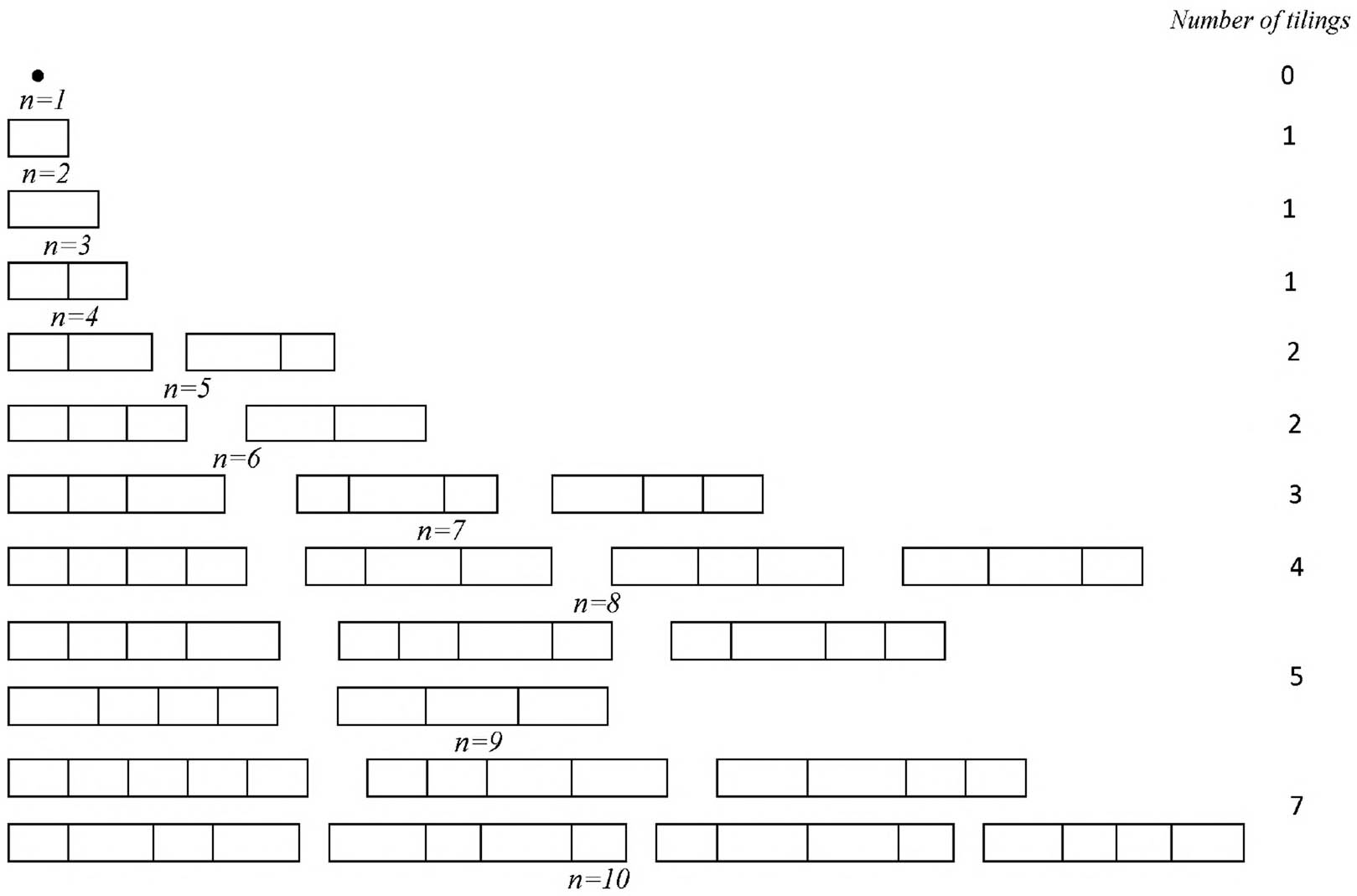
Tilings of a
So,
Theorem 3.1
[27,28] The number of tilings of a
Before proceeding to the proof of the Theorem 3.1, we present Theorem 3.2.
Theorem 3.2
Let
Proof
We will prove the result using the strong induction. Since
So the formula holds when
The proof of the Theorem 3.2 is shown according to the Padovan tiling model as follows.
We know that
4 A model for Padovan polynomials
Now we consider the weight of a tile. Let us define a
 . The product of the weights of all tiles in a tiling gives as the weight of the tiling. For example, the weight of the tiling
  is
is

 is
is
 is
is
Figure 2 shows the tilings and the sum of their weights of a

Tilings of a
Theorem 4.1
The sum of the weights of tilings of a
Proof
By
 . The sum of the weight of such tiling is equal to
 . The sum of the weight of such tilings equals
Let us now give the following theorem that can be proved according to the tiling model of Padovan polynomials.
Theorem 4.2
Let
Proof
We will prove the result using the strong induction. Since
So the formula holds when
The proof of Theorem 4.2 is shown according to the Padovan polynomials tiling model as follows.
We consider the seven tilings of a
In this study, the elements along the rising diagonals in Pascal’s triangle give coefficients of the Padovan polynomials. The first few Padovan polynomials are displayed in Figure 3 as well as the array of their coefficients on the Pascal’s triangle.

Pascal’s triangle of the Padovan polynomial.
Some certain binomial sums for Padovan polynomials are given below:
Theorem 4.3
Let
Proof
By applying Binet-like formula (6) and combining this with (2), we obtain the identity
Thus, the proof is completed.□
Theorem 4.4
Let
Proof
By applying Binet-like formula (6) and combining this with (2) we obtain the identity
Thus, the proof is completed.□
5 The palindromic representations of the compositions with 2s and 3s
Now we shift our attention to compositions with special properties. Compositions of
Let us investigate some properties of the function
Theorem 5.1
The arithmetic function
Moreover,
Proof
By
Since
By the similar way, we obtain
Now (7), (8), and (6) together from Theorem 5.1.□
From Table 3, the following identity can be easily proved.
The palindromic representations of the compositions with 2s and 3s
|
|
Palindromic compositions |
|
|---|---|---|
| 1 | — | 0 |
| 2 | 2 | 1 |
| 3 | 3 | 1 |
| 4 | 2 + 2 | 1 |
| 5 | — | 0 |
| 6 | 2 + 2 + 2, 3 + 3 | 2 |
| 7 | 2 + 3 + 2 | 1 |
| 8 | 2 + 2 + 2 + 2, 3 + 2 + 3 | 2 |
| 9 | 3 + 3 + 3 | 1 |
| 10 | 2 + 2 + 2 + 2 + 2, 2 + 3 + 3 + 2, 3 + 2 + 2 + 3 | 3 |
| 11 | 2 + 2 + 3 + 2 + 2 | 1 |
| 12 | 2 + 2 + 2 + 2 + 2 + 2, 3 + 2 + 2 + 2 + 3, 2 + 3 + 2 + 3 + 2, 3 + 3 + 3 + 3 | 4 |
| 13 | 3 + 2 + 3 + 2 + 3, 2 + 3 + 3 + 3 + 2 | 2 |
| 14 | 3 + 3 + 2 + 3 + 3, 2 + 2 + 3 + 3 + 2 + 2, 3 + 2 + 2 + 2 + 2 + 3, 2 + 3 + 2 + 2 + 3 + 2, 2 + 2 + 2 + 2 + 2 + 2 + 2 | 5 |
| 15 | 2 + 2 + 2 + 3 + 2 + 2 + 2, 3 + 3 + 3 + 3 + 3 | 2 |
Theorem 5.2
The following identity is valid:
Now we define counting polynomials
and this is quite obvious, for
Now we define counting polynomials
and this is quite obvious, for
The notations
Theorem 5.3
The following identities are valid:
- (11)
- (12)
- (13)
Proof
From the definition,
By (10), we have
Taking
- (14)
The number of 2s in all compositions ending 3 in
The sum of the 2s in all compositions ending 2 in
So from (14), this proves
- (15)
The number of 3s in all compositions ending 2 in
The sum of the 3s in all compositions ending 3 in
So from (15), this proves
□
Theorem 5.4
The following identities are valid:
- (16)
- (17)
- (18)
Proof
By using (9), we have
For
By using (9), we have
For
By using (9), we have
For
□
6 Conclusion
In the present work, the combinatorial interpretations of compositions of positive integers with 2s and 3s are investigated. The connection between these compositions and the Padovan numbers is established. The numerous identities of these compositions are obtained. Some tiling models are illustrated for the compositions of positive integers with 2s and 3s. The palindromic representations of the compositions with 2s and 3s are studied, and an arithmetical function related to these palindromic representations is defined. The numerous identities of these compositions are obtained.
A table that compares the first few values of all the results obtained from compositions of positive integers with 2s and 3s is provided as in Table 4.
All representations of the compositions with 2s and 3s
|
|
|
|
|
|
|
|
|
|
|
|---|---|---|---|---|---|---|---|---|---|
| 1 | 0 | 0 | 0 | 0 | 0 | 0 | 0 | 0 | 0 |
| 2 | 1 | 1 | 1 | 0 | 1 | 1 | 0 | 1 | 0 |
| 3 | 1 | 1 | 0 | 1 | 1 | 1 | 0 | 0 | 1 |
| 4 | 1 | 1 | 2 | 0 |
|
1 | 1 | 2 | 0 |
| 5 | 2 | 2 | 2 | 2 | 0 | 0 | 0 | 0 | 0 |
| 6 | 2 | 2 | 3 | 2 |
|
2 | 3 | 3 | 2 |
| 7 | 3 | 3 | 6 | 3 |
|
1 | 2 | 2 | 1 |
| 8 | 4 | 4 | 7 | 6 |
|
2 | 5 | 5 | 2 |
| 9 | 5 | 5 | 12 | 7 |
|
1 | 2 | 0 | 3 |
| 10 | 7 | 7 | 17 | 12 |
|
3 | 10 | 9 | 4 |
In future studies, combinatorial interpretations for the sequences defined by higher-order recurrence relations may be considered. Tiling models may be examined for these sequences.
Acknowledgement
The authors wish to thank the referees for useful comments and suggestions.
-
Author contributions: All authors contributed equally and significantly in writing this article. All authors read and approved the final manuscript.
-
Conflict of interest: The authors declare that they have no competing interests.
References
[1] P. A. MacMahon, XVII. Memoir on the theory of the compositions of numbers, Philos. Trans. Roy. Soc. London 184 (1893), 835–901, https://doi.org/10.1098/rsta.1893.0017. 10.1098/rsta.1893.0017Search in Google Scholar
[2] P. Hitczenko and C. D. Savage, On the multiplicity of parts in a random composition of a large integer, SIAM J. Discrete Math. 18 (2004), no.2, 418–435, https://doi.org/10.1137/S0895480199363155. 10.1137/S0895480199363155Search in Google Scholar
[3] P. Hitczenko and G. Stengle, Expected number of distinct part sizes in a random integer composition, Comb. Probab. Comput. 9 (2000), no.6, 519–527, https://doi.org/10.1017/S0963548300004399. 10.1017/S0963548300004399Search in Google Scholar
[4] S. Heubach and T. Mansour, Avoiding patterns of length three in compositions and multiset permutations, Adv. Appl. Math. 36 (2006), no.2, 156–174, https://doi.org/10.1016/j.aam.2005.06.005. 10.1016/j.aam.2005.06.005Search in Google Scholar
[5] S. Heubach and T. Mansour, Combinatorics of Compositions and Words, Chapman and Hall/CRC, New York, 2009. 10.1201/9781420072686Search in Google Scholar
[6] S. Heubach and T. Mansour, Compositions of n with parts in a set, Congr. Numerantium 168 (2004), 127. Search in Google Scholar
[7] C. D. Savage and H. S. Wilf, Pattern avoidance in compositions and multiset permutations, Adv. Appl. Math. 36 (2006), no. 2, 194–201, https://doi.org/10.1016/j.aam.2005.06.003. 10.1016/j.aam.2005.06.003Search in Google Scholar
[8] K. Alladi and V. E. Hoggatt, Compositions with ones and twos, Fibonacci Q. 13 (1975), 233–239. 10.1080/00150517.1975.12430642Search in Google Scholar
[9] C. Banderier and P. Hitczenko, Enumeration and asymptotics of restricted compositions having the same number of parts, Discrete Appl. Math. 160 (2012), no. 18, 2542–2554, https://doi.org/10.1016/j.dam.2011.12.011.10.1016/j.dam.2011.12.011Search in Google Scholar
[10] P. Chinn and S. Heubach, Compositions of n with no occurence of k, Congr. Numerantium (2003), 164 33–52. Search in Google Scholar
[11] S. Eger, Restricted weighted integer compositions and extended binomial coefficient, J. Integer. Seq. 16 (2013), 3. Search in Google Scholar
[12] V. E. Hoggatt and M. Bicknell, Generalized Fibonacci polynomials, Fibonacci Q. 11 (1973), 457–465. 10.1080/00150517.1973.12430785Search in Google Scholar
[13] V. E. Hoggatt and K. Alladi, Compositions and recurrence relations II, Fibonacci Q. 15 (1977), 239–245. 10.1080/00150517.1977.12430449Search in Google Scholar
[14] A. V. Sills, Compositions, Partitions, and Fibonacci Numbers, 2013, arxiv:1312.0693. Search in Google Scholar
[15] I. M. Gessel and J. Li, Compositions and Fibonacci Identities, 2013, arxiv:1303.1366. Search in Google Scholar
[16] C. Kimberling, Enumeration of paths, compositions of integers, and Fibonacci numbers, Fibonacci Q. 39 (2001), no. 5, 430–434. Search in Google Scholar
[17] A. Knopfmacher and N. Robbins, On binary and Fibonacci compositions, Ann. Univ. Sci. Budapest. Sect. Comput. 22 (2003), 193–206. Search in Google Scholar
[18] OEIS Foundation Inc. (2011), The On-Line Encyclopedia of Integer Sequences, https://oeis.org/A000931. Search in Google Scholar
[19] R. Padovan, Dom Hans van Der Laan and the plastic number, Nexus Netw. J. 4 (2002), no. 3, pp. 181–193. Search in Google Scholar
[20] I. Stewart, Tales of a neglected number, Sci. Amarican. 274 (1996), no. 6, 102. 10.1038/scientificamerican0696-102Search in Google Scholar
[21] G. Cerda-Morales, New Identities for Padovan Numbers, 2019, arXiv:1904.05492. Search in Google Scholar
[22] O. Deveci and E. Karaduman, On the Padovan p-numbers, Hacet. J. Math. 46 (2017), no. 4, 579–592. 10.15672/HJMS.20174622760Search in Google Scholar
[23] Z. İşbilir and G. Gürses, Padovan and Perrin generalized quaternions, Math. Methods Appl. Sci 45 (2022), no. 18, 12060–12076, https://doi.org/10.1002/mma.7495. 10.1002/mma.7495Search in Google Scholar
[24] Y. Soykan, On Generalized Padovan Numbers, 2011, https://doi.org/10.20944/preprints202110.0101.v1. 10.20944/preprints202110.0101.v1Search in Google Scholar
[25] N. Yilmaz and N. Taskara, Matrix sequences in terms of Padovan and Perrin Numbers, J. Appl. Math. 2013 (2013), https://doi.org/10.1155/2013/941673. 10.1155/2013/941673Search in Google Scholar
[26] N. Gogin and A. Mylläri, Padovan-like sequences and Bell polynomials, Math. Comput. Simul. 125 (2016), 168–177, https://doi.org/10.1016/j.matcom.2015.08.008. 10.1016/j.matcom.2015.08.008Search in Google Scholar
[27] S. J. Tedford, Combinatorial identities for the Padovan numbers, Fibonacci Quart. 57 (2019), 291–298. 10.1080/00150517.2019.12427628Search in Google Scholar
[28] Vieira, R. P. M., Alves, F. R. V., and Catarino, P. M. M. C., Combinatorial interpretation of numbers in the generalized Padovan sequence and some of its extensions. Axioms, 11 (2022), no. 11, 598, https://doi.org/10.3390/axioms11110598. 10.3390/axioms11110598Search in Google Scholar
[29] T. Koshy, Fibonacci and Lucas Numbers with Applications 1, John Wiley & Sons, New York, 2018. 10.1002/9781118742297Search in Google Scholar
[30] T. Koshy, Fibonacci and Lucas Numbers with Applications 2, John Wiley & Sons, New York, 2019. 10.1002/9781118742297Search in Google Scholar
[31] A. T. Benjamin and J. J. Quinn, Proofs that Really Count: The Aart of Combinatorial Proof, vol. 27, American Mathematical Society, Providence-Rhode Island, 2022. Search in Google Scholar
© 2023 the author(s), published by De Gruyter
This work is licensed under the Creative Commons Attribution 4.0 International License.
Articles in the same Issue
- Regular Articles
- A novel class of bipolar soft separation axioms concerning crisp points
- Duality for convolution on subclasses of analytic functions and weighted integral operators
- Existence of a solution to an infinite system of weighted fractional integral equations of a function with respect to another function via a measure of noncompactness
- On the existence of nonnegative radial solutions for Dirichlet exterior problems on the Heisenberg group
- Hyers-Ulam stability of isometries on bounded domains-II
- Asymptotic study of Leray solution of 3D-Navier-Stokes equations with exponential damping
- Semi-Hyers-Ulam-Rassias stability for an integro-differential equation of order 𝓃
- Jordan triple (α,β)-higher ∗-derivations on semiprime rings
- The asymptotic behaviors of solutions for higher-order (m1, m2)-coupled Kirchhoff models with nonlinear strong damping
- Approximation of the image of the Lp ball under Hilbert-Schmidt integral operator
- Best proximity points in ℱ-metric spaces with applications
- Approximation spaces inspired by subset rough neighborhoods with applications
- A numerical Haar wavelet-finite difference hybrid method and its convergence for nonlinear hyperbolic partial differential equation
- A novel conservative numerical approximation scheme for the Rosenau-Kawahara equation
- Fekete-Szegö functional for a class of non-Bazilevic functions related to quasi-subordination
-
On local fractional integral inequalities via generalized
- On some geometric results for generalized k-Bessel functions
- Convergence analysis of M-iteration for 𝒢-nonexpansive mappings with directed graphs applicable in image deblurring and signal recovering problems
- Some results of homogeneous expansions for a class of biholomorphic mappings defined on a Reinhardt domain in ℂn
- Graded weakly 1-absorbing primary ideals
- The existence and uniqueness of solutions to a functional equation arising in psychological learning theory
- Some aspects of the n-ary orthogonal and b(αn,βn)-best approximations of b(αn,βn)-hypermetric spaces over Banach algebras
- Numerical solution of a malignant invasion model using some finite difference methods
- Increasing property and logarithmic convexity of functions involving Dirichlet lambda function
- Feature fusion-based text information mining method for natural scenes
- Global optimum solutions for a system of (k, ψ)-Hilfer fractional differential equations: Best proximity point approach
- The study of solutions for several systems of PDDEs with two complex variables
- Regularity criteria via horizontal component of velocity for the Boussinesq equations in anisotropic Lorentz spaces
- Generalized Stević-Sharma operators from the minimal Möbius invariant space into Bloch-type spaces
- On initial value problem for elliptic equation on the plane under Caputo derivative
- A dimension expanded preconditioning technique for block two-by-two linear equations
- Asymptotic behavior of Fréchet functional equation and some characterizations of inner product spaces
- Small perturbations of critical nonlocal equations with variable exponents
- Dynamical property of hyperspace on uniform space
- Some notes on graded weakly 1-absorbing primary ideals
- On the problem of detecting source points acting on a fluid
- Integral transforms involving a generalized k-Bessel function
- Ruled real hypersurfaces in the complex hyperbolic quadric
- On the monotonic properties and oscillatory behavior of solutions of neutral differential equations
- Approximate multi-variable bi-Jensen-type mappings
- Mixed-type SP-iteration for asymptotically nonexpansive mappings in hyperbolic spaces
- On the equation fn + (f″)m ≡ 1
- Results on the modified degenerate Laplace-type integral associated with applications involving fractional kinetic equations
- Characterizations of entire solutions for the system of Fermat-type binomial and trinomial shift equations in ℂn#
- Commentary
- On I. Meghea and C. S. Stamin review article “Remarks on some variants of minimal point theorem and Ekeland variational principle with applications,” Demonstratio Mathematica 2022; 55: 354–379
- Special Issue on Fixed Point Theory and Applications to Various Differential/Integral Equations - Part II
- On Cauchy problem for pseudo-parabolic equation with Caputo-Fabrizio operator
- Fixed-point results for convex orbital operators
- Asymptotic stability of equilibria for difference equations via fixed points of enriched Prešić operators
- Asymptotic behavior of resolvents of equilibrium problems on complete geodesic spaces
- A system of additive functional equations in complex Banach algebras
- New inertial forward–backward algorithm for convex minimization with applications
- Uniqueness of solutions for a ψ-Hilfer fractional integral boundary value problem with the p-Laplacian operator
- Analysis of Cauchy problem with fractal-fractional differential operators
- Common best proximity points for a pair of mappings with certain dominating property
- Investigation of hybrid fractional q-integro-difference equations supplemented with nonlocal q-integral boundary conditions
- The structure of fuzzy fractals generated by an orbital fuzzy iterated function system
- On the structure of self-affine Jordan arcs in ℝ2
- Solvability for a system of Hadamard-type hybrid fractional differential inclusions
- Three solutions for discrete anisotropic Kirchhoff-type problems
- On split generalized equilibrium problem with multiple output sets and common fixed points problem
- Special Issue on Computational and Numerical Methods for Special Functions - Part II
- Sandwich-type results regarding Riemann-Liouville fractional integral of q-hypergeometric function
- Certain aspects of Nörlund ℐ-statistical convergence of sequences in neutrosophic normed spaces
- On completeness of weak eigenfunctions for multi-interval Sturm-Liouville equations with boundary-interface conditions
- Some identities on generalized harmonic numbers and generalized harmonic functions
- Study of degenerate derangement polynomials by λ-umbral calculus
- Normal ordering associated with λ-Stirling numbers in λ-shift algebra
- Analytical and numerical analysis of damped harmonic oscillator model with nonlocal operators
- Compositions of positive integers with 2s and 3s
- Kinematic-geometry of a line trajectory and the invariants of the axodes
- Hahn Laplace transform and its applications
- Discrete complementary exponential and sine integral functions
- Special Issue on Recent Methods in Approximation Theory - Part II
- On the order of approximation by modified summation-integral-type operators based on two parameters
- Bernstein-type operators on elliptic domain and their interpolation properties
- A class of strongly convergent subgradient extragradient methods for solving quasimonotone variational inequalities
- Special Issue on Recent Advances in Fractional Calculus and Nonlinear Fractional Evaluation Equations - Part II
- Application of fractional quantum calculus on coupled hybrid differential systems within the sequential Caputo fractional q-derivatives
- On some conformable boundary value problems in the setting of a new generalized conformable fractional derivative
- A certain class of fractional difference equations with damping: Oscillatory properties
- Weighted Hermite-Hadamard inequalities for r-times differentiable preinvex functions for k-fractional integrals
- Special Issue on Recent Advances for Computational and Mathematical Methods in Scientific Problems - Part II
- The behavior of hidden bifurcation in 2D scroll via saturated function series controlled by a coefficient harmonic linearization method
- Phase portraits of two classes of quadratic differential systems exhibiting as solutions two cubic algebraic curves
- Petri net analysis of a queueing inventory system with orbital search by the server
- Asymptotic stability of an epidemiological fractional reaction-diffusion model
- On the stability of a strongly stabilizing control for degenerate systems in Hilbert spaces
- Special Issue on Application of Fractional Calculus: Mathematical Modeling and Control - Part I
- New conticrete inequalities of the Hermite-Hadamard-Jensen-Mercer type in terms of generalized conformable fractional operators via majorization
- Pell-Lucas polynomials for numerical treatment of the nonlinear fractional-order Duffing equation
- Impacts of Brownian motion and fractional derivative on the solutions of the stochastic fractional Davey-Stewartson equations
- Some results on fractional Hahn difference boundary value problems
- Properties of a subclass of analytic functions defined by Riemann-Liouville fractional integral applied to convolution product of multiplier transformation and Ruscheweyh derivative
- Special Issue on Development of Fuzzy Sets and Their Extensions - Part I
- The cross-border e-commerce platform selection based on the probabilistic dual hesitant fuzzy generalized dice similarity measures
- Comparison of fuzzy and crisp decision matrices: An evaluation on PROBID and sPROBID multi-criteria decision-making methods
- Rejection and symmetric difference of bipolar picture fuzzy graph
Articles in the same Issue
- Regular Articles
- A novel class of bipolar soft separation axioms concerning crisp points
- Duality for convolution on subclasses of analytic functions and weighted integral operators
- Existence of a solution to an infinite system of weighted fractional integral equations of a function with respect to another function via a measure of noncompactness
- On the existence of nonnegative radial solutions for Dirichlet exterior problems on the Heisenberg group
- Hyers-Ulam stability of isometries on bounded domains-II
- Asymptotic study of Leray solution of 3D-Navier-Stokes equations with exponential damping
- Semi-Hyers-Ulam-Rassias stability for an integro-differential equation of order 𝓃
- Jordan triple (α,β)-higher ∗-derivations on semiprime rings
- The asymptotic behaviors of solutions for higher-order (m1, m2)-coupled Kirchhoff models with nonlinear strong damping
- Approximation of the image of the Lp ball under Hilbert-Schmidt integral operator
- Best proximity points in ℱ-metric spaces with applications
- Approximation spaces inspired by subset rough neighborhoods with applications
- A numerical Haar wavelet-finite difference hybrid method and its convergence for nonlinear hyperbolic partial differential equation
- A novel conservative numerical approximation scheme for the Rosenau-Kawahara equation
- Fekete-Szegö functional for a class of non-Bazilevic functions related to quasi-subordination
-
On local fractional integral inequalities via generalized
- On some geometric results for generalized k-Bessel functions
- Convergence analysis of M-iteration for 𝒢-nonexpansive mappings with directed graphs applicable in image deblurring and signal recovering problems
- Some results of homogeneous expansions for a class of biholomorphic mappings defined on a Reinhardt domain in ℂn
- Graded weakly 1-absorbing primary ideals
- The existence and uniqueness of solutions to a functional equation arising in psychological learning theory
- Some aspects of the n-ary orthogonal and b(αn,βn)-best approximations of b(αn,βn)-hypermetric spaces over Banach algebras
- Numerical solution of a malignant invasion model using some finite difference methods
- Increasing property and logarithmic convexity of functions involving Dirichlet lambda function
- Feature fusion-based text information mining method for natural scenes
- Global optimum solutions for a system of (k, ψ)-Hilfer fractional differential equations: Best proximity point approach
- The study of solutions for several systems of PDDEs with two complex variables
- Regularity criteria via horizontal component of velocity for the Boussinesq equations in anisotropic Lorentz spaces
- Generalized Stević-Sharma operators from the minimal Möbius invariant space into Bloch-type spaces
- On initial value problem for elliptic equation on the plane under Caputo derivative
- A dimension expanded preconditioning technique for block two-by-two linear equations
- Asymptotic behavior of Fréchet functional equation and some characterizations of inner product spaces
- Small perturbations of critical nonlocal equations with variable exponents
- Dynamical property of hyperspace on uniform space
- Some notes on graded weakly 1-absorbing primary ideals
- On the problem of detecting source points acting on a fluid
- Integral transforms involving a generalized k-Bessel function
- Ruled real hypersurfaces in the complex hyperbolic quadric
- On the monotonic properties and oscillatory behavior of solutions of neutral differential equations
- Approximate multi-variable bi-Jensen-type mappings
- Mixed-type SP-iteration for asymptotically nonexpansive mappings in hyperbolic spaces
- On the equation fn + (f″)m ≡ 1
- Results on the modified degenerate Laplace-type integral associated with applications involving fractional kinetic equations
- Characterizations of entire solutions for the system of Fermat-type binomial and trinomial shift equations in ℂn#
- Commentary
- On I. Meghea and C. S. Stamin review article “Remarks on some variants of minimal point theorem and Ekeland variational principle with applications,” Demonstratio Mathematica 2022; 55: 354–379
- Special Issue on Fixed Point Theory and Applications to Various Differential/Integral Equations - Part II
- On Cauchy problem for pseudo-parabolic equation with Caputo-Fabrizio operator
- Fixed-point results for convex orbital operators
- Asymptotic stability of equilibria for difference equations via fixed points of enriched Prešić operators
- Asymptotic behavior of resolvents of equilibrium problems on complete geodesic spaces
- A system of additive functional equations in complex Banach algebras
- New inertial forward–backward algorithm for convex minimization with applications
- Uniqueness of solutions for a ψ-Hilfer fractional integral boundary value problem with the p-Laplacian operator
- Analysis of Cauchy problem with fractal-fractional differential operators
- Common best proximity points for a pair of mappings with certain dominating property
- Investigation of hybrid fractional q-integro-difference equations supplemented with nonlocal q-integral boundary conditions
- The structure of fuzzy fractals generated by an orbital fuzzy iterated function system
- On the structure of self-affine Jordan arcs in ℝ2
- Solvability for a system of Hadamard-type hybrid fractional differential inclusions
- Three solutions for discrete anisotropic Kirchhoff-type problems
- On split generalized equilibrium problem with multiple output sets and common fixed points problem
- Special Issue on Computational and Numerical Methods for Special Functions - Part II
- Sandwich-type results regarding Riemann-Liouville fractional integral of q-hypergeometric function
- Certain aspects of Nörlund ℐ-statistical convergence of sequences in neutrosophic normed spaces
- On completeness of weak eigenfunctions for multi-interval Sturm-Liouville equations with boundary-interface conditions
- Some identities on generalized harmonic numbers and generalized harmonic functions
- Study of degenerate derangement polynomials by λ-umbral calculus
- Normal ordering associated with λ-Stirling numbers in λ-shift algebra
- Analytical and numerical analysis of damped harmonic oscillator model with nonlocal operators
- Compositions of positive integers with 2s and 3s
- Kinematic-geometry of a line trajectory and the invariants of the axodes
- Hahn Laplace transform and its applications
- Discrete complementary exponential and sine integral functions
- Special Issue on Recent Methods in Approximation Theory - Part II
- On the order of approximation by modified summation-integral-type operators based on two parameters
- Bernstein-type operators on elliptic domain and their interpolation properties
- A class of strongly convergent subgradient extragradient methods for solving quasimonotone variational inequalities
- Special Issue on Recent Advances in Fractional Calculus and Nonlinear Fractional Evaluation Equations - Part II
- Application of fractional quantum calculus on coupled hybrid differential systems within the sequential Caputo fractional q-derivatives
- On some conformable boundary value problems in the setting of a new generalized conformable fractional derivative
- A certain class of fractional difference equations with damping: Oscillatory properties
- Weighted Hermite-Hadamard inequalities for r-times differentiable preinvex functions for k-fractional integrals
- Special Issue on Recent Advances for Computational and Mathematical Methods in Scientific Problems - Part II
- The behavior of hidden bifurcation in 2D scroll via saturated function series controlled by a coefficient harmonic linearization method
- Phase portraits of two classes of quadratic differential systems exhibiting as solutions two cubic algebraic curves
- Petri net analysis of a queueing inventory system with orbital search by the server
- Asymptotic stability of an epidemiological fractional reaction-diffusion model
- On the stability of a strongly stabilizing control for degenerate systems in Hilbert spaces
- Special Issue on Application of Fractional Calculus: Mathematical Modeling and Control - Part I
- New conticrete inequalities of the Hermite-Hadamard-Jensen-Mercer type in terms of generalized conformable fractional operators via majorization
- Pell-Lucas polynomials for numerical treatment of the nonlinear fractional-order Duffing equation
- Impacts of Brownian motion and fractional derivative on the solutions of the stochastic fractional Davey-Stewartson equations
- Some results on fractional Hahn difference boundary value problems
- Properties of a subclass of analytic functions defined by Riemann-Liouville fractional integral applied to convolution product of multiplier transformation and Ruscheweyh derivative
- Special Issue on Development of Fuzzy Sets and Their Extensions - Part I
- The cross-border e-commerce platform selection based on the probabilistic dual hesitant fuzzy generalized dice similarity measures
- Comparison of fuzzy and crisp decision matrices: An evaluation on PROBID and sPROBID multi-criteria decision-making methods
- Rejection and symmetric difference of bipolar picture fuzzy graph
