Home Mathematics The behavior of hidden bifurcation in 2D scroll via saturated function series controlled by a coefficient harmonic linearization method
Article Open Access

The behavior of hidden bifurcation in 2D scroll via saturated function series controlled by a coefficient harmonic linearization method

  • Zaamoune Faiza EMAIL logo and Menacer Tidjani
Published/Copyright: April 13, 2023
Become an author with De Gruyter Brill

Abstract

In this article, the behavior of hidden bifurcation in a two-dimensional (2D) scroll via saturated function series controlled by the coefficient harmonic linearization method is presented. A saturated function series approach for chaos generation. The systematic saturated function series methodicalness improved here can make multi-scroll and grid scroll chaotic attractors from a 3D linear autonomous system with a plain saturated function series supervisor. We have used a hidden bifurcation method in grid scroll., where the method of hidden bifurcation presented by Menacer, et al. in (2016) for Chua multi-scroll attractors. This additional parameter, which is absent from the initial problem, is perfectly adapted to unfold the structure of the multispiral chaotic attractor. The novelty of this article is twofold: first, the saturated function series model for hidden bifurcation in a 2 – D scroll; and second, the control of hidden bifurcation behavior by the value of the harmonic coefficient k 3 .

MSC 2010: 39A21; 39A28; 39A33

1 Introduction

During precedent and until now, the generation of multispiral chaotic attractors has been extensively examined due to their hopeful applications in manifold real-world technologies. Few techniques have been suggested, like linear and nonlinear modulating functions and in electronic circuits (saturated circuits, etc.), for generating multispiral chaotic attractors see [13]. The issue of hidden oscillations in nonlinear control systems forces us to improvise a novel approximation of nonlinear oscillation theory. Meanwhile, during the initial institution and evolution of the theory of nonlinear oscillations in the first half of the twentieth century broad attention was given to the analysis and composite of oscillating systems, for which the solution of existing problems of oscillating ranks was not too uneasy [4].

The construction itself of many systems was such that they had oscillating solutions, the nature of which was almost clear. The rise in these systems’ periodic solutions was visible by numerical analysis when the numerical integration procedure of the trajectories permitted one to track from the little neighborhood of equilibrium to a periodic trajectory [5,6]. A self-excited attractor’s basin of attraction interferes with the neighborhood of an equilibrium point, whereas a hidden attractor’s basin of attraction does not intersect with the small neighborhoods of any equilibrium points, making it hard to find. The hidden attractors are important in engineering applications [1,715]. Though most multi-spirals generations are have been known for many years, it is only recently that they have been studied underneath the area of bifurcation theory [14]. In all the multispirals previously familiar, the number of spirals (or scrolls) is a fixed integer, whereas it depends on one or more discrete parameters after the rapid development in more than a decade. In [14], the authors modified the model of discrete parameters by producing hidden bifurcations and generating multispirals.

Thus, hidden bifurcation theory is instituted based on the hidden attractor theory introduced by Leonov et al. [8,10]. In this work, the focus is on the study of paradigm hidden bifurcation in 2D grid scroll chaotic attractors generated by saturated function series. In the work of Chen et al., a saturated function series was suggested for generating multispiral chaotic attractors, including 1D n -scroll, 2D n × m -grid scroll, and 3D n × m × l -grid scroll chaotic attractors [9]. Additionally, in order to find the hidden bifurcations, we fixed p 1 , p 2 , and q 1 , q 2 and introduce the new control parameter ε in the nonlinear part, governed by a homotopy parameter ε while keeping p 1 , p 2 , and q 1 , q 2 constant. The parameter ε varies between 0 and 1, indicating that when it takes the value 0, the non-linear part of the system (1-2-3) is unpaired and an attractor in the form of a cycle is obtained, whereas when it takes the value 1, the attractor of the original system (1-2-3) is found to be, with a number of spirals, m = ( p 1 + q 1 + 2 ) ( p 2 + q 2 + 2 ) . Between these two values of ε , the number of spirals is increased in direct proportion to ε .

The aspects of this article are as follows: (i) the study of hidden bifurcation of 2D n × m -grid scroll chaotic attractors via saturated function series with a method based on a homotopy parameter ε while conserving the number of scrolls constant [14]; the novel idea of controlling the parameter k 3 harmonic linearization method the spirals in 2 − D n × m grid scroll chaotic attractors via saturation function series is introduced, which is related to the behavior of spirals while taking one and two values of the parameter k 3 .

This article is organized as follows: in Section 2, we first present the model of 2D n × m -grid scroll chaotic attractors generated by saturated function series proposed in [9], then we introduce the analytical-numerical method for hidden attractor localization proposed by Leonov [10], Leonov and Kuznetsov [11], and finally we introduce the Poincare map for harmonic linearization in vector case. Section 3 is devoted to the localization of hidden bifurcations of 2 − D n × m grid- scroll chaotic attractors via saturated function series. In addition, we presented a new idea about controlling the parameter k 3 harmonic linearization method of behavior of the spirals, and we are given the results of the numerical bifurcation of the analysis. Finally, in Section 4, a brief conclusion is drawn.

2 Analytical-numerical method for double-spiral chaotic attractors from saturated function series

2.1 Double-spiral attractors generated via a saturated function series

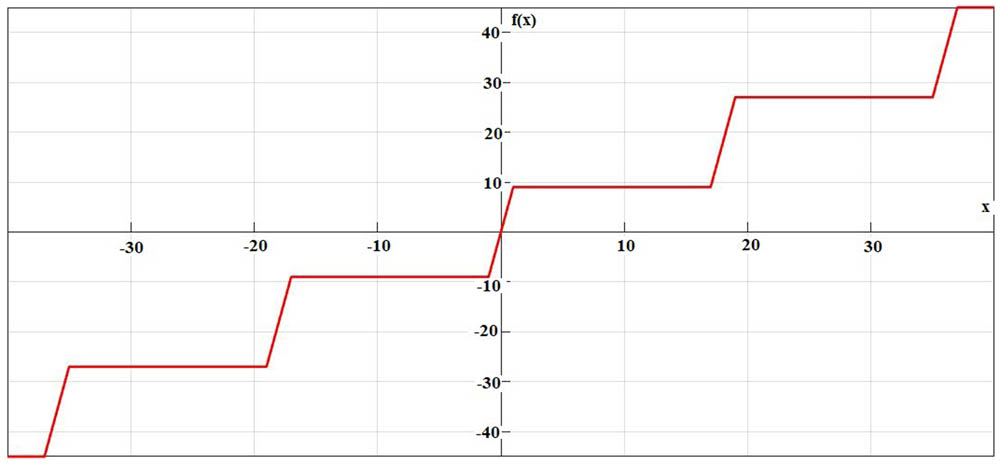
In the following, to create a 2D n × m -grid scroll chaotic attractors [1], a saturated function series as a controller is added to system 1 leading to [9], and see the Figure 1,

(1) x = y d 2 b g ( y ; k 2 ; h 2 ; p 2 ; q 2 ) y = z z = a x b y c z + d 1 f ( x ; k 1 ; h 1 ; p 1 ; q 1 ) + d 2 g ( y ; k 2 ; h 2 ; p 2 ; q 2 ) ,

where

(2) f ( x ; k 1 ; h 1 ; p 1 ; q 1 ) = y 1 if x > q 1 h 1 + 1 y 2 if x i h 1 1 , p 1 i q 1 y 3 if i h 1 + 1 < x < ( i + 1 ) h 1 1 and p 1 < i < q 1 1 y 4 if x < p 1 h 1 1 ,

y 1 = ( 2 q 1 + 1 ) k 1 , y 2 = k 1 ( x i h 1 ) + 2 i k 1 , y 3 = ( 2 i + 1 ) k 1 , and y 4 = ( 2 q 1 + 1 ) k 1 ,

(3) g ( y ; k 2 ; h 2 ; p 2 ; q 2 ) = y 1 if y > q 2 h 2 + 1 y 2 if y i h 2 1 , p 2 i q 2 y 3 if i h 2 + 1 < y < ( i + 1 ) h 2 1 and p 2 < i < q 2 1 y 4 if x < p 2 h 2 1 ,

y 1 = ( 2 q 2 + 1 ) k 2 , y 2 = k 2 ( y i h 2 ) + 2 i k 2 , y 3 = ( 2 i + 1 ) k 2 , and y 4 = ( 2 q 2 + 1 ) k 2 .

Figure 1 
                  Graph of saturated function series for 


                              k
                              =
                              9
                              ,
                              h
                              =
                              18
                           
                           k=9,h=18
                        
                     .
Figure 1

Graph of saturated function series for k = 9 , h = 18 .

The parameters p 1 , q 1 , p 2 , q 2 , h 1 , h 2 , and k 1 , k 2 are integers and a , b , c , d 1 , and d 2 are real numbers.

So, the number m of scrolls is defined as follows:

m = ( p 1 + q 1 + 2 ) ( p 2 + q 2 + 2 ) .

For k 1 = k 2 = 50 , h 1 = h 2 = 100 , p 1 = p 2 = 1 , and q 1 = q 2 = 0 , a nine-scroll attractor is generated as the verged attractor of system (1-2-3), see Figure 2.

Figure 2 
                  Two-directional 


                              3
                              ×
                              3
                           
                           3\times 3
                        
                     -grid scroll chaotic attractors for 


                                    k
                                 
                                 
                                    1
                                 
                              
                              =
                              
                                 
                                    k
                                 
                                 
                                    2
                                 
                              
                              =
                              50
                           
                           {k}_{1}={k}_{2}=50
                        
                     , 


                                    h
                                 
                                 
                                    1
                                 
                              
                              =
                              
                                 
                                    h
                                 
                                 
                                    2
                                 
                              
                              =
                              100
                           
                           {h}_{1}={h}_{2}=100
                        
                     , 


                                    p
                                 
                                 
                                    1
                                 
                              
                              =
                              
                                 
                                    p
                                 
                                 
                                    2
                                 
                              
                              =
                              1
                           
                           {p}_{1}={p}_{2}=1
                        
                     , 


                                    q
                                 
                                 
                                    1
                                 
                              
                              =
                              
                                 
                                    q
                                 
                                 
                                    2
                                 
                              
                              =
                              0
                           
                           {q}_{1}={q}_{2}=0
                        
                     .
Figure 2

Two-directional 3 × 3 -grid scroll chaotic attractors for k 1 = k 2 = 50 , h 1 = h 2 = 100 , p 1 = p 2 = 1 , q 1 = q 2 = 0 .

2.1.1 Attraction basin of the nine spirals attractors

For our system (1-2-3), we have a ( 2 p 1 + 2 q 1 + 3 ) ( 2 p 2 + 2 q 2 + 3 ) equilibrium point situated along the y -axis, which can be categorized into two different sets as follows:

N y = ( 2 p 1 + 1 ) d 2 k 2 b , ( 2 p 1 + 1 ) d 2 k 2 b , , ( 2 q 2 + 1 ) d 2 k 2 b M y = p 2 k 2 d 2 ( h 2 2 ) k 2 d 2 b , ( p 2 + 1 ) k 2 d 2 ( h 2 2 ) k 2 d 2 b , , q 2 k 2 d 2 ( h 2 2 ) k 2 d 2 b .

For all equilibria in two sets N y and M y are saddle points (for more information see [9] (Lü 2007)).

In this obstacle, we took p 1 = p 2 = 1 and q 1 = q 2 = 0 , so we have 25 equilibrium points that are unstable points. Since all of the points in our system are unstable, we do not have any hidden attractors, which is why we are interested in the attraction basin. We took some points as we saw that the same outcomes appeared in all figures. The motion starting in these initial state regions is depicted by cyan color, which will diverge from equilibrium points, while the yellow regions denote the attraction basin of chaotic attractors (Figure 3).

Figure 3 
                     The attraction basin of 9 spirals attractors. (a) Attraction basin attractors cross section passing through four equilibrium points 


                                    (
                                    
                                       0
                                       ,
                                       −
                                       50
                                       ,
                                       0
                                    
                                    )
                                 
                                 ,
                                 
                                    (
                                    
                                       0
                                       ,
                                       −
                                       100
                                       ,
                                       0
                                    
                                    )
                                 
                                 ,
                                 
                                    (
                                    
                                       0
                                       ,
                                       −
                                       150
                                       ,
                                       0
                                    
                                    )
                                 
                              
                              \left(0,-50,0),\left(0,-100,0),\left(0,-150,0)
                           
                         and (b) attraction basin zooming in around 


                                    (
                                    
                                       0
                                       ,
                                       100
                                       ,
                                       0
                                    
                                    )
                                 
                              
                              \left(0,100,0)
                           
                         equilibrium point.
Figure 3

The attraction basin of 9 spirals attractors. (a) Attraction basin attractors cross section passing through four equilibrium points ( 0 , 50 , 0 ) , ( 0 , 100 , 0 ) , ( 0 , 150 , 0 ) and (b) attraction basin zooming in around ( 0 , 100 , 0 ) equilibrium point.

2.2 Analytical-numerical method for attractors localization

Twelve years ago, Leonov [10], Leonov and Kuznetsov [11,13], proposed an effective method for the numerical localization of hidden attractors in multidimensional dynamical systems. They improve this method, especially for Chua attractors. In 2016, the method developed by Menacer et al. to discover hidden bifurcations in the multispiral Chua attractor was published. For the search of periodic solution close to harmonic oscillation, we consider a coefficient of harmonic linearization k 3 at like the matrix G 0 as:

(4) d x d t = G x + δ Ψ ( κ T x ) , x R 3 ,

where G is a constant ( n × n ) matrix, δ and κ are constant n -dimensional vectors, T is a transposition operation, Ψ ( ι ) is a continuous piecewise-differentiable vector-function, and Ψ ( 0 ) = 0 . Consider a coefficient of harmonic linearization k 3 at like the matrix G 0 as:

(5) G 0 = G + k 3 δ κ T

which ± i ω 0 ( ω 0 > 0 ) eigenvalues the matrix G 0 and the rest have negative real parts. We assume that such k 3 exists. Then, rewrite system 4 as follows:

(6) d x d t = G 0 x + δ ρ ( κ T x ) ,

where ρ ( ι ) = Ψ ( ι ) k 3 ι . We introduce a fixed sequence of functions ρ 0 ( ι ) , ρ 1 ( ι ) , , ρ n ( ι ) such that the graphs of the neighboring functions ρ i ( ι ) and ρ i + 1 ( ι ) , ( i = 0 , , n 1 ) partly disagree from each other.

Suppose that the function ρ 0 ( ι ) is small, and ρ m ( σ ) = ρ ( ι ) . In this situation, the smallness of function ρ 0 ( ι ) allows one to apply the method of harmonic linearization for the system

(7) d x d t = G 0 x + δ ρ 0 ( κ T x )

and determine a stable nontrivial periodic solution x 0 ( t ) . In order to localize the attractor of system (5), put up the numerical transformation of this periodic solution. As we obtain the primary condition x 0 ( 0 ) of the periodic solution, system (7) can be changed by H ( X = H Y ) to the form:

(8) z 1 = ω 0 z 2 + v 1 ρ 0 ( z 1 + c 3 T Z 3 ) z 2 = ω 0 z 1 + v 2 ρ 0 ( z 1 + c 3 T Z 3 ) Z 3 = A 3 Z 3 + V 3 ρ 0 ( z 1 + c 3 T Z 3 ) .

So z 1 and z 2 are scalar values; Z 3 is an ( n 2 ) -dimensional vector, V 3 and c 3 are an ( n 2 ) -dimensional vectors; v 1 and v 2 are real numbers; and A 3 is an ( n 2 ) × ( n 2 ) matrix, where all of its eigenvalues have negative real parts. Supposed that, for the matrix A 3 , there exists d 3 > 0 such that

(9) Z 3 T ( A 3 + A 3 T ) Z 3 2 d 3 Z 3 2 Y 3 R n 2 .

2.3 Poincare map for harmonic linearization in vector case

Define system (8) with ϕ = ε ρ , where the parameter ε is ( ε ) . Suppose, for the ρ ( z ) ,

(10) ρ ( z ) ρ ( z ) L z z z , z R n

is satisfied. In a phase space of system (8), we introduce the following formula:

(11) Ω = { Z 3 M ε , z 2 = 0 , z 1 [ λ 1 , λ 2 ] } .

Hither, M > 0 , λ 1 > 0 , λ 2 > 0 . Introduce n -dimensional vector O n ( ε ) as follows:

(12) O n ( ε ) = O ( ε ) O ( ε )

By using the conditions (10) and (8) for the solutions with initial data from Ω , we take out the formulas

(13) z 1 ( t ) = cos ( ω 0 t ) z 1 ( 0 ) + O ( ε ) , z 2 ( t ) = sin ( ω 0 t ) z 1 ( 0 ) + O ( ε ) , Z 3 ( t ) = exp ( A t ) Z 3 ( 0 ) + O n 2 ( ε ) .

From relation (13), it follows that for any point z 1 ( 0 ) , z 2 ( 0 ) = 0 , and Z 3 ( 0 ) belonging to Ω , exists a number

(14) Λ = Λ ( z 1 ( 0 ) , z 2 ( 0 ) ) = 2 π / ω 0 + O ( ε )

such as relations

(15) z 1 ( t ) > 0 , z 2 ( t ) = 0 , t ( 0 , Λ )

are not verified. Construct a Poincare map P of the list Ω for the trajectories of system (8):

(16) P = z 1 ( 0 ) , 0 , z 2 ( 0 ) . = z 1 ( T ) , 0 , z 2 ( T ) . .

Introduce the describing function Φ of a real variable ι as follows:

(17) Φ ( ι ) = 0 2 π / ω 0 ρ 1 ( cos ( ω 0 t ) ι ) , ( sin ( ω 0 t ) , 0 ) cos ( ω 0 t ) + ρ 2 ( cos ( ω 0 t ) ι ) , ( sin ( ω 0 t ) , 0 ) sin ( ω 0 t ) d t .

From relation (13) and condition (10) for solutions of system (8), we obtain the following relations:

(18) y 3 ( Λ ) D ε ,

(19) z 2 1 ( Λ ) z 2 1 ( 0 ) = 2 z 1 ( 0 ) ε Φ ( z 1 ( 0 ) ) + O ( ε 2 ) .

Theorem 1

If the inequalities

(20) Φ ( ι 1 ) > 0 , Φ ( ι 2 ) < 0

are verified, then, for ε > 0 , we have

(21) P Ω Ω .

From this theorem, and the Brouwer fixed point theorem, we have the following conclusions.

Theorem 2

If the inequalities (20) are verified, then, for ε > 0 , system (8) has a periodic solution with the period as follows:

(22) Λ = 2 π / ω 0 + O ( ε ) .

This solution is stable in the sense that its neighborhood Ω is mapped into itself: P Ω Ω .

Theorem 3

If the conditions

(23) Φ ( ι 0 ) = 0 , b 1 d Φ ( ι ) d ι ι = ι 0 > 0

are verified, then for ε > 0 system with scalar nonlinearity has Λ periodic solution.

2.3.1 Justification of hidden bifurcation in a 2D scroll via saturated function series (harmonic linearization method in vector case)

The Theorems 13 were proved that the positive parameter ι 0 is a solution for the function Φ to find a Poincare map [12].

The previous work [16] has proven a hidden bifurcation in multispirals generated by saturated function series, which is similar to the method introduced by Menacer et al. [14] for Chua multi-scroll attractors. In this work, we apply the above-described multi-step procedure for the localization of hidden bifurcation in vector case (Poincare map harmonic linearization), and we developed for study a hidden bifurcation in 2D scroll.

After a lot of calculation for our system (13), we found a field for the parameter ι 0 (the solution),

(24) ι 1 < ι 0 < ι 2

in this field, we noted that the last three theorems are satisfied. For our system, we took ι 0 > 50 and ι 0 < 10 in this field and the function Φ has a solution.

3 Method for uncovering hidden bifurcations (2D scroll)

Theorem 2 can be used for looking hidden bifurcation with n × m -grid scroll chaotic attractors generated via a saturated function series. In order to find a hidden bifurcation in a 2D scroll, the harmonic linearization coefficient, k 3 , is essential. For this study, we rewrite the system 13 as follows:

(25) d x d t = G x + δ Ψ ( κ t x ) , x R 3

Here,

G = 0 1 0 0 0 1 a b c , δ = 0 d 2 / b 0 0 0 1 d 1 d 2 0

κ = 0 1 0 1 0 0 0 1 0 .

Define the coefficient k 3 and a small parameter ε , then system (25) can be rewritten as follows:

(26) d x d t = G 0 x + δ ε ρ ( κ T x ) ,

where

G 0 = G + k 3 δ κ T = 1 / b k 3 d 2 1 1 / b k 3 d 2 0 0 1 k 3 d 1 a b k 3 d 1 c .

The transfer function W G ( s ) of system (25) can be given as follows:

(27) W G ( s ) = 0 a / d 2 b d 1 s s 3 + c s 2 + b s + a d 2 s s 3 + c s 2 + b s + a 0 ( d 2 / b ) s 2 ( c / b ) s d 2 d 1 s 3 + c s 2 + b s + a d 2 s 3 + c s 2 + b s + a 0 a / d 2 b d 1 s s 3 + c s 2 + b s + a s 2 s 3 + c s 2 + b s + a .

From this transfer function W G ( s ) , the following starting frequency ω 0 and a coefficient of harmonic linearization k 3 are computed:

ω 0 = 6.8 , k 3 = 0.3 , and k 3 = 0.17

3.1 Numerical result of hidden bifurcation in 2D scroll

The goal of this article is to study the hidden bifurcation in a 2D scroll, and we focused on the behavior of spirals when we took one value for coefficient harmonic linearization and two values for coefficient harmonic linearization for the solutions of system 26.

3.1.1 One value for coefficient harmonic linearization

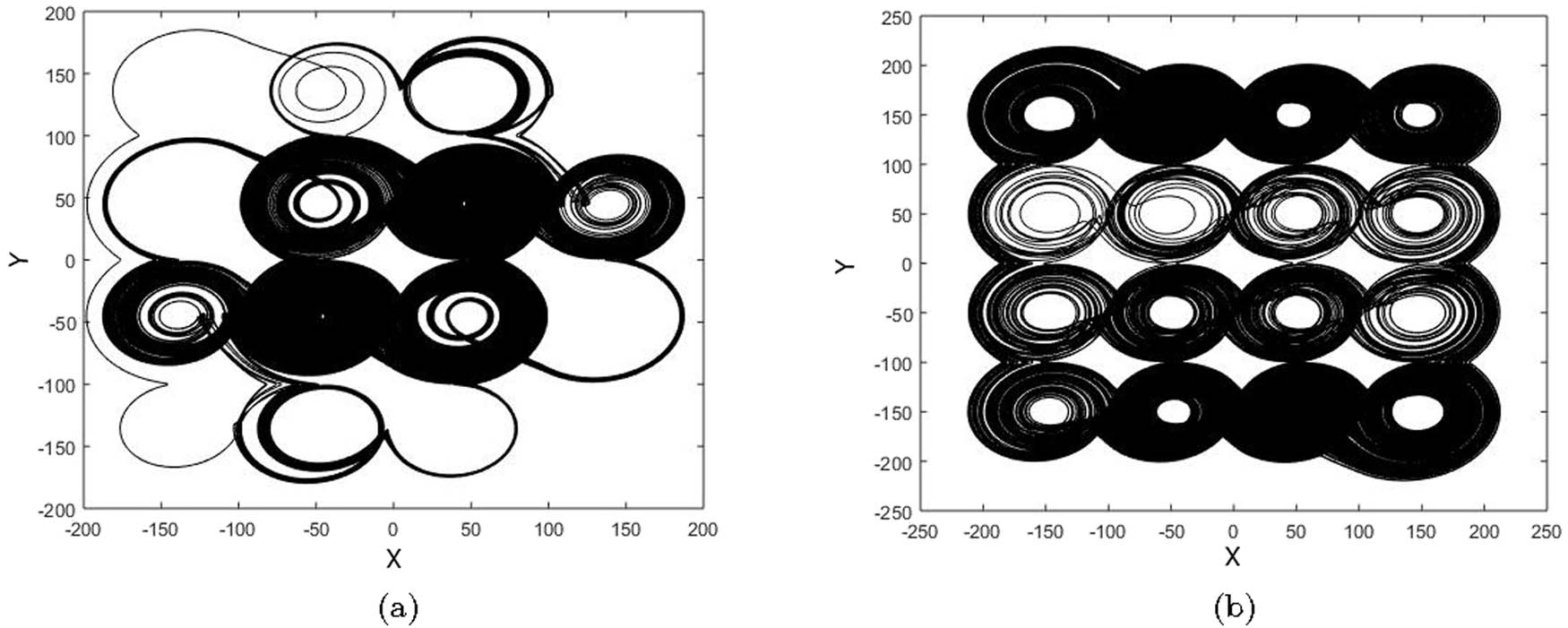
In the first, we took one value for the coefficient of harmonic linearization k 3 , so for a = b = c = d 1 = d 2 = 0.7 , k = 50 , h = 100 and taking k 3 = 0 . 3 . Then, the solutions of system 26 are calculated by increasing sequentially ε from the value ε = 0.55 to ε = 1 , for p 1 = p 2 = 1 , q 1 = q 2 = 0 for 9 scroll the initial conditions given by,

(28) X 0 ( 0 ) = 93.5056 , y 0 ( 0 ) = 30.1536 , z 0 ( 0 ) = 37.5733

and for p 1 = 1 , p 2 = 1 , q 1 = q 2 = 1 for 16 scroll the initial conditions given by

(29) X 0 ( 0 ) = 51.2850 , y 0 ( 0 ) = 63.5128 , z 0 ( 0 ) = 8.2182 .

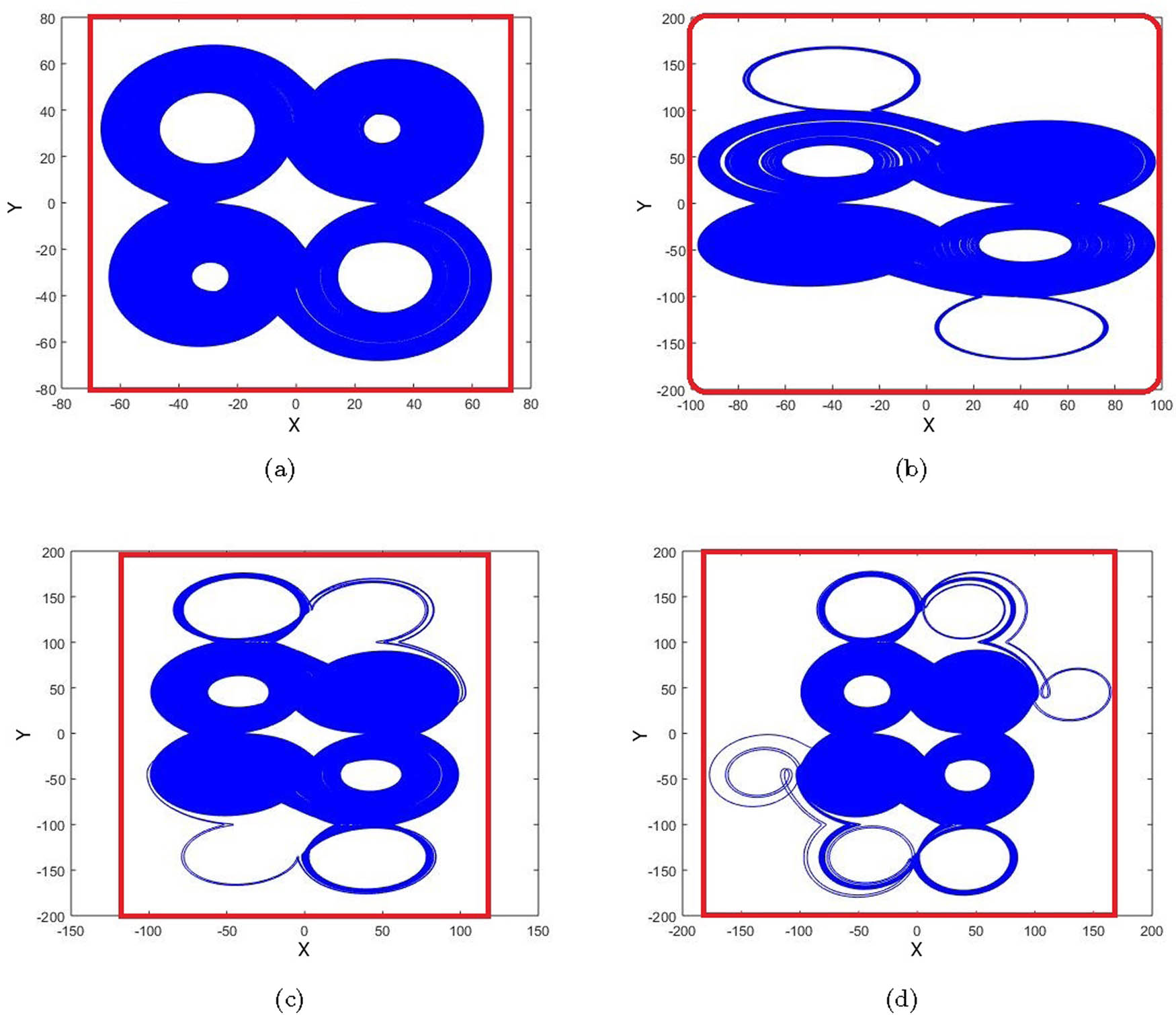
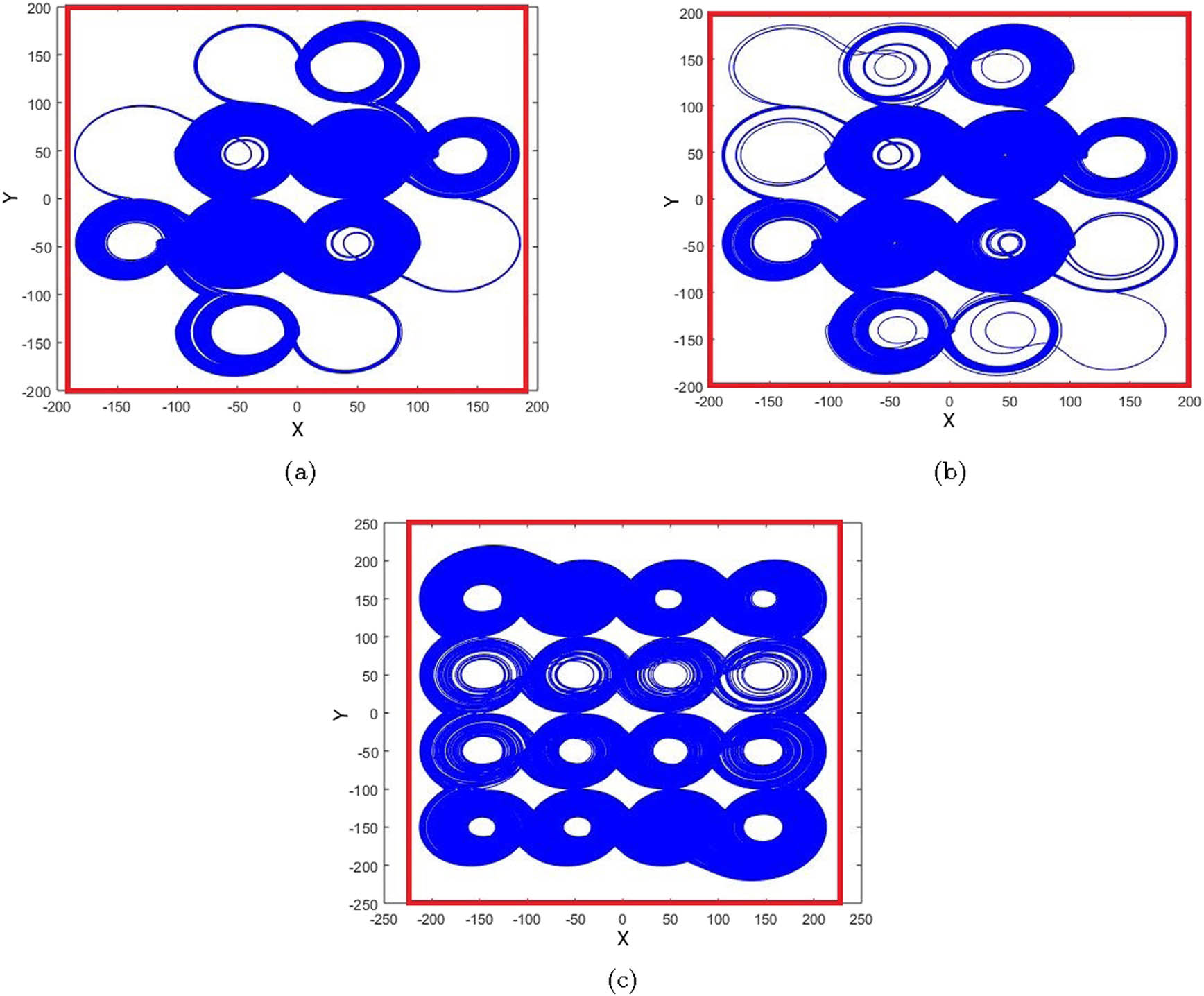
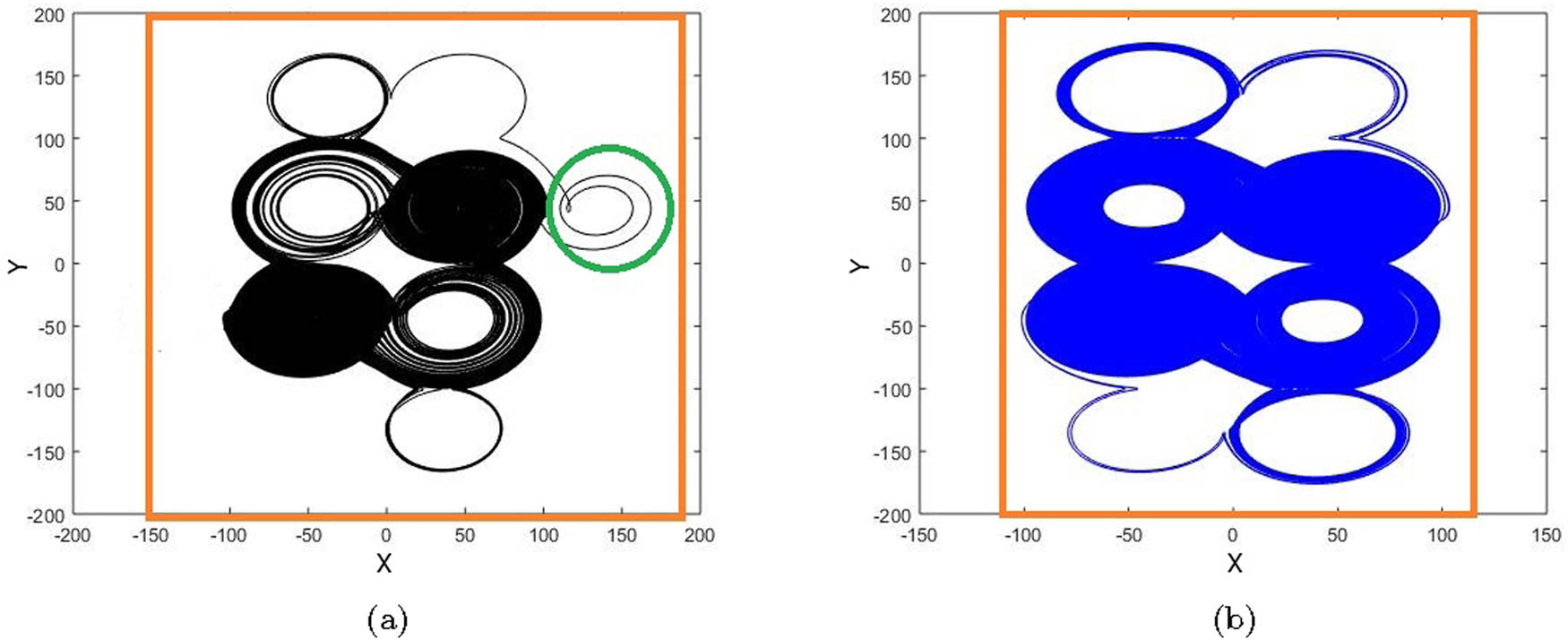
Using these initial data, the procedure described above in Section 2 produces the values of the parameter ε at the bifurcation points where the attractor increases the number of spirals from 2 to 9 spirals (16 spirals, respectively), as shown in Table 1, in the following order: 2, 4, 5, 7, 8, and 9 (for 16 scroll, 2, 4, 6, 8, 10, 12, 14, and 16) depending on the values of ε , as shown in Figures 4, 5, 6, 7, 8.

Table 1

Numerical results of 2D hidden bifurcations for p 1 = p 2 = 1 and q 1 = q 2 = 0 (9 scroll)

Values of ε 0.55 0.7 0.75 0.82 0.85 0.93
Number of spirals 2 4 5 7 8 9
Figure 4 
                     The increasing number of spirals of system (1-2-3) according to the increasing 


                                 ε
                              
                              \varepsilon 
                           
                         values, when 


                                       p
                                    
                                    
                                       1
                                    
                                 
                                 =
                                 
                                    
                                       p
                                    
                                    
                                       2
                                    
                                 
                                 =
                                 1
                              
                              {p}_{1}={p}_{2}=1
                           
                         and 


                                       q
                                    
                                    
                                       1
                                    
                                 
                                 =
                                 
                                    
                                       q
                                    
                                    
                                       2
                                    
                                 
                                 =
                                 0
                              
                              {q}_{1}={q}_{2}=0
                           
                         for nine scroll, 


                                       k
                                    
                                    
                                       3
                                    
                                    
                                       ′
                                    
                                 
                                 =
                                 0.3
                              
                              {k}_{3}^{^{\prime} }=0.3
                           
                        , k = 50, and h = 100. (a) Two spirals for 


                                 ε
                                 =
                                 0.55
                              
                              \varepsilon =0.55
                           
                        , (b) four spirals for 


                                 ε
                                 =
                                 0.7
                              
                              \varepsilon =0.7
                           
                        , and (c) five spirals for 


                                 ε
                                 =
                                 0.8
                              
                              \varepsilon =0.8
                           
                        .
Figure 4

The increasing number of spirals of system (1-2-3) according to the increasing ε values, when p 1 = p 2 = 1 and q 1 = q 2 = 0 for nine scroll, k 3 = 0.3 , k = 50, and h = 100. (a) Two spirals for ε = 0.55 , (b) four spirals for ε = 0.7 , and (c) five spirals for ε = 0.8 .
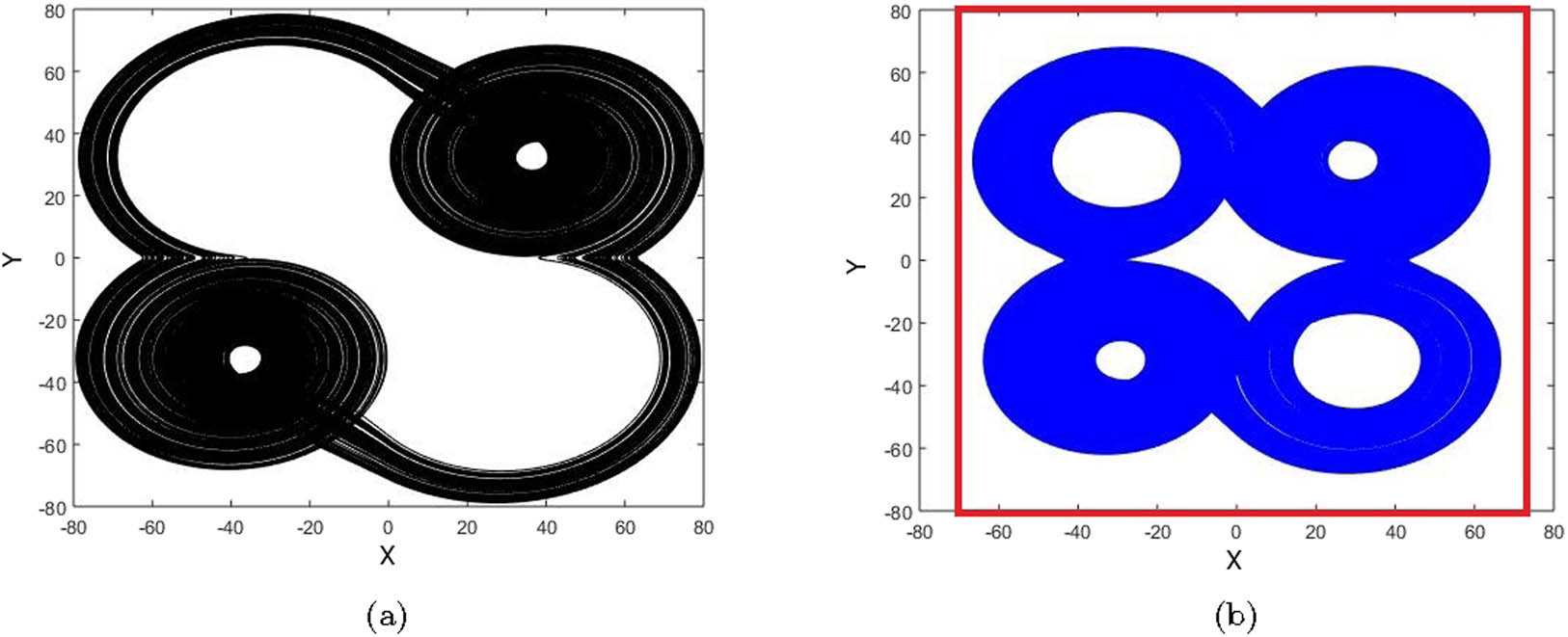
Figure 5 
                     The increasing number of spirals of system (1-2-3) according to the increasing 


                                 ε
                              
                              \varepsilon 
                           
                         values, when 


                                       p
                                    
                                    
                                       1
                                    
                                 
                                 =
                                 
                                    
                                       p
                                    
                                    
                                       2
                                    
                                 
                                 =
                                 1
                              
                              {p}_{1}={p}_{2}=1
                           
                         and 


                                       q
                                    
                                    
                                       1
                                    
                                 
                                 =
                                 
                                    
                                       q
                                    
                                    
                                       2
                                    
                                 
                                 =
                                 0
                              
                              {q}_{1}={q}_{2}=0
                           
                         for nine scrolls 


                                       k
                                    
                                    
                                       3
                                    
                                    
                                       ′
                                    
                                 
                                 =
                                 0.3
                              
                              {k}_{3}^{^{\prime} }=0.3
                           
                        , k = 50, and h = 100. (a) Seven spirals for 


                                 ε
                                 =
                                 0.82
                              
                              \varepsilon =0.82
                           
                        , (b) eight spirals for 


                                 ε
                                 =
                                 0.85
                              
                              \varepsilon =0.85
                           
                        , and (c) nine spirals for 


                                 ε
                                 =
                                 0.94
                              
                              \varepsilon =0.94
                           
                        .
Figure 5

The increasing number of spirals of system (1-2-3) according to the increasing ε values, when p 1 = p 2 = 1 and q 1 = q 2 = 0 for nine scrolls k 3 = 0.3 , k = 50, and h = 100. (a) Seven spirals for ε = 0.82 , (b) eight spirals for ε = 0.85 , and (c) nine spirals for ε = 0.94 .

Figure 6 
                     The increasing number of spirals of system (1-2-3) according to increasing 


                                 ε
                              
                              \varepsilon 
                           
                         values, when 


                                       p
                                    
                                    
                                       1
                                    
                                 
                                 =
                                 
                                    
                                       p
                                    
                                    
                                       2
                                    
                                 
                                 =
                                 1
                              
                              {p}_{1}={p}_{2}=1
                           
                         and 


                                       q
                                    
                                    
                                       1
                                    
                                 
                                 =
                                 
                                    
                                       q
                                    
                                    
                                       2
                                    
                                 
                                 =
                                 1
                              
                              {q}_{1}={q}_{2}=1
                           
                         for 16 scrolls, 


                                       k
                                    
                                    
                                       3
                                    
                                    
                                       ′
                                    
                                 
                                 =
                                 0.3
                              
                              {k}_{3}^{^{\prime} }=0.3
                           
                        , k = 50, and h = 100. (a) Two spirals for 


                                 ε
                                 =
                                 0.55
                              
                              \varepsilon =0.55
                           
                        , (b) four spirals for 


                                 ε
                                 =
                                 0.7
                              
                              \varepsilon =0.7
                           
                        , and (c) six spirals for 


                                 ε
                                 =
                                 0.8
                              
                              \varepsilon =0.8
                           
                        .
Figure 6

The increasing number of spirals of system (1-2-3) according to increasing ε values, when p 1 = p 2 = 1 and q 1 = q 2 = 1 for 16 scrolls, k 3 = 0.3 , k = 50, and h = 100. (a) Two spirals for ε = 0.55 , (b) four spirals for ε = 0.7 , and (c) six spirals for ε = 0.8 .
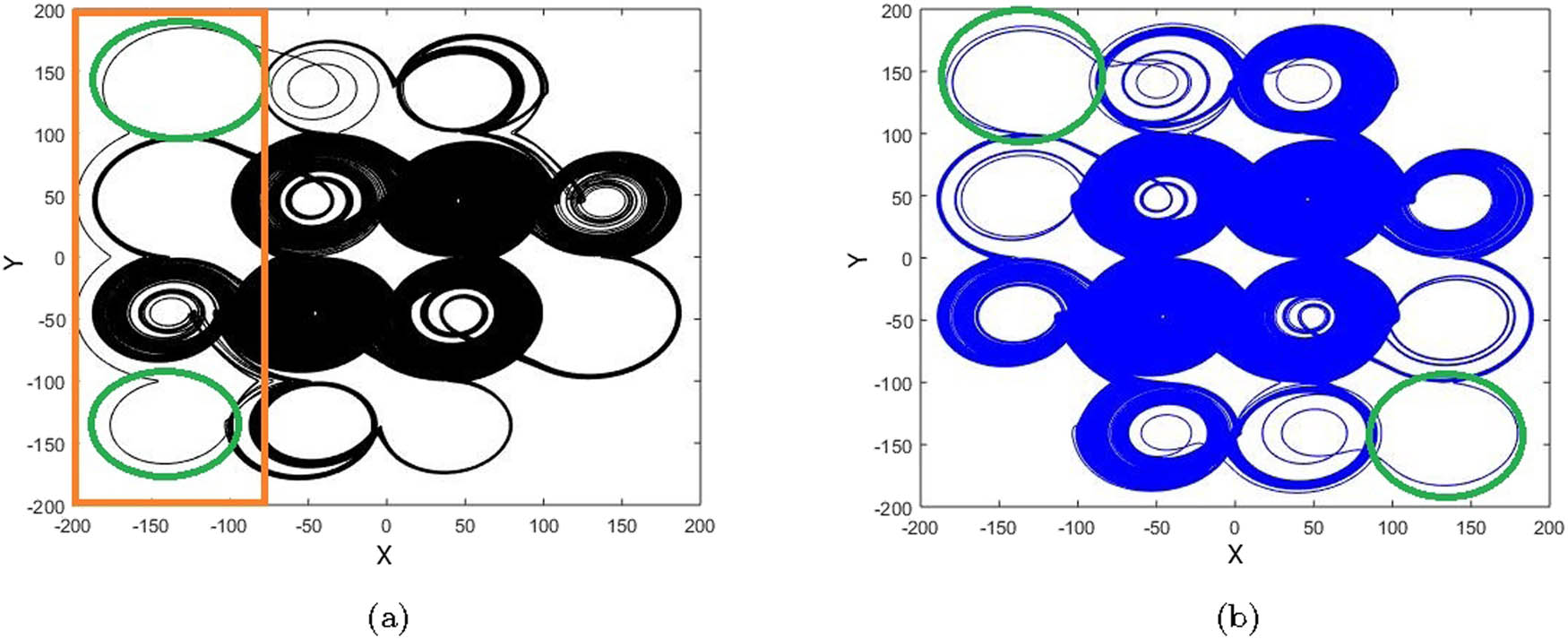
Figure 7 
                     The increasing number of spirals of system (1-2-3) according to increasing 


                                 ε
                              
                              \varepsilon 
                           
                         values, when 


                                       p
                                    
                                    
                                       1
                                    
                                 
                                 =
                                 
                                    
                                       p
                                    
                                    
                                       2
                                    
                                 
                                 =
                                 1
                              
                              {p}_{1}={p}_{2}=1
                           
                         and 


                                       q
                                    
                                    
                                       1
                                    
                                 
                                 =
                                 
                                    
                                       q
                                    
                                    
                                       2
                                    
                                 
                                 =
                                 1
                              
                              {q}_{1}={q}_{2}=1
                           
                         for 16 scrolls, 


                                       k
                                    
                                    
                                       3
                                    
                                    
                                       ′
                                    
                                 
                                 =
                                 0.3
                              
                              {k}_{3}^{^{\prime} }=0.3
                           
                        , k = 50, and h = 100. (a) Eight spirals for 


                                 ε
                                 =
                                 0.55
                              
                              \varepsilon =0.55
                           
                        , (b) ten spirals for 


                                 ε
                                 =
                                 0.829
                              
                              \varepsilon =0.829
                           
                        , and (c) twelve spirals for 


                                 ε
                                 =
                                 0.8
                              
                              \varepsilon =0.8
                           
                        .
Figure 7

The increasing number of spirals of system (1-2-3) according to increasing ε values, when p 1 = p 2 = 1 and q 1 = q 2 = 1 for 16 scrolls, k 3 = 0.3 , k = 50, and h = 100. (a) Eight spirals for ε = 0.55 , (b) ten spirals for ε = 0.829 , and (c) twelve spirals for ε = 0.8 .

Figure 8 
                     The increasing number of spirals of system (1-2-3) according to increasing 


                                 ε
                              
                              \varepsilon 
                           
                         values, when 


                                       p
                                    
                                    
                                       1
                                    
                                 
                                 =
                                 
                                    
                                       p
                                    
                                    
                                       2
                                    
                                 
                                 =
                                 1
                              
                              {p}_{1}={p}_{2}=1
                           
                         and 


                                       q
                                    
                                    
                                       1
                                    
                                 
                                 =
                                 
                                    
                                       q
                                    
                                    
                                       2
                                    
                                 
                                 =
                                 1
                              
                              {q}_{1}={q}_{2}=1
                           
                         for 16 scrolls, 


                                       k
                                    
                                    
                                       3
                                    
                                    
                                       ′
                                    
                                 
                                 =
                                 0.3
                              
                              {k}_{3}^{^{\prime} }=0.3
                           
                        , k = 50, and h = 100. (a) Fourteen spirals for 


                                 ε
                                 =
                                 0.865
                              
                              \varepsilon =0.865
                           
                         and (b) 16 spirals for 


                                 ε
                                 =
                                 0.94
                              
                              \varepsilon =0.94
                           
                        .
Figure 8

The increasing number of spirals of system (1-2-3) according to increasing ε values, when p 1 = p 2 = 1 and q 1 = q 2 = 1 for 16 scrolls, k 3 = 0.3 , k = 50, and h = 100. (a) Fourteen spirals for ε = 0.865 and (b) 16 spirals for ε = 0.94 .

Remark 1

In the case p 1 = p 2 = 1 ; q 1 = q 2 = 1 , 16 scroll the apparition behavior of spirals is even (two by two) where the attractor increases the number of spirals from 2 to 16 spirals ( 2 , 4 , 6 , 8 , 10 , 12 , 14 , 16 ) , see Table 2 and Figures 6, 7, 8.

Table 2

Numerical results of 2D hidden bifurcations for p 1 = p 2 = 1 and q 1 = q 2 = 1 (16 scrolls)

Values of ε 0.55 0.7 0.8 0.829
Number of spirals 2 4 6 8
Values of ε 0.83 0.86 0.865 0.94
Number of spirals 10 12 14 16

Remark 2

In the case p 1 = 0 , q 1 = 1 , p 2 = 0 , q 2 = 1 , the apparition behavior of spirals is different on the case(right) p 1 = 1 , q 1 = 0 , p 2 = 1 , q 2 = 0 , from these numerical results, it appears clearly that there exists some symmetry in the five, seven and eight spirals such as hidden bifurcation routes we studied in [16] see Figure 9.

Figure 9 
                     The increasing number of spirals of system (1-2-3) according to increasing 


                                 ε
                              
                              \varepsilon 
                           
                         values, when 


                                       p
                                    
                                    
                                       1
                                    
                                 
                                 =
                                 
                                    
                                       p
                                    
                                    
                                       2
                                    
                                 
                                 =
                                 0
                              
                              {p}_{1}={p}_{2}=0
                           
                         and 


                                       q
                                    
                                    
                                       1
                                    
                                 
                                 =
                                 
                                    
                                       q
                                    
                                    
                                       2
                                    
                                 
                                 =
                                 1
                              
                              {q}_{1}={q}_{2}=1
                           
                         for nine scrolls, 


                                       k
                                    
                                    
                                       3
                                    
                                    
                                       ′
                                    
                                 
                                 =
                                 0.3
                              
                              {k}_{3}^{^{\prime} }=0.3
                           
                        , k = 50, and h = 100. (a) Five spirals for 


                                 ε
                                 =
                                 0.8
                              
                              \varepsilon =0.8
                           
                        , (b) seven spirals for 


                                 ε
                                 =
                                 0.82
                              
                              \varepsilon =0.82
                           
                        , and (c) eight spirals for 


                                 ε
                                 =
                                 0.85
                              
                              \varepsilon =0.85
                           
                        , in symmetry with the increasing number of spirals according to increasing 


                                 ε
                              
                              \varepsilon 
                           
                         values, when 


                                       p
                                    
                                    
                                       1
                                    
                                 
                                 =
                                 
                                    
                                       p
                                    
                                    
                                       2
                                    
                                 
                                 =
                                 1
                              
                              {p}_{1}={p}_{2}=1
                           
                         and 


                                       q
                                    
                                    
                                       1
                                    
                                 
                                 =
                                 
                                    
                                       q
                                    
                                    
                                       2
                                    
                                 
                                 =
                                 0
                              
                              {q}_{1}={q}_{2}=0
                           
                        .
Figure 9

The increasing number of spirals of system (1-2-3) according to increasing ε values, when p 1 = p 2 = 0 and q 1 = q 2 = 1 for nine scrolls, k 3 = 0.3 , k = 50, and h = 100. (a) Five spirals for ε = 0.8 , (b) seven spirals for ε = 0.82 , and (c) eight spirals for ε = 0.85 , in symmetry with the increasing number of spirals according to increasing ε values, when p 1 = p 2 = 1 and q 1 = q 2 = 0 .

3.1.2 Two values for coefficient harmonic linearization

We took two values of the coefficient of harmonic linearization k 3 where k 3 = 0.3 and k 3 = 0.17 , then, the solutions of system 26 are calculated by increasing sequentially ε from the value ε = 0.55 to ε = 1 .

The results about the behavior of points bifurcations each spiral genesis in the cell (oblong) and the appearance of points bifurcation organized two-by-two-in all number of the scroll. For this purpose, we studied a 16 scroll for p 1 = 1 , p 2 = 1 , q 1 = q 2 = 1 , we noted that the differences in the first spiral were that, in the first case, the first step (spiral) began with two spirals, whereas in the second case, the first step began with four spirals. The second difference in eight spirals is that, in the first case, the spiral number 8 has come up on top, not down as it is imposed, whereas in the second case, the appearance of two spirals to complete eight spirals is organized for building an oblong. The third difference in 14 spirals is that, in the first case, the behavior of two spirals from 12 to 14 spirals one up and then down just in the left side, whereas in a second case the behavior of two spirals from 12 to 14 spirals one up and then down in both sides (left and right), and we noted the other difference in values of ε , which is explained in Table 3 and Figures 10, 11, 12, 13, 14.

Table 3

Numerical results of 2D hidden bifurcations for p 1 = 1 , p 2 = 1 , and q 1 = q 2 = 1 for the second case (16 scrolls)

Values of ε 0.55 0.85 0.867 0.873 0.9 0.915 1
Number of spirals 4 6 8 10 12 14 16
Figure 10 
                     The increasing number of spirals of system (1-2-3) according to the increasing 


                                 ε
                              
                              \varepsilon 
                           
                         values, when 


                                       p
                                    
                                    
                                       1
                                    
                                 
                                 =
                                 
                                    
                                       p
                                    
                                    
                                       2
                                    
                                 
                                 =
                                 1
                              
                              {p}_{1}={p}_{2}=1
                           
                         and 


                                       q
                                    
                                    
                                       1
                                    
                                 
                                 =
                                 
                                    
                                       q
                                    
                                    
                                       2
                                    
                                 
                                 =
                                 1
                              
                              {q}_{1}={q}_{2}=1
                           
                         for 16 scrolls, 


                                       k
                                    
                                    
                                       3
                                    
                                    
                                       ′
                                    
                                 
                                 =
                                 0.3
                              
                              {k}_{3}^{^{\prime} }=0.3
                           
                         and 


                                       k
                                    
                                    
                                       3
                                    
                                    
                                       ″
                                    
                                 
                                 =
                                 0.17
                              
                              {k}_{3}^{^{\prime\prime} }=0.17
                           
                        , k = 50, and h = 100. (a) Four spirals for 


                                 ε
                                 =
                                 0.55
                              
                              \varepsilon =0.55
                           
                        , (b) six spirals for 


                                 ε
                                 =
                                 0.85
                              
                              \varepsilon =0.85
                           
                        , (c) eight spirals for 


                                 ε
                                 =
                                 0.867
                              
                              \varepsilon =0.867
                           
                        , and (d) ten spirals for 


                                 ε
                                 =
                                 0.873
                              
                              \varepsilon =0.873
                           
                        .
Figure 10

The increasing number of spirals of system (1-2-3) according to the increasing ε values, when p 1 = p 2 = 1 and q 1 = q 2 = 1 for 16 scrolls, k 3 = 0.3 and k 3 = 0.17 , k = 50, and h = 100. (a) Four spirals for ε = 0.55 , (b) six spirals for ε = 0.85 , (c) eight spirals for ε = 0.867 , and (d) ten spirals for ε = 0.873 .

Figure 11 
                     The increasing number of spirals of system (1-2-3) according to increasing 


                                 ε
                              
                              \varepsilon 
                           
                         values, when 


                                       p
                                    
                                    
                                       1
                                    
                                 
                                 =
                                 
                                    
                                       p
                                    
                                    
                                       2
                                    
                                 
                                 =
                                 1
                              
                              {p}_{1}={p}_{2}=1
                           
                         and 


                                       q
                                    
                                    
                                       1
                                    
                                 
                                 =
                                 
                                    
                                       q
                                    
                                    
                                       2
                                    
                                 
                                 =
                                 1
                              
                              {q}_{1}={q}_{2}=1
                           
                         for 16 scrolls, 


                                       k
                                    
                                    
                                       3
                                    
                                    
                                       ′
                                    
                                 
                                 =
                                 0.3
                              
                              {k}_{3}^{^{\prime} }=0.3
                           
                        , 


                                       k
                                    
                                    
                                       3
                                    
                                    
                                       ″
                                    
                                 
                                 =
                                 0.17
                              
                              {k}_{3}^{^{\prime\prime} }=0.17
                           
                        , k = 50, and h = 100. (a) Twelve spirals for 


                                 ε
                                 =
                                 0.9
                              
                              \varepsilon =0.9
                           
                        , (b) 14 spirals for 


                                 ε
                                 =
                                 0.915
                              
                              \varepsilon =0.915
                           
                        , and (c) 16 spirals for 


                                 ε
                                 =
                                 0.96
                              
                              \varepsilon =0.96
                           
                        .
Figure 11

The increasing number of spirals of system (1-2-3) according to increasing ε values, when p 1 = p 2 = 1 and q 1 = q 2 = 1 for 16 scrolls, k 3 = 0.3 , k 3 = 0.17 , k = 50, and h = 100. (a) Twelve spirals for ε = 0.9 , (b) 14 spirals for ε = 0.915 , and (c) 16 spirals for ε = 0.96 .

Figure 12 
                     The comparison between the behavior of spirals of system (1-2-3) according to increasing 


                                 ε
                              
                              \varepsilon 
                           
                         values, when 


                                       p
                                    
                                    
                                       1
                                    
                                 
                                 =
                                 
                                    
                                       p
                                    
                                    
                                       2
                                    
                                 
                                 =
                                 1
                              
                              {p}_{1}={p}_{2}=1
                           
                         and 


                                       q
                                    
                                    
                                       1
                                    
                                 
                                 =
                                 
                                    
                                       q
                                    
                                    
                                       2
                                    
                                 
                                 =
                                 1
                              
                              {q}_{1}={q}_{2}=1
                           
                         for 16 scrolls in two cases. (a) Two spirals for 


                                 ε
                                 =
                                 0.55
                              
                              \varepsilon =0.55
                           
                         for one value for coefficient harmonic linearization 


                                       k
                                    
                                    
                                       3
                                    
                                    
                                       ′
                                    
                                 
                                 =
                                 0.3
                              
                              {k}_{3}^{^{\prime} }=0.3
                           
                         and (b) four spirals for 


                                 ε
                                 =
                                 0.55
                              
                              \varepsilon =0.55
                           
                         for two values of coefficient harmonic linearization 


                                       k
                                    
                                    
                                       3
                                    
                                    
                                       ′
                                    
                                 
                                 =
                                 0.3
                              
                              {k}_{3}^{^{\prime} }=0.3
                           
                         and 


                                       k
                                    
                                    
                                       3
                                    
                                    
                                       ″
                                    
                                 
                                 =
                                 0.17
                              
                              {k}_{3}^{^{\prime\prime} }=0.17
                           
                        .
Figure 12

The comparison between the behavior of spirals of system (1-2-3) according to increasing ε values, when p 1 = p 2 = 1 and q 1 = q 2 = 1 for 16 scrolls in two cases. (a) Two spirals for ε = 0.55 for one value for coefficient harmonic linearization k 3 = 0.3 and (b) four spirals for ε = 0.55 for two values of coefficient harmonic linearization k 3 = 0.3 and k 3 = 0.17 .

Figure 13 
                     The comparison between the behavior of spirals of system (1-2-3) according to increasing 


                                 ε
                              
                              \varepsilon 
                           
                         values, when 


                                       p
                                    
                                    
                                       1
                                    
                                 
                                 =
                                 
                                    
                                       p
                                    
                                    
                                       2
                                    
                                 
                                 =
                                 1
                              
                              {p}_{1}={p}_{2}=1
                           
                         and 


                                       q
                                    
                                    
                                       1
                                    
                                 
                                 =
                                 
                                    
                                       q
                                    
                                    
                                       2
                                    
                                 
                                 =
                                 1
                              
                              {q}_{1}={q}_{2}=1
                           
                         for 16 scrolls in two cases. (a) Eight spirals for 


                                 ε
                                 =
                                 0.829
                              
                              \varepsilon =0.829
                           
                         for one value of coefficient harmonic linearization 


                                       k
                                    
                                    
                                       3
                                    
                                    
                                       ′
                                    
                                 
                                 =
                                 0.3
                              
                              {k}_{3}^{^{\prime} }=0.3
                           
                         and (b) eight spirals for 


                                 ε
                                 =
                                 0.867
                              
                              \varepsilon =0.867
                           
                         for two values of coefficient harmonic linearization 


                                       k
                                    
                                    
                                       3
                                    
                                    
                                       ′
                                    
                                 
                                 =
                                 0.3
                              
                              {k}_{3}^{^{\prime} }=0.3
                           
                         and 


                                       k
                                    
                                    
                                       3
                                    
                                    
                                       ″
                                    
                                 
                                 =
                                 0.17
                              
                              {k}_{3}^{^{\prime\prime} }=0.17
                           
                        .
Figure 13

The comparison between the behavior of spirals of system (1-2-3) according to increasing ε values, when p 1 = p 2 = 1 and q 1 = q 2 = 1 for 16 scrolls in two cases. (a) Eight spirals for ε = 0.829 for one value of coefficient harmonic linearization k 3 = 0.3 and (b) eight spirals for ε = 0.867 for two values of coefficient harmonic linearization k 3 = 0.3 and k 3 = 0.17 .

Figure 14 
                     The comparison between the behavior of spirals of system (1-2-3) according to increasing 


                                 ε
                              
                              \varepsilon 
                           
                         values, when 


                                       p
                                    
                                    
                                       1
                                    
                                 
                                 =
                                 
                                    
                                       p
                                    
                                    
                                       2
                                    
                                 
                                 =
                                 1
                              
                              {p}_{1}={p}_{2}=1
                           
                         and 


                                       q
                                    
                                    
                                       1
                                    
                                 
                                 =
                                 
                                    
                                       q
                                    
                                    
                                       2
                                    
                                 
                                 =
                                 1
                              
                              {q}_{1}={q}_{2}=1
                           
                         for 16 scrolls in two cases. (a) Fourteen spirals for 


                                 ε
                                 =
                                 0.865
                              
                              \varepsilon =0.865
                           
                         for one value of coefficient harmonic linearization 


                                       k
                                    
                                    
                                       3
                                    
                                    
                                       ′
                                    
                                 
                                 =
                                 0.3
                              
                              {k}_{3}^{^{\prime} }=0.3
                           
                         and (b) 14 spirals for 


                                 ε
                                 =
                                 0.915
                              
                              \varepsilon =0.915
                           
                         for two values of coefficient harmonic linearization 


                                       k
                                    
                                    
                                       3
                                    
                                    
                                       ′
                                    
                                 
                                 =
                                 0.3
                              
                              {k}_{3}^{^{\prime} }=0.3
                           
                         and 


                                       k
                                    
                                    
                                       3
                                    
                                    
                                       ″
                                    
                                 
                                 =
                                 0.17
                              
                              {k}_{3}^{^{\prime\prime} }=0.17
                           
                        .
Figure 14

The comparison between the behavior of spirals of system (1-2-3) according to increasing ε values, when p 1 = p 2 = 1 and q 1 = q 2 = 1 for 16 scrolls in two cases. (a) Fourteen spirals for ε = 0.865 for one value of coefficient harmonic linearization k 3 = 0.3 and (b) 14 spirals for ε = 0.915 for two values of coefficient harmonic linearization k 3 = 0.3 and k 3 = 0.17 .

Remark 3

In our results, we noted that the coefficient harmonic linearization controlled the apparition behavior of hidden bifurcation, and in the case of two values for the coefficient harmonic linearization, we noted that it organized the apparition behavior of the hidden bifurcation better than the first case.

4 Conclusion

This article has initiated the behavior of hidden bifurcation in scroll via a saturated function series controlled by the coefficient harmonic linearization method, where a saturated function series approach is used for generating multi-scroll chaotic attractors, including 1D-scroll, 2D-grid scroll, and 3D-grid scroll attractors [9] from a given 1D-2D linear autonomic system with a saturated function series as the controller. In particular, a 2D Poincaré return map has been harshly structured to fulfill the chaotic behaviors of the double-scroll attractor. The method used is similar to the one presented by Leonov [10] and Leonov and Kuznetsov [11]. Such hidden bifurcations were first uncovered in 2016 for Chua multi-scroll attractors, which depend on a discrete parameter [14]. The novelties that this article introduces are (i) the model hidden bifurcation in a 2D scroll via saturated function series and (ii) controlling the behavior of a hidden bifurcation by the value of coefficient harmonic k 3 .

  1. Funding information: The authors state that there is no funding involved.

  2. Author contributions: Zaamoune Faiza developed the code Matlab and simulations and wrote the article. Menacer Tidjani designed the experiments and corrected grammatical and stylistic errors.

  3. Conflict of interest: The authors state no conflict of interest.

  4. Informed consent: Informed consent has been obtained from all individuals included in this study.

  5. Ethical approval: The conducted research is not related to either human or animals use.

  6. Data availability statement: The datasets generated and/or analyzed during the current study are available from the corresponding author on reasonable request.

References

[1] J. Lü and G. Chen, Generating multiscroll chaotic attractors: Theories, methods and applications, Int J Bifurcat Chaos 16 (2006), no. 4, 775–858, DOI: https://doi.org/10.1142/S0218127406015179. 10.1142/S0218127406015179Search in Google Scholar

[2] X. Zhang and Ch. Wang, A novel multi-attractor period multi-scroll chaotic integrated circuit based on CMOS wide adjustable CCCII, IEEE Access 7 (2019), no. 1, 16336–16350, DOI: https://doi.org/10.1109/ACCESS.2019.2894853. 10.1109/ACCESS.2019.2894853Search in Google Scholar

[3] H. Lin, Ch. Wang, Y. Sun, and T. Wang, Generating n-scroll chaotic attractors from a memristor-based magnetized hopfield neural network, IEEE Trans. Circuits Syst II Express Briefs 70 (2023), no. 1, 311–315, DOI: https://doi.org/10.1109/TCSII.2022.3212394. 10.1109/TCSII.2022.3212394Search in Google Scholar

[4] H. Lin, Ch. Wang, C. Xu, and X. Zhang, A memristive synapse control method to generate diversified multi-structure chaotic attractors, IEEE Trans Computer-aided Design Integrated Circuits Syst. 42 (2022), no. 3, 942–955, DOI: https://doi.org/10.1109/TCSII.2022.3186516. 10.1109/TCAD.2022.3186516Search in Google Scholar

[5] L. Zhou, Ch. Wang, and L. Zhou, Generating hyperchaotic multi-wing attractor in a 4D memristive circuit, Nonlinear Dyn. 85 (2016), no. 4, 2653–2663, DOI: http://dx.doi.org/10.10072Fs11071-016-2852-8. 10.1007/s11071-016-2852-8Search in Google Scholar

[6] L. Zhou, Ch. Wang, and L. Zhou, A novel no-equilibrium hyperchaotic multi-wing system via introducing memristor, Int. J. Circuit Theory Appl. 46 (2018), no. 1, 84–98, DOI: https://doi.org/10.1002/cta.2339. 10.1002/cta.2339Search in Google Scholar

[7] Q. Deng and C. Wang, Multi-scroll hidden attractors with two stable equilibrium points, Chaos 29 (2019), no. 9, 093112, DOI: https://doi.org/10.1063/1.5116732. 10.1063/1.5116732Search in Google Scholar PubMed

[8] G. A. Leonov, N. V. Kuznetsov, and V. I. Vagaitsev, Hidden attractor in smooth Chua systems, Physica D 241 (2012), no. 18, 1482–1486, DOI: https://doi.org/10.1016/j.physd.2012.05.016. 10.1016/j.physd.2012.05.016Search in Google Scholar

[9] J. Lü, G. Chen, X. Yu, and H. Leung, Design and analysis of multiscroll chaotic attractors from saturated function series, IEEE Trans. Circuits Syst. 51 (2004), no. 12, 2476–2490, DOI: https://doi.org/10.1109/TCSI.2004.838151. 10.1109/TCSI.2004.838151Search in Google Scholar

[10] G. A. Leonov, Effective methods for periodic oscillations search in dynamical systems, Appl. Math. Mech. 74 (2010), no. 1, 37–73, DOI: http://dx.doi.org/10.1016/j.jappmathmech.2010.03.004. 10.1016/j.jappmathmech.2010.03.004Search in Google Scholar

[11] G. A. Leonov and N. V. Kuznetsov, Localization of hidden Chua’s attractors, Phys. Lett. A 375 (2011), no. 23, 2230–2233, DOI: https://doi.org/10.1016/j.physleta.2011.04.037. 10.1016/j.physleta.2011.04.037Search in Google Scholar

[12] G. A. Leonov and N. V. Kuznetsov, Analytical numerical methods for investigation of hidden oscillations in nonlinear control systems, Proc. 18th IFAC World Congress, Milano, Italy 18 (2011), no. 1, 2494–2505, DOI: http://dx.doi.org/10.3182/20110828-6-IT-1002.03315. 10.3182/20110828-6-IT-1002.03315Search in Google Scholar

[13] G. A. Leonov and N. V. Kuznetsov, Hidden attractors in dynamical systems. From hidden oscillations in Hilbert-Kolmogrov, Aizerman, and Kalman problems to hidden chaotic attractor in Chua circuits, Int. J. Bifurcat. Chaos 23 (2013), no. 1, 1330002–13300071, DOI: https://doi.org/10.1142/S0218127413300024. 10.1142/S0218127413300024Search in Google Scholar

[14] T. Menacer, R. Lozi, and L. O. Chua, Hidden bifurcations in the multispiral Chua attractor, Int. J. Bifurcat. Chaos 16 (2016), no. 4, 1630039–1630065, DOI: https://dx.doi.org/10.1142/S0218127416300391. 10.1142/S0218127416300391Search in Google Scholar

[15] X. Zhang and C. Wang, Multiscroll hyperchaotic system with hidden attractors and its circuit implementation, Int. J. Bifurcat. Chaos 29 (2019), no. 9, 1950117, DOI: https://doi.org/10.1142/S0218127419501177. 10.1142/S0218127419501177Search in Google Scholar

[16] F. Zaamoune, T. Menacer, R. Lozi, and G. Chen, Symmetries in hidden bifurcation routes to multiscroll chaotic attractors generated by saturated function series, J. Adv. Eng. Comput. 3 (2019), no. 4, 511–522, DOI: https://doi.org/10.1142/S0218127419501177. 10.25073/jaec.201934.256Search in Google Scholar

Received: 2021-09-28
Revised: 2023-01-06
Accepted: 2023-02-16
Published Online: 2023-04-13

© 2023 the author(s), published by De Gruyter

This work is licensed under the Creative Commons Attribution 4.0 International License.

Articles in the same Issue

  1. Regular Articles
  2. A novel class of bipolar soft separation axioms concerning crisp points
  3. Duality for convolution on subclasses of analytic functions and weighted integral operators
  4. Existence of a solution to an infinite system of weighted fractional integral equations of a function with respect to another function via a measure of noncompactness
  5. On the existence of nonnegative radial solutions for Dirichlet exterior problems on the Heisenberg group
  6. Hyers-Ulam stability of isometries on bounded domains-II
  7. Asymptotic study of Leray solution of 3D-Navier-Stokes equations with exponential damping
  8. Semi-Hyers-Ulam-Rassias stability for an integro-differential equation of order 𝓃
  9. Jordan triple (α,β)-higher ∗-derivations on semiprime rings
  10. The asymptotic behaviors of solutions for higher-order (m1, m2)-coupled Kirchhoff models with nonlinear strong damping
  11. Approximation of the image of the Lp ball under Hilbert-Schmidt integral operator
  12. Best proximity points in -metric spaces with applications
  13. Approximation spaces inspired by subset rough neighborhoods with applications
  14. A numerical Haar wavelet-finite difference hybrid method and its convergence for nonlinear hyperbolic partial differential equation
  15. A novel conservative numerical approximation scheme for the Rosenau-Kawahara equation
  16. Fekete-Szegö functional for a class of non-Bazilevic functions related to quasi-subordination
  17. On local fractional integral inequalities via generalized ( h ˜ 1 , h ˜ 2 ) -preinvexity involving local fractional integral operators with Mittag-Leffler kernel
  18. On some geometric results for generalized k-Bessel functions
  19. Convergence analysis of M-iteration for 𝒢-nonexpansive mappings with directed graphs applicable in image deblurring and signal recovering problems
  20. Some results of homogeneous expansions for a class of biholomorphic mappings defined on a Reinhardt domain in ℂn
  21. Graded weakly 1-absorbing primary ideals
  22. The existence and uniqueness of solutions to a functional equation arising in psychological learning theory
  23. Some aspects of the n-ary orthogonal and b(αn,βn)-best approximations of b(αn,βn)-hypermetric spaces over Banach algebras
  24. Numerical solution of a malignant invasion model using some finite difference methods
  25. Increasing property and logarithmic convexity of functions involving Dirichlet lambda function
  26. Feature fusion-based text information mining method for natural scenes
  27. Global optimum solutions for a system of (k, ψ)-Hilfer fractional differential equations: Best proximity point approach
  28. The study of solutions for several systems of PDDEs with two complex variables
  29. Regularity criteria via horizontal component of velocity for the Boussinesq equations in anisotropic Lorentz spaces
  30. Generalized Stević-Sharma operators from the minimal Möbius invariant space into Bloch-type spaces
  31. On initial value problem for elliptic equation on the plane under Caputo derivative
  32. A dimension expanded preconditioning technique for block two-by-two linear equations
  33. Asymptotic behavior of Fréchet functional equation and some characterizations of inner product spaces
  34. Small perturbations of critical nonlocal equations with variable exponents
  35. Dynamical property of hyperspace on uniform space
  36. Some notes on graded weakly 1-absorbing primary ideals
  37. On the problem of detecting source points acting on a fluid
  38. Integral transforms involving a generalized k-Bessel function
  39. Ruled real hypersurfaces in the complex hyperbolic quadric
  40. On the monotonic properties and oscillatory behavior of solutions of neutral differential equations
  41. Approximate multi-variable bi-Jensen-type mappings
  42. Mixed-type SP-iteration for asymptotically nonexpansive mappings in hyperbolic spaces
  43. On the equation fn + (f″)m ≡ 1
  44. Results on the modified degenerate Laplace-type integral associated with applications involving fractional kinetic equations
  45. Characterizations of entire solutions for the system of Fermat-type binomial and trinomial shift equations in ℂn#
  46. Commentary
  47. On I. Meghea and C. S. Stamin review article “Remarks on some variants of minimal point theorem and Ekeland variational principle with applications,” Demonstratio Mathematica 2022; 55: 354–379
  48. Special Issue on Fixed Point Theory and Applications to Various Differential/Integral Equations - Part II
  49. On Cauchy problem for pseudo-parabolic equation with Caputo-Fabrizio operator
  50. Fixed-point results for convex orbital operators
  51. Asymptotic stability of equilibria for difference equations via fixed points of enriched Prešić operators
  52. Asymptotic behavior of resolvents of equilibrium problems on complete geodesic spaces
  53. A system of additive functional equations in complex Banach algebras
  54. New inertial forward–backward algorithm for convex minimization with applications
  55. Uniqueness of solutions for a ψ-Hilfer fractional integral boundary value problem with the p-Laplacian operator
  56. Analysis of Cauchy problem with fractal-fractional differential operators
  57. Common best proximity points for a pair of mappings with certain dominating property
  58. Investigation of hybrid fractional q-integro-difference equations supplemented with nonlocal q-integral boundary conditions
  59. The structure of fuzzy fractals generated by an orbital fuzzy iterated function system
  60. On the structure of self-affine Jordan arcs in ℝ2
  61. Solvability for a system of Hadamard-type hybrid fractional differential inclusions
  62. Three solutions for discrete anisotropic Kirchhoff-type problems
  63. On split generalized equilibrium problem with multiple output sets and common fixed points problem
  64. Special Issue on Computational and Numerical Methods for Special Functions - Part II
  65. Sandwich-type results regarding Riemann-Liouville fractional integral of q-hypergeometric function
  66. Certain aspects of Nörlund -statistical convergence of sequences in neutrosophic normed spaces
  67. On completeness of weak eigenfunctions for multi-interval Sturm-Liouville equations with boundary-interface conditions
  68. Some identities on generalized harmonic numbers and generalized harmonic functions
  69. Study of degenerate derangement polynomials by λ-umbral calculus
  70. Normal ordering associated with λ-Stirling numbers in λ-shift algebra
  71. Analytical and numerical analysis of damped harmonic oscillator model with nonlocal operators
  72. Compositions of positive integers with 2s and 3s
  73. Kinematic-geometry of a line trajectory and the invariants of the axodes
  74. Hahn Laplace transform and its applications
  75. Discrete complementary exponential and sine integral functions
  76. Special Issue on Recent Methods in Approximation Theory - Part II
  77. On the order of approximation by modified summation-integral-type operators based on two parameters
  78. Bernstein-type operators on elliptic domain and their interpolation properties
  79. A class of strongly convergent subgradient extragradient methods for solving quasimonotone variational inequalities
  80. Special Issue on Recent Advances in Fractional Calculus and Nonlinear Fractional Evaluation Equations - Part II
  81. Application of fractional quantum calculus on coupled hybrid differential systems within the sequential Caputo fractional q-derivatives
  82. On some conformable boundary value problems in the setting of a new generalized conformable fractional derivative
  83. A certain class of fractional difference equations with damping: Oscillatory properties
  84. Weighted Hermite-Hadamard inequalities for r-times differentiable preinvex functions for k-fractional integrals
  85. Special Issue on Recent Advances for Computational and Mathematical Methods in Scientific Problems - Part II
  86. The behavior of hidden bifurcation in 2D scroll via saturated function series controlled by a coefficient harmonic linearization method
  87. Phase portraits of two classes of quadratic differential systems exhibiting as solutions two cubic algebraic curves
  88. Petri net analysis of a queueing inventory system with orbital search by the server
  89. Asymptotic stability of an epidemiological fractional reaction-diffusion model
  90. On the stability of a strongly stabilizing control for degenerate systems in Hilbert spaces
  91. Special Issue on Application of Fractional Calculus: Mathematical Modeling and Control - Part I
  92. New conticrete inequalities of the Hermite-Hadamard-Jensen-Mercer type in terms of generalized conformable fractional operators via majorization
  93. Pell-Lucas polynomials for numerical treatment of the nonlinear fractional-order Duffing equation
  94. Impacts of Brownian motion and fractional derivative on the solutions of the stochastic fractional Davey-Stewartson equations
  95. Some results on fractional Hahn difference boundary value problems
  96. Properties of a subclass of analytic functions defined by Riemann-Liouville fractional integral applied to convolution product of multiplier transformation and Ruscheweyh derivative
  97. Special Issue on Development of Fuzzy Sets and Their Extensions - Part I
  98. The cross-border e-commerce platform selection based on the probabilistic dual hesitant fuzzy generalized dice similarity measures
  99. Comparison of fuzzy and crisp decision matrices: An evaluation on PROBID and sPROBID multi-criteria decision-making methods
  100. Rejection and symmetric difference of bipolar picture fuzzy graph
Downloaded on 25.1.2026 from https://www.degruyterbrill.com/document/doi/10.1515/dema-2022-0211/html
Scroll to top button