Impact of the economic crisis on pain research: a bibliometric analysis of pain research publications from Ireland, Greece, and Portugal between 1997 and 2017
-
Liliane Mendonça


Abstract
Background and aims
The recent economic crisis started in the USA in 2008 but quickly had worldwide impact. Ireland, Greece, and Portugal were in economic distress in 2009 and received rescue monetary packages from the European Union (EU) and the International Monetary Fund (IMF) in the following years. Meanwhile, the economic recovery has begun for those countries, but at different paces. The aim of the present study was to evaluate if the economic crisis influenced pain research outcomes, by performing a bibliometric analysis based on the ISI Web of Science to evaluate the evolution of the scientific production and performance in the field of pain research between 1997 and 2017.
Methods
Articles search was conducted using the ISI Web of Science, search keywords “pain or nocicep*”, between 1997 and 2017, and one author affiliated in an Irish, Greek or Portuguese institution. The total number of published articles per country, total citations, h-index, document types and authors’ institution were tabulated to determine the quantity and quality of the publications in this field.
Results
The search retrieved 2,368 publications over the 20 years’ period, increasing from 26 in 1997 to 230 in 2017. The number of Irish publications per year increased steadily along the studied period, while the number of Greek publications stabilized from 2008 onward and Portuguese publications started to increase only in 2007 but declined slightly after 2014. In total, Irish authors published 1,143 articles, Greek authors 624 and Portuguese authors 618. There were nine articles with more than 100 citations, and Irish publications had a higher h-index (52) than Greek’s (45) or Portuguese’s (36) publications. Ireland had the highest number of pain publications per capita, but in 2016 Portugal had the lowest cost per publication, as measured by the GDP per capita per publication (in 1997 Portugal had the highest cost). The three major research fields of the publications were neurosciences/neurology (19%), general internal medicine (16%) and anaesthesiology (13%), and the affiliation institutions were mostly universities or universities hospitals.
Conclusions
The number of Irish, Greek, and Portuguese pain publications increased between 1997 and 2017, but at different paces. It appears that the economic crisis had no impact on the rate of pain publications in Ireland, had a delayed impact in Portugal, and affected mostly Greek pain scientific research. This may be related to the fact that Greece was the country that received more rescue packages and where the economic crisis was deepest and lasted longer.
Implications
Economics and scientific production have a mutual influence: usually research investment decreases in recession times (reducing grants and scientific employment), but health scientific production can improve health and quality of life and also benefit the economy. So in crisis periods, governments should create means to protect and foster scientific work.
1 Introduction
Pain research is a “separate discipline in biomedicine” [1] that has increased worldwide over the last decades. Understanding pain mechanisms, pain management and pain treatment, whether in animals or humans, has been the focus for pain researchers and clinicians [2], and is the result of the development of different areas like medicine, psychology, and pharmacy [3].
The geographical and political expansion of the European Union (EU) in the last years, had a repercussion in European dominance in biomedical research [2]. This happened for several reasons, namely: the EU financial funding of research projects, the proximity between countries fostering international collaboration, and the emergence of European scientific pain associations’ journals (“The European Journal of Pain” in 1997 and “The Journal of Headache and Pain” in 2000) [2, 4]. As an example, in December 2017, a search of CORDIS (Community Research & Development Information Service) for “pain” in the tag “scientific research” retrieved 978 ongoing research projects funded by the EU [5]. There was also an increase in pan-European studies focusing mainly on chronic pain epidemiology, cancer pain, musculoskeletal diseases and pain induced disability [2].
There is an interconnection between the development of scientific research and economic funding, and in some areas of research like economics, investigation outcomes increase in crisis scenarios [6]. Usually, an economic crisis has a negative impact on research because public research and innovation budgets and scientific human resources diminish [7]. The literature demonstrates also that a country financial crisis can contaminate countries in geographic proximity, affecting large regions [8, 9].
One of the questions in the current European scenario is how the economic crises have influenced pain research outcomes in the last decade, especially in European countries like Ireland, Greece, and Portugal, where austerity has been imposed and budgets for research and for health systems have been reduced because of EU and IMF intervention [10]. Briefly, in 2008 when the USA financial crisis was obvious, the world acted as it was a restricted phenomenon; meanwhile, worldwide economies slowed, some European banks had high losses, stock markets declined, credit was more restricted and international trade dropped rising unemployment rates. Due to Euro currency and the Stability and Growth Pact, established by the Economic Monetary Union, European countries in financial debt no longer could devalue its own currency and aggravated their international credibility (difficulty to repay debts). This had a negative impact decreasing foreign direct investment especially in Greece and Portugal (with higher debt to foreign creditors). GDP of these countries grasped its lowest in 2009. In 2012, even with rescue packages, some European countries had high sovereign debt and austerity measures were not working [11].
As a result of the economic crises, Greece received a first rescue package from the EU and IMF of€110 billion in May 2010, followed by a second one of €130 billion in August 2012 (exit in June 2015), while Ireland received €67.5 billion in November 2010 (exit in December 2013) and Portugal €78 billion in April 2011 (exit in June 2014) [12]. Greek’s austerity rescue packages resulted in a deeper recession, so in August 2015 (with the end in August 2018) a new stability support program of €86 billion was launched, with IMF and European Stability Mechanism approval [11, 13, 14, 15].
Recently, the Irish economy had a strong recovery, with a GDP growth of 5.1% in 2016 and 6.5% in 2017 [16]. Official Portuguese statistics also point to an economic recovery, though at a slower pace, with a GDP increase of 1.5% in 2016 and 2.7% in 2017, which consolidates the economic recovery that began in 2014 [17]. Between 2008 and 2016, Greece had an “extreme reduction of the GDP (25%), which is equivalent to a war period” [18], but, surprisingly, the prevision of Greek economic growth in 2018 is 2.5% [19].
Returning to pain research, it must be noticed that the three referred countries have national pain societies (the Irish Pain Society, the Hellenic Society of Algology and the Portuguese Association for the Study of Pain) and a history of regular pain publications [2].
The aim of the present study was to evaluate if the economic crises affected the evolution of scientific production and performance in the field of pain research in Ireland, Greece, and Portugal. For that purpose, we performed a bibliometric analysis based on the ISI Web of Science indicators, namely the total number of published articles per country, total citations, h-index, document types, and research areas. Bibliometric analysis is a tool that facilitates monitoring and the analysis of research growth by quantitatively summarizing the activity and achievements in a given research area (productivity measures related to paper counts) and also by providing objective information on the performance (recognition and efficiency measures, that include citation counts, average citations per paper and journal’s impact factor, among others) [20, 21].
Since, in general, the economic crisis started around 2008 and possibly had a higher impact in pain research in the following years, we have extended our analysis from 1997 to 2017, in order to compare the evolution before and after the onset of the crisis.
2 Methods
2.1 Data acquisition
There are few databases that produce citation counts (namely ISI Web of Science, SCOPUS and Google Scholar), but these counts are not always completely extensive or identical. The ISI Web of Science database was selected for the present study and the electronic search was conducted on January 3rd, 2018. A title-search was conducted, requiring the presence of at least the word “pain” or “nocicep*”, since these are comprehensive and sensitive terms in the pain field [22], and an address in one of the three countries under study, irrespective of the order of the authors list, was also required. Query used was TI= ((pain OR nocicep*) AND AD= (Portugal or Greece or Ireland)), restricted to the years 1997–2017. There was no restriction concerning document type or language.
Data collected from articles were: title, year of publication, journal, all author’s data (name, institution, and country of affiliation), research field, the total number of citations and number of citations per year. Relative impact of citations was calculated considering the number of articles cited per articles uncited. The H-index is a measure that considers both productivity and scientific impact of an author, where higher values mean more publications and citations. In the present study, we used the ISI Web of Science feature to calculate this measure in a specific search for each country. The research field of each publication was also retrieved from ISI Web of Science database. Descriptive statistics were used to analyse data and results are presented in tables and graphics.
The demographic and economic information was retrieved from Eurostat [23], the reference site on European statistics.
3 Results
3.1 Analysis of publication outputs
3.1.1 Productivity – the number of publications
Between 1997 and 2017, 2,368 articles were published by an author with Irish, Greek or Portuguese affiliation. Only 17 of those articles were a result of international cooperation between the mentioned countries (11 signed by Greek and Irish authors and 6 by Greek and Portuguese authors).
In 1997, 26 articles were published about pain or nociception altogether and in 2017 there were 230 (Table 1). The year with the highest number of publications was 2015 (n=239), followed by 2017 (n=230) and 2016 (n=223).
Number of publications per year and country.
| Year | Ireland | Greece | Portugal | World |
|---|---|---|---|---|
| 1997 | 17 | 7 | 2 | 3,171 |
| 1998 | 23 | 11 | 6 | 3,550 |
| 1999 | 19 | 20 | 2 | 3,574 |
| 2000 | 30 | 12 | 0 | 3,916 |
| 2001 | 35 | 14 | 9 | 3,750 |
| 2002 | 20 | 17 | 6 | 4,146 |
| 2003 | 29 | 19 | 10 | 4,483 |
| 2004 | 33 | 25a | 14a | 4,948 |
| 2005 | 24 | 25 | 8 | 5,290 |
| 2006 | 40b | 29b | 15 | 5,598 |
| 2007 | 34 | 41 | 6 | 6,009 |
| 2008 | 48c | 46c | 18 | 6,779 |
| 2009 | 50c | 38c | 32 | 6,918 |
| 2010 | 62b | 30b | 38 | 7,465 |
| 2011 | 70b | 48a,b | 42a | 7,890 |
| 2012 | 85 | 37 | 47 | 8,453 |
| 2013 | 84b | 43a,b | 67a | 9,465 |
| 2014 | 88 | 39d | 79d | 9,773 |
| 2015 | 120 | 44 | 75 | 11,324 |
| 2016 | 109b | 40 | 74 | 12,001 |
| 2017 | 123 | 39a | 68a | 10,739 |
| Total | 1143 | 624 | 618 | 139,242 |
-
aOne article with Greek and Portuguese cooperation; bone article with Irish and Greek cooperation; cthree articles with Irish and Greek cooperation; dtwo articles with Greek and Portuguese cooperation.
Of the three countries analyzed in the present study, Ireland had the highest number of publications (1,143), and its publication growth was steady during the studied period and similar to what happened worldwide. On the contrary, the number of Greek publications increased slowly until 2008 and then remained stable until 2017. Regarding Portuguese publications, there were a small number of published studies until 2007, a rapid growth from then until 2014 and a slight decline thereafter (Fig. 1).
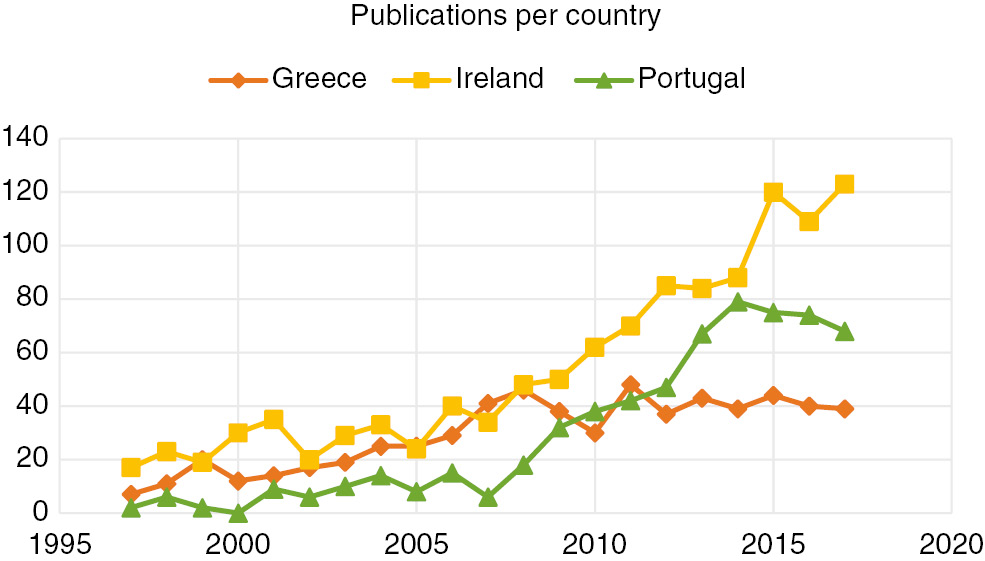
Publication growth per country.
Each of the mentioned countries has a unique reality of population growth, real gross domestic product (GDP) per capita and percentage of GDP invested in research and development (Table 2 and Fig. 2). GDP measures the value of the total final output of goods and services produced by an economy within a certain period of time, while real GDP is adjusted for inflation. The percentage of Gross Domestic Expenditures on Research and Development (GERD) is a measure of governmental and private effort to generate and transfer knowledge and is used for international comparisons [24].
Population, real GDPa and research expenditure indicators evolution.
| Year | Ireland |
Greece |
Portugal |
European Union (28 countries) |
||||||||
|---|---|---|---|---|---|---|---|---|---|---|---|---|
| Population | Real GDP per capita1 | R&D expenditure2 | Population | Real GDP per capita1 | R&D expenditure2 | Population | Real GDP per capita1 | R&D expenditure2 | Population | Real GDP per capita1 | R&D expenditure2 | |
| 1997 | 3,654,955 | 25,600 | 1.24e | 10,629,267 | 16,000 | 0.43 | 10,084,196 | 14,600 | 0.56 | 483,512,803 | 21,000 | NA |
| 1998 | 3,693,386 | 27,400 | 1.21 | 10,693,250 | 16,500 | NA | 10,133,758 | 15,300 | 0.62 | 485,877,558b | 21,600 | NA |
| 1999 | 3,732,006 | 30,000 | 1.15e | 10,747,768 | 17,000 | 0.57 | 10,186,634 | 15,800 | 0.68 | 486,577,953 | 22,200 | NA |
| 2000 | 3,777,565 | 32,400 | 1.09 | 10,775,627 | 17,600 | NA | 10,249,022 | 16,200 | 0.72e | 487,259,080b | 22,900 | NA |
| 2001 | 3,832,783 | 33,800 | 1.05 | 10,835,980 | 18,200 | 0.56 | 10,330,774 | 16,400 | 0.76 | 488,240,527b | 23,400 | NA |
| 2002 | 3,899,702 | 35,300 | 1.06 | 10,888,274 | 18,900 | NA | 10,394,669 | 16,500 | 0.72e | 488,962,706 | 23,700 | NA |
| 2003 | 3,964,191 | 35,800 | 1.12 | 10,915,770 | 19,900 | 0.55 | 10,444,592 | 16,300 | 0.7 | 490,691,578 | 23,900 | NA |
| 2004 | 4,028,851 | 37,500 | 1.18 | 10,940,369 | 20,900 | 0.53e | 10,473,050 | 16,500 | 0.73e | 492,555,798 | 24,400 | NA |
| 2005 | 4,111,672 | 38,900 | 1.19 | 10,969,912 | 20,900 | 0.58 | 10,494,672 | 16,600 | 0.76 | 494,598,322 | 24,800 | 1.74 |
| 2006 | 4,208,156 | 40,000 | 1.2 | 11,004,716 | 22,000 | 0.56e | 10,511,988 | 16,800 | 0.95e | 496,436,597 | 25,500 | 1.76 |
| 2007 | 4,340,118 | 40,800 | 1.23 | 11,036,008 | 22,700 | 0.58e | 10,532,588 | 17,200 | 1.12 | 498,300,775 | 26,200 | 1.77 |
| 2008 | 4,457,765 | 38,400 | 1.39 | 11,060,937 | 22,600 | 0.66b,e | 10,553,339 | 17,200 | 1.45b | 500,297,033b | 26,200 | 1.84 |
| 2009 | 4,521,322 | 36,300 | 1.61e | 11,094,745 | 21,500 | 0.63e | 10,563,014 | 16,700 | 1.58 | 502,090,235 | 25,000 | 1.93 |
| 2010 | 4,549,428 | 36,800 | 1.59e | 11,119,289 | 20,300 | 0.6e | 10,573,479 | 17,000 | 1.53 | 503,170,618b | 25,500 | 1.93 |
| 2011 | 4,570,881 | 37,700 | 1.55e | 11,123,392 | 18,500p | 0.67 | 10,572,721 | 16,700 | 1.46 | 502,964,837b | 25,800 | 1.97 |
| 2012 | 4,582,707 | 37,600 | 1.56e | 11,086,406 | 17,200p | 1.56e | 10,542,398 | 16,100 | 1.38 | 504,047,964b | 25,700 | 2.01 |
| 2013 | 4,591,087 | 38,100 | 1.56e | 11,003,615 | 16,800p | 1.56e | 10,487,289 | 16,000 | 1.33 | 505,163,008 | 25,700 | 2.02 |
| 2014 | 4,605,501p | 41,200 | 1.5e | 10,926,807 | 17,000p | 1.5e | 10,427,301 | 16,300 | 1.29 | 507,011,330e | 26,100 | 2.03 |
| 2015 | 4,628,949p | 51,400 | 1.2 | 10,858,018 | 17,100p | 1.2 | 10,374,822 | 16,600 | 1.24 | 508,540,103b,e | 26,600 | 2.03 |
| 2016 | 4,724,720b,e | 53,600 | 1.18e | 10,783,748 | 17,100p | 1.18e | 10,341,330 | 16,900p | 1.27p | 510,277,177e,p | 27,100 | 2.03p |
| 2017 | 4,774,833e | 56,300b | NA | 10,757,293e,p | 17,400p | NA | 10,309,573e | 17,400e | NA | 511,522,671b,p | 27,600 | NA |
-
aGDP measures the value of total final output of goods and services produced by an economy within a certain period of time, while real GDP is adjusted for inflation. 1Euro per capita; 2percentage of GDP; bbreak in time series; eestimated; pprovisional; NA=not available; Data from Eurostat.
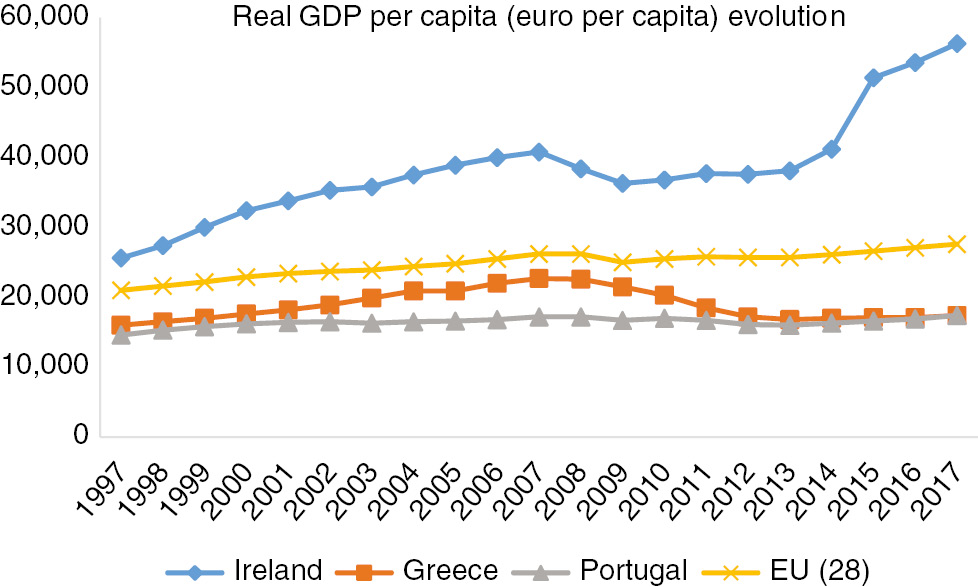
Real GDP per capita (euro per capita) evolution.
Irish population and GDP per capita has grown in the last two decades (in fact GDP per capita has duplicated), although the percentage of research investment has slightly decreased, the real investment in research as also increased.
In Greece and Portugal, the population has grown until 2010/2011 and then decreased (although the population in 2017 is higher than in 1997); also the GDP per capita in these countries has grown until 2007/2008 and then decreased; but the percentage of research expenditure has increased, especially in Portugal in the last 10 years.
From the observed countries, Ireland has a GDP that is about twice higher than the European (considering the 28 countries) average, while Greek and Portuguese GDP are lower than the European average, and the three countries have a percentage of GDP expenditure in research lower than the European average.
When we consider the number of pain publications per capita (Table 3), Ireland is the most productive country (with 7 times more papers per capita than Greece and 4 times more than Portugal in 2017, in 1997 the ratio was identical to Greece (6.7) but much higher comparing to Portugal (24 times more productive). The lowest cost of paper production, as measured by the real GDP per capita per publication, has changed through the years: first, it was Ireland (1997–2001), then Greece (2002–2008) and finally Portugal (2009–2017). Portugal had the most expensive cost per paper from 1997 till 2008 and then, in the last decade, the lowest cost.
Temporal evolution of the publications’ ratio per country.
| Year | Ireland |
Greece |
Portugal |
||||||
|---|---|---|---|---|---|---|---|---|---|
| Publications | Publications per capitaa | Real GDP/publication | Publications | Publications per capitaa | Real GDP/publication | Publications | Publications per capitaa | Real GDP/publication | |
| 1997 | 17 | 4.7 | 1,505.9 | 7 | 0.7 | 2,285.7 | 2 | 0.2 | 73,000.0 |
| 1998 | 23 | 6.2 | 1,191.3 | 11 | 1.0 | 1,500.0 | 6 | 0.6 | 25,500.0 |
| 1999 | 19 | 5.1 | 1,578.9 | 20 | 1.9 | 850.0 | 2 | 0.2 | 79,000.0 |
| 2000 | 30 | 7.9 | 1,080.0 | 12 | 1.1 | 1,466.7 | 0 | 0.0 | 0.0 |
| 2001 | 35 | 9.1 | 965.7 | 14 | 12.9 | 1,300.0 | 9 | 0.9 | 1,822.2 |
| 2002 | 20 | 5.1 | 1,765.0 | 17 | 1.6 | 1,111.8 | 6 | 0.6 | 2,750.0 |
| 2003 | 29 | 7.3 | 1,234.5 | 19 | 1.7 | 1,047.4 | 10 | 1.0 | 1,630.0 |
| 2004 | 33 | 8.2 | 1,136.4 | 25 | 2.3 | 836.0 | 14 | 1.3 | 1,178.6 |
| 2005 | 24 | 5.8 | 1,620.8 | 25 | 2.3 | 836.0 | 8 | 0.8 | 2,075.0 |
| 2006 | 40 | 9.5 | 1,000.0 | 29 | 2.6 | 758.6 | 15 | 1.4 | 1,120.0 |
| 2007 | 34 | 7.8 | 1,200.0 | 41 | 3.7 | 553.7 | 6 | 0.6 | 2,866.7 |
| 2008 | 48 | 10.8 | 800.0 | 46 | 4.2 | 491.3 | 18 | 1.7 | 955.6 |
| 2009 | 50 | 11.1 | 726.0 | 38 | 3.4 | 565.8 | 32 | 3.0 | 521.9 |
| 2010 | 62 | 13.6 | 593.5 | 30 | 2.7 | 676.7 | 38 | 3.6 | 447.4 |
| 2011 | 70 | 15.3 | 538.6 | 48 | 4.3 | 385.4 | 42 | 4.0 | 397.6 |
| 2012 | 85 | 18.5 | 442.4 | 37 | 3.3 | 464.9 | 47 | 4.5 | 342.6 |
| 2013 | 84 | 18.3 | 453.6 | 43 | 3.9 | 390.7 | 67 | 6.4 | 238.8 |
| 2014 | 88 | 19.1 | 468.2 | 39 | 3.6 | 435.9 | 79 | 7.6 | 206.3 |
| 2015 | 120 | 25.9 | 428.3 | 44 | 4.1 | 388.6 | 75 | 7.2 | 221.3 |
| 2016 | 109 | 23.1 | 491.7 | 40 | 3.7 | 427.5 | 74 | 7.2 | 228.4 |
| 2017 | 123 | 25.8 | 457.7 | 39 | 3.6 | 446.2 | 68 | 6.6 | 255.9 |
-
aPer million inhabitants.
3.1.2 Articles citation profile
The 2,368 articles were cited 26,112 times. Irish articles are cited more often, and have an h-index (a measure of publications productivity and citation impact) of 52, while Greek publications h-index is 45 and Portuguese is 36 (Table 4).
Citation profile per country.a
| Ireland | Greece | Portugal | |
|---|---|---|---|
| Sum of citation | 13,045 | 6,977 | 6,090 |
| Without self-citations | 12,333 | 6,751 | 5,704 |
| Mean citation per item | 11.41 | 11.18 | 9.85 |
| h-index | 52 | 45 | 36 |
| Uncited articles | 462 | 227 | 292 |
-
aThese data are the result of a country-specific query search in ISI Web of Science.
Forty-one percent of the articles have no citations (n=981), but, as expected, a large proportion (30%) of all uncited articles were published in the last 2 years (2016 and 2017). Of these, 55 were from Greece, 88 from Portugal, and 153 from Ireland, representing 70%, 62% and 66% of the publications per country in those years, respectively.
There were nine highly cited articles, i.e. with more than 100 citations (Table 5). Concerning the document type, articles represent 56% (n=1,314) of all published work. The most common language used was English (98%, n=2,315), 1.7% of the articles were published in Portuguese (n=40), and very few articles in other languages such as Greek, Spanish and Russian.
Top 10 highly cited articles by an Irish, Greek or Portuguese representative author.
| Total citations | Title | Representative author | Year | Country |
|---|---|---|---|---|
| 282 | Validity of four pain intensity rating scales | Ferreira-Valente, MA | 2011 | Portugal |
| 236 | Different pain scores in single transumbilical incision laparoscopic cholecystectomy versus classic laparoscopic cholecystectomy: a randomized controlled trial | Tsimogiannis, KE | 2010 | Greece |
| 168 | Trunk muscle stabilization training plus general exercise versus general exercise only: Randomized controlled trial of patients with recurrent low back pain | Koumantakis, GA | 2005 | Greece |
| 140 | Multimodal analgesia with gabapentin and local anesthetics prevents acute and chronic pain after breast surgery for cancer | Fassoulaki, A | 2005 | Greece |
| 132 | Anandamide-evoked activation of vanilloid receptor 1 contributes to the development of bladder hyperreflexia and nociceptive transmission to spinal dorsal horn neurons in cystitis | Cruz, F | 2004 | Portugal |
| 128 | Synaptobrevin I mediates exocytosis of CGRP from sensory neurons and inhibition by botulinum toxins reflects their anti-nociceptive potential | Dolly, JO | 2007 | Ireland |
| 124 | Gabapentin in postamputation phantom limb pain: A randomized, double-blind, placebo-controlled, cross-over study | Buggy, DJ | 2002 | Ireland |
| 104 | Effect of bisphosphonates on pain and quality of life in patients with bone metastases | Costa, L | 2009 | Portugal |
| 103 | Carotid artery disease as a marker for the presence of severe coronary artery disease in patients evaluated for chest pain | Kallikazaros, I | 1999 | Greece |
3.1.3 Institutions, research areas, and authors
The affiliation institutions are mostly universities or universities hospitals (Table 6). The ten institutions with more articles published in this sample represent 60% (n=1,424) of all articles. University of Porto (n=206), University College Dublin (n=195) and University of Athens (n=194) are the Portuguese, Irish and Greek institutions with more publications respectively, representing 33%, 17% and 31% of the articles published about pain in those countries between 1997 and 2017.
Top five institutions according to the number of publications by country.
| Ireland |
Greece |
Portugal |
||||||
|---|---|---|---|---|---|---|---|---|
| Institution | Numbera | %b | Institution | Numbera | %b | Institution | Numbera | %b |
| University College Dublin | 195 | 17.1 | University of Athens | 194 | 17.0 | University of Porto | 206 | 18.0 |
| Trinity College Dublin | 158 | 13.8 | Athens Medical School | 87 | 7.6 | University of Lisboa | 112 | 9.8 |
| National University of Ireland Nui Galway | 142 | 12.4 | Aristotle University of Thessaloniki | 80 | 7.0 | University of Coimbra | 80 | 7.0 |
| Ulster University | 130 | 11.4 | University of Patras | 44 | 3.8 | Sao Joao Hospital | 67 | 5.9 |
| University of Limerick | 120 | 10.5 | University of Crete | 42 | 3.7 | University of Minho | 51 | 4.5 |
| Total | 745 | 65.2 | Total | 447 | 71.6 | Total | 516 | 83.5 |
-
aNumber of publications; bpercentage of publications by country.
The three major pain research fields are neurosciences/neurology (19%, n=454), general internal medicine (16%, n=370) and anaesthesiology (13%, n=296). Irish main fields are general and internal medicine, neurosciences/neurology and anaesthesiology (Table 7). Neurosciences/neurology, anaesthesiology and orthopedics, and are the main Greek pain research fields. Portuguese authors main pain research fields are neurosciences/neurology, anaesthesiology, and rheumatology.
Top five research fields, number of publications and percentage by country.
| Ireland |
Greece |
Portugal |
||||||
|---|---|---|---|---|---|---|---|---|
| Research area | Numbera | %b | Research area | Numbera | %b | Research area | Numbera | %b |
| General internal medicine | 267 | 23.4 | Neurosciences/neurology | 170 | 27.2 | Neurosciences/neurology | 91 | 14.7 |
| Neurosciences/neurology | 193 | 16.9 | Anaesthesiology | 80 | 12.8 | Anaesthesiology | 74 | 12.0 |
| Anaesthesiology | 142 | 12.4 | Rheumatology | 73 | 11.7 | Orthopedics | 65 | 10.5 |
| Rehabilitation | 99 | 8.7 | Psychology | 62 | 9.9 | Surgery | 65 | 10.5 |
| Rheumatology | 66 | 5.8 | General internal medicine | 48 | 7.7 | General internal medicine | 55 | 8.9 |
| Total | 767 | 67.1 | Total | 433 | 69.4 | Total | 350 | 56.6 |
-
aNumber of publications; bpercentage of publications by country.
The five authors with more publications in pain research in each country are depicted in Table 8.
Top five authors per country.
| Ireland |
Greece |
Portugal |
||||||
|---|---|---|---|---|---|---|---|---|
| Author | Numbera | %b | Author | Numbera | %b | Author | Numbera | %b |
| Finn DP | 53 | 4.6 | Mystakidou K | 21 | 3.4 | Tavares I | 40 | 6.5 |
| Baxter GD | 45 | 3.9 | Fassoulaki A | 16 | 2.6 | Lima D | 37 | 6.0 |
| Hurley DA | 43 | 3.8 | Vlahos L | 16 | 2.6 | Almeida A | 33 | 5.3 |
| McGuire BE | 40 | 3.5 | Melemeni A | 13 | 2.1 | Cruz F | 21 | 3.4 |
| Harmon D | 39 | 3.4 | Tsilika E | 13 | 2.1 | Castro-Lopes JM | 17 | 2.8 |
| Total | 220 | 19.2 | Total | 79 | 12.7 | Total | 148 | 23.9 |
-
aNumber of publications; bpercentage of publications by country.
4 Discussion and conclusions
Pain scientific research has increased in the three countries analyzed during the period under study. That is consistent with the data from a bibliometric analysis of the “Pain” journal publications, one of the reference journals in the pain field, between 1975 and 2007, describing the growth of pain research [1].
Although the studied countries have a common European background and endured an economic crisis in recent years, the results of the present study demonstrate that the growth of the number of Irish, Greek and Portuguese publications over the analyzed time had a different profile.
Ireland is the country with a higher number of publications (more than 100 in the last 3 years), a higher number of citations and the number of publications per year rose at a constant pace. Irish population and GDP also increased over the last 20 years despite the recent economic crisis, in fact, the Irish economy was the first to recover in 2013 [16]. The University College Dublin is the institution with more publications and the three most productive authors of the three countries analyzed are Irish (Finn, Baxter, and Hurley).
Greek performance was very different in the last two decades: in the beginning, there was a publication growth, but from 2008 onwards the number of publications per year remained stable. There are four Greek highly cited papers and the University of Athens is the Greek institution with more publications. Greek population and GDP has oscillated in the studied years, but there was an increment in research expenditure in the last years (Greece has the lowest percentage of research investment of the three countries, but is the only one that has always increased that investment). In leading European countries (like Sweden, Austria, Germany, Denmark, and Finland), GERD value is around 3% of GDP, but the reported rate for the three studied countries is around 1%. An effort to reduce Greek National Health expenditure was also observed [25], which may also have consequences for Greek pain research.
Portugal is the country with fewer pain publications, with only two papers published in 1997, and fewer citations, but with the fastest growth from 2007 to 2014. Looking at Portuguese statistics, in the last decade population growth, GDP and research expenditure has reached a peak and then decreased (although to a slightly higher level than in 1997). In the last decade, Portugal had the lowest cost of paper production (measured by the GDP per capita per publication) while in 1997 it had the highest of the three compared countries. This could be the result of the Investment and Employment Initiative approved in 2008 by the Portuguese Council of Ministers to face the economic crisis. Portugal also has the most cited article included, a paper about pain scales validation by Ferreira-Valente in 2011. It is important to highlight that citations counts do not necessarily reflect article quality, only its impact on scientific research [6]. The University of Porto is the main promoter of pain research in Portugal.
This data corroborates, as in other studies, that scientific development is conditioned by the socio-economic context [24]. Probably, of the three analyzed countries, Greek financial crises and uncertainty had extended to scientific research, since there is always a time delay between research funding and publishing the article.
To our knowledge, this is the first bibliometric analysis in pain research to consider the economic crisis scenario in three European countries over 20 years, but this bibliometric study has some limitations. The first one is that only one electronic database was searched to retrieve the published articles. On the other hand, the main advantage of using ISI Web of Science was the standardization of the collected article’s information, especially about article’s citation profiles.
Secondly, by using only the terms “pain and nocicep*” in the title, a considerable number of publications on the subject of pain may be missed. However, this is likely to affect equally the publications arising from the three countries, and the main purpose of the present study was to analyse the evolution over the years and not the absolute numbers. In fact, bibliometric comparisons between countries or research fields should be interpreted with caution [26].
Also, the criteria of the author’s country affiliation institution defining the country of publication may not always reflect the country where the scientific work was conducted and/or funded, since authors from one country may work in institutions from different countries.
We also recognize that analysing the number of citations of the articles published in the last years is premature since the peak of articles citations usually occurs 2–3 years after the publication [26].
Finally, one must consider the time lag that encompasses scientific production from the start of a research project until the publication of the results [24], so possibly only in a few more years, we will be able to fully understand the economic crisis impact in scientific research.
4.1 Conclusions
This study provides an analysis of the publications in the pain field between 1997 and 2017 in Ireland, Greece, and Portugal.
Altogether, there has been a growth of pain scientific production in the studied period in the countries analyzed but at different paces. It appears that the economic crisis had an impact on Greek pain scientific research and no impact in Ireland. It is possible that in Portugal, the EU background and financial support delayed the economic impact of the austerity measures on pain research. However, investigation outcomes are a process of several years, so it would be interesting to analyse what will happen with pain research in the next years.
-
Authors’ statements
-
Research funding: None declared.
-
Conflict of interest: The authors report no conflicts of interest in this work.
-
Informed consent: Not applicable.
-
Ethical approval: Not applicable.
-
Author Contributions
-
José M. Castro-Lopes had the original idea for the bibliometric and economic analysis. Liliane Mendonça collected the literature. Both authors wrote and revised the article.
References
[1] Mogil JS, Simmonds K, Simmonds MJ. Pain research from 1975 to 2007: a categorical and bibliometric meta-trend analysis of every Research Paper published in the journal, Pain. Pain 2009;142:48–58.10.1016/j.pain.2008.11.012Search in Google Scholar PubMed
[2] Robert C, Wilson CS, Donnadieu S, Gaudy J-F, Arreto C-D. Evolution of the scientific literature on pain from 1976 to 2007. Pain Med 2010;11:670–84.10.1111/j.1526-4637.2010.00816.xSearch in Google Scholar PubMed
[3] Norton PJ, Asmundson GJG, Norton GR, Craig KD. Growing pain: 10-year research trends in the study of chronic pain and headache. Pain 1999;79:59–65.10.1016/S0304-3959(98)00149-3Search in Google Scholar PubMed
[4] Robert C, Wilson C, Donnadieu S, Gaudy J-F, Arreto C-D. Analysis of the medical and biological pain research literature in the European Union: a 2006 snapshot. Scientometrics 2009;80:693–716.10.1007/s11192-008-2102-zSearch in Google Scholar
[5] CORDIS. Community Research and Development Information Service. Available at: https://cordis.europa.eu/projects/home_en.html. Accessed: 29 December 2017.Search in Google Scholar
[6] Chang C-C, Ho Y-S. Bibliometric analysis of financial crisis research. Afr J Bus Manage 2010;4:3898–910.Search in Google Scholar
[7] Izsak K, Markianidou P, Lukach R, Wastyn A. The impact of the crisis on research and innovation policies. Study for the European Commission DG Research by Technopolis Group Belgium and Idea Consult. 2013.Search in Google Scholar
[8] Eichengreen B, Rose A, Wyplosz C. Contagious currency crises: first tests. Scand J Econ 1996;98:463–84.10.2307/3440879Search in Google Scholar
[9] Glick R, Rose AK. Contagion and trade: Why are currency crises regional? J Int Money Finance 1999;18:603–17.10.1016/S0261-5606(99)00023-6Search in Google Scholar
[10] Karanikolos M, Mladovsky P, Cylus J, Thomson S, Basu S, Stuckler D, Mackenbach JP, McKee M. Financial crisis, austerity, and health in Europe. Lancet 2013;381:1323–31.10.1016/S0140-6736(13)60102-6Search in Google Scholar PubMed
[11] Lin CY-Y, Edvinsson L, Chen J, Beding T. Impact of the 2008 Global Financial Crisis. National Intellectual Capital and the Financial Crisis in Indonesia, Malaysia, The Philippines, and Thailand. New York, NY: Springer New York, 2014:7–18.10.1007/978-1-4614-7943-7_2Search in Google Scholar
[12] International Monetary Fund. Available at: http://www.imf.org/external/index.htm. Accessed: 28 March 2018.Search in Google Scholar
[13] International Monetary Fund. Greece. Available at: http://www.imf.org/en/Countries/GRC. Accessed: 28 March 2018.Search in Google Scholar
[14] European Commission. Financial assistance to Greece. Available at: https://ec.europa.eu/info/business- economy-euro/economic-and-fiscal-policy-coordination/eu-financial-assistance/which-eu-countries-have-received-assistance/financial-assistance-greece_en. Accessed: 28 March 2018.Search in Google Scholar
[15] International Monetary Fund. IMF Executive Board Approves in Principle €1.6 Billion Stand-By Arrangement for Greece. Available at: http://www.imf.org/en/News/Articles/2017/07/20/pr17294-greece-imf-executive-board-approves-in-principle-stand-by-arrangement. Accessed: 28 March 2018.10.5089/9781484311219.002Search in Google Scholar
[16] Mangan O. The Irish Economic Update. AIB, 2018.Search in Google Scholar
[17] Wise P. Portugal grows at fastest rate since 2000. Financial Times [Internet] 2018.Search in Google Scholar
[18] Mavridis S. Greece’s Economic and Social Transformation 2008–2017. Soc Sci 2018;7:9.10.3390/socsci7010009Search in Google Scholar
[19] Witte G. Battered for a decade, Greece feels an unexpected whiff of revival as Europe gains strength. The Washington Post, 2018.Search in Google Scholar
[20] Montgomery W, Sato M, Nagasaka Y, Vietri J. The economic and humanistic costs of chronic lower back pain in Japan. ClinicoEcon Outcomes Res CEOR 2017;9:361–71.10.2147/CEOR.S134130Search in Google Scholar PubMed PubMed Central
[21] Reuthers T. Whitepaper using bibliometrics: a guide to evaluating research performance with citation data 2013 [updated January 2013]. Available from: http://ip-science.thomsonreuters.com/m/pdfs/325133_thomson.pdf.Search in Google Scholar
[22] Robert C, Wilson CS, Donnadieu S, Gaudy J-F, Arreto C-D. Bibliometric analysis of the scientific literature on pain research: a 2006 study✩. Pain 2008;138:250–4.10.1016/j.pain.2008.05.016Search in Google Scholar PubMed
[23] Eurostat. Your key to European statistics. Available at: http://ec.europa.eu/eurostat. Accessed: 15 February 2018.Search in Google Scholar
[24] Miguel S, Moya-Anegón F, Herrero-Solana V. The impact of the socio-economic crisis of 2001 on the scientific system of Argentina from the scientometric perspective. Scientometrics 2010;85:495–507.10.1007/s11192-010-0266-9Search in Google Scholar
[25] Simou E, Koutsogeorgou E. Effects of the economic crisis on health and healthcare in Greece in the literature from 2009 to 2013: a systematic review. Health Policy 2014;115:111–9.10.1016/j.healthpol.2014.02.002Search in Google Scholar PubMed
[26] Lewison G, Devey ME. Bibliometric methods for the evaluation of arthritis research. Rheumatology 1999;38:13–20.10.1093/rheumatology/38.1.13Search in Google Scholar PubMed
©2018 Scandinavian Association for the Study of Pain. Published by Walter de Gruyter GmbH, Berlin/Boston. All rights reserved.
Articles in the same Issue
- Frontmatter
- Editorial comment
- Support for mirror therapy for phantom and stump pain in landmine-injured patients
- Lifting with straight legs and bent spine is not bad for your back
- Bipolar radiofrequency neurotomy for spinal pain – a promising technique but still some steps to go
- Topical review
- Prevalence, localization, perception and management of pain in dance: an overview
- Clinical pain research
- Pain assessment in native and non-native language: difficulties in reporting the affective dimensions of pain
- Colored body images reveal the perceived intensity and distribution of pain in women with breast cancer treated with adjuvant taxanes: a prospective multi-method study of pain experiences
- Physiotherapy pain curricula in Finland: a faculty survey
- Mirror therapy for phantom limb and stump pain: a randomized controlled clinical trial in landmine amputees in Cambodia
- Pain and alcohol: a comparison of two cohorts of 60 year old women and men: findings from the Good Aging in Skåne study
- Prolonged, widespread, disabling musculoskeletal pain of adolescents among referrals to the Pediatric Rheumatology Outpatient Clinic from the Päijät-Häme Hospital District in southern Finland
- Impact of the economic crisis on pain research: a bibliometric analysis of pain research publications from Ireland, Greece, and Portugal between 1997 and 2017
- Measurement of skin conductance responses to evaluate procedural pain in the perioperative setting
- Original experimental
- An observational study of pain self-management strategies and outcomes: does type of pain, age, or gender, matter?
- Fibromyalgia patients and healthy volunteers express difficulties and variability in rating experimental pain: a qualitative study
- Effect of the market withdrawal of dextropropoxyphene on use of other prescribed analgesics
- Observational study
- Winning or not losing? The impact of non-pain goal focus on attentional bias to learned pain signals
- Gabapentin and NMDA receptor antagonists interacts synergistically to alleviate allodynia in two rat models of neuropathic pain
- Offset analgesia is not affected by cold pressor induced analgesia
- Central and peripheral pain sensitization during an ultra-marathon competition
- Reduced endogenous pain inhibition in adolescent girls with chronic pain
- Evaluation of implicit associations between back posture and safety of bending and lifting in people without pain
- Assessment of CPM reliability: quantification of the within-subject reliability of 10 different protocols
- Cerebrospinal fluid cutaneous fistula after neuraxial anesthesia: an effective treatment approach
- Pain in the hand caused by a previously undescribed mechanism with possible relevance for understanding regional pain
- The response to radiofrequency neurotomy of medial branches including a bipolar system for thoracic facet joints
- Letter to the Editor
- Diagnosis of carpal tunnel syndrome – implications for therapy
- Reply to the Letter to the Editor by Ly-Pen and Andréu
- Letter to the Editor regarding “CT guided neurolytic blockade of the coeliac plexus in patients with advanced and intractably painful pancreatic cancer”
- Reply to comments from Ulf Kongsgaard to our study
Articles in the same Issue
- Frontmatter
- Editorial comment
- Support for mirror therapy for phantom and stump pain in landmine-injured patients
- Lifting with straight legs and bent spine is not bad for your back
- Bipolar radiofrequency neurotomy for spinal pain – a promising technique but still some steps to go
- Topical review
- Prevalence, localization, perception and management of pain in dance: an overview
- Clinical pain research
- Pain assessment in native and non-native language: difficulties in reporting the affective dimensions of pain
- Colored body images reveal the perceived intensity and distribution of pain in women with breast cancer treated with adjuvant taxanes: a prospective multi-method study of pain experiences
- Physiotherapy pain curricula in Finland: a faculty survey
- Mirror therapy for phantom limb and stump pain: a randomized controlled clinical trial in landmine amputees in Cambodia
- Pain and alcohol: a comparison of two cohorts of 60 year old women and men: findings from the Good Aging in Skåne study
- Prolonged, widespread, disabling musculoskeletal pain of adolescents among referrals to the Pediatric Rheumatology Outpatient Clinic from the Päijät-Häme Hospital District in southern Finland
- Impact of the economic crisis on pain research: a bibliometric analysis of pain research publications from Ireland, Greece, and Portugal between 1997 and 2017
- Measurement of skin conductance responses to evaluate procedural pain in the perioperative setting
- Original experimental
- An observational study of pain self-management strategies and outcomes: does type of pain, age, or gender, matter?
- Fibromyalgia patients and healthy volunteers express difficulties and variability in rating experimental pain: a qualitative study
- Effect of the market withdrawal of dextropropoxyphene on use of other prescribed analgesics
- Observational study
- Winning or not losing? The impact of non-pain goal focus on attentional bias to learned pain signals
- Gabapentin and NMDA receptor antagonists interacts synergistically to alleviate allodynia in two rat models of neuropathic pain
- Offset analgesia is not affected by cold pressor induced analgesia
- Central and peripheral pain sensitization during an ultra-marathon competition
- Reduced endogenous pain inhibition in adolescent girls with chronic pain
- Evaluation of implicit associations between back posture and safety of bending and lifting in people without pain
- Assessment of CPM reliability: quantification of the within-subject reliability of 10 different protocols
- Cerebrospinal fluid cutaneous fistula after neuraxial anesthesia: an effective treatment approach
- Pain in the hand caused by a previously undescribed mechanism with possible relevance for understanding regional pain
- The response to radiofrequency neurotomy of medial branches including a bipolar system for thoracic facet joints
- Letter to the Editor
- Diagnosis of carpal tunnel syndrome – implications for therapy
- Reply to the Letter to the Editor by Ly-Pen and Andréu
- Letter to the Editor regarding “CT guided neurolytic blockade of the coeliac plexus in patients with advanced and intractably painful pancreatic cancer”
- Reply to comments from Ulf Kongsgaard to our study
