The crystal structure of 3-((tert-butyldiphenylsilyl)methyl)-5,5-diphenyl-6-(p-tolyl) tetrahydro-2H-pyran-2-one, C41H42O2Si
-
Xiao-Feng Zhai


Abstract
C41H42O2Si, monoclinic, P21/n (no. 14), a = 14.1100(17) Å, b = 15.8352(19) Å, c = 16.644(2) Å, β = 110.659(2)°, V = 3479.7(7) Å3, Z = 4, R gt (F) = 0.0540, wRref(F2) = 0.1633, T = 296.15 K.
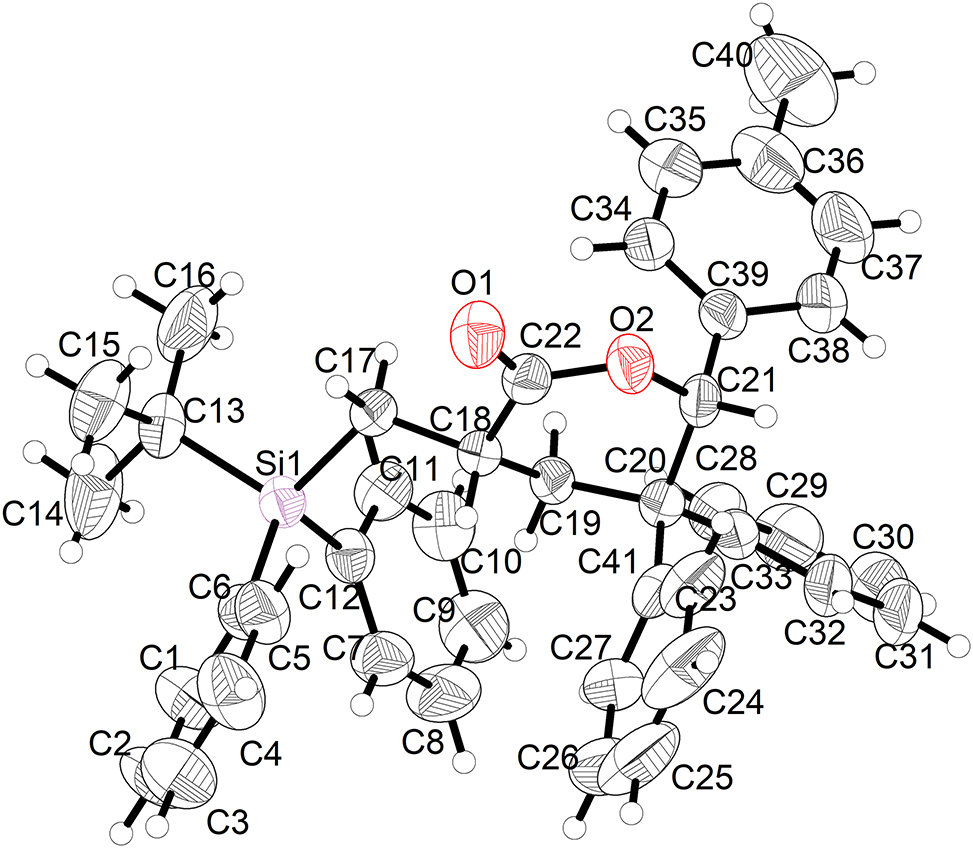
The molecular structure is shown in the figure. Table 1 contains crystallographic data and Table 2 contains the list of the atoms including atomic coordinates and displacement parameters.
Data collection and handling.
| Crystal: | Colourless block |
| Size: | 0.11 × 0.09 × 0.08 mm |
| Wavelength: | Mo Kα radiation (0.71073 Å) |
| μ: | 0.10 mm−1 |
| Diffractometer, scan mode: | Bruker APEX-II, φ and ω |
| θmax, completeness: | 27.5°, >99 % |
| N(hkl)measured, N(hkl)unique, Rint: | 20,285, 7826, 0.041 |
| Criterion for Iobs, N(hkl)gt: | Iobs > 2σ(Iobs), 4126 |
| N(param)refined: | 401 |
| Programs: | CrysAlisPRO [1], SHELX [2, 3], Diamond [4] |
Fractional atomic coordinates and isotropic or equivalent isotropic displacement parameters (Å2).
| Atom | x | y | z | Uiso*/Ueq |
|---|---|---|---|---|
| C1 | 0.2305 (2) | 0.79129 (18) | 0.6468 (2) | 0.0757 (8) |
| C2 | 0.1355 (2) | 0.8290 (2) | 0.6109 (3) | 0.0926 (10) |
| C3 | 0.0771 (2) | 0.8123 (2) | 0.5280 (3) | 0.0966 (11) |
| C4 | 0.1104 (2) | 0.7584 (2) | 0.4800 (2) | 0.0877 (10) |
| C5 | 0.20424 (18) | 0.72046 (18) | 0.51630 (17) | 0.0625 (7) |
| C6 | 0.26756 (17) | 0.73516 (14) | 0.60015 (15) | 0.0516 (6) |
| C7 | 0.4735 (2) | 0.84798 (16) | 0.69275 (18) | 0.0639 (7) |
| C8 | 0.5510 (2) | 0.90615 (18) | 0.7248 (2) | 0.0849 (9) |
| C9 | 0.6477 (2) | 0.8796 (2) | 0.7696 (2) | 0.0809 (9) |
| C10 | 0.6671 (2) | 0.79548 (19) | 0.78216 (16) | 0.0670 (7) |
| C11 | 0.59012 (18) | 0.73743 (16) | 0.74954 (15) | 0.0574 (6) |
| C12 | 0.49075 (17) | 0.76140 (14) | 0.70416 (13) | 0.0459 (5) |
| C13 | 0.37934 (18) | 0.59661 (16) | 0.72688 (14) | 0.0540 (6) |
| C14 | 0.3648 (3) | 0.6401 (2) | 0.80415 (19) | 0.1071 (12) |
| C15 | 0.2857 (2) | 0.54250 (19) | 0.68279 (19) | 0.0871 (9) |
| C16 | 0.4710 (2) | 0.5385 (2) | 0.7585 (2) | 0.1033 (12) |
| C17 | 0.42895 (16) | 0.62578 (13) | 0.56386 (13) | 0.0427 (5) |
| C18 | 0.44728 (16) | 0.67878 (12) | 0.49277 (13) | 0.0402 (5) |
| C19 | 0.53969 (16) | 0.73617 (13) | 0.52612 (14) | 0.0437 (5) |
| C20 | 0.56481 (17) | 0.77645 (13) | 0.45192 (14) | 0.0453 (5) |
| C21 | 0.59238 (17) | 0.70147 (14) | 0.40413 (15) | 0.0490 (6) |
| C22 | 0.44856 (17) | 0.62209 (14) | 0.41943 (14) | 0.0454 (5) |
| C23 | 0.4244 (2) | 0.81103 (18) | 0.30731 (19) | 0.0759 (8) |
| C24 | 0.3391 (3) | 0.8579 (3) | 0.2595 (3) | 0.1081 (13) |
| C25 | 0.3014 (3) | 0.9187 (3) | 0.2984 (4) | 0.1245 (18) |
| C26 | 0.3488 (3) | 0.9342 (2) | 0.3842 (3) | 0.1098 (13) |
| C27 | 0.4328 (2) | 0.88875 (17) | 0.4312 (2) | 0.0780 (9) |
| C28 | 0.72602 (19) | 0.83424 (16) | 0.56663 (19) | 0.0641 (7) |
| C29 | 0.8091 (2) | 0.88753 (19) | 0.5922 (2) | 0.0836 (9) |
| C30 | 0.8228 (3) | 0.9451 (2) | 0.5361 (3) | 0.0892 (10) |
| C31 | 0.7538 (3) | 0.94987 (18) | 0.4538 (2) | 0.0833 (9) |
| C32 | 0.6709 (2) | 0.89605 (16) | 0.42755 (18) | 0.0674 (7) |
| C33 | 0.65555 (18) | 0.83669 (14) | 0.48379 (16) | 0.0521 (6) |
| C34 | 0.69911 (19) | 0.59100 (14) | 0.50715 (15) | 0.0525 (6) |
| C35 | 0.7903 (2) | 0.55390 (17) | 0.55124 (18) | 0.0692 (7) |
| C36 | 0.8788 (2) | 0.5830 (2) | 0.5429 (2) | 0.0856 (9) |
| C37 | 0.8704 (3) | 0.6478 (2) | 0.4855 (3) | 0.0978 (11) |
| C38 | 0.7785 (2) | 0.68453 (17) | 0.4398 (2) | 0.0787 (9) |
| C39 | 0.69113 (18) | 0.65788 (14) | 0.45156 (16) | 0.0515 (6) |
| C40 | 0.9807 (3) | 0.5460 (3) | 0.5960 (3) | 0.1437 (17) |
| C41 | 0.47173 (19) | 0.82523 (15) | 0.39422 (16) | 0.0554 (6) |
| O1 | 0.39231 (12) | 0.56306 (11) | 0.39407 (10) | 0.0614 (5) |
| O2 | 0.51154 (12) | 0.63950 (10) | 0.37661 (10) | 0.0542 (4) |
| Si1 | 0.39207 (5) | 0.68023 (4) | 0.64919 (4) | 0.04297 (18) |
1 Source of materials
An improved synthesis was performed which was similar to the previous report [5], [6], [7]. To the solution of tert-butyldiphenylsilane carboxylic acid (3.41 g, 12.0 mmol) in anhydrous 1,4-dioxane (80 mL) was added 4-methylbenzaldehyde (1.44 g, 12.0 mmol), benzyl acrylate (1.30 g, 8.0 mmol), 1,1-diphenylethylene (2.16 g, 12.0 mmol), NaHCO3 (0.67 g, 8.0 mmol) and organic photo catalyst 4CzIPN (316 mg, 0.4 mmol) under argon atmosphere. After addition, the reaction mixture was irradiated under 440 nm Kessil light for 12 h. TLC detection showed the reaction was finished. After simple filtration by silicone gel, the solvent was removed in vacuo. The obtained residue was dissolved in dichloromethane (100 mL), washed with water (50 mL × 2), brine (50 mL × 2) and dried over anhydrous MgSO4. After filtration, the solvent was evaporated in vacuo. The obtained residue was purified by column chromatography to afford white solid of 3-((tert-butyldiphenylsilyl)methyl)-5,5-diphenyl-6-(p-tolyl)tetrahydro-2H-pyran-2-one (1.52 g, 32 %), which was further purified by recrystallization from hexane and ethyl acetate. Crystals were obtained by slow evaporation from the solution at 268–270 K.
2 Comment
3-((tert-Butyldiphenylsilyl)methyl)-5,5-diphenyl-6-(p-tolyl)tetrahydro-2H-pyran-2-one is a product formed by a novel four-component radical dual difunctionalization (RDD) of two different alkenes with silanecarboxylic acid and aldehyde [8], in which the lactone product is generated from esterification of benzyl 2-((tert-butyldiphenylsilyl) methyl)-5-hydroxy-4,4-diphenyl-5-(p-tolyl)pentanoate afterwards. The selective ordered assembly of four-component molecules might be achieved by the inherent nucleophilic/electrophilic reactivity of radicals and alkenes [8, 9]. In this paper, single electron oxidation and decarboxylation of tert-butyldiphenylsilanecarboxylic acid anion produced nucleophilic silane radical [10], [11], [12], which preferentially added to electro-deficient methyl acrylate. The next produced electrophilic alkyl radical with α-ester group would subsequently added to 1,1-diphenylethylene in high chemo-selectivity. Finally, a reductive radical polar crossover (RPC)-type reaction [13] or radical-radical coupling process [14] with 4-methylbenzaldehyde provided four-component RDD product before intramolecular esterification reaction for silica-containing lactone product. In the literature, the detailed crystal structure analysis of 3-((tert-butyldiphenylsilyl) methyl)-5,5-diphenyl-6-(p-tolyl)tetrahydro-2H-pyran-2-one was obtained by continuous adjustment of crystallization conditions, which revealed the specific structure of the four-component radical dual difunctionalization (RDD) of two different alkenes with silanecarboxylic acid and aldehyde for the first time. Moreover, this single crystal data also provided direct proof for the mechanism of the previously reported multi-component radical relay reaction from a structural perspective [5], [6], [7], [8], which is also a significant reaction for further understanding organosilicon chemistry. The title structure (see the Figure) is a six-membered cyclic ester compound with one (tert-butyldiphenylsilyl)methyl at C18, two phenyls at C20 and one 4-methylphenyl group at C21. The six-membered heterocycle adopts an approximate chair conformation with two vertical groups (p-methylphenyl and one of phenyl group). Summarily, the bond lengths and angles are in the expected ranges [15].
Funding source: Natural Science Foundation of Jiangxi Province
Award Identifier / Grant number: 20212BAB213027
Award Identifier / Grant number: 20232BAB205058
Funding source: Nanchang Normal University
Award Identifier / Grant number: NSBSJJ2020009
-
Research ethics: Not applicable.
-
Author contributions: All the authors have accepted responsibility for the entire content of this submitted manuscript and approved submission.
-
Competing interests: The authors declare no conflicts of interest regarding this article.
-
Research funding: This work was supported by Natural Science Foundation of Jiangxi Province (20212BAB213027, 20232BAB205058), and Nanchang Normal University (NSBSJJ2020009).
-
Data availability: The raw data can be obtained on request from the corresponding author.
References
1. Oxford Diffraction Ltd. CrysAlisPRO: Abingdon, Oxfordshire, England, 2006.Search in Google Scholar
2. Sheldrick, G. M. SHELXTL – integrated space-group and crystal-structure determination. Acta Crystallogr. 2015, A71, 3–8; https://doi.org/10.1107/s2053273314026370.Search in Google Scholar PubMed PubMed Central
3. Sheldrick, G. M. Crystal structure refinement with SHELXL. Acta Crystallogr. 2015, C71, 3–8, https://doi.org/10.1107/s2053229614024218.Search in Google Scholar PubMed PubMed Central
4. Brandenburg, K. DIAMOND. Visual Crystal Structure Information System. Ver. 4.0; Crystal Impact: Bonn, Germany, 2015.Search in Google Scholar
5. Tan, G., Paulus, F., Petti, A., Wiethoff, M., Lauer, A., Daniliuc, C., Glorius, F. Metal-free photosensitized radical relay 1,4-carboimination across two distinct olefins. Chem. Sci. 2023, 14, 2447–2454; https://doi.org/10.1039/d2sc06497a.Search in Google Scholar PubMed PubMed Central
6. Liu, R., Chen, X., Yang, L. D-A-D-T-type four-component radical dual-difunctionalization and acylative azidation of two different alkenes. Chem. Commun. 2023, 59, 7986–7989; https://doi.org/10.1039/d3cc01463k.Search in Google Scholar PubMed
7. Wu, C., Liu, R., Ma, D., Luo, C., Yang, L. Four-component radical dual difunctionalization (RDD) of two different alkenes with aldehydes and tert-butyl hydroperoxide (TBHP): an easy access to β,δ-functionalized ketones. Org. Lett. 2019, 21, 6117–6121; https://doi.org/10.1021/acs.orglett.9b02264.Search in Google Scholar PubMed
8. Du, P., Li, H., Wang, Y., Cheng, J., Wang, X. Radical-polar crossover reactions: oxidative coupling of 1,3-dioxolanes with electron-deficient alkenes and vinylarenes based on a radical addition and Kornblu–DeLaMare rearrangement. Org. Lett. 2014, 16, 6350–6353; https://doi.org/10.1021/ol503128j.Search in Google Scholar PubMed
9. Fischer, H. The persistent radical effect: a principle for selective radical reactions and living radical polymerizations. Chem. Rev. 2001, 101, 3581–3610; https://doi.org/10.1021/cr990124y.Search in Google Scholar PubMed
10. Xu, N., Li, B., Wang, C., Uchiyama, M. Sila- and germacarboxylic acids: precursors for the corresponding silyl and germyl radicals. Angew. Chem. Int. Ed. 2020, 59, 10639–10644; https://doi.org/10.1002/ange.202003070.Search in Google Scholar
11. Zhou, R., Goh, Y. Y., Liu, H., Tao, H., Li, L., Wu, J. Visible-light-mediated metal-free hydrosilylation of alkenes through selective hydrogen atom transfer for Si–H activation. Angew. Chem. Int. Ed. 2017, 56, 16621–16625; https://doi.org/10.1002/anie.201711250.Search in Google Scholar PubMed
12. Hou, J., Ee, A., Cao, H., Ong, H.-W., Xu, J.-H., Wu, J. Visible-light- mediated metal-free difunctionalization of alkenes with CO2 and silanes or C(sp3)-H alkanes. Angew. Chem. Int. Ed. 2018, 57, 17220–17224; https://doi.org/10.1002/anie.201811266.Search in Google Scholar PubMed
13. Pitzer, L., Schwarz, J. L., Glorius, F. Reductive radical-polar crossover: traditional electrophiles in modern radical reactions. Chem. Sci. 2019, 10, 8285–8291; https://doi.org/10.1039/c9sc03359a.Search in Google Scholar PubMed PubMed Central
14. Bao, Q., Li, M., Xia, Y., Wang, Y., Zhou, Z., Liang, Y. Visible-light-mediated decarboxylative radical addition bifunctionalization cascade for the production of 1,4-amino alcohols. Org. Lett. 2021, 23, 1107–1112; https://doi.org/10.1021/acs.orglett.1c00034.Search in Google Scholar PubMed
15. Ramella, V., He, Z., Daniliuc, C. G., Studer, A. Palladium-catalyzed dearomatizing difunctionalization of indoles and benzofurans. Eur. J. Org Chem. 2016, 2016, 2268–2273; https://doi.org/10.1002/ejoc.201600194.Search in Google Scholar
© 2023 the author(s), published by De Gruyter, Berlin/Boston
This work is licensed under the Creative Commons Attribution 4.0 International License.
Articles in the same Issue
- Frontmatter
- New Crystal Structures
- Crystal structure of poly[diaqua-(μ4-3,3′-di(1H-1,2,4-triazol-1-yl)-[1,1′-biphenyl]-4,4′-dicarboxylate-N:N′:O:O′)cadmium(II)], C18H14N6O6Cd
- Crystal structure of (8R,8′S,13S,13′R)-8,8′-bis(hydroxymethyl)-9,9′,10,10′-tetramethoxy-5,5′,6,6′,8,8′,13,13′-octahydro-[13,13′-bi[1,3]dioxolo[4,5-g]isoquinolino[3,2-a]isoquinoline]-7,7′-diium chloride-methanol (1/2), C46H58N2O14Cl2
- The crystal structure of 8-methoxy-2,2-diphenyl-tosyl-1,2-dihydro-2λ4,3λ4-[1,3,2]diazaborolo[4,5,1-ig]quinoline, C29H25BN2O3S
- Crystal structure of aqua-(5,5,7,12,12,14-hexamethyl-1,4,8,11-tetraazacyclotetradecane-κ4N,N′,N″,N‴)copper(II) 5-carboxyisophthalate tetrahydrate, C25H50N4CuO11
- The crystal structure of 1-(naphthalen-2-ylsulfonyl)-2,2-diphenyl-1,2-dihydro-2λ4,3λ4-[1,3,2]diazaborolo[4,5,1-ij]quinoline, C31H23BN2O2S
- Crystal structure of iodido-(η6-benzene) (1-(pyridin-2-yl)-N-(p-fluoro-methanamine)-κ2N,Nʹ)ruthenium(II) hexaflourophosphate, (C18H15F7IN2RuP)
- The crystal structure of 1-(3-oxo-1-phenyl-3-(p-tolyl) propylidene)-1,3-dihydro-2H-inden-2-one, C25H20O2
- Crystal structure of tricyclohexyl[4-(4H-1,2,4-triazol-4-yl)-benzoato-κO]tin(IV), C27H39N3O2Sn
- Crystal structure of [triaqua-(8-carboxymethoxy-quinoline-2-carboxylate-κ4N,O,O,O)cadmium(II)]monohydrate, C12H15NO9Cd
- Crystal structure of ethyl 2-((4-(3,5-dimethylisoxazol-4-yl)-2,6-difluorophenyl)amino)benzoate, C20H18F2N2O3
- The crystal structure of 2-(hydroxymethyl)-2-(4H-1,2,4-triazol-4-yl)propane-1,3-diol, C6H11N3O3
- The crystal structure of 1,2-bis(2,4-dinitrophenyl) hydrazine, C12H8N6O8
- Crystal structure of 1-(2,6-dichloro-4-(3,5-dimethylisoxazol-4-yl)phenyl)-1,2-dihydro-4H-benzo[d][1,3]oxazin-4-one, C19H14Cl2N2O3
- The crystal structure of 5-amino-5-oxo-4-(1-oxo-4-(2-oxopyrrolidin-1-yl)isoindolin-2-yl)pentanoic acid, C17H19N3O5
- Crystal structure of N2,N6-bis(2-(((Z)-5-bromo-2-hydroxybenzylidene)amino) phenyl)pyridine-2,6-dicarboxamide, C33H23Br2N5O4
- The crystal structure of (E)-2-methoxy-6-(((5-methyl-1,3,4-thiadiazol-2-yl)imino)methyl)phenol, C11H11N3O2S
- The crystal structure of 3-((tert-butyldiphenylsilyl)methyl)-5,5-diphenyl-6-(p-tolyl) tetrahydro-2H-pyran-2-one, C41H42O2Si
- Crystal structure of 9-fluoro-4-(6-methoxypyridin-3-yl)-5,6-dihydrobenzo[h]quinazolin-2-amine, C18H15FN4O
- The crystal structure of 2-bromo-5-(4-cyanophenoxy)benzyl 1-methyl-1,2,5,6-tetrahydropyridine-3-carboxylate, C21H19BrN2O3
- Crystal structure of 3,3′-(1,4-phenylenebis(methylene))bis(1-isopropyl-1H-imidazol-3-ium) bis(hexafluorophosphate(V)), C10H14F6N2P
- The crystal structure of 2,2-di(thiophen-3-yl)-1-tosyl-1,2-dihydro-2λ4,3λ4-[1,3,2]diazaborolo[4,5,1-ig]quinoline, C24H19BN2O2S3
- Crystal structure of 5-bromo-1-(2-iodobenzoyl)-1H-indole-3-carbaldehyde, C16H9BrINO2
- The crystal structure of monocarbonyl-2-carboxypyridinato-κ2N,O-triphenylphosphine-rhodium(I) acetonitrile solvate, C26H20.50N1.50O3PRh
- Crystal structure of dichlorido-tetrakis(1-(2,4-dichlorophenyl)-4,4-dimethyl-2-(1,2,4-triazol-1-yl)pent-1-en-3-ol-κ1N)manganese(II), C60H68O4N12Cl10Mn
- Crystal structure of 3-(tert-butyldiphenylsilyl)-1-(2,6-dichlorophenyl)-2,2-diphenylpropan-1-ol, C37H36Cl2OSi
- Crystal structure of langite from Mine du Pradet (France)
- The crystal structure of 5′-(furan-2-yl)-3′-((4-methylphenyl)sulfonamido)-3′,4′,5′,6′-tetrahydro-[1,1′:3′,1″-terphenyl]-4′-carboxylic acid, C30H27NO5S
- Synthesis and crystal structure of bis{2-(((4-acetophenone)imino)methyl)-4-fluorophenolato-κ2N,O}zinc(II), C30H22F2N2O4Zn
- The crystal structure of poly[(tripyridine-κ3N,N′,N″) μ3-(pyridine-3,4-dicarboxylate-κ3N:O:O′) manganese(II)], C22H22N4O8Mn
- The crystal structure of (E)-4-chloro-N′-(1-(4-hydroxyphenyl)propylidene)benzohydrazide, C16H15ClN2O2
- Synthesis and crystal structure of bis{2-(tert-butyl)-6-((E)-((4-((E)-1-(methoxyimino) ethyl)phenyl)imino)methyl)phenolato-κ2N,O}cobalt(II), C40H46CoN4O4
- Crystal structure of tetraaqua-[(1-(carboxymethyl)-1H-pyrazole-3-carboxylato-κ2N,O)cobalt(II)], C6H12CoN2O8
- (6R,7S)-2,3,13-trimethoxy-6,7-dimethyl-5,6,7,8-tetrahydrobenzo[3′,4′]cycloocta [1′,2′:4,5]benzo[1,2-d][1,3]dioxol-1-ol, C22H26O6
- Crystal structure of 2-((2,6-dichloro-4-(3,5-dimethylisoxazol-4-yl)phenyl)amino)benzoic acid, C18H14Cl2N2O3
- Crystal structure of (5aS,6aS,8aR,9R,11aS, 11bS,13R,13aS)-1,1,8a,11a-tetramethyl-9-((S)-1-((S)-5-methyl-6-oxo-3,6-dihydro-2H-pyran-2-yl)ethyl)-3-oxo-1,7,8,8a,9,10,11,11a,11b,12,13,13a-dodecahydro-3H,6H-cyclopenta[5,6]cyclopropa[1,8a]naphtho[2,1-c]oxepin-13-yl acetate, C32H44O6
- Crystal structure of catena-poly[triaqua-(μ2-1-(4-carboxylatophenyl)-4-oxo-1,4-dihydropyridazine-3-carboxylato-O,O′:O″)cobalt(II)], C12H12N2O8Co
- Crystal structure of 3-[(furan-2-ylmethyl)-amino]-2-(2,3,4,5-tetrafluoro-benzoyl)-acrylic acid ethyl ester, C17H13F4NO4
- Crystal structure of methyl 4-(2-ethoxy-2-oxoethoxy)-3-methoxybenzoate, C13H16O6
- Crystal structure of 4-bromo-2-(4-chlorophenyl)-1-methyl-5-(trifluoromethyl)-1H-pyrrole-3-carbonitrile, C13H7BrClF3N2
- The crystal structure of triaqua-(8-carboxymethoxy-quinoline-2-carboxylate-κ3N,O,O)nickel(II) monohydrate, C12H15NO9Ni
- Crystal structure of dihydroxy(2,4,6-triisopro-pylphenyl)telluronium trifluoromethanesulfonate, C16H25F3O5STe
- The crystal structure of 1-(carboxymethyl)-1H-imidazole 3-oxide
- The crystal structure of 1,3,5-tris(dibromomethyl)benzene, C9H6Br6
- Crystal structure of (Z)-3-(4-methoxyphenyl)-4-(5-methyl-1-phenyl-1H-1,2,3-triazol-4-yl)-N-phenylthiazol-2(3H)-imine, C25H21N5OS
- Crystal structure of (Z)-3-(3-(4-hydroxyphenyl)-2-(phenylimino)-2,3-dihydrothiazol-4-yl)-2H-chromen-2-one, C24H16N2O3S
Articles in the same Issue
- Frontmatter
- New Crystal Structures
- Crystal structure of poly[diaqua-(μ4-3,3′-di(1H-1,2,4-triazol-1-yl)-[1,1′-biphenyl]-4,4′-dicarboxylate-N:N′:O:O′)cadmium(II)], C18H14N6O6Cd
- Crystal structure of (8R,8′S,13S,13′R)-8,8′-bis(hydroxymethyl)-9,9′,10,10′-tetramethoxy-5,5′,6,6′,8,8′,13,13′-octahydro-[13,13′-bi[1,3]dioxolo[4,5-g]isoquinolino[3,2-a]isoquinoline]-7,7′-diium chloride-methanol (1/2), C46H58N2O14Cl2
- The crystal structure of 8-methoxy-2,2-diphenyl-tosyl-1,2-dihydro-2λ4,3λ4-[1,3,2]diazaborolo[4,5,1-ig]quinoline, C29H25BN2O3S
- Crystal structure of aqua-(5,5,7,12,12,14-hexamethyl-1,4,8,11-tetraazacyclotetradecane-κ4N,N′,N″,N‴)copper(II) 5-carboxyisophthalate tetrahydrate, C25H50N4CuO11
- The crystal structure of 1-(naphthalen-2-ylsulfonyl)-2,2-diphenyl-1,2-dihydro-2λ4,3λ4-[1,3,2]diazaborolo[4,5,1-ij]quinoline, C31H23BN2O2S
- Crystal structure of iodido-(η6-benzene) (1-(pyridin-2-yl)-N-(p-fluoro-methanamine)-κ2N,Nʹ)ruthenium(II) hexaflourophosphate, (C18H15F7IN2RuP)
- The crystal structure of 1-(3-oxo-1-phenyl-3-(p-tolyl) propylidene)-1,3-dihydro-2H-inden-2-one, C25H20O2
- Crystal structure of tricyclohexyl[4-(4H-1,2,4-triazol-4-yl)-benzoato-κO]tin(IV), C27H39N3O2Sn
- Crystal structure of [triaqua-(8-carboxymethoxy-quinoline-2-carboxylate-κ4N,O,O,O)cadmium(II)]monohydrate, C12H15NO9Cd
- Crystal structure of ethyl 2-((4-(3,5-dimethylisoxazol-4-yl)-2,6-difluorophenyl)amino)benzoate, C20H18F2N2O3
- The crystal structure of 2-(hydroxymethyl)-2-(4H-1,2,4-triazol-4-yl)propane-1,3-diol, C6H11N3O3
- The crystal structure of 1,2-bis(2,4-dinitrophenyl) hydrazine, C12H8N6O8
- Crystal structure of 1-(2,6-dichloro-4-(3,5-dimethylisoxazol-4-yl)phenyl)-1,2-dihydro-4H-benzo[d][1,3]oxazin-4-one, C19H14Cl2N2O3
- The crystal structure of 5-amino-5-oxo-4-(1-oxo-4-(2-oxopyrrolidin-1-yl)isoindolin-2-yl)pentanoic acid, C17H19N3O5
- Crystal structure of N2,N6-bis(2-(((Z)-5-bromo-2-hydroxybenzylidene)amino) phenyl)pyridine-2,6-dicarboxamide, C33H23Br2N5O4
- The crystal structure of (E)-2-methoxy-6-(((5-methyl-1,3,4-thiadiazol-2-yl)imino)methyl)phenol, C11H11N3O2S
- The crystal structure of 3-((tert-butyldiphenylsilyl)methyl)-5,5-diphenyl-6-(p-tolyl) tetrahydro-2H-pyran-2-one, C41H42O2Si
- Crystal structure of 9-fluoro-4-(6-methoxypyridin-3-yl)-5,6-dihydrobenzo[h]quinazolin-2-amine, C18H15FN4O
- The crystal structure of 2-bromo-5-(4-cyanophenoxy)benzyl 1-methyl-1,2,5,6-tetrahydropyridine-3-carboxylate, C21H19BrN2O3
- Crystal structure of 3,3′-(1,4-phenylenebis(methylene))bis(1-isopropyl-1H-imidazol-3-ium) bis(hexafluorophosphate(V)), C10H14F6N2P
- The crystal structure of 2,2-di(thiophen-3-yl)-1-tosyl-1,2-dihydro-2λ4,3λ4-[1,3,2]diazaborolo[4,5,1-ig]quinoline, C24H19BN2O2S3
- Crystal structure of 5-bromo-1-(2-iodobenzoyl)-1H-indole-3-carbaldehyde, C16H9BrINO2
- The crystal structure of monocarbonyl-2-carboxypyridinato-κ2N,O-triphenylphosphine-rhodium(I) acetonitrile solvate, C26H20.50N1.50O3PRh
- Crystal structure of dichlorido-tetrakis(1-(2,4-dichlorophenyl)-4,4-dimethyl-2-(1,2,4-triazol-1-yl)pent-1-en-3-ol-κ1N)manganese(II), C60H68O4N12Cl10Mn
- Crystal structure of 3-(tert-butyldiphenylsilyl)-1-(2,6-dichlorophenyl)-2,2-diphenylpropan-1-ol, C37H36Cl2OSi
- Crystal structure of langite from Mine du Pradet (France)
- The crystal structure of 5′-(furan-2-yl)-3′-((4-methylphenyl)sulfonamido)-3′,4′,5′,6′-tetrahydro-[1,1′:3′,1″-terphenyl]-4′-carboxylic acid, C30H27NO5S
- Synthesis and crystal structure of bis{2-(((4-acetophenone)imino)methyl)-4-fluorophenolato-κ2N,O}zinc(II), C30H22F2N2O4Zn
- The crystal structure of poly[(tripyridine-κ3N,N′,N″) μ3-(pyridine-3,4-dicarboxylate-κ3N:O:O′) manganese(II)], C22H22N4O8Mn
- The crystal structure of (E)-4-chloro-N′-(1-(4-hydroxyphenyl)propylidene)benzohydrazide, C16H15ClN2O2
- Synthesis and crystal structure of bis{2-(tert-butyl)-6-((E)-((4-((E)-1-(methoxyimino) ethyl)phenyl)imino)methyl)phenolato-κ2N,O}cobalt(II), C40H46CoN4O4
- Crystal structure of tetraaqua-[(1-(carboxymethyl)-1H-pyrazole-3-carboxylato-κ2N,O)cobalt(II)], C6H12CoN2O8
- (6R,7S)-2,3,13-trimethoxy-6,7-dimethyl-5,6,7,8-tetrahydrobenzo[3′,4′]cycloocta [1′,2′:4,5]benzo[1,2-d][1,3]dioxol-1-ol, C22H26O6
- Crystal structure of 2-((2,6-dichloro-4-(3,5-dimethylisoxazol-4-yl)phenyl)amino)benzoic acid, C18H14Cl2N2O3
- Crystal structure of (5aS,6aS,8aR,9R,11aS, 11bS,13R,13aS)-1,1,8a,11a-tetramethyl-9-((S)-1-((S)-5-methyl-6-oxo-3,6-dihydro-2H-pyran-2-yl)ethyl)-3-oxo-1,7,8,8a,9,10,11,11a,11b,12,13,13a-dodecahydro-3H,6H-cyclopenta[5,6]cyclopropa[1,8a]naphtho[2,1-c]oxepin-13-yl acetate, C32H44O6
- Crystal structure of catena-poly[triaqua-(μ2-1-(4-carboxylatophenyl)-4-oxo-1,4-dihydropyridazine-3-carboxylato-O,O′:O″)cobalt(II)], C12H12N2O8Co
- Crystal structure of 3-[(furan-2-ylmethyl)-amino]-2-(2,3,4,5-tetrafluoro-benzoyl)-acrylic acid ethyl ester, C17H13F4NO4
- Crystal structure of methyl 4-(2-ethoxy-2-oxoethoxy)-3-methoxybenzoate, C13H16O6
- Crystal structure of 4-bromo-2-(4-chlorophenyl)-1-methyl-5-(trifluoromethyl)-1H-pyrrole-3-carbonitrile, C13H7BrClF3N2
- The crystal structure of triaqua-(8-carboxymethoxy-quinoline-2-carboxylate-κ3N,O,O)nickel(II) monohydrate, C12H15NO9Ni
- Crystal structure of dihydroxy(2,4,6-triisopro-pylphenyl)telluronium trifluoromethanesulfonate, C16H25F3O5STe
- The crystal structure of 1-(carboxymethyl)-1H-imidazole 3-oxide
- The crystal structure of 1,3,5-tris(dibromomethyl)benzene, C9H6Br6
- Crystal structure of (Z)-3-(4-methoxyphenyl)-4-(5-methyl-1-phenyl-1H-1,2,3-triazol-4-yl)-N-phenylthiazol-2(3H)-imine, C25H21N5OS
- Crystal structure of (Z)-3-(3-(4-hydroxyphenyl)-2-(phenylimino)-2,3-dihydrothiazol-4-yl)-2H-chromen-2-one, C24H16N2O3S
