
Crystal structure of 1,1′-(1,2-ethanediyl)bis(pyridin-1-ium) bis(1,2-dicyanoethene-1,2-dithiolato-κ2 S:S)nickel(II), C20H14N6NiS4
-
Wei-Hong Yan

 und
Wan-Yao Chen
und
Wan-Yao Chen

Abstract
C20H14N6NiS4, triclinic,
Table 1 contains crystallographic data and Table 2 contains the list of the atoms including atomic coordinates and displacement parameters.
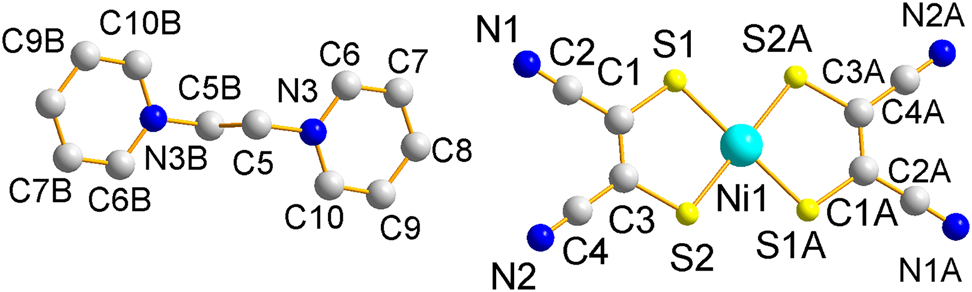
Data collection and handling.
| Crystal: | Red block |
| Size: | 0.25 × 0.21 × 0.17 mm |
| Wavelength: | Mo Kα radiation (0.71073 Å) |
| μ: | 1.30 mm−1 |
| Diffractometer, scan mode: | φ and ω |
| θ max, completeness: | 28.5°, 99% |
| N(hkl)measured, N(hkl)unique, R int: | 3974, 2708, 0.027 |
| Criterion for I obs, N(hkl)gt: | I obs > 2 σ(I obs), 2157 |
| N(param)refined: | 142 |
| Programs: | SHELX [1], Bruker [2] |
Fractional atomic coordinates and isotropic or equivalent isotropic displacement parameters (Å2).
| Atom | x | y | z | U iso*/U eq |
|---|---|---|---|---|
| C1 | 0.2296 (4) | 0.3660 (4) | 0.5637 (4) | 0.0185 (6) |
| C2 | 0.2905 (4) | 0.5305 (4) | 0.5563 (4) | 0.0204 (7) |
| C3 | 0.3197 (4) | 0.3216 (4) | 0.6662 (4) | 0.0175 (6) |
| C4 | 0.4793 (4) | 0.4371 (4) | 0.7693 (4) | 0.0194 (7) |
| C5 | 1.0133 (4) | 1.4167 (4) | 0.9267 (4) | 0.0187 (7) |
| H5A | 1.006242 | 1.425756 | 0.818658 | 0.022* |
| H5B | 1.121933 | 1.408168 | 0.957223 | 0.022* |
| C6 | 0.7543 (4) | 1.1766 (4) | 0.7662 (4) | 0.0178 (6) |
| H6 | 0.744419 | 1.223846 | 0.689105 | 0.021* |
| C7 | 0.6339 (4) | 1.0267 (4) | 0.7451 (4) | 0.0225 (7) |
| H7 | 0.541736 | 0.973156 | 0.653955 | 0.027* |
| C8 | 0.6501 (5) | 0.9569 (5) | 0.8581 (5) | 0.0303 (8) |
| H8 | 0.569174 | 0.856050 | 0.843959 | 0.036* |
| C9 | 0.7887 (5) | 1.0377 (5) | 0.9949 (5) | 0.0359 (10) |
| H9 | 0.801802 | 0.991621 | 1.072584 | 0.043* |
| C10 | 0.9051 (5) | 1.1868 (5) | 1.0116 (5) | 0.0302 (8) |
| H10 | 0.998230 | 1.242254 | 1.101628 | 0.036* |
| N1 | 0.3333 (4) | 0.6627 (4) | 0.5477 (4) | 0.0259 (6) |
| N2 | 0.6084 (4) | 0.5299 (4) | 0.8526 (4) | 0.0288 (7) |
| N3 | 0.8864 (3) | 1.2536 (4) | 0.9002 (3) | 0.0179 (6) |
| Ni1 | 0.000000 | 0.000000 | 0.500000 | 0.01449 (16) |
| S1 | 0.03407 (10) | 0.22651 (11) | 0.44255 (10) | 0.01830 (19) |
| S2 | 0.24209 (10) | 0.11917 (11) | 0.67378 (10) | 0.01782 (19) |
Source of material
All reagents and chemicals were purchased from commercial sources and used without further purification. The starting materials disodium maleonitriledithiolate and 1,1′-(1,2-ethanediyl)bis(pyridin-1-ium)bromide were synthesized following the literature procedures [3, 4]. An aqueous solution (10 mL) of 1,1′-(1,2-ethanediyl)bis(pyridin-1-ium)bromide (0.068 g, 0.2 mmol) was added slowly to an aqueous solution (20 mL) of disodium maleonitriledithiolate (0.074 g, 0.4 mmol) and NiCl2·6H2O (0.048 g, 0.2 mmol), and the mixture was stirred at room temperature for several minutes. A red precipitate was filtered off, washed by water and dried under vacuum. The precipitate was dissolved in DMF with ether diffusion. Two weeks later yielded red crystals.
Experimental details
Absorption corrections were applied by using multi-scan program. The structure was refined based on F 2 with the SHELXL software package. Hydrogen atoms were treated as riding atoms. The U iso values of the hydrogen atoms were set to 1.2U eq (C).
Comment
The development of polythiene complexes have captured much attention because of their variable structures and properties on molecular conductors, magnets, catalysts, and nonlinear optical, etc. [5], [6], [7], [8], [9]. The maleonitriledithiolate (mnt) ligand is one of the most popular ligands in this area. It is crucial to design and prepare suitable multifunctional salts to achieve new molecular arrangements, resulting in developing unique stacking schemes of [M(mnt)2]2− anions and properties. Recently, our effort have been devoted to maleonitriledithiolate complexes using different cations [10], [11], [12].
The title complex crystallizes in triclinic
Funding source: National Natural Science Foundation of China
Award Identifier / Grant number: 21776063
Award Identifier / Grant number: U1704127
-
Author contributions: All the authors have accepted responsibility for the entire content of this submitted manuscript and approved submission.
-
Research funding: This study was financially supported by the National Natural Science Foundation of China (21776063, U1704127).
-
Conflict of interest statement: The authors declare no conflicts of interest regarding this article.
References
1. Sheldrick, G. M. Crystal structure refinement with SHELXL. Acta Crystallogr. 2015, C71, 3–8; https://doi.org/10.1107/s2053229614024218.Suche in Google Scholar
2. Bruker. SMART APEX-II CCD; Bruker AXS Inc.: Madison, WI, USA, 2006.Suche in Google Scholar
3. Simmons, H. E., Blomstrom, D. C., Vest, R. D. Thiacyanocarbons. II. chemistry of disodium dimercaptomaleonitrile. J. Am. Chem. Soc. 1962, 84, 4756–4771; https://doi.org/10.1021/ja00883a029.Suche in Google Scholar
4. Musilek, K., Komloova, M., Zavadova, V., Holas, O., rabinova, M., Pohanka, M., Dohnal, V., Nachon, F., Dolezal, M., Kuca, K., Jung, Y. S. Preparation and in vitro screening of symmetrical bispyridinium cholinesterase inhibitors bearing different connecting linkage-initial study for Myasthenia gravis implications. Bioorg. Med. Chem. Lett 2010, 20, 1763–1766; https://doi.org/10.1016/j.bmcl.2010.01.034.Suche in Google Scholar
5. Coomber, A. T., Beljonne, D., Friend, R. H., Brédas, J. L., Charlton, A., Robertson, N., Underbill, A. E., Kurmoo, M., Day, P. Intermolecular interactions in the molecular ferromagnetic NH4Ni(mnt)2 ⋅ H2O. Nature 1996, 380, 144–146; https://doi.org/10.1038/380144a0.Suche in Google Scholar
6. Robertson, N., Cronin, L. Metal bis-1,2-dithiolene complexes in conducting or magnetic crystalline assemblies. Coord. Chem. Rev. 2002, 227, 93–127; https://doi.org/10.1016/s0010-8545(01)00457-x.Suche in Google Scholar
7. Duan, H. B., Ren, X. M., Meng, Q. J. One-dimensional (1D) [Ni(mnt)2]− based spin-Peierls-like complexes: structural, magnetic and transition properties. Coord. Chem. Rev. 2010, 254, 1509–1522; https://doi.org/10.1016/j.ccr.2009.12.021.Suche in Google Scholar
8. Wang, P. Crystal structure of Mn(II)(H2O)(2,13-dimethyl-3,6,9,12,18-pentaazabicyclo[12.3.1]octadeca-1(18),2,12,14,16-pentaene) bis (maleonitriledithiolate)nickel(II), C23H25MnN9NiOS4. Z. Kristallogr. N. Cryst. Struct. 2012, 227, 511–512; https://doi.org/10.1524/ncrs.2012.0244.Suche in Google Scholar
9. Perochon, R., Barriere, F., Jeannin, O., Piekara-Sady, L., Fourmigue, M. A radical mixed-ligand gold bis(dithiolene) complex. Chem. Commun. 2021, 57, 1615–1618; https://doi.org/10.1039/d0cc07602c.Suche in Google Scholar PubMed
10. Yan, W. H., Ji, E. Y., Shen, M. L., Li, Z. Y., Li, X., Xu, X. L. Two ion-pair complexes constructed by [M(mnt)2]n−(M = Ni, Co, mnt = maleonitriledithiolate): syntheses, characterization and thermal stability. Chin. J. Struct. Chem. 2015, 34, 306–312.Suche in Google Scholar
11. Yan, W. H., Pan, H. Y. Crystal structure of 1,4-bis(methylpyridinium benzene) bis(1,2-dicyanoethene-1,2-dithiolato-κ2S:S) nickel(II), C26H18N6NiS4. Z. Kristallogr. N. Cryst. Struct. 2021, 236, 107–108; https://doi.org/10.1515/ncrs-2020-0407.Suche in Google Scholar
12. Yan, W. H., Liu, X. G., Shen, M. L., Pan, H. Y. Crystal structure of 1,1′-(1,4-phenylenebis(methylene))bis(pyridin-1-ium) bis (1,2-dicyanoethene-1,2-dithiolato-κ2S:S) zinc(II), C26H18N6ZnS4. Z. Kristallogr. N. Cryst. Struct. 2021, 236, 533–535; https://doi.org/10.1515/ncrs-2020-0624.Suche in Google Scholar
13. Jeffrey, G. A. Hydrogen-bonding: an update. Crystallogr. Rev. 2003, 9, 135–176; https://doi.org/10.1080/08893110310001621754.Suche in Google Scholar
© 2022 Wei-Hong Yan and Wan-Yao Chen, published by De Gruyter, Berlin/Boston
This work is licensed under the Creative Commons Attribution 4.0 International License.
Artikel in diesem Heft
- Frontmatter
- New Crystal Structures
- Crystal structure of {2,2′-{cyclohexane-1,2-diylbis[(azanylylidene)methylylidene]}bis(2,4-dibromophenolato)-κ4 N,N′,O,O′}copper(II) ─ diethylformamide (1/1), C23H23Br4CuN3O3
- The crystal structure of 2-(2-methyl-6-phenyl-4H-pyran-4-ylidene)-1H-indene-1,3(2H)-dione, C21H14O3
- Crystal structure of bis((1-methylbenzimidazol-2-yl)methyl)amine, C18H19N5
- Crystal structure of (E)-N′-(1-(2-hydroxy-4-methoxyphenyl)ethylidene) isonicotinohydrazide, C15H15N3O3
- Crystal structure of 2-((4-phenyl-5-(pyridin-4-yl)-4H-1,2,4-triazol-3-yl)thio)acetonitrile, C15H11N5S
- The crystal structure of 2,2′-((1E,1′E)-hydrazine-1,2-diylidenebis(methaneylylidene))bis(4-chlorophenol), C14H10Cl2N2O2
- Dichlorido-{2,6-bis(4,5-dihydro-1H-pyrazol-3-yl)pyridine-κ3 N,N′,N″}zinc(II), C11H9C12N5Zn
- The crystal structure of dichlorido-(2-((4-phenyl-2H-1,2,3-triazol-2-yl)methyl)pyridine-κ2N,N′)palladium(II), C14H12Cl2N4Pd
- The crystal structure of 1-(N1-benzyl-2-methyl-4-nitro-imidazol-5-yl)-4-(prop-2-yn-1-yl) piperazine, C18H21N5O2
- Crystal structure of (μ4-(1,2,4,5-tetra(1,2,4-triazol-1-ylmethyl)-benzene-κ4N:N1:N2:N3)disilver(I) diperchlorate
- The crystal structure of 1-(2-bromoethane)-4-amine-3,5-dinitropyrazole, C5H6Br1N5O4
- Crystal structure of (E)-1-(4-benzyl-3,5-dioxomorpholin-2-ylidene)ethyl acetate, C15H15N1O5
- The crystal structure of poly[diaqua-(μ2-1,2,4,5-tetrakis(1,2,4-triazol-1-ylmethyl)-benzene-κ2N:N′)-bis(μ3-terephthalato-κ3O:O′:O′′)dicadmium(II)], C17H15N6O5Cd
- Crystal structure of (E)-N′-(1-(5-chloro-2-hydroxyphenyl) ethylidene)thiophene-2-carbohydrazide, C13H11ClN2O2S
- The crystal structure of [(2,2′-bipyridine-k2 N,N)-bis(6-phenylpyridine-2-carboxylato-k2 N,O)cobalt(II)]-monohydrate, C36H26N4O5Co
- Crystal structure of (E)-N′-(2-chloro-6-hydroxybenzylidene)-3-hydroxybenzo-hydrazide monohydrate, C14H13ClN2O4
- Crystal structure of 1,1′-(methylene)bis(pyridin-1-ium) bis(1,2-dicyanoethene-1,2-dithiolato-κ2S:S)nickel(II), C42H30N14Ni2S8
- Crystal structure of 1,1′-(1,2-ethanediyl)bis(pyridin-1-ium) bis(1,2-dicyanoethene-1,2-dithiolato-κ2 S:S)nickel(II), C20H14N6NiS4
- The crystal structure of 1-methyl-1H-pyrazol-2-ium nitrate, C4H7O3N3
- The crystal structure of 4,4′-diselanediylbis(8-(hexyloxy)-3,6-dimethyl-1-(piperidin-1-yl)isoquinoline-7-carbonitrile), C46H60N6O2Se2
- The crystal structure of tris(6-methylpyridin-2-yl)phosphine selenide, C18H18N3PSe
- The crystal structure of 1,2-bis(2,4-dinitro-1H-imidazol-1-yl)ethane ─ acetone (1/1), C11H12N8O9
- Crystal structure of [diaqua[2,2′-(1,2-phenylene)bis(1H-imidazole-4-carboxylato-5-carboxy)-κ4N,N′,O,O′]nickel(II)] tetrahydrate, C16H12N4NiO10·4H2O
- The crystal structure of tris(4-methyl-1H-pyrazol-1-yl)methane, C13H16N6
- The crystal structure of 5,6-dichloro-2-(quinolin-8-yl)isoindoline-1,3-dione, C17H8Cl2N2O2
- Crystal structure of (E)-(2-methoxy-benzylidene)-(4-[1,2,4]triazol-1-yl-phenyl)-amine, C16H14N4O
- The crystal structure of (Z)-2-(4-(4-bromophenyl)thiazol-2-yl)-4-(3-hydroxybut-2-enoyl)-5-methyl -1,2-dihydro-3H-pyrazol-3-one – methanol (1/1), C18H18N3O4S
- Crystal structure of tetraaqua-tris(nitrato-κ2 O,O′) erbium(III) monohydrate, Er(NO3)3·5H2O, H10ErN3O14
- The crystal structure of 1-methyl-2-nitro-1H-imidazole 3-oxide, C4H5N3O3
- The crystal structure of 1-methyl-2-nitroimidazole, C4H5N3O2
- The crystal structure of 2-carboxyl-4-nitroimidazole monohydrate, C4H5N3O5
- Crystal structure of bis[hydrido-hexaphenylcarbodiphosphoran][tetra-trifluoromethyl-(μ-diiodo)-diplatinat]
- The crystal structure of poly[μ2-aqua- aqua-(μ3-(E)-2-(4-((2-carbamothioylhydrazineylidene)methyl)phenoxy)acetato-κ3 O:S:S)sodium(I)], C10H14N3O5SNa
- The twinned crystal structure of [4,4′-bipyridine]-1,1′-diium hexachloridostannate(IV), C10H10N2SnCl6
- The crystal structure of [(2,2′-bipyridine-k2 N,N)-bis(6-phenylpyridine-2-carboxylate-k2 N,O)copper(II)], C34H24N4O4Cu
- Crystal structure of trans-1,2-bis(pyridinium-4-yl) ethylene bis(2-carboxy-4-bromobenzoate) – water (1/4), C14H14BrNO6
- Crystal structure of poly[diaqua-(μ3-fumarato)-(μ3-maleato)-(μ4-1,2,4,5-tetrakis((1H-1,2,4-triazol-1-yl)methyl)benzene)tetracadmium(II)] dihydrate, C34H32N12O9Cd4
- Crystal structure of a second modification of Pachypodol, C18H16O7
- Crystal structure of methyl 2-(4-(2-(cyclopentyl-amino)-1-(N-(4-methoxyphenyl)-1-methyl-5-phenyl-1-H-pyrazole-3-carboxamido)-2-oxoethyl)phenyl)acetate, C34H36N4O5
- The crystal structure of catena-poly[(m2-4,4′-bipyridine-κ2 N:N)-bis(6-phenylpyridine-2-carboxylato-κ2 N,O) zinc(II)], C34H24N4O4Zn
- The crystal structure of hexaquamagnesium(II) (2,4-bis(nitroimino)-6-oxo-1,3,5-triazinane-1,3-diide), C3H15MgN7O12
- The crystal structure of 7-Bromo-2-(4-chloro-phenyl)-quinoxaline, C14H9BrClN2
- Crystal structure of methyl 4-{[4-(4-cyanobenzamido)phenyl]amino}benzofuro[2,3-d]pyrimidine-6-carboxylate, C26H17N5O4
- The crystal structure of (4SR)-7-(3,4-dichlorobenzyl)-4,8,8-trimethyl-7,8-dihydroimidazo[5,1c][1,2,4]triazine-3,6(2H,4H)-dione, C15H16Cl2N4O2
- Crystal structure of catena-poly[{μ2-3-carboxy-2,3-bis((4-methylbenzoyl)oxy)propanoato-κ2 O:O′}tris(methanol-κ1 O)lanthanum(III)], C63H63LaO27
Artikel in diesem Heft
- Frontmatter
- New Crystal Structures
- Crystal structure of {2,2′-{cyclohexane-1,2-diylbis[(azanylylidene)methylylidene]}bis(2,4-dibromophenolato)-κ4 N,N′,O,O′}copper(II) ─ diethylformamide (1/1), C23H23Br4CuN3O3
- The crystal structure of 2-(2-methyl-6-phenyl-4H-pyran-4-ylidene)-1H-indene-1,3(2H)-dione, C21H14O3
- Crystal structure of bis((1-methylbenzimidazol-2-yl)methyl)amine, C18H19N5
- Crystal structure of (E)-N′-(1-(2-hydroxy-4-methoxyphenyl)ethylidene) isonicotinohydrazide, C15H15N3O3
- Crystal structure of 2-((4-phenyl-5-(pyridin-4-yl)-4H-1,2,4-triazol-3-yl)thio)acetonitrile, C15H11N5S
- The crystal structure of 2,2′-((1E,1′E)-hydrazine-1,2-diylidenebis(methaneylylidene))bis(4-chlorophenol), C14H10Cl2N2O2
- Dichlorido-{2,6-bis(4,5-dihydro-1H-pyrazol-3-yl)pyridine-κ3 N,N′,N″}zinc(II), C11H9C12N5Zn
- The crystal structure of dichlorido-(2-((4-phenyl-2H-1,2,3-triazol-2-yl)methyl)pyridine-κ2N,N′)palladium(II), C14H12Cl2N4Pd
- The crystal structure of 1-(N1-benzyl-2-methyl-4-nitro-imidazol-5-yl)-4-(prop-2-yn-1-yl) piperazine, C18H21N5O2
- Crystal structure of (μ4-(1,2,4,5-tetra(1,2,4-triazol-1-ylmethyl)-benzene-κ4N:N1:N2:N3)disilver(I) diperchlorate
- The crystal structure of 1-(2-bromoethane)-4-amine-3,5-dinitropyrazole, C5H6Br1N5O4
- Crystal structure of (E)-1-(4-benzyl-3,5-dioxomorpholin-2-ylidene)ethyl acetate, C15H15N1O5
- The crystal structure of poly[diaqua-(μ2-1,2,4,5-tetrakis(1,2,4-triazol-1-ylmethyl)-benzene-κ2N:N′)-bis(μ3-terephthalato-κ3O:O′:O′′)dicadmium(II)], C17H15N6O5Cd
- Crystal structure of (E)-N′-(1-(5-chloro-2-hydroxyphenyl) ethylidene)thiophene-2-carbohydrazide, C13H11ClN2O2S
- The crystal structure of [(2,2′-bipyridine-k2 N,N)-bis(6-phenylpyridine-2-carboxylato-k2 N,O)cobalt(II)]-monohydrate, C36H26N4O5Co
- Crystal structure of (E)-N′-(2-chloro-6-hydroxybenzylidene)-3-hydroxybenzo-hydrazide monohydrate, C14H13ClN2O4
- Crystal structure of 1,1′-(methylene)bis(pyridin-1-ium) bis(1,2-dicyanoethene-1,2-dithiolato-κ2S:S)nickel(II), C42H30N14Ni2S8
- Crystal structure of 1,1′-(1,2-ethanediyl)bis(pyridin-1-ium) bis(1,2-dicyanoethene-1,2-dithiolato-κ2 S:S)nickel(II), C20H14N6NiS4
- The crystal structure of 1-methyl-1H-pyrazol-2-ium nitrate, C4H7O3N3
- The crystal structure of 4,4′-diselanediylbis(8-(hexyloxy)-3,6-dimethyl-1-(piperidin-1-yl)isoquinoline-7-carbonitrile), C46H60N6O2Se2
- The crystal structure of tris(6-methylpyridin-2-yl)phosphine selenide, C18H18N3PSe
- The crystal structure of 1,2-bis(2,4-dinitro-1H-imidazol-1-yl)ethane ─ acetone (1/1), C11H12N8O9
- Crystal structure of [diaqua[2,2′-(1,2-phenylene)bis(1H-imidazole-4-carboxylato-5-carboxy)-κ4N,N′,O,O′]nickel(II)] tetrahydrate, C16H12N4NiO10·4H2O
- The crystal structure of tris(4-methyl-1H-pyrazol-1-yl)methane, C13H16N6
- The crystal structure of 5,6-dichloro-2-(quinolin-8-yl)isoindoline-1,3-dione, C17H8Cl2N2O2
- Crystal structure of (E)-(2-methoxy-benzylidene)-(4-[1,2,4]triazol-1-yl-phenyl)-amine, C16H14N4O
- The crystal structure of (Z)-2-(4-(4-bromophenyl)thiazol-2-yl)-4-(3-hydroxybut-2-enoyl)-5-methyl -1,2-dihydro-3H-pyrazol-3-one – methanol (1/1), C18H18N3O4S
- Crystal structure of tetraaqua-tris(nitrato-κ2 O,O′) erbium(III) monohydrate, Er(NO3)3·5H2O, H10ErN3O14
- The crystal structure of 1-methyl-2-nitro-1H-imidazole 3-oxide, C4H5N3O3
- The crystal structure of 1-methyl-2-nitroimidazole, C4H5N3O2
- The crystal structure of 2-carboxyl-4-nitroimidazole monohydrate, C4H5N3O5
- Crystal structure of bis[hydrido-hexaphenylcarbodiphosphoran][tetra-trifluoromethyl-(μ-diiodo)-diplatinat]
- The crystal structure of poly[μ2-aqua- aqua-(μ3-(E)-2-(4-((2-carbamothioylhydrazineylidene)methyl)phenoxy)acetato-κ3 O:S:S)sodium(I)], C10H14N3O5SNa
- The twinned crystal structure of [4,4′-bipyridine]-1,1′-diium hexachloridostannate(IV), C10H10N2SnCl6
- The crystal structure of [(2,2′-bipyridine-k2 N,N)-bis(6-phenylpyridine-2-carboxylate-k2 N,O)copper(II)], C34H24N4O4Cu
- Crystal structure of trans-1,2-bis(pyridinium-4-yl) ethylene bis(2-carboxy-4-bromobenzoate) – water (1/4), C14H14BrNO6
- Crystal structure of poly[diaqua-(μ3-fumarato)-(μ3-maleato)-(μ4-1,2,4,5-tetrakis((1H-1,2,4-triazol-1-yl)methyl)benzene)tetracadmium(II)] dihydrate, C34H32N12O9Cd4
- Crystal structure of a second modification of Pachypodol, C18H16O7
- Crystal structure of methyl 2-(4-(2-(cyclopentyl-amino)-1-(N-(4-methoxyphenyl)-1-methyl-5-phenyl-1-H-pyrazole-3-carboxamido)-2-oxoethyl)phenyl)acetate, C34H36N4O5
- The crystal structure of catena-poly[(m2-4,4′-bipyridine-κ2 N:N)-bis(6-phenylpyridine-2-carboxylato-κ2 N,O) zinc(II)], C34H24N4O4Zn
- The crystal structure of hexaquamagnesium(II) (2,4-bis(nitroimino)-6-oxo-1,3,5-triazinane-1,3-diide), C3H15MgN7O12
- The crystal structure of 7-Bromo-2-(4-chloro-phenyl)-quinoxaline, C14H9BrClN2
- Crystal structure of methyl 4-{[4-(4-cyanobenzamido)phenyl]amino}benzofuro[2,3-d]pyrimidine-6-carboxylate, C26H17N5O4
- The crystal structure of (4SR)-7-(3,4-dichlorobenzyl)-4,8,8-trimethyl-7,8-dihydroimidazo[5,1c][1,2,4]triazine-3,6(2H,4H)-dione, C15H16Cl2N4O2
- Crystal structure of catena-poly[{μ2-3-carboxy-2,3-bis((4-methylbenzoyl)oxy)propanoato-κ2 O:O′}tris(methanol-κ1 O)lanthanum(III)], C63H63LaO27
