MoS2 based 2D material photodetector array with high pixel density
-
Russell L. T. Schwartz
 ,
Hao Wang
,
Hao Wang


Abstract
Arrays of photodetector-based pixel sensors are ubiquitous in modern devices, such as smart phone cameras, automobiles, drones, laptops etc. Two-dimensional (2D) material-based photodetector arrays are a relevant candidate, especially for applications demanding planar form factors. However, shortcomings in pixel density and prototyping without cross contamination limit technology adoption and impact. Also, while 2D material detectors offer high absorption, graphene’s closed bandgap results in undesirably high dark currents. Here, we introduce the experimental demonstration of dense planar photodetector arrays. We demonstrate a micrometer-narrow pitched 2D detector pixels and show this approach’s repeatability by verifying performing of a 16-pixel detector array. Such dense and repeatable detector realization is enabled by a novel, selective, contamination-free 2D material transfer system, that we report here in automated operation. The so realized photodetectors responsivity peaks at a high 0.8 A/W. Furthermore, we achieve uniform detector performance via bias voltage tuning calibration to maximize deployment. Lastly, we demonstrate 2D arrayed photodetectors not only on a silicon chip platform but verify array performance on flexible polymer substrates. Densley-arrayed, flat, bendable, and uniform performing photodetector pixels enable emerging technologies in the space where lightweight and reliable performance is required, such as for the smart phone and emerging VR/AR markets, but also for smart gadgets, wearables, and also for size-weight-power-constrained aviation and space platforms.
1 Introduction
Image sensors have abundant applications in today’s world from biomedical applications [1], [2] to smart devices internet of things (IoT) [3], focal plane arrays [4], to wearable devices [5]. Especially, for network edge applications a reduced formfactor is of relevance. Thin film image sensors offer an added advantage in these fields by having a low impact on space constraints and lowered power consumption, making them easier to integrate [6], [7]. Two-dimensional (2D) materials have attracted attention due to their unique properties physically, electrically, and optically [8], [9], [10], [11]. As a class of materials transition metal dichalcogenides (TMDCs) have been extensively researched for their usage in photodetector devices [12], [13], [14], [15]. Molybdenum disulfide (MoS2) has emerged as a promising candidate due to its direct bandgap in monolayer form, layer dependent electrical and optical characteristics, high absorption in the visible range, and ease of integration with different material systems [16], [17], [18], [19], [20], [21], [22], [23], [24], [25], [26], [27], [28], [29], [30], [31]. A variety of devices and systems have been shown with MoS2 including photoconductive detectors, photo-gated detectors, and detector arrays/Image sensors. However, these systems still have issues generally with large pitch spacings between detectors, non-uniform device performance, high-voltage requirements, and fabrication incompatibilities with desirable materials.
Here, we present an MoS2 based photodetector array with a dense sub-10-μm pitch in both lateral directions with a maximum responsivity of 0.8 A/W that can be fabricated on nearly any substrate. The arrays are shown on a standard rigid substrate and on a flexible polymer substrate with operation continuing to a maximum bending radius of 1.25 cm and less than 10 % variation of device performance across repeated bending cycles. Also demonstrated is a post-fabrication tuning process to ensure that all devices in the system operate at the same responsivity level using a maximum of 2 V bias. This is achieved by careful design of the array electrodes and the usage of a specialized 2D material transfer printer [32], [33] to accurately transfer exfoliated flakes of MoS2 to designated areas on the electrode design. With the assistance of a semi-automated program an operator of the system can transfer flakes on to the design with an average rate of 1 per minute. We believe that these arrays can see potential usage in wearable devices by being resilient to bending conditions, having a high density, and reliable performance with tuning.
2 Array design
The arrays were designed with MoS2 as the active photo-sensitive material, with a peak response at 670 nm, the arrays are intended to operate in visible light regime, mainly in the red portion of the spectrum. Each detector in the array is a two-electrode device operating as a photoconductive detector where the incident light generates electron–hole pairs (EHPs) contributing to the photocurrent of the device (Figure 1a). Photoconductive detectors were chosen over phototransistors to maximize the density of the devices rather than a focus on device performance, allowing the array to fabricated in only two layers by a process conducive to rapid prototyping and allowing an avenue for high-throughput manufacturing. To maximize density of the arrays they were designed such that the device pitch in both horizontal and vertical directions were equal creating a densely packed square array of devices. The pitches tested for these arrays scale from 50 μm to 9.5 μm, with each pitch corresponding to a specific spacing between the electrodes denoted as the device width (Figure 1b and c). In addition to the pitch the volumetric density is ruled by the maximum height of the array above the substrate, this can be found by a simple addition of the electrode height and the height of the thickest MoS2 flakes in each array. With MoS2 as a 2D material device thickness remained low ranging from below 100 nm to a maximum of 160 nm including the 50 nm electrode lines. The arrays then have a maximum pixel density of 40,000 pixels/cm−2 with total thickness below 160 nm creating a densely packed array with respect to volume. Electrodes were designed to be prefabricated with MoS2 flake placement occurring later, with all devices sharing common ground lines and each with a separate signal/supply line allowing for individual post-tuning with control over the bias voltage. The design of the arrays is intentionally substrate independent such that arrays can be fabricated to conform to the material system of their eventual application. Notably the arrays were fabricated on SiO2 substrates and a flexible polymer substrate, polyimide (PI), giving rise to potential applications in the wearable devices field.
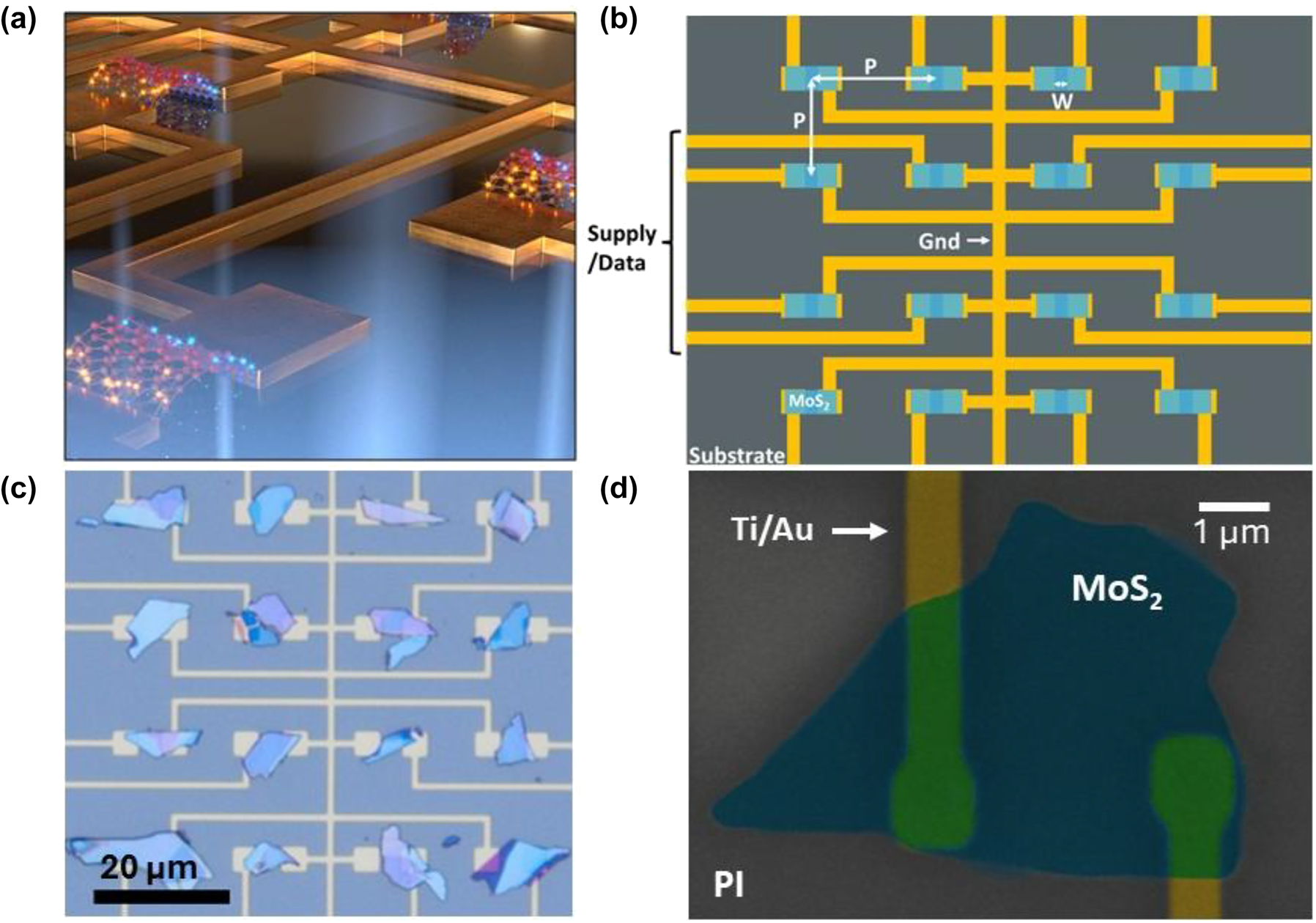
Physical 2D material (2DM) array design. (a) Conceptual image of 2D array in usage, showing light absorption and EHP generation in the MoS2 devices. (b) Schematic design of the 2DM array, where p is the pitch of the array in both vertical and horizontal directions, and w is the device width which is dependent on p of the designed array. The design contains a common ground line for all devices in the array and individual signal/source pads for device biasing and current readout. Substrate material is either SiO2 or polyimide for rigid and flexible applications, respectively. (c) A fabricated array on SiO2 with pixel pitch of 25 μm, all devices in the array are operational but vary in size and shape from the 2DM selection process. 20 μm scale bar. (d) False colored SEM image of a device from 9.5 μm pitched array on PI. Titanium (5 nm) and gold (45 nm) metal lines are shown in gold, while the MoS2 flake for the device is shown in blue, and substrate PI is left uncolored. Scale bar is 1 μm.
3 Results & discussion
Devices are first characterized for their performance as photoconductive detectors and then characterized as whole array for variations across devices, tuning characteristics, and post-tuning variations. Focus is placed on the characterization for operational conditions of the device for a flexible device and preparation conditions of the array impacting the device performance.
3.1 Device characterization
The devices are tested over the visible spectrum from 500 to 900 nm at varying optical power levels to see the photo response with the corresponding conditions. Results for these tests show a main peak at 670 nm which increases in relative strength with decreasing optical power level, up to a maximum responsivity of 0.8 A/W (Figure 2a). This suggests that the device is saturating with higher optical power levels, further evidenced by the response curves shown on average decreasing in responsivity with the increasing optical power levels. The primary peak seen in the response corresponds well with main excitonic peak in MoS2 which has been shown to exist in the region of 1.8–1.9 eV. In addition to the main peak seen at 670 nm a secondary peak can be seen around 600 nm corresponding to the secondary excitonic peak around 2.0 eV. Finally, a third peak at 860 nm is caused by indirect band gap absorption seen in multilayered materials. Another pertinent result from this testing is the decrease seen in the main peak with increasing optical power, suggesting that the saturation of the devices is significant in the direct band transition, however the secondary excitonic peak remains relatively constant throughout shifting optical power levels. Additionally, the indirect band transition sees a significant initial decrease from increasing optical power but less of a decrease at further increasing power levels (Figure 2b). This decrease however does not affect the total function of the device, with the main response shifting to slightly shorter wavelengths in visible spectrum with increased optical power. Furthermore, the red-light regime can still be detected albeit with a lower response than the red–yellow border regime, and the near infrared around the indirect peak remains relatively stable.
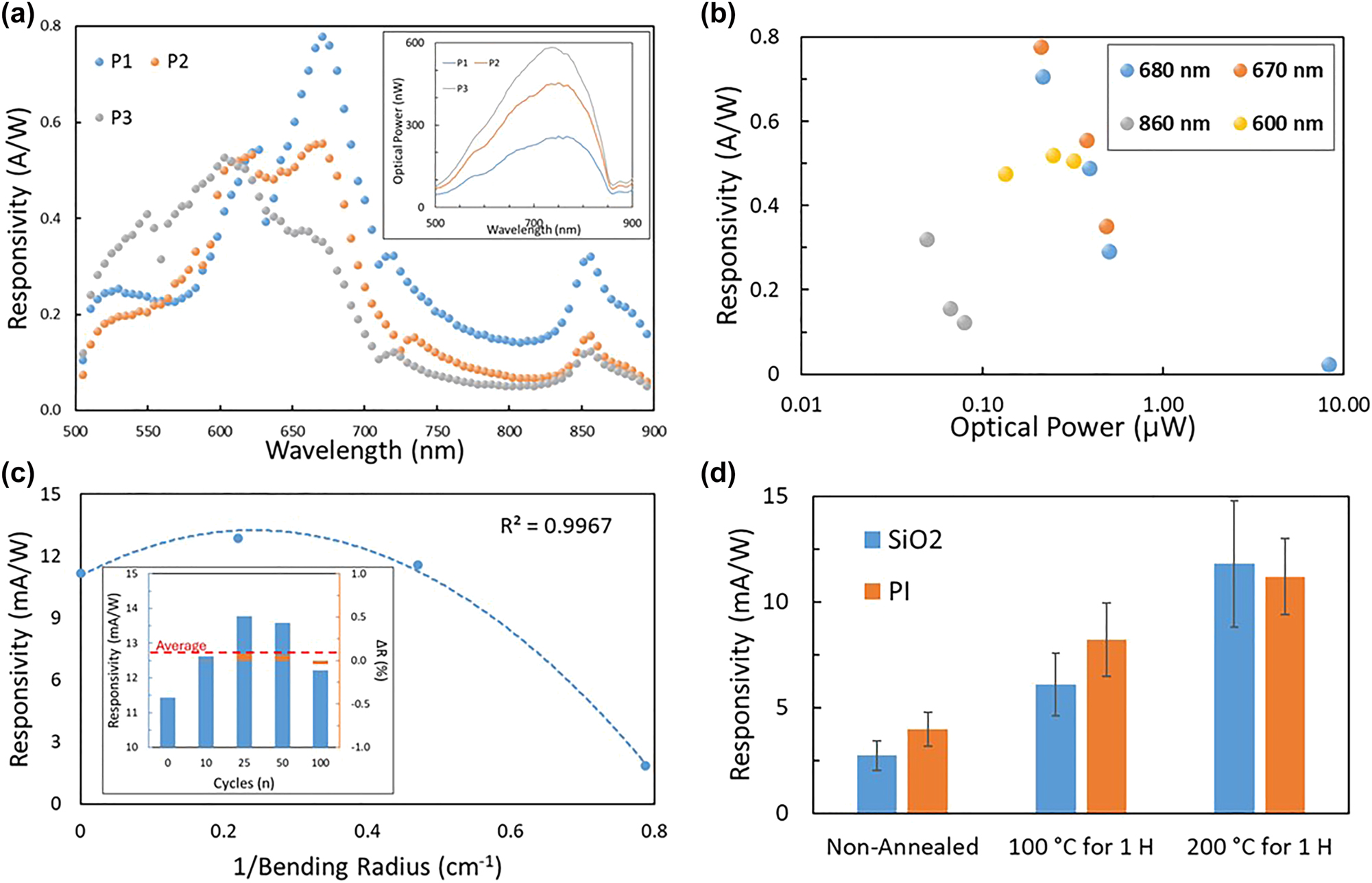
Device and application performance. (a) Responsivity for the optical excitation range of 500 nm–900 nm, for three different laser power levels. Peak photo response is seen growing at the main peak, 670 nm, with decreasing optical power. Further two additional peaks can be seen 610 nm and 860 nm, corresponding to additional photo response peaks seen in multi-layered MoS2. Inset shows the incident optical power for all three power levels, ranging from 50 nW to 580 nW. (b) Responsivity over changing optical power at 600, 670, 680, and 860 nm. (c) Device responsivity over bending radius, slight increases can be seen with shallow bending radii before decreasing to a maximum bending radius of 1.25 cm. The maximum bending radius was used for cyclability testing between flat and bent positions. Inset shows results over 100 bending cycles, showing less than 10 % variation in responsivity after the first bending cycle of the as fabricated devices. (d) Device responsivity as a function of annealing conditions of the array on both SiO2 and PI substrates. Annealing was done in an inert environment using a hotplate where arrays were allowed to heat up and cool down while on the plate. n = 16.
Exploring further the device characteristics with changing optical power we observe that as the optical power is even further increased, to microwatt levels, that a roll off is occurring in the device saturation in the main peak (Figure 2b). Additionally, it is shown that the device saturation characteristics are occurring at an earlier power level in the indirect gap transition, where roll off is beginning to be seen in the 10’s–100’s of nanowatt range (Figure 2b). Finally, in the second excitonic peak a relatively consistent response is seen suggesting there’s no significant saturation occurring, although it is possible that the saturation still occurs outside of the tested optical power ranges. This is supported by the fact that the optical power range at the 600 nm wavelength test is slightly lower than that of 670 and 680 nm. Further the upper limit of the 600 nm power range appears to begin dropping in responsivity but needs a larger test span for conclusive evidence.
Testing is also done on device characteristics for applications in potential applications in flexible substrates and systems, such as smart clothing, for example. The testing for this is executed using a polyimide substrate which is subsequently exposed to various bending conditions. The initial bending tests are done to find the maximum bending radius under which the devices would cease to operate properly, defined as follows; this is done by testing for device characteristics of a freshly fabricated array and then subjecting the array to various levels of bending and retesting to see how the characteristics of the device changed. Results for this line of testing yielded a maximum bending radius around 1.25 cm, with a slight increase in the response of the devices with a small bending radius 4.5–5.0 cm and a decrease towards the maximum bending radius (Figure 2c). The curve for this type of response with respect to bending radius fits closely with a negative second order polynomial function with the intercept set at the unbent level, with an R 2 value of 0.997. One explanation for the initial increase in responsivity under these test conditions is that the uniaxial strain is shifting the peak of the band gap and thus the optical response to match the testing wavelength of 680 nm. The MoS2 band gap is known to have a strong dependency on strain with a 45–70 meV redshift happening per degree of strain [12], [34], [35]. To shift the main excitonic peak it would be 27 meV or roughly 0.5 % strain, and to shift the secondary excitonic peak it would be a 216 meV or roughly 3–4 % strain. With a 3 mm-thick substrate and a 4.5 cm bending radius the strain induced on the MoS2 is 3.3 % making it possible for the increase to be from the secondary excitonic peak shifted to be at the 680 nm testing wavelength. Furthermore, the reduced responsivity at mA/W levels is because testing was done with a laser operating around 10 μW approximately 2 orders of magnitude higher than the start of saturation that was seen previously. With the maximum bending radius established it is then used for stress testing over cycles between flat and the maximum bending radius, where the device characteristics are tracked over 100 cycles. The arrays experience relatively little change when tracked over the 100 cycles, having less than a 10 % change from the average responsivity after the initial bending. Throughout the bending cycles devices were also inspected for delamination of the MoS2 flakes from the substrate and electrodes, across all 100 cycles no significant delamination was observed. This can be attributed to the relatively high Young’s modulus of MoS2 in comparison with PI, which should have a lower breaking point from mechanical strain [36]. Allowing for the MoS2 to bend with the substrate rather than delaminate, with a remaining possibility of delamination under more strenuous conditions. The results for responsivity under bending conditions are promising for usage in flexible systems, with special care being given to not exceed the maximum bending radius of the array.
Devices are also characterized under various preparation conditions, mainly by changing the annealing temperature and time for the devices. Both SiO2 and PI substrates were tested, PI has a glass transition temperature around 250 °C leading to a maximum annealing temperature of 200 °C to avoid deformation. Previous research has shown that thermal annealing at low temperatures can help to create metallic phase transitions in the region between mechanically exfoliated TMDCs and electrode, thus leading to a lower contact resistance [37]. While other results have shown that Au-assisted exfoliation of monolayer material can result in little to benefit from thermal annealing, which could be caused from a minimal phase change seen with preheated gold electrodes, such is the case with a typical Au-assisted exfoliation method [37], [38]. Although previous demonstrations show minimization of resistance at 400 °C some improvements are shown at 200 °C and the surface roughness of the gold can help to increase transitions. Other researchers have shown that low temperature thermal annealing of MoS2 based devices have 2 distinct regions where device improvements are <300 °C and a second region showing device degradation beyond 300 °C towards 400 °C in both photodetectors and FETs [38], [39], [40], [41]. Here, the devices see a 5× and 3× improvement on SiO2 and PI substrates, respectively, the improvements are consistent with about half of the improvement seen at 100 °C anneal compared to the 200 °C anneal. These results suggest that annealing can help to improve the devices significantly and thus limiting the options for flexible substrates to those with high glass transition temperatures. Such substrates as PI and thin glass substrates with some potential on polyethylene naphthalate, although it has a glass transition temperature under 200 °C.
3.2 Photodetector array characterization and tuning
Photodetector array characterization is done by collecting all the device characteristics for a given 4 × 4 array and then comparing them with one another. I–V curves are collected per device from a range of −2 to 2 V of photoconductor bias in both dark and illuminated conditions (Figure 3a). This data and physical parameters are then used to find a normalized responsivity mapping of devices (Figure 3b). The mapping between devices shows significant variations with responses at 2 V and 680 nm ranging from 1 mA/W to 15.5 mA/W. Responsivities can roughly be clustered into three groups low performance (1–3.5 mA/W), middle performance (4–8 mA/W), and high performance (9–16 mA/W), while we again note, that experiments were carried out at laser powers where saturation occurred, else the responsivities are in the 0.× A/W range, see Figure 2b. No significant differences between these three groups can be established due to thickness, leading to a conclusion that innate resistive differences in the flakes and potentially contact resistance is leading to responsivity variations. Post-fabrication tuning for the array to generate a uniform photoabsorption condition and reduce the back-end burden on the digital signal processing (DSP) electronics, is done by changing the voltage bias on individual devices. The tuning level is set to be the lowest maximum responsivity of all devices, in this case devices 15 & 16 have 1.0 mA/W responses so that is set as the tuning level. The initial voltage for tuning was set at 1 V as the middle value for operational range of devices, from there the voltage is adjusted in 100 mV increments to reach the tuned responsivity level. Results for this methodology show bias voltages span the full range of 0.1 V–2 V, with the final voltage tunings resulting in −0.9 V to +1.0 V (Figure 3c). Reduction in voltage does not present a significant issue and can lead to reduced power consumption for the sensor, but voltage increases would require a method of amplification in a final system or potentially a local annealing method to further improve device performance. However, the maximally tuned up voltages still fall below the standard CMOS image sensor 3.3 V level, potentially leading to power savings overall using the MoS2 detector array in an image sensor system. Final post-tuning response levels range from 0.9 mA/W to 1.5 mA/W showing much greater uniformity across the devices (Figure 3d). The bias voltage tuning condition also helps create a greater uniformity among device dark currents, moving from 50 % to 87.5 % agreement (Supplementary Material, Figure 4). We note here that it is possible to achieve 100 % agreement in the dark current but would come at the cost of responsivity agreement and an additional precision factor in bias voltage levels. Additionally non-uniformity in the dark current levels could require additional signal processing (e.g. DSP) to not trigger false positive readings on devices with higher dark currents. One potential avenue to further increase device uniformity is to use CVD grown MoS2 rather than exfoliated material, which has been shown to have more uniform material characteristics and ultimately device performance [42]. The challenge with CVD growth is to find a suitable technique that would be amiable with growth on flexible substrates. Currently thermal CVD growth shows minimum temperatures around 500 °C, much higher than most flexible substrates can sustain [43], [44], [45]. However, recent advancements have shown potential in ALD and PECVD with lower growth temperatures (150–500 °C) for TMDCs creating potential for growth on some flexible substrates [46], [47], [48].
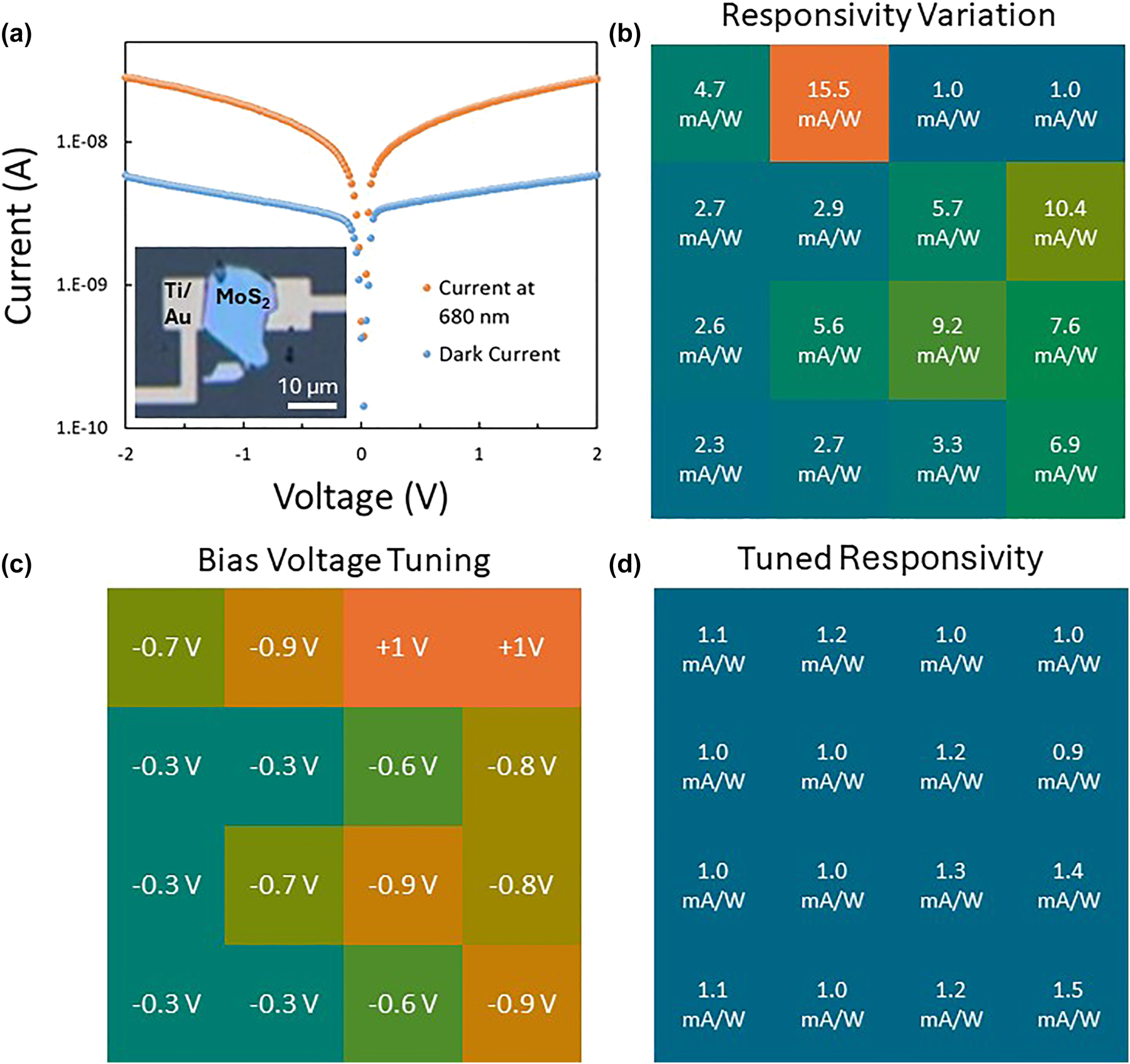
Array variations and tuning. (a) Example of device I–V characteristics with operation with dark current and light current operated at 8.2 μW and 680 nm. Absolute value of the device current is taken to plot on a log scale graph. Inset shows device 7 on PI, the device under test, with a 10 μm scale bar. (b) As fabricated device characteristics for responsivities tested at 2 V, with colder colors representing lower device performance and warmer colors representing higher device performance. (c) Tuning to 1 V bias voltage applied to each device to increase uniformity for the full array. Warmer colors represent larger absolute value for the device tuning, while colder colors represent lower absolute value for tuning. (d) Array responsivities after applying voltage tuning from (c) minimal variation is seen between devices.
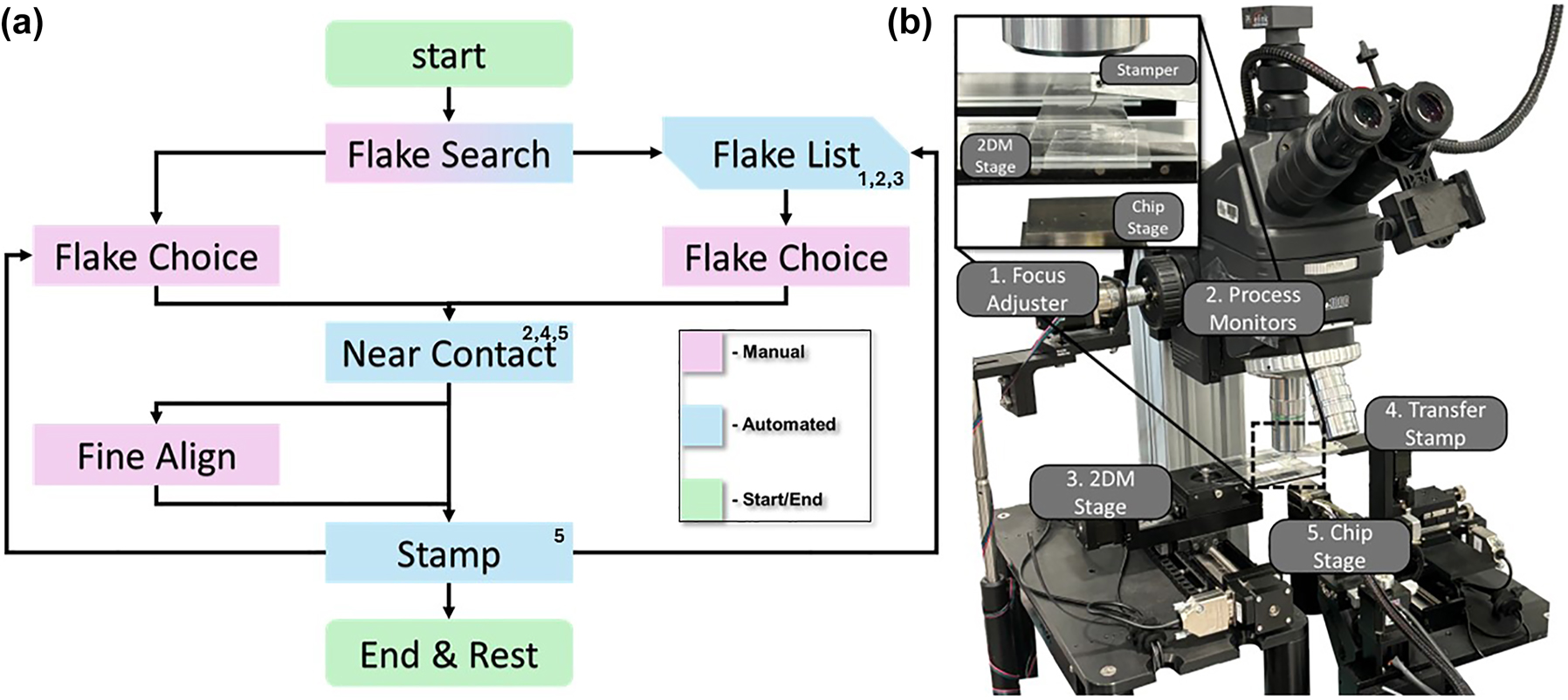
2D material transfer process and system. (a) A flow chart for the 2D material transfer process showing automated and manual steps in the process where subroutines are marked with corresponding subsystems in (b). The process begins with a startup routine and then manually or automatically searching for suitable flakes that have been exfoliated on to a PDMS film, flakes must be manually chosen to be transferred to the given device region. Once the flake choice has been made the system will automatically do a rough alignment procedure and bring the flake to near contact with the device region, at which point the operator can choose to a manually fine alignment or to stamp the flake down for wider pitched devices. After the flake has been transferred the process can be repeated until all devices are created, at which point the system will run an automated end and rest routine. (b) 2D material transfer system and labelled subsystems. The first subsystem is an automated focus adjuster which is used in conjunction with the process monitor subsystem consisting of a camera and image processing software designed to find when images of the PDMS sheet are in focus. Utilizing these two subsystems and the third subsystem, the 2DM stage, flakes can automatically be searched for and located using edge detection and centroid localization algorithm. The final two subsystems control the transfer stamper and chip stages, respectively, both subsystems have 3 dimensional movements with the vertical axis of the transfer stamper using a sensitive piezo-electric system.
4 Methods & manufacturing
Array fabrication is done in two stages, the first was to pre-fabricate the electrode array on the given substrate and the second was to transfer the MoS2 flakes and anneal them. The electrode fabrication followed a standard procedure using electron beam lithography to pattern the design, then deposit the electrodes using electron beam physical vapor deposition and lift off to expose the designed electrodes. The second stage is to perform the MoS2 flake transfer. The active MoS2 material used has been previously demonstrated and used for heterojunction devices, using similar overall fabrication procedures [17], [18]. This is done with a semi-automated version of a stamper based 2D material transfer system [32], [33] (Figure 4). The transfer process is semi-automated where the operator loads both the chip and a sheet of PDMS which has mechanically exfoliated flakes on it into the system. From there the system can begin a startup routine where the operator can choose to manually search for flakes on the PDMS or run an automated routine to compile a flake list which uses a camera and an edge detection algorithm to locate flake centroids. With a list of flakes the operator can then choose which flake/s they wish to transfer to the current device/s, the system then begins the near contact routine which does a rough alignment and brings the flake within 25 μm of the chip. Once the near contact is complete the operator can then choose whether to do a fine alignment for tighter pitched devices or directly stamp the flake on to the device, once the transfer is completed the system will move on to the next device following the same process. After all the devices have been transferred the system will stop and follow a rest routine to return to the load/unload stage where the chip and PDMS film can be removed. Following the automated routine with no fine alignment and several devices to be transferred the system has a throughput of about one transfer every minute. The development of this process is focused on fabricating arrays of devices for various pitch sizes, with fine alignment being necessary for lower pitch dimensions.
5 Conclusions
Here we have presented an automated 2D manufacturing system that has allowed the dense fabrication of arrays and automation system to achieve a high throughput of devices. The manufacturing process enables fabrication of many device concepts, while maintaining high rate of throughput and the ability to assess device concepts through rapid prototyping. Additionally, we have demonstrated an MoS2 based photodetector array that has been fabricated both on SiO2 and PI substrates with a maximum responsivity of 0.8 A/W and maximum bending radius of 1.25 cm, while demonstrating to our knowledge the densest 2D photodetector array to date, achieving over 400,000 pixels per cm2 with a maximum device thickness of 160 nm. The density of our arrays compares competitively with industry CMOS sensors which have pitches span the range in the single digit micron scale. Further development can be implemented in the array design here to increase practicality in application for image sensors. One such change would be to change the fabrication process to use CVD grown MoS2 to increase material consistency and enable larger, more dense arrays. Another development could be implemented through addition of a device passivation layer which would aid in any potential delamination through usage, protect devices from external forces, and could potentially be used to filter light levels to avoid saturation for the application environment. Considering a design with further development towards an end-user application would also require a fine examination of the system’s packaging. A variety of packaging solutions could be explored depending on the application, for example an antenna-based approach could be used in biomedical/wearable devices to decrease obstruction for the end user. Further we have demonstrated an ability to use post fabrication bias voltage tuning to achieve high uniformity among devices made with exfoliated flakes. We believe that following this methodology that 2D arrays could see usage in the wearable device field, specifically in smart glasses or lenses technology.
Funding source: Semiconductor Research Corporation
Award Identifier / Grant number: 2023-JU-3136
Funding source: Defense Advanced Research Projects Agency
Award Identifier / Grant number: 2023-JU-3136
Acknowledgments
The authors thank The George Washington University Nanofabrication and Imaging Center for its facilities and device fabrication support. This work was partly conducted at the Nanoscale Research Facility of the Herbert Wertheim College of Engineering at the University of Florida. RLTS is partially supported by the L3Harris PhD student fellowship. This work was supported in part by CHIMES one of the seven centers in JUMP 2.0, a Semiconductor Research Corporation (SRC) program sponsored by DARPA.
-
Research funding: Joint University Microelectronics Program (JUMP2.0) supported by the Defense Advanced Research Projects Agency (DARPA) and Semiconductor Research Corporation (SRC): Center for Heterogeneous Integration of Micro Electronic Systems. Grant No. 2023-JU-3136.
-
Author contributions: All authors have accepted responsibility for the entire content of this manuscript and consented to its submission to the journal, reviewed all the results and approved the final version of the manuscript. RLTS designed, fabricated, and tested arrays. CP designed and built the measurement setup. CP and RLTS contributed to the 2D material transfer tool. HW and MT contributed to the development of flexible tests. HW, MT, and VS contributed to physical understanding of devices. VS developed the idea for and managed the overall project.
-
Conflict of interest: Authors state no conflicts of interest.
-
Data availability: The datasets generated and/or analyzed during the current study are available from the corresponding author upon reasonable request.
References
[1] T. Yokota, K. Fukuda, and T. Someya, “Recent progress of flexible image sensors for biomedical applications,” Adv. Mater., vol. 33, no. 19, p. 2004416, 2021. https://doi.org/10.1002/adma.202004416.Search in Google Scholar PubMed
[2] Z. Göröcs and A. Ozcan, “On-chip biomedical imaging,” IEEE Rev. Biomed. Eng., vol. 6, pp. 29–46, 2013, https://doi.org/10.1109/rbme.2012.2215847.Search in Google Scholar PubMed PubMed Central
[3] M. Maheepala, M. A. Joordens, and A. Z. Kouzani, “Low power processors and image sensors for vision based IoT devices: a review,” IEEE Sens. J., vol. 21, no. 2, p. 1, 2020. https://doi.org/10.1109/jsen.2020.3015932.Search in Google Scholar
[4] A. Rogalski, “Progress in focal plane array technologies,” Prog. Quantum Electron., vol. 36, nos. 2–3, pp. 342–473, 2012. https://doi.org/10.1016/j.pquantelec.2012.07.001.Search in Google Scholar
[5] J. Choi, J. Shin, D. Kang, and D.-S. Park, “Always-on CMOS image sensor for mobile and wearable devices,” IEEE J. Solid State Circ., vol. 51, no. 1, pp. 130–140, 2016. https://doi.org/10.1109/jssc.2015.2470526.Search in Google Scholar
[6] J. Lee, et al.., “Thin-film image sensors with a pinned photodiode structure,” Nat. Electron., vol. 6, no. 8, pp. 590–598, 2023. https://doi.org/10.1038/s41928-023-01016-9.Search in Google Scholar
[7] P. E. Malinowski, et al.., “Image sensors using thin-film absorbers,” Appl. Opt., vol. 62, no. 17, p. F21, 2023. https://doi.org/10.1364/ao.485552.Search in Google Scholar
[8] D. Akinwande, et al.., “A review on mechanics and mechanical properties of 2D materials – graphene and beyond,” Extreme Mech. Lett., vol. 13, pp. 42–77, 2017, https://doi.org/10.1016/j.eml.2017.01.008.Search in Google Scholar
[9] Q. Ma, G. Ren, K. Xu, and J. Z. Ou, “Tunable optical properties of 2D materials and their applications,” Adv. Opt. Mater., vol. 9, no. 2, p. 2001313, 2020. https://doi.org/10.1002/adom.202001313.Search in Google Scholar
[10] S. B. Mitta, et al.., “Electrical characterization of 2D materials-based field-effect transistors,” 2D Mater., vol. 8, no. 1, p. 012002, 2020. https://doi.org/10.1088/2053-1583/abc187.Search in Google Scholar
[11] E. Heidari, et al.., “Integrated ultra-high-performance graphene optical modulator,” Nanophotonics, vol. 11, no. 17, pp. 4011–4016, 2022. https://doi.org/10.1515/nanoph-2021-0797.Search in Google Scholar PubMed PubMed Central
[12] R. Maiti, et al.., “Strain-engineered high-responsivity MoTe2 photodetector for silicon photonic integrated circuits,” Nat. Photonics, vol. 14, no. 9, pp. 578–584, 2020. https://doi.org/10.1038/s41566-020-0647-4.Search in Google Scholar
[13] C. Patil, et al.., “Self-driven highly responsive PN junction InSe heterostructure near-infrared light detector invited,” Photonics Res., vol. 10, no. 7, 2022, https://doi.org/10.1364/prj.441519.Search in Google Scholar
[14] P. Ma, et al.., “Fast MoTe2 waveguide photodetector with high sensitivity at telecommunication wavelengths,” ACS Photonics, vol. 5, no. 5, pp. 1846–1852, 2018. https://doi.org/10.1021/acsphotonics.8b00068.Search in Google Scholar
[15] O. Özdemir, I. Ramiro, S. Gupta, and G. Konstantatos, “High sensitivity hybrid PbS CQD-TMDC photodetectors up to 2 μm,” ACS Photonics, vol. 6, no. 10, pp. 2381–2386, 2019. https://doi.org/10.1021/acsphotonics.9b00870.Search in Google Scholar
[16] R. Maiti, et al.., “Loss and coupling tuning via heterogeneous integration of MoS2 layers in silicon photonics [Invited],” Opt. Mater. Express, vol. 9, no. 2, p. 751, 2019. https://doi.org/10.1364/ome.9.000751.Search in Google Scholar
[17] H. Wang, et al.., “Self-powered Sb2Te3/MoS2 heterojunction broadband photodetector on flexible substrate from visible to near infrared,” Nanomaterials, vol. 13, no. 13, p. 1973, 2023. https://doi.org/10.3390/nano13131973.Search in Google Scholar PubMed PubMed Central
[18] H. Wang, et al.., “Self-powered broadband photodetector based on MoS2/Sb2Te3 heterojunctions: a promising approach for highly sensitive detection,” Nanophotonics, vol. 11, no. 22, pp. 5113–5119, 2022. https://doi.org/10.1515/nanoph-2022-0413.Search in Google Scholar PubMed PubMed Central
[19] H. Park, et al.., “A wafer-scale nanoporous 2D active pixel image sensor matrix with high uniformity, high sensitivity, and rapid switching (adv. Mater. 14/2023),” Adv. Mater., vol. 35, no. 14, 2023, https://doi.org/10.1002/adma.202370104.Search in Google Scholar
[20] A. Dodda, et al.., “Active pixel sensor matrix based on monolayer MoS2 phototransistor array,” Nat. Mater., vol. 21, no. 12, pp. 1379–1387, 2022. https://doi.org/10.1038/s41563-022-01398-9.Search in Google Scholar PubMed
[21] S. Hong, et al.., “Highly sensitive active pixel image sensor array driven by large-area bilayer MoS2 transistor circuitry,” Nat. Commun., vol. 12, no. 1, 2021, https://doi.org/10.1038/s41467-021-23711-x.Search in Google Scholar PubMed PubMed Central
[22] Y. Xie, et al.., “Ultrabroadband MoS2 photodetector with spectral response from 445 to 2717 nm,” Adv. Mater., vol. 29, no. 17, p. 1605972, 2017. https://doi.org/10.1002/adma.201605972.Search in Google Scholar PubMed
[23] D. Kufer and G. Konstantatos, “Highly sensitive, encapsulated MoS2 photodetector with gate controllable gain and speed,” Nano Lett., vol. 15, no. 11, pp. 7307–7313, 2015. https://doi.org/10.1021/acs.nanolett.5b02559.Search in Google Scholar PubMed
[24] P. Gant, P. Huang, D. Pérez de Lara, D. Guo, R. Frisenda, and A. Castellanos-Gomez, “A strain tunable single-layer MoS2 photodetector,” Mater. Today, vol. 27, pp. 8–13, 2019, https://doi.org/10.1016/j.mattod.2019.04.019.Search in Google Scholar
[25] O. Lopez-Sanchez, D. Lembke, M. Kayci, A. Radenovic, and A. Kis, “Ultrasensitive photodetectors based on monolayer MoS2,” Nat. Nanotechnol., vol. 8, no. 7, pp. 497–501, 2013. https://doi.org/10.1038/nnano.2013.100.Search in Google Scholar PubMed
[26] Z. Yin, et al.., “Single-layer MoS2 phototransistors,” ACS Nano, vol. 6, no. 1, pp. 74–80, 2011. https://doi.org/10.1021/nn2024557.Search in Google Scholar PubMed
[27] W. Choi, et al.., “High-detectivity multilayer MoS2 phototransistors with spectral response from ultraviolet to infrared,” Adv. Mater., vol. 24, no. 43, pp. 5832–5836, 2012. https://doi.org/10.1002/adma.201201909.Search in Google Scholar PubMed
[28] R. Wadhwa, A. V. Agrawal, and M. Kumar, “A strategic review of recent progress, prospects and challenges of MoS2-based photodetectors,” J. Phys. D: Appl. Phys., vol. 55, no. 6, p. 063002, 2021. https://doi.org/10.1088/1361-6463/ac2d60.Search in Google Scholar
[29] Y. Cheng, et al.., “Research progress on improving the performance of MoS2 photodetector,” J. Opt., vol. 24, no. 10, p. 104003, 2022. https://doi.org/10.1088/2040-8986/ac8a5b.Search in Google Scholar
[30] H. S. Nalwa, “A review of molybdenum disulfide (MoS2) based photodetectors: from ultra-broadband, self-powered to flexible devices,” RSC Adv., vol. 10, no. 51, pp. 30529–30602, 2020. https://doi.org/10.1039/d0ra03183f.Search in Google Scholar PubMed PubMed Central
[31] K. F. Mak, C. Lee, J. Hone, J. Shan, and T. F. Heinz, “Atomically ThinMoS2: a new direct-gap semiconductor,” Phys. Rev. Lett., vol. 105, no. 13, 2010, https://doi.org/10.1103/physrevlett.105.136805.Search in Google Scholar
[32] C. Patil, H. Dalir, J. H. Kang, A. Davydov, C. W. Wong, and V. J. Sorger, “Highly accurate, reliable, and non-contaminating two-dimensional material transfer system,” Appl. Phys. Rev., vol. 9, no. 1, 2022, https://doi.org/10.1063/5.0071799.Search in Google Scholar
[33] R. Maiti, C. Patil, R. Hemnani, T. Xie, N. Ansari, and V. J. Sorger, “2D material printer: a novel deterministic transfer method for on-chip photonic integration,” in 2018 IEEE Research and Applications of Photonics In Defense Conference (RAPID), 2019, pp. 1–3.10.1109/RAPID.2019.8864292Search in Google Scholar
[34] K. He, C. Poole, K. F. Mak, and J. Shan, “Experimental demonstration of continuous electronic structure tuning via strain in atomically thin MoS2,” Nano Lett., vol. 13, no. 6, pp. 2931–2936, 2013. https://doi.org/10.1021/nl4013166.Search in Google Scholar PubMed
[35] H. J. Conley, B. Wang, J. I. Ziegler, R. F. Haglund, S. T. Pantelides, and K. I. Bolotin, “Bandgap engineering of strained monolayer and bilayer MoS2,” Nano Lett., vol. 13, no. 8, pp. 3626–3630, 2013. https://doi.org/10.1021/nl4014748.Search in Google Scholar PubMed
[36] S. Bertolazzi, J. Brivio, and A. Kis, “Stretching and breaking of ultrathin MoS2,” ACS Nano, vol. 5, no. 12, pp. 9703–9709, 2011. https://doi.org/10.1021/nn203879f.Search in Google Scholar PubMed
[37] D. Qi, et al.., “Reducing the Schottky barrier between few-layer MoTe2 and gold,” 2D Mater., vol. 4, no. 4, p. 045016, 2017. https://doi.org/10.1088/2053-1583/aa89fc.Search in Google Scholar
[38] S. Lough, J. E. Thompson, D. Smalley, R. Rao, and M. Ishigami, “Impact of thermal annealing on the interaction between monolayer MoS2 and Au,” Adv. Eng. Mater., vol. 26, no. 3, 2023, https://doi.org/10.1002/adem.202301944.Search in Google Scholar
[39] M. H. Johari, M. S. Sirat, M. A. Mohamed, Y. Wakayama, and A. R. Mohmad, “Effects of post-annealing on MoS2 thin films synthesized by multi-step chemical vapor deposition,” Nanomater. Nanotechnol., vol. 11, p. 184798042098153, 2021, https://doi.org/10.1177/1847980420981537.Search in Google Scholar
[40] F. Iacovella, et al.., “Impact of thermal annealing in forming gas on the optical and electrical properties of MoS2 monolayer,” J. Phys. Condens. Matter, vol. 33, no. 3, p. 035001, 2020. https://doi.org/10.1088/1361-648x/abbe76.Search in Google Scholar
[41] S. D. Namgung, S. Yang, K. Park, A.-J. Cho, H. Kim, and J.-Y. Kwon, “Influence of post-annealing on the off current of MoS2 field-effect transistors,” Nanoscale Res. Lett., vol. 10, no. 1, 2015, https://doi.org/10.1186/s11671-015-0773-y.Search in Google Scholar PubMed PubMed Central
[42] H. Schmidt, et al.., “Transport properties of monolayer MoS2 grown by chemical vapor deposition,” Nano Lett., vol. 14, no. 4, pp. 1909–1913, 2014. https://doi.org/10.1021/nl4046922.Search in Google Scholar PubMed
[43] V. Shanmugam, et al.., “A review of the synthesis, properties, and applications of 2D materials,” Part. Part. Syst. Char., vol. 39, no. 6, p. 2200031, 2022. https://doi.org/10.1002/ppsc.202200031.Search in Google Scholar
[44] A. J. Mannix, B. Kiraly, M. C. Hersam, and N. P. Guisinger, “Synthesis and chemistry of elemental 2D materials,” Nat. Rev. Chem., vol. 1, no. 2, 2017, https://doi.org/10.1038/s41570-016-0014.Search in Google Scholar
[45] H. Li, Y. Li, A. Aljarb, Y. Shi, and L.-J. Li, “Epitaxial growth of two-dimensional layered transition-metal dichalcogenides: growth mechanism, controllability, and scalability,” Chem. Rev., vol. 118, no. 13, pp. 6134–6150, 2017. https://doi.org/10.1021/acs.chemrev.7b00212.Search in Google Scholar PubMed
[46] J. Zhu, et al.., “Low-thermal-budget synthesis of monolayer molybdenum disulfide for silicon back-end-of-line integration on a 200 mm platform,” Nat. Nanotechnol., vol. 18, no. 5, pp. 456–463, 2023. https://doi.org/10.1038/s41565-023-01375-6.Search in Google Scholar PubMed
[47] X. Zhang, J. Lai, and T. Gray, “Recent progress in low-temperature CVD growth of 2D materials,” Oxf. Open Mater. Sci., vol. 3, no. 1, 2023, https://doi.org/10.1093/oxfmat/itad010.Search in Google Scholar
[48] A. Tang, A. Kumar, M. Jaikissoon, K. Saraswat, H.-S. P. Wong, and E. Pop, “Toward low-temperature solid-source synthesis of monolayer MoS2,” ACS Appl. Mater. Interfaces, vol. 13, no. 35, pp. 41866–41874, 2021. https://doi.org/10.1021/acsami.1c06812.Search in Google Scholar PubMed
Supplementary Material
This article contains supplementary material (https://doi.org/10.1515/nanoph-2025-0048).
© 2025 the author(s), published by De Gruyter, Berlin/Boston
This work is licensed under the Creative Commons Attribution 4.0 International License.
Articles in the same Issue
- Frontmatter
- Editorial
- In honor of Federico Capasso, a visionary in nanophotonics, on the occasion of his 75th birthday
- Reviews
- Flat nonlinear optics with intersubband polaritonic metasurfaces
- Polaritonic quantum matter
- Machine-learning-assisted photonic device development: a multiscale approach from theory to characterization
- Perspectives
- Towards field-resolved visible microscopy of 2D materials
- Perspective on tailoring longitudinal structured beam and its applications
- Tunable holographic metasurfaces for augmented and virtual reality
- Polarization-sensitive diffractive optics and metasurfaces: “Past is Prologue”
- Compound meta-optics: there is plenty of room at the top
- Nonlocal metasurfaces: universal modal maps governed by a nonlocal generalized Snell’s law
- Resonant metasurface-enabled quantum light sources for single-photon emission and entangled photon-pair generation
- Active metasurface designs for lensless and detector-limited imaging
- Letter
- Real-time tuning of plasmonic nanogap cavity resonances through solvent environments
- Research Articles
- On the generalized Snell–Descartes laws, shock waves, water wakes, and Cherenkov radiation
- Silicon rich nitride: a platform for controllable structural colors
- Overcoming stress limitations in SiN nonlinear photonics via a bilayer waveguide
- High-harmonic generation from subwavelength silicon films
- Space-time wedges
- XUV yield optimization of two-color high-order harmonic generation in gases
- Skyrmion bag robustness in plasmonic bilayer and trilayer moiré superlattices
- Quantum-enhanced detection of viral cDNA via luminescence resonance energy transfer using upconversion and gold nanoparticles
- Deep neural networks for inverse design of multimode integrated gratings with simultaneous amplitude and phase control
- Topological chiral-gain in a Berry dipole material
- Diagnostic oriented discrimination of different Shiga toxins via PCA-assisted SERS-based plasmonic metasurface
- Quantum emitter interacting with a dispersive dielectric object: a model based on the modified Langevin noise formalism
- 3D-printed mirror-less helicity preserving metasurface “mirror” for THz applications
- Supershift properties for nonanalytic signals
- Enhancing radiative heat transfer with meta-atomic displacement
- Quasi-bound states in the continuum in finite waveguide grating couplers
- Long lived surface plasmons on the interface of a metal and a photonic time-crystal
- Tailoring propagation-invariant topology of optical skyrmions with dielectric metasurfaces
- Experimental generation of optimally chiral azimuthally-radially polarized beams
- Tailoring optical response of MXene thin films
- Nonlinear analog processing with anisotropic nonlinear films
- Optical levitation of Janus particles within focused cylindrical vector beams
- Large tuning of the optical properties of nanoscale NdNiO3 via electron doping
- Combining quantum cascade lasers and plasmonic metasurfaces to monitor de novo lipogenesis with vibrational contrast microscopy
- Monoclinic nonlinear metasurfaces for resonant engineering of polarization states
- Non-linear bistability in pulsed optical traps
- Tutorial: Hong–Ou–Mandel interference with structured photons
- Inhomogeneous broadening in the time domain
- MoS2 based 2D material photodetector array with high pixel density
- Temporal interface in dispersive hyperbolic media
- Measurement of the cavity dispersion in quantum cascade lasers using subthreshold luminescence
- Designing the response-spectra of microwave metasurfaces: theory and experiments
- Exciton–polariton condensation in MAPbI3 films from bound states in the continuum metasurfaces
- Experimental analysis of the thermal management and internal quantum efficiency of terahertz quantum cascade laser harmonic frequency combs
- Energy-efficient thermally smart windows with tunable properties across the near- and mid-infrared ranges
Articles in the same Issue
- Frontmatter
- Editorial
- In honor of Federico Capasso, a visionary in nanophotonics, on the occasion of his 75th birthday
- Reviews
- Flat nonlinear optics with intersubband polaritonic metasurfaces
- Polaritonic quantum matter
- Machine-learning-assisted photonic device development: a multiscale approach from theory to characterization
- Perspectives
- Towards field-resolved visible microscopy of 2D materials
- Perspective on tailoring longitudinal structured beam and its applications
- Tunable holographic metasurfaces for augmented and virtual reality
- Polarization-sensitive diffractive optics and metasurfaces: “Past is Prologue”
- Compound meta-optics: there is plenty of room at the top
- Nonlocal metasurfaces: universal modal maps governed by a nonlocal generalized Snell’s law
- Resonant metasurface-enabled quantum light sources for single-photon emission and entangled photon-pair generation
- Active metasurface designs for lensless and detector-limited imaging
- Letter
- Real-time tuning of plasmonic nanogap cavity resonances through solvent environments
- Research Articles
- On the generalized Snell–Descartes laws, shock waves, water wakes, and Cherenkov radiation
- Silicon rich nitride: a platform for controllable structural colors
- Overcoming stress limitations in SiN nonlinear photonics via a bilayer waveguide
- High-harmonic generation from subwavelength silicon films
- Space-time wedges
- XUV yield optimization of two-color high-order harmonic generation in gases
- Skyrmion bag robustness in plasmonic bilayer and trilayer moiré superlattices
- Quantum-enhanced detection of viral cDNA via luminescence resonance energy transfer using upconversion and gold nanoparticles
- Deep neural networks for inverse design of multimode integrated gratings with simultaneous amplitude and phase control
- Topological chiral-gain in a Berry dipole material
- Diagnostic oriented discrimination of different Shiga toxins via PCA-assisted SERS-based plasmonic metasurface
- Quantum emitter interacting with a dispersive dielectric object: a model based on the modified Langevin noise formalism
- 3D-printed mirror-less helicity preserving metasurface “mirror” for THz applications
- Supershift properties for nonanalytic signals
- Enhancing radiative heat transfer with meta-atomic displacement
- Quasi-bound states in the continuum in finite waveguide grating couplers
- Long lived surface plasmons on the interface of a metal and a photonic time-crystal
- Tailoring propagation-invariant topology of optical skyrmions with dielectric metasurfaces
- Experimental generation of optimally chiral azimuthally-radially polarized beams
- Tailoring optical response of MXene thin films
- Nonlinear analog processing with anisotropic nonlinear films
- Optical levitation of Janus particles within focused cylindrical vector beams
- Large tuning of the optical properties of nanoscale NdNiO3 via electron doping
- Combining quantum cascade lasers and plasmonic metasurfaces to monitor de novo lipogenesis with vibrational contrast microscopy
- Monoclinic nonlinear metasurfaces for resonant engineering of polarization states
- Non-linear bistability in pulsed optical traps
- Tutorial: Hong–Ou–Mandel interference with structured photons
- Inhomogeneous broadening in the time domain
- MoS2 based 2D material photodetector array with high pixel density
- Temporal interface in dispersive hyperbolic media
- Measurement of the cavity dispersion in quantum cascade lasers using subthreshold luminescence
- Designing the response-spectra of microwave metasurfaces: theory and experiments
- Exciton–polariton condensation in MAPbI3 films from bound states in the continuum metasurfaces
- Experimental analysis of the thermal management and internal quantum efficiency of terahertz quantum cascade laser harmonic frequency combs
- Energy-efficient thermally smart windows with tunable properties across the near- and mid-infrared ranges
