XUV yield optimization of two-color high-order harmonic generation in gases
-
Ann-Kathrin Raab

 ,
Melvin Redon
,
Sylvianne Roscam Abbing
,
Melvin Redon
,
Sylvianne Roscam Abbing

Abstract
We perform an experimental two-color high-order harmonic generation study in argon with the fundamental of an ytterbium ultrashort pulse laser and its second harmonic. The intensity of the second harmonic and its phase relative to the fundamental are varied while keeping the total intensity constant. We extract the optimum values for the relative phase and ratio of the two colors which lead to a maximum yield enhancement for each harmonic order in the extreme ultraviolet spectrum. Within the three-step model, the yield maximum can be associated with a flat electron return time versus return energy distribution. An analysis of different distributions allows to predict the required relative two-color phase and ratio for a given harmonic order, total laser intensity, fundamental wavelength, and ionization potential.
1 Introduction
High-order harmonic generation (HHG) with more than one color is a very versatile tool. By overlapping the fundamental laser driver with, usually, its second or third harmonic, the properties of the high-order harmonics can be optimized depending on the individual driving color fields’ ratio and phase relationship. Experimentally, spatial [1], [2], spectral [3], [4], [5], [6], and temporal [7] shaping of the resulting extreme ultraviolet (XUV) radiation have already been demonstrated by using multi-color driving fields. It has also served as a tool to better understand the fundamentals of HHG [8], [9], [10]. One of the most prevalent properties of two-color HHG is the increase in yield compared to single-color HHG, with up to several orders of magnitude enhancement [2], [11], [12], [13], [14], [15].
The science behind XUV yield optimization becomes increasingly important with HHG entering the industrial realms as e.g. metrology tool [16]. Two different aspects are to be considered, the single-atom response, which can be intuitively described by the three-step model [17], [18], as well as propagation effects in the nonlinear medium [19], [20]. In the three-step model, an electron first tunnels out through the potential distorted by the laser field (step one), travels in the continuum driven by the strong electric field (step two), before it eventually recombines with the parent atom (step three). The energy of the XUV photon that is emitted then corresponds to its return kinetic energy E R plus the ionization potential I p of the atom. When using a multi-color driver, both the ionization rate and the trajectory taken by an electron are affected by the change in the electric field shape.
Theoretical studies have provided waveform parameters for multi-color synthesis to enhance flux and/or cutoff [21], [22], [23], or to optimize phase-matching [24], [25], [26], all based on relatively complex simulations. The objective of the study presented in this work is to provide a simple rule giving the optimum relative phase and ratio, to enhance the XUV yield of a specific harmonic order, using a two-color field consisting of the fundamental and its second harmonic for a given total intensity and gas species. We hereby use, verify, and extend the findings of Raz et al., connecting local extrema in the electron return energy versus ionization time distribution to yield enhancements [27], based on predictions from catastrophe theory [28].
2 Experiment
2.1 Setup
The experimental setup consists of an interferometric two-color synthesizer, where part of the fundamental (ω, 1030 nm) is mixed with its second harmonic (2ω, 515 nm). The synthesizer is driven by an ytterbium laser system (Pharos, Light Conversion) at 10 kHz repetition rate with a maximum pulse energy of 700 µJ and a pulse duration of 180 fs. In each interferometer arm, a spatial light modulator (SLM) is used to shape the spatial phase to correct for aberrations, perform fine alignment, and adjust the relative phase ϕ in a 2π range. In addition, a thin film polarizer and a motorized wave plate vary the relative contribution of the ω and 2ω fields in the individual arms separately, determined by
where I ω , I 2ω and I tot denote the intensity of the fundamental, the second harmonic and the total intensity. To determine the intensities, the individual colors’ pulse energy, pulse duration and beam size are measured or estimated. Both colors are recombined and focused with a singlet lens (f = 250 mm) into an argon gas target, consisting of a gas jet from a nozzle with a 42 µm diameter opening and a backing pressure of 2 bar. The focused beams have a radius of w ω = 27 µm and w 2ω = 14 µm, respectively. The total electric field in the gas target is defined by
with the speed of light c and the vacuum permittivity ϵ 0. Both colors are linearly polarized parallel to each other. The generated XUV radiation is sent on a curved grating and detected by a multi-channel plate with a phosphor screen behind, which is imaged by a camera. The experimental setup including the two-color field diagnostics is described in detail in a previous publication [29].
2.2 Results
In Figure 1, the XUV yield for harmonic orders 17–37 is shown as a function of R and ϕ, for a constant total intensity of I tot = 0.9 × 10¹⁴ W/cm2 in identical experimental conditions. Each data point consists of the integrated counts for one harmonic order. Due to minor phase instabilities, ϕ is measured every 200 ms which is used to sort and interpolate the data to a common grid with respect to R and ϕ, as shown in Figure 1. No extrapolation towards the limits of the ϕ-axis is performed, causing the white regions in all subfigures. For illustration purposes, each subfigure corresponding to one harmonic order is normalized to its maximum yield. With increasing harmonic order, the R-value leading to the maximum yield, R opt, decreases.
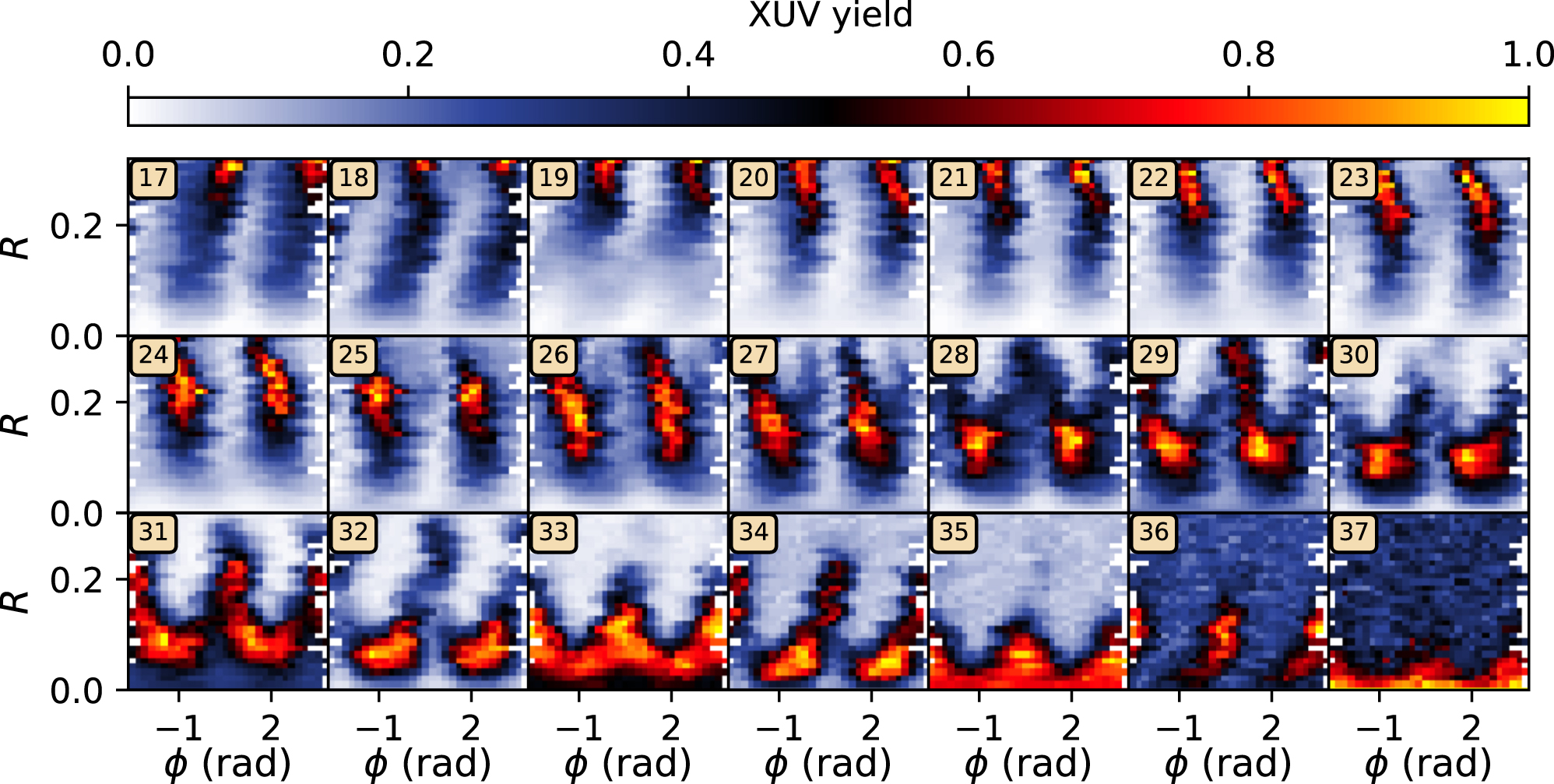
XUV yield for individual harmonic orders, depending on R and ϕ for I tot = 0.9 × 10¹⁴ W/cm2. For each harmonic, with the order indicated by the numbered box, the yield is normalized to its maximum.
2.3 Analysis
To determine R opt as well as the optimum phase ϕ opt more accurately, a fit was conducted for every line of experimental data with respect to ϕ according to
A represents the modulation amplitude with ϕ of an harmonic order H, while C represents the constant signal baseline. The measure A + C then represents the maximum yield at ϕ opt. In Figure 2(a), A + C is shown as a color scale for all harmonic orders within the HHG plateau (H = 18 − 29), as a function of R. The cyan dashed line represents R opt. Figure 2(b) shows ϕ opt for all harmonic orders as a function of R on a cyclic color scale. Overlaying the dashed cyan line (R opt), it becomes evident that the phase values corresponding to this line seem to be constant (white color). These values of ϕ opt at R opt are extracted and shown on the right axis as red triangles in Figure 2(c). As soon as a global yield optimum in Figure 1 is reached from H = 23 on, ϕ opt at R opt indeed is concentrated around ϕ opt = −1 rad. This applies only for H > 22, where a global maximum of the yield could be reached. For H < 23 (yellow-filled triangles) the optimum phase at the yield maximum at R = 0.32 is shown instead. The left axis in Figure 2(c) represents the yield enhancement, which is calculated by dividing the yield at R opt by the yield at R = 0, for odd orders, shown as black stars. For H < 23, a global yield maximum at R opt could not be reached due to the limitation for R in the experiment; see Figure 1. The stars filled with yellow thus denote the enhancement that was reached at R = 0.32.

Data analysis results. (a) A + C from Eq. (3) for R and harmonic order (color) within the plateau (H = 18 − 29). The optimum ratio R opt (cyan dashed line) marks the maximum yield for each harmonic order. (b) ϕ opt for R and harmonic order (color, cyclic scale). (c) For odd orders, the enhancement of the yield compared to R = 0 is plotted (black stars). The ϕ opt value at R opt below the cyan dashed line is extracted and shown on the right axis (red triangles). The stars and triangles filled with yellow H < 23 denote that a global yield maximum was not reached in the experiment.
3 Discussion
3.1 Three-step model at ϕ = −1 rad
To understand what is happening at ϕ opt = −1 rad, the three-step model is evaluated, calculating the electron trajectories for an electric field according to Eq. (2), for varying ionization times T I and extracting the kinetic energy and the return time T R of the electrons that recombine with the parent atom, matching the conditions of the experiment with I tot = 0.9 × 10¹⁴ W/cm2. In Figure 3(a)–(d), the corresponding XUV photon energy with I p = 15.7 eV is shown for different values of R as a function of ϕ and T R in units of the single-color laser cycle T ω , for one electric field half-cycle.

Electron time-energy curves. (a)–(d) E R + I p in the unit of harmonic order H for electrons ionized during one electric field half cycle, as a function of ϕ and return time T R in units of the electric field cycle of the fundamental T ω , for four examples of R. The cyan line marks the experimentally discovered optimum phase ϕ opt = −1 rad. (e)–(h) The energy distribution at the position of the cyan lines as line-outs.
E R + I p is given in units of the corresponding harmonic order H. For R = 0 (a), which corresponds to a standard single-color field, there is no variation with ϕ and the electrons in the two half-cycles behave identically with respect to their return energy. When R increases, from (a) to (d) in Figure 3, the return energies of the electrons in the first half cycle are suppressed, while they are enhanced for the second one. The location of the largest suppression corresponds to ϕ = −1 rad, which is indicated by the cyan dashed line. The distributions of E R + I p corresponding to this line are shown in Figure 3(e)–(h) as line-outs. The essential observation is that this suppression of return energy is what causes an increase of harmonic yield.
The harmonic yield can be estimated by assuming that it is proportional to
Here, e is the electron charge and m e the electron mass. This situation corresponds to the R = 0 line-out in Figure 3 which leads to a rapid decrease of the strength of the harmonic orders in the cutoff region. Such a singularity can also be treated with catastrophe theory [28] in the form of caustics. Caustics in the context of optics describe high concentrations of intensity in a diffraction pattern [30]. In the context of two-color HHG, the enhancement of yield is proportional to the order of the return energy versus return time singularity, which is related to how many orders of derivatives of the curves shown in Figure 3(e)–(h) vanish [27]. Thus, addition of a second harmonic field can suppress the return energies in a certain range of the optical cycle, which flattens the time-energy curve. This makes electrons coalesce to the same energy of the emitted harmonic, which is thus enhanced.
To calculate the harmonic order to which the location of the time-energy curve flattening corresponds, the contributions of ω and 2ω are considered separately. In Figure 4(a), the electric fields are plotted for ϕ = −1 rad at an exemplary ratio of R = 0.2 for ω (red) and 2ω (green). In Figure 4(b), the resulting total electric field according to Eq. (2) for ϕ = −1 rad and different R values is shown. The electric fields hereby correspond to the electron return energy distributions highlighted in (e)–(h) of Figure 3. Figure 4(c) shows the calculated XUV photon energies (E R + I p ) in the unit of the corresponding harmonic order, sharing the same color scale as Figure 3, as a function of the ionization T I and return time T R at ϕ = −1 rad.

The three-step model at ϕ = −1 rad. (a) Electric field for ω (red) and 2ω (green) for ϕ = −1 rad and R = 0.2. (b) Total electric field according to Eq. (2) for different values of R and ϕ = −1 rad. (c) E R + I p at the corresponding ionization time T I and return time T R at ϕ = −1 rad, sharing the color scale of Figure 3. The approximately constant flattening location with respect to ionization (orange) and return (cyan) is highlighted with solid vertical lines.
The electrons that contribute to the flattening of the time-energy curve are ionized and return approximately at the same times, independently of R. This is indicated by the vertical lines for ionization (orange, T I = −0.93T ω ) and recombination (cyan, T R = −0.295T ω ). The total field plotted in Figure 4(b) is approximately highest at the time of ionization. At the time of recombination the 2ω contribution is equal to zero, as highlighted in Figure 4(a). Interestingly, the time of return coincides with an isosbestic point of the fields, independent of R. This means that the electric field E(t = T R , ϕ = −1 rad, R) upon return has the same amplitude. For R = 0.2, which is associated with the highest enhancement of the harmonic order corresponding to the plateau in the time-energy curve (see Figure 3(g)) the first derivative of E tot also vanishes (pink dashed line).
The absolute value of the velocity v an electron acquires upon recombination is calculated by
with p being the momentum and E ω , E 2ω given by Eq. (2). For the fundamental ω, the orange and cyan lines in Figure 4 approximately coincide with the times following the classical cutoff energy, with
applying energy conservation and E R = m e v 2/2. For R = 0, Eq. (6) corresponds to the well-known cutoff law [17]. For the 2ω component, the vertical lines coincide with the field peak (ionization) and the zero-crossing (recombination), greatly simplifying the evaluation of Eq. (5) and leading to
using the definition of the ponderomotive potential U p for R = 0.
The XUV photon energy corresponding to electrons at the flat region of E R versus T R is expressed as
Solving Eq. (8) for R yields an expression for R opt depending on the harmonic order corresponding to E H that is to be enhanced.
3.2 Theory – experiment comparison
In Figure 5, Eq. (8) is compared to the experimental results. The theory is shown as a dashed line and the experimentally found R opt values are indicated as squares, for I tot = 0.9 × 10¹⁴ W/cm2 (red) and I tot = 1.35 × 10¹⁴ W/cm2 (blue). The shaded areas represent the effect of a 10 % change of I tot and R in Eq. (8) to highlight the effect of a realistic error margin for optical intensity measurements in an experiment. The red squares hereby correspond to the data shown in Figure 1, for harmonic orders where a global yield maximum could be reached. For I tot = 1.35 × 10¹⁴ W/cm2, the maximum value for R that could be reached experimentally decreased to R = 0.2, only a small amount of second harmonic was available due to the design of the interferometer [29]. As the setup was originally designed for the observation of low-order high harmonics the signal-to-noise ratio after H37 decreases rapidly. Within the shown observation range in Figure 5, the experimental results show excellent agreement with Eq. (8).

The relative yield enhancement compared to R = 0 shown in black in Figure 2(c) seems to be proportional to R opt (dashed cyan line). The overall best enhancement according to catastrophe theory should occur at the parameters with the largest degree of singularity, which corresponds to the very flat plateau at (R, ϕ) ≈ (0.2, −1 rad) (see Figure 3(g)). In terms of overall yield enhancement (sum of all harmonic orders) the experiment agrees as well with the highest yield at R ≈ 0.2, shown in Figure 2(a). The relatively increasing individual enhancement below H23 can be explained by the very low signal at R = 0 for these harmonics. It is also interesting to notice that our findings in terms of ϕ opt = −1 rad also correspond to the results shown in Raz et al. for several electric field ratios in a comparable range, measured at a fundamental wavelength of 800 nm and a pulse duration of 30 fs [27], strengthening the validity of our optimization law in Eq. (8).
In our simple model, the change of ionization rate due to the second color is not included. We still consider the model to be valid, since the impact of the second color on the trajectories seems to be more significant than on the ionization rates. Similar observations were also made in an ω/3ω experiment [31].
3.3 Implications for phase-matching
The discussion so far only considered the single-atom response. Thus, the validity of Eq. (8) is independent of other experimental parameters, such as gas target design or pulse duration. The fairest comparison of XUV yield enhancement that can be reached for a harmonic order would be to compare two perfectly phase-matched experimental conditions. This was already realized in a previous work when investigating the influence of relative polarization in a two-color setup, achieving an unexpected higher enhancement for perpendicular polarization than for parallel polarization [12], contradicting conclusions drawn from the three-step model [32].
In this work, the experimental conditions for R = 0 and R ≠ 0 are identical regarding focusing geometries, gas target length, gas pressure, and total intensity to ensure reproducibility. For every R and ϕ variation, the phase matching conditions change as the phase-mismatch due to ionization varies. The sensitivity of the XUV conversion efficiency with these changes depends on the gas target length relative to the Rayleigh length of the laser.
According to Weissenbilder et al., HHG is efficient either for a short gas target with high gas pressure or for a long gas target at lower pressure [20]. In our experiment, the gas target length is estimated to be equal to
4 Conclusion and outlook
In this work, we study HHG in argon using the fundamental of an ytterbium laser and its second harmonic. We measure the harmonic yield in argon as a function of the relative intensity ratio and phase between the two colors to find the optimum generation parameters. The optimum ratio decreases with harmonic order, while the optimum phase between the two fields is independent of the order and equal to ϕ opt = −1 rad. We explain these findings using an analysis based on the three-step model and propose a simple equation to find the best fraction of second harmonic intensity for the desired harmonic order in the HHG plateau (Eq. (8)). This equation depends only on the fundamental wavelength and gas species through the ionization energy and total available intensity.
To achieve even stronger yield enhancements, the investigation of synthesizing more than two colors to further shape the time-energy curves is a promising route [33], as well as repeating the same experiment with ω/3ω due to identical electric field half-cycle contributions [31].
Funding source: Knut och Alice Wallenbergs Stiftelse
Funding source: European Research Council
Award Identifier / Grant number: QPAP, 884900
Funding source: Crafoordska Stiftelsen
Funding source: Vetenskapsrådet
Award Identifier / Grant number: 2013-8185
Award Identifier / Grant number: 2021-04691
Award Identifier / Grant number: 2022-03519
Award Identifier / Grant number: 2023-04603
-
Research funding: The authors acknowledge support from the Swedish Research Council (Grant Nos. 2013-8185, 2021-04691, 2022-03519, and 202304603), the European Research Council (advanced grant QPAP, Grant No. 884900), the Crafoord Foundation, and the Knut and Alice Wallenberg Foundation. ALH is partly supported by the Wallenberg Center for Quantum Technology (WACQT), funded by the Knut and Alice Wallenberg Foundation.
-
Author contributions: All authors have accepted responsibility for the entire content of this manuscript and approved its submission.
-
Conflict of interest: Authors state no conflict of interest.
-
Data availability: The datasets generated during and/or analyzed during the current study are available from the corresponding author on reasonable request.
References
[1] N. Dudovich, J. L. Tate, Y. Mairesse, D. M. Villeneuve, P. B. Corkum, and M. B. Gaarde, “Subcycle spatial mapping of recollision dynamics,” Phys. Rev. A, vol. 80, no. 1, p. 011806, 2009. https://doi.org/10.1103/physreva.80.011806.Search in Google Scholar
[2] S. D. C. Roscam Abbing, F. Campi, A. Zeltsi, P. Smorenburg, and P. M. Kraus, “Divergence and efficiency optimization in polarization-controlled two-color high-harmonic generation,” Sci. Rep., vol. 11, no. 1, p. 24253, 2021. https://doi.org/10.1038/s41598-021-03657-2.Search in Google Scholar PubMed PubMed Central
[3] E. Mansten, J. M. Dahlström, P. Johnsson, M. Swoboda, A. L’Huillier, and J. Mauritsson, “Spectral shaping of attosecond pulses using two-colour laser fields,” New J. Phys., vol. 10, no. 8, p. 083041, 2008. https://doi.org/10.1088/1367-2630/10/8/083041.Search in Google Scholar
[4] P. Wei, et al.., “Selective enhancement of a single harmonic emission in a driving laser field with subcycle waveform control,” Phys. Rev. Lett., vol. 110, no. 23, p. 233903, 2013. https://doi.org/10.1103/physrevlett.110.233903.Search in Google Scholar PubMed
[5] P. Wei, et al.., “Efficient selection of a single harmonic emission using a multi-color laser field with an aperture-iris diaphragm,” Laser Phys., vol. 24, no. 8, p. 085302, 2014. https://doi.org/10.1088/1054-660x/24/8/085302.Search in Google Scholar
[6] S. Mitra, et al.., “Suppression of individual peaks in two-colour high harmonic generation,” J. Phys. B: At., Mol. Opt. Phys., vol. 53, no. 13, p. 134004, 2020. https://doi.org/10.1088/1361-6455/ab859c.Search in Google Scholar
[7] J. Mauritsson, P. Johnsson, E. Gustafsson, A. L’Huillier, K. J. Schafer, and M. B. Gaarde, “Attosecond pulse trains generated using two color laser fields,” Phys. Rev. Lett., vol. 97, no. 1, p. 013001, 2006. https://doi.org/10.1103/physrevlett.97.013001.Search in Google Scholar PubMed
[8] N. Dudovich, et al.., “Measuring and controlling the birth of attosecond xuv pulses,” Nat. Phys., vol. 2, no. 11, pp. 781–786, 2006. https://doi.org/10.1038/nphys434.Search in Google Scholar
[9] D. Shafir, Y. Mairesse, D. M. Villeneuve, P. B. Corkum, and N. Dudovich, “Atomic wavefunctions probed through strong-field light–matter interaction,” Nat. Phys., vol. 5, no. 6, pp. 412–416, 2009. https://doi.org/10.1038/nphys1251.Search in Google Scholar
[10] M. Fieß, et al.., “Attosecond control of tunneling ionization and electron trajectories,” New J. Phys., vol. 13, no. 3, p. 033031, 2011. https://doi.org/10.1088/1367-2630/13/3/033031.Search in Google Scholar
[11] S. Watanabe, K. Kondo, Y. Nabekawa, A. Sagisaka, and Y. Kobayashi, “Two-color phase control in tunneling ionization and harmonic generation by a strong laser field and its third harmonic,” Phys. Rev. Lett., vol. 73, no. 20, pp. 2692–2695, 1994. https://doi.org/10.1103/physrevlett.73.2692.Search in Google Scholar
[12] I. J. Kim, et al.., “Highly efficient high-harmonic generation in an orthogonally polarized two-color laser field,” Phys. Rev. Lett., vol. 94, no. 24, p. 243901, 2005. https://doi.org/10.1103/physrevlett.94.243901.Search in Google Scholar
[13] T. T. Liu, T. Kanai, T. Sekikawa, and S. Watanabe, “Significant enhancement of high-order harmonics below 10 nm in a two-color laser field,” Phys. Rev. A, vol. 73, no. 6, p. 063823, 2006. https://doi.org/10.1103/physreva.73.063823.Search in Google Scholar
[14] R. A. Ganeev, et al.., “Enhancement of high-order harmonic generation using a two-color pump in plasma plumes,” Phys. Rev. A, vol. 80, no. 3, p. 033845, 2009. https://doi.org/10.1103/physreva.80.033845.Search in Google Scholar
[15] L. Brugnera, et al.., “Enhancement of high harmonics generated by field steering of electrons in a two-color orthogonally polarized laser field,” Opt. Lett., vol. 35, no. 23, pp. 3994–3996, 2010. https://doi.org/10.1364/ol.35.003994.Search in Google Scholar PubMed
[16] C. Porter, et al.., “Soft x-ray: novel metrology for 3D profilometry and device pitch overlay,” in Metrology, Inspection, and Process Control XXXVII, vol. 12496, 2023, pp. 412–420.10.1117/12.2658495Search in Google Scholar
[17] P. B. Corkum, “Plasma perspective on strong field multiphoton ionization,” Phys. Rev. Lett., vol. 71, no. 13, pp. 1994–1997, 1993. https://doi.org/10.1103/physrevlett.71.1994.Search in Google Scholar PubMed
[18] K. J. Schafer, B. Yang, L. F. DiMauro, and K. C. Kulander, “Above threshold ionization beyond the high harmonic cutoff,” Phys. Rev. Lett., vol. 70, no. 11, pp. 1599–1602, 1993. https://doi.org/10.1103/physrevlett.70.1599.Search in Google Scholar PubMed
[19] E. Constant, et al.., “Optimizing high harmonic generation in absorbing gases: model and experiment,” Phys. Rev. Lett., vol. 82, no. 8, pp. 1668–1671, 1999. https://doi.org/10.1103/physrevlett.82.1668.Search in Google Scholar
[20] R. Weissenbilder, et al.., “How to optimize high-order harmonic generation in gases,” Nat. Rev. Phys., vol. 4, no. 11, pp. 713–722, 2022. https://doi.org/10.1038/s42254-022-00522-7.Search in Google Scholar
[21] L. E. Chipperfield, J. S. Robinson, J. W. G. Tisch, and J. P. Marangos, “Ideal waveform to generate the maximum possible electron recollision energy for any given oscillation period,” Phys. Rev. Lett., vol. 102, no. 6, p. 063003, 2009. https://doi.org/10.1103/physrevlett.102.063003.Search in Google Scholar
[22] C. Jin, G. Wang, A.-T. Le, and C. D. Lin, “Route to optimal generation of soft x-ray high harmonics with synthesized two-color laser pulses,” Sci. Rep., vol. 4, no. 1, p. 7067, 2014. https://doi.org/10.1038/srep07067.Search in Google Scholar PubMed PubMed Central
[23] C. Jin, G. Wang, H. Wei, A.-T. Le, and C. D. Lin, “Waveforms for optimal sub-kev high-order harmonics with synthesized two- or three-colour laser fields,” Nat. Commun., vol. 5, no. 1, p. 4003, 2014. https://doi.org/10.1038/ncomms5003.Search in Google Scholar PubMed
[24] K. Schiessl, E. Persson, A. Scrinzi, and J. Burgdörfer, “Enhancement of high-order harmonic generation by a two-color field: influence of propagation effects,” Phys. Rev. A, vol. 74, no. 5, p. 053412, 2006. https://doi.org/10.1103/physreva.74.053412.Search in Google Scholar
[25] Y. Chen, B. Li, X. Li, X. Tang, C. Zhang, and C. Jin, “Effect of laser focus in two-color synthesized waveform on generation of soft x-ray high harmonics,” Chin. Phys. B, vol. 32, no. 1, p. 014203, 2023. https://doi.org/10.1088/1674-1056/ac8cea.Search in Google Scholar
[26] S. Stremoukhov, “Role of gas pressure in quasi-phase matching in high harmonics driven by two-color laser field,” Atoms, vol. 11, no. 7, p. 103, 2023. https://doi.org/10.3390/atoms11070103.Search in Google Scholar
[27] O. Raz, O. Pedatzur, B. D. Bruner, and N. Dudovich, “Spectral caustics in attosecond science,” Nat. Photonics, vol. 6, no. 3, pp. 170–173, 2012. https://doi.org/10.1038/nphoton.2011.353.Search in Google Scholar
[28] M. V. Berry and C. Upstill, “IV catastrophe optics: morphologies of caustics and their diffraction patterns,” in Progress in Optics, vol. 18, E. Wolf, Ed., Amsterdam, Netherlands, Elsevier, 1980, pp. 257–346.10.1016/S0079-6638(08)70215-4Search in Google Scholar
[29] A.-K. Raab, et al.., “Highly versatile, two-color setup for high-order harmonic generation using spatial light modulators,” Rev. Sci. Instrum., vol. 95, no. 7, p. 073002, 2024. https://doi.org/10.1063/5.0212578.Search in Google Scholar PubMed
[30] Y. A. Kravtsov and Y. I. Orlov, “Caustics, catastrophes, and wave fields,” Phys.-Usp., vol. 26, no. 12, pp. 1038–1058, 1983. https://doi.org/10.1070/pu1983v026n12abeh004582.Search in Google Scholar
[31] T. Severt, J. Troß, G. Kolliopoulos, I. Ben-Itzhak, and C. A. Trallero-Herrero, “Enhancing high-order harmonic generation by controlling the diffusion of the electron wave packet,” Optica, vol. 8, no. 8, pp. 1113–1121, 2021. https://doi.org/10.1364/optica.422711.Search in Google Scholar
[32] H. Eichmann, et al.., “Polarization-dependent high-order two-color mixing,” Phys. Rev. A, vol. 51, no. 5, pp. R3414–R3417, 1995. https://doi.org/10.1103/physreva.51.r3414.Search in Google Scholar PubMed
[33] S. Haessler, et al.., “Optimization of quantum trajectories driven by strong-field waveforms,” Phys. Rev. X, vol. 4, no. 2, p. 021028, 2014. https://doi.org/10.1103/physrevx.4.021028.Search in Google Scholar
© 2025 the author(s), published by De Gruyter, Berlin/Boston
This work is licensed under the Creative Commons Attribution 4.0 International License.
Articles in the same Issue
- Frontmatter
- Editorial
- In honor of Federico Capasso, a visionary in nanophotonics, on the occasion of his 75th birthday
- Reviews
- Flat nonlinear optics with intersubband polaritonic metasurfaces
- Polaritonic quantum matter
- Machine-learning-assisted photonic device development: a multiscale approach from theory to characterization
- Perspectives
- Towards field-resolved visible microscopy of 2D materials
- Perspective on tailoring longitudinal structured beam and its applications
- Tunable holographic metasurfaces for augmented and virtual reality
- Polarization-sensitive diffractive optics and metasurfaces: “Past is Prologue”
- Compound meta-optics: there is plenty of room at the top
- Nonlocal metasurfaces: universal modal maps governed by a nonlocal generalized Snell’s law
- Resonant metasurface-enabled quantum light sources for single-photon emission and entangled photon-pair generation
- Active metasurface designs for lensless and detector-limited imaging
- Letter
- Real-time tuning of plasmonic nanogap cavity resonances through solvent environments
- Research Articles
- On the generalized Snell–Descartes laws, shock waves, water wakes, and Cherenkov radiation
- Silicon rich nitride: a platform for controllable structural colors
- Overcoming stress limitations in SiN nonlinear photonics via a bilayer waveguide
- High-harmonic generation from subwavelength silicon films
- Space-time wedges
- XUV yield optimization of two-color high-order harmonic generation in gases
- Skyrmion bag robustness in plasmonic bilayer and trilayer moiré superlattices
- Quantum-enhanced detection of viral cDNA via luminescence resonance energy transfer using upconversion and gold nanoparticles
- Deep neural networks for inverse design of multimode integrated gratings with simultaneous amplitude and phase control
- Topological chiral-gain in a Berry dipole material
- Diagnostic oriented discrimination of different Shiga toxins via PCA-assisted SERS-based plasmonic metasurface
- Quantum emitter interacting with a dispersive dielectric object: a model based on the modified Langevin noise formalism
- 3D-printed mirror-less helicity preserving metasurface “mirror” for THz applications
- Supershift properties for nonanalytic signals
- Enhancing radiative heat transfer with meta-atomic displacement
- Quasi-bound states in the continuum in finite waveguide grating couplers
- Long lived surface plasmons on the interface of a metal and a photonic time-crystal
- Tailoring propagation-invariant topology of optical skyrmions with dielectric metasurfaces
- Experimental generation of optimally chiral azimuthally-radially polarized beams
- Tailoring optical response of MXene thin films
- Nonlinear analog processing with anisotropic nonlinear films
- Optical levitation of Janus particles within focused cylindrical vector beams
- Large tuning of the optical properties of nanoscale NdNiO3 via electron doping
- Combining quantum cascade lasers and plasmonic metasurfaces to monitor de novo lipogenesis with vibrational contrast microscopy
- Monoclinic nonlinear metasurfaces for resonant engineering of polarization states
- Non-linear bistability in pulsed optical traps
- Tutorial: Hong–Ou–Mandel interference with structured photons
- Inhomogeneous broadening in the time domain
- MoS2 based 2D material photodetector array with high pixel density
- Temporal interface in dispersive hyperbolic media
- Measurement of the cavity dispersion in quantum cascade lasers using subthreshold luminescence
- Designing the response-spectra of microwave metasurfaces: theory and experiments
- Exciton–polariton condensation in MAPbI3 films from bound states in the continuum metasurfaces
- Experimental analysis of the thermal management and internal quantum efficiency of terahertz quantum cascade laser harmonic frequency combs
- Energy-efficient thermally smart windows with tunable properties across the near- and mid-infrared ranges
Articles in the same Issue
- Frontmatter
- Editorial
- In honor of Federico Capasso, a visionary in nanophotonics, on the occasion of his 75th birthday
- Reviews
- Flat nonlinear optics with intersubband polaritonic metasurfaces
- Polaritonic quantum matter
- Machine-learning-assisted photonic device development: a multiscale approach from theory to characterization
- Perspectives
- Towards field-resolved visible microscopy of 2D materials
- Perspective on tailoring longitudinal structured beam and its applications
- Tunable holographic metasurfaces for augmented and virtual reality
- Polarization-sensitive diffractive optics and metasurfaces: “Past is Prologue”
- Compound meta-optics: there is plenty of room at the top
- Nonlocal metasurfaces: universal modal maps governed by a nonlocal generalized Snell’s law
- Resonant metasurface-enabled quantum light sources for single-photon emission and entangled photon-pair generation
- Active metasurface designs for lensless and detector-limited imaging
- Letter
- Real-time tuning of plasmonic nanogap cavity resonances through solvent environments
- Research Articles
- On the generalized Snell–Descartes laws, shock waves, water wakes, and Cherenkov radiation
- Silicon rich nitride: a platform for controllable structural colors
- Overcoming stress limitations in SiN nonlinear photonics via a bilayer waveguide
- High-harmonic generation from subwavelength silicon films
- Space-time wedges
- XUV yield optimization of two-color high-order harmonic generation in gases
- Skyrmion bag robustness in plasmonic bilayer and trilayer moiré superlattices
- Quantum-enhanced detection of viral cDNA via luminescence resonance energy transfer using upconversion and gold nanoparticles
- Deep neural networks for inverse design of multimode integrated gratings with simultaneous amplitude and phase control
- Topological chiral-gain in a Berry dipole material
- Diagnostic oriented discrimination of different Shiga toxins via PCA-assisted SERS-based plasmonic metasurface
- Quantum emitter interacting with a dispersive dielectric object: a model based on the modified Langevin noise formalism
- 3D-printed mirror-less helicity preserving metasurface “mirror” for THz applications
- Supershift properties for nonanalytic signals
- Enhancing radiative heat transfer with meta-atomic displacement
- Quasi-bound states in the continuum in finite waveguide grating couplers
- Long lived surface plasmons on the interface of a metal and a photonic time-crystal
- Tailoring propagation-invariant topology of optical skyrmions with dielectric metasurfaces
- Experimental generation of optimally chiral azimuthally-radially polarized beams
- Tailoring optical response of MXene thin films
- Nonlinear analog processing with anisotropic nonlinear films
- Optical levitation of Janus particles within focused cylindrical vector beams
- Large tuning of the optical properties of nanoscale NdNiO3 via electron doping
- Combining quantum cascade lasers and plasmonic metasurfaces to monitor de novo lipogenesis with vibrational contrast microscopy
- Monoclinic nonlinear metasurfaces for resonant engineering of polarization states
- Non-linear bistability in pulsed optical traps
- Tutorial: Hong–Ou–Mandel interference with structured photons
- Inhomogeneous broadening in the time domain
- MoS2 based 2D material photodetector array with high pixel density
- Temporal interface in dispersive hyperbolic media
- Measurement of the cavity dispersion in quantum cascade lasers using subthreshold luminescence
- Designing the response-spectra of microwave metasurfaces: theory and experiments
- Exciton–polariton condensation in MAPbI3 films from bound states in the continuum metasurfaces
- Experimental analysis of the thermal management and internal quantum efficiency of terahertz quantum cascade laser harmonic frequency combs
- Energy-efficient thermally smart windows with tunable properties across the near- and mid-infrared ranges
