Perspective on tailoring longitudinal structured beam and its applications
-
Alan E. Willner
 ,
Huibin Zhou
,
Huibin Zhou
 und
Xinzhou Su
und
Xinzhou Su

Abstract
Tailoring structured beams with varying lightwave properties along the longitudinal dimension has recently gained much interest. This paper gives a perspective on the advances of longitudinally structured beams, their potential applications, and future opportunities.
1 Prologue
The entire optics and photonics community is indebted to Prof. Federico Capasso for his profound and monumental impact on our field. He has dramatically influenced the research and applications areas worldwide, and we join everyone in wishing Prof. Capasso a very Happy 75th Birthday, and many more years of happiness, health, and impact.
This paper concerns the longitudinal structuring of light’s properties, and his vast contributions extend to our article. As one example, his pioneering work on metasurfaces for light transformation is seminal and is cited below.
2 Introduction
In general, a lightwave has several properties, including amplitude, phase, polarization, and wavelength. On its most basic level, varying the amplitude of light can be utilized for many important applications, such as communications, sensing, and imaging [1]. As such, there has been significant and growing interest in the field of “structured light”, in which multiple properties of light can be tailored in multiple spatial dimensions [1]. This subfield is also fairly young, since much of the activity began with the seminal 1992 paper (L. Allen, et al. [2]) that described how a beam of light that has a transverse vortex intensity spatial distribution and helical phasefront “twisting” during propagation can carry orbital-angular-momentum (OAM) [3], [4].
Any beam of light can be thought of as having “structure”, since any beam can be a summation of different spatial modes from a modal basis set [5]. Each mode from a set is orthogonal to all other modes, and each mode will have a unique complex coefficient and corresponding transverse phase, amplitude, and polarization. The summation of these modes can produce any arbitrary optical field in the transverse dimension, and any beam being composed of only a single mode is also considered “structured”. Examples of transverse structured light can be each spatial mode from the Laguerre Gaussian (LG ℓ,p ) and Hermite Gaussian (HG m,n ) modes [6]. In these modal sets, there exist two indices that define the transverse spatial distribution of each mode; for LG beams, ℓ describes the number of 2π phase changes in the azimuthal direction and p relates to the number of intensity rings [3].
There are various exciting applications of transverse structured light, including:
(a) Communications: Since each transverse spatial mode is orthogonal to other modes, communication systems can have dramatically higher capacity by two approaches:
i. Multiplexing : Multiple data-carrying beams each containing a single mode can be simultaneously transmitted in the same medium with little inherent channel crosstalk [7], [8], [9]. This is commonly referred to as mode-division-multiplexing (MDM), which can be considered a subset of space-division-multiplexing (SDM) [10].
The above discussion relates to the tailoring of the transverse spatial properties of light all along the propagation. When neglecting divergence issues, this transverse structure is not designed at the transmitter to vary as it continues to propagate, e.g., a beam of a certain OAM value will stay that value as it propagates. However, light’s properties can also be designed at the transmitter to vary in the longitudinal dimension, such that some properties of light can appear at some distance and not appear at other distances [1].
One of the most basic and useful ways to longitudinally tailor a lightwave is a simple lens. The wave comes to a focus at a given distance. However, lenses are typically static, thus limiting the ability to arbitrarily tailor a beam longitudinally. Indeed, all of a lightwave’s properties can be designed to change at various propagation distances. A typical approach to longitudinally tailoring light is to judiciously utilize the longitudinal wavenumber, k
z
, which is typically thought of as part of the Bessel Gauss (
One example of longitudinal structured light is where a beam composed of multiple BG modes of different k z values is launched from a transmitter and yet can undergo various degrees of intensity focusing at different distances [22]. Changing the composite k z values and their complex coefficients can change whatever longitudinal distribution that is desired [23], [24], [25]. This longitudinal structuring can be extended to multiple properties of light [26], [27], [28], [29], [30].
In this paper, we will discuss various advances in the ability to longitudinally structure light, potential applications of such an ability, and thoughts on specific exciting and future areas of research in this field.
3 Longitudinal structured beam (LSB)
Longitudinally structuring light can be thought of as a priori programming into a beam an ability such that it can morph into something unique at different distances. Importantly, this programming is governed by the selection and control of the longitudinal wavenumbers at the transmitter.
The longitudinal wavenumber (k
z
) of a lightwave generally refers to the component of the wavevector (k) that lies along the axial direction (typically the z-axis) [31]. For plane waves propagating in different directions, the k
z
varies depending on the angle of propagation relative to the z-axis [31]. For a BG beam, the k
z
is the longitudinal component of its wavevector
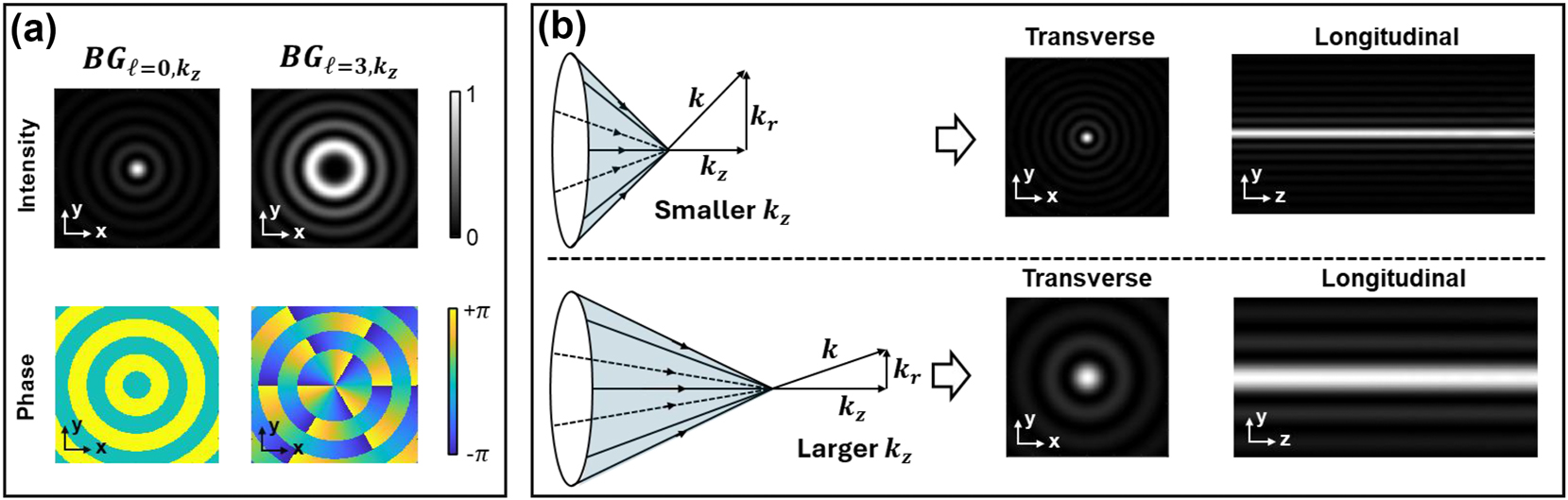
Transverse and longitudinal profiles for BG beams. (a) Transverse intensity and phase profiles for two examples of
LSBs can be tailored by a coherent superposition of multiple BG beams carrying different k z with equal spacing [22]. By designing the complex coefficients of each k z , one can control the constructive and destructive interference between different k z components at different z distances. As a result, the beam has a higher on-axis intensity at some designed distances, while at other distances the on-axis intensity is low. Such on-axis intensity changes along the longitudinal direction form a longitudinal intensity pattern, which is determined by the complex coefficients of k z through a Fourier transform (see Figure 2) [23], [25]. Such a beam is also named “Frozen wave” [22]. Indeed, as shown in Figure 3, this concept of longitudinal beam structuring is analogous to (a) transverse beam shaping by superposition of multiple transverse modes [33], [34], and (b) temporal pulse shaping by superposition of multiple wavelengths [35], [36].

Tailoring LSBs by a coherent superposition of multiple BG beams carrying different k z . (a) Fourier relation between the longitudinal wavenumbers and the on-axis longitudinal intensity pattern. (b) Three examples of Frozen waves with different on-axis longitudinal intensity patterns.
![Figure 3:
Longitudinal beam structuring is analogous to transverse beam structuring [34] by superposition of multiple transverse modes and temporal pulse shaping [37] by superposition of multiple wavelengths.
F
means Fourier transform. Transverse beam profiles are reprinted from Ref. [34], with permission from Optica Publishing Group. Temporal pulse shapes are reprinted from Ref. [37], with permission from Optica Publishing Group.](/document/doi/10.1515/nanoph-2024-0720/asset/graphic/j_nanoph-2024-0720_fig_003.jpg)
Longitudinal beam structuring is analogous to transverse beam structuring [34] by superposition of multiple transverse modes and temporal pulse shaping [37] by superposition of multiple wavelengths. F means Fourier transform. Transverse beam profiles are reprinted from Ref. [34], with permission from Optica Publishing Group. Temporal pulse shapes are reprinted from Ref. [37], with permission from Optica Publishing Group.
Besides intensity, longitudinal controls of several other on-axis light properties have also been demonstrated, including OAM, polarization, and wavelength. Figure 4 shows some examples, in which their generation share a similar mechanism; that is, multiple Frozen waves each carrying a different light property are superposed such that specific properties can appear at designed distances [27], [28], [29].
![Figure 4:
Examples of longitudinally tailored light properties, including (a) OAM [27]: OAM changes from ℓ = 1 to ℓ = 3 during the beam propagation, (b) polarization [28]: the white arrows indicate the polarization degrees at different distances, and (c) wavelength [29]: the wavelength oscillates between 635 nm and 532 nm along the propagation path. (a) is reprinted from Ref. [27], with permission from American Physical Society. (b) is reprinted from Ref. [28], with permission from American Physical Society. (c) is reprinted from Ref. [29], with permission from Optica Publishing Group.](/document/doi/10.1515/nanoph-2024-0720/asset/graphic/j_nanoph-2024-0720_fig_004.jpg)
Examples of longitudinally tailored light properties, including (a) OAM [27]: OAM changes from ℓ = 1 to ℓ = 3 during the beam propagation, (b) polarization [28]: the white arrows indicate the polarization degrees at different distances, and (c) wavelength [29]: the wavelength oscillates between 635 nm and 532 nm along the propagation path. (a) is reprinted from Ref. [27], with permission from American Physical Society. (b) is reprinted from Ref. [28], with permission from American Physical Society. (c) is reprinted from Ref. [29], with permission from Optica Publishing Group.
There are several issues one should consider when designing and generating LSBs:
(a) Transmitter (Tx) aperture size: For a single BG beam with a given k z , the size of the Tx aperture limits its non-diffraction propagation region [22]. Moreover, a smaller k z has a smaller non-diffraction region for a given Tx aperture size. Therefore, the maximum working distance of a LSB composed by multiple BG beams is limited by both the Tx aperture size and the minimal k z value [22].
(b) The spacing between k z : Based on the Fourier relation between the designed longitudinal pattern and k z , the spacing between neighboring k z is determined to be 2π/L, where L is the maximum distance range designed for the LSB [22].
(c) The number of k z : By utilizing more k z , one can generate an LSB with a more accurate longitudinal pattern as designed [23]. However, the number of k z is limited by several factors. Specifically, according to above mentioned (a) and (b), the lower limit and the spacing of k z values are determined by the Tx aperture size and the maximum working distance L. Moreover, the upper limit of k z is k = 2π/λ [22].
Various approaches have been reported for the generation of LSBs. One approach involves utilizing a bulky spatial light modulator (SLM) [24], [30], which implements a computer-generated hologram to spatially modulate the complex amplitude of a light field at z = 0. This light field then propagates and exhibits longitudinally varying properties at different distances. By modifying the holographic pattern of the SLM, the LSB can be tuned to achieve different longitudinal properties [24], [30]. Recently, a more compact approach using metasurfaces has been demonstrated for generating LSBs [38]. Such a metasurface is a thin, passive device with a specifically designed distribution of subwavelength structures, acting as a hologram to tailor an input light field for LSB generation [38]. Notably, the transformation function of a metasurface can be designed to depend on the input light field [38]. For example, the metasurface can switch between different holograms by altering the input light’s incidence angle, polarization, or spatial mode [38], [39]. Therefore, the same metasurface can be used to generate different LSBs by modifying the input light field [39].
4 What can we do with the LSB?
The advances described above in the longitudinal structuring of light can potentially enable a number of important applications. The following list shows some recent examples of utilizing longitudinal structuring:
(a) Focusing: Achieving high-resolution optical imaging typically requires a tightly focused optical beam to attain diffraction-limited resolution in optical microscopy. However, the conventional focused beam results in a shallow depth of field (DOF), leading to reduced longitudinal resolution when moving away from the optical focal plane [40]. A longitudinally structured “needle-shaped” beam has been demonstrated to extend the DOF (see Figure 5(a)) [40]. Such a needle beam is generated by customized diffractive optical elements, which shape the transverse spatial phase profile of an input Gaussian beam and generate many closely adjacent foci along the longitudinal direction. Experimental results show the needle beam has a DOF up to a 28-fold Rayleigh length (14× longer than a focused Gaussian beam) [40].
(b) 3-D Display: Creating high-quality 3D scenes through computer-generated holography is highly important in many applications, such as AR and VR. Traditionally, 3D objects are reconstructed from a single hologram by projecting multiple 2D transverse scenes along and perpendicular to the optical path (i.e., longitudinal direction). However, in this approach, the spatial separation of these 2D scenes is fundamentally limited by the hologram’s numerical aperture, restricting the longitudinal resolution and depth perception of the generated 3D display [41]. To address this issue, a novel class of hologram has been recently demonstrated (see Figure 5(b)) [41], in which desired scenes are projected onto multiple 2D light sheets that are perpendicular to the display screen (instead of the optical path). Each 2D light sheet consists of an array of many longitudinally structured beams (also called “pencil-like” beams in this work) with intensity envelopes that can be locally structured along the propagation direction as needed. This approach can achieve continuous and uniform reconstruction of objects along the optical path with high axial resolution and low crosstalk [41].
(c) Link Security Enhancement: Securing data transmission against eavesdropping is a key requirement in communication systems [42]. FSO links are considered to be physically easy to intercept if an eavesdropper is in a data beam’s line of sight. LSB has been demonstrated to enhance the physical layer security of FSO links and prevent eavesdropping at unintended line-of-sight locations (see Figure 5(c)) [43]. Specifically, a data-carrying beam and a longitudinally structured artificial-noise-carrying beam can be transmitted together. The artificial noise (AN) beam can be made to narrow or widen at any given distance region by adjusting the complex coefficients of k z components. Therefore, it can be designed to produce low signal-to-noise ratio at all distances except for where it is tailored to be much wider and thus not overlapping with the data beam. As a result, the data would only be readily detected at the location of a legitimate receiver.
(d) Turbulence Probing: Atmospheric turbulence can cause significant issues in various applications, including (i) injuring aircraft and airline passengers [44], and (ii) degrading free-space communication and imaging systems [45]. Understanding the inhomogeneous spatial distribution of turbulence is critical to help avoid and mitigate turbulence. LSB has been demonstrated to probe the strength distribution of turbulence along a propagation path (see Figure 5(d)) [46]. Due to light–matter interactions, a beam can couple power from one OAM mode into other OAM modes [47]. This power coupling depends on the beam size, such that a narrower beam has less interaction with the turbulence than a wider beam [47]. In this turbulence probing approach, multiple longitudinally structured beams are transmitted sequentially, each being tailored to be a superposition of multiple ℓ = 0 order BG modes with different k z . By controlling the complex coefficients of k z , the beam size of each beam can be designed to be distance-dependent, resulting in different distance- and turbulence-dependent modal coupling from the OAM ℓ = 0 order to other orders [46]. Based on measured modal coupling, the inhomogeneously distributed turbulence strength along the propagation path can be extracted.
(e) Ranging: There is growing interest in optical ranging in underwater environments [48]. A typical approach is based on measuring the time-of-flight (ToF) of a transmitted pulse reflected by a target object. However, underwater scattering can cause temporal spreading of the pulse and degrade ToF ranging accuracy [48]. Alternatively, an LSB-based ranging approach (see Figure 5(e)) has been shown relatively less sensitivity to scattering [49], [50]. Specifically, a CW beam consisting of two BG modes with different OAM orders and k z is transmitted and reflected by an object. The interference between the two OAM orders results in a transverse petal-like intensity profile [32], [49]. The two k z causes a distance-dependent phase delay between the two modes, resulting in rotation of the petals as the beam propagates [32], [49], [51]. Therefore, the object’s location can be detected by measuring the angle rotation of the petals. Moreover, the performance of this approach has been recently improved by utilizing more k z to (i) increase the power density of the petals [52], and (ii) enable an attenuation-resilient property of the petals when propagating in turbid water [25], [53]. Additionally, the concept of rotating petals has also been demonstrated for measuring an object’s longitudinal velocity [54] and the refractive index of a medium [32], [55].
(f) Trapping: The techniques of optical trapping have become an important tool in various research fields and applications. It has been shown that the OAM beam can trap particles and drive them to move around the beam’s phase singularity in a transverse plane [18]. Recently, reports have shown that it is also possible to enable longitudinal trapping of microparticles in multiple transverse planes using longitudinal structured beams (see Figure 5(f)) [56], [57]. A longitudinally structured beam with high central intensity in two separate distance regions was used for trapping. The distribution of the optical force field around the center of the two regions was investigated. Experimental results show the microparticles can be trapped in different transverse planes located at the center of the two regions [56].
![Figure 5:
Various applications of LSBs: (a) Focusing [40]: a longitudinally structured needle beam was used to enhance depth of field and image resolution in optical microscopy. (b) 3-D display [41]: LSB-based holography was used for uniform reconstruction of 3-D objects with high resolution and low crosstalk. (c) Link security enhancement [43]: a longitudinally structured artificial-noise (AN) carrying beam was transmitted to produce low SNR at all distances except for where it is tailored to be much wider and thus not overlapping with the data beam. (d) Turbulence probing [46]: multiple longitudinally structured probe beams were tailored to have distance-dependent beam width in order to probe the distribution of turbulence strength along a path. (e) Ranging [49]: a longitudinally structured ranging beam has a petal-like transverse intensity profile that rotates along the beam propagation. (f) Trapping [56]: LSB was used to enable longitudinal trapping of microparticles in multiple transverse planes. (a) is reprinted from Ref. [40], with permission from Springer Nature Group. (b) is reprinted from Ref. [41], with permission from Springer Nature Group. (c) is reprinted from Ref. [43], with permission from Optica Publishing Group. (d) is reprinted from Ref. [44], with permission from Springer Nature Group. (e) is reprinted from Ref. [49], with permission from Elsevier. (f) is reprinted from Ref. [56], with permission from Optica Publishing Group.](/document/doi/10.1515/nanoph-2024-0720/asset/graphic/j_nanoph-2024-0720_fig_005.jpg)
Various applications of LSBs: (a) Focusing [40]: a longitudinally structured needle beam was used to enhance depth of field and image resolution in optical microscopy. (b) 3-D display [41]: LSB-based holography was used for uniform reconstruction of 3-D objects with high resolution and low crosstalk. (c) Link security enhancement [43]: a longitudinally structured artificial-noise (AN) carrying beam was transmitted to produce low SNR at all distances except for where it is tailored to be much wider and thus not overlapping with the data beam. (d) Turbulence probing [46]: multiple longitudinally structured probe beams were tailored to have distance-dependent beam width in order to probe the distribution of turbulence strength along a path. (e) Ranging [49]: a longitudinally structured ranging beam has a petal-like transverse intensity profile that rotates along the beam propagation. (f) Trapping [56]: LSB was used to enable longitudinal trapping of microparticles in multiple transverse planes. (a) is reprinted from Ref. [40], with permission from Springer Nature Group. (b) is reprinted from Ref. [41], with permission from Springer Nature Group. (c) is reprinted from Ref. [43], with permission from Optica Publishing Group. (d) is reprinted from Ref. [44], with permission from Springer Nature Group. (e) is reprinted from Ref. [49], with permission from Elsevier. (f) is reprinted from Ref. [56], with permission from Optica Publishing Group.
5 Future research directions
The subfield of longitudinal structuring of light is still fairly young, with many of the early seminal papers dating back only to the early 2000’s [22], [23]. The amount of research in this area and interest in advancement has been growing, and the future promises to be rich in exciting research topics to explore. These range from a basic understanding of wave propagation to device technologies for tunable longitudinal beam control. Some examples of future research directions include the following:
(a) Integration: Reducing size, weight, and power (SWaP) is crucial for generating LSBs in practical applications. Two promising approaches are: (a) Photonic Integrated Circuits (PICs): Integrating multiple antennas on a single chip enables precise control of Bessel beam generation [58], [59], though complex longitudinal tailoring remains underexplored. (b) Metasurfaces: Ultra-thin structures with high-resolution subwavelength elements manipulate light properties, offering longitudinal control of multiple parameters (see Figure 6) [39], [60]. However, their tunability requires further investigation.
(b) Multi-dimensional: As previously mentioned, longitudinal spatial control is analogous to temporal and transverse spatial control, as all are fundamentally based on the Fourier relationship between the spatial, temporal, or longitudinal domains and their respective wavelength domains. The tailoring of these dimensions is inherently compatible, allowing for precise manipulation across multiple domains [37]. By integrating multi-dimensional control, it becomes possible to achieve dynamic manipulation of instantaneous light states (e.g., longitudinal-varying spatiotemporal structured light [37], [61]) (see Figure 7)
(c) Quantum: An important basic understanding was the idea that a single photon can be transversely structured and carry OAM [62], similar to a classical optical beam. An interesting area of exploration might be determining the similarities and differences between a photon and a classical beam when it comes to longitudinal structuring (e.g., z-dependent entanglement in quantum systems and in classical light fields [63]). Moreover, it could be quite interesting to study potential applications for quantum systems when longitudinally structuring a single photon.
(d) Fiber: Most of the longitudinal structuring of light has been demonstrated for free-space propagation, in which light can be tailored to exist in almost any mode or wavenumber. On the other hand, a waveguide (e.g., fiber) has inherent constraints on the allowable mode and wavenumber combinations. An interesting scientific exploration could be the control, limitations, and applications of the propagation of longitudinally structured light in fiber and integrated waveguides [64].
(e) Wavelengths: Although this paper has dealt primarily with visible and near-infrared optical wavelengths, it can be assumed that the fundamental physics would likely hold true for many other regions of the electromagnetic (EM) spectrum; this was shown to be true for transverse structured EM waves [65], [66], [67], [68], [69]. However, the specific engineering implementations, systems limitations, and potential applications might be quite different for wavelengths outside of the above regions.
(f) Nonlinear interaction: In Section 4, we discuss several example applications of LSBs in the linear regime of light–matter interactions. LSBs may also offer new opportunities for research on nonlinear interactions. For instance, LSBs can be designed with arbitrary beam-focusing regions distributed along the propagation path, enabling control over the beam’s spatial power density at different distances [22]. This z-dependent power density may help to explore various nonlinear light–matter interactions in the longitudinal dimension [70]. Additionally, it could also be interesting to study the generation and tailoring of different LSBs through nonlinear wave mixing [61].
![Figure 6:
Metasurface for the generation of LSBs. (a) Metasurface designed and fabricated by Prof. Capasso’s group for generating LSBs [60]. (b) Measured LSB with longitudinally tailored OAM generated by such metasurface [60]. (a) and (b) are reprinted from Ref. [60], with permission from Springer Nature Publishing Group.](/document/doi/10.1515/nanoph-2024-0720/asset/graphic/j_nanoph-2024-0720_fig_006.jpg)
Metasurface for the generation of LSBs. (a) Metasurface designed and fabricated by Prof. Capasso’s group for generating LSBs [60]. (b) Measured LSB with longitudinally tailored OAM generated by such metasurface [60]. (a) and (b) are reprinted from Ref. [60], with permission from Springer Nature Publishing Group.
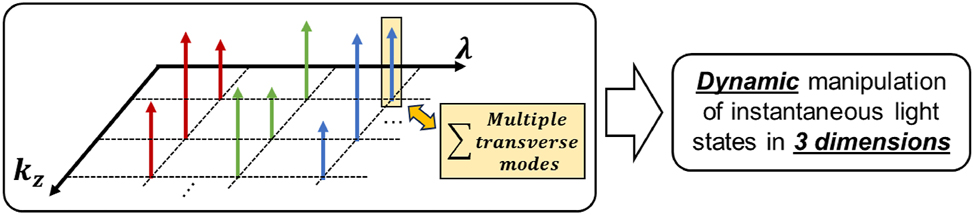
Simultaneous tailoring of the beam in transverse, longitudinal, and wavelength domains can potentially enable dynamic manipulation of instantaneous light states in 3 dimensions.
6 Summary
Tailoring multiple properties of light longitudinally is a great complement to tailoring light transversely, such that there is a toolkit for producing almost any kind of light at any given location. Although it is unclear what applications will ultimately be impacted by this capability, there is much excitement in finding out what is possible. Indeed, we would venture to say that there is much confidence that such unique capabilities will be used in ways we may not yet envision.
Funding source: Airbus Institute for Engineering Research (AIER)
Funding source: Office of Naval Research
Award Identifier / Grant number: N00014-20-1-2558
Award Identifier / Grant number: N00014-20-1-2789
Award Identifier / Grant number: N6833522C0735
-
Research funding: We acknowledge the generous support from Airbus Institute for Engineering Research (AIER) and Office of Naval Research (N00014-20-1-2558, N00014-20-1-2789, and N6833522C0735).
-
Author contribution: AW supervised the work, provided overall guidance and perspective, and refined the structure of the manuscript. HZ and XS performed the literature survey and contributed to the synthesis and interpretation of the recent advances. All authors discussed the content and contributed to the writing of the manuscript. All authors have accepted responsibility for the entire content of this manuscript and consented to its submission to the journal, reviewed all the results and approved the final version of the manuscript.
-
Conflict of interest: Authors state no conflict of interest.
-
Data availability: Data sharing is not applicable to this article as no datasets were generated or analyzed during the current study.
References
[1] A. Forbes, M. de Oliveira, and M. R. Dennis, “Structured light,” Nat. Photonics, vol. 15, no. 4, pp. 253–262, 2021, https://doi.org/10.1038/s41566-021-00780-4.Suche in Google Scholar
[2] L. Allen, M. W. Beijersbergen, R. Spreeuw, and J. Woerdman, “Orbital angular momentum of light and the transformation of Laguerre-Gaussian laser modes,” Phys. Rev. A, vol. 45, no. 11, p. 8185, 1992, https://doi.org/10.1103/physreva.45.8185.Suche in Google Scholar PubMed
[3] A. M. Yao and M. J. Padgett, “Orbital angular momentum: origins, behavior and applications,” Adv. opt. photonics, vol. 3, no. 2, pp. 161–204, 2011, https://doi.org/10.1364/aop.3.000161.Suche in Google Scholar
[4] Y. Shen, et al.., “Optical vortices 30 years on: OAM manipulation from topological charge to multiple singularities,” Light: Sci. Appl., vol. 8, no. 1, p. 90, 2019, https://doi.org/10.1038/s41377-019-0194-2.Suche in Google Scholar PubMed PubMed Central
[5] A. E. Willner, K. Pang, H. Song, K. Zou, and H. Zhou, “Orbital angular momentum of light for communications,” Appl. Phys. Rev., vol. 8, no. 4, p. 041312, 2021, https://doi.org/10.1063/5.0054885.Suche in Google Scholar
[6] J. Wang, J. Liu, S. Li, Y. Zhao, J. Du, and L. Zhu, “Orbital angular momentum and beyond in free-space optical communications,” Nanophotonics, vol. 11, no. 4, pp. 645–680, 2022, https://doi.org/10.1515/nanoph-2021-0527.Suche in Google Scholar PubMed PubMed Central
[7] A. E. Willner, et al.., “Optical communications using orbital angular momentum beams,” Adv. Opt. Photon., vol. 7, no. 1, p. 66, 2015, https://doi.org/10.1364/AOP.7.000066.Suche in Google Scholar
[8] J. Wang, et al.., “Terabit free-space data transmission employing orbital angular momentum multiplexing,” Nat. photonics, vol. 6, no. 7, pp. 488–496, 2012, https://doi.org/10.1038/nphoton.2012.138.Suche in Google Scholar
[9] Z. Hu, et al.., “Aiming for high-capacity multi-modal free-space optical transmission leveraging complete modal basis sets,” Opt. Commun., vol. 541, p. 129531, 2023, https://doi.org/10.1016/j.optcom.2023.129531.Suche in Google Scholar
[10] P. J. Winzer, “Making spatial multiplexing a reality,” Nat. Photonics, vol. 8, no. 5, pp. 345–348, 2014, https://doi.org/10.1038/nphoton.2014.58.Suche in Google Scholar
[11] M. Mafu, et al.., “Higher-dimensional orbital-angular-momentum-based quantum key distribution with mutually unbiased bases,” Phys. Rev. A – At., Mol., Opt. Phys., vol. 88, no. 3, p. 032305, 2013, https://doi.org/10.1103/physreva.88.032305.Suche in Google Scholar
[12] M. Mirhosseini, et al.., “High-dimensional quantum cryptography with twisted light,” New J. Phys., vol. 17, no. 3, p. 033033, 2015, https://doi.org/10.1088/1367-2630/17/3/033033.Suche in Google Scholar
[13] M. A. Cox, N. Mphuthi, I. Nape, N. Mashaba, L. Cheng, and A. Forbes, “Structured light in turbulence,” IEEE J. Select. Topics Quantum Electron., vol. 27, no. 2, pp. 1–21, 2021, https://doi.org/10.1109/JSTQE.2020.3023790.Suche in Google Scholar
[14] H. Cao, A. P. Mosk, and S. Rotter, “Shaping the propagation of light in complex media,” Nat. Phys., vol. 18, no. 9, pp. 994–1007, 2022, https://doi.org/10.1038/s41567-022-01677-x.Suche in Google Scholar
[15] G. Xie, et al.., “Using a complex optical orbital-angular-momentum spectrum to measure object parameters,” Opt. Lett., vol. 42, no. 21, pp. 4482–4485, 2017, https://doi.org/10.1364/ol.42.004482.Suche in Google Scholar PubMed
[16] S. Fürhapter, A. Jesacher, S. Bernet, and M. Ritsch-Marte, “Spiral phase contrast imaging in microscopy,” Opt. Express, vol. 13, no. 3, pp. 689–694, 2005, https://doi.org/10.1364/opex.13.000689.Suche in Google Scholar PubMed
[17] Y. Shi, et al.., “Advances in light transverse momenta and optical lateral forces,” Adv. Opt. Photonics, vol. 15, no. 3, pp. 835–906, 2023, https://doi.org/10.1364/aop.489300.Suche in Google Scholar
[18] E. Otte and C. Denz, “Optical trapping gets structure: structured light for advanced optical manipulation,” Appl. Phys. Rev., vol. 7, no. 4, 2020, https://doi.org/10.1063/5.0013276.Suche in Google Scholar
[19] F. Gori, G. Guattari, and C. Padovani, “Bessel-gauss beams,” Opt. Commun., vol. 64, no. 6, pp. 491–495, 1987, https://doi.org/10.1016/0030-4018(87)90276-8.Suche in Google Scholar
[20] J. Durnin, J. MiceliJr, and J. H. Eberly, “Diffraction-free beams,” Phys. Rev. Lett., vol. 58, no. 15, p. 1499, 1987, https://doi.org/10.1103/physrevlett.58.1499.Suche in Google Scholar PubMed
[21] R. Vasilyeu, A. Dudley, N. Khilo, and A. Forbes, “Generating superpositions of higher–order Bessel beams,” Opt. Exp., vol. 17, no. 26, pp. 23389–23395, 2009. https://doi.org/10.1364/oe.17.023389.Suche in Google Scholar PubMed
[22] M. Zamboni-Rached, “Stationary optical wave fields with arbitrary longitudinal shape by superposing equal frequency Bessel beams: Frozen waves,” Opt. Express, vol. 12, no. 17, p. 4001, 2004, https://doi.org/10.1364/OPEX.12.004001.Suche in Google Scholar PubMed
[23] M. Zamboni-Rached, E. Recami, and H. E. Hernández-Figueroa, “Theory of ‘frozen waves’: modeling the shape of stationary wave fields,” J. Opt. Soc. Am. A, vol. 22, no. 11, p. 2465, 2005, https://doi.org/10.1364/JOSAA.22.002465.Suche in Google Scholar PubMed
[24] T. A. Vieira, M. R. R. Gesualdi, and M. Zamboni-Rached, “Frozen waves: experimental generation,” Opt. Lett., vol. 37, no. 11, p. 2034, 2012, https://doi.org/10.1364/OL.37.002034.Suche in Google Scholar PubMed
[25] M. Zamboni-Rached and M. Mojahedi, “Shaping finite-energy diffraction-and attenuation-resistant beams through Bessel-Gauss–beam superposition,” Phys. Rev. A, vol. 92, no. 4, p. 043839, 2015, https://doi.org/10.1103/physreva.92.043839.Suche in Google Scholar
[26] A. H. Dorrah, M. Zamboni-Rached, and M. Mojahedi, “Controlling the topological charge of twisted light beams with propagation,” Phys. Rev. A, vol. 93, no. 6, p. 063864, 2016, https://doi.org/10.1103/PhysRevA.93.063864.Suche in Google Scholar
[27] A. H. Dorrah, C. Rosales-Guzmán, A. Forbes, and M. Mojahedi, “Evolution of orbital angular momentum in three-dimensional structured light,” Phys. Rev. A, vol. 98, no. 4, p. 043846, 2018, https://doi.org/10.1103/physreva.98.043846.Suche in Google Scholar
[28] M. Corato-Zanarella, A. H. Dorrah, M. Zamboni-Rached, and M. Mojahedi, “Arbitrary control of polarization and intensity profiles of diffraction-attenuation-resistant beams along the propagation direction,” Phys. Rev. Appl., vol. 9, no. 2, p. 024013, 2018, https://doi.org/10.1103/physrevapplied.9.024013.Suche in Google Scholar
[29] A. H. Dorrah, M. Zamboni-Rached, and M. Mojahedi, “Wavelength and topological charge management along the axis of propagation of multichromatic non-diffracting beams,” JOSA B, vol. 36, no. 7, pp. 1867–1872, 2019, https://doi.org/10.1364/josab.36.001867.Suche in Google Scholar
[30] P. Li, et al.., “Polarization oscillating beams constructed by copropagating optical frozen waves,” Photonics Res., vol. 6, no. 7, pp. 756–761, 2018, https://doi.org/10.1364/prj.6.000756.Suche in Google Scholar
[31] T. Freegarde, Introduction to the Physics of Waves, Cambridge, UK, Cambridge University Press, 2012.10.1017/CBO9781139048149Suche in Google Scholar
[32] A. H. Dorrah, M. Zamboni-Rached, and M. Mojahedi, “Experimental demonstration of tunable refractometer based on orbital angular momentum of longitudinally structured light,” Light Sci Appl, vol. 7, no. 1, p. 40, 2018, https://doi.org/10.1038/s41377-018-0034-9.Suche in Google Scholar PubMed PubMed Central
[33] K. Pang, et al.., “Experimental mitigation of the effects of the limited size aperture or misalignment by singular-value-decomposition-based beam orthogonalization in a free-space optical link using Laguerre–Gaussian modes,” Opt. Lett., vol. 45, no. 22, p. 6310, 2020, https://doi.org/10.1364/OL.405399.Suche in Google Scholar PubMed
[34] G. Xie, et al.., “Spatial light structuring using a combination of multiple orthogonal orbital angular momentum beams with complex coefficients,” Opt. Lett., vol. 42, no. 5, pp. 991–994, 2017, https://doi.org/10.1364/ol.42.000991.Suche in Google Scholar PubMed
[35] A. M. Weiner, “Ultrafast optical pulse shaping: a tutorial review,” Opt. Commun., vol. 284, no. 15, pp. 3669–3692, 2011, https://doi.org/10.1016/j.optcom.2011.03.084.Suche in Google Scholar
[36] F. Ferdous, et al.., “Spectral line-by-line pulse shaping of on-chip microresonator frequency combs,” Nat. Photonics, vol. 5, no. 12, pp. 770–776, 2011, https://doi.org/10.1038/nphoton.2011.255.Suche in Google Scholar
[37] X. Su, et al.., “Temporally and longitudinally tailored dynamic space-time wave packets,” Opt. Express, vol. 32, no. 15, pp. 26653–26666, 2024, https://doi.org/10.1364/oe.527713.Suche in Google Scholar
[38] A. H. Dorrah and F. Capasso, “Tunable structured light with flat optics,” Science, vol. 376, no. 6591, p. eabi6860, 2022, https://doi.org/10.1126/science.abi6860.Suche in Google Scholar PubMed
[39] A. H. Dorrah, N. A. Rubin, A. Zaidi, M. Tamagnone, and F. Capasso, “Metasurface optics for on-demand polarization transformations along the optical path,” Nat. Photonics, vol. 15, no. 4, pp. 287–296, 2021, https://doi.org/10.1038/s41566-020-00750-2.Suche in Google Scholar
[40] R. Cao, et al.., “Optical-resolution photoacoustic microscopy with a needle-shaped beam,” Nat. photonics, vol. 17, no. 1, pp. 89–95, 2023, https://doi.org/10.1038/s41566-022-01112-w.Suche in Google Scholar PubMed PubMed Central
[41] A. H. Dorrah, et al.., “Light sheets for continuous-depth holography and three-dimensional volumetric displays,” Nat. Photonics, vol. 17, no. 5, pp. 427–434, 2023, https://doi.org/10.1038/s41566-023-01188-y.Suche in Google Scholar
[42] Y. Zou, J. Zhu, X. Wang, and L. Hanzo, “A survey on wireless security: technical challenges, recent advances, and future trends,” Proc. IEEE, vol. 104, no. 9, pp. 1727–1765, 2016, https://doi.org/10.1109/jproc.2016.2558521.Suche in Google Scholar
[43] X. Su, et al.., “Enhancement of physical layer security in FSO links by longitudinally tailoring the noise power to overwhelm the signal power,” in CLEO: Science and Innovations, Charlotte, North Carolina, USA, Optica Publishing Group, 2024, p. SW3N-4.10.1364/CLEO_SI.2024.SW3N.4Suche in Google Scholar
[44] R. Sharman, and T. Lane, Eds. Aviation Turbulence, Cham, Springer International Publishing, 2016.10.1007/978-3-319-23630-8Suche in Google Scholar
[45] L. C. Andrews and R. L. Phillips, “Laser beam propagation through random media,” in Laser Beam Propagation through Random Media, 2nd ed. Bellingham, Washington, USA, SPIE Press, 2005.10.1117/3.626196Suche in Google Scholar
[46] H. Zhou, et al.., “Atmospheric turbulence strength distribution along a propagation path probed by longitudinally structured optical beams,” Nat. Commun., vol. 14, no. 1, p. 4701, 2023, https://doi.org/10.1038/s41467-023-40381-z.Suche in Google Scholar PubMed PubMed Central
[47] A. Klug, I. Nape, and A. Forbes, “The orbital angular momentum of a turbulent atmosphere and its impact on propagating structured light fields,” New J. Phys., vol. 23, no. 9, p. 093012, 2021, https://doi.org/10.1088/1367-2630/ac1fca.Suche in Google Scholar
[48] A. Jantzi, W. Jemison, A. Laux, L. Mullen, and B. Cochenour, “Enhanced underwater ranging using an optical vortex,” Opt. Express, vol. 26, no. 3, pp. 2668–2674, 2018, https://doi.org/10.1364/oe.26.002668.Suche in Google Scholar PubMed
[49] H. Song, et al.., “Optical ranging through underwater scattering using z-dependent angular rotation of a spatially structured beam,” Opt. Commun., vol. 557, p. 130335, 2024, https://doi.org/10.1016/j.optcom.2024.130335.Suche in Google Scholar
[50] N. Barbieri, et al.., “Double helical laser beams based on interfering first-order Bessel beams,” J. Opt. Soc. Am. A, vol. 28, no. 7, p. 1462, 2011, https://doi.org/10.1364/JOSAA.28.001462.Suche in Google Scholar PubMed
[51] Z. Wan, Z. Tang, and J. Wang, “Optical ranging and vibration sensing based on the lagging propagation phase of structured beams,” Opt. Lett., vol. 49, no. 4, p. 927, 2024, https://doi.org/10.1364/OL.510527.Suche in Google Scholar PubMed
[52] Z. Jiang, et al.., “Experimental demonstration of underwater optical ranging with enhanced accuracy in scattering medium using multiple Bessel modes,” J. Lightwave Technol., vol. 43, no. 3, pp. 1123–1129, 2025. https://doi.org/10.1109/jlt.2024.3475477.Suche in Google Scholar
[53] Y. Wang, et al.., “Attenuation resilient underwater ranging using petal-like structured light with tailorable longitudinal intensity,” in Frontiers in Optics, Denver, Colorado, USA, Optica Publishing Group, 2024, p. JTu5A-69.10.1364/FIO.2024.JTu5A.69Suche in Google Scholar
[54] Z. Zhang, L. Cen, F. Wang, and Y. Zhao, “Tiny velocity measurement using rotating petal-like mode of orbital angular momentum,” Opt. Lett., vol. 46, no. 19, p. 4805, 2021, https://doi.org/10.1364/OL.439841.Suche in Google Scholar PubMed
[55] Y. Qin, Y. Li, D. Deng, Y. Liu, and M. Sun, “Ultracompact biosensor based on a metalens with a longitudinally structured vector beam,” Appl. Opt., vol. 58, no. 16, p. 4438, 2019, https://doi.org/10.1364/AO.58.004438.Suche in Google Scholar PubMed
[56] R. A. Suarez, L. A. Ambrosio, A. A. Neves, M. Zamboni-Rached, and M. R. Gesualdi, “Experimental optical trapping with frozen waves,” Opt. Lett., vol. 45, no. 9, pp. 2514–2517, 2020, https://doi.org/10.1364/ol.390909.Suche in Google Scholar
[57] R. A. Suarez, A. A. Neves, and M. R. Gesualdi, “Optical trapping with higher-order frozen waves,” JOSA B, vol. 40, no. 3, pp. 631–636, 2023, https://doi.org/10.1364/josab.473922.Suche in Google Scholar
[58] J. Notaros, C. V. Poulton, M. J. Byrd, M. Raval, and M. R. Watts, “Integrated optical phased arrays for quasi-Bessel-beam generation,” Opt. Lett., vol. 42, no. 17, pp. 3510–3513, 2017, https://doi.org/10.1364/ol.42.003510.Suche in Google Scholar
[59] Z. Zhi, et al.., “On-chip generation of Bessel–Gaussian beam via concentrically distributed grating arrays for long-range sensing,” Light: Sci. Appl., vol. 12, no. 1, p. 92, 2023, https://doi.org/10.1038/s41377-023-01133-2.Suche in Google Scholar PubMed PubMed Central
[60] A. H. Dorrah, N. A. Rubin, M. Tamagnone, A. Zaidi, and F. Capasso, “Structuring total angular momentum of light along the propagation direction with polarization-controlled meta-optics,” Nat. Commun., vol. 12, no. 1, p. 6249, 2021, https://doi.org/10.1038/s41467-021-26253-4.Suche in Google Scholar PubMed PubMed Central
[61] C. He, Y. Shen, and A. Forbes, “Towards higher-dimensional structured light,” Light Sci. Appl., vol. 11, no. 1, p. 205, 2022, https://doi.org/10.1038/s41377-022-00897-3.Suche in Google Scholar PubMed PubMed Central
[62] M. Erhard, R. Fickler, M. Krenn, and A. Zeilinger, “Twisted photons: new quantum perspectives in high dimensions,” Light: Sci. Appl., vol. 7, no. 3, p. 17146, 2018, https://doi.org/10.1038/lsa.2017.146.Suche in Google Scholar PubMed PubMed Central
[63] E. Otte, C. Rosales-Guzmán, B. Ndagano, C. Denz, and A. Forbes, “Entanglement beating in free space through spin–orbit coupling,” Light Sci. Appl., vol. 7, no. 5, p. 18009, 2018, https://doi.org/10.1038/lsa.2018.9.Suche in Google Scholar PubMed PubMed Central
[64] X. Su, et al.., “Demonstration of space-time wave packets in optical fibers with dynamic motion and tunable group velocity,” in Laser Science, Tacoma, Washington, USA, Optica Publishing Group, 2023, p. JTu7B-1.10.1364/FIO.2023.JTu7B.1Suche in Google Scholar
[65] C. Shi, M. Dubois, Y. Wang, and X. Zhang, “High-speed acoustic communication by multiplexing orbital angular momentum,” Proc. Natl. Acad. Sci. U.S.A., vol. 114, no. 28, pp. 7250–7253, 2017, https://doi.org/10.1073/pnas.1704450114.Suche in Google Scholar PubMed PubMed Central
[66] Y. Yan, et al.., “High-capacity millimetre-wave communications with orbital angular momentum multiplexing,” Nat. Commun., vol. 5, no. 1, p. 4876, 2014, https://doi.org/10.1038/ncomms5876.Suche in Google Scholar PubMed PubMed Central
[67] F. Tamburini, E. Mari, A. Sponselli, B. Thidé, A. Bianchini, and F. Romanato, “Encoding many channels on the same frequency through radio vorticity: first experimental test,” New J. Phys., vol. 14, no. 3, p. 033001, 2012, https://doi.org/10.1088/1367-2630/14/3/033001.Suche in Google Scholar
[68] H. Zhou, et al.., “Utilizing multiplexing of structured THz beams carrying orbital-angular-momentum for high-capacity communications,” Opt. Express, vol. 30, no. 14, p. 25418, 2022, https://doi.org/10.1364/OE.459720.Suche in Google Scholar PubMed
[69] K. Zou, et al.., “High-capacity free-space optical communications using wavelength- and mode-division-multiplexing in the mid-infrared region,” Nat. Commun., vol. 13, no. 1, p. 7662, 2022, https://doi.org/10.1038/s41467-022-35327-w.Suche in Google Scholar PubMed PubMed Central
[70] M. Zamboni-Rached, K. Z. Nobrega, and M. Mojahedi, “Creating light-made waveguides with structured optical beams in nonlinear Kerr media,” Phys. Rev. A, vol. 109, no. 5, p. 053502, 2024, https://doi.org/10.1103/PhysRevA.109.053502.Suche in Google Scholar
© 2025 the author(s), published by De Gruyter, Berlin/Boston
This work is licensed under the Creative Commons Attribution 4.0 International License.
Artikel in diesem Heft
- Frontmatter
- Editorial
- In honor of Federico Capasso, a visionary in nanophotonics, on the occasion of his 75th birthday
- Reviews
- Flat nonlinear optics with intersubband polaritonic metasurfaces
- Polaritonic quantum matter
- Machine-learning-assisted photonic device development: a multiscale approach from theory to characterization
- Perspectives
- Towards field-resolved visible microscopy of 2D materials
- Perspective on tailoring longitudinal structured beam and its applications
- Tunable holographic metasurfaces for augmented and virtual reality
- Polarization-sensitive diffractive optics and metasurfaces: “Past is Prologue”
- Compound meta-optics: there is plenty of room at the top
- Nonlocal metasurfaces: universal modal maps governed by a nonlocal generalized Snell’s law
- Resonant metasurface-enabled quantum light sources for single-photon emission and entangled photon-pair generation
- Active metasurface designs for lensless and detector-limited imaging
- Letter
- Real-time tuning of plasmonic nanogap cavity resonances through solvent environments
- Research Articles
- On the generalized Snell–Descartes laws, shock waves, water wakes, and Cherenkov radiation
- Silicon rich nitride: a platform for controllable structural colors
- Overcoming stress limitations in SiN nonlinear photonics via a bilayer waveguide
- High-harmonic generation from subwavelength silicon films
- Space-time wedges
- XUV yield optimization of two-color high-order harmonic generation in gases
- Skyrmion bag robustness in plasmonic bilayer and trilayer moiré superlattices
- Quantum-enhanced detection of viral cDNA via luminescence resonance energy transfer using upconversion and gold nanoparticles
- Deep neural networks for inverse design of multimode integrated gratings with simultaneous amplitude and phase control
- Topological chiral-gain in a Berry dipole material
- Diagnostic oriented discrimination of different Shiga toxins via PCA-assisted SERS-based plasmonic metasurface
- Quantum emitter interacting with a dispersive dielectric object: a model based on the modified Langevin noise formalism
- 3D-printed mirror-less helicity preserving metasurface “mirror” for THz applications
- Supershift properties for nonanalytic signals
- Enhancing radiative heat transfer with meta-atomic displacement
- Quasi-bound states in the continuum in finite waveguide grating couplers
- Long lived surface plasmons on the interface of a metal and a photonic time-crystal
- Tailoring propagation-invariant topology of optical skyrmions with dielectric metasurfaces
- Experimental generation of optimally chiral azimuthally-radially polarized beams
- Tailoring optical response of MXene thin films
- Nonlinear analog processing with anisotropic nonlinear films
- Optical levitation of Janus particles within focused cylindrical vector beams
- Large tuning of the optical properties of nanoscale NdNiO3 via electron doping
- Combining quantum cascade lasers and plasmonic metasurfaces to monitor de novo lipogenesis with vibrational contrast microscopy
- Monoclinic nonlinear metasurfaces for resonant engineering of polarization states
- Non-linear bistability in pulsed optical traps
- Tutorial: Hong–Ou–Mandel interference with structured photons
- Inhomogeneous broadening in the time domain
- MoS2 based 2D material photodetector array with high pixel density
- Temporal interface in dispersive hyperbolic media
- Measurement of the cavity dispersion in quantum cascade lasers using subthreshold luminescence
- Designing the response-spectra of microwave metasurfaces: theory and experiments
- Exciton–polariton condensation in MAPbI3 films from bound states in the continuum metasurfaces
- Experimental analysis of the thermal management and internal quantum efficiency of terahertz quantum cascade laser harmonic frequency combs
- Energy-efficient thermally smart windows with tunable properties across the near- and mid-infrared ranges
Artikel in diesem Heft
- Frontmatter
- Editorial
- In honor of Federico Capasso, a visionary in nanophotonics, on the occasion of his 75th birthday
- Reviews
- Flat nonlinear optics with intersubband polaritonic metasurfaces
- Polaritonic quantum matter
- Machine-learning-assisted photonic device development: a multiscale approach from theory to characterization
- Perspectives
- Towards field-resolved visible microscopy of 2D materials
- Perspective on tailoring longitudinal structured beam and its applications
- Tunable holographic metasurfaces for augmented and virtual reality
- Polarization-sensitive diffractive optics and metasurfaces: “Past is Prologue”
- Compound meta-optics: there is plenty of room at the top
- Nonlocal metasurfaces: universal modal maps governed by a nonlocal generalized Snell’s law
- Resonant metasurface-enabled quantum light sources for single-photon emission and entangled photon-pair generation
- Active metasurface designs for lensless and detector-limited imaging
- Letter
- Real-time tuning of plasmonic nanogap cavity resonances through solvent environments
- Research Articles
- On the generalized Snell–Descartes laws, shock waves, water wakes, and Cherenkov radiation
- Silicon rich nitride: a platform for controllable structural colors
- Overcoming stress limitations in SiN nonlinear photonics via a bilayer waveguide
- High-harmonic generation from subwavelength silicon films
- Space-time wedges
- XUV yield optimization of two-color high-order harmonic generation in gases
- Skyrmion bag robustness in plasmonic bilayer and trilayer moiré superlattices
- Quantum-enhanced detection of viral cDNA via luminescence resonance energy transfer using upconversion and gold nanoparticles
- Deep neural networks for inverse design of multimode integrated gratings with simultaneous amplitude and phase control
- Topological chiral-gain in a Berry dipole material
- Diagnostic oriented discrimination of different Shiga toxins via PCA-assisted SERS-based plasmonic metasurface
- Quantum emitter interacting with a dispersive dielectric object: a model based on the modified Langevin noise formalism
- 3D-printed mirror-less helicity preserving metasurface “mirror” for THz applications
- Supershift properties for nonanalytic signals
- Enhancing radiative heat transfer with meta-atomic displacement
- Quasi-bound states in the continuum in finite waveguide grating couplers
- Long lived surface plasmons on the interface of a metal and a photonic time-crystal
- Tailoring propagation-invariant topology of optical skyrmions with dielectric metasurfaces
- Experimental generation of optimally chiral azimuthally-radially polarized beams
- Tailoring optical response of MXene thin films
- Nonlinear analog processing with anisotropic nonlinear films
- Optical levitation of Janus particles within focused cylindrical vector beams
- Large tuning of the optical properties of nanoscale NdNiO3 via electron doping
- Combining quantum cascade lasers and plasmonic metasurfaces to monitor de novo lipogenesis with vibrational contrast microscopy
- Monoclinic nonlinear metasurfaces for resonant engineering of polarization states
- Non-linear bistability in pulsed optical traps
- Tutorial: Hong–Ou–Mandel interference with structured photons
- Inhomogeneous broadening in the time domain
- MoS2 based 2D material photodetector array with high pixel density
- Temporal interface in dispersive hyperbolic media
- Measurement of the cavity dispersion in quantum cascade lasers using subthreshold luminescence
- Designing the response-spectra of microwave metasurfaces: theory and experiments
- Exciton–polariton condensation in MAPbI3 films from bound states in the continuum metasurfaces
- Experimental analysis of the thermal management and internal quantum efficiency of terahertz quantum cascade laser harmonic frequency combs
- Energy-efficient thermally smart windows with tunable properties across the near- and mid-infrared ranges
