Equational characterizations for some subclasses of domains
-
Fan Feng


Abstract
It is well known that the continuity of a poset can be seen as a special distributivity. There is an open problem: is there an equational characterization for continuous semilattices? Based on equational characterizations of continuous lattices, bounded complete domains and L-domains, we prove that a special class of domains can be characterized by an equation. As an application, an equational characterization for a subclass of continuous semilattices is given. Moreover, by using ideals instead of directed sets, we obtain a unified equational characterization for more subclasses of domains, including that of domains mentioned above. Unfortunately, even if using ideals, we still can not characterize all of the domains. Some examples are provided to illustrate it.
1 Introduction
In the late 1960s, Dana Scott found the semantic structure in computer science being close to partial order structures. Based on this observation, he established Domain Theory, which plays a central role in the field of theoretical computer science. It is well known that the continuity and the quasicontinity of posets are important concept in Domain Theory. These can be used to describe convergence and approximation in order theory [1], [2], [3]. Similar to the study of universal algebra, it raises the question as to whether domains are maintained under subalgebras, products and homomorphic images. For this question, it was shown in [4] that two special subclass of domains that continuous lattices and bounded complete domains can be characterized by the distributivity. This kind of characterization is called an equational characterization. The continuity on complete lattice can be viewed as an infinite distributive law. In [5], Marcel Erné shows the relationship between continuity and the other laws of infinite distribution. In fact, many infinite distributive laws can be applied to a broader range. For example, Wei Luan and Qingguo Li showed that quasi-continuity complete semilattice can be characterized by an equation in [6] and Paul Taylor provided an equational characterization for L-domains in [7]. There is an open problem about equational characterization in [8]: is there an equational characterization for continuous semilattices?
In this paper, we first introduce a concept of an
2 Preliminaries
In this section, we recall some definitions and results related to the paper. A partially ordered set is a nonempty set equipped with a partial order ≤, where the partial order is a binary relation satisfying transitive, reflexive and antisymmetric. The term poset will be used to denote a partially ordered set.
Definition 2.1.
[9]
Let L be a set equipped a partial order ≤ and A be a subset of L.
A partial order ≤ A on A is called the hereditary order, if ≤ A = ≤∩(A × A).
An element x ∈ L is called an upper bound of A, if a ≤ x for all a ∈ A. Respectively, an element y ∈ L is called a lower bound of A, if y ≤ a for all a ∈ A. For x ∈ L, we write ↓ x = {y ∈ L : y ≤ x} and ↑ x = {z ∈ L : x ≤ z}.
An element x ∈ L is called the least upper bound of A, if x ≤ y for each upper bound y of A. And we write it as ⋁A or sup A. Respectively, p is called the greatest lower bound of A, if q ≤ p for each lower bound q of A. The greatest lower bound is written as ⋀A or inf A.
A is called a directed set, if A is nonempty and every finite subset of A has an upper bound in A. Respectively, A is called a filtered set, if A is nonempty and every finite subset of A has a lower bound in A.
A is called a lower set, if A = {x ∈ L : x ≤ a for some a ∈ A}. Respectively, A is called an upper set, if A = {y ∈ L : a ≤ y for some a ∈ A}.
A is called a ideal, if A is a directed lower set. A is called a filter, if A is a filtered upper set.
A is called a principal idea, if A is an ideal with ⋁A ∈ A. A is called a principal filter, if A is a filter with ⋀A ∈ A.
Definition 2.2.
[10]
A complete lattice is a poset in which every subset has a sup and an inf.
A poset is called a complete semilattice if every nonempty subset has an inf and every directed subset has a sup.
A poset is called a dcpo if every directed subset has a sup.
A dcpo is called an L-dcpo if every principal ideal equipped with its hereditary order is a complete lattice.
Definition 2.3.
[10]
Let L be a poset. We say that x is way-below y, in symbols x ≪ y, iff for all directed subsets D ⊆ L for which sup D exists, the relation y ≤ sup D always implies the existence of a d ∈ D with x ≤ d. For each x ∈ L, we denote by ↡ x the set of all elements are way-below x.
A poset L is called continuous if it satisfies the axiom of approximation:
i.e. for all x ∈ L, the set ↡x = {u ∈ L∣u ≪ x} is directed and x = ⋁{u ∈ L∣u ≪ x}.
A dcpo which is continuous is called a domain.
A domain which is a semilattice is called a continuous semilattice.
A domain which is also an L-dcpo is called an L-domain.
A domain which is a complete lattice is called a continuous lattice.
A domain which is a complete semilattice is called a bounded complete domain.
An element x of L is called a compact element, if for each directed set D of L with ⋁D exists, x ≤ ⋁D always implies x ≤ d for some d ∈ D (i.e., x ≪ x). Denotes K(L) as the set of all compact elements.
A poset L is called algebraic if it satisfies the axiom of approximation:
i.e. for all x ∈ L, the set (↡ x ∩ K(L)) is directed and x = ⋁(↡ x ∩ K(L)).
Definition 2.4.
[11] Let L be a poset. A topology τ on L is called the Alexandrov topology, if τ is the set of all upper set of L.
For a poset L and x ∈ L, let
Proposition 2.5.
If L is an algebraic domain, then L is a domain.
Proposition 2.6.
Let L be a poset. Then the following conditions are equivalent:
y ≪ x;
Theorem 2.7.
[4] Let L be a complete semilattice. Then the following conditions are equivalent.
L is continuous.
Let {x j,k ∣j ∈ J, k ∈ K(j)} be a nonempty family of elements in L such that {x j,k ∣k ∈ K(j)} is directed for each j ∈ J. Then the following identity holds:
where K(j) is a index set for any j ∈ J and M is the set of all choice functions f : J → ⋃ j∈J K(j) with f(j) ∈ K(j) for all j ∈ J.
If L is a complete lattice, then these conditions are also equivalent to
Let {x j,k ∈ J × K} be any family in L. Then the following identity holds:
where N denotes the set of all choice functions f from J into the finite subsets of K, i.e., f : J → fin(K).
Next, we recall the definition of connectedness in order theory.
Definition 2.8.
[12] Let P be a poset. Then P is called connected, if every two elements x, y can be connected by a zigzag in P, i.e. there is
The following theorem is an excerpt of [7], Proposition 1.3.3].
Theorem 2.9.
Let L be an L-dcpo. Then the following conditions are equivalent.
L is continuous.
Let
where M is the set of all choice functions f : J → ⋃ j∈J K(j) with f(j) ∈ K(j) for all j ∈ J.
3 Main results
First, we propose some families of dcpos. For convenience, we denote by PFS(L) the family of all principal filters and singleton sets of a poset L.
Definition 3.1.
Let L be a dcpo and
L is called an
L is called an
of directed subsets of L with
L is called an
Example 3.2.
Let L be a complete lattice and
Let L be a complete semilattice and
Let L be an L-dcpo and
Let L be a dcpo and
Now we give the main result of this paper.
Theorem 3.3.
Let L be a dcpo and
L is continuous.
If
where M is the set of all choice functions f : J → ⋃ j∈J K(j) such that f(j) ∈ K(j) for all j ∈ J and
Proof.
We prove that (1) implies (2).
To this end, we first claim that {⋀
j∈J
x
j,f(j)∣f ∈ M} is directed. Assume f
1, f
2 ∈ M. For each j ∈ J, there is
Take a choice function f : J → ⋃
j∈J
K(j) such that
Assume that
Assume y ≪rhs. Given j ∈ J, there is k
j
∈ K(j) such that
there is a choice function f ∈ M such that
Now we show that (2) implies (1).
Fix x ∈ L, let
Since z ∈ ↡ x implies z ∈ ⋂
j∈J
I
j
, there is f ∈ M such that x
j,f(j) = z for each j ∈ J, due to the fact that
Remark 3.4.
Note that we can characterize many domains by changing
Taking bounded complete domains as an example, let L be a dcpo and
For a special subclass of continuous semilattices, we have the following equational characterization.
Corollary 3.5.
Suppose that dcpo L is also a semilattice, and
L is continuous.
If
where M is the set of all choice functions f : J → ⋃ j∈J K(j) such that f(j) ∈ K(j) for all j ∈ J and
Proof.
Since a compact set of the semilattice L with the Alexandrov topology always has an inf, L is an
Meet continuous is a distributivity on directed complete semilattice. In [13], Hui Kou stated that the property can be extended to general dcpos and the characterization uses sets to replace points. By using ideals instead of directed sets, we will obtain an equational characterization for a subclass of domains, including that of domains mentioned above. For convenience, we denote by PF(L) the family of all principal filters of a poset L.
Definition 3.6.
Let L be a dcpo and
for each
Proposition 3.7.
Let L be a dcpo and
Proof.
Assume that
Fix a, b ∈ ⋂
j∈J
I
j
. Then there exists k
j
∈ K(j) such that
Theorem 3.8.
Let L be a dcpo and
L is continuous.
If
Proof.
(1) implies (2): Let
(2) implies (1): Assume x ∈ L. Let
Then the conclusion is proved.
4 Some examples
In this section, we will give some examples. First, we illustrate that there is a poset which belongs to the subclass of continuous semilattice discussed in Corollary 3.5. Before this, we give the following concept of an A-domain.
Definition 4.1.
A poset L is called an A-domain if ↑ x is a finite lattice for each x ∈ L under the hereditary order.
Lemma 4.2.
If L is an A-domain, then L is an algebraic domain.
Proof.
Assume D is a directed set of L. Fix d ∈ D, then ↑d ∩ D is a finite directed set. Hence, ⋁(↑d ∩ D) exists in D. Moreover, all elements in L are compact elements because ⋁D exists in D for each directed set D. It follows that L is algebraic.
Example 4.3.
Let
Lemma 4.4.
Let L be an A-domain, and
Proof.
Clearly, L is an
Thus, L is an
Thus each A-domain L can seen be as an
Example 4.5.
Let L = {a, b, c} be a set. Define a relation ≤ on L by
Obviously, ≤ is a partial order on L and (L, ≤) is an A-domain. But (L, ≤) is neither a continuous semilattice nor an L-domain.
Finally, we propose the following example to reveal that the method of using ideals can not be used to characterize all of domains.
Example 4.6.
Let
where “ ≤ ” is the usual order on
We now prove that the relation ≤* forms a partial order.
We first prove that ≤* is reflexive. Given (a, b) ∈ L.
a = 0, b ∈ F. Then (a, b) ≤*(a, b) by
a = 1, b ∈ F. Then (a, b) ≤*(a, b) by
a ∈ F, b = 0. Then (a, b) ≤*(a, b) by
Secondly, we prove that ≤* is antisymmetric. Given (a, b), (c, d) ∈ L with (a, b) ≤*(c, d) and (c, d) ≤*(a, b).
Finally, we prove the transitivity of ≤*. Given (a, b) ≤*(c, d) ≤*(e, f).
Then a = c = 0, e = 0 or 1, b ≤ d ≤ f. And (a, b) ≤*(e, f), by
Then a = 0, c = e = 1, b ≤ d ≤ f. And (a, b) ≤*(e, f), by
Then a ≤ d, c = 0, e = 0 or 1, d ≤ f.
If e = 0, then
If e = 1, then
If
If
If
Then c = e = 1 and
Then a = c = e = 1 and b ≤ d ≤ f. That is
Hence ≤* is a partial order.
To understand the above dcpo L more intuitively, we can see Figure 1.
For r ∈ F and (a, b) ∈ L, we set
There is an approximate identity
Thus L is an FS-domain, and also a domain.
Let
However, L \{(1, 1), (0, 1)}∩↓(0, 1) is not an ideal. It shows that L is not an
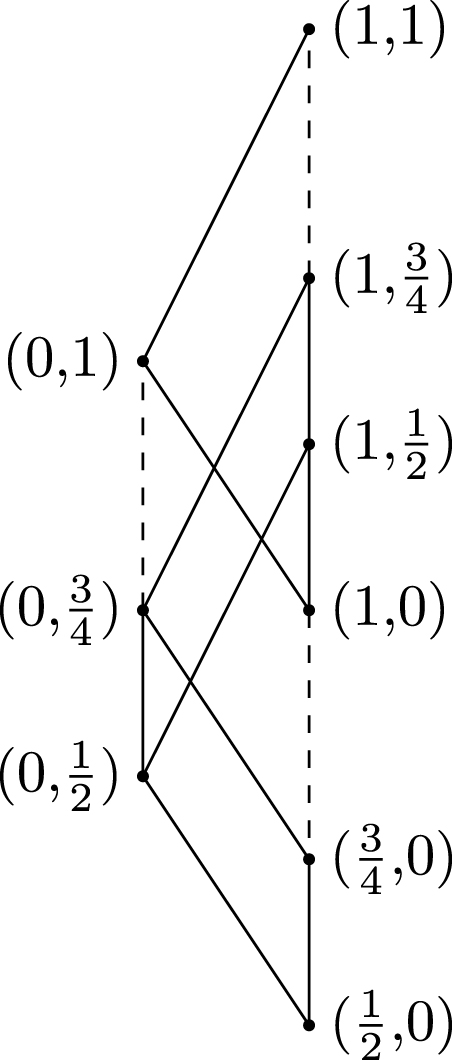
The poset L in Example 4.6.
Example 4.6 also tells us that an equational characterization for FS-domains has not been established. So it is a good follow-up effort to resolve the above question.
-
Research ethics: Not applicable.
-
Informed consent: Not applicable.
-
Author contributions: All authors have accepted responsibility for the entire content of this manuscript and consented to its submission to the journal, reviewed all the results and approved the final version of the manuscript. All authors contributed equally in this work.
-
Use of Large Language Models, AI and Machine Learning Tools: None declared.
-
Conflict of interest: Authors state no conflicts of interest.
-
Research funding: None declared.
-
Data availability: Data sharing is not applicable for this article since no dataset was created or analyzed during the study.
References
[1] M. Erne and H. Gatzke, Convergence and continuity in partially ordered sets and semilattices, in: R.-E. Hoffmann and K. H. Hofmann (eds), Continous Lattices and Their Applications, in: Lecture Notes in Pure and Applications Mathematics, vol. 101, CRC Press, Boca Raton, 1985, pp. 9–40.10.1201/9781003072621-2Suche in Google Scholar
[2] L. Zhou and Q. Li, Convergence on quasi-continuous domain, J. Comput. Anal. Appl. 15 (2013), no. 2, 381–390.Suche in Google Scholar
[3] T. Sun, Q. Li, and Z. Zou, The B-topology on S*-doubly quasicontinuous posets, Open Math. 19 (2021), 658–674, https://doi.org/10.1515/math-2021-0035.Suche in Google Scholar
[4] A. Day, Filter monads, continuous lattices and closure systems, Can. J. Math. 27 (1975), 50–59, https://doi.org/10.4153/CJM-1975-008-8.Suche in Google Scholar
[5] M. Erné, Infinite distributive laws versus local connectedness and compactness properties, Topol. Appl. 156 (2009), 2054–2069, https://doi.org/10.1016/j.topol.2009.03.029.Suche in Google Scholar
[6] W. Luan and Q. Li, A defining equation and reflective subcategories of quasicontinuous complete semilattices, Semigroup Forum 109 (2024), 433–446, https://doi.org/10.1007/s00233-024-10459-1.Suche in Google Scholar
[7] P. Taylor, An algebraic approach to stable domains, J. Pure Appl. Algebra 64 (1990), 171–203, https://doi.org/10.1016/0022-4049(90)90156-C.Suche in Google Scholar
[8] G. Gierz, K. H. Hoffmann, K. Keimel, J. D. Lawson, M. Mislove, and D. S. Scott, Continuous Lattices and Domains, Cambridge University Press, Cambridge, 2003.10.1017/CBO9780511542725Suche in Google Scholar
[9] B. A. Davey and H. A. Priestley, Introduction to Lattices and Order, Cambridge University Press, Cambridge, 2002.10.1017/CBO9780511809088Suche in Google Scholar
[10] S. Abramsky and A. Jung, Domain theory, in: S. Abramsky, D. M. Gabbay, and T. S. E. Maibaum (eds), Handbook of Logic in Computer Science, Oxford University Press, Oxford, 1995, pp. 1–168.10.1093/oso/9780198537625.003.0001Suche in Google Scholar
[11] J. Goubault-Larrecq, Non-Hausdorff Topology and Domain Theory, Cambridge University Press, New York, 2013.10.1017/CBO9781139524438Suche in Google Scholar
[12] A. Jung, Cartesian Closed Categories of Domains, Centrum voor Wiskunde en Informatica, Amsterdam, 1989.Suche in Google Scholar
[13] H. Kou, Y. Liu, and M. Luo, On meet-continuous dcpos, in: G. Q. Zhang, J. Lawson, Y. M. Liu, and M. K. Luo (eds), Domain Theory, Logic and Computation, Semantic Structures in Computation, vol. 3, Springer, Dordrecht, 2003, pp. 117–135.10.1007/978-94-017-1291-0_5Suche in Google Scholar
© 2025 the author(s), published by De Gruyter, Berlin/Boston
This work is licensed under the Creative Commons Attribution 4.0 International License.
Artikel in diesem Heft
- On I-convergence of nets of functions in fuzzy metric spaces
- Special Issue on Contemporary Developments in Graphs Defined on Algebraic Structures
- Forbidden subgraphs of TI-power graphs of finite groups
- Finite group with some c#-normal and S-quasinormally embedded subgroups
- Classifying cubic symmetric graphs of order 88p and 88p 2
- Two-sided zero-divisor graphs of orientation-preserving and order-decreasing transformation semigroups
- Simplicial complexes defined on groups
- Further results on permanents of Laplacian matrices of trees
- Algebra
- Classes of modules closed under projective covers
- On the dimension of the algebraic sum of subspaces
- Green's graphs of a semigroup
- On an uncertainty principle for small index subgroups of finite fields
- On a generalization of I-regularity
- Algorithm and linear convergence of the H-spectral radius of weakly irreducible quasi-positive tensors
- The hyperbolic CS decomposition of tensors based on the C-product
- On weakly classical 1-absorbing prime submodules
- Equational characterizations for some subclasses of domains
- Algebraic Geometry
- Spin(8, ℂ)-Higgs bundles fixed points through spectral data
- Embedding of lattices and K3-covers of an Enriques surface
- Kodaira-Spencer maps for elliptic orbispheres as isomorphisms of Frobenius algebras
- Applications in Computer and Information Sciences
- Dynamics of particulate emissions in the presence of autonomous vehicles
- Exploring homotopy with hyperspherical tracking to find complex roots with application to electrical circuits
- Category Theory
- The higher mapping cone axiom
- Combinatorics and Graph Theory
- 𝕮-inverse of graphs and mixed graphs
- On the spectral radius and energy of the degree distance matrix of a connected graph
- Some new bounds on resolvent energy of a graph
- Coloring the vertices of a graph with mutual-visibility property
- Ring graph induced by a ring endomorphism
- A note on the edge general position number of cactus graphs
- Complex Analysis
- Some results on value distribution concerning Hayman's alternative
- Freely quasiconformal and locally weakly quasisymmetric mappings in metric spaces
- A new result for entire functions and their shifts with two shared values
- On a subclass of multivalent functions defined by generalized multiplier transformation
- Singular direction of meromorphic functions with finite logarithmic order
- Growth theorems and coefficient bounds for g-starlike mappings of complex order λ
- Refinements of inequalities on extremal problems of polynomials
- Control Theory and Optimization
- Averaging method in optimal control problems for integro-differential equations
- On superstability of derivations in Banach algebras
- The robust isolated calmness of spectral norm regularized convex matrix optimization problems
- Observability on the classes of non-nilpotent solvable three-dimensional Lie groups
- Differential Equations
- The ill-posedness of the (non-)periodic traveling wave solution for the deformed continuous Heisenberg spin equation
- A note on the global existence and boundedness of an N-dimensional parabolic-elliptic predator-prey system with indirect pursuit-evasion interaction
- Blow-up of solutions for Euler-Bernoulli equation with nonlinear time delay
- Periodic or homoclinic orbit bifurcated from a heteroclinic loop for high-dimensional systems
- Regularity of weak solutions to the 3D stationary tropical climate model
- Local minimizers for the NLS equation with localized nonlinearity on noncompact metric graphs
- Global existence and blow-up of solutions to pseudo-parabolic equation for Baouendi-Grushin operator
- Bubbles clustered inside for almost-critical problems
- Existence and multiplicity of positive solutions for multiparameter periodic systems
- Existence of positive periodic solutions for evolution equations with delay in ordered Banach spaces
- On a nonlinear boundary value problems with impulse action
- Normalized ground-states for the Sobolev critical Kirchhoff equation with at least mass critical growth
- Multiple positive solutions to a p-Kirchhoff equation with logarithmic terms and concave terms
- Infinitely many solutions for a class of Kirchhoff-type equations
- Real and non-real eigenvalues of regular indefinite Sturm–Liouville problems
- Existence of global solutions to a semilinear thermoelastic system in three dimensions
- Limiting profile of positive solutions to heterogeneous elliptic BVPs with nonlinear flux decaying to negative infinity on a portion of the boundary
- Morse index of circular solutions for repulsive central force problems on surfaces
- Differential Geometry
- On tangent bundles of Walker four-manifolds
- Pedal and negative pedal surfaces of framed curves in the Euclidean 3-space
- Discrete Mathematics
- Eventually monotonic solutions of the generalized Fibonacci equations
- Dynamical Systems Ergodic Theory
- Dynamical properties of two-diffusion SIR epidemic model with Markovian switching
- A note on weighted measure-theoretic pressure
- Pullback attractors for a class of second-order delay evolution equations with dispersive and dissipative terms on unbounded domain
- Pullback attractor of the 2D non-autonomous magneto-micropolar fluid equations
- Functional Analysis
- Spectrum boundary domination of semiregularities in Banach algebras
- Approximate multi-Cauchy mappings on certain groupoids
- Investigating the modified UO-iteration process in Banach spaces by a digraph
- Tilings, sub-tilings, and spectral sets on p-adic space
- Continuity and essential norm of operators defined by infinite tridiagonal matrices in weighted Orlicz and l∞ spaces
-
A family of commuting contraction semigroups on
- q-Stirling sequence spaces associated with q-Bell numbers
- Chlodowsky variant of Bernstein-type operators on the domain
- Hyponormality on a weighted Bergman space of an annulus with a general harmonic symbol
- Characterization of derivations on strongly double triangle subspace lattice algebras by local actions
- Fixed point approaches to the stability of Jensen’s functional equation
- Geometry
- The regularity of solutions to the Lp Gauss image problem
- Solving the quartic by conics
- Group Theory
- On a question of permutation groups acting on the power set
- A characterization of the translational hull of a weakly type B semigroup with E-properties
- Harmonic Analysis
- Eigenfunctions on an infinite Schrödinger network
- Maximal function and generalized fractional integral operators on the weighted Orlicz-Lorentz-Morrey spaces
- Subharmonic functions and associated measures in ℝn
- Mathematical Logic, Model Theory and Foundation
- A topology related to implication and upsets on a bounded BCK-algebra
- Boundedness of fractional sublinear operators on weighted grand Herz-Morrey spaces with variable exponents
- Number Theory
- Fibonacci vector and matrix p-norms
- Recurrence for probabilistic extension of Dowling polynomials
- Carmichael numbers composed of Piatetski-Shapiro primes in Beatty sequences
- The number of rational points of some classes of algebraic varieties over finite fields
- Classification and irreducibility of a class of integer polynomials
- Decompositions of the extended Selberg class functions
- Joint approximation of analytic functions by the shifts of Hurwitz zeta-functions in short intervals
- Fibonacci Cartan and Lucas Cartan numbers
- Recurrence relations satisfied by some arithmetic groups
- The hybrid power mean involving the Kloosterman sums and Dedekind sums
- Numerical Methods
- A modified predictor–corrector scheme with graded mesh for numerical solutions of nonlinear Ψ-caputo fractional-order systems
- A kind of univariate improved Shepard-Euler operators
- Probability and Statistics
- Statistical inference and data analysis of the record-based transmuted Burr X model
- Multiple G-Stratonovich integral in G-expectation space
- p-variation and Chung's LIL of sub-bifractional Brownian motion and applications
- Real Analysis
- Chebyshev polynomials of the first kind and the univariate Lommel function: Integral representations
- Multiple solutions for a class of fourth-order elliptic equations with critical growth
- Majorization-type inequalities for (m, M, ψ)-convex functions with applications
- The evaluation of a definite integral by the method of brackets illustrating its flexibility
- Some new Fejér type inequalities for (h, g; α - m)-convex functions
- Some new Hermite-Hadamard type inequalities for product of strongly h-convex functions on ellipsoids and balls
- Topology
- Unraveling chaos: A topological analysis of simplicial homology groups and their foldings
- A generalized fixed-point theorem for set-valued mappings in b-metric spaces
- On SI2-convergence in T0-spaces
- Generalized quandle polynomials and their applications to stuquandles, stuck links, and RNA folding
Artikel in diesem Heft
- On I-convergence of nets of functions in fuzzy metric spaces
- Special Issue on Contemporary Developments in Graphs Defined on Algebraic Structures
- Forbidden subgraphs of TI-power graphs of finite groups
- Finite group with some c#-normal and S-quasinormally embedded subgroups
- Classifying cubic symmetric graphs of order 88p and 88p 2
- Two-sided zero-divisor graphs of orientation-preserving and order-decreasing transformation semigroups
- Simplicial complexes defined on groups
- Further results on permanents of Laplacian matrices of trees
- Algebra
- Classes of modules closed under projective covers
- On the dimension of the algebraic sum of subspaces
- Green's graphs of a semigroup
- On an uncertainty principle for small index subgroups of finite fields
- On a generalization of I-regularity
- Algorithm and linear convergence of the H-spectral radius of weakly irreducible quasi-positive tensors
- The hyperbolic CS decomposition of tensors based on the C-product
- On weakly classical 1-absorbing prime submodules
- Equational characterizations for some subclasses of domains
- Algebraic Geometry
- Spin(8, ℂ)-Higgs bundles fixed points through spectral data
- Embedding of lattices and K3-covers of an Enriques surface
- Kodaira-Spencer maps for elliptic orbispheres as isomorphisms of Frobenius algebras
- Applications in Computer and Information Sciences
- Dynamics of particulate emissions in the presence of autonomous vehicles
- Exploring homotopy with hyperspherical tracking to find complex roots with application to electrical circuits
- Category Theory
- The higher mapping cone axiom
- Combinatorics and Graph Theory
- 𝕮-inverse of graphs and mixed graphs
- On the spectral radius and energy of the degree distance matrix of a connected graph
- Some new bounds on resolvent energy of a graph
- Coloring the vertices of a graph with mutual-visibility property
- Ring graph induced by a ring endomorphism
- A note on the edge general position number of cactus graphs
- Complex Analysis
- Some results on value distribution concerning Hayman's alternative
- Freely quasiconformal and locally weakly quasisymmetric mappings in metric spaces
- A new result for entire functions and their shifts with two shared values
- On a subclass of multivalent functions defined by generalized multiplier transformation
- Singular direction of meromorphic functions with finite logarithmic order
- Growth theorems and coefficient bounds for g-starlike mappings of complex order λ
- Refinements of inequalities on extremal problems of polynomials
- Control Theory and Optimization
- Averaging method in optimal control problems for integro-differential equations
- On superstability of derivations in Banach algebras
- The robust isolated calmness of spectral norm regularized convex matrix optimization problems
- Observability on the classes of non-nilpotent solvable three-dimensional Lie groups
- Differential Equations
- The ill-posedness of the (non-)periodic traveling wave solution for the deformed continuous Heisenberg spin equation
- A note on the global existence and boundedness of an N-dimensional parabolic-elliptic predator-prey system with indirect pursuit-evasion interaction
- Blow-up of solutions for Euler-Bernoulli equation with nonlinear time delay
- Periodic or homoclinic orbit bifurcated from a heteroclinic loop for high-dimensional systems
- Regularity of weak solutions to the 3D stationary tropical climate model
- Local minimizers for the NLS equation with localized nonlinearity on noncompact metric graphs
- Global existence and blow-up of solutions to pseudo-parabolic equation for Baouendi-Grushin operator
- Bubbles clustered inside for almost-critical problems
- Existence and multiplicity of positive solutions for multiparameter periodic systems
- Existence of positive periodic solutions for evolution equations with delay in ordered Banach spaces
- On a nonlinear boundary value problems with impulse action
- Normalized ground-states for the Sobolev critical Kirchhoff equation with at least mass critical growth
- Multiple positive solutions to a p-Kirchhoff equation with logarithmic terms and concave terms
- Infinitely many solutions for a class of Kirchhoff-type equations
- Real and non-real eigenvalues of regular indefinite Sturm–Liouville problems
- Existence of global solutions to a semilinear thermoelastic system in three dimensions
- Limiting profile of positive solutions to heterogeneous elliptic BVPs with nonlinear flux decaying to negative infinity on a portion of the boundary
- Morse index of circular solutions for repulsive central force problems on surfaces
- Differential Geometry
- On tangent bundles of Walker four-manifolds
- Pedal and negative pedal surfaces of framed curves in the Euclidean 3-space
- Discrete Mathematics
- Eventually monotonic solutions of the generalized Fibonacci equations
- Dynamical Systems Ergodic Theory
- Dynamical properties of two-diffusion SIR epidemic model with Markovian switching
- A note on weighted measure-theoretic pressure
- Pullback attractors for a class of second-order delay evolution equations with dispersive and dissipative terms on unbounded domain
- Pullback attractor of the 2D non-autonomous magneto-micropolar fluid equations
- Functional Analysis
- Spectrum boundary domination of semiregularities in Banach algebras
- Approximate multi-Cauchy mappings on certain groupoids
- Investigating the modified UO-iteration process in Banach spaces by a digraph
- Tilings, sub-tilings, and spectral sets on p-adic space
- Continuity and essential norm of operators defined by infinite tridiagonal matrices in weighted Orlicz and l∞ spaces
-
A family of commuting contraction semigroups on
- q-Stirling sequence spaces associated with q-Bell numbers
- Chlodowsky variant of Bernstein-type operators on the domain
- Hyponormality on a weighted Bergman space of an annulus with a general harmonic symbol
- Characterization of derivations on strongly double triangle subspace lattice algebras by local actions
- Fixed point approaches to the stability of Jensen’s functional equation
- Geometry
- The regularity of solutions to the Lp Gauss image problem
- Solving the quartic by conics
- Group Theory
- On a question of permutation groups acting on the power set
- A characterization of the translational hull of a weakly type B semigroup with E-properties
- Harmonic Analysis
- Eigenfunctions on an infinite Schrödinger network
- Maximal function and generalized fractional integral operators on the weighted Orlicz-Lorentz-Morrey spaces
- Subharmonic functions and associated measures in ℝn
- Mathematical Logic, Model Theory and Foundation
- A topology related to implication and upsets on a bounded BCK-algebra
- Boundedness of fractional sublinear operators on weighted grand Herz-Morrey spaces with variable exponents
- Number Theory
- Fibonacci vector and matrix p-norms
- Recurrence for probabilistic extension of Dowling polynomials
- Carmichael numbers composed of Piatetski-Shapiro primes in Beatty sequences
- The number of rational points of some classes of algebraic varieties over finite fields
- Classification and irreducibility of a class of integer polynomials
- Decompositions of the extended Selberg class functions
- Joint approximation of analytic functions by the shifts of Hurwitz zeta-functions in short intervals
- Fibonacci Cartan and Lucas Cartan numbers
- Recurrence relations satisfied by some arithmetic groups
- The hybrid power mean involving the Kloosterman sums and Dedekind sums
- Numerical Methods
- A modified predictor–corrector scheme with graded mesh for numerical solutions of nonlinear Ψ-caputo fractional-order systems
- A kind of univariate improved Shepard-Euler operators
- Probability and Statistics
- Statistical inference and data analysis of the record-based transmuted Burr X model
- Multiple G-Stratonovich integral in G-expectation space
- p-variation and Chung's LIL of sub-bifractional Brownian motion and applications
- Real Analysis
- Chebyshev polynomials of the first kind and the univariate Lommel function: Integral representations
- Multiple solutions for a class of fourth-order elliptic equations with critical growth
- Majorization-type inequalities for (m, M, ψ)-convex functions with applications
- The evaluation of a definite integral by the method of brackets illustrating its flexibility
- Some new Fejér type inequalities for (h, g; α - m)-convex functions
- Some new Hermite-Hadamard type inequalities for product of strongly h-convex functions on ellipsoids and balls
- Topology
- Unraveling chaos: A topological analysis of simplicial homology groups and their foldings
- A generalized fixed-point theorem for set-valued mappings in b-metric spaces
- On SI2-convergence in T0-spaces
- Generalized quandle polynomials and their applications to stuquandles, stuck links, and RNA folding
