Home Mathematics A modified predictor–corrector scheme with graded mesh for numerical solutions of nonlinear Ψ-caputo fractional-order systems
Article Open Access

A modified predictor–corrector scheme with graded mesh for numerical solutions of nonlinear Ψ-caputo fractional-order systems

  • Danuruj Songsanga and Parinya Sa Ngiamsunthorn EMAIL logo
Published/Copyright: February 25, 2025

Abstract

The aim of this article is to develop a modified predictor–corrector scheme for solving the system of nonlinear Ψ -Caputo fractional differential equations with order 0 < α < 1 . By using the graded mesh and considering the predictor–corrector scheme for Ψ -Caputo fractional derivative, the numerical solutions of nonlinear Ψ -Caputo fractional-order systems are derived. Moreover, the error estimations of predictor–corrector scheme with graded mesh are also investigated. Particularly, the accuracy of numerical solutions depended on the function Ψ and the partition size on graded mesh. Numerical examples for linear and nonlinear fractional differential systems with various kernels and meshes are considered to explain the value and effectiveness of the proposed schemes.

MSC 2010: 26A33; 34A08; 65L05

1 Introduction

Over the last few decades, the concepts of fractional calculus have increased interest in related fields of science and engineering. Some important results in applications of fractional calculus are reported in [1]. Additionally, fractional calculus can be described as complex procedures in real world applications such as signal and image processing [2], biology [3], environmental science [4], economics [5], multidisciplinary engineering fields [6], etc. In mathematical models, fractional derivatives are suitable tools for explaining memory and hereditary properties of several materials and processes. Moreover, there are many definitions of fractional derivatives for applying to fractional-order models, e.g., Caputo-Hadamard, Hadamard, Caputo-Erdélyi-Kober, Erdélyi-Kober, Caputo, and Riemann-Liouville. We recommend reading previous studies [710] for further information.

There is a specific type of kernel dependency represented in each of those definitions. To investigate fractional differential equations in a comprehensive way, Almeida [11] proposed the definition of fractional derivatives with arbitrary kernel and called Ψ -Caputo derivative. In particular, Caputo-Erdélyi-Kober, Caputo-Hadamard, and Caputo are the specific cases of Ψ -Caputo derivatives.

The study of Ψ -Caputo fractional differential equation is currently increasing. Many researchers have worked on the solution of Ψ -Caputo fractional differential equations, and have not yet succeeded. The work of Almeida et al. [12] suggested that the Ψ -Caputo fractional derivatives in mathematical models are more practical and capable of extracting hidden parts of real-world conditions. The applications of Ψ -Caputo fractional differential equation are also shown in the research of Almeida et al. [13]. Moreover, the approximation on the extremal solutions of Ψ -Caputo fractional differential equations is shown and obtained by using the monotone iteration of upper and lower solutions [14,15]. Furthermore, the linear Ψ -Caputo fractional differential systems are represented by the work of Almeida et al. [16] and solved in the form of Mittag-Leffler function. They also proved theorems on the existence and uniqueness of the solution of linear Ψ -Caputo fractional differential systems. However, the work of Almeida et al. [16] considered only the case of linear Ψ -Caputo fractional differential equations. Nevertheless, numerous practical research problems are still represented by linear Ψ -Caputo fractional differential equations. For example, the solution of a linear nonhomogeneous fractional differential system involving Ψ -Caputo fractional derivatives is derived in the form of matrix Mittag-Leffler functions in [17].

To extend the idea of Almeida et al. [16], solving the system of nonlinear Ψ -Caputo fractional differential equations is investigated in this study. However, the system of nonlinear Ψ -Caputo fractional differential equations is difficult to solve analytically. Consequently, numerical schemes are necessary to estimate the solution of the system of nonlinear Ψ -Caputo fractional differential equations. To solve nonlinear fractional differential equations, several studies constructed numerical schemes under the assumption of uniform meshes, as referenced in [1821]. In order to acquire the optimal convergence order for numerical schemes, Liu et al. [22] applied predictor–corrector scheme with graded mesh to solve nonlinear fractional differential equations. Furthermore, the error estimation for the predictor–corrector scheme with graded mesh shows that the optimal convergence order of this scheme is adjusted uniformly. In this study, we consider the predictor–corrector scheme with graded mesh for solving nonlinear Ψ -Caputo fractional-order differential systems on R M ,

D t 0 α , Ψ C Y ( t ) = F ( t , Y ( t ) ) , Y ( t 0 ) = Y 0 ,

where D t 0 α , Ψ C denotes the Ψ -Caputo fractional derivative with α > 0 , Ψ C 1 ( [ t 0 , T ] ) is an increasing function such that Ψ ( t ) 0 for all t [ t 0 , T ] , Y 0 R M denotes the initial condition and F : [ t 0 , T ] × R M R M is a nonlinearity term. Additionally, several illustrations are shown, and solutions are obtained by the related predictor–corrector scheme with uniform and graded meshes. Consequently, the presented scheme with graded mesh can save numerical accuracy and reduce the computation fee.

This work is divided to six sections as follows. The first section is introduction. It includes the review of the related research and work. In Section 2, important definitions for the system of fractional differential equations with Ψ -Caputo derivative are presented. A modified predictor–corrector scheme with graded mesh is described in Section 3. Next the error estimation of this scheme is demonstrated. In Section 5, various examples are offered to demonstrate the performance of our numerical schemes. The final section gives the conclusion.

2 Ψ -Caputo nonlinear fractional-order systems

Some definitions and theorems in this section will be used to declare and verify our essential results. Let J = [ t 0 , T ] be finite interval. f C ( J , R ) is the continuous function from interval J into R . Moreover, C n ( J , R ) is the continuous function and n times differentiable from interval J into R . We suppose that α > 0 and Ψ is increasing for all t J .

Definition 2.1

[8] The Riemann-Liouville fractional integral of the function f C ( J , R ) with the order α is defined as

(1) I t 0 α f ( t ) 1 Γ ( α ) t 0 t f ( s ) ( t s ) 1 α d s , t J ,

where Γ ( α ) is the Gamma function such that

Γ ( α ) 0 e t t α 1 d t .

Definition 2.2

[11] The Ψ -Riemann-Liouville fractional integral of the function f C ( J , R ) with the order α is given by

(2) I t 0 α , Ψ f ( t ) 1 Γ ( α ) t 0 t Ψ ( s ) ( Ψ ( t ) Ψ ( s ) ) α 1 f ( s ) d s .

Definition 2.3

[11] Let n = [ α ] + 1 , the Ψ -Riemann-Liouville derivative of the function f C ( J , R ) with the order α is defined as

(3) D t 0 α , ψ f ( t ) 1 Ψ ( t ) d d t n I t 0 n α , Ψ f ( t ) .

Definition 2.4

[12] Given Ψ C n ( J ) and f C n 1 ( J ) , the Ψ -Caputo fractional derivative with order α is defined as

(4) D t 0 α , Ψ c f ( t ) 1 Γ ( 1 α ) t 0 t Ψ ( s ) ( Ψ ( t ) Ψ ( s ) ) n α 1 f Ψ [ n ] ( s ) d s , if α N , f Ψ [ n ] ( t ) , if α = n N ,

where

(5) f Ψ [ n ] ( t ) 1 Ψ ( t ) d d t n f ( t ) .

Remark 1

From Definition 2.4, the examples of specific kernels ψ are presented as Ψ ( t ) = t , Ψ ( t ) = ln ( t ) , and Ψ ( t ) = t ϱ reduce to Caputo, Caputo-Hadamard, and Caputo-Erdélyi-Kober fractional derivatives, respectively.

Then, the important properties of fractional ψ -integrals and Ψ -derivatives in [11] are introduced below.

Theorem 2.1

[12] If f C n 1 ( J , R ) , then

I t 0 α , Ψ D t 0 α , Ψ C f ( t ) = f ( t ) i = 0 n 1 f ψ [ i ] ( t 0 ) i ! ( ψ ( t ) ψ ( t 0 ) ) i

and

D t 0 α , Ψ C I t 0 α , Ψ f ( t ) = f ( t ) .

In this study, the Ψ -Caputo nonlinear fractional-order systems are defined as

(6) D t 0 α , Ψ C Y ( t ) = F ( t , Y ( t ) ) , t J , Y ( t 0 ) = Y 0 ,

where

  • Y ( t ) = [ y 1 ( t ) , y 2 ( t ) , , y M ( t ) ] T ,

  • D t 0 α , Ψ C Y ( t ) = [ D t 0 α , Ψ C y 1 ( t ) , D t 0 α , Ψ C y 2 ( t ) , , D t 0 α , Ψ C y M ( t ) ] T with α ( 0 , 1 ) ,

  • The function Ψ C 1 ( [ t 0 , T ] ) is increasing such that Ψ ( t ) 0 for all t [ t 0 , T ] ,

  • Y 0 is fixed vectors in R M ,

  • F = [ f 1 , f 2 , , f M ] T with F C ( J × R M , R M ) .

In particular, we found that system (6) can be reformulated to the system of Volterra integral equations (SVIEs):

(7) Y ( t ) = Y ( t 0 ) + 1 Γ ( α ) t 0 t Ψ ( s ) ( Ψ ( t ) Ψ ( s ) ) α 1 F ( s , y ( s ) ) d s

or

(8) Y ( t ) = Y ( t 0 ) + 1 Γ ( α ) t 0 t Ψ ( s ) ( Ψ ( t ) Ψ ( s ) ) α 1 D t 0 α , Ψ c Y ( s ) d s .

Based on the idea of Songsanga and Sa Ngiamsunthorn [23], we extend the concept of predictor–corrector scheme for solving Ψ -Caputo fractional differential systems in (6) by adding graded mesh. In order to ensure the existence of a unique solution for (6), we found that the detail of existence and uniqueness for the system of Ψ -Caputo fractional differential equations can be proved in [16]. In [22,24,25], the concept of smoothness properties is suggested for improving the optimal convergence of predictor–corrector scheme. To develop predictor–corrector scheme for the approximation solution of (7), the smoothness properties of [22,24,25] are applied in this study.

2.1 Smoothness properties

Theorem 2.2

[22]

  • Assume that α ( 0 , 1 ) , U is an appropriate set, and F C 2 ( U ) . Then, there exists a function Λ C 1 ( J ) , such that the solution Y ( t ) of equation (6) can be smoother than being continuous as

    Y ( t ) = Λ ( t ) + ω = 1 1 α 1 c ω ( Ψ ( t ) Ψ 0 ) α ω ,

    where c ω is the real number and 1 α is the ceiling value.

  • Assume that α ( 0 , 1 ) , U is the appropriate set and F C 3 ( U ) . Then, there exists a function Λ ˜ C 2 ( J ) , such that the solution Y ( t ) of equation (6) can be smoother than being continuous as

    Y ( t ) = Λ ˜ ( t ) + ω = 1 2 α 1 c ω ( Ψ ( t ) Ψ 0 ) α ω + μ = 1 1 α 1 d μ ( Ψ ( t ) Ψ 0 ) 1 + α μ ,

    where c ω and d μ are real numbers.

Additionally, we applied Theorem 2.2 and modified the smoothness assumptions of [22] to the solution of Ψ -Caputo nonlinear fractional-order systems in (6).

Assumption 1

Given ϱ ( 0 , 1 ) and Y can be the solution of (6). Denote that ρ ( Ψ ( t ) ) D t 0 α , Ψ C Y ( t ) C 2 ( J ) with α ( 0 , 1 ) . There is a positive constant ζ such that

(9) ρ ( Ψ ( t ) ) ζ ( Ψ ( t ) Ψ 0 ) ϱ 1 , ρ ( Ψ ( t ) ) ζ ( Ψ ( t ) Ψ 0 ) ϱ 2 .

where ρ ( ) and ρ ( ) are the first- and second-order derivatives of ρ , respectively.

Let Y Ψ ( t ) ρ ( Ψ ( t ) ) . By (5) in Definition 2.4, we have

(10) Y Ψ [ 1 ] ( t ) 1 Ψ ( t ) d d t Y ( t ) = ρ ( Ψ ( t ) ) , Y Ψ [ 2 ] ( t ) 1 Ψ ( t ) d d t 2 Y ( t ) = ρ ( Ψ ( t ) ) .

Therefore, condition (9) can be rewritten as follows:

(11) Y Ψ [ 1 ] ( t ) ζ ( Ψ ( t ) Ψ 0 ) ϱ 1 , Y Ψ [ 2 ] ( t ) ζ ( Ψ ( t ) Ψ 0 ) ϱ 2 .

Remark 2

Assumption 1 provides the behavior of Y Ψ ( t ) near t = t 0 . We imply that Y Ψ ( t ) has the singularity near t = t 0 . It is obvious that Y Ψ ( t ) C 2 ( J ) . For instance, we choose Y Ψ ( t ) = ( Ψ ( t ) Ψ 0 ) ϱ with ϱ ( 0 , 1 ) .

3 Predictor-corrector scheme with graded mesh

In this section, we investigate the predictor–corrector scheme for solving the system of nonlinear fractional differential equations involving Ψ -Caputo fractional derivative with graded mesh.

To divide the partition on the interval J , we assumed that t 0 < t 1 < < t M = T , where M is a positive integer. Motivated by [22,25], the graded mesh on [ Ψ ( t 0 ) , Ψ ( T ) ] can be represented below

(12) Ψ ( t j ) Ψ ( t 0 ) Ψ ( t M ) Ψ ( t 0 ) = j M r ,

where Ψ ( t 0 ) < Ψ ( t 1 ) < < Ψ ( t M ) = Ψ ( T ) and r 1 . In the case r = 1 , equation (12) is called uniform mesh. Moreover, we denote Ψ k Ψ ( t k ) , F k F ( t k , Y k ) , and Y k Y ( t k ) , k = 0 , 1 , 2 , , M 1 . Therefore, the solution of the SVIEs (7) at t k + 1 is rewritten in a piece-wise way

(13) Y k + 1 = Y 0 + 1 Γ ( α ) j = 0 k t j t j + 1 Ψ ( s ) ( Ψ k + 1 Ψ ( s ) ) α 1 F ( s , y ( s ) ) d s .

The predictor–corrector scheme is proposed in the work of Liu et al. [22] for solving the numerical solution of nonlinear fractional differential equations. It is suggested to be one of the most reliable, consistent, and effective approaches. The graded mesh is applied to recover the optimal convergence order for Volterra integral equations. The SVIEs (13) can be solved through the modification of predictor–corrector scheme with graded mesh [22]. To approximate F ( s , y ( s ) ) in the SVIEs (13), we apply the rectangular interpolation to obtain F ( s , y ( s ) ) P 0 ( s ) = F j on [ t j , t j + 1 ] , j = 0 , 1 , 2 , , k . The mentioned step is known as the predictor step and can be defined as follows:

(14) Y k + 1 = Y 0 + 1 Γ ( α ) j = 0 k t j t j + 1 Ψ ( s ) ( Ψ k + 1 Ψ ( s ) ) α 1 P 0 ( s ) d s = Y 0 + j = 0 k b k + 1 , j r , α , Ψ F j ,

where b k + 1 , j r , α , Ψ with k = 0 , 1 , 2 , , M 1 is defined as

(15) b k + 1 , j r , α , Ψ = ( Ψ k + 1 Ψ j ) α ( Ψ k + 1 Ψ j + 1 ) α Γ ( α + 1 ) .

Next the function F ( s , y ( s ) ) on the right-hand side of (13) is approximated by using trapezoidal interpolation, which is F ( s , y ( s ) ) P 1 ( s ) on [ t j , t j + 1 ] , j = 0 , 1 , 2 , , k + 1 . P 1 ( s ) denotes the trapezoidal interpolation function

(16) P 1 ( s ) = Ψ ( s ) Ψ j + 1 Ψ j Ψ j + 1 F j + Ψ ( s ) Ψ j Ψ j + 1 Ψ j F j + 1 .

Then, this step is called corrector step and is defined as

(17) Y k + 1 = Y 0 + 1 Γ ( α ) j = 0 k t j t j + 1 Ψ ( s ) ( Ψ k + 1 Ψ ( s ) ) α 1 P 1 ( s ) d s = Y 0 + j = 0 k + 1 a k + 1 , j r , α , Ψ F j ,

where a k + 1 , j r , α , Ψ , k = 0 , 1 , 2 , , M 1 is defined as

(18) a k + 1 , j r , α , Ψ = 1 Γ ( α + 2 ) × A k + 1 , 0 Ψ 0 Ψ 1 , j = 0 A k + 1 , j Ψ j Ψ j + 1 + B k + 1 , j Ψ j Ψ j 1 , 1 j k ( Ψ k + 1 Ψ k ) α , j = k + 1 ,

A k + 1 , j = α ( Ψ k + 1 Ψ j ) α + 1 + ( Ψ k + 1 Ψ j + 1 ) α + 1 ( α + 1 ) ( Ψ k + 1 Ψ j + 1 ) ( Ψ k + 1 Ψ j ) α , j = 0 , 1 , , k , B k + 1 , j = α ( Ψ k + 1 Ψ j ) α + 1 + ( Ψ k + 1 Ψ j 1 ) α + 1 ( α + 1 ) ( Ψ k + 1 Ψ j 1 ) ( Ψ k + 1 Ψ j ) α , j = 1 , 2 , , k .

Therefore, the predictor–corrector scheme is defined as

(19) Y k + 1 P = Y 0 + j = 0 k b k + 1 , j r , α , Ψ F j Y k + 1 = Y 0 + j = 0 k a k + 1 , j r , α , Ψ F j + a k + 1 , k + 1 r , α , Ψ F ( t k + 1 , Y k + 1 P ) ,

where b k + 1 , j r , α , Ψ and a k + 1 , j r , α , Ψ are defined in (15) and (18), respectively.

4 Error estimation of the approximation

Next we introduce some properties of the coefficients in (15) and (18), respectively, and several useful lemmas.

Lemma 4.1

If α ( 0 , 1 ) and Q ( t ) satisfies Assumption 1, then

t 0 t k + 1 ( Ψ k + 1 Ψ ( s ) ) α 1 ( Y Ψ ( s ) P 1 ( s ) ) d Ψ ( s ) ζ M r ( ϱ + α ) , if r ( ϱ + α ) < 2 ζ M 2 log M , if r ( ϱ + α ) = 2 ζ M 2 , if r ( ϱ + α ) > 2 .

Proof

t 0 t k + 1 ( Ψ k + 1 Ψ ( s ) ) α 1 ( Y Ψ ( s ) P 1 ( s ) ) d Ψ ( s ) = t 0 t 1 + j = 1 k 1 t j t j + 1 + t k t k + 1 ( Ψ k + 1 Ψ ( s ) ) α 1 ( Y Ψ ( s ) P 1 ( s ) ) d Ψ ( s ) = S 1 + S 2 + S 3 ,

where

(20) S 1 t 0 t 1 ( Ψ k + 1 Ψ ( s ) ) α 1 [ Y Ψ ( s ) P 1 ( s ) ] d Ψ ( s ) ,

(21) S 2 j = 1 k 1 t j t j + 1 ( Ψ k + 1 Ψ ( s ) ) α 1 [ Y Ψ ( s ) P 1 ( s ) ] d Ψ ( s ) ,

and

(22) S 3 t k t k + 1 ( Ψ k + 1 Ψ ( s ) ) α 1 [ Y Ψ ( s ) P 1 ( s ) ] d Ψ ( s ) .

First, we consider Y Ψ ( s ) P 1 ( s ) with s [ t 0 , t 1 ] ,

(23) Y Ψ ( s ) P 1 ( s ) = Y Ψ ( s ) Y Ψ ( t 1 ) + Ψ ( s ) Ψ 1 Ψ 1 Ψ 0 ( Y Ψ ( t 1 ) Y Ψ ( t 0 ) ) = Ψ ( s ) Ψ 1 Ψ 0 Ψ 1 ( Y Ψ ( s ) Y Ψ ( t 0 ) ) + Ψ ( s ) Ψ 0 Ψ 1 Ψ 0 ( Y Ψ ( s ) Y Ψ ( t 1 ) ) = Ψ ( s ) Ψ 1 Ψ 0 Ψ 1 t 0 s ρ ( Ψ ( η ) ) d Ψ ( η ) + Ψ ( s ) Ψ 0 Ψ 1 Ψ 0 t 1 s ρ ( Ψ ( η ) ) d Ψ ( η ) .

By Assumption 1 and equation (23), we obtain

(24) Y Ψ ( s ) P 1 ( s ) t 0 s ρ ( Ψ ( η ) ) d Ψ ( η ) + s t 1 ρ ( Ψ ( η ) ) d Ψ ( η ) ζ t 0 s ( Ψ ( η ) Ψ 0 ) ϱ 1 d ( Ψ ( η ) Ψ 0 ) + ζ s t 1 ( Ψ ( η ) Ψ 0 ) ϱ 1 d ( Ψ ( η ) Ψ 0 ) ζ ( Ψ ( s ) Ψ 0 ) ϱ + ζ ( Ψ 1 Ψ 0 ) ϱ .

For k = 1 , 2 , , M 1 , there exists a constant ζ > 0 such that

( Ψ k + 1 Ψ 0 ) ( Ψ k + 1 Ψ 1 ) ζ ( Ψ k + 1 Ψ 0 ) ,

which implies that

1 ( Ψ k + 1 Ψ 0 ) ( Ψ k + 1 Ψ 1 ) = ( k + 1 ) r ( k + 1 ) r 1 r = 1 ( k + 1 ) r 1 + 1 1 2 r 1 + 1 ζ .

For S 1 in (20), we have

S 1 ζ t 0 t 1 ( Ψ k + 1 Ψ ( s ) ) α 1 ( Ψ ( s ) Ψ 0 ) ϱ d Ψ ( s ) + ζ t 0 t 1 ( Ψ k + 1 Ψ ( s ) ) α 1 ( Ψ 1 Ψ 0 ) ϱ d Ψ ( s ) ζ ( Ψ k + 1 Ψ 1 ) α 1 t 0 t 1 ( Ψ ( s ) Ψ 0 ) ϱ d Ψ ( s ) + ζ ( Ψ k + 1 Ψ 1 ) α 1 ( Ψ 1 Ψ 0 ) ϱ + 1 ζ ( Ψ k + 1 Ψ 1 ) α 1 ( Ψ 1 Ψ 0 ) ϱ + 1 ζ ( Ψ k + 1 Ψ 0 ) α 1 ( Ψ 1 Ψ 0 ) ϱ + 1 ζ ( Ψ k Ψ 0 ) α 1 ( Ψ 1 Ψ 0 ) ϱ + 1 = ζ ( Ψ M Ψ 0 ) α 1 k M r ( α 1 ) ( Ψ M Ψ 0 ) ϱ + 1 1 M r ( ϱ + 1 ) = ζ ( k r ( α 1 ) M r ( α + ϱ ) ) .

Therefore,

S 1 ζ M r ( α + ϱ ) .

It follows from the mean value theorem that for s ( t j , t j + 1 ) there exists t j τ j t j + 1 with j = 1 , 2 , , k 1 and k = 2 , 3 , , M 1 , such that

Y Ψ ( s ) Ψ ( s ) Ψ j + 1 Ψ ( t j ) Ψ j + 1 Y Ψ ( t j ) + Ψ ( s ) Ψ j Ψ ( t j + 1 ) Ψ j Y Ψ ( t j + 1 ) = ( Ψ ( s ) Ψ j ) ( Ψ ( s ) Ψ j + 1 ) Y Ψ [ 2 ] ( τ j ) .

In the case of S 2 in (21), the condition above is applied as

S 2 = j = 1 k 1 t j t j + 1 ( Ψ k + 1 Ψ ( s ) ) α 1 ( Ψ ( s ) Ψ j ) ( Ψ ( s ) Ψ j + 1 ) Y Ψ [ 2 ] ( τ j ) d Ψ ( s ) .

Applying the result of Stynes et al. [26] and using the Assumption 1, we obtain

S 2 ζ j = 1 k 1 ( Ψ j + 1 Ψ j ) 2 ( Ψ j Ψ 0 ) ϱ 2 t j t j + 1 ( Ψ k + 1 Ψ j ) α 1 d Ψ ( s ) ζ j = 1 k 1 2 1 ( Ψ j + 1 Ψ j ) 2 ( Ψ j Ψ 0 ) ϱ 2 t j t j + 1 ( Ψ k + 1 Ψ j ) α 1 d Ψ ( s ) + ζ j = k 1 2 ( Ψ j + 1 Ψ j ) 2 ( Ψ j Ψ 0 ) ϱ 2 t j t j + 1 ( Ψ k + 1 Ψ j ) α 1 d Ψ ( s ) = A 1 + A 2 ,

where

(25) A 1 ζ j = 1 k 1 2 1 ( Ψ j + 1 Ψ j ) 2 ( Ψ j Ψ 0 ) ϱ 2 t j t j + 1 ( Ψ k + 1 Ψ j ) α 1 d Ψ ( s ) ,

(26) A 2 ζ j = k 1 2 ( Ψ j + 1 Ψ j ) 2 ( Ψ j Ψ 0 ) ϱ 2 t j t j + 1 ( Ψ k + 1 Ψ j ) α 1 d Ψ ( s ) ,

and k 1 2 can be the least integer greater than or equal to k 1 2 .

Assuming that j τ j j + 1 with j = 1 , 2 , , k 1 2 1 , we have the conditions, such that

(27) ( Ψ j + 1 Ψ j ) = ( Ψ M Ψ 0 ) ( ( j + 1 ) r j r ) M r = ζ r τ j r 1 M r ζ r ( j + 1 ) r 1 M r ζ j r 1 M r

and

(28) ( Ψ k + 1 Ψ j + 1 ) α 1 = M r ( k + 1 ) r ( j + 1 ) r 1 α ( Ψ M Ψ 0 ) α 1 M r ( k + 1 ) r k + 1 2 r 1 α ( Ψ M Ψ 0 ) α 1 ζ ( ( k + 1 ) r M r ) 1 α ζ ( M k ) r ( 1 α ) .

For k 4 ,

(29) A 1 ζ j = 1 k 1 2 1 ( Ψ j + 1 Ψ j ) 2 ( Ψ j Ψ 0 ) ϱ 2 ( Ψ k + 1 Ψ j + 1 ) α 1 ( Ψ j + 1 Ψ j ) ζ j = 1 k 1 2 1 ( Ψ j + 1 Ψ j ) 3 ( Ψ j Ψ 0 ) ϱ 2 ( Ψ k + 1 Ψ j + 1 ) α 1 ζ j = 1 k 1 2 1 ( j r 1 M r ) 3 j M r ( ϱ 2 ) M k r ( 1 α ) ζ j = 1 k 1 2 1 ( j r 1 M r ) 3 j M r ( ϱ 2 ) M k r ( 1 α ) = ζ j = 1 k 1 2 1 j r ( α + ϱ ) 3 M r ( ϱ + α ) j k r ( 1 α ) = ζ M r ( ϱ + α ) j = 1 k 1 2 1 j r ( α + ϱ ) 3 .

Inequality (29) is considered in three cases

  • If r ( ϱ + α ) < 2 ,

    A 1 ζ M r ( ϱ + α ) j = 1 k 1 2 1 j r ( ϱ + α ) 3 ζ M r ( ϱ + α ) .

  • If r ( ϱ + α ) = 2 ,

    A 1 ζ M 2 j = 1 k 1 2 1 j 1 ζ M 2 1 + 1 2 + + 1 M ζ M 2 log M .

  • If r ( ϱ + α ) > 2 ,

    A 1 ζ M r ( ϱ + α ) j = 1 k 1 2 1 j r ( ϱ + α ) 3 ζ M r ( ϱ + α ) k r ( ϱ + α ) 2 = ζ ( k M ) r ( ϱ + α ) 2 M 2 ζ M 2 .

Hence,

A 1 ζ M r ( ϱ + α ) , if r ( ϱ + α ) < 2 ζ M 2 log M , if r ( ϱ + α ) = 2 ζ M 2 , if r ( ϱ + α ) > 2 .

For k 2 and k 1 2 j k 1 , we obtain that

(30) ( Ψ j Ψ 0 ) ϱ 2 = ( Ψ M Ψ 0 ) ϱ 2 ( j M ) r ( ϱ 2 ) = ( Ψ M Ψ 0 ) ( M j ) r ( 2 ϱ ) ζ M k r ( 2 ϱ )

and

(31) t k 1 2 t k ( Ψ k + 1 Ψ ( s ) ) α 1 d Ψ ( s ) = 1 α Ψ k + 1 Ψ k 1 2 α ( Ψ k + 1 Ψ k ) α 1 α Ψ k + 1 Ψ k 1 2 α 1 α ( Ψ k + 1 Ψ 0 ) α = 1 α ( Ψ M Ψ 0 ) α ( k + 1 M ) r α ζ k M r α .

From (30) and (31), we conclude that

A 2 ζ j = k 1 2 k 1 ( k r 1 M r ) 2 M k r ( 2 ϱ ) t j t j + 1 ( Ψ k + 1 Ψ ( s ) ) α 1 d Ψ ( s ) ζ k r ϱ 2 M r ϱ t k 1 2 t k ( Ψ k + 1 Ψ ( s ) ) α 1 d Ψ ( s ) ζ M r ( ϱ + α ) k r ( ϱ + α ) 2 ζ M r ( ϱ + α ) , if r ( ϱ + α ) < 2 ζ M 2 , if r ( ϱ + α ) 2 .

Let τ k ( t k , t k + 1 ) , k = 1 , 2 , , M 1 . By Assumption 1, we obtain

(32) S 3 = t k t k + 1 ( Ψ k + 1 Ψ ( s ) ) α 1 [ Y Ψ ( s ) P 1 ( s ) ] d Ψ ( s ) = t k t k + 1 ( Ψ k + 1 Ψ ( s ) ) α 1 ( Ψ ( s ) Ψ k ) ( Ψ ( s ) Ψ k + 1 ) Y Ψ [ 2 ] ( τ k ) d Ψ ( s ) ζ ( Ψ k + 1 Ψ k ) 2 ( Ψ k Ψ 0 ) ϱ 2 t k t k + 1 ( Ψ k + 1 Ψ ( s ) ) α 1 d Ψ ( s ) = ζ ( Ψ k + 1 Ψ k ) 2 ( Ψ k Ψ 0 ) ϱ 2 1 α ( Ψ k + 1 Ψ k ) α = ζ ( Ψ k + 1 Ψ k ) 2 + α ( Ψ k Ψ 0 ) ϱ 2 ζ ( Ψ M Ψ 0 ) 2 + α ( k r 1 M r ) 2 + α ( Ψ M Ψ 0 ) ϱ 2 k M r ( ϱ 2 ) = ζ k r ( α + ϱ ) 2 α M r ( ϱ + α ) ζ M r ( ϱ + α ) , if r ( ϱ + α ) < 2 + α ζ M ( 2 + α ) , if r ( ϱ + α ) 2 + α .

It is obvious that the bound of S 3 is stronger than the bound of A 1 . The proof of this lemma is completed.□

Lemma 4.2

Assume that M is a positive integer, r 1 , Ψ 0 , j = 0 , 1 , 2 , , k + 1 with k = 0 , 1 , 2 , , M 1 , and α ( 0 , 1 ) . We have two conditions

  • b k + 1 , j r , α , Ψ in (15) and a k + 1 , j r , α , Ψ in (18) are positive constants.

  • a k + 1 , k + 1 r , α , Ψ ζ M r α k ( r 1 ) α

Proof

It is obvious that b k + 1 , j r , α , Ψ and a k + 1 , j r , α , Ψ are positive constants. Hence, we skip the proof of b k + 1 , j r , α , Ψ and a k + 1 , j r , α , Ψ .

According to (15) and by mean value theorem, there is τ k ( k , k + 1 ) , such that

a k + 1 , k + 1 r , α , Ψ 1 Γ ( α + 2 ) ( Ψ k + 1 Ψ k ) α ζ ( Ψ M Ψ 0 ) α M r α ( ( k + 1 ) r k r ) α = ζ M r α ( r τ k r 1 ) α = ζ M r α ( r ( k + 1 ) ( r 1 ) ) α = ζ M r α k ( r 1 ) α .

Lemma 4.3

If α ( 0 , 1 ) and Y Ψ ( t ) satisfies Assumption 1, then

(33) a k + 1 , k + 1 r , α , Ψ t 0 t k + 1 ( Ψ k + 1 Ψ ( s ) ) α 1 ( Y Ψ ( s ) P 0 ( s ) ) d Ψ ( s ) ζ M r ( ϱ + α ) , if r ( ϱ + α ) < 1 + α ζ M r ( ϱ + α ) log M , if r ( ϱ + α ) = 1 + α ζ M 1 α , if r ( ϱ + α ) > 1 + α .

Proof

Similar to the proof of Lemma 4.1, we denote

S ˆ 1 a k + 1 , k + 1 r , α , Ψ 0 t 1 ( Ψ k + 1 Ψ ( s ) ) α 1 ( Y Ψ ( s ) P 0 ( s ) ) d Ψ ( s ) ,

S ˆ 2 a k + 1 , k + 1 r , α , Ψ j = 1 k 1 t j t j + 1 ( Ψ k + 1 Ψ ( s ) ) α 1 ( Y Ψ ( s ) P 0 ( s ) ) d Ψ ( s ) ,

and

S ˆ 3 a k + 1 , k + 1 r , α , Ψ t k t k + 1 ( Ψ k + 1 Ψ ( s ) ) α 1 ( Y Ψ ( s ) P 0 ( s ) ) d Ψ ( s ) .

Then, we consider

a k + 1 , k + 1 r , α , Ψ t 0 t k + 1 ( Ψ k + 1 Ψ ( s ) ) α 1 ( Y Ψ ( s ) P 0 ( s ) ) d Ψ ( s ) = S ˆ 1 + S ˆ 2 + S ˆ 3 .

For Y Ψ ( s ) = ρ ( Ψ ( s ) ) ζ ( Ψ ( t ) Ψ 0 ) ϱ and P 0 ( s ) = Y Ψ ( t 0 ) = 0 in Assumption 1,

S ˆ 1 a k + 1 , k + 1 r , α , Ψ t 0 t 1 ( Ψ k + 1 Ψ ( s ) ) α 1 Y Ψ ( s ) d Ψ ( s ) + t 0 t 1 ( Ψ k + 1 Ψ ( s ) ) α 1 P 0 ( s ) d Ψ ( s ) ( ζ M r α k ( r 1 ) α ) t 0 t 1 ( Ψ k + 1 Ψ ( s ) ) α 1 ( Ψ ( s ) Ψ 0 ) ϱ d Ψ ( s ) ( ζ M r α k ( r 1 ) α ) ( Ψ k + 1 Ψ 1 ) α 1 ( Ψ 1 Ψ 0 ) ϱ + 1 ( ζ M r α k ( r 1 ) α ) ( Ψ k + 1 Ψ 0 ) α 1 ( Ψ 1 Ψ 0 ) ϱ + 1 = ( ζ M r α k ( r 1 ) α ) ( Ψ M Ψ 0 ) α 1 k + 1 M r ( α 1 ) ( Ψ M Ψ 0 ) ϱ + 1 1 M r ( ϱ + 1 ) ( ζ M r α k ( r 1 ) α ) ( ζ M r ( α + ϱ ) ) = ζ k M r α k α ( ζ M r ( α + ϱ ) ) .

Thus,

S ˆ 1 ζ M r ( α + ϱ ) .

We have Assumption 1 and the mean value theorem, which is τ j ( t j , t j + 1 ) , j = 1 , 2 , , k 1 , such that

S ˆ 2 = a k + 1 , k + 1 r , α , Ψ j = 1 k 1 t j t j + 1 ( Ψ k + 1 Ψ ( s ) ) α 1 ( Y Ψ ( s ) P 0 ( s ) ) d Ψ ( s ) a k + 1 , k + 1 r , α , Ψ j = 1 k 1 t j t j + 1 ( Ψ k + 1 Ψ ( s ) ) α 1 ( Ψ ( s ) Ψ j ) Y Ψ [ 1 ] ( τ j ) d Ψ ( s ) = B 1 + B 2 ,

where

B 1 = ζ a k + 1 , k + 1 r , α , Ψ j = 1 k 1 2 1 ( Ψ j + 1 Ψ j ) ( Ψ j Ψ 0 ) ϱ 1 t j t j + 1 ( Ψ k + 1 Ψ ( s ) ) α 1 d Ψ ( s )

and

B 2 = ζ a k + 1 , k + 1 r , α , Ψ k 1 2 k 1 ( Ψ j + 1 Ψ j ) ( Ψ j Ψ 0 ) ϱ 1 t j t j + 1 ( Ψ k + 1 Ψ ( s ) ) α 1 d Ψ ( s ) .

For k 4 , we consider

B 1 ( ζ M r α k ( r 1 ) α ) j = 1 k 1 2 1 ( Ψ j + 1 Ψ j ) 2 ( Ψ j Ψ 0 ) ϱ 1 ( Ψ k + 1 Ψ j + 1 ) α 1 = ζ M r α k ( r 1 ) α j = 1 k 1 2 1 ( j r 1 M r ) 2 j M r ( ϱ 1 ) M k r ( 1 α ) ζ M r ( α + ϱ ) j = 1 k 1 2 1 j r ( α + ϱ ) 2 α .

Thus,

B 1 ζ M r ( α + ϱ ) , if r ( α + ϱ ) < 1 + α ζ M r ( α + ϱ ) log M , if r ( α + ϱ ) = 1 + α ζ M 1 α , if r ( α + ϱ ) > 1 + α .

According to k 1 2 j k 1 with k 2 ,

( Ψ j Ψ 0 ) ϱ 1 = ( Ψ M Ψ 0 ) ϱ 1 j M r ( ϱ 1 ) = ( Ψ M Ψ 0 ) ϱ 1 M j r ( 1 ϱ ) ζ M k r ( 1 ϱ ) .

From the above inequality, we obtain

B 2 ζ M r α k ( r 1 ) α k 1 2 k 1 ( Ψ j + 1 Ψ j ) ( Ψ j Ψ 0 ) ϱ 1 t j t j + 1 ( Ψ k + 1 Ψ ( s ) ) α 1 d Ψ ( s ) ( ζ M r α k ( r 1 ) α ) k 1 2 k 1 ( ζ k r 1 M r ) ( M k ) r ( 1 ϱ ) t j t j + 1 ( Ψ k + 1 Ψ ( s ) ) α 1 d Ψ ( s ) ( ζ M r α k ( r 1 ) α ) k r 1 r + ϱ M r + r r ϱ k M r α ζ k r ( ϱ + α ) 1 α M r ( ϱ + α ) .

Hence, we have

B 2 ζ M r ( ϱ + α ) , if r ( ϱ + α ) < 1 + α ζ M 1 α , if r ( ϱ + α ) 1 + α .

In the case of S ˆ 3 , we find that

S ˆ 3 ( ζ M r α k ( r 1 ) α ) ( Ψ k + 1 Ψ k ) ( Ψ k Ψ 0 ) ϱ 1 ( Ψ k + 1 Ψ k ) α ( ζ M r α k ( r 1 ) α ) ( Ψ k + 1 Ψ k ) α + 1 ( Ψ k Ψ 0 ) ϱ 1 ( ζ M r α k ( r 1 ) α ) ( k r 1 M r ) 1 + α k M r ( ϱ 1 ) = ζ k M r α k r ( α + ϱ ) 1 M r ( α + ϱ ) ζ k r ( α + ϱ ) α 1 M r ( α + ϱ )

Therefore,

S ˆ 3 ζ M r ( ϱ + α ) , if r ( ϱ + α ) < 1 + α ζ M 1 α , if r ( ϱ + α ) 1 + α .

This completes the proof.□

Lemma 4.4

Let Y Ψ ( s ) = 1 , there exists ζ > 0 such that

(34) j = 0 k a k + 1 , j r , α , Ψ ζ ( Ψ M Ψ 0 ) α

and

(35) j = 0 k b k + 1 , j r , α , Ψ ζ ( Ψ M Ψ 0 ) α .

Proof

We have

t 0 t k + 1 ( Ψ k + 1 Ψ ( s ) ) α 1 Y Ψ ( s ) d Ψ ( s ) = j = 0 k + 1 a j , k + 1 g ( t j ) + remainder term ,

which implies that

j = 0 k + 1 a k + 1 , j r , α , Ψ = t 0 t k + 1 ( Ψ k + 1 Ψ ( s ) ) α 1 1 d Ψ ( s ) = 1 α ( Ψ k + 1 Ψ 0 ) α ζ ( Ψ M Ψ 0 ) α .

Because the proof of (35) is similar to the proof of (34), we only prove the case of (34). Therefore, the proof is complete.□

To prove Theorem 4.5, we recall that Y ( t j ) and Y j are the solutions of (7) and (19), respectively. Moreover, we denote E j = Y ( t j ) Y j and apply all the above lemmas.

Theorem 4.5

If α ( 0 , 1 ) and Y Ψ ( t ) D t 0 α , Ψ C Y ( t ) satisfy Assumption 1,

max 0 j M E j ζ M r ( ϱ + α ) , if r ( ϱ + α ) < 1 + α ζ M r ( ϱ + α ) log M , if r ( ϱ + α ) = 1 + α ζ M ( 1 + α ) , if r ( ϱ + α ) > 1 + α .

Proof

We suppose that

S 1 ́ 1 Γ ( α ) t 0 t k + 1 ( Ψ k + 1 Ψ ( s ) ) α 1 ( F ( s , y ( s ) ) P 1 ( s ) ) d Ψ ( s ) S 2 ́ j = 0 k a k + 1 , j r , α , Ψ ( F ( t j , Y ( t j ) ) Y Ψ ( t 0 ) ) S 3 ́ a k + 1 , k + 1 r , α , Ψ ( F ( t k + 1 , Y ( t k + 1 ) ) F ( t k + 1 , Y k + 1 P ) ) .

Subtracting (19) from (7), we obtain

E k + 1 = 1 Γ ( α ) ( S 1 ́ + S 2 ́ + S 3 ́ ) .

By Lemma 4.1, one obtains:

S 1 ́ ζ M r ( ϱ + α ) , if r ( ϱ + α ) < 2 , ζ M 2 log M , if r ( ϱ + α ) = 2 , ζ M 2 , if r ( ϱ + α ) > 2 .

Applying the Lipschitz condition of F and by Lemma 4.2, there is a constant > 0 , such that

S 2 ́ = j = 0 k a k + 1 , j r , α , Ψ ( F ( t j , Y ( t j ) ) F j ) j = 0 k a k + 1 , j r , α , Ψ ( F ( t j , Y ( t j ) ) F j ) j = 0 k a k + 1 , j r , α , Ψ Y ( t j ) Y j .

To estimate the term of S 3 ́ , we have

Y ( t k + 1 ) Y k + 1 P = 1 Γ ( α ) t 0 t k + 1 ( Ψ k + 1 Ψ ( s ) ) α 1 ( F ( s , y ( s ) ) P 0 ( s ) ) d Ψ ( s ) + j = 0 k b k + 1 , j r , α , Ψ ( F ( t j , Y ( t j ) ) F j ) .

Denote that

D 1 ζ a k + 1 , k + 1 r , α , Ψ t 0 t k + 1 ( Ψ k + 1 Ψ ( s ) ) α 1 F ( s , y ( s ) ) P 0 ( s ) d Ψ ( s )

and

D 2 ζ a k + 1 , k + 1 r , α , Ψ j = 0 k b k + 1 , j r , α , Ψ F ( t j , Y ( t j ) ) F j .

By Lemma 4.3, the term D 1 is estimated. Applying Lemma 4.2 for the case of D 2 , we obtain

D 2 ζ a k + 1 , k + 1 r , α , Ψ j = 0 k b k + 1 , j r , α , Ψ Y ( t j ) Y j ( ζ M r α k ( r 1 ) α ) j = 0 k b k + 1 , j r , α , Ψ Y ( t j ) Y j ζ ( k M ) ( r 1 ) α M α j = 0 k b k + 1 , j r , α , Ψ Y ( t j ) Y j ζ M α j = 0 k b k + 1 , j r , α , Ψ Y ( t j ) Y j .

Similar to the proof of term S 2 ́ , we apply Lemma 4.2 and the Lipschitz condition of F for the proof of term S 3 ́ .

S 3 ́ = a k + 1 , k + 1 r , α , Ψ ( F ( t k + 1 , Y ( t k + 1 ) ) F ( t k + 1 , Y k + 1 P ) ) a k + 1 , k + 1 r , α , Ψ Y ( t k + 1 ) Y k + 1 P = D 1 + D 2 .

Therefore, we conclude that

Y ( t k + 1 ) Y k + 1 ζ S 1 ́ + ζ j = 0 k a k + 1 , j r , α , Ψ Y ( t j ) Y j + ζ D 2 + ζ M α j = 0 k b k + 1 , j r , α , Ψ Y ( t j ) Y j .

This completes the proof.□

5 Numerical examples

To support Theorem 4.5 in Section 4, we present some numerical examples in this section. The Ψ -Caputo fractional differential systems, both linear and nonlinear type, can be solved by using our numerical scheme. In the examples, we will choose distinct functions Ψ and different values of r to investigate the effectiveness of the error estimation.

Example 1

Let α and β ( 0 , 1 ) , we consider the following nonlinear Ψ -Caputo fractional differential equations:

(36) D t 0 α , Ψ C y ( t ) = f ( t , y ( t ) ) , t [ 1 , 2 ] , y ( 1 ) = 0 ,

where the function f in this case is nonsmooth and nonlinear as

f ( t , y ( t ) ) = Γ ( 1 + β ) Γ ( 1 + β α ) ( Ψ ( t ) Ψ 0 ) β a + ( Ψ ( t ) Ψ 0 ) 2 β y 2

with two kernels Ψ 1 ( t ) log t and Ψ 2 ( t ) t 1 . Moreover, it is well known that the exact solution in this example is provided as y = ( Ψ ( t ) Ψ 0 ) β and D t 0 α , Ψ C y ( t ) = Γ ( 1 + β ) Γ ( 1 + β α ) ( Ψ ( t ) Ψ 0 ) β α . By Assumption 1 and Theorem 4.5, the error estimation is obtained as follows:

(37) max 0 j M E j ζ M r β , if r < 1 + α β , ζ M r β log M , if r = 1 + α β , ζ M ( 1 + α ) , if r > 1 + α β ,

where ϱ = β α .

For this example, the value of β can be fixed at 0.9. In Tables 1, 2, and 3, the maximum absolute errors of our numerical example are presented by varying the order α and the values of r at r = 1 and r = 1 + α β , which are uniform mesh and graded mesh, respectively. We found that the maximum absolute errors in the case of graded mesh give higher accuracy than the case uniform mesh. In particular, the numerical solutions of both uniform and graded meshes are awfully close to the exact solution when N is increased. Moreover, the maximum absolute errors in Table 1 correspond to the result in [25].

Table 1

Maximum absolute error with Ψ ( t ) = log t

N α = 0.4 α = 0.6 α = 0.8
r = 1 r = 1 + α β r = 1 r = 1 + α β r = 1 r = 1 + α β
10 9.17 × 1 0 3 6.38 × 1 0 3 2.15 × 1 0 2 4.51 × 1 0 3 3.54 × 1 0 2 0.00452
20 5.63 × 1 0 3 2.18 × 1 0 3 1.19 × 1 0 2 1.49 × 1 0 3 1.92 × 1 0 2 0.0013
40 3.18 × 1 0 3 7.66 × 1 0 4 6.47 × 1 0 3 4.92 × 1 0 4 1.03 × 1 0 2 0.000373
80 1.74 × 1 0 3 2.75 × 1 0 4 3.48 × 1 0 3 1.62 × 1 0 4 5.53 × 1 0 3 0.000107
160 9.38 × 1 0 4 1.00 × 1 0 4 1.87 × 1 0 3 5.36 × 1 0 5 2.96 × 1 0 3 3.08 × 1 0 5
320 5.04 × 1 0 4 3.69 × 1 0 5 1.00 × 1 0 3 1.77 × 1 0 5 1.59 × 1 0 3 8.84 × 1 0 6
640 2.71 × 1 0 4 1.37 × 1 0 5 5.37 × 1 0 4 5.83 × 1 0 6 8.51 × 1 0 4 2.54 × 1 0 6
1,280 1.45 × 1 0 4 5.08 × 1 0 6 2.88 × 1 0 4 1.92 × 1 0 6 4.56 × 1 0 4 7.29 × 1 0 7
Table 2

Maximum absolute error with Ψ ( t ) = t 1

N α = 0.4 α = 0.6 α = 0.8
r = 1 r = 1 + α β r = 1 r = 1 + α β r = 1 r = 1 + α β
10 1.08 × 1 0 2 9.29 × 1 0 3 2.87 × 1 0 2 6.25 × 1 0 3 4.85 × 1 0 2 6.29 × 1 0 3
20 7.42 × 1 0 3 3.13 × 1 0 3 1.64 × 1 0 2 2.07 × 1 0 3 2.65 × 1 0 2 1.81 × 1 0 3
40 4.33 × 1 0 3 1.09 × 1 0 3 8.95 × 1 0 3 6.84 × 1 0 4 1.43 × 1 0 2 5.19 × 1 0 4
80 2.40 × 1 0 3 3.89 × 1 0 4 4.83 × 1 0 3 2.26 × 1 0 4 7.68 × 1 0 3 1.49 × 1 0 4
160 1.30 × 1 0 3 1.41 × 1 0 4 2.60 × 1 0 3 7.45 × 1 0 5 4.12 × 1 0 3 4.28 × 1 0 5
320 7.00 × 1 0 4 5.17 × 1 0 5 1.39 × 1 0 3 2.46 × 1 0 5 2.21 × 1 0 3 1.23 × 1 0 5
640 3.76 × 1 0 4 1.91 × 1 0 5 7.46 × 1 0 4 8.11 × 1 0 6 1.18 × 1 0 3 3.53 × 1 0 6
1,280 2.02 × 1 0 4 7.11 × 1 0 6 4.00 × 1 0 4 2.67 × 1 0 6 6.34 × 1 0 4 1.01 × 1 0 6
Table 3

Maximum absolute error with Ψ ( t ) = cos π t 2

N α = 0.4 α = 0.6 α = 0.8
r = 1 r = 1 + α β r = 1 r = 1 + α β r = 1 r = 1 + α β
10 1.61 × 1 0 1 1.58 × 1 0 1 3.16 × 1 0 2 2.46 × 1 0 2 4.74 × 1 0 2 2.46 × 1 0 2
20 5.53 × 1 0 2 6.34 × 1 0 2 1.69 × 1 0 2 6.47 × 1 0 3 2.56 × 1 0 2 1.72 × 1 0 3
40 1.77 × 1 0 2 2.14 × 1 0 2 9.05 × 1 0 3 1.82 × 1 0 3 1.38 × 1 0 2 4.89 × 1 0 4
80 6.00 × 1 0 3 7.29 × 1 0 3 4.85 × 1 0 3 5.45 × 1 0 4 7.36 × 1 0 3 1.39 × 1 0 4
160 2.12 × 1 0 3 2.57 × 1 0 3 2.60 × 1 0 3 1.70 × 1 0 4 3.93 × 1 0 3 3.95 × 1 0 5
320 7.63 × 1 0 4 9.24 × 1 0 4 1.39 × 1 0 3 5.41 × 1 0 5 2.10 × 1 0 3 1.12 × 1 0 5
640 3.77 × 1 0 4 3.36 × 1 0 4 7.47 × 1 0 4 1.75 × 1 0 5 1.12 × 1 0 3 3.18 × 1 0 6
1,280 2.02 × 1 0 4 1.23 × 1 0 4 4.00 × 1 0 4 5.70 × 1 0 6 5.99 × 1 0 4 8.97 × 1 0 7

Example 2

The linear Ψ -Caputo fractional differential system is defined as

(38) D t 0 α , Ψ C Y ( t ) = A Y ( t ) , t [ 0 , 1 ] , Y ( 0 ) = 2 1 ,

where

A 0 1 1 0 .

From [16], the exact solution of this example is given by

Y ( t ) = Y ( 0 ) E α ( A ( Ψ ( t ) Ψ ( 0 ) ) α ) ,

where

E α ( A ) k = 0 A k Γ ( k α + 1 ) = I + A Γ ( α + 1 ) + A 2 Γ ( 2 α + 1 ) +

is the matrix Mittag-Leffler function for a square matrix A . Because Y ( t ) is smooth, this system shows that ϱ = α in Assumption 1. Theorem 4.5 is defined as

(39) max 0 j M E j ζ M 2 r α , if r < 1 + α 2 α , ζ M 2 r α log M , if r = 1 + α 2 α , ζ M ( 1 + α ) , if r > 1 + α 2 α ,

In this example, we proposed the results with two kernels Ψ 1 ( t ) t 1 and Ψ 2 ( t ) cos ( π t 2 ) .

Similar the previous example, the maximum absolute errors of our numerical example in Tables 4 and 5 are shown by varying the order α and the values of r at r = 1 and r = 1 + α 2 α , which are uniform mesh and graded mesh, respectively. The maximum absolute errors in case of both the uniform and graded meshes give higher accuracy. Because we are aware of specific details about the exact solutions in the examples above, the graded mesh is divided based on the exact solution. However, choosing the value of r in a real problem depended on the real data because we cannot usually find the exact solution.

Table 4

Maximum absolute error with Ψ ( t ) = t 1

N α = 0.4 α = 0.6 α = 0.8
r = 1 r = 1 + α 2 α r = 1 r = 1 + α 2 α r = 1 r = 1 + α 2 α
10 5.89 × 1 0 1 1.73 × 1 0 1 3.63 × 1 0 1 3.39 × 1 0 1 4.96 × 1 0 1 5.00 × 1 0 1
20 2.55 × 1 0 1 4.45 × 1 0 2 7.68 × 1 0 2 7.22 × 1 0 2 1.06 × 1 0 1 1.10 × 1 0 1
40 1.24 × 1 0 1 1.46 × 1 0 2 2.16 × 1 0 2 1.92 × 1 0 2 2.53 × 1 0 2 2.65 × 1 0 2
80 5.94 × 1 0 2 5.08 × 1 0 3 7.13 × 1 0 3 5.66 × 1 0 3 6.60 × 1 0 3 6.92 × 1 0 3
160 2.83 × 1 0 2 1.82 × 1 0 3 2.63 × 1 0 3 1.75 × 1 0 3 1.80 × 1 0 3 1.90 × 1 0 3
320 1.35 × 1 0 2 6.61 × 1 0 4 1.23 × 1 0 3 5.58 × 1 0 4 5.05 × 1 0 4 5.34 × 1 0 4
640 6.48 × 1 0 3 2.43 × 1 0 4 5.59 × 1 0 4 1.80 × 1 0 4 1.43 × 1 0 4 1.52 × 1 0 4
1,280 3.17 × 1 0 3 8.99 × 1 0 5 2.50 × 1 0 4 5.88 × 1 0 5 4.09 × 1 0 5 4.36 × 1 0 5
Table 5

Maximum absolute error with Ψ ( t ) = cos ( π t 2 )

N α = 0.4 α = 0.6 α = 0.8
r = 1 r = 1 + α 2 α r = 1 r = 1 + α 2 α r = 1 r = 1 + α 2 α
20 6.24 × 1 0 2 1.31 × 1 0 2 7.67 × 1 0 3 5.97 × 1 0 3 2.14 × 1 0 3 2.47 × 1 0 3
40 2.97 × 1 0 2 4.56 × 1 0 3 2.76 × 1 0 3 1.03 × 1 0 3 6.02 × 1 0 4 6.97 × 1 0 4
80 1.42 × 1 0 2 1.63 × 1 0 3 1.30 × 1 0 3 6.48 × 1 0 4 2.89 × 1 0 4 2.00 × 1 0 4
160 6.80 × 1 0 3 5.95 × 1 0 4 5.90 × 1 0 4 2.15 × 1 0 4 1.72 × 1 0 4 5.79 × 1 0 5
320 3.31 × 1 0 3 2.19 × 1 0 4 2.64 × 1 0 4 7.16 × 1 0 5 4.97 × 1 0 5 1.68 × 1 0 5
640 2.00 × 1 0 3 8.10 × 1 0 5 1.17 × 1 0 4 2.38 × 1 0 5 1.44 × 1 0 5 4.89 × 1 0 6
1,280 1.20 × 1 0 3 3.02 × 1 0 5 5.13 × 1 0 5 7.91 × 1 0 6 1.28 × 1 0 6 1.42 × 1 0 6

Example 3

Brusselator system with nonlinear Ψ -Caputo fractional-order derivative is defined as

(40) D t 0 α , Ψ C Y ( t ) = F ( t , Y ( t ) ) , t [ 0 , 100 ] , Y ( 0 ) = 1.2 2.8 ,

where

F ( t , Y ( t ) ) 1 4 y 1 ( t ) + y 1 ( t ) 2 y 2 ( t ) 3 y 1 ( t ) y 1 ( t ) 2 y 2 ( t ) .

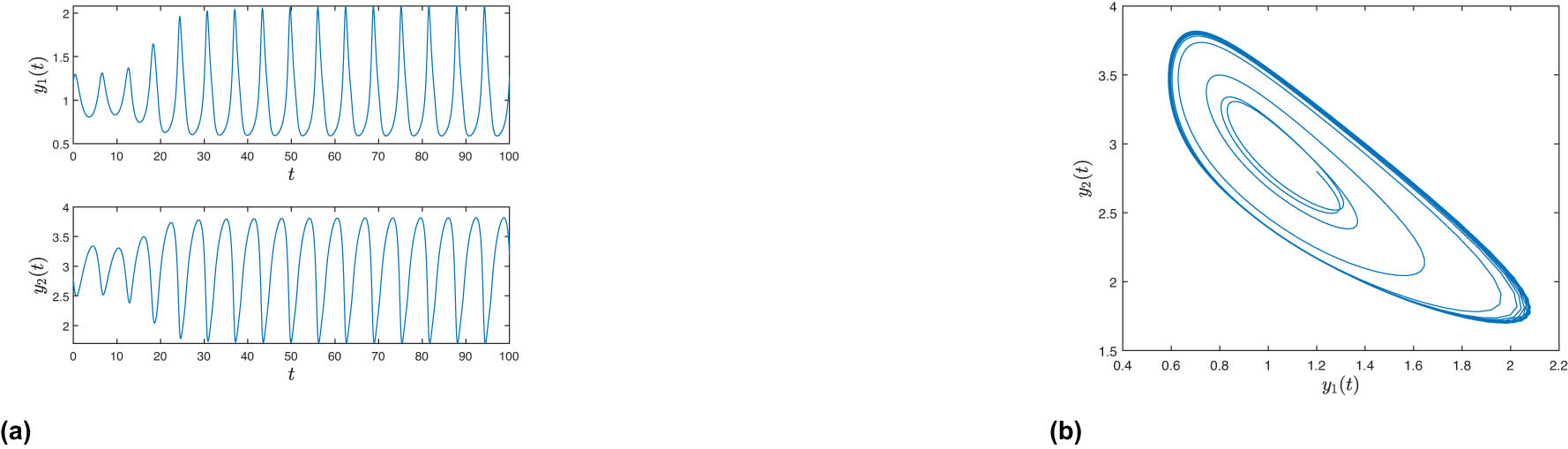
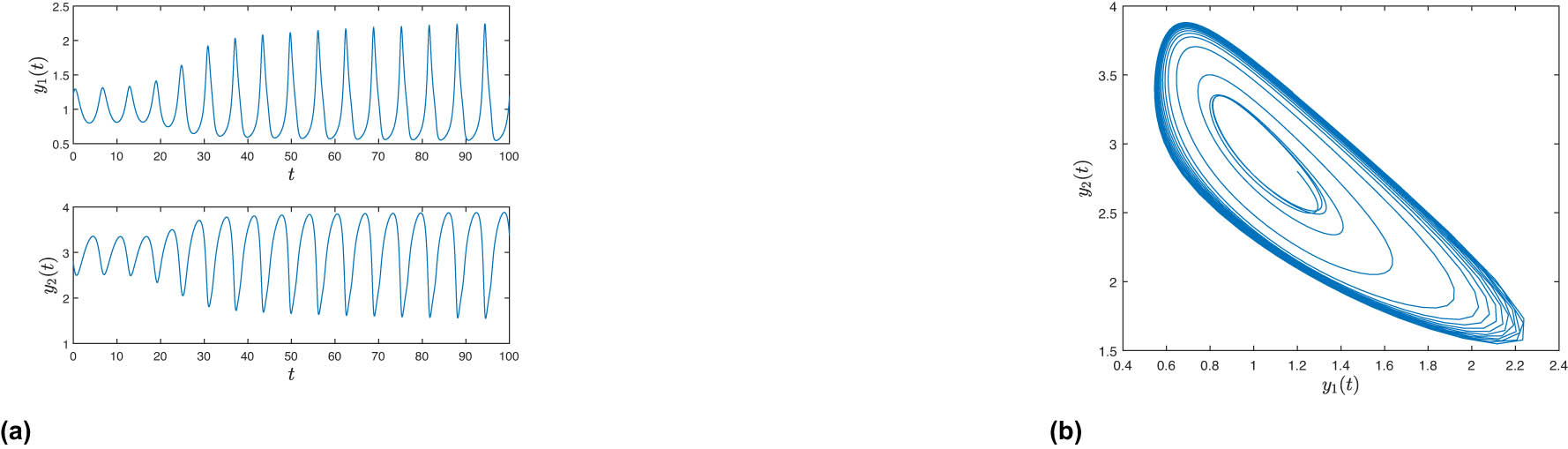
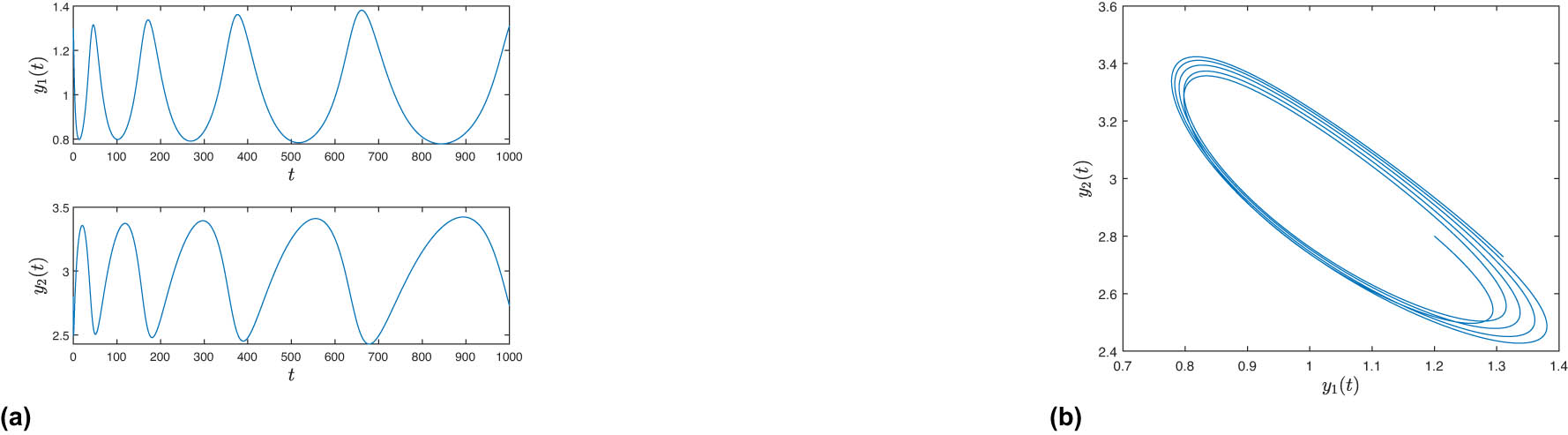
In this example, we cannot know the exact solution of (40). Therefore, we choose the value of ϱ based on Assumption 1 and the value of r based on Theorem 4.5. In addition, we present the numerical simulations with different r and two kernels as Ψ 1 ( t ) t and Ψ 2 ( t ) t with α = 0.7 .

For the case of Ψ ( t ) = t , Figures 1 and 2 represent the behavior of the numerical solution for the Brusselator system (40) with r = 1 and r = 1.5 , respectively.

Figure 1 
               Behavior of the numerical solution for the system (40) with 


                           Ψ
                           
                              (
                              
                                 t
                              
                              )
                           
                           =
                           t
                        
                        \Psi \left(t)=t
                     
                   and 


                           r
                           =
                           1
                        
                        r=1
                     
                   in the 


                              (
                              
                                 t
                                 ,
                                 
                                    
                                       y
                                    
                                    
                                       1


                                    (
                                    
                                       t
                                    
                                    )
                                 
                              
                              )
                           
                        
                        \left(t,{y}_{1}\left(t))
                     
                   and 


                              (
                              
                                 t
                                 ,
                                 
                                    
                                       y
                                    
                                    
                                       2


                                    (
                                    
                                       t
                                    
                                    )
                                 
                              
                              )
                           
                        
                        \left(t,{y}_{2}\left(t))
                     
                   planes and in the phase plane, respectively.
Figure 1

Behavior of the numerical solution for the system (40) with Ψ ( t ) = t and r = 1 in the ( t , y 1 ( t ) ) and ( t , y 2 ( t ) ) planes and in the phase plane, respectively.

Figure 2 
               Behavior of the numerical solution for the system (40) with 


                           Ψ
                           
                              (
                              
                                 t
                              
                              )
                           
                           =
                           t
                        
                        \Psi \left(t)=t
                     
                   and 


                           r
                           =
                           1.5
                        
                        r=1.5
                     
                   in the 


                              (
                              
                                 t
                                 ,
                                 
                                    
                                       y
                                    
                                    
                                       1


                                    (
                                    
                                       t
                                    
                                    )
                                 
                              
                              )
                           
                        
                        \left(t,{y}_{1}\left(t))
                     
                   and 


                              (
                              
                                 t
                                 ,
                                 
                                    
                                       y
                                    
                                    
                                       2


                                    (
                                    
                                       t
                                    
                                    )
                                 
                              
                              )
                           
                        
                        \left(t,{y}_{2}\left(t))
                     
                   planes and in the phase plane, respectively.
Figure 2

Behavior of the numerical solution for the system (40) with Ψ ( t ) = t and r = 1.5 in the ( t , y 1 ( t ) ) and ( t , y 2 ( t ) ) planes and in the phase plane, respectively.

In this case, we find that the behavior of Figure 1 is in agreement with the work of Garrappa [27].

For the case of Ψ ( t ) = t , Figures 3 and 4 represent the behavior of the numerical solution for the Brusselator system (40) with value of r = 1 and r = 1.5 , respectively.
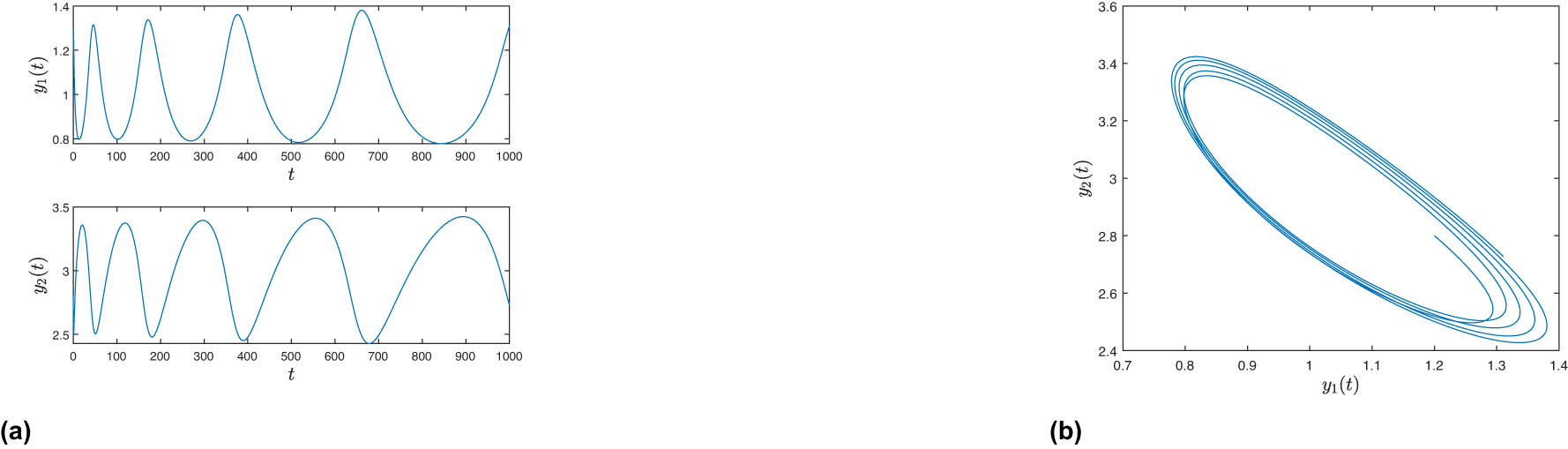
Figure 3 
               Behavior of the numerical solution for the system (40) with 


                           Ψ
                           
                              (
                              
                                 t
                              
                              )
                           
                           =
                           
                              
                                 t


                        \Psi \left(t)=\sqrt{t}
                     
                   and 


                           r
                           =
                           1
                        
                        r=1
                     
                   in the 


                              (
                              
                                 t
                                 ,
                                 
                                    
                                       y
                                    
                                    
                                       1


                                    (
                                    
                                       t
                                    
                                    )
                                 
                              
                              )
                           
                        
                        \left(t,{y}_{1}\left(t))
                     
                   and 


                              (
                              
                                 t
                                 ,
                                 
                                    
                                       y
                                    
                                    
                                       2


                                    (
                                    
                                       t
                                    
                                    )
                                 
                              
                              )
                           
                        
                        \left(t,{y}_{2}\left(t))
                     
                   planes and in the phase plane at 


                           T
                           =
                           
                              
                              1,000


                        T=\hspace{0.1em}\text{1,000}\hspace{0.1em}
                     
                  , respectively.
Figure 3

Behavior of the numerical solution for the system (40) with Ψ ( t ) = t and r = 1 in the ( t , y 1 ( t ) ) and ( t , y 2 ( t ) ) planes and in the phase plane at T = 1,000 , respectively.

Figure 4 
               Behavior of the numerical solution for the system (40) with 


                           Ψ
                           
                              (
                              
                                 t
                              
                              )
                           
                           =
                           
                              
                                 t


                        \Psi \left(t)=\sqrt{t}
                     
                   and 


                           r
                           =
                           1.5
                        
                        r=1.5
                     
                   in the 


                              (
                              
                                 t
                                 ,
                                 
                                    
                                       y
                                    
                                    
                                       1


                                    (
                                    
                                       t
                                    
                                    )
                                 
                              
                              )
                           
                        
                        \left(t,{y}_{1}\left(t))
                     
                   and 


                              (
                              
                                 t
                                 ,
                                 
                                    
                                       y
                                    
                                    
                                       2


                                    (
                                    
                                       t
                                    
                                    )
                                 
                              
                              )
                           
                        
                        \left(t,{y}_{2}\left(t))
                     
                   planes and in the phase plane at 


                           T
                           =
                           
                              
                              1,000


                        T=\hspace{0.1em}\text{1,000}\hspace{0.1em}
                     
                  , respectively.
Figure 4

Behavior of the numerical solution for the system (40) with Ψ ( t ) = t and r = 1.5 in the ( t , y 1 ( t ) ) and ( t , y 2 ( t ) ) planes and in the phase plane at T = 1,000 , respectively.

6 Discussion and conclusion

In order to solve the nonlinear Ψ -Caputo fractional-order differential systems with order 0 < α < 1 , the predictor–corrector scheme with graded mesh is proposed in this article. The smoothness properties of the solution to equation (6) are also reviewed and discussed to help the proof of error estimation. After that, the error estimation on the fractional rectangle and fractional trapezoidal schemes with uniform ( r = 1 ) and graded meshes ( r 1 ) have been made. It is found that the error estimation of the proposed scheme depends on the order of fractional derivative, the partition size on graded mesh, and the value of r . Based on the various functions of Ψ and the different values of α , N , and r , the utility and accuracy of numerical solutions on Examples 1 and 2 was investigated to support the theoretical analysis of predictor–corrector scheme. We found that the truncation error of predictor–corrector scheme with graded mesh has better convergence than the case of uniform mesh. For the case Ψ ( t ) = log t in Example 1, the maximum absolute error is in agreement with the numerical results of [25]. Moreover, the behaviors of numerical solution for the case Ψ ( t ) = log t in Example 3 are also in agreement with the results of [27]. All tables and figures indicate that our suggested scheme performed particularly well. Additionally, choosing the value of r for graded mesh depends on the error estimation in Theorem 4.5, whereas the choice of function Ψ ( t ) depends on nonlinear term and initial condition. A general way to determine these parameters is not known. The optimal choice for the parameter r and the function Ψ ( t ) is still open for further investigation.

Acknowledgement

The authors would like to thank the referees for their comments and suggestions which helped in improving the quality of the manuscript.

  1. Funding information: This research project was supported by Thailand Science Research and Innovation (TSRI) Basic Research Fund: Fiscal year 2023 under project number FRB660073/0164.

  2. Author contributions: The main idea of this work was proposed and mainly proved by P.S.N, while D.S. performed some proofs and provided some examples. All authors read and approved the final manuscript.

  3. Conflict of interest: The authors state no conflict of interest.

References

[1] H. Sun, Y. Zhang, D. Baleanu, W. Chen, and Y. Chen, A new collection of real world applications of fractional calculus in science and engineering, Commun. Nonlinear Sci. Numer. Simul. 64 (2018), 213–231. 10.1016/j.cnsns.2018.04.019Search in Google Scholar

[2] P. Yi-Fei, Fractional differential analysis for texture of digital image, J. Algorithms Comput. Technol. 1 (2007), no. 3, 357–380. 10.1260/174830107782424075Search in Google Scholar

[3] C. M. Pinto and A. R. Carvalho, The HIV/TB coinfection severity in the presence of TB multi-drug resistant strains, Ecol. Complex. 32 (2017), 1–20. 10.1016/j.ecocom.2017.08.001Search in Google Scholar

[4] W. Chen, J. Zhang, and J. Zhang, A variable-order time-fractional derivative model for chloride ions sub-diffusion in concrete structures, Fract. Calc. Appl. Anal. 16 (2013), no. 1, 76–92. 10.2478/s13540-013-0006-ySearch in Google Scholar

[5] V. V. Tarasova and V. E. Tarasov, Concept of dynamic memory in economics, Commun. Nonlinear Sci. Numer. Simul. 55 (2018), 127–145. 10.1016/j.cnsns.2017.06.032Search in Google Scholar

[6] R. Garrappa, F. Mainardi, and M. Guido, Models of dielectric relaxation based on completely monotone functions, Fract. Calc. Appl. Anal. 19 (2016), no. 5, 1105–1160. 10.1515/fca-2016-0060Search in Google Scholar

[7] F. Jarad, T. Abdeljawad, and D. Baleanu, Caputo-type modification of the Hadamard fractional derivatives, Adv. Differential Equations 1 (2012), 1–8. 10.1186/1687-1847-2012-142Search in Google Scholar

[8] A. A. Kilbas, Hari M. Srivastava, and J. J. Trujillo, Theory and Applications of Fractional Differential Equations, North-Holland Mathematics Studies, Vol. 204, Elsevier Science Inc., New York, 2006. Search in Google Scholar

[9] Y. Luchko and J. Trujillo, Caputo-type modification of the Erdélyi-Kober fractional derivative, Fract. Calc. Appl. Anal. 10 (2007), no. 3, 249–267. Search in Google Scholar

[10] S. G. Samko, A. A. Kilbas, and O. I. Marichev, Fractional Integrals and Derivatives, Gordon and Breach Science Publishers, Amsterdam, 1993. Search in Google Scholar

[11] R. Almeida, A Caputo fractional derivative of a function with respect to another function, Commun. Nonlinear Sci. Numer. Simul. 44 (2017)460–481. 10.1016/j.cnsns.2016.09.006Search in Google Scholar

[12] R. Almeida, A. B. Malinowska, and M. T. T. Monteiro, Fractional differential equations with a Caputo derivative with respect to a kernel function and their applications, Math. Methods Appl. Sci. 41 (2018), no. 1, 336–352. 10.1002/mma.4617Search in Google Scholar

[13] R. Almeida, M. Jleli, and B. Samet, A numerical study of fractional relaxation-oscillation equations involving ψ-Caputo fractional derivative, Rev. R. Acad. Cienc. Exactas Fís. Nat. Ser. A Mat. RACSAM 113 (2019), no. 3, 1873–1891. 10.1007/s13398-018-0590-0Search in Google Scholar

[14] C. Derbazi, Z. Baitiche, M. Benchohra, and A. Cabada, Initial value problem for nonlinear fractional differential equations with ψ-Caputo derivative via monotone iterative technique, Axioms 9 (2020), no. 2, 57. 10.3390/axioms9020057Search in Google Scholar

[15] A. Suechoei and P. S. Ngiamsunthorn, Extremal solutions of φ-Caputo fractional evolution equations involving integral kernels, AIMS Math. 6 (2021), no. 5, 4734–4757. 10.3934/math.2021278Search in Google Scholar

[16] R. Almeida, A. B. Malinowska, and T. Odzijewicz, On systems of fractional differential equations with the ψ-Caputo derivative and their applications, Math. Methods Appl. Sci. 44 (2021), no. 10, 8026–8041. 10.1002/mma.5678Search in Google Scholar

[17] M. A. Zaitri, H. Zitane, and D. F. Torres, Pharmacokinetic/Pharmacodynamic anesthesia model incorporating psi-Caputo fractional derivatives, Comput. Biol. Med. 167 (2023), 107679. 10.1016/j.compbiomed.2023.107679Search in Google Scholar PubMed

[18] K. Diethelm, N. J. Ford, and A. D. Freed, A predictor–corrector approach for the numerical solution of fractional differential equations, Nonlinear Dyn. 29 (2002), no. 1, 3–22. 10.1023/A:1016592219341Search in Google Scholar

[19] C. Li and F. Zeng, The finite difference methods for fractional ordinary differential equations, Numer. Funct. Anal. Optim. 34 (2013), no. 2, 149–179. 10.1080/01630563.2012.706673Search in Google Scholar

[20] K. Pal, F. Liu, and Y. Yan, Numerical solutions of fractional differential equations by extrapolation, in: I. Dimov, I. Faragó, L. Vulkov (Eds.), Finite Difference Methods, Theory and Applications, FDM 2014, Lecture Notes in Computer Science, vol. 9045, Springer, Cham, 2014, pp. 299–306. 10.1007/978-3-319-20239-6_32Search in Google Scholar

[21] W. Qiu, O. Nikan, and Z. Avazzadeh, Numerical investigation of generalized tempered-type integro-differential equations with respect to another function, Fract. Calc. Appl. Anal. 26 (2023), no. 6, 2580–2601. 10.1007/s13540-023-00198-5Search in Google Scholar

[22] Y. Liu, J. Roberts, and Y. Yan, Detailed error analysis for a fractional Adams method with graded meshes, Numer. Algorithms 78 (2018), no. 4, 1195–1216. 10.1007/s11075-017-0419-5Search in Google Scholar

[23] D. Songsanga and P. S. Ngiamsunthorn, Single-step and multi-step methods for Caputo fractional-order differential equations with arbitrary kernels, AIMS Math. 7 (2022), no. 8, 15002–15028. 10.3934/math.2022822Search in Google Scholar

[24] K. Diethelm, Smoothness properties of solutions of Caputo-type fractional differential equations, Fract. Calc. Appl. Anal. 10 (2007), no. 2, 151–160. Search in Google Scholar

[25] C. W. H. Green, Y. Liu, and Y. Yan, Numerical methods for Caputo-Hadamard fractional differential equations with graded and non-uniform meshes, Mathematics 9 (2021), no. 21, 2728. 10.3390/math9212728Search in Google Scholar

[26] M. Stynes, E. O’Riordan, and J. L. Gracia, Error analysis of a finite difference method on graded meshes for a time-fractional diffusion equation, SIAM J. Numer. Anal. 55 (2017), no. 2, 1057–1079. 10.1137/16M1082329Search in Google Scholar

[27] R. Garrappa, Numerical solution of fractional differential equations: A survey and a software tutorial, Mathematics 6 (2018), no. 2, 16. 10.3390/math6020016Search in Google Scholar

Received: 2023-06-27
Revised: 2024-10-17
Accepted: 2025-01-15
Published Online: 2025-02-25

© 2025 the author(s), published by De Gruyter

This work is licensed under the Creative Commons Attribution 4.0 International License.

Articles in the same Issue

  1. On I-convergence of nets of functions in fuzzy metric spaces
  2. Special Issue on Contemporary Developments in Graphs Defined on Algebraic Structures
  3. Forbidden subgraphs of TI-power graphs of finite groups
  4. Finite group with some c#-normal and S-quasinormally embedded subgroups
  5. Classifying cubic symmetric graphs of order 88p and 88p 2
  6. Two-sided zero-divisor graphs of orientation-preserving and order-decreasing transformation semigroups
  7. Simplicial complexes defined on groups
  8. Further results on permanents of Laplacian matrices of trees
  9. Algebra
  10. Classes of modules closed under projective covers
  11. On the dimension of the algebraic sum of subspaces
  12. Green's graphs of a semigroup
  13. On an uncertainty principle for small index subgroups of finite fields
  14. On a generalization of I-regularity
  15. Algorithm and linear convergence of the H-spectral radius of weakly irreducible quasi-positive tensors
  16. The hyperbolic CS decomposition of tensors based on the C-product
  17. On weakly classical 1-absorbing prime submodules
  18. Equational characterizations for some subclasses of domains
  19. Algebraic Geometry
  20. Spin(8, ℂ)-Higgs bundles fixed points through spectral data
  21. Embedding of lattices and K3-covers of an Enriques surface
  22. Kodaira-Spencer maps for elliptic orbispheres as isomorphisms of Frobenius algebras
  23. Applications in Computer and Information Sciences
  24. Dynamics of particulate emissions in the presence of autonomous vehicles
  25. Exploring homotopy with hyperspherical tracking to find complex roots with application to electrical circuits
  26. Category Theory
  27. The higher mapping cone axiom
  28. Combinatorics and Graph Theory
  29. 𝕮-inverse of graphs and mixed graphs
  30. On the spectral radius and energy of the degree distance matrix of a connected graph
  31. Some new bounds on resolvent energy of a graph
  32. Coloring the vertices of a graph with mutual-visibility property
  33. Ring graph induced by a ring endomorphism
  34. A note on the edge general position number of cactus graphs
  35. Complex Analysis
  36. Some results on value distribution concerning Hayman's alternative
  37. Freely quasiconformal and locally weakly quasisymmetric mappings in metric spaces
  38. A new result for entire functions and their shifts with two shared values
  39. On a subclass of multivalent functions defined by generalized multiplier transformation
  40. Singular direction of meromorphic functions with finite logarithmic order
  41. Growth theorems and coefficient bounds for g-starlike mappings of complex order λ
  42. Refinements of inequalities on extremal problems of polynomials
  43. Control Theory and Optimization
  44. Averaging method in optimal control problems for integro-differential equations
  45. On superstability of derivations in Banach algebras
  46. The robust isolated calmness of spectral norm regularized convex matrix optimization problems
  47. Observability on the classes of non-nilpotent solvable three-dimensional Lie groups
  48. Differential Equations
  49. The ill-posedness of the (non-)periodic traveling wave solution for the deformed continuous Heisenberg spin equation
  50. A note on the global existence and boundedness of an N-dimensional parabolic-elliptic predator-prey system with indirect pursuit-evasion interaction
  51. Blow-up of solutions for Euler-Bernoulli equation with nonlinear time delay
  52. Periodic or homoclinic orbit bifurcated from a heteroclinic loop for high-dimensional systems
  53. Regularity of weak solutions to the 3D stationary tropical climate model
  54. Local minimizers for the NLS equation with localized nonlinearity on noncompact metric graphs
  55. Global existence and blow-up of solutions to pseudo-parabolic equation for Baouendi-Grushin operator
  56. Bubbles clustered inside for almost-critical problems
  57. Existence and multiplicity of positive solutions for multiparameter periodic systems
  58. Existence of positive periodic solutions for evolution equations with delay in ordered Banach spaces
  59. On a nonlinear boundary value problems with impulse action
  60. Normalized ground-states for the Sobolev critical Kirchhoff equation with at least mass critical growth
  61. Multiple positive solutions to a p-Kirchhoff equation with logarithmic terms and concave terms
  62. Infinitely many solutions for a class of Kirchhoff-type equations
  63. Real and non-real eigenvalues of regular indefinite Sturm–Liouville problems
  64. Existence of global solutions to a semilinear thermoelastic system in three dimensions
  65. Limiting profile of positive solutions to heterogeneous elliptic BVPs with nonlinear flux decaying to negative infinity on a portion of the boundary
  66. Morse index of circular solutions for repulsive central force problems on surfaces
  67. Differential Geometry
  68. On tangent bundles of Walker four-manifolds
  69. Pedal and negative pedal surfaces of framed curves in the Euclidean 3-space
  70. Discrete Mathematics
  71. Eventually monotonic solutions of the generalized Fibonacci equations
  72. Dynamical Systems Ergodic Theory
  73. Dynamical properties of two-diffusion SIR epidemic model with Markovian switching
  74. A note on weighted measure-theoretic pressure
  75. Pullback attractors for a class of second-order delay evolution equations with dispersive and dissipative terms on unbounded domain
  76. Pullback attractor of the 2D non-autonomous magneto-micropolar fluid equations
  77. Functional Analysis
  78. Spectrum boundary domination of semiregularities in Banach algebras
  79. Approximate multi-Cauchy mappings on certain groupoids
  80. Investigating the modified UO-iteration process in Banach spaces by a digraph
  81. Tilings, sub-tilings, and spectral sets on p-adic space
  82. Continuity and essential norm of operators defined by infinite tridiagonal matrices in weighted Orlicz and l spaces
  83. A family of commuting contraction semigroups on l 1 ( N ) and l ( N )
  84. q-Stirling sequence spaces associated with q-Bell numbers
  85. Chlodowsky variant of Bernstein-type operators on the domain
  86. Hyponormality on a weighted Bergman space of an annulus with a general harmonic symbol
  87. Characterization of derivations on strongly double triangle subspace lattice algebras by local actions
  88. Fixed point approaches to the stability of Jensen’s functional equation
  89. Geometry
  90. The regularity of solutions to the Lp Gauss image problem
  91. Solving the quartic by conics
  92. Group Theory
  93. On a question of permutation groups acting on the power set
  94. A characterization of the translational hull of a weakly type B semigroup with E-properties
  95. Harmonic Analysis
  96. Eigenfunctions on an infinite Schrödinger network
  97. Maximal function and generalized fractional integral operators on the weighted Orlicz-Lorentz-Morrey spaces
  98. Subharmonic functions and associated measures in ℝn
  99. Mathematical Logic, Model Theory and Foundation
  100. A topology related to implication and upsets on a bounded BCK-algebra
  101. Boundedness of fractional sublinear operators on weighted grand Herz-Morrey spaces with variable exponents
  102. Number Theory
  103. Fibonacci vector and matrix p-norms
  104. Recurrence for probabilistic extension of Dowling polynomials
  105. Carmichael numbers composed of Piatetski-Shapiro primes in Beatty sequences
  106. The number of rational points of some classes of algebraic varieties over finite fields
  107. Classification and irreducibility of a class of integer polynomials
  108. Decompositions of the extended Selberg class functions
  109. Joint approximation of analytic functions by the shifts of Hurwitz zeta-functions in short intervals
  110. Fibonacci Cartan and Lucas Cartan numbers
  111. Recurrence relations satisfied by some arithmetic groups
  112. The hybrid power mean involving the Kloosterman sums and Dedekind sums
  113. Numerical Methods
  114. A modified predictor–corrector scheme with graded mesh for numerical solutions of nonlinear Ψ-caputo fractional-order systems
  115. A kind of univariate improved Shepard-Euler operators
  116. Probability and Statistics
  117. Statistical inference and data analysis of the record-based transmuted Burr X model
  118. Multiple G-Stratonovich integral in G-expectation space
  119. p-variation and Chung's LIL of sub-bifractional Brownian motion and applications
  120. Real Analysis
  121. Chebyshev polynomials of the first kind and the univariate Lommel function: Integral representations
  122. Multiple solutions for a class of fourth-order elliptic equations with critical growth
  123. Majorization-type inequalities for (m, M, ψ)-convex functions with applications
  124. The evaluation of a definite integral by the method of brackets illustrating its flexibility
  125. Some new Fejér type inequalities for (h, g; α - m)-convex functions
  126. Some new Hermite-Hadamard type inequalities for product of strongly h-convex functions on ellipsoids and balls
  127. Topology
  128. Unraveling chaos: A topological analysis of simplicial homology groups and their foldings
  129. A generalized fixed-point theorem for set-valued mappings in b-metric spaces
  130. On SI2-convergence in T0-spaces
  131. Generalized quandle polynomials and their applications to stuquandles, stuck links, and RNA folding
Downloaded on 20.1.2026 from https://www.degruyterbrill.com/document/doi/10.1515/math-2024-0127/html
Scroll to top button