The prosodic marking of discourse functions: German genau ‘exactly’ between confirming propositions and resuming actions
-
Pia Bergmann
 und
Alexandra Groß
und
Alexandra Groß


Abstract
This article describes conversational functions of the turn-constructional-unit-initial (TCU-initial) German genau ‘exactly’ in relation to its prosodic realization. Prior research has shown that genau is prominently used as a confirming response particle or marker of recipiency. In its confirmatory function, it may also occur as a sequence-structuring device in that it closes disaligned sequences in order to foster the transition to the main line of talk. Based on an interactional study of 113 instances of genau in a range of mundane and institutional contexts taken from the Research and Teaching Corpus of Spoken German (FOLK), this contribution shows that the confirmatory function of genau in contexts of sequential disruption may be shifted to using it as an initial discourse marker. In this use, genau does not confirm a proposition in question but connects a suspended sequential path to the upcoming line of talk. We show that this resumptive function of genau is transferred to sequential contexts where no side sequences occur, leading to a connective use of the element. This process of integration from a response particle to a TCU-initial discourse marker is linked to prosodic changes in the realization of genau: It will be shown that differences in the perceived prosodic (dis)integration reflect the speakers’ practices of signalling if genau should be understood as either confirming a prior turn or rather projecting the upcoming turn to be complementing an established path of action. Perceptual ambiguity and variation are discussed to be an integral part of participant-focused conceptions of prosodic units.
1 Introduction
Many ways of using genau ‘exactly’ have been described in prior studies (Willkop 1988, Werlen 2010, Oloff 2017, Auer 2021a). While the confirmatory function of genau in responsive or reactive turns seems to be prototypical for its use in talk-in-interaction, Oloff (2017) and Auer (2021a) have also indicated that genau (a) may occur turn-initially, not only in responsive but also in sequence-initial position, and (b) that it may also be used as a turn-internal discourse marker for structuring sequences as well as multi-unit turns.[1] Based on their observations, we describe uses of initial genau that exhibit a pragmatic shift from performing an autonomous responsive action to an initial discourse marker[2] that primarily resumes and connects spates of talk while not confirming a proposition.
The following introductory example 1 gives an impression of this projective use of genau, which we will be focussing on in this study. In a multiparty interaction of a student theatre group, the interlocutors talk about the characters of their theatre play and how they relate to each other. After having finished talking about a male character (not shown), MA brings up the next character to discuss which is connected to the foregoing sequence by the initial resumptive und ‘and’ (l. 16). Having already displayed problems to recall the character’s name properly in line 16, MA then initiates a repair sequence (l. 19) and requests information on how they had decided to name the character (l. 21).[3] [4]
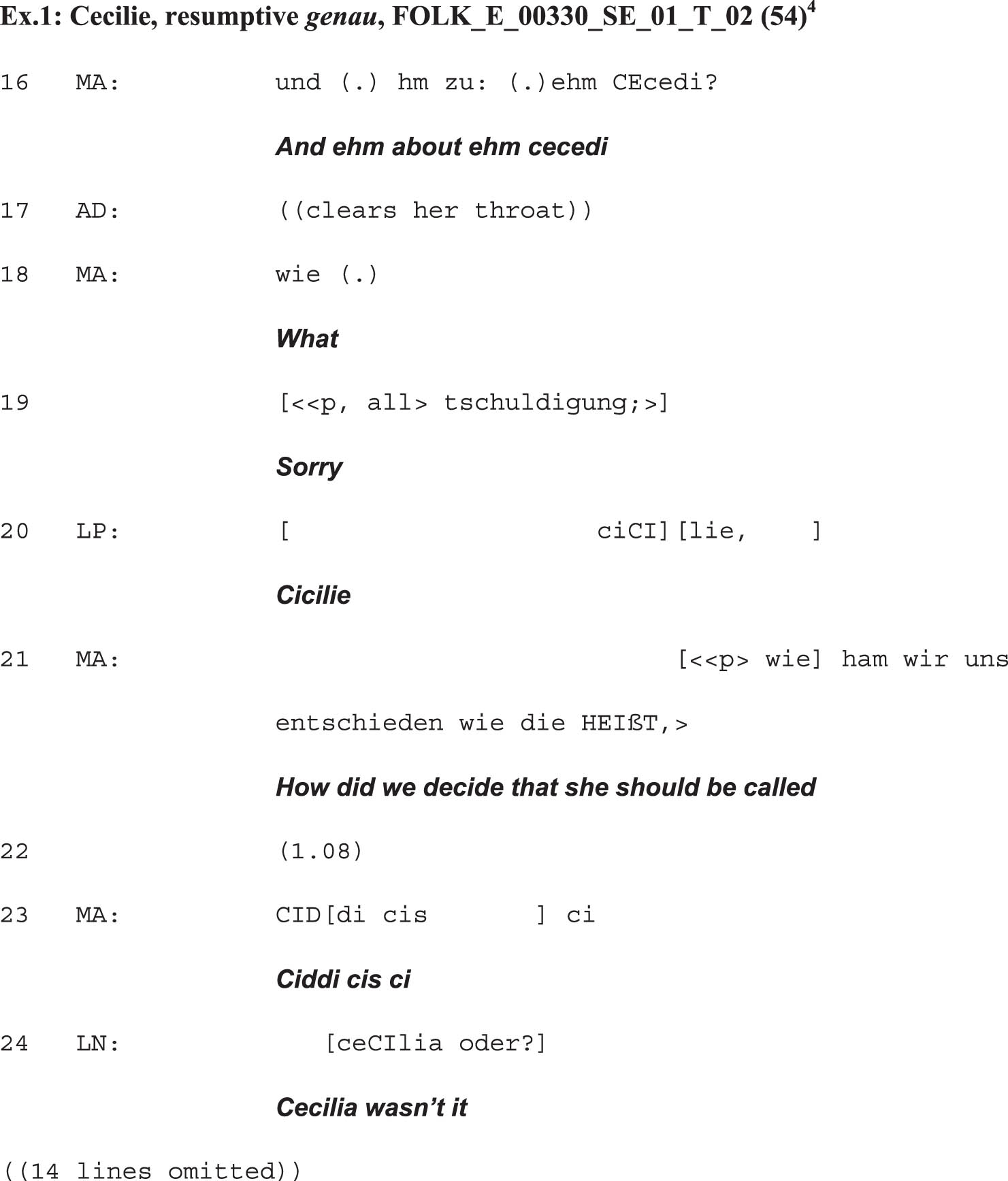
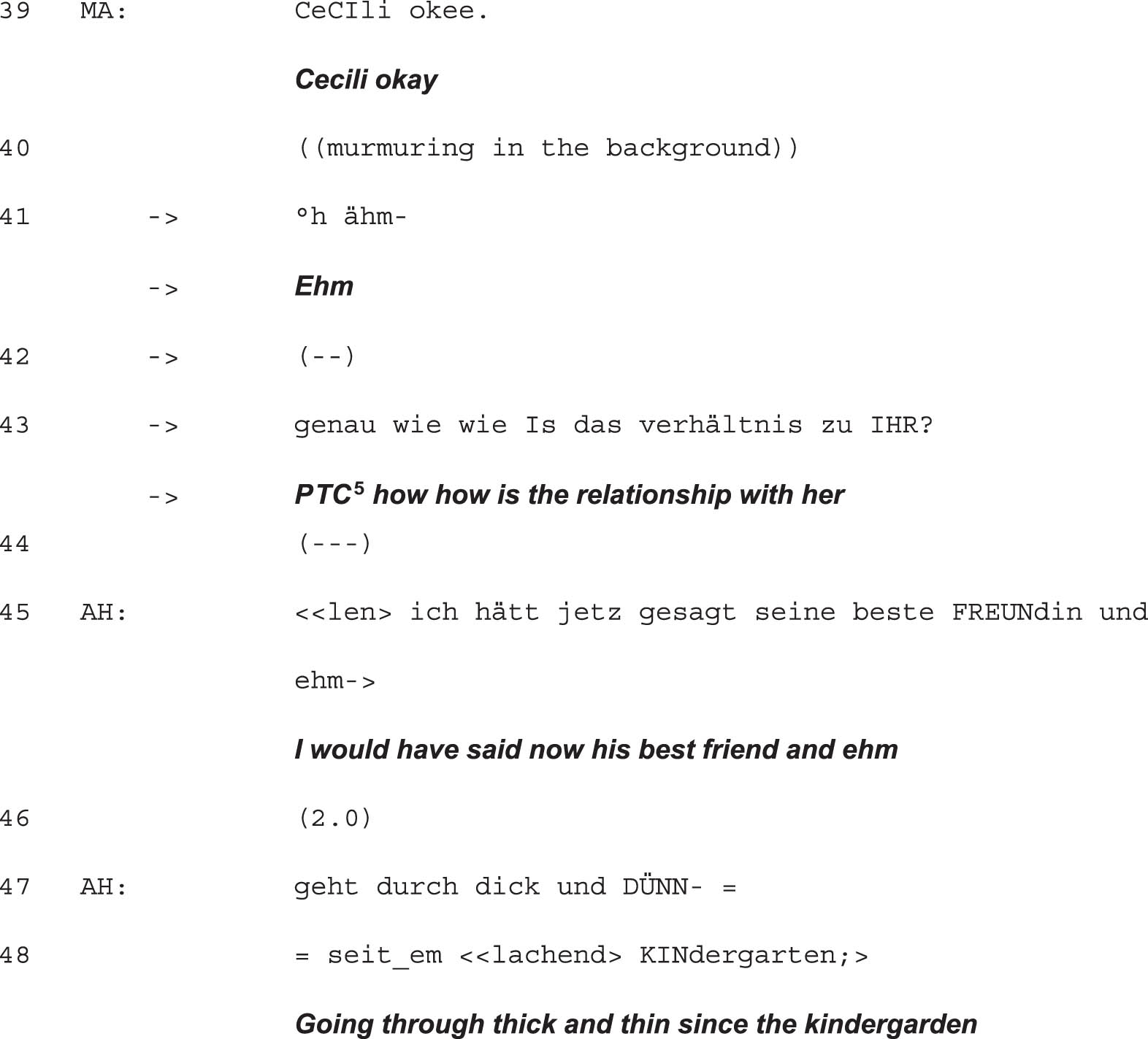
After another unsuccessful attempt[5] to articulate the name (l. 23) in overlap with a candidate response by LN in line 24, several interlocutors produce (humorous) variants of the name Cecilie, which we omitted here. MA then produces another modification (l. 39), whereafter the sequence comes to a closure. In line 41, MA again takes the turn while prefacing it with ehm and a pause (0.63 s, l. 42) and then produces a turn-constructional-unit-initial (TCU-initial) genau before requesting information about Cecilie’s relation to her male co-character (l. 43). We argue that genau is used here to reopen the abandoned activity of determining the characters’ relationships. Genau therefore adopts a sequence-structuring function but in a way that hasn’t been described in previous studies, as it occurs after the closure of the previous sequence, i.e. detached from a sequential requirement to perform a confirmatory move. Genau links the upcoming TCU(s) to the abandoned sequential path, i.e. re-initiates the action of finding out how Cecilie is related to the character they had talked about before and thereby exhibits a mainly prospective orientation. Regarding its prosodic design, MA’s genau is produced in a high speech rate, which contributes to the perception of prosodic integration with the rest of her turn (we refer to Section 6.2.3/Figure 7 for more details on the prosody of this example). This makes it accountable (Robinson 2016) to the interlocutors that genau is not used to perform a confirmatory response. However, a retrospective function persists in that the interlocutors treat the sequence as completed.
The above-described resumptive function of genau is exemplary for pragmatic developments of lexical elements that undergo a grammaticalization process of integration from a stand-alone response particle to a TCU-initial discourse marker (Auer 1996, 2021a, see also Mazeland and Huiskes 2001, for a resumptive function of Dutch maar ‘but’). As the central aims of this study are to trace pragmatic changes of genau as well as linking them to prosodic modifications in the production of the element, we first give a brief overview of prior research on pragmatic developments of conversational markers and on the role of prosody in distinguishing between different functions (Section 2). Against this background, the functions of genau as described in prior studies will be recalled in detail (Section 3) before giving a description of the data and methods used for this study (Section 4). We then turn to the results of our study, which are the projective, i.e. resumptive and connective, functions of genau (Section 5) and their relation to the perceived prosodic status of the element (Section 6). A summary and discussion is given in Section 7.
2 Grammaticalization of turn-initial lexical elements and their prosodic realization
In spoken interaction, the initial position in a turn is crucial for the organization of talk. It is the relevant position to signal connectivity to previous talk, as well as expectations for upcoming talk, to regulate turn-taking and other dimensions of interaction (Auer 1996, 310–12, Beeching and Detges 2014, 11–2, Fiehler et al. 2004, 261–8, Heritage and Sorjonen 2018, 1–6, Traugott 2014, 72–3). In many languages, specific particles and phrases have evolved to deal with these functions (e.g. English actually, anyway, in fact, okay, well/German also, ja, jedenfalls, naja, etc., see Mushin et al. 2023 for similar descriptions of Australian Aboriginal languages). Since about the 1980s, many studies have dealt with this phenomenon, e.g. under the term of discourse markers or pragmatic markers (Beeching and Detges 2014, 5–8). Often, these elements have homophones in other lexical classes from which they are supposed to derive. It is because of this connection to homophonous lexemes that discourse markers have been discussed in the context of grammaticalization or pragmaticalization (Auer and Günthner 2005, Traugott 1995), also in approaches of CA and IL (e.g. Auer and Günthner 2005, Barth-Weingarten and Couper-Kuhlen 2002). The connection of the latter to grammaticalization theory (e.g. the contribution by Barth-Weingarten and Couper-Kuhlen 2002 in Diewald and Wischer 2002) thereby builds on a concept of grammar that is extended to the domain of discourse. Following this view, grammaticalization is not only relevant for the development of grammatical morphemes (such as auxiliary verbs) but also for evolving discourse markers which likewise undergo processes of semantic bleaching and extension to other usage contexts (Auer and Günthner 2005, 354–6).
It is worth noting that the pragmatic shift of discourse markers goes along with a positional shift in terms of their utterance-based or turn-related position. In this regard, Auer (1996, 313) suggests two clines that capture two opposite directions of positional movement: For example, English anyway or German jedenfalls are adverbials in utterance medial or utterance final position. Used in TCU- or turn-initial position, however, they assume discourse structuring functions by indicating that the current speaker intends to take up a previously abandoned strand of talk (Bergmann 2024, Ferrara 1997). In cases as such, an integrated element within the inner sentence frame moves to the left periphery and becomes disintegrated in terms of syntax, which is well documented both synchronically and diachronically (Gohl and Günthner 1999, Lenker 2010, Mroczynski 2012, Traugott 2014, Traugott and Dasher 2001, 152–92).
A second cline, which will be relevant for genau ‘exactly’, takes the opposite course: Here, elements which perform an autonomous “sequential move” (Auer 1996, 313–7) become more dependent by developing from a stand-alone, disintegrated, into an integrated initial element prefacing a turn or TCU. The cases under this second positional shift therefore reveal a loss of autonomy which is one aspect of grammaticalization processes (Lehmann 2002): “Grammaticalization on the interaction-to-grammar cline is … involved when structures typically used in conversation for responsive moves … are re-categorized as projecting, pre-front field structures.” (Auer 1996, 315). Stand-alone responsive particles such as yes, no, okay, gut ‘good’, sure are a case in point that can adopt typical discourse marker functions of foreshadowing specific continuations. It is this second cline that becomes relevant for the functional variation we encounter in contemporary German genau ‘exactly’ as will be shown in Sections 3 and 5.
In our article, we take up the thought of (turn-initial) elements moving along these clines in the process of grammaticalization/pragmaticalization. We show how different functions of genau are linked to one another forming intermediate stages between retrospective confirmation and prospective connection. In these intermediate stages, the sequential position, i.e. the context of genau gradually disfavours a reading of genau as backwardly oriented confirmation and emphasizes a projective reading instead. In this sense, we argue for a cline of several, related functions of genau. We then ask whether or how the prosodic realization of genau is related to the movement along the cline.
The general picture regarding the prosody of discourse markers in the context of grammaticalization is quite confusing. Some studies point to prosodic weakening of discourse markers (Arens 2023, Betz 2017, Dehé and Stathi 2016, Wichmann et al. 2010), others show prosodic strengthening (Auer 1996, Bergmann 2024, Barden et al. 2001, Fiehler et al. 2004, Ferrara 1997, Sohn and Kim 2014). Again, we apply the two clines introduced above to this unclear picture, and we suggest that the elements on the two clines behave differently in terms of their prosodic realization. For the second cline – from stand-alone to TCU-initial/turn-initial – we expect a loss in prosodic strength. This loss in prosodic strength for cline 2-elements is borne out by e.g. Arens (2023) on German gut ‘good’ or by Betz (2017) for a response particle similar to genau, i.e. German ja ‘yes’: While performing an affirmative move when being used responsively (e.g. Imo 2013), ja in its initial use only marks formal coherence to the foregoing conduct while primarily projecting a follow-up turn that is dispreferred or lies outside the expected responsive range of the question (Betz 2017, 183). Betz finds that the prospective, non-affirmative use of ja exhibits a loss of prosodic autonomy, i.e. it is realized as part of the following intonation unit. For respective functions of genau, Oloff (2017, 228) observes that “[t]he more genau is used for confirming responsively, the more it is pronounced with a clear accent on the 2nd syllable and a middle-falling intonation. The more genau is used for closing respectively structuring sequences, the more it is pronounced minimally, faster and with level intonation.” (translated by the authors) Results such as these are consistent with further studies that find prosodic weakening and prosodic integration of an element to be indicative of different discourse functions in general and of retro- vs prospective orientation in particular (Barden et al. 2001, Ford et al. 2004, Szczepek Reed 2015, Barth-Weingarten and Ogden 2021, Couper-Kuhlen 2021, Bergmann 2022, Arens 2023).
Against this backdrop, our study addresses the prosodic realization of genau along the cline of discourse functions from confirmatory responsive to turn-initial connective. To do so, our study takes into account prosodic characteristics of genau as well as boundary-marking phonetic parameters towards the subsequent syllables (Section 4). We find the prosodic design of genau to reveal an increasing and gradual loss of prosodic autonomy and integration into the following stretch of talk by the same speaker. Our analyses thereby acknowledge cases of ambiguity and doubt regarding the prosodic autonomy of genau, both in terms of individual perception and interrater agreement. It will be argued that prosodic ambiguity is systematically linked to the stepwise development of projective discourse functions of genau.
3 Genau for performing confirmations and structuring sequences
Before looking at uses of genau as (part of) a conversational action, we take a brief look at its fundamental structural characteristics, i.e. its sentence-based grammatical functions. Regarding this genau is considered an adjective: Like in the following noun phrase das genaue Datum ‘The exact date’, it can be inflected as well as put into comparative, like in der genaueste Rechner ‘the most exact calculator’. DUDEN online lists two lexical meanings of genau, being ‘thoroughly in detail’ and ‘consistent with a reference value’ (translated by the authors). The latter meaning is usually linked to its second grammatical function of a focus particle, as in Genau so ist es ‘That’s exactly how it is’ (DUDEN Das große Wörterbuch der Deutschen Sprache) (1999, 1453, see also Altmann 1978, 45) which already leads us to prototypical contexts of stand-alone genau in conversation: It prominently occurs within (the beginning of) responsive turns. In line with Altmann (1978) and König (1991), Werlen (2010) sees the development of the focus particle genau in clause-shaped utterances as a preconditional for developing its responsive use as a stand-alone confirmation particle, which is seen as an elliptical form of the former. While also a simple ja ‘yes’ can perform this function of a Responsiv (Zifonun et al. 1997; Ehlich 2009, 437), the use of genau is more constrained to requests for confirmations, informings or statements and less common in response to requests for information. Genau is further characterized by a higher emphasis than a mere ja: By using genau the respondent displays strong agreement with the interlocutor’s proposed state of affairs. The latter can be either a fact-alike confirmable (Betz et al. 2013, 138) or an opinion which the genau-speaker completely agrees with (see Willkop 1988; Oloff 2017, 210). In the case the genau-producer responds to informings or requests for confirmation, genau might indicate epistemic negotiations in that it confirms while claiming an at least equal, if not superior, epistemic access to the matter at hand.
Example 2 illustrates this prototypical confirming use of genau (for further examples in different sequence types see Oloff 2017, 215–8). The extract is taken from an interaction of two colleagues in kindergarten who reflect on how teachers can support the children’s language development best possible. In line 0180, EV utters a formulation (Antaki 2008) that states what she has understood about AG’s point of view (l. 0170-0175) and thereby requests confirmation about it.
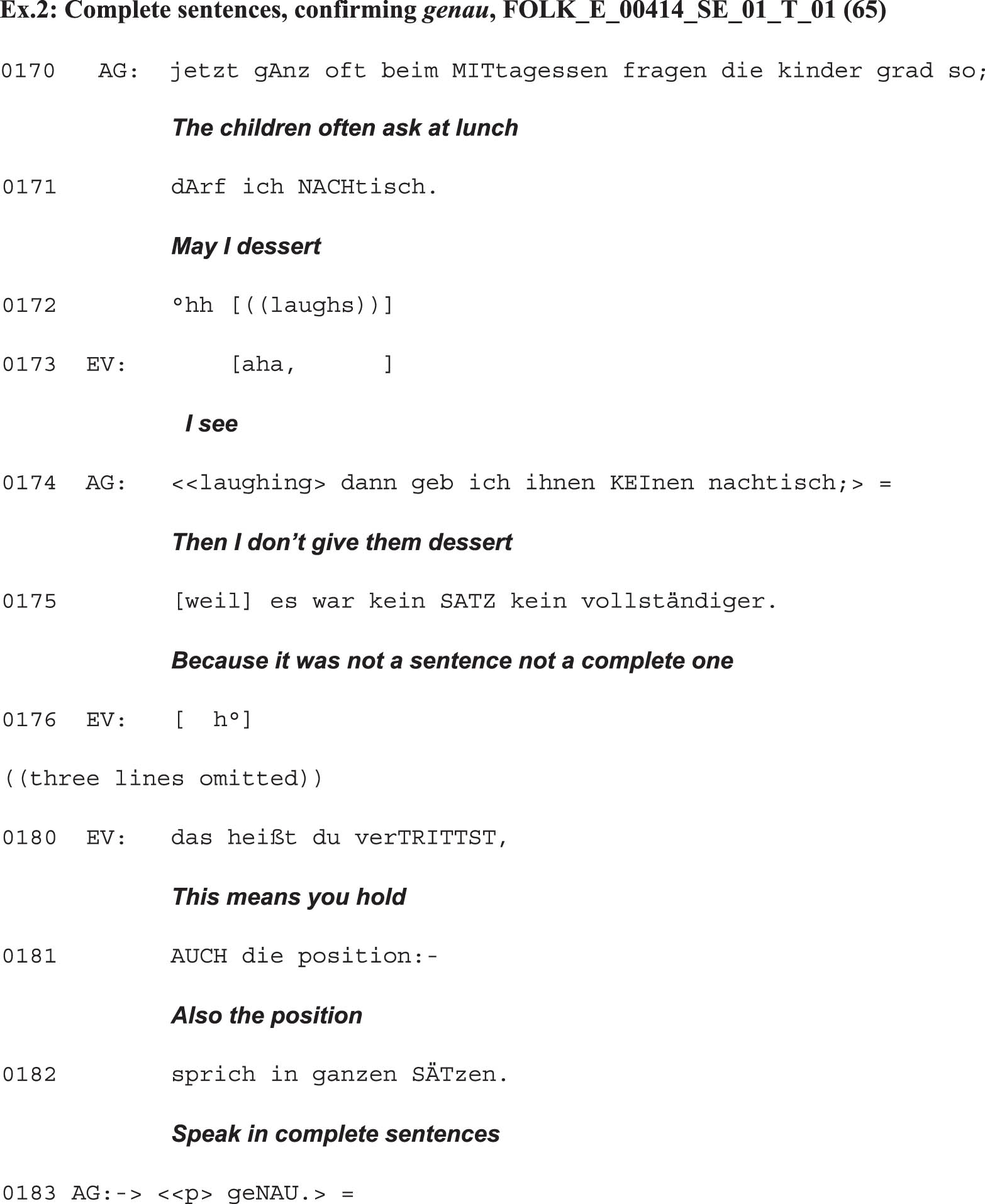
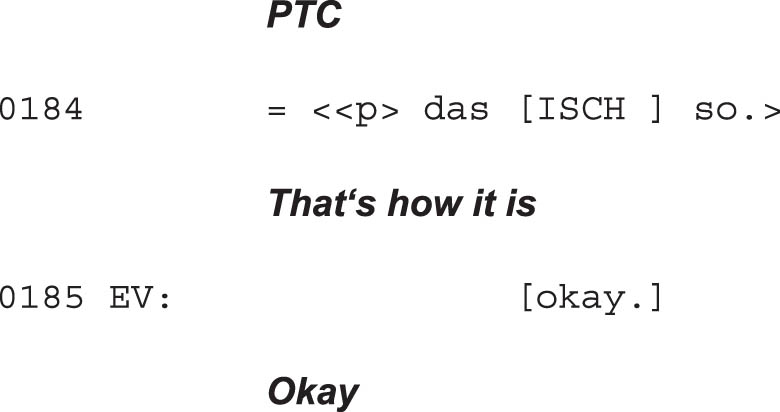
AG responds with genau (l. 0183) and reinforces this understanding by giving an elaborate confirmation with das isch so ‘That’s how it is’. EV then closes the sequence with okay (Mondada and Sorjonen 2021) in third position.
Based on this prototypical function of genau as a confirmation particle, Oloff (2017) describes uses of genau which occur in contexts of disaligned side sequences that interrupt an established main line of talk, e.g. tellings or explanations. In the second sequential position of these side sequences, genau still confirms in a responsive position but adopts an additional sequence structuring function as it closes the side sequence in order to lead back to the main sequential path. Example 3 illustrates this function of genau. The excerpt is part of a dyadic informal talk between female roommates. In the beginning of the example, AG continues a multi-unit turn in which she informs NR about how to drink a special kind of detox tea.
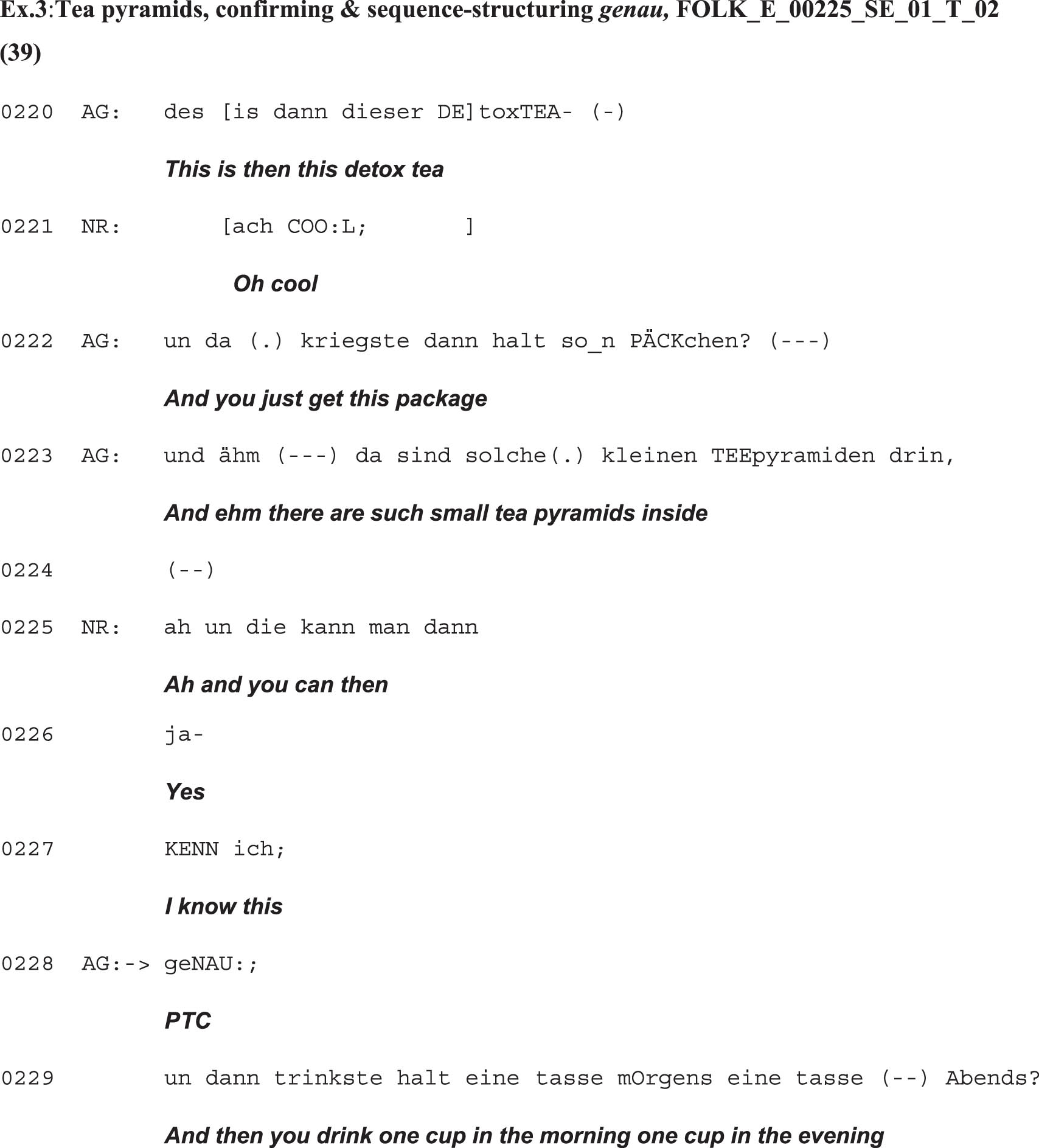
AG’s information in line 0223 is a continuation of a multi-unit explanation about details of tea drinking. As AG uses rising final intonation, it projects the continuation of her turn. At this point, NR comes in with a particle-initiated (ah, see Betz and Golato 2008) assertion that documents sudden understanding and remembering of the explainable. While being affiliative in this respect, her move is nonetheless disaligned at this point, not only by its placement beyond a TRP but also in that NR claims pre-existing knowledge about the tea pyramids and therefore does not follow the proposed action of being informed. By referring to utilization options in a designedly incomplete way as she omits the grammatical object, NR draws upon common knowledge about what she hints at. AG responds with genau (l. 0228), thereby not only confirming the unformulated proposition but also aligning with the ascription of common ground regarding possible uses of the tea pyramids. Initiated with a resumptive und ‘and’ in line 0229, she then directly leads over to continuing her informing. In sum, genau confirms while closing the disaligned side sequence, so that the main sequential path can be resumed. Its prosodic design thereby contributes to making understandable to the interlocutor that genau performs a confirmatory move here: It is clearly realized as a separate intonation unit with high onset on the first syllable and final lengthening on the accented syllable ‘nau’.
Oloff (2017, 224–6) views genau as offering the affordance to recognize disaligned turns as correct in terms of content while, at the same time, exhibiting a projective force in that it makes relevant the continuation of the interrupted line of action. We will show in Section 5 that this pragmatic bleaching of genau from performing an autonomous responsive action to being used for structuring sequences progresses in such a way that it occurs after turns which do not demand a confirmation as a type-fitted next anymore. Before that, our data and methodological procedure are presented in Section 4.
4 Data and methods
As a first step of selecting data for our study, a broad sample of instances of genau was searched using the FOLK corpus (FOLK = Forschungs- und Lehrkorpus Gesprochenes Deutsch, Schmidt 2014, Reineke et al. 2023). FOLK includes audio- and/or video recordings of 436 conversations that have been collected for linguistic research and language teaching. It includes mundane conversations, such as between friends, family conversations, as well as (semi-)institutional interaction in public spaces or team meetings. Since our analysis focuses on stand-alone occurrences vs (dis)integrated turn-initial occurrences, we made use of the turn position filters[6] available in FOLK for this initial sample, resulting in a total sample of N = 3,514 instances. The manual deletion of false positives was the next necessary step (Bergmann 2022, 86–7). This broad sample formed the basis for extensive single case analyses in joint data sessions of both authors in order to identify the functional spectrum associated with genau in this sequential/TCU-related position (Sections 3 and 5). The functional analysis is based on the principles of Conversation Analysis and Interactional Linguistics (Couper-Kuhlen and Selting 2018, Sidnell 2011).
The functions (re-)identified were defined as follows and used for the following classification of cases within our broad sample:
Sequence-Structuring (Oloff 2017, Section 3): Genau closes disaligned side sequences and confirms a confirmable/statement; it operates primarily retrospectively (consistent to confirming) but also exhibits a prospective orientation in the sense that the genau-speaker aims at taking up the temporarily suspended path and regaining the right to speak.
Resumptive (Example 1, Section 5.1): Genau signals the overcoming of a progression barrier, it is a resumptive marker upon the completion of side sequences within a temporarily suspended main path of action. Genau in this function reactivates coherence and can be used both turn- and TCU-initially, depending on who has the last turn in the side sequence. Crucially, it does not confirm a proposition in this function, which sets it apart from the sequence-structuring function.
Connective (Section 5.2): Genau aligns with and follows on from an overarching path of action, this may be done in first sequential position or in second position after foregoing actions that are not confirmables. Genau is retrospectively oriented in that it marks the connection to prior contributions within an ongoing main action path and takes them as a starting point. It is prospectively oriented in that it projects another contribution for the purpose of continuation.[7]
We then compiled the final collection of 113 instances of genau. Instances from non-native speakers of German and instances from parent–child interaction were discarded from the data set. There were no further exclusion criteria; the data entail tokens from private and institutional settings (e.g. staff meetings), from face-to-face interaction and video-mediated meetings alike. As our aim was to analyse the previously undescribed functions of genau, the compilation process began by collecting all candidates for resumptive and connective genau that we could find in the original data set. Following this step, instances for the other functions were selected on the basis of a preliminary functional analysis so as to yield a balanced data set. Since the total number of resumptive and connective genau is quite low, however, the other functions are still in the majority. After the initial compilation, each element was separately subjected to a detailed functional analysis by both authors and later discussed. After the discussion, each element was assigned a function. In addition, several ‘in-between’ cases were identified, where genau fulfilled more than one of the coded functions. These cases are referred to as ‘blends’. Table 1 shows the final distribution of genau across the functions in our data set.
Distribution of functions of genau across the collection
| N total | Confirming (Section 3) | Sequence-structuring (Section 3) | Resumptive (Section 5.1) | Connective (Section 5.2) | Blends |
|---|---|---|---|---|---|
| 113 | 37 | 18 | 18 | 9 | 31 |
The final collection (n = 113) was then coded comprehensively by both authors in terms of relevant prosodic parameters. For this formal analysis, the audio files were cut to the respective genau-instance within its immediate linguistic context (the foregoing and subsequent utterance). The prosodic coding involved prosodic and phonetic properties related to perceived prosodic (dis)integration of genau in both parametric and holistic ways. In the coding process, the functions identified for the single cases were hidden in the spreadsheet in order to minimize a functional bias on the perception of prosody.
First, both authors coded in a holistic manner, whether they perceived the element genau as a full and independent intonation unit or not.[8] The coding scheme includes three categories: ‘yes’ for clear cases of a full and independent intonation unit, ‘no’ for clear cases, where genau is not perceived as an intonation unit of its own, and ‘doubt’ for unclear cases.[9] By including ‘doubt’ as a category, we bear witness to the fact that in spontaneous speech, it is not always the case that stretches of talk can be easily and unequivocally segmented and attributed intonation unit status. In addition, as we are dealing with a functional shift on a cline, we attribute theoretical relevance to the notion of ambiguity or doubt as was introduced in Section 2.
Second, both authors coded each item for the following prosodic–phonetic parameters: Prominence on ge (1 - 0), prominence on nau (1 - 0); high onset on ge (h - 0); final pitch movement (fall, fall-to-mid, level, rise, rise-fall); pitch jump to following syllable (up, down, no); change in speech rate to following syllable (up, down, no); change in perceived loudness to following syllable (up, down, no); pause after genau (yes, min (<0.2 s), no); glottalization in following syllable if V-initial, e.g. genau ich, genau also (yes, no, other, where other refers to audible constrictions or non-modal phonation other than glottal stop or glottalization). The coding of these parameters aims to capture gradient discontinuities between genau and the following stretch of talk (Barth-Weingarten and Ogden 2021; see also Ford et al. 2004; Pekarek Doehler 2021; Szczepek Reed and Cantarutti 2024 for similar approaches).
The phonetic–prosodic analyses were carried out in Praat (Boersma and Weenink 2024), mainly on an auditory basis. In cases of doubt for perceived loudness, intensity curves were taken into account; pauses were measured in cases of doubt regarding minimal (<0.2 s) or non-minimal pauses. Glottalization was checked by visual inspection of the spectrogram.
All coding (functional and prosodic) was recorded in a coding scheme that was jointly developed by the authors and updated as necessary. Interrater reliability was checked in R (R Core Team 2013-2024) with Cohen’s Kappa using the package irr, version 0.84.1 (Gamer et al. 2022).
5 Beyond confirming: TCU-initial genau
5.1 Resuming a main line of action after sequential perturbations
Starting from Oloff’s observations that genau adopts sequence-structuring functions following disruptions of the main line of action, we argue that these contexts occasion a pragmatic shift of genau from a turn-valued responsive element to an initial discourse marker that prospectively indicates the connection to or the resumption of a main line of talk without performing a confirmation anymore. The sequential perturbations as the home environment (Zinken and Ogiermann 2013) for this resuming genau can thereby take the form of a disaligned confirmable by the interlocutor (as we have seen in Example 3 for the sequence-structuring genau in the sense of Oloff 2017) or a side sequence which is due to repair or insertion sequences (Example 1) or ongoing efforts in performing bodily-instrumental actions (see Example 4). In any case, it is not necessarily the recipient that comes in with a disaligned statement or request for confirmation but the genau-speaker him-/herself who temporarily interrupts a main action in favour of something which is pending.
Example 4 illustrates how genau marks the resumption of a suspended line of action in the context of multimodal multi-activity (Haddington et al. 2014). The excerpt is taken out of an interaction with the physiotherapist in which MR (the physiotherapist) shows and explains to the patient TS what is wrong with one of her muscles, which MR touches at the same time (l. 0718-0725).
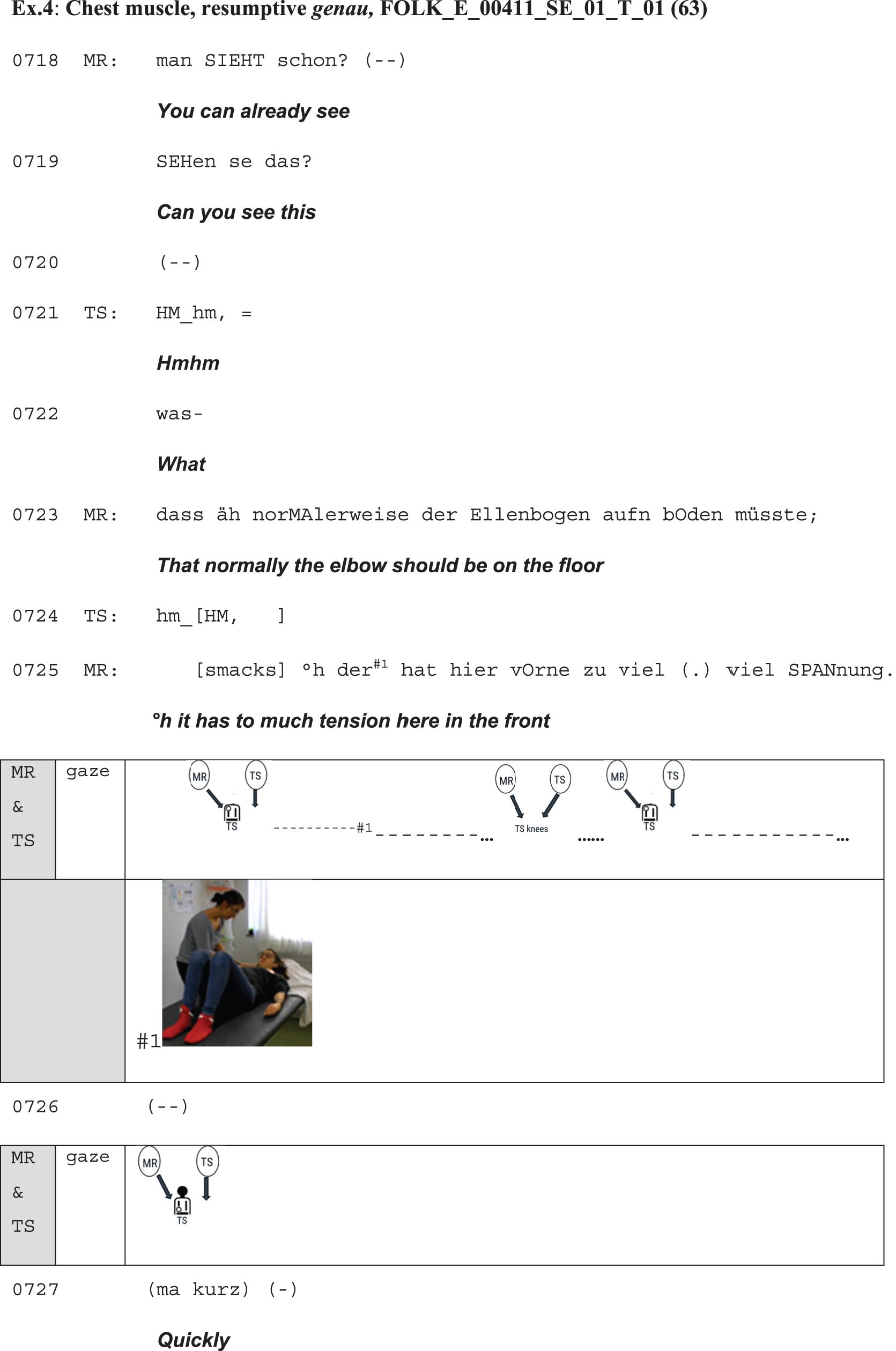
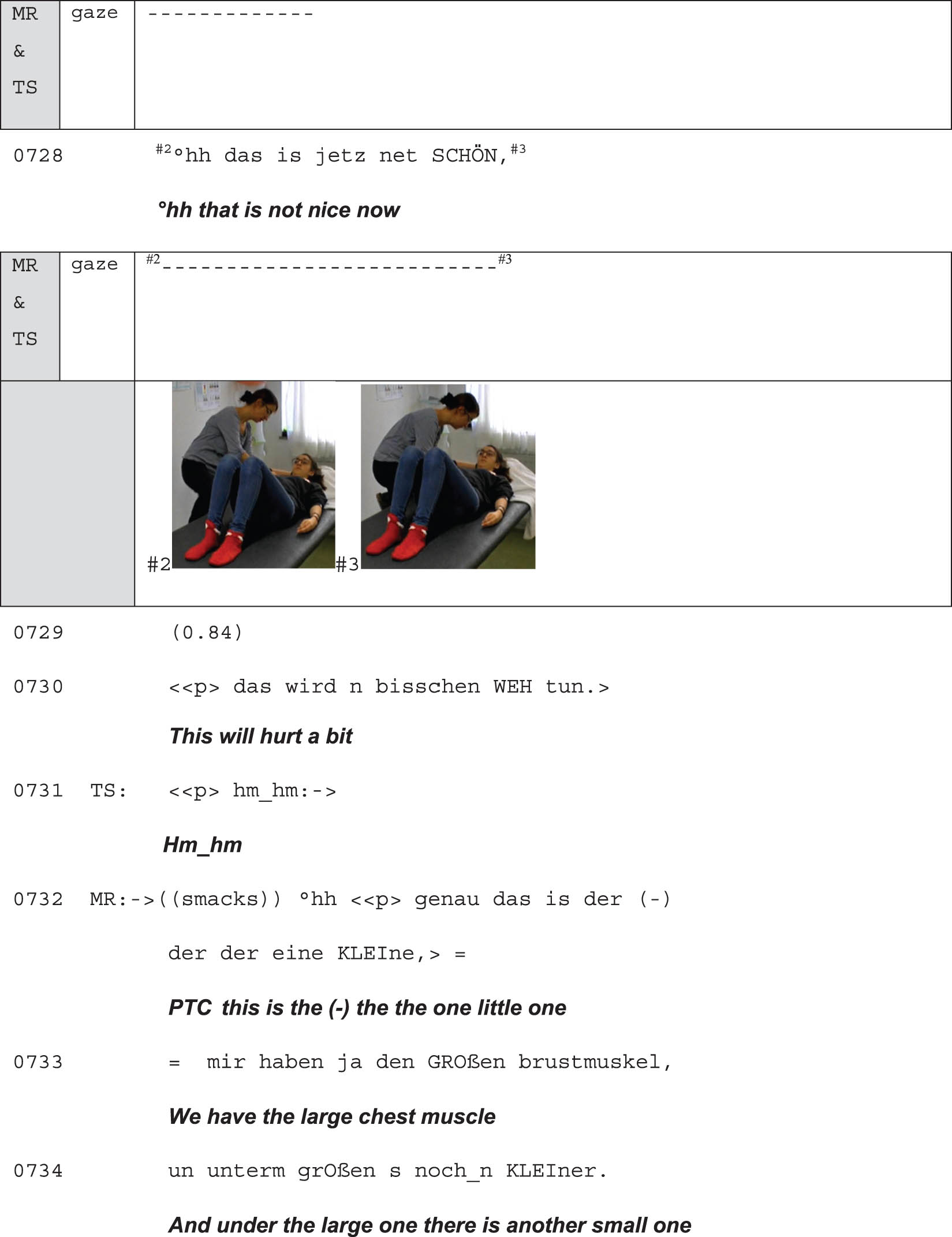
From line 0728, MR lifts her knee onto the patient’s arm on the treatment table and thereby initiates a special manual treatment after announcing it minimally in line 0727. So in contrast to the side sequence which we have seen in Example 3, here it is the speaker MR herself who suspends the main line of action (which is an informing about the patient’s muscular problem) in favour of an announcement that the treatment will be unpleasant while applying it at the same time.
After that, MR produces the element genau before continuing the action of informing TS about her muscles (l. 0732-0734). Although genau occurs in a position in which it does not follow up on a confirmable, it is rather used by MR to structure her own turn. However, in contrast to the Power Point-genau (Auer 2021a), genau in this function does not merely mark the transition to anything next within one multi-unit turn but rather more specifically to the taking up of the informing of the patient, which has been abandoned in favour of the therapeutic procedure that needed to be announced and conducted immediately.
In conclusion, what we can see here is that genau occurs in the context of a sequence which temporarily prevents a main line of action from progressing. The difference to its use as a sequence structuring confirmation particle (see Section 3) is (a) that it does not occur in a responsive position (in Example 4, it is the speaker herself who initiates the side sequence) and b) that genau does not confirm a proposition. However, among genau as a resumptive device, there remains a persisting retrospective function of tying back to the conversational context, this does not come to the fore. It rather adopts a mainly prospective orientation here in that it projects a specific continuation.
5.2 Connecting the upcoming turn to prior contributions within a main line of action
The next step within this pragmatic development of genau is that it connects an upcoming turn to a previous one while projecting the continuation of a main line of action. This function corresponds to its use for resuming an abandoned action, but differs in its sequential context as it lacks the marking of overcoming sequential perturbations. In other words, genau smoothly ties in with an ongoing main action, but the latter is not suspended in between.
Example 5 is taken from a computer-mediated interaction of two couples who play online games together and discuss travel options facing the corona-related restrictions (not shown and l. 912-915). In this context, AD suggests checking where there is no corona hotspot (l. 916). RD responds with an affirmative particle and assesses this (or: the situation of traveling in the pandemic) as difficult, which is followed by a soft laughter (l. 917).
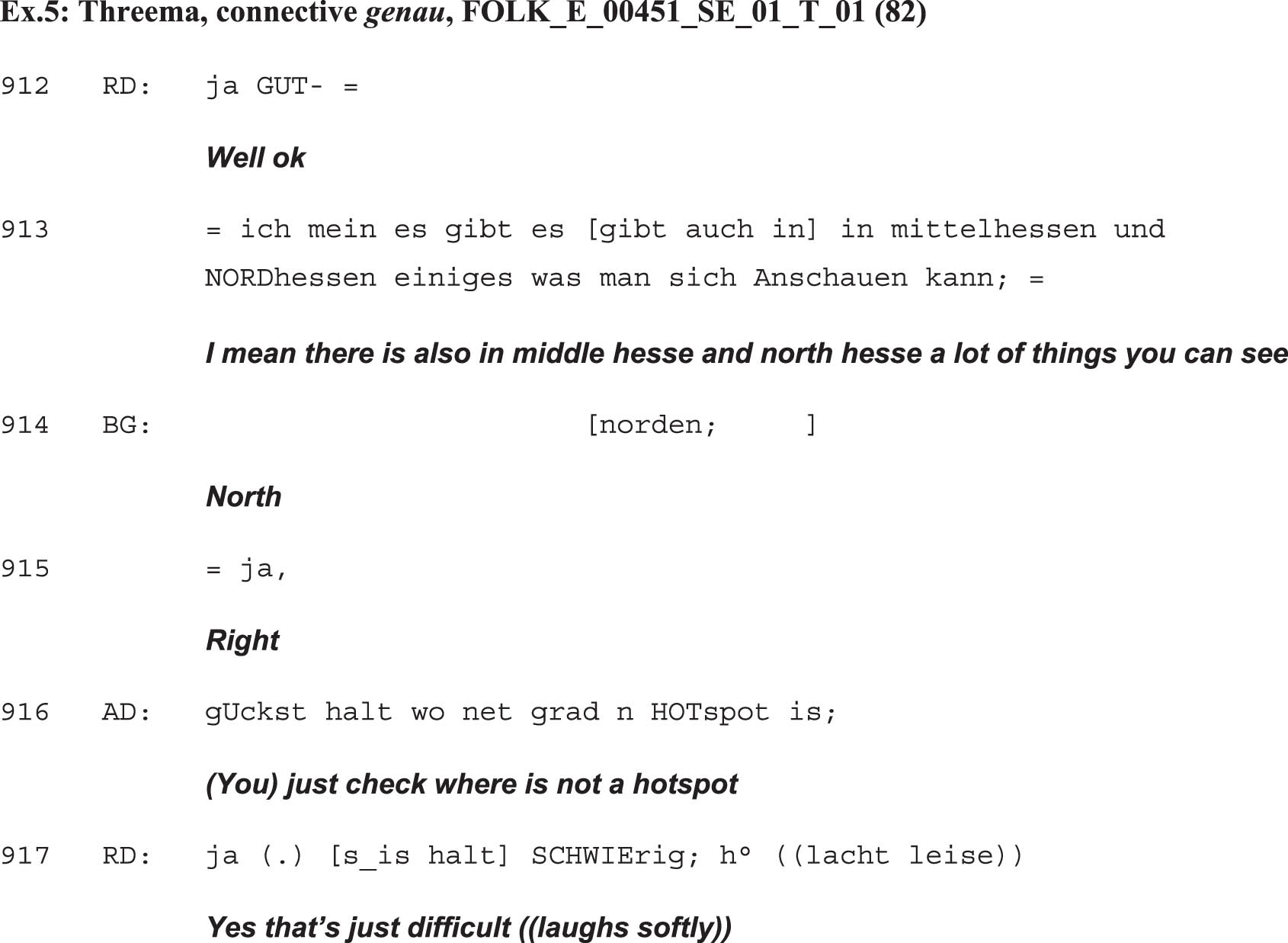
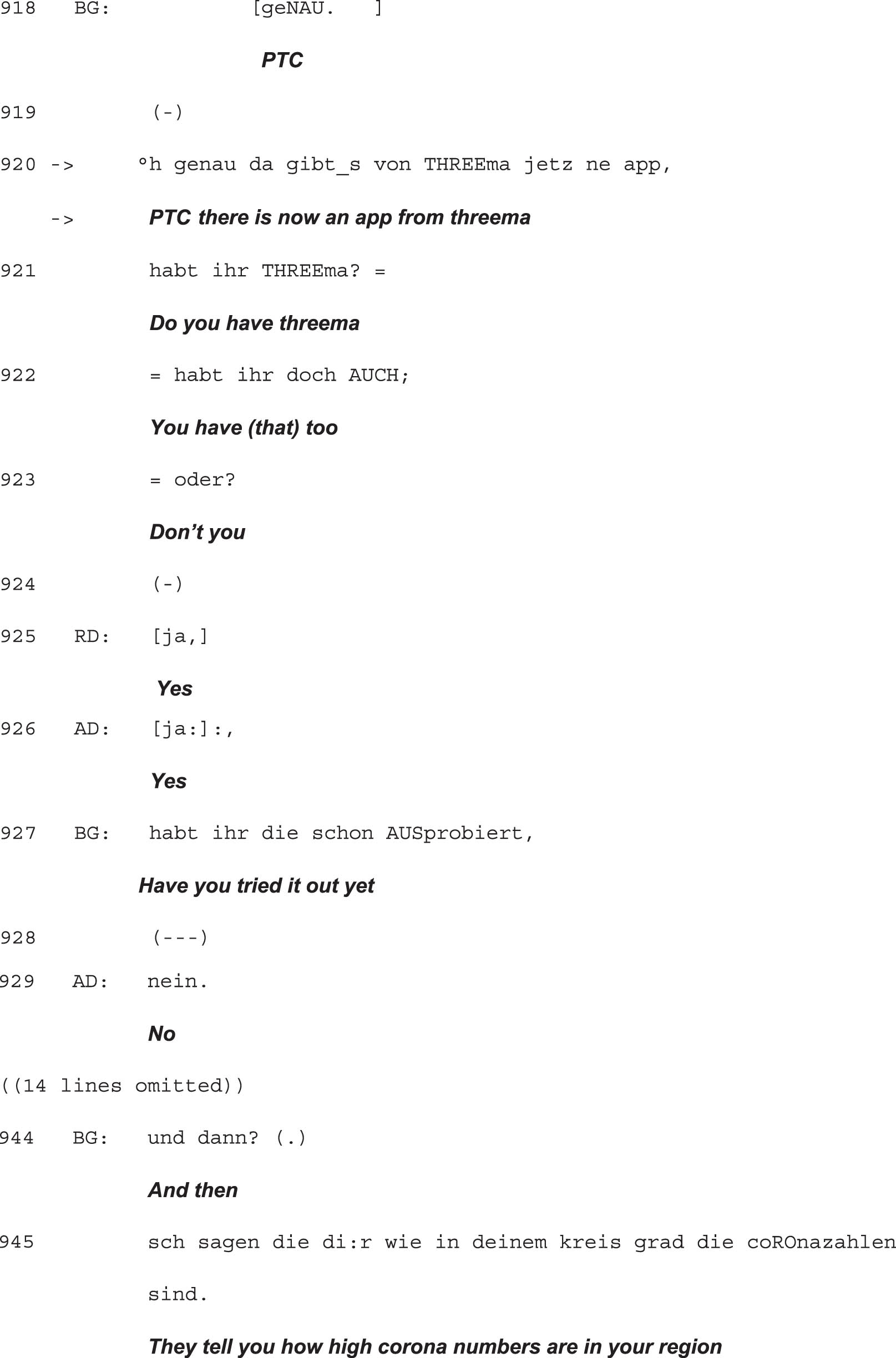
Overlapping with the first part of RD’s response, also BG agrees to AD’s statement with genau (l. 918), which is prosodically designed with a clear falling intonation from a high onset. After RD’s laughter, a short pause and a pre-beginning inbreath, BG takes the turn (l. 920) with an initial genau which is produced in high speech rate, with no significant pitch movement and a seamless transition to an informing about a new app (Section 6.2.4 for a detailed prosodic analysis of this example). After an expanded insertion sequence, in which BG checks her interlocutors’ pre-existing knowledge on this app (l. 921-929), she informs them about it (lines omitted) and specifically about the corona-related feature that you can find out how high the corona numbers are for any place of interest (omitted and l. 944).
What we find crucial for our analytical claim here is that genau is not confirming a proposition on a denotative-referential level, as BG produces it after the closing of the previous sequence. Instead, we argue that the retrospective orientation of this initial genau is rather that it appreciates AD’s proposed action while putting emphasis on the projection of another contribution to it, i.e. taking into account the regional pandemic conditions when planning a trip. In other words, genau is clearly back-tying to the topic of traveling under pandemic conditions while bringing to the fore that the upcoming contribution will exactly tie in with this topic. The lexical semantics of genau ‘exactly’ therefore points to its interactional function as projecting an exact match of the current topic/path of action with the upcoming turn.
As a consequence of what we have described so far, we state the following: We see the development of genau as a process which is characterized by two different aspects which have been associated with grammaticalization processes in prior research. First, we see a change in its main reference direction. While the confirming as well as the sequence-structuring genau have a clear-cut and specific retrospective orientation as they constitute a type-fitted response to a confirmable, only the latter is able to also establish projective expectations in the form of continuing a main line of action (Oloff 2017). While the resumptive as well as the merely connective function of genau keep this narrower projective force, their retrospective orientation becomes blurry as they do not confirm a proposition anymore and, therefore, do not perform responses. Rather, the prospective function of genau comes to the fore, which is resumption and continuation. This loss of specificity in retrospective rebinding is, second, inextricably linked to a loss of pragmatic weight. In its confirming and sequence-structuring functions, genau performs its own conversational action, which is confirming in the first place and closing a disaligned side sequence in the second place. In contrast, in resumptive/connective uses genau is not able to occur as a stand-alone element, which is why we see such instances as characterized by what we call a pragmatic bleaching in that the conversational function is reduced from a full-fledged to a subsidiary action (see e.g. Auer 2010 for this distinction). The question, whether this is linked to prosodic bleaching in the proposed continuum of confirming to connective uses of genau, will be addressed in the following section.
6 The prosodic marking of retrospective (confirming/sequence-structuring) and prospective (resumptive/connective) discourse functions of genau
6.1 Holistic perception of prosodic (dis)integration
This section starts with an overview of the holistic perception of genau as an autonomous intonation unit. As was explained in Section 4, both authors rated each element with respect to its intonational status as a separate intonation unit. Next to clear cases where genau is or is not perceived as a complete intonation unit (=‘yes’/‘no’), we included ‘doubt’ as a category. This was done in order to capture ambiguous cases which we deem typical for elements that shift functions along the clines introduced in Section 2. Thus, we deliberately did not aim to eliminate unclear cases, but view them as an essential step in the process of moving from a stand-alone responsive to a non-stand-alone turn-initial connective.
In the following, we argue that – from a holistic perspective – both ends of the clines are associated with a higher number of clear cases of independent or dependent intonational units, while the intermediate functions, i.e. sequence-structuring genau and resumptive genau, expose a higher number of unclear cases. Internal variation is higher in intermediate functions than in clear retrospectively oriented resp. clear prospectively oriented functions.
Figure 1 demonstrates the distribution of the intonational categories ‘yes’ (= dark blue), ‘no’ (= turquoise) and ‘doubt’ (= light blue) across the functions ‘Responsive’, ‘Structuring’, ‘Resumptive’ and ‘Connective’. The overall number of instances is n = 81. The functions are given in bars from left to right. The ratings of raters A and B are given in two separate plots (Figure 1a: Rater A, Figure 1b: Rater B). Interrater reliability reached a ‘fair’ value of 0.38 (Cohen’s Kappa).
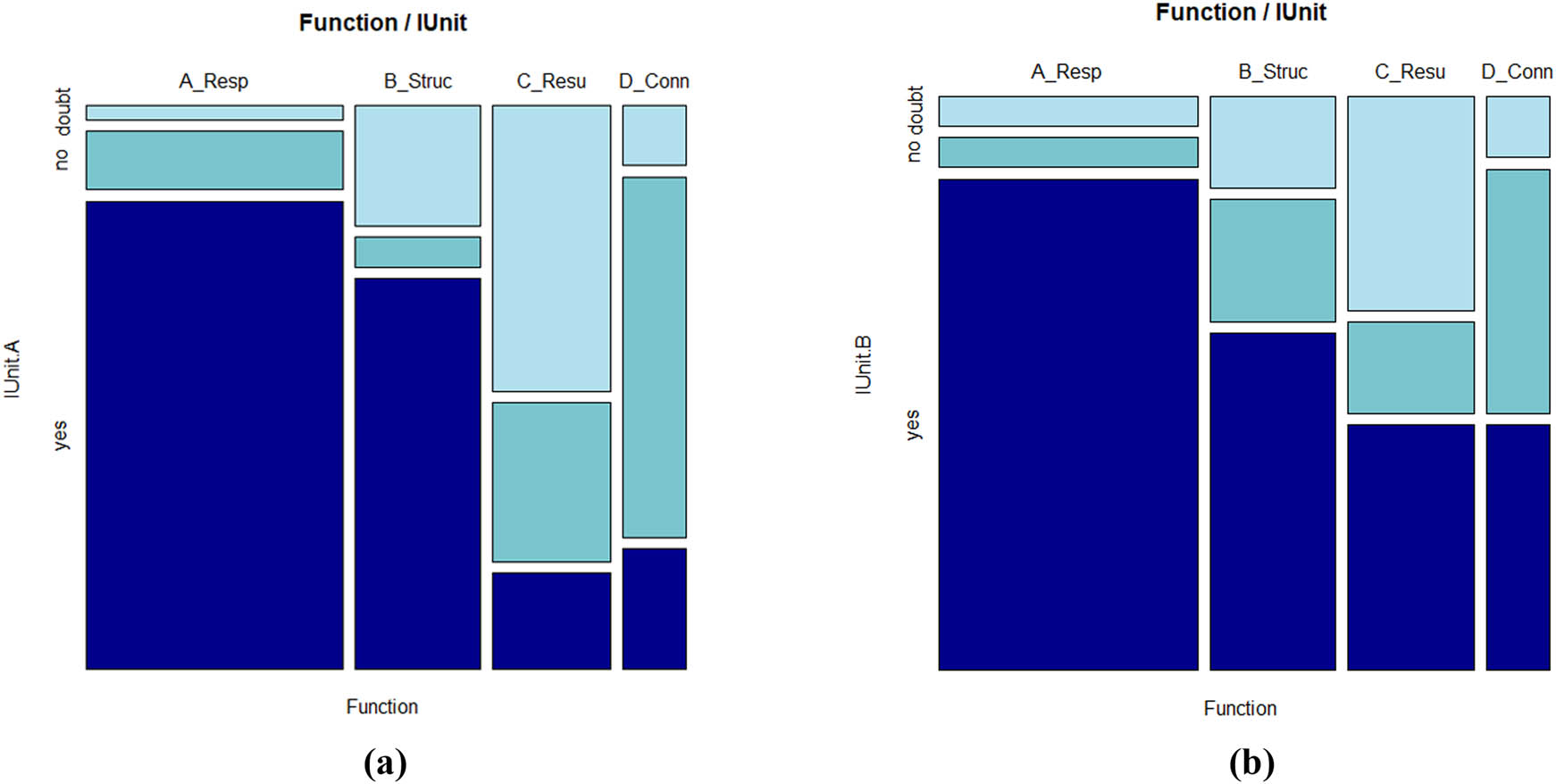
(a) Holistic perception of intonation units by rater A; (b) Holistic perception of intonation units by rater B.
Both distributions demonstrate a drop in perceived independent intonation units (‘yes’, dark blue) from the responsive elements (left-hand bar) to the connective elements (right-hand bar). This pattern is more pronounced in the ratings of rater A, who coded fewer ‘yes’-cases in both functions with a prospective orientation (i.e. resumptive and connective) than rater B. The remaining cases other than ‘yes’ are divided into the ‘no’-cases and the ‘doubt’-cases. Interestingly, most cases of doubt are attributed to the resumptive function by both raters. For this function, cases of doubt are more frequent than ‘no’-cases. On the contrary, in the connective function, ‘no’-cases gain the upper hand.
Figure 2 exemplifies the combined coding of both raters in the four functional categories. ‘Variable’ refers to elements that were coded differently by both raters (inter-rater variability). Across the categories, these include the following combinations: doubt – no (n = 11), doubt – yes (n = 6) and yes – no (n = 4). The categories ‘Doubt’, ‘No’ and ‘Yes’ stand for elements with consistent codings by both raters.
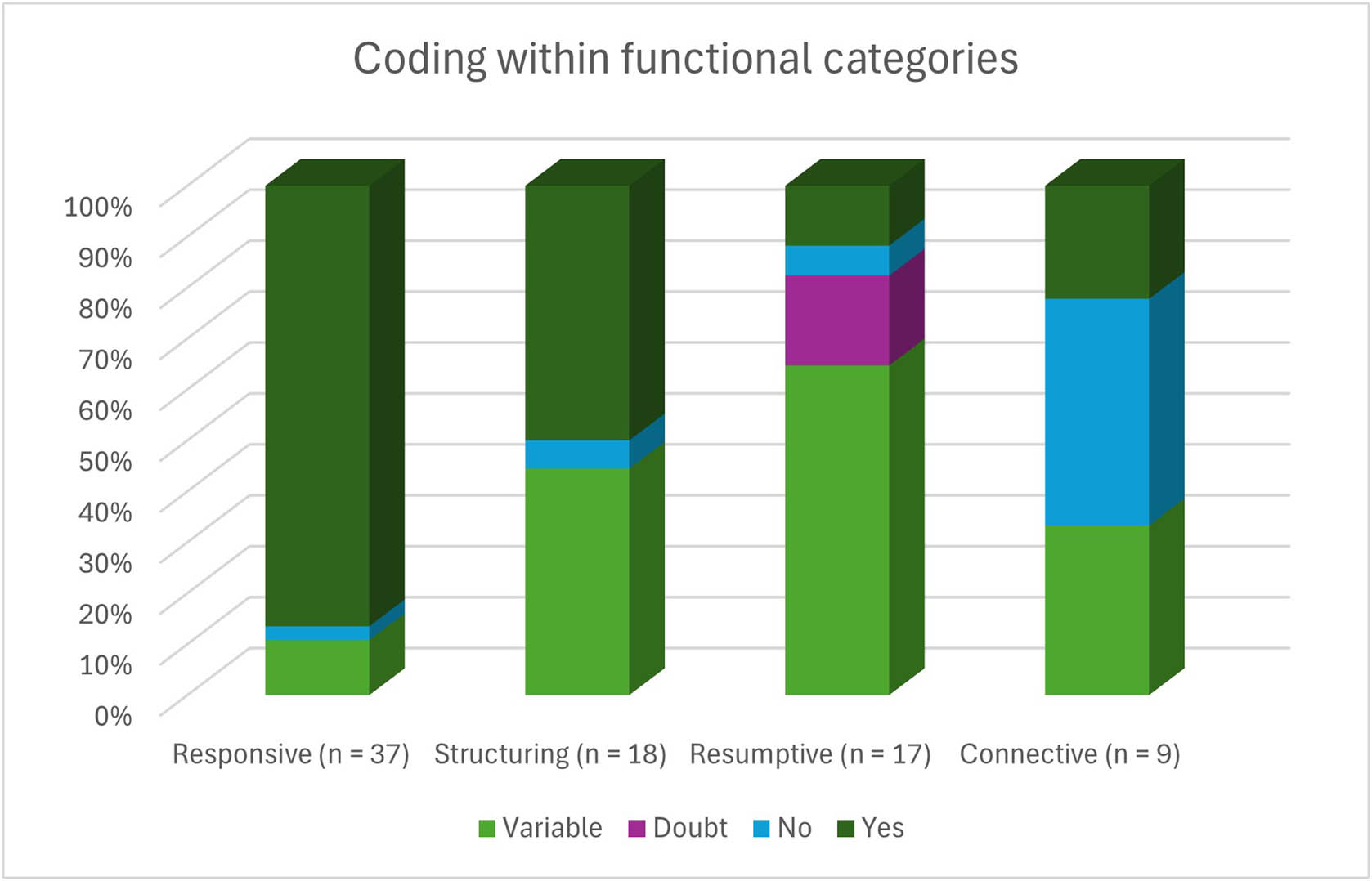
Intonation units within functional categories.
The plot gives the distribution of perceived intonation units as a ratio of all elements in the category in percent. It has to be borne in mind that the absolute numbers in the functional categories are rather low. This is especially true for the ‘newer’, connective function (n = 9). Still, the proportion of variable cases and unclear cases across the categories is quite striking: While variable coding between both raters is clearly in the minority in the cases where genau serves as a responsive (n = 4), it is the majority of cases (n = 11) when genau serves as a resumptive. In addition, there are three unclear cases in this group. This means that in the resumptive function, only 3 out of 17 instances[10] are perceived as either ‘yes’ (n = 2) or ‘no’ (n = 1) by both raters alike. The degree of ambiguity – be it inter-rater variability or substantial doubt – decreases again in the next functional category, which is the connective use of genau. Here, elements perceived as non-intonation units form the majority (n = 4). Although the numbers are low and statistical testing is not really a relevant option for this small data set, we consider this distribution more than a pure random distribution. In our view, it mirrors a process from prosodic disintegration to prosodic integration in accordance with the process of a functional shift from a retrospectively oriented responsive to a prospectively oriented connective.
6.2 Typical prosodic–phonetic design of the different functions of genau
The remainder of this section presents exemplary cases for the different functions. By doing so, we introduce and discuss the relevant prosodic parameters and flesh out the perceptual holistic assessment given above with more prosodic detail.
6.2.1 Confirming genau
The first example demonstrates an instance of turn-initial responsive genau. Genau confirms a prior statement by the other speaker. The current speaker then goes on to underline the correctness of the prior speaker’s utterance with an elaboration. From a prosodic point of view, the example is prototypical for the responsive genau in our data set. It was consistently coded by both raters in all prosodic parameters except for ‘perceived prominence on ‘ge’’, where one rater chose ‘yes’, the other ‘no’.
Holistically, genau constitutes an intonation unit of its own. It is characterized by a falling pitch movement, and it is followed by a pause (0.87 s). After the silence, there is a pitch reset up to a higher intonation level (Figure 3). No changes in speech rate or loudness were perceived between genau and the following stretch of talk. Thus, thinking in terms of boundary marking, the prosodic discontinuities in this case refer to intonational means (falling movement and pitch reset) and silence.
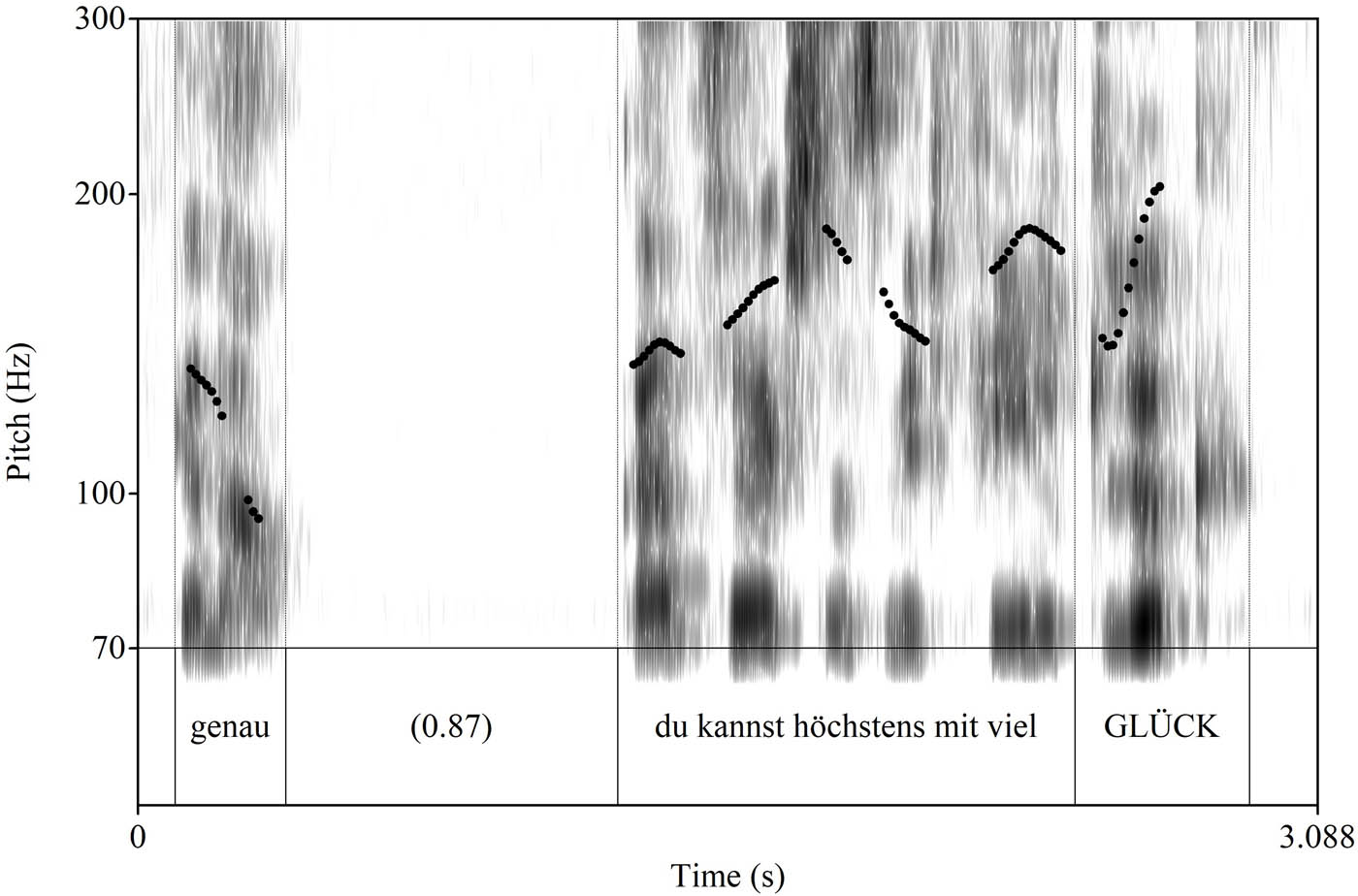
Confirming genau, FOLK_E_00451_SE_01_T_06_DF_01_c876 (95).
Out of 37 cases of responsive genau, 34 cases are characterized by a final fall (comprising fall, fall to mid, rise-fall), the majority of which are followed by a pitch reset (n = 27) and a (sometimes minimal) pause (n = 15). Only four responsive genaus have a final rising pattern. Three of these cases are perceived as non-independent intonation units or unclear cases in the holistic assessment of intonational units. None of these cases is followed by a pause, either. We could not discover a meaningful pattern for the other prosodic parameters we analysed in order to capture the notion of prosodic discontinuity (i.e. changes in speech rate and loudness). In many cases, no changes were perceived, but overall interrater reliability was low (0.13 for speech rate and 0.34 for loudness).
To summarize, responsive confirming genau is mostly realized with a falling intonation pattern, typically followed by a pitch reset and sometimes set apart from the following stretch by a pause or minimal pause. This corroborates the observations of Oloff (2017, 228, see also section 2).
6.2.2 Confirming and sequence-structuring genau
This section turns to the prosody of turn-initial genau with a structuring function as described by Oloff (2017). As was explained in Section 3, this function is characterized by a combination of retrospective confirmation with sequence structuring. Genau confirms and thereby ends a disaligned side sequence after which the current speaker continues with a previously abandoned sequence. Prosodically, this group is more diverse than the solely confirming occurrences of genau (see Figure 3 in Section 6.1). Half of the cases (n = 9/18) are consistently perceived as independent intonation units (= ‘yes’), but nearly the other half is made up of variably coded cases, most of which include combinations of ‘doubt’ with ‘yes’ or ‘no’ (n = 7, yes – no n = 1). One item was consistently perceived as a dependent intonation unit.
The instances that were coded as independent intonation units are very similar to those in the group of responsives with a confirmatory function. Figure 4 exemplifies this similarity. Genau is realized with a pitch fall, and after a pause, there is a pitch reset to the following intonation unit beginning with und er würd. At the beginning of und, there is an audible glottalized onset. The non-modal phonation visible in the spectrogram between genau and und, however, is caused by overlapping laughter by another speaker. So this should not be confused with some kind of boundary marking between these elements. There are no perceptible changes in speech rate or loudness between genau and what follows.
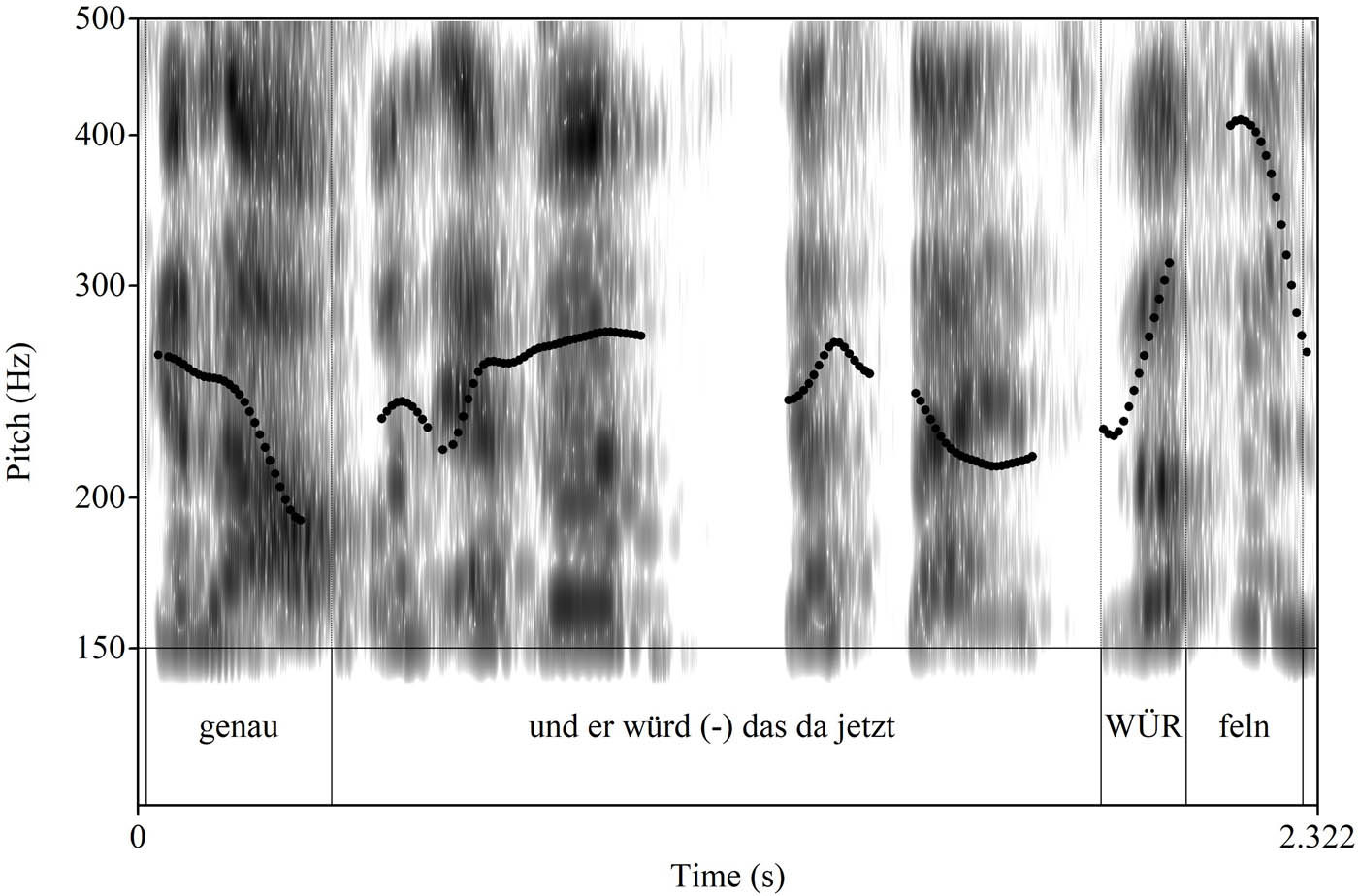
Confirming and sequence-structuring genau, FOLK_E_00451_SE_01_T_04_DF_01_c131 (103).
In comparison to these cases with genau in a separate intonation unit, the following two examples are instances with variable coding for intonation unit status on the one hand (Figure 5) and with uniform coding as a dependent intonation unit on the other (Figure 6).
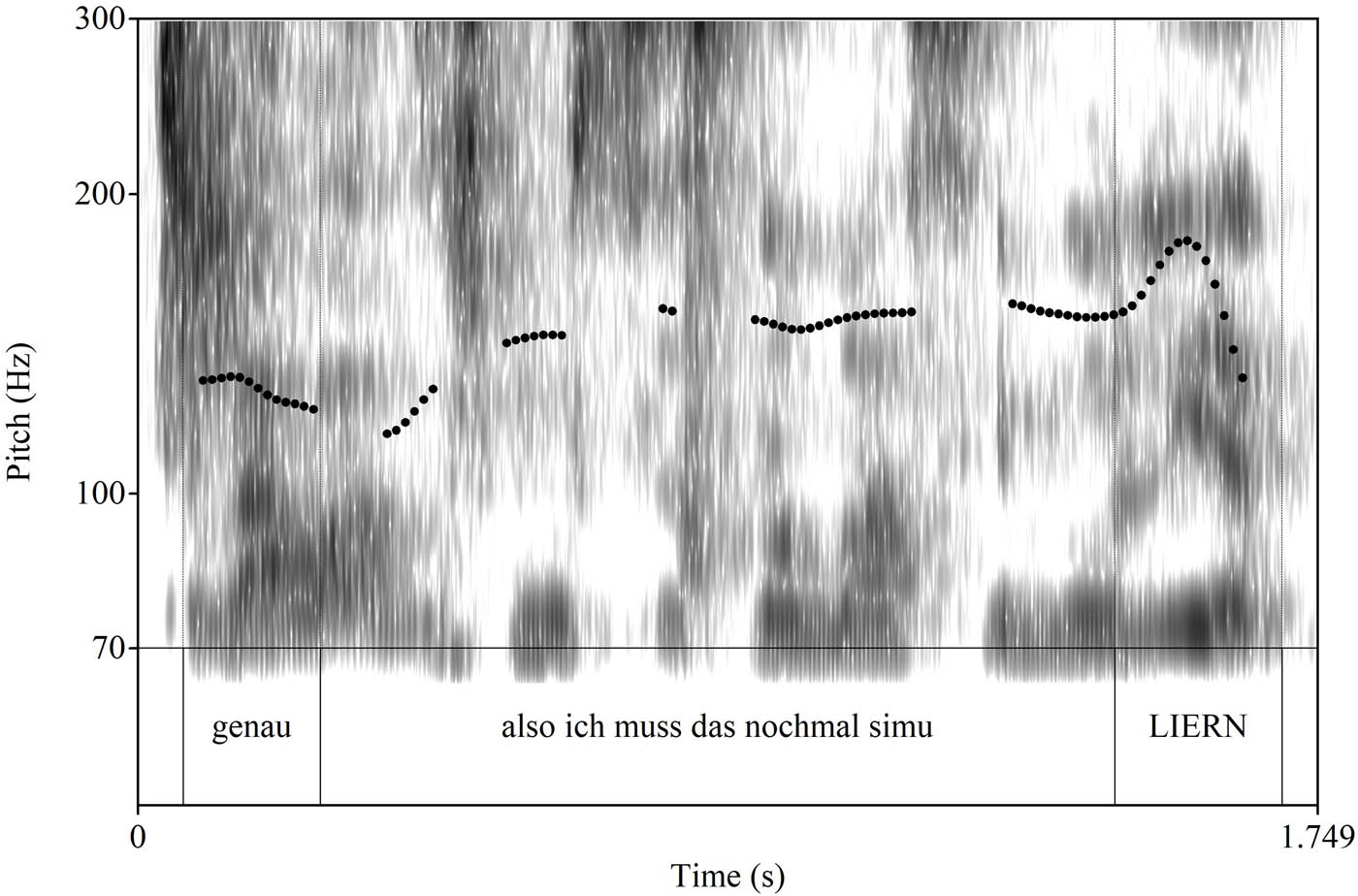
Confirming and sequence-structuring genau, FOLK_E_00451_SE_01_T_06_DF_01_c651 (93).
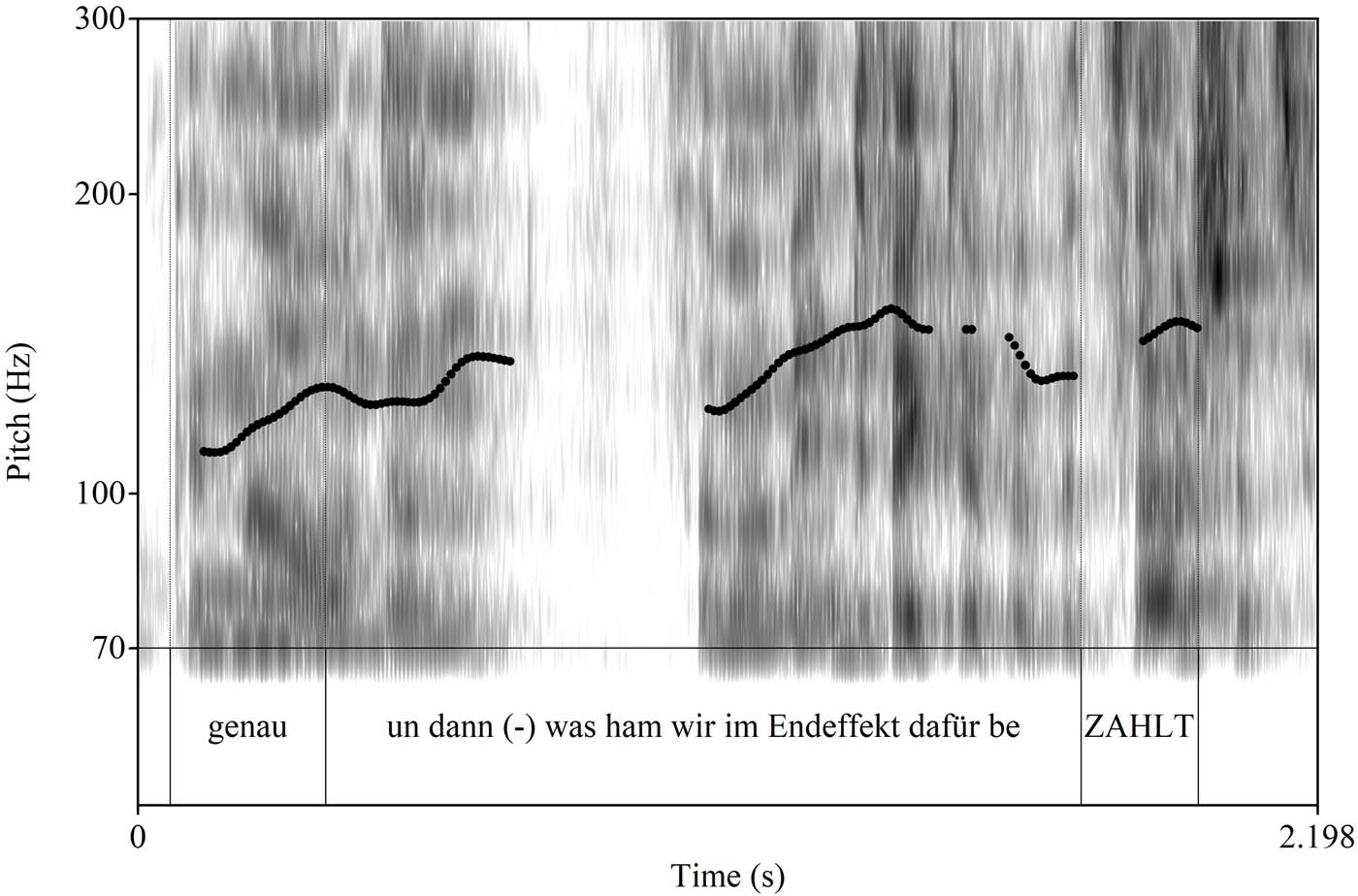
Confirming and sequence-structuring genau, FOLK_E_00293_SE_01_T_01_DF_01_c773 (43).
Variable coding in the first example (Figure 5) included one rating as a doubtful case and one rating as a dependent intonation unit. In comparison to the separate intonation units, the fall on genau is less steep, and there is no pitch reset to the immediately following syllable. There is no pause between genau and also. The initial vowel [a] in also is non-modal, which probably may be perceived as a kind of boundary marking.
By way of comparison, consider the transition from genau to vowel-initial un (i.e. und/‘and’) in the next example (Figure 6), which is the only clear case of a dependent intonation phrase in the group of structuring genau. Here, there are no signs of non-modal discontinuity such as glottalization. Instead, the slightly rising intonation on genau continues through un until dann so that audibly, genau un dann forms one coherent stretch. After that, the speaker halts and starts a new intonation unit and syntactic unit was ham wir im Endeffekt dafür bezahlt (‘what did we eventually pay for x’).
To summarize, genau varies prosodically with respect to pitch movement, pitch reset, timing (pause), and (dis)continuous voicing in genau + V-initial combinations such as genau und or genau also. We want to argue that this degree of variation within one functional group is an indication of the function of prosodic means for contextualizing a more or less retrospective or prospective orientation of the confirming genau. As this function is characterized by the combination of confirming and sequence structuring, speakers probably have an option as to whether they want to highlight the backwardly oriented confirmational force of genau or the forwardly oriented structuring function that secures the uptake and continuation of their turn.
6.2.3 Resumptive genau
The next functional group, resumptive genau, differs from the others in that genau cannot confirm in the sequential position in which it occurs; i.e. it either occurs sequentially detached from the foregoing disaligned side sequence and/or the genau-speaker him-/herself closes the side sequence (Section 5). From a prosodic point of view, this group is the most ‘chaotic’ of the four functions as was described in Section 6.1. The majority of cases were not perceived consistently with respect to intonation unit status, and it is the only group where ‘doubt’ surfaces as a consistently coded category. Figure 7 is one such example rated as ‘doubt’ by both raters.
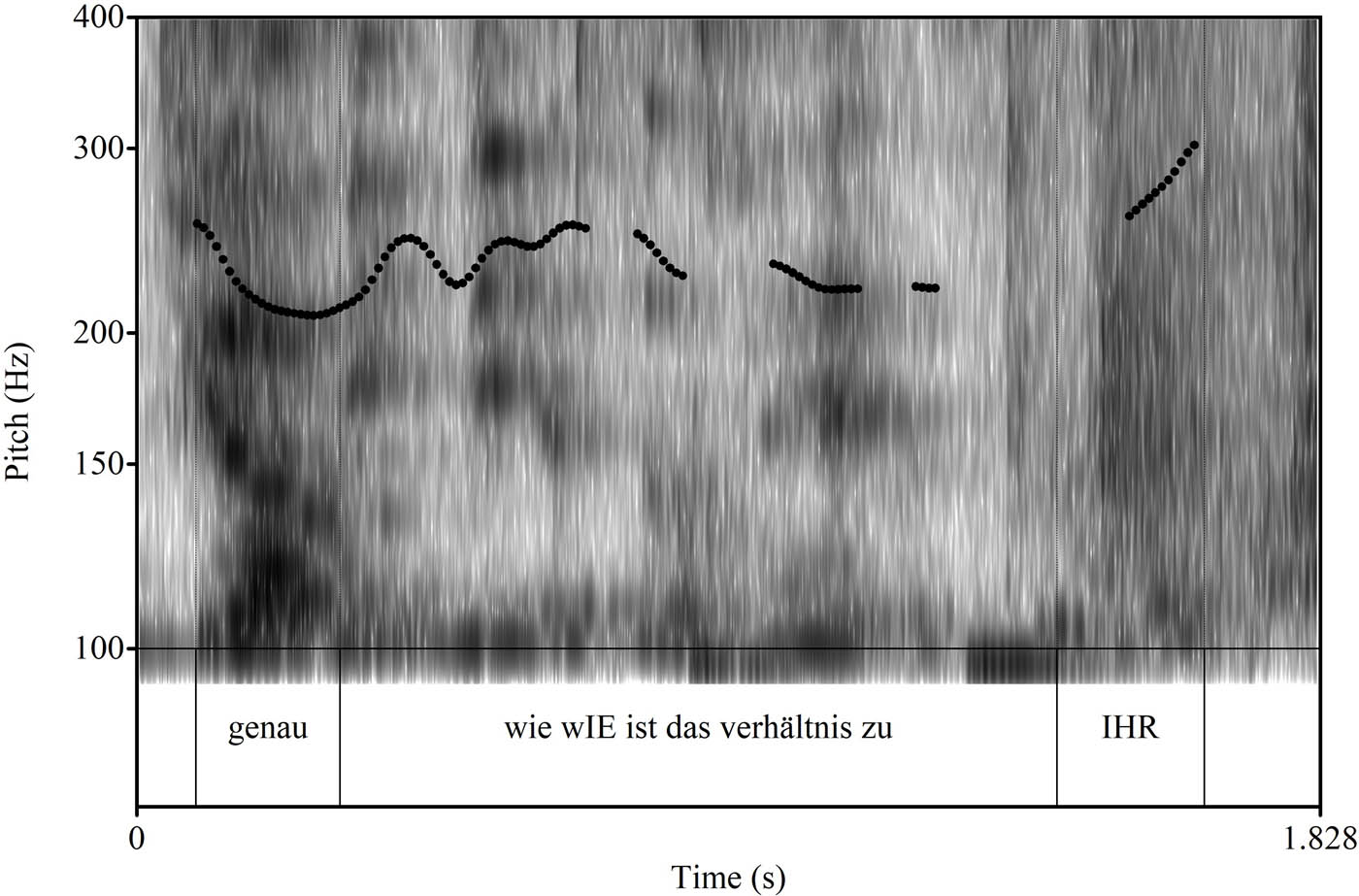
Resumptive genau, FOLK_E_00330_SE_01_T_02_DF_01_c801 (54), Example 1, Section 1.
Despite the fact that there is a slight fall on genau with a perceived prominence on nau and a slight rise to the first syllable wie (‘how’), genau does not clearly constitute an intonation unit of its own. The auditory impression of genau is shortened or speeded up compared to what follows. The low number of instances does not allow a real quantitative evaluation, but it seems that changes in speech rate are more frequent in this group than in others, particularly than in the group with structuring genau: Of 18 items in the resumptive group, there are only six, where no speech rate changes were perceived by both raters as compared to 13 out of 18 cases in the structuring group. This may be seen as an indication that timing becomes more relevant in this function. It may also be seen as one cause for the ambiguous picture regarding intonation status: While all genaus are still perceived as carrying prominence on genau, and many are still associated with a falling pitch movement, including pitch reset, changes in speech rate and maybe also shortening of genau as well as a loss in phonetic substance contribute to an unclear impression regarding intonational independency. Neither the duration of genau nor its phonetic reduction was part of our study. However, these observations point to the fact that this may be a worthwhile undertaking in future research.
6.2.4 Connective genau
Finally, we turn to connective genau. In these cases, genau can neither confirm a previous statement nor does it resume an earlier turn after a disaligned sequence. Instead, it connectively links the utterance to an already established trajectory (Section 5). This type of genau is the smallest group in our data set (n =9). Prosodically, the group is less diverse than the resumptive cases of genau, as was described in Section 6.1. All clearly dependent intonation units (n = 4) are characterized by a level pitch movement that leads continuously to the rest of the utterance. This is exemplified by Figure 8.
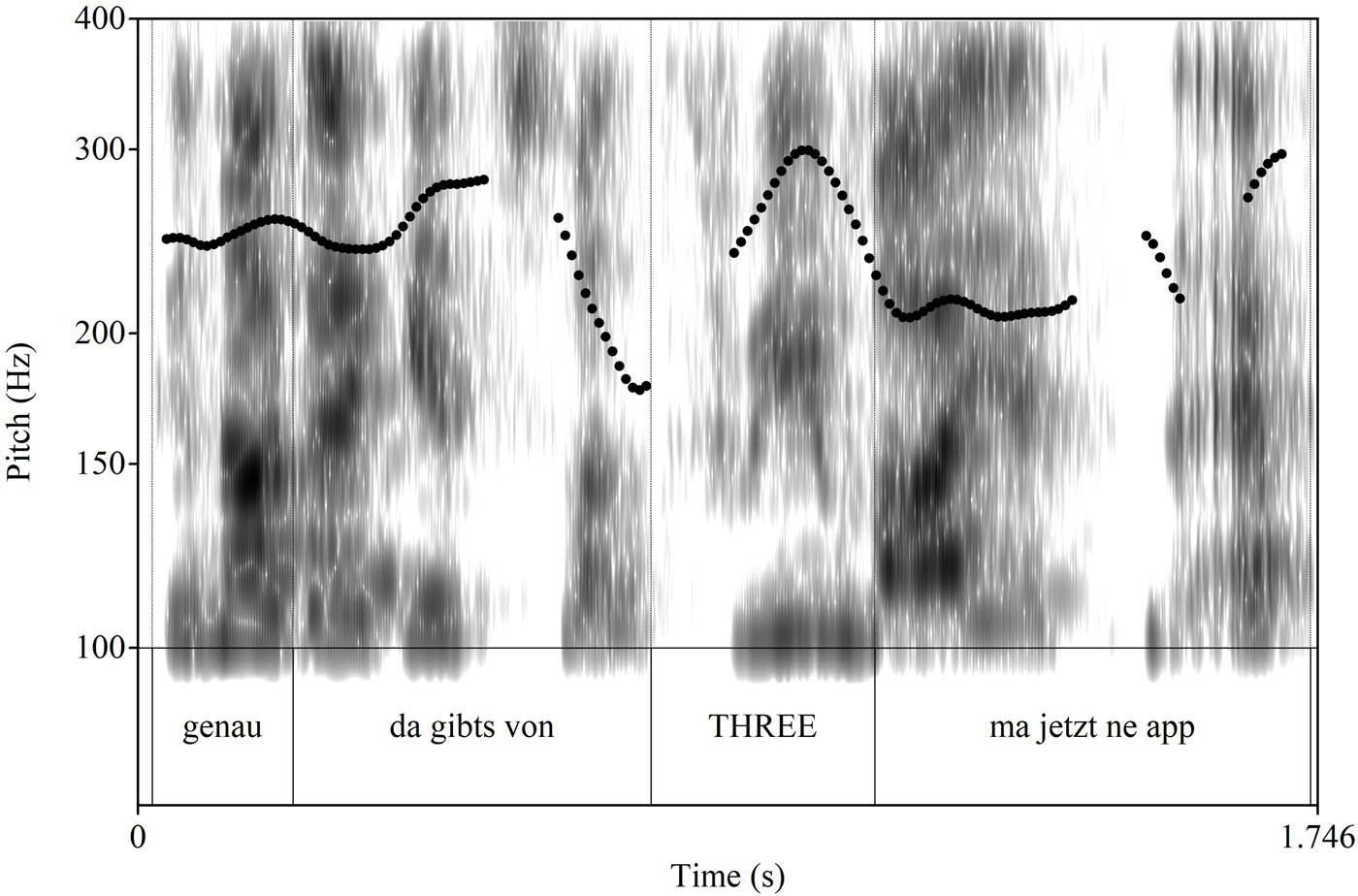
Connective genau, FOLK_E_00451_SE_01_T_01_DF_01_c918 (82), Example 5, Section 5.2.
In addition to the continuous pitch movement across genau and the subsequent syllable da, there are also no perceptible changes in speech rate or loudness. From a prosodic point of view, thus, genau is perfectly integrated into the intonation unit genau da gibts von THREEma jetzt ne app (‘PTC there is now an app from threema’).
To conclude the section, our results indicate that there is indeed a link between the prosodic realization of genau and the different functions of genau on a cline from stand-alone responsive with retrospective orientation to TCU-initial connective with prospective orientation.
Confirming genau is predominantly perceived as an independent intonation unit, characterized by a final falling intonation pattern and a pitch reset to the following syllable. On the other end of the cline, TCU-initial connective genau is predominantly perceived as prosodically dependent, with level intonation.
Unclear cases and variable coding of prosodic independence are most pervasive in the intermediate function of resumptive genau. This is also the group where prosodic changes in loudness and speech rate occur most often (Section 6.2.3). Overall, there is an increase in unclear cases and variable coding from responsive via sequence structuring to resumptive genau and then again a decrease to connective genau.
The intermediate function of sequence-structuring genau resembles the responsive genau in the realization of the clear independent intonation units. Cases of variable coding or coding as doubt are characterized by varying degrees of boundary strength (glottalization) to the following V-initial syllable.
Taking these observations together, we claim that the functional cline of genau is not only reflected in its clear prosodic differentiation of the opposite poles (1), but also in prosodic ambiguity regarding the independence of genau in the intermediate functions, where genau is neither clearly retrospectively oriented nor (not yet) clearly prospectively oriented (2). The prosodic parameters that we investigated as indicators of boundary strength do not yield a systematic picture along the cline. However, it is interesting to see that the intermediate function of resumptive genau makes most use of timing-related changes. We suggest that the perception of the shortening/higher speech rate of genau contributes to the perception of unclear intonation unit status. Prosodic marking seems to be incongruous in this group: Prominence on nau, falling pitch, and pitch reset co-occur with shortening and changes in speech rate, rendering the intonation unit status unclear to the listener. Likewise, the other ‘intermediate’ function sequence-structuring genau exposes interesting differences regarding the boundary strength to following V-initial onsets ((3), Section 6.2.2). We argue that in this function, the participants of an interaction can use changes in boundary strength to contextualize whether the forward-looking function of genau or the backward-looking function of genau should be foregrounded.[11]
7 Summary and conclusion
In this article, we have provided a CA and IL approach to identify conversational functions and prosodic forms of turn-/TCU initial genau ‘exactly’, occurring in German face-to-face and phone-call interactions. Starting from earlier descriptions of genau as a confirmation and sequence-structuring particle (Willkop 1988, Werlen 2010, Oloff 2017, Auer 2021a), the focus of the first part of our article was on the functional side of genau. We showed that it takes on ‘new’ prospective functions as an initial discourse marker. Specifically, genau may be used to resume a main line of action upon sequential perturbations and multiactivity (resumptive function) or to mark an upcoming turn as tying in with a main activity (connective function), which we see as a process exhibiting characteristics of grammaticalization. The specificity of the development of stand-alone genau to turn initial genau seems to be primarily characterized by a loss of pragmatic weight as the conversational functions of genau develop from performing a full-fledged action to performing a subsidiary action (Auer 2010). By adopting a concept of ‘intermediate functions’ on a cline from stand-alone responsive to turn-initial connective, we allude to the notion of bridging contexts according to Heine (2002, 86). However, in order to reveal the pragmatic shift in the development of discourse markers, it is crucial to go beyond the scope of a sentence and to take into account the sequential infrastructure of social interaction. In this sense, careful analysis of synchronic data can provide valuable insights into possible avenues of (micro-)diachronic change. Our approach of inferring a (micro-)diachronic development from analysing synchronic data is also in line with previous IL studies such as Barth-Weingarten and Couper-Kuhlen (2002, 353). Similarly to their take on final though in English, we thus see the existence of intermediate stages between mere confirmation and mere connection as an indirect indicator that genau is undergoing a process of change. Additional evidence comes from the frequency pattern of the different functions, with the arguably ‘newer’ connective use being much more infrequent than the ‘original’ stand-alone confirmatory responsive.
Against the background of controversial findings regarding the question of how grammaticalization processes of lexical or phrasal elements are reflected in their prosodic design, a second aim of this contribution was to shed light on the prosodic autonomy and (dis)integration of genau in its context of occurrence. Our analysis stood in the context of research highlighting the relevance of gradience in prosodic autonomy, particularly when dealing with the sedimentation of patterns in grammaticalization/pragmaticalization processes (cf. Barth-Weingarten and Ogden 2021, Pekarek Doehler 2021). Consequently, our analysis combined a holistic view of prosodic independence (i.e. holistic perception of genau as an intonation unit) with a parametric approach where several prosodic–phonetic markers of boundary strength between genau and the subsequent stretch of talk (pitch reset, pauses, changes in loudness, and others) were taken into account. In addition, we took seriously the notion of ‘ambiguity’ or ‘doubt’ regarding prosodic autonomy. Neither did we discard or force a choice on ratings where both raters did not agree on the prosodic autonomy of genau (i.e. interpersonal variation), nor did we force a choice on cases where we found perceptive doubt (i.e. intrapersonal ambiguity). Our approach is in line with former interactionally oriented conceptions of prosody that try to integrate incomplete units and fuzzy boundaries into participant-oriented conceptions of prosody. It presents an exemplary case for that it is worth considering the prosodic surface form not only in categorical terms of prosodic phrasing and accentuation but also in a more gradient manner, leaving space for non-exhaustive and non-discrete descriptions of prosodic units (Auer 2010).
Our results regarding the prosody of genau along the cline from stand-alone responsive to TCU- or turn-initial connective demonstrate that ambiguity with respect to prosodic autonomy is not distributed randomly across the different functions on the cline: While the extreme poles of the continuum are characterized by few ambiguous cases, it is the two intermediate functions that are characterized by a higher degree of interpersonal variation and intrapersonal ambiguity. Thus, the grammaticalization/pragmaticalization process of genau is characterized by a gradient, stepwise loss in prosodic autonomy that leads from prosodically independent, disintegrated elements in the retrospective confirmatory response to predominantly dependent, integrated elements in the prospective connective. Our study therefore is another contribution to underline the assumption that a continuous functional shift is or can be mirrored by prosodic gradience, i.e. a stepwise shift from prosodic autonomy to prosodic dependence. Consequently, our study fosters the view that incomplete intonation units and fuzzy boundaries can be seen as a source of informational richness, as was argued before by previous studies on other languages than German as well (Barth-Weingarten and Ogden 2021, Pekarek Doehler 2021, Temer and Ogden 2021).
Another observation from our data is that the boundary marking phonetic–prosodic cues do not seem to play the same role in the different functional categories. Instead, changes in timing and different degrees of boundary strength to the element after genau were mainly observed in the intermediate functions, where there is room to negotiate the backward orientation or forward orientation of genau. We interpret this as an indication that the contextualizing function of these phonetic–prosodic cues is highly sensitive to the position in which they occur. This is in line with an earlier study on ‘getting past no’ by Ford et al. (2004, 263) who state that “[s]equence, action, and phonetics work together in projecting the trajectory and shape of a no-initiated turn.” In other words, the phonetic–prosodic realization of genau leads the recipient’s interpretation of its interactional meaning together with its placement within an ongoing activity and sequence. We believe that this positional sensitivity of phonetics in conversation is worth being addressed in more detail in future research.
Further investigation into the gradience of prosodic constituency in grammaticalization/pragmaticalization processes will bring to light more valuable insight into the role of prosody and phonetic–prosodic cues in the development of discourse markers, be it along the cline from stand-alone elements to initial elements or along the cline from an integrated to a more peripheral element.
Acknowledgments
The authors are grateful for the reviewers’ valuable comments that improved the manuscript. Many thanks to Beatrice Szczepek Reed and to Karin Birkner for helpful comments on an earlier version of this contribution.
-
Funding information: The work was supported by the German Research Foundation/Deutsche Forschungsgemeinschaft (DFG): The prosody of initial discourse markers/Die Prosodie von initialen Diskursmarkern (ProIDiM), Project number 532151809 granted to Pia Bergmann. The contribution was funded by the Open Access Publishing Fund of the University of Bayreuth.
-
Author contributions: Both authors have accepted responsibility for the entire content of this manuscript and consented to its submission to the journal, reviewed all the results, and approved the final version of the manuscript. Both authors contributed in equal parts to the writing of the manuscript.
-
Conflict of interest: The authors declare no conflict of interest.
-
Data availability statement: The data that support the findings of this study are available from the DGD (https://dgd.ids-mannheim.de/dgd/pragdb.dgd_extern.welcome) but restrictions apply to the availability of these data, which were used under license for the current study. Registration with the database for spoken German (DGD) is required in order to access the collection.
References
Altmann, Hans. 1978. Gradpartikel-Probleme: Zur Beschreibung von gerade, genau, eben, ausgerechnet, vor allem, insbesondere, zumindest, wenigstens. Gunter Narr Verlag.Suche in Google Scholar
Antaki, Charles. 2008. “Formulations in Psychotherapy.” Discourse Studies 7 (6): 627–47.10.1177/1461445605055420Suche in Google Scholar
Arens, Katja. 2023. Strukturieren und Evaluieren im Gespräch: Lexikalische Diskurspartikeln als Ressourcen der Gesprächsorganisation. Universitätsverlag Winter.10.33675/978-3-8253-8567-5Suche in Google Scholar
Auer, Peter and Susanne Günthner. 2005. “Die Entstehung von Diskursmarkern im Deutschen – ein Fall von Grammatikalisierung?” In Grammatikalisierung im Deutschen, edited by Torsten Leuschner, Tanja Mortelmans and Sarah de Groodt. de Gruyter. 10.1515/9783110925364.335.Suche in Google Scholar
Auer, Peter. 1996. “The Pre-Front Field in Spoken German and its Relevance as a Grammaticalization Position.” Pragmatics 6 (3): 295–322. 10.1075/prag.6.3.03aue.Suche in Google Scholar
Auer, Peter. 2010. “Zum Segmentierungsproblem in der Gesprochenen Sprache.” InLiSt – Interaction and Linguistic Structures 49. http://www.inlist.uni-bayreuth.de/issues/49/InList49.pdf.Suche in Google Scholar
Auer, Peter. 2021a. “Genau! Der auto-reflexive Dialog als Motor der Entwicklung von Diskursmarkern.” In Verfestigungen in der Interaktion, edited by Beate Weidner et al. de Gruyter. 10.1515/9783110637502.Suche in Google Scholar
Auer, Peter. 2021b. “Turn-allocation and gaze: A Multimodal Revision of the “Current-speaker-selects-next” Rule of the Turn-taking System of Conversation Analysis.” Discourse Studies 23 (2): 117–40.10.1177/1461445620966922Suche in Google Scholar
Barden, Birgit, Mechthild Elstermann, and Reinhard Fiehler. 2001. “Operator-Skopus-Strukturen in gesprochener Sprache.” In Pragmatische Syntax, edited by Franz Liedtke and Franz Hundsnurscher. Niemeyer. 10.1515/9783110941258.197.Suche in Google Scholar
Barth-Weingarten, Dagmar and Elizabeth Couper-Kuhlen. 2002. “On the Development of Final though: A Case of Grammaticalization?” In New Reflections on Grammaticalization, edited by Diewald and Wischer. John Benjamins. 10.1075/tsl.49.Suche in Google Scholar
Barth-Weingarten, Dagmar and Richard Ogden. 2021. “‘Chunking’ Spoken Language: Introducing Weak Cesuras.” Open Linguistics 7: 531–48. 10.1515/opli-2020-0173.Suche in Google Scholar
Beeching, Kate and Ulrich Detges, eds. 2014. Discourse Functions at the Left and Right Periphery. Brill. 10.1163/9789004274822_002.Suche in Google Scholar
Bergmann, Pia and Christine Mertzlufft. 2009. “Die Segmentierung spontansprachlicher Daten in Intonationsphrasen. Ein Leitfaden für die Transkription.” In Die Arbeit mit Transkripten, edited by Karin Birkner and Anja Stukenbrock. Verlag für Gesprächsforschung.Suche in Google Scholar
Bergmann, Pia. 2022. “Sprachliche Variation im Gegenwartsdeutschen: Lautliche Realisierungsvarianten im Gespräch.” In Forschen in der Linguistik, edited by Michael Beißwenger et al. UTB.Suche in Google Scholar
Bergmann, Pia. 2024. “Discourse Influences on the Prosody and Phonetics of ‘auf jeden Fall’ and ‘jedenfalls’ in German Spontaneous Speech.” In Interfaces of Phonetics, edited by Marcel Schlechtweg. De Gruyter.10.1515/9783110783452-007Suche in Google Scholar
Betz, Emma and Andrea Golato. 2008. “Remembering Relevant Information and Withholding Relevant Next Actions: The German Token achja.” Research on Language and Social Interaction 41: 58–98.10.1080/08351810701691164Suche in Google Scholar
Betz, Emma, Carmen Taleghani-Nikazm, Veronika Drake, and Andrea Golato. 2013. “Third-Position Repeats in German: The Case of Repair- and Request-for-Information Sequences.” Gesprächsforschung - Online-Zeitschrift zur verbalen Interaktion 14: 133–66. http://www.gespraechsforschung-ozs.de.Suche in Google Scholar
Betz, Emma. 2017. “Diskursmarker aus konversationsanalytischer Sicht: Prosodisch integriertes ja am Beginn von responsiven Turns.” In Diskursmaker im Deutschen: Reflexionen und Analysen, edited by Hardarik Blühdorn et al. Verlag für Gesprächsforschung. http://verlag-gespraechsforschung.de/2017/pdf/diskursmarker.pdf.Suche in Google Scholar
Boersma, Paul and David Weenink. 2024. Praat: doing phonetics by computer [Computer program]. Version 6.4.22.Suche in Google Scholar
Couper-Kuhlen, Elizabeth and Margret Selting. 2018. Interactional Linguistics: Studying Language in Social Interaction. Cambridge University Press.10.1017/9781139507318Suche in Google Scholar
Couper-Kuhlen, Elizabeth. 2021. “OH + OKAY in Informing Sequences: On Fuzzy Boundaries in a Particle Combination.” Open Linguistics 7 (1): 816–36.10.1515/opli-2020-0151Suche in Google Scholar
Cruttenden, Alan. 1997. Intonation. Cambridge University Press.10.1017/CBO9781139166973Suche in Google Scholar
Dehé, Nicole and Katerina Stathi. 2016. “Grammaticalization and Prosody: The Case of English sort/kind/type of Constructions.” Language 92: 911–46. 10.1353/lan.2016.0077.Suche in Google Scholar
Diewald, Gabriele and Ilse Wischer. 2002. New reflections on grammaticalization. John Benjamins Publishing Company.Suche in Google Scholar
Dix, Carolin. 2023. “Transcribing Facial Gestures: Combining Jefferson with the International SignWriting Alphabet (ISWA).” Social Interaction. Video-Based Studies of Human Sociality 6 (3). 10.7146/si.v6i3.143071.Suche in Google Scholar
Duden. 1999. Das große Wörterbuch der deutschen Sprache. Dudenverlag.Suche in Google Scholar
Ehlich, Konrad. 2009. “Interjektion und Responsiv”. In Handbuch der deutschen Wortarten, edited by Ludger Hoffmann (423–444). De Gruyter.10.1515/9783110217087.423Suche in Google Scholar
Ferrara, Kathleen. 1997. “Form and Function of the Discourse Marker Anyway: Implications for Discourse Analysis.” Linguistics 35: 343–78. 10.1515/ling.1997.35.2.343.Suche in Google Scholar
Fiehler, Reinhard, Birgit Barden, Mechthild Elstermann, and Barbara Kraft. 2004. Eigenschaften Gesprochener Sprache. Gunter Narr Verlag. https://www.narr.de/eigenschaften-gesprochener-sprache-16027/.10.24053/9783823370277Suche in Google Scholar
Fischer, Kerstin. 2006. “Towards an Understanding of the Spectrum of Approaches to Discourse Particles: Introduction to the Volume.” In Approaches to Discourse Particles, edited by Kerstin Fischer. Bril.10.1163/9780080461588_002Suche in Google Scholar
Ford, Cecilia E., Barbara A. Fox, and John Hellermann. 2004. “‘Getting Past No’: Sequence, Action and Sound Production in the Projection of No-Initiated Turns.” In Sound Patterns in Interaction: Cross-Linguistic Studies from Conversation, edited by Elizabeth Couper-Kuhlen and Cecilia E. Ford. John Benjamins Publishing.10.1075/tsl.62.13forSuche in Google Scholar
Gamer, Matthias, Jim Lemon, Ian Fellows, and Puspendra Singh. 2022. irr: Various Coefficients of Interrater Reliability and Agreement. 10.32614/CRAN.package.irr.Suche in Google Scholar
Gohl, Christine and Susanne Günthner. 1999. “Grammatikalisierung von weil als Diskursmarker in der gesprochenen Sprache.” Zeitschrift für Sprachwissenschaft 18 (1): 39–75. 10.1515/zfsw.1999.18.1.39.Suche in Google Scholar
Haddington, Pentti, Tiina Keisanen, Lorenza Mondada, and Maurice Nevile. 2014. Multiactivity in Social Interaction: Beyond multitasking. John Benjamins Publishing.10.1075/z.187Suche in Google Scholar
Heine, Bernd. 2002. “On the Role of Context in Grammaticalization.” In New reflections on grammaticalization, edited by Diewald and Wischer. John Benjamins Publishing.10.1075/tsl.49.08heiSuche in Google Scholar
Heritage, John and Marja-Leena Sorjonen. 2018. “Analyzing Turn-Initial Particles.” In Between Turn and Sequence: Turn-initial particles across languages, edited by John Heritage and Marja-Leena Sorjonen. John Benjamins Publishing. 10.1075/slsi.31.01her.Suche in Google Scholar
Imo, Wolfgang. 2013. Sprache in Interaktion. Analysemethoden und Untersuchungsfelder. Linguistik – Impulse & Tendenzen 49. de Gruyter.10.1515/9783110306323Suche in Google Scholar
König, Ekkehard. 1991. “Identical Values in Conflicting Roles: The Use of German Ausgerechnet, Eben, Genau and Gerade as Focus Particles.” In Discourse particles: Descriptive and Theoretical Investigations on the Logical, Syntactic and Pragmatic Properties of Discourse Particles in German, edited by Werner Abraham. John Benjamins Publishing.Suche in Google Scholar
Lehmann, Christian. 2002. “New Reflections on Grammaticalization and Lexicalization.” In New Reflections on Grammaticalization, edited by Diewald and Wischer. John Benjamins Publishing.10.1075/tsl.49.03lehSuche in Google Scholar
Lenker, Ursula. 2010. Argument and Rhetoric: Adverbial Connectors in the History of English. de Gruyter. 10.1515/9783110216066.Suche in Google Scholar
Maschler, Yael and Deborah Schiffrin. 2015. “Discourse Markers Language, Meaning, and Context.” In The Handbook of Discourse Analysis, 189–221.10.1002/9781118584194.ch9Suche in Google Scholar
Mazeland, Harrie and Mike Huiskes. 2001. “Dutch ‘but’ as a Sequential Conjunction. Its Use as a Resumption Marker.” In Studies in Interactional Linguistics, edited by Margret Selting and Elizabeth Couper-Kuhlen. John Benjamins. 10.1075/sidag.10.Suche in Google Scholar
Mondada, Lorenza and Marja-Leena Sorjonen. 2021. “Okay in Closings and Transitions.” In OKAY Across Languages: Toward a Comparative Approach to its Use in Talk-in-Interaction, edited by Elisabeth Betz, Arnulf Deppermann, Lorenza Mondada, and Marja-Leena Sorjonen. John Benjamins.10.1075/slsi.34.04monSuche in Google Scholar
Mondada, Lorenza. 2018. “Multiple Temporalities of Language and Body in Interaction: Challenges for Transcribing Multimodality.” Research on Language and Social Interaction 51 (1): 85–106.10.1080/08351813.2018.1413878Suche in Google Scholar
Mroczynski, Robert. 2012. Grammatikalisierung und Pragmatikalisierung: Zur Herausbildung der Diskursmarker wobei, weil und ja im gesprochenen Deutsch. Gunter Narr Verlag. http://deposit.d-nb.de/cgibin/dokserv?id=3991049&prov=M&dok_var=1&dok_ext=htm.10.24053/9783823377139Suche in Google Scholar
Mushin, Ilana, Joe Blythe, Josua Dahmen, Caroline De Dear, Rod Gardner, Francesco Possemato, and Lesley Stirling. 2023. “Towards an interactional grammar of interjections: Expressing compassion in four Australien languages”. Australian Journal of Linguistics 43 (2): 158–89.10.1080/07268602.2023.2244442Suche in Google Scholar
Oloff, Florence. 2017. “Genau als redebeitragsinterne, responsive, sequenzschließende oder sequenzstrukturierende Bestätigungspartikel im Gespräch.” In Diskursmarker im Deutschen: Reflexionen und Analysen, edited by Hardarik Blühdorn et al. Verlag für Gesprächsforschung. http://nbn-resolving.de/urn:nbn:de:bsz:mh39-109564.Suche in Google Scholar
Pekarek Doehler, Simona. 2021. “How Grammar Grows Out of Social Interaction: From Multi-Unit to Single-Unit Question.” Open Linguistics 7 (1): 837–64.10.1515/opli-2020-0150Suche in Google Scholar
R Core Team. 2013-2024. R: A language and environment for statistical computing. R Foundation for Statistical Computing. http://www.R-project.org/.Suche in Google Scholar
Reineke, Silke, Arnulf Deppermann, and Thomas Schmidt. 2023. “Das Forschungs- und Lehrkorpus für Gesprochenes Deutsch (FOLK). Zum Nutzen eines großen annotierten Korpus gesprochener Sprache für interaktionslinguistische Fragestellungen.” In Korpora in der germanistischen Sprachwissenschaft. Mündlich, schriftlich, multimedial, edited by Arnulf Deppermann, Christian Fandrych, Marc Kupietz, and Thomas Schmidt. De Gruyter.10.1515/9783111085708-005Suche in Google Scholar
Robinson, Jeffrey D. 2016. Accountability in Social Interaction. Oxford University Press.10.1093/acprof:oso/9780190210557.001.0001Suche in Google Scholar
Schmidt, Thomas. 2014. “The Research and Teaching Corpus of Spoken German – FOLK.” In Proceedings of the Ninth conference on International Language Resources and Evaluation (LREC’14), 383–7. European Language Resources Association (ELRA).Suche in Google Scholar
Selting, Margret, Peter Auer, Dagmar Barth-Weingarten, Jörg R. Bergmann, Pia Bergmann, Karin Birkner, Elizabeth Couper-Kuhlen, et al. 2009. “Gesprächsanalytisches Transkriptionssystem 2 (GAT 2).” Gesprächsforschung (10): 353–402. http://www.gespraechsforschung-ozs.de/heft2009/px-gat2.pdf.Suche in Google Scholar
Sidnell, Jack. 2011. Conversation Analysis. Oxford University Press.10.1093/obo/9780199772810-0062Suche in Google Scholar
Sohn, Sung-Ock S. and Stephanie Hyeri Kim. 2014. “The interplay of discourse and prosody at the left and right periphery in Korean: An analysis of kuntey ‘but’.” In Discourse Functions at the Left and Right Periphery, edited by Kate Beeching and Ulrich Detges. Brill. 10.1163/9789004274822_010.Suche in Google Scholar
Stivers, Tanya. 2015. “Coding Social Interaction.” Research on Language and Social Interaction 48 (1): 1–19.10.1080/08351813.2015.993837Suche in Google Scholar
Szczepek Reed, Beatrice and Marina Cantarutti. 2024. “Turn Continuation in Yeah/No Responding Turns. Glottalization and Vowel Linking as Contrastive Sound Patterns.” In New Perspectives in Interactional Linguistic Research, edited by Margret Selting and Dagmar Barth-Weingarten. John Benjamins.Suche in Google Scholar
Szczepek Reed, Beatrice. 2010. “Intonation Phrases in Natural Conversation. A Participants’ Category?” In Prosody in Interaction, edited by Dagmar Barth-Weingarten, Elisabeth Reber, and Margret Selting. John Benjamins.10.1075/sidag.23.16reeSuche in Google Scholar
Szczepek Reed, Beatrice. 2015. “Managing the Boundary between “Yes” and “But”: Two Ways of Disaffiliating with German ja aber jaber.” Research on Language & Social Interaction 48 (1): 32–57.10.1080/08351813.2015.993843Suche in Google Scholar
Temer, Véronica González and Richard Ogden. 2021. “Non-Convergent Boundaries and Action Ascription in Multimodal Interaction.” Open Linguistics 7: 685–706.10.1515/opli-2020-0170Suche in Google Scholar
Traugott, Elizabeth C. 1995. “Subjectification in Grammaticalisation.” In Subjectivity and Subjectivisation, edited by Dieter Stein and Susan Wright. Cambridge University Press. 10.1017/CBO9780511554469.003.Suche in Google Scholar
Traugott, Elizabeth C. 2014. “On the Function of the Epistemic Adverbs Surely and No Doubt at the Left and Right Peripheries of the Clause.” In Discourse Functions at the Left and Right Periphery, edited by Kate Beeching and Ulrich Detges. Brill. 10.1163/9789004274822_005.Suche in Google Scholar
Traugott, Elizabeth C. and Richard B. Dasher. 2001. Regularity in Semantic Change. Cambridge University Press. 10.1017/CBO9780511486500.Suche in Google Scholar
Werlen, Ivar. 2010. “Genau als Hörersignal im (Schweizer-)Deutschen.” In 40 Jahre Partikelforschung, edited by Theo Harden and Elke Hentschel. Stauffenburg Verlag.Suche in Google Scholar
Wichmann, Anne, Anne-Marie Simon-Vandenbergen, and Karin Aijmer. 2010. “How Prosody Reflects Semantic Change: A Synchronic Case Study of of Course.” In Subjectification, Intersubjectification and Grammaticalization, edited by Kristin Davidse, Lieven Vandelanotte, and Hubert Cuyckens. de Gruyter. 10.1515/9783110226102.2.103.Suche in Google Scholar
Wichmann, Anne. 2011. “Grammaticalization and Prosody.” In The Oxford Handbook of Grammaticalization, edited by Heiko Narrog and Bernd Heine. Oxford University Press. 10.1093/oxfordhb/9780199586783.013.0026.Suche in Google Scholar
Willkop, Eva. 1988. Gliederungspartikeln im Dialog. Iudicium.Suche in Google Scholar
Zifonun, Gisela, Ludger Hoffmann, Bruno Strecker, and Joachim Ballweg. 1997. Grammatik der deutschen Sprache. de Gruyter.Suche in Google Scholar
Zinken, Jörg and Eva Ogiermann. 2013. “Responsibility and Action: Invariants and Diversity in Requests for Objects in British English and Polish Interaction.” Research on Language and Social Interaction 46: 256–76. 10.1080/08351813.2013.810409.Suche in Google Scholar
© 2025 the author(s), published by De Gruyter
This work is licensed under the Creative Commons Attribution 4.0 International License.
Artikel in diesem Heft
- Research Articles
- No three productions alike: Lexical variability, situated dynamics, and path dependence in task-based corpora
- Individual differences in event experiences and psychosocial factors as drivers for perceived linguistic change following occupational major life events
- Is GIVE reliable for genealogical relatedness? A case study of extricable etyma of GIVE in Huī Chinese
- Borrowing or code-switching? Single-word English prepositions in Hong Kong Cantonese
- Stress and epenthesis in a Jordanian Arabic dialect: Opacity and Harmonic Serialism
- Can reading habits affect metaphor evaluation? Exploring key relations
- Acoustic properties of fricatives /s/ and /∫/ produced by speakers with apraxia of speech: Preliminary findings from Arabic
- Translation strategies for Arabic stylistic shifts of personal pronouns in Indonesian translation of the Quran
- Colour terms and bilingualism: An experimental study of Russian and Tatar
- Argumentation in recommender dialogue agents (ARDA): An unexpected journey from Pragmatics to conversational agents
- Toward a comprehensive framework for tonal analysis: Yangru tone in Southern Min
- Variation in the formant of ethno-regional varieties in Nigerian English vowels
- Cognitive effects of grammatical gender in L2 acquisition of Spanish: Replicability and reliability of object categorization
- Interaction of the differential object marker pam with other prominence hierarchies in syntax in German Sign Language (DGS)
- Modality in the Albanian language: A corpus-based analysis of administrative discourse
- Theory of ecology of pressures as a tool for classifying language shift in bilingual communities
- BSL signers combine different semiotic strategies to negate clauses
- Embodiment in colloquial Arabic proverbs: A cognitive linguistic perspective
- Voice quality has robust visual associations in English and Japanese speakers
- The cartographic syntax of Lai in Mandarin Chinese
- Rhetorical questions and epistemic stance in an Italian Facebook corpus during the COVID-19 pandemic
- Sentence compression using constituency analysis of sentence structure
- There are people who … existential-attributive constructions and positioning in Spoken Spanish and German
- The prosodic marking of discourse functions: German genau ‘exactly’ between confirming propositions and resuming actions
- Semantic features of case markings in Old English: a comparative analysis with Russian
- The influence of grammatical gender on cognition: the case of German and Farsi
- Phonotactic constraints and learnability: analyzing Dagaare vowel harmony with tier-based strictly local (TSL) grammar
- Translating the Quranic word ‘Al-ðann’ into English
- Special Issue: Request for confirmation sequences across ten languages, edited by Martin Pfeiffer & Katharina König - Part II
- Request for confirmation sequences in Castilian Spanish
- A coding scheme for request for confirmation sequences across languages
- Special Issue: Classifier Handshape Choice in Sign Languages of the World, coordinated by Vadim Kimmelman, Carl Börstell, Pia Simper-Allen, & Giorgia Zorzi
- Classifier handshape choice in Russian Sign Language and Sign Language of the Netherlands
- Formal and functional factors in classifier choice: Evidence from American Sign Language and Danish Sign Language
- Choice of handshape and classifier type in placement verbs in American Sign Language
- Somatosensory iconicity: Insights from sighted signers and blind gesturers
- Diachronic changes the Nicaraguan sign language classifier system: Semantic and phonological factors
- Depicting handshapes for animate referents in Swedish Sign Language
- A ministry of (not-so-silly) walks: Investigating classifier handshapes for animate referents in DGS
- Choice of classifier handshape in Catalan Sign Language: A corpus study
- Showing language change: examining depiction in Israeli Sign Language
Artikel in diesem Heft
- Research Articles
- No three productions alike: Lexical variability, situated dynamics, and path dependence in task-based corpora
- Individual differences in event experiences and psychosocial factors as drivers for perceived linguistic change following occupational major life events
- Is GIVE reliable for genealogical relatedness? A case study of extricable etyma of GIVE in Huī Chinese
- Borrowing or code-switching? Single-word English prepositions in Hong Kong Cantonese
- Stress and epenthesis in a Jordanian Arabic dialect: Opacity and Harmonic Serialism
- Can reading habits affect metaphor evaluation? Exploring key relations
- Acoustic properties of fricatives /s/ and /∫/ produced by speakers with apraxia of speech: Preliminary findings from Arabic
- Translation strategies for Arabic stylistic shifts of personal pronouns in Indonesian translation of the Quran
- Colour terms and bilingualism: An experimental study of Russian and Tatar
- Argumentation in recommender dialogue agents (ARDA): An unexpected journey from Pragmatics to conversational agents
- Toward a comprehensive framework for tonal analysis: Yangru tone in Southern Min
- Variation in the formant of ethno-regional varieties in Nigerian English vowels
- Cognitive effects of grammatical gender in L2 acquisition of Spanish: Replicability and reliability of object categorization
- Interaction of the differential object marker pam with other prominence hierarchies in syntax in German Sign Language (DGS)
- Modality in the Albanian language: A corpus-based analysis of administrative discourse
- Theory of ecology of pressures as a tool for classifying language shift in bilingual communities
- BSL signers combine different semiotic strategies to negate clauses
- Embodiment in colloquial Arabic proverbs: A cognitive linguistic perspective
- Voice quality has robust visual associations in English and Japanese speakers
- The cartographic syntax of Lai in Mandarin Chinese
- Rhetorical questions and epistemic stance in an Italian Facebook corpus during the COVID-19 pandemic
- Sentence compression using constituency analysis of sentence structure
- There are people who … existential-attributive constructions and positioning in Spoken Spanish and German
- The prosodic marking of discourse functions: German genau ‘exactly’ between confirming propositions and resuming actions
- Semantic features of case markings in Old English: a comparative analysis with Russian
- The influence of grammatical gender on cognition: the case of German and Farsi
- Phonotactic constraints and learnability: analyzing Dagaare vowel harmony with tier-based strictly local (TSL) grammar
- Translating the Quranic word ‘Al-ðann’ into English
- Special Issue: Request for confirmation sequences across ten languages, edited by Martin Pfeiffer & Katharina König - Part II
- Request for confirmation sequences in Castilian Spanish
- A coding scheme for request for confirmation sequences across languages
- Special Issue: Classifier Handshape Choice in Sign Languages of the World, coordinated by Vadim Kimmelman, Carl Börstell, Pia Simper-Allen, & Giorgia Zorzi
- Classifier handshape choice in Russian Sign Language and Sign Language of the Netherlands
- Formal and functional factors in classifier choice: Evidence from American Sign Language and Danish Sign Language
- Choice of handshape and classifier type in placement verbs in American Sign Language
- Somatosensory iconicity: Insights from sighted signers and blind gesturers
- Diachronic changes the Nicaraguan sign language classifier system: Semantic and phonological factors
- Depicting handshapes for animate referents in Swedish Sign Language
- A ministry of (not-so-silly) walks: Investigating classifier handshapes for animate referents in DGS
- Choice of classifier handshape in Catalan Sign Language: A corpus study
- Showing language change: examining depiction in Israeli Sign Language
