The contribution of second language writers’ translanguaging ability to their information-based academic writing ability
-
Chengyuan Yu
Chengyuan Yu, with degrees in both (applied) linguistics (B.A., M.A. & Ph.D.) and library & information studies (B.S. & Ph.D. in progress), conducts interdisciplinary research on three main areas: (1) human information behavior in writing, (2) language factors in human information behavior, and (3) educational assessment, particularly focusing on writing and information literacy. Additionally, Chengyuan enjoys applying sociological theories to make sense of educational phenomena in situ. His works have appeared in
Language Testing, Qualitative Research Journal ,Journal of Academic Librarianship ,Asia Pacific Education Review ,International Journal of Qualitative Research in Education , and so forth.


Abstract
Academic writing has been found to be a translanguaging practice. While existing research has revealed interesting findings through qualitative textual analysis, quantitative evidence is scarce regarding the extent to which translanguaging is associated with academic writing. To fill this gap, this study investigates the extent to which the increase in the ability of translanguaging contributes to the increase in the ability of information-based academic writing (IBAW) at both the whole construct level and the individual process level. The results reveal that the ability(ies) at the integrated process level of IBAW and most of its individual process level are correlated with the ability of translanguaging with moderately high to high correlation coefficients. Regression analysis further demonstrates that the translanguaging ability contributes to the IBAW ability at both the individual and integrated process level with varying degrees. The varying degrees of correlation/predictive power are further discussed to reinstate the complexity of the translanguaging phenomenon in academic writing: why the translanguaging ability contributes to certain IBAW processes more than the others. This study demonstrates that the ability of translanguaging can be important for multilingual writers. To facilitate multilingual speakers’ development of IBAW, instructors are recommended to teach translanguaging strategies for IBAW.
About the author
Chengyuan Yu, with degrees in both (applied) linguistics (B.A., M.A. & Ph.D.) and library & information studies (B.S. & Ph.D. in progress), conducts interdisciplinary research on three main areas: (1) human information behavior in writing, (2) language factors in human information behavior, and (3) educational assessment, particularly focusing on writing and information literacy. Additionally, Chengyuan enjoys applying sociological theories to make sense of educational phenomena in situ. His works have appeared in Language Testing, Qualitative Research Journal, Journal of Academic Librarianship, Asia Pacific Education Review, International Journal of Qualitative Research in Education, and so forth.
Acknowledgments
First, I would like to thank all the participants in this study. Second, this manuscript was developed based on the final project for the Quantitative Research Methods class taught by Dr. David E. Silva at Kent State University, who provided excellent feedback on its early versions and statistical method.
-
Conflict of interest: The authors report there are no competing interests to declare.
-
Declaration of Generative AI and AI-assisted technologies in the writing process: During the preparation of this work the author(s) used ChatGPT to proofread. After using this tool/service, the author reviewed and edited the content as needed and takes full responsibility for the content of the publication.
The Self-assessment Scale of Translanguaging for Information-based Academic Writing
Can effectively use the first language to search for the concepts learned in English
Can use different languages to search for information
Can use English to summarize knowledge learned in the first language
Can use the first language to summarize knowledge learned in English
Can flexibly use multiple languages and semiotic systems to make writing outlines
Can flexibly use multiple languages and semiotic systems to take notes while reading
Can flexibly use multiple languages and semiotic systems to revise writing
Can effectively draw on experience and practices of writing in different languages
Can think across different languages
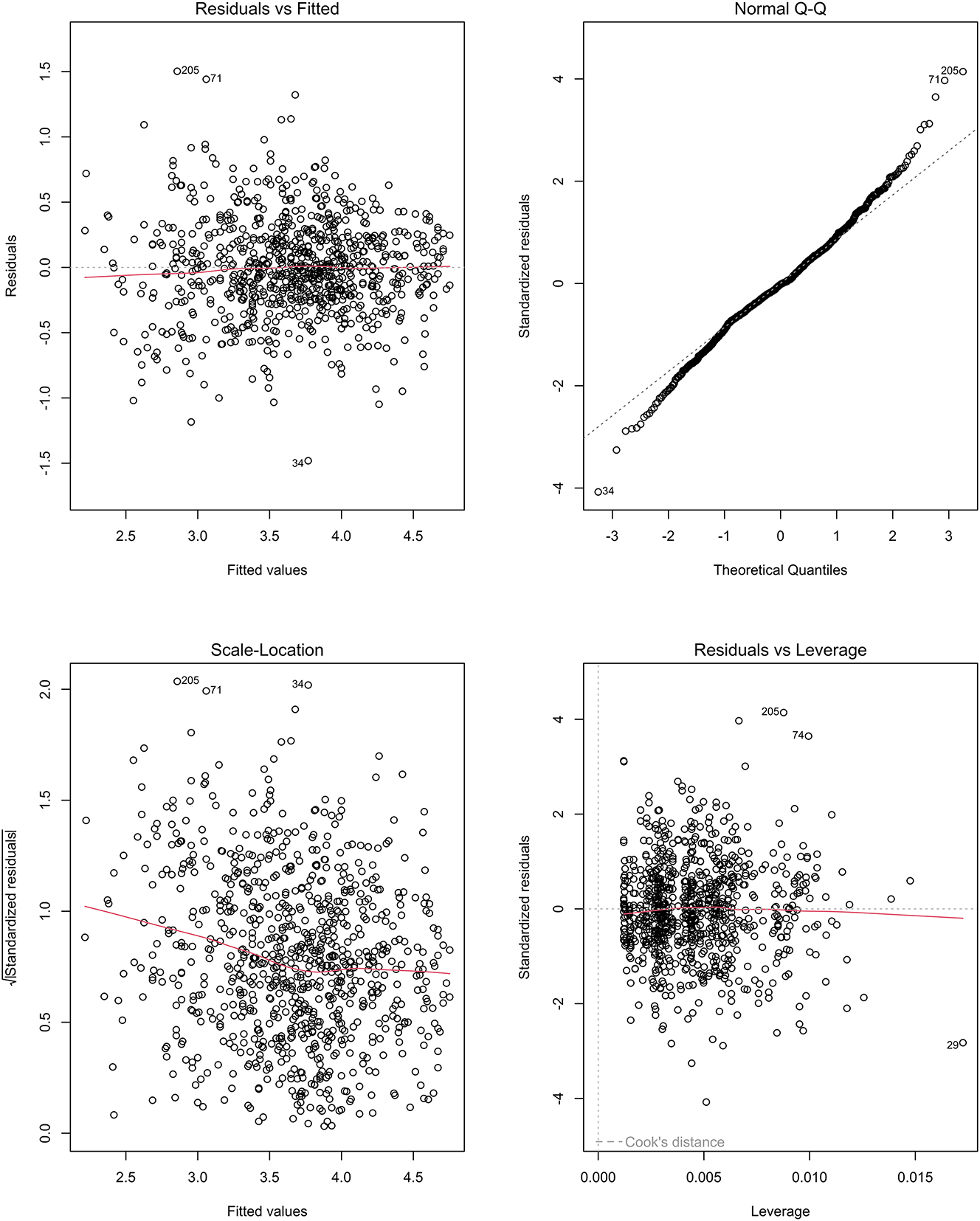
Model assumption plots of step 2 regression model predicting integrated information-based academic writing.
References
Association of College and Research Libraries [ACRL]. 2015. Framework for information literacy for higher education. Available from: http://www.ala.org/acrl/standards/ilframework.Suche in Google Scholar
Bawarshi, Anis S. & Mary J. Reiff. 2010. Genre: An introduction to history, theory, research, and pedagogy. West Lafayette, IN: Parlor Press.Suche in Google Scholar
Braine, George S. 1995. Writing in the natural sciences and engineering. In Diane Belcher & George S. Braine (eds.), Academic writing in a second language: Essays on research and pedagogy, 113–134. New York, NY: Albex.Suche in Google Scholar
Costley, Tracy, Nancy Kula & Lutz Marten. 2023. Translanguaging spaces and multilingual public writing in Zambia: Tracing change in the linguistic landscape of ndola on the copperbelt. Journal of Multilingual and Multicultural Development 44(9). 773–793. https://doi.org/10.1080/01434632.2022.2086985.Suche in Google Scholar
Cummins, Jim. 2009. Preface. In Danling Fu (ed.), Writing between languages: How English language learners make the transition to fluency, Grades 4–12, ix–xii. Portsmouth, NH: Heinemann.Suche in Google Scholar
Ene, Estela, Kyle McIntosh & Ulla Connor. 2019. Using intercultural rhetoric to examine translingual practices of postgraduate L2 writers of English. Journal of Second Language Writing 45. 105–110. https://doi.org/10.1016/j.jslw.2019.100664.Suche in Google Scholar
Fan, Jason Jinsong. 2016. The construct and predictive validity of a self-assessment scale. Papers in Language Testing and Assessment 5(2). 69–100. https://doi.org/10.58379/JDLZ9308.Suche in Google Scholar
Flower, Linda & John R. Hayes. 1981. A cognitive process theory of writing. College Composition & Communication 32(4). 365–387. https://doi.org/10.2307/356600.Suche in Google Scholar
García, Ofelia. 2011. The translanguaging of Latino kindergarteners. In Kim Potowski & Jason Rothman (eds.), Bilingual youth: Spanish in English-speaking societies, 33–56. Amsterdam: John Benjamins Publishing Company.10.1075/sibil.42.05garSuche in Google Scholar
García, Ofelia & Naomi Kano. 2014. Translanguaging as process and pedagogy: Developing the English writing of Japanese students in the U.S. In Jean Conteh & Gabriela Meier (eds.), The multilingual turn in languages education: Benefits for individuals and societies, 258–277. Bristol, UK: Multilingual Matters.10.21832/9781783092246-018Suche in Google Scholar
Grabe, William. 2003. Reading and writing relations: Second language perspectives on research and practice. In Barbara Kroll (ed.), Exploring the dynamics of second language writing, 242–262. Cambridge, UK: Cambridge University Press.10.1017/CBO9781139524810.016Suche in Google Scholar
Gort, Mileidis. 2006. Strategic codeswitching, interliteracy, and other phenomena of emergent bilingual writing: Lessons from first-grade dual language classrooms. Journal of Early Childhood Literacy 6(3). 323–354. https://doi.org/10.1177/1468798406069796.Suche in Google Scholar
Gort, Mileidis. 2012. Code-switching patterns in the writing-related talk of young emergent bilinguals. Journal of Literacy Research 44(1). 45–75. https://doi.org/10.1177/1086296X11431626.Suche in Google Scholar
Guo, Congbin, Mun C. Tsang & Xiaohao Ding. 2010. Gender disparities in science and engineering in Chinese universities. Economics of Education Review 20. 225–235. https://doi.org/10.1016/j.econedurev.2009.06.005.Suche in Google Scholar
Holbrook, Allyson. 2008. Self-reported measure. In Encyclopedia of survey research methods, 805–806. Thousand Oaks, CA: Sage Publications, Inc.Suche in Google Scholar
Kiramba, Lydiah Kananu. 2017. Translanguaging in the writing of emergent multilinguals. International Multidisciplinary Research Journal 11(2). 115–130. https://doi.org/10.1080/19313152.2016.1239457.Suche in Google Scholar
Li, Wei. 2018. Translanguaging as a practical theory of language. Applied Linguistics 39(1). 9–30. https://doi.org/10.1093/applin/amx039.Suche in Google Scholar
Machado, Emily & Paul Hartman. 2019. Translingual writing in a linguistically diverse primary classroom. Journal of Literacy Research 51(4). 480–503. https://doi.org/10.1177/1086296X19877462.Suche in Google Scholar
Matsuda, Paul Kei & Christine M. Tardy. 2007. Voice in academic writing: The rhetorical construction of author identity in blind manuscript review. English for Specific Purposes 26. 235–249. https://doi.org/10.1016/j.esp.2006.10.001.Suche in Google Scholar
Mayer, Richard E., Andrew T. Stull, Julie Campbell, Kevin Almeroth, Bruce Bimber, Dorothy Chun & Allan Knight. 2007. Overestimation bias in self-reported SAT scores. Educational Psychology Review 19. 443–454. https://doi.org/10.1007/s10648-006-9034-z.Suche in Google Scholar
Plakans, Lia & Atta Gebril. 2013. Using multiple texts in an integrated writing assessment: Source text use as a predictor of score. Journal of Second Language Writing 22. 217–230. https://doi.org/10.1016/j.jslw.2013.02.003.Suche in Google Scholar
Plakans, Lia, Jui-Teng Liao & Fang Wang. 2019. “I should summarize this whole paragraph”: Shared processes of reading and writing in iterative integrated assessment tasks. Assessing Writing 40. 14–26. https://doi.org/10.1016/j.asw.2019.03.003.Suche in Google Scholar
Porte, Graeme K. 1996. When writing fails: How academic context and past learning experiences shape revision. System 24. 107–116. https://doi.org/10.1016/0346-251X(95)00056-P.Suche in Google Scholar
Porte, Graeme. 1997. The etiology of poor second language writing: The influence of perceived teacher preferences on second language revision strategies. Journal of Second Language Writing 6. 61–78. https://doi.org/10.1016/S1060-3743(97)90006-0.Suche in Google Scholar
Ross, Steven. 1998. Self-assessment in second language testing: A meta-analysis and analysis of experiential factors. Language Testing 15(1). 1–20. https://doi.org/10.1177/026553229801500101.Suche in Google Scholar
Stevenson, Marie, Rob Schoonen & Kees De Glopper. 2006. Revising in two languages: A multi-dimensional comparison of online writing revisions in L1 and fl. Journal of Second Language Writing 15. 201–233. https://doi.org/10.1016/j.jslw.2006.06.002.Suche in Google Scholar
Sun, Yachao. 2022. Implementation of translingual pedagogies in EAL writing: A systematic review. Language Teaching Research. https://doi.org/10.1177/13621688221090665, In press.Suche in Google Scholar
Sun, Yachao. 2023. Increasing critical language awareness through translingual practices in academic writing. Journal of English for Academic Purposes 62. https://doi.org/10.1016/j.jeap.2023.101229.Suche in Google Scholar
Sun, Yachao & Ge. Lan. 2021. Enactment of a translingual approach to writing. Tesol Quarterly 55(2). 398–426. https://doi.org/10.1002/tesq.609.Suche in Google Scholar
Tarchi, Christian, Ruth Villalón, Nina Vandermeulen, Lidia Casado-Ledesma & Anna Paola Fallaci. 2024. Recursivity in source-based writing: A process analysis. Reading and Writing 37. 2571–2593. https://doi.org/10.1007/s11145-023-10482-8.Suche in Google Scholar
Turnbull, Blake. 2019. Translanguaging in the planning of academic and creative writing: A case of adult Japanese EFL learners. Bilingual Research Journal 42(2). 232–251. https://doi.org/10.1080/15235882.2019.1589603.Suche in Google Scholar
Velasco, Patricia & Ofelia García. 2014. Translanguaging and the writing of bilingual learners. Bilingual Research Journal 37(1). 6–23. https://doi.org/10.1080/15235882.2014.893270.Suche in Google Scholar
Wang, Wen-Chung. 2008. Assessment of differential item functioning. Journal of Applied Measurement 9(4). 387–408.Suche in Google Scholar
Williamson, Thea & Aris Clemons. 2023. Illustrating linguistic dexterity in “English mostly” spaces: How translanguaging can support academic writing in secondary ELA classrooms. English Teaching: Practice and Critique 22(1). 79–95. https://doi.org/10.1108/ETPC-02-2022-0029.Suche in Google Scholar
Wilson, Mark. 2004. Constructing measures: An item response Modeling approach. New York, NY: Routledge.Suche in Google Scholar
Wolfersberger, Mark. 2003. L1 to L2 writing process and strategy transfer: A look at lower proficiency writers. TESL-EJ 7(2). Available from: http://www.tesl-ej.org/wordpress/issues/volume7/ej26/ej26a6/.Suche in Google Scholar
Xie, Qin. 2010. Test design and use, preparation, and performance: A structural equation modeling study of consequential validity. Hong Kong SAR: Unpublished Ph.D. Thesis at The University of Hong Kong.Suche in Google Scholar
Yu, Chengyuan. 2023a. Understanding the role of information literacy in academic writing in higher education. Macau: University of Macau Unpublished Ph.D. Thesis.Suche in Google Scholar
Yu, Chengyuan. 2023b. Integrating information literacy and academic writing: Developing a self-assessment scale of information-based academic writing. The Journal of Academic Librarianship 47(6). 102804. https://doi.org/10.1016/j.acalib.2023.102804.Suche in Google Scholar
Yu, Chengyuan & Yanchao Yang. 2024. Developing a scale of translanguaging for information-based academic writing. In Proceedings of the 52nd annual Conference of Canadian Association for information science. https://cais2024.ca/talk/37.yu/37.Yu.pdf.Suche in Google Scholar
Yu, Chengyuan & Cecilia Guanfang Zhao. 2021. Continuing the dialogue between writing experts and academic librarians: A conceptual model of information-based academic writing in higher education. The Journal of Academic Librarianship 47(6). 102454. https://doi.org/10.1016/j.acalib.2021.102454.Suche in Google Scholar
Zhang, Xuezi & Xenia Hadjioannou. 2022. Chinese graduate students’ translanguaging practice in the context of academic writing in English. Applied Linguistics Review 13(3). 373–388. https://doi.org/10.1515/applirev-2021-0020.Suche in Google Scholar
Zhao, Cecilia Guanfang & Lorena Llosa. 2008. Voice in high-stakes L1 academic writing assessment: Implications for L2 writing instruction. Assessing Writing 13(3). 153–170. https://doi.org/10.1016/j.asw.2008.10.003.Suche in Google Scholar
Zheng, Ying. 2010. Chinses university students’ motivation, anxiety, global awareness, linguistic confidence, and English test performance: A casual and correlational investigation. Kingston, Canada: Unpublished Ph.D. Thesis at Queen’s University.Suche in Google Scholar
Zhu, Hua & Wei Li. 2022. Translanguaging in performance or performance in translanguaging. Journal of Multilingual and Multicultural Development. 1–14. https://doi.org/10.1080/01434632.2022.2066109.Suche in Google Scholar
© 2025 Walter de Gruyter GmbH, Berlin/Boston
Artikel in diesem Heft
- Frontmatter
- Review Article
- The application of social network analysis in applied linguistics research: a systematic review
- Research Articles
- The neoliberal coloniality of EMI in Hong Kong higher education: insights from online stancetaking
- Unpacking fluid linguistic landscape in a community coffeehouse in Hangzhou, East China: an everyday life perspective
- Translanguaging in public and digital spaces: integrating telecollaboration to linguistic landscapes studies
- Investigating the relationships of writing behaviours to linguistic complexity and accuracy in independent and integrated writing task performance
- Exploring unobserved heterogeneity of speech fluency and its dynamic interactions with emotions
- Modality of input and factors affecting incidental vocabulary learning: reading, listening, and viewing with captions
- Blurred lines of participation: nexus analytical tools for reflecting on the roles of researchers and participants in change-oriented research projects
- The contribution of second language writers’ translanguaging ability to their information-based academic writing ability
- Translanguaging in the linguistic landscape: creative scripts in Yi ethnicity students’ handwritten signs
- Playing with funds of difficult knowledge: interactional insights for heritage language education
- Creating a meaningful summative assessment in a Chinese immersion context: a translanguaging perspective
- Transnational media and English spread in the Expanding Circle: Hollywood’s predominance, language accommodation, and English as an additional language in cinema, television, and video on demand
- Translingual practices for critical language awareness in English as an additional language writing education
- Multilingualism, translanguaging, and education in the Vaupés, Northwest Amazonia: dynamics of language use, and language loss
- Moderation of teacher-student rapport in the link between smartphone addiction and foreign language burnout and its gender difference
- The impact of divergent language policies on teachers’ language attitudes and proficiency in two multilingual education settings
- Exploring EFL learner resilience and examining its association with L2 buoyancy and language achievement
Artikel in diesem Heft
- Frontmatter
- Review Article
- The application of social network analysis in applied linguistics research: a systematic review
- Research Articles
- The neoliberal coloniality of EMI in Hong Kong higher education: insights from online stancetaking
- Unpacking fluid linguistic landscape in a community coffeehouse in Hangzhou, East China: an everyday life perspective
- Translanguaging in public and digital spaces: integrating telecollaboration to linguistic landscapes studies
- Investigating the relationships of writing behaviours to linguistic complexity and accuracy in independent and integrated writing task performance
- Exploring unobserved heterogeneity of speech fluency and its dynamic interactions with emotions
- Modality of input and factors affecting incidental vocabulary learning: reading, listening, and viewing with captions
- Blurred lines of participation: nexus analytical tools for reflecting on the roles of researchers and participants in change-oriented research projects
- The contribution of second language writers’ translanguaging ability to their information-based academic writing ability
- Translanguaging in the linguistic landscape: creative scripts in Yi ethnicity students’ handwritten signs
- Playing with funds of difficult knowledge: interactional insights for heritage language education
- Creating a meaningful summative assessment in a Chinese immersion context: a translanguaging perspective
- Transnational media and English spread in the Expanding Circle: Hollywood’s predominance, language accommodation, and English as an additional language in cinema, television, and video on demand
- Translingual practices for critical language awareness in English as an additional language writing education
- Multilingualism, translanguaging, and education in the Vaupés, Northwest Amazonia: dynamics of language use, and language loss
- Moderation of teacher-student rapport in the link between smartphone addiction and foreign language burnout and its gender difference
- The impact of divergent language policies on teachers’ language attitudes and proficiency in two multilingual education settings
- Exploring EFL learner resilience and examining its association with L2 buoyancy and language achievement
