Cornuside, identified in Corni fructus, suppresses melanin biosynthesis in B16/F10 melanoma cells through tyrosinase inhibition
-
Mi-Hee Kim


To the Editor
Objective section: To enhance skin whitening efficacy, tyrosinase activity and melanin biosynthesis should be inhibited in the skin. To achieve this goal, we examined the extract of Corni fructus (ECF), and identified cornuside, a functional metabolite in the ECF. Cornuside, identified in the ECF, effectively inhibited melanin biosynthesis in B16/F10 cells, possibly by suppressing tyrosinase activity. Therefore, this study suggests that cornuside can be used as a cosmetic ingredient for skin whitening.
Corni fructus is the fruit of Cornus officinalis, and has been widely used as an important herbal medicine in East Asia, including Korea. C. fructus has pharmacological efficacies such as cirrhosis, blood pressure strengthening, anticancer and antibacterial effects [1]. Major components of C. fructus are gallic acid, malic acid, tartaric acid, ursolic acid, morroniside, loganin and sweoside [2].
Melanin is a biopolymer of phenols widely distributed in nature and is a complex of black pigment and protein. Melanin, which is present in animals, plants and microorganisms, is not essential for growth and development, but is a substance that enhances the viability of any environment. Pigment accumulation in the skin such as blemishes and freckles is due to abnormal increase of melanin pigment in the epidermis and is mainly synthesized in melanosomes of melanocytes present in the epidermis [3]. Tyrosinase, a key enzyme of melanin biosynthesis, initiates melanin biosynthesis by oxidizing tyrosine in melanosomes [4]. In order to increase skin whitening efficacy, melanin biosynthesis and tyrosinase activity need to be inhibited in the skin. In this study, we identified cornuside present in the ECF, and investigated the skin whitening effects of cornuside.
Using the UPLC-MS/MS method, we analyzed a variety of metabolites in ECF, and identified cornuside as a functional metabolite. Cornuside is included in ECF at 0.821 mg/g DW (Figure 1A). Cornuside is a metabolite of the secoiridoid glucoside family and is known to show anti-neoplasmic, anti-inflammatory, hepatoprotective and anti-diabetic effects [5]. We first examined whether cornuside, identified in ECF, shows cytotoxicity in B16/F10 melanoma cells. As shown in Figure 1B, cornuside showed no cytotoxicity in B16/F10 cells. Next, we examined whether cornuside shows tyrosinase inhibition. As shown in Figure 1C, cornuside showed about 30% tyrosinase inhibition at a concentration of 50 μg/mL. In addition, cornuside inhibited melanin biosynthesis by about 75% at a concentration of 50 μg/mL (Figure 1D). These results reveal that cornuside, a functional metabolite identified in ECF, can inhibit melanin biosynthesis in B16/F10 cells by inhibiting tyrosinase activity. Therefore, this study suggests that cornuside can be used as a cosmetic ingredient to enhance skin whitening efficacy. The experimental methods used in this study are described in the supplement section.
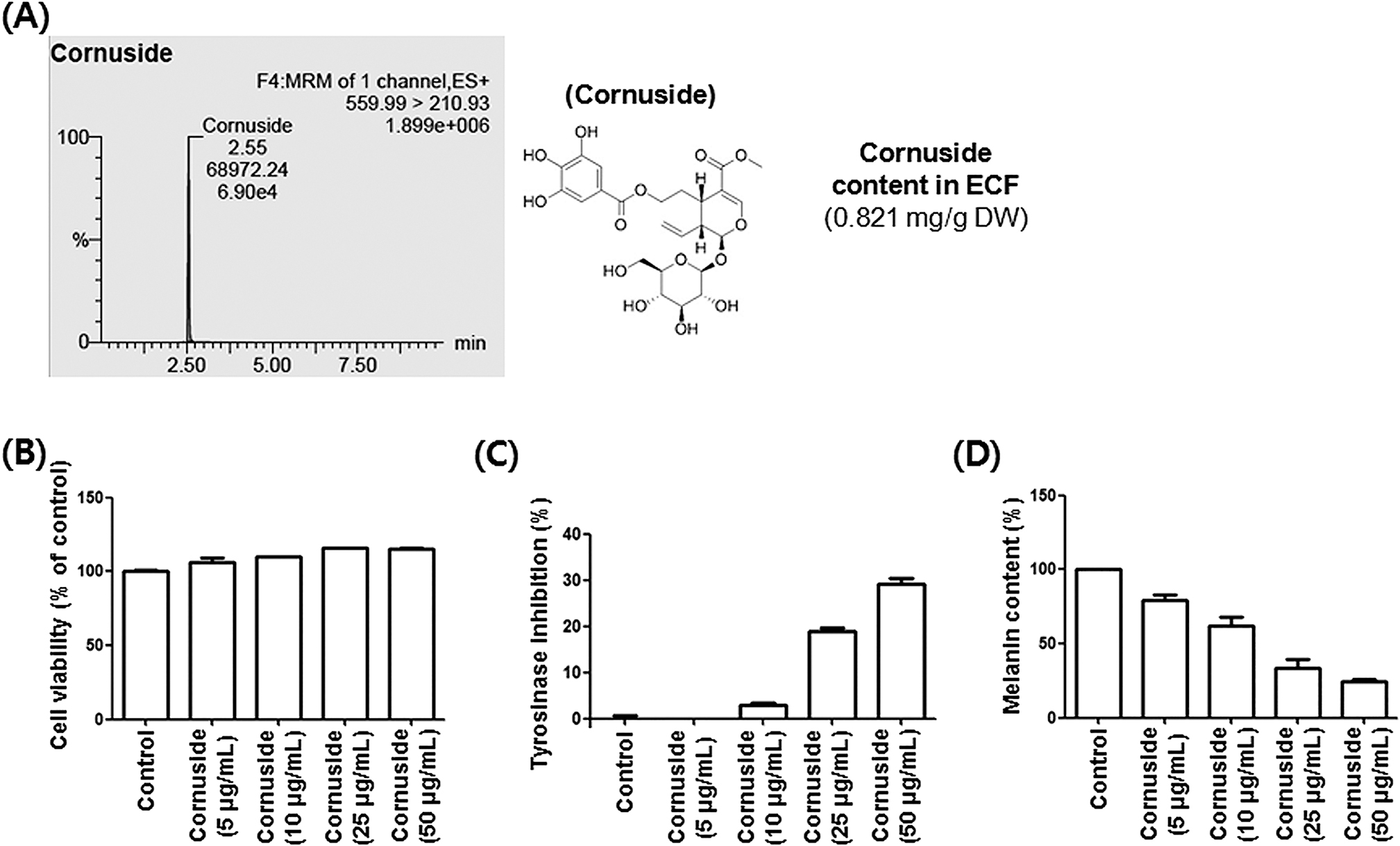
Cornuside has biological efficacies in improving skin whitening. (A) ECF contains cornuside (0.821 mg/g DW) as a functional ingredient. The UPLC-MS/MS was performed using a Waters Xevo TQ-S system (Waters, USA). (B) Cell proliferation assay was carried out using the MTS assay in B16/F10 cells. Error bars represent SD of three biological replicates. (C) Cornuside inhibits the activity of tyrosinase. 0.1 M sodium phosphate buffer and 1.5 mM tyrosine were mixed and tyrosinase (1,500-2,000 U/mL) was added sequentially. The absorbance was measured at 490 nm using an ELISA reader. Error bars represent SD of three biological replicates. (D) Cornuside inhibits melanin accumulation in B16/F10 cells. B16/F10 cells were treated with 10 µM forskolin. Absorbance was measured at 405 nm. Error bars represent SD of three biological replicates.
Funding source: Ministry of Trade, Industry & Energy (MOTIE)
Funding source: Korea Institute for Advancement of Technology (KIAT)
Award Identifier / Grant number: P0002204
Funding: This research was supported by the Ministry of Trade, Industry & Energy (MOTIE), Korea Institute for Advancement of Technology (KIAT) through the Encouragement Program for The Industries of Economic Cooperation Region (Grant Number: P0002204).
Conflict of interest: The authors certify that there is no conflict of interest with any financial organization regarding the material discussed in the manuscript.
Ethical approval: This letter does not contain any studies with human participants or animals performed by any of the authors.
References
1. Seo KI, Lee SW, Tang KH. Antimicrobial and antioxidative activities of Corni fructus extracts. Kor J Postharvest Sci Technol 1999;6:99–103. https://doi.org/10.3746/jkfn.2016.45.2.222.Search in Google Scholar
2. Jeon YH, Park MH, Kim M. Antibacterial activity of the ethanol extract from Cornus officinalis against some bacteria related to foodborne illness and food spoilage. J East Asian Soc Dietary Life 2012;22:692–700.Search in Google Scholar
3. Costin GE, Hearing VJ. Human skin pigmentation: melanocytes modulate skin color in response to stress. FASEB J 2007;21:976–94. https://doi.org/10.1096/fj.06-6649rev.Search in Google Scholar PubMed
4. Hill HZ, Li W, Xin P, Michell DL. The regulation of tyrosinase gene transcription. Pigment Cell Res 1997;10:127–38. https://doi.org/10.1038/sj.jid.5700840.Search in Google Scholar PubMed
5. Chu Q, Satoh K, Kanamoto T, Terakubo S, Nakashima H, Wang Q, Antitumor potential of three herbal extracts against human oral squamous cell lines. Anticancer Res 2009;29:3211–9.Search in Google Scholar
Supplementary Material
The online version of this article offers supplementary material (https://doi.org/10.1515/tjb-2020-0033).
© 2020 Walter de Gruyter GmbH, Berlin/Boston
Articles in the same Issue
- Frontmatter
- Research Articles
- Development of new total RNA isolation method for tissues with rich phenolic compounds
- Myofibrillar degeneration with diphtheria toxin
- In vitro and in silico studies on AChE inhibitory effects of a series of donepezil-like arylidene indanones
- In vitro antioxidant, anti-inflammatory and anti-cancer activities of methanolic extract of Asparagus horridus grows in North Cyprus Kuzey Kıbrıs da yetişen Asparagus horridus metanolik ekstraktının in-vitro antioksidan, anti-enflamatuar ve anti-kanser aktivitesi
- Purification and characterization of glucose-6-phosphate dehydrogenase from Eisenia fetida and effects of some pesticides and metal ions
- Nephroprotective effects of eriocitrin via alleviation of oxidative stress and DNA damage against cisplatin-induced renal toxicity
- The impact of orally administered gadolinium orthovanadate GdVO4:Eu3+ nanoparticles on the state of phospholipid bilayer of erythrocytes
- An anxiolytic drug buspirone ameliorates hyperglycemia and endothelial dysfunction in type 2 diabetic rat model
- Effects of mesenchymal stem cell and amnion membrane transfer on prevention of pericardial adhesions
- How potential endocrine disruptor deltamethrin effects antioxidant enzyme levels and total antioxidant status on model organisms
- Antiproliferative effect of rosehip tea phenolics in prostate cancer cell lines
- Investigation of MMP-9 rs3918242 and TIMP-2 rs8179090 polymorphisms in renal cell carcinoma tissues
- Investigation of SR-BI gene rs4238001 and rs5888 polymorphisms prevalence and effects on Turkish patients with metabolic syndrome
- Assessment of the frequency and biochemical parameters of conjunctivitis in COVID-19 and other viral and bacterial conditions
- Short Communication
- Lack of hotspot mutations other than TP53 R249S in aflatoxin B1 associated hepatocellular carcinoma
- Letter to the Editors
- Cornuside, identified in Corni fructus, suppresses melanin biosynthesis in B16/F10 melanoma cells through tyrosinase inhibition
- The extract of male bee and beehive from Bombus terrestris has biological efficacies for promoting skin health
- COVID-19 laboratory biosafety guide
- Retraction note
Articles in the same Issue
- Frontmatter
- Research Articles
- Development of new total RNA isolation method for tissues with rich phenolic compounds
- Myofibrillar degeneration with diphtheria toxin
- In vitro and in silico studies on AChE inhibitory effects of a series of donepezil-like arylidene indanones
- In vitro antioxidant, anti-inflammatory and anti-cancer activities of methanolic extract of Asparagus horridus grows in North Cyprus Kuzey Kıbrıs da yetişen Asparagus horridus metanolik ekstraktının in-vitro antioksidan, anti-enflamatuar ve anti-kanser aktivitesi
- Purification and characterization of glucose-6-phosphate dehydrogenase from Eisenia fetida and effects of some pesticides and metal ions
- Nephroprotective effects of eriocitrin via alleviation of oxidative stress and DNA damage against cisplatin-induced renal toxicity
- The impact of orally administered gadolinium orthovanadate GdVO4:Eu3+ nanoparticles on the state of phospholipid bilayer of erythrocytes
- An anxiolytic drug buspirone ameliorates hyperglycemia and endothelial dysfunction in type 2 diabetic rat model
- Effects of mesenchymal stem cell and amnion membrane transfer on prevention of pericardial adhesions
- How potential endocrine disruptor deltamethrin effects antioxidant enzyme levels and total antioxidant status on model organisms
- Antiproliferative effect of rosehip tea phenolics in prostate cancer cell lines
- Investigation of MMP-9 rs3918242 and TIMP-2 rs8179090 polymorphisms in renal cell carcinoma tissues
- Investigation of SR-BI gene rs4238001 and rs5888 polymorphisms prevalence and effects on Turkish patients with metabolic syndrome
- Assessment of the frequency and biochemical parameters of conjunctivitis in COVID-19 and other viral and bacterial conditions
- Short Communication
- Lack of hotspot mutations other than TP53 R249S in aflatoxin B1 associated hepatocellular carcinoma
- Letter to the Editors
- Cornuside, identified in Corni fructus, suppresses melanin biosynthesis in B16/F10 melanoma cells through tyrosinase inhibition
- The extract of male bee and beehive from Bombus terrestris has biological efficacies for promoting skin health
- COVID-19 laboratory biosafety guide
- Retraction note
