Morphemic and Syntactic Phrasemes
-
Igor Mel’čuk


Abstract
A morphemic phraseme is a phraseme (= a constrained combination of linguistic signs) composed of morphemes that are part of the same wordform. Like a lexemic phraseme, a morphemic phraseme has a segmental signifier. All logically possible types of morphemic phrasemes are presented and illustrated: morphemic idioms, collocations, nominemes and clichés. Formally, these can be phraseologized complex stems, phraseologized complex affixes and phraseologized wordforms.
A syntactic phraseme is a phraseme that includes at least two minimal syntactic subtrees and whose signifier is non-segmental (it involves prosody or an operation). All syntactic phrasemes are idioms. A syntactic idiom must be distinguished from 1) phrases described by means of semantically loaded surface-syntactic relations; 2) phrases consisting of a lexical unit taken together with its actants; 3) lexemic phrasemes consisting of “light-weight” words, such as Rus. ˹nu i˺ [X]! lit. ‘Well and [X]’ = ‘What an amazing X!’, and 4) lexemic phrasemes with syntactic pecularities. The notion of fictitious lexeme, necessary for designating some syntactic idioms (those that are expressed only by prosody), is introduced. An illustrative list of 29 Russian syntactic idioms is presented, as well as the lexical entries for several Russian syntactic idioms.
1 Introduction
The present paper continues my previous work on phrasemes: Mel’čuk 1995, 2012, 2015a, 2015b: 293–362. All relevant notions are introduced in these titles, which the reader is kindly invited to consult for explanations of the necessary terms and formalisms. The definitions of notions that are directly involved in the present discussion are given below.
Let us start with the most general definition of phraseme.
Definition 1: phraseme
A phraseme is a complex linguistic sign s = s1 + s2 + … (= a combination of signs s1, s2, … on the syntagmatic axis) that is constrained (= non-free): the selection of at least one of the signs si by the Speaker depends on other individual signs in the combination.
The best-known phrasemes, or constrained combinations of linguistic signs, are lexemic phrasemes.
Definition 2: lexemic phraseme
A lexemic phraseme is a phraseme consisting of syntactically linked lexemes, that is, a constrained, or non-free, phrase.
Examples: ˹under the weather˺, ˹pull [N’s] leg˺, pay attention, take a shower, heavy losses.
☛ The top corners ˹ … ˺ enclose an idiom, see below.
In a lexemic phraseme s, all si are lexemes, and s is a phrase.
Lexemic phrasemes are phrasemes par excellence: they are the most numerous and the best studied of all phrasemes. However, languages also use two other major classes of phrasemes: morphemic phrasemes and syntactic phrasemes, which are the object of the present paper.
Morphemic phrasemes, like lexemic phrasemes, are segmental signs: the signifier of a lexemic or a morphemic phraseme is a string of phonemes (supplied with a particular prosody). These two classes of phrasemes contrast with syntactic phrasemes, which are non-segmental signs: the signifier of a syntactic phraseme includes—maybe along with a segmental component—autonomous prosody (i.e., prosody unattached to a phonemic string), a configuration of surface-syntactic relations (i.e., non-lexicalized surface-syntactic subtree), grammemes, or an operation. Because of their segmental nature, morphemic phrasemes are more similar to lexemic phrasemes and have been longer known in linguistics than syntactic phrasemes. It seems reasonable, therefore, to begin with morphemic phrasemes.
| NB | Calling lexemic and morphemic phrasemes segmental signs is abus de langage: their components—lexemes and morphemes—are not signs, but sets of signs. Therefore, the term segmental is used here as an obvious abbreviation: strictly speaking, lexemic and morphemic phrasemes are, of course, sets of segmental signs, but both these types of phraseme are implemented on the linguistic surface as complex segmental signs. |
2 Morphemic phrasemes
2.1 The definition of morphemic phraseme
Melʹčuk 1964 proposed a generalization of the notion of lexemic phraseme for it to be applicable to non-free combinations of units of the morphological level, that is, of morphemes. A constrained (= non-free) combination of morphemes within a wordform is a morphemic phraseme, or morphophraseme.
| NB | The first explicit mention (known to me) of morphemic phrasemes is found in Pike 1961: 579–581: cf. his terms affixal idiom and affixal collocational complex. “Word-level analogs of idioms” are discussed in Dillon 1977: 47 and in Čermák 2007; a detailed characterization of morphophrasemes is given in Mel’čuk 1993–2000: vol. 4, Ch. 9 and Beck and Mel’čuk 2011. |
Definition 3: morphemic phraseme
A morphemic phraseme (= morphophraseme) is a phraseme consisting of morphemes that are part of the same wordform.
In a morphemic phraseme s, all si are morphemes, and s is a wordform or a part of a wordform (a complex stem or a complex affix).
Morphemic phrasemes can be considered from a diachronic or from a synchronic viewpoint.
From a diachronic perspective, a morphemic phraseme is:
Either a phraseologized diachronically complex stem, which can be a phraseologized diachronically derived stem (= a phraseologized diachronical combination of a stem with derivational affixes) or a phraseologized diachronically compound stem (= a phraseologized diachronical combination of a stem with another stem);
or a phraseologized diachronically complex affix (= a phraseologized combination of affixes).
In today’s language, diachronically complex stems and affixes can remain complex or become simplexes, depending on the degree of autonomy enjoyed by their component morphemes: are these morphemes contiguous or not within the wordform, do they retain their combinatorial properties or not, etc.; see examples below.
From a synchronic perspective, a morphemic phraseme can only be a phraseologized synchronically complex wordform, that is, a phraseologized combination of a stem with inflectional affixes, where the stem determines the selection of the affix expressing the given grammeme(s).
The phraseological properties of morphemic phrasemes are, as indicated above, similar to those of their lexemic sisters. This should not come as a surprise, since, as we said, morphemic and lexemic phrasemes are both segmental signs. Therefore, among morphemic phrasemes, as among lexemic phrasemes, two major phrasemic subclasses are distinguished:
semantic-morphemic phrasemes, where the combination of morphemes is constrained with respect to the corresponding meaning, which is itself freely constructed by the Speaker; and
conceptual-morphemic phrasemes, where not only the combination of morphemes, but also the underlying meaning is constrained with respect to the corresponding conceptual description of the extralinguistic reality.
In the first class, non-compositional morphemic idioms and compositional morphemic collocations are distinguished; the second class subdivides into non-compositional morphemic nominemes and compositional morphemic clichés. All types of morphemic phrasemes can also be constrained pragmatically (= by the situation of their use), that is, be pragmatemes. The language-universal typology of morphemic phrasemes is presented in Figure 1.

Universal Typology of Morphemic Phrasemes
(for the universal typology of lexemic phrasemes, see Mel’čuk 2015a: 68)[1].
First, semantic-morphemic phrasemes are presented (Subsection 2.2), then conceptual-morphemic phrasemes (2.3).
2.2 Semantic-morphemic phrasemes
Like semantic-lexemic phrasemes, semantic-morphemic phrasemes come in two major types: morphemic idioms (2.2.1) and morphemic collocations (2.2.2).
2.2.1 Morphemic idioms
Morphemic idioms are found only in diachronic word-formation (= diachronic derivation and diachronic compounding) and diachronic affix-formation, that is, in the historical, at present non-productive creation of new lexemes and new affixes. This is so because synchronic derivation and compounding as well as inflection are by definition too regular to allow for the idiomaticity, i.e., the semantic non-compositionality, of produced complex signs.
| NB | On the formal non-compositionality of complex morphemic signs, see “Morphemic Idioms and Suppletion” below, p. 41. |
To put it differently, a morphemic idiom is necessarily stored as a whole (= as a simplex) in the lexicon, if it is a lexeme, or in the grammar, if it is an affix.
Morphemic idioms can be subdivided into the same three subclasses as lexemic idioms: strong idioms, semi-idioms and weak idioms.[2]
Terminological remark
A morpheme {M} is implemented on the surface by one of its morphs mi: thus,
{leaf} ⇔ leaf-, leav-,
where the stems leaf-(Ø) and leav-(es) are morphs.
A morphemic idiom ˹{M1+M2}˺ is implemented by a quasi-morph; thus,
˹{for+get}˺ ⇔ forget,
where the stem forget- is—from a diachronic viewpoint—a quasi-morph.
The components of a quasi-morph are
either morphoids, if they have semantic links with morphs of the language,
or submorphs, if they do not (Mel’čuk 1993–2000: vol. 4, 249–251).
For instance, in the wordform conceive, the elements con- and -ceive are morphoids; in forget, the elements for- and -get are submorphs.
This analysis is valid only with respect to diachrony. In the modern language, the diachronically complex stems and affixes illustrated below can be simple stems and simple affixes. Thus, in a formal synchronic description of English, {forget} and {conceive} are simple morphemes and forget- and conceive-, simple morphs.
☛ m stands for “morph”; within a morphemic idiom, m denotes the corresponding morphoid/submorph; morphoids/submorphs are separated by pluses: m1+m2; in the examples, lexical stems are printed in caps, and affixes, in boldface lowercase characters.
■ Strong morphemic idioms
The meaning of a strong morphemic idiom ˹{M1+M2}˺ does not include the meaning either of {M1} or of {M2}: ‘˹{M1+M2}˺’ ⊅ ‘{M1}’ and ‘˹{M1+M2}˺’ ⊅ ‘{M2}’.
Strongly idiomatic diachronically complex stems
| Strongly idiomatic diachronically derived stems | ||
| (1) | a. | for+get ‘X forgets Y’ = ‘X loses information Y that has been in X’s brain’: ‘forget’ ⊅ ‘for’ and ‘forget’ ⊅ ‘get’ |
| b. | whopp+er ‘something extremely large’: ‘whopper’ ⊅ ‘whop [= ‘hit hard’]’ and ‘whopper’ ⊅ ‘-er’ |
|
| Strongly idiomatic diachronically compound stems |
| (2) | a. | blue+stocking ‘woman who is too intellectual and not sufficiently feminine’: ‘bluestocking’ ⊅ ‘blue’ and ‘bluestocking’ ⊅ ‘stocking’ |
| b. | brow+beat ‘X browbeats Y’ = ‘X intimidates Y by stern and/or arrogant behavior’: ‘browbeat’ ⊅ ‘brow’ and ‘browbeat’ ⊅ ‘beat’ |
In Modern English, all the stems in (1) and (2) are simplexes. But there also exist strongly idiomatic diachronically derived and diachronically compound stems that remain complex in modern language; for instance, in Dene-Suline (Athabaskan) (Holden 2009):
| (3) | a. | na +ne +hode+ s +ł +ker ‘I beg you’ [*‘I repeatedly iter 2sgOBJ ask 1sgsub.imperf class2 ask ask you’] na-…-hode-…-ker ‘beg’ is a strongly idiomatic diachronically derived interrupted (= discontinuous) verbal stem. |
| b. | k’a +the +Ø +da ‘S/he lays in ambush’ arrow 3sub.imperf class4 sit k’a-…-da ‘lay in ambush’ is a strongly idiomatic diachronically compound interrupted verbal stem. |
Strongly idiomatic diachronically complex affixes
| (4) | The German verbal inflectional circumfix ge-…-en PAST PARTICIPLE (of strong verbs): ge+schrieb+en ‘written’, ge+flog+en ‘flown’, ge+schlaf+en ‘[have] slept’ |
Diachronically, the circumfix ge-…-en consists of the prefix ge-, which is not productively used in modern German with verbs, and the suffix -en, which, outside of this circumfix, marks a verb as either infinitive or 1pl and 3pl.
| (5) | The Russian nominal derivational circumfix za-…-/j/(-e) ‘geographical region behind…’ This circumfix derives the names of geographical regions situated “behind” a mountain range, a river, or a big lake:[3] Za+kavkazʹ+j(-e) ‘Transcaucasus = region behind (= south of) the Caucasus’ Za+volžʹ+j(-e) ‘Transvolga = region behind (= east of) the Volga’ Za+bajkalʹ+j(-e) ‘Transbaikal = region behind (= east of) Lake Baikal’ |
In Modern Russian, the prefix za- does not combine with nouns at all; the suffix -j- derives depreciative collective nouns, such as babʹ+j(-o) ‘women of the type the Speaker dislikes’ (from baba ≈ ‘woman of the type the Speaker dislikes’) or duračʹ+j(-o) ‘fools’ (from durak ‘fool’)’.
| (6) | Three of the Basque (Guipuzcoan) case affixes (Janda and Manandise 1984: 223) are strongly idiomatic diachronically affix complexes:[4] | |||
| -rako | destinative [‘intended for’] | : -ra allаtive, | -ko relative | |
| -rengatik | causal [‘because of’] | : -ren genitive, | -ga [empty morph], -tik ablative | |
| -rentzat | benefactive [‘beneficiary for’] | : -ren genitive, | -tzat equative [‘taken for’] | |
■ Morphemic semi-idioms
The meaning of a morphemic semi-idiom ˹{M1+M2}˺ 1) includes the meaning of one of the morphemes {M1} or {M2}, which is not its semantic pivot,[5] and 2) does not include the meaning of the other:
‘˹{M1+M2}˺’ ⊃ ‘{M1}’, and ‘˹{M1+M2}˺’ ⊅ ‘{M2}’, and
{M1} is not the semantic pivot of ˹{M1+M2}˺
Semi-idiomatic diachronically complex stems
| Semi-idiomatic diachronically derived stems | ||
| (7) | a. | team+ster ‘professional who drives a truck’ |
| b. | stopp+er ‘device designed for plugging an opening’ | |
| c. | bind+ing1 ‘device designed for protecting and keeping together the pages of a book—hard thin plates that…’ | |
| d. | bind+ing2 ‘device designed for fixing a ski boot to the ski’ | |
| Semi-idiomatic diachronically compound stems | ||
| (8) | a. | light+house ‘construction designed for sending signals by light to ships’ |
| b. | sweet+meat ‘small food item that is sweet’ | |
| c. | pan+cake ‘food item that is made from batter cooked in a pan’ | |
| d. | lumber+jack ‘professional who fells trees for lumber’ |
Semi-idiomatic synchronic affix complexes (uninterrupted and interrupted)
| (9) | Kannada (Aronoff and Sridhar 1984): ind(icative), non-past, neg(ation) ⇔ {GERUND} ⊕ {NON-PAST} ⊕{NEG} ⇔ uvud⊕-illa mād․ +uvudu ‘doing’ ~ mād․ +uvud+illa ‘doesn’t/won’t do’ ind(icative), past, neg(ation) ⇔ {INF} ⊕{NEG} ⇔ -alu⊕-illa mād․ +alu ‘to do’ ~ mād․ +al+illa ‘didn’t do’ |
| (10) | Upper Necaxa Totonac (Beck and Mel’čuk 2011: 176) 1.PLsub-excl ⇔ {1.SGsub}, {1.PLsub-INCL} ⇔ ik-, -w ik+l̴tatā́+yā+w ‘we.excluding.you sleep’ [-yā- is a marker of the incompletive aspect] |
■ Weak morphemic idioms
The meaning of a weak morphemic idiom ˹{M1+M2}˺ 1) includes the meanings of both the morphemes {M1} and {M2}, 2) but neither of these is the semantic pivot, and 3) it includes an additional meaning ‘A’:
‘˹{M1+M2}˺’ ⊃ ‘{M1}’, and ‘˹{M1+M2}˺’ ⊃ ‘{M2}’, and ‘˹{M1+M2}˺’ ⊃ ‘A’, and {M1}/{M2} is not the semantic pivot of ˹{M1+M2}˺.
Weakly idiomatic diachronically complex stems
| Weakly idiomatic diachronically derived stems | ||
| (11) | a. | din+er ‘informal and inexpensive restaurant’ |
| b. | bomb+er ‘airplane designed for dropping bombs on targets’ | |
| c. | wine+ery ‘business where wine is produced and stored’ | |
| d. | Rus. spasa +telʹ lit. ‘sav+er’ = ‘lifeguard; first responder’ = ‘professional who saves people in extreme situations’ | |
| e. | Ger. leich en+beschau+er lit. ‘corpse examiner’ = ‘professional who examines corpses in order to make out death certificates’ | |
| f. | Ger. brief+träg+er lit. ‘letter carrier’ = ‘professional who delivers mail’ | |
| NB | Examples (11e–f) present stems derived from nominal compounds. | |
| Weakly idiomatic diachronically compound stems | ||
| (12) | a. | feed+back ‘information about the results of an action [by X on Y] [that is] fed back [to X]’ |
| b. | snow+shoes ‘device [designed for X] to walk on snow—flat frames to be attached under X’s shoes’ |
Morphemic idioms and suppletion Klammer nicht fett (Mel’čuk 1993–2000: vol. 4, 403)
A morphemic idiom is defined by its semantic non-compositionality—that is, its signified is not a regular (i.e., compositional) union of the signifieds of its component morphemes. However, formally it is quite regular, that is, compositional. At the same time, there are complex morphological signs of, so to speak, an inverse nature: they are semantically compositional, but formally non-compositional. Thus, the English wordform has is semantically compositional, since its signified is regularly constructed out of the signifieds of its virtual components:
‘has’ = ‘have’ ⊕ ‘ind.pres’ ⊕ ‘3’ ⊕ ‘sg’.
But its signifier is not regularly constructed: it “should” be *haves, but it is has. This is a well-known linguistic phenomenon: the wordform has is а strong megamorph suppletive with respect to the stem have-. I am not in a position to develop this point any further here (on suppletion, see Mel’čuk 2006: 405–467), and I will limit myself to emphasizing the following fact:
Either the signified of a phraseologized morphological complex sign can be a non-regular (= compositional) combination of the signifieds of its components, or its signifier can be a non-regular combination of the signifiers of its components.
The first case gives us morphemic idioms, and the second, pairs of suppletive units—a strong megamorph and the corresponding stem. In one of his last papers, Weinreich (1969: 43) defines an idiom as a phraseme whose meaning is “suppletive [sic!—IM] with respect to the sum of the meanings of its components,” i.e., Weinreich treats phraseologization as suppletion in the domain of meaning. Inversely, we can say that suppletion is phraseologization in the domain of form.
The properties of morphemic idioms and those of strong megamorphs can be presented in parallel:
| A morphemic idiom ˹{M1+M2}˺ is implemented by a non-elementary segmental sign m1+m2 whose signifier is regularly representable in terms of the signifiers of its components, but whose signified is not regularly representable in terms of the signifieds of its components. Schematically: ‘m1+m2’ ≠ ‘m1’ ⊕ ‘m2’ /m1+m2/ = /m1/ ⊕ /m2/ Example ‘for+get’ ≠ ‘for’ ⊕ ‘get’ /fɔ̄r+get/ = /fɔ̄r/ ⊕ /get/ |
A strong megamorph m͂ = m1.m2 is a non-elementary segmental sign whose signified is regularly representable in terms of the signifieds of its components, but whose signifier is not regularly representable in terms of the signifiers of its components. Schematically: ‘m͂’ = ‘m1’ ⊕ ‘m2’ /m͂/ ≠ /m1/ ⊕ /m2/ Example ‘is’ = ‘be’ ⊕ ‘{IND.PRES}’ ⊕ ‘{3SG}’ /ɪz/ ≠ /bī/ ⊕ /Ø/ ⊕ /z/ |
These close ties between suppletion and phraseologization are theoretically important.
2.2.2 Morphemic collocations
☛ The collocation base is printed in small caps, and the collocate (in this case, the derivational affix or dependent compound component), in boldface lowercase characters.
Morphemic collocations are found in diachronic and synchronic derivation and compounding, as well as in inflection.
Collocational complex stems
Collocational diachronically derived stems
Here are two stock examples of diachronic derivational collocations.
| (13) | Names of inhabitants London+er, Boston+ian, Muscov+ite, Vienn+ese, Damasc+ene, Hyderabad+i, Sydney+sider |
One of the suffixal morphemes {person who lives in L} is selected by the Speaker as a function of the stem, which is the name of a city or a town.
| (14) | Action nouns accept+ance, acknowledg+ment, observ+ation, intrus+sion, refus+al, oust+er, weight+ing |
Now, three more complex examples of diachronically derivational collocations.
| (15) | Russian | |
| a. | pas+tux lit. ‘pastur+er’ = ‘shepherd’ The noun is diachronically derived from pas(-ti) ‘pasture(V) [trans.]’ by the agentive unisuffix[6] -tux ‘person who…’. |
|
| b. | pop+adʹj(-a) lit. ‘Orthodox.priest+wife’ -adʹj- is also a unisuffix. |
|
| c. | topor+išč(-e) lit. ‘axe+handle’ | |
Russian has two homonymous derivational suffixes -išč-:
the semi-productive augmentative suffix -išč1- ‘extremely big’, as in nos+išč(-e) ‘extremely big nose’, komnat+išč(-a) ‘extremely big room’, etc.;
the unproductive, but frequent locative suffix -išč2- ‘place where …’, as in požar ‘fire’+išč(-e) ‘place where there has been a fire’, strelʹb ‘shoot’+išč(-e) ‘shooting range’, etc.
The suffix -išč- carries the meaning ‘handle’ only in the lexeme toporišče. (knut+ovišč(-e) ‘whip handle’ contains a different, albeit similar, suffix: -ovišč-.)
| Collocational diachronically compound stems | ||
| (16) | German | |
| a. | Haus+tür lit. ‘house door’ = ‘the door that is the main entrance to the building’ = ‘front door’ | |
| b. | Schmerz+ens+geld lit. ‘pain money’ = ‘money paid as compensation for personal injuries’ | |
Collocational synchronically complex wordforms (inflection)
In a language with rich non-agglutinative morphology, where nouns of different types have formally different declensions and verbs of different types have different conjugations, each declined or conjugated wordform (that is, each inflectional form) is a morphemic collocation: its stem is the base and the inflectional suffix is the collocate, since it is selected for the given grammemic combination as a function of this stem. Four examples follow.
| (17) | Russian declensions | |
| Ist | — sg, nom knig+a ‘book’ | |
| IInd masc | — sg, nom rog+Ø ‘horn’; neu — sg, nom bolot+o ‘swamp’ | |
| IIIrd | — sg, nom nočʹ+Ø ‘night’ | |
| (18) | Spanish conjugations | |
| Ist | — inf nad+a(-r) ‘[to] swim’ | |
| IInd | —inf coc+e(-r) ‘[to] cook’ | |
| IIIrd | —inf mor+i(-r) ‘[to] die’ | |
| (19) | Russian verbal aspect prefixes (six out of 15 aspect prefixes are given) |
| imperfective | perfective | imperfective | perfective | ||||
| čitatʹ | ∼ pro +čitatʹ | ‘read’ | stroitʹ | ∼ | po+stroitʹ | ‘build’ | |
| buditʹ | ∼ raz +buditʹ | ‘wake’ | pitʹ | ∼ | vy+pitʹ | ‘drink’ | |
| delatʹ | ∼ s +delatʹ | ‘do’ | poitʹ | ∼ | na+poitʹ | ‘make drink’ | |
Тhe perfective forms are compositional: all the prefixes express only the perfective aspect. However, their selection cannot be described in general or systematic terms; hence the claim that there are 15 perfective morphemes rather than 15 suppletive allomorphs of a single perfective morpheme. This means that each verb has to be marked in the lexicon for the particular perfective prefix morpheme it takes. The choice of the perfective prefix for each radical is thus severely constrained, but the resulting form is compositional. This is characteristic of collocations: the stem is the base of the collocation, as well as its semantic pivot.
| (20) | Yasin-Burushaski noun plural suffixes (Berger 1974: 15–20; twenty out of about 70 plural suffixes are given) |
| singular | plural | singular | plural | ||||||
| thám | ∼ | thám | +u | ‘king’ | hír | ∼ | hur | +í | ‘man’ |
| páqu | ∼ | páqu | +mu | ‘bread’ | díu | ∼ | diw | +ánc | ‘demon’ |
| aiždahár | ∼ | aiždahá | +išu | ‘dragon’ | asqór | ∼ | asqór | +iŋ | ‘flower’ |
| táγ | ∼ | taγ | +ášku | ‘branch’ | hárč̣ | ∼ | harč̣ | +óŋ | ‘plow’ |
| tál | ∼ | tál | +ǯu | ‘pigeon’ | tíṣ̌ | ∼ | tiṣ̌ | +míŋ | ‘wind’ |
| dán | ∼ | dan | +ǯó | ‘stone’ | wazíir | ∼ | wazíir | +tiŋ | ‘minister’ |
| dušmán | ∼ | dušmá | +yu | ‘enemy’ | gús | ∼ | guš | +íŋa | ‘woman’ |
| čár | ∼ | čar | +kó | ‘rock(N)’ | gót․ | ∼ | got․ | +ó | ‘[a] mute’ |
| húk | ∼ | huk | +á, +ái | ‘dog’ | d․ ím | ∼ | d․ ím | +a | ‘body’ |
| úrk | ∼ | urk | +á, +ás | ‘wolf’ | túr | ∼ | tur | +iáŋ | ‘horn’ |
The plural forms of Burushaski nouns are semantically compositional, but formally unpredictable: for each individual radical (which is the base of the morphemic collocation and its semantic pivot), the corresponding plural suffix has to be specified in the lexicon. The distribution of the plural morphemes does not correspond to any more general morphological or declension class of nouns in the language: therefore, it cannot be described as allomorphy, which should be sufficiently general as to be treated as rule-governed behavior.
2.3 Conceptual-morphemic phrasemes
2.3.1 Morphemic nominemes
Morphemic nominemes are the proper names of individual places, events, human groups, etc., and, therefore, like lexemic nominemes, they represent little interest for a language lexicon: their place is rather in an encyclopedia.
Diachronically derived morphemic nominemes
| (21) | Russian | ||
| a. | Aleksandr+ov(-Ø) lit. ‘Alexander’s’: | a city in Russia, named after some Aleksandr. | |
| b. | Ežov+ščin(-a) lit. ‘Ezhov era’: | the period in the USSR (1936–1939) named after the then Minister of State Security Ežov, when Stalinist terror reached its peak. | |
| c. | staxanov+c(-y) lit. ‘Stakhano v+ite(s)’: | members of the mass movement of workers in the USSR in the 1930s aimed at working harder and producing more; the movement was named after its initiator, a miner called Staxanov. | |
Diachronically compound morphemic nominemes
| (22) | a. | German | |
| Neu+stadt lit. ‘new city’: | a city in Germany (cf. Nov+gorod lit. ‘new city’: a city in Russia). | ||
| Schwan+gau lit. ‘swan district’: a district in Germany. | |||
| b. | English | ||
| Green+land; Burn+side [a city in the US]; New+town [a city in the US] | |||
2.3.2 Morphemic clichés
For the time being, I have examples for three subclasses of morphemic clichés: morphemic nicknames, morphemic termemes and morphemic formulemes (but no examples for morphemic sentencemes[7]).
■ Morphemic nicknames
A morphemic nickname is a morphemic cliché that has a specific concrete referent, that is, it refers to an individual (in the logical sense). But unlike a nomineme, a nickname has a meaning: it not only identifies its referent, but tells us something about it; its lexical components are semantically full (= meaningful) morphemes. Nevertheless, morphemic nicknames, just like their lexemic counterparts, belong in an encyclopedia.
| (23) | German | ||
| a. | Kristall+nacht lit. | ‘crystal night’: the night of Nov. 9–10 1938 in Germany when massive pogroms against Jews were organized by the government and when mobs broke Jewish shop windows. | |
| b. | Braun+hemd(-en) lit. | ‘Brown Shirts’: members of the paramilitary wing of the National-Socialist party in the Nazi Germany, who wore brown shirts. | |
■ Morphemic termemes
A morphemic termeme is a morphemic cliché that has a generic concrete referent, that is, it denotes a particular class of individuals (in the logical sense). This means that a termeme corresponds to a technical term.
| (24) | German | |
| a. | Auslands+ministerium lit. ‘abroad ministry’ = ‘ministry of foreign affairs’ | |
| b. | Tee+rose ‘tea rose’ | |
| c. | Blind+darm lit. ‘blind gut’ = ‘caecum’ | |
| d. | Rot+wein ‘red wine’ | |
| e. | Weiss+wurst lit. ‘white sausage’ = ‘veal sausage’ | |
■ Morphemic formulemes
A formuleme is a cliché that has a specific abstract referent, that is, denotes a particular situation.
| (25) | a. | Thank+s! and Serb. Hval+a! ‘Thanks!’ |
| b. | Ger. Entschuldig+ung! lit. ‘excusing’ = ‘Sorry!’ |
Many morphemic formulemes are constrained pragmatically, that is, by the situation of their use. Such formulemes are, at the same time, pragmatemes (Mel’čuk 2020):
| c. | Stop+Ø [on a traffic sign] (= [to] stopIMPER) | |
| d. | Fr. Tir+ez ‘Pull’ [sign on a door in a public building] (= TIRERIMPER, 2, PL ‘pull’). | |
| e. | Rus. Lož+isʹ! lit. ‘Lie.down!’ = ‘Duck!/Take cover!’ [in a situation of shooting] (Ložisʹ = ložitʹsjaIMPERF, IMPER, 2, SG ‘lie down’)[8] and Pol. Padn+ij! lit. ‘Drop down!’ = ‘Duck!/Take cover!’ [in a situation of shooting] (Padnij = paśćPERF, IMPER, 2, SG ‘drop down’) |
|
| f. | Rus. Privet+Ø! lit. ‘greeting(N)’ [in a situation of greeting] = ‘Hi!’ | |
| g. | Upper Necaxa Totonac (D. Beck, personal communication) Wilá+ya̰? lit. ‘Are you sitting?’ [in a situation of greeting somebody sitting] = ‘Hi!’ Pin+pá̰? lit. ‘Are you going?’ [in a situation of greeting somebody walking] = ‘Hi!’ Kuwín+ḭ! lit. ‘Be.late.morning 2SGSUB.PERF’ [in a situation of greeting somebody in the morning] = ‘Good morning!’ |
2.4 The place of morphemic phrasemes in language
Interestingly, the following statement seems to hold:
Many lexemes of a language are in fact diachronic morphemic phrasemes.
How many? Strictly speaking, nobody knows, but we can try a rough estimate.
Among the thousand words of basic English roughly 10% are diachronic morphemic idioms. Here is a sample count performed for five letters (A, C, H, P and S):
| A: 14 out of 48 | C: 8 out of 76 | H: 3 out of 49 | P: 5 out of 78 | S: 10 out of 136 | |||
| across actor active activity alone along already |
always another anyone anything anytime around away |
careful careless central clothes |
cloudy comfortable computer cupboard |
healthy hers holiday |
photograph pleased probably produce provide |
someone something sometimes student subject |
substance successful suitable sunny support |
Total: 40 words out of 387 are diachronically derived, which makes > 10%.
In the general vocabulary, the proportion of diachronically complex (= diachronically derived or compound) lexemes must be—and is—much higher. Thus, if we arbitrarily take five pages from the Longman Dictionary of Contemporary English (1978), the picture is as follows:
p. 150: 29 words ~ 10 diachronically complex (= derived or compound)
p. 250: 35 words ~ 23 diachronically complex
p. 350: 34 words ~ 20 diachronically complex
p. 460: 22 words ~ 15 diachronically complex
p. 551: 37 words ~ 11 diachronically complex
Total: 79 out of 157 words are diachronically derived or compound; this is already ≈ 50%! Our rough calculations suggest that almost half of the lexical stock of a language are diachronically complex lexemes. Thus, morphemic phrasemes have an important place in the vocabulary of a language.
It is true that for a synchronic description of language L morphemic phrasemes are, logically speaking, irrelevant: derived and compound stems are presented in L’s lexicon as simplexes. Nevertheless, from a pedagogical viewpoint, the indication of diachronic derivation and compounding for a synchronic simplex seems quite useful: for instance, it gives a human user additional knowledge about the semantic range of the lexeme he considers.
Having discussed morphemic phrasemes, I can now move to syntactic phrasemes.
3 Syntactic phrasemes
3.1 Introductory remarks
As far as I know, the notion of syntactic phraseme as one of the three major classes of phrasemes was formally introduced in Mel’čuk (1987: 645). Syntactic phrasemes are in contrast to both lexemic and morphemic phrasemes. As a typical example of an English syntactic phraseme (more precisely, a syntactic idiom; for the definitions, see Subsection 3.3.1 below), the following tautology-like expression (which is by no means a tautology!) can be cited (Wierzbicka 1987):
| (26) | [Xs] ˹are L(X)s˺ | ≈ ‘Humans X, in conformity with their nature, do some undesirable things that are not so bad and can be put up with’. |
☛ Reminder: a variable in square brackets stands for a semantic actant slot; L(X)—a bound lexemic variable—denotes the lexeme L that expresses X; the top corners ˹ … ˺ enclose an idiom.
This syntactic idiom is implementable as BoysX are boysL(X); WivesX are wivesL(X); PoetsX are poetsL(X); etc. It expresses, in Wierzbicka’s terms, “tolerance for human qualities.” Wierzbicka (1987) offers detailed semantic descriptions of many “tautologically organized” syntactic idioms in several languages; see also Rhodes (2009).
The deep-syntactic [DSynt-] and surface-syntactic [SSynt-]structures of this syntactic idiom are as follows:

This idiom is not a segmental sign: its signifier contains, along with the copula be, an operation—the duplication of the actant X; this operation is represented by the bound lexemic variable L(X). Since such non-segmental signs are not very well known in the literature, it is useful to give some more examples. Thus, here is a Russian syntactic phraseme (also a syntactic idiom):
| (27) | ˹bytʹi.З vsem L(X)(N)PL, DAT˺ [X(N)n, NOM] ‘This is the most outstanding X of all Xs’[9] Askrej i Arsija na Marse – vsem goramL(X) goryX ‘Ascraeus Mons and Arsia Mons on Mars are the most outstanding mountainsX of all mountainsL(X)’. |
☛ The sub n stands for “number”; it refers to the number of the subject of the copula bytʹi.З.
This idiom’s DSynt- and SSynt-structures are here:

Now come three more Russian syntactic idioms. These expressions are of a very different nature, and my choice is deliberate: they demonstrate the astonishing structural variety of syntactic idioms.
| (28) | a. | [X ˹xotʹ L(INTENS(X))(ṽ)imperf, imper, 2, sg]˺[10] {Mne stalo} [stydnoX], xotʹ von begiL(INTENS(X)) 〈xotʹ v pogreb prjačʹsja; …〉 ‘{I was} ashamedx, even ready to run away 〈to hide in a cellar; …〉. |
| b. | [ХNOM] ˹èto bytʹi.2PRES, 3, SG L(X)nom˺ [VojnaХ] – èto vojnaL(X) lit. ‘WarХ it [is] war L(X)’. ≈ ‘War is war’. [MatematikaХ] – èto matematikaL(X) ‘Mathematics is mathematics’. [FaktyХ] – èto faktyL(X) ‘Facts are facts’. |
|
| c. | «will.be.punished» [OnХ] [u menjaZ] [budet valjatʹsjaY na divane]! lit. ‘He X at meZ will lie.aroundY on the.sofa!’ = ‘If he continues to lie around on the sofa he will be severely punished by me!’ |
|
| NB | In (28a) and (28b) the surface “manifestations” of the syntactic idioms are boldfaced. But in (28c) nothing can be boldfaced, because the signifier of this syntactic idiom does not contain segmental components: the meaning of threat is expressed exclusively through prosody attached to this particular surface-syntactic relation configuration. This idiom has to be represented (in the deep-syntactic structure) by a fictitious lexeme: «will.be.punished» (Subsection 3.2 below, (29)). |
Expressions of the type presented in (28) have been thoroughly described: for instance, Šmelëv (1960), Švedova (1960: 269–279), Švedova, ed. (1970: 558, 563–565; 1980: 85, 385–386), Wierzbicka (1987), Kajgorodova (1999), Lim (2001), Iomdin (2006a, 2006b, 2010, 2013, 2017), Kopotev (2008), Kopotev and Steksova (2016), Vilinbaxova and Kopotev (2017), Avgustinova and Iomdin (2019), Dobrovolʹskij et al. (2019). These expressions have been given different names: “(bound) constructions,” “phraseoschemata,” “syntactic phraseologisms,” or, as a cover term, “syntactic phrasemes,” or else “syntactic idioms.” However, the expression syntactic phrasemes/idioms seems to be abused: it is often interpreted too widely and too vaguely, namely as referring to any multiword expression that features syntactic peculiarities. In a similar vein, Construction Grammar (Goldberg 1995; Goldberg and Jackendoff 2004; Raxilina ed. 2010) considers as constructions not only phrasemes, but also phrases manifesting government of syntactic actants, that is, phrases of the form L1–synt→L2, where the lexeme L2 is an actant of the lexeme L1. As a result, linguistic phenomena of quite a different nature get mixed up, and this leads to incorrect and/or unnatural descriptions. To correct this drawback the present paper proposes and illustrates a rigorous definition of the notion syntactic phraseme (see Section 3.3.1).
3.2 Typical Russian syntactic phrasemes (= syntactic idioms)
Consider three Russian sentences (the subs X, Y, and Z designate the semantic actants of the expressions under analysis):
| (29) | a. | – TyХ poguljaešʹY u IvanaZ po nočam! lit. ‘YouХ will.go.for.a.walkY at IvanZ at night!’ [threat] = ‘I signal: if you go for a walk at night, you will be severely punished by Ivan’. |
| b. | – Kak že, tyХ poguljaešʹY u IvanaZ po nočam! lit. ‘Well, well, youХ will.go.for.a.walkY at IvanZ at night!’ [sarcastic negation] = ‘I signal: it is impossible that you will be allowed by Ivan to go for a walk at night’. | |
| c. | – Ne somnevajsja, tyХ poguljaešʹY u IvanaZ po nočam! lit. ‘Don’t doubt, youХ will.go.for.a.walkY at IvanZ at night!’ [assurance] = ‘I signal: no doubt that you will be made by Ivan to go for a walk at night’. |
All three sentences are signalatives (Mel’čuk 2001: 242–251, 354–256). That is, they do not communicate statements about facts or entities in the extralinguistic world, that is, statements that can be negated or interrogated. A signalative signals a mental state of the Speaker (‘I signal that…’) and represents his particular speech act: (29а) is the Speaker’s threat that is intended to prevent the action ‘you go for a walk at night’; in (29b), the Speaker sarcastically negates the possibility of this action; on the contrary, (29c) gives the Speaker’s assurance of its future realization.[11] The three sentences in (29) consist of the same lexemes, linked by the same syntactic relations; they differ only in prosody. That is, the meanings that distinguish these sentences are expressed exclusively prosodically; the prosody of each one of them is invariably associated to a particular predicate meaning ‘σ(29а)’/‘σ(29b)’/‘σ(29c)’. The lexemes with subs X, Y and Z in (29) express the semantic actants of these meanings, while each meaning ‘σ(29а)’/‘σ(29b)’/‘σ(29c)’ itself is carried by the prosody of the sentence—that is, it is expressed by a non-segmental means. Thus, sentences (29) contain linguistic signs of quite a particular type. A question arises naturally:
How should the signs carrying the meanings ‘σ(29а)’/‘σ(29b)’/‘σ(29c)’ in sentences (29) be described formally?
Let us start with the type of sign in sentence (29а).
Its signified is ordinary, the same as with most linguistic signs: the semantic representation [SemR] of a meaning.
Its signifier, on the contrary, is quite special. On the morphological level it is not a phonemic string: the lexemic variables X, Y and Z, linked by particular surface-syntactic relations [SSyntRels], stand for the actant slots of the meaning ‘σ(29а)’ ≈ ‘Z will punish X for Y(X)’, not in any way for the meaning ‘σ(29а)’ itself. This meaning is expressed only by a particular prosody. Such a signifier must be presented (in the lexicon) in the form of a prosodic structure.
Its syntactics is also special. On the one hand, it specifies the configuration of surface-syntactic relations (= a subtree) on which the prosodic signifier is to be imposed. On the other hand, it indicates that the resulting expression is a full sentence and a signalative; as for its style, it is colloquial.
Let us call the sign under consideration «will.be.punished». This expression «will.be.punished» is a fictitious lexeme (see Section 3.3.3).
Here is a formal representation of this sign.
«WILL.BE.PUNISHED»

Formal representation of the Russian non-segmental sign «WILL.BE.PUNISHED»
☛ In the prosodic structure of this sign’s signifier, the arrows show the movement of the intonation, and the symbol ʹ indicates a particular type of strong accent.
Now, what is the class of linguistic signs to which the sign «will.be.punished» belongs? The answer depends on this sign’s signifier, since the signifieds of all types of linguistic signs are of the same logical and formal nature. The signifier of the «will.be.punished» sign is a particular prosodic structure to be imposed on the string of lexemes in order to form a sentence; but these lexemes are not part of the sign: some of them are the sign’s actants, and the others are dependents of these actants. The meaning carried by said prosodic structure, that is, the signified of the sign «will.be.punished», shown as the SemR in Figure 2 (≈ ‘I signal that if X does Y, X will be severely punished by Z for Y’), is not built in a regular way out of the signifieds of its components. To put it in other words, the meaning of this sign cannot be regularly distributed among the components of its signifier, that is, between chunks of its prosody. Therefore, the sign «will.be.punished» is not compositional and thus it is an idiom. And since its signifier is not segmental, it is a syntactic idiom. This idiom is, as I have said, denoted with a fictitious lexeme; and a fictitious lexeme, like any genuine lexeme, has its own lexical entry, which is given below.
NB The lexical entry of a lexemic idiom features two additional zones with respect to the lexical entry of a single lexeme:
The zone of surface-syntactic implementation, which specifies the SSynt-tree of the idiom.
The zone of deep-morphological implementation, which contains the necessary data on the linear order of the idiom’s lexemic components, on possible gaps between these components, etc.
The lexical entry of a syntactic idiom also has these two zones: they likewise specify the SSynt-tree of the idiom and the linear ordering of its lexemic components; however, in the case of a syntactic idiom whose signifier consists only of prosody they specify the SSynt-structure and the ordering not of the idiom components themselves, but of the components of the resulting expression—the idiom plus its actants. In the illustrative lexical entries given below, the deep-morphological implementation zone is not shown.
| «WILL.BE.PUNISHED», | fictitious lexeme that represents a syntactic idiom; with its actants, it forms a full sentence, which is signalative; colloquial |
| Definition | |
| ‘[X] «WILL.BE.PUNISHED» [for Y by Z]’ = | ‘I signal that if X does Y, X will be severely punished by Z for doing Y’ |
Government Pattern
| X ⇔ I | Y ⇔ II | Z ⇔ III |
| 1. Nnom | 1. VIMPERF, FUT 2. po+VPERF, FUT |
1. u ‘at’ + NGEN |
IvanX u novogo direktoraZ budetY pʹjanstvovatʹ! 〈= popjanstvuet!〉
lit. ‘IvanX at new directorZ willY be.drinking!’ =
‘If Ivan drinks, the new director will severely punish him’.
Surface-Syntactic Implementation
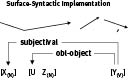
Once again, [X(N)], [Y(V)] and [Z(N)] are the semantic actants of the idiom «will.be.punished», not its “variable lexical parts,” as they are often characterized.
The signs of the «will.be.punished» form, where the signifier is just the prosody, are by no means the only variety of syntactic idioms. Another (and quantitavely overwhelming) type of Russian syntactic idiom is presented in (30); these idioms are non-segmental because of a bound lexemic variable in their signifier:
| (30) | a. | {Na pervyj vzgljad,} [derevoХ] bylo kak derevoL(X) lit. ‘{At first sight,} [treeХ] was as treeL(X)’. = ‘At first sight, this tree was quite an ordinary tree’. |
| b. | [NamY] [obedX] Øbytʹi.З ‘be’ ne v obedL(X) {kolʹ xozjajuški net} lit. ‘To.usY dinnerX [is] not into dinnerL(X) if the.lady.of.the.house is.absent’. = ‘The dinner cannot be enjoyed by us if the lady of the house is absent’. |
The sentence in (30a) features the syntactic idiom ˹kak derevo˺ ‘as tree’. A sign of this form can be represented as follows:
[X] ˹как L(X)˺ =
〈‘quite an ordinary [X]’; [X(n)nom]–attributive→как–comparative-conjunctional→L(X)(n)nom; ∑ = syntactic idiom, adnominal adverb, signalative; colloquial〉
Its signifier is a SSynt-subtree that includes the lexeme kak ‘as’ (a comparative conjunction) and a bound lexemic variable L(X)(N)NOM, which refers to X(N)NOM, the semantic actant of the expression; it is this variable that denotes the operation of duplication. Since the meaning of the expression cannot be distributed between its components, it is an idiom; and since its signifier is not segmental (it contains the operation of duplication), it is a syntactic idiom. Here is its lexical entry:
[X] ˹как L(X)˺, syntactic idiom, adnominal adverb, signalative; colloquial
Definition
‘[X] ˹как L(X)˺’ = ‘quite an ordinary X’
Government Pattern
| X ⇔ I |
| 1. NNOM |
Ja prosto čelovekX kak čelovekL(X) lit. ‘I [am] simply a.human as a.human’. =
‘I am simply quite an ordinary human’.
Surface-Syntactic Implementation[12]
Ξ–subjectival→[X]–attributive→kak–compar-conjunctional→L(X) | no X–modificative→Ψ
Pered nami stojalΞ domX–attr→kak domL(X) lit. ‘Before us [there] stood house as house’. =
‘Before us there was quite an ordinary house’.
[X]←subjectival–bytʹ–copular-completive→kak–compar-conjunctional→L(X) | no X–modificative→Ψ
DomX ètot byl–cop-compl→kak domL(X) lit. ‘House this was as house’. =
‘This house was quite ordinary’.
The sign presented in (30b) also has as its signifier a SSynt-subtree that contains three genuine lexemes—bytʹi.З ‘be’, ne ‘not’ and v ‘in’—and a bound lexemic variable L(X), to be filled with a duplicate of the actant Х; thus, this sign is non-segmental. It is another syntactic idiom:
[Y-u] [X] ˹bytʹi.З ne v L(X)˺, syntactic idiom, full clause, signalative; colloquial
Definition
‘[Y-u] [X] ˹bytʹi.З ne v L(X)˺’ = ‘X cannot be enjoyed by Y’
Government Pattern
| X ⇔ I | Y ⇔ II |
| 1. Nnom | 1. Ndat |
Sejčas detjamY kanikulyX ne v kanikuly
lit. ‘Now to.kidsY holidaysX are not into holidays’. = ‘Now holidays cannot be enjoyed by kids’.

3.3 Syntactic idioms
3.3.1 The definition of syntactic idiom
Since idioms are a type of phraseme, in order to define syntactic idioms, syntactic phrasemes must first be defined.
The syntactic phrasemes, just like lexemic and morphemic phrasemes, are a major subclass of phrasemes. However, unlike the latter, syntactic phrasemes are non-segmental signs. In prose, this means that they do not consist exclusively of lexemes or morphemes: the signifier of a syntactic phraseme includes prosody (intonations, pauses, accents) or an operation (for instance, the duplication of an actant).
Definition 5: syntactic phraseme (see Mel’čuk 1987)
Let there be a complex sign s = 〈‘σ’ ; /s/ ; Σs 〉 involving at last two minimal syntactic subtrees (of the form L1–synt→L2) which is constrained: that is, s is such that none of its components can be selected freely by the Speaker to express the meaning ‘σ’; cf. Definition 1.
A constrained complex sign s is a syntactic phraseme if and only if its signifier /s/ is non-segmental, that is, /s/ contains prosody or a bound lexemic variable, e.g., L(X), symbolizing the operation of duplication of the phraseme’s actant X.
| NB | The genuine lexemes that appear as components of a syntactic phraseme belong mostly to closed lexical-syntactic classes: they are prepositions, conjunctions or particles. |
Remember, the signifier of a lexemic phraseme is segmental: such a phraseme contains only genuine lexemes of the language, but no special prosody and no bound lexemic variables. The difference between a lexemic phraseme and a syntactic phraseme, whose signifier is non-segmental—it contains special prosody or a bound lexemic variable—is obvious.
For the time being, only one class of syntactic phrasemes is known: syntactic idioms.
Definition 6: syntactic idiom
A syntactic phraseme is a syntactic idiom if and only if it is non-compositional.
It is not known whether compositional syntactic phrasemes—that is, syntactic collocations and syntactic clichés—are possible. Therefore, in what follows I will speak exclusively of syntactic idioms.
All the syntactic phrasemes cited above are syntactic idioms, since the meaning of each of them cannot be regularly constructed by uniting the meanings of its components.
In conformity with Definitions 5 and 6, syntactic idioms come in two structural types.
Syntactic idioms whose signifier contains prosody
Idioms containing no lexemes at all, as, for instance, ˹[PetjaX] [u nasZ] [budet guljatʹY po nočam!]˺ lit. ‘PeteX at usZ will.go.for.a.walkY at night!’ = ‘If Pete goes for a walk at night, he will be severely punished by us’. All lexemes of the sentence Petja u nas budet guljatʹ po nočam! are part of the actants of the idiom (that is, the actants of the predicate ‘punish’). The meaning of the idiom (a threat of punishment: ‘If X does Y, X will be punished by Z for Y(X)’) is expressed, as explained above, by the prosody imposed on the string of its actants.
Idioms containing just one lexeme (plus prosody), as, for instance, čtoby ‘that’ in ˹Čtoby [Petja guljalX po nočam]?˺ lit. ‘That Pete go.for.a.walkX at night?’ The clause Petja guljaetX po nočam is the actant of the idiom (‘It is quite impossible [that X takes place]’), while the conjunction čtoby ‘that’ is a component of it, even if it contributes nothing to its meaning, a sarcastic negation: ‘quite impossible for Pete to go for a walk at night’. This meaning is, again, expressed by prosody.
Syntactic idioms whose signifier contains a bound lexemic variable L, which can be one of the two types:
Either L is filled with any lexical expression that, however, is semantically bound to actant X: it must denote an intensifier of X (see (28a), p. 50);
or L is filled with a duplicate of the idiom’s actant: [MalʹčikiX] ˹estʹ malʹčikiL(X)˺ ‘Boys are boys’ (see all other cases above). Syntactic idioms of the last type are the most numerous among the syntactic idioms known to me (in any case, in Russian).
3.3.2 Distinguish and avoid confounding!
Since the notion of syntactic idiom is relatively new and not stable enough, it is worth insisting on the differences between syntactic idioms and the following four other types of phrase that look similar enough to, and maybe confounded with, the former.
1) A phrase describable by a semantically loaded (= meaningful) SSynt- relation. Thus, the well-known Russian approximate-quantitative construction of the type knig pjatnadcatʹ lit. ‘books fifteen’ = ‘maybe fifteen books’ manifests the approximate-quantitative SSynt-relation:
pjatnadcatʹ←approx-quantitative–knigaPL ⇔ knig pjatnadcatʹ ‘maybe fifteen books’
The ordinary quantitative construction is implemented by a phrase with the inverse word order and a different SSynt-relation:
pjatnadcatʹ←quantitative–knigaPL ⇔ pjatnadcatʹ knig ‘fifteen books’
The approximate-quantitative SSyntRel is meaningful (contrary to the quantitative SSyntRel, which does not carry any meaning): it contributes to the meaning of the phrase the semantic component ‘the Speaker is not sure of the number he indicates’. In our description, this component can be encoded in the deep-syntactic structure by means of the fictitious lexeme «primerno» ‘maybe’.[13] It is «primerno» that appears in the deep-syntactic structure to represent the approximate-quantitative phrase; the DSynt-structure of the phrase knig pjatnadcatʹ is as follows:
«primerno»←ATTR–pjatnadcatʹ←ATTR–knigapl
As another example, consider phrases of the type {Ivan –} durak durakom lit. {Ivan [is]} fool by.fool’ = ‘{Ivan is} merely a fool’ = ‘Ivan is a fool times two’, {Èto} voda vodoj lit. ‘{This [is]} water by.water’ = ‘{This [is]} merely water’, etc. They are described, on the DSynt-level, by the fictitious lexeme «prosto» = «merely» and at the SSynt-level, by means of the “merely”-reduplicative SSyntRel:
«merely»←ATTR–durakSG ⇔ durakSG–“merely”-reduplicative→duraкSG (for more on this construction, see Janda et al. 2020).[14]
2) A phrase containing an ordinary lexical unit L (a lexemic idiom or a single lexeme) and L’s actants. Thus, the sentence U Ivana ruki češutsja vzjatʹsja za kistʹ lit. ‘At Ivan hands itch to take up a.paint.brush’ = ‘Ivan has a strong wish to start painting’ contains quite an ordinary lexemic idiom [u Х-a] ˹ruki češutsja˺ [Y-itʹ]; X and Y are the idiom’s actants, and by no means “its variable lexical parts,” as one sees them called from time to time. In an analogous way, in the expression ˹k čërtu˺ [Y]! lit. ‘To devil [with.Y]!’ Y is the actant of this lexemic idiom rather than its mystical “variable lexical part.” In the sentence Doloj ètix islamofašistov! ‘Down with these Islamofascists!’ the phrase ètix islamofašistov expresses the actant of the lexeme doloj [Y]! ‘Down [with.Y]!’: no idiom at all here. Similarly, the phrase Xren tebe! lit. ‘Horseradish to.you!’ = ‘You won’t get anything!’ contains the single lexeme xren [Y-u]!) and its actant tebe ‘to.you’.
3) An ordinary lexemic idiom that consists of “semi”-grammatical, or “light-weight,” lexemes. Such is, for instance, the Russian lexemic idiom (31), whose lexemic components are bytʹ ‘be’ and ne ‘not’:
| (31) | [X-u] ˹bytʹ ne˺ [do Y-a] lit. ‘[To.X] [it] is not [up.to Y]’ = ‘X cannot think of Y because X is preoccupied with something else’. MašeX bylo ne do knigY lit. ‘To.Masha [it] was not up.to books’.= ‘Masha could not think of books because she was preoccupied with something else’. |
Its SSynt-structure is as follows:

4) An ordinary lexemic idiom that has some syntactic peculiarities fairly often is also called “syntactic phraseme/idiom.” As an example, consider Russian lexemic idioms ˹vsë ravno˺ ≈ ‘just the same’ (described in Iomdin 2010: 156–162):
| ˹vsë ravno˺1: ≈ ‘independently from anything’ ≈ ‘anyway’ Ja vsë ravno sižu doma ‘I stay at home anyway’. |
| ˹vsë ravno˺2: ≈ ‘be.indifferent to Y’ Mne bylo vsë ravno, kuda idti ‘It was the same to me where to go’. |
| ˹vsë ravno˺3: ≈ ‘the same as…’ Dejstvovatʹ tak – èto vsë ravno, čto priznatʹ poraženie ‘To act in this way is the same as to accept defeat’. |
| ˹vsë ravno˺4: ≈ ‘no matter…’ Vsë ravno gde, vsë ravno kem, no èto otkrytie budet sdelano ‘No matter where, no matter by whom, but this discovery will be done’. |
Тhe four idioms have the same SSynt-structure: ˹vsë←restrictive–ravno˺. Their syntactic peculiarities:
| ˹vsë ravno˺1 | is a sentential adverb and cannot have syntactic dependents. |
| ˹vsë ravno˺2 | appears as a copular complement and governs—via the copula verb bytʹ ‘be’—a subject subordinate clause (with the complementizer čto ‘that’ or with a relative-interrogative pronoun) and an indirect object in the dative. |
| ˹vsë ravno˺3 | is also used as the complement of the copula bytʹ ‘be’ and governs an oblique object (of the form čto/kak ≈ ‘as’ + N/VINF) or an object subordinate clause introduced by the complex conjunction ˹kak esli by˺ ‘as if’. |
| ˹vsë ravno˺4 | is a component of a dozen indefinite pronouns, such as ˹vsë ravno˺ kto ‘no matter who’, ˹vsë ravno˺ otkuda ‘no matter where from’ and ˹vsë ravno˺ počemu ‘no matter why’ (similar to koe-kto ‘somebody’, kto ugodno ‘anybody’, malo kto ‘few people’, etc.). |
The four ˹vsë ravno˺ expressions are ordinary lexemic idioms featuring some syntactic particularities.
3.3.3 Fictitious lexemes
Strictly speaking, the topic of fictitious lexemes lies outside of the general discussion of phraseology. However, since fictitious lexemes are necessary to represent –both in the lexicon and in deep-syntactic structures–syntactic idioms whose signifier is only prosody, a few words have to be said about them.
Definition 7: fictitious lexeme (Mеl’čuk 2013: 37–41, 2018)
A fictitious lexeme of language L is a linguistic sign of L whose signified is similar to lexical signifieds of L, but whose signifier is non-segmental, that is, it is not a string of phonemes: it can be word order, prosody, or operations (presented by lexemic variables).
A fictitious lexeme is given a conventional name shown by « » quotes; under this name it is stored in the lexicon and appears in DSynt-structures.
| NB | Strictly speaking, a fictitious lexeme is a type of deep lexeme; it is as different from a surface lexeme as a fictitious person is different from a real person. |
Fictitious lexemes are used to represent linguistic phenomena of the three following types:
Those semantic differences between phrases consisting of the same lexemes that cannot be expressed in the DSynt-structure only by means of DSynt- relations. Such is, for instance, the case of phrases with the subject-copredicative and object-copredicative SSynt-relations. These SSyntRels both correspond to the DSynt-relation ATTR, but carry different meanings, since their dependents semantically bear on different clause elements:

To express this semantic difference on the DSynt-level, the fictitious lexeme «be» is introduced into the DSyntS as an ATTR-dependent of the Main Verb:
(33) a. [John] met–[Mary]–subj-copredicative→dressed [John was dressed]. ⇔ 
vs.b. [John] met–[Mary]–obj-copredicative→dressed [Mary was dressed] ⇔ 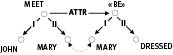
☛ A dashed double-headed arrow indicates coreference.Semantically loaded (= meaningful) surface-syntactic relations, which are illustrated in 3.3.2, Item 1), with the approximate-quantitative SSyntRel. Meaningful SSyntRels are not widespread in English, but there are some; here is an example:
| (34) | Politics, schmolitics! | Theory, schmeory. | Books, schmooks. | Baby, schmaby… |
The so-called schm-reduplication of a noun L(N) expresses the Speaker’s derision and skepticism about L(N’s referent: ‘SCHM-L(N)’ ≈ ‘I signal that I dismiss L(N) as being ludicrous and worthless’. In the DSyntS of a sentence with the lexeme schm-L(N, this meaning can be represented by the fictitious lexeme «derision», and English has the following deep-syntactic rule:
| (35) | L(N)–ATTR→«derision» ⇔ L(N)–schm-reduplicative→L(N) |
Note that the rule (35) actually is a part of the lexical entry for the fictitious lexeme «DERISION»: it tells us how to implement this DSynt-node in the surface-syntactic structure. On the next step, the schm-reduplicative SSyntRel is expressed as SCHM-L(N), where SCHM- is the name of the corresponding derivational means (adding to L(N) the prefix /šm/- and deleting the initial prevocalic cluster in L(N), if any).
Russian is rich in semantically-loaded SSyntRels; here are two more examples of such SSyntRels and of their encoding in the DSynt-structure.
| (36) | «if.only» for the irreal-subjectival SSyntRel: DSyntS: «if.only»–II→zametitʹ ‘notice’–I→Ivan ⇔ SSyntS: zametitʹ–irreal-subjectival→Ivan Zametʹ IMPER, 2, SG Ivan ètu jamu, … ‘If only Ivan had noticed this hole, …’ |
| (37) | «as.for» for the focalizing-reduplicative SSyntRel (Russian phrases of the corresponding type are described in detail in Iomdin 2013):[15]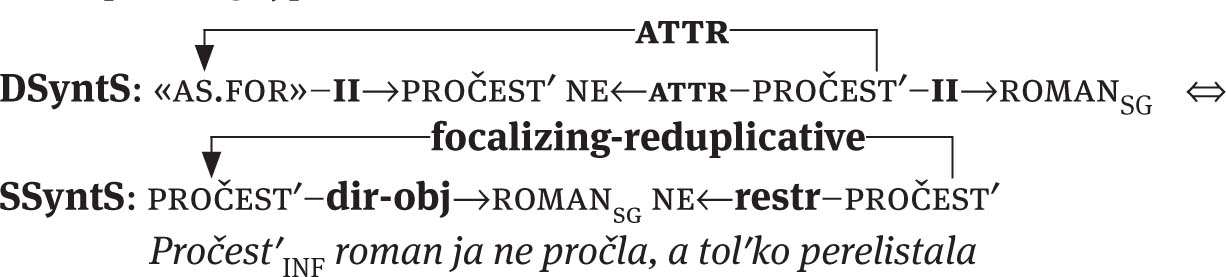 ‘As for réading the novel, I did not read it, but only leafed through it’. |
Syntactic idioms whose signifier is exclusively prosody (it is because of these idioms that the notion of fictitious lexeme had to be introduced in this paper).
One such idiom—«will.be.punished»—was described in Subsection 2.2, here is another one (the conversive of the former)—«will.punish»—in sentence (38):
| (38) | Ivan tebe poguljaet po nočam! lit. ‘Ivan to.you will.go.for.a.walk at night!’ = ‘If you go for a walk at night, Ivan will severely punish you’. |
The DSynt- and SSynt-structures of this idiom taken together with its actants are as follows:

It is on this structure that the idiom’s prosody is imposed.
As already mentioned, each syntactic idiom has its own lexical entry, just like lexemic idioms do; this entry gives, among other things, the information necessary to expand the DSynt-node of the idiom into its SSynt-subtree (and then to properly implement this subtree in the morphological string).
Here is a list of fictitious lexemes gleaned from various languages (see also Mel’čuk 2013: 37–42); to facilitate the reader’s task, they are represented here by their English equivalents. The fictitious lexemes feature rather abstract meanings that one could loosely qualify as “grammatical”; that is why Žolkovskij (1971: 10) spoke of them as “belonging to a border zone between the lexicon and the grammar.”
| NB | In the strict sense of the term, a fictitious lexeme is not a grammatical lexeme: it carries a specific meaning, it is not introduced into the SSyntS by syntactic rules, it does not express an inflectional value, and it is not a pronoun. But it is similar to a grammatical lexeme by its broad and vague enough meaning. |
| «affect» «after» «as.for» «be» «be.able» «be.from» «become» «belong» |
«cause(N)» «condition» «derision» «for» (buy her a dress) «from» (one of these) «goal» «have» «have.to» |
«if» «if.only» «include» «instrument» «material» «maybe» «merely» «more» |
«moveDIR» «name» «number [of]» «say» «should» «title» (Professor Drouin) «while» «with» |
| NB | This list does not include the fictitious lexemes postulated for the Russian purely prosodic syntactic idioms in this paper. |
3.3.4 An illustrative list of Russian syntactic idioms
Syntactic idioms include lexemes mainly from closed lexical classes or are implemented only by prosody; therefore, they cannot be very numerous. However, they are of special interest from a theoretical angle, so that it is worth presenting here those Russian idioms that are known to me at present.
| NB | 1. | This list is, of course, far from complete; for a more detailed enumeration of hypothetical Russian syntactic idioms, see Kopotev (2008: 124–126). |
| 2. | The syntactic idioms in the list below are not described lexicographically, and their meanings are formulated approximately; neither their SSynt-structures, nor their prosodies are shown (while, for instance, the idioms Nos. 11, 12 and 13 are distinguished only by prosody—example (29), p. 52). |
| 1. | ˹bytʹi.З vsem L(X)-am˺ [X] ‘X is the most outstanding of Xs’ {Èto} vsem borščaml(x) borščх! lit. ‘{This} [is] to.all borschtsl(x) borschtх!’ = ‘This is the most outstanding of all possible borschts!’ |
||
| 2. | ˹Čto [X], to L(X)˺ ‘I admit that this is really an X’ Čto Ivan durakx, to durakl(x) lit. ‘What Ivan [is] foolx, so fooll(x)’. = ‘I admit that Ivan is really a fool’. Čto xolodnox, to xolodnol(x) lit. ‘What [is] coldx, so coldl(x)’. = ‘I admit that it is really cold’.
|
||
| 3. | ˹Čtoby [X(ṽ)past]?˺ ‘X is quite impossible’ Čtoby Ivan soglasilsjax na èto?!? lit. ‘That Ivan agreex with this?!?’ = ‘It is quite impossible that Ivan agrees with this’. |
||
| 4. | ˹estʹ [Х-y] i L(X)-y˺ ‘there are different Xs’ Da, no estʹ poètyх i poètyl(x)! lit. ‘Yes, but there.are poetsx and poetsl(x)!’ = ‘Well, there are poets and there are poets!’ |
||
| 5. | ˹Kakoj [iz X-a] [Y]!˺ ‘X is not fit to be Y’ Kakie iz nasх soldatyy! lit. ‘What from usх [are] soldiersy!’ = ‘We are not fit to be soldiers’. |
||
| 6. | [P→Х]˹za L(X)-om˺1 ‘to do P one X after another’ Turki šlip vperëd šerengix za šerengamil(x) lit. ‘Turks wentp forward linesх after linesl(x)’. = ‘Turks were advancing lines after lines’. Oni obyskivalip komnatux za komnatojl(x) lit. ‘They were searchingp roomx after rooml(x)’. = ‘They were searching one room after another’.
|
||
| 7. | [P→Y, Х]˹za L(X)-om˺2 ‘to do P to Y, one X after another’ Oni obyskivalip domy, komnatax za komnatojl(x) lit. ‘They were searching the housey, roomx after rooml(x)’. = ‘They were searching the house room by room’. |
||
| 8. | ˹tak tebe/vam i˺ [Х-net] ‘X will never take place’ {Aga,} tak tebe/vam Ivan i prygnetX 〈= i prygnulx〉! lit. ‘{Uh-huh,} so to.you Ivan well will.jumpx 〈= well have.jumpedx〉!’ = ‘Well, Ivan will never jump’.
|
||
| 9. | ˹Vot (èto) bytʹi.З [X] tak L(X)!˺ ‘This is an excellent X’[16] Vot (èto) bylo vinox tak vinol(x)! lit. ‘Here (this) was winex so winel(x)!’ = ‘This was an excellent wine!’ |
||
| 10. | ˹(vsë) [Х-ee] i L(X)-ee˺ ‘even more X’ {Vremja mčitsja} (vsë) bystreex i bystreel(x) lit. {‘Time rushes.ahead} (even) fasterx and fasterl(x)’. = ‘Time flies faster and faster’. |
||
| 11. | «will.be.coerced» = ˹[X(n)nom] [u Z(n)gen] [Y(v)fut]!˺ [assurance] ‘X will be coerced to do Y by Z’ Ivanх u nasz vyučity francuzskij! lit. ‘Ivanх at usz will learny French!’ = ‘With us Ivan will learn French all right!’ |
||
| 12. | «will.not.be.allowed» = ˹[X(n)nom] [u Z(n)gen] [Y(v)fut]˺ [sarcastic negation] ‘X will not be allowed to do Y by Z’ Ivanx u nasz poguljaety po nočam lit. ‘Ivanx at usz will.go.out.for.a.walky at night’. = ‘We won’t let Ivan go out for a walk at night’. |
||
| 13. | «will.be.punished» = ˹[X(n)nom] [u Z(n)gen] [Y(v)fut]!˺ [threat] ‘X will be punished for Y by Z’ Ivanx u nasz poguljaety po nočam! lit. ‘Ivanx at usz will.go.for.a.walky at night!’ = ‘If Ivan goes for a walk at night, he’ll be severely punished by us!’ |
||
| 14. | «will.punish» = ˹[X(n)nom] [Z(n)dat] [Y(v)fut]!˺ [threat] ‘X will punish Z for Y’ Ivanx tebez poguljaety po nočam! lit. ‘Ivanx to youz will.go.for.a.walky at night!’ = ‘If you go for a walk at night, Ivan will severely punish you!’
|
||
| 15. | [X] ˹(bytʹi.2) kak L(X)˺ ‘(be) quite an ordinary X’ Èto byla komnataх kak komnatal(x) lit. ‘This was roomx as rooml(x)’. = ‘This was quite an ordinary room’. Komnataх byla kak komnatal(x) lit. ‘Roomx was as rooml(x)’. = ‘This room was quite ordinary’. |
||
| 16. | [Х] ˹bytʹi.2 L(X)˺ ‘X has well-known properties’[17] (Vilinbaxova and Kopotev 2017.) {Nu,} mužčinyх estʹ mužčinyl(х) ‘{Well,} menх are [lit. ‘is’] menl(х)’. = ‘Everybody knows what can be expected of men’. |
||
| 17. | [Х] ˹– èto bytʹi.З L(Х)˺ ‘X is exactly an X’ (Vilinbaxova and Kopotev 2017.) {Nu,} mužčinaх – èto mužčinal(x) lit. ‘{Well,} manx—this [is] manl(x)’. = ‘A man is exactly a man’. Blizkoх – èto blizkol(x) ‘Close x—this [is] closel(x)’. = ‘Close is exactly close’. Uexalaх – èto uexala(x) ‘[She].left x—this [is] [she].leftl(x)’. = ‘She left is exactly she left’. |
||
| 18. | [Х] ˹i L(X)˺ ‘X is nothing special’ {A čto takogo?} Vyšelх i vyšell(х) lit. ‘{And what is there?} [He] went.outх and went.outl(x)’. = ‘He went out, and this is nothing special’. {Nu,} gostʹх i gostʹl(х) lit. ‘{Well,} guestх and guestl(х)’. = ‘Well, there is a guest, and this is nothing special’. |
||
| 19. | [Х] ˹L(X)-om, а˺ [Y] ‘Let’s leave X out of discussion because Y’ Vodkax vodkojl(х), a rabota ne ždëty! lit. ‘Vodkax by.vodkal(x), but work does not waity!’ = ‘Let’s leave vodka out, since we have to work’. |
||
| 20. | [Х] ˹L(X)-om, а [Y] L(Y)-om˺ ‘Both X and Y are important and should not interfere with each other’. Rabotax rabotojl(x), a obedy obedoml(y) lit. ‘Workx by.workl(x), but lunchy by.lunchl(y)’. = ‘Both work and lunch are important and should not interfere with each other’. |
||
| 21. | [Х] ˹na L(X)-e sidit i L(X)-om pogonjaet˺ ‘Xs are everywhere’ Zdesʹ žulikx na žulikel(x) sidit i žulikoml(x) pogonjaet lit. ‘Here crookx is.sitting on crookl(x) and is.driving with.crookl(x)’. = ‘Here there are crooks everywhere’. |
||
| 22. | [X] ˹ne L(X)˺ ‘This is not quite an X’ Mordobojх ne mordobojl(x) {, prosto spor} lit. ‘Tussleх not tusslel(x) {, simply discussion}’. = ‘This is not quite a fight, this is simply a discussion’. |
||
| 23. | [Х] ˹tak L(X)˺ ‘I accept X’[18] Pivax tak pival(x)! lit. ‘Of.beerx so of.beerl(x)!’ = ‘OK, I’ll have the beer’. Ždatʹx tak ždatʹ lit. ‘To.wait so to.wait’. = ‘OK, I’ll wait’. Po-xorošemux tak po-xorošemu lit. ‘Nicely so nicely’. = ‘OK, nicely then’. |
||
| 24. | [Х]˹-to L(X)˺ ‘As far as X is concerned, it is X’ Po formex-to {, konečno,} po formel(x). {Odnako delo ne v ètom.} lit. ‘According.to formx, well, of.course, according.to forml(x). {The problem, however, is somewhere else’.} = ‘As for being according to form, it is according to form. The problem, …’. Spalx〈Spatʹx〉-to on spall(x), no vsë videl lit. ‘Sleptx〈To.sleepx〉, well, he sleptl(x), but [he] saw everything’. = ‘As for sleeping, he slept, but [he] saw everything’. |
||
| 25. | [X]˹-to on bytʹPRES L(X)˺ ‘As for being X, he is X’ Karlikx-to on karlikl(x); no nos u nego ogromnyj lit. ‘Dwarf, well, he is dwarf, but his nose is enormous’. = ‘As for being a dwarf, he is a dwarf; but he has an enormous nose’. |
||
| 26. | [X,] ˹xotʹ L(intens(X))(v)imperf, imper, 2, sg˺ ‘extremely X’[19] {Ivan takoj} xudojx, xotʹ stroenie skeleta na nëm izučajl(intens(x))(v)imperf, imper, 2, sg ‘{Ivan is} so skinnyх, you might even studyl(intens(x)) the structure of the human skeleton on him’. |
||
| 27. | [X-it] ˹i L(X)-it˺ ‘continues to do X’ ‘Ivan pelx i pell(x) ‘Ivan sangx and sangl(x)’. = ‘Ivan kept singing’. Ivanu xotelosʹ petʹx i petʹl(x) ‘Ivan felt like singingx and singingl(x)’. = ‘Ivan felt like keeping on singing’. |
||
| 28. | [X-itʹ] ˹tak L(X)-itʹ!˺ ‘Let’s really do X!’ Veselitʹsjax tak veselitʹsjal(x)! lit. ‘To.have.funx so to.have.funl(x)!’ = ‘Let’s really have fun!’ |
||
| 29. | [Y-u] ˹(i) [X] bytʹi.З ne v L(X)˺ ‘X cannot be enjoyed by Y’ Namy (i) otdyxx ne v otdyxl(x) lit. ‘To.usy even vacationsx are not into vacationsl(x)’. = ‘We can’t even enjoy vacations’. |
This list presents both structural types of syntactic idiom:
A syntactic idiom whose signifier contains prosody, that is, which has less than two lexemes: either one or none. The idioms of this type are Nos. 3, 5, and 11–14.
A syntactic idiom whose signifier contains a lexemic variable that is filled with the duplicate of one of the idiom’s actants. The idioms of this type are all the others: Nos. 1, 2, 4, 6–10 and 15–29.
4 Conclusion
Introducing the notions of morphemic and syntactic phrasemes allows for the elaboration of a universal typology of phrasemes, which will be quite formal and strictly deductive. On the one hand, this contributes to a better description of phrasemes in the lexicon and in the grammar; on the other hand, this constitutes a step toward the construction of the coherent notional system and a formalized metalanguage for linguistics.
Acknowledgments
The first version of this paper was read and criticized, as always, by L. Iordanskaja; the succeeding variants underwent the scrutiny of M. Kopotev, F. Louis and J. Milićević; I also took into account the considerations of the two anonymous reviewers of Yearbook of Phraseology. I thank all these people for their judicious remarks and constructive proposals.
References
Apresjan, Valentina. 2014. Syntactic idioms across languages: Corpus evidence from Russian and English. Russian Linguistics 38(1). 187–203.10.1007/s11185-014-9127-0Search in Google Scholar
Aronoff, Mark & Shikaripur N. Sridhar. 1984. Agglutination and composition in Kannada verb morphology. In David Testen, Veena Mishra & Joseph Drogo (eds.), Lexical Semantics, 3–20. Chicago: Chicago Linguistic Society.Search in Google Scholar
Avgustinova, Tania & Leonid Iomdin. 2019. Towards a typology of microsyntactic constructions. In Gloria Corpas-Pastor & Ruslan Mitkov (eds.), Computational and Corpus-Based Phraseology, 15–30. Cham: Springer.10.1007/978-3-030-30135-4_2Search in Google Scholar
Beck, David & Igor Mel’čuk. 2011. Morphological phrasemes and Totonacan verbal morphology. Linguistics 49(1). 175–228.10.1515/ling.2011.005Search in Google Scholar
Berger, Hermann. 1974. Das Yasin-Burushaski (Werchikwar). Wiesbaden: Otto Harrassowitz.Search in Google Scholar
Čermák, František. 2007. Idioms and morphology. In Harald Burger, Dmitrij Dobrovol’skij, Peter Kühn & Neal Norrick (eds.), Phraseology. An International Handbook of Contemporary Research, 20–26. Berlin & New York: W. de Gruyter.10.1515/9783110171013.20Search in Google Scholar
Dillon, George. 1977. Introduction to contemporary linguistic semantics. Englewood Cliffs, N.J.: Prentice-Hall.Search in Google Scholar
Dobrovolʹskij, Dmitrij, Mixail Kopotev, & Ljudmila Poppel. 2019. Gruppa konstrukcij Nu i Х: semantika, pragmatika, sočetaemostʹ [The group of constructions of Nu i X type: semantics. pragmatics, combinatorics]. Scando-Slavica 65(1). 5–25.Search in Google Scholar
Goldberg, Adele. 1995. A Construction Grammar approach to argument structure. Chicago & London: The Chicago University Press.Search in Google Scholar
Goldberg, Adele & Ray Jackendoff. 2004. English resultative as a family of constructions. Language 80(3). 532–568.10.1353/lan.2004.0129Search in Google Scholar
Holden, Joshua. 2009. Towards a new meta-language for Athapaskan linguistics: The case of morphological phrasemes. In David Beck, Kim Gerdes, Jasmina Milićević & Alain Polguère (eds.), Proceedings of the fourth international conference on Meaning-Text theory, 157–165. Montreal: University of Montreal.Search in Google Scholar
Iomdin, Leonid. 2006a. Mnogoznačnye sintaksičeskie frazemy: meždu leksikoj i sintaksisom [Polysemous syntactic phrasemes: between lexicon and syntax]. In Natalʹja Laufer, Aleksandr Narinʹjani & Vladimir Selegej (eds.), Kompʹjuternaja lingvistika i intellektualʹnye texnologii, 202–206. Moskva: RGGU Publisher.Search in Google Scholar
Iomdin, Leonid. 2006b. Novye nabljudenija nad sintaksisom russkix frazem [New observations on the syntax of Russian phrasemes]. In Bożena Chodźko, Elżbieta Feliksiak, Marek Olesiewicz (eds.), Obecność, 247–281. Białystok: Uniwersytet w Białymstoku.Search in Google Scholar
Iomdin, Leonid. 2008. V glubinax mikrosintaksisa: odin leksičeskij klass sintaksičeskix frazem [In the depths of microsyntax: a lexical class of syntactic phrasemes]. Kompʹjuternaja lingvistika i intellektualʹnye texnologii 7(14).178–184.Search in Google Scholar
Iomdin, Leonid. 2010. Sintaksičeskie frazemy: meždu leksikoj i sintaksisom [Syntactic phrasemes: between lexicon and syntax]. In Jurij Apresjan, Igorʹ Boguslavskij, Leonid Iomdin & Vladimir Sannikov, Teoretičeskie problemy russkogo sintaksisa. Vzaimodejstvie grammatiki i slovarja, 141–190. Moskva: Jazyki slavjanskix kulʹtur.Search in Google Scholar
Iomdin, Leonid. 2013. Čitatʹ ne čital, no…: ob odnoj russkoj konstrukcii s povtorjajuščimisja slovesnymi èlementami [Čitatʹ ne čital, no…: on a Russian construction with repeated lexical elements]. Kompʹjuternaja lingvistika i intellektualʹnye texnologii 12(19). 297–310.Search in Google Scholar
Iomdin, Leonid. 2017. Meždu sintaksičeskoj frazemoj i sintaksičeskoj konstrukciej. Netrivialʹnye slučai mikrosintaksičeskoj neodnoznačnosti [Between the syntactic phraseme and the syntactic construction. Nontrivial cases of microsyntactic ambiguity]. Slavia 68(2–3). 230–243.Search in Google Scholar
Jackendoff, Ray. 2008. Construction after construction and its theoretical challenges. Language 84(1). 8–28.10.1353/lan.2008.0058Search in Google Scholar
Janda, Laura, Mihail Kopotev & Tore Nesset. 2020. Constructions, their families and their neighborhoods: the case of durak durakom ‘a fool times two’. Russian Linguistics 44 (1). 109–127.10.1007/s11185-020-09225-ySearch in Google Scholar
Kopotev, Mixail. 2005. ГУЛЯТЬ ТАК ГУЛЯТЬ: Between grammar and dictionary. In Jurij Apresjan & Leonid Iomdin (eds.), East West Encounter. Second International Conference on Meaning – Text Theory, 225–236. Moscow: Slavic Culture Languages Publishing House.Search in Google Scholar
Kopotev, Mixail. 2008. Principy sintaksičeskoj idiomatizacii [Principles of syntactic idiomatization]. Helsinki: Helsinki University Press.Search in Google Scholar
Kopotev, Mixail & Aleksandra Fajnvejc. 2007. Izučatʹ tak izučatʹ: sinxronija i diaxronija [Izučatʹ tak izučatʹ: synchrony and diachrony]. Naučno-texničeskaja informacija, serija 2. Informacionnye processy i sistemy 9. 103–123.Search in Google Scholar
Kopotev, Mixail & Tatʹjana Steksova. 2016. Isključenie kak pravilo: perexodnye edinicy v grammatike i slovare [The exception as a rule: transitional units in grammar and in lexicon]. Moskva: Jazyki slavjanskix kulʹtur.Search in Google Scholar
Melʹčuk, Igorʹ. 1964. Obobščenie ponjatija frazeologizma (morfologičeskie “frazeologizmy”) [Generalizing the notion of phraseologism (morphological “phraseologisms”)]. In Leonid Rojzenzon (ed.), Materialy konferencii “Aktualʹnye voprosy sovremennogo jazykoznanija i lingvističeskoe nasledie E.D. Polivanova” [Proceedings of the Conference “Current Problems in Modern Linguistics and the Linguistic Heritage of E.D. Polivanov”], vol. I, Samarkandskij Gosudarstvennyj Universitet: Samarkand, 89–90.Search in Google Scholar
Mel’čuk, Igor. 1987. Un affixe dérivationnel et un phrasème syntaxique du russe moderne. Essai de description formelle. Revue des études slaves, 59(3). 631–648.10.3406/slave.1987.5680Search in Google Scholar
Mel’čuk, Igor. 1993–2000. Cours de morphologie générale, vols. 1–5. Montréal, Les Presses de l’Université de Montréal & Paris: CNRS Éditions.Search in Google Scholar
Mel’čuk, Igor. 1995. Phrasemes in language and phraseology in linguistics. In Martin Everaert, Erik-Jan van der Linden, André Schenk & Rob Schreuder (eds.), Idioms. Structural and Psychological Perspectives, 167–232. Hillsdale, N.J. & Hove, U.K.: Lawrence Erlbaum Associates.Search in Google Scholar
Mel’čuk, Igor. 2001. Communicative organization in natural language. The semantic-communicative structure of sentences. Amsterdam & Philadelphia: John Benjamins.10.1075/slcs.57Search in Google Scholar
Mel’čuk, Igor. 2004. La non-compositionnalité en morphologie linguistique. Verbum 26(4). 439–458. See also: http://olst.ling.umontreal.ca/pdf/CompositionnaliteEnMorphologie.pdf.Search in Google Scholar
Mel’čuk, Igor. 2006. Aspects of the theory of morphology. Berlin & New York: Mouton de Gruyter.Search in Google Scholar
Mel’čuk, Igor. 2008. Zero affixes and nominal cases in Daghestanian languages. In A. Arxipov, L. Zaxarov, A.A. Kibrik, A.E. Kibrik, I. Kobozeva, O. Krivnova, E. Ljutikova & O. Fëdorova (eds.), Fonetika i nefonetika. K 70-letiju Sandro V. Kodzasova, 176–183. Moskva: Jazyki slavjanskix kul´tur.Search in Google Scholar
Mel’čuk, Igor. 2012. Phraseology in the language, in the dictionary, and in the computer. Yearbook of Phraseology 3. 31–56.10.1515/phras-2012-0003Search in Google Scholar
Mel’čuk, Igor. 2013. Semantics: From meaning to text, vol. 2. Amsterdam & Philadelphia: John Benjamins.Search in Google Scholar
Mel’čuk, Igor. 2015a. Clichés, an understudied subclass of phrasemes. Yearbook of Phraseology 6. 55–86.10.1515/phras-2015-0005Search in Google Scholar
Mel’čuk, Igor. 2015b. Semantics: From meaning to text. Vol. 3. Amsterdam & Philadelphia: John Benjamins.Search in Google Scholar
Mel’čuk, Igor. 2018. “Wordlets”: One of Zholkovsky’s major contributions to the notion of deep-syntactic structure. In Dennis Ioffe, Marcus Levitt, Joe Peschio & Igor Pilshchikov (eds.), A/Z: Essays in Honor of Alexander Zholkovsky, 350–360. Boston: Academic Studies Press.10.2307/j.ctv1zjg7n9.24Search in Google Scholar
Mel’čuk, Igor. 2020. Clichés and pragmatemes. Neophilologica 32. 9–20.10.31261/NEO.2020.32.01Search in Google Scholar
Pike, Kenneth. 1961. Compound affixes in Ocaina. Language 37(4). 570–581.10.2307/411359Search in Google Scholar
Raxilina, Ekaterina, ed. 2010. Grammatika konstrukcij [Construction Grammar]. Moskva: Azbukovnik.Search in Google Scholar
Rhodes, Russell. 2009. Tautological constructions in English… and beyond. https://www.semanticscholar.org/paper/Tautological-constructions-in-English…and-beyond-Rhodes/928c09fca831c1ef6ba61a5ac9f0d71c1167f99c.Search in Google Scholar
Šmelëv, Dmitrij. 1960. O «svjazannyx» sintaksičeskix konstrukcijax v russkom jazyke [“Bound” syntactic constructions in Russian]. Voprosy Jazykoznanija 5. 47–60.Search in Google Scholar
Švedova, Julija. 1960. Očerki po sintaksisu russkoj razgovornoj reči [Essays on the syntax of colloquial Russian]. Moskva: AN SSSR.Search in Google Scholar
Švedova, Julija, ed. 1970. Grammatika sovremennogo russkogo literaturnogo jazyka [Grammar of modern literary Russian]. Moskva: AN SSSR.Search in Google Scholar
Švedova, Julija, ed. 1980. Russkaja grammatika. Tom II. Sintaksis [Russian grammar. Vol. II. Syntax]. Moskva: Nauka.Search in Google Scholar
Vilinbaxova, Elena & Kopotev, Mixail. 2017. «X estʹ X» značit «X èto X»? Iščem otvet v sinxronii i diaxronii [«X estʹ X» means «X èto X»? We are looking for an answer in synchrony and diachrony]. Voprosy Jazykoznanija 3. 110–124.10.31857/S0373658X0001003-2Search in Google Scholar
Weinreich, Uriel. 1969. Problems in the analysis of idioms. In Jaan Puhvel (ed.), Substance and Structure of Language, 23–81. Berkeley & Los Angeles: University of California Press.Search in Google Scholar
Wierzbicka, Anna. 1987. Boys will be boys – ‘Radical Semantics’ vs. ‘Radical Pragmatics’. Language 63(1). 95–114. (See also in Wierzbicka, Anna. 1991. Cross-cultural pragmatics. The semantics of human interaction, 391–452. Berlin & New York: Mouton de Gruyter).10.2307/415385Search in Google Scholar
Žolkovskij, Aleksandr. 1971. Syntaksis somali [Somali syntax]. Moskva: Nauka.Search in Google Scholar
© 2021 Walter de Gruyter GmbH, Berlin/Boston
Articles in the same Issue
- Frontmatter
- Editorial
- Editorial (English)
- Editorial (Deutsch)
- Articles
- The origins of the term “phraseology”1
- Morphemic and Syntactic Phrasemes
- “Shall I (compare) compare thee?”
- Ni as the introductory particle for expressions of negation in three dialectal variants of Spanish
- Kommunikative und expressive Formeln des Deutschen in Internettexten: ein diskursorientierter Ansatz
- Phrasal verb vs. Simplex pairs in legal-lay discourse: the Late Modern English period in focus
- Book reviews
- Book reviews
- Book reviews
- Book reviews
- Book reviews
- Book reviews
- Book reviews
- Book reviews
- Book reviews
Articles in the same Issue
- Frontmatter
- Editorial
- Editorial (English)
- Editorial (Deutsch)
- Articles
- The origins of the term “phraseology”1
- Morphemic and Syntactic Phrasemes
- “Shall I (compare) compare thee?”
- Ni as the introductory particle for expressions of negation in three dialectal variants of Spanish
- Kommunikative und expressive Formeln des Deutschen in Internettexten: ein diskursorientierter Ansatz
- Phrasal verb vs. Simplex pairs in legal-lay discourse: the Late Modern English period in focus
- Book reviews
- Book reviews
- Book reviews
- Book reviews
- Book reviews
- Book reviews
- Book reviews
- Book reviews
- Book reviews
