Impacts of adopting specialized agricultural programs relying on “good practice” – Empirical evidence from fruit growers in Vietnam
-
 und
und

Abstract
Vietnamese Good Agricultural Practice (VietGAP) has been introduced in many provinces in the Mekong Delta, Vietnam to enhance the competitive advantage to fruit growers, including Idor longan (Dimocarpus longan Lour.) growers, to explore the stricter domestic and export markets and increase the income of the fruit growers in the Mekong Delta, Vietnam. This article presents a case study on the impacts of adopting VietGAP on the income of fruit growers (Idor longan) in the Mekong Delta by applying both T-test and Propensity Score Matching of 180 VietGAP and non-VietGAP adopters. The results show that applying VietGAP can reduce production cost, increase revenue, and profit to fruit growers. This is evidence to prove the benefits of adopting VietGAP and encourage the expansion of VietGAP to many fruits and other agricultural sectors in Vietnam.
1 Introduction
Vietnamese Good Agricultural Practices (VietGAP) is the set of criteria published by Ministry of Agriculture and Rural Development of Vietnam. VietGAP is issued to certify the quality of each product, and group of products such as aquaculture, cultivation, and livestock. Producers apply this standard to ensure productive techniques, food safety, product traceability, and protection of environment and health [1,2,3,4,5]. When products or group of products are certified by VietGAP, they can easily penetrate into the markets, especially both specific domestic and export markets. Many cases of agricultural products in Vietnam have limited relative advantages due to lack of certified products, trace of the origin, and high agrochemical residues [6,7]. As a result of VietGAP certification, producers are more productive, save production cost, and get higher prices at their farms. They also secure their production to save their own health, environmental responsibility, and provide safe products to consumers [1,4].
Recently, VietGAP certification of products has been launched in many provinces of Mekong Delta, Vietnam to improve the comparative advantage of fruits, rice, aquaculture, and husbandry [8,9]. Among them, VietGAP program on fruits (durian, ranbutan, longan, mango, dragon fruits,…) is one of the most introduced in many provinces in the Mekong Delta, Vietnam in last five years. VietGAP techniques and certification were introduced to fruit growers through the cooperatives or cooperative groups to improve their business capacity and create fruit production in large scale qualified with VietGAP standard to supply to domestic and export markets. At the bottom line, how this program achieves its goal to improve fruit growers income has not been discussed in many publications. This is the most direct benefit of VietGAP that can attract fruit growers to change their farming practice.
Idor longan, E-dor, E-daw, or Ido (Dimocarpus longan Lour.), originated from Thailand, with thin-skinned fruit, small seeds, thick flesh with less water content, and moderate sweetness, has great potential for the domestic and export markets [10,11]. During 2015–2019, Idor longan has been promoted in many provinces in the Mekong Delta, Vietnam, due to its ability to resist witches’ broom disease, one of the most affected pests in the Mekong Delta in recent years [12].
In order to increase the income for longan growers and prepare to meet the target demand of specific domestic and export markets, Idor longan growers in the Mekong Delta have been encouraged to apply VietGAP and integrated pest management (IPM) [9,13,14,15]. In VietGAP programs, farmers were introduced to new technical knowledge about longan farming that met consumers’ demand and requirements, and they were also encouraged to participate in cooperatives or contract farming to enhance their capacity to be more effective in the supply chain of Idor longan [16,17,18].
How has the VietGAP program improved income of Idor longan growers? What are the factors that improve income of Idor longan growers? How have the outcomes of VietGAP adoption satisfied adopters, the local authorities, and extension workers? To answer these questions, this article will be a good case study on the impacts of VietGAP on the income of fruit growers in Vietnam.
2 Materials and methods
2.1 Data collection
The data are obtained from face-to-face interviews with 180 Idor longan growers in 3 Mekong delta provinces, Vinh Long, Tien Giang, and Dong Thap. The data represent 90 Idor longan growers who adopted the VietGAP and 90 growers who were non-VietGAP adopters. The VietGAP adopters in Vinh Long and Tien Giang province have also participated in a so-called IPM program (innovative steps to strengthen production and export of Vietnamese fruit crops), which may influence the behavior compared to the data collected in the third province (Dong Thap). Study sites are presented in Figure 1. In each province, the largest Idor longan growers (using “area” as the selection criteria) were included in the interviews involving both VietGAP and non-VietGAP adopters. Standard sampling techniques to identify persons to be interviewed were applied and representatives from each commune in the provinces assisted the interviewers in this process to obtain household quotas representative for the various study sites. About 80% of VietGAP adopters were interviewed. The Idor longan cultivation area that used VietGAP accounted for approximately 10–20% of the total longan area in the 3 study sites that were interviewed. Most of the VietGAP adopters are more active and have more benefits in terms of production and convenience in commuting in their communes than the non-VietGAP adopters.
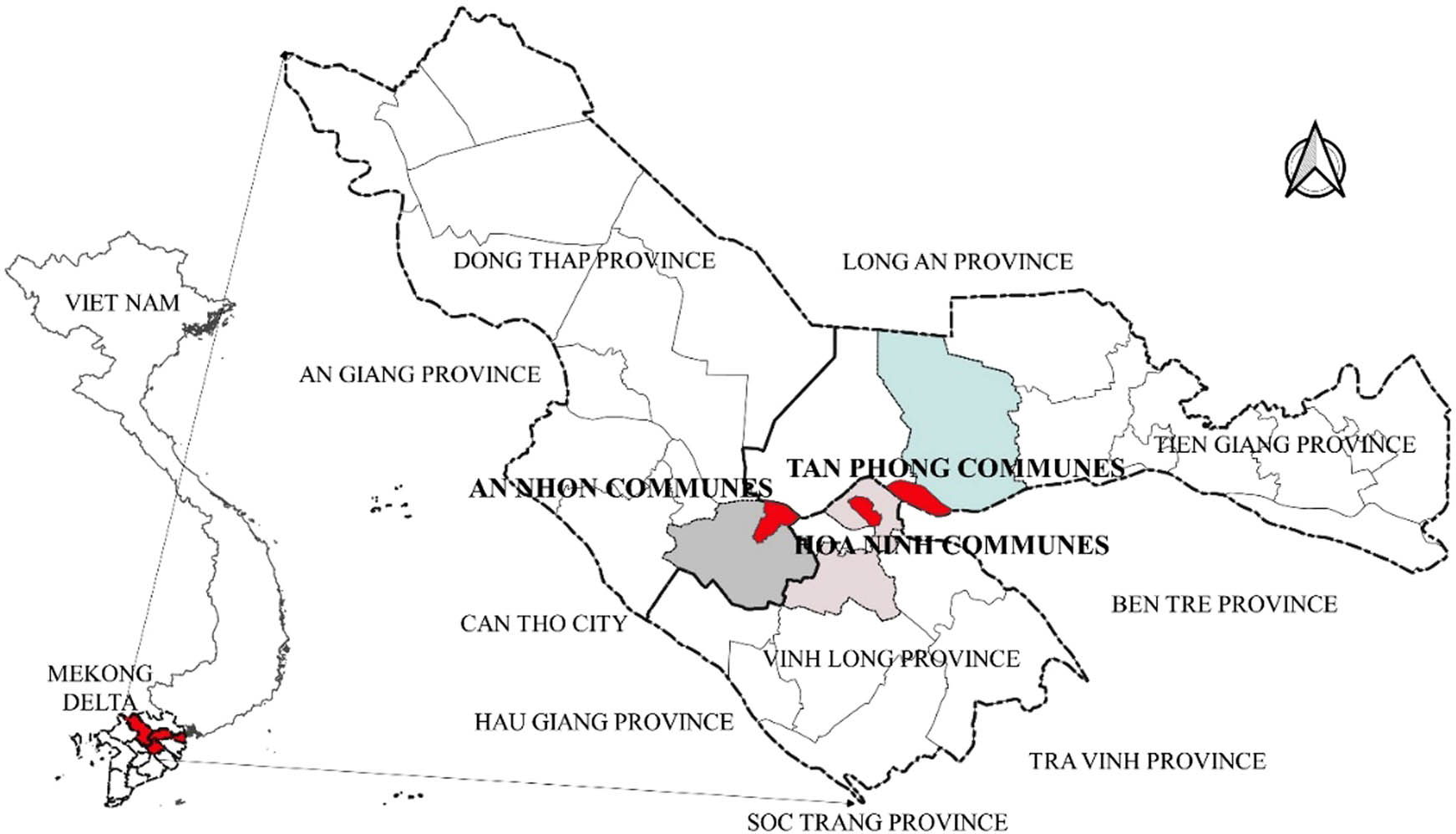
Study sites. The interview communes are red in the map. The study sites were Hoa Ninh commune, Long Ho district, Vinh Long province; Tan Phong commune, Cai Lay district, Tien Giang province and An Nhon commune, Chau Thanh district, Dong Thap province.
2.2 Methods of data analysis
The main method applied in the analysis is the Propensity Score Matching (PSM) which is a non-parametric methodology and will be used to estimate the income impacts of adopting the VietGAP compared to not adopting the “good practice,” i.e., the non-VietGAP Idor longan growers [4,19,20,21,22,23]. The purpose of applying the PSM is to avoid bias when comparing the income outcomes of VietGAP and non-VietGAP growers as there is a selection problem. Participants in the VietGAP program are not randomly selected as there might be some special competences or motivations to enter the program and therefore the characteristics of the VietGAP and non-VietGAP growers are not equivalent. The PSM method aims to balance the sample into comparable treatment groups, i.e., those who are participating in the VietGAP program and those who are not participating in the VietGAP, and the latter being the control group. The PSM estimates the change in outcome (i.e. income) through measuring an average treatment effect (ATT) for the VietGAP participants. ATT is derived from
where Y 1 is the outcome for adoption and Y 0 is the outcome for non-adoption.
The first step in applying PSM is to select the variables or covariates to be used in the PSM model. The propensity scores are created via logit regressions of VietGAP participation. This logit model shows factors or covariates to predict the decision of Idor longan growers to participate in VietGAP. These factors are the main differing characteristics between VietGAP and non-VietGAP adopters and farms. This is the false self-selection that causes bias when comparing the outcomes of VietGAP and non-VietGAP by parametric methods (T-test or regression) [23]. Then, the smaller groups are created from the propensity scores to make them more comparable between the treated and control groups. Lastly, the ATTs and the impacts of adopting VietGAP are estimated via single nearest neighbor matching (NNM), radius, kernel, and stratification matching methods [23,33].
NNM imputes the missing potential outcome for each subject by using an average of the outcomes of similar subjects that received the other treatment level. Similarity between subjects is based on a weighted function of the covariates for each observation. Applying caliper or radius matching means that an individual from the comparison group is chosen as a matching partner for an individual that lies within the caliper (“propensity range”) and is closest in terms of propensity score. Kernel matching is a non-parametric matching estimator that constructs the counterfactual outcome using weighted averages of all individuals in the control group. As a result, one of the key advantages of these approaches is the lower variance, which is accomplished by using more data. Stratification matching is to partition the common support of the propensity score into a set of intervals (strata) and to calculate the impact within each interval by taking the mean difference in outcomes between the treated and control observations.
Cost-return analysis of longan growing was conducted in order to assess the financial efficiency of Idor longan growers as well as their income. The unit of analysis was VND 1,000/1,000 m2. The cost structure (total costs in 2019) was split into distributed fixed costs and variable costs. Fixed costs are the investment costs in the first 3 years of longan cultivation. Separating the types of costs helps to identify which costs can be reduced and how they affect the profits of Idor longan growers. The distributed fixed cost (VND 1,000/year) is the value in 2019 of the investment cost for the first 3 years (r = 10%) and distributed for 12 years (t = 12) [24]. The variable costs included materials and labor costs (hired and household). The revenue or gross income of Idor longan was calculated by multiplying average farm gate price (VND/kg) by longan yield (1,000 kg/1,000 m2). Profit was revenue minus total cost. Net income was revenue minus variable costs in 2019.
The structure of the results includes two main parts, namely introduction of characteristics of respondents, longan grower households and longan farming practice (Section 3.2). Sections 3.3 and 3.4 provide the results of applying the procedure to study the impact of adopting VietGAP on the outcomes (cost, revenue, income, and profit). Further discussion on how to improve the impacts of adoption of VietGAP by understanding farmers’ perception and constrains of adopting VietGAP is given in Section 3.5.
3 Results and discussion
3.1 Characteristics of interviewees and households of Idor longan growers in the Mekong Delta, Vietnam
Table 1 summarizes the characteristics of interviewees, main persons taking care of Idor longan trees in the Mekong Delta, Vietnam. 100% of interviewees are male and 97% of them are household heads. It is noted that this research interviewed both male and female in the households for gender and value chain analysis of Idor longan in the Mekong Delta, Vietnam. The information related to how the Idor longan gardens are taken care and inputs – outputs analysis mainly relied on the male respondents; thus, Table 1 presents the characteristics of these male respondents. The interviews show that male respondents of more VietGAP adopters (averagely 7.9 years and median of 8 yeas) got higher education attainment than non-VietGAP adopters (averagely 6.7 years and median of 7 years) and 29% of VietGAP interviewees got more than 10 years of schooling, while only 13% of non-VietGAP adopters got more than 10 years of schooling.
Characteristics of interviewees
| Characteristics of interviewees | VietGAP (n = 90) | Non-VietGAP (n = 90) | Total (n = 180) | |||
|---|---|---|---|---|---|---|
| Mean | SE | Mean | SE | Mean | SE | |
| 1. Ratio of male interviewees (%) | 100 | — | 100 | — | 100ns | — |
| 2. Ratio of male household heads (%) | 97 | 97 | 97ns | |||
| 3. Age of respondent (years) | 53.3 (54.0) | 1.1 | 53.6 (53.0) | 1.3 | 53.5ns (53.5) | 53.3 (54.0) |
| 4. Educational attainment | ||||||
| No. of school years attainment | 7.9 (8.0) | 0.3 | 6.8 (7.0) | 0.3 | 7.3** (7.0) | 0.2 |
| Ratio of interviewees who got more than 10 years of school attendance (%) | 29 | 13 | 21** | |||
| 5. No. of years’ experience in growing Idor longan | 9.2 (8.5) | 0.4 | 8.4 (8.0) | 0.4 | 8.8* (8.0) | 0.3 |
SE is standard error; values in the parentheses are medians; * and ** mean significant at α = 10% and 1%, respectively;
ns — not significant at α = 10%.
Table 2 describes the household characteristics of Idor longan growers in the Mekong Delta, Vietnam. There were four members on an average in the household of Idor longan growers and were not significantly different between VietGAP and non-VietGAP households. An average of about two household members were involved in Idor longan farming. Each household had about 0.63 ha and about 88% of this land was used to grow Idor longan. The VietGAP adopters had significantly bigger land than the non-VietGAP adopters and they used more land to grow Idor longan (94.5% of the total land). Total household income in 2019 was 182 million VND (∼7,864 USD, 1 USD = 23,143 VND, December, 2019) and per capita income was 4.4 million VND per person per month. Household income of VietGAP adopters were higher than income of non-VietGAP adopters as VietGAP adopters have bigger land than non-VietGAP adopters.
Household characteristics of Idor longan growers in the Mekong Delta, Vietnam
| Characteristics of households | VietGAP (n = 90) | Non-VietGAP (n = 90) | Total (n = 180) | |||
|---|---|---|---|---|---|---|
| Mean | SE | Mean | SE | Mean | SE | |
| 1. Household members (persons/household) | 3.7 (4.0) | 0.1 | 3.6 (4.0) | 0.1 | 3.6ns (4.0) | 0.1 |
| 2. Household members involved in Idor longan farming (persons/household) | 2.0 (2.0) | 0.05 | 2.0 (2.0) | 0.04 | 2.0ns (2.0) | 0.03 |
| 3. Household land area (1,000 m2) | 7.3 (5.5) | 0.6 | 5.3 (4.3) | 0.4 | 6.3** (5.2) | 0.3 |
| 4. Ratio of land growing Idor longan/total land (%) | 95.1 | 81.5 | 88.3** | |||
| 5. Total household income in 2019 (Million VND/household/year) | 209.7 (160.0) | 25.3 | 154.3 (150.0) | 10.2 | 182.0* (152.0) | 13.8 |
| 6. Income from Idor longan in 2019 (Million VND/household/year) | 147.9 (100.0) | 20.1 | 97.7 (80.0) | 7.5 | 122.8* (91.0) | 10.8 |
| 7. Ratio of income from Idor longan/total household income (%) | 76.4 | 72.3 | 74.4ns | |||
| 8. Per capita income (Million VND/person/month) | 5.0 (3.8) | 0.5 | 3.7 (3.3) | 0.2 | 4.4* (3.7) | 0.3 |
SE is standard error; values in the parentheses are medians; 1 USD ∼ 23,143 VND, December 2019; * and ** mean significant at α = 5% and 1% respectively; ns — is not significant at α = 10%.
3.2 Characteristics of Idor longan cultivation in the Mekong Delta, Vietnam
The average area of Idor longan in the Mekong Delta, Vietnam is 0.52 ha per household and the VietGAP adopters have bigger Idor longan area (averagely 0.65 and median of 0.5 ha/household) than the non-VietGAP adopters (averagely 0.4 and median of 0.35 ha/household) (Table 3). There are no significant differences in longan density (23 trees/1,000 m2) and age of longan (about 8.8 years). Both VietGAP adopters and non-VietGAP adopters reported that they have been applying organic fertilizers, supplementary to inorganic fertilizers, which are recommended in guidelines of GAP and IPM. However, the investment cost of organic fertilizers of both VietGAP adopters and non-VietGAP adopters varied a lot due to the volume and type of organic fertilizers applied.
Characteristics of Idor longan cultivation in the Mekong Delta, Vietnam
| Characteristics of Idor cultivation | VietGAP (n = 90) | Non-VietGAP (n = 90) | Total (n = 180) | |||
|---|---|---|---|---|---|---|
| Mean | SE | Mean | SE | Mean | SE | |
| 1. Longan area (1,000 m2/household) | 6.5 (5.0) | 0.9 | 4.0 (3.5) | 0.3 | 5.2* (4.0) | 0.5 |
| 2. Longan density (trees/1,000 m2) | 21.8 (20.0) | 1.2 | 24.3 (21.7) | 1.5 | 23.1* (20.6) | 1.0 |
| 3. Age of longan trees (year) | 9.1 (8.0) | 0.4 | 8.5 (8.0) | 0.4 | 8.8ns (8.0) | 0.3 |
| 4. No. of years applying organic fertilizers | 4.0 (4.0) | 0.3 | 4.7 (4.0) | 0.4 | 4.3ns (4.0) | 0.2 |
| 5. Ratio of household applying organic fertilizers for 5 years and above (%) | 40.0 | 47.0 | 44.0ns | |||
| 6. Yield (kg/1000 m2) | 1,092 (950) | 76.1 | 1,158 (1,042) | 68.6 | 1,125ns (1,000) | 51.1 |
Values in the parenthesis are medians; SE is standard error; * means significant at α = 10%; ns — is not significant at α = 10%.
The production costs of Idor longan in the Mekong Delta, Vietnam are shown in Figures 2 and 3. The total fixed cost in the first 3 years was 7.9 (mean) and 5.2 (median) million VND/1,000 m2 (value in 2019, r = 10%). Of which, 50% of the total fixed investment was used in the first year. The rest 50% of the fixed investment cost were spent in the second and third years (Figure 2a). Among the cost items, land preparation was about 27% of the fixed costs and varied depending on the height of the beds (Figure 2b). Fertilizers, including organic and inorganic fertilizers, occupied more than 50% of the fixed investment costs and were significantly higher for VietGAP adopters than for non-VietGAP adopters. The distributed fixed costs in 2019 was 622 (mean) and 433 (median) thousand VND/1,000 m2 and not significantly different between the VietGAP and non-VietGAP adopters (Table 5).
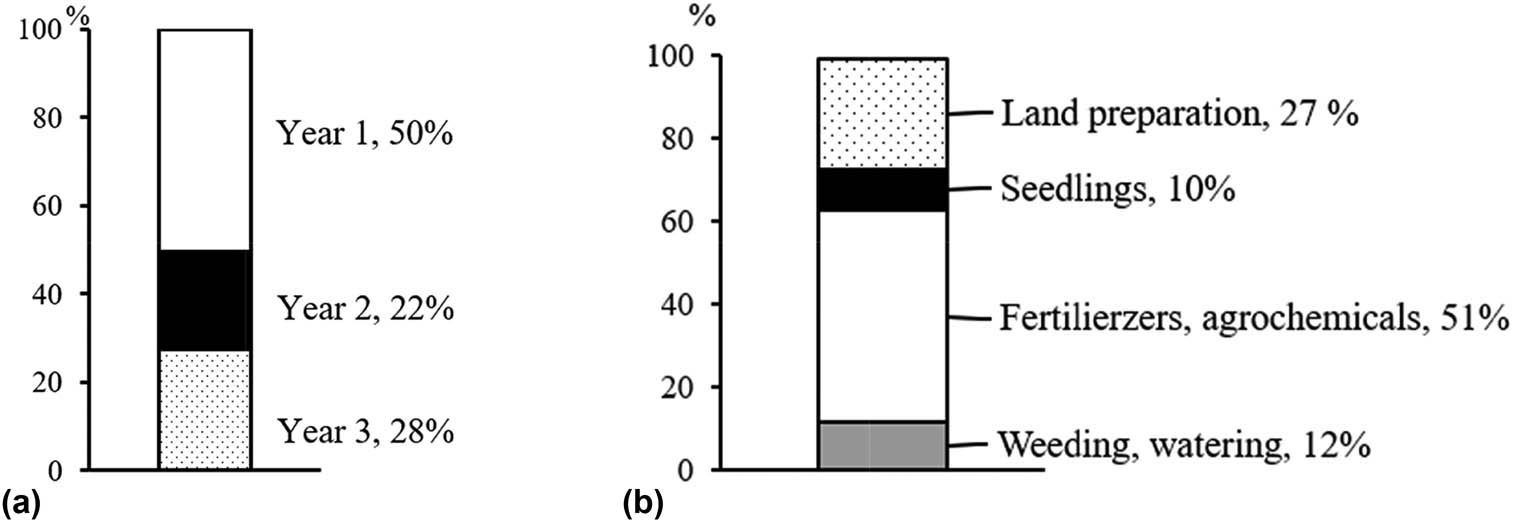
Cost structure of distributed fixed costs of Idor longan growers in 2019 in the Mekong Delta, Vietnam: (a) by year investment and (b) by main cost items.
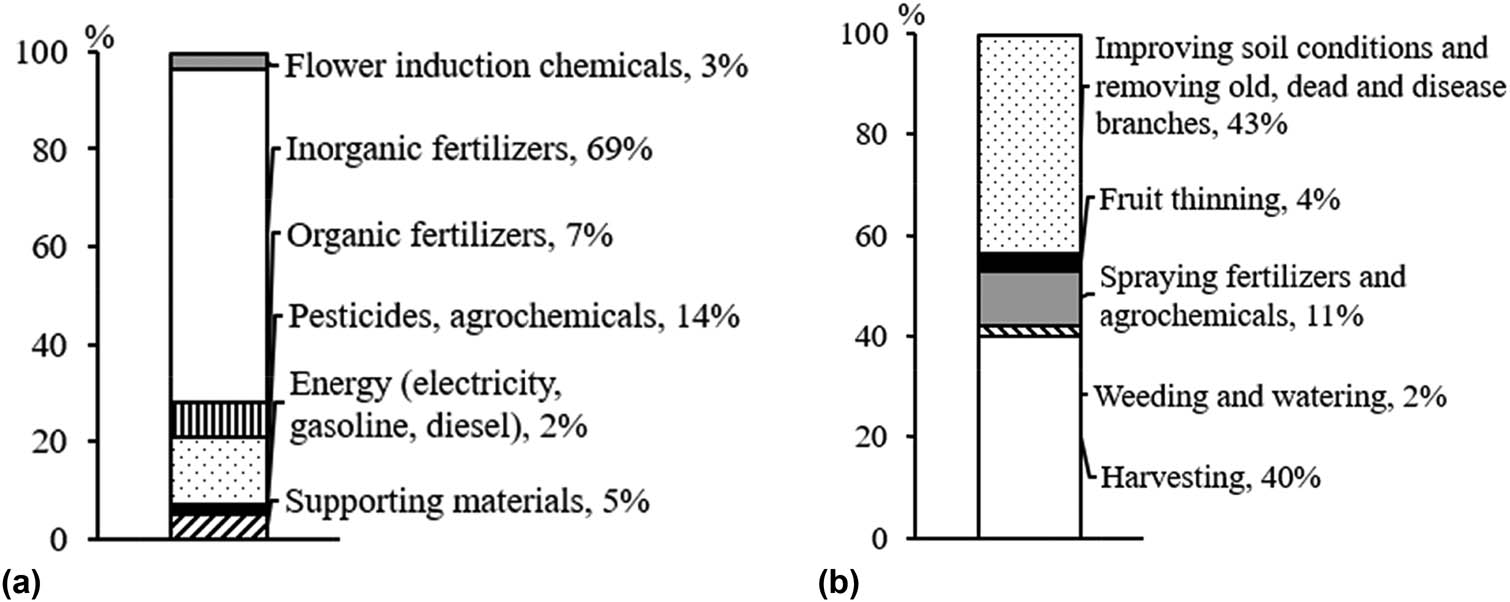
Cost structure of material and labor costs of Idor longan growers in 2019: (a) materials costs; (b) labor costs.
Factor affecting profit and decision to adopt VietGAP of Idor longan growers in the Mekong Delta, Vietnam
| Variables | Profit model | Logit model | |||
|---|---|---|---|---|---|
| Coef. | SE | Coef. | SE | ||
| X 1 | No. of years of schooling attainment of respondents | −171ns | 375 | 0.125* | 0.558 |
| X 2 | No. of years of applying organic fertilizers | 543 ns | 366 | ||
| X 3 | Area of longan (1,000 m2/household) | −1,357*** | 188 | 0.204*** | 0.680 |
| X 4 | Longan tree density (trees/1,000 m2) | 160* | 91 | −0.195ns | 0.213 |
| X 5 | Age of longan (years) | 1,059*** | 308 | −0.125ns | 0.467 |
| X 6 | VietGAP (1 = VietGAP) | 891ns | 2,304 | ||
| Cons | 9,626** | 4,322 | −1.177* | 0.713 | |
| No. of observation | 170 | 170 | |||
| R 2 | 0.26 | 0.09 | |||
| Adjusted R 2 | 0.23 | ||||
| Prob. > F | 0.0000 | 0.0003 | |||
| Multicollinearity (VIF) | 1.13 | ||||
| Heteroscedasticity test | 0.6805 | ||||
*, **, and *** mean significant at α = 10, 5, and 1%, respectively; ns — not significant at α = 10%; coef. — coefficient of the profit and logit model; SE — standard error.
Impacts (VND 1,000/1,000 m2) of adopting VietGAP and IPM on the income of longan growers in 2019 in the Mekong Delta, Vietnam
| Parameters | T-test | PSM matching methods | |||
|---|---|---|---|---|---|
| NNM | Radius | Kernel | Stratification | ||
| 1. Total cost in 2019 (1 = 1.1 + 1.2) | 1,692** | −491*** | −23ns | 606* | 295** |
| (876) | (510) | (634) | (380) | (365) | |
| 1.1. Distributed fixed costs in 2019 | 174* | −7ns | −151ns | 66ns | 80ns |
| (111) | (74) | (90) | (70) | (63) | |
| 1.2 Variable cost in 2019 (1.2 = 1.2.1 + 1.2.2) | 1,518** | −484*** | 128ns | 540* | 215** |
| (844) | (488) | (616) | (404) | (355) | |
| 1.2.1 Material cost in 2019 | 916ns | −995*** | −70ns | −38ns | −298** |
| (719) | (442) | (450) | (334) | (322) | |
| 1.2.2 Labor cost in 2019 | 602** | 511*** | 198** | 578** | 513** |
| (281) | (156) | (260) | (148) | (135) | |
| 2. Revenue | −668ns | 2,236*** | 3,000* | 1,836* | 2,788* |
| (2,253) | (1,361) | (2,612) | (1,033) | (1,061) | |
| 3. Profit (3 = 2 − 1) | −2,360ns | 2,726*** | 2,977* | 1,230* | 2,493** |
| (2,404) | (1,470) | (2,490) | (1,058) | (1,074) | |
| 4. No. of observations after matching | |||||
| VietGAP | 85 | 85 | 18 | 85 | 80 |
| Non-VietGAP | 85 | 41 | 18 | 79 | 80 |
Impacts = means of VietGAP – means of Non-VietGAP in T-test and ATT of matching methods; values in the parentheses are standard errors; *, **, and *** mean significant at α = 10, 5, and 1%, respectively; ns — not significant at α = 10%; variables to apply PSM were number of years of schooling of respondents, age of longan trees (years), area of longan (1,000 m2/household), and density of longan trees (trees/1,000 m2); NNM — nearest neighbor matching.
VietGAP adopters spent more variable costs in 2019 (∼8 million VND/1,000 m2) than non-VietGAP adopters (∼6.6 million VND/1,000 m2) (Table 5). Variable costs are the most concerned investment to fruit growers, which is added every year after the investment costs of the first 3 years to longan trees. They can be divided as material (60%) and labor costs (40%). The details of cost structure of the material and labor costs are presented in Figure 3. However, the investment in variable costs of Idor longan growers in 2019 greatly varied among them. According to the technical assistants of the VietGAP program, longan growers have not strictly followed the guidelines in the practice of longan growing. It has also happened in many other fruits [1,3]. The investment in fertilizers depended much on the financial capacity of longan growers and the results of the flowers induction. Among labor costs, improving soil conditions, removing old, dead, and diseased branches, and harvesting occupied 83% of the labor costs. These two costs increased when Idor longan growers were successful in flower induction. Most of the cost items of both material and labor costs of VietGAP adopters were higher than non-VietGAP adopters. We will find who were more financially efficient or if VietGAP can reduce production costs and result in higher income to VietGAP adopters in the next section of this article.
The results of T-test show that Idor longan growers who adopted VietGAP invested higher cost than the non-VietGAP adopters, especially the variables costs occurring in 2019. VietGAP adopters spent higher costs in improving soil conditions, removing damaged, dead, and diseased branches after harvest, thinning fruits, and applying organic fertilizers. These results show that VietGAP adopters have practiced techniques to improve the yields and quality of longans (increase in size of longan, color of the fruit skin, and taste) [24]. There are no significant difference in revenue and profit between VietGAP and non-VietGAP adopters. These results have really discouraged VietGAP adopters and the expansion of VietGAP to the non-VietGAP adopters. We will discuss more details about the constraints to VietGAP adoption and expansion due to low or insignificant difference in the outcomes including yields, selling price at farm gate, production costs, income, and profit.
According to the technical guidelines, investment for improving soil and removing damaged branches would maximize the effects of fertilizers and quality of longan size and appearance, one of the most important criteria to help increase selling price of longan at the farm gate. However, it is a bit difficult to convince longan growers because they need to add more labor costs to follow these guidelines. Besides, supporting materials were special investment to Idor longan trees as the Idor longan trees have big canopies. Whereas the root system is not strong enough and easily gets damaged due to the use of KClO3, the flower induction chemicals. The investment for the supporting materials was also dramatically varied depending on the types of the materials. They can use these materials for 3–5 years depending on these supporting materials. For the safety of supporting materials, fruit growers need to follow stricter guidelines of VietGAP and IPM introduced by both individual trainings and local TV programs in agricultural extension, namely prepare the beds carefully in the first year, use both organic and inorganic fertilizers properly, use agents less harmful to longan roots in flower induction, and remove damaged branches to maximize the effect of the fertilizers and make the longan canopies lighter. In fact, these guidelines are most relevant to many other fruits in Vietnam.
3.3 Factor affecting profit of Idor longan production and decision to adopt VietGAP by Idor longan growers in the Mekong Delta, Vietnam
This section presents the factors that affect the profit of Idor longan production and the decision to adopt VietGAP by Idor longan growers. The first two important steps in estimating the impacts of VietGAP on the income of the fruit growers are using both T-test and PSM [19,23]. Profit of Idor longan production in 2019 was about 16.7 million VND/1,000 m2 (∼722 USD, with 23,143 VND per USD, December 2019). Factors affecting profit of Idor longan production in the Mekong Delta, Vietnam were determined by applying the linear regression (Table 4, profit model). The multicollinearity test (VIF) and heteroscedasticity test were conducted and they showed that the model is valid to estimate the coefficients. The results show that profit of Idor longan are significantly affected by the area of longan (1,000 m2/household), age of longan (years), and density of Idor longan trees (trees/1,000 m2). These factors are also found in other studies [24,25,26]. The profit of Idor longan growers were insignificantly different between VietGAP and non-VietGAP adopters when using the parameter methods (T-test and regression). There is a need to continue the analysis using PSM to estimate the impacts of VietGAP on the outcomes [4,19,20,21,22,23].
Factors affecting decision of fruit growers to adopt VietGAP in three provinces in the Mekong Delta, Vietnam are presented in Table 4 by conducting the logit regression (T = 1: adopt VietGAP, otherwise T = 0). This is the important step to identify how VietGAP and non-VietGAP adopters differ in their characteristics, main sources of bias to estimate the outcomes of VietGAP and non-VietGAP adopters by T-test or regression (profit model) [23]. The model is qualified to estimate the coefficients (Prob. > F is 0.0003) and identify which factors will be used to create comparable group between VietGAP and non-VietGAP adopters. Among five variables testing in the logit model, the results show that the number of years of schooling of respondents and area of longan (1,000 m2/household) significantly affect the decision to apply VietGAP for longan in the Mekong Delta, Vietnam. These results are comparable to many studies on factors affecting users’ adoption to agricultural technologies, especially VietGAP programs for different crops in Vietnam [4,22,27,28]. The logit model in this section focuses only on socio-economic factors or background information of the respondents and interviewed households which are the key resources influencing the change. Whereas factors affecting the adoption of VietGAP are fully presented in [30] in which both variables are related to attitudes toward the behavior, social norms, perceived behavior control, and background information. According to VietGAP adopters and the local authorities, the VietGAP adopters who have big longan areas, have intention to keep Idor longan gardens for a long time, and willing to adopt new techniques in growing Idor longan were voluntarily chosen. Even VietGAP and non-VietGAP adopters among whom longan density (trees/1,000 m2) and age of longan trees (years) are not significantly different are included in the matching process of PSM as they significantly affect longan yield and profit (Table 4, [29]). After these two steps, PSM was applied to estimate the impacts of VietGAP on the income of Idor longan growers in the Mekong Delta (Table 5).
3.4 Impacts of adopting VietGAP on the income of longan growers in the Mekong Delta, Vietnam
This section presents the result of impact of adopting VietGAP on the income of longan growers by both T-test and PSM. The factors used to balance the two samples are the number of years of schooling of the respondents, age of longan trees (years), area of longan (1,000 m2/household), and density of longan trees (trees/1,000 m2) (logit model). Then, PSM was applied to estimate the impacts of adopting VietGAP on the Idor longan growers in the Mekong Delta, Vietnam. The results show that adopting VietGAP helped Idor longan growers to reduce production cost in 2019 (491 thousand VND per 1,000 m2), increase revenue and profit in 2019 (2.2 million VND and 2.7 million VND per 1,000 m2, respectively; using NNM). These results have proved and encouraged Idor longan growers to adopt VietGAP. In fact, applying VietGAP leads to reduced material costs (995 thousand VND/1,000 m2), especially in fertilizers. However, the labor costs increased to 511 thousand VND/1,000 m2. This is one of the constraints to convince Idor longan growers to apply VietGAP and IPM in three study sites. Due to the migration of youth from the countryside to the big city for education and jobs [31,32], lack of labor and increase in labor cost made both VietGAP and non-VietGAP adopters reluctant to adopt VietGAP and other agricultural technologies. The impacts of increasing revenue of Idor longan were contributed by both the increase in the selling price at farm gate (559 thousand VND/1,000 m2) and Idor longan yield of VietGAP adopters (67 kg/1,000 m2).
Besides using the NNM to estimate the impacts of adopting VietGAP, other matching methods were applied, such as kernel, radius, and stratification. However, the number of observations of the non-VietGAP is much smaller after balancing the two groups of VietGAP and non-VietGAP. The standard errors are also varied. The results of the impacts are more reliable in NNM (Table 5).
The same procedure was repeated with a new logit model with eight variables, namely, schooling of respondents (years), age of longan trees (years), area of longan (1,000 m2/household), density of longan trees (trees/1,000 m2), respondents knew about IPM and VietGAP before participating in VietGAP (1 = knew), respondents perceived adopting IPM results in both direct and indirect benefits to longan growers (1 = yes) (two variables), and respondents perceived increased price of agro-chemicals influencing IPM or VietGAP adoption (1 = yes). These new factors were learned from ref. [30] in the same research. However, the impact of profit is a bit higher than the first estimation. But they also have small observations after matching, so they are not considered in this sensitivity analysis.
The case study of Idor longan is a typical case of many fruits as well as agricultural products in the Mekong Delta, Vietnam. Many agricultural technologies have been introduced to fruit growers or farmers to increase both their production efficiency and protect the environment. Despite how good the programs or the technologies are, small farmers here are often reluctant to apply or adopt these programs if they cannot directly benefit their farms or increase their income. To increase income, there are three parameters, namely increase yield and selling price and reduce production cost. Most of the programs introduced often increased labor costs, like this case study of Idor longan. This is one of the most important obstacles of these programs. Besides, the guidelines to produce more sustainable, low, or less harmful inputs might affect fruits’ yield. This is the second most concerned factor to farmers to adopt the technologies. Lastly, the commitment between the extension workers and farmers to strictly apply the technical guidelines in the long run would assure the improvement in outcomes in these programs. In this case study, there is no reduction in both materials and labor costs when adopting VietGAP, one of the biggest obstacles to maintaining and expanding VietGAP. The practice of applying inputs still dramatically varies among farmers. It shows that longan growers have different beliefs about the application of new technologies in longan production. Besides, they have different financial resources to invest in the longan trees.
To estimate the impacts on the outcomes, especially the income or profit to farmers in the extension programs, T-test is the most used method to compare the outcomes to illustrate the benefits of these programs. However, most of these programs have a bias in participant selection. Thus, PSM is more relevant to estimate the impacts on the outcomes of these programs [4,22,27,28]. The weak point of this method is more complicated to both farmers and extension workers. The technical guidelines of how to apply PSM should be introduced widely to extension workers as well as program managers adopting this technique, or they should apply random selection to recruit participants for these programs. Then, comparing the outcomes by T-test can be applied.
3.5 Perception and constraints of Idor longan growers in the Mekong Delta, Vietnam to adopt VietGAP
VietGAP adopters listed five most significant advantages when applying VietGAP in Idor longan cultivation. Applying VietGAP helps them to ensure they produce safe products (longan) for the consumers (67%). The quality of longan is also improved (62%), as a result, the selling price of Idor longan at farm gate of VietGAP adopters is higher than that of the non-VietGAP adopters. It is also ensured that growing Idor longan is safe for growers due to following VietGAP guidelines and avoiding use of toxic chemicals (60%) and reducing environmental pollution (39%). VietGAP adopters agreed that adopting VietGAP helps to reduce the production costs (44%). It is one of the most important reasons that attracted longan growers to adopt VietGAP.
A constraint for farmers applying VietGAP is that they could not sell Idor longan with branded name of VietGAP certified (50%). Longan growers expected to sell Idor longan with higher price when Idor longan is VietGAP certified. However, there is no improvement in longan consumption at the farm gate. The impact of VietGAP on the income and profit will be much improved if they can sell their longan to new channels and strengthen the capacity of their representatives, the cooperatives, or cooperative groups. Besides, VietGAP requires many difficult requirements (24%) and complicated procedure (23%) which made Idor longan growers resistant to adopt VietGAP, especially increase in both hired and household labor costs.
About 80% of non-VietGAP adopters know the term “VietGAP.” They learned about VietGAP from their neighbors and relatives (75%), cooperative members (68%), and technical experts and social media (40%). However, only 27% of non-VietGAP adopters intend to adopt VietGAP. The main reasons that they did not have interest in VietGAP are the procedure to apply VietGAP is complicated and the rules are strict, especially in using agrochemicals and pesticides. Besides, VietGAP longans have not been sold separately from non-VietGAP longans and the price of VietGAP longans is not significantly higher at farm gate. Some farmers have the intention to shift to other fruits with higher economic value such as durian, pomelo, or dragon fruits.
4 Conclusion
There were difference in characteristics of households and growing Idor longan between VietGAP and non-VietGAP adopters. VietGAP adopters applied more inputs and labor than non-VietGAP adopters leading to increase in investment costs in 2019. Whereas, the yields of VietGAP adopters have not improved, and they sold Idor longan mostly to middlemen, no distinguish between certified and uncertified Idor longan. As a result, revenue and profit between VietGAP and non-VieGAP adopters were insignificantly different.
The impacts of VietGAP recruiting from PSM show that applying VietGAP could reduce the production costs, especially rational use of fertilizers (76% of the investment in 2019), and increase revenue and profit for the VietGAP adopters. The different results in T-test and PSM were caused by the difference in the educational attainment of Idor longan growers, Idor longan area, age, and density of longan trees. However, the impact of VietGAP on revenue and profit was minimal for longan growers. As a result, it affected the VietGAP adoption and expansion of VietGAP at the study sites. There are more efforts from both longan growers and cooperatives and project implementers to improve both the production and consumption of VietGAP products.
Idor longan growers can improve their income by reducing production costs by sufficient investments in the first 3 years, and proper use of chemicals for flower induction and fertilizers. Then, the costs of supporting materials and labor costs in removing damaged branches and adding fertilizers and agrochemicals would decrease accordingly. The improvement of dealing between the cooperatives or cooperative groups and fruit trading companies secures the selling price to Idor longan growers, especially when the market price and demand change. It would also encourage the VietGAP adoption expansion in the Mekong Delta, Vietnam.
Acknowledgments
The authors would like to thank Professor Jan Bentzen, Aahus University, Denmark and Professor Paul Kristiansen, University of New England, Australia for their comments on the manuscript.
-
Funding information: This article is part of the research “Including gender to develop the sustainable value chain of Idor longan in the Mekong Delta, Vietnam” (B2019-TCT-07), supported by Ministry of Education and Training of Vietnam.
-
Author contributions: NTTT designed this research, guided in data collection, did data analysis, interpreted the results and discussion, and prepared the manuscript. LVT is responsible mainly for writing and editing the manuscript.
-
Conflict of interest: The authors state no conflict of interest.
-
Data availability statement: The datasets generated during and/or analyzed during the current study are available from the corresponding author on reasonable request.
References
[1] Hoang HG. Exploring farmers’ adoption of VietGAP from systemic perspective: implication for developing agri-food systems. Br Food J. 2020;122(12):3641–61. 10.1108/BFJ-09-2019-0724.Suche in Google Scholar
[2] Nguyen TKQ, Sano M, Kuga M. Current situation of VietGAP system in White Leg Shrimp (Litopenaeus vannamei) intensive farming. J Regional Fish. 2019;59(3):146–56.Suche in Google Scholar
[3] Loan LT, Pabuayon IM, Catelo SP, Sumalde ZM. Adoption of good agricultural practice (VietGAP) in the lychee industry in Vietnam. Asian J Agric Extension, Econ & Sociol. 2015;8(2):1–12. 10.9734/AJAEES/2016/19948.Suche in Google Scholar
[4] Chau THB. Using propensity score matching method to estimate the impact of VietGAP program on the health of farmers in Thua Thien Hue province, Vietnam. Hue Univ J Science: Econ Dev. 2017;126(5B):17–31.10.26459/jed.v126i5B.4109Suche in Google Scholar
[5] Ha MT. Evaluating production efficiency and quality of leafy radish cultivated according to the Vietnamese Good Agricultural Practice (VietGAP) guideline in Northern Vietnam. Int J Dev Res. 2014;4(11):2219–24.Suche in Google Scholar
[6] Ministry of Agriculture and Rural Development. 2015. Decision No. 2027/QD-BNN-BVTV approving the Program on accelerating the application of integrated pest management (IPM) on crops for the period 2015-2020.Suche in Google Scholar
[7] PSAV News. New impetus to spread the IPM Program; 2020. Available from: http://psav-mard.org.vn/new-impetus-to-spread-the-ipm-program.html, accessed July 19, 2021.Suche in Google Scholar
[8] Vietnam News. Dong Thap to expand fruit cultivation, improve fruit value; 2020. Available from: https://vietnamnews.vn/society/804405/dong-thap-to-expand-fruit-cultivation-improve-fruit-value.html, accessed July 19, 2021.Suche in Google Scholar
[9] Southern Fruit Research Institute. Mekong Delta to set up VietGAP fruits, Global GAP fruits process; 2019. Available from: http://hxcorp.com.vn/product/827-mekong-delta-to-set-up-vietgap-fruits-globalgap-fruits-process.html, accessed July 19, 2021.Suche in Google Scholar
[10] Oanh N. Growing Idor longan in Thoi An; 2016. Available from: https://vietnam.vnanet.vn/english/growing-ido-longan-in-thoi-an/264643.html, accessed July 19, 2021.Suche in Google Scholar
[11] Hau TV, Huan DM. Investigating characteristics of shoot flushing, flowering and fruit development of “E-Dor” longan (Dimocarpus longan Lour.) in Chau Thanh district, Dong Thap province. Can Tho Univ J Sci. 2011;20(b):129–38.Suche in Google Scholar
[12] Hanh TTM, Hieu NT, Bay DTB, Hoa NV, Hoat TX. Evaluation of susceptibility to witches’ broom of longan varieties growth in mekong delta. Vietnam J Agric Sci. 2016;14(6):843–51.Suche in Google Scholar
[13] Duc H, Dam M. Mekong Delta farmers restructuring crop cultivation to better respond to climate change; 2021. Available from: https://vietnamagriculture.nongnghiep.vn/mekong-delta-farmers-restructuring-crop-cultivation-to-better-respond-to-climate-change-d296686.html, accessed July 19, 2021.Suche in Google Scholar
[14] Vu HL, Thang N. The rise of Idor longan in converted land; 2021. Available from: https://vietnamagriculture.nongnghiep.vn/the-rise-of-ido-longan-in-converted-land-d296972.html, accessed July 19, 2021.Suche in Google Scholar
[15] Anh N. Australia ready to get its teeth into Vietnamese longans in 2019; 2018. Available from: https://e.vnexpress.net/news/business/markets/australia-ready-to-get-its-teeth-into-vietnamese-longans-in-2019-3717416.html, accessed July 19, 2021.Suche in Google Scholar
[16] Komorek C. New standards impact Vietnamese fruit exports; 2020. Available from: http://www.fruitnet.com/asiafruit/article/183037/new-standards-impact-vietnamese-fruit-exports, accessed July 19, 2021.Suche in Google Scholar
[17] Vietnam News. Vietnam struggles to export fruit to demanding markets; 2018. Available from: https://vietnamnews.vn/economy/463812/viet-nam-struggles-to-export-fruit-to-demanding-markets.html, accessed July 19, 2021.Suche in Google Scholar
[18] Massmann O. Vietnam – Agriculture Sector – Current Issues and Solutions for Investment and Outlook on Major Trade Deals TPP 11 and EUVNFTA; 2017. Available from: https://blogs.duanemorris.com/vietnam/2017/12/20/vietnam-agriculture-sector-current-issues-and-solutions-for-investment-and-outlook-on-major-trade-deals-tpp-11-and-euvnfta/, accessed July 19, 2021.Suche in Google Scholar
[19] Tran D, Goto D. Impacts of sustainability certification on farm income: Evidence from small-scale specialty green tea farmers in Vietnam. Food Policy. 2019;83:70–82.10.1016/j.foodpol.2018.11.006Suche in Google Scholar
[20] Ma W, Abdulai A. IPM adoption, cooperative membership and farm economic performance. China Agric Econ Rev. 2018;11(12):218–36.10.1108/CAER-12-2017-0251Suche in Google Scholar
[21] Ninh HN, Aragon CT, Palis FG, Rejesus RM, Singleton GR. Yield and income effects of ecologically-based rodent management in Mekong River Delta. Vietnam Asian J Agricul Dev. 2016;13(2):55–74.10.37801/ajad2016.13.2.4Suche in Google Scholar
[22] Wang H, Moustier P, Loc NTT. Economic impact of direct marketing and contracts: the case of safe vegetable chains in northern Vietnam. Food Policy. 2014;47:13–23.10.1016/j.foodpol.2014.04.001Suche in Google Scholar
[23] Khandker SR, Koolwal GB, Samad HA. Handbook on impact evaluation: quantitative methods and practices. Washington, DC: The World Bank; 2010.10.1596/978-0-8213-8028-4Suche in Google Scholar
[24] Binh Dien. Binh Dien Newsletter on technical guidelines on how to get high productivity in Idor longan. (translated); 2019. Available from: https://binhdien.com/dong-hanh-cung-nha-nong/ban-tin-binh-dien/ky-thuat-xu-ly-nhan-ido-cho-nang-suat-cao.html, accessed May 29, 2021.Suche in Google Scholar
[25] Giao NT. Efficiency of land use in longan E-Dor farming (Dimocarpus longan Lour.) in Thoi Lai District, Can Tho City, Vietnam. J Sci Technol Res. 2021;3(1):58–71.Suche in Google Scholar
[26] Kiet THVT, Thoa NTK, Nguyen PT. Measurement of technical efficiency: a case study of Dailoan-mango in Vietnam. WIT Trans Ecol Environ. 2020;243:133–42.10.2495/UA200121Suche in Google Scholar
[27] Ho VB, Nanseki T, Chomei Y. Impact of VietGAP tea production on farmers’ income in northern Vietnam. Jpn J Farm Manag. 2019;56(4):100–5.Suche in Google Scholar
[28] Loan LTT, Pabuayon IM, Catelo SP, Sumalde ZM. Adoption of good agricultural practice (VietGAP) in the lychee industry in Vietnam. Asian. J Agric Ext, Econ Sociol. 2016;8(2):1–12.10.9734/AJAEES/2016/19948Suche in Google Scholar
[29] Truc NTT, Bao DTO, Ngan NV, Dat LT. Impacts of Vietnamese good agricultural practice adoption to production efficiency of Idor longan production in the Mekong Delta, Vietnam. Vietnamese J Agric Rural Dev. 2021;11(1):156–64.Suche in Google Scholar
[30] Truc NTT, Bao DTO, Giang DTH. Farmers behavior and intention to adopt integrated pest management in fruit. Case Study Vietnam. 2021;17(11):755–69.Suche in Google Scholar
[31] Huy HT, Khoi LND. Analysis of labour migration flows in the mekong delta of Vietnam. In: Stewart M, Coclanis P, editors. Environmental change and agricultural sustainability in the Mekong delta. Advances in global change research. Vol. 45. Dordrecht: Springer; 2011. 115–40.10.1007/978-94-007-0934-8_8Suche in Google Scholar
[32] Huy HT, Nonneman W. Economic effects of labor migration on agricultural production of farm households in the Mekong River Delta region of Vietnam. Asian Pac Migr J. 2016;25(1):3–21.10.1177/0117196815621199Suche in Google Scholar
[33] Becker SO, Ichino A. Estimation of average treatment effects based on propensity scores. Stata J. 2002;2(4):358–77.10.1177/1536867X0200200403Suche in Google Scholar
© 2022 Ngo Thi Thanh Truc and Le Vinh Thuc, published by De Gruyter
This work is licensed under the Creative Commons Attribution 4.0 International License.
Artikel in diesem Heft
- Regular Articles
- Foliar application of boron positively affects the growth, yield, and oil content of sesame (Sesamum indicum L.)
- Impacts of adopting specialized agricultural programs relying on “good practice” – Empirical evidence from fruit growers in Vietnam
- Evaluation of 11 potential trap crops for root-knot nematode (RKN) control under glasshouse conditions
- Technical efficiency of resource-poor maize farmers in northern Ghana
- Bulk density: An index for measuring critical soil compaction levels for groundnut cultivation
- Efficiency of the European Union farm types: Scenarios with and without the 2013 CAP measures
- Participatory validation and optimization of the Triple S method for sweetpotato planting material conservation in southern Ethiopia
- Selection of high-yield maize hybrid under different cropping systems based on stability and adaptability parameters
- Soil test-based phosphorus fertilizer recommendation for malting barley production on Nitisols
- Effects of domestication and temperature on the growth and survival of the giant freshwater prawn (Macrobrachium rosenbergii) postlarvae
- Influence of irrigation regime on gas exchange, growth, and oil quality of field grown, Texas (USA) olive trees
- Present status and prospects of value addition industry for agricultural produce – A review
- Competitiveness and impact of government policy on chili in Indonesia
- Growth of Rucola on Mars soil simulant under the influence of pig slurry and earthworms
- Effect of potassium fertilizer application in teff yield and nutrient uptake on Vertisols in the central highlands of Ethiopia
- Dissection of social interaction and community engagement of smallholder oil palm in reducing conflict using soft system methodology
- Farmers’ perception, awareness, and constraints of organic rice farming in Indonesia
- Improving the capacity of local food network through local food hubs’ development
- Quality evaluation of gluten-free biscuits prepared with algarrobo flour as a partial sugar replacer
- Effect of pre-slaughter weight on morphological composition of pig carcasses
- Study of the impact of increasing the highest retail price of subsidized fertilizer on rice production in Indonesia
- Agrobiodiversity and perceived climatic change effect on family farming systems in semiarid tropics of Kenya
- Influences of inter- and intra-row spacing on the growth and head yield of cabbage (Brassica oleracea var. capitata) in western Amhara, Ethiopia
- The supply chain and its development concept of fresh mulberry fruit in Thailand: Observations in Nan Province, the largest production area
- Toward achieving sustainable development agenda: Nexus between agriculture, trade openness, and oil rents in Nigeria
- Phenotyping cowpea accessions at the seedling stage for drought tolerance in controlled environments
- Apparent nutrient utilization and metabolic growth rate of Nile tilapia, Oreochromis niloticus, cultured in recirculating aquaculture and biofloc systems
- Influence of season and rangeland-type on serum biochemistry of indigenous Zulu sheep
- Meta-analysis of responses of broiler chickens to Bacillus supplementation: Intestinal histomorphometry and blood immunoglobulin
- Weed composition and maize yield in a former tin-mining area: A case study in Malim Nawar, Malaysia
- Strategies for overcoming farmers’ lives in volcano-prone areas: A case study in Mount Semeru, Indonesia
- Principal component and cluster analyses based characterization of maize fields in southern central Rift Valley of Ethiopia
- Profitability and financial performance of European Union farms: An analysis at both regional and national levels
- Analysis of trends and variability of climatic parameters in Teff growing belts of Ethiopia
- Farmers’ food security in the volcanic area: A case in Mount Merapi, Indonesia
- Strategy to improve the sustainability of “porang” (Amorphophallus muelleri Blume) farming in support of the triple export movement policy in Indonesia
- Agrarian contracts, relations between agents, and perception on energy crops in the sugarcane supply chain: The Peruvian case
- Factors influencing the adoption of conservation agriculture by smallholder farmers in KwaZulu-Natal, South Africa
- Meta-analysis of zinc feed additive on enhancement of semen quality, fertility and hatchability performance in breeder chickens
- Meta-analysis of the potential of dietary Bacillus spp. in improving growth performance traits in broiler chickens
- Biocomposites from agricultural wastes and mycelia of a local mushroom, Lentinus squarrosulus (Mont.) Singer
- Cross transferability of barley nuclear SSRs to pearl millet genome provides new molecular tools for genetic analyses and marker assisted selection
- Detection of encapsulant addition in butterfly-pea (Clitoria ternatea L.) extract powder using visible–near-infrared spectroscopy and chemometrics analysis
- The willingness of farmers to preserve sustainable food agricultural land in Yogyakarta, Indonesia
- Transparent conductive far-infrared radiative film based on polyvinyl alcohol with carbon fiber apply in agriculture greenhouse
- Grain yield stability of black soybean lines across three agroecosystems in West Java, Indonesia
- Forms of land access in the sugarcane agroindustry: A comparison of Brazilian and Peruvian cases
- Assessment of the factors contributing to the lack of agricultural mechanization in Jiroft, Iran
- Do poor farmers have entrepreneurship skill, intention, and competence? Lessons from transmigration program in rural Gorontalo Province, Indonesia
- Communication networks used by smallholder livestock farmers during disease outbreaks: Case study in the Free State, South Africa
- Sustainability of Arabica coffee business in West Java, Indonesia: A multidimensional scaling approach
- Farmers’ perspectives on the adoption of smart farming technology to support food farming in Aceh Province, Indonesia
- Rice yield grown in different fertilizer combination and planting methods: Case study in Buru Island, Indonesia
- Paclobutrazol and benzylaminopurine improve potato yield grown under high temperatures in lowland and medium land
- Agricultural sciences publication activity in Russia and the impact of the national project “Science.” A bibliometric analysis
- Storage conditions and postharvest practices lead to aflatoxin contamination in maize in two counties (Makueni and Baringo) in Kenya
- Relationship of potato yield and factors of influence on the background of herbological protection
- Biology and life cycle Of Diatraea busckella (Lepidoptera: Crambidae) under simulated altitudinal profile in controlled conditions
- Evaluation of combustion characteristics performances and emissions of a diesel engine using diesel and biodiesel fuel blends containing graphene oxide nanoparticles
- Effect of various varieties and dosage of potassium fertilizer on growth, yield, and quality of red chili (Capsicum annuum L.)
- Review Articles
- Germination ecology of three Asteraceae annuals Arctotis hirsuta, Oncosiphon suffruticosum, and Cotula duckittiae in the winter-rainfall region of South Africa: A review
- Animal waste antibiotic residues and resistance genes: A review
- A brief and comprehensive history of the development and use of feed analysis: A review
- The evolving state of food security in Nigeria amidst the COVID-19 pandemic – A review
- Short Communication
- Response of cannabidiol hemp (Cannabis sativa L.) varieties grown in the southeastern United States to nitrogen fertilization
- Special Issue on the International Conference on Multidisciplinary Research – Agrarian Sciences
- Special issue on the International Conference on Multidisciplinary Research – Agrarian Sciences: Message from the editor
- Maritime pine land use environmental impact evolution in the context of life cycle assessment
- Influence of different parameters on the characteristics of hazelnut (var. Grada de Viseu) grown in Portugal
- Organic food consumption and eating habit in Morocco, Algeria, and Tunisia during the COVID-19 pandemic lockdown
- Customer knowledge and behavior on the use of food refrigerated display cabinets: A Portuguese case
- Perceptions and knowledge regarding quality and safety of plastic materials used for food packaging
- Understanding the role of media and food labels to disseminate food related information in Lebanon
- Liquefaction and chemical composition of walnut shells
- Validation of an analytical methodology to determine humic substances using low-volume toxic reagents
- Special Issue on the International Conference on Agribusiness and Rural Development – IConARD 2020
- Behavioral response of breeder toward development program of Ongole crossbred cattle in Yogyakarta Special Region, Indonesia
- Special Issue on the 2nd ICSARD 2020
- Perceived attributes driving the adoption of system of rice intensification: The Indonesian farmers’ view
- Value-added analysis of Lactobacillus acidophilus cell encapsulation using Eucheuma cottonii by freeze-drying and spray-drying
- Investigating the elicited emotion of single-origin chocolate towards sustainable chocolate production in Indonesia
- Temperature and duration of vernalization effect on the vegetative growth of garlic (Allium sativum L.) clones in Indonesia
- Special Issue on Agriculture, Climate Change, Information Technology, Food and Animal (ACIFAS 2020)
- Prediction model for agro-tourism development using adaptive neuro-fuzzy inference system method
- Special Issue of International Web Conference on Food Choice and Eating Motivation
- Can ingredients and information interventions affect the hedonic level and (emo-sensory) perceptions of the milk chocolate and cocoa drink’s consumers?
Artikel in diesem Heft
- Regular Articles
- Foliar application of boron positively affects the growth, yield, and oil content of sesame (Sesamum indicum L.)
- Impacts of adopting specialized agricultural programs relying on “good practice” – Empirical evidence from fruit growers in Vietnam
- Evaluation of 11 potential trap crops for root-knot nematode (RKN) control under glasshouse conditions
- Technical efficiency of resource-poor maize farmers in northern Ghana
- Bulk density: An index for measuring critical soil compaction levels for groundnut cultivation
- Efficiency of the European Union farm types: Scenarios with and without the 2013 CAP measures
- Participatory validation and optimization of the Triple S method for sweetpotato planting material conservation in southern Ethiopia
- Selection of high-yield maize hybrid under different cropping systems based on stability and adaptability parameters
- Soil test-based phosphorus fertilizer recommendation for malting barley production on Nitisols
- Effects of domestication and temperature on the growth and survival of the giant freshwater prawn (Macrobrachium rosenbergii) postlarvae
- Influence of irrigation regime on gas exchange, growth, and oil quality of field grown, Texas (USA) olive trees
- Present status and prospects of value addition industry for agricultural produce – A review
- Competitiveness and impact of government policy on chili in Indonesia
- Growth of Rucola on Mars soil simulant under the influence of pig slurry and earthworms
- Effect of potassium fertilizer application in teff yield and nutrient uptake on Vertisols in the central highlands of Ethiopia
- Dissection of social interaction and community engagement of smallholder oil palm in reducing conflict using soft system methodology
- Farmers’ perception, awareness, and constraints of organic rice farming in Indonesia
- Improving the capacity of local food network through local food hubs’ development
- Quality evaluation of gluten-free biscuits prepared with algarrobo flour as a partial sugar replacer
- Effect of pre-slaughter weight on morphological composition of pig carcasses
- Study of the impact of increasing the highest retail price of subsidized fertilizer on rice production in Indonesia
- Agrobiodiversity and perceived climatic change effect on family farming systems in semiarid tropics of Kenya
- Influences of inter- and intra-row spacing on the growth and head yield of cabbage (Brassica oleracea var. capitata) in western Amhara, Ethiopia
- The supply chain and its development concept of fresh mulberry fruit in Thailand: Observations in Nan Province, the largest production area
- Toward achieving sustainable development agenda: Nexus between agriculture, trade openness, and oil rents in Nigeria
- Phenotyping cowpea accessions at the seedling stage for drought tolerance in controlled environments
- Apparent nutrient utilization and metabolic growth rate of Nile tilapia, Oreochromis niloticus, cultured in recirculating aquaculture and biofloc systems
- Influence of season and rangeland-type on serum biochemistry of indigenous Zulu sheep
- Meta-analysis of responses of broiler chickens to Bacillus supplementation: Intestinal histomorphometry and blood immunoglobulin
- Weed composition and maize yield in a former tin-mining area: A case study in Malim Nawar, Malaysia
- Strategies for overcoming farmers’ lives in volcano-prone areas: A case study in Mount Semeru, Indonesia
- Principal component and cluster analyses based characterization of maize fields in southern central Rift Valley of Ethiopia
- Profitability and financial performance of European Union farms: An analysis at both regional and national levels
- Analysis of trends and variability of climatic parameters in Teff growing belts of Ethiopia
- Farmers’ food security in the volcanic area: A case in Mount Merapi, Indonesia
- Strategy to improve the sustainability of “porang” (Amorphophallus muelleri Blume) farming in support of the triple export movement policy in Indonesia
- Agrarian contracts, relations between agents, and perception on energy crops in the sugarcane supply chain: The Peruvian case
- Factors influencing the adoption of conservation agriculture by smallholder farmers in KwaZulu-Natal, South Africa
- Meta-analysis of zinc feed additive on enhancement of semen quality, fertility and hatchability performance in breeder chickens
- Meta-analysis of the potential of dietary Bacillus spp. in improving growth performance traits in broiler chickens
- Biocomposites from agricultural wastes and mycelia of a local mushroom, Lentinus squarrosulus (Mont.) Singer
- Cross transferability of barley nuclear SSRs to pearl millet genome provides new molecular tools for genetic analyses and marker assisted selection
- Detection of encapsulant addition in butterfly-pea (Clitoria ternatea L.) extract powder using visible–near-infrared spectroscopy and chemometrics analysis
- The willingness of farmers to preserve sustainable food agricultural land in Yogyakarta, Indonesia
- Transparent conductive far-infrared radiative film based on polyvinyl alcohol with carbon fiber apply in agriculture greenhouse
- Grain yield stability of black soybean lines across three agroecosystems in West Java, Indonesia
- Forms of land access in the sugarcane agroindustry: A comparison of Brazilian and Peruvian cases
- Assessment of the factors contributing to the lack of agricultural mechanization in Jiroft, Iran
- Do poor farmers have entrepreneurship skill, intention, and competence? Lessons from transmigration program in rural Gorontalo Province, Indonesia
- Communication networks used by smallholder livestock farmers during disease outbreaks: Case study in the Free State, South Africa
- Sustainability of Arabica coffee business in West Java, Indonesia: A multidimensional scaling approach
- Farmers’ perspectives on the adoption of smart farming technology to support food farming in Aceh Province, Indonesia
- Rice yield grown in different fertilizer combination and planting methods: Case study in Buru Island, Indonesia
- Paclobutrazol and benzylaminopurine improve potato yield grown under high temperatures in lowland and medium land
- Agricultural sciences publication activity in Russia and the impact of the national project “Science.” A bibliometric analysis
- Storage conditions and postharvest practices lead to aflatoxin contamination in maize in two counties (Makueni and Baringo) in Kenya
- Relationship of potato yield and factors of influence on the background of herbological protection
- Biology and life cycle Of Diatraea busckella (Lepidoptera: Crambidae) under simulated altitudinal profile in controlled conditions
- Evaluation of combustion characteristics performances and emissions of a diesel engine using diesel and biodiesel fuel blends containing graphene oxide nanoparticles
- Effect of various varieties and dosage of potassium fertilizer on growth, yield, and quality of red chili (Capsicum annuum L.)
- Review Articles
- Germination ecology of three Asteraceae annuals Arctotis hirsuta, Oncosiphon suffruticosum, and Cotula duckittiae in the winter-rainfall region of South Africa: A review
- Animal waste antibiotic residues and resistance genes: A review
- A brief and comprehensive history of the development and use of feed analysis: A review
- The evolving state of food security in Nigeria amidst the COVID-19 pandemic – A review
- Short Communication
- Response of cannabidiol hemp (Cannabis sativa L.) varieties grown in the southeastern United States to nitrogen fertilization
- Special Issue on the International Conference on Multidisciplinary Research – Agrarian Sciences
- Special issue on the International Conference on Multidisciplinary Research – Agrarian Sciences: Message from the editor
- Maritime pine land use environmental impact evolution in the context of life cycle assessment
- Influence of different parameters on the characteristics of hazelnut (var. Grada de Viseu) grown in Portugal
- Organic food consumption and eating habit in Morocco, Algeria, and Tunisia during the COVID-19 pandemic lockdown
- Customer knowledge and behavior on the use of food refrigerated display cabinets: A Portuguese case
- Perceptions and knowledge regarding quality and safety of plastic materials used for food packaging
- Understanding the role of media and food labels to disseminate food related information in Lebanon
- Liquefaction and chemical composition of walnut shells
- Validation of an analytical methodology to determine humic substances using low-volume toxic reagents
- Special Issue on the International Conference on Agribusiness and Rural Development – IConARD 2020
- Behavioral response of breeder toward development program of Ongole crossbred cattle in Yogyakarta Special Region, Indonesia
- Special Issue on the 2nd ICSARD 2020
- Perceived attributes driving the adoption of system of rice intensification: The Indonesian farmers’ view
- Value-added analysis of Lactobacillus acidophilus cell encapsulation using Eucheuma cottonii by freeze-drying and spray-drying
- Investigating the elicited emotion of single-origin chocolate towards sustainable chocolate production in Indonesia
- Temperature and duration of vernalization effect on the vegetative growth of garlic (Allium sativum L.) clones in Indonesia
- Special Issue on Agriculture, Climate Change, Information Technology, Food and Animal (ACIFAS 2020)
- Prediction model for agro-tourism development using adaptive neuro-fuzzy inference system method
- Special Issue of International Web Conference on Food Choice and Eating Motivation
- Can ingredients and information interventions affect the hedonic level and (emo-sensory) perceptions of the milk chocolate and cocoa drink’s consumers?
