Thirty-five years in environmentally assisted cracking in Italy: a point of view
-
Giovanna Gabetta is a nuclear engineer graduated in 1975. She specialized in Environmentally Assisted Cracking, working about 18 years on Reactor Pressure Vessel Steel (Environmentally Assisted Fatigue). During this time, she cooperated with the International Scientific Community and namely with the International Cyclic Crack Growth rate Cooperative Group. In 2004 she moved to the Italian Oil & Gas company, eni S.p.A. She is the author of more than 150 scientific papers, and has an interest in Knowledge management and Gender studies.


Abstract
In this paper, I will attempt to summarize my experience of approximately 35 years on environmental fatigue damage, which I gained from industries outside Milan, Italy, and as a visiting scientist at the Naval Research Laboratory in Washington, DC. I will present a brief summary of my understanding of the topic of environmentally assisted fatigue of metals. About halfway in my career, I moved from the nuclear industry towards the oil and gas industry. This shift allowed me to understand that environmentally assisted cracking, which is an important topic for pipeline steels, is also similar to the nuclear pressure vessel steel community and that the problems are similar. At the same time, I became aware that the scientific communities are not working well to communicate the issues and challenges. People working in one industrial sector do not seem to appreciate the contribution from another industrial sector. This is understandable, as there are industrial rules and regulations. Because of such constraints, a knowledge gap is introduced into the technical community. This lack of cooperation slows down the progress of relevant research, especially nowadays, when we are facing increasingly complex service situations that may lead to failures. While trying to cope with such difficulties, I became interested in knowledge management. I learned that there is a need to build bridges between contemporary science, engineering, and business. We are facing big challenges in analyzing failures, and maybe it is time to do things differently and consolidate different disciplines of engineering with applications that can give us more reliable predictions. Organizations and companies worldwide are currently facing (a) increasing quantity of available information on material usage, (b) increasing number of people with high education in science and engineering, (c) increasing complexity of the failure problems to be solved, and (d) increasing lack of communication between institutions. It is estimated that the material loss in the US due to corrosion alone is approximately $300 billion per year. The necessity of knowing, understanding, and processing such complex data and problems is a very large task. Thus, there is a need for exploiting the technical information and using communication technology tools to help support teamwork, networking, using available experience and expertise, and, hopefully, international cooperation. Knowledge management involves a cultural change to stimulate a better use of all types of resources. Progress will be slow and difficult if we do not learn how to cope with this new situation.
1 Early observations
In 1946, after the Second World War, a research center called the Centro lnformationi Studi Esperienze (CISE) was created in Milan, Italy, to support research in nuclear power generation. There I was involved starting in 1978 in research activities focused in the field of environmentally assisted cracking (EAC), more particularly in the environmental fatigue testing of reactor pressure vessel (RPV) steels. At the beginning of my training, I spent some time in 1979 at the Naval Research Laboratory (NRL) in Washington, DC, where corrosion fatigue was studied on steels and titanium and aluminum alloys using fracture mechanics principles developed by George Irwin. I worked with several people at NRL, and when I returned to Milan, a brand-new laboratory was built at the CISE to work on EAC. I had the opportunity to take part in the international scientific community working on EAC and to complete some test programs in the subject. Unfortunately, in 1987, the Italian Government stopped building nuclear reactors, and the decision was made also to stop any research activity relating to the use of nuclear energy. Such a decision ended the existence of the CISE in 1996.
Meanwhile, in 1994, a few of us moved to the research laboratories of the Italian Oil and Gas Company. The subject of the research I was involved in was mainly stress corrosion cracking (SCC) of pipeline steel, internal corrosion of pipelines, and coupling of corrosion with flow dynamics. This is also where I became involved in a project on knowledge management. In 2004, after 10 years, due to the reorganization of research in the Company, I moved to exploration and production and stopped to do direct research work in the laboratory; however, I am still involved in EAC and I try to keep contact with the research community.
2 EAC
EAC is defined as a damage form where acute defects (cracks) nucleate and grow due to the combined action of aggressive environment, applied load, and the metallurgy of the material. EAC can be the result of different damage mechanisms, for instance, hydrogen diffusion in the metal and/or anodic dissolution coupled with stress.
However, when corrosion occurs, anodic and cathodic processes are present at the same time, and it is sometimes difficult to distinguish between different damage mechanisms.
In Figure 1, the main parameters involved in EAC are graphically represented. In EAC, the applied load may be both static and dynamic, as schematically shown in Figure 2, so that the damage form can be called environmental fatigue, SCC, or hydrogen embrittlement. The damage mechanisms are often dependent on strain rate, ε dot, either applied externally or at the crack tip.
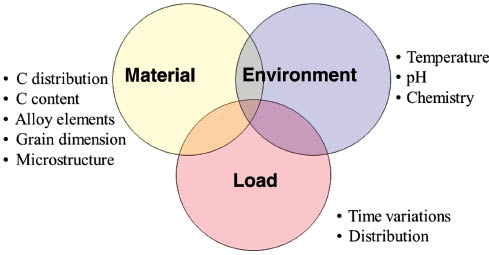
EAC parameters.
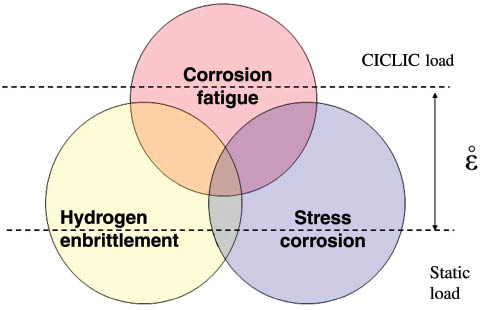
Strain rate effect.
In the early days, we were involved in the study of the environmental fatigue of RPV steel and focused on different types of tests, all on the same material and similar environments of demineralized water with or without some oxygen at two temperature levels.
Using large CT specimens (2 inches wide), we measured crack tip chemistry by inserting a potential probe and a pH electrode inside the crack (Gabetta, 1982; Gabetta & Rizzi, 1983) for measurement. A summary of test results is shown in Figure 3. Both oxygen depletion and crack tip acidification were observed (Edwards & Schuitemaker, 1987; MacDonald & Urquidi-MacDonald, 1988).
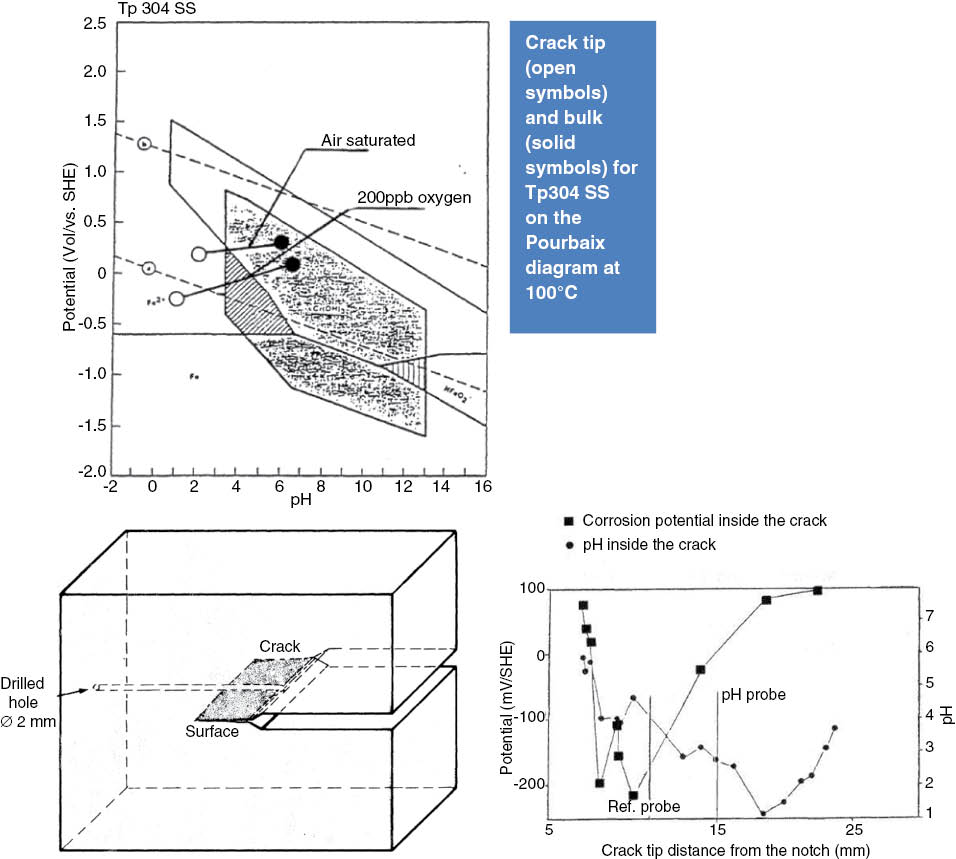
Potential and pH measurements at the crack tip: test method and results.
The effect of loading (fatigue) was included in the study using the superposition model (Austen, 1983; Gabetta, 1987) at different loading frequency (Vosikovsky, 1975) and is shown schematically in Figure 4.
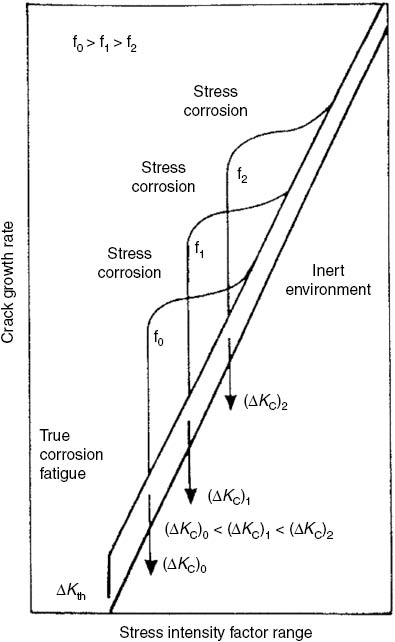
Schematic of the superposition model for corrosion fatigue.
This model takes into account two different effects of the environment on fatigue. If general corrosion is superimposed onto fatigue loading, the Paris law line [plot of cyclic crack growth rate (da/dN) vs. the stress intensity factor range (ΔK)] is moved towards higher crack growth velocities. This is true corrosion fatigue. If damage due to SCC is superimposed on true corrosion fatigue, a component with constant growth rate can be added to the Paris law to describe crack growth (Gabetta & Torronen, 1986). In this case, different frequency values are associated with different plateau crack growth rate values, as in the following equation:
This model agrees with striation spacing measurements (Gabetta, Rinaldi, & Lucia, 1992). Ductile and/or brittle striations are associated with the true corrosion fatigue and stress corrosion fatigue components of the crack growth rate, respectively. Striation measurements do confirm the existence of both mechanisms in different sections of the fracture surface, often close to each other. A method to measure striation spacing was developed by Claudia Rinaldi at the CISE (Gabetta, Pozzi, & Rinaldi, 1990). Examples are shown in Figures 5 and 6.
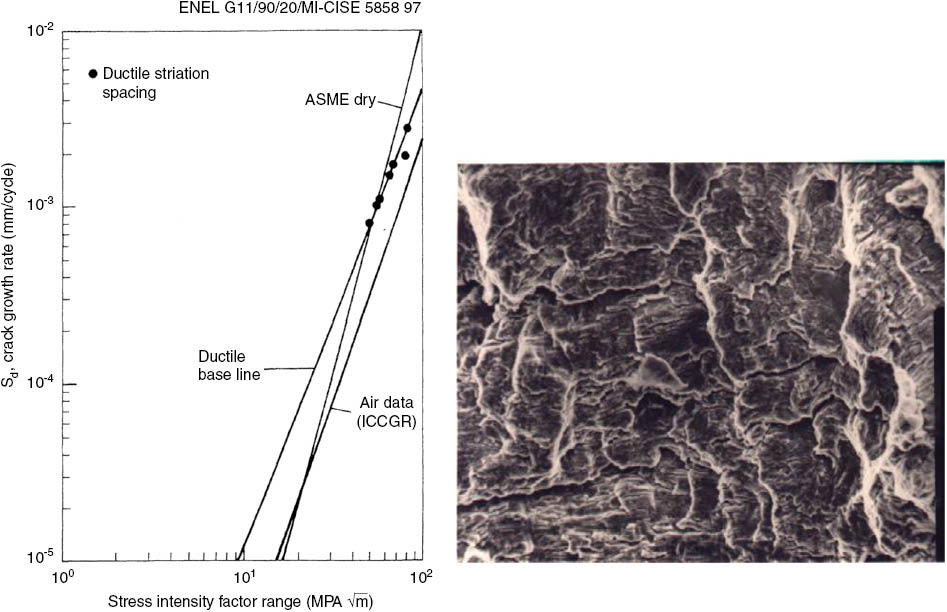
Example of ductile striations and spacing measurements.
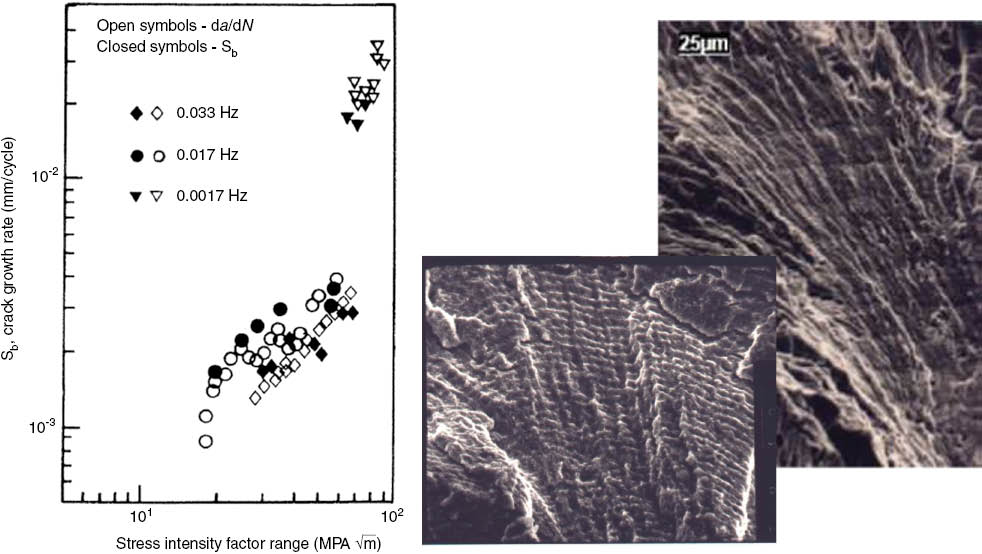
Examples of brittle striation spacing compared with crack growth rate at different frequency.
The value of spacing varies as a function of loading frequency for brittle striations due to stress corrosion mechanisms; ductile striation spacing is a function of the applied stress intensity factor range and falls on the Paris law for true corrosion fatigue.
Transgranular SCC can be observed in pipelines transporting hydrocarbons, following the well-known spectrum proposed by Parkins (1963) and summarized in Figure 7.
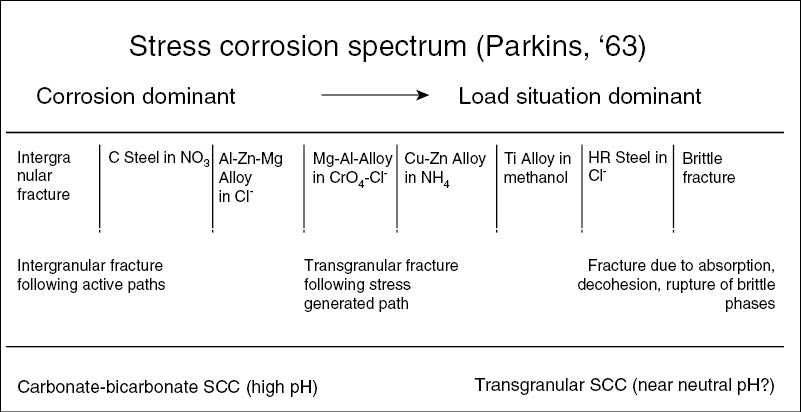
Stress corrosion spectrum in pipelines.
In a buried pipeline, an increasing applied load can be generated by a moving landslide, as summarized in Figure 8. The SCC component is associated with a plateau crack growth rate value.
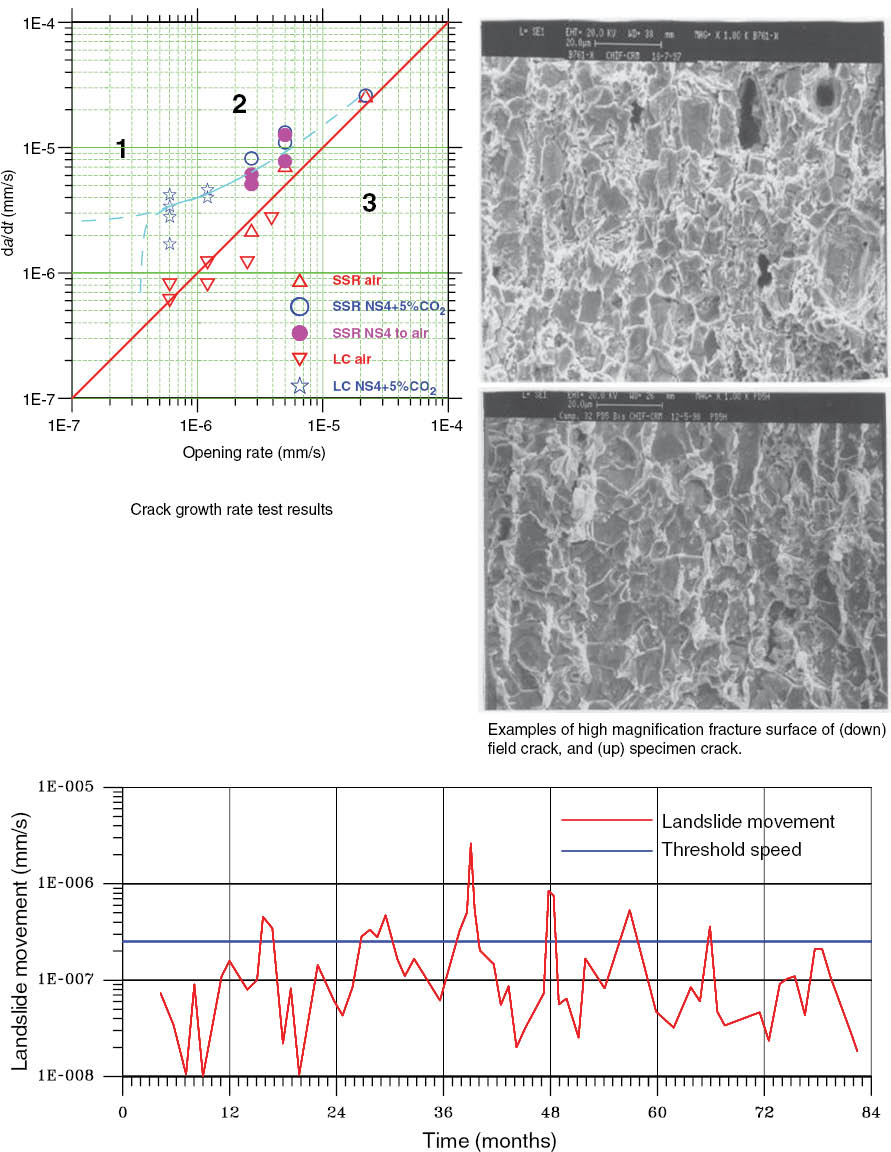
Superposition model for transgranular stress corrosion in pipelines.
Transgranular SCC in pipeline steel can be easily compared with the brittle component of corrosion fatigue. We applied the superposition model to pipeline steel and succeeded in reproducing, in a laboratory sample, the fracture surface observed in the field. However, oil and gas researchers prefer to use the term “near-neutral pH SCC.” In my opinion, this description can cause ambiguity. On the contrary, in that community, transgranular SCC is mainly associated with hydrogen embrittlement, whereas anodic dissolution is associated with intergranular damage and an active path. The two cracking mechanisms are observed in the field, under different conditions, and can be easily differentiated. The discussion on cracking mechanisms is more open in the group of people working in the environmental fatigue of RPV steel (Cullen, Gabetta, & Hänninen, 1985; Shoji, Komai, Abe, & Nakajima, 1986). My participation in the International Cyclic Crack Growth Rate Cooperative Group was a very stimulating experience, and the discussion on the subject (anodic dissolution, hydrogen embrittlement, slip and dissolution, and so on; see Figure 9) is still active and open to debate.
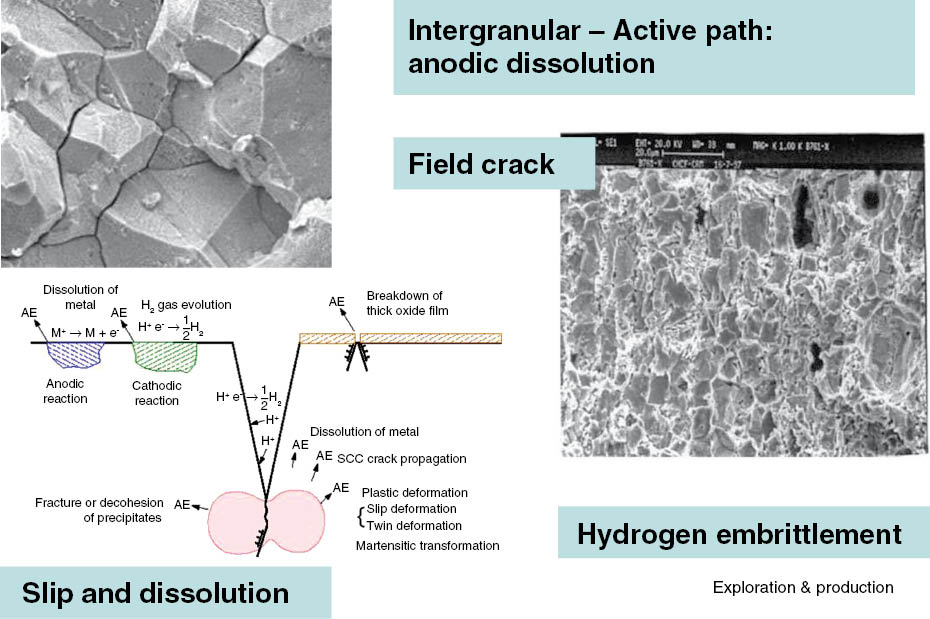
SCC proposed mechanisms.
3 Comments on acronyms and definitions
Damage mechanisms observed in carbon steel in contact with aqueous solutions are usually related to hydrogen-induced cracking and anodic dissolution. However, it seems that names, definitions, and opinions on data interpretation are widely different and depend not only on the observation of phenomena but also on the bias of the scientist who is studying such a problem. Nowadays, the amount of information and the analytical means available to researchers is very large, yet concrete experiments are lacking to clearly separate the damage mechanisms.
In the following, one can see a list of definitions-acronyms about hydrogen embrittlement, stress corrosion, and cracking mechanisms. This list is only partial but contains acronyms not present in the NACE Style Manual (NACE International, 2008) or in the NACE/ASTM G193 Standard (NACE/ASTM G193-12d, 2013).
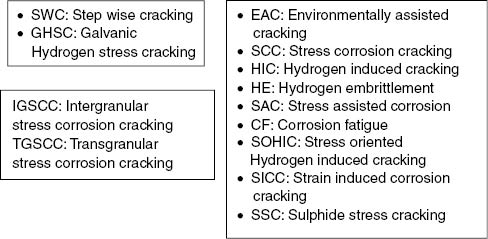
One may suggest that work is needed to distinguish between types of damage and damage mechanisms. Moreover, there is a need for simplification to avoid having too many different and overlapping definitions, which has diluted the damage analysis. As our knowledge increases and with all of the new analytical information that has become available, we develop a deeper understanding of damage mechanisms. However, in going deeper and trying to identify those mechanisms, we tend to lose the site of the damage that occurs in practice and to forget that the goal should be how to avoid damage in service components.
As a concluding remark, I would like to suggest assembling a task force to list all definitions and mechanisms and damage formulas, with the objective of obtaining consensus and promoting the use of a lower number of acronyms with a physical meaning that can be accepted by many. It can be a large task. People with experience in understanding corrosion failures, component design, inspection, etc., should be gathered to address this problem.
About the author

Giovanna Gabetta is a nuclear engineer graduated in 1975. She specialized in Environmentally Assisted Cracking, working about 18 years on Reactor Pressure Vessel Steel (Environmentally Assisted Fatigue). During this time, she cooperated with the International Scientific Community and namely with the International Cyclic Crack Growth rate Cooperative Group. In 2004 she moved to the Italian Oil & Gas company, eni S.p.A. She is the author of more than 150 scientific papers, and has an interest in Knowledge management and Gender studies.
References
Austen IM. Quantitative understanding of corrosion fatigue crack growth behaviour: final report. Commission of European Communities, Technical Steel Research, Brussels, EUR 8560, 1983.Search in Google Scholar
Cullen WH, Gabetta G, Hänninen H. A review of models and mechanisms for environmentally-assisted crack growth of pressure vessel and piping steels in PWR environments. NUREG/CR-4422, December 1985.Search in Google Scholar
Edwards RHA, Schuitemaker P. Determination of crack-tip pH and electrode potential during corrosion fatigue of steel. In: Turnbull A, editor. Paper 21. Corrosion chemistry within pits, crevices and cracks. London: HMSO Books, 1987.Search in Google Scholar
Gabetta G. A method to measure electrochemical potential at the tip of a growing crack during an environmental fatigue test. Fat Fract Engng Mater Struct 1982; 5: 215–220.10.1111/j.1460-2695.1982.tb01248.xSearch in Google Scholar
Gabetta G. The effect of frequency in environmental fatigue tests. Fat Fract Engng Mater Struct 1987; 10: 373–383.10.1111/j.1460-2695.1987.tb00487.xSearch in Google Scholar
Gabetta G, Rizzi R. Electrochemical potential measured at the tip of a growing fatigue crack in demineralized water at 93C: the effect of frequency, wave form and oxygen content. Corros Sci 1983; 23: 613–620.10.1016/0010-938X(83)90122-1Search in Google Scholar
Gabetta G, Torronen K. Prediction of cyclic crack growth rate in LWR environments. In: Cullen WH, editor. Proc. IAEA Specialists Meeting on Subcritical Crack Growth, Sendai, Japan, May 15–17, 1985, USNRC NUREG/CP-0067, April 1986.Search in Google Scholar
Gabetta G, Pozzi D, Rinaldi C. A model for environmentally assisted crack growth rate. In: Lisagor WB, Crooker TW, Leis BN, editors. Environmentally assisted cracking: science and engineering. ASTM STP 1049. Philadelphia: American Society for Testing and Materials, 1990: 117–135.10.1520/STP24070SSearch in Google Scholar
Gabetta G, Rinaldi C, Lucia A. A comparison of two environmentally assisted cracking models, for crack growth rate prediction in a scaled pressure vessel. In: Proceedings of the international conference on pressure vessel technology, Dusseldorf, 1992.Search in Google Scholar
MacDonald DD, Urquidi-MacDonald M. Modeling of electrochemistry of stress corrosion cracks in sensitized type 304 SS in boiling water reactors. Final report SRI Project PYG-4032, October 1988.Search in Google Scholar
NACE International. Publication style manual. Item 36101, 5th ed. revised 2008, Houston, TX: NACE International, Appendix B1.Search in Google Scholar
NACE/ASTM G193-12d. Standard terminology and acronyms relating to corrosion. Item 21137, approved December 1, 2012, published February 2013.Search in Google Scholar
Parkins RN. Mechanisms of stress corrosion cracking. Chap. 8.2. In: Sheir LL, editor. Corrosion. London: Newness-Butterworths, 1963; 8: 27.10.1016/B978-0-08-052351-4.50064-9Search in Google Scholar
Shoji T, Komai K, Abe S, Nakajima H. Mechanistic understanding of environmentally assisted cracking of RPV steels in LWR primary coolants. In: Cullen WH, editor. Proc. IAEA specialists meeting on subcritical crack growth, Sendai, Japan, May 15–17, 1985, USNRC NUREG/CP-0067, April 1986.Search in Google Scholar
Vosikovsky O. Fatigue-crack growth in an X-65 line-pipe steel at low cyclic frequencies in aqueous environments. J Eng Mater Tech Trans ASME 1975; 97: 298–304.10.1115/1.3443302Search in Google Scholar
©2015 by De Gruyter
Articles in the same Issue
- Frontmatter
- In this issue
- Editorial
- International Symposium on Environmental Damage Under Static and Cyclic Loads in Structural Metallic Materials at Ambient Temperatures III (Bergamo, Italy, June 15–20, 2014)
- Overviews and reviews
- U.S. Naval Aviation: operational airframe experience with combined environmental and mechanical loading
- Thirty-five years in environmentally assisted cracking in Italy: a point of view
- Fatigue and corrosion fatigue
- Transgranular corrosion fatigue crack growth in age-hardened Al-Zn-Mg (-Cu) alloys
- Effect of cyclic frequency on fracture mode transitions during corrosion fatigue cracking of an Al-Zn-Mg-Cu alloy
- Crack growth behavior of 4340 steel under corrosion and corrosion fatigue conditions
- Modeling of environmentally assisted fatigue crack growth behavior
- Factors influencing embrittlement and environmental fracture
- Pre-exposure embrittlement of an Al-Cu-Mg alloy, AA2024-T351
- Electrochemical approach to repassivation kinetics of Al alloys: gaining insight into environmentally assisted cracking
- Localized dissolution of grain boundary T1 precipitates in Al-3Cu-2Li
- Grain boundary anodic phases affecting environmental damage
- Defect tolerance under environmentally assisted cracking conditions
- Role of Mo/V carbides in hydrogen embrittlement of tempered martensitic steel
- Stress corrosion cracking
- The role of crack branching in stress corrosion cracking of aluminium alloys
- An atomistically informed energy-based theory of environmentally assisted failure
- Discrete dislocation modeling of stress corrosion cracking in an iron
- Quasi-static behavior of notched Ti-6Al-4V specimens in water-methanol solution
- Role of excessive vacancies in transgranular stress corrosion cracking of pure copper
- Multiscale investigation of stress-corrosion crack propagation mechanisms in oxide glasses
- Hydrogen assisted cracking
- Hydrogen effects on fracture of high-strength steels with different micro-alloying
- Environmentally assisted cracking and hydrogen diffusion in traditional and high-strength pipeline steels
- Multiscale thermodynamic analysis on hydrogen-induced intergranular cracking in an alloy steel with segregated solutes
Articles in the same Issue
- Frontmatter
- In this issue
- Editorial
- International Symposium on Environmental Damage Under Static and Cyclic Loads in Structural Metallic Materials at Ambient Temperatures III (Bergamo, Italy, June 15–20, 2014)
- Overviews and reviews
- U.S. Naval Aviation: operational airframe experience with combined environmental and mechanical loading
- Thirty-five years in environmentally assisted cracking in Italy: a point of view
- Fatigue and corrosion fatigue
- Transgranular corrosion fatigue crack growth in age-hardened Al-Zn-Mg (-Cu) alloys
- Effect of cyclic frequency on fracture mode transitions during corrosion fatigue cracking of an Al-Zn-Mg-Cu alloy
- Crack growth behavior of 4340 steel under corrosion and corrosion fatigue conditions
- Modeling of environmentally assisted fatigue crack growth behavior
- Factors influencing embrittlement and environmental fracture
- Pre-exposure embrittlement of an Al-Cu-Mg alloy, AA2024-T351
- Electrochemical approach to repassivation kinetics of Al alloys: gaining insight into environmentally assisted cracking
- Localized dissolution of grain boundary T1 precipitates in Al-3Cu-2Li
- Grain boundary anodic phases affecting environmental damage
- Defect tolerance under environmentally assisted cracking conditions
- Role of Mo/V carbides in hydrogen embrittlement of tempered martensitic steel
- Stress corrosion cracking
- The role of crack branching in stress corrosion cracking of aluminium alloys
- An atomistically informed energy-based theory of environmentally assisted failure
- Discrete dislocation modeling of stress corrosion cracking in an iron
- Quasi-static behavior of notched Ti-6Al-4V specimens in water-methanol solution
- Role of excessive vacancies in transgranular stress corrosion cracking of pure copper
- Multiscale investigation of stress-corrosion crack propagation mechanisms in oxide glasses
- Hydrogen assisted cracking
- Hydrogen effects on fracture of high-strength steels with different micro-alloying
- Environmentally assisted cracking and hydrogen diffusion in traditional and high-strength pipeline steels
- Multiscale thermodynamic analysis on hydrogen-induced intergranular cracking in an alloy steel with segregated solutes
