Grain boundary anodic phases affecting environmental damage
-
A.K. Vasudevan (PhD in Materials Science) retired from the US Navy during January 2014 and is currently working at Technical Data Analysis, Inc at Falls Church, Virginia, USA. Prior to joining the Navy, he spent about 10 years at ALCOA Research Labs, where he developed high strength aerospace aluminum alloys. During his 25 years in the Navy, he directed research in the areas of bulk nanostructured materials for wear and corrosion applications, piezoelectric materials, molybdenum disilicide materials and fatigue and fracture of Navy structural alloys. He further directed the group to develop a fatigue life prediction model (called UniGrow) that has currently become important in the community. He has over 200 publications, 12 patents and 12 books. He received the Sigma-Xi Award in 1983, ASM George Burgess Award in 2000, ASM Fellow in 2002, Navy Dual-Use Award in 2002, Lifetime FDSM award in 2008 and Henry Marion Howe Gold Medal in 2012.
 and
and
K. Sadananda (PhD in Metallurgy & Materials Engineering) retired from the Naval Research Lab. in 2004 after 30 years as a Section Head of the Deformation and Fracture department. He has made major contributions to the field of dislocation mechanics, high temperature creep of metals, intermetallic and ceramics materials. He has over 250 publications and 10 books. He received the Sigma-Xi award in 1980, ASM George Burgess Award in 1999, ASM Fellow Award in 1999, Lifetime FDSM award in 2004 and Henry Marion Howe award in 2012.

Abstract
Stress corrosion characterization is analyzed in two alloys, 5083 and binary AL-3Li, both having anodic grain boundary precipitates. The 5083 commercial alloy forms AL3Mg2 (β phase), whereas the AL-3Li alloys have ALLi (δ phase). These are intermetallic phases that form on the grain boundaries and grow in size and area fraction with heat treatment time. When exposed to the NaCl solution, they anodically dissolve and form grain boundary cracks under an applied stress. A brief electrochemical description of these phases reacting with NaCl solution is described. The crack initiation occurs when the appropriate local environmental conditions at the crack tip and stress state is established. Overall, crack initiation mechanism seems to be a combination of mostly anodic dissolution coupled with hydrogen-assisted cracking.
1 Introduction
It has been observed that there are two major types of grain boundary (GB) precipitates in most commercial precipitation-hardened alloys that can affect the intergranular stress corrosion behavior in an aqueous solution environment. These are of the type anodic and cathodic precipitates in relation to their respective matrices. Anodic precipitates usually undergo dissolution in preference to their matrix in an aqueous solution due to galvanic currents, whereas cathodic precipitates help their interface and their surrounding matrix to dissolve. These two types of GB precipitates play an important role in stress corrosion cracking initiation (and growth) kinetics, in an aqueous electrolyte medium.
Here, for the sake of analysis, we choose two alloys for the study, both having anodic grain boundary precipitates (GB-ppt). The 5083 alloy (Al-4.5Mg-0.7Mn) is a commercial alloy, and the other is an experimental Al-2.9Li (with 2.7–2.9 Li) binary alloy. The mechanical behavior of these two alloys markedly differ in the inert (considered as lab air) environment, after aging. For example, 5083 alloy shows a constant yield stress (YS) with a small variation in fracture toughness (KIc) with aging time at 175°C. This constancy of YS with aging time is mainly due to the solid solution strengthening of Mg resulting in serrated yielding and Luders band propagation. Fracture toughness is controlled by the second-phase constituent (such as AI6 (Fe, Mn) and AI3Fe) and dispersoid (such as Al20Mn3Cu2 and AI12Mg2Cr) particles in the 5083 alloy. It is not affected by GB-β (β is Al3Mg2). On the other hand, Al-2.9Li alloy shows YS increasing with aging time to a peak value and then decreases with further aging. Thus, aging behavior AL-2.9Li alloy is similar to that of other precipitation hardening alloys such as 7075 and 2024. In the underage (UA) region of this alloy, slip is planar, and in the overage (OA) region, it is wavy. For this alloy, strengthening comes from ordered δ′ (Al3Li) precipitates in the matrix. In contrast to the YS, fracture toughness (Charpy KIc) decreases with aging time in the UA region, reaches a minimum at peakaged (PA), and levels off in the OA region. In the UA region, the fracture is mixed mode (slip+IG) and transitions to completely intergranular fracture (IGF) in the OA region. The IGF is controlled by GB-δ precipitates via GB void nucleation and growth. Given these mechanical property differences in the two alloys, we analyze the fracture behavior in inert (lab air, KIc) and in NaCl (KIscc) solution environments.
The experiments are conducted in a constant 3.5% NaCl solution (for AL-2) and 1% NaCl (for 5083) to evaluate stress corrosion properties such as KIscc as a function of aging time. Selected fracture surface observations are made to describe the failure behavior. The mechanisms for corrosion crack initiation and growth are examined in the light of GB-ppt dissolution versus hydrogen-assisted cracking (HAC). Experimental details of these alloys are described by Gao and Quesnel (2011), Pao, Holtz, Goswami, and Bayles (2013), and Vasudevan and Doherty (1987). However, not all the data with heat treatment time taken from literature match well with electrochemical results. Hence, we have to interpolate to show the general trend on the behavior.
2 General physical/chemical properties
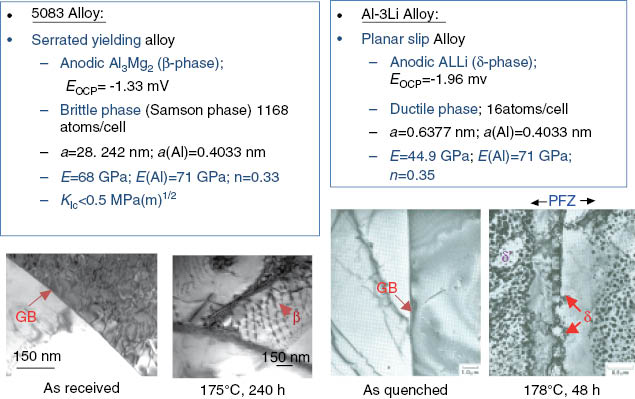
Al-Li binary alloy is a planar slip alloy with an ordered matrix δ′ precipitate, with very low misfit strain with matrix Al, and forms an anodic GB-δ (ALLi) ductile phase at grain boundaries. The δ phase (Uesugi, Takigawa, & Higashi, 2005) is an intermetallic phase with elastic modulus E(δ)=44.9 GPa and ν(δ)=0.35, compared with E(Al)=71 GPa. δ has 16 atoms/cell, with lattice parameter a=0.6477 nm larger than the matrix AL (a=0.4033 nm). This large lattice parameter difference creates interface dislocations around δ making it incoherent. The precipitates are anodic because the open circuit potential (EOCP) of the δ phase is -1.96 V, which is lower compared with that of Al=-0.73 V. EOCP is referred as the potential in an aqueous solution, in which metal surface corrodes freely with no applied driving force. The difference between the EOCP values of an alloy with respect to the Al matrix gives an indication about the anodic or cathodic character of the alloy phases.
In contrast, commercial 5083 is an AL-4.5Mg alloy that undergoes serrated yielding (at low strain rates) giving rise to Luders slip band. This has an anodic GB-β phase (Zielinska-Lipiec, Dubiel, & Czyrska-Filipowicz, 2010) that is brittle because KIc<0.5 MPa·m1/2, E(β)=68 GPa compared with E(Al)=71 GPa. GB-β is called a complex Samson phase with 1168 atoms/cell and a=28.242 nm with respect to (Al)=0.4033 nm. B is an intermetallic Laves phase with EOCP (β)=-1.33 V, which is also lower than matrix AL. Also, the phase has interface dislocations confined to the GB plane (Goswami & Holtz, 2013; Goswami, Spanos, Pao, & Holtz, 2010). It is clear that the corrosion potential of the anodic intermetallic phases is substantially lower than the matrix and is likely responsible for the dissolution of the precipitates.
The corrosion potential data of the various precipitate phases in aluminum alloys was investigated by preparing individual intermetallic phases and measuring their electrochemical properties. A summary of the electrochemical properties was compiled by Buchheit (1995). Table 1 gives a list of properties for the GB β and δ phases.
Physical properties of GB ppts in 5083 and Al-3Li alloys.
 |
3 Materials and methods
The two alloys chosen for the study are 5083 and AL-Li binary alloy with Li content varying from 2.7% to 2.9% Li. These alloys were solution heat treated and aged at 175°C and 177–200°C, respectively, for various aging times to measure YS, KIc in lab air, and KIscc in 1% NaCl (for 5083) and 3.5% NaCl (for Al-2.9Li) solutions. Fracture toughness in lab air was measured using Charpy samples for AL-Li alloys, whereas compact tension (CT) samples were used for 5083. Precracked double cantilever beam (DCB) samples were used to measure KIscc by the load reduction method in NaCl solution. Hence, KIscc is related to long incubation time in the load reduction method compared with a rising load method at low K-rate. Selected fracture surfaces were mapped in SEM to observe the mode of fracture in these environments. Some DCB sample fracture surfaces were contaminated with oxides preventing from clear observation of fracture. In such cases, slow strain rate (SSR) tensile fracture samples in NaCl were used. Mechanical property data are taken from several sources of reference (Gao & Quesnel, 2011; Pao et al., 2013; Sanders, 1980; Sanders & Starke, 1989; Tosca, Christodoulou, & Pickens, 1985; Vasudevan & Doherty, 1987, 1989; Vasudevan, Ludwiczak, Baumann, Doherty, & Kersker, 1985). All the SCC tests were conducted without an applied voltage.
4 Estimation of the area fraction (Af) of GB precipitates
The sensitization heat treatment process in 5083 produces Mg-rich β phase (Al3Mg2) on the grain boundaries as well as at any interior heterogeneous nucleation sites such as constituent and dispersoid particles. The free corrosion potential is made up of an anodic reaction and the reverse cathodic reaction leading to equilibrium at a specific potential (termed as open circuit potential, EOCP), where the number of electrons produced from the anodic reaction equals the number produced from the cathodic reaction, all occurring on the same surface. Mixed potential theory in electrochemistry states that when metals are mixed, both of the metals have their same pairs of processes, but the potential that is observed is due to the anodic branch of the more active metal with the cathodic branch of the more passive metal. The other two branches have their reactions suppressed. Hence, to determine the area fraction of the metals based on the variation in apparent free corrosion potentials, the log of current rather than current density should be plotted. The smooth and well-defined variation in the experimentally determined EOCP together with the aging of these alloys (and hence area fraction beta phase) suggests that such mixed corrosion potential can be applied here. Gao and Quesnel (2011) have explained the causality of using mixed potential theory to estimate the relative area fractions of the regions with different OCPs, when measured separately. Thus, electrochemistry allows a direct measurement of the nonequilibrium area fraction of the β phase based on a rule of mixtures as the precipitation process proceeds with heat treatment time in the 5083 alloy.
Knowing that the open circuit free corrosion potential (Buchheit, 1995) of the matrix phase is approximately -0.73 V (SCE) and the open circuit free corrosion potential of pure β phase is approximately -1.33 V, measurements of the open circuit free corrosion potentials of sensitized alloys represent the growth of the β phase area fraction exposed by preparation of the surface area between these two extremes. Similar to the logic used in mixed potential theory, the free corrosion potential of a system containing area fraction Am of matrix phase and Aβ of the β phase is just the area-weighted average of the potentials of each region,
Naturally, the extreme values from the AL-Mg alloy phase diagram check as expected with a linear dependence of alloy potential on the area fraction of β. Using the fact that Aβ+Am=1, it is possible to estimate the area fraction β, equal to the volume fraction β, because on a two-dimensional cross section created by the crack surface, we can assume that Af ~vol%:
These are estimates because the OCP values can change with experimental conditions and solution concentrations. Transmission electron microscopy (TEM) work (Goswami et al., 2010; Goswami & Holtz, 2013) show β are also nucleated at the interface of the matrix constituent and dispersoid particles, and hence the estimation of the Af of β numbers on the GB could be lower, but the trend in Af versus aging time would be similar. The previously mentioned method of estimating Aβ is described in reference (Gao & Quesnel, 2011).
In AL-2.9Li alloy, the GB-ppt is δ phase (ALLi). Here the δ forms only on the GBs and are not found in the matrix at the second phase of the particle sites. The area fraction of this phase was measured in the SEM using liquid Ga-induced fracture surface after various aging treatments (Vasudevan & Doherty, 1987). This is a direct measurement of area fraction of δ. Here we tried to locate flat areas (with respect to the electron beam) of the GB plane for the measurements required by quantitative metallography. δ Precipitates are sensitive to lab air humidity, and the size can decrease because of its reaction with time of exposure, but the Af would be same.
Figure 1 shows the plot of the estimated Af of and δ as a function of sensitization/aging time on a log-log scale. Af varied linearly with heat treatment time as Af α tn. The trend is similar for both precipitates, with a slope n~0.15. This could be due to similar precipitate growth kinetics. We have included the upper limit vol% calculated by Stumpf (1980) from phase diagrams of Al-Li and Al-Mg (Phillips, 1961) and know the respective densities of pure AL, δ, and β. Phase diagram calculations imply that all the solute Li and Mg in the respective alloys are tied up to form δ and β precipitates, respectively:
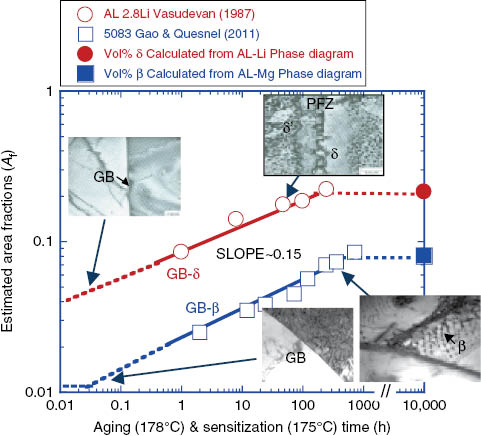
Estimated area fraction of the grain boundary precipitates in AL-3Li (from SEM fracture surface measurements) and 5083 alloys (from electrochemical data) with aging heat treatment; along with selected TEM micrographs.
For AL-2.9Li alloy, at the aging temperature 178°C, the amount of Li in solid solution is approximately 0.05 wt%, which indicates that approximately 2.85 wt% of Li has precipitated. Similarly, for AL-4.5Mg, at 175°C, ~2.5 wt% is in solid solution, indicating that approximately 2.0 wt% of Mg has precipitated. Using Equations 3a and 3b, we can estimate the maximum vol% of δ=21.2% and that of β=8.03% at the heat treatment temperature.
The estimated Af data merge with the phase diagram estimated values as an upper limit. Dotted lines are extrapolations based on available data. Figure 1 also shows that after the solution treatment of the AL-2.9Li alloys, there is no incubation time for the δ precipitates to form on the GBs. This is due to the low formation energy for δ, approximately -23.4 kJ/mol (Kishio & Brittain, 1979, 1981; Sluiter, Watanabe, deFontaine, & Kawazoe, 1996). Hence, the quenching from solution temperature is not fast enough to suppress the precipitation kinetics of δ (and δ′). X-ray analysis (Fuller, 1990; Whitman, 1990) indicates that the Af<0.1 for GB-δ formation in the as-quenched condition. In 5083, the as-quenched alloys do not show any β precipitates forming on the GB. Perhaps it takes longer time to form β precipitates. This is perhaps due to the higher formation energy, approximately +15.7 kJ/mol (Starink & Zahra, 1998), for β. Few TEM micrographs show (in the inserts) the GB-ppts in as quenched condition and after longer aging times in both alloys.
5 General mechanical behavior in inert environment
Figure 2 shows the YS stress variation with aging time for AL-2.9Li and 5083 alloys. AL-2.9Li is an age-hardening alloy (Sanders, 1980; Vasudevan & Doherty, 1987, 1989; Vasudevan et al., 1985) in which ordered δ′ (AL3Li, L12, misfit strain [~-0.08%]) is the strengthening precipitates. The YS increases with aging time at 177°C to a peak strength around aging time of 24 h, and with further aging, the YS decreases. Strengthening occurs because of dislocation cutting δ′ in the UA region giving planar slip and by dislocation bypassing in the OA region yielding wavy slip.
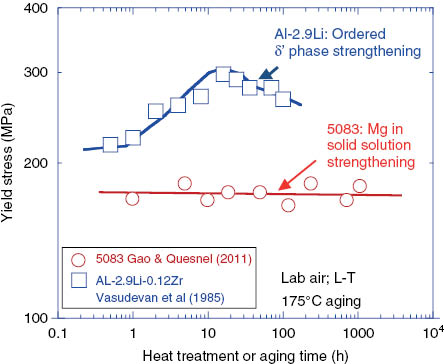
Yield strength variation with aging time for AL-2.9Li and 5083 alloys.
In contrast, 5083 alloy is a solid solution alloy. Mg in solid solution contributes to the YS (Gao & Quesnel, 2011; Pao et al., 2013), and hence it is independent of heat treatment time at 175°C. This is because the %Mg in solid solution at 175°C heat treatment temperature is constant (~2.5 wt%) with time and yields in “strain aging” phenomena.
In both alloys, GB-ppts form during heat treatment, and their size and volume fraction increase with time. However, 5083 alloy does not show any GB precipitate free zones (PFZs) whereas AL-2.9Li alloy shows wide GB-PFZ with aging time.
The PFZs in Al-3Li binary alloy form by a solute Li depletion mechanism, and its growth was described as a solute diffusion-controlled process in α-Al (Jha, Sanders, & Dayananda, 1987), coupled with the δ formation/growth at the GB. Such a PFZ formation is absent in 5083 alloy because no Mg depletion was observed at the GB (Goswami et al., 2010; Uesugi et al., 2005; Zielinska-Lipiec et al., 2010). In addition, the growth of β is due to the collector plate mechanism with Mg diffusing along the lattice and dislocation. The activation energies associated with GB diffusivity in both alloys is nearly the same: 118 kJ/mol for Al-Li alloy (Fugita, Horita, & Langdon, 2004) and 115 kJ/mol for Al-Mg (Fugita et al., 2004). Thus, one can infer that the GB diffusivity for these alloys is not very different. However, GB diffusivity can vary depending on the misorientation angle.
In 5083 alloy (Gao & Quesnel, 2011; Pao et al., 2013), both YS (Figure 2) and fracture toughness KIc (Figure 3A) in the inert (lab air) environment are not affected by the sensitization treatment. As the heat treatment time at 175°C is increased, Af of GB- increase and saturates after approximately 300 h. GB-β is in the form of a platelet (Goswami & Holtz, 2013; Goswami et al., 2010) that grows with time within the GB-plane. GB-β does not seem to take part in the fracture process of 5083 in an inert environment. This could be due to the interfacial energy of β/Al~0.8 J/m2 being similar to the surface energy of Al~0.9 J/m2 (Bernstein, Goswami, & Holtz, 2012). One can only infer that strong β/Al interface can suppress its contribution to fracture (Bernstein et al., 2012), giving rise to dimpled transgranular fracture. The dimpled transgranular fracture in lab air (Figure 3A, insert) indicates that the fracture is of ductile mode and is due to second-phase intermetallic constituents and not from GB-β. Unfortunately, fracture surface that does not show β is being fractured for reasons unknown, although pure β is brittle with KIc<0.5 MPa·m1/2 (Zielinska-Lipiec et al., 2010).
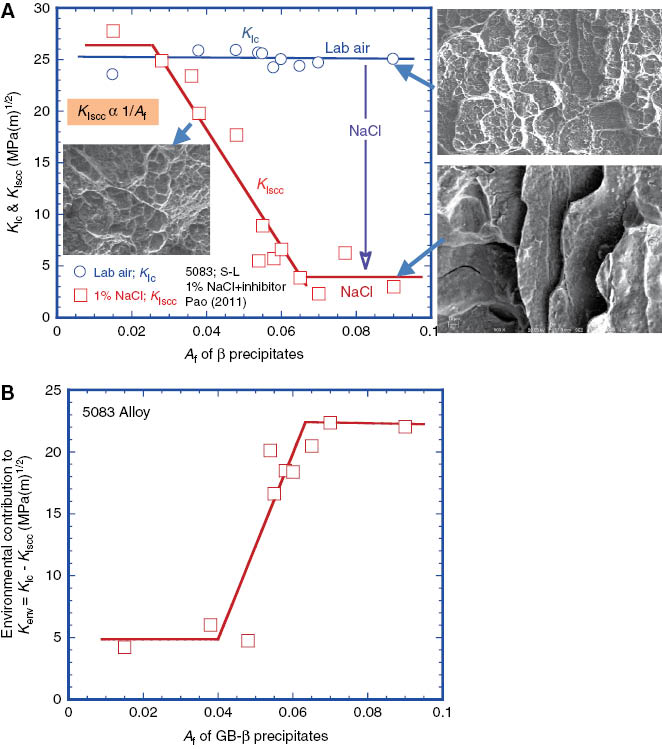
(A) 5083: KIc and KIscc dependence on Af of GB-β along with selected fracture micrographs. In comparison with data from LME for the alloy 7075-T651: KIscc (Hg) ~1.5 MPa·Vm, KIscc (Ga) ~1.7 MPa·Vm. (B) Environmental contribution to stress intensity Kenv variation with Af of β in 5083 alloy.
Fracture toughness KIc in AL-2.9Li alloy (Figure 4A) decreases in the UA region, reaching a minimum at PA, and is unchanged in the OA region. KIc is affected by the GB-δ because of its weak interfacial energy. The interfacial energy of GB-δ/AL~0.5 J/m2 (Fujikawa, Izeki, & Hirano, 1986) was measured and estimated using electrical resistivity method. The electrical resistivity method gives a resistivity combination of both matrix-δ′ and GB-δ phases. The formation of δ will have had a major effect on the resistivity behavior, causing it to fall to much lower values than if only δ′ had been produced during the 200°C aging. Incidentally, the interfacial energy of matrix-δ′ is approximately 0.045 J/m2, significantly lower than the GB-δ phase. Analogously, in low-carbon steels containing sulfide particles, void nucleation and growth fracture are due to the low interfacial energy of sulfide particles (Martin, 1980).
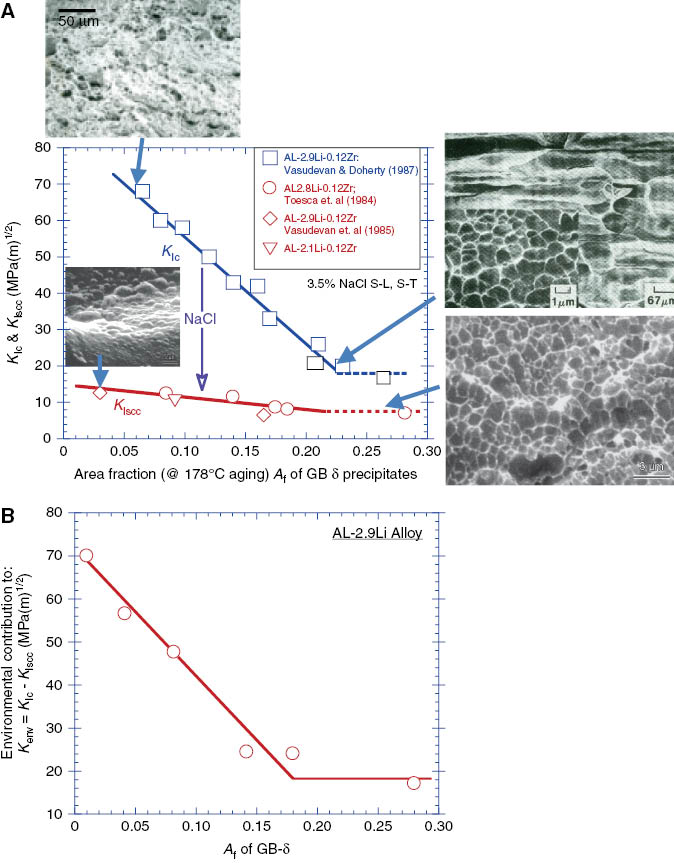
(A) KIc and KIscc variations with Af of GB-δ precipitates in AL-2.9Li alloys along with selected fracture micrographs. (B) Environmental contribution to stress intensity Kenv variation with Af of δ in AL-2.9Li alloy.
In Figures 3A and 4A, KIc is plotted as a function of Af (taken from Figure 2) of the GB precipitates for the two alloys. Figure 3A shows that the KIc in 5083 is independent of Af, whereas in AL-2.9Li (Figure 4A), KIc α 1/Af of the GB precipitates. In the case of AL-2.9Li alloy, GB-δ is an incoherent oblate spheroid that grows in size and number (Af) with aging time. In the early stage of aging where δ is very small in size, the fracture is transgranular. As δ grows in size and Af with aging time, fracture increasingly becomes mixed mode (TG+IG) from severely UA (planar slip) to PA (wavy slip). This mix mode fracture comes partly from the matrix planer slip decohesion in UA and GB-δ. With longer aging time past the PA condition, the fracture is completely along the GB with void nucleation and growth process at the interface of δ. Fracture surfaces at low and higher aging times are shown in the inserts of Figure 4A. One can replot Figures 3A and 4A to see the trend due to the contribution of environment to K. Then K takes the form Kenv=KIc-KIscc, as in Figures 3B and 4B as a function of Af. Here Kenv increases with Af for 5083 (KIc is constant with Af), whereas it decreases for Al-2.9Li alloy (KIc decreases with Af). There is a lower and an upper plateau in Figure 3B. This can be due to the delay in forming enough Af (and size) of β that can dissolve to contribute to a measurable KIscc. The upper plateau is where β is nearly continuous, giving rise to dissolution as Af does not change. Such a trend in Figure 3B is in agreement with incubation time for crack initiation decreasing with Af of β (Gao & Quesnel, 2011). In contrast, Kenv decreases with Af of δ for the Al-2.9Li case (Figure 4B) because the δ formation begins from the stage of as quenched condition. Kenv eventually tends to plateau at higher Af>0.17 of δ. The background decrease in KIc affects the overall fracture in NaCl. This mechanical fracture in the background seems to reduce to environmental effect to a minimum past PA, suggesting that mechanical fracture due to δ is the primary cause and dissolution of δ is the secondary cause. This can be observed on the fracture surface in PA with dimples after exposure to NaCl (insert in Figure 4A) in an SSR sample, where GB-δ has dissolved. At very low Af, the dissolution rate can be severe, and the fracture surface was covered with oxide.
Figure 5 illustrates schematically the GB fracture process of AL-2.9Li alloy for the severely UA and OA cases in lab air. In the UA condition, fracture is mixed with some slip and IG fracture, whereas in the OA case, it is completely IG fracture with GB microvoid and coalescence. The schematic in Figure 5 gives the UA and PA fracture with the corresponding fracture surfaces showing mix mode in the UA and IG voids in PA and OA conditions. One can show a similar trend observed in Figures 3A and 4A if we had plotted KIc versus heat treatment time.
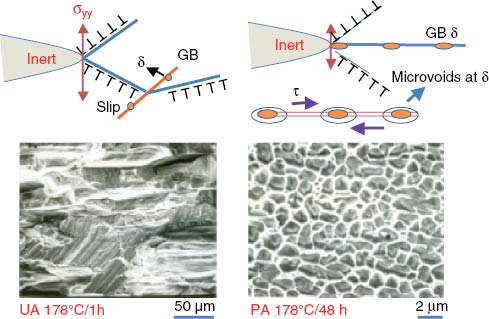
Fracture process in AL-2.9 Li alloys with GB-δ ppts under inert lab air environment. In the UA, fracture surface is mixed TG+IG and in PA (and OA) it is IG.
6 Stress corrosion
When these two alloys are tested under NaCl solution environment, the threshold KIscc behavior with Af of GB precipitates vary significantly from the trend in KIc. This is also shown in Figures 3A and 4A. For comparison, the lab air data are shown.
6.1 5083 alloy
Figure 3A shows the KIscc decreasing with Af of GB-β in 5083 alloy (Pao et al., 2013). There is an upper shelf plateau (here Af of β is very low), and a lower shelf corresponds to when Af has saturated. In between these limits, KIscc α (1/Af). Even in 1% NaCl solution at Af<0.03, the fracture is transgranular similar to that in lab air. At Af>0.06, fracture is completely intergranular. The SEM fracture surfaces are shown in the inserts. In between Af ~0.03–0.06, fracture starts off in mixed mode transitioning to intergranular mode with increasing Af. This trend can be related to the β dissolution in NaCl. At low Af<0.03, where the spacing between β is very large, the alloy is not very sensitive to NaCl environment and KIscc is same as KIc. With increasing Af with heat treatment time, β spacing decreases. Here the fracture mode changes from the mixed mode of IG+TG (at low Af) to the IG mode (at higher Af) due to the β dissolution at GB. Spacing in between β has been interpreted as due to HAC (Crane & Gangloff, 2012; Jones, 2003). This may not be occurring because KIc~KIscc at very low Af of β. This can also be just a transgranular mechanical fracture (Osaki, 1974) due to the applied stress. See insert on Figure 3A at KIscc~20 MPa·m1/2, showing IG with edges tearing. When Af>0.06, the fracture is completely IG and is due to just active path β dissolution, and KIscc reaches a minimum value around 4–5 MPa·m1/2. Inserts show the mode of fracture from TG to completely IG. Interestingly, as a comparison, liquid metal embrittlement (LME) results in 7075-T651 alloy with Hg, and Ga gives similar KIscc, around 1.5–2.0 and 1.7 MPa·m1/2, respectively (Benson & Hoagland, 1989; Chu, Liu, Luo, & Qiao, 1999; Speidel, 1971; Wheeler, Hoagland, & Hirth, 1989). LME thresholds are also comparable with 5083-NaCl KIscc~3 MPa·m1/2 data for heat treatment times longer than 300 h where Af>0.06. KIscc values at longer aging times are still higher than Griffith’s fracture values K (Griffith) ~0.22 MPa·m1/2. Factors that can affect this difference could be the oxide delaying the reaction at the crack tip and the plasticity suppressing brittle fracture. Because β can dissolve without the need of an applied stress, then applied stress can just help in keeping the crack tip open to allow for the access of NaCl electrolyte to allow the galvanic dissolution of β until its solubility limit is reached in NaCl solution, a process similar to LME. Figures 6 and 7 give the schematic description of the mechanism for the two cases, where β is discontinuous (Figure 6 with some finite spacing between ) and continuous (Figure 7 with negligible spacing between β).
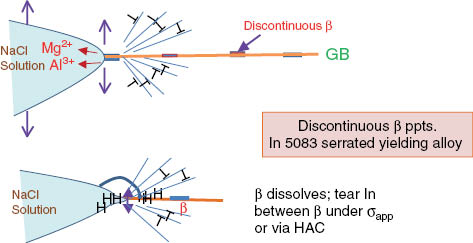
Fracture process in 5083 alloy with discontinuous GB-β In NaCl environment.
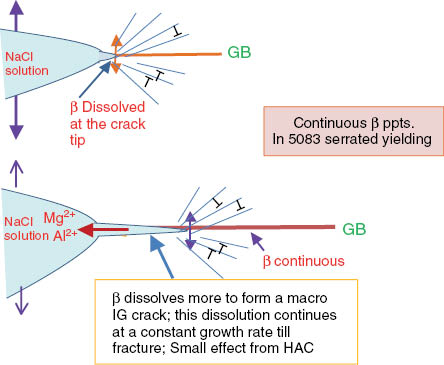
Fracture process in 5083 alloy with continuous GB-β precipitates in NaCl solution.
6.2 AL-Li alloy
Figure 4A compares the SCC behavior of AL-2.9Li with lab air toughness. Here KIc decreases markedly with Af of δ. However, this dramatic effect is weakened in NaCl as KIscc decreases as a function of Af of GB-δ (Sanders & Starke, 1989; Tosca et al., 1985; Vasudevan & Doherty, 1987). The large decrease of KIc with Af is absent in NaCl. However, the loss in magnitude of KIscc at low Af itself is large in relation to KIc. The corresponding fracture surfaces (from SSR expt.) are also shown as inserts (Ricker & Vasudevan, 2003) because the regular fracture surface from CT sample was masked by a very thick oxide. At very low Af, the drop in KIscc from the KIc level is very large, whereas at large Af, the KIc levels off at approximately 20 MPa·m1/2. In this plateau range, the KIscc levels off at a lower level to approximately 10 MPa·m1/2. At low Af~0.02, the details of the fracture surface seem to be masked by reaction products, whereas at higher Af>0.2, the dimples can be seen without δ ppts, as they seem to have dissolved in the NaCl solution. This suggests that deformation and fracture along the interfaces occur first, thereby exposing the δ ppts to dissolve later. In general, being a very reactive element in AL-2.9Li alloy, Li reacts readily with NaCl solution even in the absence of an applied stress. This reaction can produce low crack tip pH (without any GB-δ at very low aging), resulting in producing a large amount of H+ to lower the KIscc significantly below KIc. As GB-δ increase with aging time, δ dissolution will accompany HAC. There a coupled effect of KIc decreases with Af markedly and δ dissolution adds to the overall fracture. At very large Af>0.2, there can be a saturation effect of HAC and dissolution process. Thus, the background KIc helps in initiating to form the crack, allowing NaCl solution to access the crack tip to react with the exposed δ to dissolve and produce H+. This process (dissolution+HAC) continues with increasing Af and saturates at very high Af>0.2, where KIscc becomes constant at a very low value than KIc. KIscc is the limit of slow deformation, where the rate-limiting step is governed by the chemical process of the alloy reacting with NaCl. When the crack tip pH is lowered and the stress is adjusted to a sufficient level, the crack is nucleated to give the threshold KIscc. If this process is due to the dissolving δ to create the nascent H, then less H diffusion is needed as Af increases, and the process kinetics increases. Hence, KIscc is a combined effect from both crack tip chemistry and applied stress. Thus, the reaction with NaCl effect decreases with increasing Af. The reason for a smaller effect of KIscc with Af (compared with 5083 in Figure 3) can be due to the local H concentration formed by the δ dissolution. Because the dissolution process is due to galvanic effect of the GB-ppt with NaCl in both alloys, we will now examine the electrochemistry involved in the process.
7 Electrochemistry
If the chemistry within the crack tip region reaches a critical condition because of the reactions between the β phase and the NaCl solution, then the crack can form intergranularly. This depends on the size and Af of the β phase. A hypothetical sketch of the development of critical local chemistry during crack initiation period when β reacts with NaCl is illustrated in Figure 8, which results in a decreasing pH (~3) at the crack tip.
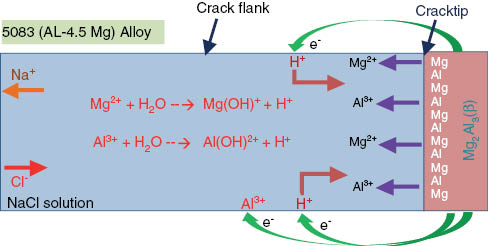
Chemical reactions in NaCl solution of 5083 alloy.
Al3+ ions from dissolving β phase can participate in the cathodic reaction:
the Mg2+ ion can dissociate the H2O to release H+:
The β phase on the grain boundaries is polarized to higher values than the breakdown potential, which would then lead to the rapid dissolution of the precipitates. The dissolution of the precipitates leads to the generation of the Al3+ and Mg2+ ions, which hydrolyze subsequently leading to a low pH environment at the GB, setting up conditions for crack nucleation/propagation along the GB. Thus, after the dissolution of β, H+ is released from the hydrolysis reaction of Mg3+ with water.
E OCP corrosion potential of 5083 is influenced by the degree of sensitization time. As this time increases, EOCP decreases monotonically from -722 to -751 mV. Because the EOCP potential of pure β phase in 3.5% NaCl is lower than Al, -1330 versus -730 mV (Buchheit, 1995; Jain, Lim, Hudson, & Scully, 2012; Searle, Gouma, & Buchheit, 2001) (Figure 10), this decrease in EOCP for longer sensitization time can be attributed to an increase in the amount of the β phase exposed on GBs. This implies that the electrochemical anodicity of sensitized 5083 alloy increases with the amount of the β phase and thus with sensitization time. Breakdown potential is insensitive to sensitization time (Jain et al., 2012), suggesting that the passive film stability is not affected.
At longer heat treatment times, the β phase becomes continuous along the GB and is expected to be more susceptible than that in the as-received condition. With the continuous precipitation of the β phase along the GB, β dissolves rapidly and can lead to rapid crack nucleation/propagation. Thus, at heat treatment times greater than approximately 300 h, the selective anodic dissolution of β is the major process of failure. At lower heat treatment times, the β phase is discontinuous, and the dissolution of the β phase will occur discontinuously along the GB. The local chemistry established by this discontinuous β could cause lower dissolution rate in between the β-free region along the boundary because it is not likely to be polarized anodically to the rest of the matrix. Thus, the β dissolution mechanism largely accounts for the SCC observation in Figure 3A and B.
Figure 9 schematically describes the reaction of GB-δ in AL-2.9Li alloy with NaCl solution. Electrochemical tests in NaCl solution on AL-2.9Li alloys show that OCP is nearly constant in the UA region (OCP changed from -990 to -1023 mV) up to 80 h of aging and then dramatically decreases (from -1023 to -1374 mV) in the OA region. The alloy may be showing general corrosion in the UA region along with δ dissolving. This is observed as surface reaction is severe in the UA region (see insert in Figure 3A). Also, in the UA region, the alloy undergoes planar slip that can react with NaCl solution to give slip line dissolution (Chen & Duquette, 1992). In the OA region, the alloy is becoming more active as the aging time increases (or Af of GB-δ increases) and OCP is reduced severely. At longer aging times, beyond PA, the OA region enhanced the anodic dissolution of δ as noted by increased OCP (Chen & Duquette, 1992; Niskanen, Sanders, Rinker, & Marek, 1982). Thus, the corrosion resistance of the alloy was reduced with the increasing aging time because of the presence of increased Af of active δ (Figure 10). The pitting potential of the alloy was not sensitive to aging (Chen & Duquette, 1992; Niskanen et al., 1982), suggesting that passive film stability is not affected. Figure 9 describes the basic galvanic reactions of δ-ppt with NaCl solution. Both β and δ phases show similar electrochemical behavior in NaCl solution.
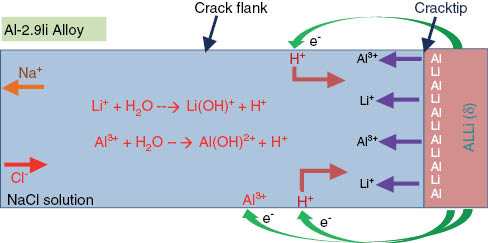
Chemical reactions in NaCl solution of AL-2.9Li alloy.
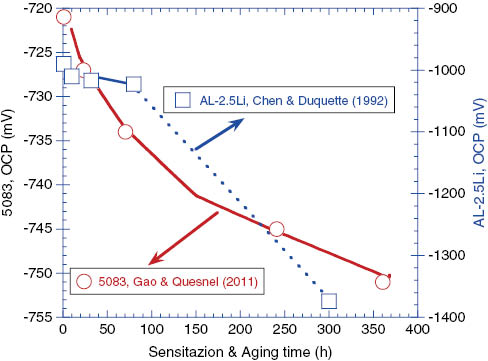
OCP variation with heat treatment time for 5083 and AL-2.5Li alloys.
Figure 10 indicates that in the early stages of heat treatment, the 5083 alloy seems to be more anodic in general relative to AL-2.9Li. Figure 11 shows that KIscc decreases with EOCP for both 5083 and AL-2.9Li alloys, with a large decrease in 5083 mainly due to β dissolution and a modest decrease in AL-2.9Li alloy due to the dissolution of δ and possibly slip dissolution and the background KIc. One can note that the changes in OCP for 5083 I are much smaller (~-30 mV) compared with AL-Li (~-320 mV). Other factors such as size and shape of δ versus β could also play a role in the rate of dissolution, interfacial energy, and H+ generation. The EOCP values for pure β and δ are also shown on the plot. The overall mechanism could be GB-ppt dissolution coupled with HAC.
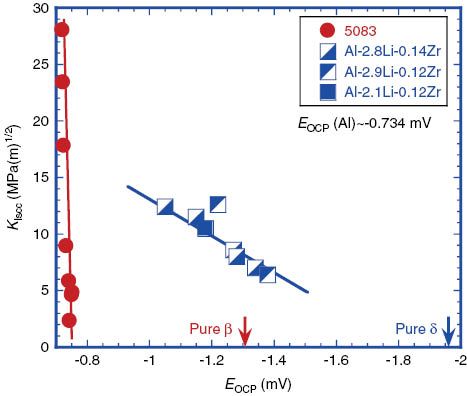
K Iscc variation with OCP for 5083 and AL-2.9Li alloys.
These anodic reactive phases (β and δ) with respect to the matrix (cathode) allow the net rate of chemical reaction to occur (Figures 8 and 9), and this is observed to be related to the Af of these phases. The rate of chemical reaction determines the rate of pH change at the crack tip. As pH becomes more acidic, it provides the crack tip pH and potential to stimulate H+ production that can drive the cathode reaction to consume the electrons and create more H+, which diffuse into the crack tip deformation region of the alloy. This consumption of the electrons drives the dissolution of the anodic phases. These anodic phases have both AL3+ ion and Mg2+(from β) and Li+ (from δ) ions, which hydrolyze to dissociate H2O to create more H+. Thus, HAC can occur in the regions of the GB with no phases to give rise to brittle fracture. This means the overall SCC behavior is probably a combined effect of anodic dissolution and HAC, although it is difficult to separate them. Fracture surfaces are not very discernable as it is covered by oxides.
8 Summary
The following list gives a few salient points from the analysis of the SCC behavior of the two alloys. Interestingly, most of the available data in the literature were concerned with crack growth than initiation. The lack of connection between electrochemistry and KIscc and good matching fracture surface analysis makes it difficult to analyze the results.
Binary planar slip AL-Li alloy
In an inert (lab air) environment, matrix δ′ affects YS over the entire aging curve. Dislocations cut the coherent δ′ below PA (planar slip region), and the YS increases from as quenched (AQ) to PA. Past the PA, in the OA region, YS decreases due to dislocations bypassing the incoherent δ′.
The Af of GB-δ ppts strongly affects the static fracture toughness in lab air and KIc α (1/Af) below PA (UA region), whereas in the OA region, KIc is independent of Af. This is due to the weak δ/matrix interface resulting in GB void nucleation/growth.
The static fracture in lab air shows dimple fracture surface in the AQ condition, slip line fracture with IG voids at intermediate aging times, and complete IG with voids in the OA region.
Stress corrosion fracture initiation KIscc is mostly due to the dissolution of δ (assisted by HAC) with a weak dependence on Af of δ below PA and KIscc α (1/Af). In the AQ condition, fracture surface is masked by Li-oxide showing strong reaction with NaCl. At very low Af, the fracture mostly consists of some slip fracture and IG, and at high Af, the SCC fracture is completely IG and the fracture surface seems to maintain the dimples without δ, suggesting that deformation preceded before δ dissolution. NaCl has a large effect on KIscc when the Af is very low, and this environmental effect decreases as Af is increasing with aging time. These alloys being chemically very active are prone to pitting. Overall, the KIscc mechanism is affected by the background KIc of the alloy at Af<0.17. The environmental contribution to SCC is mostly due to the dissolution of δ at high Af>0.17.
Commercial 5083 solid solution (serrated yielding) alloy
GB-β ppts do not affect YS as well as KIc in lab air. Mg in solid solution affects the YS and is constant with sensitizing time because the amount of Mg at the 175°C temperature is constant.
In NaCl environment, there are three regions of SCC behavior. Environmental effect on KIscc increases, with increasing Af, to reach a minimum plateau value of approximately 4–5 MPa·m1/2. This value is close to the LME threshold observed in 7075-T651 alloy with Hg or Ga, and the dissolution of β mechanism is similar to that of LME.
At very low Af of β, near the unsensitized condition, SCC is negligible because KIc=KIscc. This also suggests HAC is negligible and the failure is mechanical with minimal effect from NaCl.
At low sensitization times from approximately 5 h–300 h, where β is discontinuously precipitated, failure is mixed with mechanical tearing (in the β free regions) and dissolution of β, as observed on the fracture surface. In this region, KIscc α (1/Af).
At longer heat treatment times greater than 300 h, failure is mostly due to the anodic dissolution of GB- (similar to LME), and KIscc is independent of Af. The Af of GB ppts δ and β shows an inverse relationship with KIscc=C/Af.
C=300 (lab air) and C=50 (NaCl) for AL-2.9Li.
C=0 (lab air) and C=60 (NaCl) for 5083 alloy (the unit of C is MPa·m1/2 per unit Af of GB precipitates).
The large differences in slopes of KIc, KIscc versus Af, can in part be due to the differences in the background fracture behavior in lab air and dissolution (in NaCl) kinetics affected by the interface strength of δ and β and their electrochemical behavior.
Environmental contribution to SCC, Kenv=KIc-KIscc, increases with Af of β for 5083 and decreases with Af of δ for AL-2.9Li alloy.
EOCP decreased with heat treatment time for both the alloys with negligible changes in pitting corrosion. KIscc also varied inversely with EOCP for both alloys as KIscc α (1/EOCP) because of the differences in the electrochemical properties of δ and β, their size and Af, and their interfacial energies. How these parameters affect the electrochemistry and crack initiation is not clear.
About the authors
A.K. Vasudevan (PhD in Materials Science) retired from the US Navy during January 2014 and is currently working at Technical Data Analysis, Inc at Falls Church, Virginia, USA. Prior to joining the Navy, he spent about 10 years at ALCOA Research Labs, where he developed high strength aerospace aluminum alloys. During his 25 years in the Navy, he directed research in the areas of bulk nanostructured materials for wear and corrosion applications, piezoelectric materials, molybdenum disilicide materials and fatigue and fracture of Navy structural alloys. He further directed the group to develop a fatigue life prediction model (called UniGrow) that has currently become important in the community. He has over 200 publications, 12 patents and 12 books. He received the Sigma-Xi Award in 1983, ASM George Burgess Award in 2000, ASM Fellow in 2002, Navy Dual-Use Award in 2002, Lifetime FDSM award in 2008 and Henry Marion Howe Gold Medal in 2012.
K. Sadananda (PhD in Metallurgy & Materials Engineering) retired from the Naval Research Lab. in 2004 after 30 years as a Section Head of the Deformation and Fracture department. He has made major contributions to the field of dislocation mechanics, high temperature creep of metals, intermetallic and ceramics materials. He has over 250 publications and 10 books. He received the Sigma-Xi award in 1980, ASM George Burgess Award in 1999, ASM Fellow Award in 1999, Lifetime FDSM award in 2004 and Henry Marion Howe award in 2012.
Acknowledgments
The authors thank Dr. T. Ramgopal (DNV Labs, Ohio) and Prof. R.P. Gangloff (University of Virginia) and Prof. D.J. Quesnel (University of Rochester) for helpful discussions on electrochemistry. AKV would like to dedicate this article to all the technicians at ALCOA Labs. They were the best people the author has worked with at ALCOA Labs during the 1980s.
References
Benson BA, Hoagland RG. Crack growth behavior in high strength aluminum alloy during LME by gallium. Scr Metal 1989; 23: 1945–1948.10.1016/0036-9748(89)90487-0Search in Google Scholar
Bernstein N, Goswami R, Holtz RL. Surface and interface energies of complex crustal structure AL-Mg alloys. Metal Mater Trans 2012; 43A: 2166–2176.10.1007/s11661-011-1061-9Search in Google Scholar
Buchheit RA. A compilation of corrosion potentials reported for intermetallic phases in AL-alloys. J Electrochem Soc 1995; 142: 3994–3996.10.1149/1.2048447Search in Google Scholar
Chen GS, Duquette DJ. Corrosion fatigue of precipitation-hardened AL-Li-Zr alloy in a 0.5M sodium chloride solution. Met Trans 1992; 23A: 1563–1572.10.1007/BF02647338Search in Google Scholar
Chu WY, Liu XM, Luo JL, Qiao LJ. Mechanism of embrittlement of AL-alloy by liquid metal Ga. Can Metall Quart 1999; 38: 127–132.10.1179/cmq.1999.38.2.127Search in Google Scholar
Crane CB, Gangloff RP. DoD Corrosion Conference Proceedings, 2011, NACE International, Houston, TX, 2012, Paper #20175.Search in Google Scholar
Fugita T, Horita Z, Langdon TG. Using grain boundary engineering to evaluate the diffusion characteristics in ultrafine grained AL-Mg and AL-Zn alloys. Mater Sci Eng 2004; 371A: 241–250.10.1016/j.msea.2003.12.042Search in Google Scholar
Fujikawa S, Izeki Y, Hirano K. Determination of equilibrium solute content in matrix, precipitate-matrix interfacial energy and effective diffusivity in AL-Li alloys using coarsening data alone for δ′ precipitates. Scr Metal 1986; 20: 1275–1280.10.1016/0036-9748(86)90048-7Search in Google Scholar
Fuller SJ. An examination of the as-quenched and early aging characteristics of AL-4.1Li binary alloy by X-ray examination. MS thesis. California: Naval Postgraduate School, June 1990.Search in Google Scholar
Gao J, Quesnel DJ. Enhancement of the stress corrosion sensitivity of AA5083 by heat treatment. Met Trans 2011; 42A: 356–364.10.1007/s11661-010-0375-3Search in Google Scholar
Goswami R, Holtz RL. TEM investigations of grain boundary β-phase precipitation in AL-5083 aged at 373K. Metal Mater Trans 2013; 44A: 1279–1289.10.1007/s11661-012-1166-9Search in Google Scholar
Goswami R, Spanos G, Pao PS, Holtz RL. Precipitation behavior of the ß phase in Al-5083. Mater Sci Eng 2010; A527: 1089–1095.10.1016/j.msea.2009.10.007Search in Google Scholar
Jain S, Lim MLC, Hudson JL, Scully JR. Spreading on intergranular corrosion on the surface of sensitized AL-4.4Mg alloys: a general finding. Corrosion Sci 2012; 59: 136–147.10.1016/j.corsci.2012.02.018Search in Google Scholar
Jha S, Sanders Jr TH, Dayananda MA. Grain boundary precipitate free zones in AL-Li alloys. Acta Metall 1987; 35: 473–482.10.1016/0001-6160(87)90253-7Search in Google Scholar
Jones RH. The influence of hydrogen on the stress corrosion cracking of low strength AL-Mg alloys. J Metals 2003; 55: 42–46.10.1007/s11837-003-0225-5Search in Google Scholar
Kishio K, Brittain JO. Defect structure of β-LiAl. J Phys Chem Solids 1979; 40: 933–840.10.1016/0022-3697(79)90121-5Search in Google Scholar
Kishio K, Brittain JO. Phase stability of doped β-LiAl. Mater Sci Eng 1981; 49: 1–6.10.1016/0025-5416(81)90144-0Search in Google Scholar
Martin JW. Micromechanisms in particle-hardened alloys. Chapter 3. Cambridge Solid State Science Series. Cambridge University Press, Cambridge, UK, 1980.Search in Google Scholar
Niskanen P, Sanders Jr TH, Rinker JG, Marek M (1982). Corrosion of aluminum alloys containing lithium. Corrosion Sci 22: 283–304.10.1016/0010-938X(82)90031-2Search in Google Scholar
Osaki S. Stress Corrosion cracking of Al-5Mg(5083) alloy. Tech. report. Yamaguchi University, July 23, 1974: 347–358.Search in Google Scholar
Pao PS, Holtz RL, Goswami R, Bayles RA. Effect of sensitization on corrosion-fatigue cracking in 5083 alloy. NRL Report/MR/6355–14-9581, 2013.Search in Google Scholar
Phillips HWL. Institute of Metals Monograph-25, UK, December 1961.Search in Google Scholar
Ricker RE, Vasudevan AK. The influence of grain boundary precipitation of stress corrosion cracking of AL-Li and AL-Li-Cu alloys. In: Moody NR, Thompson AW, Ricker RE, Was GW, Jones RH, editors. Hydrogen effects on materials behavior and corrosion deformation interactions. Warrendale, PA: TMS, 2003: 927–935.Search in Google Scholar
Sanders Jr TH. Aluminum-Lithium Alloys Conference Proceedings, Stone Mountain, Georgia, 1980.Search in Google Scholar
Sanders Jr TH, Starke Jr EA. Aluminum-lithium alloys V (AIME). The Metallurgical Society of AIME, Warrendale, PA, 1989.Search in Google Scholar
Searle JL, Gouma PI, Buchheit RG. Stress corrosion cracking of sensitized AA5083 (Al-4.5Mg-1.0Mn). Met Trans 2001; 32A: 2859–2867.10.1007/s11661-001-1036-3Search in Google Scholar
Sluiter MHF, Watanabe Y, deFontaine D, Kawazoe Y. First principle calculation of phase equilibria in AL-Li system. Phys Rev B 1996; 53: 6137–6151.10.1103/PhysRevB.53.6137Search in Google Scholar
Speidel MO. Theory of stress corrosion cracking in alloys. In: Scully JC, editor. NATO Conference Proceedings, 1971: 289–344.Search in Google Scholar
Starink MJ, Zahra AM. β′ and β precipitation in an AL-Mg alloy studied by DSC and TEM. Acta Mater 1998; 46: 3381–3397.10.1016/S1359-6454(98)00053-6Search in Google Scholar
Stumpf HC. ALCOA Labs, 1980 (deceased).Search in Google Scholar
Tosca SG, Christodoulou L, Pickens JR. Stress corrosion cracking of an AL-2.7Li-0.1Zr alloy. In: Barret P, Dufour LC, editors. Reactivity of solids. Elsevier Science Publishers B.V., Amsterdam, The Netherlands, 1985: 223–227.Search in Google Scholar
Uesugi T, Takigawa Y, Higashi K. Elastic constants of AL-Li from first principles. Mater Trans 2005; 46(6): 1117–1121.10.2320/matertrans.46.1117Search in Google Scholar
Vasudevan AK, Doherty RD. Grain boundary ductile fracture in precipitation hardened aluminum alloys. Overview-58. Acta Metall 1987; 35: 1193–1219.10.1016/0001-6160(87)90001-0Search in Google Scholar
Vasudevan AK, Doherty RD. Aluminum alloys – contemporary research and applications. Treatise on materials science and technology. Volume 31. New York: Academic Press, 1989.Search in Google Scholar
Vasudevan AK, Ludwiczak EA, Baumann SF, Doherty RD, Kersker MM. Fracture behavior in AL-Li alloys: role of grain boundary δ. Mater Sci Eng 1985; 72: L25–L30.10.1016/0025-5416(85)90165-XSearch in Google Scholar
Wheeler DA, Hoagland RG, Hirth JP. Evidence of crack tip oxidation effects during the LME of AA-7075 aluminum alloy by Hg. Corros Sci 1989; 45: 207–212.10.5006/1.3577843Search in Google Scholar
Whitman CE. An examination of δ′-growth in AL-LI alloy by X-ray diffraction. MS thesis, Naval Postgraduate School, California, March 1990.Search in Google Scholar
Zielinska-Lipiec A, Dubiel B, Czyrska-Filipowicz A. Microstructure of the complex metallic β-Al3Mg2 phase. Inzynieria Materialowa 2010; 31: 562–564.Search in Google Scholar
©2015 by De Gruyter
Articles in the same Issue
- Frontmatter
- In this issue
- Editorial
- International Symposium on Environmental Damage Under Static and Cyclic Loads in Structural Metallic Materials at Ambient Temperatures III (Bergamo, Italy, June 15–20, 2014)
- Overviews and reviews
- U.S. Naval Aviation: operational airframe experience with combined environmental and mechanical loading
- Thirty-five years in environmentally assisted cracking in Italy: a point of view
- Fatigue and corrosion fatigue
- Transgranular corrosion fatigue crack growth in age-hardened Al-Zn-Mg (-Cu) alloys
- Effect of cyclic frequency on fracture mode transitions during corrosion fatigue cracking of an Al-Zn-Mg-Cu alloy
- Crack growth behavior of 4340 steel under corrosion and corrosion fatigue conditions
- Modeling of environmentally assisted fatigue crack growth behavior
- Factors influencing embrittlement and environmental fracture
- Pre-exposure embrittlement of an Al-Cu-Mg alloy, AA2024-T351
- Electrochemical approach to repassivation kinetics of Al alloys: gaining insight into environmentally assisted cracking
- Localized dissolution of grain boundary T1 precipitates in Al-3Cu-2Li
- Grain boundary anodic phases affecting environmental damage
- Defect tolerance under environmentally assisted cracking conditions
- Role of Mo/V carbides in hydrogen embrittlement of tempered martensitic steel
- Stress corrosion cracking
- The role of crack branching in stress corrosion cracking of aluminium alloys
- An atomistically informed energy-based theory of environmentally assisted failure
- Discrete dislocation modeling of stress corrosion cracking in an iron
- Quasi-static behavior of notched Ti-6Al-4V specimens in water-methanol solution
- Role of excessive vacancies in transgranular stress corrosion cracking of pure copper
- Multiscale investigation of stress-corrosion crack propagation mechanisms in oxide glasses
- Hydrogen assisted cracking
- Hydrogen effects on fracture of high-strength steels with different micro-alloying
- Environmentally assisted cracking and hydrogen diffusion in traditional and high-strength pipeline steels
- Multiscale thermodynamic analysis on hydrogen-induced intergranular cracking in an alloy steel with segregated solutes
Articles in the same Issue
- Frontmatter
- In this issue
- Editorial
- International Symposium on Environmental Damage Under Static and Cyclic Loads in Structural Metallic Materials at Ambient Temperatures III (Bergamo, Italy, June 15–20, 2014)
- Overviews and reviews
- U.S. Naval Aviation: operational airframe experience with combined environmental and mechanical loading
- Thirty-five years in environmentally assisted cracking in Italy: a point of view
- Fatigue and corrosion fatigue
- Transgranular corrosion fatigue crack growth in age-hardened Al-Zn-Mg (-Cu) alloys
- Effect of cyclic frequency on fracture mode transitions during corrosion fatigue cracking of an Al-Zn-Mg-Cu alloy
- Crack growth behavior of 4340 steel under corrosion and corrosion fatigue conditions
- Modeling of environmentally assisted fatigue crack growth behavior
- Factors influencing embrittlement and environmental fracture
- Pre-exposure embrittlement of an Al-Cu-Mg alloy, AA2024-T351
- Electrochemical approach to repassivation kinetics of Al alloys: gaining insight into environmentally assisted cracking
- Localized dissolution of grain boundary T1 precipitates in Al-3Cu-2Li
- Grain boundary anodic phases affecting environmental damage
- Defect tolerance under environmentally assisted cracking conditions
- Role of Mo/V carbides in hydrogen embrittlement of tempered martensitic steel
- Stress corrosion cracking
- The role of crack branching in stress corrosion cracking of aluminium alloys
- An atomistically informed energy-based theory of environmentally assisted failure
- Discrete dislocation modeling of stress corrosion cracking in an iron
- Quasi-static behavior of notched Ti-6Al-4V specimens in water-methanol solution
- Role of excessive vacancies in transgranular stress corrosion cracking of pure copper
- Multiscale investigation of stress-corrosion crack propagation mechanisms in oxide glasses
- Hydrogen assisted cracking
- Hydrogen effects on fracture of high-strength steels with different micro-alloying
- Environmentally assisted cracking and hydrogen diffusion in traditional and high-strength pipeline steels
- Multiscale thermodynamic analysis on hydrogen-induced intergranular cracking in an alloy steel with segregated solutes
