
Quasi-static behavior of notched Ti-6Al-4V specimens in water-methanol solution
-
Sergio Baragetti
Sergio Baragetti is a full Professor of Machine Design and Computational Mechanics at the Università degli Studi di Bergamo in Italy. He graduated with a MSc degree in mechanical engineering in 1994 from Politecnico di Milano and PhD in quality engineering in 1998 from Università di Firenze. His research activities include numerical and experimental study of the effects induced by surface treatments on the fatigue behavior of mechanical components, the study of the corrosion fatigue mechanisms in aqueous environments, and the study of the surface thin hard coatings effects on the fatigue, contact fatigue, and corrosion fatigue behavior of mechanical components. He performed several component and structure analyses, including the evaluation of the limit load for hydraulic actuators; the evaluation of fatigue resistance for innovative railway undercarriages; the study and optimization of conical threaded connections for oil applications; the design of devices for fatigue tests, crankshafts and connecting rods, components for lifting appliances, and highly accelerated inert vibrating screening units; and the probabilistic analysis of components and structures. He is the director of the GITT Centre on Innovation Management and Technology Transfer of the University of Bergamo.
 ,
Riccardo Gerosa
,
Riccardo Gerosa
Riccardo Gerosa has been an Assistant Professor of Metallurgy at Politecnico di Milano since 2008. From 2003 to 2006, he was a PhD student at Politecnico di Torino, studying the mechanical and physical properties of large steel blooms for plastic molding, focusing on fracture mechanics aspects. From 2006 to 2007, he worked on a project (funded by Höganäs AB, Höganäs, Sweden) on crack propagation in sintered steels, and from 2007 to 2008, he worked on a research funded by ABB Sace (Lenno, Como, Italy) on crack propagation and SCC of stainless steels for high-precision pressure transducers. His experimental activity ranges from primary fabrication to heat treatment optimization, from traditional to advanced characterization of ferrous and non-ferrous alloys, and from the analysis of coatings and surface treatments to the mechanical and toughness properties of traditional and sintered steels. His didactic activity deals with metallurgy and its mechanical aspects; he is currently teaching applied metallurgy (Lecco Campus) and metallurgy and non-metallic materials (Bovisa Campus) at Politecnico di Milano.
Francesco Villa is has been a PhD candidate in Mechanical Engineering at the University of Bergamo since 2013, where he is also a teaching assistant in machine design and computational mechanics courses. He graduated in 2012 at the Politecnico di Milano with a MSc in aeronautical engineering. He is currently focusing his studies on the experimental characterization of fatigue behavior of mechanical components and materials, including corrosion fatigue and quasi-static corrosion mechanisms on light alloys in aqueous mixtures. He is also studying fatigue behavior of thin hard coatings on light alloys and their properties in aggressive environments. He is developing numerical models for materials characterization and fracture mechanics as well as FE modeling for structural design.

Abstract
The adoption of Ti-6Al-4V titanium alloy is widespread in advanced engineering fields, such as the aerospace, automotive, and maritime sectors, due to its remarkable mechanical characteristics and proven corrosion resistance. However, literature studies and field failures have underlined that the Ti-6Al-4V is susceptible to the stress corrosion cracking (SCC) and the corrosion fatigue phenomena in methanol-water solutions. Although several studies focused on the SCC behavior of this particular titanium alloy, recent corrosion fatigue experiments (R=0.1) on Ti-6Al-4V specimens in a water-methanol environment have highlighted a sensible decrease in maximum applied stress of up to 50% and a high sensitivity even to low methanol concentrations. In the present work, an experimental quasi-static SCC test campaign in water-methanol mixture at different concentrations has been conducted on flat dogbone Ti-6Al-4V specimens. The results have been compared with recent corrosion fatigue experiments to characterize the different damage mechanisms at play and decouple mechanical and chemical driving forces. The micromechanical behavior of the material has been analyzed, highlighting the role of the microstructure in the SCC mechanism. Failure surfaces have been investigated with scanning electron and optical microscopy.
1 Introduction
Currently, the Ti-6Al-4V titanium alloy is used for a vast range of applications, due to its outstanding mechanical and corrosion resistance characteristics. Use of this lightweight material is common in the aerospace, automotive, and nautical fields, especially for advanced structural design, due to its high strength-to-mass ratio, as reported by Lütjering and Williams (2007). This alloy is adopted in critical, highly stressed lightweight parts, such as structural components for jet fighters and commercial liners. These application include compressor blades, disks in jet engines that are exposed to temperatures up to ~315°C (according to Boyer, 1996), and high-cycle fatigue-stressed turbine components (as investigated by Lanning, Haritos, & Nicholas, 1999; Lanning, Nicholas, & Haritos, 2005). It is also widely employed in landing gears and other common structural components such as fuselage, nacelles, wing, and empennage frames, as reported by Boyer (1996) and Ritchie et al. (1999). For this reason, its fatigue properties have been studied in high detail, both in air and in corrosive environments, by Sadananda, Vasudevan and colleagues (Lee, Vasudevan, & Sadananda, 2005; Sadananda & Vasudevan, 2005; Sadananda, Sarkar, Kujawski, & Vasudevan, 2009). Owing to its good corrosion properties, which are mainly derived from the ability to spontaneously form a stable, protective, strongly adherent oxide film in air and water environments, and its subsequent enhanced biocompatibility, the Ti-6Al-4V alloy is also widely adopted in the biomedical sector, as indicated by Dimah, Devesa Albeza, Amigó Borrás, and Igual Muñoz (2012) and Niinomi (1998). Another application field of the Ti-6Al-4V alloy is the energy sector, for the realization of geothermal plants and hydrocarbon wells, as reported by Schutz and Watkins (1998), and its properties have been studied for different chemical, industrial, and marine environments by Gurrappa (2003).
As already mentioned, the corrosion resistance of titanium alloys is granted, despite the high reactivity of titanium as a pure element, by the formation of a titanium dioxide (TiO2) external layer, which typically assures passivity in the presence of an oxidizing environment, as recognized in the works of Aladjem (1973) and Dimah et al. (2012). The effectiveness of this external oxide film can, however, be reduced by the presence of surface defects, such as sharp notches or cracks, or applied stresses, as found by Brown (1972) and Trasatti and Sivieri (2005). The TiO2 layer can be also removed by external mechanical stress or abrasive actions, thus leading to corrosion sensitivity of titanium alloys. Indeed, the presence of stress corrosion cracking (SCC) effects in water mixtures and other media for certain titanium alloys under surface defects and mechanical actions has been already pointed out in several research studies, i.e. in the works by Brown (1972), Pilchak, Young, and Williams (2010), Sanderson and Scully (1968), Sanderson, Powell, and Scully (1968), and Trasatti and Sivieri (2005).
The most dramatic SCC and corrosion fatigue behavior was found during the experimental testing of the Ti-6Al-4V fuel tanks of the Apollo spacecraft, as reported by Johnson (1967) and Johnston, Johnson, Glenn, and Castner (1967). During these tests, in which pure methanol was adopted as a reference corrosive fluid, a dramatic reduction of the time to failure for static pressurization and of the maximum number of cycles for repeated pressure loads was found, as summarized in Table 1.
Static and fatigue results on loaded titanium pressure vessels (from Johnston et al., 1967).
| Environment | Static tests |
Fatigue tests |
||
|---|---|---|---|---|
| Pressure (MPa) | Failure time (min) | Pressure (MPa) | Cycles to failure | |
| Air | 827 | >4463 | 48–965 | 1385 |
| Methanol | 827 | 17 | 48–965 | 86 |
Similar results involving the stress corrosion behavior of Ti-6Al-4V alloy were also found by Chen, Kirkpatrick, and Gegel (1972) in mixtures of water, methanol, and 0.166 wt% HCl, at different methanol concentrations. From these results, the authors concluded that for Ti-6Al-4V specimens in water, methanol, and 0.166 wt% HCl, an amount of water higher than 0.05% was necessary to initiate SCC, with the maximum SCC effect in terms of dramatic decrease of time to failure being found at 0.3–0.6% water concentration, with minimum fracture times of <5 h. For water concentrations >1%, the SCC behavior moved towards the same results obtained in air, where no failure was observed. According to Chen et al. (1972), this effect was caused by the formation of passive oxide films, which interferes with crack initiation and propagation.
In another research work by Sanderson and Scully (1968) on Ti-6Al-4V U-bend specimens immersed in reagent-grade methanol and methanol+1.13 wt% HCl with an overall water content of 0.083 vol%, they found fracture times of 30 h for reagent-grade methanol and <1 h for methanol+HCl, with transgranular cracking of the α+β-alloy across the α-phase. In the specimens tested in the methanol+HCl mixture, detachment of the protective oxide was found initially near the stress-loaded SCC cracks, increasing to a wider region before fracture. The authors reported that amount of water needed in a methanol+HCl solution to prevent cracking was near 1.5%.
Concerning corrosion fatigue, no known tests on Ti-6Al-4V in methanol water mixtures have been reported prior to recent works carried out by Baragetti (2013, 2014), Baragetti, Cavalleri, and Tordini (2011), and Lee et al. (2005), apart from the pressure tank cyclic testing of the Apollo missions reported by Johnson (1967) and Johnston et al. (1967). In a recent work on corrosion, involving step-loading axial fatigue testing (R=0.1) of Kt=1.18 flat dogbone Ti-6Al-4V specimens, several corrosion fatigue tests in a water-methanol mixture at different concentrations were performed. The results showed a dramatic decrease in fatigue performance, even for very low methanol concentrations, from a -24% σmax drop at 5-wt% methanol concentration up to a -56% σmax reduction for a 95-wt% methanol concentration, in terms of the 200,000-cycle fatigue strength limit.
2 Materials and methods
The Ti-6Al-4V flat dogbone specimens were machined from a raw laminated plate of 6.35 mm (0.25 in) initial thickness, according to the geometry shown in Figure 1. The stress concentration factor, caused by a 30-mm radius notch, has been determined by finite element (FE) analysis, with the plane stress linear elastic model shown in Figure 2, leading to a value of Kt=1.18. The chemical composition of the base material has been reported in Table 2. The base material’s mechanical properties were measured along the direction perpendicular to the plate rolling direction, coincident with the final load application direction, and resulted in UTS=1100 MPa and YS=1050 MPa. The raw material has been processed according to a solution treatment and overaging (STOA) cycle, consisting of a 1-h solution treatment at 925°C for 1 h, followed by a 2-h overaging at 700°C. The specimens were then machined from the plate and subsequently treated for stress relief. The mechanical properties, as determined by tensile tests on the load application direction after the STOA process, were UTS=990 MPa and YS=945 MPa, and the material hardness was 350 HV. The microstructure of the alloy is shown in Figure 3, after polishing and etching, resulting in an α+β bimodal microstructure.
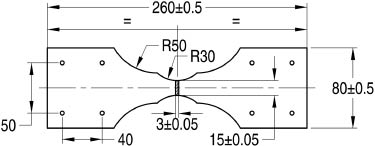
Specimen geometry from Baragetti, Gerosa, and Villa (2013).
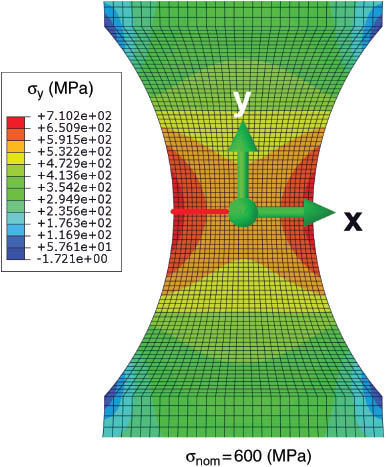
FE model for the determination of Kt at σnom=600 MPa applied load on linear elastic model from Baragetti et al. (2013).
Chemical composition and mechanical characterization of the base Ti-6Al-4V material from Baragetti et al. (2013).
| Al (%) | V (%) | Fe (%) | O (%) | C (%) | Ti (%) |
|---|---|---|---|---|---|
| 5.97 | 4.07 | 0.20 | 0.19 | 0.03 | Bal. |
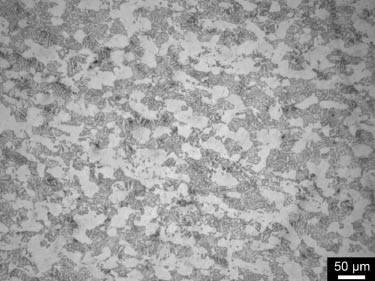
The α+β microstructure of the Ti-6Al-4V alloy after the STOA treatment.
The specimens were mounted in a frame that has been specifically designed for quasi-static SCC testing, consisting of a threaded rod support linked to two spherical hinge grips, to reduce parasite bending moments due to misalignments during specimen mounting. The load was applied by a nut on the threaded rod and measured using an in-line load cell. The test section of the specimens was constantly immersed in a water-methanol solution during the load application. Strain gages were mounted on both the specimens’ sides to ensure a negligible parasite bending moment during the mounting phase and the load application. A picture of the test setup is presented in Figure 4.
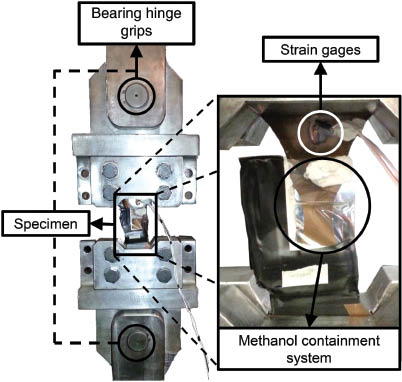
Quasi-static SCC test setup, with details of the methanol-water containment and the applied strain gages (Baragetti et al., 2013).
The methanol-water solution was prepared with the help of a precision scale, ensuring the correct weight percent concentration. The tested concentrations were 25, 50, 75, 85, 90, 92.5, 95, 97.5, and 99.8 wt%. The solution was changed every test day to ensure that no variation in the composition due to water or methanol evaporation could influence the test conditions. For each concentration, a step-loading quasi-static corrosion test was performed. The specimen, with its test section completely immersed in the mixture, was stressed at a given load for approximately 1 h, then a Δσ=5 MPa increment in terms of nominal stress was imposed to the specimen by tightening the terminal nut of the threaded rod-supporting frame, starting from an initial nominal load of 650 MPa. Each load increase was performed slowly and carefully to prevent dynamic effects and to control the applied load as well as possible. The mean strain rate value was
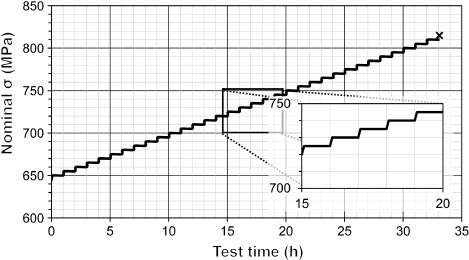
Load history for a single-concentration SCC test.
The specimens were tested until failure was achieved, with complete fracture of the sample in the test section. The obtained fracture surfaces were then analyzed using scanning electron microscopy (SEM) to characterize the failure mechanism with respect to the environment. Crack propagation rate measurement was not achieved, even if optical microscopy measurement, replica method, or the adoption of a crack gage will be considered for future studies. The reconstruction of the crack growth rate in different environments could be useful to assess the impact of the material’s microstructure and of the aggressive media on environmentally assisted crack propagation.
3 Results and discussion
3.1 Experimental results
By looking at the results shown in Figure 6, in terms of nominal test area maximum failure stress, it is possible to notice that methanol contribution becomes critical for concentrations higher than 90 wt%. After this point, the maximum quasi-static SCC strength shows a steep linear decrease, which leads to a -25% fall in terms of maximum nominal stress for the highest methanol concentration tested, i.e. reagent-grade, higher than 99.8 wt%.
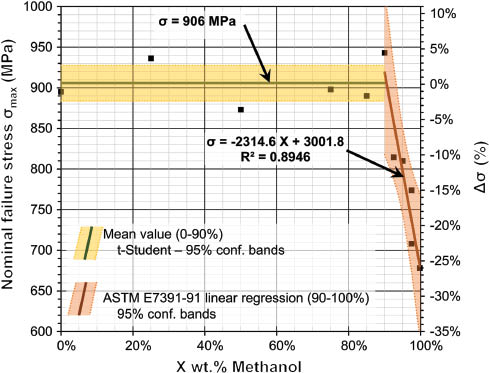
Experimental results for the different quasi-static SCC tests, in terms of nominal maximum stress σmax, at different methanol weight percent concentrations (Baragetti & Villa, 2014).
The performance decrease can be related to the interaction of the methanol solution with the protective titanium oxide layer. From literature evidence, it has been postulated that the presence of methanol inhibits the formation of the passive film because it reacts with titanium, resulting in a non-protective titanium methoxide, according to the reactions described by Sanderson and Scully (1968). Water addition to dry methanol represents an extremely effective and practical way to protect titanium alloys from the SCC. The presence of sufficient water in methanol, in fact, promotes full repassivation, as reported by ASM International (2005). The experimental tests described in this article showed that the minimum water content to prevent mechanical performance loss is ~7.5%, even if the minimum required value in ASM International technical literature is lower (~3%).
The broken specimens were studied by SEM and light optical microscopes (LOM) to understand the failure mechanisms and explain this phenomenon. Metallographic cross sections were taken along a plane parallel to the fracture surface, and after polishing and etching, they were observed by LOM. Metallographic analysis highlighted an α-enriched layer, ~60 μm thick, all around the external surface of the sample, as can be seen in Figure 7. A microhardness profile was carried out on the sample tested with 97.5 and 92.5 wt% methanol solution, resulting in very high values, especially close to the surface, as shown in Figure 8.
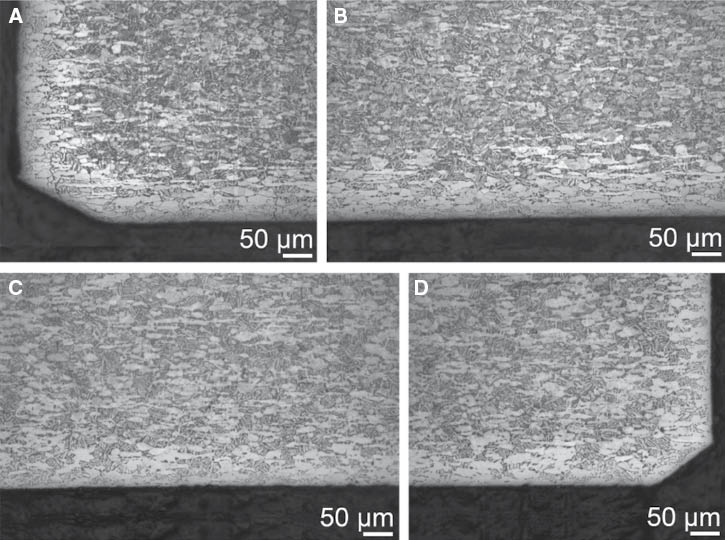
The α-case observed on the samples’ microstructure near the fracture surface.
(A) 92.5 wt% near fracture initiation edge, (B) 92.5 wt% external edge, (C) 97.5 wt% external edge, and (D) 97.5 wt% near fracture initiation edge.
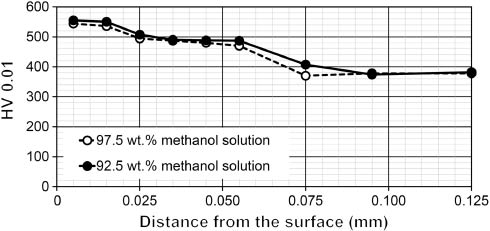
Microhardness profile focused on the α-case layer.
The microhardness values in the bimodal microstructure (distance from the surface higher than ~60 μm) refer to the α-grains.
As known in the literature, the α-case can be generated by oxygen absorption at high temperatures (for example, during a heat treatment), and it is generally hard and brittle, as reported by Dong, Li, and Wang (2013). The presence of the α-case can promote the premature nucleation of small cracks and defects, which can increase the SCC sensitivity, as widely reported by Brown (1972) and Trasatti and Sivieri (2005). Some of the fracture surfaces were observed by SEM. In Figures 9–11, the fracture surfaces of the samples tested in laboratory air and methanol solutions with concentrations equal to 90% and 99.8%, respectively, are shown.
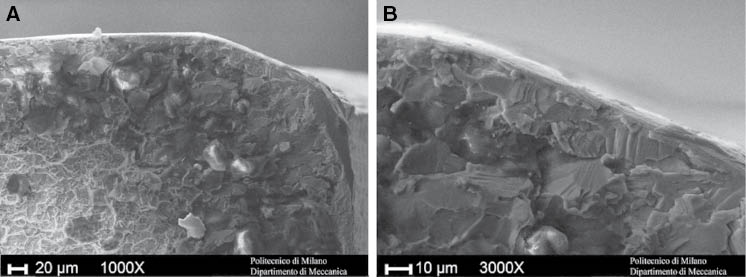
SEM observation of the sample tested in laboratory air near the crack initiation region.
(A) 1000× and (B) 3000×.
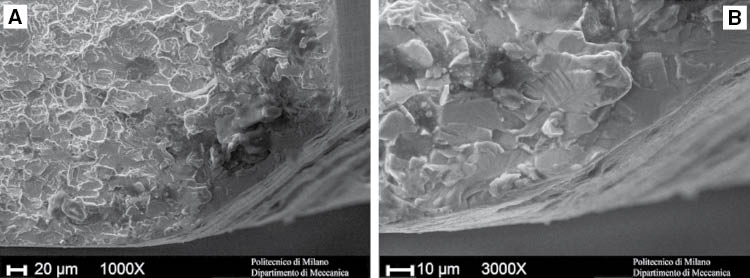
SEM observation of the sample tested in 90% methanol solution near the crack initiation region.
(A) 1000× and (B) 3000×.
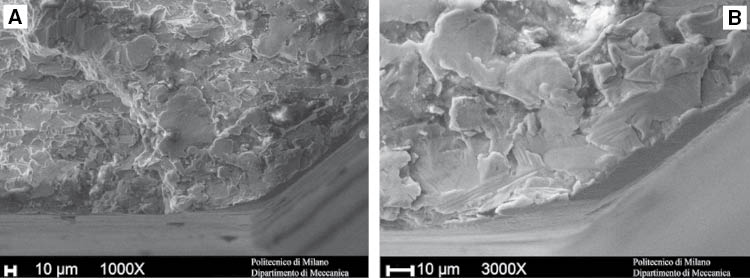
SEM observation of the sample tested in 99.8% methanol solution near the crack initiation region
(A) 1000× and (B) 3000×.
The fracture surfaces show a transgranular propagation close to the outer surfaces, mainly concentrated in the α-enriched layer. After this region, the ductile features appear. The influence of the aggressive solution is obvious, especially in the 99.8% sample, where the fracture close to the outer surfaces seems to be “smoothed”, probably because of the corrosion phenomenon. Even if the fracture surfaces show similar features, the detrimental effects of the methanol solution is clear if considering the loads the samples were tested at: the solution with 99.8% methanol concentration, for example, led to fracture with an applied stress of ~25% less with respect to the laboratory air test.
Further analysis was carried out, focusing on the samples’ outer surfaces. Microcracks, perpendicular to the load application direction, were observed within the α-enriched layer, as shown in Figure 12.
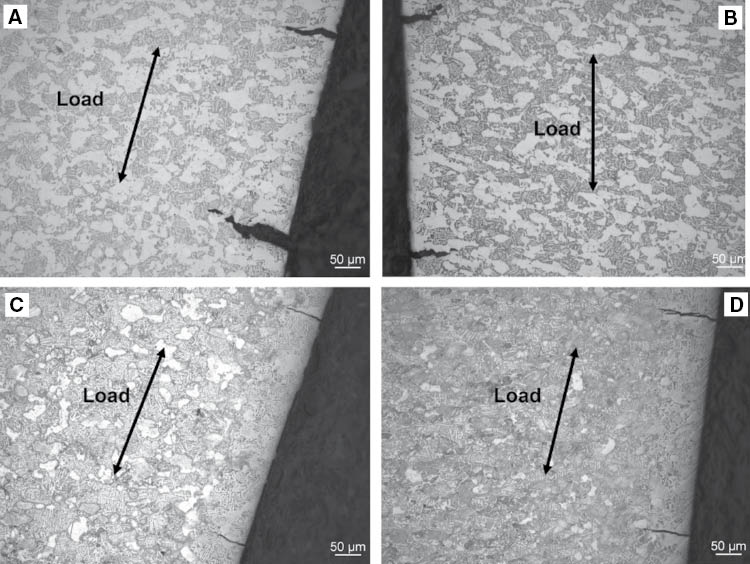
LOM observation of the sample.
Tested in (A) laboratory air and (B) 50%, (C) 95%, and (D) 99.8% methanol solutions.
The crack lengths are similar, but they are associated with very different loads; the samples tested in the 95% and 99.8% methanol solution, for example, failed with stresses, respectively, 15% and 25% less than the laboratory air and 50% methanol solution specimens. Furthermore, it has been shown in literature that, from a corrosion point of view, the presence of an α-enriched layer can result in a decrease in SCC resistance, as found by Polmear (2005). Full understanding of the α-case contribution involves further study of its effects on the oxide layer adherence and strength, to assess the role of its presence in crack nucleation, although some useful remarks can be obtained from the present work. The contribution in terms of crack propagation rate and environmental effects at the interface between the α-layer and the bulk surface must be investigated as well.
Another possible influence on the test results could be found in the reduced oxygenation of the methanol water solution, as seen from the test setup in Figure 4, being detrimental to TiO2 layer repassivation even in the presence of sufficient amount of water, as reported by Aladjem (1973). Indeed, the methanol containment system was sealed to prevent methanol evaporation. Solution recirculation could likely improve the passivation phenomenon, promoting the beneficial effect of water additions to the solution.
In summary, the reduced water passivation effect found in the present study, with respect to literature evidence, could hence be motivated by two testing variables: primarily, the presence of an α-layer and its reported cracking at high applied stresses; furthermore, the reduced oxygenation of the methanol water solution.
3.2 Comparison with corrosion fatigue
Figure 13 reports the chemical contribution in terms of maximum stress drop from the mechanical limit of the material. To decouple the environmental effect in terms of limiting stress decrease, the chemical driving forces have been isolated by measuring the chemical drop Δσchem obtained as a function of the methanol weight percent concentration, according to the relations reported by Figure 13. The reference mechanical limiting stresses, achieved by repeating the tests in laboratory air, are σmech,F,2e5=528 MPa, for the alternating (R=0.1) fatigue tests at 200,000 cycles, and σmech,QS=906 MPa, for the quasi-static loading procedure, as reported in Figure 6.
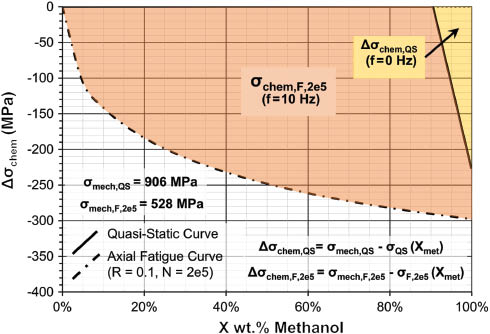
Comparison between the limiting stress chemical drop Δσchem from the corrosion fatigue tests at 200,000 cycles – 10 Hz from Baragetti (2013) and the quasi-static SCC behavior at 0 Hz.
From the data of Figure 13, it can be observed that the chemical influence on Ti-6Al-4V strength varies profoundly with different loading conditions. In particular, fatigue loading dramatically extends the influence field of the environment to low-methanol-concentration mixtures. This phenomenon could be related as well to the mechanical disruption of the TiO2 protective layer caused by the more demanding fatigue loads, especially at the crack tip. This aspect must be taken into account when designing fatigue-stressed Ti-6Al-4V components for low-concentration aggressive environments, particularly concerning water-methanol mixtures, which are used also as fuel addictive in jet engines, according to Soares (2008), and injected in hydrocarbon wells, as reported by Schutz and Watkins (1998). In the fatigue case, the well-established SCC assumption that low water contents can inhibit the corrosive behavior by oxide passivation, as mentioned by ASM International (2005), Chen et al. (1972), and Sanderson and Scully (1968), must be taken with extreme care.
4 Conclusions
In the present work, a quasi-static SCC test campaign was conducted over STOA notched Ti-6Al-4V (Kt=1.18) specimens, dunked in a methanol-water mixture at different weight percent concentrations. The material was characterized by tensile tests, microindentation tests, fracture surface SEM observation, and optical investigation of the microstructure. The microindentation tests and microstructural observations revealed an α-case layer, ~60 μm thick, on the external surface of the specimen, just below the oxide layer.
The quasi-static load test results showed marked SCC influence of the methanol-water mixture, starting from a maximum strength drop of -25% for the reagent-grade (≥99.8%) methanol solution and decreasing linearly by water addition, up to a 92.5-wt% methanol concentration. For water content higher than 7.5 wt%, no effect of the environment is found anymore, and the specimen tested at 90 wt% methanol concentration failed at a stress level comparable to air tests. The presence of the brittle α-case, combined with the effects of the high applied load in the terminal test phases, could explain the relatively high 7.5-wt% water concentration passivation value. The cracking of the α-case on the external surface was indeed assessed by optical microscopy of the metallographic cross sections for all the failed tested concentrations at their corresponding maximum stress values. The SEM observation on the fracture surface of the Ti-6Al-4V specimens that failed at high methanol concentrations show a clear environmental effect in the proximity of the crack nucleation region, thus corroborating the experimental stress data.
The comparison of the quasi-static SCC data with the corrosion fatigue data on the same material, environment and geometry, STOA notched Ti-6Al-4V specimens, Kt=1.18, in water-methanol mixture presented by Baragetti (2013), revealed a substantial difference in the corrosion mechanisms between the two loading cases. In particular, the fatigue corrosion mechanism shows a remarkable influence of the aggressive environment even for low concentrations of methanol, in contrast with the quasi-static loading. This aspect could be linked with the mechanical effects on the external TiO2 protective layer as well as with the passivation mechanisms near the crack propagation front. Further investigation on these aspects and new experimental testing on a wider spectrum of fatigue loading condition (different frequencies, fatigue life limits, and R values) are needed to understand the interaction between the mechanical and the chemical effects for Ti-6Al-4V alloy in such aggressive environments.
About the authors

Sergio Baragetti is a full Professor of Machine Design and Computational Mechanics at the Università degli Studi di Bergamo in Italy. He graduated with a MSc degree in mechanical engineering in 1994 from Politecnico di Milano and PhD in quality engineering in 1998 from Università di Firenze. His research activities include numerical and experimental study of the effects induced by surface treatments on the fatigue behavior of mechanical components, the study of the corrosion fatigue mechanisms in aqueous environments, and the study of the surface thin hard coatings effects on the fatigue, contact fatigue, and corrosion fatigue behavior of mechanical components. He performed several component and structure analyses, including the evaluation of the limit load for hydraulic actuators; the evaluation of fatigue resistance for innovative railway undercarriages; the study and optimization of conical threaded connections for oil applications; the design of devices for fatigue tests, crankshafts and connecting rods, components for lifting appliances, and highly accelerated inert vibrating screening units; and the probabilistic analysis of components and structures. He is the director of the GITT Centre on Innovation Management and Technology Transfer of the University of Bergamo.

Riccardo Gerosa has been an Assistant Professor of Metallurgy at Politecnico di Milano since 2008. From 2003 to 2006, he was a PhD student at Politecnico di Torino, studying the mechanical and physical properties of large steel blooms for plastic molding, focusing on fracture mechanics aspects. From 2006 to 2007, he worked on a project (funded by Höganäs AB, Höganäs, Sweden) on crack propagation in sintered steels, and from 2007 to 2008, he worked on a research funded by ABB Sace (Lenno, Como, Italy) on crack propagation and SCC of stainless steels for high-precision pressure transducers. His experimental activity ranges from primary fabrication to heat treatment optimization, from traditional to advanced characterization of ferrous and non-ferrous alloys, and from the analysis of coatings and surface treatments to the mechanical and toughness properties of traditional and sintered steels. His didactic activity deals with metallurgy and its mechanical aspects; he is currently teaching applied metallurgy (Lecco Campus) and metallurgy and non-metallic materials (Bovisa Campus) at Politecnico di Milano.

Francesco Villa is has been a PhD candidate in Mechanical Engineering at the University of Bergamo since 2013, where he is also a teaching assistant in machine design and computational mechanics courses. He graduated in 2012 at the Politecnico di Milano with a MSc in aeronautical engineering. He is currently focusing his studies on the experimental characterization of fatigue behavior of mechanical components and materials, including corrosion fatigue and quasi-static corrosion mechanisms on light alloys in aqueous mixtures. He is also studying fatigue behavior of thin hard coatings on light alloys and their properties in aggressive environments. He is developing numerical models for materials characterization and fracture mechanics as well as FE modeling for structural design.
Acknowledgments
The authors thank Prof. Dr. A.K. Vasudevan of the Office of Naval Research, US Navy (retired), for the discussion and the precious advice.
References
Aladjem A. Anodic oxidation of titanium and its alloys. J Mater Sci 1973; 8: 688–704.10.1007/BF00561225Suche in Google Scholar
ASM International. Corrosion of titanium and titanium alloys. In: Corrosion: materials, vol. 13B. ASM handbook, ASM International, 2005.Suche in Google Scholar
Baragetti S. Corrosion fatigue behaviour of Ti-6Al-4V in methanol environment. Surf Interface Anal 2013; 45: 1654–1658.10.1002/sia.5203Suche in Google Scholar
Baragetti S. Notch corrosion fatigue behavior of Ti-6Al-4V. Materials 2014; 7: 4349–4366.10.3390/ma7064349Suche in Google Scholar PubMed PubMed Central
Baragetti S, Villa F. SCC and corrosion fatigue characterization of a Ti-6Al-4V alloy in a corrosive environment – experiments and numerical models. Frattura ed Integrità Strutturale 2014; 30: 84–94.10.3221/IGF-ESIS.30.12Suche in Google Scholar
Baragetti S, Cavalleri S, Tordini F. Fatigue behavior of notched Ti-6Al-4V in air and corrosive environment. Procedia Eng 2011; 10: 2435–2440.10.1016/j.proeng.2011.04.401Suche in Google Scholar
Baragetti S, Gerosa R, Villa F. Comportamento quasi-statico di provini intagliati in lega Ti-6Al-4V in metanolo. In: AIAS 2013, 42nd National Conference Salerno. Padova: Padova University Press, 2013.Suche in Google Scholar
Boyer RR. An overview on the use of titanium in the aerospace industry. Mater Sci Eng A 1996; 213: 103–114.10.1016/0921-5093(96)10233-1Suche in Google Scholar
Brown B. Stress corrosion cracking in high strength steels and in titanium and aluminum alloys. Washington, DC: Naval Research Laboratory, 1972.Suche in Google Scholar
Chen C, Kirkpatrick H, Gegel H. Stress corrosion cracking of titanium alloys in methanolic and other media. Wright-Patterson AFB, OH: Air Force Materials Laboratory, 1972.Suche in Google Scholar
Dimah MK, Devesa Albeza F, Amigó Borrás V, Igual Muñoz A. Study of the biotribocorrosion behaviour of titanium biomedical alloys in simulated body fluids by electrochemical techniques. Wear 2012; 294–295: 409–418.10.1016/j.wear.2012.04.014Suche in Google Scholar
Dong J, Li F, Wang C. Micromechanical behavior study of α phase with different morphologies of Ti-6Al-4V alloy by microindentation. Mater Sci Eng A 2013; 580: 105–113.10.1016/j.msea.2013.05.032Suche in Google Scholar
Gurrappa I. Characterization of titanium alloy Ti-6Al-4V for chemical, marine and industrial applications. Mater Charact 2003; 51: 131–139.10.1016/j.matchar.2003.10.006Suche in Google Scholar
Johnson RE. NASA experiences with Ti-6Al-4V in methanol. DMIC memorandum 228. Columbus, OH: Battelle Memorial Institute, 1967.Suche in Google Scholar
Johnston RL, Johnson RE, Glenn M, Castner WL. Stress-corrosion cracking of Ti-6Al-4V in methanol. Houston, TX: Manned Spacecraft Center/Washington, DC: NASA, 1967.Suche in Google Scholar
Lanning D, Haritos G, Nicholas T. Influence of stress state on high cycle fatigue of notched Ti-6Al-4V specimens. Int J Fatigue 1999; 21: S87–S95.10.1016/S0142-1123(99)00059-6Suche in Google Scholar
Lanning DB, Nicholas T, Haritos GK. On the use of critical distance theories for the prediction of the high cycle fatigue limit stress in notched Ti-6Al-4V. Int J Fatigue 2005; 27: 45–47.10.1016/j.ijfatigue.2004.06.002Suche in Google Scholar
Lee E, Vasudevan A, Sadananda K. Effects of various environments on fatigue crack growth in laser formed and in Ti-6Al-4V alloys. Int J Fatigue 2005; 27: 1597–1607.10.1016/j.ijfatigue.2005.07.013Suche in Google Scholar
Lütjering G, Williams JC. Titanium, 2nd ed., Berlin: Springer, 2007.Suche in Google Scholar
Niinomi M. Mechanical properties of biomedical titanium alloys. Mater Sci Eng A 1998; 243: 231–236.10.1016/S0921-5093(97)00806-XSuche in Google Scholar
Pilchak AL, Young AH, Williams JC. Stress corrosion cracking facet crystallography of Ti-8Al-1Mo-1V. Corros Sci 2010; 52: 3287–3296.10.1016/j.corsci.2010.05.046Suche in Google Scholar
Polmear I. Light alloys – from traditional alloys to nanocrystals, 4th ed., Amsterdam: Elsevier, 2005.Suche in Google Scholar
Ritchie R, Boyce B, Campbell J, Roder O, Thompson A, Milligan W. Thresholds for high-cycle fatigue in a turbine engine Ti-6Al-4V alloy. Int J Fatigue 1999; 21: 653–662.10.1016/S0142-1123(99)00024-9Suche in Google Scholar
Sadananda K, Vasudevan AK. Fatigue crack growth behavior of titanium alloys. Int J Fatigue 2005; 27: 45–47.10.1016/j.ijfatigue.2005.07.001Suche in Google Scholar
Sadananda K, Sarkar S, Kujawski D, Vasudevan, AK. A two-parameter analysis of s-n fatigue life using ∆σ and σmax. Int J Fatigue 2009; 31: 1648–1659.10.1016/j.ijfatigue.2009.03.007Suche in Google Scholar
Sanderson G, Scully JC. The stress corrosion of Ti alloys in methanolic solutions. Corros Sci 1968; 8: 541–548.10.1016/S0010-938X(68)80008-3Suche in Google Scholar
Sanderson G, Powell DT, Scully JC. The stress-corrosion cracking of Ti alloys in aqueous chloride solutions at room temperature. Corros Sci 1968; 8: 473–481.10.1016/S0010-938X(68)80002-2Suche in Google Scholar
Schutz R, Watkins H. Recent developments in titanium alloy application in the energy industry. Mater Sci Eng A 1998; 243: 305–315.10.1016/S0921-5093(97)00819-8Suche in Google Scholar
Soares C. Gas turbines: a handbook of air, land and sea applications. Amsterdam: Elsevier, 2008.Suche in Google Scholar
Trasatti, SP, Sivieri E. Corrosion behaviour of titanium in non-aqueous solvents. Mater Chem Phys 2005; 92: 475–479.10.1016/j.matchemphys.2005.01.053Suche in Google Scholar
©2015 by De Gruyter
Artikel in diesem Heft
- Frontmatter
- In this issue
- Editorial
- International Symposium on Environmental Damage Under Static and Cyclic Loads in Structural Metallic Materials at Ambient Temperatures III (Bergamo, Italy, June 15–20, 2014)
- Overviews and reviews
- U.S. Naval Aviation: operational airframe experience with combined environmental and mechanical loading
- Thirty-five years in environmentally assisted cracking in Italy: a point of view
- Fatigue and corrosion fatigue
- Transgranular corrosion fatigue crack growth in age-hardened Al-Zn-Mg (-Cu) alloys
- Effect of cyclic frequency on fracture mode transitions during corrosion fatigue cracking of an Al-Zn-Mg-Cu alloy
- Crack growth behavior of 4340 steel under corrosion and corrosion fatigue conditions
- Modeling of environmentally assisted fatigue crack growth behavior
- Factors influencing embrittlement and environmental fracture
- Pre-exposure embrittlement of an Al-Cu-Mg alloy, AA2024-T351
- Electrochemical approach to repassivation kinetics of Al alloys: gaining insight into environmentally assisted cracking
- Localized dissolution of grain boundary T1 precipitates in Al-3Cu-2Li
- Grain boundary anodic phases affecting environmental damage
- Defect tolerance under environmentally assisted cracking conditions
- Role of Mo/V carbides in hydrogen embrittlement of tempered martensitic steel
- Stress corrosion cracking
- The role of crack branching in stress corrosion cracking of aluminium alloys
- An atomistically informed energy-based theory of environmentally assisted failure
- Discrete dislocation modeling of stress corrosion cracking in an iron
- Quasi-static behavior of notched Ti-6Al-4V specimens in water-methanol solution
- Role of excessive vacancies in transgranular stress corrosion cracking of pure copper
- Multiscale investigation of stress-corrosion crack propagation mechanisms in oxide glasses
- Hydrogen assisted cracking
- Hydrogen effects on fracture of high-strength steels with different micro-alloying
- Environmentally assisted cracking and hydrogen diffusion in traditional and high-strength pipeline steels
- Multiscale thermodynamic analysis on hydrogen-induced intergranular cracking in an alloy steel with segregated solutes
Artikel in diesem Heft
- Frontmatter
- In this issue
- Editorial
- International Symposium on Environmental Damage Under Static and Cyclic Loads in Structural Metallic Materials at Ambient Temperatures III (Bergamo, Italy, June 15–20, 2014)
- Overviews and reviews
- U.S. Naval Aviation: operational airframe experience with combined environmental and mechanical loading
- Thirty-five years in environmentally assisted cracking in Italy: a point of view
- Fatigue and corrosion fatigue
- Transgranular corrosion fatigue crack growth in age-hardened Al-Zn-Mg (-Cu) alloys
- Effect of cyclic frequency on fracture mode transitions during corrosion fatigue cracking of an Al-Zn-Mg-Cu alloy
- Crack growth behavior of 4340 steel under corrosion and corrosion fatigue conditions
- Modeling of environmentally assisted fatigue crack growth behavior
- Factors influencing embrittlement and environmental fracture
- Pre-exposure embrittlement of an Al-Cu-Mg alloy, AA2024-T351
- Electrochemical approach to repassivation kinetics of Al alloys: gaining insight into environmentally assisted cracking
- Localized dissolution of grain boundary T1 precipitates in Al-3Cu-2Li
- Grain boundary anodic phases affecting environmental damage
- Defect tolerance under environmentally assisted cracking conditions
- Role of Mo/V carbides in hydrogen embrittlement of tempered martensitic steel
- Stress corrosion cracking
- The role of crack branching in stress corrosion cracking of aluminium alloys
- An atomistically informed energy-based theory of environmentally assisted failure
- Discrete dislocation modeling of stress corrosion cracking in an iron
- Quasi-static behavior of notched Ti-6Al-4V specimens in water-methanol solution
- Role of excessive vacancies in transgranular stress corrosion cracking of pure copper
- Multiscale investigation of stress-corrosion crack propagation mechanisms in oxide glasses
- Hydrogen assisted cracking
- Hydrogen effects on fracture of high-strength steels with different micro-alloying
- Environmentally assisted cracking and hydrogen diffusion in traditional and high-strength pipeline steels
- Multiscale thermodynamic analysis on hydrogen-induced intergranular cracking in an alloy steel with segregated solutes
