Isolation and characterization of lytic phages TSE1-3 against Enterobacter cloacae
-
Komal Ameer Khawaja


Abstract
The emergence of antibiotic resistant bacterial pathogens is becoming a major challenge for patient care. The utilization of alternative therapies for infectious diseases other than antibiotics is an urgent need of today medical practice. The utilization of lytic bacteriophages and their gene products as therapeutic agents against antibiotic resistant bacteria is one of the convincing alternative approaches. Here we present the isolation and characterization of three lytic bacteriophages TSE1-3 against Enterobacter cloacae from sewage effluent. The isolates maintained antibacterial activity for 10 hours of incubation followed by the development of phage resistance. Their stability at different temperatures and pH, established their possible application in phage therapy. The highest activity of the phages was observed at 37°C and pH 7.0, while they gave lytic activity up to 60°C. The latent period of all the TSE phages was 20 minutes, while the burst size was 360 for TSE1, 270 for TSE2 and 311 for TSE3. The phages were harboring double-stranded DNA larger than 12kb in size. Further research into the phages genome and proteins, animal experiments, delivery parameters and clinical trials may lead to their utilization in phage therapy.
1 Introduction
The Gram-negative bacteria belonging to Enterobacter spp. are the third leading cause of hospital-acquired infections of blood stream and respiratory tract after Staphylococcusaureus and Pseudomonas aeruginosa [1]. The E. aerogenes and E. cloacae are among the two most common Enterobacterspecies, responsible for causing human infections (90–99% of Enterobacter infections) [2]. The Enterobacter cloacaemainly causes urinary and respiratory tract infections. The majority of Enterobacter spp. are resistant to antibiotics of common use and present a global clinical problem [1]. The Enterobacter cloacaeis associated with different types of outbreaks in hospital settings [3-5].
The bacteriophages were first discovered by Félix d’Herelle in 1917 [6]. The therapeutic potential of bacteriophages in controlling the bacterial infections in humans were first employed in 1919 [6]. Consequently, the anti-plague activity of bacteriophages was reported by d’Herelle in 1925 [7]. The concept of phage therapy ceased in western medicine due to the emergence of antibiotics, while it is still researched and applied in Russia and neighboring countries [8]. The West remained reluctant in using the bacteriophages as therapeutic agents due to early unreliable trials; however now phage therapy has also gained attention in the developed world.
Increasing emergence of antibiotic resistance poses a challenge among the scientific community to identify potential modalities for controlling the antibiotic resistant Enterobacter spp. The bacteriophages against the Enterobacter spp. can be utilized as an alternative therapy for controlling the antibiotic resistant isolates. The bacteriophages selectively infect their bacterial host down to individual strains. The bacteriophages are thought of as a potentially valuable tool in controlling bacterial infections, which in certain cases of antibiotic resistance, might be the only available effective modality. Additionally a single dose of phage can destroy a specific bacterium, while multiple doses of antibiotics are needed to treat bacterial infections. Currently no harmful effects of phages to eukaryotic cells have been reported. The United States Food and Drug Administration have approved the use of Listeria phage in foods, which has re-established the use of phages as antimicrobial agents [9]. The current effort was done to isolate and characterize the lytic phages against Enterobacter cloacae to be used in phage therapy.
2 Materials and Methods
2.1 Host bacterial strains
A characterized environmental isolate of Enterobacter cloacae (accession no: KF975427) is used as the bacteriophage host (donated by Dr. Yasir Rehman, Assistant Professor in the Department of Microbiology and Molecular Genetics, University of the Punjab, Lahore, Pakistan) in this study. The host bacterial strain was streaked on L-agar plates and cultured in L-broth for use after 24 hours incubation at 37°C.
2.2 Isolation and purification ofbacteriophages
The bacteriophage was isolated from sewage outlet of Tech Housing Society, Lahore. Isolation and purification of the bacteriophages was performed according to an already published protocol by our group [10]. Purified bacteriophage lysate was stored at 4°C when storing for short time or further processing, while stored at -20°C for longer time. The viral titer in each phage lysate is expressed as plaque forming units per millilitre (PFU/mL).
2.3 Determination of host specificity
The host infectivity of each isolated phage against Aeromonas caviae (accession no: KF975428), Pseudomonas stutzeri (accession no: KF975434), and Klebsiella pneumoniae (accession no: KF975429) (gift from Dr Yasir Rehman, Assistant Professor at the Department of Microbiology and Molecular Genetics, University of the Punjab, Lahore Pakistan) was determined through the double layer agar technique. The host specificity against two hospital isolates of Enterobacter cloacae (strain number EC11 and EC12) was also tested.
2.4 Examining bacteriophage stability atwide range of pH and temperature
The viability of Enterobacter cloacaephages at varying pH and temperatures was investigated. Briefly, known concentrations of purified bacteriophages were incubated in L-broth with different pH values (5-10), incubated for 1 hour at 37°C. Similarly, to study the temperature stability of bacteriophages, a known concentration of bacteriophages was incubated at varying temperatures (28, 35, 37, 40, 45, 50, 55, 60 and 65°C) for 1 hour in L-broth (pH 7.0) followed by calculating phage titer by the double layer agar method [11].
2.5 Analysis of bacteriophage growth parameters
The one step growth curve of the bacteriophages was performed in duplicates following an already reported method [10]. Actively growing cells of host strain (O.D 600of 0.4-0.6), were suspended in 500 μL of L-broth and mixed with bacteriophages, and incubated for one minute at 37°C. Centrifugation of the mixture was done at 11000 × g for 30 seconds and the pellet was re-suspended in 100 mL fresh broth followed by incubation at 37°C with shaking. Viral titer was counted by double layer agar technique from samples taken at 5 minute intervals for an hour.
2.6 Assessment of bacteriophage antibacterial activity
The potential of the bacteriophages against the respective host bacterial strain was checked according to already published work [10]. Briefly, a 24 hour bacterial culture (1 × 10⁸ CFU) and respective bacteriophage (1 × 10⁸ PFU) were added in one flask, while the other flask containing the same concentration of bacteria but no phages was taken as control. The optical density was taken at intervals of 2 hours for a 24 hour period after incubation at 37°C with shaking (120 rpm).
2.7 Stability of bacteriophages during storage
The purified phages (1 × 10¹⁰ CFU/ml) were incubated for one month at different storage temperatures (-20, 4, 37°C) followed by assay for phage infectivity.
2.8 Isolation of bacteriophage genomic DNA
The DNA of the bacteriophages was extracted as previously mentioned [10] followed by electrophoretic analysis in 0.7% TBE agarose gel. The isolated bacteriophage genome was treated with endonuclease I to assess either it is single or double stranded DNA.
3 Results
The bacteriophages TSE1, TSE2 and TSE3 against Enterobacter cloacaewere isolated from the sewage exhaust of the Tech housing society Lahore and are shown in Figure 1 and Figure 2. The plaque morphology along with the PFU/mL were recorded for each stock of the virus. The plaque morphology of TSE1 and TSE3 phages appeared as pinpoint, while morphology of the TSE2 was small circular on double layer agar plates (Figure 2). The plaque size of TSE1 and TSE3 appeared less than 1mm, while it was 1mm for the plaques of TSE2. The virus titer of TSE1, TSE2 and TSE3 were determined as 2.0 × 10⁸, 4.8 × 10⁶ and 2.5 × 10⁸ PFU/mL respectively.

Isolation of bacteriophages from the sewage exhaust of Tech housing Society Lahore, against Enterobacter cloacae. The figure shows different types of bacteriophages isolated on a single plate using the double layer agar technique.

The plaque morphology of purified bacteriophages against Enterobacter cloacae obtained through double layer agar technique. (A) bacteriophage TSE1 with an average size of less than 1 mm. (B) bacteriophage TSE2 with the size of 1 mm. (C) bacteriophage TSE3 with the size less than 1 mm.
The host range of the isolated phages was checked against different bacterial strains, including Aeromonas caviae, Pseudomonas stutzeri, and Klebsiella pneumoniae and hospital isolates of Enterobacter cloacae. All the TSE phages exhibited a narrow host range as they were unable to infect any tested bacteria other than Enterobacter cloacae. The purified phages (1 × 10¹⁰ CFU/ml) were incubated for one month at different temperatures followed by analysis of viral titer. All the TSE phages remained stable at both tested storage temperatures (-20°C and 4°C), while none remained stable at 37°C (Figure 3).

Storage conditions of different temperatures (-20°C, 4°C and 37°C) checked for average PFU/mL of bacteriophages after incubation for a month.
The phage survival in the adverse environment is also a desired characteristic for their use in phage therapy. The PFU of all the phages was maximum at pH 7 (2.2 × 10⁵ for TSE1, 4.6 × 10⁴ for TSE2 and 2.3 × 10⁴ for TSE3), while reduction of PFU was observed at both pH 6 (2.8 × 10³ for TSE1, 7.0 × 10² for TSE2, 1.4 × 10³ for TSE3) and at pH 8 (2.8 × 10³ for TSE1, 3.6 × 10³ for TSE2 and 1.3 × 10³ for TSE3). No plaques were observed at pH 5, 9 and 10 (Figure 4). The PFU was highest after treatment at 37°C while fewer plaques were observed at other temperatures (28°C to 60°C), however no lytic activity was observed after treatment at 65°C (Figure 5).

The effect of pH on bacteriophage stability. The phage lysate treated at different pH values (5, 6, 7, 8, 9 and 10) for one hour followed by calculating phage titer.

The effect of temperature on bacteriophage stability. The phage lysate treated at different temperatures (28, 37, 45, 55 and 60°C) for an hour followed by determining phage titer.
The latent period, and burst size of all the TSE phages was calculated from a one-step growth curve. The latent period for all TSE bacteriophages was calculated as 20 minutes. However the burst size of TSE1, TSE2 and TSE3 was 360, 270 and 311 particles per cell respectively (Figure 6).

One step growth curve experiment performed for estimation of the bacteriophage latent period, burst size and growth pattern.
The potential of the isolated TSE phages to reduce the growth of their host bacteria and development of phage resistant bacteria were analyzed by plotting the bacterial growth reduction curve. The OD600 of non-infected E. cloacaeincreased throughout the 24 hours incubation which indicates their normal growth pattern. The bacteriophages reduced the growth of target bacteria during 8-18 hours post infection. However the development of resistant bacteria occurred after 18 hours post infection, and attained the optical density similar to uninfected control at 24 hour post infection (Figure 7), which indicates the development of phage resistant bacterial cells.
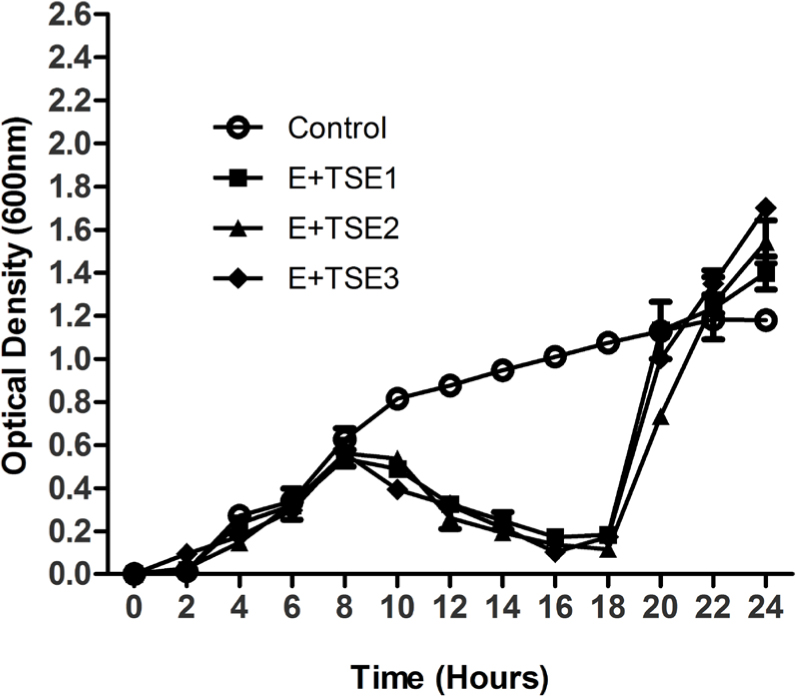
The bacteriophages TSE1-3 showed a pronounced reduction in growth of their host Enterobacter cloacae at 8 hours to 18 hours post infection on bacterial growth reduction assay.
The genome of all the bacteriophages was isolated and observed under UV after running the 0.7% agarose gel for one and half hours. The genome of all the phages appeared double stranded DNA as it was not digested by endonuclease I enzyme, indicative of double stranded DNA. The genome of all the phages appeared more than 12 kb in size (Figure 8).

The bacteriophage DNA extraction: The genome of TSE1, TSE2 and TSE3 showin in lanes 1-3 respectively compared with 1kb plus ladder in the labeled (lane 4) on 0.7% agarose gel.
4 Discussion
Hospital acquired infections (HAIs) are global, but are less studied in developing nations like Pakistan [12]. In the present study, bacteriophages against the Enterobacter cloacaewhich usually show marked antibiotic resistance were under investigation. The bacteriophages against an environmentally isolated Enterobacter cloacae (accession no: KF975427) strain were isolated and characterized. The TSE phages were isolated from sewage exhaust which has been reported as a good source for bacteriophage isolation [13]. The TSE phages under study showed a narrow host range, a characteristic of majority of bacteriophages already reported [15]. The ability of phages to infect specific host(s) makes them suitable for phage therapy [16].
The stability of studied TSE phages at varying temperatures and pH was also investigated, this data is helpful in determining their suitability for use in phage therapy through the oral route. The TSE phages showed their viability at pH of 6-8, while at neutral pH (7.0) maximum phage titer was recorded (Figure 4). The ability of phages to tolerate at varying pH levels indicates that they may be suitable for administration through the oral route after completing the clinical trials [16, 17]. The best temperature for phage stability was determined as 37°C, which is also reported for other bacteriophages against Enterobacter cloacae [8,18]. The TSE phages survived at all the tested temperatures from 28°C to 60°C, however the phage titer decreased when treated at 37°C to 60°C (Figure 4 and Figure 5). For the application of bacteriophages in phage therapy, their prolonged stability is most important. The stability of the isolated TSE bacteriophages was tested at three different temperatures; the bacteriophages remained stable at 4°C and -20°C for a month, while none survived at 37°C. The best storage temperature for the TSE phages was -20°C, as reported by previous authors [14].
The growth pattern of the TSE phages was studied by plotting their one step growth curve, all three phages showed similar behavior in the growth curve for the same latent period (20 minutes) and moderate burst size (Figure 6). This moderate burst size favors their use in the phage therapy and coincide with other phages against Enterobacterspecies [19]. The physiological stage of the host cell will also have effects on the burst size of phages and this factor should explored in future research [20]. The bacterial growth reduction assay indicated the phage’s potential to reduce the growth of the target bacteria during the incubation time. The application of phages in phage therapy and their feasibility can be predicted by the results of the bacterial growth reduction assay [21]. The TSE phages reduced the growth of the target bacteria at eight hours post infection until 18 hours had elapsed, after which resistant bacterial cells started to emerge (Figure 7). The development of resistant bacterial strains after phage exposure is a great hindrance in phage therapy. The bacteria become resistant to phages by downregulating the expression of the phages receptors (flagella and capsules), which make them less virulent [22].
The genome of the studied phages was larger than 12 kb, and it was DNA evident by digestion with the DNase. According to the size of the genome, we can deduce that the genome is double-stranded, as the size categorization placed them among medium-to large-sized genomes, which are mostly double-stranded [23]. The reported small size phage genomes are around 5.5 kb, while the larger size genomes may be greater than 250 kb [24].
Currently, there are great number of studies on bacteriophage isolation and characterization against E. cloacae. The emergence of phage resistant strains poses a great challenge for phage therapy, while there is need to investigate its role in decreasing the bacterial virulence. The concept of using bacteriophages in contrast to antibiotics for controlling bacterial infections looks promising. The financial investment for phage therapy is considerably less compared with identification of a novel antibiotic. Further work on bacteriophage genome characterization, dose and lytic activity against more clinical isolates might lead to utilization of theses phages in therapy.
Conflict of Interest
Authors declare to have no conflict of interest for this work.
References
[1] Bornet C., Davin-Regli A., Bosi C., Pages J. M., Bollet C., Imipenem resistance of enterobacter aerogenes mediated by outer membrane permeability, J. Clin. Microbiol., 2000, 38, 1048-1052.10.1128/JCM.38.3.1048-1052.2000Suche in Google Scholar PubMed PubMed Central
[2] Marcos M., Inurrieta A., Soriano A., Martinez J. A., Almela M., Marco F., et al., Effect of antimicrobial therapy on mortality in 377 episodes of Enterobacter spp. bacteraemia, J. Antimicrob. Chemother., 2008, 62, 397-403.10.1093/jac/dkn155Suche in Google Scholar PubMed
[3] Andersen B. M., Sorlie D., Hotvedt R., Almdahl S. M., Olafsen K., George R., et al., Multiply beta-lactam resistant Enterobacter cloacae infections linked to the environmental flora in a unit for cardiothoracic and vascular surgery, Scand. J. Infect. Dis., 1989, 21, 181-191.10.3109/00365548909039967Suche in Google Scholar PubMed
[4] Ayus J. C., Sheikh-Hamad D., Silent infection in clotted hemodialysis access grafts, J. Am. Soc. Nephrol., 1998, 9, 1314-1317.10.1681/ASN.V971314Suche in Google Scholar PubMed
[5] Musil I., Jensen V., Schilling J., Ashdown B., Kent T., Enterobacter cloacae infection of an expanded polytetrafluoroethylene femoral-popliteal bypass graft: a case report, J. Med. Case Rep., 2010, 4, 131 doi: 10.1186/1752-1947-4-131.Suche in Google Scholar PubMed PubMed Central
[6] Hermoso J. A., Garcia J. L., Garcia P., Taking aim on bacterial pathogens: from phage therapy to enzybiotics, Curr. Opin. Microbiol., 2007, 10, 461-472.10.1016/j.mib.2007.08.002Suche in Google Scholar PubMed
[7] D’Herelle F., Studies Upon Asiatic Cholera, Yale J. Biol. Med., 1929, 1, 195-219.Suche in Google Scholar
[8] Haq I. U., Chaudhry W. N., Akhtar M. N., Andleeb S., Qadri I., Bacteriophages and their implications on future biotechnology: a review, Virol. J., 2012, 9, 9 doi: 10.1186/1743-422X-9-9.Suche in Google Scholar PubMed PubMed Central
[9] Bren L., Bacteria-Eating Virus Approved as Food Additive, FDA Consumer Magazine, 2007, 41, 20-21.10.1037/e589942007-003Suche in Google Scholar
[10] Bibi Z., Abbas Z., Rehman S. u., A Phage P.E1, Isolated from Hospital Sewage Reduces the Growth of Escherichia coli, Biocontrol Sci. Technol., 2016, 26, 181-188.10.1080/09583157.2015.1086311Suche in Google Scholar
[11] Capra M. L., Quiberoni A., Reinheimer J., Phages of Lactobacillus casei/paracasei: response to environmental factors and interaction with collection and commercial strains, J. Appl. Microbiol., 2006, 100, 334-342.10.1111/j.1365-2672.2005.02767.xSuche in Google Scholar PubMed
[12] Akhtar N., Hospital acquired infections in a medical intensive care unit, J. Coll. Physicians Surg. Pak., 2010, 20, 386-390.Suche in Google Scholar
[13] Synnott A. J., Kuang Y., Kurimoto M., Yamamichi K., Iwano H., Tanji Y., Isolation from sewage influent and characterization of novel Staphylococcus aureus bacteriophages with wide host ranges and potent lytic capabilities, Appl. Environ. Microbiol., 2009, 75, 4483-4490.10.1128/AEM.02641-08Suche in Google Scholar
[14] Mishra C. K., Choi T. J., Kang S. C., Isolation and characterization of a bacteriophage F20 virulent to Enterobacter aerogenes, J. Gen. Virol., 2012, 93, 2310-2314.10.1099/vir.0.043562-0Suche in Google Scholar PubMed
[15] Hyman P., Abedon S. T., Bacteriophage host range and bacterial resistance, Adv. Appl. Microbiol., 2010, 70, 217-248.10.1016/S0065-2164(10)70007-1Suche in Google Scholar
[16] Kim M., Kim S., Ryu S., Complete genome sequence of bacteriophage SSU5 specific for Salmonella enterica serovar Typhimurium rough strains, J. Virol., 2012, 86, 10894 doi: 10.1128/JVI.01796-12.Suche in Google Scholar PubMed PubMed Central
[17] Ryan E. M., Gorman S. P., Donnelly R. F., Gilmore B. F., Recent advances in bacteriophage therapy: how delivery routes, formulation, concentration and timing influence the success of phage therapy, J. Pharm. Pharmacol., 2011, 63, 1253-1264.10.1111/j.2042-7158.2011.01324.xSuche in Google Scholar PubMed
[18] Yang H., Liang L., Lin S., Jia S., Isolation and characterization of a virulent bacteriophage AB1 of Acinetobacter baumannii, BMC Microbiol., 2010, 10, 131 doi: 10.1186/1471-2180-10-131.Suche in Google Scholar PubMed PubMed Central
[19] Mishra C. K., Choi T. J., Kang S. C., Isolation and characterization of a bacteriophage F20 virulent to Enterobacter aerogenes, J. Gen. Virol., 2012, 93, 2310-2314.10.1099/vir.0.043562-0Suche in Google Scholar
[20] Bolger-Munro M., Cheung K., Fang A., Wang L., T4 Bacteriophage average burst size varies with Escherichia coli B23 cell culture age, J. Exp. Microbiol. Immunol., 2013, 17, 115-119.Suche in Google Scholar
[21] Ul Haq I., Chaudhry W. N., Andleeb S., Qadri I., Isolation and partial characterization of a virulent bacteriophage IHQ1 specific for Aeromonas punctata from stream water, Microb. Ecol., 2012, 63, 954-963.10.1007/s00248-011-9944-2Suche in Google Scholar PubMed
[22] Levin B. R., Bull J. J., Population and evolutionary dynamics of phage therapy, Nat. Rev. Microbiol., 2004, 2, 166-173.10.1038/nrmicro822Suche in Google Scholar PubMed
[23] Abedon S. T., Size does matter-disinguishing bacteriophages by genome length (and ‘breadth’), Microbiol. Australia, 2011, 32, 2.10.1071/MA11095Suche in Google Scholar
[24] Hatfull G. F., Bacteriophage genomics, Curr. Opin. Microbiol., 2008, 11, 447-453.10.1016/j.mib.2008.09.004Suche in Google Scholar PubMed PubMed Central
© 2016 Komal Ameer Khawaja et al., published by De Gruyter Open
This work is licensed under the Creative Commons Attribution-NonCommercial-NoDerivatives 3.0 License.
Artikel in diesem Heft
- Regular article
- Purification of polyclonal IgG specific for Camelid’s antibodies and their recombinant nanobodies
- Regular article
- Antioxidative defense mechanism of the ruderal Verbascum olympicum Boiss. against copper (Cu)-induced stress
- Regular article
- Polyherbal EMSA ERITIN Promotes Erythroid Lineages and Lymphocyte Migration in Irradiated Mice
- Regular article
- Expression and characterization of a cutinase (AnCUT2) from Aspergillus niger
- Regular article
- The Lytic SA Phage Demonstrate Bactericidal Activity against Mastitis Causing Staphylococcus aureus
- Regular article
- MafB, a target of microRNA-155, regulates dendritic cell maturation
- Regular article
- Plant regeneration from protoplasts of Gentiana straminea Maxim
- Regular article
- The effect of radiation of LED modules on the growth of dill (Anethum graveolens L.)
- Regular article
- ELF-EMF exposure decreases the peroxidase catalytic efficiency in vitro
- Regular article
- Cold hardening protects cereals from oxidative stress and necrotrophic fungal pathogenesis
- Regular article
- MC1R gene variants involvement in human OCA phenotype
- Regular article
- Chondrogenic potential of canine articular cartilage derived cells (cACCs)
- Regular article
- Cloning, expression, purification and characterization of Leishmania tropica PDI-2 protein
- Regular article
- High potential of sub-Mediterranean dry grasslands for sheep epizoochory
- Regular article
- Identification of drought, cadmium and root-lesion nematode infection stress-responsive transcription factors in ramie
- Regular article
- Herbal supplement formula of Elephantopus scaber and Sauropus androgynus promotes IL-2 cytokine production of CD4+T cells in pregnant mice with typhoid fever
- Regular article
- Caffeine effects on AdoR mRNA expression in Drosophila melanogaster
- Regular article
- Effects of MgCl2 supplementation on blood parameters and kidney injury of rats exposed to CCl4
- Regular article
- Effective onion leaf fleck management and variability of storage pathogens
- Regular article
- Improving aeration for efficient oxygenation in sea bass sea cages. Blood, brain and gill histology
- Regular article
- Biogenic amines and hygienic quality of lucerne silage
- Regular article
- Isolation and characterization of lytic phages TSE1-3 against Enterobacter cloacae
- Regular article
- Effects of pH on antioxidant and prooxidant properties of common medicinal herbs
- Regular article
- Relationship between cytokines and running economy in marathon runners
- Regular article
- Anti-leukemic activity of DNA methyltransferase inhibitor procaine targeted on human leukaemia cells
- Regular article
- Research Progress in Oncology. Highlighting and Exploiting the Roles of Several Strategic Proteins in Understanding Cancer Biology
- Regular article
- Ectomycorrhizal communities in a Tuber aestivum Vittad. orchard in Poland
- Regular article
- Impact of HLA-G 14 bp polymorphism and soluble HLA-G level on kidney graft outcome
- Regular article
- In-silico analysis of non-synonymous-SNPs of STEAP2: To provoke the progression of prostate cancer
- Regular article
- Presence of sequence and SNP variation in the IRF6 gene in healthy residents of Guangdong Province
- Regular article
- Environmental and economic aspects of Triticum aestivum L. and Avena sativa growing
- Regular article
- A molecular survey of Echinococcus granulosus sensu lato in central-eastern Europe
- Topical Issue on Cancer Signaling, Metastasis and Target Therapy
- Molecular genetics related to non-Hodgkin lymphoma
- Topical Issue on Cancer Signaling, Metastasis and Target Therapy
- Roles of long noncoding RNAs in Hepatocellular Carcinoma
- Topical Issue on Cancer Signaling, Metastasis and Target Therapy
- Advancement of Wnt signal pathway and the target of breast cancer
- Topical Issue on Cancer Signaling, Metastasis and Target Therapy
- A tumor suppressive role of lncRNA GAS5 in human colorectal cancer
- Topical Issue on Cancer Signaling, Metastasis and Target Therapy
- The role of E-cadherin - 160C/A polymorphism in breast cancer
- Topical Issue on Cancer Signaling, Metastasis and Target Therapy
- The proceedings of brain metastases from lung cancer
- Topical Issue on Cancer Signaling, Metastasis and Target Therapy
- Newly-presented potential targeted drugs in the treatment of renal cell cancer
- Topical Issue on Cancer Signaling, Metastasis and Target Therapy
- Decreased expression of miR-132 in CRC tissues and its inhibitory function on tumor progression
- Topical Issue on Cancer Signaling, Metastasis and Target Therapy
- The unusual yin-yang fashion of RIZ1/RIZ2 contributes to the progression of esophageal squamous cell carcinoma
- Topical Issue on Cancer Signaling, Metastasis and Target Therapy
- Human papillomavirus infection mechanism and vaccine of vulva carcinoma
- Topical Issue on Cancer Signaling, Metastasis and Target Therapy
- Abnormal expressed long non-coding RNA IRAIN inhibits tumor progression in human renal cell carcinoma cells
- Topical Issue on Cancer Signaling, Metastasis and Target Therapy
- UCA1, a long noncoding RNA, promotes the proliferation of CRC cells via p53/p21 signaling
- Topical Issue on Cancer Signaling, Metastasis and Target Therapy
- Forkhead box 1 expression is upregulatedin non-small cell lung cancer and correlateswith pathological parameters
- Topical Issue on Cancer Signaling, Metastasis and Target Therapy
- The development of potential targets in the treatment of non-small cell lung cancer
- Topical Issue on Cancer Signaling, Metastasis and Target Therapy
- Low expression of miR-192 in NSCLC and its tumor suppressor functions in metastasis via targeting ZEB2
- Topical Issue on Cancer Signaling, Metastasis and Target Therapy
- Downregulation of long non-coding RNA MALAT1 induces tumor progression of human breast cancer through regulating CCND1 expression
- Topical Issue on Cancer Signaling, Metastasis and Target Therapy
- Post-translational modifications of EMT transcriptional factors in cancer metastasis
- Topical Issue on Cancer Signaling, Metastasis and Target Therapy
- EZH2 Expression and its Correlation with Clinicopathological Features in Patients with Colorectal Carcinoma
- Topical Issue on Cancer Signaling, Metastasis and Target Therapy
- The association between EGFR expression and clinical pathology characteristics in gastric cancer
- Topical Issue on Cancer Signaling, Metastasis and Target Therapy
- The peiminine stimulating autophagy in human colorectal carcinoma cells via AMPK pathway by SQSTM1
- Topical Issue on Cancer Signaling, Metastasis and Target Therapy
- Activating transcription factor 3 is downregulated in hepatocellular carcinoma and functions as a tumor suppressor by regulating cyclin D1
- Topical Issue on Cancer Signaling, Metastasis and Target Therapy
- Progress toward resistance mechanism to epidermal growth factor receptor tyrosine kinase inhibitor
- Topical Issue on Cancer Signaling, Metastasis and Target Therapy
- Effect of miRNAs in lung cancer suppression and oncogenesis
- Topical Issue on Cancer Signaling, Metastasis and Target Therapy
- Role and inhibition of Src signaling in the progression of liver cancer
- Topical Issue on Cancer Signaling, Metastasis and Target Therapy
- The antitumor effects of mitochondria-targeted 6-(nicotinamide) methyl coumarin
- Special Issue on CleanWAS 2015
- Characterization of particle shape, zeta potential, loading efficiency and outdoor stability for chitosan-ricinoleic acid loaded with rotenone
- Special Issue on CleanWAS 2015
- Genetic diversity and population structure of ginseng in China based on RAPD analysis
- Special Issue on CleanWAS 2015
- Optimizing the extraction of antibacterial compounds from pineapple leaf fiber
- Special Issue on CleanWAS 2015
- Identification of residual non-biodegradable organic compounds in wastewater effluent after two-stage biochemical treatment
- Special Issue on CleanWAS 2015
- Remediation of deltamethrin contaminated cotton fields: residual and adsorption assessment
- Special Issue on CleanWAS 2015
- A best-fit probability distribution for the estimation of rainfall in northern regions of Pakistan
- Special Issue on CleanWAS 2015
- Artificial Plant Root System Growth for Distributed Optimization: Models and Emergent Behaviors
- Special Issue on CleanWAS 2015
- The complete mitochondrial genomes of two weevils, Eucryptorrhynchus chinensis and E. brandti: conserved genome arrangement in Curculionidae and deficiency of tRNA-Ile gene
- Special Issue on CleanWAS 2015
- Characteristics and coordination of source-sink relationships in super hybrid rice
- Special Issue on CleanWAS 2015
- Construction of a Genetic Linkage Map and QTL Analysis of Fruit-related Traits in an F1 Red Fuji x Hongrou Apple Hybrid
- Special Issue on CleanWAS 2015
- Effects of the Traditional Chinese Medicine Dilong on Airway Remodeling in Rats with OVA-induced-Asthma
- Special Issue on CleanWAS 2015
- The effect of sewage sludge application on the growth and absorption rates of Pb and As in water spinach
- Special Issue on CleanWAS 2015
- Effectiveness of mesenchymal stems cells cultured by hanging drop vs. conventional culturing on the repair of hypoxic-ischemic-damaged mouse brains, measured by stemness gene expression
Artikel in diesem Heft
- Regular article
- Purification of polyclonal IgG specific for Camelid’s antibodies and their recombinant nanobodies
- Regular article
- Antioxidative defense mechanism of the ruderal Verbascum olympicum Boiss. against copper (Cu)-induced stress
- Regular article
- Polyherbal EMSA ERITIN Promotes Erythroid Lineages and Lymphocyte Migration in Irradiated Mice
- Regular article
- Expression and characterization of a cutinase (AnCUT2) from Aspergillus niger
- Regular article
- The Lytic SA Phage Demonstrate Bactericidal Activity against Mastitis Causing Staphylococcus aureus
- Regular article
- MafB, a target of microRNA-155, regulates dendritic cell maturation
- Regular article
- Plant regeneration from protoplasts of Gentiana straminea Maxim
- Regular article
- The effect of radiation of LED modules on the growth of dill (Anethum graveolens L.)
- Regular article
- ELF-EMF exposure decreases the peroxidase catalytic efficiency in vitro
- Regular article
- Cold hardening protects cereals from oxidative stress and necrotrophic fungal pathogenesis
- Regular article
- MC1R gene variants involvement in human OCA phenotype
- Regular article
- Chondrogenic potential of canine articular cartilage derived cells (cACCs)
- Regular article
- Cloning, expression, purification and characterization of Leishmania tropica PDI-2 protein
- Regular article
- High potential of sub-Mediterranean dry grasslands for sheep epizoochory
- Regular article
- Identification of drought, cadmium and root-lesion nematode infection stress-responsive transcription factors in ramie
- Regular article
- Herbal supplement formula of Elephantopus scaber and Sauropus androgynus promotes IL-2 cytokine production of CD4+T cells in pregnant mice with typhoid fever
- Regular article
- Caffeine effects on AdoR mRNA expression in Drosophila melanogaster
- Regular article
- Effects of MgCl2 supplementation on blood parameters and kidney injury of rats exposed to CCl4
- Regular article
- Effective onion leaf fleck management and variability of storage pathogens
- Regular article
- Improving aeration for efficient oxygenation in sea bass sea cages. Blood, brain and gill histology
- Regular article
- Biogenic amines and hygienic quality of lucerne silage
- Regular article
- Isolation and characterization of lytic phages TSE1-3 against Enterobacter cloacae
- Regular article
- Effects of pH on antioxidant and prooxidant properties of common medicinal herbs
- Regular article
- Relationship between cytokines and running economy in marathon runners
- Regular article
- Anti-leukemic activity of DNA methyltransferase inhibitor procaine targeted on human leukaemia cells
- Regular article
- Research Progress in Oncology. Highlighting and Exploiting the Roles of Several Strategic Proteins in Understanding Cancer Biology
- Regular article
- Ectomycorrhizal communities in a Tuber aestivum Vittad. orchard in Poland
- Regular article
- Impact of HLA-G 14 bp polymorphism and soluble HLA-G level on kidney graft outcome
- Regular article
- In-silico analysis of non-synonymous-SNPs of STEAP2: To provoke the progression of prostate cancer
- Regular article
- Presence of sequence and SNP variation in the IRF6 gene in healthy residents of Guangdong Province
- Regular article
- Environmental and economic aspects of Triticum aestivum L. and Avena sativa growing
- Regular article
- A molecular survey of Echinococcus granulosus sensu lato in central-eastern Europe
- Topical Issue on Cancer Signaling, Metastasis and Target Therapy
- Molecular genetics related to non-Hodgkin lymphoma
- Topical Issue on Cancer Signaling, Metastasis and Target Therapy
- Roles of long noncoding RNAs in Hepatocellular Carcinoma
- Topical Issue on Cancer Signaling, Metastasis and Target Therapy
- Advancement of Wnt signal pathway and the target of breast cancer
- Topical Issue on Cancer Signaling, Metastasis and Target Therapy
- A tumor suppressive role of lncRNA GAS5 in human colorectal cancer
- Topical Issue on Cancer Signaling, Metastasis and Target Therapy
- The role of E-cadherin - 160C/A polymorphism in breast cancer
- Topical Issue on Cancer Signaling, Metastasis and Target Therapy
- The proceedings of brain metastases from lung cancer
- Topical Issue on Cancer Signaling, Metastasis and Target Therapy
- Newly-presented potential targeted drugs in the treatment of renal cell cancer
- Topical Issue on Cancer Signaling, Metastasis and Target Therapy
- Decreased expression of miR-132 in CRC tissues and its inhibitory function on tumor progression
- Topical Issue on Cancer Signaling, Metastasis and Target Therapy
- The unusual yin-yang fashion of RIZ1/RIZ2 contributes to the progression of esophageal squamous cell carcinoma
- Topical Issue on Cancer Signaling, Metastasis and Target Therapy
- Human papillomavirus infection mechanism and vaccine of vulva carcinoma
- Topical Issue on Cancer Signaling, Metastasis and Target Therapy
- Abnormal expressed long non-coding RNA IRAIN inhibits tumor progression in human renal cell carcinoma cells
- Topical Issue on Cancer Signaling, Metastasis and Target Therapy
- UCA1, a long noncoding RNA, promotes the proliferation of CRC cells via p53/p21 signaling
- Topical Issue on Cancer Signaling, Metastasis and Target Therapy
- Forkhead box 1 expression is upregulatedin non-small cell lung cancer and correlateswith pathological parameters
- Topical Issue on Cancer Signaling, Metastasis and Target Therapy
- The development of potential targets in the treatment of non-small cell lung cancer
- Topical Issue on Cancer Signaling, Metastasis and Target Therapy
- Low expression of miR-192 in NSCLC and its tumor suppressor functions in metastasis via targeting ZEB2
- Topical Issue on Cancer Signaling, Metastasis and Target Therapy
- Downregulation of long non-coding RNA MALAT1 induces tumor progression of human breast cancer through regulating CCND1 expression
- Topical Issue on Cancer Signaling, Metastasis and Target Therapy
- Post-translational modifications of EMT transcriptional factors in cancer metastasis
- Topical Issue on Cancer Signaling, Metastasis and Target Therapy
- EZH2 Expression and its Correlation with Clinicopathological Features in Patients with Colorectal Carcinoma
- Topical Issue on Cancer Signaling, Metastasis and Target Therapy
- The association between EGFR expression and clinical pathology characteristics in gastric cancer
- Topical Issue on Cancer Signaling, Metastasis and Target Therapy
- The peiminine stimulating autophagy in human colorectal carcinoma cells via AMPK pathway by SQSTM1
- Topical Issue on Cancer Signaling, Metastasis and Target Therapy
- Activating transcription factor 3 is downregulated in hepatocellular carcinoma and functions as a tumor suppressor by regulating cyclin D1
- Topical Issue on Cancer Signaling, Metastasis and Target Therapy
- Progress toward resistance mechanism to epidermal growth factor receptor tyrosine kinase inhibitor
- Topical Issue on Cancer Signaling, Metastasis and Target Therapy
- Effect of miRNAs in lung cancer suppression and oncogenesis
- Topical Issue on Cancer Signaling, Metastasis and Target Therapy
- Role and inhibition of Src signaling in the progression of liver cancer
- Topical Issue on Cancer Signaling, Metastasis and Target Therapy
- The antitumor effects of mitochondria-targeted 6-(nicotinamide) methyl coumarin
- Special Issue on CleanWAS 2015
- Characterization of particle shape, zeta potential, loading efficiency and outdoor stability for chitosan-ricinoleic acid loaded with rotenone
- Special Issue on CleanWAS 2015
- Genetic diversity and population structure of ginseng in China based on RAPD analysis
- Special Issue on CleanWAS 2015
- Optimizing the extraction of antibacterial compounds from pineapple leaf fiber
- Special Issue on CleanWAS 2015
- Identification of residual non-biodegradable organic compounds in wastewater effluent after two-stage biochemical treatment
- Special Issue on CleanWAS 2015
- Remediation of deltamethrin contaminated cotton fields: residual and adsorption assessment
- Special Issue on CleanWAS 2015
- A best-fit probability distribution for the estimation of rainfall in northern regions of Pakistan
- Special Issue on CleanWAS 2015
- Artificial Plant Root System Growth for Distributed Optimization: Models and Emergent Behaviors
- Special Issue on CleanWAS 2015
- The complete mitochondrial genomes of two weevils, Eucryptorrhynchus chinensis and E. brandti: conserved genome arrangement in Curculionidae and deficiency of tRNA-Ile gene
- Special Issue on CleanWAS 2015
- Characteristics and coordination of source-sink relationships in super hybrid rice
- Special Issue on CleanWAS 2015
- Construction of a Genetic Linkage Map and QTL Analysis of Fruit-related Traits in an F1 Red Fuji x Hongrou Apple Hybrid
- Special Issue on CleanWAS 2015
- Effects of the Traditional Chinese Medicine Dilong on Airway Remodeling in Rats with OVA-induced-Asthma
- Special Issue on CleanWAS 2015
- The effect of sewage sludge application on the growth and absorption rates of Pb and As in water spinach
- Special Issue on CleanWAS 2015
- Effectiveness of mesenchymal stems cells cultured by hanging drop vs. conventional culturing on the repair of hypoxic-ischemic-damaged mouse brains, measured by stemness gene expression
