Startseite Mathematik Generalized quasi-linear fractional Wentzell problems
Artikel Open Access

Generalized quasi-linear fractional Wentzell problems

  • Efren Mesino-Espinosa und Alejandro Vélez-Santiago EMAIL logo
Veröffentlicht/Copyright: 28. November 2025

Abstract

Given a bounded ( ε , δ ) -domain Ω R N ( N 2 ) whose boundary Γ Ω is a d -set for d ( N p , N ) , we investigate a generalized quasi-linear elliptic boundary value problem governed by the regional fractional p -Laplacian ( Δ ) p , Ω s in Ω , and generalized fractional Wentzell boundary conditions of type

C p , s N p ( 1 s ) u + β u q 2 u + Θ q η u = g on Γ ,

where Θ q η stands as a nonlocal fractional-type q -operator on Γ (also referred as a Besov q -map), C p , s N p ( 1 s ) denotes the fractional p -normal derivative operator in Γ , and p , q are two growth exponents acting on the interior and boundary, respectively (which are in general unrelated between each other). We first show that this model equation admits a unique weak solution, which is globally bounded in Ω ¯ . Furthermore, given two distinct weak solution related to this boundary value problem with different data values, we establish a priori L -estimates for the difference of weak solutions with upper bound depending on the differences of the respective interior and boundary data functions. Additionally, a Weak Comparison Principle is derived, and we conclude by establishing a sort of nonlinear Fredholm alternative related to this generalized elliptic fractional model equation.

MSC 2020: 35J92; 35J62; 35D30; 35B45

1 Introduction

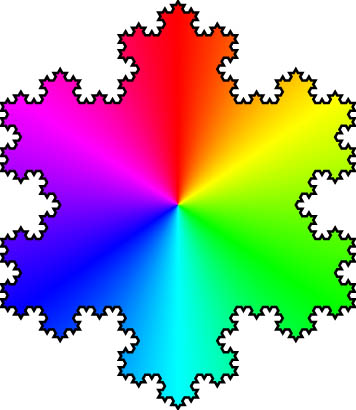
Let Ω R N ( N 2 ) be a bounded domain with “sufficient geometry” over its boundary Γ Ω (refer to Assumptions A(a,b)). We are concerned with a fractional-type quasi-linear elliptic equation involving the regional fractional p -Laplace operator ( Δ ) p , Ω s in Ω and boundary conditions containing a generalized fractional q -Laplace-type operator on the boundary Γ Ω (in the sense of Besov spaces and operators on the boundary). Boundary conditions of this kind will be called Wentzell boundary conditions, as a fractional counterpart of the classical Wentzell boundary value problems (also referred as Venttsel’) introduced by Venttsel [36]. In the classical setting, Δ q , Γ is known as the Laplace-Beltrami operator on Γ , which requires a certain level of regularity on the manifold Γ in order to be well defined. For example, if Ω R 2 is the classical Snowflake domain (refer Example 17(a)) and 1 < q 2 , then Δ q , Γ is no longer well defined over Γ , but an abstract realization of a quasi-linear Wentzell-type boundary condition over the Snowflake domains has been introduced in [26,27]. In the case of the fractional Wentzell-type operator, we are allowed to deal with less regularity structure on Γ , but there are almost no results obtained for models of fractional Wentzell type. It is also worth mentioning that the regional fractional Laplacian is not as known as the classical fractional Laplacian ( Δ ) s , defined over all R N . A complete treatment of the regional fractional Laplace equation over non-smooth domains has been given by Warma [39].

We now introduce the boundary value problem under consideration in this work. Consider the following quasi-linear Wentzell-type problem, explicitly given by

( Δ ) p , Ω s u + α u p 2 u = f in Ω , C p , s N p p ( 1 s ) u + β u q 2 u + Θ q η u = g on Γ , ( ℰP )

where C p , s N p ( 1 s ) denotes the fractional p -normal derivative operator in Γ . Then, under the conditions listed in Assumption (A), we establish five main results which we briefly enumerate below:

  1. The existence and uniqueness of a weak solution to problem ( ℰP ) (e.g., Theorem 22).

  2. The global boundedness of weak solutions of problem ( ℰP ) under minimal and optimal conditions on the data (e.g., Theorem 24(a)).

  3. A L -estimate for the difference of two weak solution of equation ( ℰP ) with respect to the difference of the corresponding data for each weak solution (e.g., Theorem 24(b)).

  4. A weak comparison principle for solution to the boundary value problem ( ℰP ) (e.g., Theorem 28).

  5. A nonlinear Fredholm alternative associated with the equation ( ℰP ) (e.g., Theorem 34).

In view of the above formulations, we address several important main observations concerning our equation of interest. First, we observe that problem ( ℰP ) involves two exponents p , q ( 1 , ) , which are allowed to be independent with respect to each other. Furthermore, the interior data in the problem depends solely on p while the boundary data depends exclusively on q , and thus, the data values may be unrelated with respect to each other. As expected, these generalities bring much more complications in the proofs of most of the results. The mentioned independence between the interior power p and the boundary power q implies that problem ( ℰP ) can be interpreted (in the variational setting) as a system of equations of the form

(1.1) C N , p , s Ω Ω u ( x ) u ( y ) p 2 ( u ( x ) u ( y ) ) ( φ ( x ) φ ( y ) ) x y N + s p d x d y + Ω α u p 2 u φ d x = Ω f φ d x , Γ Γ v ( x ) v ( y ) q 2 ( v ( x ) v ( y ) ) ( ψ ( x ) ψ ( y ) ) x y d + η q d μ x d μ y + Γ β v q 2 v ψ d μ x = Γ g ψ d μ x ,

for v u Γ , ψ φ Γ . In our knowledge, this is the first time that a problem of this type has been considered, with all these structures.

For the classical local problem involving the p -Laplace operator on the interior and the q -Laplace-Beltrami operator on the boundary, Gal and Warma [17] introduced this problem, and they established results (1)–(3) and (5) stated above, assuming that min { p , q } 2 and that p , q have a sort of relationship between them. These two conditions were removed in [11], where the problem was also generalized to anisotropic structures. Further properties of local parabolic problems under these generalized structures were recently given in [6]. In particular, all conditions (1)–(5) above were established in [11], and our problem ( ℰP ) constitutes a fractional counterpart of the boundary value problem and results in [11] (in the constant setting). Since the calculations and estimates over nonlocal-type integrals bring further complications and additional cases were not found in the classical local case, it becomes substantial to provide complete justification to all the derivations and estimates.

Fractional Wentzell-type boundary value problems are barely known. For the linear case ( p = 2 ), Gal and Warma [18] introduced these model equations, and a complete realization of a diffusion problem of Wentzell-type was recently developed in [21]. For the quasi-linear case with q = p , Creo and Lancia [8] were the first authors to formulate problem ( ℰP ) under the same generality assumptions on the domain. In fact, they were the ones who extended the fractional integration by part formula to non-Lipschitz domains (refer Theorem 15). On the other hand, they assume that the coefficients α , β are such that α 0 and β L μ ( Γ ) is strictly positive. Under these conditions, Creo and Lancia [8] established the global boundedness of weak solutions under the hypothesis p 2 . Motivated by the model equation introduced by Creo and Lancia in [8], in our case, we extend their model to the case when p q (possibly without any relation between p and q ), we allow unbounded interior and boundary local coefficients (refer condition A(d)), and we establish our results including the singular cases p , q ( 1 , 2 ) . Particularly, we allow situations in which our interior operator is in singular mode ( 1 < p < 2 ) while the boundary part is non-singular ( q 2 ), and the other way around. Henceforth, under the generality of our assumption, model equation ( ℰP ) is new, and the set of results (1)–(5) are established for this generalized fractional boundary value problem for the first time.

Fractional Laplacian-type operators are very important in probability, as they are generators of s -stable processes (Lévy flights in some of the physical literature), widely used to model systems of stochastic dynamics with applications in operation research, mathematical finance, risk estimate, and generalized Fokker-Plank equations for nonlinear stochastic differential equations driven by Levy noise, among many others (e.g., [3,31] and references therein). Models of nonlocal structure are tied to many applications, including continuum mechanics, graph theory, nonlocal wave equations, jump processes, image analysis, machine learning, kinetic equations, phase transitions, nonlocal heat conduction, and the peridynamic model for mechanics (among others). As mentioned in [39], the fractional Laplacian and fractional derivative operators are commonly used to model anomalous diffusion. Physical phenomena exhibiting this property cannot be modeled accurately by the usual advection-dispersion equation; among others, we mention turbulent flows and chaotic dynamics of classical conservative systems. For more information, properties, and applications of nonlocal-type operators and structures, we refer to [13,14,19,22,39] (among many others).

The study is organized as follows. Section 2 reviews the fundamental concepts, definitions, and known results, which will be applied in the subsequent sections. Some particular examples of non-smooth domains having the structure suitable for the study are also given in this section. In Section 3, we first state the main assumptions that will be carried out throughout the study, and then we proceed to stablish the unique solvability of problem ( ℰP ). In Section 4, we develop a priori estimates for weak solutions to problem ( ℰP ), as well as for the difference of weak solutions. This is the crucial part of the study, where the generality of the growth interior and boundary exponents produce many complications, and in particular, to derive L -bounds for weak solutions depending on the difference of their corresponding data, one needs to consider four cases related to the singularity/non-singularity of the interior/boundary part of the variational problem. However, having a priori estimates for the difference of weak solutions is a very useful result, which also provides continuous dependence between the data and the corresponding weak solutions, in the sense that the “closeness” between the data terms imply the closeness of the corresponding weak solutions. As a direct consequence, global boundedness of weak solutions to problem ( ℰP ) is established in this section. Section 5 features inverse positivity results for weak solutions of problem ( ℰP ), and at the end, a Weak Comparison Principle is derived for problem ( ℰP ). Finally, in Section 6, a nonlinear Fredholm alternative is given for the associated functional related to problem ( ℰP ).

2 Preliminaries

We state fundamental concepts, notations, and important tools for the development of the work in this study. We introduce some function spaces along with their essential properties. We also define fractional Sobolev spaces and Besov spaces and provide some embedding theorems. Furthermore, we introduce the regional fractional p -Laplacian and the fractional normal derivative. Examples of irregular domains in which the framework of the study applies are given, and at the end, we provide some analytical results, which will be of utility for the establishment of main results of the study.

2.1 ( ε , δ ) -domains and d -sets

Here we will introduce two key concepts about sets that will be considered in the development of this research. For a deeper exploration of these concepts, readers are encouraged to refer [23,24].

Definition 1

[23] Let Ω R N be open and connected, and let

d ( x ) inf y Ω c x y , x Ω .

We say that Ω is an ( ε , δ ) -domain if, whenever x , y Ω with x y < δ , there exists a rectifiable arc γ Ω joining x to y such that

(2.1) l ( γ ) 1 ε x y and d ( z ) ε x z y z x y for every z γ .

Definition 2

[24] A closed non-empty set F R N is a d-set (for 0 < d N ) if there exist a Borel measure μ with supp μ = F and two positive constants c 1 and c 2 such that

(2.2) c 1 r d μ ( B ( x , r ) F ) c 2 r d , x F .

The measure μ is called d-Ahlfors measure.

Examples of sets fulfilling both of the above definitions include many non-smooth and non-Lipschitz domains, as shown here.

2.2 Fractional Sobolev spaces, Besov spaces, and other function spaces

In this section, we will introduce the concepts of fractional Sobolev spaces and Besov spaces. Additionally, we will discuss some important properties of these spaces that are essential for the development of this work. For more information, please refer [8,10,15,24,25,28,38].

First, given r [ 1 , ] and a μ -measurable set E in R N , we denote by L μ r ( E ) the basic L r -spaces with respect to the measure μ , and for the particular case in which μ ( ) = is the N -dimensional Lebesgue measure on E , we write L μ r ( E ) L r ( E ) . The norm for the L r -spaces will be denoted by r , E .

Definition 3

[28,38] Let Ω R N be an open set. For p [ 1 , ) and s ( 0 , 1 ) . The fractional Sobolev space on Ω is defined as

W s , p ( Ω ) u L p ( Ω ) Ω Ω u ( x ) u ( y ) p x y N + s p d x d y < ,

endowed with the norm

u W s , p ( Ω ) p u p , Ω p + Ω Ω u ( x ) u ( y ) p x y N + s p d x d y .

Theorem 4

[28] The fractional Sobolev space ( W s , p ( Ω ) , W s , p ( Ω ) ) is a Banach space. Moreover, W s , p ( Ω ) is reflexive for 1 < p < .

Definition 5

[8,9] Let F be a d -set with respect to a d -Ahlfors measure μ . Given q [ 1 , ) and η ( 0 , 1 ) , the Besov space on F relative to the measure μ is defined as

B η q ( F ) u L μ q ( F ) F F u ( x ) u ( y ) q x y d + η q d μ x d μ y < ,

endowed with the norm

u B η q ( F ) q u q , F q + F F u ( x ) u ( y ) q x y d + η q d μ x d μ y .

Theorem 6

[24] The Besov space ( B η q ( F ) , B η q ( F ) ) is a Banach space. Moreover, B η q ( F ) is reflexive for 1 < q < .

For the domains under consideration in this study, a characterization of the trace space of W s , p ( Ω ) is given in the next known result.

Theorem 7

[8,24] Let Ω R N be a bounded ( ε , δ ) -domain with boundary Ω a d -set, N d p < s < 1 and η = s N d p ( 0 , 1 ) . Then, B η p ( Ω ) is the trace space of W s , p ( Ω ) in the following sense:

  1. γ 0 is a continuous linear operator from W s , p ( Ω ) to B η p ( Γ ) ;

  2. there exists a continuous linear operator Ext from B η p ( Γ ) to W s , p ( Ω ) such that γ 0 E x t is the identity operator in B η p ( Γ ) .

Definition 8

[28] Let 1 p < and 0 < s < 1 . An open set Ω R N is called a W s , p -extension domain, if there exists a continuous linear operator : W s , p ( Ω ) W s , p ( R N ) such that u = u a.e. on Ω .

It is known that if Ω R N is a N -set, then Ω is a W s , p -extension domain for p [ 1 , ) (e.g., [24]). Now, we provide an important result about ( ε , δ ) -domains having as boundary a d -set.

Theorem 9

[8, Theorem 1.6] Let 1 p < , 0 < s < 1 , and Ω R N be an ( ε , δ ) -domain with boundary a d-set. Then, Ω is a W s , p -extension domain.

In some instances, for r , l [ 1 , ) , or r = l = , we will deal with the space

X r , l ( Ω , Ω ) { ( f , g ) f L r ( Ω ) , g L μ l ( Ω ) } ,

endowed with the norm

( f , g ) X r , l ( Ω , Ω ) = ( f , g ) r , l f r , Ω + g l , Ω ,

and, if r = l = ,

( f , g ) X , = ( f , g ) max { f , Ω , g , Ω } .

2.3 Embedding theorems

The following embedding results are important and will be highly applied throughout the rest of the study. We will present results regarding fractional Sobolev spaces and Besov spaces.

First, we set

(2.3) p * N p N s p , ( p * ) N p N p N + s p , q * d q d η q , ( q * ) d q d q d + η q .

We first state the interior embedding result.

Theorem 10

[10, Theorem 6.7] Let s ( 0 , 1 ) and p 1 be such that s p < N . Let Ω R N be a bounded W s , p -extension domain. Then, there exists a positive constant c 1 = c 1 ( N , s , p , Ω ) such that, for every u W s , p ( Ω ) , we have

(2.4) u r 1 , Ω c 1 u W s , p ( Ω ) ,

that is, the space W s , p ( Ω ) is continuously embedded in L r 1 ( Ω ) for any r 1 [ 1 , p * ] . Moreover, if in addition, r 1 < p * , then the embedding is compact.

For the next result, we use the first part of [9, Theorem 11.1] together with the extension property and the fact that C ( Ω ¯ ) is dense in the fractional Sobolev spaces (following the idea as in [9, chapter 10]; see also [7, derivation of inequality (2.3)] for the linear case) to obtain the following boundary embedding. These results justify the fact that one may be able to consider independent growth exponents in the interior and at the boundary.

Theorem 11

[9] Let η ( 0 , 1 ) and q 1 be such that N η q < d < N . Let F be a d-set with respect to a d-Ahlfors measure μ . Then, B η q ( F ) is continuously embedded in L r 2 ( F ) for every r 2 [ 1 , q * ] , i.e., there exists a positive constant c 2 such that

u r 2 , F c 2 u B η q ( F ) , u B η q ( F ) .

Remark 12

Let Ω R N be a bounded ( ε , δ ) -domain whose boundary is a d -set ( N 2 ). Then, the following hold.

  1. From [33], one can clearly deduce that Ω is a N -set.

  2. Since the maps W s , p ( Ω ) L r p ( Ω ) and B η q ( Γ ) L μ r q ( Γ ) are compact whenever r p [ 1 , p * ) and r q [ 1 , q * ) , in view of [30, Lemma 2.4.7], for any ε > 0 , there exist constants C ε , C ε > 0 such that

    (2.5) v r p , Ω p ε Ω Ω u ( x ) u ( y ) p x y N + s p d x d y + C ε v p , Ω p

    and

    (2.6) w r q , Γ q ε Γ Γ u ( x ) u ( y ) q x y d + η q d μ x d μ y + C ε w q , Γ q ,

    for each v W s , p ( Ω ) and w B η q ( Γ ) .

  3. If s ( N d ) p < 1 , then by [39, Corollary 4.9], we obtain that W s , p ( Ω ) = W 0 s , p ( Ω ) C c ( Ω ) ¯ W s , p ( Ω ) .

2.4 Regional fractional p -Laplacian

In this section, we focus on the regional fractional p -Laplacian, which has been previously studied in the linear case ( p = 2 ) in [10,20,28]. However, given our interest in a more general approach, we concentrate on the details provided in [38]. Additionally, we introduce the p -fractional normal derivative via a p -fractional Green formula given in [8].

Definition 13

[38] Let s ( 0 , 1 ) , p > 1 , and Ω R N , we define the space

s p 1 ( Ω ) u : Ω R measurable Ω u ( x ) p 1 ( 1 + x ) N + s p d x < .

Definition 14

[38] Let s ( 0 , 1 ) , p > 1 , and Ω R N be an open set. For u s p 1 ( Ω ) and x Ω , we define the regional fractional p-Laplacian ( Δ ) p , Ω s as follows:

(2.7) ( Δ ) p , Ω s u ( x ) C N , p , s P.V. Ω u ( x ) u ( y ) p 2 u ( x ) u ( y ) x y N + s p d y = C N , p , s lim ε 0 + { y Ω : x y > ε } u ( x ) u ( y ) p 2 u ( x ) u ( y ) x y N + s p d y ,

provided that the limit exists. Where the positive normalized constant C N , p , s is given by

C N , p , s s 4 s Γ ( ( p s + p + N 2 ) 2 ) π N 2 Γ ( 1 s ) ,

and Γ ( ) is the usual Gamma function.

Now, we introduce the notion of p -fractional normal derivative for the domains under study in this work, and a corresponding integration by parts formula. For more details and proof, refer [8, Theorem 2.2]. For this, we define the space

V ( ( Δ ) p , Ω s , Ω ) { u W s , p ( Ω ) ( Δ ) p , Ω s u L p ( Ω ) in the sense of distributions } .

Theorem 15

(Fractional Green formula; [8, Theorem 2.2]) Let Ω R N be a bounded ( ε , δ ) -domain, which can be approximated by a sequence { Ω n } of domains such that for every n N ,

( ) Ω n is b o u n d e d a n d L i p s c h i t z ; Ω n Ω n + 1 ; Ω = n = 1 Ω n ,

and its boundary Ω is a d-set, for p > 1 , N d p < s < 1 and η = s N d p . Then, there exists a bounded linear operator N p p ( 1 s ) from V ( ( Δ ) p , Ω s , Ω ) to B η p ( Ω ) , the following generalized Green formula holds for every u V ( ( Δ ) p , Ω s , Ω ) and v W s , p ( Ω ) :

C p , s N p p ( 1 s ) u , v Ω B η p ( Ω ) , B η p ( Ω ) = Ω ( Δ ) p , Ω s u v d x + C N , p , s 2 Ω Ω u ( x ) u ( y ) p 2 ( u ( x ) u ( y ) ) ( v ( x ) v ( y ) ) x y N + s p d x d y ,

where

C p , s ( p 1 ) C 1 , p , s ( s p ( p 2 ) ) ( s p ( p 2 ) 1 ) 0 t 1 p 1 s p ( t 1 ) p s p 1 t p s p d t .

Remark 16

Note that if p ( 1 s ) = 2 γ , where γ = p s 1 p 1 + 1 , then we have the usual notation for the p -fractional normal derivative.

2.5 Examples of domains

We now collect some examples of non-smooth regions exhibiting the required conditions for the validity of Theorem 15.

Example 17

We present three concrete examples of non-Lipschitz domains fulfilling all the conditions mentioned in Theorem 15.

  1. The most known example of a locally uniform domain with fractal boundary (and thus failing to be a Lipschitz domain) is the classical Koch snowflake domain in R 2 , Figure 1. In this case, μ ( ) = d ( ) is the d -dimensional Hausdorff measure supported on Γ for d log ( 4 ) log ( 3 ) . The first result concerning traces of Sobolev functions over this particular set was introduced by Wallin [37].

  2. Recently, Ferrer and Vélez-Santiago [16] constructed a class of Koch-type domains { Ω m } in R 3 for a given m > 2 being an integer not having 3 as a factor. Such domains are called Koch-type crystals, Figure 2. Here μ ( ) = d ( ) for d log ( m 2 + 2 ) log ( m ) .

  3. We consider ramified domains over R 2 introduced by Achdou et al. [1] and Achdou and Tchou [2], Figure 3. In [1,2], it is shown that these ramified domains are N -sets, but are not W 1,2 -extension domains, and thus from Jones [23, Theorem 3], it follows that these sets are not ( ε , δ ) -domains. However, since these domains are 2-sets, it follows that these domains are W s , p -extension domains for any p [ 1 , ) and s ( 0 , 1 ) , which can be approximated by a sequence of bounded Lipschitz domains fulfilling the condition ( ) in Theorem 15. Furthermore, by adapting the extension results in [2,24], we can deduce the existence of a parameter η such that the extension operator from B η p ( Γ ) into W s , p ( Ω ) is bounded, for Γ denoting the ramified boundaries of the sets in Figure 3. By taking functions in the set W s ( Ω ) { u W s , p ( Ω ) u Γ \ Γ = 0 } , one can deduce the validity of Theorem 15 for this case. Thus, the results of this study can be extended to sets like these ramified tree-type regions. These sets can be regarded as idealizations of the bronchial trees in a lungs system (e.g., [1,2]), which provides an important reason to investigate boundary value problems over such regions. For a more complete understanding of this domain and its importance with respect to a suitable diffusion problem, we refer to the recent manuscript by Silva-Pérez and Vélez-Santiago [34].

Figure 1 
                  The two-dimensional Koch snowflake domain.
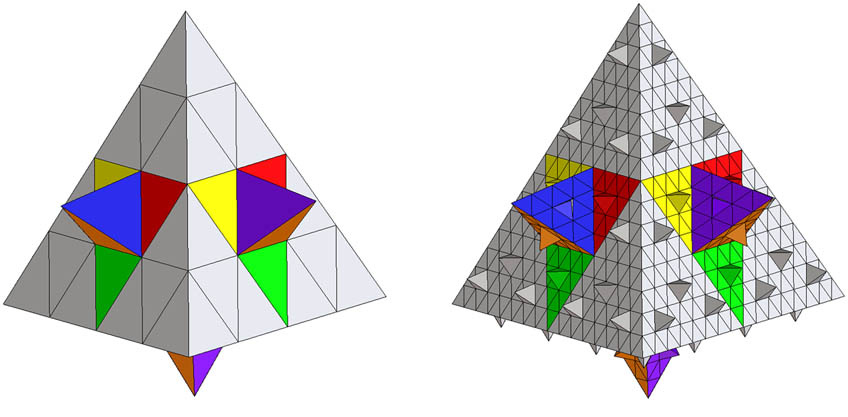
Figure 1

The two-dimensional Koch snowflake domain.

Figure 2 
                  Koch 4-crystal 


                                    Ω
                                 
                                 
                                    4


                           {\Omega }_{4}
                        
                      (pre-fractal structure: first and second iterations).
Figure 2

Koch 4-crystal Ω 4 (pre-fractal structure: first and second iterations).

Figure 3 
                  A T-shaped domain (refer [1]) on the left-hand side and a domain with ramified fractal boundary in the critical case 


                              a
                              =
                              
                                 
                                    a
                                 
                                 
                                    ∗
                                 
                              
                              ≃
                              0.593465
                           
                           a={a}^{\ast }\simeq 0.593465
                        
                      (refer [2]) on the right-hand side.
Figure 3

A T-shaped domain (refer [1]) on the left-hand side and a domain with ramified fractal boundary in the critical case a = a 0.593465 (refer [2]) on the right-hand side.

2.6 Some analytical tools

We close this section by presenting some analytical results, which will be very helpful in the subsequent sections of this study.

Lemma 18

[11] Let φ = φ ( t ) be a non-negative, non-increasing function on a half line { t k 0 0 } , such that there exist constants c , α 1 , α 2 > 0 , and there exists δ > 1 with

φ ( h ) c [ ( h k ) α 1 + ( h k ) α 2 ] φ ( k ) δ ,

for h > k k 0 . Then,

φ ( k 0 + ς 1 + ς 2 ) = 0 ,

where

ς 1 α 1 = ς 2 α 2 = c φ ( k 0 ) δ 1 2 ( α 1 + α 2 ) δ ( δ 1 ) .

Proposition 19

[5] Let a , b R and r ( 1 , ) . Then, there exists a constant c r > 0 such that

(2.8) ( a r 2 a b r 2 b ) ( a b ) c r ( a + b ) r 2 a b 2 0 .

If in addition r [ 2 , ) , then there exists a constant c r * ( 0 , 1 ] such that

(2.9) ( a r 2 a b r 2 b ) ( a b ) c r * a b r ,

and also, in this case, there is a constant c r ( 0 , 1 ] such that

(2.10) sgn ( a b ) ( a r 2 a b r 2 b ) c r a b r 1 .

For r ( 1 , 2 ] and a b , we have

(2.11) a r 2 a b r 2 b , a b [ a r + b r ] 2 r r ( r 1 ) a b r ,

Finally, if r ( 1 , 2 ] and ε > 0 , then for each a , b R N with a b ε min { a , b } , we find a constant c r , ε such that

(2.12) a r 2 a b r 2 b , a b c r , ε a b r ,

and

(2.13) sgn ( a b ) ( a r 2 a b r 2 b ) c r , ε a b r 1 .

Proposition 20

[5] Let ξ , ς , c , τ , ϱ [ 0 , ) and r [ 1 , ) , and assume that ξ τ ε ϱ ς + ε r c for all ε > 0 . Then, one has

(2.14) ξ ( τ + 1 ) ς r r + ϱ c ϱ r + ϱ + ς .

3 Solvability

The aim of this section is to establish existence and uniqueness for weak solutions of the boundary value problem ( ℰP ). Let us begin by stating below the main set of assumptions on problem ( ℰP ), which will be carried out through the rest of the study.

    1. Ω R N is a bounded ( ε , δ ) -domain ( N 2 ), which can be approximated by a sequence { Ω n } n N of domains satisfying, for each n N ,

      (3.1) Ω n is bounded and Lipschitz; Ω n Ω n + 1 ; Ω = n = 1 Ω n .

    2. The boundary Γ Ω is a d -set with respect to a measure μ supported on Γ , for N p < d < N ;

    3. 1 < p < N and 1 < q < d (unrelated);

    4. s , η ( 0 , 1 ) (unrelated) with s > ( N d ) p ;

    5. α L r 1 ( Ω ) for r 1 > N ( s p ) and β L μ r 2 ( Γ ) for r 2 > d ( τ q ) , with ess inf x Ω α ( x ) α 0 and ess inf x Γ β ( x ) β 0 for some constants α 0 , β 0 > 0 ;

    6. ( f , g ) X r , l ( Ω , Γ ) for r , l [ 1 , ] given.

Next define the following nonlinear forms:

Ω ( u , v ) C N , p , s Ω Ω u ( x ) u ( y ) p 2 ( u ( x ) u ( y ) ) ( v ( x ) v ( y ) ) x y N + s p d x d y + Ω α u p 2 u v d x , Γ ( u , v ) Γ Γ u ( x ) u ( y ) q 2 ( u ( x ) u ( y ) ) ( v ( x ) v ( y ) ) x y d + η q d μ x d μ y + Γ β u q 2 u v d μ x ,

and

(3.2) p , q ( u , v ) Ω ( u , v ) + Γ ( u , v ) , u , v W p , q ( Ω , Γ ) .

Then, we have the following result for the above form.

Lemma 21

The (nonlinear) form given by (3.2) satisfies p , q ( u , ) W p , q ( Ω , Γ ) for each u W p , q ( Ω , Γ ) . Moreover, p , q ( , ) is hemicontinuous, strictly monotone, and coercive.

Proof

Fix u W p , q ( Ω , Γ ) . Then, in view of Theorems 10 and 11 together with Hölder’s inequality, we obtain the following calculations over each of the integral terms of the form p , q ( , ) :

(3.3) Ω Ω u ( x ) u ( y ) p 2 ( u ( x ) u ( y ) ) ( v ( x ) v ( y ) ) x y N + s p d x d y Ω Ω u ( x ) u ( y ) p 1 x y p 1 p ( N + p s ) v ( x ) v ( y ) x y ( N + p s ) 1 p d x d y Ω Ω u ( x ) u ( y ) p x y N + s p d x d y p 1 p Ω Ω v ( x ) v ( y ) p x y N + s p d x d y 1 p u W s , p ( Ω ) p 1 v W s , p ( Ω ) u W p , q ( Ω , Γ ) p 1 v W p , q ( Ω , Γ ) .

In the same way, we deduce that

(3.4) Γ Γ u ( x ) u ( y ) q 2 ( u ( x ) u ( y ) ) ( v ( x ) v ( y ) ) x y d + η q d μ x d μ y u B η q ( Γ ) q 1 v B η q ( Γ ) u W p , q ( Ω , Γ ) q 1 v W p , q ( Ω , Γ ) .

For the local terms, first we apply Theorem 10 to infer that

(3.5) Ω α u p 2 u v d x α N s p , Ω u N p N s p , Ω p 1 v N p N s p , Ω C 1 α N s p , Ω u W s , p ( Ω ) p 1 v W s , p ( Ω ) C 1 α N s p , Ω u W p , q ( Ω , Γ ) p 1 v W p , q ( Ω , Γ )

for some constant C 1 > 0 , and similarly an application of Theorem 11 gives

(3.6) Γ β u q 2 u v d μ x β d η q , Γ u d q d η q , Γ q 1 v d q d η q , Γ C 2 β d η q u W p , q ( Ω , Γ ) q 1 v W p , q ( Ω , Γ )

for some C 2 > 0 . Then, by combining inequalities (3.3), (3.4), (3.5), and (3.6), we obtain that

p , q ( u , v ) 4 max 1 , C N , p , s , C 1 α N s p , C 2 β d η q max { u W p , q ( Ω , Γ ) p 1 , u W p , q ( Ω , Γ ) q 1 } v W p , q ( Ω , Γ )

for all v W p , q ( Ω , Γ ) . The above estimate shows that p , q ( u , ) W p , q ( Ω , Γ ) for each u W p , q ( Ω , Γ ) . Using the fact that the norm function in every Banach space is continuous, we obtain that

lim t 0 p , q ( u + t w , v ) = p , q ( u , v ) , u , v , w W p , q ( Ω , Γ ) ,

which shows that p , q is hemicontinuous. Furthermore, recalling the positivity of the coefficients α , β , a direct application of (2.8) clearly shows that

p , q ( u , u v ) p , q ( v , u v ) > 0 for all u , v W p , q ( Ω , Γ ) with u v .

Proving that p , q ( , ) is strictly monotone. Now, by the definition of p , q ( , ) , and the properties of α and β , we have that

(3.7) p , q ( u , u ) C N , p , s Ω Ω u ( x ) u ( y ) p x y N + s p d x d y + α 0 Ω u p d x + Γ Γ u ( x ) u ( y ) q x y d + η q d μ x d μ y + β 0 Γ u q d μ x M 0 ( u W s , p ( Ω ) p + u B η q ( Γ ) q )

where

(3.8) M 0 min { 1 , α 0 , β 0 , C N , p , s } > 0 .

Taking θ min { p , q } , θ > 1 , it follows that

(3.9) u W p , q ( Ω , Γ ) θ = ( u W s , p ( Ω ) + u B η q ( Γ ) ) θ K ( u W s , p ( Ω ) θ + u B η q ( Γ ) θ ) .

We then distinguish two cases:

Case 1 . If p > q , applying Young’s inequality, we have that

(3.10) u W s , p ( Ω ) q = u W s , p ( Ω ) q × 1 u W s , p ( Ω ) q ( p q ) p q + 1 ( p q ) ( p q ) u W s , p ( Ω ) p + 1 .

Combining the above inequality with (3.9), it follows that

u W p , q ( Ω , Γ ) θ K ( u W s , p ( Ω ) q + u B η q ( Γ ) q ) K ( u W s , p ( Ω ) p + u B η q ( Γ ) q + 1 ) .

Case 2 . If p < q , applying Young’s inequality, we have that

(3.11) u B η q ( Γ ) p = u B η q ( Γ ) p × 1 u B η q ( Γ ) p ( q p ) q p + 1 ( q p ) ( q p ) u B η q ( Γ ) q + 1 ,

and thus from the above inequality with (3.9), it follows that

u W p , q ( Ω , Γ ) θ K ( u W s , p ( Ω ) p + u B η q ( Γ ) p ) K ( u W s , p ( Ω ) p + u B η q ( Γ ) q + 1 ) .

Therefore,

(3.12) u W p , q ( Ω , Γ ) θ K ( u W s , p ( Ω ) p + u B η q ( Γ ) q + 1 ) .

From (3.7) and (3.12), we deduce that

p , q ( u , u ) M 0 ( u W s , p ( Ω ) p + u B η q ( Γ ) q ) = M 0 ( u W s , p ( Ω ) p + u B η q ( Γ ) q + 1 ) M 0 M 0 K u W p , q ( Ω , Γ ) θ M 0 .

Since θ > 1 , the above estimate implies that

p , q ( u , u ) u W p , q ( Ω , Γ ) , as u W p , q ( Ω , Γ ) ,

proving that p , q ( , ) is coercive.□

Now, we will prove the existence and uniqueness of weak solutions to problem ( ℰP ).

Theorem 22

Let ( f , g ) X r , l ( Ω , Γ ) , where r ( p * ) and l ( q * ) (for ( p * ) , ( q * ) given by (2.3)). Then, the boundary value problem ( ℰP ) admits a unique weak solution in the sense that there exists a unique function u W p , q ( Ω , Γ ) such that

(3.13) p , q ( u , φ ) = Ω f φ d x + Γ g φ d μ x , φ W p , q ( Ω , Γ ) ,

where p , q ( , ) is defined as in (3.2).

Proof

The conclusions of Lemma 21 imply particularly that for every u W p , q ( Ω , Γ ) , there exists an operator ( u ) W p , q ( Ω , Γ ) such that

(3.14) p , q ( u , φ ) = ( u ) , φ W p , q , φ W p , q ( Ω , Γ ) ,

where , W p , q denotes the duality between W p , q ( Ω , Γ ) and W p , q ( Ω , Γ ) * . It follows that equality (3.14) defines an operator : W p , q ( Ω , Γ ) W p , q ( Ω , Γ ) , which by Lemma 21 is also hemicontinuous, bounded, strictly monotone, and coercive, and it follows from [32, Corollary 2.2, pag. 39] that is surjective. Hence, for every T W p , q ( Ω , Γ ) , there exists u W p , q ( Ω , Γ ) satisfying

(3.15) ( u ) , φ W p , q = p , q ( u , φ ) = T , φ W p , q , φ W p , q ( Ω , Γ ) .

Because is strictly monotone, Browder’s theorem (e.g., [12, Theorem 5.3.22]) implies that the solution u W p , q ( Ω , Γ ) of ( ℰP ) is unique. To complete the proof, given ( f , g ) X r , l ( Ω , Γ ) as in the theorem, define the operator T : W p , q ( Ω , Γ ) R by

(3.16) T u Ω f u d x + Γ g u d μ x , u W p , q ( Ω , Γ ) .

A straightforward application of Hölder’s inequality together with Theorems 10 and 11 shows that

T u C ( f r , Ω + g l , Γ ) u W p , q ( Ω , Γ ) ,

for some constant C > 0 , proving that T W p , q ( Ω , Γ ) , which completes the proof.□

4 A priori estimates

In this section, we are fully devoted in establishing L -norm estimates for weak solutions to problem ( ℰP ), under all the conditions in Assumption (A). To achieve this, we employ a variation in De Giorgi’s techniques, motivated by the results obtained in [8,11,35]. Since the nonlocal structure of the problem brings substantial complications, complete proofs will be given for the main results of the section.

To begin, given u W p , q ( Ω , Γ ) and k 0 a fixed real number, we put

(4.1) u ^ k ( u k ) + sgn ( u ) .

Since it is well known that the spaces W s , p ( Ω ) and B η q ( Γ ) are Banach lattices, the same conclusion holds for the space W p , q ( Ω , Γ ) , and consequently u ^ k W p , q ( Ω , Γ ) .

For a set A Ω ¯ , we put

A k { x A u k } , A ˜ k A \ A k = { x A u < k } ,

(4.2) A k + { x A u k } , A k { x A u k } ,

(4.3) A ˜ k + { x A 0 u < k } , A ˜ k { x A k < u < 0 } .

Clearly A k = A k + A k and A ˜ k = A ˜ k + A ˜ k . We now collect few properties, which will be used in the main result of this section. The proofs are straightforward (although tedious), so we will skip it (for proof, refer [29, Lemma 5.2]).

Lemma 23

Let u , u 1 , u 2 W p , q ( Ω , Γ ) ; λ ( 1 , ) , and w = u 1 u 2 . For D denoting either Ω or Γ , the following hold:

  1. u ^ k u , in D .

  2. u ^ k ( x ) u ^ k ( y ) u ( x ) u ( y ) in D × D .

  3. [ u 1 λ 2 u 1 u 2 λ 2 u 2 ] w ^ k 0 , in D .

  4. [ u 1 ( x ) u 1 ( y ) λ 2 ( u 1 ( x ) u 1 ( y ) ) u 2 ( x ) u 2 ( y ) λ 2 ( u 2 ( x ) u 2 ( y ) ) ]   × ( w ^ k ( x ) w ^ k ( y ) ) 0 , in D × D .

  5. If λ 2 , then [ u 1 λ 2 u 1 u 2 λ 2 u 2 ] w ^ k C 0 w ^ k λ , in D .

  6. If λ 2 , then [ u 1 ( x ) u 1 ( y ) λ 2 ( u 1 ( x ) u 1 ( y ) ) u 2 ( x ) u 2 ( y ) λ 2 ( u 2 ( x ) u 2 ( y ) ) ] × ( w ^ k ( x ) w ^ k ( y ) ) C 0 w ^ k ( x ) w ^ k ( y ) λ , in D × D .

  7. p , q ( u ^ k , u ^ k ) p , q ( u , u ^ k ) .

  8. p , q ( u 1 , w ^ k ) p , q ( u 2 , w ^ k ) p , q ( u 1 , u 1 u 2 ) p , q ( u 2 , u 1 u 2 ) .

  9. p , q ( u 1 , w ^ k ) p , q ( u 2 , w ^ k ) 4 [ p , q ( u 1 , u 1 ) + p , q ( u 2 , u 2 ) ] .

Now, we are ready to give the main result of this section.

Theorem 24

Let ( f i , g i ) X r i , l i ( Ω , Γ ) for i { 0 , 1 , 2 } , where

(4.4) r i > N s p χ { i = 0 } + N p N p + 2 s p 2 N , if 2 N N + 2 s < p < 2 N s p , if p 2 χ { 1 i 2 }

and

(4.5) l i > d η q χ { i = 0 } + d q d q + 2 η q 2 d , if 2 d d + 2 η < q < 2 d η q , if q 2 χ { 1 i 2 } .

  1. If u W p , q ( Ω , Γ ) is a weak solution of problem ( ℰP ) related to ( f 0 , g 0 ) , then there exists a constant C 0 > 0 (independent of u), such that

    max { u , Ω , u , Γ } C 0 f 0 r 0 , Ω 1 p 1 + f 0 r 0 , Ω p q ( p 1 ) + g 0 l 0 , Γ 1 q 1 + g 0 l 0 , Γ q p ( q 1 ) .

  2. If u 1 , u 2 W p , q ( Ω , Γ ) are weak solutions of problem ( ℰP ) related to ( f 1 , g 1 ) and ( f 2 , g 2 ) , respectively, then there exists a constant C C ( p , q , f 1 , f 2 , g 1 , g 2 , Ω , μ ( Γ ) ) > 0 (independent of u 1 and u 2 ), such that

    max { u 1 u 2 , Ω , u 1 u 2 , Γ } C χ B f 1 f 2 r , Ω 1 p 1 + f 1 f 2 r , Ω p q ( p 1 ) + g 1 g 2 l , Γ 1 q 1 + g 1 g 2 l , Γ q p ( q 1 ) + χ A ( f 1 f 2 , g 1 g 2 ) r , l + ( f 1 f 2 , g 1 g 2 ) r , l max { p , q } min { p , q } ,

    where

    A 2 N N + 2 s < p < 2 or 2 d d + 2 η < q < 2 and B { p 2 or q 2 } ,

    for r min { r 1 , r 2 } and l min { l 1 , l 2 } .

Proof

We will only prove part (b) (since part (a) follows in an easier manner). Let ( f 1 , g 1 ) , ( f 2 , g 2 ) X r , l ( Ω , Γ ) be as in the theorem, for r min { r 1 , r 2 } and l min { l 1 , l 2 } ( r i , l i are given by (4.4) and (4.5), respectively, for i { 1 , 2 } ), and let u 1 , u 2 W p , q ( Ω , Γ ) be solutions to ( ℰP ) related to ( f 1 , g 1 ) and ( f 2 , g 2 ) , respectively. Given w u 1 u 2 , let k k 0 be a real number, for k 0 0 , and let w ^ k W p , q ( Ω , Γ ) be defined by (4.1). Given that the exponents p and q are unrelated to each other, we divide the proof into four cases.

Case1 : Assume that 2 N N + 2 s < p < 2 and 2 d d + 2 η < q < 2 . For ε ( 0 , 1 ] , let

C p , ε min { c p , c p * , c p , c p , ε } > 0 and C q , ε min { c q , c q * , c q , c q , ε } > 0 ,

where c p , c p * , c p , c p , ε , c q , c q * , c q , c q , ε denote the constants in Proposition 19 (for r = p or r = q ). Then, there exists a constant C p , q > 0 such that

(4.6) C ε ( p , q ) min { C p , ε , C q , ε } max { ε 2 p , ε 2 q } C p , q , for all ε ( 0 , 1 ] .

We will assume that p > q ; the reverse inequality follows similarly, and the equality is the easier case.

Then, we define the following sets:

Ω ( ε ) { x Ω w ( x ) ε min { u 1 ( x ) , u 2 ( x ) } } , Γ ( ε ) { x Γ w ( x ) ε p q min { u 1 ( x ) , u 2 ( x ) } } , Ω * ( ε ) { ( x , y ) Ω × Ω w ( x ) w ( y ) ε min { u 1 ( x ) u 1 ( y ) , u 2 ( x ) u 2 ( y ) } } , Γ * ( ε ) { ( x , y ) Γ × Γ w ( x ) w ( y ) ε p q min { u 1 ( x ) u 1 ( y ) , u 2 ( x ) u 2 ( y ) } } , Ω k , ε Ω k Ω ( ε ) , Ω ˜ k , ε Ω k \ Ω k , ε , Γ k , ε Γ k Γ ( ε ) , Γ ˜ k , ε Γ k \ Γ k , ε , Ω k , ε * ( Ω k × Ω k ) Ω * ( ε ) , Ω ˜ k , ε * ( Ω × Ω ) \ Ω k , ε * , Γ k , ε * ( Γ k × Γ k ) Γ * ( ε ) , Γ ˜ k , ε * ( Γ × Γ ) \ Γ k , ε * .

Then, we clearly see that

Ω k = Ω k , ε Ω ˜ k , ε , Γ k = Γ k , ε Γ ˜ k , ε , Ω × Ω = Ω k , ε * Ω ˜ k , ε * , Γ × Γ = Γ k , ε * Γ ˜ k , ε * .

Apply Proposition 19 and Lemma 23 when necessary, for ε ( 0 , 1 ] , to obtain the following:

p , q ( u 1 , w ^ k ) p , q ( u 2 , w ^ k ) C N , p , s Ω k , ε * Ω k , ε * [ u 1 ( x ) u 1 ( y ) p 2 ( u 1 ( x ) u 1 ( y ) ) u 2 ( x ) u 2 ( y ) p 2 ( u 2 ( x ) u 2 ( y ) ) ] ( w ^ k ( x ) w ^ k ( y ) ) x y N + s p d x d y + Ω k , ε α [ u 1 p 2 u 1 u 2 p 2 u 2 ] w ^ k d x + Γ k , ε β [ u 1 q 2 u 1 u 2 q 2 u 2 ] w ^ k d μ x + Γ k , ε * Γ k , ε * [ u 1 ( x ) u 1 ( y ) q 2 ( u 1 ( x ) u 1 ( y ) ) u 2 ( x ) u 2 ( y ) q 2 ( u 2 ( x ) u 2 ( y ) ) ] ( w ^ k ( x ) w ^ k ( y ) ) x y d + η q d μ x d μ y C ε ( p , q ) C N , p , s Ω k , ε * Ω k , ε * w ^ k ( x ) w ^ k ( y ) p x y N + s p d x d y + Ω k , ε α w ^ k p d x + Γ k , ε β w ^ k q d μ x + Γ k , ε * Γ k , ε * w ^ k ( x ) w ^ k ( y ) q x y d + η q d μ x d μ y C ε ( p , q ) p , q ( w ^ k , w ^ k ) C N , p , s Ω ˜ k , ε * Ω ˜ k , ε * w ^ k ( x ) w ^ k ( y ) p x y N + s p d x d y Ω ˜ k , ε α w ^ k p d x Γ ˜ k , ε * Γ ˜ k , ε * w ^ k ( x ) w ^ k ( y ) q x y d + η q d μ x d μ y Γ ˜ k , ε β w ^ k q d μ x C ε ( p , q ) p , q ( w ^ k , w ^ k ) ε p C N , p , s Ω ˜ k , ε * Ω ˜ k , ε * u 1 ( x ) u 1 ( y ) p + u 2 ( x ) u 2 ( y ) p x y N + s p d x d y ε p Ω ˜ k , ε α ( u 1 p + u 2 p ) d x ε p Γ ˜ k , ε * Γ ˜ k , ε * u 1 ( x ) u 1 ( y ) q + u 2 ( x ) u 2 ( y ) q x y d + η q d μ x d μ y ε p Γ ˜ k , ε β ( u 1 q + u 2 q ) d μ x C ε ( p , q ) [ p , q ( w ^ k , w ^ k ) ε p ( p , q ( u 1 , u 1 ) + p , q ( u 2 , u 2 ) ) ] .

By rearranging the above calculations, we obtain that

(4.7) p , q ( w ^ k , w ^ k ) 1 C ε ( p , q ) [ p , q ( u 1 , w ^ k ) p , q ( u 2 , w ^ k ) ] + ε p [ p , q ( u 1 , u 1 ) + p , q ( u 2 , u 2 ) ] ,

and by virtue of (4.6), equation (4.7) becomes

(4.8) p , q ( w ^ k , w ^ k ) C p , q ε 2 p [ p , q ( u 1 , w ^ k ) p , q ( u 2 , w ^ k ) ] + ε p [ p , q ( u 1 , u 1 ) + p , q ( u 2 , u 2 ) ] .

Applying Proposition 20 for

r p , τ C p , q , ϱ 2 p , ξ p , q ( w ^ k , w ^ k ) , ς p , q ( u 1 , w ^ k ) p , q ( u 2 , w ^ k ) , and c p , q ( u 1 , u 1 ) + p , q ( u 2 , u 2 ) ,

it follows that

(4.9) p , q ( w ^ k , w ^ k ) ( C p , q + 1 ) [ p , q ( u 1 , w ^ k ) p , q ( u 2 , w ^ k ) ] p 2 [ p , q ( u 1 , u 1 ) + p , q ( u 2 , u 2 ) ] 2 p 2 + ( C p , q + 1 ) [ p , q ( u 1 , w ^ k ) p , q ( u 2 , w ^ k ) ] p 2 [ p , q ( u 1 , w ^ k ) p , q ( u 2 , w ^ k ) ] 2 p 2 .

Combining (4.9) with Lemma 23, we obtain that

p , q ( w ^ k , w ^ k ) ( C p , q + 1 ) [ p , q ( u 1 , w ^ k ) p , q ( u 2 , w ^ k ) ] p 2 [ p , q ( u 1 , u 1 ) + p , q ( u 2 , u 2 ) ] 2 p 2 + 4 2 p 2 ( C p , q + 1 ) [ p , q ( u 1 , w ^ k ) p , q ( u 2 , w ^ k ) ] p 2 [ p , q ( u 1 , u 1 ) + p , q ( u 2 , u 2 ) ] 2 p 2 .

Taking C = C ( p , q ) ( C p , q + 1 ) ( 1 + 2 2 p ) 0 in the above inequality, we obtain that

(4.10) p , q ( w ^ k , w ^ k ) C [ p , q ( u 1 , w ^ k ) p , q ( u 2 , w ^ k ) ] p 2 [ p , q ( u 1 , u 1 ) + p , q ( u 2 , u 2 ) ] 2 p 2 .

Also, note that from Theorems 10,11, and the definition of the space W p , q ( Ω , Γ ) , we have that

(4.11) v p * , q * c v W p , q ( Ω , Γ ) ,

for c = max { c 1 , c 2 } . Since u 1 , u 2 W p , q ( Ω , Γ ) solve ( ℰP ) related to ( f 1 , g 1 ) and ( f 2 , g 2 ) , respectively, testing (3.13) with u 1 and u 2 , applying Hölder and Young’s inequalities together with (4.11) and (3.7), we can obtain the following calculation:

p , q ( u 1 , u 1 ) + p , q ( u 2 , u 2 ) i = 1 2 ( f i ( p * ) , Ω u i p * , Ω + g i ( q * ) , Γ u i q * , Γ ) c i = 1 2 ( f i ( p * ) , Ω + g i ( q * ) , Γ ) u i W p , q ( Ω , Γ ) i = 1 2 c ε 1 p ( f i , g i ) ( p * ) , ( q * ) p p 1 + c ε 1 q ( f i , g i ) ( p * ) , ( q * ) q q 1 + ε i = 1 2 [ u i W s , p ( Ω ) p + u i B η q ( Γ ) q ] K ε ( p , q ) i = 1 2 ( f i , g i ) ( p * ) , ( q * ) p p 1 + ( f i , g i ) ( p * ) , ( q * ) q q 1 + ε M 0 [ p , q ( u 1 , u 1 ) + p , q ( u 2 , u 2 ) ] ,

for all ε > 0 and for some constant K ε ( p , q ) > 0 . Letting

G = G p , q ( f 1 , f 2 , g 1 , g 2 ) K ε ( p , q ) i = 1 2 ( f i , g i ) ( p * ) , ( q * ) p p 1 + ( f i , g i ) ( p * ) , ( q * ) q q 1

and selecting ε > 0 suitably, we have

(4.12) p , q ( u 1 , u 1 ) + p , q ( u 2 , u 2 ) G .

Then, substituting the previous expression in equation (4.10) results in

(4.13) p , q ( w ^ k , w ^ k ) C G 2 p 2 [ p , q ( u 1 , w ^ k ) p , q ( u 2 , w ^ k ) ] p 2 .

Letting

(4.14) G ˜ G ˜ p , q ( f 1 , f 2 , g 1 , g 2 ) = C ( c ) p 2 M 0 G 2 p 2 ,

for M 0 > 0 and c > 0 denoting the constants in (3.8) and (4.11), respectively, one deduces from (4.13) and (4.14) that

(4.15) p , q ( w ^ k , w ^ k ) M 0 G ˜ ( c ) p 2 [ p , q ( u 1 , w ^ k ) p , q ( u 2 , w ^ k ) ] p 2 .

Now, by (3.7) and (4.15), we have that

(4.16) w ^ k W s , p ( Ω ) p + w ^ k B η q ( Γ ) q 1 M 0 p , q ( w ^ k , w ^ k ) G ˜ ( c ) p 2 [ p , q ( u 1 , w ^ k ) p , q ( u 2 , w ^ k ) ] p 2 .

Since u 1 , u 2 W p , q ( Ω , Γ ) solve ( ℰP ) related to ( f 1 , g 1 ) and ( f 2 , g 2 ) , respectively, testing (3.13) with w ^ k and applying Hölder inequality together with (4.11), proceeding as in the previous calculations, we infer that

(4.17) p , q ( u 1 , w ^ k ) p , q ( u 2 , w ^ k ) c ( χ Ω k , χ Γ k ) r ˜ , l ˜ ( f 1 f 2 , g 1 g 2 ) r , l ( w ^ k W s , p ( Ω ) + w ^ k B η q ( Γ ) ) ,

where r ˜ , l ˜ ( 1 , ) are such that 1 r ˜ + 1 r + 1 p * = 1 and 1 l ˜ + 1 l + 1 q * = 1 . Then, substituting (4.17) into (4.16) yields

(4.18) w ^ k W s , p ( Ω ) p + w ^ k B η q ( Γ ) q G ˜ ( χ Ω k , χ Γ k ) r ˜ , l ˜ p 2 ( f 1 f 2 , g 1 g 2 ) r , l p 2 w ^ k W s , p ( Ω ) p 2 + w ^ k B η q ( Γ ) p 2 .

Now, on the right side of inequality (4.18), we must deal with the expression w ^ k B η q ( Γ ) p 2 . For this, first note that combining Proposition 23(i), (4.10), and (4.12), we obtain that

(4.19) p , q ( w ^ k , w ^ k ) C ( 4 G ) p 2 G 2 p 2 = 2 p C G .

Recalling our assumption p > q , we apply (3.7) and (4.19) to obtain that

(4.20) w ^ k B η q ( Γ ) p 2 = w ^ k B η q ( Γ ) p q 2 w ^ k B η q ( Γ ) q 2 2 p C G M 0 p q 2 q w ^ k B η q ( Γ ) q 2 w ^ k B η q ( Γ ) q 2 .

Substituting (4.20) in (4.18), and applying Young’s inequality, we deduce that

w ^ k W s , p ( Ω ) p + w ^ k B η q ( Γ ) q G ˜ max { 1 , } ( χ Ω k , χ Γ k ) r ˜ , l ˜ p 2 ( f 1 f 2 , g 1 g 2 ) r , l p 2 w ^ k W s , p ( Ω ) p 2 + G ˜ max { 1 , } ( χ Ω k , χ Γ k ) r ˜ , l ˜ p 2 ( f 1 f 2 , g 1 g 2 ) r , l p 2 w ^ k B η q ( Γ ) q 2 ( χ Ω k , χ Γ k ) r ˜ , l ˜ p ( f 1 f 2 , g 1 g 2 ) r , l p + 1 2 ( w ^ k W s , p ( Ω ) p + w ^ k B η q ( Γ ) q ) ,

where

= p , q ( f 1 , f 2 , g 1 , g 2 ) ( G ˜ ) 2 max { 1 , } 2 .

It follows that

(4.21) w ^ k W s , p ( Ω ) p + w ^ k B η q ( Γ ) q 2 ( 1,1 ) r ˜ , l ˜ , Ω k , Γ k p ( f 1 f 2 , g 1 g 2 ) r , l p .

Note that

(4.22) μ ( Γ k ) p l ˜ μ ( Γ ) p q l ˜ μ ( Γ k ) q l ˜ C Γ μ ( Γ k ) q l ˜ ,

so rewriting (4.21) and substituting (4.22), we obtain that

(4.23) w ^ k W s , p ( Ω ) p + w ^ k B η q ( Γ ) q 2 Ω k 1 r ˜ + μ ( Γ k ) 1 l ˜ p ( f 1 f 2 , g 1 g 2 ) r , l p 2 p max { 1 , C Γ } Ω k p r ˜ + μ ( Γ k ) q l ˜ ( f 1 f 2 , g 1 g 2 ) r , l p .

Applying Theorems 10 and 11 on the left-hand side of (4.23), we have that

(4.24) w ^ k p * , Ω k p + w ^ k q * , Γ k q G ˜ Ω k p r ˜ + μ ( Γ k ) q l ˜ ( f 1 f 2 , g 1 g 2 ) r , l p ,

where

G ˜ = G ˜ p , q ( f 1 , f 2 , g 1 , g 2 ) 2 p max { 1 , C Γ } max { c 1 p , c 2 q } > 0 .

Next given h > k , and note that A h A k and w ^ k h k over A h (refer to (4.2) for the definition of A k ). With this in mind, we can conclude that

(4.25) w ^ k p * , Ω k p ( h k ) p Ω h p p * and w ^ k q * , Γ k q ( h k ) q μ ( Γ h ) q q * .

Thus, combining (4.25) and (4.24), we deduce that

(4.26) Ω h p p * + μ ( Γ h ) q q * G ˜ ( f 1 f 2 , g 1 g 2 ) r , l p ( ( h k ) p + ( h k ) q ) Ω k p r ˜ + μ ( Γ k ) q l ˜ .

Setting

(4.27) Ψ ( t ) Ω t p p * + μ ( Γ t ) q q * for each t [ 0 , ) ,

from (4.26), it follows that

(4.28) Ψ ( h ) G ˜ ( f 1 f 2 , g 1 g 2 ) r , l p ( ( h k ) p + ( h k ) q ) Ψ ( k ) p * r ˜ + Ψ ( k ) q * l ˜ .

Since r > N p N p + 2 s p 2 N and s > d q d q + 2 η q 2 d for this case, note that

δ min p * r ˜ , q * l ˜ > 1 ,

and henceforth, it follows from (4.28) that

(4.29) Ψ ( h ) G ˜ ( f 1 f 2 , g 1 g 2 ) r , l p ( ( h k ) p + ( h k ) q ) Ψ ( k ) p * r ˜ δ + Ψ ( k ) q * l ˜ δ Ψ ( k ) δ .

Clearly Ψ ( k ) p * r ˜ δ + Ψ ( k ) q * l ˜ δ C 0 for some constant C 0 > 0 , and inequality (4.29) results in

Ψ ( h ) C 0 G ˜ ( f 1 f 2 , g 1 g 2 ) r , l p ( ( h k ) p + ( h k ) q ) Ψ ( k ) δ .

Applying Lemma 18 to the function Ψ ( ) for

k 0 0 , α 1 p , α 2 q , and c C 0 G ˜ ( f 1 f 2 , g 1 g 2 ) r , l p ,

we obtain that

(4.30) Ψ ( ς 1 + ς 2 ) = 0 , for ς 1 p = ς 2 q C G ˜ ( f 1 f 2 , g 1 g 2 ) r , l p ,

for some constant C = C ( Ω , μ ( Γ ) ) > 0 . Equation (4.30) and the definition of Ψ ( ) imply that

Ω ς 1 + ς 2 = μ ( Γ ς 1 + ς 2 ) = 0 ,

and thus,

(4.31) w = u 1 u 2 ς 1 + ς 2 , almost everywhere over  Ω ¯ .

From here, combining (4.30) and (4.31), we have that

(4.32) u 1 u 2 ( C G ˜ ( f 1 f 2 , g 1 g 2 ) r , l p ) 1 p + ( C G ˜ ( f 1 f 2 , g 1 g 2 ) r , l p ) 1 q C * ( f 1 f 2 , g 1 g 2 ) r , l + ( f 1 f 2 , g 1 g 2 ) r , l p q a.e. in Ω ¯ ,

where C * = C p , q * ( f 1 , f 2 , g 1 , g 2 , Ω , μ ( Γ ) ) max { C 1 p G ˜ 1 p , C 1 q G ˜ 1 q } . The L -bound follows for this case when p > q . Moreover, following the same procedure as before but switching the roles of p and q , if p < q , then one obtains that

u 1 u 2 < C ( f 1 f 2 , g 1 g 2 ) r , l + ( f 1 f 2 , g 1 g 2 ) r , l q p a.e. in Ω ¯ ,

for some constant C > 0 , and if we set p = q , there exists a constant C > 0 such that

u 1 u 2 < C ( ( f 1 f 2 , g 1 g 2 ) r , l + ( f 1 f 2 , g 1 g 2 ) r , l ) a.e. in Ω ¯ .

Finally, combining all possibilities in this case, we can conclude that there exists a constant

C = C ( p , q , f 1 , f 2 , g 1 , g 2 , Ω , μ ( Γ ) ) > 0

such that

u 1 u 2 < C ( f 1 f 2 , g 1 g 2 ) r , l + ( f 1 f 2 , g 1 g 2 ) r , l max { p , q } min { p , q } a.e. in Ω ¯ ,

establishing our desired result for the case 2 N N + 2 s < p < 2 and 2 d d + 2 η < q < 2 .

Case 2 : Assume that p 2 and q 2 . In this case, the proof proceeds analogously to the previous case and an even simpler one. Given w ^ k defined as in the previous case, a direct application of Lemma 23(e,f) gives that

(4.33) ς 0 p , q ( w ^ k , w ^ k ) p , q ( u 1 , w ^ k ) p , q ( u 2 , w ^ k ) .

Proceeding as before, we calculate and arrive at

(4.34) w ^ k p * , Ω k p + w ^ k q * , Γ k q max { c 1 p , c 2 q } M 0 ς 0 [ p , q ( u 1 , w ^ k ) p , q ( u 2 , w ^ k ) ] .

As u 1 , u 2 W p , q ( Ω , Γ ) solve ( ℰP ) related to ( f 1 , g 1 ) and ( f 2 , g 2 ) , respectively, testing (3.13) with w ^ k and applying Hölder inequality, one obtains that

(4.35) p , q ( u 1 , w ^ k ) p , q ( u 2 , w ^ k ) 1 r ˜ , Ω k f 1 f 2 r , Ω w ^ k p * , Ω k + 1 l ˜ , Γ k g 1 g 2 l , Γ w ^ k q * , Γ k ,

where r ˜ , l ˜ ( 1 , ) are such that 1 r ˜ + 1 r + 1 p * = 1 and 1 l ˜ + 1 l + 1 q * = 1 . Then, combining (4.34) with (4.35) and applying Young’s inequality yield that

w ^ k p * , Ω k p + w ^ k q * , Γ k q max { c 1 p , c 2 q } M 0 ς 0 1 r ˜ , Ω k f 1 f 2 r , Ω w ^ k p * , Ω k + max { c 1 p , c 2 q } M 0 ς 0 1 l ˜ , Γ k g 1 g 2 l , Γ w ^ k q * , Γ k C 1 r ˜ , Ω k p f 1 f 2 r , Ω p + C 1 l ˜ , Γ k q g 1 g 2 l , Γ q + ε ( w ^ k p * , Ω k p + w ^ k q * , Γ k q ) ,

for any ε ( 0 , 1 ) , where

C = C p , q max max { c 1 p , c 2 q } M 0 ς 0 ε 1 p p , max { c 1 p , c 2 q } M 0 ς 0 ε 1 q q .

Selecting ε ( 0 , 1 ) suitably and setting C = C p , q C 1 ε , we have

(4.36) w ^ k p * , Ω k p + w ^ k q * , Γ k q C ( f 1 f 2 r , Ω p + g 1 g 2 l , Γ q ) Ω k p r ˜ + μ ( Γ k ) q l ˜ .

Taking h > k , we proceed similarly as in the proof of the first case to entail that

(4.37) Ω h p p * + μ ( Γ h ) q q * C ( f 1 f 2 r , Ω p + g 1 g 2 l , Γ q ) ( ( h k ) p + ( h k ) q ) Ω k p r ˜ + μ ( Γ k ) q l ˜ .

Recalling the definition of Ψ ( ) given in (4.27), equation (4.37) becomes

(4.38) Ψ ( h ) C ( f 1 f 2 r , Ω p + g 1 g 2 l , Γ q ) ( ( h k ) p + ( h k ) q ) Ψ ( k ) p * r ˜ ( p 1 ) + Ψ ( k ) q * l ˜ ( q 1 ) .

Since r > N s p and l > d η q in this case, selecting

δ min p * r ˜ ( p 1 ) , q * l ˜ ( q 1 ) > 1 ,

it follows (similarly as in the previous case) that there exists a constant C 0 = C 0 ( Ω , μ ( Γ ) ) > 0 such that

(4.39) Ψ ( h ) C 0 ( f 1 f 2 r , Ω p + g 1 g 2 l , Γ q ) ( ( h k ) p + ( h k ) q ) Ψ ( k ) δ .

Applying Lemma 18 to the function Ψ ( ) for

k 0 0 , α 1 p , α 2 q , and c C 0 ( f 1 f 2 r , Ω p + g 1 g 2 l , Γ q ) ,

we obtain that

(4.40) Ψ ( ς 1 + ς 2 ) = 0 , for ( ς 1 ) p = ( ς 2 ) q = C ( f 1 f 2 r , Ω p + g 1 g 2 l , Γ q ) ,

for some constant C = C ( Ω , μ ( Γ ) ) > 0 . Thus, using (4.40), we arrive at

(4.41) u 1 + u 2 C f 1 f 2 r , Ω 1 p 1 + f 1 f 2 r , Ω p q ( p 1 ) + g 1 g 2 l , Γ 1 q 1 + g 1 g 2 l , Γ q p ( q 1 ) a.e. in Ω ¯ ,

where C = C ( p , q , Ω , μ ( Γ ) ) max C 1 p , C 1 q . This establishes the result for the case p 2 and q 2 .

Case 3 : Assume that p 2 and 2 d d + 2 η < q < 2 . In this case, we are going to use the same notations and selections as in the previous cases. Additionally, due to the hypotheses of p and q , this case is a combination of the two previous cases. Then, in view of (4.24), (4.36), and the fact that p > q , we have

(4.42) w ^ k q * , Γ k q G ˜ ( f 1 f 2 , g 1 g 2 ) r , l p Ω k p r ˜ + μ ( Γ k ) q l ˜ ,

and

(4.43) w ^ k p * , Ω k p C ( f 1 f 2 r , Ω p + g 1 g 2 l , Γ q ) Ω k p r ˜ + μ ( Γ k ) q l ˜ ,

where r ˜ , l ˜ ( 1 , ) are such that 1 r ˜ + 1 r + 1 p * = 1 and 1 l ˜ + 1 s + 1 q * = 1 . Then, combining (4.42) and (4.43), it follows that

(4.44) w ^ k p * , Ω k p + w ^ k q * , Γ k q G ˜ ( f 1 f 2 , g 1 g 2 ) r , l p Ω k p r ˜ + μ ( Γ k ) q l ˜ + C ( f 1 f 2 r , Ω p + g 1 g 2 l , Γ q ) Ω k p r ˜ + μ ( Γ k ) q l ˜ K ( f 1 f 2 r , Ω p + g 1 g 2 l , Γ q + ( f 1 f 2 , g 1 g 2 ) r , l p ) × Ω k p r ˜ + μ ( Γ k ) q l ˜ + Ω k p r ˜ + μ ( Γ k ) q l ˜ ,

where K = K p , q ( f 1 , f 2 , g 1 , g 2 ) max { G ˜ , C } . Since p 2 and 2 d d + 2 η < q < 2 , we see that

p r ˜ = p r ˜ ( p 1 ) < p r ˜ and q l ˜ < q l ˜ ( q 1 ) = q l ˜ ,

and consequently,

(4.45) Ω k p r ˜ = Ω k p r ˜ p r ˜ Ω k p r ˜ Ω p p r ˜ Ω k p r ˜ C Ω Ω k p r ˜ ,

and

(4.46) μ ( Γ k ) q l ˜ = μ ( Γ k ) q l ˜ q l ˜ μ ( Γ k ) q l ˜ μ ( Γ ) q q l ˜ μ ( Γ k ) q l ˜ C Γ μ ( Γ k ) q l ˜ .

Substituting (4.45) and (4.46) in (4.44) gives that

(4.47) w ^ k p * , Ω k p + w ^ k q * , Γ k q K ( f 1 f 2 r , Ω p + g 1 g 2 l , Γ q + ( f 1 f 2 , g 1 g 2 ) r , l p ) C Ω Ω k p r ˜ + μ ( Γ k ) q l ˜ + Ω k p r ˜ + C Γ μ ( Γ k ) q l ˜ K ˜ ( f 1 f 2 r , Ω p + g 1 g 2 l , Γ q + ( f 1 f 2 , g 1 g 2 ) r , l p ) Ω k p r ˜ + μ ( Γ k ) q l ˜ ,

where

K ˜ = K ˜ p , q ( f 1 , f 2 , g 1 , g 2 ) K max { 1 + C Ω , 1 + C Γ } .

Now, proceeding similarly as to the previous cases, if we take h > k , then calculating we find that

(4.48) Ω h p p * + μ ( Γ h ) q q * K ˜ ( h k ) p ( f 1 f 2 r , Ω p + g 1 g 2 l , Γ q + ( f 1 f 2 , g 1 g 2 ) r , l p ) Ω k p r ˜ + μ ( Γ k ) q l ˜ + K ˜ ( h k ) q ( f 1 f 2 r , Ω p + g 1 g 2 l , Γ q + ( f 1 f 2 , g 1 g 2 ) r , l p ) Ω k p r ˜ + μ ( Γ k ) q l ˜ = K ˜ ( f 1 f 2 r , Ω p + g 1 g 2 l , Γ q + ( f 1 f 2 , g 1 g 2 ) r , l p ) ( ( h k ) p + ( h k ) q ) Ω k p r ˜ + μ ( Γ k ) q l ˜ .

Using again the function Ψ ( ) defined by (4.27) and following the same approach as in the previous cases, we deduce that

(4.49) Ψ ( h ) K ˜ ( f 1 f 2 r , Ω p + g 1 g 2 l , Γ q + ( f 1 f 2 , g 1 g 2 ) r , l p ) ( ( h k ) p + ( h k ) q ) Ψ ( k ) p * r ˜ ( p 1 ) + Ψ ( k ) q * l ˜ .

As r > N s p and l > d q d q + 2 η q 2 d in this case, putting

δ min p * r ˜ ( p 1 ) , q * l ˜ > 1 ,

we obtain that

(4.50) Ψ ( h ) C 0 K ˜ ( f 1 f 2 r , Ω p + g 1 g 2 l , Γ q + ( f 1 f 2 , g 1 g 2 ) r , l p ) ( ( h k ) p + ( h k ) q ) Ψ ( k ) δ ,

for some constant C 0 > 0 . An application of Lemma 18 to the function Ψ ( ) for

k 0 0 , α 1 p , α 2 q , and

c C 0 K ˜ ( f 1 f 2 r , Ω p + g 1 g 2 l , Γ q + ( f 1 f 2 , g 1 g 2 ) r , l p ) ,

gives that

(4.51) Ψ ( ς 1 + ς 2 ) = 0 for ( ς 1 ) p = ( ς 2 ) q = C K ˜ ( f 1 f 2 r , Ω p + g 1 g 2 l , Γ q + ( f 1 f 2 , g 1 g 2 ) r , l p ) ,

for some constant C = C ( Ω , μ ( Γ ) ) > 0 . Inequality (4.51) implies that

(4.52) u 1 u 2 C f 1 f 2 r , Ω 1 p 1 + f 1 f 2 r , Ω p q ( p 1 ) + g 1 g 2 l , Γ 1 q 1 + g 1 g 2 l , Γ q p ( q 1 ) + ( f 1 f 2 , g 1 g 2 ) r , l + ( f 1 f 2 , g 1 g 2 ) r , l max { p , q } min { p , q } a.e. in Ω ¯ ,

where

C = C ( p , q , f 1 , f 2 , g 1 , g 2 , Ω , μ ( Γ ) ) max ( C K ˜ ) 1 p , ( C K ˜ ) 1 q .

Equation (4.52) establishes the desired result for the case p 2 and 2 d d + 2 η < q < 2 .

Case 4 : Assume that 2 N N + 2 s < p < 2 and q 2 . In this final case, by employing (4.36), and similar to how (4.42) was obtained, considering that p < q , we can conclude that

(4.53) w ^ k q * , Γ k q C ( f 1 f 2 r , Ω p + g 1 g 2 l , Γ q ) Ω k p r ˜ + μ ( Γ k ) q l ˜ ,

and

(4.54) w ^ k p * , Ω k p G ˜ ( f 1 f 2 , g 1 g 2 ) r , l q Ω k p r ˜ + μ ( Γ k ) q l ˜ ,

where r ˜ , l ˜ ( 1 , ) are such that 1 r ˜ + 1 r + 1 p * = 1 and 1 l ˜ + 1 s + 1 q * = 1 . Taking into account (4.53), (4.54), and following a step-by-step approach similar to the previous case, we can conclude that there exists a constant C = C ( p , q , f 1 , f 2 , g 1 , g 2 , Ω , μ ( Γ ) ) > 0 such that

u 1 u 2 C f 1 f 2 r , Ω 1 p 1 + f 1 f 2 r , Ω p q ( p 1 ) + g 1 g 2 l , Γ 1 q 1 + g 1 g 2 l , Γ q p ( q 1 ) + ( f 1 f 2 , g 1 g 2 ) r , l + ( f 1 f 2 , g 1 g 2 ) r , l max { p , q } min { p , q } .

Therefore, by combining these four cases, we have proven the desired result.□

5 Maximum principle

In this section, we explore inverse positivity and a weak comparison principle for solutions of the boundary value problem ( ℰP ), built upon the assumptions established in the previous sections.

To begin, consider the differential inequality, formally given by

(5.1) ( Δ ) p , Ω s u + α u p 2 u 0 in Ω , C p , s N p p ( 1 s ) u + β u q 2 u + Θ q η u 0 on Γ ,

where p , q , α , and β are defined in the same way as in problem ( ℰP ).

Definition 25

A function u W p , q ( Ω , Γ ) is called a weak solution of differential inequality (5.1), if

(5.2) p , q ( u , Φ ) 0 , Φ W p , q + ( Ω , Γ ) ,

where

W p , q + ( Ω , Γ ) { w W p , q ( Ω , Γ ) w ( x ) 0 for almost every x Ω ¯ } ,

and the nonlinear form p , q ( , ) is defined by (3.2).

Our first result shows that weak solutions to differential inequality (5.1) are globally nonnegative. We recall that for a measurable function v , we write v + = max { v , 0 } and u = min { u , 0 } .

Theorem 26

Let u W p , q ( Ω , Γ ) be a weak solution of differential inequality (5.1). Then, u ( x ) 0 for almost every x Ω ¯ (a.e. in Ω and μ -a.e. on Γ ).

Proof

Let u W p , q ( Ω , Γ ) be a weak solution of (5.1). For D denoting either Ω or Γ , we put

D * { x D u ( x ) 0 } and D * D \ D * .

Then, testing (5.2) with the function u W p , q + ( Ω , Γ ) , and using the fact that u = u + u , we obtain

p , q ( u , u ) = C N , p , s Ω * Ω * ( u + u ) ( x ) ( u + u ) ( y ) p 2 ( ( u + u ) ( x ) ( u + u ) ( y ) ) ( u ( x ) u ( y ) ) x y N + s p d x d y + Ω * Ω * ( u + u ) ( x ) ( u + u ) ( y ) p 2 ( ( u + u ) ( x ) ( u + u ) ( y ) ) ( u ( x ) ) x y N + s p d x d y + Ω * Ω * ( u + u ) ( x ) ( u + u ) ( y ) p 2 ( ( u + u ) ( x ) ( u + u ) ( y ) ) ( u ( y ) ) x y N + s p d x d y + Ω * α ( u + u ) p 2 ( u + u ) u d x + Γ * Γ * ( u + u ) ( x ) ( u + u ) ( y ) q 2 ( ( u + u ) ( x ) ( u + u ) ( y ) ) ( u ( x ) u ( y ) ) x y d + η q d μ x d μ y + Γ * Γ * ( u + u ) ( x ) ( u + u ) ( y ) q 2 ( ( u + u ) ( x ) ( u + u ) ( y ) ) ( u ( x ) ) x y d + η q d μ x d μ y + Γ * Γ * ( u + u ) ( x ) ( u + u ) ( y ) q 2 ( ( u + u ) ( x ) ( u + u ) ( y ) ) ( u ( y ) ) x y d + η q d μ x d μ y + Γ * β ( u + u ) q 2 ( u + u ) u d μ x = C N , p , s Ω * Ω * u ( x ) u ( y ) p x y N + s p d x d y + Ω * Ω * u ( x ) + u + ( y ) p 2 ( u ( x ) + u + ( y ) ) ( u ( x ) ) x y N + s p d x d y + Ω * Ω * u + ( x ) + u ( y ) p 2 ( u + ( x ) + u ( y ) ) ( u ( y ) ) x y N + s p d x d y Ω * α u p d x Γ * Γ * u ( x ) u ( y ) q x y d + η q d μ x d μ y Γ * Γ * u ( x ) + u + ( y ) q 2 ( u ( x ) + u + ( y ) ) ( u ( x ) ) x y d + η q d μ x d μ y Γ * Γ * u + ( x ) + u ( y ) q 2 ( u + ( x ) + u ( y ) ) ( u ( y ) ) x y d + η q d μ x d μ y Γ * β u q d μ x C N , p , s Ω * Ω * u ( x ) u ( y ) p x y N + s p d x d y + Ω * Ω * u ( x ) p x y N + s p d x d y + Ω * Ω * u ( y ) p x y N + s p d x d y + Ω * α u p d x + Γ * Γ * u ( x ) u ( y ) q x y d + η q d μ x d μ y + Γ * Γ * u ( x ) q x y d + η q d μ x d μ y + Γ * Γ * u ( y ) q x y d + η q d μ x d μ y + Γ * β u q d μ x = p , q ( u , u ) 0 .

Since u W p , q ( Ω , Γ ) is a weak solution of differential inequality (5.1), in view of the above inequality, we have

0 p , q ( u , u ) p , q ( u , u ) 0 ,

and thus,

(5.3) p , q ( u , u ) = 0 .

Furthermore, by (3.7), there exists a constant M 0 > 0 such that

(5.4) p , q ( u , u ) M 0 ( u W s , p ( Ω ) p + u B η q ( Γ ) q ) 0 .

Combining (5.3) and (5.4), we deduce that ( u , u Γ ) = ( 0,0 ) a.e. on Ω × Γ , which implies that u = u + 0 a.e. over Ω ¯ , as desired.□

Taking into account the previous result, we can easily derive the following result on inverse positivity.

Corollary 27

Let ( f , g ) X r , l ( Ω , Γ ) , where r ( p * ) and l ( q * ) , and let u W p , q ( Ω , Γ ) be a weak solution of problem ( ℰP ). If f 0 a.e. in Ω and g 0 μ -a.e. on Γ , then u ( x ) 0 for almost every x Ω ¯ (a.e. in Ω and μ -a.e. on Γ ).

To conclude this section, we introduce a fundamental tool for analyzing the behavior of weak solutions to problem ( ℰP ), namely, a Weak Comparison Principle.

Theorem 28

Given ( f 1 , g 1 ) , ( f 2 , g 2 ) X r , l ( Ω , Γ ) , for r ( p * ) and l ( q * ) , let u 1 , u 2 W p , q ( Ω , Γ ) be weak solutions of problem ( ℰP ) related to ( f 1 , g 1 ) and ( f 2 , g 2 ) , respectively. If f 1 f 2 a.e. in Ω and g 1 g 2 μ -a.e. on Γ , then u 1 ( x ) u 2 ( x ) for almost every x Ω ¯ (a.e. in Ω and μ -a.e. on Γ ).

Proof

Given u 1 and u 2 as in the theorem, since f 1 f 2 a.e. in Ω and g 1 g 2 μ -a.e. on Γ , then for each w W p , q + ( Ω , Γ ) , we have

p , q ( u 1 , w ) = Ω f 1 w d x + Γ g 1 w d μ x Ω f 2 w d x + Γ g 2 w d μ x = p , q ( u 2 , w ) ,

and thus,

0 p , q ( u 1 , w ) p , q ( u 2 , w ) .

On the other hand, clearly

p , q ( u 1 , w ) p , q ( u 2 , w ) = C N , p , s Ω Ω [ u 1 ( x ) u 1 ( y ) p 2 ( u 1 ( x ) u 1 ( y ) ) u 2 ( x ) u 2 ( y ) p 2 ( u 2 ( x ) u 2 ( y ) ) ] ( w ( x ) w ( y ) ) x y N + s p d x d y + Γ Γ [ u 1 ( x ) u 1 ( y ) q 2 ( u 1 ( x ) u 1 ( y ) ) u 2 ( x ) u 2 ( y ) q 2 ( u 2 ( x ) u 2 ( y ) ) ] ( w ( x ) w ( y ) ) x y d + η q d μ x d μ y + Ω α [ u 1 p 2 u 1 u 2 p 2 u 2 ] w d x + Γ β [ u 1 q 2 u 1 u 2 q 2 u 2 ] w d μ x .

In particular, choosing w = ( u 2 u 1 ) + in the above inequality and taking

b = b ( x , y ) = u 1 ( x ) u 1 ( y ) and a = a ( x , y ) = u 2 ( x ) u 2 ( y ) ,

it follows that

(5.5) 0 C N , p , s Ω Ω [ b p 2 b a p 2 a ] ( ( u 2 u 1 ) + ( x ) ( u 2 u 1 ) + ( y ) ) x y N + s p d x d y + Γ Γ [ b q 2 b a q 2 a ] ( ( u 2 u 1 ) + ( x ) ( u 2 u 1 ) + ( y ) ) x y d + η q d μ x d μ y + Ω α [ u 1 p 2 u 1 u 2 p 2 u 2 ] ( u 2 u 1 ) + d x + Γ β [ u 1 q 2 u 1 u 2 q 2 u 2 ] ( u 2 u 1 ) + d μ x .

Next in either Ω or Γ , writing Ψ u 2 u 1 , we calculate and deduce that

( Ψ ( y ) Ψ ( x ) ) ( Ψ + ( x ) Ψ + ( y ) ) = { [ Ψ + ( x ) Ψ + ( y ) ] 2 + Ψ ( y ) Ψ + ( x ) + Ψ ( x ) Ψ + ( y ) } 0 .

Taking into account this latest calculation, the definitions of a ,   b ,   Ψ , and the equality

(5.6) b p 2 b a p 2 a = ( p 1 ) ( b a ) Q ( x , y ) for Q ( x , y ) = 0 1 a + t ( b a ) p 2 d t 0 ,

we obtain that

[ b p 2 b a p 2 a ] ( ( u 2 u 1 ) + ( x ) ( u 2 u 1 ) + ( y ) ) x y N + s p = ( p 1 ) Q ( x , y ) x y N + s p ( b a ) ( ( u 2 u 1 ) + ( x ) ( u 2 u 1 ) + ( y ) ) = ( p 1 ) Q ( x , y ) x y N + s p { [ Ψ + ( x ) Ψ + ( y ) ] 2 + Ψ ( y ) Ψ + ( x ) + Ψ ( x ) Ψ + ( y ) } 0 .

Consequently,

(5.7) C N , p , s Ω Ω [ b p 2 b a p 2 a ] ( ( u 2 u 1 ) + ( x ) ( u 2 u 1 ) + ( y ) ) x y N + s p d x d y 0 ,

and similarly,

(5.8) Γ Γ [ b q 2 b a q 2 a ] ( ( u 2 u 1 ) + ( x ) ( u 2 u 1 ) + ( y ) ) x y d + η q d μ x d μ y 0 .

Now, for D denoting either Ω or Γ , we put

D + { x D u 2 u 1 } and D { x D u 2 < u 1 } .

Clearly ( u 2 u 1 ) + = u 2 u 1 in D + and ( u 2 u 1 ) + = 0 in D , and an application of (2.8) gives

(5.9) Ω α [ u 1 p 2 u 1 u 2 p 2 u 2 ] ( u 2 u 1 ) + d x = Ω + α [ u 1 p 2 u 1 u 2 p 2 u 2 ] ( u 1 u 2 ) d x 0 ,

and similarly,

(5.10) Γ β [ u 1 q 2 u 1 u 2 q 2 u 2 ] ( u 2 u 1 ) + d μ x 0 .

From (5.5), together with (5.7), (5.8), (5.9), and (5.10), we conclude that

(5.11) C N , p , s Ω Ω [ b p 2 b a p 2 a ] ( ( u 2 u 1 ) + ( x ) ( u 2 u 1 ) + ( y ) ) x y N + s p d x d y + Γ Γ [ b q 2 b a q 2 a ] ( ( u 2 u 1 ) + ( x ) ( u 2 u 1 ) + ( y ) ) x y d + η q d μ x d μ y + Ω α [ u 1 p 2 u 1 u 2 p 2 u 2 ] ( u 2 u 1 ) + d x + Γ β [ u 1 q 2 u 1 u 2 q 2 u 2 ] ( u 2 u 1 ) + d μ x = 0 .

Since each term in (5.11) has the same sign, this implies that

Ω α [ u 1 p 2 u 1 u 2 p 2 u 2 ] ( u 2 u 1 ) + d x = 0

and

Γ β [ u 1 q 2 u 1 u 2 q 2 u 2 ] ( u 2 u 1 ) + d μ x = 0 .

In the last two integrals, each term within them has a defined sign, so this implies that ( u 2 u 1 ) + = 0 a.e. in Ω , and ( u 2 u 1 ) + = 0 a.e. on Γ , which also says that Ω + = μ ( Γ + ) = 0 . Consequently, one has that u 2 u 1 0 a.e. in Ω and u 2 u 1 0 a.e. on Γ . Therefore, u 1 ( x ) u 2 ( x ) for almost every x Ω ¯ , which completes the proof.□

6 Nonlinear Fredholm alternative

In this section, we establish a sort of “nonlinear Fredholm alternative” for our problem, assuming the conditions and structures given in (A). To begin, we define the sets

W 0 s , p ( Ω ) u W s , p ( Ω ) Ω u d x = 0 and B η , 0 q ( Γ ) u B η q ( Γ ) Γ u d μ = 0 .

It follows that W 0 s , p ( Ω ) and B η , 0 q ( Γ ) are closed subspaces of W s , p ( Ω ) and B η q ( Γ ) , respectively, and consequently, they are Banach spaces with respect to the norms

W 0 s , p ( Ω ) W s , p ( Ω ) and B η , 0 q ( Γ ) B η q ( Γ ) .

The following simple result shows that the fractional and Besov semi-norms become norms when restricted to the spaces W 0 s , p ( Ω ) and B η , 0 q ( Γ ) , respectively.

Proposition 29

The norms

u W 0 s , p ( Ω ) [ N Ω p ( u ) ] 1 p and u B η , 0 q ( Γ ) [ N Γ q ( u ) ] 1 q

define equivalent norms for the spaces W 0 s , p ( Ω ) and B η , 0 q ( Γ ) , respectively, where

N Ω p ( u ) Ω Ω u ( x ) u ( y ) p x y N + s p d x d y and N Γ q ( u ) Γ Γ u ( x ) u ( y ) q x y η q + d d μ x d μ y .

Proof

If u W 0 s , p ( Ω ) , then an application of Poincaré’s inequality (e.g., [28, Theorem 6.33]) together with the fact that u integrates to zero over Ω gives that

u W 0 s , p ( Ω ) p = u u Ω W s , p ( Ω ) p = u u Ω p , Ω p + N Ω p ( u u Ω ) C N Ω p ( u ) ,

where u Ω 1 Ω Ω u d x denotes the average of u over Ω . Obviously, N Ω p ( u ) u W s , p ( Ω ) p = u W 0 s , p ( Ω ) p for each u W 0 s , p ( Ω ) , and thus, the combination of these inequalities gives the desired equivalence of norms for W 0 s , p ( Ω ) . Turning our attention to the boundary Besov semi-norm, using the Poincaré-type inequality in [9, Theorem 11.1] together with the fact C ( Ω ¯ ) is dense in the fractional W s , q -type Sobolev spaces over Ω (in the same spirit as in [9, section 10]), we obtain u u Γ q , Γ q C Γ N Γ q ( u ) for some constant C Γ > 0 , where u Γ 1 μ ( Γ ) Γ u d μ . From here, one can just imitate the same procedure used for the interior norms to conclude the validity of the equivalent boundary norms, as desired.□

We now define the Banach space

(6.1) W 0 ( Ω ¯ ) { u W 0 s , p ( Ω ) u B η , 0 q ( Γ ) } ,

endowed with the norm W 0 ( Ω ¯ ) W p , q ( Ω , Γ ) . From the definition of W 0 ( Ω ¯ ) and Proposition 29, we obtain that the norm

(6.2) u 0 , Ω ¯ [ N Ω p ( u ) ] 1 p + [ N Γ q ( u ) ] 1 q

defines an equivalent norm for the space W 0 ( Ω ¯ ) .

Next we define the functional Ψ : L 2 ( Ω ) [ 0 , ] , by:

(6.3) Ψ ( u ) 1 p N Ω p ( u ) + 1 q N Γ q ( u ) , if u D ( Ψ ) , + if u L 2 ( Ω ) \ D ( Ψ ) ,

with effective domain D ( Ψ ) W p , q ( Ω , Γ ) L 2 ( Ω ) . We have the following simple result (whose proof is standard and thus, it will be omitted).

Proposition 30

Let p 2 N N + 2 s , , q 2 d d + 2 η , . Then, the functional Ψ defined by (6.3) is a proper, convex, lower semi-continuous functional on L 2 ( Ω ) . Furthermore, if Ψ is the corresponding subdifferential associated with the functional Ψ , let f L 2 ( Ω ) and u W p , q ( Ω , Γ ) L 2 ( Ω ) . Then, f Ψ ( u ) if and only if

(6.4) ( Δ ) p , Ω s u = f , in Ω , C p , s N p p ( 1 s ) u + Θ q η u = 0 , on Γ .

Remark 31

Observe that the variational formulation of equation (6.4) is given by

(6.5) ( u , v ) C N , p , s Ω Ω u ( x ) u ( y ) p 2 ( u ( x ) u ( y ) ) ( v ( x ) v ( y ) ) x y N + s p d x d y + Γ Γ u ( x ) u ( y ) q 2 ( u ( x ) u ( y ) ) ( v ( x ) v ( y ) ) x y d + η q d μ x d μ y ,

for all u , v W p , q ( Ω , Γ ) L 2 ( Ω ) . Therefore, a function u W p , q ( Ω , Γ ) L 2 ( Ω ) is a weak solution to problem (6.4) if and only if

(6.6) ( u , φ ) = Ω f φ d x , φ W p , q ( Ω , Γ ) L 2 ( Ω ) .

In the next two results, we establish a relation between the null space of the operator A Ψ and its range.

Lemma 32

Let N ( A ) denote the null space of the operator A . Then,

N ( A ) = C { c R } ,

that is, N ( A ) consists of all the real constant functions on Ω .

Proof

By Lemma 30, we have that u N ( A ) if and only if u is a weak solution of (6.4) with f = 0 . Moreover, by Remark 31, this is equivalent to u N ( A ) if and only if

(6.7) ( u , v ) = 0 , v W p , q ( Ω , Γ ) L 2 ( Ω ) .

First, assume that u N ( A ) . Taking v = u in (6.7), we obtain

( u , u ) = C N , p , s Ω Ω u ( x ) u ( y ) p x y N + s p d x d y + Γ Γ u ( x ) u ( y ) q x y η q + d d μ x d μ y = 0 .

The above equality implies that u ( x ) u ( y ) = 0 a.e. in Ω ¯ , which means that u ( x ) = u ( y ) a.e. Hence, u ( x ) = c for some constant c R . Conversely, if u ( x ) = c for some constant c R , then it is clear that u satisfies (6.7), which implies that u N ( A ) .□

Lemma 33

The range of the operator A is given by

R ( A ) = f L 2 ( Ω ) Ω f d x = 0 .

Proof

Let f R ( A ) L 2 ( Ω ) . Then, there exists u D ( Ψ ) such that A ( u ) = f . In other words, by Lemma 30 and Remark 31, we have that

(6.8) ( u , v ) = Ω f v d x , v W p , q ( Ω , Γ ) L 2 ( Ω ) .

In particular, by setting v = 1 W p , q ( Ω , Γ ) L 2 ( Ω ) in (6.8), we obtain

0 = ( u , 1 ) = Ω f d x ,

from which it follows that

R ( A ) f L 2 ( Ω ) Ω f d x = 0 .

Conversely, let f L 2 ( Ω ) be such that Ω f d x = 0 , and define the function space

W 0,2 ( Ω ¯ ) W 0 ( Ω ¯ ) L 2 ( Ω )

endowed with the norm

W 0,2 ( Ω ¯ ) W 0 ( Ω ¯ ) + 2 , Ω ,

where W 0 ( Ω ¯ ) is defined by (6.1). Clearly, W 0,2 ( Ω ¯ ) is a closed linear subspace of W p , q ( Ω , Γ ) L 2 ( Ω ) and therefore is a reflexive Banach space. Now, define the functional : W 0,2 ( Ω ¯ ) R by

( u ) 1 p N Ω p ( u ) + 1 q N Γ q ( u ) Ω f u d x .

By Hölder’s inequality and the norm equivalence given in (6.2), it follows that

Ω f u d x f 2 , Ω u 2 , Ω C f 2 , Ω ( [ N Ω p ( u ) ] 1 p + [ N Γ q ( u ) ] 1 q ) ,

and the above inequality implies that

( u ) 1 p N Ω p ( u ) + 1 q N Γ q ( u ) C f 2 , Ω ( [ N Ω p ( u ) ] 1 p + [ N Γ q ( u ) ] 1 q ) .

This result implies that

( u ) u W 0,2 ( Ω ¯ ) 1 p N Ω p ( u ) + 1 q N Γ q ( u ) [ N Ω p ( u ) ] 1 p + [ N Γ q ( u ) ] 1 q C f 2 , Ω 1 p N Ω p ( u ) + 1 q N Γ q ( u ) 1 η p , q C f 2 , Ω ,

where

η p , q min 1 p , 1 q χ 1 p N Ω p ( u ) + 1 q N Γ q ( u ) > 1 + max 1 p , 1 q χ 1 p N Ω p ( u ) + 1 q N Γ q ( u ) 1 < 1 .

From this, we deduce that

lim u W 0,2 ( Ω ¯ ) ( u ) u W 0,2 ( Ω ¯ ) = + ,

which shows that the functional is coercive. Furthermore, from Lemma 30, we see that is convex and lower-semicontinuous on L 2 ( Ω ) , and thus, it follows from [4, Theorem 3.3.4] that there exists a function u * W 0,2 ( Ω ¯ ) that minimizes in the sense that ( u * ) ( v ) for all v W 0,2 ( Ω ¯ ) . Henceforth, for every 0 < t 1 and every v W 0,2 ( Ω ¯ ) ,

( u * + t v ) ( u * ) 0 .

Hence,

lim t 0 + ( u * + t v ) ( u * ) t 0 .

Applying the Lebesgue Dominated Convergence Theorem, we obtain

(6.9) 0 lim t 0 + ( u * + t v ) ( u * ) t = C N , p , s Ω Ω u * ( x ) u * ( y ) p 2 ( u * ( x ) u * ( y ) ) ( v ( x ) v ( y ) ) x y N + s p d x d y + Γ Γ u * ( x ) u * ( y ) q 2 ( u * ( x ) u * ( y ) ) ( v ( x ) v ( y ) ) x y d + η q d μ x d μ y Ω f v d x .

Changing v to v in (6.9) implies that

(6.10) ( u * , v ) = Ω f v d x , v W 0,2 ( Ω ¯ ) .

Now, let v W p , q ( Ω , Γ ) L 2 ( Ω ) . Since the function v v Ω integrates to zero over Ω , it follows that v v Ω W 0,2 ( Ω ¯ ) . Thus, testing (6.10) with v v Ω and using the assumption that Ω f d x = 0 , we conclude that

(6.11) ( u * , v ) = ( u * , v v Ω ) = Ω f ( v v Ω ) d x = Ω f v d x ,

for all v W p , q ( Ω , Γ ) L 2 ( Ω ) . This establishes the existence of u * W p , q ( Ω , Γ ) L 2 ( Ω ) such that A ( u * ) = f . Consequently, f ( A ) , completing the proof.□

We are now ready to state and prove the main result of this section.

Theorem 34

The operator A = Ψ satisfies the following type of quasi-linear Fredholm alternative:

(6.12) R ( A ) = N ( A ) .

Proof

This is a direct consequence of Lemmas 32 and 33.□


Acknowledgments

We would like to thank Dr. Yves Achdou and Dr. Nicoletta Tchou for their help in providing us with suitable images of ramified domains.

  1. Funding information: The second author (the corresponding author) was supported by The Puerto Rico Science, Technology and Research Trust, under agreement number 2022-00014, and by University of Puerto Rico - R\'io Piedras FIPI grant 2024-2026, award number 20FIP1570025.

  2. Author contributions: All authors have accepted responsibility for the entire content of this manuscript and consented to its submission to the journal, reviewed all the results, and approved the final version of the manuscript. Alejandro Vélez-Santiago (corresponding author) was the author of the idea of the project, which was given to Efren Mesino-Espinosa (first author) as a topic for his Master’s thesis. Therefore, the first author worked out most of the calculations and derivations of the manuscript under continuous guidance of the corresponding author. All the statements and calculations were refined further by the corresponding author, who also built the introduction section. Combining these procedures, we were able to complete the current manuscript.

  3. Conflict of interest: The authors state no conflict of interest.

  4. Disclaimer: This content is only the responsibility of the authors and does not necessarily represent the official views of The Puerto Rico Science, Technology and Research Trust.

References

[1] Y. Achdou, C. Sabot, and N. Tchou, A multiscale numerical method for Poisson problems in some ramified domains with a fractal boundary, Multiscale Model. Simul. 5 (2006), 828–860, https://doi.org/10.1137/05064583X. Suche in Google Scholar

[2] Y. Achdou and N. Tchou, Trace results on domains with self-similar fractal boundaries, J. Math. Pures Appl. 89 (2008), 596–623, https://doi.org/10.1016/j.matpur.2008.02.008. Suche in Google Scholar

[3] D. Applebaum, Lévy Processes and Stochastic Calculus, Cambridge University Press, Cambridge, 2011, https://doi.org/10.1017/CBO9780511809781. Suche in Google Scholar

[4] H. Attouch, G. Buttazzo, and G. Michaille, Variational analysis in Sobolev and BV spaces: applications to PDEs and optimization, MOS-SIAM Series on Optimization, Society for Industrial and Applied Mathematics, 2014, https://doi.org/10.1137/1.9781611973488. Suche in Google Scholar

[5] M. Biegert, A priori estimates for the difference of solutions to quasi-linear elliptic equations, Manuscripta Math. 133 (2010), 273–306, https://doi.org/10.1007/s00229-010-0367-z. Suche in Google Scholar

[6] C. Carvajal-Ariza, J. Henríquez-Amador, and A. Vélez-Santiago, The generalized anisotropic dynamical Wentzell heat equation with nonstandard growth conditions, J. Anal. Math. 154 (2024), 615–668, https://doi.org/10.1007/s11854-023-0306-z. Suche in Google Scholar

[7] Z. -Q. Chen and T. Kumagai, Heat kernels estimates for stable-like processes on d-sets, Stochastic Process. Appl. 108 (2003), 27–62, https://doi.org/10.1016/S0304-4149(03)00105-4. Suche in Google Scholar

[8] S. Creo and M. R. Lancia, Fractional (s,p)-Robin-Venttsel’ problems on extension domains, NoDEA Nonlinear Differential Equations Appl. 28 (2021), 31, https://doi.org/10.1007/s00030-021-00692-w. Suche in Google Scholar

[9] D. Danielli, N. Garofalo, and D. M. Nhieu, Non-doubling Ahlfors measures, perimeter measures, and the characterization of the trace spaces of Sobolev functions in Carnot-Carathéodory spaces, vol. 182, Memoirs of the American Mathematical Society, Providence, 2006, https://doi.org/10.1090/memo/0857. Suche in Google Scholar

[10] E. Di Nezza, G. Palatucci, and E. Valdinoci, Hitchhiker’s guide to the fractional Sobolev spaces, Bull. Sci. Math. 136 (2012), 521–573, https://doi.org/10.1016/j.bulsci.2011.12.004. Suche in Google Scholar

[11] V. Díaz-Martínez and A. Vélez-Santiago, Generalized anisotropic elliptic Wentzell problems with nonstandard growth conditions, Nonlinear Anal. Real World Appl. 68 (2022), 103689, https://doi.org/10.1016/j.nonrwa.2022.103689. Suche in Google Scholar

[12] P. Drábek and J. Milota, Methods of Nonlinear Analysis: Applications to Differential Equations, Birkhäuser, Basel, 2007. Suche in Google Scholar

[13] Q. Du, M. Gunzburger, and R. B. Lehoucq, A nonlocal vector calculus, nonlocal volume-constrained problems, and nonlocal balance laws, Math. Models Methods Appl. Sci. 23 (2013), 493–540, https://doi.org/10.1142/S0218202512500546. Suche in Google Scholar

[14] Q. Du, M. Gunzburger, and R. B. Lehoucq, Analysis and approximation of nonlocal diffusion problems with volume constraints, SIAM Rev. 54 (2012), 667–696, https://doi.org/10.1137/1108332. Suche in Google Scholar

[15] D. E. Edmunds and W. D. Evans, Fractional Sobolev Spaces and Inequalities, Cambridge University Press, Cambridge, 2022, https://doi.org/10.1017/9781009254625. Suche in Google Scholar

[16] G. Ferrer and A. Vélez-Santiago, 3D Koch-type crystals, J. Fractal Geom. 10 (2023), 109–149, 10.4171/JFG/130. Suche in Google Scholar

[17] C. G. Gal and M. Warma, Nonlinear elliptic boundary value problems at resonance with nonlinear Wentzell-Robin type boundary conditions, Adv. Math. Phys. 2017 (2017), 1–20, https://doi.org/10.1155/2017/5196513. Suche in Google Scholar

[18] C. G. Gal and M. Warma, Elliptic and parabolic equations with fractional diffusion and dynamic boundary conditions, Evol. Equ. Control Theory 5 (2016), 61–103, 10.3934/eect.2016.5.61. Suche in Google Scholar

[19] C. H. Gu and Y. B. Tang, Well-posedness of Cauchy problems of fractional drift diffusion system in non-critical spaces with power-law nonlinearity, Adv. Nonlinear. Anal. 13 (2024), 20240023, https://doi.org/10.1515/anona-2024-0023. Suche in Google Scholar

[20] Q. Y. Guan, Integration by parts formula for regional fractional Laplacian, Comm. Math. Phys. 266 (2006), 289–329, https://doi.org/10.1007/s00220-006-0054-9. Suche in Google Scholar

[21] M. Guerrero-Laos, E. Mesino-Espinosa, F. Seoanes, and A. Vélez-Santiago. Wentzell-type fractional heat equations: solvability and L∞-regularity, Preprint (2025). Suche in Google Scholar

[22] M. Gunzburger and R. B. Lehoucq, A nonlocal vector calculus with application to nonlocal boundary value problems, Multiscale Model. Simul. 8 (2010), 1581–1598, https://doi.org/10.1137/090766607. Suche in Google Scholar

[23] P. W. Jones, Quasiconformal mappings and extendability of functions in Sobolev spaces, Acta Math. 147 (1981), 71–88, 10.1007/BF02392869. Suche in Google Scholar

[24] A. Jonsson and H. Wallin, Function Spaces on Subsets of Rn, Part 1, Mathematics Reports, 2, Harwood Academic Publishers, London, 1984. Suche in Google Scholar

[25] A. Jonsson, Besov Spaces on Closed Subsets of Rn, Trans. Amer. Math. Soc. 341 (1994), 355–370, https://doi.org/10.2307/2154626. Suche in Google Scholar

[26] M. R. Lancia, A. Vélez-Santiago, and P. Vernole, A quasi-linear nonlocal Venttsel’ problem of Ambrosetti-Prodi type on fractal domains, Discrete Contin. Dyn. Syst. 39 (2019), 4487–4518, 10.3934/dcds.2019184. Suche in Google Scholar

[27] M. R. Lancia, A. Vélez-Santiago, and P. Vernole, Quasi-linear Venttsel’ problems with nonlocal boundary conditions on fractal domains, Nonlinear Anal. Real World Appl. 35 (2017), 265–291, https://doi.org/10.1016/j.nonrwa.2016.11.002. Suche in Google Scholar

[28] G. Leoni, A First Course in Fractional Sobolev Spaces, Graduate Studies in Mathematics, vol. 105, American Mathematical Society, Providence, 2009, 607 pp. 10.1090/gsm/105/10Suche in Google Scholar

[29] E. Mesino-Espinosa, Generalized Quasi-linear Fractional Venttsel’-type Problems Over Non-smooth Regions, Master’s Thesis, University of Puerto Rico - Mayagüez, 2024. Suche in Google Scholar

[30] R. Nittka, Elliptic and Parabolic Problems with Robin Boundary Conditions on Lipschitz Domains, Ph.D. Dissertation, Ulm, 2010. Suche in Google Scholar

[31] D. Schertzer, M. Larcheveque, J. Duan, V. V. Yanovsky, and S. Lovejoy, Fractional Fokker-Planck equation for nonlinear stochastic differential equations driven by non-Gaussian Lévy stable noises, J. Math. Phys. 42 (2001), 200–212, 10.1063/1.1318734. Suche in Google Scholar

[32] R. E. Showalter, Monotone Operators in Banach Space and Nonlinear Partial Differential Equations, American Mathematical Society, 2013. 10.1090/surv/049Suche in Google Scholar

[33] P. Shvartsman, On extensions of Sobolev functions defined on regular subsets of metric measure spaces, J. Approx. Theory 144 (2007), 139–161, https://doi.org/10.1016/j.jat.2006.05.005. Suche in Google Scholar

[34] K. Silva-Pérez and A. Vélez-Santiago, Diffusion over ramified domains: solvability and fine regularity, Calc. Var. Partial Differential Equations 64 (2025), 238, https://doi.org/10.1007/s00526-025-03103-5. Suche in Google Scholar

[35] A. Vélez-Santiago, Global regularity for a class of quasi-linear local and nonlocal elliptic equations on extension domains, J. Funct. Anal. 269 (2015), 1–46, https://doi.org/10.1016/j.jfa.2015.04.016. Suche in Google Scholar

[36] A. D. Venttsel, On boundary conditions for multidimensional diffusion processes, Theory Probab. Appl. 4 (1959), 164–177, 10.1137/1104014. Suche in Google Scholar

[37] H. Wallin, The trace to the boundary of Sobolev spaces on a snowflake, Manuscripta Math. 73 (1991), 117–125, https://doi.org/10.1007/BF02567633. Suche in Google Scholar

[38] M. Warma, The fractional Neumann and Robin type boundary conditions for the regional fractional p-Laplacian, NoDEA Nonlinear Differential Equations Appl. 23 (2016), 1–46, https://doi.org/10.1007/s00030-016-0354-5. Suche in Google Scholar

[39] M. Warma, The fractional relative capacity and the fractional Laplacian with Neumann and Robin boundary conditions on open sets, Potential Anal. 42 (2015), 499–547, https://doi.org/10.1007/s11118-014-9443-4. Suche in Google Scholar

Received: 2025-04-15
Revised: 2025-07-16
Accepted: 2025-08-12
Published Online: 2025-11-28

© 2025 the author(s), published by De Gruyter

This work is licensed under the Creative Commons Attribution 4.0 International License.

Artikel in diesem Heft

  1. Research Articles
  2. Incompressible limit for the compressible viscoelastic fluids in critical space
  3. Concentrating solutions for double critical fractional Schrödinger-Poisson system with p-Laplacian in ℝ3
  4. Intervals of bifurcation points for semilinear elliptic problems
  5. On multiplicity of solutions to nonlinear Dirac equation with local super-quadratic growth
  6. Entire radial bounded solutions for Leray-Lions equations of (p, q)-type
  7. Combinatorial pth Calabi flows for total geodesic curvatures in spherical background geometry
  8. Sharp upper bounds for the capacity in the hyperbolic and Euclidean spaces
  9. Positive solutions for asymptotically linear Schrödinger equation on hyperbolic space
  10. Existence and non-degeneracy of the normalized spike solutions to the fractional Schrödinger equations
  11. Existence results for non-coercive problems
  12. Ground states for Schrödinger-Poisson system with zero mass and the Coulomb critical exponent
  13. Geometric characterization of generalized Hajłasz-Sobolev embedding domains
  14. Subharmonic solutions of first-order Hamiltonian systems
  15. Sharp asymptotic expansions of entire large solutions to a class of k-Hessian equations with weights
  16. Stability of pyramidal traveling fronts in time-periodic reaction–diffusion equations with degenerate monostable and ignition nonlinearities
  17. Ground-state solutions for fractional Kirchhoff-Choquard equations with critical growth
  18. Existence results of variable exponent double-phase multivalued elliptic inequalities with logarithmic perturbation and convections
  19. Homoclinic solutions in periodic partial difference equations
  20. Classical solution for compressible Navier-Stokes-Korteweg equations with zero sound speed
  21. Properties of minimizers for L2-subcritical Kirchhoff energy functionals
  22. Asymptotic behavior of global mild solutions to the Keller-Segel-Navier-Stokes system in Lorentz spaces
  23. Blow-up solutions to the Hartree-Fock type Schrödinger equation with the critical rotational speed
  24. Qualitative properties of solutions for dual fractional parabolic equations involving nonlocal Monge-Ampère operator
  25. Regularity for double-phase functionals with nearly linear growth and two modulating coefficients
  26. Uniform boundedness and compactness for the commutator of an extension of Riesz transform on stratified Lie groups
  27. Normalized solutions to nonlinear Schrödinger equations with mixed fractional Laplacians
  28. Existence of positive radial solutions of general quasilinear elliptic systems
  29. Low Mach number and non-resistive limit of magnetohydrodynamic equations with large temperature variations in general bounded domains
  30. Sharp viscous shock waves for relaxation model with degeneracy
  31. Bifurcation and multiplicity results for critical problems involving the p-Grushin operator
  32. Asymptotic behavior of solutions of a free boundary model with seasonal succession and impulsive harvesting
  33. Blowing-up solutions concentrated along minimal submanifolds for some supercritical Hamiltonian systems on Riemannian manifolds
  34. Stability of rarefaction wave for relaxed compressible Navier-Stokes equations with density-dependent viscosity
  35. Singularity for the macroscopic production model with Chaplygin gas
  36. Global strong solution of compressible flow with spherically symmetric data and density-dependent viscosities
  37. Global dynamics of population-toxicant models with nonlocal dispersals
  38. α-Mean curvature flow of non-compact complete convex hypersurfaces and the evolution of level sets
  39. High-energy solutions for coupled Schrödinger systems with critical growth and lack of compactness
  40. On the structure and lifespan of smooth solutions for the two-dimensional hyperbolic geometric flow equation
  41. Well-posedness for physical vacuum free boundary problem of compressible Euler equations with time-dependent damping
  42. On the existence of solutions of infinite systems of Volterra-Hammerstein-Stieltjes integral equations
  43. Remark on the analyticity of the fractional Fokker-Planck equation
  44. Continuous dependence on initial data for damped fourth-order wave equation with strain term
  45. Unilateral problems for quasilinear operators with fractional Riesz gradients
  46. Boundedness of solutions to quasilinear elliptic systems
  47. Existence of positive solutions for critical p-Laplacian equation with critical Neumann boundary condition
  48. Non-local diffusion and pulse intervention in a faecal-oral model with moving infected fronts
  49. Nonsmooth analysis of doubly nonlinear second-order evolution equations with nonconvex energy functionals
  50. Qualitative properties of solutions to the viscoelastic beam equation with damping and logarithmic nonlinear source terms
  51. Shape of extremal functions for weighted Sobolev-type inequalities
  52. One-dimensional boundary blow up problem with a nonlocal term
  53. Doubling measure and regularity to K-quasiminimizers of double-phase energy
  54. General solutions of weakly delayed discrete systems in 3D
  55. Global well-posedness of a nonlinear Boussinesq-fluid-structure interaction system with large initial data
  56. Optimal large time behavior of the 3D rate type viscoelastic fluids
  57. Local well-posedness for the two-component Benjamin-Ono equation
  58. Self-similar blow-up solutions of the four-dimensional Schrödinger-Wave system
  59. Existence and stability of traveling waves in a Keller-Segel system with nonlinear stimulation
  60. Existence and multiplicity of solutions for a class of superlinear p-Laplacian equations
  61. On the global large regular solutions of the 1D degenerate compressible Navier-Stokes equations
  62. Normal forms of piecewise-smooth monodromic systems
  63. Fractional Dirichlet problems with singular and non-locally convective reaction
  64. Sharp forced waves of degenerate diffusion equations in shifting environments
  65. Global boundedness and stability of a quasilinear two-species chemotaxis-competition model with nonlinear sensitivities
  66. Non-existence, radial symmetry, monotonicity, and Liouville theorem of master equations with fractional p-Laplacian
  67. Global existence, asymptotic behavior, and finite time blow up of solutions for a class of generalized thermoelastic system with p-Laplacian
  68. Formation of singularities for a linearly degenerate hyperbolic system arising in magnetohydrodynamics
  69. Linear stability and bifurcation analysis for a free boundary problem arising in a double-layered tumor model
  70. Hopf's lemma, asymptotic radial symmetry, and monotonicity of solutions to the logarithmic Laplacian parabolic system
  71. Generalized quasi-linear fractional Wentzell problems
  72. Existence, symmetry, and regularity of ground states of a nonlinear Choquard equation in the hyperbolic space
  73. Normalized solutions for NLS equations with general nonlinearity on compact metric graphs
  74. Boundedness and global stability in a predator-prey chemotaxis system with indirect pursuit-evasion interaction and nonlocal kinetics
  75. Review Article
  76. Existence and stability of contact discontinuities to piston problems
Heruntergeladen am 29.1.2026 von https://www.degruyterbrill.com/document/doi/10.1515/anona-2025-0110/html?lang=de
Button zum nach oben scrollen