Hessenberg factorization and firework algorithms for optimized data hiding in digital images
-
Methaq Talib Gaata


Abstract
Data hiding and watermarking are considered one of the most important topics in cyber security. This article proposes an optimized method for embedding a watermark image in a cover medium (color image). First, the color of the image is separated into three components (RGB). Consequently, the discrete wavelet transform is applied to each component to obtain four bands (high–high, high–low, low–high, and low–low), resulting in 12 bands in total. By omitting the low–low band from each component, a new square matrix is formed from the rest bands to be used for the hiding process after adding keys to it. These keys are generated using a hybrid approach, combining two chaotic functions, namely Gaussian and exponential maps. The embedding matrix is divided into square blocks with a specific length, each of which is converted using Hessenberg transform into two matrices, P and H. For each block, a certain location within the H-matrix is used for embedding a secret value; the updated blocks are assembled, and the reverse process is performed. An optimization method is applied, through the application of the firework algorithm, on the set of the initial values that generate keys. Using an optimization procedure to obtain keys requires performing lowest possible change rate in an image and maintain the quality of the image. To analyze and test the efficiency of the proposed method, mean-square error (MSE) and peak signal-to-noise ratio (PSNR) measurements are calculated. Furthermore, the robustness of the watermark is computed by applying several attacks. The experimental results show that the value of the MSE is reduced by about 0.01 while the value of the PSNR is increased by about 1.25 on average. Moreover, the proposed method achieved a high-retrieval rate in comparison with the non-optimization approach.
1 Introduction
With the increased amounts of digital information on the web emerged the need to provide a way to preserve the intellectual property rights of individuals and organizations. Digital watermarking systems provide the necessary tools to protect copyrights, which attracted many researchers’ attention due to increasing multimedia developments [1,2,3]. The digital image watermarking systems could be classified into two types, namely spatial and frequency domains. Each type has its characteristics. The former type includes those approaches that directly adjust the values of pixels in the cover images. The techniques under this type are characterized by being simple, fast, and embedding large data. However, they fail to persevere against various types of attacks, such as noise addition, median filtering, sharpening, and blurring. On the other hand, the latter type involves those watermarking techniques that embed data by modifying the coefficients of the transformed digital images. The advantages of these techniques are their robustness in terms of persisting against various security attacks. However, they are not problem free, requiring more computational power [4,5]. Several algorithms fall under the frequency domain type. The most used algorithms have singular value decomposition (SVD), discrete cosine transform (DCT), and discrete wavelet transform (DWT), just to name a few [2,4,6,7,8].
Wavelet analysis is a technique for separating the information in an image into approximation and detailed sub-signals [9]. Wavelet analysis is calculated using filter banks. Filters are divided into two categories. A high-pass filter preserves high-frequency information while obliterating low-frequency information, and a low-pass filter: high-frequency information is obliterated while low-frequency data are preserved. DWT can be easily combined with linear algebra; therefore, it is considered one of the best candidates compared to the other transformation methods. The literature shows the effectiveness of using the matrix decomposition schemes in the field of digital image watermarking. The eigenvalue decomposition matrices were used in the study presented by Kokabifar et al. [10], in which the authors suggested several digital image watermarking systems. The idea behind their suggested methods was to transform the cover and watermark images into the normal matrices space, whereas the watermarked images are obtained by performing the spectral decompositions. Although the achieved results show high-quality embedding, their persistence against various types of attack was not considered.
The Hessenberg matrix decomposition (HMD) was used for color image watermarking in Su’s [11] work. The authors suggested an embedding process that modifies each element in the matrix of the color watermark image. In addition, the watermark extraction process of their proposed system does not require the original watermark and cover images. Moreover, the use of HMD showed a great improvement in the performance of the proposed watermarking system, as the experiential results indicated. A multiple decomposition watermarking system was proposed by Thajeel et al. [12]. The authors utilized the Arnold transform to increase the image watermarking security. Furthermore, several transforms were applied on the cover image, such as Schur decomposition, DCT, and Slantlet transform. The final step includes the scrambled watermark images. The quality of image watermarking was promising, as the experimental results illustrated. Liu et al. [13] introduced a hybrid decomposition watermarking system that combines DWT, SVD, and HMD. The DWT has first applied to the cover image. The resulted matrix is transformed using HMD, whereas the watermark image is obtained using SVD to be included in the cover image. Good quality embedding results were achieved for different image watermarking sizes. However, the time complexity of combining these methods is high.
In this article, an optimized digital image watermarking system is proposed. The suggested system depends on the use of DWT and Hessenberg Factorization. Furthermore, to enhance the performance of the embedding process, some generated keys are used. These keys are generated using chaotic hybrid maps, and their initial values are optimized using the firework algorithm (FWA). Consequently, the use of optimized keys will reduce the distortion in the covered image. The proposed method could be used in any watermarking-based applications, such as copyright protection.
The rest of the article is organized such that the fundamentals of Hessenberg factorization and FWAs are presented in Section 2. The proposed watermarking method is presented in Section 3. The results of implementing the proposed method are enumerated in Section 4. Finally, Section 5 draws the research conclusion and provides future work.
2 Methods and materials
This section reviews the main methods that are used in the proposed watermarking scheme.
2.1 Hessenberg factorization
A Hessenberg matrix is a 2D array that has been introduced by Karl Hessenberg, which is almost triangular in terms of linear algebra. It could be either lower or upper. The values of the elements above the first sub-diagonal in the former matrix are zeros. Likewise, the elements below the first sub-diagonal in the latter matrix are also zeros [14]. It can be noticed that many linear algebra procedures can be effectively applied on triangular matrices with substantially less computational power required. This advantage could be extended to include Hessenberg matrices. Therefore, if a typical complete matrix is hard to convert into a triangular to manipulate it in terms of computational power effectively, the next best alternative is to convert it into a Hessenberg matrix. In general, any matrix can be transformed into a Hessenberg matrix. This conversion can be done in a finite number of steps that do not require high computational power [15,16]. One of the conversion procedures is the shifting QR factorization, which is an iterative algorithm that can be employed to transform any matrix into a Hessenberg matrix.
2.2 FWA
An FWA is a swarm-based approach that simulates the explosion of fireworks at night. It produces sparks around each firework [17], as illustrated in Figure 1. Moreover, it can be used as a local search since each firework that sparks around some positions in the range is called amplitude. The global optimum can be reached from the cooperation of evolved populations. FWA is distinguished from other swarm and population-based methods by its distributed parallelism implementation, providing diversity, simplicity, and easy extension [18].
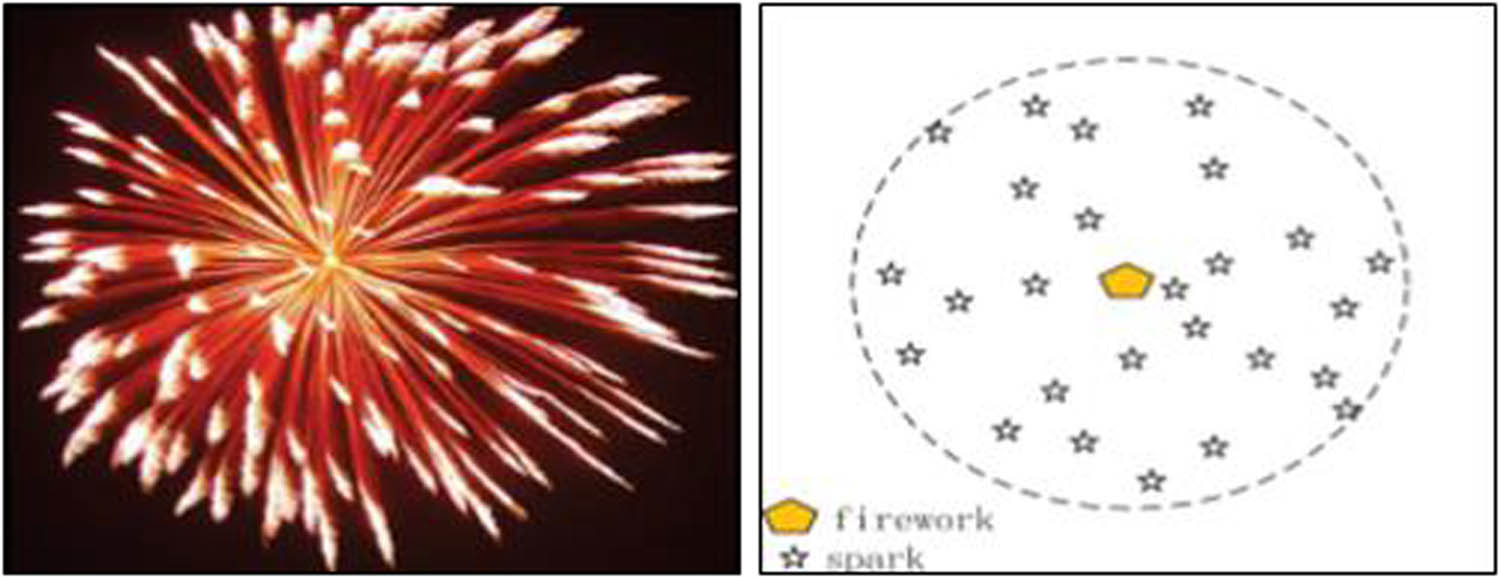
Firework search algorithm.
The general procedure of FWA can be described as follows [19]: it first randomly generates an initial population that contains N fireworks. It then computes their fitness values. The number of sparks and the explosion (explosion amplitude) range are determined by evaluating each firework. The new populations were obtained from exploding the previous fireworks and applying a local search on each one. The amplitude makes sure that the space between the local and global optimum is balanced. As a result, the diversity is maintained, and the chances of escaping from local minima are increased. Furthermore, FWA applies a mutation operator, which is known as Gaussian mutation, and a selection scheme that iteratively chooses a subset of the whole population [20]. The details of each step in FWA are explained as follows:
Explosion operator: An explosion operator is applied to select multiple sparks from each firework in fireworks. This operator can be calculated by the following equation:
(1)where
(2)where
To specify the displacement on every dimension in a firework, the aforementioned parameters are utilized as described in the following equation:
(3)where
Mutation operator: The mutation operator is applied to the current individual. Let
(4)where RG (1, 1) is a random number obtained from the Gaussian distribution.
Mapping rule: This rule guarantees that all solutions in a population are kept in an accepted domain. It makes sure that the resulting solutions after applying any FWA operation will be within the set of feasible solutions. This rule makes use of the modular operation as stated in the following equation:
(5)where
Selection method: The selection method might be required to calculate the distance between solutions. To serve this goal, the Euclidean distance measurement could be utilized to find the closest solution, as depicted in the following equation:
where d is the distance, which may be calculated using the Euclidean distance rule, between the two given individuals
One of the approaches that FWA could use for selecting a new population is the classical Roulette Wheel procedure. It depends on
The resulting generation’s diversity can be increased due to maintaining solutions with high distances to each other.
3 The proposed watermarking method
The general outlines of the proposed method are illustrated in Figure 2. It includes several steps for hiding a watermark in a color image [22]. The cover image is split into three color bands, and then, the DWT transform is performed.
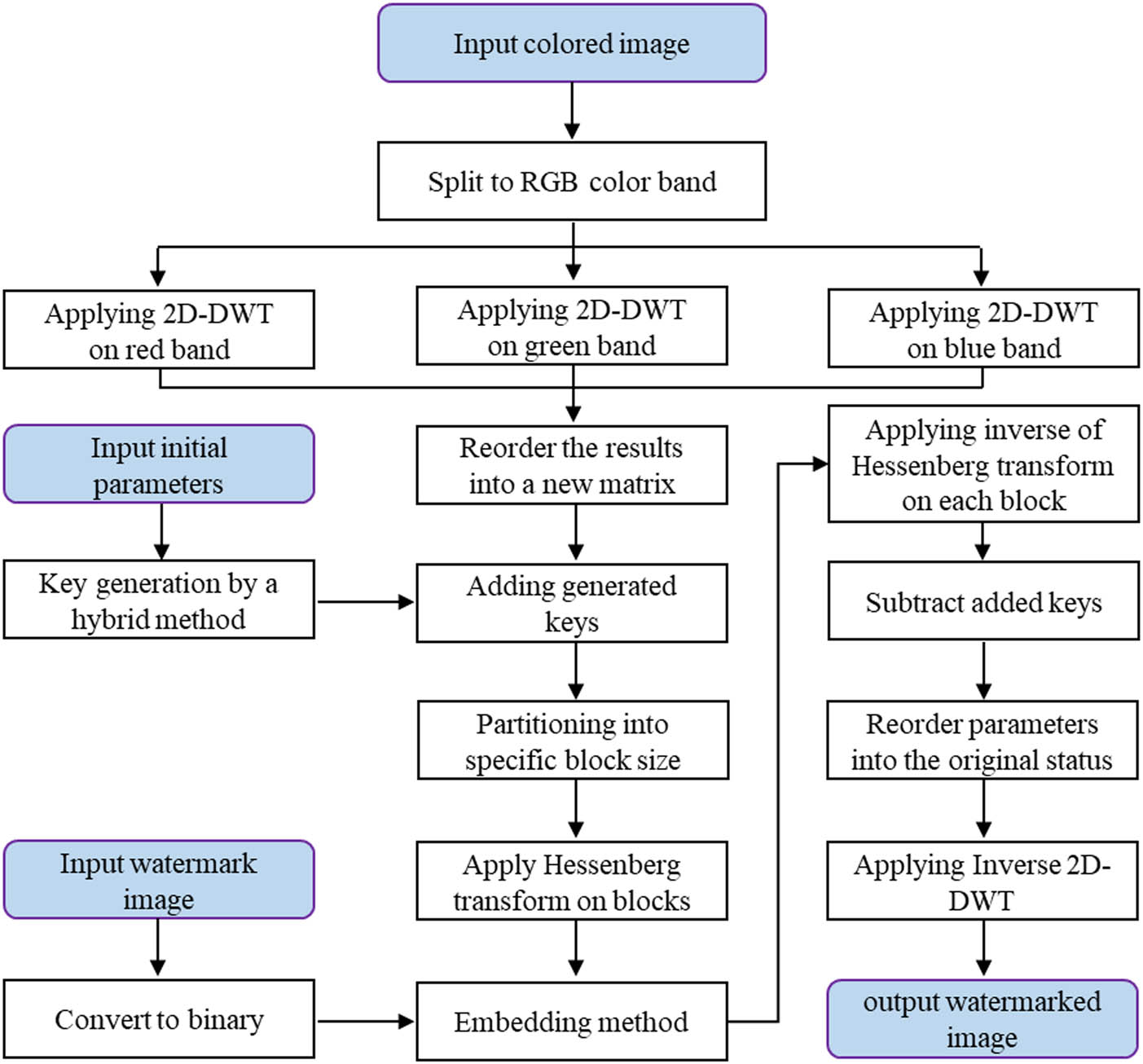
The watermarking method.
The next step involves reordering DWT parameters into a new embedding matrix (EM), and then a generated key is added to this matrix. The resulted matrix is divided into specific block sizes. The next sub-sections explain in detail each step. The optimization process is applied to reduce the percentage of change in the cover image. The cover image is tested with the watermark image (secret image) to find the best set of generated numbers added to the DWT embedding matrix (transformation process). This operation is done by FWA. A set of keys is initially generated, and then, these keys are changed by the operations associated with the algorithm that controls the generation of new keys. Each firework contains several sparks, as presented in the equations. From each solution, a set of sparks is generated by performing the rotation operation for these solutions, as shown in Figure 3.
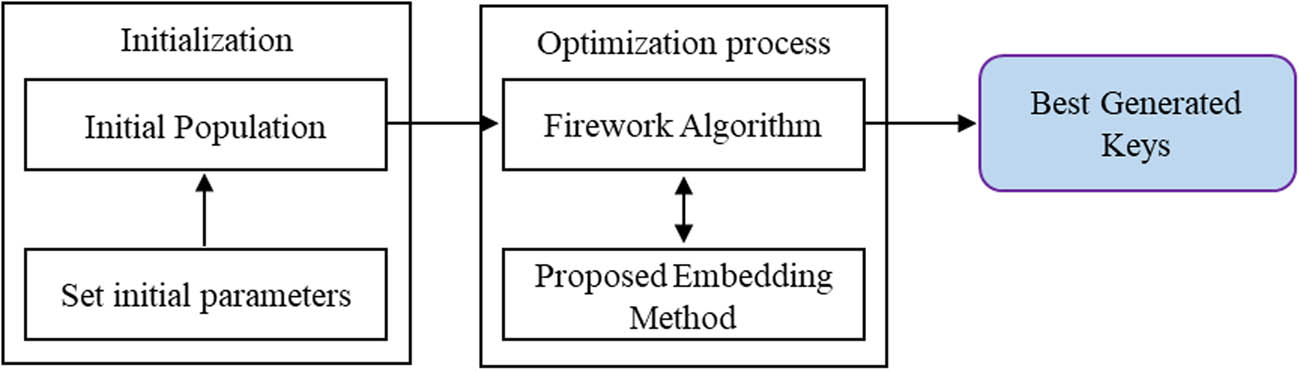
The optimization stage of the FWA.
3.1 Split to RGB color band
In this step, a color image is split into three color bands (RGB) [23], as shown in Figure 4. Each of these bands is used in the hiding procedure.
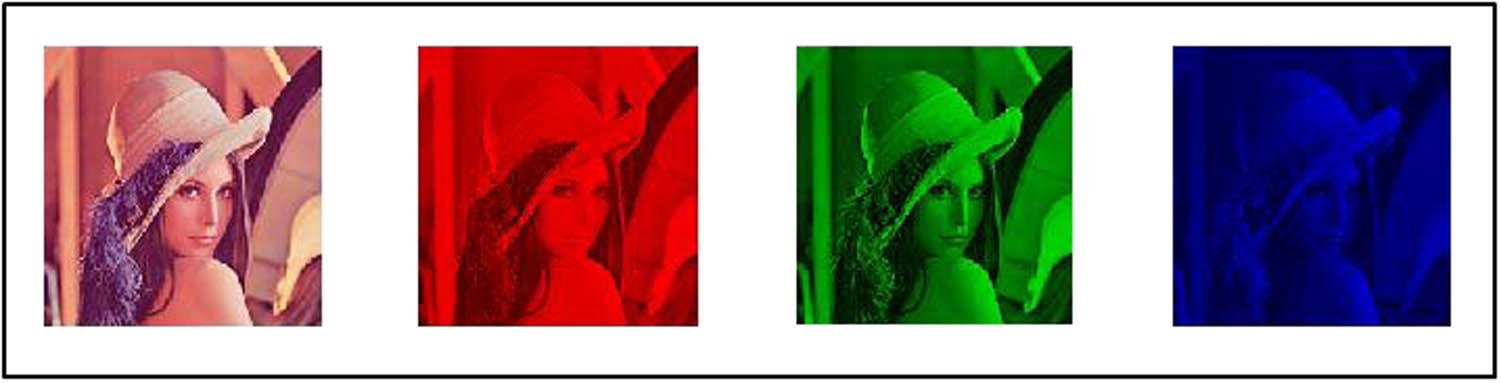
The splitting of the color image.
3.2 Applying 2D-DWT
In this step, the 2D-DWT procedure is applied to the three-color bands. The result of this conversion will be (high–high, high–low, low–high, and low–low) for each color band, as shown in Figure 5.
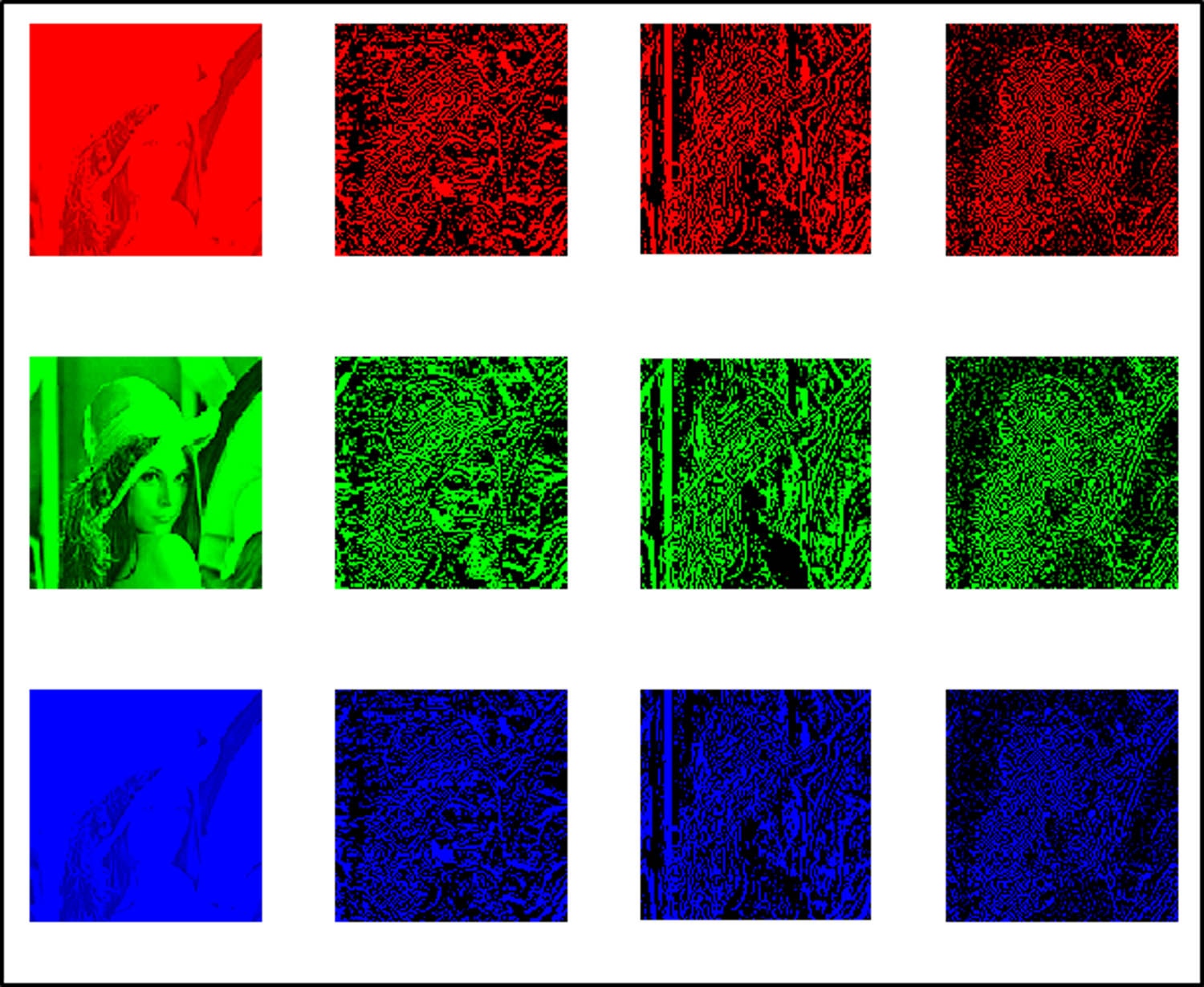
The 2D-DWT of the three-color band.
3.3 Reordering DWT parameters
After the conversion process, a new matrix (embedding matrix) is formed by taking all the conversion parameters except the low–low band, which retains the basic characteristics of the image. As a result, the new matrix consists of the merge of the three conversion parameters high–high, low–high, and high–low for the red band as a first row, the three conversion parameters of the green band as a second row, and the three conversion parameters of blue as a third row, as shown in Figure 6 [24,25,26,27,28]. The minimum value in the embedding matrix is found, and its absolute value is added to all parameters to process the negative values, i.e., all values will be positive.
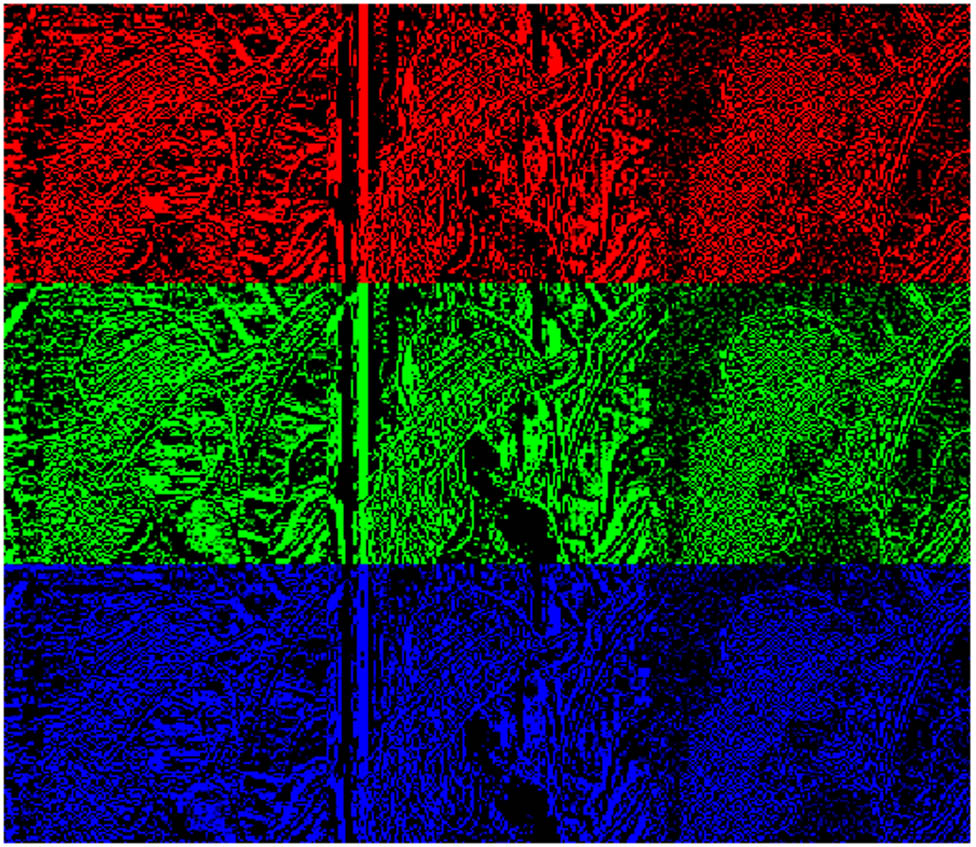
Embedding matrix.
3.4 Key generation
Two chaotic map methods, namely Gaussian map and exponential map, are used for the key generation process to produce numbers that will be added to the embedding matrix. The generated numbers are equal to the number of parameters in the embedding matrix. The initial parameters of these chaotic map functions are carefully selected later through the optimization process. The parameters of FWA are as follows: population size (N = 100), y
min = 3, y
max = 50, A
i
= 40, and mutation spark number
3.5 Partitioning embedding matrix
The embedding matrix is partitioned into blocks with a specific size, such as 4 × 4. Each block contains secret information (secret bit). The Hessenberg transform is applied on each block in the next stage, as shown in Figure 7.
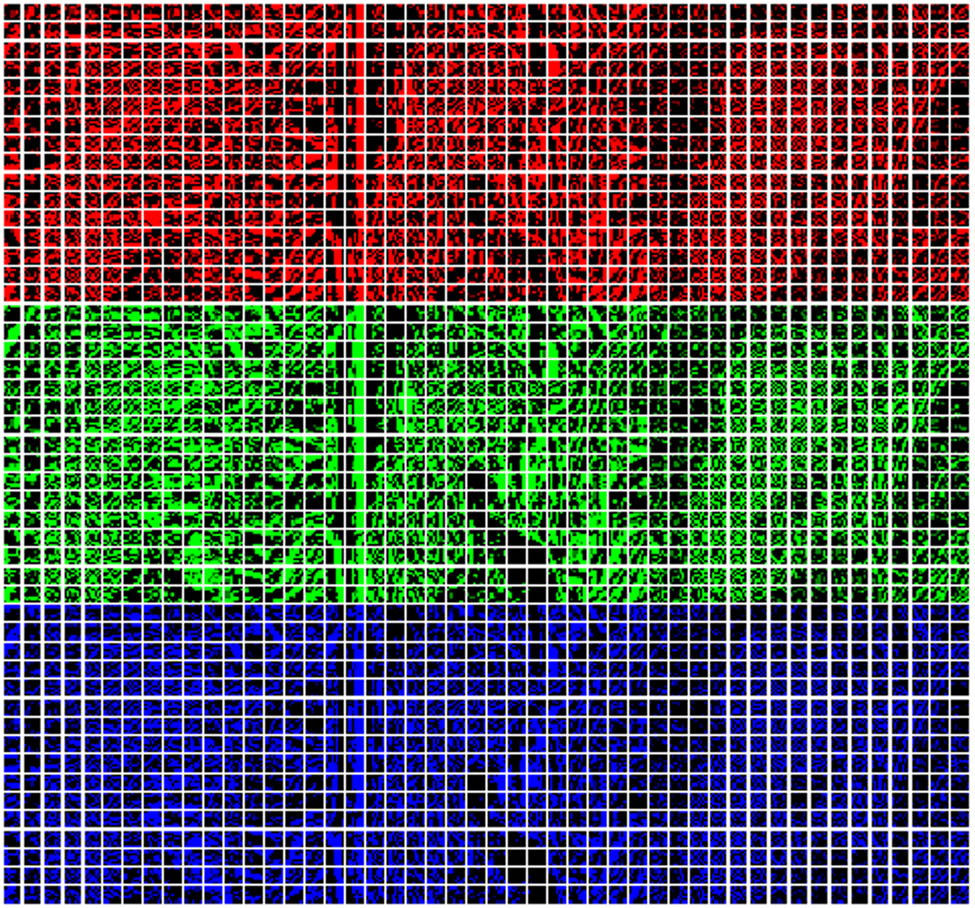
Embedding matrix partitioning.
3.6 Applying Hessenberg transform
Hessenberg transformation (factorization) is applied to each block that was partitioned in the previous step. The result of applying this transformation will be two matrices called P-matrix and H-matrix, as shown in Table 1. The embedding process will only use H-matrix for embedding.
Hessenberg factorization example
| Block number samples | P-matrix | H-matrix | |||||||||
|---|---|---|---|---|---|---|---|---|---|---|---|
| 162.000 | 176.000 | 176.500 | 178.000 | 1.000 | 0.000 | 0.000 | 0.000 | 162.000 | −301.253 | 44.346 | −33.049 |
| 157.500 | 128.000 | 127.500 | 125.000 | 0.000 | −0.420 | 0.803 | −0.423 | −375.364 | 602.987 | −89.929 | 70.669 |
| 231.500 | 235.500 | 235.500 | 233.500 | 0.000 | −0.617 | −0.594 | −0.516 | 0.000 | 46.591 | −6.587 | 4.526 |
| 250.000 | 234.500 | 234.500 | 235.000 | 0.000 | −0.666 | 0.044 | 0.745 | 0.000 | 0.000 | −0.291 | 2.101 |
3.7 Embedding method
The embedding method involves converting the secret information (watermark image) into a vector of binary numbers [29,30]. Each binary number (bit) is embedded into one block using the following steps: first, specify one position in H-matrix such as (4,4); second, get the sign of numbers; third, get the integer value of the number; and fourth, get the digit after the floating point and check if it is odd or even. If it is odd and the secret bit is one or even and the secret bit is zero, do nothing. The change is applied when the secret bit is one and the selected digit is even. This is modified to be odd by adding one to it in the same option when the secret bit is zero, and the selected digit is odd. It will be modified by subtracting one from it to be even.
3.8 The inverse of Hessenberg transform
The inverse Hessenberg transform is applied on the P-matrix and the modified H-matrix by multiplying the P-matrix with the modified H-matrix, and the result is multiplied by the transpose of the P-matrix.
3.9 Reorder modifying parameters
The modified embedding matrix is first subtracted from the added key (generated numbers). The minimum value that was added to all blocks is subtracted before applying the inverse DWT (IDWT). The matrix is portioned into 3 × 3 sub-matrices representing the DWT parameters for each color band. The three sub-matrices are in the first row for the red band. The three sub-matrices are in the second row for the green band, and the three sub-matrices are in the third row for the blue band, respectively. The IDWT is applied on the low–low parameters and the three modified high–low, low–high, and high–high parameters and produced a red-color band. Similarly, the same procedure is applied to the other parameters to the produced green-color band and blue-color band.
3.10 Extraction of secret information
To perform the extraction process, the same steps in embedding are applied. It is started with splitting the image into three color bands and applying 2D-DWT on the three color bands. It then reorders parameters into the embedding matrix, adds minimum value, and adds the generated numbers. It is followed by partitioning the embedding matrix into blocks (4 × 4) and applying Hessenberg transform on the block that gets the digit after the floating point. Finally, checking if it is odd for secret bit one and even for secret bit zero and collecting secret bit into array represent watermark image.
4 Experiment and results
The experimental results analyze the performance of the proposed algorithm by comparing it with the non-optimization hiding approach. Six standard images, namely house, car, Lenna, peppers, woman, and Baboon, were used as cover images. In addition, six binary images were used as a logo for watermarking, as shown in Figure 8.
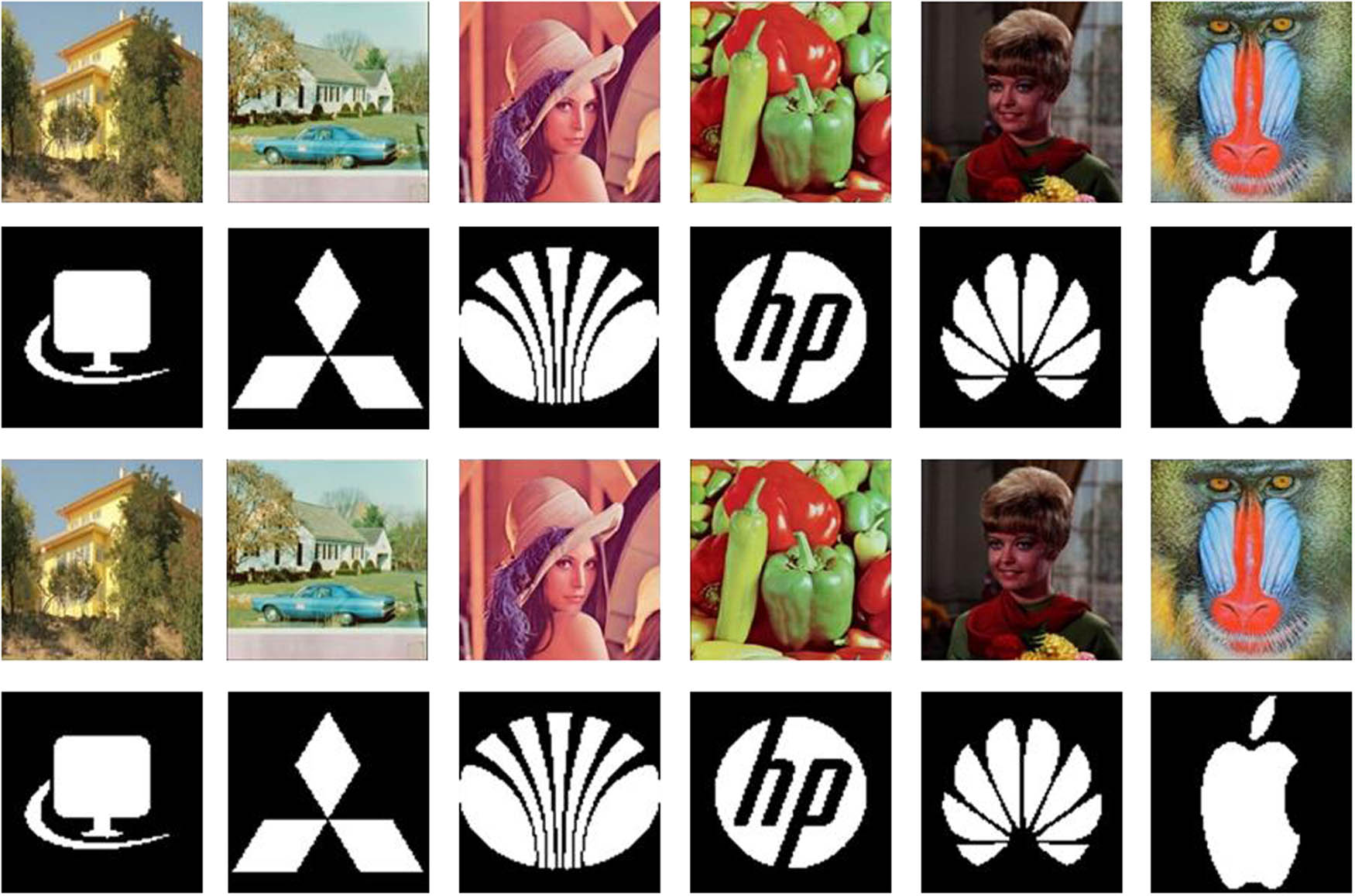
Images and watermark sets.
To test the effect of the optimization, the FWA process was used to reduce the change in the cover image by keeping the blocks without changing as much as possible. This test was applied on all cover images with all secret images. Table 2 shows the optimization process’s changing rate on the cover images (six images) with all embedding watermark images (six watermarks).
The changing rate in the cover image
| Wmk →Image | 1 | 2 | 3 | 4 | 5 | 6 | ||||||
|---|---|---|---|---|---|---|---|---|---|---|---|---|
| Per Chg | Use FWA | Per Chg | Use FWA | Per Chg | Use FWA | Per Chg | Use FWA | Per Chg | Use FWA | Per Chg | Use FWA | |
| 1 | 0.54 | 0.44 | 0.49 | 0.38 | 0.48 | 0.38 | 0.52 | 0.42 | 0.44 | 0.36 | 0.57 | 0.45 |
| 2 | 0.58 | 0.47 | 0.47 | 0.37 | 0.49 | 0.38 | 0.52 | 0.43 | 0.45 | 0.36 | 0.60 | 0.47 |
| 3 | 0.54 | 0.44 | 0.55 | 0.43 | 0.57 | 0.45 | 0.53 | 0.44 | 0.59 | 0.48 | 0.56 | 0.44 |
| 4 | 0.58 | 0.47 | 0.59 | 0.47 | 0.51 | 0.40 | 0.52 | 0.43 | 0.49 | 0.39 | 0.59 | 0.46 |
| 5 | 0.52 | 0.42 | 0.47 | 0.37 | 0.55 | 0.43 | 0.49 | 0.40 | 0.50 | 0.40 | 0.49 | 0.39 |
| 6 | 0.59 | 0.47 | 0.50 | 0.40 | 0.50 | 0.39 | 0.53 | 0.43 | 0.50 | 0.40 | 0.58 | 0.46 |
| Average | 0.56 | 0.45 | 0.51 | 0.40 | 0.52 | 0.40 | 0.52 | 0.42 | 0.49 | 0.40 | 0.56 | 0.45 |
Table 2 shows the percentage of change in different cover images. It can be noticed that the proposed method provides an improvement between 9 and 12% over the non-optimization method.
Two measurements are applied to the cover images after embedding information to examine the quality of embedding. These measurements are MSE and PSNR, which are used to find the degradation in quality. A small MSE value means good quality, whereas a high PSNR value means a good-quality index [30]. The recorded results show that the use of optimization increases the quality of images as the change rate in the cover medium is reduced. Although the results of the non-optimization method are promising, the FWA-based method is even better in terms of MSE and PSNR, as shown in Table 3. The value of the MSE is reduced by about 0.01, and the value of the PSNR is increased by about 1.25 on average, as shown in Figure 9.
Images and watermark sets
| Image | MSE | PSNR | ||
|---|---|---|---|---|
| Non-optimization method | FWA method | Non-optimization method | FWA method | |
| 1 | 0.04719 | 0.03539 | 37.32736 | 38.57674 |
| 2 | 0.03637 | 0.02728 | 38.45764 | 39.70703 |
| 3 | 0.03638 | 0.02728 | 38.45690 | 39.70629 |
| 4 | 0.05154 | 0.03865 | 36.94413 | 38.19351 |
| 5 | 0.03748 | 0.02811 | 38.32698 | 39.57637 |
| 6 | 0.03600 | 0.02700 | 38.50226 | 39.75165 |
| Average | 0.04083 | 0.03062 | 38.00254 | 39.25193 |
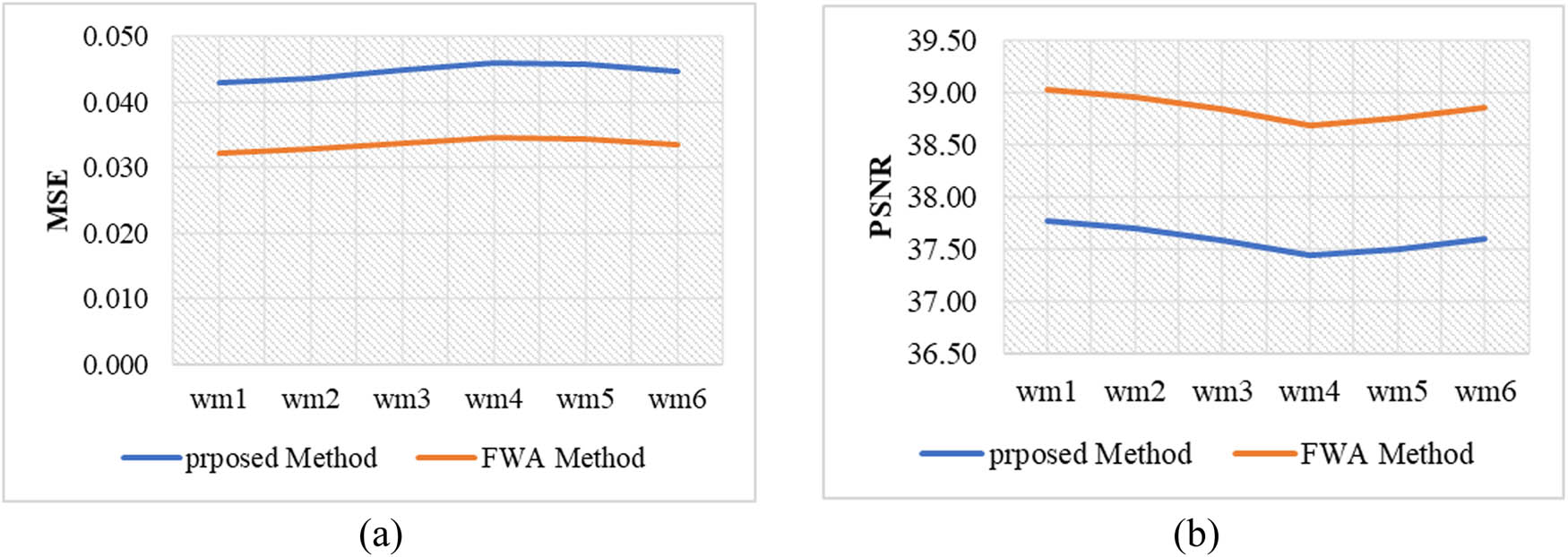
Images and watermarks comparative results. (a) The MSE results. (b) The PSNR results.
Table 4 shows the retrieval percentages after applying different types of attacks, namely JPG compression, scaling, rotation, Gaussian noise, histogram equalization, and image adjustment.
Watermark attacks on proposed methods
| Watermark image | 1 | 2 | 3 | 4 | 5 | 6 | ||||||
|---|---|---|---|---|---|---|---|---|---|---|---|---|
| Attack | Non-optimization method | FWA method | Non-optimization method | FWA method | Non-optimization method | FWA method | Non-optimization method | FWA method | Non-optimization method | FWA method | Non-optimization method | FWA method |
| JPG compression | 96.23 | 98.12 | 96.23 | 98.12 | 96.23 | 98.12 | 96.23 | 98.12 | 96.24 | 98.12 | 96.23 | 98.11 |
| Scaling | 98.31 | 99.01 | 98.31 | 99.00 | 98.31 | 99.00 | 98.31 | 99.00 | 98.31 | 99.00 | 98.32 | 99.01 |
| Rotation | 95.54 | 97.62 | 95.54 | 97.62 | 95.54 | 97.62 | 95.54 | 97.62 | 95.54 | 97.62 | 95.54 | 97.62 |
| Gaussian noise | 94.85 | 95.24 | 94.84 | 95.24 | 94.85 | 95.25 | 94.85 | 95.25 | 94.85 | 95.25 | 94.85 | 95.24 |
| Histogram equalization | 92.77 | 94.85 | 92.77 | 94.84 | 92.77 | 94.85 | 92.77 | 94.85 | 92.77 | 94.84 | 92.76 | 94.84 |
| Image adjustment | 93.16 | 93.96 | 93.17 | 93.96 | 93.17 | 93.95 | 93.17 | 93.95 | 93.17 | 93.95 | 93.17 | 93.95 |
The results of the non-optimization method are promising; nevertheless, the FWA-based method provides better results in persisting against all the tested attacks. The improvement percentages of the FWA-based method over the non-optimization method in terms of persisting all attacks are listed in Table 5.
Improving percentages of FWA-based method over non-optimization method
| Attack | Image 1 | Image 2 | Image 3 | Image 4 | Image 5 | Image 6 |
|---|---|---|---|---|---|---|
| JPG compression | 0.020 | 0.020 | 0.020 | 0.020 | 0.020 | 0.020 |
| Scaling | 0.007 | 0.007 | 0.007 | 0.007 | 0.007 | 0.007 |
| Rotation | 0.022 | 0.022 | 0.022 | 0.022 | 0.022 | 0.022 |
| Gaussian noise | 0.004 | 0.004 | 0.004 | 0.004 | 0.004 | 0.004 |
| Histogram equalization | 0.022 | 0.022 | 0.022 | 0.022 | 0.022 | 0.022 |
| Image adjustment | 0.009 | 0.008 | 0.008 | 0.008 | 0.008 | 0.008 |
Table 5 shows the percentage of improvement in retrieval secret image when adding the optimization stage using the FWA algorithm. The table shows the enhancement results at different rates as compared with the traditional method. It is for all the six images used in the examination. This percentage is according to the types of possible attacks, such as JPG compression, scaling, rotation, Gaussian noise, histogram equalization, and image adjustment.
5 Conclusion
Data hiding and watermarking are highly challenging issues in cyber security that attracted many researchers. This article proposed an optimized method for embedding a watermark in a host image. The DWT is applied, and four bands are obtained. A new square matrix includes all bands except the low–low band and some keys. These keys are generated using a hybrid approach, combining two chaotic functions, namely Gaussian and exponential maps. The FWA is used, as an optimization method, to select the best set of the initial values for the generated keys. Using an optimization procedure is to obtain keys that require the lowest possible change rate in the cover and increase the image quality scale. The embedding process involves the use of the Hessenberg transform, which generates two matrices, P and H. A certain location within the H-matrix for each block is used for embedding a secret value. The same operations are performed in reverse order to retrieve the original image. The MSE and PSNR measurements are utilized to evaluate the overall performance of the proposed method. In addition, the robustness of the watermark is computed by applying several attacks. The experimental results show that the proposed system obtained a high-retrieval rate compared to the non-optimization approach. Although the recorded results in this article were promising, there is room for further improvements. One possible improvement includes examining other matrix decomposition techniques, such as SVD, and performing a comparison between them to determine which one is the best. Similarly, selecting different chaotic-based key generators can also be considered. In addition, it will be interesting to test the performance of the suggested method of another type of multimedia, such as video.
Acknowledgments
We would like to express our heartfelt gratitude to the people in the Department of Computer Science at Mustansiriyah University in Baghdad, Iraq, for supporting this research. In addition, the authors would like to thank the Center of Intelligent and Autonomous Systems (CIAS), Faculty of Computer Science and Information Technology, University Tun Hussein Onn Malaysia (UTHM) for supporting this work.
-
Funding information: Communication of this research is made possible through monetary assistance by Universiti Tun Hussein Onn Malaysia and the UTHM Publisher’s Office via Publication Fund E15216.
-
Conflict of interest: The authors have no conflicts of interest to declare. The authors certify that the submission is an original work and is not under review at any other publication. All authors have seen and agree with the contents of the manuscript and there is no financial interest to report.
-
Data availability statement: The used dataset of this research is available online and has a proper citation within the paper contents.
References
[1] Ismael HA, Abbas JM, Mostafa SA, Fadel AH. An enhanced fireworks algorithm to generate prime key for multiple users in fingerprinting domain. Bull Electr Eng Inform. 2021;10(1):337–43.10.11591/eei.v10i1.2521Suche in Google Scholar
[2] Ali RR, Mohamad KM. RX_myKarve carving framework for reassembling complex fragmentations of JPEG images. J King Saud UnivComputer Inf Sci. 2021;33(1):21–32.10.1016/j.jksuci.2018.12.007Suche in Google Scholar
[3] Ali RR, Mohamad KM, Jamel SAPIEE, Khalid SKA. A review of digital forensics methods for JPEG file carving. J Theor Appl Inf Technol. 2018;96(17):5841–56.Suche in Google Scholar
[4] Abduldaim AM, Waleed J, Mazher AN. An efficient scheme of digital image watermarking based on Hessenberg factorization and DWT. 2020 International Conference on Computer Science and Software Engineering (CSASE). Duhok, Iraq: IEEE; 2020. p. 180–5.10.1109/CSASE48920.2020.9142096Suche in Google Scholar
[5] Sari CA, Sari IP, Rachmawanto EH, Proborini E, Ali RR, Rizqa I. Papaya Fruit Type Classification using LBP Features Extraction and Naive Bayes Classifier. 2020 international seminar on application for technology of information and communication (iSemantic). IEEE; 2020. p. 28–33.10.1109/iSemantic50169.2020.9234240Suche in Google Scholar
[6] Ali RR, Mohamad KM, Jamel S, Khalid SKA. Classification of JPEG files by using extreme learning machine. International Conference on Soft Computing and Data Mining. Cham: Springer; 2018, February. p. 33–42.10.1007/978-3-319-72550-5_4Suche in Google Scholar
[7] Hussain M, Wahab AWA, Idris YIB, Ho AT, Jung KH. Image steganography in spatial domain: A survey. Signal Process Image Commun. 2018;65:46–66.10.1016/j.image.2018.03.012Suche in Google Scholar
[8] Mohammed AA, Salih DA, Saeed AM, Kheder MQ. An imperceptible semi-blind image watermarking scheme in DWT-SVD domain using a zigzag embedding technique. Multimed Tools Appl. 2020;79(43):32095–118.10.1007/s11042-020-09694-9Suche in Google Scholar
[9] Abduldaim AM, Sabri RI. The effectiveness of Lud on digital image watermarking based on sugeno fuzzy inference system. Int J Latest Eng Manag Res (IJLEMR). 2019;4(7):53–60.Suche in Google Scholar
[10] Kokabifar E, Loghmani GB, Karbassi SM. Nearest matrix with prescribed eigenvalues and its applications. J Comput Appl Math. 2016;298:53–63.10.1016/j.cam.2015.11.031Suche in Google Scholar
[11] Su LW. Computational nanophotonic design: frameworks and applications. Ph.D. Dissertation. Department of Applied Physics, Stanford University, Stanford US; 2020.Suche in Google Scholar
[12] Thajeel SA, Kadhim LM, Abdlateef SA. A new color image watermarking technique using multiple decompositions. J Theor Appl Inf Technol. 2017;95(10):2323–31.Suche in Google Scholar
[13] Liu Y, Tang S, Liu R, Zhang L, Ma Z. Secure and robust digital image watermarking scheme using logistic and RSA encryption. Expert Syst Appl. 2018;97:95–105.10.1016/j.eswa.2017.12.003Suche in Google Scholar
[14] Sridhar B. An investigation of different video watermarking techniques. Int J Smart Sens Intell Syst. 2017;10(2):387–406.10.21307/ijssis-2017-217Suche in Google Scholar
[15] Azizan AH, Mostafa SA, Mustapha A, Foozy CFM, Wahab MHA, Mohammed MA, et al. A machine learning approach for improving the performance of network intrusion detection systems. Ann Emerg Technol Comput (AETiC). 2021;5(5):201–8.10.33166/AETiC.2021.05.025Suche in Google Scholar
[16] Bhattacharjee S, Kim CH, Park HG, Prakash D, Madusanka N, Cho NH, et al. Multi-features classification of prostate carcinoma observed in histological sections: analysis of wavelet-based texture and colour features. Cancers. 2019;11(12):1937.10.3390/cancers11121937Suche in Google Scholar PubMed PubMed Central
[17] Huang Ruihao. Novel computational methods for eigenvalue problems. Dissertation. Michigan Technological University, Houghton, Michigan, United States; 2019.10.37099/mtu.dc.etdr/929Suche in Google Scholar
[18] Abdelfattah A, Anzt H, Boman EG, Carson E, Cojean T, Dongarra J, et al. A survey of numerical methods utilizing mixed precision arithmetic. arXiv Prepr arXiv. 2020;2007:06674.Suche in Google Scholar
[19] Tan Y. Recent developments of fireworks algorithms. Handbook of research on fireworks algorithms and swarm intelligence. Peking University: IGI Global; 2020. p. 1–41.10.4018/978-1-7998-1659-1.ch001Suche in Google Scholar
[20] Gholizadeh S, Milany A. An improved fireworks algorithm for discrete sizing optimization of steel skeletal structures. Eng Optim. 2018;50(11):1829–49.10.1080/0305215X.2017.1417402Suche in Google Scholar
[21] Chen Y, He F, Zeng X, Li H, Liang Y. The explosion operation of fireworks algorithm boosts the coral reef optimization for multimodal medical image registration. Eng Appl Artif Intell. 2021;102:104252.10.1016/j.engappai.2021.104252Suche in Google Scholar
[22] Sucipto A, Zyen AK, Wahono BB, Tamrin T, Mulyo H, Ali RR. Linear discriminant analysis for apples fruit variety based on color feature extraction. 2021 International Seminar on Application for Technology of Information and Communication (iSemantic). IEEE; 2021. p. 184–9.10.1109/iSemantic52711.2021.9573200Suche in Google Scholar
[23] Yusuf DM, Rachmawanto EH, Sari CA, Ali RR. Dual encryption method for file security. 2019 4th International Conference on Information Technology, Information Systems and Electrical Engineering (ICITISEE). Yogyakarta, Indonesia: IEEE; 2019. p. 222–7.10.1109/ICITISEE48480.2019.9003909Suche in Google Scholar
[24] Susanto A, Rachmawanto EH, Sari CA, Ali RR, Mulyono IUW. Dual security method for digital image using HBV encryption and least significant bit steganography. J Phys: Conf Ser. 2019;1201(1):012024. IOP Publishing.10.1088/1742-6596/1201/1/012024Suche in Google Scholar
[25] Mohammed MA, Al-Khateeb B, Rashid AN, Ibrahim DA, Abd Ghani MK, Mostafa SA. Neural network and multi-fractal dimension features for breast cancer classification from ultrasound images. Computers Electr Eng. 2018;70:871–82.10.1016/j.compeleceng.2018.01.033Suche in Google Scholar
[26] Khaleefah SH, Mostafa SA, Mustapha A, Nasrudin MF. The ideal effect of Gabor filters and Uniform Local Binary Pattern combinations on deformed scanned paper images. J King Saud Univ-Computer Inf Sci. 2021;33(10):1219–30.10.1016/j.jksuci.2019.07.012Suche in Google Scholar
[27] Aswad FM, Salman I, Mostafa SA. An optimization of color halftone visual cryptography scheme based on Bat algorithm. J Intell Syst. 2021;30(1):816–35.10.1515/jisys-2021-0042Suche in Google Scholar
[28] Khaleefah SH, Mostafa SA, Mustapha A, Darman R. A general framework of multi-agent features extraction operators for deformed images identification. 2018 International Symposium on Agent, Multi-Agent Systems and Robotics (ISAMSR). IEEE; 2018. p. 1–5.10.1109/ISAMSR.2018.8540560Suche in Google Scholar
[29] Sara U, Akter M, Uddin MS. Image quality assessment through FSIM, SSIM, MSE and PSNR—a comparative study. J Computer Commun. 2019;7(3):8–18.10.4236/jcc.2019.73002Suche in Google Scholar
[30] Elameer AS, Jaber MM, Abd SK. Radiography image analysis using cat swarm optimized deep belief networks. J Intell Syst. 2022;31(1):40–54.10.1515/jisys-2021-0172Suche in Google Scholar
© 2022 Methaq Talib Gaata et al., published by De Gruyter
This work is licensed under the Creative Commons Attribution 4.0 International License.
Artikel in diesem Heft
- Research Articles
- Construction of 3D model of knee joint motion based on MRI image registration
- Evaluation of several initialization methods on arithmetic optimization algorithm performance
- Application of visual elements in product paper packaging design: An example of the “squirrel” pattern
- Deep learning approach to text analysis for human emotion detection from big data
- Cognitive prediction of obstacle's movement for reinforcement learning pedestrian interacting model
- The application of neural network algorithm and embedded system in computer distance teach system
- Machine translation of English speech: Comparison of multiple algorithms
- Automatic control of computer application data processing system based on artificial intelligence
- A secure framework for IoT-based smart climate agriculture system: Toward blockchain and edge computing
- Application of mining algorithm in personalized Internet marketing strategy in massive data environment
- On the correction of errors in English grammar by deep learning
- Research on intelligent interactive music information based on visualization technology
- Extractive summarization of Malayalam documents using latent Dirichlet allocation: An experience
- Conception and realization of an IoT-enabled deep CNN decision support system for automated arrhythmia classification
- Masking and noise reduction processing of music signals in reverberant music
- Cat swarm optimization algorithm based on the information interaction of subgroup and the top-N learning strategy
- State feedback based on grey wolf optimizer controller for two-wheeled self-balancing robot
- Research on an English translation method based on an improved transformer model
- Short-term prediction of parking availability in an open parking lot
- PUC: parallel mining of high-utility itemsets with load balancing on spark
- Image retrieval based on weighted nearest neighbor tag prediction
- A comparative study of different neural networks in predicting gross domestic product
- A study of an intelligent algorithm combining semantic environments for the translation of complex English sentences
- IoT-enabled edge computing model for smart irrigation system
- A study on automatic correction of English grammar errors based on deep learning
- A novel fingerprint recognition method based on a Siamese neural network
- A hidden Markov optimization model for processing and recognition of English speech feature signals
- Crime reporting and police controlling: Mobile and web-based approach for information-sharing in Iraq
- Convex optimization for additive noise reduction in quantitative complex object wave retrieval using compressive off-axis digital holographic imaging
- CRNet: Context feature and refined network for multi-person pose estimation
- Improving the efficiency of intrusion detection in information systems
- Research on reform and breakthrough of news, film, and television media based on artificial intelligence
- An optimized solution to the course scheduling problem in universities under an improved genetic algorithm
- An adaptive RNN algorithm to detect shilling attacks for online products in hybrid recommender system
- Computing the inverse of cardinal direction relations between regions
- Human-centered artificial intelligence-based ice hockey sports classification system with web 4.0
- Construction of an IoT customer operation analysis system based on big data analysis and human-centered artificial intelligence for web 4.0
- An improved Jaya optimization algorithm with ring topology and population size reduction
- Review Articles
- A review on voice pathology: Taxonomy, diagnosis, medical procedures and detection techniques, open challenges, limitations, and recommendations for future directions
- An extensive review of state-of-the-art transfer learning techniques used in medical imaging: Open issues and challenges
- Special Issue: Explainable Artificial Intelligence and Intelligent Systems in Analysis For Complex Problems and Systems
- Tree-based machine learning algorithms in the Internet of Things environment for multivariate flood status prediction
- Evaluating OADM network simulation and an overview based metropolitan application
- Radiography image analysis using cat swarm optimized deep belief networks
- Comparative analysis of blockchain technology to support digital transformation in ports and shipping
- IoT network security using autoencoder deep neural network and channel access algorithm
- Large-scale timetabling problems with adaptive tabu search
- Eurasian oystercatcher optimiser: New meta-heuristic algorithm
- Trip generation modeling for a selected sector in Baghdad city using the artificial neural network
- Trainable watershed-based model for cornea endothelial cell segmentation
- Hessenberg factorization and firework algorithms for optimized data hiding in digital images
- The application of an artificial neural network for 2D coordinate transformation
- A novel method to find the best path in SDN using firefly algorithm
- Systematic review for lung cancer detection and lung nodule classification: Taxonomy, challenges, and recommendation future works
- Special Issue on International Conference on Computing Communication & Informatics
- Edge detail enhancement algorithm for high-dynamic range images
- Suitability evaluation method of urban and rural spatial planning based on artificial intelligence
- Writing assistant scoring system for English second language learners based on machine learning
- Dynamic evaluation of college English writing ability based on AI technology
- Image denoising algorithm of social network based on multifeature fusion
- Automatic recognition method of installation errors of metallurgical machinery parts based on neural network
- An FCM clustering algorithm based on the identification of accounting statement whitewashing behavior in universities
- Emotional information transmission of color in image oil painting
- College music teaching and ideological and political education integration mode based on deep learning
- Behavior feature extraction method of college students’ social network in sports field based on clustering algorithm
- Evaluation model of multimedia-aided teaching effect of physical education course based on random forest algorithm
- Venture financing risk assessment and risk control algorithm for small and medium-sized enterprises in the era of big data
- Interactive 3D reconstruction method of fuzzy static images in social media
- The impact of public health emergency governance based on artificial intelligence
- Optimal loading method of multi type railway flatcars based on improved genetic algorithm
- Special Issue: Evolution of Smart Cities and Societies using Emerging Technologies
- Data mining applications in university information management system development
- Implementation of network information security monitoring system based on adaptive deep detection
- Face recognition algorithm based on stack denoising and self-encoding LBP
- Research on data mining method of network security situation awareness based on cloud computing
- Topology optimization of computer communication network based on improved genetic algorithm
- Implementation of the Spark technique in a matrix distributed computing algorithm
- Construction of a financial default risk prediction model based on the LightGBM algorithm
- Application of embedded Linux in the design of Internet of Things gateway
- Research on computer static software defect detection system based on big data technology
- Study on data mining method of network security situation perception based on cloud computing
- Modeling and PID control of quadrotor UAV based on machine learning
- Simulation design of automobile automatic clutch based on mechatronics
- Research on the application of search algorithm in computer communication network
- Special Issue: Artificial Intelligence based Techniques and Applications for Intelligent IoT Systems
- Personalized recommendation system based on social tags in the era of Internet of Things
- Supervision method of indoor construction engineering quality acceptance based on cloud computing
- Intelligent terminal security technology of power grid sensing layer based upon information entropy data mining
- Deep learning technology of Internet of Things Blockchain in distribution network faults
- Optimization of shared bike paths considering faulty vehicle recovery during dispatch
- The application of graphic language in animation visual guidance system under intelligent environment
- Iot-based power detection equipment management and control system
- Estimation and application of matrix eigenvalues based on deep neural network
- Brand image innovation design based on the era of 5G internet of things
- Special Issue: Cognitive Cyber-Physical System with Artificial Intelligence for Healthcare 4.0.
- Auxiliary diagnosis study of integrated electronic medical record text and CT images
- A hybrid particle swarm optimization with multi-objective clustering for dermatologic diseases diagnosis
- An efficient recurrent neural network with ensemble classifier-based weighted model for disease prediction
- Design of metaheuristic rough set-based feature selection and rule-based medical data classification model on MapReduce framework
Artikel in diesem Heft
- Research Articles
- Construction of 3D model of knee joint motion based on MRI image registration
- Evaluation of several initialization methods on arithmetic optimization algorithm performance
- Application of visual elements in product paper packaging design: An example of the “squirrel” pattern
- Deep learning approach to text analysis for human emotion detection from big data
- Cognitive prediction of obstacle's movement for reinforcement learning pedestrian interacting model
- The application of neural network algorithm and embedded system in computer distance teach system
- Machine translation of English speech: Comparison of multiple algorithms
- Automatic control of computer application data processing system based on artificial intelligence
- A secure framework for IoT-based smart climate agriculture system: Toward blockchain and edge computing
- Application of mining algorithm in personalized Internet marketing strategy in massive data environment
- On the correction of errors in English grammar by deep learning
- Research on intelligent interactive music information based on visualization technology
- Extractive summarization of Malayalam documents using latent Dirichlet allocation: An experience
- Conception and realization of an IoT-enabled deep CNN decision support system for automated arrhythmia classification
- Masking and noise reduction processing of music signals in reverberant music
- Cat swarm optimization algorithm based on the information interaction of subgroup and the top-N learning strategy
- State feedback based on grey wolf optimizer controller for two-wheeled self-balancing robot
- Research on an English translation method based on an improved transformer model
- Short-term prediction of parking availability in an open parking lot
- PUC: parallel mining of high-utility itemsets with load balancing on spark
- Image retrieval based on weighted nearest neighbor tag prediction
- A comparative study of different neural networks in predicting gross domestic product
- A study of an intelligent algorithm combining semantic environments for the translation of complex English sentences
- IoT-enabled edge computing model for smart irrigation system
- A study on automatic correction of English grammar errors based on deep learning
- A novel fingerprint recognition method based on a Siamese neural network
- A hidden Markov optimization model for processing and recognition of English speech feature signals
- Crime reporting and police controlling: Mobile and web-based approach for information-sharing in Iraq
- Convex optimization for additive noise reduction in quantitative complex object wave retrieval using compressive off-axis digital holographic imaging
- CRNet: Context feature and refined network for multi-person pose estimation
- Improving the efficiency of intrusion detection in information systems
- Research on reform and breakthrough of news, film, and television media based on artificial intelligence
- An optimized solution to the course scheduling problem in universities under an improved genetic algorithm
- An adaptive RNN algorithm to detect shilling attacks for online products in hybrid recommender system
- Computing the inverse of cardinal direction relations between regions
- Human-centered artificial intelligence-based ice hockey sports classification system with web 4.0
- Construction of an IoT customer operation analysis system based on big data analysis and human-centered artificial intelligence for web 4.0
- An improved Jaya optimization algorithm with ring topology and population size reduction
- Review Articles
- A review on voice pathology: Taxonomy, diagnosis, medical procedures and detection techniques, open challenges, limitations, and recommendations for future directions
- An extensive review of state-of-the-art transfer learning techniques used in medical imaging: Open issues and challenges
- Special Issue: Explainable Artificial Intelligence and Intelligent Systems in Analysis For Complex Problems and Systems
- Tree-based machine learning algorithms in the Internet of Things environment for multivariate flood status prediction
- Evaluating OADM network simulation and an overview based metropolitan application
- Radiography image analysis using cat swarm optimized deep belief networks
- Comparative analysis of blockchain technology to support digital transformation in ports and shipping
- IoT network security using autoencoder deep neural network and channel access algorithm
- Large-scale timetabling problems with adaptive tabu search
- Eurasian oystercatcher optimiser: New meta-heuristic algorithm
- Trip generation modeling for a selected sector in Baghdad city using the artificial neural network
- Trainable watershed-based model for cornea endothelial cell segmentation
- Hessenberg factorization and firework algorithms for optimized data hiding in digital images
- The application of an artificial neural network for 2D coordinate transformation
- A novel method to find the best path in SDN using firefly algorithm
- Systematic review for lung cancer detection and lung nodule classification: Taxonomy, challenges, and recommendation future works
- Special Issue on International Conference on Computing Communication & Informatics
- Edge detail enhancement algorithm for high-dynamic range images
- Suitability evaluation method of urban and rural spatial planning based on artificial intelligence
- Writing assistant scoring system for English second language learners based on machine learning
- Dynamic evaluation of college English writing ability based on AI technology
- Image denoising algorithm of social network based on multifeature fusion
- Automatic recognition method of installation errors of metallurgical machinery parts based on neural network
- An FCM clustering algorithm based on the identification of accounting statement whitewashing behavior in universities
- Emotional information transmission of color in image oil painting
- College music teaching and ideological and political education integration mode based on deep learning
- Behavior feature extraction method of college students’ social network in sports field based on clustering algorithm
- Evaluation model of multimedia-aided teaching effect of physical education course based on random forest algorithm
- Venture financing risk assessment and risk control algorithm for small and medium-sized enterprises in the era of big data
- Interactive 3D reconstruction method of fuzzy static images in social media
- The impact of public health emergency governance based on artificial intelligence
- Optimal loading method of multi type railway flatcars based on improved genetic algorithm
- Special Issue: Evolution of Smart Cities and Societies using Emerging Technologies
- Data mining applications in university information management system development
- Implementation of network information security monitoring system based on adaptive deep detection
- Face recognition algorithm based on stack denoising and self-encoding LBP
- Research on data mining method of network security situation awareness based on cloud computing
- Topology optimization of computer communication network based on improved genetic algorithm
- Implementation of the Spark technique in a matrix distributed computing algorithm
- Construction of a financial default risk prediction model based on the LightGBM algorithm
- Application of embedded Linux in the design of Internet of Things gateway
- Research on computer static software defect detection system based on big data technology
- Study on data mining method of network security situation perception based on cloud computing
- Modeling and PID control of quadrotor UAV based on machine learning
- Simulation design of automobile automatic clutch based on mechatronics
- Research on the application of search algorithm in computer communication network
- Special Issue: Artificial Intelligence based Techniques and Applications for Intelligent IoT Systems
- Personalized recommendation system based on social tags in the era of Internet of Things
- Supervision method of indoor construction engineering quality acceptance based on cloud computing
- Intelligent terminal security technology of power grid sensing layer based upon information entropy data mining
- Deep learning technology of Internet of Things Blockchain in distribution network faults
- Optimization of shared bike paths considering faulty vehicle recovery during dispatch
- The application of graphic language in animation visual guidance system under intelligent environment
- Iot-based power detection equipment management and control system
- Estimation and application of matrix eigenvalues based on deep neural network
- Brand image innovation design based on the era of 5G internet of things
- Special Issue: Cognitive Cyber-Physical System with Artificial Intelligence for Healthcare 4.0.
- Auxiliary diagnosis study of integrated electronic medical record text and CT images
- A hybrid particle swarm optimization with multi-objective clustering for dermatologic diseases diagnosis
- An efficient recurrent neural network with ensemble classifier-based weighted model for disease prediction
- Design of metaheuristic rough set-based feature selection and rule-based medical data classification model on MapReduce framework
