Review of modeling schemes and machine learning algorithms for fluid rheological behavior analysis
-
Irfan Bahiuddin
 ,
Fitrian Imaduddin
,
Mohd. Ibrahim Shapiai
,
Fitrian Imaduddin
,
Mohd. Ibrahim Shapiai

Abstract
Machine learning’s prowess in extracting insights from data has significantly advanced fluid rheological behavior prediction. This machine-learning-based approach, adaptable and precise, is effective when the strategy is appropriately selected. However, a comprehensive review of machine learning applications for predicting fluid rheology across various fields is rare. This article aims to identify and overview effective machine learning strategies for analyzing and predicting fluid rheology. Covering flow curve identification, yield stress characterization, and viscosity prediction, it compares machine learning techniques in these areas. The study finds common objectives across fluid models: flow curve correlation, rheological behavior dependency on variables, soft sensor applications, and spatial–temporal analysis. It is noted that models for one type can often adapt to similar behaviors in other fluids, especially in the first two categories. Simpler algorithms, such as feedforward neural networks and support vector regression, are usually sufficient for cases with narrow range variability and small datasets. Advanced methods, like hybrid approaches combining metaheuristic optimization with machine learning, are suitable for complex scenarios with multiple variables and large datasets. The article also proposes a reproducibility checklist, ensuring consistent research outcomes. This review serves as a guide for future exploration in machine learning for fluid rheology prediction.
Abbreviation
- AI
-
artificial intelligence
- ANFIS
-
adaptive neuro-fuzzy inference system
- ANN
-
artificial neural networks
- BP
-
backpropagation
- ELM
-
extreme learning machine
- FFNN
-
feedforward neural network
- GA
-
genetic algorithm
- GC
-
group contribution
- GMDH
-
group method of data handling
- LM
-
Levenberg–Marquardt
- MLP
-
multilayer perceptron
- MSE
-
mean squared error
- PNN
-
polynomial neural network
- PSO
-
particle swarm optimization
- RBFNN
-
radial basis function neural network
- SVR
-
support vector regression
Symbol
-
-
shear stress
-
-
yield stress
-
-
viscosity/apparent viscosity
-
-
plastic viscosity
-
-
shear rate
-
-
consistency index
-
-
power law exponent
-
-
thermal conductivity
-
-
pressure
-
-
temperature
-
-
density
-
-
weight percentage
1 Introduction
Investigating the rheological parameters of fluids can be challenging, especially when considering their dependence on specific variables. Understanding these rheological parameters is critical for a wide range of real-world applications, as fluid behavior significantly impacts various industries. For example, the viscosity and rheological properties of drilling fluids are critical for efficient drilling operations. Failure to predict these parameters accurately can lead to costly drilling problems, including wellbore instability and equipment damage [1]. Industries that use polymers rely on accurate rheological data for extrusion, molding, and forming processes. Inadequate predictions can result in defects, waste, and production delays [2]. The rheological properties of concrete and cement mixtures influence their workability and curing behavior. Poor predictions can result in construction defects and reduced durability of structures [3]. In addition, fluid rheology is crucial in the design and performance of smart materials, including shape memory alloys and responsive fluids, as it ensures the desired response to external stimuli. Accurate control of rheological parameters is essential for these materials to function as intended and meet the specific requirements of various applications [4].
The nonlinear behavior of materials, such as shear thickening or thinning [5,6], can be influenced by various factors. The factor can be the fabrication techniques and compositions [7]. Furthermore, external stimuli such as magnetic fields and temperature can also affect the materials [8,9]. Due to the effort to understand and predict these complex behaviors, various classical models have been developed to characterize fluid behavior. Among them, the power law and Bingham plastic models are well-known for describing the behavior of non-Newtonian fluids [10,11]. Both models are utilized to predict viscosity and shear stress as a function of shear rate. Meanwhile, several extended models have also been formulated to accommodate the effects of other variables, such as temperature [12,13] and magnetic fields [9,14]. It is important to note that conventional models often have limited applicability or a restricted range of independent variables [15,16]. With the advance of computational technology and data availability in various databases, machine learning approaches have become more popular to overcome the limitations of conventional models for predicting rheological parameters.
Machine learning models, including artificial neural networks (ANN), are applied to predict the rheological properties of fluids. For example, the methods can be used in pattern prediction of viscosity [17] and yield stress [9,14] as a function of various variables. The models have been proven to provide a reliable prediction for rheological parameters, especially viscosity [15] and shear stress [18,19], as a function of composition structures, particle concentrations, and operating variables. The models are generated using universal methods for learning the experimental dataset using a set of equations and algorithms. Several other machine learning techniques can also be applied, such as extreme learning machine (ELM), group method of data handling (GMDH), polynomial neural networks (PNNs), support vector regression (SVR), adaptive neuro-fuzzy inference system (ANFIS), and radial basis function neural networks (RBFNN). The high number of previous works opens the possibility of selecting and employing the most effective artificial intelligence (AI) technique in a specific field of rheology [15].
Investigating, mapping, and discussing the current works are essential for considering the appropriate application or development of the machine learning model in a particular rheological behavior modeling case. A review article has discussed viscosity prediction using traditional empirical and machine learning models in automotive radiators [20]. However, the discussion is limited to nanofluids and covers only articles published up to 2016. In fact, after 2016, numerous articles have contributed to the more advanced application of various machine learning methods, such as in [21,22]. Although Hemmati-Sarapardeh et al. [15] have attempted to summarize the existing techniques up to 2018 while proposing a committee machine intelligence system, the discussion is not comprehensive enough and only limited to the nanofluids application. In oil and gas, a review article about the machine learning application for drilling fluid has shown the method’s potential for tackling the computationally expensive nature of the traditional methods [23]. In food, the early review of the machine learning application is only limited to the methods of ANFIS and ANN [24]. Nnyigide and Hyun [25] also discussed the potential of the machine learning application for food rheology while highlighting that the method is still relatively new and needs more exploration.
Table 1 shows several existing literature reviews related to rheological parameter predictions and machine learning-based models. It includes studies on biodiesel production, biofuel’s life cycle, and food process modeling, predominantly using models like ANN, recurrent neural network (RNN), and ANFIS. Most studies focus either on machine learning or rheological properties, not both, leading to a less detailed discussion. The exception is Nnyigide and Hyun’s work [25], which covers both aspects but is limited to food applications and specific models like ANFIS and ANN. Overall, there appears to be a lack of in-depth reviews on the application of ANN in fluid rheology, suggesting an area ripe for further exploration and analysis.
Literature review of machine learning and rheological properties
| Ref | Modeling objects | Reviewed machine learning | Predicted rheology parameters | Focus on machine learning | Focus on rheological properties | Remarks |
|---|---|---|---|---|---|---|
| [26] | Biodiesel production studies | ANN | Viscosity, kinematic viscosity | Yes | No | |
| [27] | Biofuel’s life cycle | ANN | Apparent viscosity, kinematic viscosity, and plastic viscosity | Yes | No | |
| [28] | Food process modeling | RNNs, deep neural networks with restricted Boltzmann machine algorithm, genetic algorithm-ANN, and ANFIS | Viscosity, loss modulus, storage modulus, and stress relaxation | Yes | No | Only focus on neural networks |
| [25] | Food rheology | ANFIS and ANN | Apparent viscosity | Yes | Yes | Covered only ANFIS and ANN |
| [24] | Honey Rheology | ANFIS and ANN | Apparent viscosity and complex viscosity | No | Yes | |
| [29] | Ionic Liquids | Least square SVM, ELM, and MLP | Viscosity | Yes | No | |
| [30] | Magnetorheological (MR) fluids | ANN ELM RBF | Yield stress | No | Yes | |
| [31] | Nanofluid modeling using ANN | ANN | Dynamic viscosity | Yes | No | ANN |
| [32] | Nanofluids using machine learning | ANN | Dynamic viscosity | Yes | No | Focus on nanofluids |
| [33] | Nanofluids in general | BP-ANN, GMDH, GA BP-ANN, and self-organizing maps | Dynamic viscosity | No | No | |
| [34] | Statistics of the ANN study for nanofluids | BP-ANN, GMDH, GA BP-ANN, and self-organizing maps | Dynamic viscosity | Yes | No | |
| [35] | Mud models | ANN | Plastic viscosity | No | Yes |
Although there are numerous reviews of machine learning applications on fluids, the existing reviews only cover a specific field without summarizing the generalization of the applicability of methods and reproducibility. The summary and classification of the current methods will be beneficial to the application of different machine learning methods to various fields or open the integration of the existing techniques with other methods in other fields.
Therefore, this study aims to identify the most effective machine learning algorithms for predicting fluid rheology behaviors by discussing and mapping the input and outputs of various schemes in various fields. The comparisons consider the existing applied machine learning model methods for building a fluid rheological model. The content of this article consists of five parts. First, the methodology for conducting the literature review is discussed. The following parts are the fields applying machine learning, the modeling purposes, the input and output schemes determination, data preparation and preprocessing, and several issues related to the machine learning algorithm, including the training methods and model topologies. The final part is about the conclusion and the possible future research directions.
2 Methodology
This section presents the methodology for surveying the article and an overview of the historical development of the research. The search was conducted using Scopus, Google Scholar, and Web of Science. First, the Scopus search is performed using a combination of words related to machine learning methods in keywords, which are “neural networks,” “machine learning,” “ANN,” “GMDH,” “artificial intelligence,” “ANFIS,” “neuro-fuzzy,” “SVR,” “support vector,” “multilayer perceptron,” “random forest,” and “ELM.” The keywords involving rheological properties of fluids, which are “viscosity,” “shear stress,” “rheology,” “rheological,” and “Bingham,” were also used. Books and chapters are excluded. The conference proceedings were selected only from peer-reviewed articles. A search using Google Scholar and Web of Science was also conducted using the same keywords to capture works with reliable sources and a high number of citations. The references and the cited articles in the selected documents are carefully examined to check for potentially missed articles.
The number of articles published up to 2024 is shown in Figure 1. The figure is obtained from data based on Scopus with the mentioned keywords and criteria, with articles numbered 2,849 before further filtering. Based on the figure, the application of machine learning methods has gained attention in the last two decades, reaching up to about 400 by 2023. The probable reason for the increasing trend is the advances in computational tools and machine learning methods. Those data are then filtered to fit the scope of this study. The exclusion ensures that the review process considers only studies with rheological parameters or variables as the output. The content of the articles was thoroughly inspected to ensure that the article satisfyingly fulfills the criteria, which are machine learning applications in predicting fluid rheological behavior consisting of viscosities, shear stress, and yield stress. After the article is filtered, 113 main articles are selected, which become the main foundation of the survey article. Material with a semi-solid state is also included as long as it satisfies the mentioned criteria. Based on a quick look at the published articles, various applications of diverse machine learning methods across multiple domains and the integration of existing methodologies with approaches from different fields are identified.

The published article related to machine learning methods, fluid viscosity, and fluid shear stress between 1993 and 2022.
Figure 2 shows the general timeline of each major field. The ANN application for predicting petroleum viscosity is the oldest, marked by the application of multilayer perceptron (MLP) for several crude oil data [36], with the latest being the application in drilling fluids by Davoodi et al. [37]. The ANN application in food is the second oldest, with sucrose modeling by Bouchard and Granjean [38], followed by smart materials [39] and Mooney viscosity [40] prediction. The applications in nanofluids [41] and ionic liquids [42] can be considered the youngest in 2011. Several other fields that have applied machine learning but only have a few numbers are refrigerants, cement, asphalt, and others.
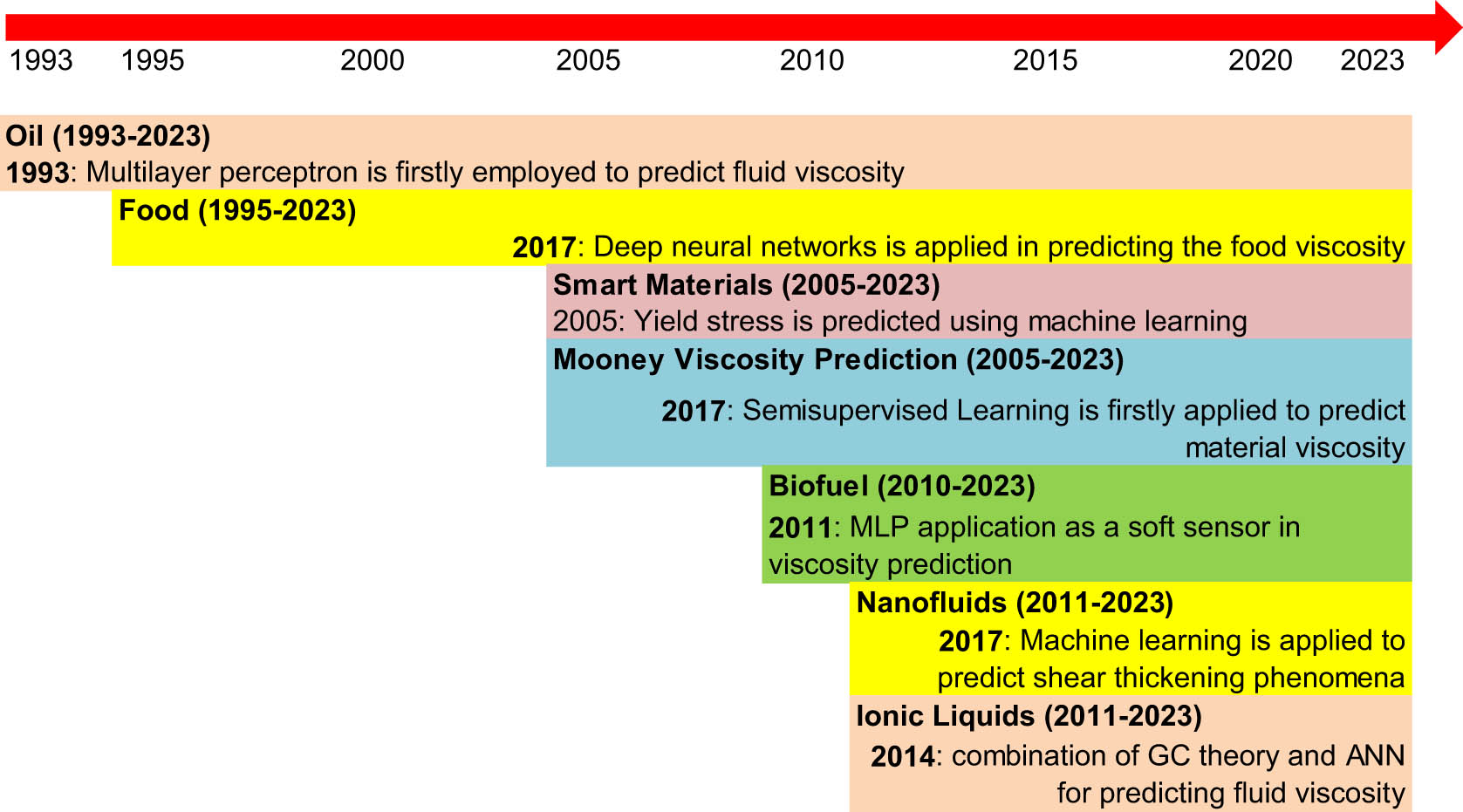
Timeline of the published articles for each field related to rheological properties prediction using machine learning methods.
Viscosity is the majority of predicted parameters, followed by shear stress. Meanwhile, a yield stress variable was first predicted in 2005 for the smart materials applied in dampers [43]. The long history of machine learning applications in various fluids is a baseline for future advancement. For example, besides using ANN, SVR, and RBFNN, a deep neural network is also applied to predicting food rheological properties [44]. The well-known methods in other fields have also been integrated with the existing machine learning methods. An example is the ionic liquids in chemistry for combining the group contribution (GC) method with ANN [45].
3 Simulation schemes
Machine learning’s role in predicting rheological behavior relies on setting clear goals for the models and choosing the right input and output variables. Before selecting a machine learning algorithm and configuring the model, it is essential to decide the model’s purpose. Crucial to this process is the selection of appropriate inputs and outputs, as incorrect choices can lead to wrong correlations and unnecessarily extended training times. Identifying the usual modeling purpose can be obtained by reviewing the input-output schemes of existing works and observing their similarities and differences. Table 2 lists these variables and their predicted outcomes, supported by relevant research. While all output variables are related to rheology, the inputs vary and can include shear rate, temperature, and composition, among others.
Mapping of the predicted rheological parameter or related variables and several functions of machine learning applications
| No. | Predicted variables | Machine learning inputs | Selected reviewed studies |
|---|---|---|---|
| 1 | Viscosity | ||
|
Shear rate and other variables | [21,22,46,47,48,49,50,51,52,53,54,55,56,57,58,59,60,61,62] | |
|
Composition and other variables | [21,22,51,52,53,54,55,56,57,58,59,60,38,61,62,63,64,65,66,67,68,69,70,39,71,72,41,46,47,48,49,50] | |
|
Signals from measurement devices and others | [40,73,74,75,76,77,78,79] | |
| 2 | Shear stress | ||
|
Shear rate and other variables | [12,18,55,80,81,82,83,84,85,86] | |
|
Composition and other variables | [55,80,81,84,87] | |
|
Geometry/size and other variables | [19,88,89,90,91,92] | |
| 4 | Rheological model parameters | ||
|
|||
| (i) Direct prediction | Compositions, temperature, or other variables | [43,93] | |
| (ii) Extended calculation | Shear rate and other variables | [80,81,82,84] | |
|
Compositions or other variables | [43,93,94] | |
|
Compositions or other variables | [50,70,75,95,96,97] |
Several other works proposed alternatives by providing inverse models. The models treat the required rheological parameters as the inputs, with the composition as the output. This kind of input–output scheme can be considered an inverse modeling scheme. Inverse modeling to predict the material composition based on certain material parameters is still rare, such as in magnetorheological fluids [98], NiMnGa [99], and salts [100].
The usual simulation purposes, based on the observation of Table 2, can be classified into three groups. The first group deals with the efforts to replicate the rheological behavior through the flow curve trend. The shear stress can be utilized to check whether the fluid is Newtonian by plotting shear stress and viscosity
3.1 Predicting the flow curve correlation with various variables
Predicting the flow curve of a material can be beneficial in identifying the fluid’s behavior over a specific shear rate range. Flow curves need at least one shear rate variable as input. The apparent viscosity vs shear rate correlation is often used to check whether the fluids have a shear thinning or thickening pattern. Shear thinning shows decreasing viscosity with the increase in shear rate. On the other hand, shear thickening shows an increasing trend, although it will usually reach a peak and then decrease after reaching a specific shear rate value. Most models of non-Newtonian fluids show shear-thinning trends, such as cement slurries [80,81], foods [54], drilling fluids [93], and magnetorheological fluids [18,82]. The work of the ANN application for predicting shear thickening can only be found in the works of Arora et al. [86].
Further study about the machine learning application for predicting shear thickening behavior should be explored rather than using phenomenological models [101]. In terms of predicted variables, it is not recommended to predict both shear stress and apparent viscosity using a single model like the study conducted by Dumitriu et al. [55] because the predictions would be redundant if the shear rate is involved. The shear stress can be calculated from the apparent viscosity as long as the shear rate is known, and vice versa.
From the flow curve, the rheological parameters can be calculated using rheological equations. Figure 3 is illustrated based on the described method in the previous studies, showing the graphical illustration for predicting rheological parameters. The calculation consists of three steps: (a) training the model, (b) the prediction process, and (c) calculating the derived parameters based on rheological equations. For the training process, the data should include the input and the target that will be deployed in the training algorithm and machine learning model. For flow curve prediction, one of the inputs should be the shear rate and the output should be either apparent viscosity or shear stress. In the training process, the user needs to determine the hyperparameters first and choose a suitable machine learning method, which will be discussed further in Section 5.1. The optimization algorithm will tune the parameters within the model. The trained model is then tested to determine its performance when facing unseen data. If the performance is acceptable, it can be deployed in the prediction platform. The shear rate ranges together, and other inputs can then be inputted into the model to predict the apparent viscosity or shear stress range. Based on the obtained flow curve, the derived parameters can be calculated. If the modeled fluid is a non-Newtonian fluid with a yield stress, the Bingham plastic equation can be used [102], formulated as
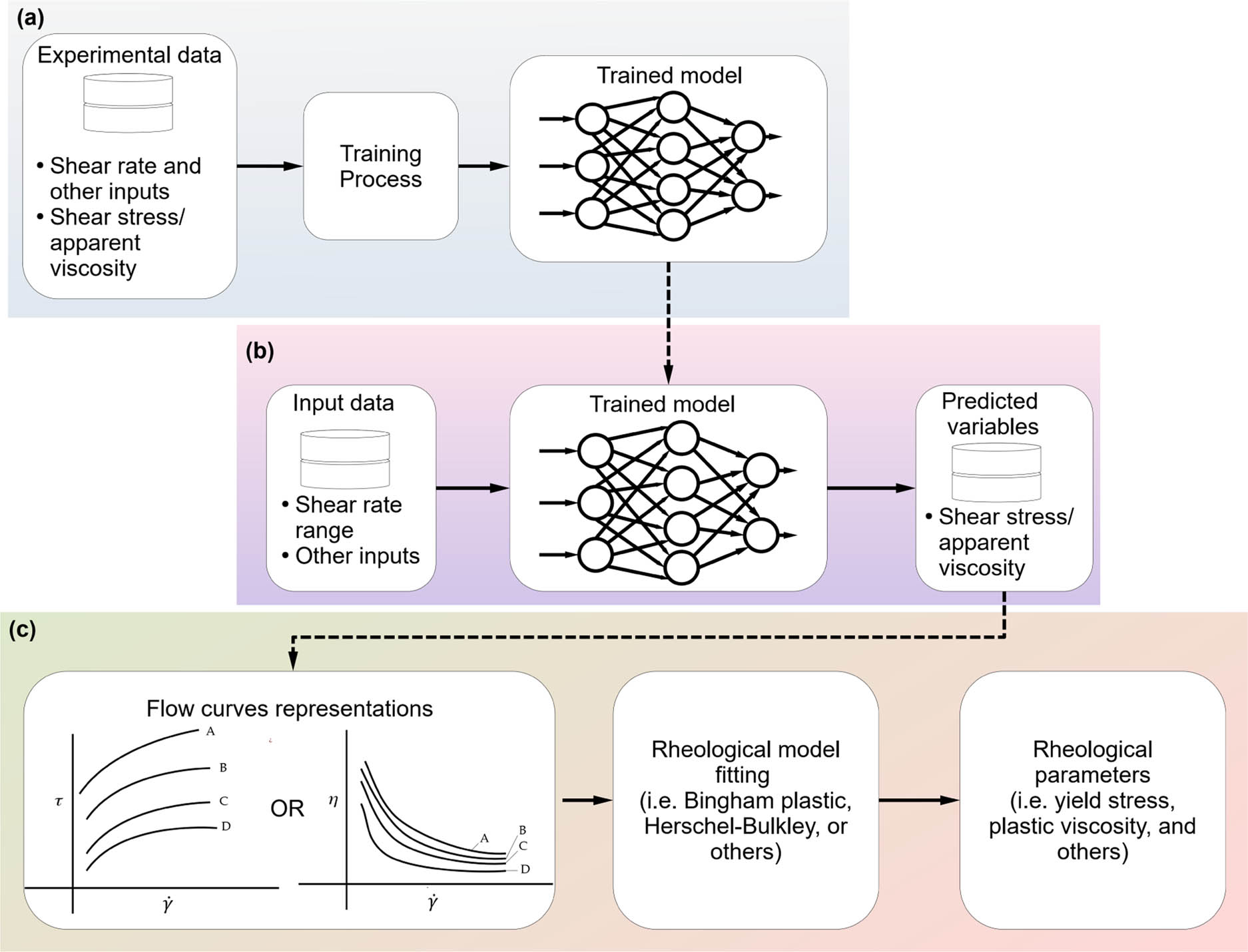
Illustration of an extended calculation of rheological parameter based on the flow curve as the machine learning output.
3.2 Prediction of rheological parameters with various variables and composition
This group considers the fluids’ compositions and other variables to represent the material’s rheological behavior. This kind of modeling scheme can support the material fabrication or characterization process. If the correlation between inputs and outputs can be identified using machine learning, the post-processing activity will be easier to perform. The input sensitivity analysis can be applied to determine which variable has the most impact on the rheological behavior of materials, such as in Torkar et al. [95] and Fayazi et al. [109]. Nanofluids can be considered the most advanced field for the application of machine learning in rheology in the form of dynamic viscosity predictions. Thermal conductivity is also predicted along the dynamic viscosity [110,111,112,113]. Composition optimization to search for the best combination for a particular application can also be one of the possible utilizations. Because of the variety of probable materials, the challenges of this group’s developments vary, such as the vast possibility of the inputs and output configurations, the data training–testing division methods, and others. Another challenge is that the predicted variables are associated with other variables, such as the thermal properties [111,113,114]. Table 2 shows that the studies included in this group are the most commonly used in simulation schemes.
3.3 Supporting measurement and manufacturing system (soft sensor)
This group was intended to deploy machine learning methods as soft sensors to predict fluid rheological properties. Practical applications usually involve measurement signals as inputs. The signal can originate from the devices or measurement systems where the fluid is applied or processed. One of the objectives is to determine variables that are not easy to measure or variables that need additional instrumentation to measure. For example, in predicting the viscosity of a device, it is not always simple to measure the fluid’s temperature, pressure, and various operating conditions. Therefore, the viscosity needs to be predicted based on the device’s working condition or the previous calibration or observation results. For example, Alabi and Williamson [76] indicate the viscosity of the kraft black liquor in a centrifugal pump using the pump torque, flow rate, shaft speed, and the pump’s mechanical status. Padmavati et al. [40] used device and sensor signals of agitators and reactors to predict the processed fluid viscosity. This method can also be a solution to overcome the difficulty in estimating the Mooney viscosity in rubber processing, as discussed by Zheng et al. [77,78] and Jin et al. [79].
This method can also be employed to calibrate a measurement device [115]. For example, in biofuel, the neural network model was applied to predict the kinematic viscosity based on the various spectral values of the near-infrared spectroscopy [73]. Ahadian et al. [74] also used the capillary rise time of liquids to estimate their surface tension and viscosity.
3.4 Prediction of rheological parameter distribution
The estimation of shear stress and viscosity distribution in a flow channel or tunnel can be a challenging process. Although computational fluid dynamics can be a solution, the simulations require considerable computing time, especially when various geometries are involved. If multiple sensors are available, making predictions using machine learning can be one of the alternatives. The geometrical features, topological features, or parameter sizes are the main inputs, followed by other fluid movement variables, such as Reynold numbers [19].
4 Data preparation and preprocessing
Data preparation for machine learning in rheological modeling involves ensuring the reliability of measurements and includes activities such as data cleaning, removing outliers, averaging repeated measurements, and normalizing data. The choice between logarithmic or linear scale normalization depends on the shear rate range, and the division of data into training and testing sets is crucial to validate model performance, with options like 70-15-15 or ten-fold cross-validation techniques for improved results.
The data should be reliable in terms of the measurement system, uncertainties, materials manufacturer, and preprocessing. Table 3 shows the common activities related to data preparation, including removing outliers, normalizing methods, and dividing training and testing data. Several works eliminate the outlier first before further processing the data [40,116]. If training data consist of several measurement points in the same configuration in a controlled environment (such as a rheometer), the data should be averaged first [67,73,117]. Data normalization is also an essential step to ensure the generalization of the produced models. Normalization can be carried out for input and output to standardize input ranges. The minimum and maximum normalized data range (
Data preparation and preprocessing activities
| Activity | Remarks | Selected related studies |
|---|---|---|
| Preparation | Removing outliers | [40,78,79,116] |
| The training data are the average values of the repeated measurement data | [67,73,117] | |
| Pearson correlation approach for selecting the independent variables | [63] | |
| Normalization | Linear normalization/min–max normalization between: | |
|
[63] | |
|
[121,122,123] | |
|
[95] | |
|
[58,60] | |
| Logarithmic scale/normalization for shear rate and linear normalization for other inputs, suitable for predicting flow curve | [12,18,84,119,120] | |
| Regularization/standardization/z-score normalization, suitable for data with Gaussian distribution | [76] | |
| Division of data | Percentage of training and testing data;training data are inputted into training algorithms that can be used for the training and validation process | |
| 80%:20% or (randomly split) | [63,124] | |
| 60%:40% (Randomly split) | [116] | |
| 70%:30% (Randomly split) | [124,125] | |
| 75%:25% (Randomly split) | [47,126] | |
| 85%:15% (Randomly split) | [82,127] | |
| 90%:10% (Randomly split) | [128] | |
| Test data are manually determined | [18,60,86,119] |
The shear rate for predicting flow curves can be normalized using a logarithmic or linear scale based on the shear rate range of the training data, as shown in Table 3. Figure 4 shows an illustration of logarithmic or linear scale normalization for shear rate and viscosity-based flow curves. If the shear rate range as input is wide, covering the region with a gradually changing gradient, the logarithmic scale normalization can be a suitable choice. Meanwhile, linear scale normalization can be used when the shear rate range covers a relatively steady gradient or possesses a relatively constant Bingham model based on plastic viscosity. The logarithmic scale normalization is suitable not only for shear rate inputs but also for normalizing the viscosity as output [120].

The alternative normalization methods based on the training data shear rate range for the flow curve based on (a) shear stress and (b) apparent viscosity.
The testing and training data selection is another important step in validating a model’s performance. The common method to determine the training and testing is to split or randomly split the data based on the predetermined varying percentages, as shown in Table 3. On several platforms, the data are divided into training, validation, and testing data, especially in the backpropagation (BP)-based training algorithm. Training and validation data are input for the training process. Hence, the arrangement can be 70% for training, 15% for validation, and 15% for testing (also denoted as 70-15-15), or, in Table 3, mentioned as 85%:15%. If the model shows high accuracy for the training case but low accuracy for the testing case, the condition will yield the so-called overfitting phenomenon. Hence, the model needs to be reevaluated. Another unusual scenario is when the model has better accuracy in the testing data compared to the training data. This scenario is uncommon because the testing data is usually less accurate than the training data. Although it could show a good model performance, it may also indicate that the testing data is not well determined. In other words, the testing data fails to identify how well the model performs on the new datasets [121]. Therefore, to solve this problem, different datasets can be selected manually [18,60,119]. The ten-fold cross-validation technique can also be an alternative to improve the model’s performance further [73]. The amount of training and testing data is also a critical factor in developing the models. The amount of training data should be enough to represent the behavior of the fluids. If the modeled rheological behavior contains a few variations and a simple relationship, fewer data can be sufficient.
5 Machine learning methods selection
Choosing machine learning methods for fluid rheology involves decisions on model topology, training algorithms, and optimization techniques. Common models include feedforward neural networks (FFNNs) with backpropagation (BP-ANN) or ELM. BP-ANN is a baseline, while ELM offers faster training. Other methods, such as ANFIS, RBFNN, SVR, and PNN, are also considered. Section 5 provides a concise overview of these models, comparing their strengths and weaknesses in predicting fluid rheology parameters. It also briefly touches on the potential of semi-supervised learning and the necessity of metaheuristic optimization for model topology. It also emphasizes the importance of reproducibility in machine learning research through a proposed checklist and the creation of a comprehensive database.
5.1 Model topologies and training algorithms
Various aspects need to be considered when selecting machine learning methods, such as the model topology or structure, training algorithm, and platform. Table 4 shows the hyperparameters, advantages, and disadvantages of the common methods for predicting variables and parameters related to fluids rheology. FFNN is the commonly employed model topology. FFNN can be trained using a BP algorithm known as BP-ANN or MLP. BP-ANN, as the classic and popular machine learning algorithm, is usually employed as the main proposed program and benchmarking method. The training algorithm can be selected from various methods. The most well-known approach is the Levenberg–Marquardt (LM) because it often shows the most accurate and rapid training time [48]. However, LM tends to have a high possibility of being trapped at a local solution. The hyperparameters include the layer number and the hidden neuron number in each layer. The layer can also be selected from one or two hidden layers, depending on whether one hidden layer has acceptable accuracy [48,63].
Various common supervised learning algorithms are applied for predicting related parameters and variables in fluids rheology
| Model topology | Training algorithm | Hyperparameters | Remarks (pros [+] and cons [−]) | Selected related studies |
|---|---|---|---|---|
| FFNN (the topology can be a single or multi-hidden layer) | Backpropagation (also called BP-ANN or MLP) and LM | Number of hidden layers, number of neurons in each hidden layer, and activation functions | (+) The most popular method. Various platforms have accommodated the method | [48,63,68,141] |
| (+) If the hyperparameters are carefully tuned, the model can accommodate various fluid rheological behaviors with relatively low complexity | ||||
| (−) The accuracy tends to be trapped in local solutions | ||||
| ELM | (+) Faster training time and more generalized solutions than BP-ANN | [90,119,120] | ||
| (−) Unclear justification for the random assignment of the weighting inputs | ||||
| ANFIS | Number of membership functions and type of membership functions | ( +) In several cases, it has faster training time and higher accuracy than BP-ANN | [60,68] | |
| (+) Fewer adjustable parameters than FFNN and a well-structured knowledge presentation | ||||
| (−) If one of the training algorithms is BP training, there is a probable local solution | ||||
| RBFNN | Number, center, width type of RBF | (+) Simple training algorithms have fewer adjustable parameters than FFNN and ANFIS | [60,63,131,142] | |
| (+) Adopting BP-ANN’s ability to recognize the pattern within a data | ||||
| (−) It needs a relatively large hidden node number to fulfill the targeted accuracy | ||||
| (−) The possibility of the local solution after reaching a certain value of the hidden node number | ||||
| (−) In several cases, the accuracy is not better than ANFIS and FFNN | ||||
| SVR and LS-SVR | Kernel type and parameters, regularization parameter, and epsilon | (+) Fast training time and best for localization results | [63,82,120] | |
| (−) Not suitable for large datasets | ||||
| GMDH PNN | Degree of polynomial | (+) Several works claimed that PNN is less complex than the FFNN structures | [143,144] | |
| (+) The model equation is quite similar to the classic polynomial method | ||||
| (−) After comparing with other machine learning, the PNN performance is less accurate | ||||
| (−) Possibility of low generalization capability | ||||
| FFNN with BP-ANN or FFNN with ELM or RBFNN or PNN combined with metaheuristic methods | GA or PSO for searching for the optimum model topology | Hyperparameters from the original model added with the optimization algorithm parameters | To search for the best-hidden node numbers in FFNN, the best-hidden node numbers, and spread values for RBFNN | [67,83,125] |
| (+) The hyperparameters can be tuned automatically | ||||
| (+) Avoid trial and error determination of the hyperparameters | ||||
| (+) Can have better accuracy than other algorithms, such as GA-PNN is better than ANFIS, and GA-RBFNN is better than SVR gene expression programming | ||||
| (−) Additional duration of the training process | ||||
| Combination of several machine learning algorithms, committee machine learning, and ensemble machine learning | (+) High accuracy for fluid rheology cases | [15,78,145] | ||
| (−) Contains multiple machine learning-based models that can be relatively too complex and have a longer training duration | ||||
In terms of structure complexity, FFNN can be built from single or multiple hidden layers. A more complex topology can lead to a longer training time. Therefore, the less-hidden layer is preferable, considering that almost all fluid rheology cases can be solved using FFNN with one hidden layer. The hidden neuron number is usually set at fewer than 20, such as 12 [75], 15 [63], 6 [129], and 9 [130], to achieve acceptable accuracy in a simple case. In terms of the activation functions, the best function can be different from one case to another, depending on the datasets. FFNN can also be trained using ELM, which has the advantage of a faster training time and better generalization [18,83,84,90,119,120].
Other alternative machine learning methods are ANFIS, SVR, PNN, and RBFNN. ANFIS is another well-known algorithm with comparable accuracy and faster training time than BP-ANN. This method is also known for its more interpretable nature compared to other black box models. In several comparative works [54,89,125], the prediction performance is better than that of BP-ANN. For kernel-based methods, SVR and RBFNN have the potential to capture nonlinear patterns in data. SVR has shown its accuracy in several works with BP-ANN [82]. However, SVR is less popular because it is quite challenging to tune the hyperparameters and can be hard to interpret while employing nonlinear kernels.
On the other hand, despite the RBFNN potential because of the fewer adjustable parameters compared to BP-ANN, several comparative works show its performance lags behind or, at most, is comparable with other machine learning algorithms [15,60,63,116,131]. PNN is another form of neural network with polynomial equations as the activation functions. While this method shows its acceptable performance in several works [67], the polynomial has several potential problems, such as interpretability and overfitting. An automatic feature selection algorithm called GMDH was also proposed to tune PNN in several works [124,132]. To overcome the overfitting possibility, more optimization algorithms, such as GAs, need to be added to achieve acceptable accuracy [21]. If the computational cost is not a priority and the parameters cannot be tuned properly, GMDH PNN can be an alternative for predicting the fluid rheological behavior.
The common parameters to be evaluated for measuring the performances of various algorithms are the accuracy of the training case, testing cases, training time, and testing time. While the training time represents the complexity of the training algorithm and model structure, the testing time represents the complexity of the model structure. Compared with the experimental data, the accuracy and error represent the model’s performance. While the accuracy of the training is utilized in the training process, the testing accuracy is crucial to determine the model performance for unlearned cases. Some articles have shown a very small error for the training but not for the testing, such as in the work by Al-Marhoun et al. [116]. The statistical parameters can be in the form of either mean squared error (MSE), mean absolute percentage error (MAPE), or coefficient of determination (
Several selected works are provided in Table 5, containing various examples of machine learning methods. From those cases, the complexity of a case can be described based on the data number, the number of input variables, and the model nonlinearity. For example, RBFNN is usually not superior when compared with other methods because it does not match the data in a work that has a high
Selected work and its statistical parameters for measuring the model performances
| Authors | Fluids | Methods | Inputs | Outputs | Data number | Training | Testing |
|---|---|---|---|---|---|---|---|
| Hemmat Esfe et al. [22] | Multi-walled carbon nanotubes-ZnO/5W50 nanolubricant | BP-ANN | Temperature (
|
|
N/A |
|
N/A |
| Razi et al. [62] | Water-based drilling fluids | BP-ANN | Shear rate (
|
|
468 |
|
MSE: 0.014 |
| MSE: 0.012 | |||||||
| Dargahi-Zarandi et al. [143] | Gas/vapor of hydrocarbon fluids | Hybrid GMDH ANN | Molecular weight, reduced pressure, reduced temperature, and density (
|
|
3,819 |
|
MAPE: 3.45% |
| MAPE: 3.44% | |||||||
| Tatar et al. [133] | Heavy oil | RBFNN |
|
|
80 |
|
|
| Aminian and ZareNezhad [125] | Biodiesels and blends | ANFIS |
|
|
527 |
|
|
| Specht et al. [146] | Asphalt–rubber | BP-ANN | The rubber content, rubber particle size, mixing duration, and temperature |
|
1,792 |
|
N/A |
| Ramzi et al. [54] | Iranian honey | ANFIS | Water content,
|
|
N/A |
|
|
| Kang et al. [120] | Ionic liquids | ELM | Molecular descriptors (Sσ-profile) Sc1-5 and SA 1-6,
|
|
1,502 |
|
|
| Bahiuddin et al. [119] | MR greases | ELM |
|
|
900 |
|
|
| Zhi et al. [131] | Six pure refrigerants | ANFIS |
|
|
1,089 |
|
|
| MAPE: 2.96% | MAPE: 4.15 | ||||||
| Arora et al. [86] | Shear thickening fluids | BP-ANN |
|
|
N/A |
|
|
More advanced models can be employed to predict the rheological properties. The examples can be deep learning algorithms, such as convolutional neural networks (CNN) [134], extreme gradient boosting and random forest based on the gated recurrent unit [135,136], and recurrent neural networks [137,138]. The CNN has been applied to predict the creep modulus of cement paste [139]. Cement paste, especially in the context of its viscoelastic properties and time-dependent behavior, can exhibit some fluid-like characteristics, but it is not a traditional fluid. Extreme gradient boosting and random forest were employed to predict soft clays [140]. Soft, sensitive clay may exhibit solid-like properties. However, if the clay is subjected to stress or disturbance, it can undergo significant changes in its strength and behavior, resembling a fluid. This phenomenon is often referred to as quick clay behavior.
5.2 Metaheuristic methods for model topology optimization
Each model topology requires its own parameters to be tuned. The parameters that need to be predetermined by the user are called hyperparameters. The hyperparameters include the layers, the hidden node number, the activation function, and others, depending on the selected topology in the machine learning method employed. Metaheuristic optimization methods can be applied to search for the best-hidden node number automatically, such as PSO or GA. The GA is also applicable for RBFNN to tune the spread value [147] and GMDH to search for the best configuration [132]. The metaheuristic method has shown its capability to improve the model performance by finding the best configuration of the hidden node number in the network [60]. The usual drawback of metaheuristic method applications is the longer training time. Several examples of topology optimization are shown in Table 6.
The applied topology optimization methods
| No. | Topology | Optimization algorithm | Tuned parameters | Ref. |
|---|---|---|---|---|
| 1 | GMDH-type PNN | GA | Hidden layers and bias coefficients | [132] |
| 2 | FFNNs | GA | Hidden layer neuron number | [54] |
| 3 | RBFNN | GA | The maximum value of the number of neurons and spread | [15,133] |
| 4 | RBFNN | PSO | The maximum value of the number of neurons and spread | [15] |
| 5 | ANFIS | PSO | Gaussian membership function | [148] |
5.3 Semi-supervised and unsupervised learning necessity
The general training methods are supervised and unsupervised, with a difference in terms of the employed labeled or unlabeled data in the training process. Almost all of the discussed methods are supervised algorithms that consider the model output or labeled data. On the other hand, unlabeled data can be valuable in viscosity prediction cases, especially in the rubber mixing process [77,78,149]. Recently, in the manufacturing industry, various measurements originating from the control system have been stored on a centralized server as a historical database. It is challenging to manually identify which data are relevant to the changes in certain product viscosity. Furthermore, the data, such as temperature distributions, pictures, or videos taken from the manufacturing process, can be considered unstructured. Therefore, the data can be treated as unlabeled and input into machine learning together with labeled data to check various possibilities, such as clustering or other purposes. By considering both labeled and unlabeled data for the training process, the training algorithm can be regarded as semi-supervised machine learning.
Several studies conducted semi-supervised learning for the prediction of viscosity in the rubber mixing process [77]. Incorporating semi-supervised learning in the rubber mixing process allows for the effective use of both labeled and unlabeled data. This approach, particularly with clustering algorithms, can enhance the prediction of viscosity and help identify relevant patterns in the unlabeled data. Given the limited application of this method in rheological fluids, there is significant potential for further exploration and development. ELM and its variants have also been used because of the shorter training time characteristics [77]. For example, the just-in-time regularized ELM (JRELM) has about a 40-s difference with just-in-time SVR [77,79]. The use of algorithms like JRELM, which offers time efficiency, suggests that semi-supervised learning can be optimized for industrial applications where timely data processing is crucial. The broader adoption of this method could lead to more accurate and efficient rheological analysis in various industrial contexts.
5.4 Explainable AI
Machine learning models, particularly in complex domains like fluid rheology, often face limitations in interpretability. Traditional machine learning models, while powerful in prediction, are commonly seen as “black boxes,” providing little insight into the reasoning behind their outputs. This lack of transparency can be a significant barrier, especially in fields where understanding the underlying phenomena is as crucial as accurate predictions. Explainable AI (XAI) emerges as a potential solution to this challenge. By making AI models more interpretable, XAI allows users to understand the decision-making process of these models. For instance, the use of deep learning for predicting fluid viscosity, as seen in the PfAbNet‑viscosity model, becomes more interpretable through feature attribution analysis [150]. This analysis reveals how specific biophysical properties influence the model’s predictions.
Similarly, Shapley Additive Explanations (SHAP) calculations are being used to identify the impact of each input on the prediction of viscosity and surface tension in ionic liquids, aiming to elucidate the decision-making process of the trained machine learning model [151]. The potential of XAI is particularly important for predicting fluid viscosity and rheology, where understanding the physical principles underlying the predictions is crucial. Despite its importance, the application of XAI in this field is still relatively rare, indicating a significant opportunity for further exploration and development across various domains.
5.5 Reproducibility
Reproducibility is an important part of machine learning for future improvement and to ensure the validity of the proposed method [152]. This issue becomes more apparent, considering these studies involve at least two different fields, such as computer science and fluid rheology. Several works have not included important details to enable the reproduction of the applied machine learning methods. Meanwhile, although some works have tried to compare their proposed models with the previously proposed methods, the benchmarked models have not been described in detail, especially regarding the training settings and topology. Therefore, a checklist is presented in Table 7, showing the information an article needs to provide to ensure reproducibility.
The suggested available information to maintain the reproducibility in a research article about rheological parameter prediction using machine learning
| Steps | The suggested available information |
|---|---|
| Data acquisition |
|
| Data preprocessing |
|
| Training process |
|
| Model topology |
|
| Post-processing |
|
A database of fluids for further usage of machine learning can support the future reproducibility of the proposed works. The database can be a collection of the training data or the models obtained in each case. Therefore, the models should be downloadable to enable further applications. A work in ionic liquids has started the collection of the dataset in various instances to perform a prediction when an unlearned composition is introduced [153].
6 Conclusions and future research directions
This review explores the use of various machine learning methods in modeling fluid rheology. It covers a range of behaviors and predictive techniques, including flow curve modeling and different input–output schemes for fluid characterization. The maturity of these methods in several applications is highlighted, with a focus on flow curve modeling and alternative schemes for fluid characterization. The review indicates that the choice of the most effective machine learning model depends on factors like case complexity. Simple models like ANN, ELM, and SVR are adequate for scenarios with fewer variables and data points and are applicable in areas like nanofluids and smart materials. However, complex data or behaviors require more advanced hybrid algorithms. These are particularly useful in applications like ionic liquids, drilling fluid characterization, and polymerization.
The conclusion of the review emphasizes the significance of training time in machine learning applications, suggesting algorithms like ELM for situations where rapid processing is crucial. It specifically recommends time-dependent methods like recurrent neural networks and long short term memory for modeling complex behaviors in non-Newtonian fluids, where temporal dynamics are essential. Adaptive algorithms are highlighted as valuable for processes that undergo frequent changes. Moreover, the review points out the relevance of unsupervised algorithms in handling unlabeled data, which is particularly pertinent in industrial settings where data from material processing might not be pre-categorized.
The survey acknowledges the potential for further exploration in this field, particularly in developing models for linking microstructure to rheological properties using deep learning. The possibility of semi-supervised or unsupervised machine learning methods, especially in the polymer industry, and the concept of inverse modeling for predicting compositions are also highlighted. The review concludes with the possibility of employing explainable AI to make machine learning models more interpretable.
Acknowledgments
The authors wish to express their gratitude to Universitas Gadjah Mada for the partial support provided for this research.
-
Funding information: This study is partially supported by the Competitive Research Grant provided by the Vocational College Universitas Gadjah Mada in 2022.
-
Author contributions: Conceptualization: I.B., S.A.M., and Ubaidillah; methodology: I.B. and D.A.S.; formal analysis: I.B. and D.A.S.; resources: I.B. and U; data curation: I.B. and F.I.; writing – original draft preparation: I.B.; writing – review and editing: I.B., S.A.M., F.I., and U.; visualization: I.B.; supervision: M.I.S., S.A.M., and F.I.
-
Conflict of interest: The authors declare no conflict of interest.
-
Data availability statement: The datasets generated during and/or analysed during the current study are available from the corresponding author on reasonable request.
References
[1] Gouda A, Attia AM. Development of a new approach using an artificial neural network for estimating oil formation volume factor at bubble point pressure of Egyptian crude oil. J King Saud Univ - Eng Sci. 2024;36:72–80. 10.1016/j.jksues.2022.08.001.Search in Google Scholar
[2] Zhang Y, Jin H, Liu H, Yang B, Dong S. Deep semi-supervised just-in-time learning based soft sensor for Mooney viscosity estimation in industrial rubber mixing process. Polym (Basel). 2022;14:1018. 10.3390/polym14051018.Search in Google Scholar PubMed PubMed Central
[3] Shahriar A, Nehdi ML. Modeling rheological properties of oil well cement slurries using artificial neural networks. J Mater Civ Eng. 2011;23:1703–10.10.1061/(ASCE)MT.1943-5533.0000340Search in Google Scholar
[4] Ashtiani M, Hashemabadi SH, Ghaffari A. A review on the magnetorheological fluid preparation and stabilization. J Magn Magn Mater. 2015;374:716–30. 10.1016/j.jmmm.2014.09.020.Search in Google Scholar
[5] Hapipi NM, Mazlan SA, Ubaidillah U, Homma K, Aziz SAA, Nordin NA, et al. The rheological studies on poly(vinyl) alcohol-based hydrogel magnetorheological plastomer. Polym (Basel). 2020;12:2332. 10.3390/polym12102332.Search in Google Scholar PubMed PubMed Central
[6] Karyappa R, Hashimoto M. Chocolate-based ink three-dimensional printing (Ci3DP). Sci Rep. 2019;9:14178. 10.1038/s41598-019-50583-5.Search in Google Scholar PubMed PubMed Central
[7] Rocabruno-Valdés CII, Ramírez-Verduzco LFF, Hernández JAA. Artificial neural network models to predict density, dynamic viscosity, and cetane number of biodiesel. Fuel. 2015;147:9–17. 10.1016/j.fuel.2015.01.024.Search in Google Scholar
[8] Yu M, Yang P, Fu J, Liu S, Choi SB. A theoretical model for the field-dependent conductivity of magneto-rheological gels and experimental verification. Sens Actuators A Phys. 2016;245:127–34. 10.1016/j.sna.2016.05.008.Search in Google Scholar
[9] Jung ID, Kim M, Park SJ. A comprehensive viscosity model for micro magnetic particle dispersed in silicone oil. J Magn Magn Mater. 2016;404:40–4. 10.1016/j.jmmm.2015.12.024.Search in Google Scholar
[10] Hemmat Esfe M, Bahiraei M, Mahian O. Experimental study for developing an accurate model to predict viscosity of CuO–ethylene glycol nanofluid using genetic algorithm based neural network. Powder Technol. 2018;338:383–90. 10.1016/j.powtec.2018.07.013.Search in Google Scholar
[11] Ghaffari A, Hashemabadi SH, Ashtiani M. A review on the simulation and modeling of magnetorheological fluids. J Intell Mater Syst Struct. 2015;26:881–904. 10.1177/1045389X14546650.Search in Google Scholar
[12] Bahiuddin I, Mazlan SA, Shapiai I, Imaduddin F, Ubaidillah U, Choi S-B. Constitutive models of magnetorheological fluids having temperature-dependent prediction parameter. Smart Mater Struct. 2018;27:095001. 10.1088/1361-665X/aac237.Search in Google Scholar
[13] Tat ME, Van Gerpen JH. The kinematic viscosity of biodiesel and its blends with diesel fuel. J Am Oil Chem Soc. 1999;76:1511–3. 10.1007/s11746-999-0194-0.Search in Google Scholar
[14] Jung ID, Kim SH, Park SJ, Kim SJ, Kang TG, Park JM. Rheological modeling of strontium ferrite feedstock for magnetic powder injection molding. Powder Technol. 2014;262:198–202. 10.1016/j.powtec.2014.04.073.Search in Google Scholar
[15] Hemmati-Sarapardeh A, Varamesh A, Husein MM, Karan K. On the evaluation of the viscosity of nanofluid systems: Modeling and data assessment. Renew Sustain Energy Rev. 2018;81:313–29. 10.1016/j.rser.2017.07.049.Search in Google Scholar
[16] Agwu OE, Akpabio JU, Alabi SB, Dosunmu A. Settling velocity of drill cuttings in drilling fluids: A review of experimental, numerical simulations and artificial intelligence studies. Powder Technol. 2018;339:728–46. 10.1016/j.powtec.2018.08.064.Search in Google Scholar
[17] Meyer JP, Adio SA, Sharifpur M, Nwosu PN. The viscosity of nanofluids: A review of the theoretical, empirical, and numerical models. Heat Transf Eng. 2016;37:387–421. 10.1080/01457632.2015.1057447.Search in Google Scholar
[18] Bahiuddin I, Mazlan SA, Shapiai MI, Choi S-B, Imaduddin F, Rahman MAA, et al. A new constitutive model of a magneto-rheological fluid actuator using an extreme learning machine method. Sens Actuators A Phys. 2018;281:209–21. 10.1016/j.sna.2018.09.010.Search in Google Scholar
[19] Khozani ZS, Bonakdari H, Zaji AH. Efficient shear stress distribution detection in circular channels using extreme learning machines and the M5 model tree algorithm. Urban Water J. 2017;14:999–1006. 10.1080/1573062X.2017.1325495.Search in Google Scholar
[20] Zhao N, Li S, Yang J. A review on nanofluids: Data-driven modeling of thermalphysical properties and the application in automotive radiator. Renew Sustain Energy Rev. 2016;66:596–616. 10.1016/j.rser.2016.08.029.Search in Google Scholar
[21] Shahsavar A, Khanmohammadi S, Karimipour A, Goodarzi M. A novel comprehensive experimental study concerned synthesizes and prepare liquid paraffin-Fe3O4 mixture to develop models for both thermal conductivity & viscosity: A new approach of GMDH type of neural network. Int J Heat Mass Transf. 2019;131:432–41. 10.1016/j.ijheatmasstransfer.2018.11.069.Search in Google Scholar
[22] Hemmat Esfe M, Goodarzi M, Reiszadeh M, Afrand M. Evaluation of MWCNTs-ZnO/5W50 nanolubricant by design of an artificial neural network for predicting viscosity and its optimization. J Mol Liq. 2019;277:921–31. 10.1016/j.molliq.2018.08.047.Search in Google Scholar
[23] Gul S. Machine learning applications in drilling fluid engineering: A review. vol. 10: Petroleum Technology. ASME 2021 International Conference on Ocean, Offshore and Arctic Engineering; 2021 Jun 21–30; virtual. ASME, 2021. 10.1115/OMAE2021-63094.Search in Google Scholar
[24] Al-Mahasneh M, Aljarrah M, Rababah T, Alu’datt M. Application of hybrid neural fuzzy system (ANFIS) in food processing and technology. Food Eng Rev. 2016;8:351–66. 10.1007/s12393-016-9141-7.Search in Google Scholar
[25] Nnyigide OS, Hyun K. A comprehensive review of food rheology: Analysis of experimental, computational, and machine learning techniques. Korea Aust Rheol J. 2023;35:279–306. 10.1007/s13367-023-00075-w.Search in Google Scholar
[26] Xing Y, Zheng Z, Sun Y, Agha Alikhani M. A review on machine learning application in biodiesel production studies. Int J Chem Eng. 2021;2021:1–12. 10.1155/2021/2154258.Search in Google Scholar
[27] Ahmad I, Sana A, Kano M, Cheema II, Menezes BC, Shahzad J, et al. Machine learning applications in Biofuels’ life cycle: Soil, feedstock, production, consumption, and emissions. Energies. 2021;14:5072. 10.3390/en14165072.Search in Google Scholar
[28] Bhagya Raj GVS, Dash KK. Comprehensive study on applications of artificial neural network in food process modeling. Crit Rev Food Sci Nutr. 2022;62:2756–83. 10.1080/10408398.2020.1858398.Search in Google Scholar PubMed
[29] Koutsoukos S, Philippi F, Malaret F, Welton T. A review on machine learning algorithms for the ionic liquid chemical space. Chem Sci. 2021;12:6820–43. 10.1039/d1sc01000j.Search in Google Scholar PubMed PubMed Central
[30] Pei P, Peng Y. Constitutive modeling of magnetorheological fluids: A review. J Magn Magn Mater. 2022;550:169076. 10.1016/j.jmmm.2022.169076.Search in Google Scholar
[31] Hemmat Esfe M, Afrand M. Predicting thermophysical properties and flow characteristics of nanofluids using intelligent methods: Focusing on ANN methods. J Therm Anal Calorim. 2020;140:501–25. 10.1007/s10973-019-08789-2.Search in Google Scholar
[32] Maleki A, Haghighi A, Mahariq I. Machine learning-based approaches for modeling thermophysical properties of hybrid nanofluids: A comprehensive review. J Mol Liq. 2021;322:114843. 10.1016/j.molliq.2020.114843.Search in Google Scholar
[33] Li J, Zhang X, Xu B, Yuan M. Nanofluid research and applications: A review. Int Commun Heat Mass Transf. 2021;127:105543. 10.1016/j.icheatmasstransfer.2021.105543.Search in Google Scholar
[34] Hemmat Esfe M, Kamyab MH, Toghraie D. Statistical review of studies on the estimation of thermophysical properties of nanofluids using artificial neural network (ANN). Powder Technol. 2022;400:117210. 10.1016/j.powtec.2022.117210.Search in Google Scholar
[35] Agwu OE, Akpabio JU, Ekpenyong ME, Inyang UG, Asuquo DE, Eyoh IJ, et al. A critical review of drilling mud rheological models. J Pet Sci Eng. 2021;203:108659. 10.1016/j.petrol.2021.108659.Search in Google Scholar
[36] van der Walt TJ, van Deventer JSJ, Barnard E. The estimation of kinematic viscosity of petroleum crude oils and fractions with a neural net. Chem Eng J. 1993;51:151–8. 10.1016/0300-9467(93)80025-J.Search in Google Scholar
[37] Davoodi S, Mehrad M, Wood DA, Ghorbani H, Rukavishnikov VS. Hybridized machine-learning for prompt prediction of rheology and filtration properties of water-based drilling fluids. Eng Appl Artif Intell. 2023;123:106459. 10.1016/j.engappai.2023.106459.Search in Google Scholar
[38] Bouchard C, Granjean BPA. A neural network correlation for the variation of viscosity of sucrose aqueous solutions with temperature and concentration. LWT - Food Sci Technol. 1995;28:157–9. 10.1016/S0023-6438(95)80029-8.Search in Google Scholar
[39] Rai P, Majumdar GC, Das Gupta S, De S. Prediction of the viscosity of clarified fruit juice using artificial neural network: a combined effect of concentration and temperature. J Food Eng. 2005;68:527–33. 10.1016/j.jfoodeng.2004.07.003.Search in Google Scholar
[40] Padmavathi G, Mandan MG, Mitra SP, Chaudhuri KK. Neural modelling of Mooney viscosity of polybutadiene rubber. Comput Chem Eng. 2005;29:1677–85. 10.1016/j.compchemeng.2005.02.028.Search in Google Scholar
[41] Karimi H, Yousefi F, Rahimi MR. Correlation of viscosity in nanofluids using genetic algorithm-neural network (GA-NN). Heat Mass Transf. 2011;47:1417–25. 10.1007/s00231-011-0802-z.Search in Google Scholar
[42] Valderrama JO, Muñoz JM, Rojas RE. Viscosity of ionic liquids using the concept of mass connectivity and artificial neural networks. Korean J Chem Eng. 2011;28:1451–7. 10.1007/s11814-010-0512-0.Search in Google Scholar
[43] Wei K, Meng G. Yield stress modeling of electrorheological fluids using neural network. Int J Mod Phys B. 2005;19:4093–102. 10.1142/S0217979205032620.Search in Google Scholar
[44] Guha P, Bhatnagar T, Pal I, Kamboj U, Mishra S. Prediction of properties of wheat dough using intelligent deep belief networks. J Exp Theor Artif Intell. 2017;29:1283–96. 10.1080/0952813X.2017.1340976.Search in Google Scholar
[45] Chen Y, Peng B, Kontogeorgis GM, Liang X. Machine learning for the prediction of viscosity of ionic liquid–water mixtures. J Mol Liq. 2022;350:118546. 10.1016/j.molliq.2022.118546.Search in Google Scholar
[46] Toker ÖS, Yilmaz MTMT, Karaman S, Doǧan M, Kayacier A, Toker OS, et al. Adaptive neuro-fuzzy inference system and artificial neural network estimation of apparent viscosity of ice-cream mixes stabilized with different concentrations of xanthan gum. Appl Rheol. 2012;22:639181. 10.3933/ApplRheol-22-63918.Search in Google Scholar
[47] Yilmaz MT, Karaman S, Kayacier A, Dogan M, Yetim H. Construction of predictive models to describe apparent and complex viscosity values of O/W model system meat emulsions using adaptive neuro-fuzzy inference system (ANFIS) and artificial neural networks (ANN). Food Biophys. 2012;7:329–40. 10.1007/s11483-012-9271-2.Search in Google Scholar
[48] Ansari HR, Zarei MJ, Sabbaghi S, Keshavarz P. A new comprehensive model for relative viscosity of various nanofluids using feed-forward back-propagation MLP neural networks. Int Commun Heat Mass Transf. 2018;91:158–64. 10.1016/j.icheatmasstransfer.2017.12.012.Search in Google Scholar
[49] Dihoru LV, Smith LN, German RM. Experimental analysis and neural network modelling of the rheological behaviour of powder injection moulding feedstocks formed with bimodal powder mixtures. Powder Metall. 2000;43:31–6. 10.1179/pom.2000.43.1.31.Search in Google Scholar
[50] Eshgarf H, Sina N, Esfe MH, Izadi F, Afrand M. Prediction of rheological behavior of MWCNTs–SiO2/EG–water non-Newtonian hybrid nanofluid by designing new correlations and optimal artificial neural networks. J Therm Anal Calorim. 2018;132:1029–38. 10.1007/s10973-017-6895-y.Search in Google Scholar
[51] Hemmat Esfe M, Rostamian H, Rejvani M, Emami MRS. Rheological behavior characteristics of ZrO2-MWCNT/10w40 hybrid nano-lubricant affected by temperature, concentration, and shear rate: An experimental study and a neural network simulating. Phys E Low-Dimension Syst Nanostruct. 2018;102:160–70. 10.1016/j.physe.2017.12.023.Search in Google Scholar
[52] Kang P, Lim J. A novel approach in estimating shear-thinning rheology of HPAM and AMPS polymers for enhanced oil recovery using artificial neural network. Isope. 2013;9:81–5.Search in Google Scholar
[53] Hemmat Esfe M, Tatar A, Ahangar MRH, Rostamian H. A comparison of performance of several artificial intelligence methods for predicting the dynamic viscosity of TiO2/SAE 50 nano-lubricant. Phys E Low-Dimension Syst Nanostruct. 2018;96:85–93. 10.1016/j.physe.2017.08.019.Search in Google Scholar
[54] Ramzi M, Kashaninejad M, Salehi F, Sadeghi Mahoonak AR, Ali Razavi SM. Modeling of rheological behavior of honey using genetic algorithm-artificial neural network and adaptive neuro-fuzzy inference system. Food Biosci. 2015;9:60–7. 10.1016/j.fbio.2014.12.001.Search in Google Scholar
[55] Dumitriu T, Dumitriu RP, Cimpanu C. Artificial neural networks and support vector regression modeling for prediction of some silver colloidal suspensions rheological behavior. 2017 21st International Conference on System Theory, Control and Computing (ICSTCC); 2017 Oct 19–21; Sinaia, Romania. IEEE, 2017. p. 624–8. 10.1109/ICSTCC.2017.8107105.Search in Google Scholar
[56] Kang PS, Lim JS, Huh C. Artificial neural network model to estimate the viscosity of polymer solutions for enhanced oil recovery. Appl Sci. 2016;6:188. 10.3390/app6070188.Search in Google Scholar
[57] Alirezaie A, Saedodin S, Esfe MH, Rostamian SH. Investigation of rheological behavior of MWCNT (COOH-functionalized)/MgO – Engine oil hybrid nanofluids and modelling the results with artificial neural networks. J Mol Liq. 2017;241:173–81. 10.1016/j.molliq.2017.05.121.Search in Google Scholar
[58] Sahoo BK, De S, Meikap BC. Artificial neural network approach for rheological characteristics of coal-water slurry using microwave pre-treatment. Int J Min Sci Technol. 2017;27:379–86. 10.1016/j.ijmst.2017.01.022.Search in Google Scholar
[59] Hemmat Esfe M, Reiszadeh M, Esfandeh S, Afrand M. Optimization of MWCNTs (10%) – Al2O3 (90%)/5W50 nanofluid viscosity using experimental data and artificial neural network. Phys A Stat Mech Appl. 2018;512:731–44. 10.1016/j.physa.2018.07.040.Search in Google Scholar
[60] Al-Mahasneh MA, Rababah TM, Ma’Abreh AS. Evaluating the combined effect of temperature, shear rate and water content on wild-flower honey viscosity using adaptive neural fuzzy inference system and artificial neural networks. J Food Process Eng. 2013;36:510–20. 10.1111/jfpe.12014.Search in Google Scholar
[61] Deosarkar MP, Sathe VS. Predicting effective viscosity of magnetite ore slurries by using artificial neural network. Powder Technol. 2012;219:264–70. 10.1016/j.powtec.2011.12.058.Search in Google Scholar
[62] Razi MM, Mazidi M, Razi FM, Aligolzadeh H, Niazi S. Artificial neural network modeling of plastic viscosity, yield point, and apparent viscosity for water-based drilling fluids. J Dispers Sci Technol. 2013;34:822–7. 10.1080/01932691.2012.704746.Search in Google Scholar
[63] Gholami E, Vaferi B, Ariana MA. Prediction of viscosity of several alumina-based nanofluids using various artificial intelligence paradigms – Comparison with experimental data and empirical correlations. Powder Technol. 2018;323:495–506. 10.1016/j.powtec.2017.10.038.Search in Google Scholar
[64] Mechiri SK, Vasu V, Gopal AV. Rheological study of Cu-Zn hybrid Newtonian nano-fluids: Experimental data and modelling using neural network. Mater Today Proc. 2017;4:1957–63. 10.1016/j.matpr.2017.02.041.Search in Google Scholar
[65] Dalkilic ASS, Çebi A, Celen A, Yildiz O, Acikgoz O, Jumpholkul C, et al. Prediction of graphite nanofluids’ dynamic viscosity by means of artificial neural networks. Int Commun Heat Mass Transf. 2016;73:33–42. 10.1016/j.icheatmasstransfer.2016.02.010.Search in Google Scholar
[66] Eryilmaz T, Arslan M, Yesilyurt MK, Taner A. Comparison of empirical equations and artificial neural network results in terms of kinematic viscosity prediction of fuels based on hazelnut oil methyl ester. Env Prog Sustain Energy. 2016;35:1827–41. 10.1002/ep.12410.Search in Google Scholar
[67] Adio SA, Mehrabi M, Sharifpur M, Meyer JP. Experimental investigation and model development for effective viscosity of MgO–ethylene glycol nanofluids by using dimensional analysis, FCM-ANFIS and GA-PNN techniques. Int Commun Heat Mass Transf. 2016;72:71–83. 10.1016/j.icheatmasstransfer.2016.01.005.Search in Google Scholar
[68] Doust AM, Rahimi M, Feyzi M. Prediction and optimization of the effects of combining ultrasonic waves and solvent on the viscosity of residue fuel oil by ANN and ANFIS. Phys Chem Res. 2016;4:333–53. 10.22036/PCR.2016.14578.Search in Google Scholar
[69] Chen G, Li L, Zhu Z, Ouyang J, Wang F, Wang Y, et al. Synthesis of ultra high molecular weight HPAM and viscosity forecast by BP neural network. Mater Sci. 2015;21:559–62. 10.5755/j01.ms.21.4.9698.Search in Google Scholar
[70] Samavati V, Emam-Djomeh Z, Omid M. Prediction of rheological properties of multi-component dispersions by using artificial neural networks. J Dispers Sci Technol. 2014;35:428–34. 10.1080/01932691.2013.794423.Search in Google Scholar
[71] Mehrabi M, Sharifpur M, Meyer JP. Viscosity of nanofluids based on an artificial intelligence model. Int Commun Heat Mass Transf. 2013;43:16–21. 10.1016/j.icheatmasstransfer.2013.02.008.Search in Google Scholar
[72] Bahiraei M, Hosseinalipour SM, Zabihi K, Taheran E. Using neural network for determination of viscosity in water-TiO2 nanofluid. Adv Mech Eng. 2012;4:742680. 10.1155/2012/742680.Search in Google Scholar
[73] Balabin RM, Lomakina EI, Safieva RZ. Neural network (ANN) approach to biodiesel analysis: Analysis of biodiesel density, kinematic viscosity, methanol and water contents using near infrared (NIR) spectroscopy. Fuel. 2011;90:2007–15. 10.1016/j.fuel.2010.11.038.Search in Google Scholar
[74] Ahadian S, Moradian S, Mohseni M, Amani Tehran M, Sharif F. Determination of surface tension and viscosity of liquids by the aid of the capillary rise procedure using artificial neural network (ANN). Iran J Chem Chem Eng. 2008;27:7–15.Search in Google Scholar
[75] Elkatatny S. Real-time prediction of rheological parameters of KCl water-based drilling fluid using artificial neural networks. Arab J Sci Eng. 2017;42:1655–65. 10.1007/s13369-016-2409-7.Search in Google Scholar
[76] Alabi SB, Williamson CJ. Centrifugal pump-based predictive models for kraft black liquor viscosity: An artificial neural network approach. Ind Eng Chem Res. 2011;50:10320–8. 10.1021/ie200684n.Search in Google Scholar
[77] Zheng W, Liu Y, Gao Z, Yang J. Just-in-time semi-supervised soft sensor for quality prediction in industrial rubber mixers. Chemom Intell Lab Syst. 2018;180:36–41. 10.1016/j.chemolab.2018.07.002.Search in Google Scholar
[78] Zheng W, Gao X, Liu Y, Wang L, Yang J, Gao Z. Industrial Mooney viscosity prediction using fast semi-supervised empirical model. Chemom Intell Lab Syst. 2017;171:86–92. 10.1016/j.chemolab.2017.10.009.Search in Google Scholar
[79] Jin W, Liu Y, Gao Z. Fast property prediction in an industrial rubber mixing process with local ELM model. J Appl Polym Sci. 2017;134:45391. 10.1002/app.45391.Search in Google Scholar
[80] Shahriar A, Nehdi ML. Optimization of rheological properties of oil well cement slurries using experimental design. Mater Struct. 2012;45:1403–23. 10.1617/s11527-012-9841-2.Search in Google Scholar
[81] Shahriar A, Nehdi ML. Artificial intelligence model for rheological properties of oil well cement slurries incorporating SCMs. Adv Cem Res. 2012;24:173–85. 10.1680/adcr.11.00015.Search in Google Scholar
[82] Rabbani Y, Shirvani M, Hashemabadi SH, Keshavarz M. Application of artificial neural networks and support vector regression modeling in prediction of magnetorheological fluid rheometery. Colloids Surf A Physicochem Eng Asp. 2017;520:268–78. 10.1016/j.colsurfa.2017.01.081.Search in Google Scholar
[83] Bahiuddin I, Mazlan SA, Shapiai MI, Nordin NA, Imaduddin F, Ubaidillah U, et al. Field dependent-shear stress prediction of magnetorheological fluid using an optimum extreme learning machine model. J Adv Res Fluid Mech Therm Sci. 2020;70:89–96. 10.37934/arfmts.70.2.8996.Search in Google Scholar
[84] Bahiuddin I, Mazlan SA, Shapiai MI, Imaduddin F, Ubaidillah, Choi S-B. A new platform for the prediction of field-dependent yield stress and plastic viscosity of magnetorheological fluids using particle swarm optimization. Appl Soft Comput. 2019;76:615–28. 10.1016/j.asoc.2018.12.038.Search in Google Scholar
[85] Bahiuddin I, Mazlan SA, Shapiai MI, Imaduddin F. Study of extreme learning machine activation functions for magnetorheological fluid modelling in medical devices application. 2017 International Conference on Robotics, Automation and Sciences; 2017 Nov 27–29; Melaka, Malaysia. IEEE, 2018. 10.1109/ICORAS.2017.8308053.Search in Google Scholar
[86] Arora S, Laha A, Majumdar A, Butola BS. Prediction of rheology of shear thickening fluids using phenomenological and artificial neural network models. Korea-Aust Rheol J. 2017;29:185–93. 10.1007/s13367-017-0019-x.Search in Google Scholar
[87] Bahiuddin I, Mazlan SA, Shapiai MI, Mohamad N, Imaduddin F. A model of magnetorheological grease using machine learning method. Key Eng Mater. 2018;775:191–7. 10.4028/www.scientific.net/KEM.775.191.Search in Google Scholar
[88] Huai W, Chen G, Zeng Y. Predicting apparent shear stress in prismatic compound open channels using artificial neural networks. J Hydroinf. 2013;15:138–46. 10.2166/hydro.2012.193.Search in Google Scholar
[89] Genc O, Kisi O, Ardiclioglu M. Modeling shear stress distribution in natural small streams by soft computing methods. Geofizika. 2016;33:137–56. 10.15233/gfz.2016.33.11.Search in Google Scholar
[90] Khozani ZS, Bonakdari H, Zaji AH. Estimating the shear stress distribution in circular channels based on the randomized neural network technique. Appl Soft Comput. 2017;58:441–8. 10.1016/j.asoc.2017.05.024.Search in Google Scholar
[91] Genç O, Gonen B, Ardıçlıoğlu M. A comparative evaluation of shear stress modeling based on machine learning methods in small streams. J Hydroinf. 2015;17:805–16. 10.2166/hydro.2015.142.Search in Google Scholar
[92] Khuntia JR, Devi K, Khatua KK. Boundary shear stress distribution in straight compound channel flow using artificial neural network. J Hydrol Eng. 2018;23:04018014. 10.1061/(asce)he.1943-5584.0001651.Search in Google Scholar
[93] Mirarab Razi M, Kelessidis VC, Maglione R, Ghiass M, Ghayyem MA, Razi MM, et al. Experimental study and numerical modeling of rheological and flow behavior of xanthan gum solutions using artificial neural network. J Dispers Sci Technol. 2014;35:1793–800. 10.1080/01932691.2013.809505.Search in Google Scholar
[94] Nguyen TD, Tran TH, Hoang ND. Prediction of interface yield stress and plastic viscosity of fresh concrete using a hybrid machine learning approach. Adv Eng Inform. 2020;44:101057. 10.1016/j.aei.2020.101057.Search in Google Scholar
[95] Torkar D, Novak S, Novak F. Apparent viscosity prediction of alumina–paraffin suspensions using artificial neural networks. J Mater Process Technol. 2008;203:208–15. 10.1016/j.jmatprotec.2007.09.058.Search in Google Scholar
[96] Elkatatny S, Mahmoud M. Real time prediction of the rheological parameters of NaCl water-based drilling fluid using artificial neural networks. SPE Kingdom of Saudi Arabia Annual Technical Symposium and Exhibition; 2017 Apr 24–27; Dammam, Saudi Arabia. 10.2118/187976-MS.Search in Google Scholar
[97] Elkatatny S, Tariq Z, Mahmoud M. Real time prediction of drilling fluid rheological properties using artificial neural networks visible mathematical model (white box). J Pet Sci Eng. 2016;146:1202–10. 10.1016/j.petrol.2016.08.021.Search in Google Scholar
[98] Bahiuddin I, Imaduddin F, Mazlan SA, Shapiai MI, Ubaidillah, Nazmi N, et al. A machine learning approach to estimate magnetorheological suspension composition based on magnetic field dependent-rheological properties. Smart Mater Struct. 2021;30:105013. 10.1088/1361-665X/ac1d92.Search in Google Scholar
[99] Pirge G, Hacioglu A, Ermis M, Altintas S. Determination of the compositions of NiMnGa magnetic shape memory alloys using hybrid evolutionary algorithms. Comput Mater Sci. 2009;45:189–93. 10.1016/j.commatsci.2008.03.055.Search in Google Scholar
[100] Dolenko S, Efitorov A, Burikov S, Dolenko T, Laptinskiy K, Persiantsev I. Neural network approaches to solution of the inverse problem of identification and determination of the ionic composition of multi-component water solutions. In: Iliadis J, Jayne C, editors. Engineering Applications of Neural Networks. vol. 517. Cham, Switzerland: Springer. p. 109–18. 10.1007/978-3-319-23983-5_11.Search in Google Scholar
[101] Galindo-Rosales FJ, Rubio-Hernández FJ, Sevilla A. An apparent viscosity function for shear thickening fluids. J Nonnewton Fluid Mech. 2011;166:321–5. 10.1016/j.jnnfm.2011.01.001.Search in Google Scholar
[102] Wereley NM. Nondimensional Herschel – Bulkley analysis of magnetorheological and electrorheological dampers. J Intell Mater Syst Struct. 2008;19:257–68. 10.1177/1045389X07088107.Search in Google Scholar
[103] Jung ID, Park JM, Yu JH, Kang TG, Kim SJ, Park SJ. Particle size effect on the magneto-rheological behavior of powder injection molding feedstock. Mater Charact. 2014;94:19–25. 10.1016/j.matchar.2014.05.004.Search in Google Scholar
[104] Augusto PE, Falguera V, Cristianini M, Ibarz A. Rheological behavior of tomato juice: Steady-state shear and time-dependent modeling. Food Bioprocess Technol. 2012;5:1715–23. 10.1007/s11947-010-0472-8.Search in Google Scholar
[105] Goldasz J, Sapinski B. Verification of magnetorheological shock absorber models with various piston configurations. J Intell Mater Syst Struct. 2013;24:1846–64. 10.1177/1045389X13479684.Search in Google Scholar
[106] Papanastasiou TC. Flows of materials with yield. J Rheol. 1987;31:385–404. 10.1122/1.549926.Search in Google Scholar
[107] Chaudhuri A, Wereley NM, Radhakrishnan R, Choi SB. Rheological parameter estimation for a ferrous nanoparticle-based magnetorheological fluid using genetic algorithms. J Intell Mater Syst Struct. 2006;17:261–9. 10.1177/1045389X06063038.Search in Google Scholar
[108] Chauhan G, Verma A, Das A, Ojha K. Correction to: Rheological studies and optimization of Herschel-Bulkley flow parameters of viscous karaya polymer suspensions using GA and PSO algorithms. Rheol Acta. 2018;57:287–91. 10.1007/s00397-017-1067-3.Search in Google Scholar
[109] Fayazi A, Arabloo M, Shokrollahi A, Zargari MH, Ghazanfari MH. State-of-the-art least square support vector machine application for accurate determination of natural gas viscosity. Ind Eng Chem Res. 2014;53:945–58. 10.1021/ie402829p.Search in Google Scholar
[110] Ruhani B, Andani MT, Abed AM, Sina N, Smaisim GF, Hadrawi SK, et al. Statistical modeling and investigation of thermal characteristics of a new nanofluid containing cerium oxide powder. Heliyon. 2022;8:e11373. 10.1016/j.heliyon.2022.e11373.Search in Google Scholar PubMed PubMed Central
[111] Tian S, Arshad NI, Toghraie D, Eftekhari SA, Hekmatifar M. Using perceptron feed-forward artificial neural network (ANN) for predicting the thermal conductivity of graphene oxide-Al2O3/water-ethylene glycol hybrid nanofluid. Case Stud Therm Eng. 2021;26:101055. 10.1016/j.csite.2021.101055.Search in Google Scholar
[112] Rostami S, Toghraie D, Esfahani MA, Hekmatifar M, Sina N. Predict the thermal conductivity of SiO2/water–ethylene glycol (50:50) hybrid nanofluid using artificial neural network. J Therm Anal Calorim. 2021;143:1119–28. 10.1007/s10973-020-09426-z.Search in Google Scholar
[113] Yang X, Boroomandpour A, Wen S, Toghraie D, Soltani F. Applying artificial neural networks (ANNs) for prediction of the thermal characteristics of water/ethylene glycol-based mono, binary and ternary nanofluids containing MWCNTs, titania, and zinc oxide. Powder Technol. 2021;388:418–24. 10.1016/j.powtec.2021.04.093.Search in Google Scholar
[114] He W, Ruhani B, Toghraie D, Izadpanahi N, Esfahani NN, Karimipour A, et al. Using of artificial neural networks (ANNs) to predict the thermal conductivity of Zinc Oxide–Silver (50%–50%)/Water hybrid Newtonian nanofluid. Int Commun Heat Mass Transf. 2020;116:104645. 10.1016/j.icheatmasstransfer.2020.104645.Search in Google Scholar
[115] Chang V, Zambrano A, Mena M, Millan A. A sensor for on-line measurement of the viscosity of non-Newtonian fluids using a neural network approach. Sens Actuators A Phys. 1995;47:332–6. 10.1016/0924-4247(94)00916-6.Search in Google Scholar
[116] Al-Marhoun MA, Nizamuddin S, Raheem AAA, Ali SS, Muhammadain AA. Prediction of crude oil viscosity curve using artificial intelligence techniques. J Pet Sci Eng. 2012;86–87:111–7. 10.1016/j.petrol.2012.03.029.Search in Google Scholar
[117] Emami Baghdadi MH, Darvish H, Zanbouri H, Rouhibakhsh K. Applying FCM-ANFIS algorithm as a novel computational method for prediction of viscosity of bitumen and heavy alkane mixture. Pet Sci Technol. 2018;36:787–92. 10.1080/10916466.2018.1446173.Search in Google Scholar
[118] Bahiuddin I, Fatah AYA, Mazlan SA, Shapiai MI, Imaduddin F, Ubaidillah U, et al. Comparing the linear and logarithm normalized extreme learning machine in flow curve modeling of magnetorheological fluid. Indones J Electr Eng Comput Sci. 2019;13:1065. 10.11591/ijeecs.v13.i3.pp1065-1072.Search in Google Scholar
[119] Bahiuddin I, Wahab NA, Shapiai MI, Mazlan SA, Mohamad N, Imaduddin F, et al. Prediction of field-dependent rheological properties of magnetorheological grease using extreme learning machine method. J Intell Mater Syst Struct. 2019;30:1727–42. 10.1177/1045389X19844007.Search in Google Scholar
[120] Kang X, Zhao Z, Qian J, Muhammad Afzal R. Predicting the viscosity of ionic liquids by the ELM intelligence algorithm. Ind Eng Chem Res. 2017;56:11344–51. 10.1021/acs.iecr.7b02722.Search in Google Scholar
[121] Duchesne MA, MacChi A, Lu DY, Hughes RW, McCalden D, Anthony EJ. Artificial neural network model to predict slag viscosity over a broad range of temperatures and slag compositions. Fuel Process Technol. 2010;91:831–6. 10.1016/j.fuproc.2009.10.013.Search in Google Scholar
[122] Fallah A, Zarei F, Zarrabi H, Lariche MJ, Baghban A. ANFIS-GA modeling of dynamic viscosity of N-Alkane in different operational conditions. Pet Sci Technol. 2018;36:1015–21. 10.1080/10916466.2018.1458117.Search in Google Scholar
[123] Meng X, Jia M, Wang T. Neural network prediction of biodiesel kinematic viscosity at 313K. Fuel. 2014;121:133–40. 10.1016/j.fuel.2013.12.029.Search in Google Scholar
[124] Ghorbani B, Ziabasharhagh M, Amidpour M. A hybrid artificial neural network and genetic algorithm for predicting viscosity of Iranian crude oils. J Nat Gas Sci Eng. 2014;18:312–23. 10.1016/j.jngse.2014.03.011.Search in Google Scholar
[125] Aminian A, ZareNezhad B. Accurate predicting the viscosity of biodiesels and blends using soft computing models. Renew Energy. 2018;120:488–500. 10.1016/j.renene.2017.12.038.Search in Google Scholar
[126] Xiao F, Putman BJ, Amirkhanian SN. Viscosity prediction of CRM binders using artificial neural network approach. Int J Pavement Eng. 2011;12:485–95. 10.1080/10298430903578903.Search in Google Scholar
[127] Rahmanifard H, Maroufi P, Alimohamadi H, Plaksina T, Gates I. The application of supervised machine learning techniques for multivariate modelling of gas component viscosity: A comparative study. Fuel. 2021;285:119146. 10.1016/j.fuel.2020.119146.Search in Google Scholar
[128] Halberstam NM, Baskin II, Palyulin VA, Zefirov NS. Construction of neural-network structure-conditions-property relationships: Modeling of the physicochemical properties of hydrocarbons. Dokl Chem. 2002;384:140–3. 10.1023/A:1015505612789.Search in Google Scholar
[129] Longo GA, Ortombina L, Zigliotto M. Application of artificial neural network (ANN) for modelling H2O/KCOOH (potassium formate) dynamic viscosity. Int J Refrig. 2018;86:435–40. 10.1016/j.ijrefrig.2017.11.033.Search in Google Scholar
[130] Longo GA, Zilio C, Ortombina L, Zigliotto M. Application of artificial neural network (ANN) for modeling oxide-based nanofluids dynamic viscosity. Int Commun Heat Mass Transf. 2017;83:8–14. 10.1016/j.icheatmasstransfer.2017.03.003.Search in Google Scholar
[131] Zhi L-H, Hu P, Chen L-X, Zhao G. Viscosity prediction for six pure refrigerants using different artificial neural networks. Int J Refrig. 2018;88:432–40. 10.1016/j.ijrefrig.2018.02.011.Search in Google Scholar
[132] Mehrabi M, Sharifpur M, Meyer JP. Application of the FCM-based neuro-fuzzy inference system and genetic algorithm-polynomial neural network approaches to modelling the thermal conductivity of alumina-water nanofluids. Int Commun Heat Mass Transf. 2012;39:971–7. 10.1016/j.icheatmasstransfer.2012.05.017.Search in Google Scholar
[133] Tatar A, Barati-Harooni A, Moradi S, Nasery S, Najafi-Marghmaleki A, Lee M, et al. Prediction of heavy oil viscosity using a radial basis function neural network. Pet Sci Technol. 2016;34:1742–8. 10.1080/10916466.2016.1221966.Search in Google Scholar
[134] Zhang W, Gu X, Hong L, Han L, Wang L. Comprehensive review of machine learning in geotechnical reliability analysis: Algorithms, applications and further challenges. Appl Soft Comput. 2023;136:110066. 10.1016/j.asoc.2023.110066.Search in Google Scholar
[135] Zhang W, Li H, Tang L, Gu X, Wang L, Wang L. Displacement prediction of Jiuxianping landslide using gated recurrent unit (GRU) networks. Acta Geotech. 2022;17:1367–82. 10.1007/s11440-022-01495-8.Search in Google Scholar
[136] Hao X, Yang J, Yang F, Sun X, Hou Y, Wang J. Track geometry estimation from vehicle–body acceleration for high-speed railway using deep learning technique. Veh Syst Dyn. 2022;61:239–59. 10.1080/00423114.2022.2037669.Search in Google Scholar
[137] Zhang W, Li H, Li Y, Liu H, Chen Y, Ding X. Application of deep learning algorithms in geotechnical engineering: a short critical review. Artif Intell Rev. 2021;54:5633–73. 10.1007/s10462-021-09967-1.Search in Google Scholar
[138] Sresakoolchai J, Kaewunruen S. Prognostics of unsupported railway sleepers and their severity diagnostics using machine learning. Sci Rep. 2022;12:6064. 10.1038/s41598-022-10062-w.Search in Google Scholar PubMed PubMed Central
[139] Minfei L, Yidong G, Ze C, Zhi W, Erik S, Branko Š. Microstructure-informed deep convolutional neural network for predicting short-term creep modulus of cement paste. Cem Concr Res. 2022;152:106681. 10.1016/j.cemconres.2021.106681.Search in Google Scholar
[140] Zhang W, Wu C, Zhong H, Li Y, Wang L. Prediction of undrained shear strength using extreme gradient boosting and random forest based on Bayesian optimization. Geosci Front. 2021;12:469–77. 10.1016/j.gsf.2020.03.007.Search in Google Scholar
[141] Hosseini SM, Pierantozzi M, Moghadasi J. Viscosities of some fatty acid esters and biodiesel fuels from a rough hard-sphere-chain model and artificial neural network. Fuel. 2019;235:1083–91. 10.1016/j.fuel.2018.08.088.Search in Google Scholar
[142] Zhao N, Wen X, Yang J, Li S, Wang Z. Modeling and prediction of viscosity of water-based nanofluids by radial basis function neural networks. Powder Technol. 2015;281:173–83. 10.1016/j.powtec.2015.04.058.Search in Google Scholar
[143] Dargahi-Zarandi A, Hemmati-Sarapardeh A, Hajirezaie S, Dabir B, Atashrouz S. Modeling gas/vapor viscosity of hydrocarbon fluids using a hybrid GMDH-type neural network system. J Mol Liq. 2017;236:162–71. 10.1016/j.molliq.2017.03.066.Search in Google Scholar
[144] Atashrouz S, Pazuki G, Alimoradi Y. Estimation of the viscosity of nine nanofluids using a hybrid GMDH-type neural network system. Fluid Phase Equilib. 2014;372:43–8. 10.1016/j.fluid.2014.03.031.Search in Google Scholar
[145] Homer J, Generalis SCC, Robson JHH. Artificial neural networks for the prediction of liquid viscosity, density, heat of vaporization, boiling point and Pitzer’s acentric factor Part I. Hydrocarbons. Phys Chem Chem Phys. 1999;1:4075–81. 10.1039/a904096j.Search in Google Scholar
[146] Specht L, Khatchatourian O. Application of artificial intelligence to modelling asphalt–rubber viscosity. Int J Pavement Eng. 2014;15:799–809. 10.1080/10298436.2014.893316.Search in Google Scholar
[147] Zhao N, Li Z. Viscosity prediction of different ethylene glycol/water based nanofluids using a RBF neural network. Appl Sci. 2017;7:409. 10.3390/app7040409.Search in Google Scholar
[148] Mousazadeh F, Naeem MHT, Daneshfar R, Soulgani BS, Naseri M. Predicting the condensate viscosity near the wellbore by ELM and ANFIS-PSO strategies. J Pet Sci Eng. 2021;204:108708. 10.1016/j.petrol.2021.108708.Search in Google Scholar
[149] Zhang M, Chen B, Wu Y, Deng W, Zhang X, Liu Y. Online semi-supervised quality prediction model for batch mixing process. 2018 IEEE 7th Data Driven Control and Learning Systems Conference; 2018 May 25–27; Enshi, China. IEEE, 2018. p. 893–8. 10.1109/DDCLS.2018.8516014.Search in Google Scholar
[150] Rai BK, Apgar JR, Bennett EM. Low-data interpretable deep learning prediction of antibody viscosity using a biophysically meaningful representation. Sci Rep. 2023;13:1–13. 10.1038/s41598-023-28841-4.Search in Google Scholar PubMed PubMed Central
[151] Lei Y, Shu Y, Liu X, Liu X, Wu X, Chen Y. Predictive modeling on the surface tension and viscosity of ionic liquid-organic solvent mixtures via machine learning. J Taiwan Inst Chem Eng 2023;151:105140. 10.1016/j.jtice.2023.105140.Search in Google Scholar
[152] Walsh I, Fishman D, Garcia-Gasulla D, Titma T, Pollastri G, Capriotti E, et al. DOME: recommendations for supervised machine learning validation in biology. Nat Methods. 2021;18:1122–7. 10.1038/s41592-021-01205-4.Search in Google Scholar PubMed
[153] Paduszyński K, Domańska U. Viscosity of ionic liquids: An extensive database and a new group contribution model based on a feed-forward artificial neural network. J Chem Inf Model. 2014;54:1311–24. 10.1021/ci500206u.Search in Google Scholar PubMed
© 2024 the author(s), published by De Gruyter
This work is licensed under the Creative Commons Attribution 4.0 International License.
Articles in the same Issue
- Research Articles
- Evaluation of the mechanical and dynamic properties of scrimber wood produced from date palm fronds
- Performance of doubly reinforced concrete beams with GFRP bars
- Mechanical properties and microstructure of roller compacted concrete incorporating brick powder, glass powder, and steel slag
- Evaluating deformation in FRP boat: Effects of manufacturing parameters and working conditions
- Mechanical characteristics of structural concrete using building rubbles as recycled coarse aggregate
- Structural behavior of one-way slabs reinforced by a combination of GFRP and steel bars: An experimental and numerical investigation
- Effect of alkaline treatment on mechanical properties of composites between vetiver fibers and epoxy resin
- Development of a small-punch-fatigue test method to evaluate fatigue strength and fatigue crack propagation
- Parameter optimization of anisotropic polarization in magnetorheological elastomers for enhanced impact absorption capability using the Taguchi method
- Determination of soil–water characteristic curves by using a polymer tensiometer
- Optimization of mechanical characteristics of cement mortar incorporating hybrid nano-sustainable powders
- Energy performance of metallic tubular systems under reverse complex loading paths
- Enhancing the machining productivity in PMEDM for titanium alloy with low-frequency vibrations associated with the workpiece
- Long-term viscoelastic behavior and evolution of the Schapery model for mirror epoxy
- Laboratory experimental of ballast–bituminous–latex–roving (Ballbilar) layer for conventional rail track structure
- Eco-friendly mechanical performance of date palm Khestawi-type fiber-reinforced polypropylene composites
- Isothermal aging effect on SAC interconnects of various Ag contents: Nonlinear simulations
- Sustainable and environmentally friendly composites: Development of walnut shell powder-reinforced polypropylene composites for potential automotive applications
- Mechanical behavior of designed AH32 steel specimens under tensile loading at low temperatures: Strength and failure assessments based on experimentally verified FE modeling and analysis
- Review Article
- Review of modeling schemes and machine learning algorithms for fluid rheological behavior analysis
- Special Issue on Deformation and Fracture of Advanced High Temperature Materials - Part I
- Creep–fatigue damage assessment in high-temperature piping system under bending and torsional moments using wireless MEMS-type gyro sensor
- Multiaxial creep deformation investigation of miniature cruciform specimen for type 304 stainless steel at 923 K using non-contact displacement-measuring method
- Special Issue on Advances in Processing, Characterization and Sustainability of Modern Materials - Part I
- Sustainable concrete production: Partial aggregate replacement with electric arc furnace slag
- Exploring the mechanical and thermal properties of rubber-based nanocomposite: A comprehensive review
- Experimental investigation of flexural strength and plane strain fracture toughness of carbon/silk fabric epoxy hybrid composites
- Functionally graded materials of SS316L and IN625 manufactured by direct metal deposition
- Experimental and numerical investigations on tensile properties of carbon fibre-reinforced plastic and self-reinforced polypropylene composites
- Influence of plasma nitriding on surface layer of M50NiL steel for bearing applications
Articles in the same Issue
- Research Articles
- Evaluation of the mechanical and dynamic properties of scrimber wood produced from date palm fronds
- Performance of doubly reinforced concrete beams with GFRP bars
- Mechanical properties and microstructure of roller compacted concrete incorporating brick powder, glass powder, and steel slag
- Evaluating deformation in FRP boat: Effects of manufacturing parameters and working conditions
- Mechanical characteristics of structural concrete using building rubbles as recycled coarse aggregate
- Structural behavior of one-way slabs reinforced by a combination of GFRP and steel bars: An experimental and numerical investigation
- Effect of alkaline treatment on mechanical properties of composites between vetiver fibers and epoxy resin
- Development of a small-punch-fatigue test method to evaluate fatigue strength and fatigue crack propagation
- Parameter optimization of anisotropic polarization in magnetorheological elastomers for enhanced impact absorption capability using the Taguchi method
- Determination of soil–water characteristic curves by using a polymer tensiometer
- Optimization of mechanical characteristics of cement mortar incorporating hybrid nano-sustainable powders
- Energy performance of metallic tubular systems under reverse complex loading paths
- Enhancing the machining productivity in PMEDM for titanium alloy with low-frequency vibrations associated with the workpiece
- Long-term viscoelastic behavior and evolution of the Schapery model for mirror epoxy
- Laboratory experimental of ballast–bituminous–latex–roving (Ballbilar) layer for conventional rail track structure
- Eco-friendly mechanical performance of date palm Khestawi-type fiber-reinforced polypropylene composites
- Isothermal aging effect on SAC interconnects of various Ag contents: Nonlinear simulations
- Sustainable and environmentally friendly composites: Development of walnut shell powder-reinforced polypropylene composites for potential automotive applications
- Mechanical behavior of designed AH32 steel specimens under tensile loading at low temperatures: Strength and failure assessments based on experimentally verified FE modeling and analysis
- Review Article
- Review of modeling schemes and machine learning algorithms for fluid rheological behavior analysis
- Special Issue on Deformation and Fracture of Advanced High Temperature Materials - Part I
- Creep–fatigue damage assessment in high-temperature piping system under bending and torsional moments using wireless MEMS-type gyro sensor
- Multiaxial creep deformation investigation of miniature cruciform specimen for type 304 stainless steel at 923 K using non-contact displacement-measuring method
- Special Issue on Advances in Processing, Characterization and Sustainability of Modern Materials - Part I
- Sustainable concrete production: Partial aggregate replacement with electric arc furnace slag
- Exploring the mechanical and thermal properties of rubber-based nanocomposite: A comprehensive review
- Experimental investigation of flexural strength and plane strain fracture toughness of carbon/silk fabric epoxy hybrid composites
- Functionally graded materials of SS316L and IN625 manufactured by direct metal deposition
- Experimental and numerical investigations on tensile properties of carbon fibre-reinforced plastic and self-reinforced polypropylene composites
- Influence of plasma nitriding on surface layer of M50NiL steel for bearing applications
