Impact of task type and task complexity on negotiation of meaning in young learners of Chinese as a second language
-
Jing Yan

 and
Christine C. M. Goh
and
Christine C. M. Goh

Abstract
Negotiation of meaning (NoM) has played a facilitative role in second language acquisition. However, the existing studies have primarily focused on adult English language learners. This study investigated the impact of task type and task complexity on NoM strategies among young learners of Chinese as a second language, an underexplored group. The participants were 110 students in Hong Kong aged 10–12, mainly from Pakistan, India, Philippines, and Nepal. They were asked to perform four tasks with different task types and levels of task complexity in Cantonese (the primary Chinese dialect spoken in Hong Kong). In terms of task type, the study found that required information exchange tasks (i.e., information gap tasks) produced significantly more clarification requests, confirmation checks, self-repetitions, and other repetitions in terms of total numbers and numbers per 100 Chinese characters than the optional exchange tasks (i.e., decision-making tasks). Complex tasks, on the other hand, elicited significantly more confirmation checks than simple tasks. These findings provide useful insights for designing tasks that can promote greater use of NoM strategies in classroom practice.
Acknowledgments
We extend our sincere thanks to our research assistant, Guan Jinglin, and the team of student helpers for their invaluable assistance in the collection and processing of the data. We also wish to extend our gratitude to the Research Grants Council of Hong Kong for their financial support. Additionally, we utilised AI tools solely for the purpose of checking the language and grammar in the manuscript.
-
Research funding: This project has been funded by Early Career Scheme (Ref. 28607420), Research Grants Council, Hong Kong.
-
Research ethics: The project obtained the Ethical Approval from Human Research Ethics Committee, Research Development Office, The Education University of Hong Kong.
-
Author contributions: The authors have accepted responsibility for the entire content of this manuscript and approved its submission. The first author was primarily responsible for designing the theoretical framework, monitoring the data collection and analysis processes, and drafting the manuscript. The second author played a crucial role in the interpretation of the data, providing substantial input by drafting and critically revising the work for intellectual content.
-
Competing interests: We hereby declare that there are no competing interests that could have appeared to influence the work reported in this study.
-
Data availability: The raw data are not publicly available due to ethical restrictions, but they can be provided based on reasonable request and under conditions that adhere to the ethical standards and guidelines of the institution.
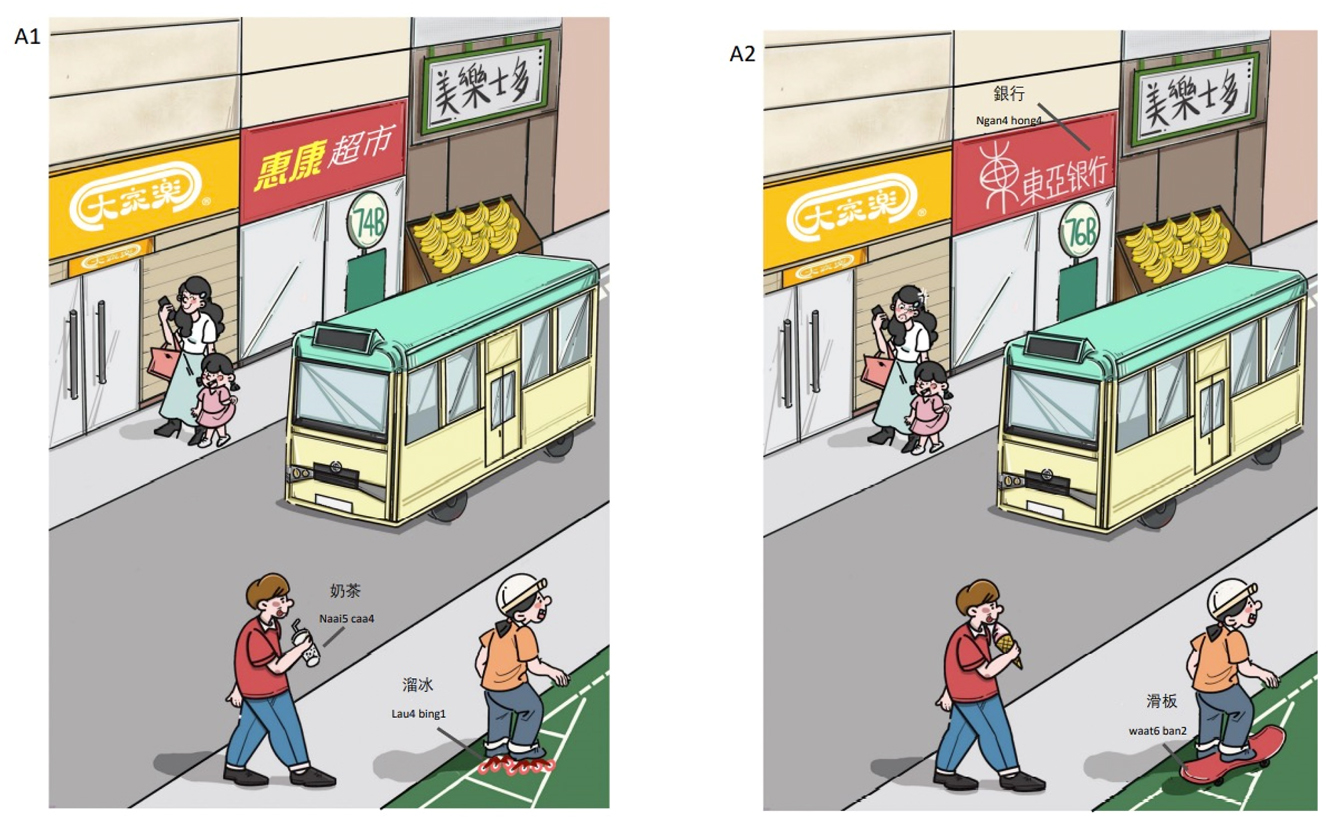
An example of the spot-the-difference task
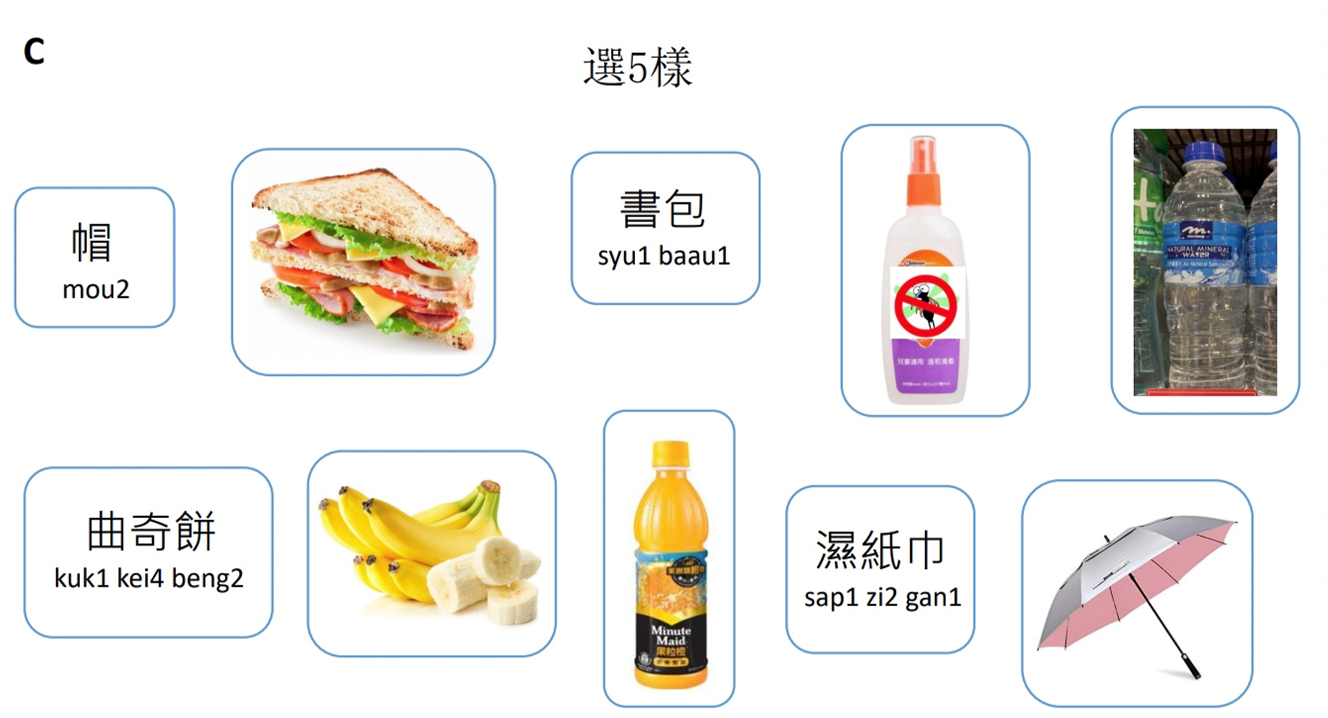
An example of the decision-making task
| (.) | Short pause |
| (…) | Long pause |
| (###) | Unclear content |
| (how to say) | Guessing content |
| 橙 | Stress |
| ↑ | Rising intonation |
| [ ] | Overlap |
| = | Interruptions |
| [/] | Full repetition |
| [//] | Partial repetition |
| [laugh] | Non-verbal behaviour |
References
Azkarai, Agurtzane & María del Pilar García Mayo. 2017. Task repetition effects on L1 use in EFL child task-based interaction. Language Teaching Research 21(4). 480–495. https://doi.org/10.1177/1362168816654169.Search in Google Scholar
Azkarai, Agurtzane, María del Pilar García Mayo & Rhonda Oliver. 2020. The effect of task repetition on the patterns of interaction of ESL children. ITL-International Journal of Applied Linguistics 171(1). 90–112. https://doi.org/10.1075/itl.17034.azk.Search in Google Scholar
Baralt, Melissa. 2013. The impact of cognitive complexity on feedback efficacy during online versus face-to-face interactive tasks. Studies in Second Language Acquisition 35(4). 689–725. https://doi.org/10.1017/S0272263113000429.Search in Google Scholar
Butler, Yuko Goto & Wei Zeng. 2015. Young learners’ interactional development in task-based paired-assessment in their first and foreign languages: A case of English learners in China. Education 3-13 43(3). 292–321. https://doi.org/10.1080/03004279.2013.813955.Search in Google Scholar
Carter, Ronald & Michael McCarthy. 1997. Exploring spoken English. Cambridge: Cambridge University Press.Search in Google Scholar
Cohen, Jacob. 1988 [1987]. Statistical power analysis for the behavioural sciences, 2nd edn. Hillsdale, NJ: Lawrence Erlbaum Associates.Search in Google Scholar
Census and Statistics Department. 2017. 2016 population by-census. Hong Kong: Census and Statistics Department, HKSAR. Available at: https://www.bycensus2016.gov.hk/en/.Search in Google Scholar
Doughty, Catherine & Teresa Pica. 1986. “Information gap” tasks: Do they facilitate second language acquisition? TESOL Quarterly 20(2). 305–325. https://doi.org/10.2307/3586546.Search in Google Scholar
Eckerth, Johannes. 2009. Negotiated interaction in the L2 classroom. Language Teaching 42(1). 109–130. https://doi.org/10.1017/S0261444808005442.Search in Google Scholar
Education Bureau. 2019. Chinese language curriculum second language learning framework. Hong Kong: Education Bureau. Available at: https://www.edb.gov.hk/en/curriculum-development/kla/chi-edu/second-lang.html.Search in Google Scholar
Evans, Stephen. 2013. The long march to biliteracy and trilingualism: Language policy in Hong Kong education since the handover. Annual Review of Applied Linguistics 33. 302–324. https://doi.org/10.1017/S0267190513000019.10.1017/S0267190513000019Search in Google Scholar
Foster, Pauline. 1998. A classroom perspective on the negotiation of meaning. Applied Linguistics 19(1). 1–23. https://doi.org/10.1093/applin/19.1.1.Search in Google Scholar
García Mayo, María del Pilar & Amparo Lázaro Ibarrola. 2015. Do children negotiate for meaning in task-based interaction? Evidence from CLIL and EFL settings. System 54. 40–54. https://doi.org/10.1016/j.system.2014.12.001.Search in Google Scholar
García Mayo, María del Pilar & Ainara Imaz Agirre. 2016. Task repetition and its impact on EFL children’s negotiation of meaning strategies and pair dynamics: An exploratory study. The Language Learning Journal 44(4). 451–466. https://doi.org/10.1080/09571736.2016.1185799.Search in Google Scholar
Gass, Susan, Alison Mackey & Lauren Ross-Feldman. 2005. Task-based interactions in classroom and laboratory settings. Language Learning 55(4). 575–611. https://doi.org/10.1111/j.0023-8333.2005.00318.x.Search in Google Scholar
Gilabert, Roger, Júlia Barón & Àngels Llanes. 2009. Manipulating cognitive complexity across task types and its impact on learners’ interaction during oral performance. International Review of Applied Linguistics in Language Teaching 47(3–4). 367–395. https://doi.org/10.1515/iral.2009.016.Search in Google Scholar
Goh, Christine C. M. & Anne Burns. 2012. Teaching speaking: A holistic approach. Cambridge: Cambridge University Press.Search in Google Scholar
Goh, Christine C. M. & Xuelin Liu. 2023. Confident speaking: Theory, practice and teacher Inquiry. New York: Routledge.10.4324/9780429265402Search in Google Scholar
Hidalgo, Maria Angeles. 2021. Differences in the task-supported negotiations of younger and older EFL children: From repair into prevention. International Review of Applied Linguistics in Language Teaching 59(3). 395–419. https://doi.org/10.1515/iral-2018-0206.Search in Google Scholar
Hidalgo, María Ángeles & María del Pilar García Mayo. 2021. The influence of task repetition type on young EFL learners’ attention to form. Language Teaching Research 25(4). 565–586. https://doi.org/10.1177/1362168819865559.Search in Google Scholar
Hong Kong Unison. 2018. A comprehensive review of learning and teaching of Chinese for ethnic minority students in Hong Kong 2006–2016. Hong Kong: Hong Kong Unison. https://unison.org.hk/sites/default/files/2020-08/R201805_A_comprehensive_review_2006-2016_final.pdf (accessed May 2018).Search in Google Scholar
Hui, Sau-yan & Wai-ip Lam. 2013. 以任務型學習策略, 從生活應用中學習中文 [Using task-based learning strategies to learn Chinese through life applications in the Chinese language]. In Wai-ip Lam, Wai-ming Cheung & Sau-yan Hui (eds.), Overcome obstacles to success: Effective approaches of teaching Chinese for non-Chinese speaking students, 62–67. Hong Kong: Centre for Advancement of Chinese Language Education and Research.Search in Google Scholar
Li, Yuming. 2018. 海外汉语学习者低龄化的思考 [Some thoughts on the younger-age trend of overseas Chinese learners in the Chinese language]. Chinese Teaching in the World 32(3). 291–301. https://doi.org/10.13724/j.cnki.ctiw.2018.03.001.Search in Google Scholar
Liu, Yu. 2017. 任务类型对汉语二语口语产出中词汇复杂度的影响 [Effect of Task Types on Lexical Complexity in L2 Chinese Speaking Performance in the Chinese language]. Chinese Teaching in the World 31(2). 253–269. https://doi.org/10.13724/j.cnki.ctiw.2017.02.011.Search in Google Scholar
Loewen, Shawn & Masatoshi Sato. 2018. Interaction and instructed second language acquisition. Language Teaching 51(3). 285–329. https://doi.org/10.1017/S0261444818000125.Search in Google Scholar
Long, Michael H. 1981. Input, interaction, and second-language acquisition. Annals of the New York Academy of Sciences 379(1). 259–278. https://doi.org/10.1111/j.1749-6632.1981.tb42014.x.Search in Google Scholar
Long, Michael H. 1983. Native speaker/non-native speaker conversation and the negotiation of comprehensible input. Applied Linguistics 4(2). 126–141. https://doi.org/10.1093/applin/4.2.126.Search in Google Scholar
Long, Michael H. 1996. The role of the linguistic environment in second language acquisition. In William C. Ritchie & Tej K. Bhatia (eds.), Handbook of second language acquisition, 413–468. New York: Academic Press.10.1016/B978-012589042-7/50015-3Search in Google Scholar
Mackey, Alison. 1999. Input, interaction, and second language development: An empirical study of question formation in ESL. Studies in Second Language Acquisition 21(4). 557–587. https://doi.org/10.1017/S0272263199004027.Search in Google Scholar
Mackey, Alison, Rebekha Abbuhl & Susan M. Gass. 2013. Interactionist approach. In Susan M. Gass & Alison Mackey (eds.), The Routledge handbook of second language acquisition, 7–23. Abingdon: Routledge.Search in Google Scholar
Nakahama, Yuko, Andrea Tyler & Leo Van Lier. 2001. Negotiation of meaning in conversational and information gap activities: A comparative discourse analysis. TESOL Quarterly 35(3). 377–405. https://doi.org/10.2307/3588028.Search in Google Scholar
Newton, Jonathan. 2013. Incidental vocabulary learning in classroom communication tasks. Language Teaching Research 17(2). 164–187. https://doi.org/10.1177/1362168812460814.Search in Google Scholar
Nuevo, Ana-María. 2006. Task complexity and interaction: L2 learning opportunities and development. Washington, D.C.: Georgetown University doctoral dissertation.Search in Google Scholar
Oliver, Rhonda. 1998. Negotiation of meaning in child interactions. The Modern Language Journal 82(3). 372–386. https://doi.org/10.1111/j.1540-4781.1998.tb01215.x.Search in Google Scholar
Oliver, Rhonda. 2002. The patterns of negotiation for meaning in child interactions. The Modern Language Journal 86(1). 97–111. https://doi.org/10.1111/1540-4781.00138.Search in Google Scholar
Oliver, Rhonda. 2009. How young is too young? Investigating negotiation of meaning and corrective feedback in children aged five to seven years. In Alison Mackey & Charlene Polio (eds.), Multiple perspectives on interaction: Second language interaction research in honour of Susan M. Gass, 35–156. London: Routledge.Search in Google Scholar
Olmedo, Irma M. 2003. Language mediation among emergent bilingual children. Linguistics and Education 14(2). 143–162. https://doi.org/10.1016/S0898-5898(03)00033-0.Search in Google Scholar
Philp, Jenefer, Rhonda Oliver & Alison Mackey. 2008. Child’s play: Second language acquisition and the younger learner. Amsterdam: John Benjamins.10.1075/lllt.23Search in Google Scholar
Pica, Teresa & Catherine Doughty. 1985. The role of group work in classroom second language acquisition. Studies in Second Language Acquisition 7(2). 233–248. https://doi.org/10.1017/S0272263100005398.Search in Google Scholar
Pinter, Annamaria. 2007. Some benefits of peer–peer interaction: 10-year-old children practicing with a communication task. Language Teaching Research 11(2). 189–207. https://doi.org/10.1177/136216880707460.Search in Google Scholar
Pladevall-Ballester, Elisabet & Alexandra Vraciu. 2020. EFL child peer interaction: Measuring the effect of time, proficiency pairing and language of interaction. Studies in Second Language Learning and Teaching 10(3). 449–472. https://doi.org/10.14746/ssllt.2020.10.3.3.Search in Google Scholar
Qiu, Xuyan & Hong Cheng. 2022. The effects of task types on L2 oral production and learner engagement. International Review of Applied Linguistics in Language Teaching 60(4). 1063–1088. https://doi.org/10.1515/iral-2020-0128.Search in Google Scholar
Qiu, Xuyan & Yuen Yi Lo. 2017. Content familiarity, task repetition and Chinese EFL learners’ engagement in second language use. Language Teaching Research 21(6). 681–698. https://doi.org/10.1177/1362168816684368.Search in Google Scholar
Robinson, Peter. 2001. Task complexity, task difficulty, and task production: Exploring interactions in a componential framework. Applied Linguistics 22(1). 27–57. https://doi.org/10.1093/applin/22.1.27.Search in Google Scholar
Robinson, Peter. 2007. Task complexity, theory of mind, and intentional reasoning: Effects on L2 speech production, interaction, uptake and perceptions of task difficulty. International Review of Applied Linguistics in Language Teaching 45(3). 193–213. https://doi.org/10.1515/iral.2007.009.Search in Google Scholar
Robinson, Peter & Roger Gilabert. 2007. Task complexity, the Cognition Hypothesis and second language learning and performance. International Review of Applied Linguistics in Language Teaching 45(2007). 161–176. https://doi.org/10.1515/IRAL.2007.007.Search in Google Scholar
Skehan, Peter & Pauline Foster. 1999. The influence of task structure and processing conditions on narrative retellings. Language Learning 49(1). 93–120. https://doi.org/10.1111/1467-9922.00071.Search in Google Scholar
Varonis, Evangeline Marlos & Susan Gass. 1985. Non-native/non-native conversations: A model for negotiation of meaning. Applied Linguistics 6(1). 71–90. https://doi.org/10.1093/applin/6.1.71.Search in Google Scholar
Wu, Qiuping & Na Xiang. 2022. 线上信息差与意见差任务中的协商互动及对口语输出的影响 [Negotiated interactions in online information gap task and opinion gap task and their influence on oral production in the Chinese language]. Chinese Teaching in the World 36(3). 416–430. https://doi.org/10.13724/j.cnki.ctiw.2022.03.010.Search in Google Scholar
Zhao, Lei. 2015. 任务型口语课堂汉语学习者协商互动研究 [Research on negotiated interations ampng Chinese language learners in task-based spoken classroom in the Chinese language]. Chinese Teaching in the World 29(3). 362–376. https://doi.org/10.13724/j.cnki.ctiw.2017.02.011.Search in Google Scholar
© 2024 Walter de Gruyter GmbH, Berlin/Boston
Articles in the same Issue
- Frontmatter
- Research Articles
- Learning academic vocabulary through reading online news
- A Q methodological study into pre-service Chinese as a foreign language (CFL) teachers’ mindsets about teaching competencies
- Assessing written production in L2 Mandarin Chinese: fluency and accuracy
- Machine translation as a form of feedback on L2 writing
- Acquisition of collocations under different glossing modalities and the mediating role of learners’ perceptual learning style
- Unpacking changing emotions in multiple contexts: idiodynamic study of college students’ academic emotions
- Exploring L2 learners’ processing of unknown words during subtitled viewing through self-reports
- Model text as corrective feedback in L2 writing: the role of working memory and vocabulary size
- Exploring learner-related variables in child collaborative writing: interaction mindset, willingness to communicate and proficiency
- Contributions of significant others to second language teacher well-being: a self-determination theory perspective
- The stone left unturned: boredom among young EFL learners
- The impact of out-of-school L2 input and interaction on adolescent classroom immersion and community-L2 learners’ L2 vocabulary: opportunities for interaction are key
- Promoting interaction and lowering speaking anxiety in an EMI course: a group dynamic assessment approach
- Relationship between learner creativity, task planning, and speaking performance in L2 narrative tasks
- Influencing factors of L2 writers’ engagement in an assessment as learning-focused context
- The cognitive-emotional dialectics in second language development: speech and co-speech gestures of Chinese learners of English
- Impact of task type and task complexity on negotiation of meaning in young learners of Chinese as a second language
- Effects of working memory and task type on syntactic complexity in EFL learners’ writing
- Assessing effects of source text complexity on L2 learners’ interpreting performance: a dependency-based approach
- Incidental learning of collocations through reading an academic text
- Listenership always matters: active listening ability in L2 business English paired speaking tasks
- Enhancing the processing advantage: two psycholinguistic investigations of formulaic expressions in Chinese as a second language
- The effect of form presentation mode and language learning aptitude on the learning burden and decay of L2 vocabulary knowledge
- Examining the impact of foreign language anxiety and language contact on oral proficiency: a study of Chinese as a second language learners
- The dynamics of changes in linguistic complexity and writing scores in timed argumentative writing among beginning-level EFL learners
- Perception of English semivowels by Japanese-speaking learners of English
- Corrigendum
- Corrigendum to: Development and validation of Questionnaire for Self-regulated Learning Writing Strategies (QSRLWS) for EFL learners
Articles in the same Issue
- Frontmatter
- Research Articles
- Learning academic vocabulary through reading online news
- A Q methodological study into pre-service Chinese as a foreign language (CFL) teachers’ mindsets about teaching competencies
- Assessing written production in L2 Mandarin Chinese: fluency and accuracy
- Machine translation as a form of feedback on L2 writing
- Acquisition of collocations under different glossing modalities and the mediating role of learners’ perceptual learning style
- Unpacking changing emotions in multiple contexts: idiodynamic study of college students’ academic emotions
- Exploring L2 learners’ processing of unknown words during subtitled viewing through self-reports
- Model text as corrective feedback in L2 writing: the role of working memory and vocabulary size
- Exploring learner-related variables in child collaborative writing: interaction mindset, willingness to communicate and proficiency
- Contributions of significant others to second language teacher well-being: a self-determination theory perspective
- The stone left unturned: boredom among young EFL learners
- The impact of out-of-school L2 input and interaction on adolescent classroom immersion and community-L2 learners’ L2 vocabulary: opportunities for interaction are key
- Promoting interaction and lowering speaking anxiety in an EMI course: a group dynamic assessment approach
- Relationship between learner creativity, task planning, and speaking performance in L2 narrative tasks
- Influencing factors of L2 writers’ engagement in an assessment as learning-focused context
- The cognitive-emotional dialectics in second language development: speech and co-speech gestures of Chinese learners of English
- Impact of task type and task complexity on negotiation of meaning in young learners of Chinese as a second language
- Effects of working memory and task type on syntactic complexity in EFL learners’ writing
- Assessing effects of source text complexity on L2 learners’ interpreting performance: a dependency-based approach
- Incidental learning of collocations through reading an academic text
- Listenership always matters: active listening ability in L2 business English paired speaking tasks
- Enhancing the processing advantage: two psycholinguistic investigations of formulaic expressions in Chinese as a second language
- The effect of form presentation mode and language learning aptitude on the learning burden and decay of L2 vocabulary knowledge
- Examining the impact of foreign language anxiety and language contact on oral proficiency: a study of Chinese as a second language learners
- The dynamics of changes in linguistic complexity and writing scores in timed argumentative writing among beginning-level EFL learners
- Perception of English semivowels by Japanese-speaking learners of English
- Corrigendum
- Corrigendum to: Development and validation of Questionnaire for Self-regulated Learning Writing Strategies (QSRLWS) for EFL learners
