Study of strength properties of semi-finished products from economically alloyed high-strength aluminium-scandium alloys for application in automobile transport and shipbuilding
-
 ,
,

Abstract
The results of a study on the strength of rolled products from aluminium alloys doped with scandium under various processing conditions of hot and cold rolling are presented. The regularities of metal flow and the level of strength of deformed semi-finished products from aluminum-scandium alloys are established, depending on the total degree of deformation and the various modes of single reduction during rolling. It is shown that when using one heating of a cast billet to obtain high-quality semi-finished products, the temperature during the rolling process should not be lower than 350-370°, and the total degree of deformation does not exceed 50-60%. It was found that the semi-finished products from alloys with a content of scandium in the range 0.11-0.12% in the deformed state had elevated values of ultimate tensile strength and yield strength of the metal, which allows them to be recommended for industrial production of sheet metal products.
1 Introduction
Recently, much attention has been paid to research in the field of creating processing technologies and studying the properties of cast and deformed semi-finished products from aluminium alloys alloyed with rare-earth metals, in particular, by scandium [1,2,3,4,5,6,7,8,9,10]. This is because such alloys, along with corrosion resistance and good performance properties, can have high strength characteristics. Alloys of the Al-Mg system that do not contain scandium (for example, alloy 5083) are widely used in industry, and alloys with a high scandium content (up to 0.24%), for example, 01570 alloy, have a high cost due to the use of expensive scandium ligature. Therefore, an urgent task is the development of new alloys, economically alloyed with scandium, having increased strength.
With the purpose of deeper studying the patterns of formation of mechanical and operational characteristics of products made of such high-strength aluminium-scandium alloys, the employees of «RUSAL» together with the scientists of the School of Non-Ferrous Metals and Materials Science of the Siberian Federal University conducted a number of experimental studies to obtain cast and deformed semi-finished products and study their properties. The results of some of these studies are given below.
The article is based on the report presented at the IX International Congress “Non-ferrous metals and minerals-2017”.
2 Methods
In the first stage of research, flat ingots of 8 alloys of the Al-Mg system with different scandium content varying in the range of 0.10-0.24% and 1 ingot of the 5083 alloy, which was basic and did not contain scandium, were cast in experimental industrial conditions. They were subjected to homogenization annealing in the following manner: heating with an oven at a rate of 1.16°C per minute to 350°C; holding at this temperature for 11 hours; reheating to temperature T = 425° C at a rate of 1.25°C per minute; holding at this temperature for 8 hours; cooling in air. For the design of the processing route for experimental alloys, a deformation scheme was adopted that included hot rolling of 28 mm thick preforms heated to 450°C to a thickness of 10 mm, and then cold rolling of these strips to a final thickness of 1 mm (Table 1).
Route of rolling all investigated alloys
| Route | Primary thickness | Final thickness | Draw ratio λ | Degree of deformation ∊, % | ||
|---|---|---|---|---|---|---|
| number | h0, mm | hi, mm | Single λs | Total λt | Single ∊s | Total ∊t |
| 28.0 | 27.5 | 1.02 | 1.02 | 1.96 | 2.0 | |
| 27.5 | 26.8 | 1.03 | 1.05 | 2.48 | 4.4 | |
| 26.8 | 25.9 | 1.03 | 1.08 | 3.36 | 7.6 | |
| 25.9 | 25.0 | 1.04 | 1.12 | 3.48 | 10.8 | |
| 25.0 | 24.1 | 1.04 | 1.16 | 3.60 | 14.0 | |
| 24.1 | 23.2 | 1.04 | 1.21 | 3.74 | 17.3 | |
| 23.2 | 22.3 | 1.04 | 1.26 | 3.88 | 20.5 | |
| 22.3 | 21.4 | 1.04 | 1.31 | 4.04 | 23.7 | |
| 21.4 | 20.5 | 1.04 | 1.37 | 4.21 | 26.9 | |
| 20.5 | 19.6 | 1.05 | 1.43 | 4.40 | 30.1 | |
| 19.6 | 18.7 | 1.05 | 1.50 | 4.60 | 33.3 | |
| 18.7 | 17.7 | 1.05 | 1.58 | 5.09 | 36.7 | |
| 17.7 | 16.8 | 1.06 | 1.67 | 5.36 | 40.1 | |
| 16.8 | 15.8 | 1.06 | 1.77 | 5.66 | 43.5 | |
| 15.8 | 14.9 | 1.06 | 1.88 | 6.01 | 46.9 | |
| 14.9 | 13.9 | 1.07 | 2.01 | 6.39 | 50.3 | |
| 13.9 | 13.0 | 1.07 | 2.16 | 6.82 | 53.7 | |
| 13.0 | 12.0 | 1.08 | 2.33 | 7.32 | 57.1 | |
| 12.0 | 11.0 | 1.09 | 2.53 | 8.07 | 60.5 | |
| 11.0 | 10.0 | 1.10 | 2.78 | 8.87 | 64.0 | |
| 10.0 | 9.1 | 1.11 | 3.09 | 9.93 | 67.6 | |
| 9.1 | 8.0 | 1.12 | 3.47 | 11.03 | 71.2 | |
| 8.0 | 7.0 | 1.14 | 3.96 | 12.39 | 74.8 | |
| 7.0 | 6.0 | 1.16 | 4.61 | 14.14 | 78.3 | |
| 6.0 | 5.0 | 1.21 | 5.60 | 16.50 | 82.1 | |
| 5.0 | 4.4 | 1.12 | 1.12 | 11.0 | 84.3 | |
| 4.4 | 3.9 | 1.14 | 1.28 | 11.9 | 86.0 | |
| 3.9 | 3.4 | 1.14 | 1.45 | 12.2 | 87.8 | |
| 3.4 | 3.0 | 1.14 | 1.66 | 12.5 | 89.2 | |
| 3.0 | 2.6 | 1.14 | 1.89 | 12.3 | 90.7 | |
| 2.6 | 2.3 | 1.14 | 2.16 | 12.1 | 91.8 | |
| 2.3 | 2.0 | 1.14 | 2.45 | 12.1 | 92.8 | |
| 2.0 | 1.8 | 1.14 | 2.79 | 12.3 | 93.6 | |
| 1.8 | 1.6 | 1.13 | 3.16 | 11.7 | 94.3 | |
| 1.3 | 1.4 | 1.12 | 3.55 | 10.8 | 95.0 | |
| 1.4 | 1.3 | 1.10 | 3.91 | 9.2 | 95.4 | |
| 1.3 | 1.2 | 1.08 | 4.24 | 7.8 | 95.7 | |
| 1.2 | 1.1 | 1.07 | 4.55 | 6.8 | 96.1 | |
| 1.1 | 1.04 | 1.06 | 4.81 | 5.5 | 96.2 | |
| 1.04 | 1.00 | 1.04 | 5.00 | 3.8 | 96.4 | |
When developing the rolling modes of experimental aluminum alloys, the methods and software described in [11, 12] were used to calculate deformation and force parameters and used the dependences characterizing the change in their strength characteristics from the degree of deformation obtained in the course of studying the mechanical properties.
For the study, 8 alloys of the Al-Mg system with Cr 0.15 to 0.20%, Si 0.20%, Zn 0.1%, Cu 0.1%, Fe 0.2% and different scandium content from 0.10 to 0.24% were chosen (Table 2). The DUO 330 mill was used as the equipment for hot rolling, and the MDM ARIETE LS 400×240 mill for cold rolling. As a result of rolling with the use of intermediate heating preheaters, hot-rolled strips were obtained, which were then rolled to specified thicknesses with ∊t up to 97%.
The chemical composition of ingots from experimental alloys with a reduced content of Mn and Cr of the Al-Mg system
| Alloy | Main elements, % | ||||
|---|---|---|---|---|---|
| number | Al | Mg | Mn | Sc | Zr |
| 0 | 5.0-5.2 | 0.8 | - | - | |
| 1 | 5.0-5.2 | 0.6 | 0.24 | 0.10 | |
| 2 | 5.0-5.2 | 0.6 | - | 0.20 | |
| 3 | 5.0-5.2 | 0.6 | 0.10 | 0.20 | |
| 4 | Basis | 5.0-5.2 | 0.3 | 0.10 | 0.20 |
| 5 | 5.0-5.2 | 0.75 | 0.10 | 0.20 | |
| 6 | 5.0-5.2 | 0.6 | 0.10 | - | |
| 7 | 5.0-5.2 | 0.6 | 0.10 | 0.10 | |
| 8 | 5.0-5.2 | 0.6 | 0.15 | 0.20 | |
In the course of rolling, samples were taken for mechanical testing and tensile strength and yield strength of the metal was determined by means of a universal machine LFM 400. The obtained 3 mm thick strips were annealed at T = 350 °C and a holding time of 3 hours. Data on the mechanical properties of semi-finished products from the experimental alloy in comparison with the alloy-analogue 5083, which does not contain scandium, are shown in Figure 1 (for the reference point for ∊ = 0, the values of σB for the cast preform are taken). Analysis of the dependencies on the graph allows us to conclude that, with an increase in the degree of deformation, the values of the temporary fracture resistance (σB) for all investigated alloys increase and at ∊t = 96.8% reach values of the order of 500-550 MPa. The regularities of the change in the values of the yield strength (σ0.2) of the metal are of a similar nature, and their values reach 360-478 MPa. It was also found that with the increase in the amount of scandium in the alloy, the strength characteristics of the metal also increase.
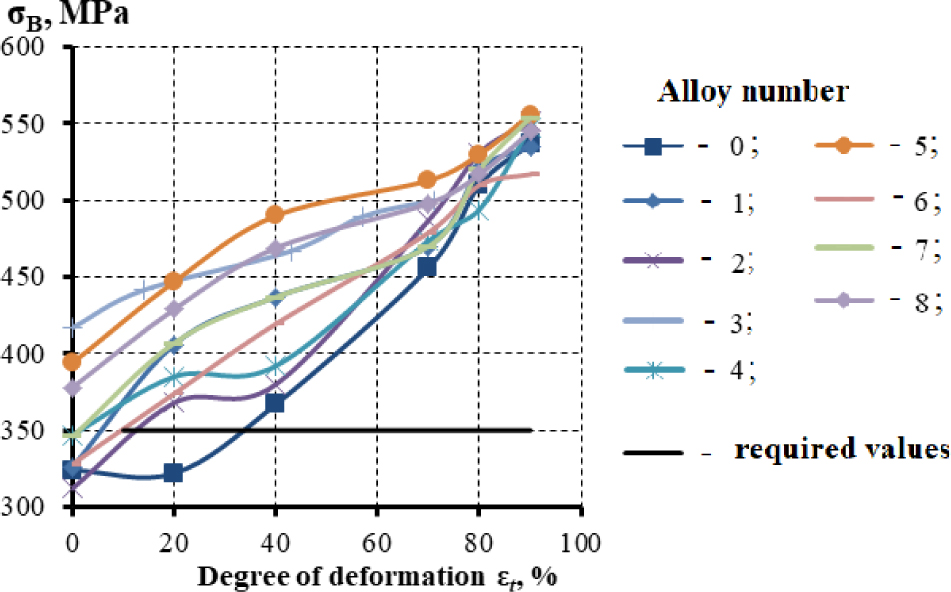
The change in the tensile strength for the investigated alloys
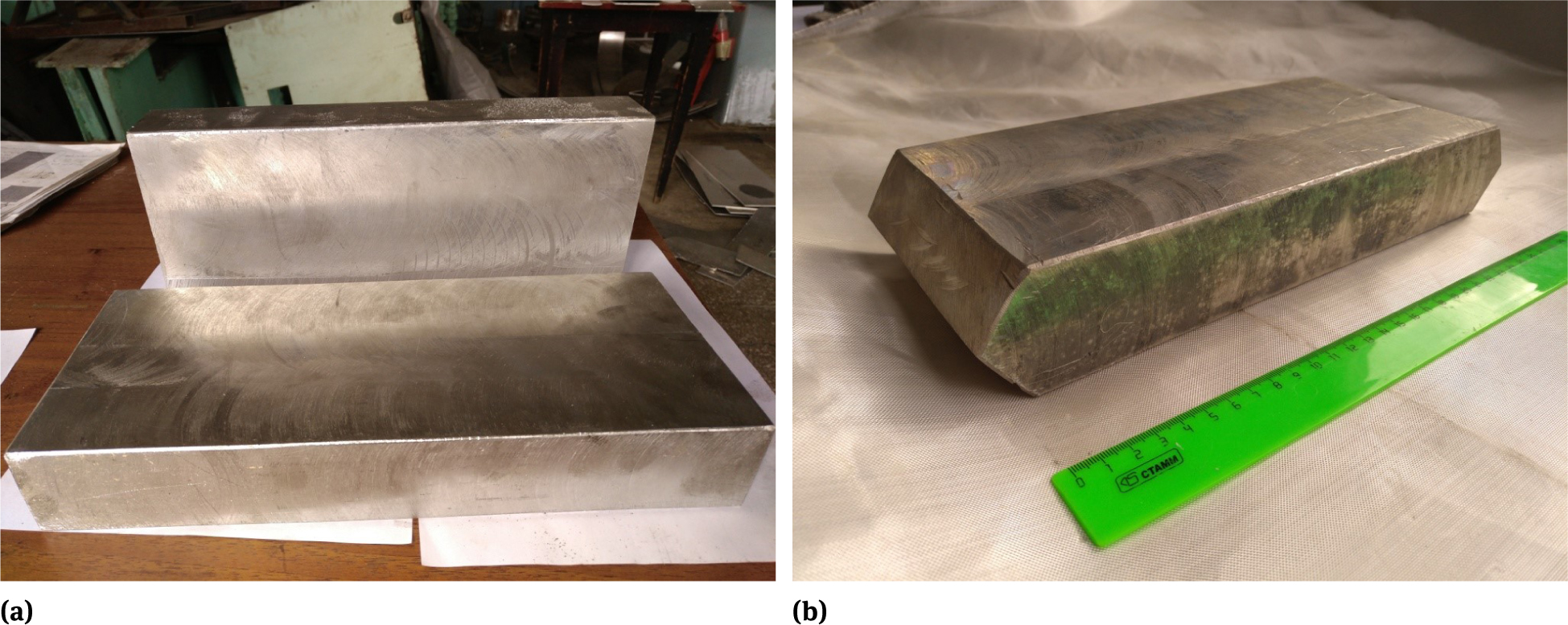
At the second stage of the research in the industrial conditions of the Bratsk aluminium smelter on the basis of alloy 5083, flat ingots 560×1360×4520 mm in size (Figure 2) were cast from an aluminium alloy in which the scandium content was in the range of 0.11-0.12%. The templates were cut off from the ingots, from which samples were prepared for testing the mechanical properties of the cast metal and the workpiece with milled faces for rolling with dimensions of 40×120×200 mm (Figure 3).

The type of ingot (a) obtained under the industrial conditions of the Bratsk aluminium smelter, and its macrostructure (b)
View of cast billets from the investigated alloys after milling
Further, according to the previously developed regimes, the homogenized preforms were hot rolled in a DUO 330 mill up to a thickness of 10 mm, and the obtained strip was rolled to a thickness of 3 mm in the cold state. In the course of rolling, samples were taken for mechanical testing and a temporary tensile strength, yield strength and elongation were determined. The resulting 3 mm thick strips were annealed at T = 350° C and a holding time of 3 hours.
Data on the mechanical properties of semi-finished products from the experimental alloy in comparison with the analog alloy 5083, which does not contain scandium, are given in Table 3 and showed that σB for deformed semifinished products increased by an average of 17%, and σ0.2 of the metal by 29%, for annealed, respectively, by 29 and 49.8%.
Strength properties of samples of rolled products from experimental alloys
| Sample number | Thickness hi, mm | Condition | Srength properties, MPa | |||
|---|---|---|---|---|---|---|
| alloy 5083 | experimental alloy | |||||
| σB | σO.2 | σB | σ0.2 | |||
| 1 | 10 | hot deformed | 297 | 196 | 356 | 232 |
| 2 | 8 | hot deformed | 305 | 217 | 372 | 280 |
| 3 | 6 | hot deformed | 318 | 213 | 387 | 312 |
| 4 | 3 | cold deformed | 394 | 373 | 453 | 429 |
| 5 | 3 | annealed | 277 | 139 | 390 | 277 |
In the third stage of the research, the possibility of rolling cast billets from an alloy with scandium content from one without additional metal heating during the rolling process and the strength properties of the obtained deformed semi-finished products were analyzed.
Rolling of the first billet with dimensions of 53×130×330 mm was carried out after homogenization with a single reduction of 2% until cracks appeared on the lateral faces that appeared at a thickness of 30 mm. The total degree of deformation was 43.4%, and the number of passes was 21. The analysis of shortcomings showed that the metal flow for a given compression pattern is uneven: the peripheral layers outstrip the central ones (Figure 4). This caused the appearance of significant tensile stresses and, as a consequence, at a low metal temperature, the appearance of cracks on both sides of the workpiece.
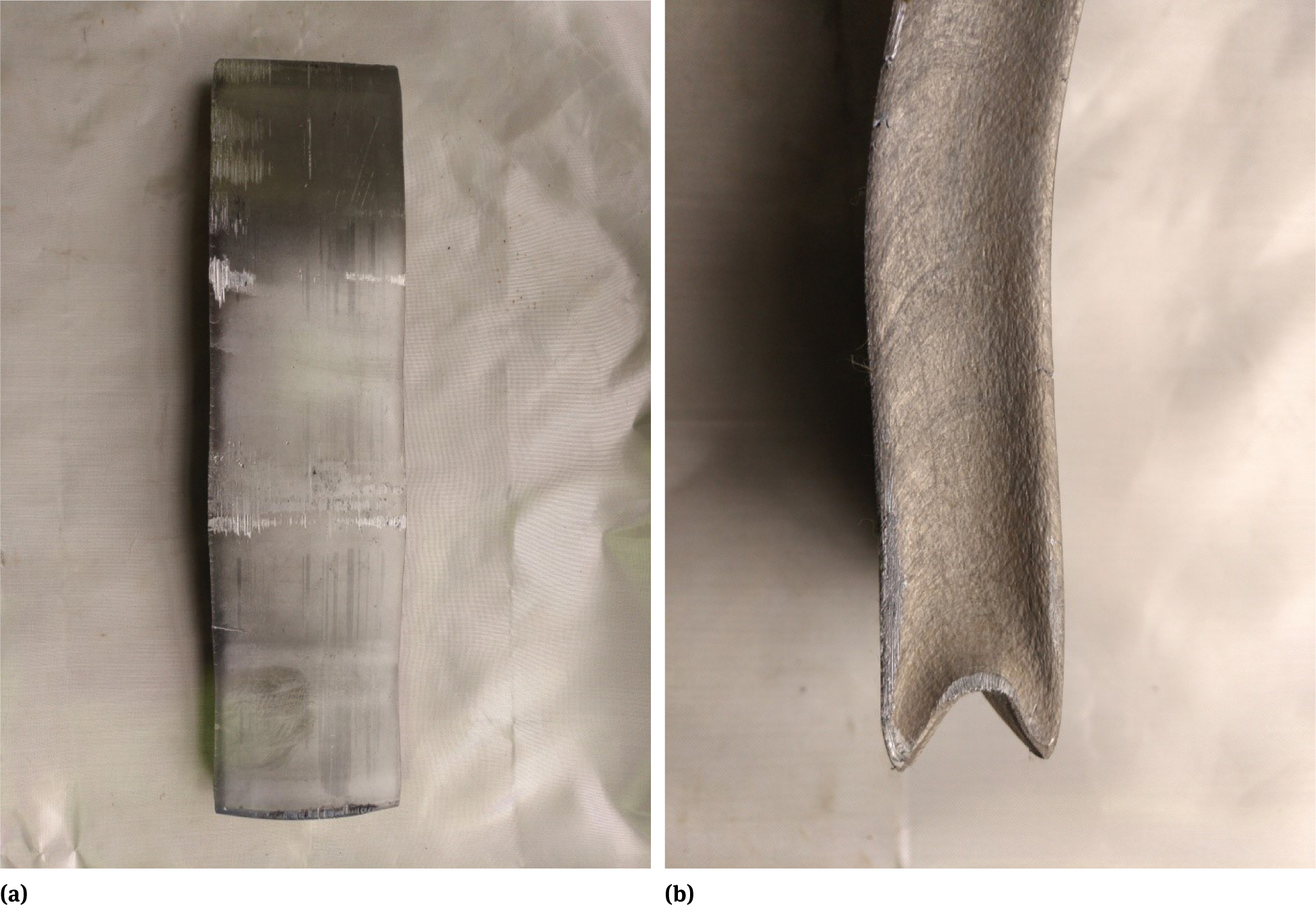
View of the first billet after rolling: a - from above; b - on the side
The second billet (Figure 5) was rolled under heating under a similar regime and the maximum reduction at rolling in the scheme 53-48-43-38-35-32-31.2 (6 passes), after which the billet was exposed at its end. The total degree of deformation was 41.1%. It can be noted that during rolling a more uniform flow of metal was observed and there was an absence of cracks on one of the faces (Figure 5b), which indicates that both the peripheral and central layers of the preform are being worked through. However, large values of single compression led to the disclosure of the billet.
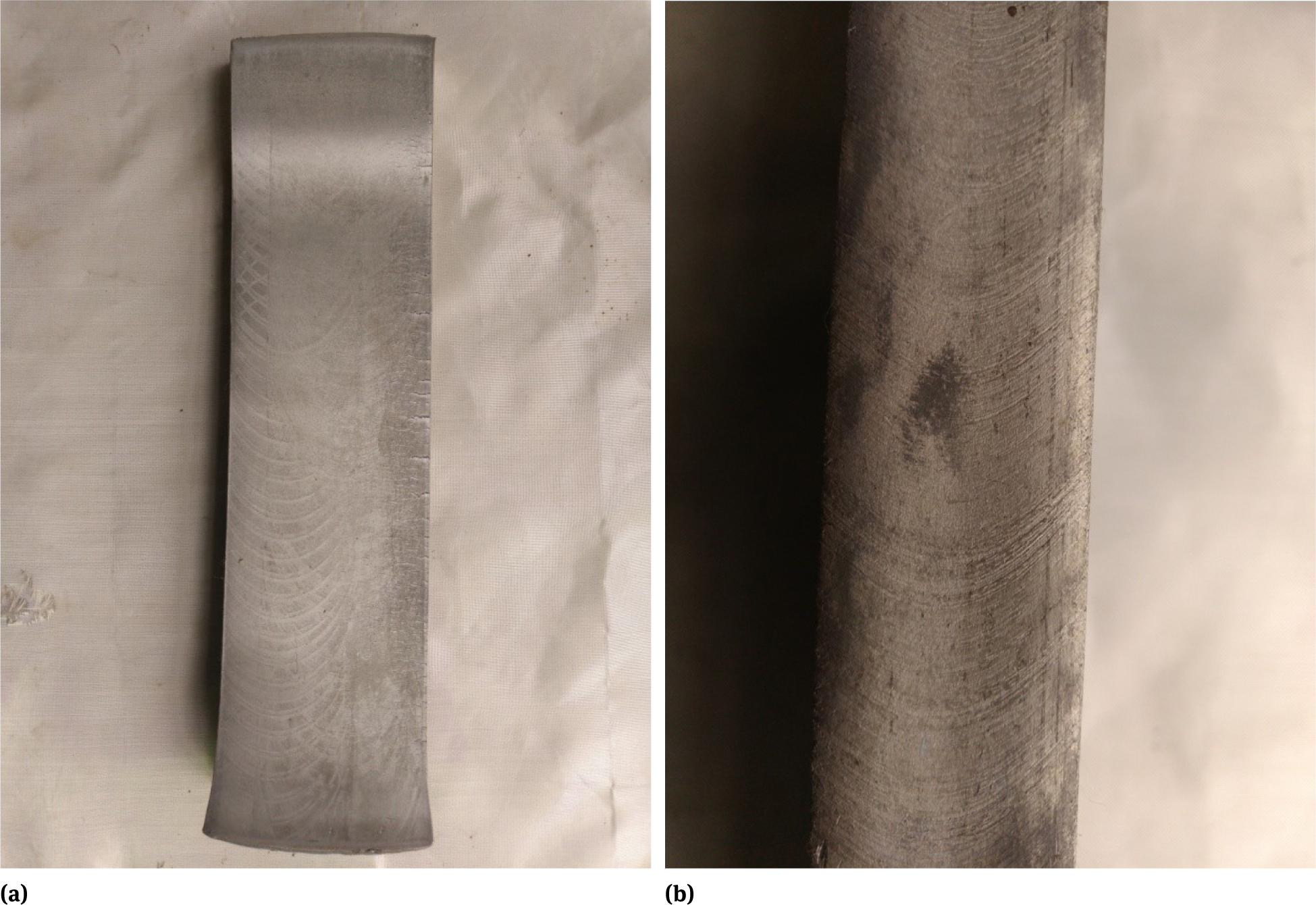
View of the second billet after rolling: a - from above; b - on the side
Rolling of the third billet (Figure 6) with a thickness of 40 mm was done with an aluminium cladding of two large facets with a 1 mm thick plate and a length of 0.75 of the sample length at T = 450°C. The modes of reduction and the temperature of the metal are given in Table 4. The total degree of deformation ∊t was 75% (final thickness hi = 11 mm), during the rolling process, 4 intermediate temperatures of the metal had to be used.
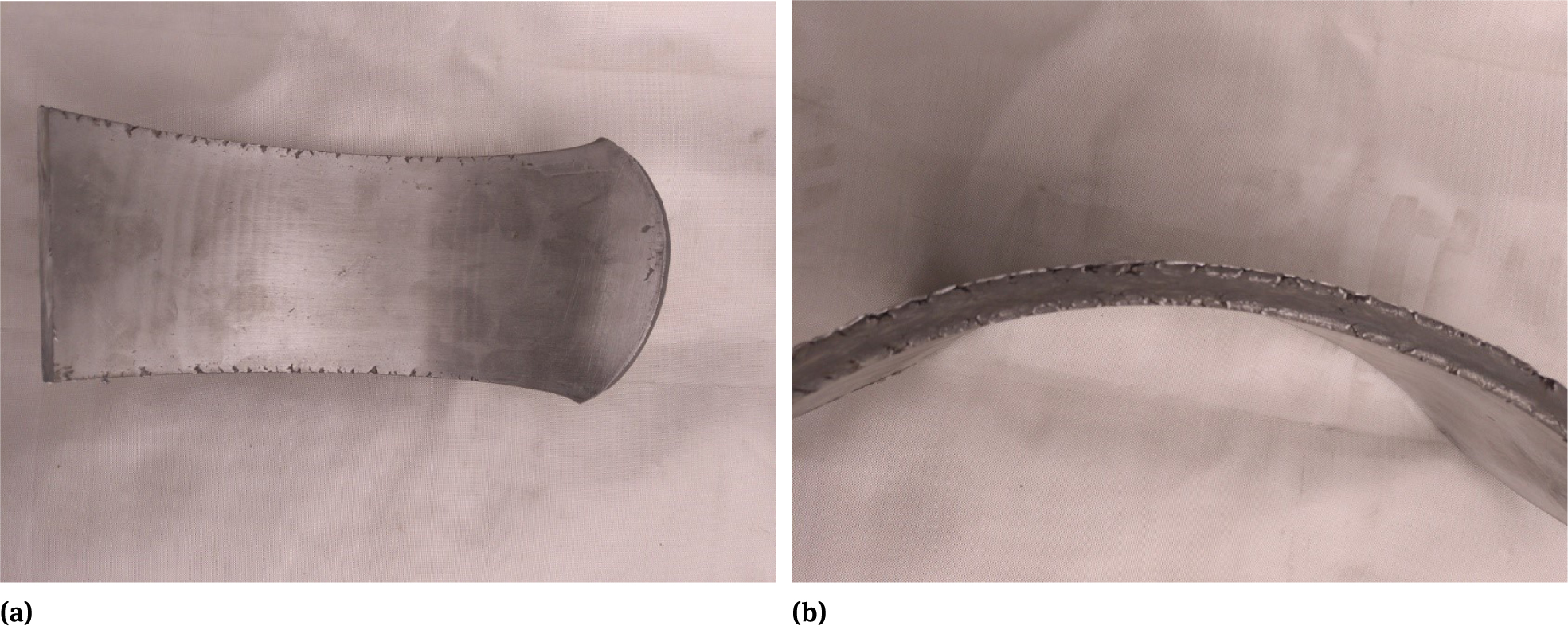
View of the third billet after rolling: a - from above; b - on the side
Modes of reduction and temperature of metal along the passes during rolling
| Pass number | Δh, mm | Reduction, % | Temperature before pass | Temperature after | Note | |
|---|---|---|---|---|---|---|
| Single εs | εt | T, °C | pass T, °C | |||
| 1 | 5 | 12.5 | 12.5 | 450 | ||
| 2 | 3 | 8.5 | 20 | 445 | 418 | |
| 3 | 2 | 6 | 25 | 418 | 395 | |
| 4 | 2 | 7 | 30 | 395 | 370 | |
| 5 | 2 | 7 | 35 | 370 | 350 | heating |
| 6 | 3 | 11.5 | 42.5 | 400 | 386 | |
| 7 | 2 | 9 | 47.5 | 386 | 357 | |
| 8 | 1 | 5 | 50 | 357 | 350 | |
| 9 | 1 | 5 | 52.5 | 350 | heating | |
| 10 | 3 | 16 | 60 | 440 | 415 | |
| 11 | 2 | 12.5 | 65 | 415 | 360 | |
| 12 | 1 | 7 | 67.5 | 360 | heating | |
| 13 | 2 | 15 | 72.5 | 430 | 360 | heating |
| 14 | 2 | 18 | 75 | 415 | 360 | |
The fourth blank with a thickness of 26 mm with a Petrov lock (Figure 7 b) on one side was rolled from one heating at T = 450°C in 45 passes. Rolling was carried out with small crimps (1-2%), the total reduction ∊t was 57.6%.

View of the fourth billet after rolling: a - from above; b - on the side
The temporary tensile strength σB for the obtained semi-finished products varied within 343-379 MPa, which corresponds to the strength characteristics for hot deformed semi-finished products from the alloy studied earlier (Table 4).
3 Conclusions
Thus, the conducted studies made it possible to establish the regularities of the metal flow and the level of strength of the deformed semi-finished products from aluminiumscandium alloys, depending on the total degree of deformation and the various modes of single reduction during rolling. The distribution of the compressions along the passes for the ingots is not important, since even when rolling with single compressions ∊s of the order of 10-15% at processing temperatures of 420-450°C, the metal deformation proceeds evenly without defects, and the metal is worked through the entire thickness. The most important technological parameters are the temperature of strip and the total reduction: the temperature is not lower than 350-370°C; the total degree of deformation ∊t is not more than 50-60%. Semi-finished products from aluminium alloys with scandium content in the range of 0.11-0.12% in the deformed state have increased values of the tensile strength and yield strength of the metal, which are on average 17-29% higher than the strength parameters for base alloy 5083, in the composition of which there is no scandium. The obtained research results will be used in the development of casting technologies for rolling these alloys in industrial conditions and obtaining products in the form of sheet products for the needs of automobile and shipbuilding.
Acknowledgement
The publication was prepared using the results of works carried out during the project 03.G25.31.0265 “Development of economically alloyed high-strength Al-Sc alloys for use in road transport and navigation” as part of the Program for the implementation of complex projects for the creation of high-tech production approved by the RF Government Decree of April 9 2010 No 218.
Nomenclature
Δh absolute reduction, [mm]
∊s single degree of deformation (reduction), [%]
∊t total degree of deformation (reduction), [%]
λs single draw ratio, [-]
λt total draw ratio, [-]
σB tensile strength, [MPa]
σT yield strength, [MPa]
h0 primary thickness, [mm]
hi final thickness, [mm]
T temperature [°C]
References
[1] Pedro Henrique R. Pereiraa, Ying Chun Wang, Yi Huang, Terence G. Langdon, Influence of grain size on the flow properties of an Al-Mg-Sc alloy over seven orders of magnitude of strain rate, Materials Science & Engineering, 2017, A685, 367-376.10.1016/j.msea.2017.01.020Search in Google Scholar
[2] S. Mondol, T. Alamb, R. Banerjee, S. Kumar, K. Chattopadhyay, Development of a high temperature high strength Al alloy by addition of small amounts of Sc and Mg to 2219 alloy, Materials Science & Engineering, 2017, A687, 221-231.10.1016/j.msea.2017.01.037Search in Google Scholar
[3] Mengjia Li, Qinglin Pan, Yunjia Shi, Xue Sun, Hao Xiang, High strain rate superplasticity in an Al–Mg–Sc–Zr alloy processed via simple rolling, Materials Science & Engineering, 2017, A687, 298-305.10.1016/j.msea.2017.01.091Search in Google Scholar
[4] Yu. Buranova, V. Kulitskiy, M. Peterlechner, A. Mogucheva, R. Kaibyshev, S.V. Divinski, et al., Al3(Sc, Zr) - based precipitates in AleMg alloy: Effect of severe deformation, Acta Materialia, 2017, 124, 210-224.10.1016/j.actamat.2016.10.064Search in Google Scholar
[5] Fuller C.B., Temporal evolution of the nanostructure of Al(Sc,Zr) alloys: Part II coarsening of Al3(Sc1-xZrx) precipitates, Acta Materialia, 2005, 53, No 20, 5415-5428.10.1016/j.actamat.2005.08.015Search in Google Scholar
[6] Ryset Ryum N., Scandium in aluminum alloys, International Materials Reviews, 2005, 50, No. 1.10.1179/174328005X14311Search in Google Scholar
[7] L.S. Toropova, D.S. Eskin, M.L. Kharakterova, T.V. Dobatkina, Advanced Aluminum Alloys Containing Scandium: Structure and Properties, Amsterdam: Gordon and Breach Science Publishers, 1998, 175.Search in Google Scholar
[8] Filatov Yu.A. Razlichnye podkhody k realizatsii uprochnyayushchego effekta ot dobavki skandiya v deformiruemykh splavakh na osnove sistemy Al–Mg–Sc [Various approaches to realization of the strengthening effect resulted from scandium addition made to wrought Al–Mg–Sc system based alloys], VILS: Tekhnologiya legkikh splavov, 2009, 3, 42–45.Search in Google Scholar
[9] Kuznetsov G.M., Pobezhimov P.P., Nefedova L.P., Belov E.V. Osobennosti formirovaniya struktury i svoistv liteinykh Al-Mg-splavov, legirovannykh skandiem [Features of the formation of the structure and properties of cast Al-Mg alloys doped with scandium], Metallovedenie i termicheskaya obrabotka metallov/ VIAM, 1996, No. 6.Search in Google Scholar
[10] Drits M.E., Kadaner E.S., Dobatkina T.V., Turkina N.I. O kharaktere vzaimodeistviya skandiya s alyuminiem v bogatoi alyuminiem chasti sistemy [On the nature of the interaction of scandium with aluminum in the aluminum-rich part of the system], Izv. AN SSSR, 1973, No. 4, 213–217.Search in Google Scholar
[11] S.B. Sidelnikov, I.L. Konstantinov, D.S. Voroshilov, Rolling technology: a textbook. – 3rd ed., Ext. and revised. – Krasnoyarsk : SibFU, 2016, 180 p.Search in Google Scholar
[12] Baranov V. N., Sidelnikov S. B., Bezrukikh A. I., Zenkin E. Y., Research of rolling regimes and mechanical properties of cold-rolled, annealed and welded semi-finished products from experimental alloys of Al–Mg system, economically alloyed by scandium, Tsvetnye Metally, 2017, No. 9, 83–88.10.17580/tsm.2017.09.13Search in Google Scholar
© 2018 V. Baranov et al.
This work is licensed under the Creative Commons Attribution-NonCommercial-NoDerivatives 4.0 License.
Articles in the same Issue
- Regular Article
- Real-scale comparison between simple and composite raw sewage sampling
- 10.1515/eng-2018-0017
- The risks associated with falling parts of glazed facades in case of fire
- Implementation of high speed machining in thin-walled aircraft integral elements
- Evaluating structural crashworthiness and progressive failure of double hull tanker under accidental grounding: bottom raking case
- Influence of Silica (SiO2) Loading on the Thermal and Swelling Properties of Hydrogenated-Nitrile-Butadiene-Rubber/Silica (HNBR/Silica) Composites
- Statistical Variations and New Correlation Models to Predict the Mechanical Behavior and Ultimate Shear Strength of Gypsum Rock
- Analytic approximate solutions to the chemically reactive solute transfer problem with partial slip in the flow of a viscous fluid over an exponentially stretching sheet with suction/blowing
- Thermo-mechanical behavior simulation coupled with the hydrostatic-pressure-dependent grain-scale fission gas swelling calculation for a monolithic UMo fuel plate under heterogeneous neutron irradiation
- Optimal Auxiliary Functions Method for viscous flow due to a stretching surface with partial slip
- Vibrations Analysis of Rectangular Plates with Clamped Corners
- Evaluating Lean Performance of Indian Small and Medium Sized Enterprises in Automotive Sector
- FPGA–implementation of PID-controller by differential evolution optimization
- Thermal properties and morphology of polypropylene based on exfoliated graphite nanoplatelets/nanomagnesium oxide
- A computer-based renewable resource management system for a construction company
- Hygrothermal Aging of Amine Epoxy: Reversible Static and Fatigue Properties
- The selected roof covering technologies in the aspect of their life cycle costs
- Influence of insulated glass units thickness and weight reduction on their functional properties
- Structural analysis of conditions determining the selection of construction technology for structures in the centres of urban agglomerations
- Selection of the optimal solution of acoustic screens in a graphical interpretation of biplot and radar charts method
- Subsidy Risk Related to Construction Projects: Seeking Causes
- Multidimensional sensitivity study of the fuzzy risk assessment module in the life cycle of building objects
- Planning repetitive construction projects considering technological constraints
- Identification of risk investment using the risk matrix on railway facilities
- Comparison of energy parameters of a centrifugal pump with a multi-piped impeller in cooperation either with an annular channel and a spiral channel
- Influence of the contractor’s payment method on the economic effectiveness of the construction project from the contractor’s point of view
- Special Issue Automation in Finland
- Diagnostics and Identification of Injection Duration of Common Rail Diesel Injectors
- An advanced teaching scheme for integrating problem-based learning in control education
- A survey of telerobotic surface finishing
- Wireless Light-Weight IEC 61850 Based Loss of Mains Protection for Smart Grid
- Smart Adaptive Big Data Analysis with Advanced Deep Learning
- Topical Issue Desktop Grids for High Performance Computing
- A Bitslice Implementation of Anderson’s Attack on A5/1
- Efficient Redundancy Techniques in Cloud and Desktop Grid Systems using MAP/G/c-type Queues
- Templet Web: the use of volunteer computing approach in PaaS-style cloud
- Using virtualization to protect the proprietary material science applications in volunteer computing
- Parallel Processing of Images in Mobile Devices using BOINC
- “XANSONS for COD”: a new small BOINC project in crystallography
- Special Issue on Sustainable Energy, Engineering, Materials and Environment
- An experimental study on premixed CNG/H2/CO2 mixture flames
- Tidal current energy potential of Nalón river estuary assessment using a high precision flow model
- Special Spring Issue 2017
- Context Analysis of Customer Requests using a Hybrid Adaptive Neuro Fuzzy Inference System and Hidden Markov Models in the Natural Language Call Routing Problem
- Special Issue on Non-ferrous metals and minerals
- Study of strength properties of semi-finished products from economically alloyed high-strength aluminium-scandium alloys for application in automobile transport and shipbuilding
- Use of Humic Sorbent from Sapropel for Extraction of Palladium Ions from Chloride Solutions
- Topical Issue on Mathematical Modelling in Applied Sciences, II
- Numerical simulation of two-phase filtration in the near well bore zone
- Calculation of 3D Coordinates of a Point on the Basis of a Stereoscopic System
- The model of encryption algorithm based on non-positional polynomial notations and constructed on an SP-network
- A computational algorithm and the method of determining the temperature field along the length of the rod of variable cross section
- ICEUBI2017 - International Congress on Engineering-A Vision for the Future
- Use of condensed water from air conditioning systems
- Development of a 4 stroke spark ignition opposed piston engine
- Development of a Coreless Permanent Magnet Synchronous Motor for a Battery Electric Shell Eco Marathon Prototype Vehicle
- Removal of Cr, Cu and Zn from liquid effluents using the fine component of granitic residual soils
- A fuzzy reasoning approach to assess innovation risk in ecosystems
- Special Issue SEALCONF 2018
- Brush seal with thermo-regulating bimetal elements
- The CFD simulation of the flow structure in the sewage pump
- The investigation of the cavitation processes in the radial labyrinth pump
- Testing of the gaskets at liquid nitrogen and ambient temperature
- Probabilistic Approach to Determination of Dynamic Characteristics of Automatic Balancing Device
- The design method of rubber-metallic expansion joint
- The Specific Features of High-Velocity Magnetic Fluid Sealing Complexes
- Effect of contact pressure and sliding speed on the friction of polyurethane elastomer (EPUR) during sliding on steel under water wetting conditions
- Special Issue on Advance Material
- Effect of thermo-mechanical parameters on the mechanical properties of Eurofer97 steel for nuclear applications
- Failure prediction of axi-symmetric cup in deep drawing and expansion processes
- Characterization of cement composites based on recycled cellulosic waste paper fibres
- Innovative Soft Magnetic Composite Materials: Evaluation of magnetic and mechanical properties
- Statistical modelling of recrystallization and grain growth phenomena in stainless steels: effect of initial grain size distribution
- Annealing effect on microstructure and mechanical properties of Cu-Al alloy subjected to Cryo-ECAP
- Influence of heat treatment on corrosion resistance of Mg-Al-Zn alloy processed by severe plastic deformation
- The mechanical properties of OFHC copper and CuCrZr alloys after asymmetric rolling at ambient and cryogenic temperatures
Articles in the same Issue
- Regular Article
- Real-scale comparison between simple and composite raw sewage sampling
- 10.1515/eng-2018-0017
- The risks associated with falling parts of glazed facades in case of fire
- Implementation of high speed machining in thin-walled aircraft integral elements
- Evaluating structural crashworthiness and progressive failure of double hull tanker under accidental grounding: bottom raking case
- Influence of Silica (SiO2) Loading on the Thermal and Swelling Properties of Hydrogenated-Nitrile-Butadiene-Rubber/Silica (HNBR/Silica) Composites
- Statistical Variations and New Correlation Models to Predict the Mechanical Behavior and Ultimate Shear Strength of Gypsum Rock
- Analytic approximate solutions to the chemically reactive solute transfer problem with partial slip in the flow of a viscous fluid over an exponentially stretching sheet with suction/blowing
- Thermo-mechanical behavior simulation coupled with the hydrostatic-pressure-dependent grain-scale fission gas swelling calculation for a monolithic UMo fuel plate under heterogeneous neutron irradiation
- Optimal Auxiliary Functions Method for viscous flow due to a stretching surface with partial slip
- Vibrations Analysis of Rectangular Plates with Clamped Corners
- Evaluating Lean Performance of Indian Small and Medium Sized Enterprises in Automotive Sector
- FPGA–implementation of PID-controller by differential evolution optimization
- Thermal properties and morphology of polypropylene based on exfoliated graphite nanoplatelets/nanomagnesium oxide
- A computer-based renewable resource management system for a construction company
- Hygrothermal Aging of Amine Epoxy: Reversible Static and Fatigue Properties
- The selected roof covering technologies in the aspect of their life cycle costs
- Influence of insulated glass units thickness and weight reduction on their functional properties
- Structural analysis of conditions determining the selection of construction technology for structures in the centres of urban agglomerations
- Selection of the optimal solution of acoustic screens in a graphical interpretation of biplot and radar charts method
- Subsidy Risk Related to Construction Projects: Seeking Causes
- Multidimensional sensitivity study of the fuzzy risk assessment module in the life cycle of building objects
- Planning repetitive construction projects considering technological constraints
- Identification of risk investment using the risk matrix on railway facilities
- Comparison of energy parameters of a centrifugal pump with a multi-piped impeller in cooperation either with an annular channel and a spiral channel
- Influence of the contractor’s payment method on the economic effectiveness of the construction project from the contractor’s point of view
- Special Issue Automation in Finland
- Diagnostics and Identification of Injection Duration of Common Rail Diesel Injectors
- An advanced teaching scheme for integrating problem-based learning in control education
- A survey of telerobotic surface finishing
- Wireless Light-Weight IEC 61850 Based Loss of Mains Protection for Smart Grid
- Smart Adaptive Big Data Analysis with Advanced Deep Learning
- Topical Issue Desktop Grids for High Performance Computing
- A Bitslice Implementation of Anderson’s Attack on A5/1
- Efficient Redundancy Techniques in Cloud and Desktop Grid Systems using MAP/G/c-type Queues
- Templet Web: the use of volunteer computing approach in PaaS-style cloud
- Using virtualization to protect the proprietary material science applications in volunteer computing
- Parallel Processing of Images in Mobile Devices using BOINC
- “XANSONS for COD”: a new small BOINC project in crystallography
- Special Issue on Sustainable Energy, Engineering, Materials and Environment
- An experimental study on premixed CNG/H2/CO2 mixture flames
- Tidal current energy potential of Nalón river estuary assessment using a high precision flow model
- Special Spring Issue 2017
- Context Analysis of Customer Requests using a Hybrid Adaptive Neuro Fuzzy Inference System and Hidden Markov Models in the Natural Language Call Routing Problem
- Special Issue on Non-ferrous metals and minerals
- Study of strength properties of semi-finished products from economically alloyed high-strength aluminium-scandium alloys for application in automobile transport and shipbuilding
- Use of Humic Sorbent from Sapropel for Extraction of Palladium Ions from Chloride Solutions
- Topical Issue on Mathematical Modelling in Applied Sciences, II
- Numerical simulation of two-phase filtration in the near well bore zone
- Calculation of 3D Coordinates of a Point on the Basis of a Stereoscopic System
- The model of encryption algorithm based on non-positional polynomial notations and constructed on an SP-network
- A computational algorithm and the method of determining the temperature field along the length of the rod of variable cross section
- ICEUBI2017 - International Congress on Engineering-A Vision for the Future
- Use of condensed water from air conditioning systems
- Development of a 4 stroke spark ignition opposed piston engine
- Development of a Coreless Permanent Magnet Synchronous Motor for a Battery Electric Shell Eco Marathon Prototype Vehicle
- Removal of Cr, Cu and Zn from liquid effluents using the fine component of granitic residual soils
- A fuzzy reasoning approach to assess innovation risk in ecosystems
- Special Issue SEALCONF 2018
- Brush seal with thermo-regulating bimetal elements
- The CFD simulation of the flow structure in the sewage pump
- The investigation of the cavitation processes in the radial labyrinth pump
- Testing of the gaskets at liquid nitrogen and ambient temperature
- Probabilistic Approach to Determination of Dynamic Characteristics of Automatic Balancing Device
- The design method of rubber-metallic expansion joint
- The Specific Features of High-Velocity Magnetic Fluid Sealing Complexes
- Effect of contact pressure and sliding speed on the friction of polyurethane elastomer (EPUR) during sliding on steel under water wetting conditions
- Special Issue on Advance Material
- Effect of thermo-mechanical parameters on the mechanical properties of Eurofer97 steel for nuclear applications
- Failure prediction of axi-symmetric cup in deep drawing and expansion processes
- Characterization of cement composites based on recycled cellulosic waste paper fibres
- Innovative Soft Magnetic Composite Materials: Evaluation of magnetic and mechanical properties
- Statistical modelling of recrystallization and grain growth phenomena in stainless steels: effect of initial grain size distribution
- Annealing effect on microstructure and mechanical properties of Cu-Al alloy subjected to Cryo-ECAP
- Influence of heat treatment on corrosion resistance of Mg-Al-Zn alloy processed by severe plastic deformation
- The mechanical properties of OFHC copper and CuCrZr alloys after asymmetric rolling at ambient and cryogenic temperatures
