Association between Caveolin-1 expression and pathophysiological progression of femoral nerves in diabetic foot amputation patients
-


Abstract
Objective
To evaluate the pathological changes of femoral nerves and the levels of caveolin-1 in diabetic foot amputation patients with neuropathy, and evaluate the association between caveolin-1 and neuropathy development.
Method
Thirty seven diabetic foot amputation patients were consecutively recruited from inpatients of Tianjin Metabolic Diseases Hospital between Jan 2003 and Nov 2005. Symptoms and signs of neuropathy, and scores of Toronto Clinical Scoring System (TCSS) were recorded. The nerve conduction velocity and HbA1c were measured. Femoral nerves were obtained 2-3 minutes after amputation. HE, Masson staining and transmission electron microscopy were used for pathological observation. Immunohistochemistry was used to observe changes of axons and count of nerve fiber density (NFD) and detect the levels of caveolin-1.
Results
HE, Masson and transmission electron microscopy showed nerve fibers were asymmetrical, the degenerated axons part had stronger staining and typical demyelinating changes. Stepwise regression models showed that HbA1c and NFD were the independent factors of caveolin-1 (F=45.090, p<0.001, R2=0.790) expression, and Caveolin-1, diabetes duration were independent factors of NFD (F=27.911, p<0.001, R2=0.691).
Conclusion
Caveolin-1 may be one of the key factors related to pathophysiological progression of femoral nerves in diabetic foot amputation patients.
1 Introduction
Diabetic foot (DF) is a serious chronic complication of diabetes caused by neuropathy accompanied by peripheral vascular disease of the lower extremities [1]. In many countries, it is the main cause of non-traumatic amputations which gives patients great personal suffering and places a heavy financial burden on the family and the society [2]. The diabetic foot has a complex etiology. One large, prospective, multi-center study indicated that neuropathy is the most important cause of ulcers in diabetic patients [3,4]. Caveolins, a family of integral membrane proteins which are the principal components of caveolae membranes, and which are involved in receptor-independent endocytosis. Caveolins may act as scaffolding proteins within caveolar membranes by compartmentalizing and concentrating signaling molecules. Caveolin plays an important role in insulin signaling in diabetes, and animal research showed that the expression of caveolin-1 in the Schwann cells of the sciatic nerve could change the signaling regulation through Erb B2, and that decreased expression of caveolin-1 relate to Diabetic Peripheral Neuropathy (DPN) [5]. But there is no report about the relation between caveolin-1 in the Schwann cells of diabetic foot patients. The aim of this study was to detect the level of caveolin-1 in femoral nerve Schwann cells of diabetic foot amputation patients and investigate the relationship between caveolin-1 and neuropathy, and provide a new insight into the underlying mechanism of diabetic peripheral neuropathy disease.
2 Material and methods
2.1 Patients
Thirty seven patients werere cruited from inpatients of Tianjin Metabolic Diseases Hospital between Jan 2013 and Nov 2015. The inclusion criteria were: 1) Type 2 diabetes with diabetic foot and diabetic peripheral neuropathy; 2) Patients underwent amputation and the indications based on the guideline of International Working Group on Diabetic Foot (IWGDF,2011). The exclusion criteria were: 1) Amputation caused by other disturbances; 2) Patients have other diseases that may be confused with diabetic neuropathic pain: lumbar disc disease, diabetic mononeuropathy, Guillain-Barre Syndrome, drug poisoning peripheral neuropathy, etc.; 3) The amputated limbs had been affected by sequelae of cerebrovascular disease. 4) History of cancer; 5) Severe obese (BMI≥40kg/m2). 6) Congestive heart failure (III-IVdegree, NYHA); 6) Significant renal impairment (CCR<60 ml/min orcreatinine>150 μmol/L) or liver damage (alanine or aspartate aminotransferase three times or more than the upper limit).
Informed consent
Informed consent has been obtained from all individuals included in this study.
Ethical approval
The research related to human use has been complied with all the relevant national regulations, institutional policies and in accordance the tenets of the Helsinki Declaration, and has been approved by the authors’ institutional review board or equivalent committee.
2.2 Clinical examination
Subjects underwent body measurement wearing only light clothing and without shoes in a fasting condition. Weight was measured by Tanita scales analyzer (Tanita TCS-WB-3000, UK) to the nearest 0.01 kg. Height was measured by using a stadiometer to the nearest 0.5 cm. Anthropometric data were taken as the mean of two measurements. Blood samples were obtained after the patients fasted for 12 hours in the hospital. Serum lipid profiles, renal and liver function were determined by Hitachi 7070 automatic biochemical analyzer(Hitachi Ltd, Japan). HbA1c was analyzed using a high-performance liquid chromatography, ion-exchange chromatography assay (HLC-723G7, TOSOH, Japan). And 24-hour urine microalbumin (UMA) were also analyzed. Color Doppler examination was used to assess the degree of lower extremity artery stenosis. Toronto Clinical Scoring System (TCSS) was used to evaluate the patients with peripheral neuropathy. All scores were acquired in voluntary, sober and quiet condition.
2.3 Measurement of nerve conduction velocity
Electro-physiological examination of motor and sensory nerves’ conduction velocity (MNCV and SNCV) was conducted by professionals. Common peroneal nerves and posterior tibial nerves of both lower extremities were checked. Electrodes were placed according to the anatomy direction of posterior tibial nerve and common peroneal nerve, distal sites of stimulation were located in the plantar and dorsal sides of hallex, and proximal sites were located in medial malleolus and fibular head. Stimulation continued until waves appeared or the maximum stimulus current was reached 100 mA. NCV was calculated by the distance between electrodes divided by the stimulation time.
2.4 Preparation of femoral nerve tissues and staining
One cm proximal end of each femoral nerve was removed from the wound within 2-3 minutes after limb amputation. Samples were promptly washed with saline and cut into pieces of about 5×5×2 mm. They were then fixed with 10% neutral formaldehyde solution, embedded with paraffin. After being sectioned (5 μm thick) with a rotary slicer (Leitz 1516, Germany), hematoxylin and eosin (H&E) stain and Masson staining was performed to evaluate the neuronal histological change. The expression of NF-H and caveolin-1 were examined by immunohistochemistry. The steps were carried out according to the manufacturers’ instructions: The sectioned tissue was incubated with primary antibody (1:100 dilution, Proteintech and Cell Signal Technology, respectively) at 4°C overnight and were incubated with horseradish peroxidase-conjugated goat anti-rabbit/rat secondary antibody (1:2,000 dilution, Proteintech and Tianjin Genomapping Technology Co., Ltd.) at 37°C for 1 hour. Lung cancer tissues were used for positive control. A double-blind pathological examination was carried out by Tianjin Medical University’s Department of Pathology. Micrograph images were taken under 400x magnification, and Image-Pro Plus 5.0 software was used to count the number of normal displayed NF-H staining positive axon and sum of integral optical density (IOD SUM) of caveolin-1. Two slices were selected for each patient, and six visions of each slice were observed.
2.5 Transmission electron microscopy
The femoral nerve tissue samples were cut into pieces of 1×1×3 mm and then fixed in 2.5% glutaraldehyde at 4°C overnight. The femoral nerve tissues were post-fixated with 1% osmium tetroxide for 1 hour and then embedded in Epon618 resin. The tissues were cut into ultrathin sections (50 nm) and double stained with uranyl acetate and Aluminum Citrate, the samples were examined under transmission electron microscopy (HITACHI H7500, Hitachi Ltd, Japan).
2.6 Statistical analysis
Normally distributed data was expressed as mean ± SD. Spearman correlation analysis was used to analyze the relationship between caveolin-1 and other parameters. Stepwise multiple linear regression analysis was performed to determine the independent variables in potential confounders that may have significant effects on caveolin-1 and NFD. The statistical analyses were performed using SPSS 17.0 software, and value of P<0.05 was considered significantly different.
3 Results
3.1 Characteristics of participants
Between Jan 2003 and Nov 2005, there were a total of 8372 diabetic patients hospitalized at the Tianjin Metabolic Diseases Hospital, 795 patients had DF as a complication (9.5%). 37 patients had a major amputation (above the ankle). Characteristics of 37 subjects recruited were showed in Table1. The duration of diabetes was between 2 months and 30 years. The mean age was 70.11 ± 7.26 years, the mean glycosylated hemoglobin (HbA1c) was 9.15 ± 2.16%, and mean body mass index (BMI) was 23.83 ± 1.63 kg/m2. Complications and other indicators were also showed in Table 1.
Characteristics of participants
| Variable | |
|---|---|
| Sex (Female/Male) | 17/20 |
| Age (years) | 70.11 ± 7.26 |
| Duration of diabetes (years) | 10.65±6.69 |
| BMI (kg/m2) | 23.88 ± 1.63 |
| SBP (mmHg) | 146.48±24.21 |
| DBP (mmHg) | 77.96±11.20 |
| Metabolic | |
| HbA1C (%) | 9.15±2.16 |
| WBC (×109/L) | 11.72 (8.13) |
| Hb (g/L) | 106.00 (33.00) |
| ALB (g/L) | 34.70 (10.80) |
| TG (mmol/L) | 1.69 (0.71) |
| TC (mmol/L) | 4.70 (1.90) |
| HDL (mmol/L) | 1.20 (0.40) |
| LDL-C (mmol/L) | 2.78±0.86 |
| BUN (mmol/L) | 4.80 (2.70) |
| CR (µmol/L) | 71.90 (22.70) |
| UMA (mg) | 64.40 (168.60) |
| TCSS | 10.07±2.54 |
| MNCV (m/s) | 45.01±5.68 |
| SNCV (m/s) | 37.89±5.15 |
| Lower limb vascular stenosis rate (%) | 53.92±16.45 |
| Complications of diabetes | (n,%) |
| CHD | (31, 83.78%) |
| History of CVD | (21,56.76%) |
| Nephropathy | (26, 70.27%) |
| Retinopathy | (28, 75.68%) |
BMI: body mass index. SBP: systolic blood pressure. DBP: diastolic blood pressure. HbA1c: glycosylatedhemoglobinA1c. Hb: hemoglobin. ALB: Albumin. TG: triglyceride. TC: totalcholesterol. HDL-C: high density lipoprotein-cholesterol. LDL-C: low densitylipoprotein-cholesterol. CHD, coronary heart disease; CVD, cerebrovasculardiseases;
3.2 Pathological changes of diabetic peripheral neuropathy
H&E and Masson staining of femoral nerve showed that under normal physiological conditions the myelinated nerve fibers were similar in size. Myelin appeared dense, round and uniform with ordered lamellar structure presenting neither axonal shrinkage nor its swelling. The wall of the endoneurial capillary was also even (Figure 1A and 1B). The nerve fibers of diabetic peripheral neuropathy (DPN) patients were asymmetrical, and the degenerated axons part had stronger staining. Axons and myelin mixed together after the degeneration and ovale formation (Figure 1C and 1D). Walls of arterioles involved in the nerve tract were remarkably distorted and thickened, and their lumens were irregular.

Histological examination of hematoxylin and eosin (H&E) stained femoral nerve. (A, B): Normal control; (C, D): Diabetic peripheral neuropathy (DPN); Masson stained femoral nerve. (E): Diabetic peripheral neuropathy (DPN). Magnification: 100× (left panel, A, C, E) and 400× (right panel, B, D).
The ultrastructure of femoral nerve was observed by transmission electron microscopy. The crosssection of femoral nerve in normal condition presented uniform and dense myelination with structural integrity. Abundant euchromatin in the nuclei was located in the center, and heterochromatin was reduced, mainly gathered under the nuclear membrane (Figure 2A). Normally the nuclei is rich in euchromatin, mainly distributed in the center with less heterochromatin. In DPN patients the myelin structure was disorganized, hyperplasia and stratification and separation of myelin sheath could be seen. The ultrastructure of Schwann cells showed irregular nuclei and expanded and degranulated rough endoplasmic reticulum. Numerous mitochondria were edematous and vacuoles were degenerated, mitochondrial cristae fused and disappeared. Large lipid droplets with high electrondensity were visible in some cells (Figure 2B-2D).

Transmission electron microscopy of femoral nerve
(A): Normalultrastructure of femoral nerve, Magnification: 10000x; (B, C, D): Diabetic peripheral neuropathy (DPN). Magnification: 6 000x(B) and 30,000x(C, D).
3.3 Immumohistochemical staining
The expression of caveolin-1 was examined by immunohistochemistry in the femoral nerve. Positive staining was brown-yellow (Figure 3A-3D). Positive rate of Caveolin-1 was 35.6±7.44 (%). NFDunder the 100 times magnification was 257.52±84.742 (n/mm2).
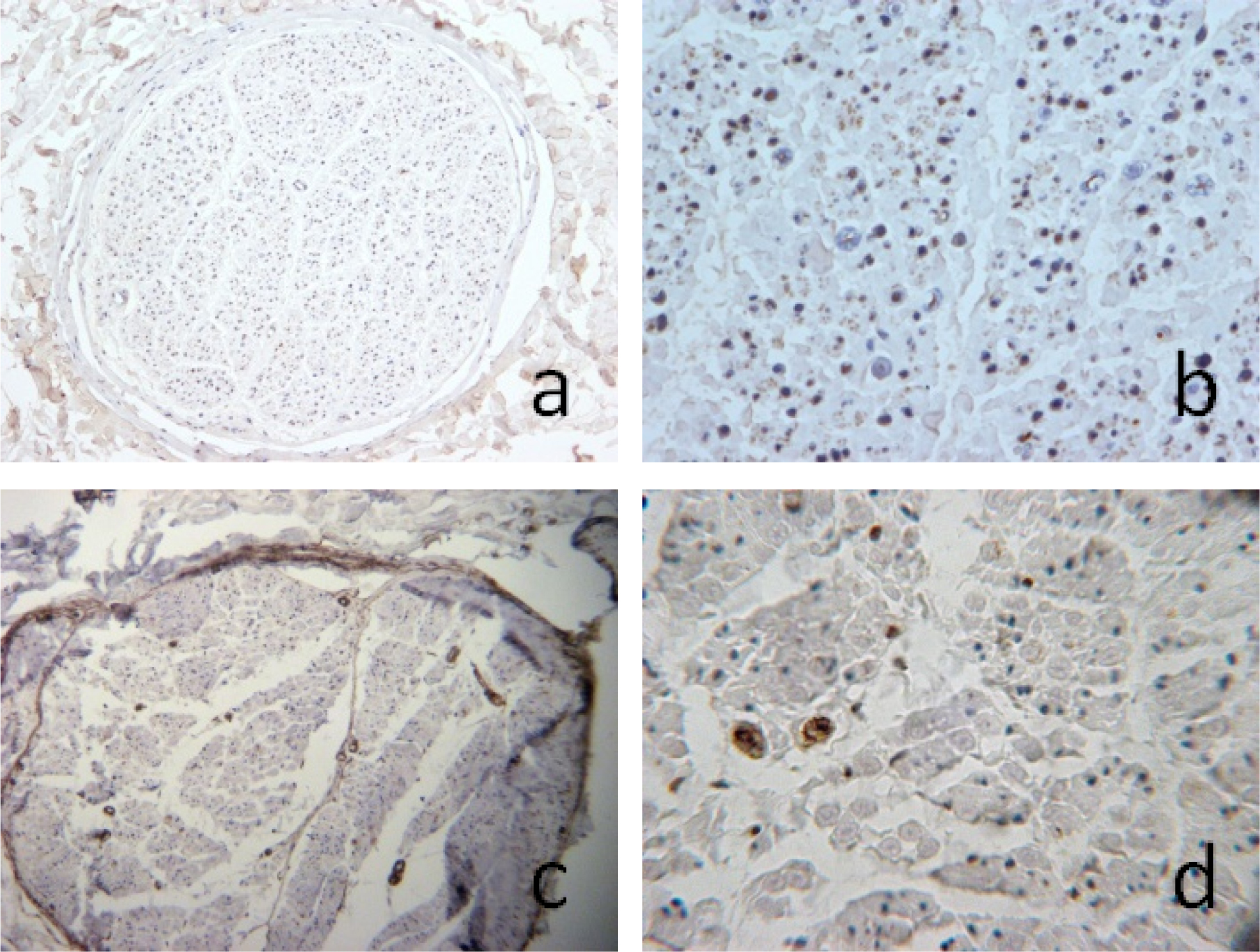
Immumohistochemicalstaining of caveolin-1 in DPN patients’ femoral nerve
Positive staining was brown-yellow. Magnification: 100× (left panel, A, C) and 400× (right panel, B, D).
3.4 Spearman’s Correlation and Stepwise stepwise multiple linear Regression models
There were significant inverse correlations between caveolin-1 and HbA1c (r=−0.884, p<0.001), TCSS (r=−0.667, p<0.001). There were positive correlations between caveolin-1 and sensory nerve conduction velocity (SNCV) (r=0.598; p<0.001), motor nerve conduction velocity (MNCV) (r=0.369; p=0.024) and NFD (r=0.632; p<0.001). No other index relationships were present (p= 0.070–0.929). Results are presented in Table 2. A stepwise multiple linear regression was constructed to determine the potential impact factors of caveolin-1. And results showed that NFD and HbA1c entered the regression equation. Caveolin-1 as a dependent variable was negatively correlated with HbA1c (regression coefficient was −5451.115) and positively correlated with NFD (regression coefficient was 106.410) (F=45.090, p<0.001, R2=0.790). This means that 79% dependent variable (caveolin-1) could be explained by independent variables (NDF andHbA1c) according to the equation.
Relationships between general and biochemical index and caveolin-1
| r | p | |
|---|---|---|
| Age (years) | 0.150 | 0.377 |
| Duration of diabetes (years) | -0.027 | 0.874 |
| BMI (kg/m2) | -0.015 | 0.929 |
| SBP (mmHg) | -0.122 | 0.473 |
| DBP (mmHg) | -0.081 | 0.636 |
| HbA1C (%) | -0.884 | <0.001 |
| WBC (×109/L) | -0.014 | 0.932 |
| Hb (g/L) | 0.018 | 0.914 |
| ALB (g/L) | 0.177 | 0.296 |
| TG (mmol/L) | -0.157 | 0.353 |
| TC (mmol/L) | 0.108 | 0.529 |
| HDL (mmol/L) | 0.212 | 0.221 |
| LDL (mmol/L) | 0.306 | 0.070 |
| BUN (mmol/L) | 0.058 | 0.732 |
| CR (µmol/L) | 0.056 | 0.712 |
| UMA (mg) | -0.051 | 0.769 |
| TCSS | -0.667 | <0.001 |
| MNCV (mm/s) | 0.369 | 0.024 |
| SNCV (mm/s) | 0.598 | <0.001 |
| Lower limb vascular stenosis rate(%) | -0.086 | 0.658 |
| NFD | 0.632 | <0.001 |
There were significant inverse correlations between NFD and diabetes duration (r=−0.301, p=0.042), HbA1c (r=−0.547, p<0.001), TCSS (r=−0.462, p=0.004). There were positive correlations between NFD and Cavelolin-1 (r=0.632, p<0.001). No other index relationships were present (p=0.052–0.904). Furthermore, NFD stepwise multiple linear regression analysis with other factors showed that Caveolin-1 and diabetes duration were independent factors of NFD (regression coefficient were 110.893 and −171.732, respectively, F=27.911, p<0.001, R2=0.691). This means that 69.1% dependent variable (NDF) could be explained by independent variables (Caveolin-1 and diabetes duration) according to the equation.
4 Discussion
Diabetic foot is a severe public health problem. Recently a Meta-analysis showed global diabetic foot ulcer prevalence was 6.3% [6]. Diabetic foot is an example of end-stage diabetes complications, associated with increased impairment of quality of life and morbidity. In our present study, most of the included 37 patients had a variety of complications, the proportion of patients with large and small vessels disease complications reached 26% to 31%, poor blood sugar control (HbA1c is 9.15±2.16%), which is consistent with the characteristics of diabetic foot patients [6]. Previous studies have confirmed diabetic peripheral neuropathy is one of the important causes of diabetic foot. About half of the people with diabetes develop nerve damage within 10 to 20 years after diagnosis. The prevalence of neuropathy is estimated to be about 8% in newly diagnosed patients and greater than 50% in patients with longstanding disease [7]. Until now, the mechanism of the pathogenesis and the development of DPN have not been fully elucidated. Previous studies suggested that many factors may lead to the occurrence of DPN. Emerging evidences show that oxidative stress [8], protein glycation, protein kinase C activation, polyol synthesis, and the hexosamine pathway, vascular, glial, and neuronal damage may be the biochemical etiology involved. And our study showed that diabetic peripheral neuropathy progressed with diabetes duration and HbA1c which is consist with published studies [9].
In recent years, publications indicated that caveolin-1had close relationship with diabetic peripheral neuropathy. Caveolin-1 is one of a conserved group of structural membrane proteins that form special cholesterol and sphingolipid-rich compartments, myelinated SCs [10], and is the most important member of the caveolin family, especially in neurons, Schwann cells, etc. Caveolins had been recognized to be implicated in pathogenesis of many diseases, including diabetes [11,12], cancer [13], atherosclerosis, heart failure, muscular dystrophy, and Alzheimer’s disease. Results from animal experiments showed caveolin-1 in the Schwann cells of the sciatic nerves was decreased. Downregulation of Caveolin-1 could enhance neuregulin-induced demyelination and contributed to the pathophysiological progression of diabetic peripheral neuropathy. And nerve conduction velocity, sensation of pain and temperature were proved to be decreased in Caveolin-1 knockout mice [5]. In our study, we verified that the recruited patients’ femoral nerve demyelination, and there were significant reductions of NFD, MNCV and SNCV compared with normal person. Regression results show that the HbA1c and NFD were independent predictors of caveolin-1. Study had ruled out the impact of NFD decline on the level of Caveolin-1 using double immunofluorescence staining [5]. Therefore, we concluded that poor glycemic control maybe an important reason of resulting in a decline in Caveolin-1. Demyelination is a typical symptom of diabetic peripheral neuropathy, eventually leading to the decrease of NFD. Regression results showed that the caveolin-1 and diabetes duration were the independent risk factors influencing NFD. Research has shown that decreases in caveolin-1 may damage the body’s ability to regulate some endogenous processes that inhibit Erb B2, thereby increasing tyrosine kinase activity, invoking the PtdIns 3K and MAPK pathways. This results in an imbalance in myelin protein expression, resulting in nerve degeneration or regeneration [5].
Overall, caveolin-1 expression in the Schwann cells of the femoral nerves of DF amputees was significantly decreased along with the increase of blood sugar. AndNFD levels decrease appeared to be directly related to caveolin-1 and prolonged duration of diabetes. It suggests that decrease of caveolin-1 may play an important role in the progress of DPN. This study may provide new clinical evidence for the study of the pathogenesis and progression of DPN and a new direction for DPN treatment.
4.1 Limitations
There were several limitations in the present study. A relative small sample size was involved and an observational design without use of control subjects in this study. Furthermore, due to lack of funding, our study did not explore a possible mechanism, this may limit our discussion.
Acknowledgments
This work was supported by Science and Technology Funds of Tianjin Municipal Bureau No. 2015KZ092 (to DM). The authors would like to thank Ming-Fang Zhang for excellent technical support.
Conflict of interest: Authors state no conflict of interest
Funding: This work was supported by Science and Technology Funds of Tianjin Municipal Bureau No. 2015KZ092 (to DM)
References
[1] Ahmad J., The diabetic foot, Diabetes Metab. Syndr., 2016, 10, 48-60.10.1016/j.dsx.2015.04.002Suche in Google Scholar
[2] Meloni M., Izzo V., Vainieri E., Giurato L., Ruotolo V., Uccioli L., Management of negative pressure wound therapy in the treatment of diabetic foot ulcers, World J. Orthop., 2015, 6, 387-93.10.5312/wjo.v6.i4.387Suche in Google Scholar
[3] Noor S., Khan R.U., Ahmad J., Understanding Diabetic Foot Infection and its Management, Diabetes Metab. Syndr., 2017, 11, 149-156.10.1016/j.dsx.2016.06.023Suche in Google Scholar
[4] Al-Mahroos F., Al-Roomi K., Diabetic neuropathy, foot ulceration, peripheral vascular disease and potential risk factors among patients with diabetes in Bahrain: a nationwide primary care diabetes clinic-based study, Ann. Saudi Med., 2007, 27, 25-31.10.5144/0256-4947.2007.25Suche in Google Scholar
[5] McGuire J.F., Rouen S., Siegfreid E., Wright DE., Dobrowsky R.T., Caveolin-1 and altered neuregulin signaling contribute to the pathophysiological progression of diabetic peripheral neuropathy, Diabetes., 2009, 58, 2677-86.10.2337/db09-0594Suche in Google Scholar
[6] Zhang P, Lu J, Jing Y, Tang S, Zhu D, Bi Y. Global epidemiology of diabetic foot ulceration: a systematic review and meta-analysis (†), Ann. Med., 2017, 49, 106-116.10.1080/07853890.2016.1231932Suche in Google Scholar
[7] Rathur H.M., Boulton AJ.. Recent advances in the diagnosis and management of diabetic neuropathy, J Bone Joint Surg Br., 2005, 87, 1605-10.10.1302/0301-620X.87B12.16710Suche in Google Scholar
[8] Stavniichuk R., Drel V.R., Shevalye H., Baicalein alleviates diabetic peripheral neuropathy through inhibition of oxidative-nitrosative stress and p38 MA.PK activation, Exp. Neurol., 2011, 230, 106-13.10.1016/j.expneurol.2011.04.002Suche in Google Scholar
[9] Witzel II., Jelinek H.F., Khalaf K., Lee S., Khandoker A.H., Alsafar H., Identifying Common Genetic Risk Factors of Diabetic Neuropathies, Front Endocrinol (Lausanne)., 2015, 6, 88.10.3389/fendo.2015.00088Suche in Google Scholar
[10] Mikol D.D., Hong H.L., Cheng H.L., Feldman E.L., Caveolin-1 expression in Schwann cells. Glia., 1999, 27, 39-52.10.1002/(SICI)1098-1136(199907)27:1<39::AID-GLIA5>3.0.CO;2-#Suche in Google Scholar
[11] Enomoto T., Usuki., Azuma A., Nakagawa T., Kudoh S., Diabetes mellitus may increase risk for idiopathic pulmonary fibrosis, Chest., 2003, 123, 2007-11.10.1378/chest.123.6.2007Suche in Google Scholar PubMed
[12] Freud W.I., Diabetes insipidus and pulmonary fibrosis, AMA Arch Intern Med., 1955, 95, 823-7.10.1001/archinte.1955.00250120059007Suche in Google Scholar PubMed
[13] Bertuzzi A., Conte F., Mingrone G., Papa F., Salinari S., Sinisgalli C., Insulin Signaling in Insulin Resistance States and Cancer: A Modeling Analysis, PLoS One., 2016, 11, e0154415.10.1371/journal.pone.0154415Suche in Google Scholar PubMed PubMed Central
© 2017 Min Ding et al.
This work is licensed under the Creative Commons Attribution-NonCommercial-NoDerivatives 4.0 License.
Artikel in diesem Heft
- Research Articles
- Field Performance and Genetic Fidelity of Micropropagated Plants of Coffea canephora (Pierre ex A. Froehner)
- Research Articles
- Foliage maturity of Quercus ilex affects the larval development of a Croatian coastal population of Lymantria dispar (Lepidoptera: Erebidae)
- Research Articles
- Structural and functional impact of SNPs in P-selectin gene: A comprehensive in silico analysis
- Research Articles
- High embryogenic ability and regeneration from floral axis of Amorphophallus konjac (Araceae)
- Research Articles
- Terpene content of wine from the aromatic grape variety ‘Irsai Oliver’ (Vitis vinifera L.) depends on maceration time
- Research Articles
- Light and smell stimulus protocol reduced negative frontal EEG asymmetry and improved mood
- Research Articles
- Swailing affects seed germination of plants of European bio-and agricenosis in a different way
- Research Articles
- Survey analysis of soil physicochemical factors that influence the distribution of Cordyceps in the Xiahe Region of Gansu Province
- Research Articles
- Production of biogas: relationship between methanogenic and sulfate-reducing microorganisms
- Research Articles
- Pentraxin 3 and atherosclerosis among type 2 diabetic patients
- Research Articles
- Evaluation of ribosomal P0 peptide as a vaccine candidate against Argulus siamensis in Labeo rohita
- Research Articles
- Variation of autosomes and X chromosome STR in breast cancer and gynecological cancer tissues
- Research Articles
- Response of antioxidant enzymes to cadmium-induced cytotoxicity in rat cerebellar granule neurons
- Research Articles
- Cardiac hypertrophy and IGF-1 response to testosterone propionate treatment in trained male rats
- Research Articles
- BRAF-activated non-protein coding RNA (BANCR) advances the development of esophageal squamous cell carcinoma via cell cycle
- Research Articles
- The influence of soil salinity on volatile organic compounds emission and photosynthetic parameters of Solanum lycopersicum L. varieties
- Research Articles
- Simple Protocol for immunoglobulin G Purification from Camel “Camelus dromedarius” Serum
- Research Articles
- Expression of psbA1 gene in Synechocystis sp. PCC 6803 is influenced by CO2
- Research Articles
- Frequency of Thrombophilic Gene Mutations in Patients with Deep Vein Thrombosis and in Women with Recurrent Pregnancy Loss
- Research Articles
- Evaluation of anticancer properties of a new α-methylene-δ-lactone DL-249 on two cancer cell lines
- Research Articles
- Impact of heated waters on water quality and macroinvertebrate community in the Narew River (Poland)
- Research Articles
- Effects of Some Additives on In Vitro True Digestibility of Wheat and Soybean Straw Pellets
- Research Articles
- RNAi-mediated gene silencing in Rhynchophorus ferrugineus (Oliver) (Coleoptera: Curculionidae)
- Research Articles
- New pathway of icariin-induced MSC osteogenesis: transcriptional activation of TAZ/Runx2 by PI3K/Akt
- Research Articles
- Tudor-SN protein expression in colorectal cancer and its association with clinical characteristics
- Research Articles
- Proteomic and bioinformatics analysis of human saliva for the dental-risk assessment
- Research Articles
- Reverse transcriptase sequences from mulberry LTR retrotransposons: characterization analysis
- Research Articles
- Strain Stimulations with Different Intensities on Fibroblast Viability and Protein Expression
- Research Articles
- miR-539 mediates osteoblast mineralization by regulating Distal-less genes 2 in MC3T3-E1 cell line
- Research Articles
- Diversity of Intestinal Microbiota in Coilia ectenes from Lake Taihu, China
- Research Articles
- The production of arabitol by a novel plant yeast isolate Candida parapsilosis 27RL-4
- Research Articles
- Effectiveness of Azospirillum brasilense Sp245 on young plants of Vitis vinifera L.
- Research Articles
- Changes of photochemical efficiency and epidermal polyphenols content of Prosopis glandulosa and Prosopis juliflora leaves exposed to cadmium and copper
- Research Articles
- Ultraweak photon emission in strawberry fruit during ripening and aging is related to energy level
- Research Articles
- Molecular cloning, characterization and evolutionary analysis of leptin gene in Chinese giant salamander, Andrias davidianus
- Research Articles
- Longevity and stress resistance are affected by activation of TOR/Myc in progenitor cells of Drosophila gut
- Research Articles
- Curcumin attenuates oxidative stress in liver in Type 1 diabetic rats
- Research Articles
- Risk factors of long-term postoperative renal function after partial nephrectomy in a solitary kidney
- Research Articles
- Developmental anomalies of the right hepatic lobe: systematic comparative analysis of radiological features
- Review articles
- Genetic Defects Underlie the Non-syndromic Autosomal Recessive Intellectual Disability (NS-ARID)
- Review articles
- Research Progress on Tissue Culture and Genetic Transformation of Kenaf (Hibiscus cannabinus)
- Topical Issue On Precision Medicine
- MiR-107 inhibits proliferation of lung cancer cells through regulating TP53 regulated inhibitor of apoptosis 1 (TRIAP1)
- Topical Issue On Precision Medicine
- The functional role of exosome microRNAs in lung cancer
- Topical Issue On Precision Medicine
- The diagnostic value of serum microRNA-183 and TK1 as biomarkers for colorectal cancer diagnosis
- Topical Issue On Precision Medicine
- Screening feature modules and pathways in glioma using EgoNet
- Topical Issue On Precision Medicine
- Isoliquiritigenin inhibits colorectal cancer cells HCT-116 growth by suppressing the PI3K/AKT pathway
- Topical Issue On Precision Medicine
- Association between Caveolin-1 expression and pathophysiological progression of femoral nerves in diabetic foot amputation patients
- Topical Issue On Precision Medicine
- Biomarkers in patients with myocardial fibrosis
- Topical Issue On Precision Medicine
- Dysregulated pathways for off-pump coronary artery bypass grafting
- Topical Issue On Precision Medicine
- Individualized identification of disturbed pathways in sickle cell disease
- Topical Issue On Precision Medicine
- The prognostic value of serum PCT, hs-CRP, and IL-6 in patients with sepsis
- Topical Issue On Precision Medicine
- Sevoflurane-medicated the pathway of chemokine receptors bind chemokines in patients undergoing CABG
- Topical Issue On Precision Medicine
- The functional role of microRNAs in laryngeal carcinoma
- Topical Issue On Precision Medicine
- Revealing pathway cross-talk related to diabetes mellitus by Monte Carlo Cross-Validation analysis
- Topical Issue On Precision Medicine
- Correlation between CDKAL1 rs10946398C>A single nucleotide polymorphism and type 2 diabetes mellitus susceptibility: A meta-analysis
- Special Issue on Agricultural and Biological Sciences
- Effects of environmental variables on seedling distribution of rare and endangered Dacrydium pierrei
- Special Issue on Agricultural and Biological Sciences
- Study on synthesis and properties of nanoparticles loaded with amaryllidaceous alkaloids
- Special Issue on Agricultural and Biological Sciences
- Bacterial Infection Potato Tuber Soft Rot Disease Detection Based on Electronic Nose
- Special Issue on Agricultural and Biological Sciences
- Effects of subsoiling on maize yield and water-use efficiency in a semiarid area
Artikel in diesem Heft
- Research Articles
- Field Performance and Genetic Fidelity of Micropropagated Plants of Coffea canephora (Pierre ex A. Froehner)
- Research Articles
- Foliage maturity of Quercus ilex affects the larval development of a Croatian coastal population of Lymantria dispar (Lepidoptera: Erebidae)
- Research Articles
- Structural and functional impact of SNPs in P-selectin gene: A comprehensive in silico analysis
- Research Articles
- High embryogenic ability and regeneration from floral axis of Amorphophallus konjac (Araceae)
- Research Articles
- Terpene content of wine from the aromatic grape variety ‘Irsai Oliver’ (Vitis vinifera L.) depends on maceration time
- Research Articles
- Light and smell stimulus protocol reduced negative frontal EEG asymmetry and improved mood
- Research Articles
- Swailing affects seed germination of plants of European bio-and agricenosis in a different way
- Research Articles
- Survey analysis of soil physicochemical factors that influence the distribution of Cordyceps in the Xiahe Region of Gansu Province
- Research Articles
- Production of biogas: relationship between methanogenic and sulfate-reducing microorganisms
- Research Articles
- Pentraxin 3 and atherosclerosis among type 2 diabetic patients
- Research Articles
- Evaluation of ribosomal P0 peptide as a vaccine candidate against Argulus siamensis in Labeo rohita
- Research Articles
- Variation of autosomes and X chromosome STR in breast cancer and gynecological cancer tissues
- Research Articles
- Response of antioxidant enzymes to cadmium-induced cytotoxicity in rat cerebellar granule neurons
- Research Articles
- Cardiac hypertrophy and IGF-1 response to testosterone propionate treatment in trained male rats
- Research Articles
- BRAF-activated non-protein coding RNA (BANCR) advances the development of esophageal squamous cell carcinoma via cell cycle
- Research Articles
- The influence of soil salinity on volatile organic compounds emission and photosynthetic parameters of Solanum lycopersicum L. varieties
- Research Articles
- Simple Protocol for immunoglobulin G Purification from Camel “Camelus dromedarius” Serum
- Research Articles
- Expression of psbA1 gene in Synechocystis sp. PCC 6803 is influenced by CO2
- Research Articles
- Frequency of Thrombophilic Gene Mutations in Patients with Deep Vein Thrombosis and in Women with Recurrent Pregnancy Loss
- Research Articles
- Evaluation of anticancer properties of a new α-methylene-δ-lactone DL-249 on two cancer cell lines
- Research Articles
- Impact of heated waters on water quality and macroinvertebrate community in the Narew River (Poland)
- Research Articles
- Effects of Some Additives on In Vitro True Digestibility of Wheat and Soybean Straw Pellets
- Research Articles
- RNAi-mediated gene silencing in Rhynchophorus ferrugineus (Oliver) (Coleoptera: Curculionidae)
- Research Articles
- New pathway of icariin-induced MSC osteogenesis: transcriptional activation of TAZ/Runx2 by PI3K/Akt
- Research Articles
- Tudor-SN protein expression in colorectal cancer and its association with clinical characteristics
- Research Articles
- Proteomic and bioinformatics analysis of human saliva for the dental-risk assessment
- Research Articles
- Reverse transcriptase sequences from mulberry LTR retrotransposons: characterization analysis
- Research Articles
- Strain Stimulations with Different Intensities on Fibroblast Viability and Protein Expression
- Research Articles
- miR-539 mediates osteoblast mineralization by regulating Distal-less genes 2 in MC3T3-E1 cell line
- Research Articles
- Diversity of Intestinal Microbiota in Coilia ectenes from Lake Taihu, China
- Research Articles
- The production of arabitol by a novel plant yeast isolate Candida parapsilosis 27RL-4
- Research Articles
- Effectiveness of Azospirillum brasilense Sp245 on young plants of Vitis vinifera L.
- Research Articles
- Changes of photochemical efficiency and epidermal polyphenols content of Prosopis glandulosa and Prosopis juliflora leaves exposed to cadmium and copper
- Research Articles
- Ultraweak photon emission in strawberry fruit during ripening and aging is related to energy level
- Research Articles
- Molecular cloning, characterization and evolutionary analysis of leptin gene in Chinese giant salamander, Andrias davidianus
- Research Articles
- Longevity and stress resistance are affected by activation of TOR/Myc in progenitor cells of Drosophila gut
- Research Articles
- Curcumin attenuates oxidative stress in liver in Type 1 diabetic rats
- Research Articles
- Risk factors of long-term postoperative renal function after partial nephrectomy in a solitary kidney
- Research Articles
- Developmental anomalies of the right hepatic lobe: systematic comparative analysis of radiological features
- Review articles
- Genetic Defects Underlie the Non-syndromic Autosomal Recessive Intellectual Disability (NS-ARID)
- Review articles
- Research Progress on Tissue Culture and Genetic Transformation of Kenaf (Hibiscus cannabinus)
- Topical Issue On Precision Medicine
- MiR-107 inhibits proliferation of lung cancer cells through regulating TP53 regulated inhibitor of apoptosis 1 (TRIAP1)
- Topical Issue On Precision Medicine
- The functional role of exosome microRNAs in lung cancer
- Topical Issue On Precision Medicine
- The diagnostic value of serum microRNA-183 and TK1 as biomarkers for colorectal cancer diagnosis
- Topical Issue On Precision Medicine
- Screening feature modules and pathways in glioma using EgoNet
- Topical Issue On Precision Medicine
- Isoliquiritigenin inhibits colorectal cancer cells HCT-116 growth by suppressing the PI3K/AKT pathway
- Topical Issue On Precision Medicine
- Association between Caveolin-1 expression and pathophysiological progression of femoral nerves in diabetic foot amputation patients
- Topical Issue On Precision Medicine
- Biomarkers in patients with myocardial fibrosis
- Topical Issue On Precision Medicine
- Dysregulated pathways for off-pump coronary artery bypass grafting
- Topical Issue On Precision Medicine
- Individualized identification of disturbed pathways in sickle cell disease
- Topical Issue On Precision Medicine
- The prognostic value of serum PCT, hs-CRP, and IL-6 in patients with sepsis
- Topical Issue On Precision Medicine
- Sevoflurane-medicated the pathway of chemokine receptors bind chemokines in patients undergoing CABG
- Topical Issue On Precision Medicine
- The functional role of microRNAs in laryngeal carcinoma
- Topical Issue On Precision Medicine
- Revealing pathway cross-talk related to diabetes mellitus by Monte Carlo Cross-Validation analysis
- Topical Issue On Precision Medicine
- Correlation between CDKAL1 rs10946398C>A single nucleotide polymorphism and type 2 diabetes mellitus susceptibility: A meta-analysis
- Special Issue on Agricultural and Biological Sciences
- Effects of environmental variables on seedling distribution of rare and endangered Dacrydium pierrei
- Special Issue on Agricultural and Biological Sciences
- Study on synthesis and properties of nanoparticles loaded with amaryllidaceous alkaloids
- Special Issue on Agricultural and Biological Sciences
- Bacterial Infection Potato Tuber Soft Rot Disease Detection Based on Electronic Nose
- Special Issue on Agricultural and Biological Sciences
- Effects of subsoiling on maize yield and water-use efficiency in a semiarid area
