Revealing pathway cross-talk related to diabetes mellitus by Monte Carlo Cross-Validation analysis
-


Abstract
Objective
To explore potential functional biomarkers in diabetes mellitus (DM) by utilizing gene pathway cross-talk.
Methods
Firstly, potential disrupted pathways that were enriched by differentially expressed genes (DEGs) were identified based on biological pathways downloaded from the Ingenuity Pathways Analysis (IPA) database. In addition, we quantified the pathway crosstalk for each pair of pathways based on Discriminating Score (DS). Random forest (RF) classification was then employed to find the top 10 pairs of pathways with a high area under the curve (AUC) value between DM samples versus normal samples based on 10-fold cross-validation. Finally, a Monte Carlo Cross-Validation was applied to demonstrate the identified pairs of pathways by a mutual information analysis.
Results
A total of 247 DEGs in normal and disease samples were identified. Based on the F-test, 50 disrupted pathways were obtained with false discovery rate (FDR) < 0.01. Simultaneously, after calculating the DS, the top 10 pairs of pathways were selected based on a higher AUC value as measured by RF classification. From the Monte Carlo Cross-Validation, we considered the top 10 pairs of pathways with higher AUC values ranked for all 50 bootstraps as the most frequently detected ones.
Conclusion
The pairs of pathways identified in our study might be key regulators in DM.
1 Introduction
Diabetes mellitus (DM) is one of the most important metabolic dysfunctions which is often asymptomatic in the early stages [1,2,3]. More than 300 million people worldwide are suffering with DM. Studies have shown that population aging, changes in lifestyle and improvement in detection techniques are the most important factors resulting in an increased number of cases being identified [4]. DM can frequently cause complications in a number of different organs, including the heart, eyes, kidneys, and nervous system, which has resulted in considerable economic cost and burden. Therefore, the diagnosis of this disease at early stages is very important.
Currently, the integration and biological interpretation of large-scale analysis is a major challenge in bioinformatics research [5]. The rapid development of high-throughput technologies has brought unprecedented opportunity for the large-scale analysis of DM to ascertain key molecular mechanisms and transform the data into a meaningful biological phenomenon. To date, there have been many studies identifying genes related to diabetes, such as PPRAG, IRS1, KCNJ11 and HNFA [6,7,8,9]. However, genes that are not differentially expressed can also be responsible for biological effects since they can exhibit significant coordinated changes. What is worse, relying on differentially expressed gene (DEG) alone may lead to false positives since some genes are not involved in disease-specific pathways. In order to obtain an accurate interpretation of high-throughput genomic experiments, identification of signaling and metabolic pathways is crucial. To our knowledge, most methods consider pathways as independent, and are rarely referred to as involved in cross-talk. Cross-talk among pathways implies a regulatory interaction between the different pathways. More importantly, identification of cross-talk can provide additional functional information for data interpretation and facilitates a better understanding of the connections between two pathways. However, currently there are no reliable methods utilized to quantify cross-talk for paired pathways [10]. Significantly, the combining of DEGs and pathway data with Monte Carlo cross-validation has been considered to quantify the cross-talk between the paired pathways [11]. Monte Carlo cross-validation [12] has been suggested to decrease the risk of overfitting of a model, and has been widely applied to measure the prediction ability of the selected model.
Therefore, to reveal novel molecular mechanisms of DM, we compiled microarray expression data and biological pathway information as study objects, and identified potential pathway pairs associated with DM while considering the functional dependency among pathways using Monte Carlo Cross-Validation. We selected DEGs using Differential Expression Analysis (DEA). The biological pathways were downloaded from the Ingenuity Pathways Analysis (IPA) database. Furthermore, we integrated DEGs with the IPA pathways to extract the disrupted pathways bearing a false discovery rate (FDR) < 0.01 based on an F-test. In addition, we calculated the Discriminating Score (DS) for each pair of pathways by quantifying their pathway cross-talk and obtained the top 10 pairs of pathways with area under the curve (AUC) value in descending order based on 10-fold cross-validation. Finally, we verified the procedures via a Monte Carlo Cross-Validation and detected several disrupted pairs of pathways that could serve as the potential biomarkers for the diagnosis of DM.
2 Materials and Methods
2.1 Data collection
In the present study, the gene expression dataset (accession number: E-GEOD-35725) [13] was downloaded from the ArrayExpress Archive of Functional Genomics Data (http://www.ebi.ac.uk/arrayexpress/) which is an international functional genomics database at the European Bioinformatics Institute (EMBL-EBI). This data was derived from samples that were analyzed by the platform of A-AFFY-44 - Affymetrix GeneChip Human Genome U133 Plus 2.0 [HG-U133_Plus_2]. In the E-GEOD-35725, there were 7 autologous plasma, 44 unrelated healthy control plasma, 63 DM patients (46 recent onset T1D plasma, 11 longstanding T1D plasma, and 6 longitudinal series plasma from pre/post onset). In our study, to explore the etiology of DM, only 63 DM patients and 44 controls were selected to perform the subsequent analysis.
2.2 Data preprocessing
When obtaining the microarray data, repeated probes were eliminated first. Additionally, we aligned the probes to the gene symbol and removed duplicates. Ultimately, there were 20544 genes identified for further analysis.
2.3 Detection of DEGs
We utilized a quantile based algorithm [14] to perform standard processing for the gene expression data. Across all samples, we selected genes with a mean value higher than the 0.25 * quantile mean. Furthermore, we used quantile-adjusted conditional maximum likelihood (qCML) method [15] involved in the edgeR package to analyze genes that were differentially expressed. Compared with several other estimators, qCML is most reliable in terms of bias on a wide range of conditions, and specifically performs best in the situation of many small samples with a common dispersion. Next, we corrected the P-value into FDR by Benjamini-Hochberg [16]. In this research, we screened out the genes as the DEGs under the threshold of FDR < 0.01.
2.4 Analysis of disrupted pathways
For the purpose of exploring the enrichment of pathways, further analysis was performed for DEGs using IPA software. Primarily, we downloaded 589 biological pathways including 20,038 genes derived from the IPA (http://www.ingenuity.com/) tool. We then mapped DEGs to corresponding IPA pathways. Consequently, we conducted an F-test for the DEGs and the genes of each IPA pathway to obtain a P-value of each pathway. In addition, the P-value was adjusted using the Benjamini-Hochberg method. Furthermore, we screened the disrupted pathways displaying an FDR < 0.01.
2.5 Extraction of pathway cross-talk based on DS value
For all genes in each pathway, we calculated the mean value and standard deviation. We computed it’s DS value [17], followed by construction of pairs of pathways for each of the two disrupted pathways. DS score reflects the relationships between pairs of pathways, with a greater value indicating relatively higher difference of activity between pathways. The formula is defined as follows:
Ma and Sa represent the mean and standard deviation of genes expression levels in pathway a, Mb and Sb represent the mean and standard deviation of expression levels of genes in pathway b.
2.6 Selection of the pathways pairs
Random forest (RF) is a machine learning algorithm used for classification and has the ability to efficiently handle high dimensionality and highly correlated data [18]. It’s high predictive power has been supported by previous comparative studies with other machine learning (ML) methods [19,20,21]. The final classification is obtained by combining the classification results from the individual decision trees. Briefly, RF builds a collection of decision trees based on randomly and independently selected subsets of data, and a simple majority vote among all trees in the forest is taken for class prediction.
In this study, we trained the RF prediction model to identify specific disrupted pathways potentially associated with diabetes mellitus based on the DS values for each sample in order to classify the DM and control samples. Specifically, we performed 10-fold cross-validation to calculate the AUC values to further randomly classify the normal group and the disease group through adopting the following parameters: mtry and ntree. The value of mtry (number of variables randomly sampled as candidates at each split) was equal to sqrt(p); p denoted the count of variables in the matrix of data; ntree (number of trees grown) was equivalent to 500. Based on the identified AUC of each pair of pathways via the RF-based method, we ranked all AUC scores in descending order, and further screened out the top 10 disrupted pairs of pathways.
2.7 Monte Carlo Cross-Validation
As described previously, for validation analysis, the sample size in the training set is generally bigger than that in the testing set. Significantly, the ratio of 6 to 4 is a commonly used proportion. A previous study randomly selected 60% as the training set and the remaining 40% as the testing data [22]. Thus, in our study, we utilized the Monte Carlo Cross-Validation to randomly form the training set and the testing set according to the proportion of 6:4. Similar to previous analyses, we repeated 50 times, generating randomly new training and test partitions each time. Moreover, we generated new DEGs, disrupted pathways and a DS score for pairs of pathways each time. Likewise, the top 10 pairs of pathways were considered via the AUC value each time that obtained the best classification performance in the training set. Meanwhile, the testing set was used to validate the top 10 pairs of pathways in each time. Finally, all AUC values were ranked in descending order, and from this, we selected the top 10 disrupted pairs of pathways.
3 Results
3.1 Analysis of disrupted pathway
After removing repeating probes, there were 20,544 genes in all samples. Furthermore, based on the quantile method, we obtained 15,408 genes with a mean value greater than the 0.25 * quantile mean. After conducting the quantile-adjusted conditional maximum likelihood method for these genes, we identified 247 DEGs possesing FDR < 0.01. Using the F-test for genes in the IPA pathway, as well as the DEGs, a list of 50 significantly pathways were presented with an FDR score < 0.01. The result is shown in Table 1. Subsequently, a DS was counted through comparing the expression levels of each pair of pathways involved in DEGs in each sample. The distribution of DS values is shown in Supplemental Table 1. With a larger DS we also observed a greater difference of activity between the pathway pairs. Remarkably, the DS values of 3 instances of pathway cross-talk were greater than 2, including the pathway pair of Choline Biosynthesis III and DNA Double-Strand Break Repair by Homologous Recombination (DS = 2.562766), Choline Biosynthesis III and DNA Double-Strand Break Repair by Non-Homologous End Joining (DS = 2.275759), and IL-9 Signaling and Choline Biosynthesis III (DS = 2.019939).
The top 10 pathways enriched by differentially expressed genes
| Pathways | False discovery rate(FDR) | Genes in pathway | Common genes |
|---|---|---|---|
| Role of IL-17A in Arthritis | 6.05E-09 | 54 | 9 |
| Role of IL-17A in Psoriasis | 1.06E-07 | 13 | 5 |
| Granulocyte Adhesion and Diapedesis | 1.37E-07 | 163 | 12 |
| IL-10 Signaling | 3.86E-07 | 68 | 8 |
| IL-17A Signaling in Fibroblasts | 1.88E-06 | 35 | 6 |
| Agranulocyte Adhesion and Diapedesis | 2.03E-06 | 173 | 11 |
| Hepatic Fibrosis / Hepatic Stellate Cell Activation | 2.34E-06 | 137 | 10 |
| LXR/RXR Activation | 4.52E-06 | 121 | 9 |
| Role of IL-17F in Allergic Inflammatory Airway Diseases | 4.93E-06 | 41 | 6 |
| TREM1 Signaling | 2.52E-05 | 55 | 6 |
| IL-17A Signaling in Airway Cells | 5.58E-05 | 54 | 6 |
| Glucocorticoid Receptor Signaling | 0.000104 | 255 | 11 |
| IL-17 Signaling | 0.00012 | 72 | 6 |
| IL-6 Signaling | 0.000208 | 116 | 7 |
| NF-kB Signaling | 0.000257 | 157 | 8 |
| CTLA4 Signaling in Cytotoxic T Lymphocytes | 0.000266 | 82 | 6 |
| HMGB1 Signaling | 0.00044 | 93 | 6 |
| Role of Pattern Recognition Receptors in Recognition of Bacteria and Viruses | 0.00044 | 91 | 6 |
| iCOS-iCOSL Signaling in T Helper Cells | 0.000621 | 97 | 6 |
| Clathrin-mediated Endocytosis Signaling | 0.000849 | 182 | 8 |
| Role of Macrophages, Fibroblasts and Endothelial Cells in Rheumatoid Arthritis | 0.00089 | 282 | 10 |
| Atherosclerosis Signaling | 0.001453 | 119 | 6 |
| LPS/IL-1 Mediated Inhibition of RXR Function | 0.001706 | 210 | 8 |
| Gluconeogenesis I | 0.00189 | 23 | 3 |
| TR/RXR Activation | 0.002195 | 85 | 5 |
| CD27 Signaling in Lymphocytes | 0.002245 | 51 | 4 |
| PPAR Signaling | 0.002312 | 90 | 5 |
| Lymphotoxin _ Receptor Signaling | 0.00277 | 54 | 4 |
| Hepatic Cholestasis | 0.002949 | 135 | 6 |
| Toll-like Receptor Signaling | 0.002963 | 55 | 4 |
| NRF2-mediated Oxidative Stress Response | 0.003121 | 177 | 7 |
| Airway Pathology in Chronic Obstructive Pulmonary Disease | 0.003131 | 8 | 2 |
| Aryl Hydrocarbon Receptor Signaling | 0.003181 | 133 | 6 |
| CD40 Signaling | 0.004569 | 62 | 4 |
| HIF1_ Signaling | 0.004659 | 100 | 5 |
| Type I Diabetes Mellitus Signaling | 0.004859 | 101 | 5 |
| Pentose Phosphate Pathway | 0.004961 | 10 | 2 |
| IL-9 Signaling | 0.005853 | 34 | 3 |
| Role of Hypercytokinemia/hyperchemokinemia in the | 0.005853 | 41 | 3 |
| Pathogenesis of Influenza | |||
| CD28 Signaling in T Helper Cells | 0.005954 | 107 | 5 |
| Chemokine Signaling | 0.006021 | 68 | 4 |
| Role of Tissue Factor in Cancer | 0.006192 | 107 | 5 |
| PKC_ Signaling in T Lymphocytes | 0.006192 | 107 | 5 |
| Dendritic Cell Maturation | 0.006507 | 159 | 6 |
| Altered T Cell and B Cell Signaling in Rheumatoid Arthritis | 0.007382 | 76 | 4 |
| LPS-stimulated MAPK Signaling | 0.008132 | 73 | 4 |
| Choline Biosynthesis III | 0.008417 | 13 | 2 |
| DNA Double-Strand Break Repair by Homologous Recombination | 0.008417 | 13 | 2 |
| MIF Regulation of Innate Immunity | 0.009216 | 40 | 3 |
| DNA Double-Strand Break Repair by Non-Homologous End Joining | 0.009751 | 14 | 2 |
Genes in Pathway represented the number of genes in Ingenuity Pathways Analysis (IPA) pathways; Common genes referred to the number of differentially expressed genes (DEGs) in IPA pathways
3.2 Selection of the best pairs of pathways in DM
Pairs of pathways were selected after 50 cycles and used to generate a heat map. The pathway pairs with an occurrence number > 4 are shown in Figure 1. More importantly, these pairs of pathways were ranked in descending order on the basis of AUC value, and the top 10 disrupted pairs of pathways are displayed in Table 2. We observed the following disrupted pairs of pathways with AUC value > 0.85 appeared in multiple cycles: (1) CD40 signaling and CD28 signaling in T helper cells; (2) HMGB1 signaling and role for hypercytokinemia/hyperchemokinemia in the pathogenesis of influenza; (3) CD40 signaling and PKC_ signaling in T lymphocytes.
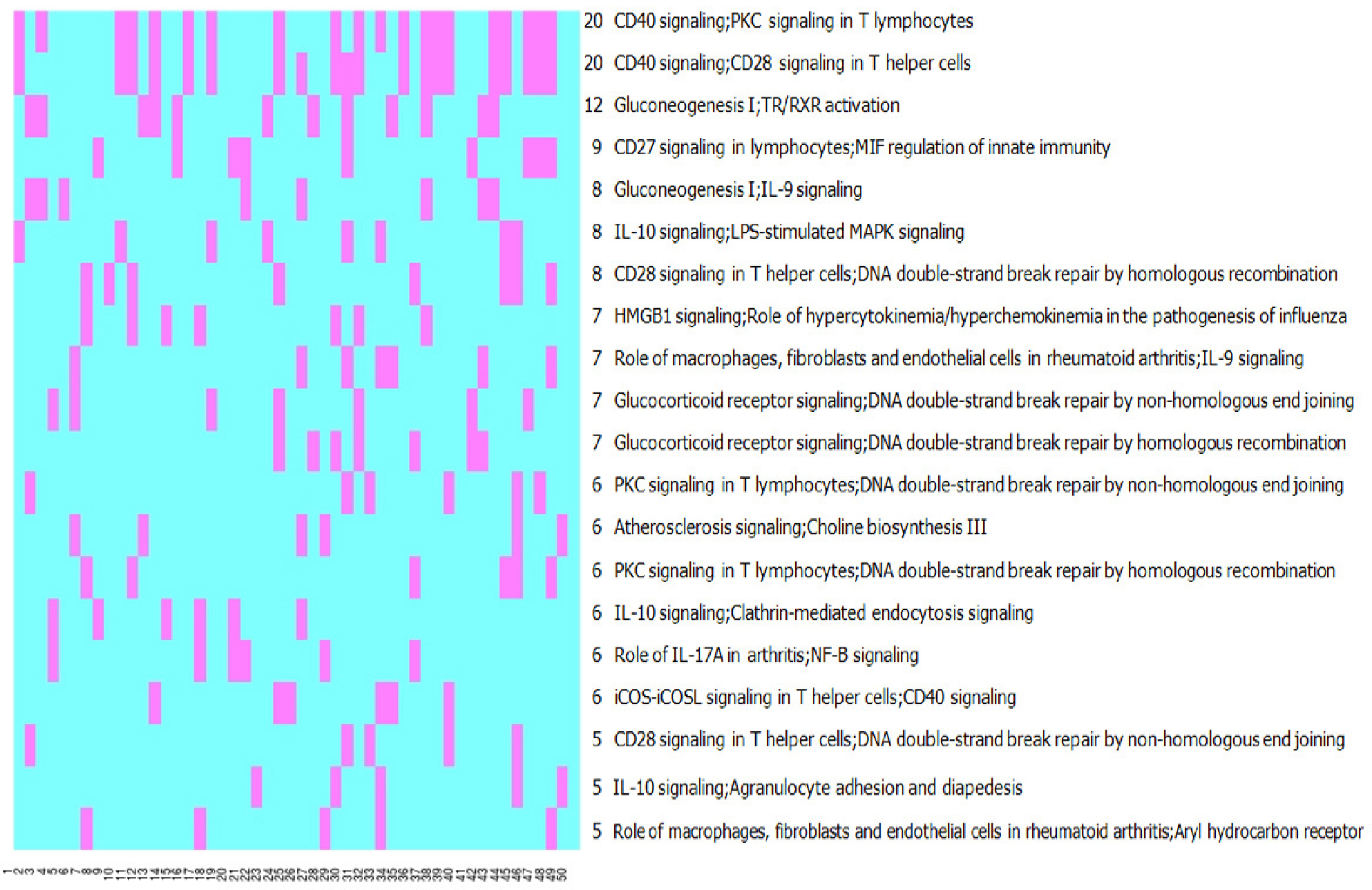
Heat map of pathway pairs with occurrence frequency more than 4 in 50 bootstraps. The Abscissa represents the number of cycles, and the ordinate represents the name of pathways pairs.
The top 10 pathway cross-talks with the better AUC value for Monte Carlo Cross-Validation
| Pairs of Pathways | AUC |
|---|---|
| PKC_ Signaling in T Lymphocytes | 0.903 |
| DNA Double-Strand Break Repair by Non-Homologous End Joining | |
| CD28 Signaling in T Helper Cells | 0.897 |
| DNA Double-Strand Break Repair by Non-Homologous End Joining | |
| CD40 Signaling | 0.876 |
| PKC_ Signaling in T Lymphocytes | |
| IL-10 Signaling | 0.865 |
| NF-_B Signaling | |
| Gluconeogenesis I | 0.865 |
| TR/RXR Activation | |
| CD40 Signaling | 0.862 |
| CD28 Signaling in T Helper Cells | |
| HMGB1 Signaling | 0.851 |
| Role of Hypercytokinemia/hyperchemokinemia in the Pathogenesis of Influenza | |
| Role of Macrophages, Fibroblasts and Endothelial Cells in Rheumatoid Arthritis | 0.843 |
| IL-9 Signaling | |
| Hepatic Cholestasis | 0.84 |
| Dendritic Cell Maturation | |
| Atherosclerosis Signaling | 0.84 |
| Choline Biosynthesis III |
4 Discussion
DM is a group of metabolic diseases in which there are high blood sugar levels for a prolonged period. From 2012 to 2014, diabetes is estimated to have resulted in 1.5 to 4.9 million deaths each year [23)]. The number of people with diabetes is expected to rise to 592 million by 2035 [24]. Hence, seeking an effective approach to prevent and treat DM is particularly important.
In this context, we proposed a comprehensive approach to elucidate pathway cross-talk associated with DM. Our analysis incorporated disrupted pairs of pathways and the RF classification. Quantitative values from a series of functional genes identified in each pathway can be used to generate biological interaction pathway pairs which provide a more integrated view of the biological mechanisms of DM. As a result, we constructed a more comprehensive view of the underlying regulatory mechanisms of DM through analysis of disrupted pairs of pathways. In addition, we validated the top 10 disrupted pathways of DM by Monte Carlo Cross-Validation. It verified the accuracy of the proposed method for analyzing the disrupted pairs of pathways of disease. Finally, we identified that the pair of pathways CD40 signaling and CD28 signaling in T Helper Cell appeared most frequently (frequency of occurrence = 47) with AUC value < 0.85.
CD40 is a cell surface receptor important in the activation of antigen-presenting cells during immune responses. CD40 signaling in professional antigen-presenting cells, including B cells, macrophages, and dendritic cells, is critical for the efficient activation of humoral and cell-mediated immune responses [25,26,27]. It was verified that CD40 signaling pathway represents a good example of a pathway for which human genetics helped to guide drug development in rheumatoid arthritis [28]. Additionally, another study has shown that CD40 pathway activation status may predict the antitumor activity of CD40-stimulating therapeutic drugs [29]. Moreover, it has been proposed that the soluble CD40L/ CD40 pathway is related to inflammation and vascular diseases [30]. In particular, other studies have indicated that CD40 signaling promotes autoimmunity in type 1 diabetes [31]. There is no inclusive information for CD28 signaling in T helper cell in DM. Fortunately, Shin et al. [32] have provided information that CD28 signaling in T helper cells was reduced following Mycobacterium avium subsp. paratuberculosis infection. Through our analysis, CD28 signaling in T helper cells is proposed as a novel biomarker for DM. Moreover, we demonstrated a link between CD40 signaling and CD28 signaling in T helper cells, as its frequency of occurrence = 47 and AUC = 0.862, which was an important pair of pathways in DM.
In the current study, DS values were used to quantify the cross-talk among pathways. Additionally, we investigated several pairs of pathways by Monte Carlo Cross-Validation analysis, with potential diagnostic and therapeutic roles relating to DM. On the basis of these results, we concluded that the method used in our research can accurately classify aggressive DM versus normal samples. These pairs of pathways might be potential biomarkers for early detection and therapy for DM.
Conflict of Interest: Authors state no conflict of interest.
Ethical approval: The conducted research is not related to either human or animals use.
References
[1] Naghavi-Behzad M., Alizadeh M., Azami S., Foroughifar S., Ghasempour-Dabbaghi K., Karzad N., et al., Risk Factors of Congenital Heart Diseases: A Case-Control Study in Northwest Iran, Journal of cardiovascular and thoracic research. 2013, 5, 5Search in Google Scholar
[2] Ghojazadeh M., Azami-Aghdash S., Mohammadi M., Vosoogh S., Mohammadi S. and Naghavi-Behzad M., Prognostic risk factors for early diagnosing of Preeclampsia in Nulliparas, Nigerian medical journal: journal of the Nigeria Medical Association. 2013, 54, 34410.4103/0300-1652.122368Search in Google Scholar PubMed PubMed Central
[3] Sahhaf F., Abbasalizadeh S., Ghojazadeh M., Velayati A., Khandanloo R., Saleh P., et al., Comparison effect of intravenous tranexamic acid and misoprostol for postpartum haemorrhage, Nigerian medical journal: journal of the Nigeria Medical Association. 2014, 55, 34810.4103/0300-1652.137228Search in Google Scholar PubMed PubMed Central
[4] Atlas I.D.: 6th edn. International Diabetes Federation 2013.Search in Google Scholar
[5] Garmhausen M., Hofmann F., Senderov V., Thomas M., Kandel B.A. and Habermann B.H., Virtual pathway explorer (viPEr) and pathway enrichment analysis tool (PEANuT): creating and analyzing focus networks to identify cross-talk between molecules and pathways, BMC Genomics. 2015, 16, 79010.1186/s12864-015-2017-zSearch in Google Scholar PubMed PubMed Central
[6] Rocha R.M., Barra G.B., Rosa É.C.C.C., Garcia É.C., Amato A.A. and Azevedo M.F., Prevalence of the rs1801282 single nucleotide polymorphism of the PPARG gene in patients with metabolic syndrome, Archives of endocrinology and metabolism. 2015, 59, 297-30210.1590/2359-3997000000086Search in Google Scholar PubMed
[7] Arikoglu H., Hepdogru M.A., Kaya D.E., Asik A., Ipekci S.H. and Iscioglu F., IRS1 gene polymorphisms Gly972Arg and Ala513Pro are not associated with insulin resistance and type 2 diabetes risk in non-obese Turkish population, Meta gene. 2014, 2, 579-58510.1016/j.mgene.2014.07.008Search in Google Scholar PubMed PubMed Central
[8] Martins L., Lourenço R., Maia A.L., Maciel P., Monteiro M.I., Pacheco L., et al., Transient neonatal diabetes due to a missense mutation (E227K) in the gene encoding the ATP-sensitive potassium channel (KCNJ11), Clinical case reports. 2015, 3, 781-78510.1002/ccr3.328Search in Google Scholar PubMed PubMed Central
[9] Meigs J.B., Manning A.K., Fox C.S., Florez J.C., Liu C., Cupples L.A., et al., Genome-wide association with diabetes-related traits in the Framingham Heart Study, BMC medical genetics. 2007, 8, S1610.1186/1471-2350-8-S1-S16Search in Google Scholar PubMed PubMed Central
[10] Donato M., Xu Z., Tomoiaga A., Granneman J.G., Mackenzie R.G., Bao R., et al., Analysis and correction of crosstalk effects in pathway analysis, Genome Research. 2013, 23, 188510.1101/gr.153551.112Search in Google Scholar PubMed PubMed Central
[11] Colaprico A., Cava C., Bertoli G., Bontempi G. and Castiglioni I., Integrative Analysis with Monte Carlo Cross-Validation Reveals miRNAs Regulating Pathways Cross-Talk in Aggressive Breast Cancer, Biomed Research International. 2015, 2015, 83131410.1155/2015/831314Search in Google Scholar PubMed PubMed Central
[12] Shao J., Linear Model Selection by Cross-validation, Journal of the American Statistical Association. 1993, 88, 486-49410.1080/01621459.1993.10476299Search in Google Scholar
[13] Levy H., Wang X., Kaldunski M., Jia S., Kramer J., Pavletich S.J., et al., Transcriptional signatures as a disease-specific and predictive inflammatory biomarker for type 1 diabetes, Genes & Immunity. 2012, 13, 59310.1038/gene.2012.41Search in Google Scholar PubMed PubMed Central
[14] Rifai N. and Ridker P.M., Proposed cardiovascular risk assessment algorithm using high-sensitivity C-reactive protein and lipid screening, Clinical chemistry. 2001, 47, 28-3010.1093/clinchem/47.1.28Search in Google Scholar
[15] Robinson M.D., McCarthy D.J. and Smyth G.K., edgeR: a Bioconductor package for differential expression analysis of digital gene expression data, Bioinformatics. 2010, 26, 139-14010.1093/bioinformatics/btp616Search in Google Scholar PubMed PubMed Central
[16] Benjamini Y. and Hochberg Y., Controlling the false discovery rate: a practical and powerful approach to multiple testing, Journal of the Royal Statistical Society. Series B (Methodological). 1995, 289-30010.1111/j.2517-6161.1995.tb02031.xSearch in Google Scholar
[17] Golub T.R., Slonim D.K., Tamayo P., Huard C., Gaasenbeek M., Mesirov J.P., et al., Molecular classification of cancer: class discovery and class prediction by gene expression monitoring, Science. 1999, 286, 531-53710.1126/science.286.5439.531Search in Google Scholar PubMed
[18] Breiman L., Random forests, Machine learning. 2001, 45, 5-3210.1023/A:1010933404324Search in Google Scholar
[19] Garzon M.B., Blazek R., Neteler M., De Dios R.S., Ollero H.S. and Furlanello C., Predicting habitat suitability with machine learning models: the potential area of Pinus sylvestris L. in the Iberian Peninsula, ecological modelling. 2006, 197, 383-39310.1016/j.ecolmodel.2006.03.015Search in Google Scholar
[20] Peters J., De Baets B., Verhoest N.E., Samson R., Degroeve S., De Becker P., et al., Random forests as a tool for ecohydrological distribution modelling, Ecological Modelling. 2007, 207, 304-31810.1016/j.ecolmodel.2007.05.011Search in Google Scholar
[21] Kampichler C., Wieland R., Calmé S., Weissenberger H. and Arriaga-Weiss S., Classification in conservation biology: a comparison of five machine-learning methods, Ecological Informatics. 2010, 5, 441-45010.1016/j.ecoinf.2010.06.003Search in Google Scholar
[22] Zhang P. and Peng J., SVM vs Regularized Least Squares Classification. In: International Conference on Pattern Recognition, pp 176-179 Vol.171, 2004.10.1109/ICPR.2004.1334050Search in Google Scholar
[23] Organization W.H., Top 10 causes of death: fact sheet no. 310: WHO 2011, Ref Type: Report L U. 2011,Search in Google Scholar
[24] Update D.A.: International Diabetes Federation [Internet]. 2014.Search in Google Scholar
[25] Elgueta R., Benson M.J., De Vries V.C., Wasiuk A., Guo Y. and Noelle R.J., Molecular mechanism and function of CD40/CD40L engagement in the immune system, Immunological reviews. 2009, 229, 152-17210.1111/j.1600-065X.2009.00782.xSearch in Google Scholar PubMed PubMed Central
[26] van Kooten C. and Banchereau J., CD40-CD40 ligand, Journal of leukocyte biology. 2000, 67, 2-1710.1002/jlb.67.1.2Search in Google Scholar PubMed
[27] Xie P., Kraus Z.J., Stunz L.L. and Bishop G.A., Roles of TRAF molecules in B lymphocyte function, Cytokine Growth Factor Rev. 2008, 19, 199-20710.1016/j.cytogfr.2008.04.002Search in Google Scholar PubMed PubMed Central
[28] Li G., Diogo D., Wu D., Spoonamore J., Dancik V., Franke L., et al., Human genetics in rheumatoid arthritis guides a high-throughput drug screen of the CD40 signaling pathway, PLoS Genet. 2013, 9, e100348710.1371/journal.pgen.1003487Search in Google Scholar PubMed PubMed Central
[29] Burington B., Yue P., Shi X., Advani R., Lau J.T., Tan J., et al., CD40 pathway activation status predicts response to CD40 therapy in diffuse large B cell lymphoma, Science translational medicine. 2011, 3, 74ra22-74ra2210.1126/scitranslmed.3001620Search in Google Scholar PubMed
[30] Jin R., Yu S., Song Z., Zhu X., Wang C., Yan J., et al., Soluble CD40 ligand stimulates CD40-dependent activation of the beta2 integrin Mac-1 and protein kinase C zeda (PKCzeta) in neutrophils: implications for neutrophil-platelet interactions and neutrophil oxidative burst, PLoS One. 2013, 8, e6463110.1371/journal.pone.0064631Search in Google Scholar PubMed PubMed Central
[31] Baker R.L., Mallevaey T., Gapin L. and Haskins K., T cells interact with T cells via CD40-CD154 to promote autoimmunity in type 1 diabetes, European journal of immunology. 2012, 42, 672-68010.1002/eji.201142071Search in Google Scholar PubMed PubMed Central
[32] Shin M.-K., Park H., Shin S.W., Jung M., Lee S.-H., Kim D.-Y., et al., Host Transcriptional Profiles and Immunopathologic Response following Mycobacterium avium subsp. paratuberculosis Infection in Mice, PloS one. 2015, 10, e013877010.1371/journal.pone.0138770Search in Google Scholar PubMed PubMed Central
© 2017 Han-Qing Cai et al.
This work is licensed under the Creative Commons Attribution-NonCommercial-NoDerivatives 4.0 License.
Articles in the same Issue
- Research Articles
- Field Performance and Genetic Fidelity of Micropropagated Plants of Coffea canephora (Pierre ex A. Froehner)
- Research Articles
- Foliage maturity of Quercus ilex affects the larval development of a Croatian coastal population of Lymantria dispar (Lepidoptera: Erebidae)
- Research Articles
- Structural and functional impact of SNPs in P-selectin gene: A comprehensive in silico analysis
- Research Articles
- High embryogenic ability and regeneration from floral axis of Amorphophallus konjac (Araceae)
- Research Articles
- Terpene content of wine from the aromatic grape variety ‘Irsai Oliver’ (Vitis vinifera L.) depends on maceration time
- Research Articles
- Light and smell stimulus protocol reduced negative frontal EEG asymmetry and improved mood
- Research Articles
- Swailing affects seed germination of plants of European bio-and agricenosis in a different way
- Research Articles
- Survey analysis of soil physicochemical factors that influence the distribution of Cordyceps in the Xiahe Region of Gansu Province
- Research Articles
- Production of biogas: relationship between methanogenic and sulfate-reducing microorganisms
- Research Articles
- Pentraxin 3 and atherosclerosis among type 2 diabetic patients
- Research Articles
- Evaluation of ribosomal P0 peptide as a vaccine candidate against Argulus siamensis in Labeo rohita
- Research Articles
- Variation of autosomes and X chromosome STR in breast cancer and gynecological cancer tissues
- Research Articles
- Response of antioxidant enzymes to cadmium-induced cytotoxicity in rat cerebellar granule neurons
- Research Articles
- Cardiac hypertrophy and IGF-1 response to testosterone propionate treatment in trained male rats
- Research Articles
- BRAF-activated non-protein coding RNA (BANCR) advances the development of esophageal squamous cell carcinoma via cell cycle
- Research Articles
- The influence of soil salinity on volatile organic compounds emission and photosynthetic parameters of Solanum lycopersicum L. varieties
- Research Articles
- Simple Protocol for immunoglobulin G Purification from Camel “Camelus dromedarius” Serum
- Research Articles
- Expression of psbA1 gene in Synechocystis sp. PCC 6803 is influenced by CO2
- Research Articles
- Frequency of Thrombophilic Gene Mutations in Patients with Deep Vein Thrombosis and in Women with Recurrent Pregnancy Loss
- Research Articles
- Evaluation of anticancer properties of a new α-methylene-δ-lactone DL-249 on two cancer cell lines
- Research Articles
- Impact of heated waters on water quality and macroinvertebrate community in the Narew River (Poland)
- Research Articles
- Effects of Some Additives on In Vitro True Digestibility of Wheat and Soybean Straw Pellets
- Research Articles
- RNAi-mediated gene silencing in Rhynchophorus ferrugineus (Oliver) (Coleoptera: Curculionidae)
- Research Articles
- New pathway of icariin-induced MSC osteogenesis: transcriptional activation of TAZ/Runx2 by PI3K/Akt
- Research Articles
- Tudor-SN protein expression in colorectal cancer and its association with clinical characteristics
- Research Articles
- Proteomic and bioinformatics analysis of human saliva for the dental-risk assessment
- Research Articles
- Reverse transcriptase sequences from mulberry LTR retrotransposons: characterization analysis
- Research Articles
- Strain Stimulations with Different Intensities on Fibroblast Viability and Protein Expression
- Research Articles
- miR-539 mediates osteoblast mineralization by regulating Distal-less genes 2 in MC3T3-E1 cell line
- Research Articles
- Diversity of Intestinal Microbiota in Coilia ectenes from Lake Taihu, China
- Research Articles
- The production of arabitol by a novel plant yeast isolate Candida parapsilosis 27RL-4
- Research Articles
- Effectiveness of Azospirillum brasilense Sp245 on young plants of Vitis vinifera L.
- Research Articles
- Changes of photochemical efficiency and epidermal polyphenols content of Prosopis glandulosa and Prosopis juliflora leaves exposed to cadmium and copper
- Research Articles
- Ultraweak photon emission in strawberry fruit during ripening and aging is related to energy level
- Research Articles
- Molecular cloning, characterization and evolutionary analysis of leptin gene in Chinese giant salamander, Andrias davidianus
- Research Articles
- Longevity and stress resistance are affected by activation of TOR/Myc in progenitor cells of Drosophila gut
- Research Articles
- Curcumin attenuates oxidative stress in liver in Type 1 diabetic rats
- Research Articles
- Risk factors of long-term postoperative renal function after partial nephrectomy in a solitary kidney
- Research Articles
- Developmental anomalies of the right hepatic lobe: systematic comparative analysis of radiological features
- Review articles
- Genetic Defects Underlie the Non-syndromic Autosomal Recessive Intellectual Disability (NS-ARID)
- Review articles
- Research Progress on Tissue Culture and Genetic Transformation of Kenaf (Hibiscus cannabinus)
- Topical Issue On Precision Medicine
- MiR-107 inhibits proliferation of lung cancer cells through regulating TP53 regulated inhibitor of apoptosis 1 (TRIAP1)
- Topical Issue On Precision Medicine
- The functional role of exosome microRNAs in lung cancer
- Topical Issue On Precision Medicine
- The diagnostic value of serum microRNA-183 and TK1 as biomarkers for colorectal cancer diagnosis
- Topical Issue On Precision Medicine
- Screening feature modules and pathways in glioma using EgoNet
- Topical Issue On Precision Medicine
- Isoliquiritigenin inhibits colorectal cancer cells HCT-116 growth by suppressing the PI3K/AKT pathway
- Topical Issue On Precision Medicine
- Association between Caveolin-1 expression and pathophysiological progression of femoral nerves in diabetic foot amputation patients
- Topical Issue On Precision Medicine
- Biomarkers in patients with myocardial fibrosis
- Topical Issue On Precision Medicine
- Dysregulated pathways for off-pump coronary artery bypass grafting
- Topical Issue On Precision Medicine
- Individualized identification of disturbed pathways in sickle cell disease
- Topical Issue On Precision Medicine
- The prognostic value of serum PCT, hs-CRP, and IL-6 in patients with sepsis
- Topical Issue On Precision Medicine
- Sevoflurane-medicated the pathway of chemokine receptors bind chemokines in patients undergoing CABG
- Topical Issue On Precision Medicine
- The functional role of microRNAs in laryngeal carcinoma
- Topical Issue On Precision Medicine
- Revealing pathway cross-talk related to diabetes mellitus by Monte Carlo Cross-Validation analysis
- Topical Issue On Precision Medicine
- Correlation between CDKAL1 rs10946398C>A single nucleotide polymorphism and type 2 diabetes mellitus susceptibility: A meta-analysis
- Special Issue on Agricultural and Biological Sciences
- Effects of environmental variables on seedling distribution of rare and endangered Dacrydium pierrei
- Special Issue on Agricultural and Biological Sciences
- Study on synthesis and properties of nanoparticles loaded with amaryllidaceous alkaloids
- Special Issue on Agricultural and Biological Sciences
- Bacterial Infection Potato Tuber Soft Rot Disease Detection Based on Electronic Nose
- Special Issue on Agricultural and Biological Sciences
- Effects of subsoiling on maize yield and water-use efficiency in a semiarid area
Articles in the same Issue
- Research Articles
- Field Performance and Genetic Fidelity of Micropropagated Plants of Coffea canephora (Pierre ex A. Froehner)
- Research Articles
- Foliage maturity of Quercus ilex affects the larval development of a Croatian coastal population of Lymantria dispar (Lepidoptera: Erebidae)
- Research Articles
- Structural and functional impact of SNPs in P-selectin gene: A comprehensive in silico analysis
- Research Articles
- High embryogenic ability and regeneration from floral axis of Amorphophallus konjac (Araceae)
- Research Articles
- Terpene content of wine from the aromatic grape variety ‘Irsai Oliver’ (Vitis vinifera L.) depends on maceration time
- Research Articles
- Light and smell stimulus protocol reduced negative frontal EEG asymmetry and improved mood
- Research Articles
- Swailing affects seed germination of plants of European bio-and agricenosis in a different way
- Research Articles
- Survey analysis of soil physicochemical factors that influence the distribution of Cordyceps in the Xiahe Region of Gansu Province
- Research Articles
- Production of biogas: relationship between methanogenic and sulfate-reducing microorganisms
- Research Articles
- Pentraxin 3 and atherosclerosis among type 2 diabetic patients
- Research Articles
- Evaluation of ribosomal P0 peptide as a vaccine candidate against Argulus siamensis in Labeo rohita
- Research Articles
- Variation of autosomes and X chromosome STR in breast cancer and gynecological cancer tissues
- Research Articles
- Response of antioxidant enzymes to cadmium-induced cytotoxicity in rat cerebellar granule neurons
- Research Articles
- Cardiac hypertrophy and IGF-1 response to testosterone propionate treatment in trained male rats
- Research Articles
- BRAF-activated non-protein coding RNA (BANCR) advances the development of esophageal squamous cell carcinoma via cell cycle
- Research Articles
- The influence of soil salinity on volatile organic compounds emission and photosynthetic parameters of Solanum lycopersicum L. varieties
- Research Articles
- Simple Protocol for immunoglobulin G Purification from Camel “Camelus dromedarius” Serum
- Research Articles
- Expression of psbA1 gene in Synechocystis sp. PCC 6803 is influenced by CO2
- Research Articles
- Frequency of Thrombophilic Gene Mutations in Patients with Deep Vein Thrombosis and in Women with Recurrent Pregnancy Loss
- Research Articles
- Evaluation of anticancer properties of a new α-methylene-δ-lactone DL-249 on two cancer cell lines
- Research Articles
- Impact of heated waters on water quality and macroinvertebrate community in the Narew River (Poland)
- Research Articles
- Effects of Some Additives on In Vitro True Digestibility of Wheat and Soybean Straw Pellets
- Research Articles
- RNAi-mediated gene silencing in Rhynchophorus ferrugineus (Oliver) (Coleoptera: Curculionidae)
- Research Articles
- New pathway of icariin-induced MSC osteogenesis: transcriptional activation of TAZ/Runx2 by PI3K/Akt
- Research Articles
- Tudor-SN protein expression in colorectal cancer and its association with clinical characteristics
- Research Articles
- Proteomic and bioinformatics analysis of human saliva for the dental-risk assessment
- Research Articles
- Reverse transcriptase sequences from mulberry LTR retrotransposons: characterization analysis
- Research Articles
- Strain Stimulations with Different Intensities on Fibroblast Viability and Protein Expression
- Research Articles
- miR-539 mediates osteoblast mineralization by regulating Distal-less genes 2 in MC3T3-E1 cell line
- Research Articles
- Diversity of Intestinal Microbiota in Coilia ectenes from Lake Taihu, China
- Research Articles
- The production of arabitol by a novel plant yeast isolate Candida parapsilosis 27RL-4
- Research Articles
- Effectiveness of Azospirillum brasilense Sp245 on young plants of Vitis vinifera L.
- Research Articles
- Changes of photochemical efficiency and epidermal polyphenols content of Prosopis glandulosa and Prosopis juliflora leaves exposed to cadmium and copper
- Research Articles
- Ultraweak photon emission in strawberry fruit during ripening and aging is related to energy level
- Research Articles
- Molecular cloning, characterization and evolutionary analysis of leptin gene in Chinese giant salamander, Andrias davidianus
- Research Articles
- Longevity and stress resistance are affected by activation of TOR/Myc in progenitor cells of Drosophila gut
- Research Articles
- Curcumin attenuates oxidative stress in liver in Type 1 diabetic rats
- Research Articles
- Risk factors of long-term postoperative renal function after partial nephrectomy in a solitary kidney
- Research Articles
- Developmental anomalies of the right hepatic lobe: systematic comparative analysis of radiological features
- Review articles
- Genetic Defects Underlie the Non-syndromic Autosomal Recessive Intellectual Disability (NS-ARID)
- Review articles
- Research Progress on Tissue Culture and Genetic Transformation of Kenaf (Hibiscus cannabinus)
- Topical Issue On Precision Medicine
- MiR-107 inhibits proliferation of lung cancer cells through regulating TP53 regulated inhibitor of apoptosis 1 (TRIAP1)
- Topical Issue On Precision Medicine
- The functional role of exosome microRNAs in lung cancer
- Topical Issue On Precision Medicine
- The diagnostic value of serum microRNA-183 and TK1 as biomarkers for colorectal cancer diagnosis
- Topical Issue On Precision Medicine
- Screening feature modules and pathways in glioma using EgoNet
- Topical Issue On Precision Medicine
- Isoliquiritigenin inhibits colorectal cancer cells HCT-116 growth by suppressing the PI3K/AKT pathway
- Topical Issue On Precision Medicine
- Association between Caveolin-1 expression and pathophysiological progression of femoral nerves in diabetic foot amputation patients
- Topical Issue On Precision Medicine
- Biomarkers in patients with myocardial fibrosis
- Topical Issue On Precision Medicine
- Dysregulated pathways for off-pump coronary artery bypass grafting
- Topical Issue On Precision Medicine
- Individualized identification of disturbed pathways in sickle cell disease
- Topical Issue On Precision Medicine
- The prognostic value of serum PCT, hs-CRP, and IL-6 in patients with sepsis
- Topical Issue On Precision Medicine
- Sevoflurane-medicated the pathway of chemokine receptors bind chemokines in patients undergoing CABG
- Topical Issue On Precision Medicine
- The functional role of microRNAs in laryngeal carcinoma
- Topical Issue On Precision Medicine
- Revealing pathway cross-talk related to diabetes mellitus by Monte Carlo Cross-Validation analysis
- Topical Issue On Precision Medicine
- Correlation between CDKAL1 rs10946398C>A single nucleotide polymorphism and type 2 diabetes mellitus susceptibility: A meta-analysis
- Special Issue on Agricultural and Biological Sciences
- Effects of environmental variables on seedling distribution of rare and endangered Dacrydium pierrei
- Special Issue on Agricultural and Biological Sciences
- Study on synthesis and properties of nanoparticles loaded with amaryllidaceous alkaloids
- Special Issue on Agricultural and Biological Sciences
- Bacterial Infection Potato Tuber Soft Rot Disease Detection Based on Electronic Nose
- Special Issue on Agricultural and Biological Sciences
- Effects of subsoiling on maize yield and water-use efficiency in a semiarid area
