Sociocultural influence on engineering students’ collaborative design project: an Activity Theory perspective
-
Peter I. De Costa
 ,
Jongbong Lee
,
Jongbong Lee
 und
Wendy Li
und
Wendy Li

Abstract
In keeping with discipline-specific genre expectations for writing in scientific and technological fields, students enrolled in English writing classes for future engineers are often required to produce collaborative reports on team projects. For freshman engineering students, such collaborative report writing, which constitutes a cornerstone in their academic literacy, is an entirely new genre. Drawing on Engeström’s (Engeström, Yrjö. 1987. Learning by expanding: An activity theoretical approach to developmental research. Orienta-Konsultit Oy) activity system and Storch’s (Storch, Neomy. 2002. Patterns of interaction in ESL pair work. Language and Learning 52(1). 119–158) interaction model, this paper explores two engineering freshmen’s experiences of working collaboratively in separate groups in the same writing class. Our focal students were both native-English-speaking women at a U.S. midwestern university. Over the course of one semester, they provided their class notes and project report drafts, and they and the course teaching assistant participated in interviews. Our findings demonstrate that while both students had similar levels of commitment to the collaborative project, their writing experiences differed depending on their respective group members and their own attitudes and experiences. Our case study has implications for engineering freshman writing education as we illustrate how the ESP class we examined can help students prepare for academic and professional communication. We also discuss ways to help apprentice future engineers overcome discipline-specific communication difficulties as they enter a new discourse community.
1 Introduction
Collaborative writing tasks are widely used in English for specific purposes (ESP) settings (e.g., Gimenez and Thondhlana 2012). Defined as the joint production of a text by two or more writers (Storch 2011), collaborative writing projects can be particularly useful for students in scientific and technological fields because this type of writing has frequent real-world applications (e.g., Johri and Olds 2011). Given that collaboration with others in the field of engineering is recommended and often expected, engineering students need to learn how to collaborate with others in instructional settings (Johri and Olds 2011). Because most “collaborative writing tasks” in ESP settings do not solely involve language skills, a “collaborative design project” approach is a more appropriate term to describe such a joint enterprise because it encompasses both non-writing and writing components. For example, in an engineering class, these components would include non-writing tasks such as designing and building a product, and complementary writing tasks that entail reporting on these designing and building processes (e.g., sharing ideas, composing, and responding to feedback across the multiple stages of a project) (Storch 2011). While these projects are designed to promote learning, they should be used with caution due to group dynamics. Common problems around these projects include the lack of trust among group members who may not know each other and the challenges of communications among group members.
To delve deeper into the group dynamics, previous research on collaborative design has focused on the division of labor in collaborative work (Gimenez and Thondhlana 2012), bilingual engineers’ translanguaging practices (Du and Zhou 2022), or the pedagogical practices of collaborative activities (Dym et al. 2005). However, these studies have paid scant attention to the students’ learning through collaboration, a key skill that future engineers need to develop. In light of this research gap, the current study takes a case study approach (Duff 2014) to consider how students’ collaborative work is socially mediated in an ESP course. Examining engineering students’ collaborative work in an ESP course through a case study lens enabled us to illuminate how students are prepared for academic and professional communication in such a course. And by employing Activity Theory (Engeström 1987, 1999; Leont’ev 1978; Vygotsky 1978) and Storch’s (2002) interaction model as our theoretical guides, we sought to investigate various factors that mediated students’ collaboration dynamics. In this paper, we demonstrate how students in an engineering writing class negotiated those factors and learned to work and think like future engineers through their participation in a collaborative design project.
2 Literature review
2.1 Collaborative design
Research in engineering education (e.g., Carter et al. 2007; Gimenez and Thondhlana 2012; Johri and Olds 2011) has illustrated that the process of doing a collaborative task yields opportunities to induct prospective engineers into the norms and practices of the professional engineering community. For example, Carter et al. (2007), who analyzed biology students’ lab reports when conducting experiments in groups of four, found that writing reports helped students engage with the disciplinary expectations of their field. As students attempted to solve problems and write reports collaboratively, as “real scientists” do, they found themselves being trained and becoming members of the scientific community.
Notably, an effective and fair division of work among team members is central to ensuring a successful collaborative experience. In and through collaborative work, each member of the team learns to view the task as a social practice and to take advantage of peer interactions to complete the work. Sometimes one member takes on a dominant role, while her team members contribute less. At other times, the work was distributed more equitably within the team. For example, Volet and Mansfield (2006) who examined why some groups were better at teamwork, reported that the most successful group described multiple goals and focused on group performance and learning as well as teamwork. Thus, while a project can be completed in different ways, it is the challenges of negotiating group dynamics (e.g., Elabdali and Arnold 2020; Gimenez and Thondhlana 2012) that warrant further investigation.
2.2 Storch’s (2002) model of interaction
To better understand individual and collective contributions and the dynamics of collaborative tasks in group work, Storch (2002) introduced a model of dyadic interaction and discussed the implications for group work. She classified the aspects of group work in terms of equality and mutuality. According to Storch, a key part of collaboration is to develop equality and mutuality into one’s academic interaction repertoire in and through collaborative tasks. Guided by the notions of equality and mutuality, she set up four quadrants (Q1 through Q4 in our modified model depicted in Figure 1) in the analytic framework to define distinctive interaction patterns:
Q1: collaborative
Q2: expert/novice
Q3: dominant/passive
Q4: dominant/dominant
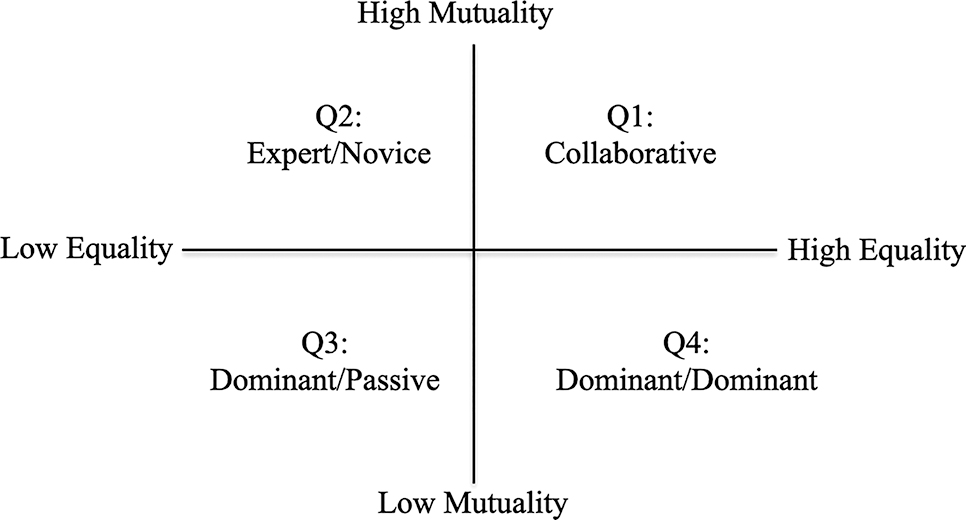
Modified version of Storch’s model of interaction (2002, p. 128).
Thus, for example, when group members equally contribute to their work and help each other, their work is considered a collaborative interaction (Q1), as it exhibits a high degree of equality and mutuality in the work. On the other hand, when one group member takes a control for the group work and provides guidance and instructions to others, the group work is considered an expert/novice interaction (Q2) in that it shows less equality and high mutuality in the work.[1]
2.3 Activity Theory
In the previous section, we looked at Storch’s (2002) writing-specific model. In this section, we briefly discuss the larger learning theory – Activity Theory – that guided our study. Activity Theory (AT) was first proposed by Vygotsky (1978) and later developed by Leont’ev (1978) to explain human cognition in relation to socially motivated activities. More recently, Engeström (1987, 1999) extended the AT idea and, correspondingly, revised his earlier representation of actions that only included a subject, object, mediating artifacts, and outcomes. In his more complex model, Engeström (1987) conceived of the human activity system as including subjects, mediating artifacts, objects (or objectives), rules, communities, division of labor, and outcomes (Figure 2).
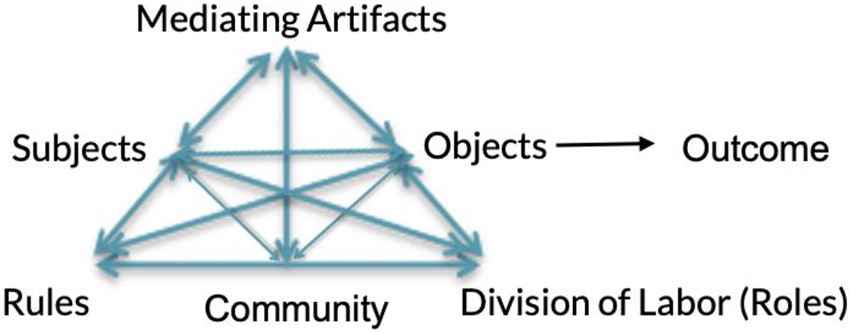
Activity system (Engeström 1987, p. 78).
In his later work (1999, 2001), and drawing on his initial theorization of AT (see Figure 2), Engeström elaborated that an activity is not a discrete individual action intended to accomplish a short-term goal; rather, it is a shared, collective process. Subjects are viewed as the agents of actions. And as agents, subjects make decisions, take control, and regulate their actions as pursuing their objects (Lantolf and Thorne 2006). The object is the goal that the subjects want to achieve. Rules refer to guidelines or regulations the subjects should abide by. The community is any of the social groups that the subjects are involved in during their participation in the activity. The mediating artifacts are the resources that the subjects utilize during the activity. Division of labor refers to how the tasks of an activity are distributed among the subjects in some way. The outcome is a solution or ideas provided by the object. Applying these AT components to ESP classrooms, engineering students are the subjects, and the projects the students want to achieve are the objects. The mediating artifacts are resources such as previous learning experiences or previous assignments that the subjects can rely on, and the rules are the guidelines or syllabus the students follow. The community consists of the groups that the engineering students are involved in. The division of labor is related to how a group of students assigns the projects among themselves.
2.4 Collaborative design projects in Activity Theory (AT)
In ESP setting, AT has proven useful for explaining learner development (Prior 2006; Russell 1997). Because AT considers human cognitive development as a socially mediated process (Lantolf 2000; Vygotsky 1978), it is a useful heuristic to examine student learning in specific educational contexts. Given the centrality of student interaction in AT, several studies that have adopted AT as a framework (e.g., Cho 2017; Fujioka 2014; Son 2022) have focused on such interaction by analyzing student collaborations. For instance, Cho (2017) used both AT and Storch’s (2002) interaction model to examine how interaction patterns were related to individual goals in collaborative writing. She found that her participants’ goals in helping group members influenced the interaction pattern, and the group’s interaction patterns affected the quality of participants’ collaboration. By using AT, Lin (2013) examined the role of agency and group work in writing activities. Lin found that the impact of group work was determined by how individual group members exercised agency and untapped every member’s potential. Simply put, AT provides a useful lens to investigate the dynamic process of student action and the development of collaborative tasks in and out of the classroom. In a more recent, AT-oriented, multi-case study, Lei and Hu (2019) examined the efforts of Chinese nursing doctoral students to publish their research. To overcome conflicts arising from a lack of familiarity with the relevant rules in their activity system, their focal students relied on mediated artifacts, such as journal articles and communities that included fellow students. Their focal students’ mentors and classmates also provided them with the necessary assistance in a socially distributed manner. In short, in keeping with the pivotal role that interaction plays in Engeström’s (1987, 2001 AT system, we join the aforementioned applied linguists who have highlighted the centrality of interaction through collaboration in the learning enterprise.
3 The present study
Building on previous studies in ESP contexts, this case study explores how two first-year engineering students, Katherine and Rebecca, developed academic literacy through collaborative work in an introductory engineering course (i.e., EGR 100). This study examines the experiences of these two students working collaboratively in separate groups in the same writing class. Adopting Engeström’s (1987, 2001 AT framework and guided by Storch’s (2002) model of interaction, we sought to investigate these two research concerns:
How did the two focal participants engage in teamwork through a collaborative design project?
In what ways were their experiences mediated in the collaborative design project?
3.1 Context
The data were collected during the Fall 2015 semester from an introductory engineering design course: EGR 100. EGR 100 is a mandatory introductory course for first-year engineering students to learn the basics of engineering writing.[2] Throughout the course, the students were expected to learn about an organized methodology to solve new and/or unfamiliar engineering design problems, and subsequently effectively communicate those solutions to scientists, engineers, or the general public. In addition to completing their requisite coursework, the students worked on limited-scope team projects and were expected to learn to collaborate effectively with team members to develop skills in communication, organization, and negotiation as well as to learn to describe the influence of individual personality traits on team dynamics. These core skills were generally discussed in large classes that were comprised of up to 300 students (see Figure 3).
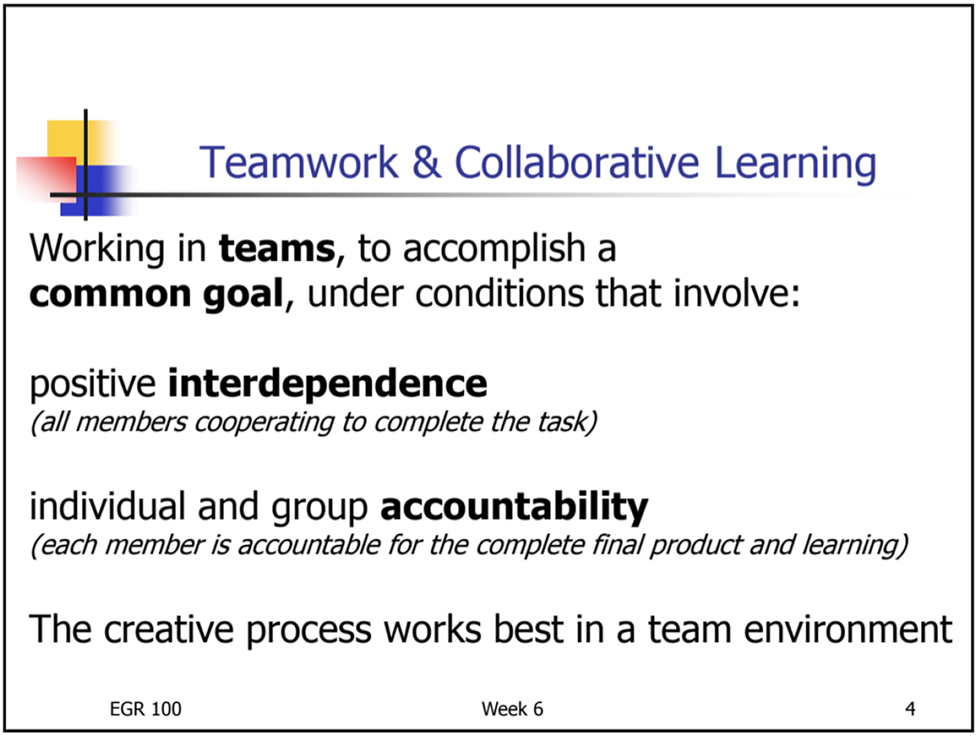
A screenshot of an EGR 100 course PPT slide.
The course comprised two parts: (1) lectures on values, norms, and practices of the field of engineering from a theoretical perspective; and (2) lab sessions that provided students with hands-on training and guidance to produce marketable products and write the product reports step-by-step. Ben (pseudonym), the graduate student instructor in the lab sessions, noted,
The two projects are designed to allow the students to build something, to develop …. We go through testing or we go through a design framework so they design, build, test, that’s how engineers usually work, design and that’s what we want the students to do.
(Excerpt 1, Ben, interview)
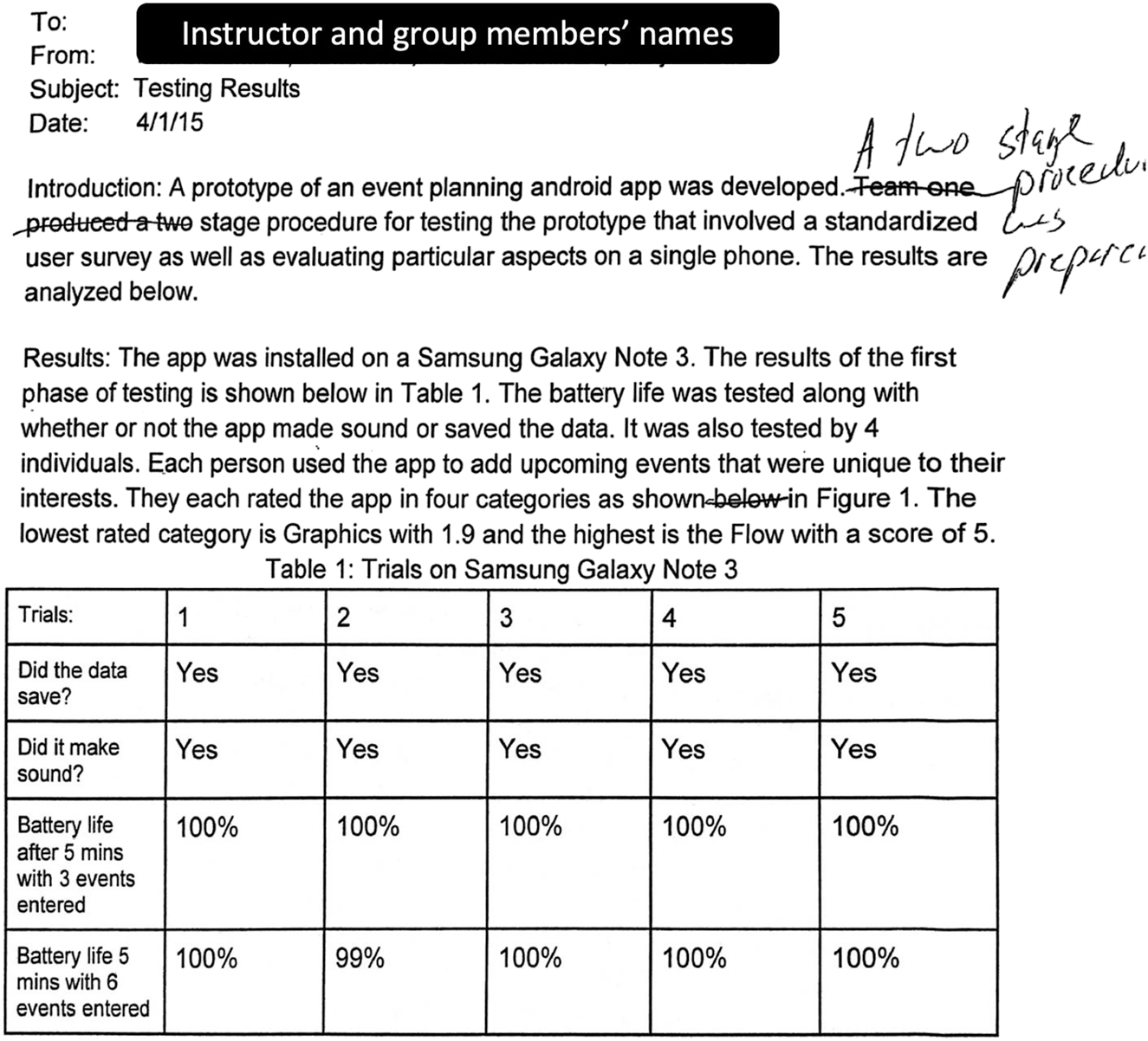
The lab sessions were meant to scaffold students step-by-step in the engineering design process by systematically incorporating tasks such as writing memos, checkpoints (i.e., multiple drafts of the final projects), building prototypes, creating products such as mobile applications, and doing poster presentations (see examples in Appendix A, B, and C). In this study, we focused on the process of the class’s final project (i.e., Project 2; see the assignment schedule for this project in Table 1). Project 2 was the collaborative project that included writing progressive reports (i.e., checkpoints) and making products. After the students submitted their project reports and products, instructors invited the teams with exemplary products to present their projects to a wider audience at an engineering college event.
Assignment schedule for Project 2 in the EGR 100 course.
| Week 10 | Checkpoint 1 (5 pts) |
| Week 11 | Checkpoint 2 (5 pts) |
| Week 12 | Checkpoint 3 (5 pts) |
| Week 13 | Competition/Demonstration (25 pts) |
| Week 14 | Poster and Presentation (10 pts) |
| Week 15 | Final report (50 pts) |
3.2 Participants and data collection
Ben, the instructor quoted earlier, and two domestic U.S. freshman students (Katherine and Rebecca; all pseudonyms) participated in our study. Katherine’s major was chemical engineering, Rebecca’s major was computer science and engineering. The two student participants who were highly motivated were chosen on a voluntary basis at the beginning of the semester. Katherine and Rebecca were 18 years old at the time of our study. Different from the previous studies (e.g., Cho 2017), our participants’ reflection data constituted our primary data because we also wanted to gain insights into students’ and ESP teachers’ critical reflection.
To triangulate the data from our participants and to enhance the trustworthiness (De Costa et al. 2019) of our results, we also collected multiple secondary data sources which included: two interviews with each participant at different stages of their projects, three checkpoint assignments, the students’ class notes as well as their curriculum vitae, final projects, and poster presentations of the final project (i.e., Project 2; Table 2). From Ben, we collected data from two interviews, lab instructions and slides, writing templates, and grading rubrics for the checkpoints and the final project assignments.
Research questions and corresponding data.
| Research questions (RQ) | Data |
|---|---|
| RQ1 |
|
| RQ2 |
|
3.3 Analysis
Adopting Activity Theory (AT) allowed us to conduct a multidimensional analysis of Katherine and Rebecca’s participation in Project 2 and capture the complex ecology of their collaborative work (Nishio et al. 2020). Nevertheless, we also remain cautious about applying AT to data analysis in an a priori manner.[3] Thus, we use AT in the present study in an a posteriori manner, that is, by letting our emergent data – in particular the reflective experiences of our participants – to guide our data analytic process.
We analyzed our reflective interview data, which as mentioned constituted our primary data source, by coding, categorizing, and recoding. In the initial coding, all three authors examined the data closely to become familiar with the data. To approximate inter-rater reliability, Authors 2 and 3 had weekly meetings to examine the data together, code the data, and check the coded data together. In addition to the interview data, for data triangulation purposes, the two students’ assignments, class notes, and Ben’s interviews were also coded on the basis of AT framework. Any disagreement between the two authors’ coding results was resolved through discussion. Because our focus was to examine Katherine and Rebecca’s teamwork into a collaborative design project, the unit of analysis was their respective activity systems.
Our participants were engaged in two core activities during the collaborative design project. The first activity entailed successfully building the final product and writing up each step of that process. The second activity, which often remains unmentioned and is left to students to figure out on their own, is to achieve successful team collaboration through a series of social activities. Katherine and Rebecca’s participation in both activities gave us insight into the dynamics of collaborative design work, which included trust-building among team members, establishing leadership, allocating roles, and developing communication strategies and channels.
An AT lens was used to examine Rebecca’s and Katherine’s learning experiences in these two activity systems (i.e., the task completion activity system, Figure 4; and the collaborative work activity system, Figure 5).
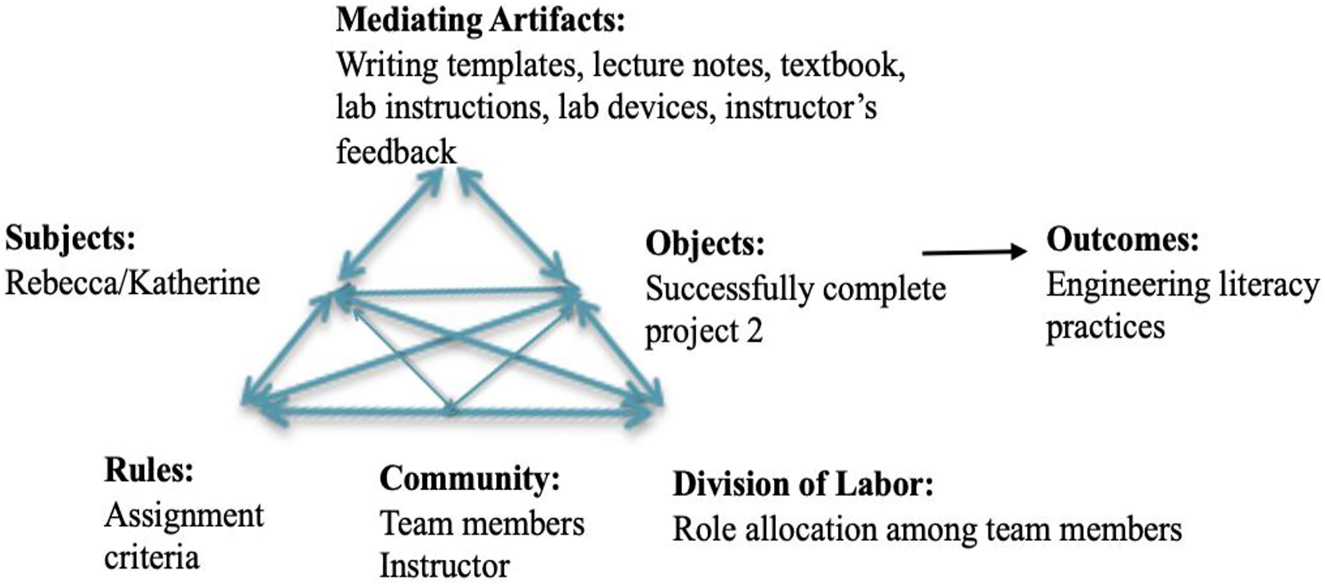
Task completion activity system-Activity 1.
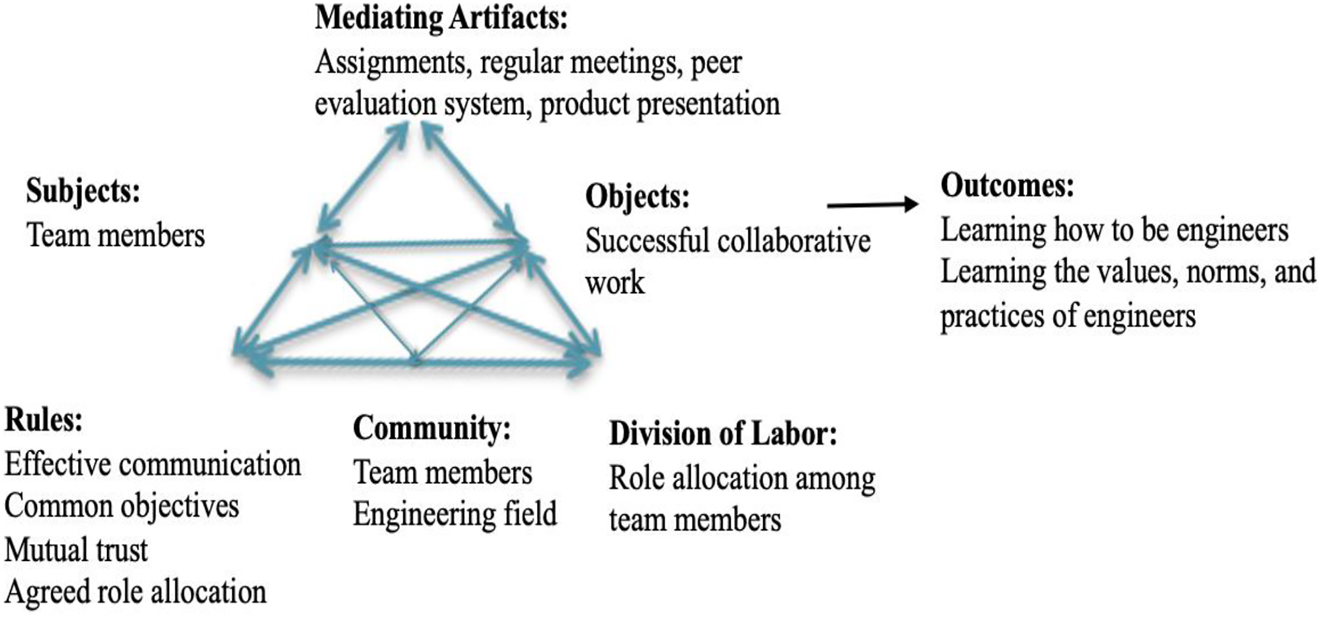
Collaborative work activity system-Activity 2.
Our examination focused on the different factors that mediated participation in the two aforementioned activities (i.e., task completion-Activity 1 and team collaboration-Activity 2). We also identified the interactions between these two activities, which in turn contributed to the different collaboration patterns and experiences of our two focal participants.
4 Findings
We analyzed Katherine and Rebecca’s interview reflection data in relation to the different AT components described earlier. Doing so allowed us to understand their individual actions as shaped by the interplay between their exercise of individual agency to achieve their personal goals and their negotiation of group dynamics shaped by the social mediators, including rules, community, and division of labor.
4.1 Rebecca
Rebecca, a computer engineering major, had taken computer science courses and learned coding since high school. She did not encounter any major problems in the EGR 100 course, disclosing in an interview, “I’m pretty okay at technical writing and writing in general” (interview). Similarly, when asked to describe her first-year learning experience, she described it as “simple”.
4.1.1 Object setting
At the beginning of the EGR 100 course, there is a technical writing assignment that requires students to talk about their goals for the course. Rebecca identified three features of EGR 100 that she thought would benefit her in becoming an engineer in the future: communication, teamwork, and organization. Not surprisingly, her goals aligned with the three course objectives. With respect to the teamwork goals, she wrote:
Another way EGR 100 benefits the student is the amount of teamwork involved. Teamwork is essential in a career in engineering and this course spends two thirds of its time in groupwork.
(Excerpt 3, Rebecca, writing assignment)
As this written comment suggests, Rebecca understood that teamwork constituted a significant part of the course and was a crucial quality of being a good engineer. Nevertheless, she felt this objective was not met during the first project. At the end of Project 1, she wrote in the reflection assignment:
There was a severe lack of communication when it came to delegation of tasks & workload distribution. For Project 2, the team should explicitly delegate tasks to each of its members… This will also provide the opportunity to diversify each members’ contribution.
(Excerpt 4, Rebecca, writing assignment)
Even though she successfully completed Project 1, Rebecca was aware that the effective teamwork goal was not met. This unsatisfying experience led her to set specific objectives for Project 2, namely, increasing the amount of communication and having a clear division of labor among team members throughout the project. In addition, Rebecca noted the lack of holistic learning when individual students focus only on their assigned part of a project and proposed to “diversify each members’ contribution”. This reflection assignment was graded by the instructor, Ben. No specific comment about the teamwork problem was given to Rebecca however, thereby confirming that the reflection assignment was graded based on the ability to comply with a technical writing genre.
4.1.2 Object achieving as mediated by individual agency, division of labor, and community
Unfortunately, the plan to realize the teamwork objective was unsuccessful. Similar issues that led to an unsuccessful teamwork in Project 1 reemerged in Project 2 because there was also limited communication about the division of labor. In fact, Rebecca ended up taking a dominant role and doing most of the work.
Interviewer: So there was no talk about division of labor, “you are going to do this,” and “you are going to do that”?
Rebecca: No, no, I just did it.
(Excerpt 5, Rebecca, interview)
Rebecca’s interaction pattern, analyzed in relation to Storch’s (2002) collaborative interaction patterns, demonstrated both low mutuality and low equality (i.e., Quadrant 3 in Figure 6) by taking charge of the whole project and failing to engage other team members in the teamwork. Such a dominant and passive collaborative relationship (see Figure 6) between her and her team members was further explained by Rebecca in the following two excerpts.
[M]y group shows up, and sometimes they’ll help, but mostly it’s me …. It’s frustrating sometimes, sometimes I understand, that um, my lab partners are busy and other times I feel like it’s better that I do it if I understand what’s happening entirely, and I clearly was a part of every step in the process of the design, so I understand like, the background of what’s happening. I don’t feel entirely comfortable letting my teammates take control of a project that they weren’t very involved in.
(Excerpt 6, Rebecca, interview)
I’m a very driven, motivated person and I wasn’t prepared to sit back and let that kind of conversation happen where nobody does it, and somebody has to at the last minute. And um, so, I guess that’s why I took command of the project.
(Excerpt 7, Rebecca, interview)
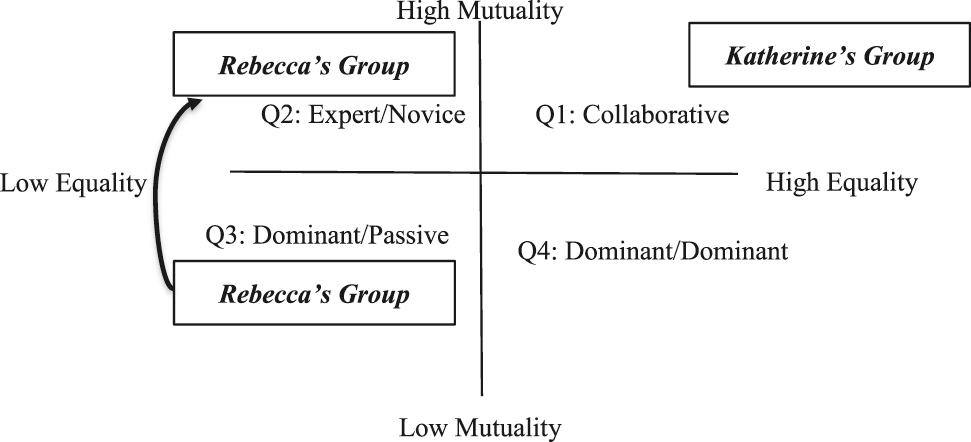
Interaction patterns of the group.
In Excerpt 6, Rebecca identified two factors: (1) different levels of motivation and involvement among team members; and (2) her unwillingness to put “her project” into the hands of the less-engaged team members. Ostensibly in contrast to her team members, she was highly motivated and engaged to work on the project. Therefore, in such a team dynamic, Rebecca was able to achieve agency by taking control of the project and letting her team members take the back seat.
Despite feeling frustrated sometimes, Rebecca was willing to and, more importantly, capable of doing most of the work by herself:
I really enjoy the project I’m working on though. Like, I knew that I was probably going to be the person doing the most work, so I made sure that we picked a project that we really enjoyed. So I don’t, I don’t feel like it’s a burden to do the work because I really enjoy it.
(Excerpt 8, Rebecca, interview)
Excerpt 8 further demonstrates how Rebecca enacted her agency to choose the project that interested her, which in turn helped keep herself engaged. Their project was to create a math tool for visually impaired middle schoolers. Because Rebecca was a computer science major, the project was less of a burden to her. One thing worth mentioning is that Rebecca’s decision with respect to the (non)division of labor and her description of the process of completing Projects 1 and 2 as not posing much difficulty also point to another issue in collaborative work, that is, team members were at different levels of disciplinary literacy and expertise. Moreover, her experience of completing Project 1 also helped Rebecca become more adept at working on Project 2. These past experiences therefore enabled her to complete the project without eliciting much help from her team members.
As they completed Project 2, an unexpected learning opportunity emerged for both Rebecca and her team members when they were selected to present their product to a larger audience at the engineering college. Due to a schedule conflict, Rebecca could not attend the poster presentation and had to allow her teammates to present the project without her. To help prepare her team members for the presentation, Rebecca assigned different parts of the project to her team members based on their familiarity with the project, stating that: “the girl who didn’t show up got the intro, she can do it, and then, people who did show up, I gave the results section and the conclusion” (interview). As a result, the presentation went quite well; Rebecca commented later that she was impressed by how smoothly things went without her. In particular, she commended one of the team members who brought her own expertise to the presentation:
One of the team members, her internship is in marketing, and she did so good at it. She was selling our product, and I was really impressed and pleased with how it turned out …
(Excerpt 9, Rebecca, interview)
This incident can be considered another form of division of labor among Rebecca’s team members, one where Rebecca’s absence (ironically) created an opportunity for her team members to learn about the project more comprehensively. Notably, her team members had to know the project well enough to deliver a good presentation. This opportunity also changed the group dynamics and created a new interaction pattern. That is, the team members’ low mutual engagement was changed to high mutual engagement, and their collaborative relationship took on an expert/novice dimension with Rebecca, the expert, agentively engaging her team members in learning about the project (see the change reflected in Figure 6).
4.1.3 Rules
In the AT framework, rules are considered a way to guide and regulate subjects’ actions. On the one hand, it seems that the rules for completing Project 2 in EGR 100 were written in a meticulous and organized way, with detailed rubrics and grading criteria for each assignment. For example, Rebecca mentioned in the interview that when they first started writing the memos and checkpoints, they kept receiving Ben’s feedback on changing the (pronoun) subjects “we,” “I,” and “they” to “the team” in order to make the report sound objective.
However, we did not find a similar level of detailed rules about collaborative teamwork in the EGR 100 course syllabus. While the importance of teamwork was emphasized repeatedly and the core teamwork features and different collaboration patterns were also introduced in both lectures and lab sessions, these rules remained at an aspirational level.
One exception was a peer evaluation activity in which the students were required to evaluate their team members’ contributions (in percentage terms) after finishing Project 2. For example, Rebecca also commented on how she evaluated her team members.
I feel like I was pretty honest in my evaluations. Um, the girl who was very good at presenting. I gave her 20% for that. The girl who did not show up to any of our meetings, I gave her 5. She came to class some days, so I mean, better than zero. Um, so I gave myself 60% because I feel like I did most of the work, all of the work, really. Then the other girl showed up to our meetings, so 15% there.
(Excerpt 10, Rebecca, interview)
As seen in the Excerpt 10, Rebecca did not necessarily evaluate her team members based on their contribution to the project, except for the student who did well at the presentation. The other two students were evaluated in relation to their attendance of team meetings. We argue that such peer evaluation is not effective in that it failed to reflect (1) the group dynamics in collaborative work, and (2) the contributions each member made to the completion of Project 2. More disturbingly, the result of the peer evaluation was not considered by the instructor, Ben. In addition, this activity was only conducted at the end of the project, which limited its role in mediating team relations in teamwork. Thus, neither the students nor the instructor could benefit much from such group evaluation reflection activity.
4.1.4 Outcome
To understand Rebecca’s teamwork outcome, we need to examine it from two perspectives: first, in terms of task completion (i.e., Activity 1; review Figure 4) and the execution of collaborative work (i.e., Activity 2; review Figure 5). To their credit, Rebecca and her team successfully completed Project 2 and achieved a good result (they were selected to deliver a poster presentation at a college event). Over the course of the whole process, Rebecca developed desired disciplinary literacy in EGR 100 and completed the task (Activity 1). However, she failed to achieve the goal of teamwork in Project 2 (i.e., she failed at Activity 2).
Based on Rebecca’s reflection data, she did not seem to reflect on this experience critically or delve deeper into the causes of her team failing to function properly. This might make one wonder how such an experience would benefit Rebecca because she did not experience teamwork (i.e., a failed result at Activity 2) and was able to complete the projects largely on her own. To this end, and in the spirit of enacting critical reflection, we argue that instructors’ scaffolding and explicit instructions on teamwork and group dynamics are necessary to guide students like Rebecca to critically reflect on their collaboration experience rather than simply asking them to evaluate each other’s contribution.
4.2 Katherine
Katherine was a transfer student majoring in chemical engineering during the data collection period. She had spent one year at another university before transferring to the current school. According to Katherine, she had taken a chemical engineering class at her previous university, but it did not require much writing. Similar to Rebecca, Katherine was a diligent and highly motivated student. In the interview, Katherine described her experience of being a female engineering student in a male-dominant discipline:
In the engineering class, I tried to answer the questions that he [the instructor] had. I try to be involved, like stay in the front row or the front three rows …. I feel like I’m a really hard worker and you know whatever needs to be done it’s gonna get done.
(Excerpt 11, Katherine, interview)
Katherine’s strong motivation got turned into actions by enacting her agency when completing Project 2 with her team members. Katherine agentively took different roles, be it the team leader, or the coordinator which required her to accommodate her team members’ needs and keep them engaged and motivated during the Project 2; Such levels of communication and collaboration among team members are considered essential for successful teamwork.
4.2.1 Object setting
When reflecting on the experience of completing Project 1, Katherine wrote:
Being a successful team is crucial in Projects 1 and 2. In Project 1, communication, adaptability, and diversity of capabilities were great aspects to have. My team had all those. The approach to Project 2 should be the same as Project 1. The team should be motivated, organized, and determined to do well.
(Excerpt 12, Katherine, writing assignment)
As can be seen in Excerpt 12, the successful teamwork experience in Project 1 became one of the mediating artifacts that provided Katherine and her team the necessary guidance and experience to complete Project 2; their team was able to learn to adapt to each other, as well as identify each member’s skills and talents. In doing Project 2, and following the EGR 100 course objectives, Katherine set the goal of maintaining the same level of motivation and determination in their efforts.
4.2.2 Object achieving as mediated by individual agency, division of labor, and community
Everyone in Katherine’s team made sure that they were equally responsible for the outcome of each task. As stated by Katherine:
Each [Project 2; review Table 1] checkpoint except for one, we all split it up pretty well. I usually do the intro and the conclusion … and then the discussion Rob will do, and then the method or like the methods or results or depending on the paper that we have to write ….Usually Nick and Rosalie work as a sub-team on one section …
(Excerpt 13, Katherine, interview)
According to Katherine, the group divided the labor in such a manner that team members’ skills and expertise, or lack thereof, were taken into consideration. It is noteworthy in Katherine’s interviews that she constantly used “we,” in contrast to Rebecca’s frequent use of “I.” Her use of “we” signals that Katherine developed a collective identity as part of a team rather than emphasizing each individual’s effort and contribution. With such an identity, Katherine considered completing Project 2 as a team effort, and therefore combined Activities 1 and 2 (i.e., task completion and team collaboration, respectively) into one.[4]
Excerpt 14 describes an incident where Katherine tried to mediate team dynamics by taking a back seat on a writing task and let her team members take control.
The interviewer: Does Nick [the international student team member] sit with you or do all four of you sit together before you make your revision? You make the final set of revisions, right?
Katherine: Sometimes. This past one I asked another student to do it … we’re a really good group, we all work really well together. I just wanna make sure we’re all on the same page and know that I don’t want them to think that I’m like dictating it, you know.
(Excerpt 14, Katherine, interview)
Excerpt 14 exemplifies the dynamics of the team’s communication and also provides evidence of Katherine’s exercise of agency. In Katherine’s case, she intentionally took a step back and let other team members take charge of the writing task. In doing so, Katherine made efforts to balance the workload among team members so as to maintain a healthy team collaboration environment. This contrasts greatly with Rebecca’s description of her team, where Rebecca purposefully took command of the project to make sure it was done the way she wanted it to be done.
While fairly dividing the work among team members played an important role in achieving a successful collaboration, building trust and reciprocity relations within the community was just as important. Katherine’s team always met up on Monday and Tuesday from 7 to 9 pm to work on the assignments together, even though the delegation of tasks was already made.
Katherine’s teamwork can be characterized by Storch’s (2002) collaborative interaction pattern (see Figure 6), and was characterized by her team members’ equal contribution to the project and their high level of engagement. Working in such an environment, Katherine’s team not only credited every member for their contribution, but also developed resilience towards challenges and provided each other mutual support during difficult times.
4.2.3 Rules
Another factor that contributed to Katherine’s successful teamwork was the implicit rules they followed among themselves. As mentioned, Katherine’s team always met at a fixed time each week to work on their tasks together. Complying with this rule, they were able to discuss their division of labor, help each other finish their assigned tasks, and develop trust in and through their interaction. This can also be seen in their peer evaluations, where they rated each other’s contributions equally (25% for each member).
With regard to the explicit rules, as explained in Rebecca’s case, the detailed rubrics and guidelines provided by Ben helped Katherine’s team with their writing tasks. Nevertheless, as shown in Excerpt 16, Katherine attributed the success of their teamwork in both projects to good luck, commenting:
Some people didn’t have good teams and I was just lucky …. We worked great together. But it would have been kind of nice to choose my group, even though I loved my group. So maybe for others, it would have been nice, especially for students who know other students in the class, you know.
(Excerpt 16, Katherine, interview)
As Katherine noted, such successful team dynamics might not apply to the other groups in the class. As we argued in Rebecca’s case, explicit rules on effective teamwork should be provided by the instructors to scaffold students’ negotiation of the complexities surrounding the division of labor and team dynamics in order to work successfully in a team. We would also like to reiterate that critical reflection on teamwork after each project is necessary.
4.2.4 Outcome
Similar to Rebecca, Katherine accomplished the objectives she set up in the reflection assignment (i.e., working collaboratively to complete Project 2). Her goals were aligned with the course objectives. She not only developed disciplinary literacy by completing the two projects, but also developed teamwork skills, including balancing the workload assigned to each member, identifying each member’s skill sets, and taking different roles to accommodate others and thus maintaining good team dynamics. These skills are essential in becoming a good engineer who often has to work in collaborative teams. We posit that by doing Projects 1 and 2 with her team, Katherine also learned the norms and practices of the engineering field.
5 Discussion
Our findings present two focal participants’ experience of doing collaborative design projects in an Engineering-specific writing course. Rebecca’s interactions with her teammates deprived them of the opportunity to engage in discipline-specific literacy practices. In the meanwhile, the adoption of a dominant-passive interaction pattern hindered them from developing effective collaboration strategies by experimenting with various interactional models. In comparison, Katherine and her teammates were able to maintain healthy interaction dynamics through establishing mutual trust, regular meetings, and shared responsibility, which resulted in expanded disciplinary knowledge.
5.1 Participants’ exercise of agency
While Katherine and Rebecca sought to complete Project 2 and engage in teamwork, their achievement of these two goals was greatly affected by how they enacted their agency. Although both identified themselves as highly motivated and driven, their enactment of agency differed in their interactions with their team members. In Rebecca’s case, based on her prior experience working with her team members, she decided to take command of the project because she perceived her team members to be not as involved or engaged in doing the project as she did. In contrast, Katherine exercised her agency, not only working on her assigned parts, but also taking on different roles at different stages to communicate with other team members to balance workload and keep others engaged and motivated, which led to a more successful collaboration experience. This observation corroborates the findings of Lin (2013), who reported that when working in a group, it is important for one to learn to control one’s agency “through interpersonal communication, through accommodating others’ different views, through regulating one’s behavior, and through modifying one’s plan and sharing work with teammates.” (p. 645).
5.2 Collaboration mediated by activity systems
Katherine’s exercise of agency also pointed to another key factor that mediated the group dynamics and shaped the learning outcome: community. Katherine identified each team member as part of the team, with a collective identity in doing different tasks and responding to challenges. Each member’s own skills, talents, and constraints were considered in the division of labor; yet, when individual members were doing their work, the community was there to help and support each other. Furthermore, in Katherine’s account, deliberate consideration was also given to the division of labor. As shown in our data, her team divided the work fairly by taking into consideration team members’ own strengths and constraints. Similarly, in their teamwork, they also created and shared some implicit rules about where, when, and how the assignments should be completed as a team. Therefore, in Katherine’s team, we observed that the components, i.e., community, rules, and division of labor, interacted to contribute to a successful teamwork outcome.
In comparison, in Rebecca’s case, she did not really see her team as a community that could build reciprocal relationships to facilitate project success. Failure to develop a sense of community can be attributed to the following reasons. First, her experience working on collaborative projects revealed some problems with team work, such as different levels of motivation and engagement, difficulty in scheduling team meetings that fit everyone’s schedule, which prompted Rebecca to take charge of the second project. Furthermore, while she was aware of the importance of collaboration, she had no prior successful collaborative experiences and no one to guide her in critically reflecting on unsuccessful collaboration experiences. This also illustrates that one’s previous experience plays an important role in mediating one’s action in the current activity system (Fujioka 2014). Rebecca may have realized that her team was able to complete the project despite limited investment from other team members. Therefore, similar to the participants in Lei and Hu (2019), Rebecca drew from her previous experiences and chose to take on most of the work to ensure a successful completion of the project.
In addition, her team’s collaborative experience was also mediated by the lack of rules to guide their collaboration. Neither Ben (the instructor) nor her team set up explicit or implicit rules to (1) scaffold how to effectively communicate personal goals, (2) decide the division of labor within them, and (3) effectively evaluate team collaboration. As we have discussed, the quality of collaboration can vary depending on the dynamics among group members, which in turn can only be enhanced when students are provided specific guidelines on how to collaborate (Gimenez and Thondhlana 2012). In addition, we maintain that the examination of reflection data – as demonstrated in our study – can illuminate the importance of engaging students in critical collaborative reflective practices.
5.3 Different interaction patterns
Informed by Storch’s (2002) four types of interaction patterns, Rebecca and Katherine’s collaborative interaction patterns can be identified as dominant/passive and collaborative interaction patterns, respectively. More importantly, we observed the interaction patterns are not static or fixed throughout the collaboration. In Rebecca’s case, the apparent constraint, i.e., her absence from the poster presentation, became an unexpected learning opportunity for her teammates. Thus, our findings aligned with those of Cho (2017) and Elabdali and Arnold (2020) who demonstrated that different interaction patterns can lead to different group dynamics and that different group dynamics can facilitate or curtail students’ learning in collaborative work. Hence, we argue that a key part of successful academic collaboration socialization is also learning to incorporate equality and mutuality (Storch 2002) into one’s academic interaction repertoire.
6 Conclusion
On a pedagogical level, we learned that collaborative work does not always go as planned by instructors (Lantolf 2004). Rebecca and Katherine’s individual activity systems differentially mediated their collaborative processes. While both of them successfully completed the collaborative design project, only Katherine did so in a real collaborative environment and benefited from such collaboration. That said, what was conspicuously missing in the collaborative design project was pedagogical guidance to support students’ learning about collaborative design. Because we did not recruit a large sample of participants for this project, we cannot confirm this. Examining how a larger number of engineering students collaborate in a group work would be a follow up to the current study. Nevertheless, in light of our findings, we call for a more systematic approach to teaching, assessing, and intervention in collaborative work to be developed. Appropriate scaffolding from the instructor is necessary to help students learn about the disciplinary discourse. However, such scaffolding need not only come discipline-specific experts. Instructors like Ben would benefit immensely from insights that their EAP/ESP colleagues might have because the latter would have pedagogical insights on how to enhance collaborative work. In other words, we think that this is an opportune time for content instructors to reach out to their ESP counterparts to refine courses such as EGR 100.
Appendix A: Rebecca’s poster presentation
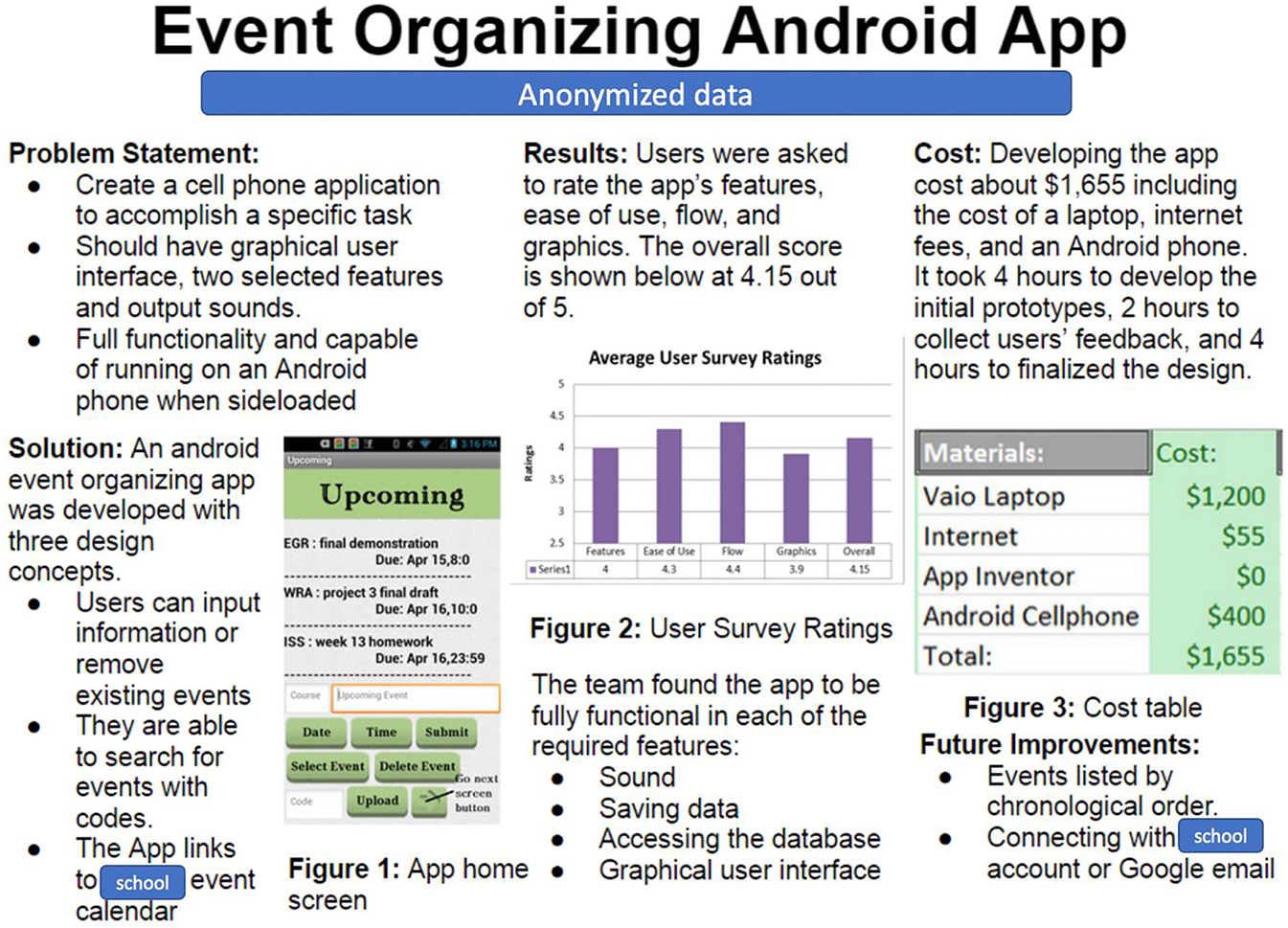
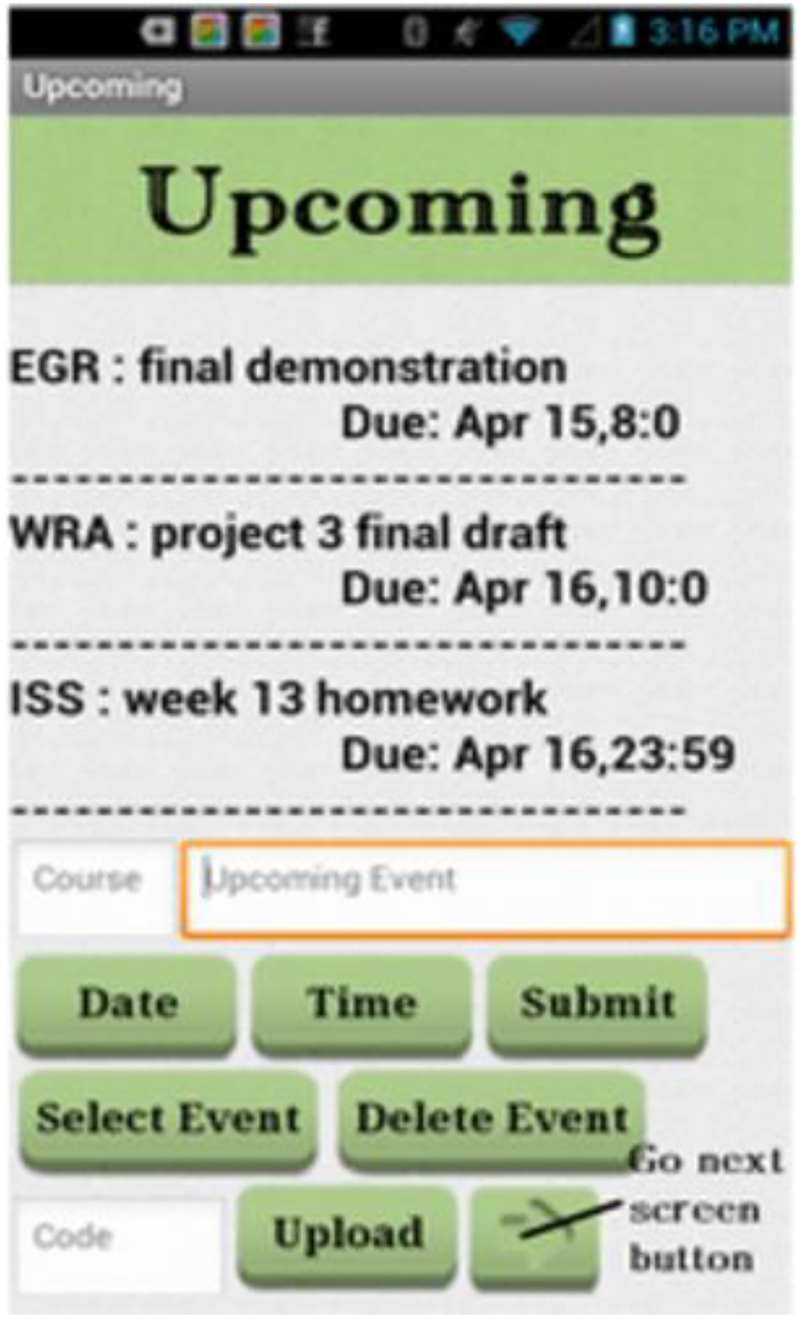
Appendix B: The final product of Rebecca’s group (event organizing Android application)
Appendix C: The checkpoint 3 assignment of Rebecca’s group
References
Carter, Michael, Miriam Ferzli & Eric N. Wiebe. 2007. Writing to learn by learning to write in the disciplines. Journal of Business and Technical Communication 21(3). 278–302. https://doi.org/10.1177/1050651907300466.Suche in Google Scholar
Cho, Hyeyoon. 2017. Synchronous web-based collaborative writing: Factors mediating interaction among second-language writers. Journal of Second Language Writing 36. 31–57. https://doi.org/10.1016/j.jslw.2017.05.013.Suche in Google Scholar
De Costa, Peter I., Wendy Li & Hima Rawal. 2019. Qualitative classroom methods. In John W. Schwieter & Alessandro Benati (eds.), The Cambridge handbook of language learning, 111–136. New York, NY: Cambridge University Press.10.1017/9781108333603.006Suche in Google Scholar
Du, Juan & Xiaodi Zhou. 2022. Translanguaging practices of Chinese/English bilingual engineers’ communications in the workplace. Applied Linguistics Review 13(3). 389–402. https://doi.org/10.1515/applirev-2021-0021.Suche in Google Scholar
Dym, Clive L., Alice M. Agogino, Ozgur Eris, Daniel D. Frey & Larry J. Leifer. 2005. Engineering design thinking, teaching, and learning. Journal of Engineering Education 94(1). 103–120. https://doi.org/10.1002/j.2168-9830.2005.tb00832.x.Suche in Google Scholar
Duff, Patricia A. 2014. Case study research on language learning and use. Annual Review of Applied Linguistics 34. 233–255. https://doi.org/10.1017/s0267190514000051.Suche in Google Scholar
Elabdali, Rima & Nike Arnold. 2020. Group dynamics across interaction modes in L2 collaborative Wiki writing. Computers and Composition 58. 102607. https://doi.org/10.1016/j.compcom.2020.102607.Suche in Google Scholar
Engeström, Yrjö. 1987. Learning by expanding: An activity theoretical approach to develop-mental research. Helsinki, Finland: Orienta-Konsultit Oy.Suche in Google Scholar
Engeström, Yrjö. 1999. Activity theory and individual and social transformation. In Yrjö Engeström, Reijo Miettinen & Raija-Leena Punamäki (eds.), Perspectives on activity theory, 19–38. Cambridge: University Press.10.1017/CBO9780511812774.003Suche in Google Scholar
Engeström, Yrjö. 2001. Expansive learning at work: Toward an activity theoretical reconceptualization. Journal of Education and Work 14(1). 133–156. https://doi.org/10.1080/13639080020028747.Suche in Google Scholar
Fujioka, Mayumi. 2014. L2 student–US professor interactions through disciplinary writing assignments: An activity theory perspective. Journal of Second Language Writing 25. 40–58. https://doi.org/10.1016/j.jslw.2014.05.004.Suche in Google Scholar
Gimenez, Julio & Juliet Thondhlana. 2012. Collaborative writing in engineering: Perspectives from research and implications for undergraduate education. European Journal of Engineering Education 37(5). 471–487. https://doi.org/10.1080/03043797.2012.714356.Suche in Google Scholar
Johri, Aditya & Barbara M. Olds. 2011. Situated engineering learning: Bridging engineering education research and the learning sciences. Journal of Engineering Education 100(1). 151–185. https://doi.org/10.1002/j.2168-9830.2011.tb00007.x.Suche in Google Scholar
Lantolf, James P. 2000. Sociocultural theory and second language learning. Oxford: Oxford University Press.Suche in Google Scholar
Lantolf, James P. 2004. An overview of sociocultural theory. In Kees van Esch & Oliver John (eds.), New insights into foreign language learning and teaching, 13–34. Berlin: Peter Lang.Suche in Google Scholar
Lantolf, James P. & Steven L. Thorne. 2006. Sociocultural theory and the genesis of second language development. Oxford: Oxford University Press.Suche in Google Scholar
Lei, Jun & Guangwei Hu. 2019. Doctoral Candidates’ dual role as student and expert scholarly writer: An activity theory perspective. English for Specific Purposes 54. 62–74. https://doi.org/10.1016/j.esp.2018.12.003.Suche in Google Scholar
Leont’ev, Alekseĭ. 1978. Activity, Consciousness and personality. Englewood Cliffs, NJ: Prentice Hall.Suche in Google Scholar
Lin, Zheng. 2013. Capitalising on learner agency and group work in learning writing in English as a foreign language. TESOL Journal 4(4). 633–654. https://doi.org/10.1002/tesj.60.Suche in Google Scholar
Nishio, Tomoe, Chie Fujikake & Masataka Osawa. 2020. Language learning motivation in collaborative online international learning: An activity theory analysis. Journal of Virtual Exchange 3. 27–47. https://doi.org/10.21827/jve.3.35780.Suche in Google Scholar
Prior, Paul. 2006. A sociocultural theory of writing. In Charles A. MacArthur, Steve Graham & Jill Fitzgerald (eds.), Handbook of writing research, 54–66. New York: Guilford Press.Suche in Google Scholar
Russell, David R. 1997. Rethinking genre in school and society: An activity theory analysis. Written Communication 14(4). 504–554. https://doi.org/10.1177/0741088397014004004.Suche in Google Scholar
Son, Myeongeun. 2022. International students’ writing development from an activity perspective. In Peter I. De Costa, Wendy Li & Jongbong Lee (eds.), International students’ multilingual literacy practices: An asset-based approach to understanding academic discourse socialization, 90–106. Bristol, UK: Multilingual Matters.10.21832/9781800415560-008Suche in Google Scholar
Storch, Neomy. 2002. Patterns of interaction in ESL pair work. Language and Learning 52(1). 119–158. https://doi.org/10.1111/1467-9922.00179.Suche in Google Scholar
Storch, Neomy. 2011. Collaborative writing in L2 contexts: Processes, outcomes, and future directions. Annual Review of Applied Linguistics 31. 275–288. https://doi.org/10.1017/s0267190511000079.Suche in Google Scholar
Volet, Simone & Caroline Mansfield. 2006. Group work at university: Significance of personal goals in the regulation strategies of students with positive and negative appraisals. Higher Education Research & Development 25(4). 341–356.10.1080/07294360600947301Suche in Google Scholar
Vygotsky, Lev S. 1978. Mind in society: The development of higher psychological processes. Cambridge, MA: Harvard University Press.Suche in Google Scholar
© 2022 the author(s), published by De Gruyter, Berlin/Boston
This work is licensed under the Creative Commons Attribution 4.0 International License.
Artikel in diesem Heft
- Frontmatter
- Research Articles
- Exploring open consonantal environments for at-home testing of vowel perception in advanced L2 speakers
- “Writing-to-learn”: the influence of task repetition on CSL writers’ attention to form
- Tourism, commodification of Dongba script and perceptions of the Naxi minority in the linguistic landscape of Lijiang: a diachronic perspective
- The early the better? Or, the more the merrier? The relative effects of onset age and exposure hours on EFL learners’ implicit and explicit grammatical attainment
- Stylistic alignment in natural conversation involving second language speakers
- Learner-internal and learner-external factors for boredom amongst Chinese university EFL students
- Epistemic positioning by science students and experts: a divide by applied and pure disciplines
- Sociocultural influence on engineering students’ collaborative design project: an Activity Theory perspective
- Interplay between language and identity: Chinese returnee scholars in the internationalisation of higher education
- The pedagogical remit of test preparation: the case of writing acquisition on an IELTS course
- Contributions of morphological awareness and lexical inferencing ability to L2 vocabulary knowledge among Chinese EFL learners: a structural equation modeling analysis
- Syntactic variation and Pan-Hispanic awareness in teachers of Spanish as a second language
- Strategic competence, task complexity, and foreign language learners’ speaking performance: a hierarchical linear modelling approach
- Effects of working memory capacity and distance-based complexity on agreement processing: a crosslinguistic competition account
- Review Article
- Oral corrective feedback on lexical errors: a systematic review
Artikel in diesem Heft
- Frontmatter
- Research Articles
- Exploring open consonantal environments for at-home testing of vowel perception in advanced L2 speakers
- “Writing-to-learn”: the influence of task repetition on CSL writers’ attention to form
- Tourism, commodification of Dongba script and perceptions of the Naxi minority in the linguistic landscape of Lijiang: a diachronic perspective
- The early the better? Or, the more the merrier? The relative effects of onset age and exposure hours on EFL learners’ implicit and explicit grammatical attainment
- Stylistic alignment in natural conversation involving second language speakers
- Learner-internal and learner-external factors for boredom amongst Chinese university EFL students
- Epistemic positioning by science students and experts: a divide by applied and pure disciplines
- Sociocultural influence on engineering students’ collaborative design project: an Activity Theory perspective
- Interplay between language and identity: Chinese returnee scholars in the internationalisation of higher education
- The pedagogical remit of test preparation: the case of writing acquisition on an IELTS course
- Contributions of morphological awareness and lexical inferencing ability to L2 vocabulary knowledge among Chinese EFL learners: a structural equation modeling analysis
- Syntactic variation and Pan-Hispanic awareness in teachers of Spanish as a second language
- Strategic competence, task complexity, and foreign language learners’ speaking performance: a hierarchical linear modelling approach
- Effects of working memory capacity and distance-based complexity on agreement processing: a crosslinguistic competition account
- Review Article
- Oral corrective feedback on lexical errors: a systematic review
