“Writing-to-learn”: the influence of task repetition on CSL writers’ attention to form
-
Yachong Cui


Abstract
The “writing-to-learn” dimension of the second language (L2) writing has generated theoretical and empirical intrigue in the past decade. Task repetition is one variable of interest; however, little attention has been given to its role in individuals’ writing processes. This study explores the influence of task repetition on L2 Chinese learners’ attention to form by analyzing their writing processes. Four advanced learners of Chinese as a second language (CSL) were asked to complete one writing task twice in 10 days under think-aloud conditions. Language-related episodes (LREs), the representation of writers’ attention to form, in participant-produced think-aloud protocols were analyzed along three dimensions: language-related problems, problem-solving strategies, and depth of processing. Results indicated that task repetition in individual writing contributed to learners’ Chinese acquisition, as learners 1) attended closely to the typological characteristics and new/complex forms of Chinese; 2) strove for precise language expression; and 3) were granted time to access external resources and expand their linguistic repertoire. Implications related to task repetition in L2 writing, L2 Chinese instruction, and associated research are discussed.
Funding source: China Postdoctoral Science Foundation
Award Identifier / Grant number: 2021M690449
Acknowledgments
We would like to extend special thanks to Dr. Mark Feng Teng from Beijing Normal Univeristy for the advice on the data analysis in this study. We are also grateful to anonymous reviewers for their kind and useful suggestions for improving this article.
-
Research funding: This work was supported by China Postdoctoral Science Foundation (grant no. 2021M690449).
Appendix A: the argumentative writing task (Chinese version)
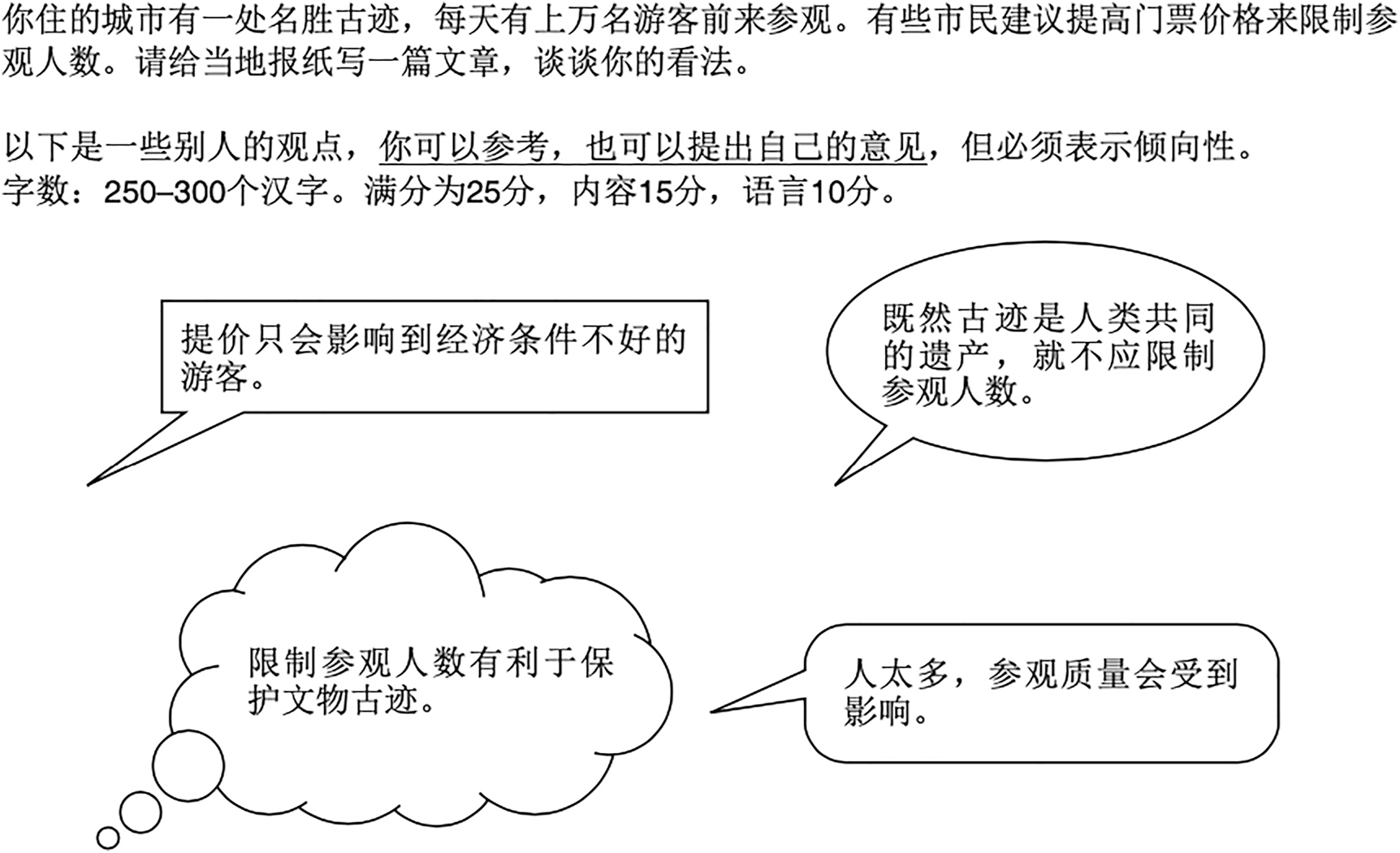
Appendix B: the think-aloud instructions
“有声思维法”指示语
在本实验中, 我们关注的是你在完成汉语写作任务过程中的想法。因此你需要在写作时说出自己的想法。你的贡献对于研究汉语作为第二语言学习者的写作过程至关重要。
从拿到题目开始到写作结束, 你需要说出整个过程中的所有想法, 想到什么就说什么!
你平时怎么写的, 怎么做的, 在实验中就怎么写, 怎么做, 只是多了一个说!
你可以使用任何你感到舒服的语言来说出自己的想法, 可以是汉语, 也可以是你的母语, 或者汉语夹杂母语。
研究人员不会和你交流, 只会在你忘记说话的时候适当提醒, 他/她的提醒可能会对你造成干扰, 这属于正常现象。
注意写作没有时间限制。
“Think-aloud” Instructions
In this experiment, we are interested in what you think while completing the writing task. For this purpose, we ask you to report your ongoing thoughts while you write. Your contribution is of great significance to studying CSL learners’ Chinese writing process.
You can begin to speak aloud everything that occurs to you, from the moment when you first see the writing topic. Report aloud whatever you think about until you submit your essay.
Just write as you usually do. There is nothing special except that you need to report out loud.
You are free to choose your reporting language, Chinese, your mother language, or mixed, whatever youfeel comfortable with.
The experimenter will not communicate with you. He or she will only duly remind you when you forget to speak. The reminder may cause some interference, but please take your time.
There is no time limit.
Appendix C: exemplification of data coding and analysis
Linguistic focus.
| Type of focus | Example |
|---|---|
| Spelling |
这一件我也很,……【这】
|
| Word |
这一件我也很, 我也, 应该是赞同, 赞同是书面语上也可以用的吗? 赞同, 赞同 (搜索词典: 赞同), 同意比较好吧 (搜索词典: 同意), 赞同, 同意, 有意见, 赞同, 赞同, 赞同, 赞同比较, 赞同比较好。【这】
|
| Phrase |
游客, 游客来我们的城市, 游客来我们的城市的理由是, 啊, |
| Clause | 会导致, 导致不太, |
| Sentence | 然后, 这里是最近我们市, 【我们市】, 我们市【有】, 有, 嗯∼∼, 我们市有辉煌历史的, 什么什么古迹, 名胜古迹, 我们有, 拥有我们市的, 我们市【拥】 有 的, 我们市拥有【辉煌历史的】某某【某某名胜古迹】, (Lan Tian 1–5) |
| Discourse | 有的人, 甚至有些人, 【甚至】 有些人提出名胜古迹的门票价要提高 。(Lan Tian 1–9) |
Resolution.
| Type of resolution | Example |
|---|---|
| Correct | 但是, 但是这样, 但是这样 人数限制, 限制人数, 限制人数, 限制, 这样限制, 限制参观人数, 但是这样限制, 限制, 限制参观人数的话, (Jing Jing 1–4) |
| Incorrect | (修改)【游客】, |
| Unresolved | 但是, 但是的意思是, 但是, 可是, 又是? (搜索:又是), 又是不对, (搜索: 可是)然而、但, 然而, 可是, 却, 不过。啊, 不过。不过, 不过, 有点, 文章很乱七八糟了, 先写好再整理。(Jing Jing 1–8) |
Strategies.
| Strategy | Example |
|---|---|
| Generation of forms through the L2 | 但是旅游业, 旅游业? 旅游, 观光, 观光, 观光, 嗯∼∼产业, 也很重要的, (Jing Jing 1–16) |
| Generation of forms through the L1 | 嗯∼关于这个, 【关于这个】, 我们的, 我们我们要, 我们????(韩语: 我们的自豪)。我们自豪, 我们的, 【我们自豪的】 XX名胜古迹 , 自豪的XX名胜古迹 。(Lan Tian 1–10) |
| Comparing cross-linguistic equivalents | 所以(韩语: 因此)不是所以, 所以, 所以(搜索词典: 所以)不是所以, 由于? 由于, 所以, 原因, 所以, 所以, 所以这是什么? 因此? 因此, 因此, 于是, 于是, 【于是我们】(Jing Jing 1–20) |
| Use of analogies |
这一件我也很, 我也, 应该是赞同, 赞同是书面语上也可以用的吗? 赞同, 赞同(搜索词典:赞同), 同意比较好吧(搜索词典:同意), 赞同, 同意, 有意见, 赞同, 赞同, 赞同, 赞同比较, 赞同比较好。【这】
|
| Sounding out/trying out in context | 因此由于什么什么, 高门价, 高门票价, 高门, 高门【票】价会给人们带来, 会带来, 给我们带来不好的影响, (Lan Tian 1–22) |
| Use of intuition | 一定之前告诉游客变动的情况 , 一定之前告诉游客变动的情况 , 啊, 有点奇怪, 等一下, 一定之前告诉游客 。(Jing Jing 1–23) |
| Rereading |
很多游客很期待
,
很多游客
|
| Resourcing | 所以, 所以, 所以, 嗯∼∼, 所以 winwin, winwin怎么说, winwin, winwin, 互相帮助? (搜索词典: 韩语: 双赢) 双赢? 不是双赢, 是什么? 啊, 是双赢, 双赢, 双赢。(Jing Jing 1–17) |
| Explanation of meaning | 因此保护文物古迹 , 人人有责!我们要做的是如何让人们爱护与珍惜 眼前的, 眼前, 我看(搜索: 眼前), 不太清楚要用眼前好, 还是当前好, 我要看一下眼前意思(查字典), 眼睛前面、跟前、目前, 当前的意思是在前面, 在面前, 目前。眼前比较好, 嗯, 眼前(搜索:眼前吉光片羽 空前绝后), 眼前的(搜索: 眼前的吉光片羽 空前绝后), 能不能这么说啊。吉光片羽, OK, 眼前的。(Yue Bing 1–21) |
| Use of grammatical rules or technical metalanguage |
由于XX名胜古迹是不仅我们市民还有
, 不仅, 还, 还 |
Strategic orientation.
| Type of orientation | Example |
|---|---|
| Compensatory | 部分, 因为, |
| Upgrading | 嗯∼关于这个, 【关于这个】, 我们的, 我们我们要, 我们???? (韩语:我们的自豪)。我们自豪, 我们的, 【我们自豪的】 XX名胜古迹 , 自豪的XX名胜古迹 。(Lan Tian 1–10) |
| No orientation | 高门价, 高,
高门票价会给人们带来不好的影响
, 给他们, 不好的印象, 不好的 |
Depth of processing.
| Type of processing | Example |
|---|---|
| Nonproblem solving-low |
这一件我也很,……【这】 |
| Problem solving-medium | 所以 (韩语: 因此) 不是所以, 所以, 所以 (搜索词典: 所以) 不是所以, 由于? 由于, 所以, 原因, 所以, 所以, 所以这是什么? 因此? 因此, 因此, 于是, 于是, 【于是我们】(Jing Jing 1–20) |
| Problem solving-high |
游客, 游客来我们的城市, 游客来我们的城市的理由是, 啊, |
References
Amiryousefi, Mohammad. 2016. The differential effects of two types of task repetition on the complexity, accuracy, and fluency in computer-mediated L2 written production: A focus on computer anxiety. Computer Assisted Language Learning 29(5). 1052–1068. https://doi.org/10.1080/09588221.2016.1170040.Search in Google Scholar
Bergsleithner, Joara Martin. 2019. The role of prior knowledge in depth of processing during written production: A preliminary investigation. In Ronald P. Leow (ed.), The Routledge handbook of second language research in classroom learning, 104–120. New York: Routledge.10.4324/9781315165080-8Search in Google Scholar
Bui, Gavin Hiu Yuet & Rhett Yat Long Yu. 2021. Differentiating task repetition from task rehearsal. In N. P. Sudharshana & Lina Mukhopadhyay (eds.), Task-based language teaching and assessment, 119–137. Singapore: Springer.10.1007/978-981-16-4226-5_7Search in Google Scholar
Bygate, Martin. 1999. Task as context for the framing, reframing and unframing of language. System 27(1). 33–48. https://doi.org/10.1016/s0346-251x(98)00048-7.Search in Google Scholar
Bygate, Martin. 2001. Effects of task repetition on the structure and control of oral language. In Bygate Martin, Skehan Peter & Merrill Swain (eds.), Researching pedagogic tasks: second language learning, teaching and testing, 23–48. Harlow: Longman.Search in Google Scholar
Bygate, Martin. 2018. Introduction. In Martin Bygate (ed.), Learning language through task repetition. Amsterdam: John Benjamins Publishing.10.1075/tblt.11Search in Google Scholar
Cohen, Andrew D. & Amanda Brooks-Carson. 2002. Research on direct versus translated writing: Students’ strategies and their results. The Modern Language Journal 85(2). 169–188. https://doi.org/10.1111/0026-7902.00103.Search in Google Scholar
Cumming, Alister. 1990. Metalinguistic and ideational thinking in second language composing. Written Communication 7(4). 482–511. https://doi.org/10.1177/0741088390007004003.Search in Google Scholar
DeKeyser, Robert M. 2009. Cognitive-psychological processes in second language learning. In Michael H. Long & Catherine J. Doughty (eds.), Handbook of language teaching, 119–138. Oxford: Wiley-Blackwell.10.1002/9781444315783.ch8Search in Google Scholar
Ellis, Rod & Fangyuan Yuan. 2004. The effects of planning on fluency, complexity, and accuracy in second language narrative writing. Studies in Second Language Acquisition 26(1). 59–84. https://doi.org/10.1017/s0272263104026130.Search in Google Scholar
Gass, Susan M. & Alison Mackey. 2007. Data elicitation for second and foreign language research. New York: Routledge.10.4324/9780203826102Search in Google Scholar
Graham, Steven & Karen R. Harris. 2019. Evidence-based practices in writing. In Steve Graham, Charles A. MacArthur & Jill Fitzgerald (eds.), Best practices in writing instruction, 3–28. New York: Guilford press.Search in Google Scholar
Hanaoka, Osamu & Shinichi Izumi. 2012. Noticing and uptake: Addressing pre-articulated covert problems in L2 writing. Journal of Second Language Writing 21(4). 332–347. https://doi.org/10.1016/j.jslw.2012.09.008.Search in Google Scholar
Harklau, Linda. 2002. The role of writing in classroom second language acquisition. Journal of Second Language Writing 11(4). 329–350. https://doi.org/10.1016/s1060-3743(02)00091-7.Search in Google Scholar
Hidalgo, María Ángeles & Amparo Lázaro-Ibarrola. 2020. Task repetition and collaborative writing by EFL children: Beyond CAF measures. Studies in Second Language Learning and Teaching 10(3). 501–522. https://doi.org/10.14746/ssllt.2020.10.3.5.Search in Google Scholar
Hidalgo, María Ángeles & María del Pilar García Mayo. 2021. The influence of task repetition type on young EFL learners’ attention to form. Language Teaching Research 25(4). 565–586. https://doi.org/10.1177/1362168819865559.Search in Google Scholar
Huang, Shuanfan. 2013. Chinese grammar at work. Amsterdam: John Benjamins Publishing.10.1075/scld.1Search in Google Scholar
Hyland, Ken. 2011. Learning to write: Issues in theory, research and pedagogy. In Rosa M. Manchón (ed.), Learning-to-write and writing-to-learn in an additional language, 17–35. Amsterdam: John Benjamins Publishing.10.1075/lllt.31.05hylSearch in Google Scholar
Kim, YouJin. 2013. Promoting attention to form through task repetition in a Korean EFL context. In Kim McDonough & Alison Mackey (eds.), Second language interaction in diverse educational settings, 3–24. Amsterdam: John Benjamins Publishing.10.1075/lllt.34.04ch1Search in Google Scholar
Latif, Muhammad M. M. 2018. Using think-aloud protocols and interviews in investigating writers’ composing processes: Combining concurrent and retrospective data. International Journal of Research and Method in Education 42(2). 111–123. https://doi.org/10.1080/1743727x.2018.1439003.Search in Google Scholar
Leow, Ronald P. 2015. Explicit learning in the L2 classroom: A student-centered approach. New York: Routledge.10.4324/9781315887074Search in Google Scholar
Leow, Ronald P. & Johnathan D. Mercer. 2015. Depth of processing in L2 learning: Theory, research, and pedagogy. Journal of Spanish Language Teaching 2(1). 69–82. https://doi.org/10.1080/23247797.2015.1026644.Search in Google Scholar
López-Serrano, Sonia, Julio Roca de Larios & Rosa M. Manchón. 2019. Language reflection fostered by individual L2 writing tasks: Developing a theoretically motivated and empirically based coding system. Studies in Second Language Acquisition 41(3). 503–527. https://doi.org/10.1017/s0272263119000275.Search in Google Scholar
López-Serrano, Sonia, Julio Roca de Larios & Rosa M. Manchón. 2020. Processing output during individual L2 writing tasks. In Rosa M. Manchón (ed.), Writing and language learning: Advancing research agendas, 231–253. Amsterdam: John Benjamins Publishing.10.1075/lllt.56.10lopSearch in Google Scholar
Lu, Yuan & Chuanren Ke. 2018. L2 Chinese grammar development. In Chuanren Ke (ed.), The Routledge handbook of Chinese second language acquisition, 151–216. New York: Routledge.10.4324/9781315670706-8Search in Google Scholar
Lu, Jianming. 2016. Julei, juxing, jumo, jushi, biaoda geshi yu goushi [An overview of Chinese sentence types, syntactic sentence patterns, semantic sentence patterns, sentence structures, expressions and constructions]. Chinese Language Learning [Hanyu Xuexi] 1. 3–11.Search in Google Scholar
Manchón, Rosa M. 2011. Writing to learn the language: Issues in theory and research. In Rosa M. Manchón (ed.), Learning-to-write and writing-to-learn in an additional language, 61–82. Amsterdam: John Benjamins Publishing.10.1075/lllt.31.07manSearch in Google Scholar
Manchón, Rosa M. 2014. The distinctive nature of task repetition in writing: Implications for theory, research and pedagogy. ELIA 14. 13–41. https://doi.org/10.12795/elia.2014.i14.02.Search in Google Scholar
Manchón, Rosa M. & Julio Roca de Larios. 2007. Writing-to-learn in instructed language learning contexts. In Eva Alcón Soler & Maria Pilar Safont Jordà (eds.), Intercultural language use and language learning, 101–121. Dordrecht: Springer.10.1007/978-1-4020-5639-0_6Search in Google Scholar
Manchón, Rosa M. & Olena Vasylets. 2019. Language learning through writing: Theoretical perspectives and empirical evidence. In John W. Schwieter & Alessandro Benati (eds.), The Cambridge handbook of language learning, 341–363. Cambridge: Cambridge University Press.10.1017/9781108333603.015Search in Google Scholar
Manchón, Rosa M. & Jessica Williams. 2016. L2 writing and SLA studies. In Rosa M. Manchón & Paul Kei Matsuda (eds.), The handbook of second and foreign language writing, 567–586. Berlin: De Gruyter.10.1515/9781614511335-029Search in Google Scholar
Moravcsik, Edith A. 2012. Introducing language typology. Cambridge: Cambridge University Press.10.1017/CBO9780511978876Search in Google Scholar
Murphy, Liz & Julio Roca de Larios. 2010. Searching for words: One strategic use of the mother tongue by advanced Spanish EFL writers. Journal of Second Language Writing 19(2). 61–81. https://doi.org/10.1016/j.jslw.2010.02.001.Search in Google Scholar
Nitta, Ryo & Kyoko Baba. 2014. Task repetition and L2 writing development. In Heidi Byrnes & Rosa M. Manchón (eds.), Task-based language learning: Insights from and for L2 writing, 107–136. Amsterdam: John Benjamins Publishing.10.1075/tblt.7.05nitSearch in Google Scholar
Payant, Caroline & Derek Reagan. 2018. Manipulating task implementation variables with incipient Spanish language learners: A classroom-based study. Language Teaching Research 22(2). 169–188. https://doi.org/10.1177/1362168816669742.Search in Google Scholar
Schmidt, Richard W. 1990. The role of consciousness in second language learning. Applied Linguistics 11(2). 129–158. https://doi.org/10.1093/applin/11.2.129.Search in Google Scholar
Schoonen, Rob, Patrick Snellings, Marie Stevenson & Amos van Gelderen. 2009. Towards a blueprint of the Foreign language writer: The linguistic and cognitive demands of Foreign language writing. In Rosa M. Manchón (ed.), Writing in foreign language contexts: Learning, teaching, and research, 77–101. Bristol: Multilingual Matters.10.21832/9781847691859-007Search in Google Scholar
Skehan, Peter. 1998. A cognitive approach to language learning. Oxford: Oxford University Press.10.1177/003368829802900209Search in Google Scholar
Swain, Merrill. 2005. The output hypothesis: Theory and research. In Eli Hinkel (ed.), Handbook of research in second language teaching and learning, 471–483. Mahwah: Lawrence Erlbaum Associates.Search in Google Scholar
Swain, Merrill & Sharon Lapkin. 1995. Problems in output and the cognitive processes they generate: A step towards second language learning. Applied Linguistics 16(3). 371–391. https://doi.org/10.1093/applin/16.3.371.Search in Google Scholar
Tocalli-Beller, Agustina & Merrill Swain. 2005. Reformulation: The cognitive conflict and L2 learning it generates. International Journal of Applied Linguistics 15(1). 5–28. https://doi.org/10.1111/j.1473-4192.2005.00078.x.Search in Google Scholar
VanPatten, Bill, Megan Smith & Alessandro G. Benati. 2020. Key questions in second language acquisition: An introduction. Cambridge: Cambridge University Press.10.1017/9781108761529Search in Google Scholar
Williams, Jessica. 2012. The potential role (s) of writing in second language development. Journal of Second Language Writing 21(4). 321–331. https://doi.org/10.1016/j.jslw.2012.09.007.Search in Google Scholar
Yang, Chengsong, Guangwei Hu & Lawrence Jun Zhang. 2014. Reactivity of concurrent verbal reporting in second language writing. Journal of Second Language Writing 24. 51–70. https://doi.org/10.1016/j.jslw.2014.03.002.Search in Google Scholar
Yang, Luxin & Ling Zhang. 2010. Exploring the role of reformulations and a model text in EFL students’ writing performance. Language Teaching Research 14(4). 464–484. https://doi.org/10.1177/1362168810375369.Search in Google Scholar
© 2022 Walter de Gruyter GmbH, Berlin/Boston
Articles in the same Issue
- Frontmatter
- Research Articles
- Exploring open consonantal environments for at-home testing of vowel perception in advanced L2 speakers
- “Writing-to-learn”: the influence of task repetition on CSL writers’ attention to form
- Tourism, commodification of Dongba script and perceptions of the Naxi minority in the linguistic landscape of Lijiang: a diachronic perspective
- The early the better? Or, the more the merrier? The relative effects of onset age and exposure hours on EFL learners’ implicit and explicit grammatical attainment
- Stylistic alignment in natural conversation involving second language speakers
- Learner-internal and learner-external factors for boredom amongst Chinese university EFL students
- Epistemic positioning by science students and experts: a divide by applied and pure disciplines
- Sociocultural influence on engineering students’ collaborative design project: an Activity Theory perspective
- Interplay between language and identity: Chinese returnee scholars in the internationalisation of higher education
- The pedagogical remit of test preparation: the case of writing acquisition on an IELTS course
- Contributions of morphological awareness and lexical inferencing ability to L2 vocabulary knowledge among Chinese EFL learners: a structural equation modeling analysis
- Syntactic variation and Pan-Hispanic awareness in teachers of Spanish as a second language
- Strategic competence, task complexity, and foreign language learners’ speaking performance: a hierarchical linear modelling approach
- Effects of working memory capacity and distance-based complexity on agreement processing: a crosslinguistic competition account
- Review Article
- Oral corrective feedback on lexical errors: a systematic review
Articles in the same Issue
- Frontmatter
- Research Articles
- Exploring open consonantal environments for at-home testing of vowel perception in advanced L2 speakers
- “Writing-to-learn”: the influence of task repetition on CSL writers’ attention to form
- Tourism, commodification of Dongba script and perceptions of the Naxi minority in the linguistic landscape of Lijiang: a diachronic perspective
- The early the better? Or, the more the merrier? The relative effects of onset age and exposure hours on EFL learners’ implicit and explicit grammatical attainment
- Stylistic alignment in natural conversation involving second language speakers
- Learner-internal and learner-external factors for boredom amongst Chinese university EFL students
- Epistemic positioning by science students and experts: a divide by applied and pure disciplines
- Sociocultural influence on engineering students’ collaborative design project: an Activity Theory perspective
- Interplay between language and identity: Chinese returnee scholars in the internationalisation of higher education
- The pedagogical remit of test preparation: the case of writing acquisition on an IELTS course
- Contributions of morphological awareness and lexical inferencing ability to L2 vocabulary knowledge among Chinese EFL learners: a structural equation modeling analysis
- Syntactic variation and Pan-Hispanic awareness in teachers of Spanish as a second language
- Strategic competence, task complexity, and foreign language learners’ speaking performance: a hierarchical linear modelling approach
- Effects of working memory capacity and distance-based complexity on agreement processing: a crosslinguistic competition account
- Review Article
- Oral corrective feedback on lexical errors: a systematic review
