On multiplicative degree based topological indices for planar octahedron networks
-
Ghulam Dustigeer


Abstract
Chemical graph theory is a branch of graph theory in which a chemical compound is presented with a simple graph called a molecular graph. There are atomic bonds in the chemistry of the chemical atomic graph and edges. The graph is connected when there is at least one connection between its vertices. The number that describes the topology of the graph is called the topological index. Cheminformatics is a new subject which is a combination of chemistry, mathematics and information science. It studies quantitative structure-activity (QSAR) and structure-property (QSPR) relationships that are used to predict the biological activities and properties of chemical compounds. We evaluated the second multiplicative Zagreb index, first and second universal Zagreb indices, first and second hyper Zagreb indices, sum and product connectivity indices for the planar octahedron network, triangular prism network, hex planar octahedron network, and give these indices closed analytical formulas.
1 Introduction
Topological indices, provided by graph theory, are a valuable tool. Cheminformatics is a modern academic area that combines the subjects of chemistry, mathematics, and information science. It studies the relationships between quantitative structure-activity (QSAR) and structure-property (QSPR) used to suggest biological activities and chemical compound properties. That is why scholars around the world are extremely interested in it.
The molecular structures are those in which atoms are connected by covalent bonds. In graph theory, atoms are considered as vertices and covalent bonds are as edges. Chem-informatics is a new area of research in which the subjects chemistry, mathematics, and information science are combined.
At present, in the field computational chemistry topological indices have a rising interest which is actually associated to their use in nonempirical quantitative structure-property relationship and quantitative-structure activity relationship. Topological descriptor Top(G) may also be defined with the property of isomorphism i.e for every graph H isomorphic to G, Top(G) = Top(H). The idea of topological indices was first introduced by Weiner (1947) during the lab work on boiling point of paraffin and named this result as Path number which was later named as Weiner Index.
Nowadays there is an extensive research activity on ABC and GA indices and their variants, for further study of topological indices of various graphs (Ali and Sajjad, 2019; Ali et al., 2019, 2020; Akhtar and Imran, 2016; Aslam et al., 2019; Babar et al., 2020; Baig et al., 2015, 2018; Gao et al., 2017; Huo et al., 2020; Imran et al., 2016, 2018; Simonraj and George, 2012; Shirdel et al., 2013; Smith, 2019; Vetrík, 2018; Wei et al., 2019; Zheng et al., 2019). For the basic notations and definitions, see (Diudea et al., 2001; Trinajstić, 1983).
In this article, we consider the silicate structure (Manuel and Rajasingh, 2011) derived from the POH network, TP network, and hex POH network (Simon Raj and George, 2015). The method of drawing planar octahedron networks with dimension m is as follows:
Step 1: Let take a silicate network with dimension m.
Step 2: At the middle of each triangular face, fix new vertices, and connect them to oxide vertices in the corresponding triangle face.
Step 3: Link all these new vertices of the centre that lie in the same silicate cell.
Step 4: The resulting graph is called the planar octahedron network for the m dimension as shown in Figure 1. Delete all silicon vertices. We can also create the triangular prism network as shown in Figure 2 and the hex POH network as shown in Figure 3.
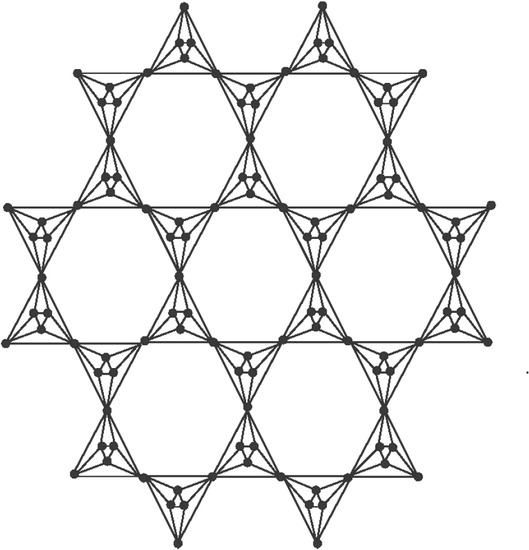
Planar octahedron network POH (2).
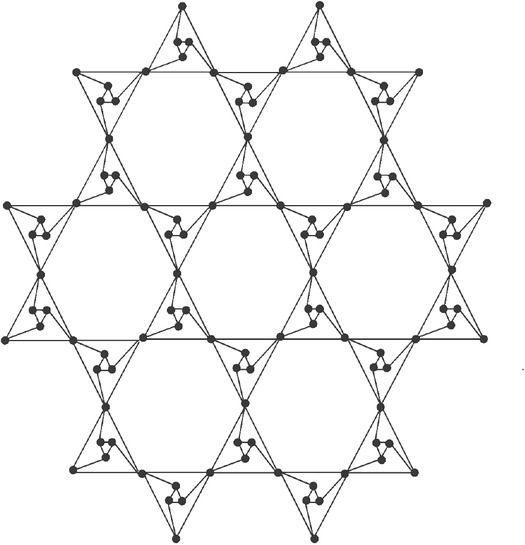
Triangular prism network TP (2).
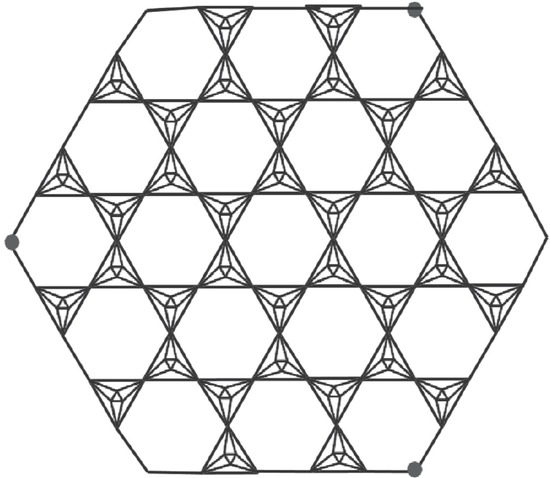
Hex planar octahedron network (2).
In the graph theory, the number of edges which is occurrence to the vertex that is the degree of vertex of the graph. Let φ be a graph. Then second multiplicative Zagreb index (Gutman et al., 1975) can be defined as:
First and second indices (Kulli, 2016) of a graph φ are defined as:
The first and second universal Zagreb index (Kulli, 2016) defined as:
where: α∈ℝ.
The sum and product connectivity of Multiplicative indices (Kulli, 2016) defined as:
2 Results
We research the Zagreb indices with its types, such as the second Zagreb multiplicative index, the first Zagreb hyper index, the second Zagreb hyper index, the first and second Zagreb universal indices and the multiplicative indices sum and product connectivity for the planar octahedron network, triangular prism network, hex planar octahedron network.
2.1 Results for planar octahedron network POH(m)
In this section, we calculate edge partition of topological indices of the dimension m for the planar octahedron network. In the coming theorems, we compute some important indices for planar octahedron network.
Theorem 2.1.1
Consider the planar octahedral network POH(m), then its second multiplicative Zagreb index is equal to:
Proof. Let φ1 ≅ POH(m). From Eq. 1, we have:
Using Table 1, we have:
Edge partition of POH(m) network.
| (da,db) | Number of edges |
|---|---|
| E1 = (4,4) | 18m2 + 12m |
| E2 = (4,8) | 36m2 |
| E3 = (8,8) | 18m2 − 12m |
This value is what, we get after calculations:
Theorem 2.1.2
Consider the POH(m) network, then its first and second hyper Zegreb indices are equal to:
Proof. Let φ1 ≅ POH(m) network and by using Eq. 2, we have:
Using Table 1, we have:
This value is what, we get after calculations:
For second hyper Zegreb index and using Eq. 3, we have:
Using Table 1, we have:
This value is what, we get after calculations:
Theorem 2.1.3
Consider the POH(m) network, then its first and second universal Zagreb indices are equal to:
Proof. Let φ1 ≅ POH(m) network. We have to prove first universal Zagreb index and using Eq. 4:
Using Table 1, we have:
This value is what, we get after calculations:
For second universal-Zegreb index and by using Eq. 5, we have:
Using Table 1, we have:
This value is what, we get after calculations:
Theorem 2.1.4
Consider the POH(m) network, the sum and product connectivity of multiplicative indices described as:
Proof. Let φ1 ≅ POH(m) network. We have to prove the sum and product connectivity of multiplicative indices and by using Eq. 6, we have:
Using Table 1, we have:
This value is what, we get after calculations:
For product connectivity of multiplicative indices and by using Eq. 7, we have:
Using Table 1, we have:
This value is what, we get after calculations:
2.2 Results for triangular prism network TP(m)
In this section, we calculate edge partition of topological indices of the dimension m for the Triangular prism network. In the coming theorems, we compute some important indices for triangular prism network.
Theorem 2.2.1
Consider the triangular prism network TP(m), then its second multiplicative Zagreb index is equal to:
Proof. Let φ2 ≅ TP network and by using Eq. 1, we have:
Using Table 2, we have:
Edge partition of TP network.
| (da,db) | Number of edges |
|---|---|
| E1 = (3,3) | 18m2 + 6m |
| E2 = (3,6) | 18m2 + 6m |
| E3 = (6,6) | 18m2 − 12m |
This value is what, we get after calculations:
Theorem 2.2.2
Consider the TP(m) network, then its first and second hyper Zegreb indices are equal to:
Proof. Let φ2 ≅ TP Network and by using Eq. 2, we have:
Using Table 2, we have:
This value is what, we get after calculations:
For second hyper Zegreb index and by using Eq. 3, we have:
Using Table 2, we have:
This value is what, we get after calculations:
Theorem 2.2.3
Consider the TP network, then its first and second universal Zagreb indices are equal to:
Proof. Let φ2 ≅ TP network. Using Eq. 4, we have:
Using Table 2, we have:
This value is what, we get after calculations:
For second universal Zegreb index and by using Eq. 5:
Using Table 2, we have:
This value is what, we get after calculations:
Theorem 2.2.4
Consider the TP(m) network, the sum and product connectivity of multiplicative indices described as:
Proof. Let φ2 ≅ TP network. We have to prove the sum and product connectivity of multiplicative indices. First prove sum connectivity of multiplicative indices and by using Eq. 6:
Using Table 2, we have:
This value is what, we get after calculations:
For product connectivity of multiplicative indices and by using Eq. 7, we have:
Using Table 2, we have:
This value is what, we get after calculations:
2.3 Results for hex POH network (m)
In this section, we calculate edge partition of topological indices of the dimension m for the hex POH network (m). In the coming theorems, we compute some important indices for hex POH network (m).
Theorem 2.3.1
Consider the hex POH network (m), then its second multiplicative Zagreb index is equal to:
Proof. Let φ3 ≅ hex POH(m) and by using Eq. 1, we have:
Using Table 3, we have:
Edge partition of hex planar octahedron network.
| (da,db) | Number of edges |
|---|---|
| E1 = (4,4) | 18m2 + 18m − 30 |
| E2 = (4,8) | 36m2 − 48m + 12 |
| E3 = (8,8) | 18m2 − 36m + 18 |
This value is what, we get after calculations:
Theorem 2.3.2
Consider the hex POH network, then its first and second hyper Zegreb indices are equal to:
Proof. Let φ3 ≅ hex POH network and by using Eq. 2, we have:
Using Table 3, we have:
This value is what, we get after calculations:
For second hyper Zegreb index and by using Eq. 3, we have:
Using Table 3, we have:
This value is what, we get after calculations:
Theorem 2.3.3
Consider the hex POH network, then its first and second universal Zagreb indices are equal to:
Proof. Let φ3 ≅ hex POH network (m). We have to prove first universal Zagreb index and by using Eq. 4, we have:
Using Table 3, we have:
This value is what, we get after calculations:
For second universal Zegreb index and by using Eq. 5, we have:
Using Table 3, we have:
This value is what, we get after calculations:
Theorem 2.3.4
Consider the hex POH(m) network, the sum and product connectivity of multiplicative indices described as:
Proof. Let φ3 ≅ hex POH(m). We have to prove the sum and product connectivity of multiplicative indices. First we prove sum connectivity of multiplicative indices and by using Eq. 6, we have:
Using Table 3, we have:
This value is what, we get after calculations:
For product connectivity of multiplicative indices and by using Eq. 7:
Using Table 3, we have:
This value is what, we get after calculations:
3 Discussion
The comparison of second kind multiplicative Zagrab, first and second kind of hyper Zagreb, first and second universal Zagreb, sum and product connectivity of multiplicative indices for the planar octahedron structure, triangular prism structure and hex planar octahedron structures have been computed for the different numerical values as shown in Figures 4-9. The graphical representations show the correctness of the results.
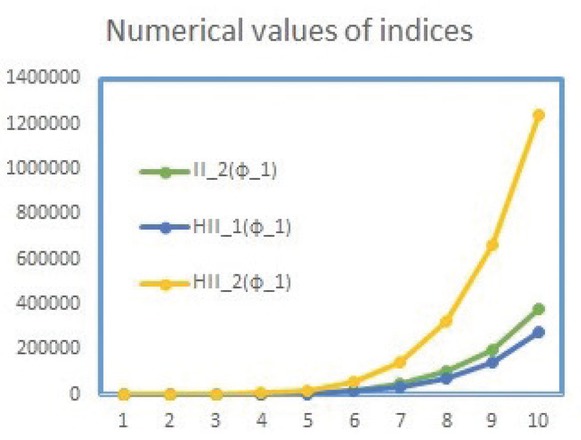
Comparison of Indices for planar octahedron network.

Comparison of indices for planar octahedron network.

Comparison of indices for triangular prism network.

Comparison of indices for triangular prism network.
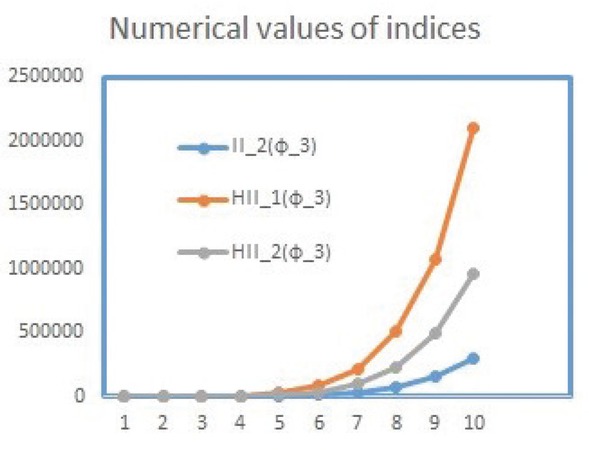
Comparison of indices for hex POH.

Comparison of indices for hex POH.
4 Conclusions
In this paper, second multiplicative Zagreb index, first hyper Zagreb and second hyper Zagreb, first universal Zagreb and second hyper Zagreb, sum and product connectivity of multiplicative indices computed for the planar octahedron network, triangular prism network and hex planar octahedron network. Chemical point of view these results may be helpful for people working in computer science and chemistry who encounter hex-derived networks. There exist many open problems for calculating the expressions of similar derived networks we are hoping to compute the other multiplicative degree based indices.
Funding source: National Natural Science Foundation of China
Award Identifier / Grant number: 11971142
Award Identifier / Grant number: 61673169
Funding statement: The research was supported by the National Natural Science Foundation of China (Grant Nos. 11971142, 61673169).
Acknowledgement
Authors are very grateful to the referees for their careful reading with corrections and useful comments, which improved this work very much.
Author contribution: Ghulam Dustigeer: Writing – original draft; Haidar Ali: Writing – review and editing; Muhammad Imran Khan: Methodology; Yu-Ming Chu: Formal analysis, Visualization, Resources.
Conflict of interest: Authors state no conflict of interest.
References
Ali H., Sajjad A., On further results of hex derived networks. Open J. Discret. Appl. Math., 2019, 2(1), 32-40.10.30538/psrp-odam2019.0009Suche in Google Scholar
Ali H., Babar U., Asghar S.S., Kausar F., On Some Topological Polynomials of Dominating David Derived Graphs. Punjab University Journal of Mathematics, 2020, 52(11), 19-44.Suche in Google Scholar
Ali H., Binyamin M.A., Shafiq M.K., Gao W., On the Degree-Based Topological Indices of Some Derived Networks. Mathematics, 2019, 7, 612.10.3390/math7070612Suche in Google Scholar
Akhtar S., Imran M., On molecular topological properties of benzenoid structures. Can. J. Chem., 2016, 94, 687-698.10.1139/cjc-2016-0032Suche in Google Scholar
Aslam A., Ahmad S., Binyamin M. A., Gao W., Calculating topological indices of certain OTIS interconnection networks. Open Chem., 2019, 17(1), 220-228.10.1515/chem-2019-0029Suche in Google Scholar
Babar U., Ali H., Arshad S.H., Sheikh U., Multiplicative topological properties of graphs derived from honeycomb structure. AIMS Mathematics, 2020, 5(2), 1562.10.3934/math.2020107Suche in Google Scholar
Baig A.Q., Imran M., Ali H., On topological indices of poly oxide, poly silicate, DOX, and DSL networks. Can. J. Chem., 2015, 93, 730-739.10.1139/cjc-2014-0490Suche in Google Scholar
Baig A.Q., Naeem, M., Gao W., Revan and hyper-Revan indices of Octahedral and icosahedral networks. Appl. Math. Nonlinear Sci., 2018, 3(1), 33-40.10.21042/AMNS.2018.1.00004Suche in Google Scholar
Diudea M.V., Gutman I., Lorentz J., Molecular Topology Babes-Bolyai University: Cluj-Napoca, Romania, 2001.Suche in Google Scholar
Gao W., Baig A. Q., Khalid W., Farahani M.R., Molecular description of copper(II) oxide. Maced. J. Chem. Chem. Eng., 2017, 36, 93-99.10.20450/mjcce.2017.1138Suche in Google Scholar
Gutman I., Rusić B., Trinajstić N., Wilcox Jr C.F., Graph theory and molecular orbitals. XII. Acyclic polyenes. J. Chem. Phys., 1975 , 62(9), 3399-3405.10.1063/1.430994Suche in Google Scholar
Huo Y., Ali H., Binyamin M.A., Asghar S.S., Babar U., Liu J.B., On Topological Indices of mth Chain Hex-Derived Network of Third Type. Front. Phys., 2020, 8, 593275.10.3389/fphy.2020.593275Suche in Google Scholar
Imran M., Baig A.Q., Ali H., On topological properties of dominating David derived networks. Can. J. Chem., 2016, 94, 137-148.10.1139/cjc-2015-0185Suche in Google Scholar
Imran S., Siddiqui M.K., Imran M., Nadeem M.F., Computing topological indices and polynomials for line graphs. Mathematics, 2018, 6(8), 137.10.3390/math6080137Suche in Google Scholar
Kulli V.R., Multiplicative hyper-Zagreb indices and coindices of graphs: Computing these indices of some nanostructures. I.R.J.P.A., 2016, 6(7), 342-347.Suche in Google Scholar
Manuel P.D., Rajasingh I., Minimum Metric Dimension of Silicate Networks. Ars Combinatoria, 2011, 98, 501-510.Suche in Google Scholar
Simon Raj F., George A., Network embedding on Planar Octahedron networks. In: 2015 IEEE International Conference on Electrical, Computer and Communication Technologies (ICECCT) (2015, March). 2015, 1-6.10.1109/ICECCT.2015.7226174Suche in Google Scholar
Simonraj F., George A., Embedding of poly honeycomb networks and the metric dimension of star of david network. GRAPH-HOC., 2012, 4, 11, 28.10.5121/jgraphoc.2012.4402Suche in Google Scholar
Shirdel G.H., Rezapour H., Sayadi A.M., The hyper Zagreb index of graph operations. Iran. J. Math. Chem., 2013, 4, 213-220.Suche in Google Scholar
Smith K.M., On neighbourhood degree sequences of complex networks. Sci. Rep.-UK, 2019, 9(1), 8340.10.1038/s41598-019-44907-8Suche in Google Scholar PubMed PubMed Central
Trinajstić N., Chemical Graph Theory. CRC Press, Boca Raton, FL, USA, 1983.Suche in Google Scholar
Vetrík T., Degree-based topological indices of hexagonal nanotubes. J. Appl. Math. Comput., 2018, 58(1-2), 111-124.10.1007/s12190-017-1136-xSuche in Google Scholar
Wei C.C., Ali H., Binyamin M.A., Naeem M.N., Liu J.B., Computing Degree Based Topological Properties of Third Type of Hex-Derived Networks. Mathematics, 2019, 7, 368.10.3390/math7040368Suche in Google Scholar
Wiener H., Structural determination of the paraffin boiling points. J. Am. Chem. Soc., 1947, 69, 17-20.10.1021/ja01193a005Suche in Google Scholar PubMed
Zheng J., Iqbal Z., Fahad A., Zafar A., Aslam A., Qureshi M.I., et al., Some eccentricity-based topological indices and polynomials of poly (EThyleneAmidoAmine)(PETAA) dendrimers. Processes, 2019, 7(7), 433.10.3390/pr7070433Suche in Google Scholar
© 2020 Dustigeer et al., published by De Gruyter
This work is licensed under the Creative Commons Attribution 4.0 International License.
Artikel in diesem Heft
- Research Articles
- An accelerated and effective synthesis of zinc borate from zinc sulfate using sonochemistry
- A new approach on lithium-induced neurotoxicity using rat neuronal cortical culture: Involvement of oxidative stress and lysosomal/mitochondrial toxic Cross-Talk
- Green synthesis and characterization of hexaferrite strontium-perovskite strontium photocatalyst nanocomposites
- Assessment of content and chemical forms of arsenic, copper, lead, and chromium in sewage sludge compost as affected by various bulking agents
- Preparation of skeletally diverse quinazoline-2,4(1H,3H)-diones using Na2SiO3/SnFe2O4 catalytic system through a four-component reaction
- Efficient photocatalytic degradation of organic dye from aqueous solutions over zinc oxide incorporated nanocellulose under visible light irradiation
- Synthesis of pyrimidines by Fe3O4@SiO2-L-proline nanoparticles
- Abnormally aggregation-induced emissions observed from hydrogen- and silyl-substituted siloles
- Organodiphosphines in PtP2X2 (X = As, Ge or Te) derivatives – Structural aspects
- Synthesis and structural characterization of dialkyltin complexes of N-salicylidene-L-valine
- Ultrasound-promoted solvent-free synthesis of some new α-aminophosphonates as potential antioxidants
- Occupational exposure in lead and zinc mines induces oxidative stress in miners lymphocytes: Role of mitochondrial/lysosomal damage
- Eccentric topological properties of a graph associated to a finite dimensional vector space
- Magnetically recoverable nanostructured Pd complex of dendrimeric type ligand on the MCM-41: Preparation, characterization and catalytic activity in the Heck reaction
- Short Communications
- The crystal structure of the first ether solvate of hexaphenyldistannane [(Ph3Sn)2 • 2 THF]
- New crystal structures of alkali metal tetrakis(pentafluorophenyl)borates
- s-Block metal scorpionates – A new sodium hydrido-tris(3,5-dimethyl-1-pyrazolyl)borate salt showing an unusual core stabilized by bridging and terminal O-bonded DMSO ligands
- Reduction of a 1,4-diazabutadiene and 2,2’-bipyridine using magnesium(I) compounds
- fac-Bis(phenoxatellurine) tricarbonyl manganese(I) bromide
- A new 2D dibutyltin coordination polymer with 3,5-dinitrosalicylate and 4,4’-bipyridine ligands
- Review
- Structures of Pt(0)P3, Pt(0)P4 and Pt(II)P4 – Distortion isomers
- Special Issue: Topological descriptors of chemical networks: Theoretical studies (Guest Editors: Muhammad Imran and Muhammad Javaid)
- Modified Zagreb connection indices of the T-sum graphs
- Topological properties of metal-organic frameworks
- Eccentricity based topological indices of siloxane and POPAM dendrimers
- On topological aspects of degree based entropy for two carbon nanosheets
- On multiplicative degree based topological indices for planar octahedron networks
- Computing entire Zagreb indices of some dendrimer structures
Artikel in diesem Heft
- Research Articles
- An accelerated and effective synthesis of zinc borate from zinc sulfate using sonochemistry
- A new approach on lithium-induced neurotoxicity using rat neuronal cortical culture: Involvement of oxidative stress and lysosomal/mitochondrial toxic Cross-Talk
- Green synthesis and characterization of hexaferrite strontium-perovskite strontium photocatalyst nanocomposites
- Assessment of content and chemical forms of arsenic, copper, lead, and chromium in sewage sludge compost as affected by various bulking agents
- Preparation of skeletally diverse quinazoline-2,4(1H,3H)-diones using Na2SiO3/SnFe2O4 catalytic system through a four-component reaction
- Efficient photocatalytic degradation of organic dye from aqueous solutions over zinc oxide incorporated nanocellulose under visible light irradiation
- Synthesis of pyrimidines by Fe3O4@SiO2-L-proline nanoparticles
- Abnormally aggregation-induced emissions observed from hydrogen- and silyl-substituted siloles
- Organodiphosphines in PtP2X2 (X = As, Ge or Te) derivatives – Structural aspects
- Synthesis and structural characterization of dialkyltin complexes of N-salicylidene-L-valine
- Ultrasound-promoted solvent-free synthesis of some new α-aminophosphonates as potential antioxidants
- Occupational exposure in lead and zinc mines induces oxidative stress in miners lymphocytes: Role of mitochondrial/lysosomal damage
- Eccentric topological properties of a graph associated to a finite dimensional vector space
- Magnetically recoverable nanostructured Pd complex of dendrimeric type ligand on the MCM-41: Preparation, characterization and catalytic activity in the Heck reaction
- Short Communications
- The crystal structure of the first ether solvate of hexaphenyldistannane [(Ph3Sn)2 • 2 THF]
- New crystal structures of alkali metal tetrakis(pentafluorophenyl)borates
- s-Block metal scorpionates – A new sodium hydrido-tris(3,5-dimethyl-1-pyrazolyl)borate salt showing an unusual core stabilized by bridging and terminal O-bonded DMSO ligands
- Reduction of a 1,4-diazabutadiene and 2,2’-bipyridine using magnesium(I) compounds
- fac-Bis(phenoxatellurine) tricarbonyl manganese(I) bromide
- A new 2D dibutyltin coordination polymer with 3,5-dinitrosalicylate and 4,4’-bipyridine ligands
- Review
- Structures of Pt(0)P3, Pt(0)P4 and Pt(II)P4 – Distortion isomers
- Special Issue: Topological descriptors of chemical networks: Theoretical studies (Guest Editors: Muhammad Imran and Muhammad Javaid)
- Modified Zagreb connection indices of the T-sum graphs
- Topological properties of metal-organic frameworks
- Eccentricity based topological indices of siloxane and POPAM dendrimers
- On topological aspects of degree based entropy for two carbon nanosheets
- On multiplicative degree based topological indices for planar octahedron networks
- Computing entire Zagreb indices of some dendrimer structures
