Molecular chirality detection using plasmonic and dielectric nanoparticles
-
TaeHyung Kim
 und
Q-Han Park
und
Q-Han Park


Abstract
Nanoscale particles and structures hold promise in circular dichroism (CD) spectroscopy for overcoming the weakness of molecular CD signals. Significant effort have been made to characterize nanophotonic CD enhancement and find efficient ways to boost molecular chirality, but the best solution is yet to be found. In this paper, we present a rigorous analytic study of the nanophotonic CD enhancement of typical nanoparticles. We consider metallic and dielectric nanoparticles capped with chiral molecules and analyze the effect of multipolar nanoparticles on the molecular CD. We identify the spectral features of the molecular CD resulting from the electric and magnetic resonances of nanoparticles and suggest better ways to boost molecular chirality. We also clarify the contribution of particle scattering and absorption to the molecular CD and the dependence on particle size. Our work provides an exact analytic approach to nanophotonic CD enhancement and offers a rule for selecting the most efficient particle for sensitive molecular chirality detection.
1 Introduction
Nanoparticles and nanostructures are a promising new direction for circular dichroism (CD) spectroscopy. They can generate locally enhanced electromagnetic fields, which are necessary for sensitive molecular CD measurement. Various approaches have been tried to utilize nanostructures for CD spectroscopy, such as chiral metasurfaces [1], [2], [3], [4], [5], achiral nanoarrays [6], [7], [8], [9], [10], [11], achiral plasmonic nanoparticles [12], [13], [14], [15], [16], [17], [18], [19], [20], [21], and dielectric nanoparticles [12, 14, 15, 22, 23]. In these studies, CD enhancement was usually achieved near the resonance frequency of the nanostructures. The most studied resonant nanostructures, both theoretically [12], [13], [14], [15, 24] and experimentally [16], [17], [18], [19], [20], [21], [22], are achiral nanoparticles, whether plasmonic or dielectric. The main advantage of using achiral nanoparticles is separating the molecular CD signals from the unwanted strong background CD signals occurring in chiral nanostructures. In addition, achiral nanoparticles in the form of colloidal solutions do not require complex measurements while, for example, nanoarrays coupled with chiral molecules require additional experimental processes to obtain measurable CD signals [1, 7, 9, 10]. Despite the growing interest in achiral nanoparticles, theoretical studies on the effect of achiral nanoparticles on chiral molecules have mostly continued to apply conventional dipole approximation [12], [13], [14]. Although exceptionally some studies report chiroptical responses by higher-order multipoles [23, 24], these works do not consider the scattering-induced CD of a nanoparticle which results from nearby chiral molecules. Large-sized achiral nanoparticles capped with chiral molecules can be synthesized experimentally [16, 17, 19, 20] and offer better efficiency for CD enhancement through an enlarged surface area. However, a non-static analytic approach has remained unexplored.
In this paper, we investigate achiral nanoparticles capped with chiral molecules and obtain exact Mie scattering solutions. We identify the multipole resonances of both plasmonic and dielectric nanoparticles and their effect on the surrounding chiral molecules. The spectral features of CD enhancement caused by electric and magnetic resonances, are presented in detail. We find that, although plasmonic nanoparticles show only electric resonances, high index dielectric nanoparticles possess magnetic resonances which can boost the molecular CD more efficiently than electric resonances. By solving Mie scattering analytically, we also clarify the contribution of nanoparticle scattering and absorption to the molecular CD and their dependence on particle size. We also show that scattering by larger nanoparticles can significantly enhance the molecular CD. In particular, the scattering of a high-index nanoparticle combined with chiral molecules contributes critically to the overall higher-order induced CD. Consequently, we find that the higher-order resonances of large-sized achiral nanoparticles, especially magnetic resonance, are more effective for enhancing weak molecular CD signals. Our analytic approach based on Mie theory can provide both a qualitative understanding of and a good approximation to other non-spherical nanostructures for which analytic solutions are possible and is applicable to the development of more sensitive molecular chirality detection methods.
2 Chiral Mie theory for achiral core-chiral shell nanoparticle
To understand analytically the chiroptical activity of chiral molecules, we consider a core–shell system with spherical core nanoparticles and a shell made of chiral molecules, as shown in Figure 1, and solve the associated Mie scattering problem. Firstly, we introduce the constitutive relation of a chiral medium
and the scattered field by
where

Schematic figure of CD measurement for (A) achiral plasmonic and dielectric nanoparticles capped with chiral molecules (B) schematic figure of Chiral Mie theory for large-sized achiral core-chiral shell nanospheres embedded in achiral background.
We solved the chiral Mie theory explicitly and calculated the rate of extinction, scattered, and absorbed energies normalized by the incident light energy (detailed derivations are given in SI). The resulting extinction, scattering and absorption cross sections are expressed by
where the scattering coefficients are determined from the boundary condition and
where the polarization states of the incident light are used with
To test the validity of our analytic solutions in Eqs. (8)–(10), we compared the analytic results from (8)–(10) with direct full-field numerical simulations, and present the results in Figure 2. In the electromagnetic simulation, we used a silicon core particle of radius 50 nm and a chiral molecule shell 5 nm thick. The material parameters for silver and silicon are chosen from the tabulated data available in the literature [26, 27]. Optical constants and the chirality parameter of the chiral molecule shell are modeled using the Condon model [28] in accordance with the behavior of typical chiral molecules in the ultraviolet-visible wavelength range [29] (see SI). We chose an aqueous background of permittivity

The circular differential cross sections calculated by analytic solution and numerical simulation. The results obtained by the two methods are perfectly matched.
3 CD of plasmonic and dielectric nanoparticles capped with chiral molecules
Equipped with these analytic tools, we are now able to uncover the role of nanoparticles in CD enhancement. The extinction cross section in Eq. (5) and the circular differential extinction cross section in Eq. (8) allow a quantitative description of enhanced molecular CD by nanoparticle resonances, such as electric/magnetic dipole (n = 1), quadrupole (n = 2), and octupole (n = 3) resonances. The scattering coefficients
Figure 3 shows the extinction cross sections of nanoparticles with a 1 nm thick chiral molecule shell which is the typical thickness of a self-assembled molecular monolayer [30]. The extinction cross section and circular differential extinction cross section of both the silver core case (Figure 3A and B) and the silicon core case (Figure 3C and D) are plotted varying the core size and wavelength. Note that the silver core case shows only electric resonance whereas the silicon core case shows both electric and magnetic resonances. Earlier works focused mostly on the electric dipole resonance and the enhanced CD signal [12], [13], [14], [15] without paying much attention to the higher-order electric resonance modes and induced CD signals. It was considered that dipole resonance plays the dominant role in CD enhancement by nanoparticles and nanostructures, and that complicated higher-order resonances, although present in large-sized particles, have less significant effect on CD enhancement. Contrary to these expectations, our analytic solution reveals the important role of higher-order resonances.
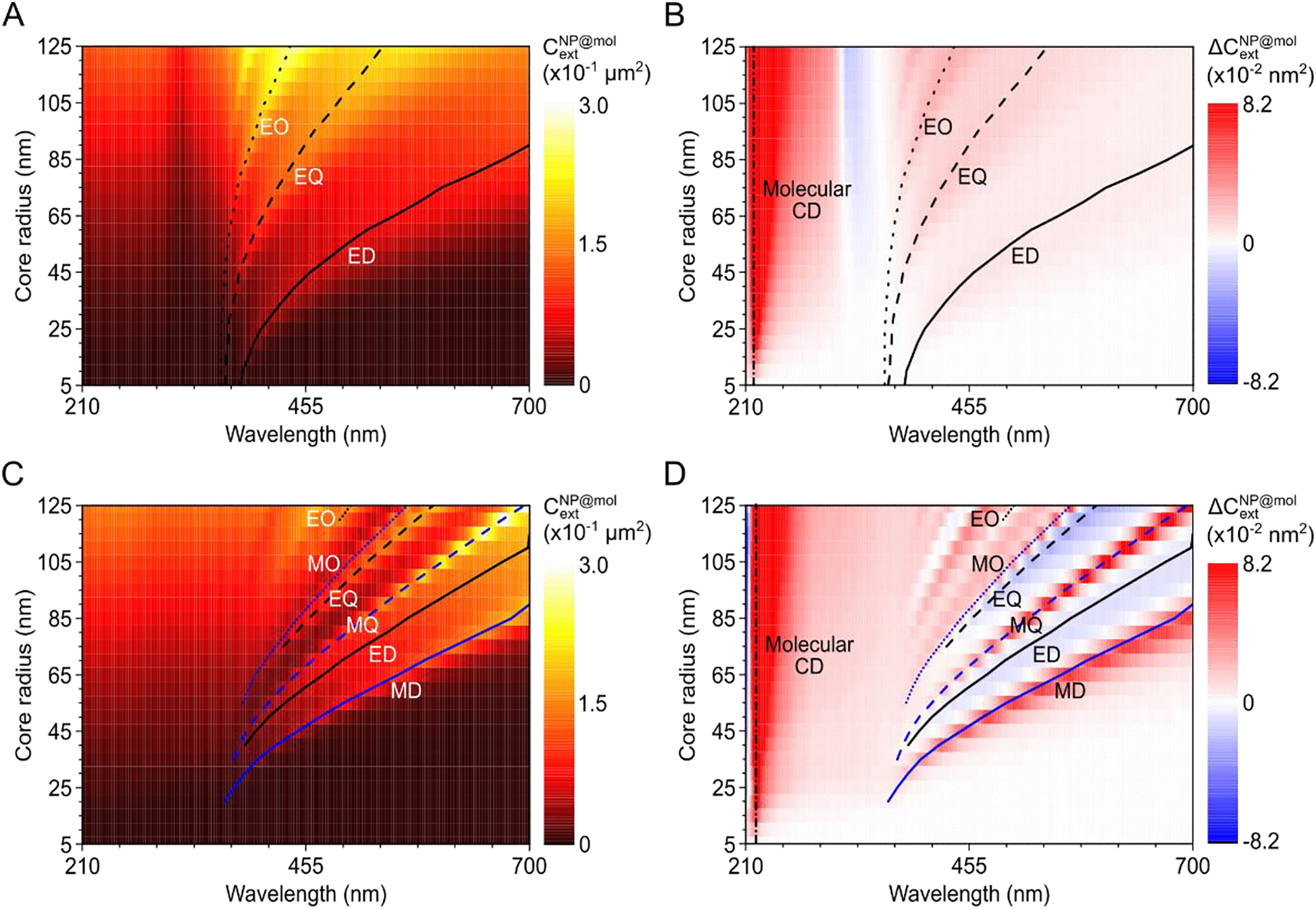
The extinction and circular differential extinction cross section of plasmonic core-chiral shell and dielectric core-chiral shell nanoparticles. (A) The extinction cross section and (B) the circular differential extinction cross section of silver core-chiral shell nanoparticle. (C) The extinction cross section and (D) the circular differential extinction cross section of silicon core-chiral shell nanoparticle. The thickness of the chiral molecular shell is fixed at 1 nm. The ED (black solid), EQ (black dashed), EO (black dotted), MD (blue solid), MQ (blue dashed), and MO (blue dotted) resonance positions are plotted. The black dashed-dotted line shows the molecular intrinsic CD resonance at 220 nm.
To clarify the role, from Figure 3, we traced the maximum value of

The maximum value of
The strong CD signal of chiral molecules is usually located in the UV region and the CD signal enhancement by nanoparticle resonances arises in the visible region where molecular CD is much weaker. In fact, the induced CD signal by the ED resonance of a silver nanoparticle is approximately 0.07 times the magnitude of the molecular intrinsic CD signals. However, the situation changes if we consider dielectric core particles. Figure 3C and D show the
Advantages of different multipole resonances for induced CD. X denotes that there are no induced CD signals. The triangle and circle symbols indicate which resonant properties are more advantageous for obtaining the measurable induced CD signals (△ ⟨ ▲ ⟨ ○ ⟨ ●). △ indicates small magnitudes and broad spectral lineshape CD signals. ● indicates large magnitudes and sharp spectral lineshape CD signals.
| Core resonances | Core particle | ||
|---|---|---|---|
| Low-index dielectric | Plasmonic (Silver) | High-index dielectric (Silicon) | |
| Electric dipole | X | △ | △ |
| Higher-order electric resonances | X | ▲ | ▲ |
| Magnetic dipole | X | X | ○ |
| Higher-order magnetic resonances | X | X | ● |
4 Scattering and absorption contribution to CD
Large-sized particles provide an efficient platform for enhancing weak molecular CD signals because they support multipole resonances and a large surface area on which chiral molecules can be adsorbed. When the particle size becomes comparable to the light wavelength, not only the absorption but also the scattering by the particles contributes critically to molecular CD. The CD signals we measure consist of the sum of circular differential scattering and absorption (
Figure 5 shows the effect of particle scattering and absorption on the induced CD. We choose a chiral molecular medium with a CD peak in the UV region to surround a nanoparticle of 75 nm radius and 1 nm shell thickness. Figure 5A shows a low-index (n = 1.33) dielectric core particle possessing no resonance and no resulting CD spectral change. In this case, the CD is determined only by the circular differential absorption of the chiral molecular medium and the scattering effect is not noticeable. In the presence of resonance modes, as in Figure 5B (silver core) and C (silicon core), the contribution of scattering to the induced CD cannot be ignored. Particularly, in the present case of the 75 nm particle size, with induced CD at dipole resonances (ED at 428 nm in Figure 5B and MD at 628 nm in Figure 5C), scattering is a dominant factor. This suggests that particle scattering plays a key role in inducing the CD near the multipole resonances as the particle size increases. Thus, it is essential to analyze the scattering properties of nanostructures when designing structures for nanophotonic CD enhancement.
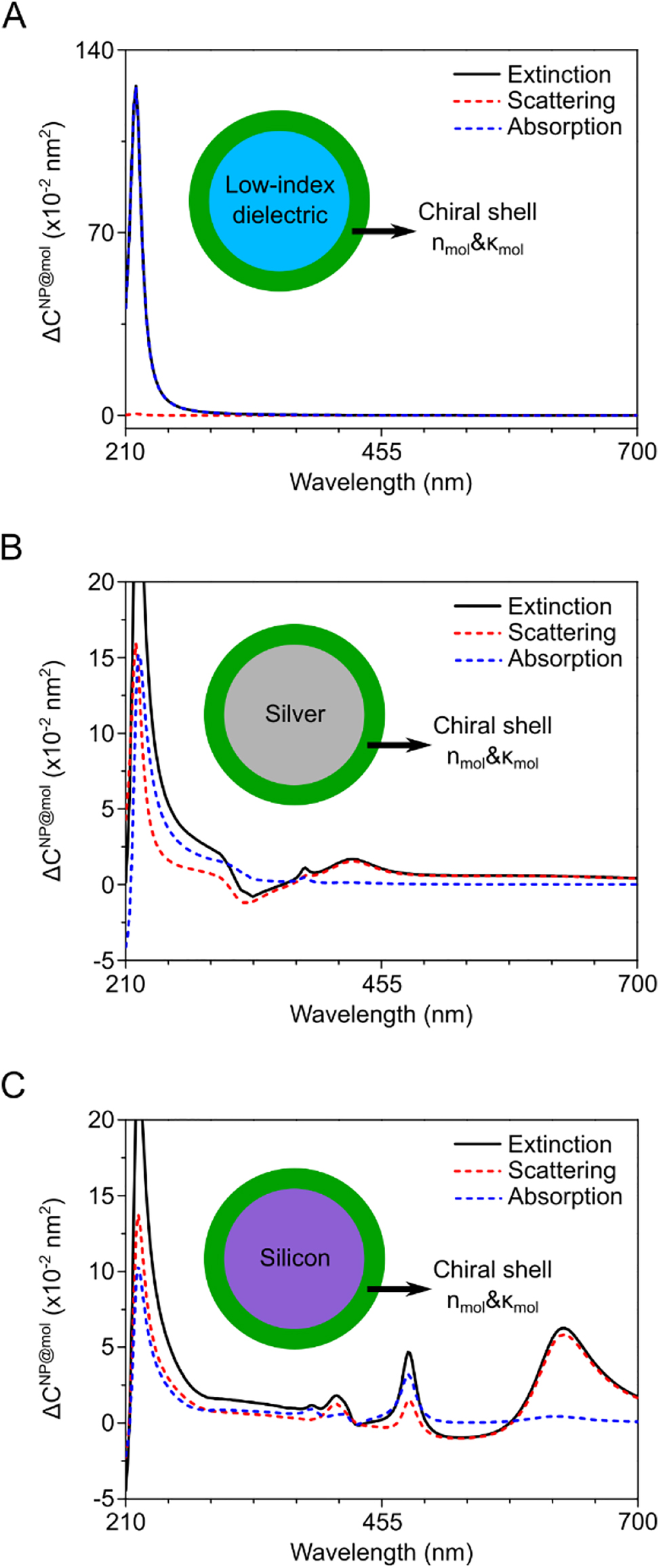
The circular differential extinction (black solid), scattering (red dashed) and absorption (blue dashed) cross section of (A) low-index dielectric core (B) silver core and (C) silicon core particle of radius 75 nm. The refractive index of the low-index dielectric material is the same as the achiral background medium.
5 Conclusions
In this paper, we investigated the effects of the multipole resonances of plasmonic and dielectric nanoparticles on the surrounding chiral molecules. We first developed the chiral Mie theory for an achiral core-chiral shell nanoparticle system and obtained an exact solution for the Mie scattering. Based on the analytic solution, we identified the role of higher-order resonances on CD enhancement. The induced CD signals around the higher-order resonances exhibit larger CD magnitudes with smaller CD linewidths than the dipole resonance case. In particular, we confirmed that high refractive index dielectric nanoparticles supporting magnetic multipoles are more effective for measuring CD signals of adsorbed chiral molecules than the plasmonic nanoparticles that support only electric resonances. In addition, we analyzed the contribution of scattering and absorption to the induced CD signals for large-sized nanoparticles. We showed that, as particle size increases, particle scattering critically contributes to the induced CD near the multipole resonances. In this study, although we only discussed achiral spherical nanoparticles, we believe that our results give insight into non-spherical achiral nanoparticles/nanostructures and that they can be applied to the development of sensitive molecular chirality detection methods.
Funding source: National Research Foundation of Korea
Award Identifier / Grant number: NRF-2019R1A4A1028121
-
Author contribution: All the authors have accepted responsibility for the entire content of this submitted manuscript and approved submission.
-
Research funding: This work was supported by the National Research Foundation of Korea (NRF) grant funded by the Korea government (MSIT) (NRF-2019R1A4A1028121).
-
Conflict of interest statement: The authors declare no conflicts of interest regarding this article.
References
[1] Y. Zhao, A. N. Askarpour, L. Sun, J. Shi, X. Li, and A. Alù, “Chirality detection of enantiomers using twisted optical metamaterials,” Nat. Commun., vol. 8, p. 14180, 2017. https://doi.org/10.1038/ncomms14180.Suche in Google Scholar PubMed PubMed Central
[2] E. H. Hendry, T. Carpy, J. Johnston, et al.., “Ultrasensitive detection and characterization of biomolecules using superchiral fields,” Nat. Nanotechnol., vol. 5, pp. 783–787, 2010. https://doi.org/10.1038/nnano.2010.209.Suche in Google Scholar PubMed
[3] C. Jack, A. S. Karimullah, R. Leyman, et al.., “Biomacromolecular stereostructure mediates mode hybridization in chiral plasmonic nanostructures,” Nano Lett., vol. 16, pp. 5806–5814, 2016. https://doi.org/10.1021/acs.nanolett.6b02549.Suche in Google Scholar PubMed
[4] R. Tullius, A. S. Karimullah, M. Rodier, et al.., “‘Superchiral’ spectroscopy: detection of protein higher order hierarchical structure with chiral plasmonic nanostructures,” J. Am. Chem. Soc., vol. 137, pp. 8380–8383, 2015. https://doi.org/10.1021/jacs.5b04806.Suche in Google Scholar PubMed
[5] M. Rodier, C. Keijzer, J. Milner, et al.., “Probing specificity of protein-protein interactions with chiral plasmonic nanostructures,” J. Phys. Chem. Lett., vol. 10, pp. 6105–6111, 2019. https://doi.org/10.1021/acs.jpclett.9b02288.Suche in Google Scholar PubMed
[6] S. Lee, S. J. Yoo, and Q. H. Park, “Microscopic origin of surface-enhanced circular dichroism,” ACS Photonics, vol. 4, pp. 2047–2052, 2017. https://doi.org/10.1021/acsphotonics.7b00479.Suche in Google Scholar
[7] N. A. Abdulrahman, Z. Fan, T. Tonooka, et al.., “Induced chirality through electromagnetic coupling between chiral molecular layers and plasmonic nanostructures,” Nano Lett., vol. 12, pp. 977–983, 2012. https://doi.org/10.1021/nl204055r.Suche in Google Scholar PubMed
[8] S. J. Yoo, M. Cho, and Q. H. Park, “Globally enhanced chiral field generation by negative-index metamaterials,” Phys. Rev. B Condens. Matter, vol. 89, p. 161405, 2014. https://doi.org/10.1103/physrevb.89.161405.Suche in Google Scholar
[9] J. García-Guirado, M. Svedendahl, J. Puigdollers, and R. Quidant, “Enhanced chiral sensing with dielectric nanoresonators,” Nano Lett., vol. 20, pp. 585–591, 2020.10.1021/acs.nanolett.9b04334Suche in Google Scholar PubMed
[10] B. M. Maoz, Y. Chaikin, A. B. Tesler, et al.., “Amplification of chiroptical activity of chiral biomolecules by surface plasmons,” Nano Lett., vol. 13, pp. 1203–1209, 2013. https://doi.org/10.1021/nl304638a.Suche in Google Scholar PubMed
[11] M. L. Nesterov, X. Yin, M. Schäferling, H. Giessen, and T. Weiss, “The role of plasmon-generated near fields for enhanced circular dichroism spectroscopy,” ACS Photonics, vol. 3, pp. 578–583, 2016. https://doi.org/10.1021/acsphotonics.5b00637.Suche in Google Scholar
[12] A. O. Govorov, Z. Fan, P. Hernandez, J. M. Slocik, and R. R. Naik, “Theory of circular dichroism of nanomaterials comprising chiral molecules and nanocrystals: plasmon enhancement, dipole interactions, and dielectric effects,” Nano Lett., vol. 10, pp. 1374–1382, 2010. https://doi.org/10.1021/nl100010v.Suche in Google Scholar PubMed
[13] A. O. Govorov, “Plasmon-induced circular dichroism of a chiral molecule in the vicinity of metal nanocrystals. Application to various geometries,” J. Phys. Chem. C, vol. 115, pp. 7914–7923, 2011. https://doi.org/10.1021/jp1121432.Suche in Google Scholar
[14] A. Garcia-Etxarri and J. A. Dionne, “Surface-enhanced circular dichroism spectroscopy mediated by nonchiral nanoantennas,” Phys. Rev. B Condens. Matter, vol. 87, p. 235409, 2013. https://doi.org/10.1103/physrevb.87.235409.Suche in Google Scholar
[15] S. J. Yoo and Q. H. Park, “Enhancement of chiroptical signals by circular differential Mie scattering of nanoparticles,” Sci. Rep., vol. 5, p. 14463, 2015. https://doi.org/10.1038/srep14463.Suche in Google Scholar PubMed PubMed Central
[16] T. Li, H. G. Park, H. S. Lee, and S. H. Choi, “Circular dichroism study of chiral biomolecules conjugated with silver nanoparticles,” Nanotechnology, vol. 15, pp. S660–S663, 2004. https://doi.org/10.1088/0957-4484/15/10/026.Suche in Google Scholar
[17] F. Lu, Y. Tian, M. Liu, et al.., “Discrete nanocubes as plasmonic reporters of molecular chirality,” Nano Lett., vol. 13, pp. 3145–3151, 2013. https://doi.org/10.1021/nl401107g.Suche in Google Scholar PubMed
[18] F. Zhu, X. Li, Y. Li, M. Yan, and S. Liu, “Enantioselective circular dichroism sensing of cysteine and glutathione with gold nanorods,” Anal. Chem., vol. 87, pp. 357–361, 2015. https://doi.org/10.1021/ac504017f.Suche in Google Scholar PubMed
[19] Z. Y. Bao, W. Zhang, Y. L. Zhang, et al.., “Interband absorption enhanced optical activity in discrete Au@Ag core-shell nanocuboids: probing extended helical conformation of chemisorbed cysteine molecules,” Angew. Chem. Int. Ed., vol. 56, pp. 1283–1288, 2017. https://doi.org/10.1002/anie.201607563.Suche in Google Scholar PubMed
[20] J. M. Slocik, A. O. Govorov, and R. R. Naik, “Plasmonic circular dichroism of peptide-functionalized gold nanoparticles,” Nano Lett., vol. 11, pp. 701–705, 2011. https://doi.org/10.1021/nl1038242.Suche in Google Scholar PubMed
[21] Y. Zhao, L. Xu, W. Ma, et al.., “Shell-engineered chiroplasmonic assemblies of nanoparticles for zeptomolar DNA detection,” Nano Lett., vol. 14, pp. 3908–3913, 2014. https://doi.org/10.1021/nl501166m.Suche in Google Scholar PubMed
[22] D. Vestler, A. Ben-Moshe, and G. Markovich, “Enhancement of circular dichroism of a chiral material by dielectric nanospheres,” J. Phys. Chem. C, vol. 123, pp. 5017–5022, 2019. https://doi.org/10.1021/acs.jpcc.8b10975.Suche in Google Scholar
[23] C. S. Ho, A. Garcia-Etxarri, Y. Zhao, and J. Dionne, “Enhancing enantioselective absorption using dielectric nanospheres,” ACS Photonics, vol. 4, pp. 197–203, 2017. https://doi.org/10.1021/acsphotonics.6b00701.Suche in Google Scholar
[24] J. Mun and J. Rho, “Importance of higher-order multipole transitions on chiral nearfield interactions,” Nanophotonics, vol. 8, pp. 941–948, 2019. https://doi.org/10.1515/nanoph-2019-0046.Suche in Google Scholar
[25] J. Lekner, “Optical properties of isotropic chiral media,” Pure Appl. Opt., vol. 5, pp. 417–443, 1996. https://doi.org/10.1088/0963-9659/5/4/008.Suche in Google Scholar
[26] P. B. Johnson and R. W. Christy, “Optical constants of the noble metals,” Phys. Rev. B, vol. 6, pp. 4370–4379, 1972. https://doi.org/10.1103/physrevb.6.4370.Suche in Google Scholar
[27] D. E. Aspnes and A. A. Studna, “Dielectric functions and optical parameters of Si, Ge, GaP, GaAs, GaSb, InP, InAs, and InSb from 1.5 to 6.0 eV,” Phys. Rev. B, vol. 27, pp. 985–1009, 1983. https://doi.org/10.1103/physrevb.27.985.Suche in Google Scholar
[28] I. V. Lindel, A. H. Shivola, S. A. Tretyakov, and A. J. Viitanen, Electromagnetic Waves in Chiral and Bi-Isotropic Media, Boston, United States, Artech House, 1994.Suche in Google Scholar
[29] Y. Inoue and V. Ramamurthy, Chiral Photochemistry, New York, United States, Marcel Dekker, 2004.10.1201/9780203026342Suche in Google Scholar
[30] H. Hinterwirth, S. Kappel, T. Waitz, T. Prohaska, W. Lindner, and M. Lammerhofer, “Quantifying thiol ligand density of self-assembled monolayers on gold nanoparticles by inductively coupled plasma-mass spectrometry,” ACS Nano, vol. 7, pp. 1129–1136, 2013. https://doi.org/10.1021/nn306024a.Suche in Google Scholar PubMed PubMed Central
Supplementary Material
The online version of this article offers supplementary material (https://doi.org/10.1515/nanoph-2021-0649).
© 2022 TaeHyung Kim and Q-Han Park, published by De Gruyter, Berlin/Boston
This work is licensed under the Creative Commons Attribution 4.0 International License.
Artikel in diesem Heft
- Frontmatter
- Editorial
- Editorial on special issue: “Metamaterials and plasmonics in Asia”
- Reviews
- Waveguide effective plasmonics with structure dispersion
- Graphene-based plasmonic metamaterial for terahertz laser transistors
- Recent advances in metamaterials for simultaneous wireless information and power transmission
- Multi-freedom metasurface empowered vectorial holography
- Nanophotonics-inspired all-silicon waveguide platforms for terahertz integrated systems
- Optical metasurfaces towards multifunctionality and tunability
- The perspectives of broadband metasurfaces and photo-electric tweezer applications
- Free-form optimization of nanophotonic devices: from classical methods to deep learning
- Optical generation of strong-field terahertz radiation and its application in nonlinear terahertz metasurfaces
- Responsive photonic nanopixels with hybrid scatterers
- Research Articles
- Efficient modal analysis of plasmonic nanoparticles: from retardation to nonclassical regimes
- Molecular chirality detection using plasmonic and dielectric nanoparticles
- Vortex radiation from a single emitter in a chiral plasmonic nanocavity
- Reconfigurable Mach–Zehnder interferometer for dynamic modulations of spoof surface plasmon polaritons
- Manipulating guided wave radiation with integrated geometric metasurface
- Comparison of second harmonic generation from cross-polarized double-resonant metasurfaces on single crystals of Au
- Rotational varifocal moiré metalens made of single-crystal silicon meta-atoms for visible wavelengths
- Meta-lens light-sheet fluorescence microscopy for in vivo imaging
- All-metallic high-efficiency generalized Pancharatnam–Berry phase metasurface with chiral meta-atoms
- Drawing structured plasmonic field with on-chip metalens
- Negative refraction in twisted hyperbolic metasurfaces
- Anisotropic impedance surfaces activated by incident waveform
- Machine–learning-enabled metasurface for direction of arrival estimation
- Intelligent electromagnetic metasurface camera: system design and experimental results
- High-efficiency generation of far-field spin-polarized wavefronts via designer surface wave metasurfaces
- Terahertz meta-chip switch based on C-ring coupling
- Resonance-enhanced spectral funneling in Fabry–Perot resonators with a temporal boundary mirror
- Dynamic inversion of planar-chiral response of terahertz metasurface based on critical transition of checkerboard structures
- Terahertz 3D bulk metamaterials with randomly dispersed split-ring resonators
- BST-silicon hybrid terahertz meta-modulator for dual-stimuli-triggered opposite transmission amplitude control
- Gate-tuned graphene meta-devices for dynamically controlling terahertz wavefronts
- Dual-band composite right/left-handed metamaterial lines with dynamically controllable nonreciprocal phase shift proportional to operating frequency
- Highly suppressed solar absorption in a daytime radiative cooler designed by genetic algorithm
- All-optical binary computation based on inverse design method
- Exciton-dielectric mode coupling in MoS2 nanoflakes visualized by cathodoluminescence
- Broadband wavelength tuning of electrically stretchable chiral photonic gel
- Spatio-spectral decomposition of complex eigenmodes in subwavelength nanostructures through transmission matrix analysis
- Scattering asymmetry and circular dichroism in coupled PT-symmetric chiral nanoparticles
- A large-scale single-mode array laser based on a topological edge mode
- Far-field optical imaging of topological edge states in zigzag plasmonic chains
- Omni-directional and broadband acoustic anti-reflection and universal acoustic impedance matching
Artikel in diesem Heft
- Frontmatter
- Editorial
- Editorial on special issue: “Metamaterials and plasmonics in Asia”
- Reviews
- Waveguide effective plasmonics with structure dispersion
- Graphene-based plasmonic metamaterial for terahertz laser transistors
- Recent advances in metamaterials for simultaneous wireless information and power transmission
- Multi-freedom metasurface empowered vectorial holography
- Nanophotonics-inspired all-silicon waveguide platforms for terahertz integrated systems
- Optical metasurfaces towards multifunctionality and tunability
- The perspectives of broadband metasurfaces and photo-electric tweezer applications
- Free-form optimization of nanophotonic devices: from classical methods to deep learning
- Optical generation of strong-field terahertz radiation and its application in nonlinear terahertz metasurfaces
- Responsive photonic nanopixels with hybrid scatterers
- Research Articles
- Efficient modal analysis of plasmonic nanoparticles: from retardation to nonclassical regimes
- Molecular chirality detection using plasmonic and dielectric nanoparticles
- Vortex radiation from a single emitter in a chiral plasmonic nanocavity
- Reconfigurable Mach–Zehnder interferometer for dynamic modulations of spoof surface plasmon polaritons
- Manipulating guided wave radiation with integrated geometric metasurface
- Comparison of second harmonic generation from cross-polarized double-resonant metasurfaces on single crystals of Au
- Rotational varifocal moiré metalens made of single-crystal silicon meta-atoms for visible wavelengths
- Meta-lens light-sheet fluorescence microscopy for in vivo imaging
- All-metallic high-efficiency generalized Pancharatnam–Berry phase metasurface with chiral meta-atoms
- Drawing structured plasmonic field with on-chip metalens
- Negative refraction in twisted hyperbolic metasurfaces
- Anisotropic impedance surfaces activated by incident waveform
- Machine–learning-enabled metasurface for direction of arrival estimation
- Intelligent electromagnetic metasurface camera: system design and experimental results
- High-efficiency generation of far-field spin-polarized wavefronts via designer surface wave metasurfaces
- Terahertz meta-chip switch based on C-ring coupling
- Resonance-enhanced spectral funneling in Fabry–Perot resonators with a temporal boundary mirror
- Dynamic inversion of planar-chiral response of terahertz metasurface based on critical transition of checkerboard structures
- Terahertz 3D bulk metamaterials with randomly dispersed split-ring resonators
- BST-silicon hybrid terahertz meta-modulator for dual-stimuli-triggered opposite transmission amplitude control
- Gate-tuned graphene meta-devices for dynamically controlling terahertz wavefronts
- Dual-band composite right/left-handed metamaterial lines with dynamically controllable nonreciprocal phase shift proportional to operating frequency
- Highly suppressed solar absorption in a daytime radiative cooler designed by genetic algorithm
- All-optical binary computation based on inverse design method
- Exciton-dielectric mode coupling in MoS2 nanoflakes visualized by cathodoluminescence
- Broadband wavelength tuning of electrically stretchable chiral photonic gel
- Spatio-spectral decomposition of complex eigenmodes in subwavelength nanostructures through transmission matrix analysis
- Scattering asymmetry and circular dichroism in coupled PT-symmetric chiral nanoparticles
- A large-scale single-mode array laser based on a topological edge mode
- Far-field optical imaging of topological edge states in zigzag plasmonic chains
- Omni-directional and broadband acoustic anti-reflection and universal acoustic impedance matching
