Gate-tuned graphene meta-devices for dynamically controlling terahertz wavefronts
-
Qiushi Li
 ,
Tong Liu
,
Min Jia
,
Tong Liu
,
Min Jia
 and
Lei Zhou
and
Lei Zhou

Abstract
Dynamical controls on terahertz (THz) wavefronts are crucial for many applications, but available mechanism requests tunable elements with sub-micrometer sizes that are difficult to find in the THz regime. Here, different from the local-tuning mechanism, we propose an alternative approach to construct wavefront-control meta-devices combining specifically designed metasurfaces and globally tuned graphene layers. Coupled-mode-theory (CMT) analyses reveal that graphene serves as a tunable loss to drive the whole meta-device to transit from one functional phase to another passing through an intermediate regime, exhibiting distinct far-field (FF) reflection wavefronts. As a proof of concept, we design/fabricate a graphene meta-device and experimentally demonstrate that it can reflect normally incident THz wave to pre-designed directions with different polarizations under appropriate gating voltages. We finally design a graphene meta-device and numerically demonstrate that it can generate vectorial THz beams with continuously varying polarization distributions upon gating. These findings pave the road to realizing a wide range of THz applications, such as sensing, imaging, and wireless communications.
1 Introduction
Dynamically controlling terahertz (THz) wavefronts play a vital role in THz technologies such as sensing, imaging, and wireless communications, which has attracted intensive attention recently. Unfortunately, traditional THz devices are typically bulky in sizes and exhibit limited functionalities, not mentioning the added complications in making the devices actively tunable. The ultimate reasons are the weak interactions between natural materials and the THz waves.
Recently, fast developments on metasurfaces provide new opportunities for achieving dynamic wavefront-controls on electromagnetic (EM) waves. Metasurfaces are ultra-thin metamaterials constructed by subwavelength planar microstructures (e.g., meta-atoms) exhibiting tailored EM responses [1], [2], [3] arranged in certain global sequences. Many fascinating wave-manipulation effects were demonstrated based on metasurfaces, such as anomalous reflection/refraction [4], [5], [6], [7], [8], [9], polarization manipulation [10], [11], [12], [13], photonic spin-Hall effect [14], [15], [16], [17], and meta-hologram [18], [19], [20], [21], [22], [23]. Moreover, integrating active elements (e.g., PIN diodes and varactors) into the metasurface designs, one can realize “tunable” meta-devices capable of dynamically controlling the wavefronts of EM waves reflected by or transmitted through the meta-devices with inserted active elements individually biased [24], [25], [26], [27]. Many tunable meta-devices have been successfully constructed in the microwave regime, with wave-manipulation functionalities ranging from beam-steering [28], [29], [30], [31], programmable holograms [32, 33], to dynamic imaging [34, 35]. However, such active meta-devices are difficult to realize at frequencies higher than THz, due to both challenges in finding deep-subwavelength-sized active elements integrated into the THz meta-atoms and the significantly increased difficulties in individually tuning these meta-atoms. Instead, most tunable meta-devices realized in the THz regime typically involve “active” layers (e.g., graphene, semi-conductor layers) controlled as a whole. As the result, typically these meta-devices can only control EM waves in a uniform fashion (e.g., amplitude control or polarization control [36], [37], [38]), but cannot control the EM wavefronts dynamically due to deficiencies in modulating EM responses at the deep-subwavelength scales.
In this paper, we propose to build globally tuned graphene meta-devices for dynamically tuning THz wavefronts without using the local tuning mechanism. Combining gate-controlled graphene and a purposely designed metasurface, we find that the whole device can exhibit different reflection wavefronts with the graphene layer gated uniformly under different voltages. The underlying physics is that the metasurface exhibits multiple functional phases with distinct FF reflection properties, and the graphene serves as a tunable loss to drive the whole device transit between two different functionality phases upon external gating. To illustrate our general strategy, we experimentally demonstrate a gate-controlled meta-deflector that can reflect normally incident THz wave to pre-designed directions with specific polarizations under two particular gating voltages. Furthermore, we can also coherently overlap two FF scattered fields generating new reflection wavefronts, which can be dynamically tuned by external gating. As an illustration, we design a tunable meta-device and numerically demonstrate that it can generate vectorial THz beams with continuously varying polarization distributions, as we change the gating voltage continuously.
2 Basic concept
Figure 1 schematically illustrates the proposed meta-device, which can generate dynamically tunable wavefronts upon global tuning, as illuminated by a circularly-polarized light beam. Such meta-device is constructed by a series of identical reflective-type meta-atoms exhibiting orientation angles described by a pre-designed function
where

Schematic of globally tuned graphene meta-device for dynamic wavefront control. Such meta-device is constructed by a series of identical meta-atoms exhibiting different orientation angles with electrically gated graphene on the top. By varying the external stimuli
We find that such a meta-device can generate gate-controlled THz wavefronts, as Eq. (1) shows that its Jones-matrix distribution
where
are the expansion coefficients of the spin-converted abnormal mode modulated by the PB phase
Equations (2) and (3) clearly show that the wavefront of reflected beam can be dynamically modulated by varying the gating voltage
In the following sections, after designing a meta-atom and experimentally/numerically characterizing how its reflection properties (e.g.,
3 Gating-voltage-dependent properties of the meta-atom
We now design and characterize the optical properties of an active meta-atom that can be used to construct dynamically tunable meta-devices in THz regime. The meta-atom we design is a metal/insulator/metal (MIM) structure with top structure being a rectangle metallic patch, as schematically depicted in Figure 2(a) [41]. The metallic patch is sized 155 × 50 µm, and the lattice constant of the array is chosen as 200 µm. In our fabrication, an Au film is firstly evaporated onto a 47 µm-thick SiO2 substrate, and this Au film serves as a perfect reflector for incident THz waves. We then fabricate an array of Au rectangle patches on the layer by using standard optical lithography [see Supplementary Material Sec. II]. We then grow the monolayer graphene on copper foils (Alfa Aesar) by using the standard CVD process. Finally, the graphene sample is transferred onto the structure by wet transfer method and is subsequently covered by a layer of ion-gel liquid. Here, the graphene sample remained uniform after being transferred, and the Raman spectroscopy of a typical graphene sample on a SiO2/Si substrate is shown in the inset of Figure 2(a), where Raman spectroscopy measurement also confirmed that the graphene sample was a monolayer. A gate bias
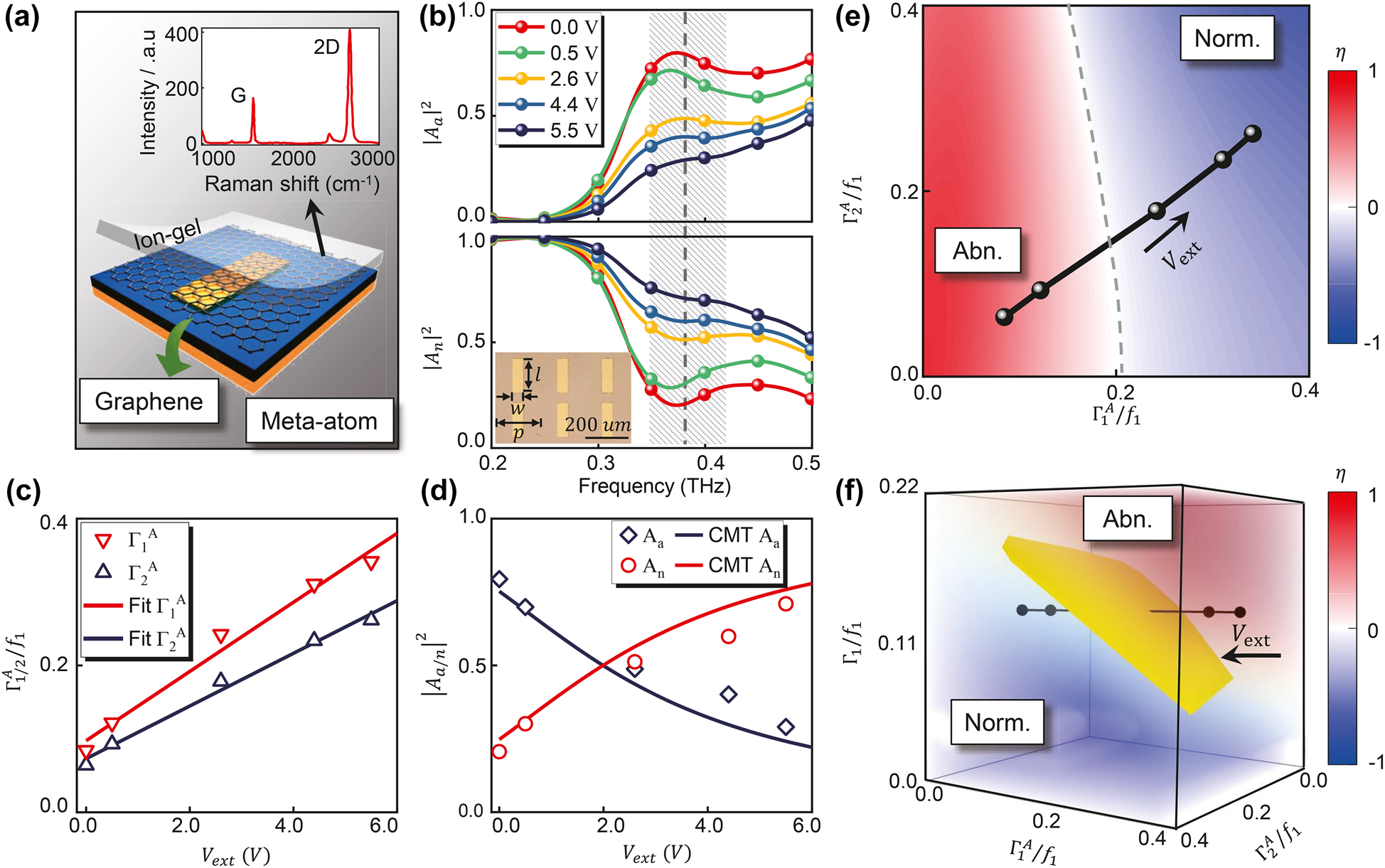
Design and experimental characterizations of graphene gated meta-atoms.
(a) A schematic view of an active graphene meta-atom composed of a single layer of graphene deposited on the metallic patch with Raman spectrum of the CVD-grown monolayer graphene as the inset. (b) Measured intensities of abnormal mode
We now characterize the optical responses of the fabricated metasurface under different gate voltages. In our experiments, shining the sample by normally incident THz beams with linear polarizations along two principle axes, we measure the spectra of two reflection coefficients
To understand the physics underlying our experimental results, we use a CMT model to analyze the EM properties of such a tunable meta-atom [42]. The Au film of the structure kills all transmissions through the system, so that we only need to care about the reflection port. Therefore, we can describe the structure by a two-mode two-port CMT model [see Supplementary Material Sec. V]. Through standard CMT analyses, we find the reflection coefficients for two orthogonal directions are given by
where
All experimental and numerical results [Figure 2(b)] can be well described by the CMT model [Eq. (4)] through carefully determining six fitting parameters
Defining
The underlying physics is ultimately connected to the competition between the absorption loss and the radiation loss. According to the CMT model in Eq. (4), we find that the resonance mode for the
4 Graphene meta-deflector with switchable beam directions
The first meta-device that we realize is a gate-controlled beam deflector which can switch the reflected THz beam between two pre-designed directions, as shown in Figure 3(a). To achieve this goal, we construct our meta-device with a series of designed meta-atoms exhibiting orientation angles described by
where
where
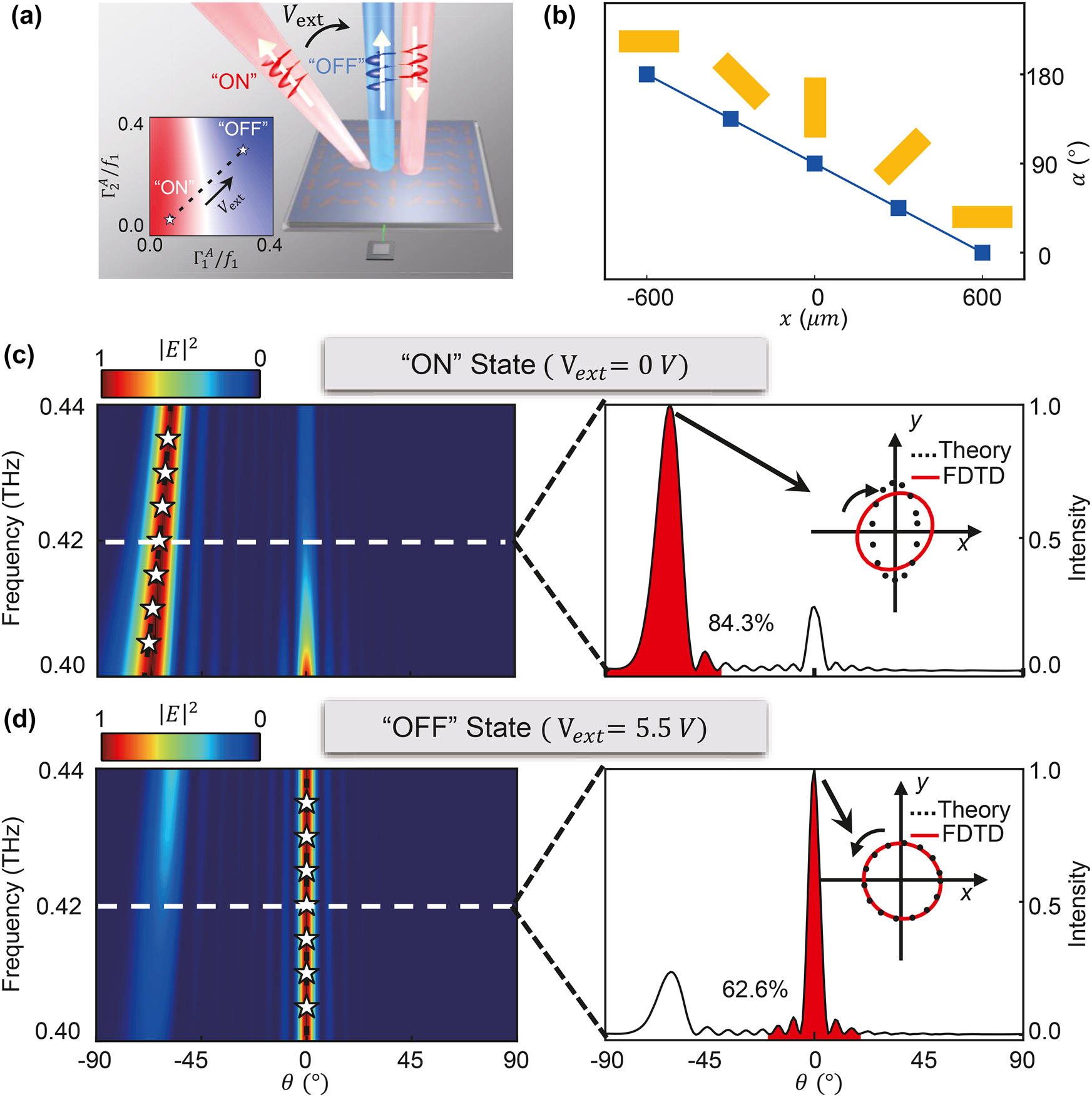
Simulated results of the gate-controlled beam deflector with two pre-designed switchable beam directions.
(a) Schematic of gate-tuned beam deflector constructed by identical meta-atoms with a linear gradient orientation angle profile. The inset illustrates the phase diagram of
Equations (5) and (6) predict that we can dynamically modulate the reflection beam by gating the graphene. At the Dirac point
We perform full-wave simulations on the designed meta-device to verify the above predictions. Figure 3(c) and (d) illustrate the simulated scattering patterns of the meta-device under the illumination of a normally incident LCP wave, as we vary the gate voltage from 0 to 5.5 V. In the case of
We fabricate out the graphene meta-device following the same process as described in Section 2, and the characterize its
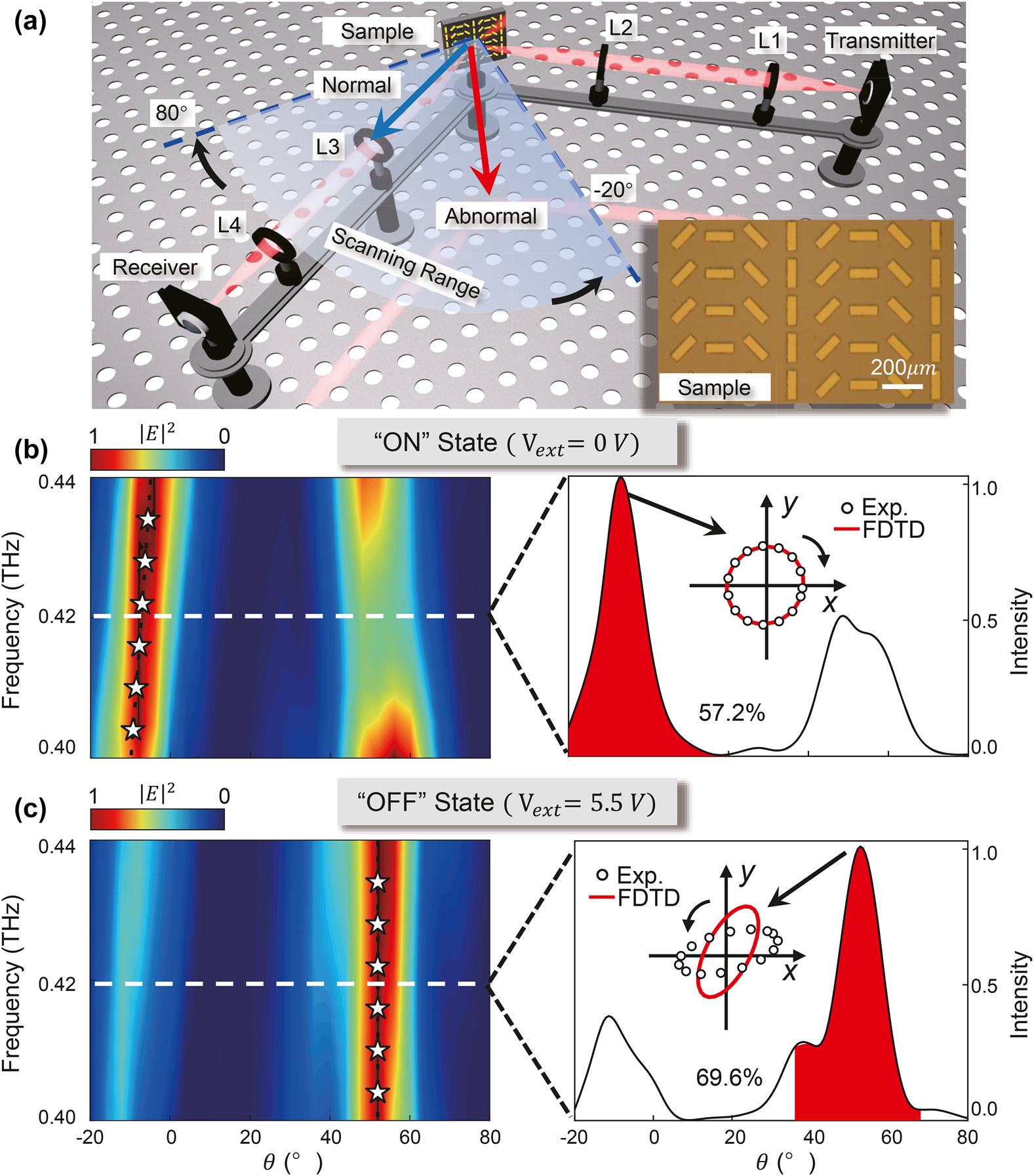
Experimental results of the gate-controlled beam deflector with two pre-designed switchable beam directions.
(a) Schematic of the experimental setup to characterize the tunable beam deflector. Inset presents the optical photography for the fabricated sample. The left-hand panels in (b and c) show the measured angular distribution of FF scattered electric field intensities of reflected waves for (b) “ON” state with
5 Graphene-tuned vectoral beam generator with variable polarizations
We proceed to demonstrate a device of the second type as described in Section 2. Specifically, upon excitation of a normally incident Laguerre–Gaussian (LG) beam with a circular polarization, the beam reflected by the proposed meta-device is a vectorial beam polarization distribution continuously modulated by
on the z = 0 plane. Obviously, both normal and abnormal modes propagate along the same direction, since the designed meta-device does not provide a phase gradient along any Cartesian axis. Meanwhile, the meta-device does provide a phase gradient along the azimuthal direction to the abnormal mode, making the reflected abnormal mode possessing a topological charge of
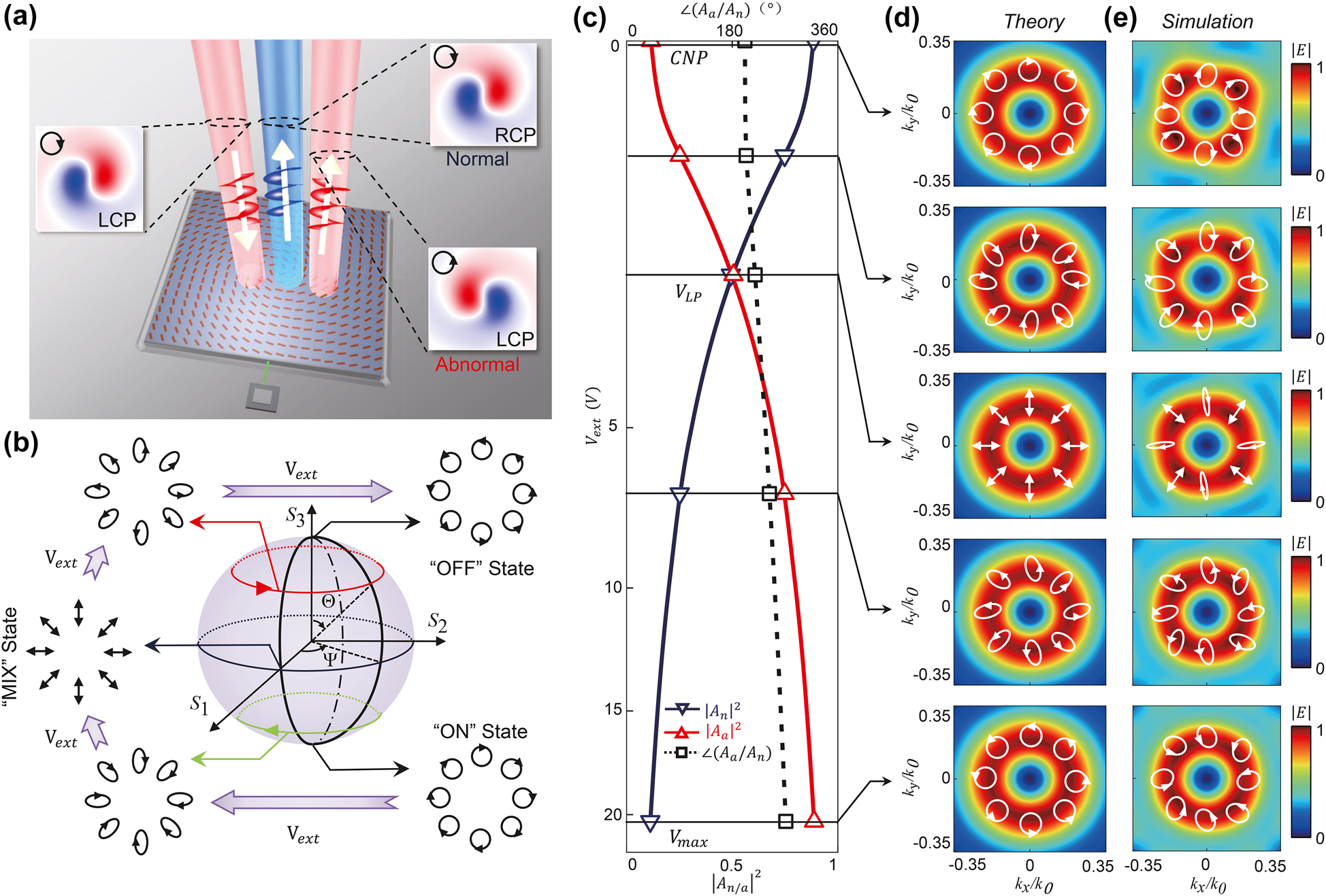
Simulated results of the graphene-controlled meta-device which can generate vectorial THz beams with continuously varying polarization distributions upon gating.
(a) Schematic for gate-tuned vectorial beam generator. Such meta-device is illuminated by a normally incident LCP Laguerre–Gaussian beam with topological charge, and the reflected beams are two beams of Laguerre–Gaussian with topological charge
Quantitatively, the “MIX” state can be expressed as
where
We now analyze Eq. (8) to see how the reflected wavefront changes as a function of gate voltage. For the meta-atom studied in Section 2, increasing
We finally use the realistic meta-atom studied in Section 2 as a building block to construct this meta-device. Based on the
6 Conclusions and discussions
In summary, we have proposed globally tuned graphene meta-devices to achieve dynamical terahertz wavefront control and experimentally demonstrate them in the THz regime. We use the CMT analysis to establish a generic phase diagram for such meta-device, revealing that the gated graphene as tunable loss can drive the whole meta-device to transit between two functional phases exhibiting completely distinct reflected wavefronts. Based on such mechanism, we experimentally demonstrate a tunable meta-device with switchable deflection angle controlled by graphene gate voltage. We finally numerically present a graphene-controlled meta-device which can generate vectorial THz beams with continuously varying polarization distributions upon gating. Our results open the gateway to terahertz tunable meta-devices control global tuning fashion, which may inspire many future works on both fundamental and application sides of research (e.g., THz radar, vectorial beam coded communication, tunable spin-Hall momentum shift, etc.).
We mention several important points before closing this section. Here, we note that the modulation efficiency is hampered by the dynamic range of absorptive loss for our fabricated meta-device (around 60%), which is not an intrinsic limitation of the design strategy. If we adopt other architecture with lower system absorption (e.g., back-gate control) and improved-quality graphene [43], the modulation range can be efficiently improved to 80% [see Supplementary Material Sec. VI]. Moreover, we note that our proposed meta-devices only use the geometric phase profiles in wavefronts control, making the scattering field for the normal mode always being a specular reflection. This is not an intrinsic limitation of our global tuning mechanism. If we further introduce a resonance phase, together with PB phase, into EM responses for each meta-atom, the scattering behaviors of two modes can be completely pre-designable to achieve more flexible wavefront control phenomena [see Supplementary Material Sec. VII]. We expect more plausible applications of our proposed strategy.
Funding source: National Key Research and Development Program of China
Award Identifier / Grant number: 2017YFA0303504
Award Identifier / Grant number: 2017YFA0700201
Funding source: Science and Technology Commission of Shanghai Municipality
Award Identifier / Grant number: 18QA1401800
Award Identifier / Grant number: 20JC1414601
Award Identifier / Grant number: 20JC1414602
Funding source: Shanghai East Scholar Plan
Funding source: National Natural Science Foundation of China
Award Identifier / Grant number: 11734007
Award Identifier / Grant number: 62175141
Award Identifier / Grant number: 62192771
Award Identifier / Grant number: 91850101
-
Author contribution: All the authors have accepted responsibility for the entire content of this submitted manuscript and approved submission.
-
Research funding: This work was financially supported by the National Key Research and Development Program of China (Grant Nos. 2017YFA0303504 and 2017YFA0700201), the National Natural Science Foundation of China (Grant Nos. 62175141, 11734007, 62192771 and 91850101), the Shanghai Science and Technology Committee (Grant Nos. 18QA1401800, 20JC1414601, and 20JC1414602), and the Shanghai East Scholar Plan.
-
Conflict of interest statement: The authors declare no conflicts of interest regarding this article.
References
[1] N. Yu and F. Capasso, “Flat optics with designer metasurfaces,” Nat. Mater., vol. 13, no. 2, pp. 139–150, 2014. https://doi.org/10.1038/nmat3839.Search in Google Scholar PubMed
[2] S. Sun, Q. He, J. Hao, S. Xiao, and L. Zhou, “Electromagnetic metasurfaces: physics and applications,” Adv. Opt. Photon., vol. 11, no. 2, pp. 380–479, 2019. https://doi.org/10.1364/aop.11.000380.Search in Google Scholar
[3] S. Xiao, J. Wang, F. Liu, S. Zhang, X. Yin, and J. Li, “Spin-dependent optics with metasurfaces,” Nanophotonics, vol. 6, no. 1, pp. 215–234, 2017. https://doi.org/10.1515/nanoph-2016-0121.Search in Google Scholar
[4] N. Yu, P. Genevet, M. A. Kats, et al.., “Light propagation with phase discontinuities: generalized laws of reflection and refraction,” Science, vol. 334, no. 6054, pp. 333–337, 2011. https://doi.org/10.1126/science.1210713.Search in Google Scholar PubMed
[5] S. Sun, Q. He, S. Xiao, Q. Xu, X. Li, and L. Zhou, “Gradient-index meta-surfaces as a bridge linking propagating waves and surface waves,” Nat. Mater., vol. 11, no. 5, pp. 426–431, 2012. https://doi.org/10.1038/nmat3292.Search in Google Scholar PubMed
[6] Z. Li, J. Hao, L. Huang, et al.., “Manipulating the wavefront of light by plasmonic metasurfaces operating in hider order modes,” Opt. Express, vol. 24, no. 8, pp. 8788–8796, 2016. https://doi.org/10.1364/oe.24.008788.Search in Google Scholar PubMed
[7] B. Yang, T. Liu, H. Guo, S. Xiao, and L. Zhou, “High-performance meta-devices based on multilayer meta-atoms: interplay between the number of layers and phase coverage,” Sci. Bull., vol. 64, no. 12, pp. 823–835, 2019. https://doi.org/10.1016/j.scib.2019.05.028.Search in Google Scholar
[8] Y. Luo, C. H. Chu, S. Vyas, et al.., “Varifocal metalens for optical sectioning fluorescence microscopy,” Nano Lett., vol. 21, no. 12, pp. 5133–5142, 2021. https://doi.org/10.1021/acs.nanolett.1c01114.Search in Google Scholar PubMed
[9] X. Cai, R. Tang, H. Zhou, et al.., “Dynamically controlling terahertz wavefronts with cascaded metasurfaces,” Adv. Photonics, vol. 3, no. 3, 2021, Art no. 036003. https://doi.org/10.1117/1.ap.3.3.036003.Search in Google Scholar
[10] J. Hao, Y. Yuan, L. Ran, et al.., “Manipulating electromagnetic wave polarizations by anisotropic metamaterials,” Phys. Rev. Lett., vol. 99, no. 6, 2011, Art no. 063908. https://doi.org/10.1103/PhysRevLett.99.063908.Search in Google Scholar PubMed
[11] A. Arbabi, Y. Horie, M. Bagheri, and A. Faraon, “Dielectric metasurfaces for complete control of phase and polarization with subwavelength spatial and high transmission,” Nat. Nanotechnol., vol. 10, no. 11, pp. 937–943, 2015. https://doi.org/10.1038/nnano.2015.186.Search in Google Scholar PubMed
[12] F. Yue, D. Wen, J. Xin, B. D. Gerardot, J. Li, and X. Chen, “Vector vortex beam generation with a single plasmonic metasurface,” ACS Photonics, vol. 3, no. 9, pp. 1558–1563, 2016. https://doi.org/10.1021/acsphotonics.6b00392.Search in Google Scholar
[13] J. P. B. Mueller, N. A. Rubin, R. C. Devlin, B. Groever, and F. Capasso, “Metasurface polarization optics: independent phase control of arbitrary orthogonal state of polarization,” Phys. Rev. Lett., vol. 118, no. 11, p. 113901, 2017. https://doi.org/10.1103/physrevlett.118.113901.Search in Google Scholar
[14] X. Yin, Z. Ye, J. Rho, Y. Wang, and X. Zhang, “Photonic spin Hall effect at metasurfaces,” Science, vol. 339, no. 6126, pp. 1405–1407, 2013. https://doi.org/10.1126/science.1231758.Search in Google Scholar PubMed
[15] S. Xiao, F. Zhong, H. Liu, S. Zhu, and J. Li, “Flexible coherent control of plasmonic spin-Hall effect,” Nat. Commun., vol. 6, no. 1, p. 8360, 2015. https://doi.org/10.1038/ncomms9360.Search in Google Scholar PubMed PubMed Central
[16] K. Y. Bliokh, F. J. Rodríguez-Fortuño, F. Nori, and A. V. Zayats, “Spin-orbit interactions of light,” Nat. Photonics, vol. 9, no. 12, pp. 769–808, 2015. https://doi.org/10.1038/nphoton.2015.201.Search in Google Scholar
[17] X. Ling, F. Guan, X. Cai, et al.., “Topology-induced phase transitions in spin-orbit photonics,” Laser Photon. Rev., vol. 15, p. 2000492, 2021. https://doi.org/10.1002/lpor.202000492.Search in Google Scholar
[18] W. T. Chen, K. Y. Yang, C. M. Wang, et al.., “High-efficiency broadband meta-hologram with polarization-controlled dual images,” Nano Lett., vol. 14, no. 1, pp. 225–230, 2014. https://doi.org/10.1021/nl403811d.Search in Google Scholar PubMed
[19] G. Zheng, H. Mühlenbernd, M. Kenney, G. Li, T. Zentgraf, and S. Zhang, “Metasurface holograms reaching 80% efficiency,” Nat. Nanotechnol., vol. 10, no. 4, pp. 308–312, 2015. https://doi.org/10.1038/nnano.2015.2.Search in Google Scholar PubMed
[20] Z. L. Deng and G. Li, “Metasurface optical holography,” Mater. Today Phys., vol. 3, pp. 16–32, 2017. https://doi.org/10.1016/j.mtphys.2017.11.001.Search in Google Scholar
[21] D. Wang, Y. Hwang, W. Dai, et al.., “Broadband high-efficiency chiral splitters and holograms from dielectric nanoarc metasurfaces,” Small, vol. 15, no. 20, p. 1900483, 2019. https://doi.org/10.1002/smll.201900483.Search in Google Scholar PubMed
[22] X. Liu, Q. Wang, X. Zhang, et al.., “Thermally dependent dynamic meta-holography using a vanadium dioxide integrated metasurface,” Adv. Opt. Mater., vol. 7, no. 12, p. 1900175, 2019. https://doi.org/10.1002/adom.201900175.Search in Google Scholar
[23] T. Wu, X. Zhang, Q. Xu, et al., “Dielectric metasurfaces for complete control of phase, amplitude, and polarization,” Adv. Opt. Mater., vol. 10, no. 1, p. 2101223, 2021. https://doi.org/10.1002/adom.202101223.Search in Google Scholar
[24] X. G. Zhang, W. X. Jiang, H. L. Jiang, et al.., “An optically driven digital metasurface for programming electromagnetic functions,” Nat. Electron., vol. 3, no. 3, pp. 165–171, 2020. https://doi.org/10.1038/s41928-020-0380-5.Search in Google Scholar
[25] Y. Li, J. Lin, H. Guo, W. Sun, S. Xiao, and L. Zhou, “A tunable metasurface with switchable functionalities: from perfect transparency to perfect absorption,” Adv. Opt. Mater., vol. 8, no. 6, p. 1901548, 2020. https://doi.org/10.1002/adom.201901548.Search in Google Scholar
[26] X. Bai, F. Kong, Y. Sun, et al.., “High-efficiency transmissive programmable metasurface for multimode OAM generation,” Adv. Opt. Mater., vol. 8, no. 17, p. 2000570, 2020. https://doi.org/10.1002/adom.202000570.Search in Google Scholar
[27] Q. Hu, K. Chen, N. Zhang, et al., “Arbitrary and dynamic poincaré sphere polarization converter with a time-varying metasurface,” Adv. Opt. Mater., vol. 10, no. 4, p. 2101915, 2021. https://doi.org/10.1002/adom.202101915.Search in Google Scholar
[28] H. X. Xu, S. Tang, S. Ma, et al.., “Tunable microwave metasurfaces for high-performance operations: dispersion compensation and dynamical switch,” Sci. Rep., vol. 6, no. 1, p. 38255, 2016. https://doi.org/10.1038/srep38255.Search in Google Scholar PubMed PubMed Central
[29] C. Huang, C. Zhang, J. Yang, B. Sun, B. Zhao, and X. Luo, “Reconfigurable metasurface for multifunctional control of electromagnetic waves,” Adv. Opt. Mater., vol. 5, no. 22, p. 1700485, 2017. https://doi.org/10.1002/adom.201700485.Search in Google Scholar
[30] L. Zhang, X. Q. Chen, S. Liu, et al.., “Space-time-coding digital metasurfaces,” Nat. Commun., vol. 9, no. 1, p. 4334, 2018. https://doi.org/10.1038/s41467-018-06802-0.Search in Google Scholar PubMed PubMed Central
[31] T. Shan, X. Pan, M. Li, S. Xu, and F. Yang, “Coding programmable metasurfaces based on deep learning techniques,” IEEE J. Em. Sel. Top. C, vol. 10, no. 1, pp. 114–125, 2020. https://doi.org/10.1109/jetcas.2020.2972764.Search in Google Scholar
[32] L. Li, T. J. Cui, W. Ji, et al.., “Electromagnetic reprogrammable coding-metasurface holograms,” Nat. Commun., vol. 8, no. 1, p. 197, 2017. https://doi.org/10.1038/s41467-017-00164-9.Search in Google Scholar PubMed PubMed Central
[33] O. Yurduseven, D. L. Marks, T. Fromenteze, and D. R. Smith, “Dynamically reconfigurable holographic metasurface aperture for a mills-cross monochromatic microwave camera,” Opt. Express, vol. 26, no. 5, pp. 5281–5291, 2018. https://doi.org/10.1364/oe.26.005281.Search in Google Scholar
[34] A. V. Diebold, M. F. Imani, T. Fromenteze, D. L. Marks, and D. R. Smith, “Passive microwave spectral imaging with dynamic metasurface apertures,” Optica, vol. 7, no. 5, pp. 527–536, 2020. https://doi.org/10.1364/optica.386516.Search in Google Scholar
[35] X. Zhang, Y. Zhou, H. Zheng, et al.., “Reconfigurable metasurface for image processing,” Nano Lett., vol. 21, no. 20, pp. 8715–8722, 2021. https://doi.org/10.1021/acs.nanolett.1c02838.Search in Google Scholar PubMed
[36] L. Cong, Y. K. Srivastava, H. Zhang, X. Zhang, J. Han, and R. Singh, “All-optical active THz metasurface for ultrafast polarization switching and dynamic beam splitting,” Light Sci. Appl., vol. 7, p. 28, 2018. https://doi.org/10.1038/s41377-018-0024-y.Search in Google Scholar PubMed PubMed Central
[37] T. T. Kim, H. Kim, M. Kenney, et al.., “Amplitude modulation of anomalously refracted terahertz waves with gated-graphene metasurfaces,” Adv. Opt. Mater., vol. 6, no. 1, p. 1700507, 2018. https://doi.org/10.1002/adom.201700507.Search in Google Scholar
[38] B. Zeng, Z. Huang, A. Singh, et al.., “Hybrid graphene metasurfaces for high-speed mid-infrared light modulation and single-pixel imaging,” Light Sci. Appl., vol. 7, p. 51, 2018. https://doi.org/10.1038/s41377-018-0055-4.Search in Google Scholar PubMed PubMed Central
[39] D. Lin, P. Fan, E. Hasman, and M. L. Brongersma, “Dielectric gradient metasurface optical elements,” Science, vol. 345, no. 6194, pp. 298–302, 2014. https://doi.org/10.1126/science.1253213.Search in Google Scholar PubMed
[40] S. Liu, T. J. Cui, L. Zhang, et al.., “Convolution operations on coding metasurfaces to reach flexible and continuous controls of terahertz beams,” Adv. Sci., vol. 3, no. 10, p. 1600156, 2016. https://doi.org/10.1002/advs.201600156.Search in Google Scholar PubMed PubMed Central
[41] Z. Miao, Q. Wu, X. Li, et al.., “Widely tunable terahertz phase modulation with gate-controlled graphene metasurface,” Phys. Rev. X, vol. 5, no. 4, 2015, Art no. 041027. https://doi.org/10.1103/physrevx.5.041027.Search in Google Scholar
[42] Here, although commercial full-wave simulations can well reproduce the experimental data, they typically shed little light on understanding the physics behind the coupling phenomena, whereas CMT is helpful to obtain physical picture behind these experimental phenomena.Search in Google Scholar
[43] Z. Chen, X. Chen, L. Tao, et al.., “Graphene controlled Brewster angle device for ultra broadband terahertz modulation,” Nat. Commun., vol. 9, no. 1, p. 4909, 2018. https://doi.org/10.1038/s41467-018-07367-8.Search in Google Scholar PubMed PubMed Central
Supplementary Material
The online version of this article offers supplementary material (https://doi.org/10.1515/nanoph-2021-0801).
© 2022 Qiushi Li et al., published by De Gruyter, Berlin/Boston
This work is licensed under the Creative Commons Attribution 4.0 International License.
Articles in the same Issue
- Frontmatter
- Editorial
- Editorial on special issue: “Metamaterials and plasmonics in Asia”
- Reviews
- Waveguide effective plasmonics with structure dispersion
- Graphene-based plasmonic metamaterial for terahertz laser transistors
- Recent advances in metamaterials for simultaneous wireless information and power transmission
- Multi-freedom metasurface empowered vectorial holography
- Nanophotonics-inspired all-silicon waveguide platforms for terahertz integrated systems
- Optical metasurfaces towards multifunctionality and tunability
- The perspectives of broadband metasurfaces and photo-electric tweezer applications
- Free-form optimization of nanophotonic devices: from classical methods to deep learning
- Optical generation of strong-field terahertz radiation and its application in nonlinear terahertz metasurfaces
- Responsive photonic nanopixels with hybrid scatterers
- Research Articles
- Efficient modal analysis of plasmonic nanoparticles: from retardation to nonclassical regimes
- Molecular chirality detection using plasmonic and dielectric nanoparticles
- Vortex radiation from a single emitter in a chiral plasmonic nanocavity
- Reconfigurable Mach–Zehnder interferometer for dynamic modulations of spoof surface plasmon polaritons
- Manipulating guided wave radiation with integrated geometric metasurface
- Comparison of second harmonic generation from cross-polarized double-resonant metasurfaces on single crystals of Au
- Rotational varifocal moiré metalens made of single-crystal silicon meta-atoms for visible wavelengths
- Meta-lens light-sheet fluorescence microscopy for in vivo imaging
- All-metallic high-efficiency generalized Pancharatnam–Berry phase metasurface with chiral meta-atoms
- Drawing structured plasmonic field with on-chip metalens
- Negative refraction in twisted hyperbolic metasurfaces
- Anisotropic impedance surfaces activated by incident waveform
- Machine–learning-enabled metasurface for direction of arrival estimation
- Intelligent electromagnetic metasurface camera: system design and experimental results
- High-efficiency generation of far-field spin-polarized wavefronts via designer surface wave metasurfaces
- Terahertz meta-chip switch based on C-ring coupling
- Resonance-enhanced spectral funneling in Fabry–Perot resonators with a temporal boundary mirror
- Dynamic inversion of planar-chiral response of terahertz metasurface based on critical transition of checkerboard structures
- Terahertz 3D bulk metamaterials with randomly dispersed split-ring resonators
- BST-silicon hybrid terahertz meta-modulator for dual-stimuli-triggered opposite transmission amplitude control
- Gate-tuned graphene meta-devices for dynamically controlling terahertz wavefronts
- Dual-band composite right/left-handed metamaterial lines with dynamically controllable nonreciprocal phase shift proportional to operating frequency
- Highly suppressed solar absorption in a daytime radiative cooler designed by genetic algorithm
- All-optical binary computation based on inverse design method
- Exciton-dielectric mode coupling in MoS2 nanoflakes visualized by cathodoluminescence
- Broadband wavelength tuning of electrically stretchable chiral photonic gel
- Spatio-spectral decomposition of complex eigenmodes in subwavelength nanostructures through transmission matrix analysis
- Scattering asymmetry and circular dichroism in coupled PT-symmetric chiral nanoparticles
- A large-scale single-mode array laser based on a topological edge mode
- Far-field optical imaging of topological edge states in zigzag plasmonic chains
- Omni-directional and broadband acoustic anti-reflection and universal acoustic impedance matching
Articles in the same Issue
- Frontmatter
- Editorial
- Editorial on special issue: “Metamaterials and plasmonics in Asia”
- Reviews
- Waveguide effective plasmonics with structure dispersion
- Graphene-based plasmonic metamaterial for terahertz laser transistors
- Recent advances in metamaterials for simultaneous wireless information and power transmission
- Multi-freedom metasurface empowered vectorial holography
- Nanophotonics-inspired all-silicon waveguide platforms for terahertz integrated systems
- Optical metasurfaces towards multifunctionality and tunability
- The perspectives of broadband metasurfaces and photo-electric tweezer applications
- Free-form optimization of nanophotonic devices: from classical methods to deep learning
- Optical generation of strong-field terahertz radiation and its application in nonlinear terahertz metasurfaces
- Responsive photonic nanopixels with hybrid scatterers
- Research Articles
- Efficient modal analysis of plasmonic nanoparticles: from retardation to nonclassical regimes
- Molecular chirality detection using plasmonic and dielectric nanoparticles
- Vortex radiation from a single emitter in a chiral plasmonic nanocavity
- Reconfigurable Mach–Zehnder interferometer for dynamic modulations of spoof surface plasmon polaritons
- Manipulating guided wave radiation with integrated geometric metasurface
- Comparison of second harmonic generation from cross-polarized double-resonant metasurfaces on single crystals of Au
- Rotational varifocal moiré metalens made of single-crystal silicon meta-atoms for visible wavelengths
- Meta-lens light-sheet fluorescence microscopy for in vivo imaging
- All-metallic high-efficiency generalized Pancharatnam–Berry phase metasurface with chiral meta-atoms
- Drawing structured plasmonic field with on-chip metalens
- Negative refraction in twisted hyperbolic metasurfaces
- Anisotropic impedance surfaces activated by incident waveform
- Machine–learning-enabled metasurface for direction of arrival estimation
- Intelligent electromagnetic metasurface camera: system design and experimental results
- High-efficiency generation of far-field spin-polarized wavefronts via designer surface wave metasurfaces
- Terahertz meta-chip switch based on C-ring coupling
- Resonance-enhanced spectral funneling in Fabry–Perot resonators with a temporal boundary mirror
- Dynamic inversion of planar-chiral response of terahertz metasurface based on critical transition of checkerboard structures
- Terahertz 3D bulk metamaterials with randomly dispersed split-ring resonators
- BST-silicon hybrid terahertz meta-modulator for dual-stimuli-triggered opposite transmission amplitude control
- Gate-tuned graphene meta-devices for dynamically controlling terahertz wavefronts
- Dual-band composite right/left-handed metamaterial lines with dynamically controllable nonreciprocal phase shift proportional to operating frequency
- Highly suppressed solar absorption in a daytime radiative cooler designed by genetic algorithm
- All-optical binary computation based on inverse design method
- Exciton-dielectric mode coupling in MoS2 nanoflakes visualized by cathodoluminescence
- Broadband wavelength tuning of electrically stretchable chiral photonic gel
- Spatio-spectral decomposition of complex eigenmodes in subwavelength nanostructures through transmission matrix analysis
- Scattering asymmetry and circular dichroism in coupled PT-symmetric chiral nanoparticles
- A large-scale single-mode array laser based on a topological edge mode
- Far-field optical imaging of topological edge states in zigzag plasmonic chains
- Omni-directional and broadband acoustic anti-reflection and universal acoustic impedance matching
