Finite vertex-based resolvability of supramolecular chain in dialkyltin
-
Xiujun Zhang
 ,
Muhammad Kamran Jamil
,
Muhammad Kamran Jamil

Abstract
For mammals, l-valine, which is a glycogen, is an essential amino acid. A protein made of 20 amino acids, salicylidene and l-valine make the carboxylate ligand which is the base of chiral Schiff. On a large scale, complexes with the ligand are utilized to help in the research work. To locate the exact location of a specific node from all the nodes, the entire node set is developed in a specific manner by choosing a particular subset and this subset is known as the resolving/locating set. This study contributed to the metric dimension of chemical complexes of supramolecular chain in dialkyltin from N-salicylidene-l-valine. We considered the complexes of 2,3,4 and
1 Introduction
In mathematics, graph theory means the study of graphs. The graph represents the set of vertices connected by the edges. Similarly, in the chemical graph theory, the atoms are represented by the nodes/vertices that are connected by the bonds/edges called the molecular graphs (Ahsan et al., 2020). Some chemical structures are more complicated and large such that these structures are not understandable. The chemical graph theory is defined as the study of graph theory with mathematics and chemical graphs (Imran et al., 2019; Siddiqui and Imran, 2015; Siddiqui et al., 2016).
To obtain the unique representations of the whole chemical structure, in structure, each atom/node is connected with bonds/edges that have distinct positions. A subset that gives the unique representations of the entire node set of a graph is called a resolving set, locating set, and metric basis in computer science applied sciences, and in pure mathematical terminologies, the minimum cardinality of resolving a set of unique representations is called locating number/metric dimension. The concept of metric basis and resolving sets was first introduced by Slater (1975) and later by Harary and Melter (1976).
2 Literature review
In the research work of Singh et al. (2021), authors discussed windmill graphs in terms of metric basis and their generalization. In the study by Moreno et al. (2021), authors discussed the generalized version of the metric dimension graph and they defined this parameter on two variables. In the work by Pirzada and Aijaz (2021), researchers computed metrics and their upper bounds on some generalized families of graphs. In the work of Azeem and Nadeem (2021), polycyclic hydrocarbons are detailed with the concept of metric and their generalizations. In the research work of Imran et al. (2018), symmetric graphs are obtained by the rooted product and they studied metrics and their generalizations. In the study by Koam et al. (2021), researchers give the idea of hollow coronoids on metric dimension and their generalization. In the research work by Koam et al. (2021a), the authors measured the resolvability of quartz structure, and particularly they computed metric parameters for the structure of quartz without considering the pendant nodes outside the circle. In the work by Anitha et al. (2021), the authors detailed the rough graphs on the topics of metric dimensions and their generalized parameters. In the research of Moscarini (2021), the author discussed hereditary bipartite and computing the metric basis of this generalized class of complex networks. In the study by Koam et al. (2019), the authors suggested the idea of pseudo valuation on KU-algebras and investigated the relationship between pseudo-valuations and KU-algebras and their generalizations. More reports on chemical networks and metric parameters of different chemical structures and networks are available in recent articles by Ahmad and Sultan (2017), Ahmad et al. (2018, 2020a, 2020b), Mahapatra et al. (2020), Raza et al. (2018, 2019a, 2019b), and Vetrik and Ahmad (2017).
There are shortlisted articles cited here to give some knowledge to the reader. Some articles show the chemical structure, and in that works of literature, most of the authors discussed the resolving sets in detail. Metric dimension is also important in any field to study the different structures such as chemical structures, computer networks/structures, and electric circuits, and also to build structures and networks forms. In pharmaceutical chemistry, drugs are represented in graph form. For mammals, l-valine, which is a glycogen, is an essential amino acid. A protein is made of 20 amino acids, salicylidene and l-valine make the carboxylate ligand which is the base of chiral Schiff. On a large scale, complexes with the ligand are utilized to help in the research work Belokon et al. (2009), Chen et al. (2004, 2007), Ucar et al. (2017), and Yu et al., (2015). To choose a unique shortest path of a structure for navigating a robot/submarine, metric parameters played an important role (Khuller et al., 1996). Process and recognition of patterns also utilized the concept of resolving set (Slater, 1975). Some concepts utilized in the electric field (Ahmad et al., 2022) and in the polymer industry (Nadeem et al., 2021) are recent discoveries of metric dimensions. For further details on this parameter, we refer to see papers by Azeem et al. (2021, 2022), Koam et al. (2021), Raza et al. (2021), Shabbir and Azeem (2021), and Wang et al., (2021).
3 Preliminaries
Some definitions giving idea to understand this work are given below.
Definition 1
(Nadeem et al., 2020)
Let
Definition 2
(Nadeem et al., 2020)
Let
4 Finite vertex-based resolvability of supramolecular chain in dialkyltin complex-2, C2,λ
The supramolecular chain dialkyltin has four types of complexes, but we will discuss here three types of complexes 2, 3, and 4. Complex-2 of N-salicylidene-l-valine is shown in Figure 1. There are λ units, the first unit is connected with the vertices of the second unit and the second unit is connected with the vertices of the third, and the
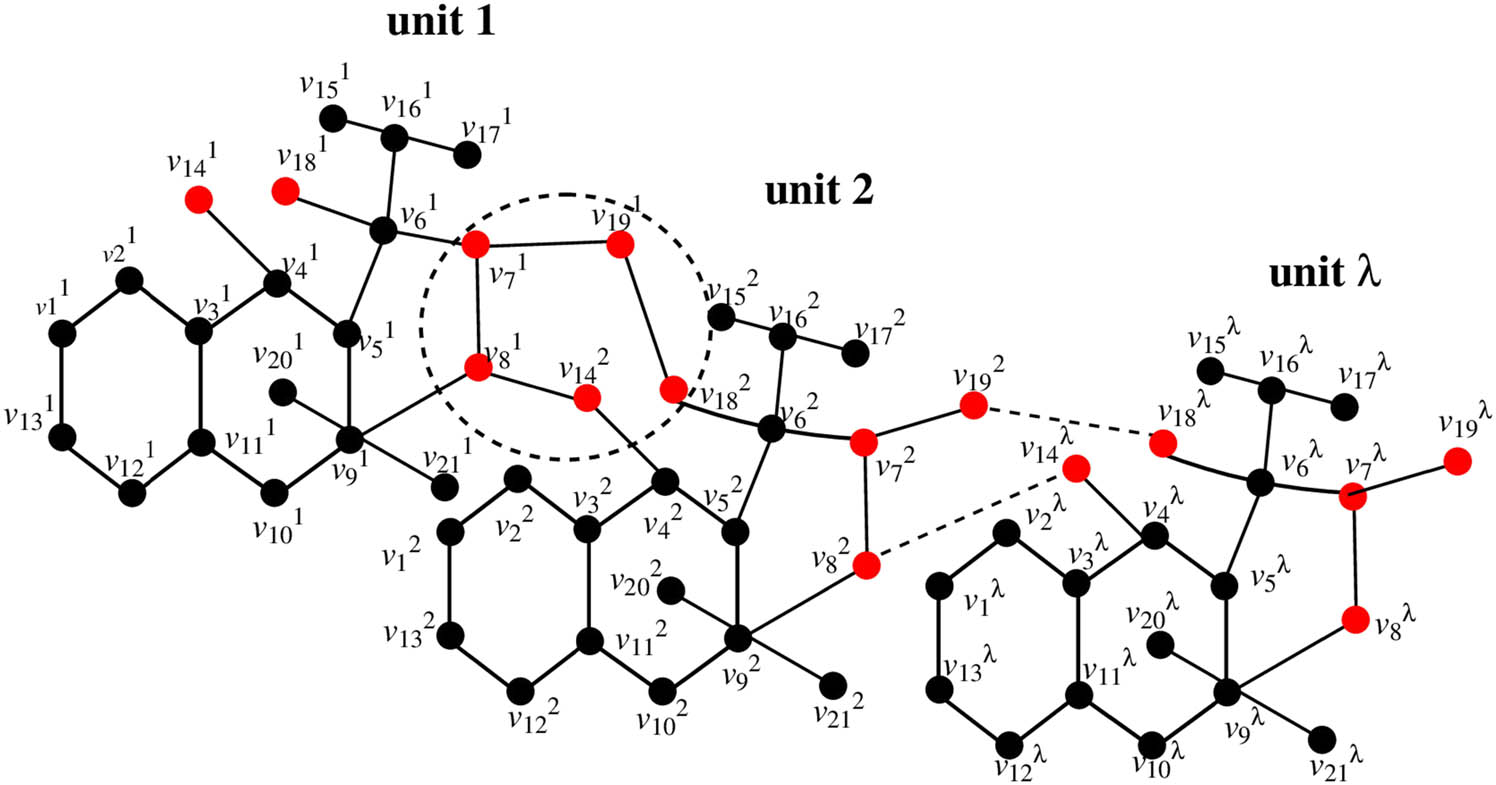
Supramolecular chain of complex-2.
Theorem 1
If
Proof. To prove that
Hence, it follows from the above arguments in the form of representation that
Now we prove that
Case 1: Let
Case 2: Let
Case 3: Let
Case 4: Let
Case 5: Let
Case 6: Let
Case 7: Let
Case 8: Let
Case 9: Let
Correspondingly, there is no single possibility from the possible cases made by the whole vertex of
Theorem 2
If
Proof. To show that
Now we assume that this assertion is true for
We will show that it is true for
Hence, the result is true for all the positive integers
5 Finite vertex-based resolvability of supramolecular chain in dialkyltin complex-3, C 3,λ
The complex-3 of N-salicylidene-l-valine has the
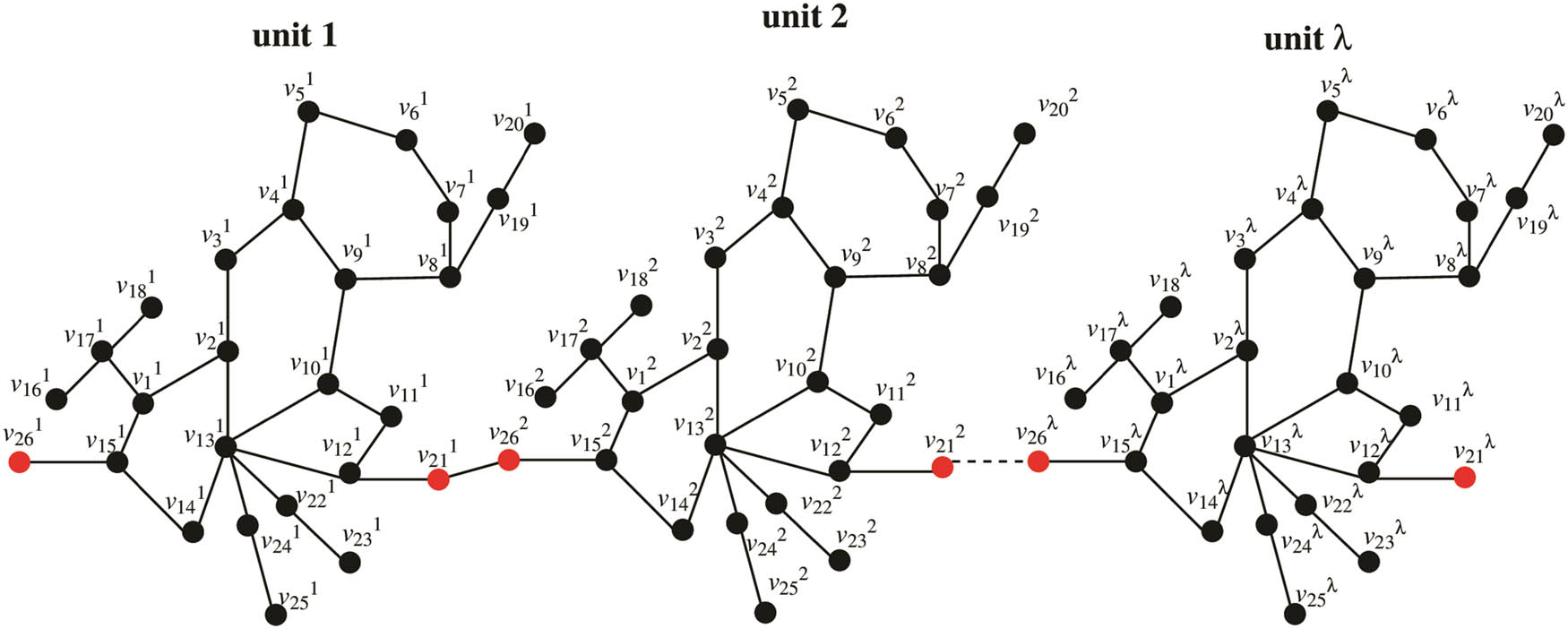
Supramolecular chain of complex-3.
Theorem 3
If
Proof. To prove that
Hence, it follows from the above arguments in the form of representation that
Now we prove that
Case 1: Let
Case 2: Let
Case 3: Let
Case 4: Let
Case 5: Let
Case 6: Let
Case 7: Let
Case 8: Let
Case 9: Let
Case 10: Let
Case 11: Let
Case 12: Let
Case 13: Let
Case 14: Let
Case 15: Let
Case 16: Let
Similarly, there is no single possibility from the feasible cases made by the entire vertex of
Hence,
Theorem 4
If
Proof. To show that
Now, we assume that this assertion is true for
We will show that it is true for
Hence, the result is true for all the positive integers
6 Finite vertex-based resolvability of supramolecular chain in dialkyltin complex-4, C 4,λ
The supramolecular chain in dialkyltin complex-4 of N-salicylidene-l-valine also has copies of
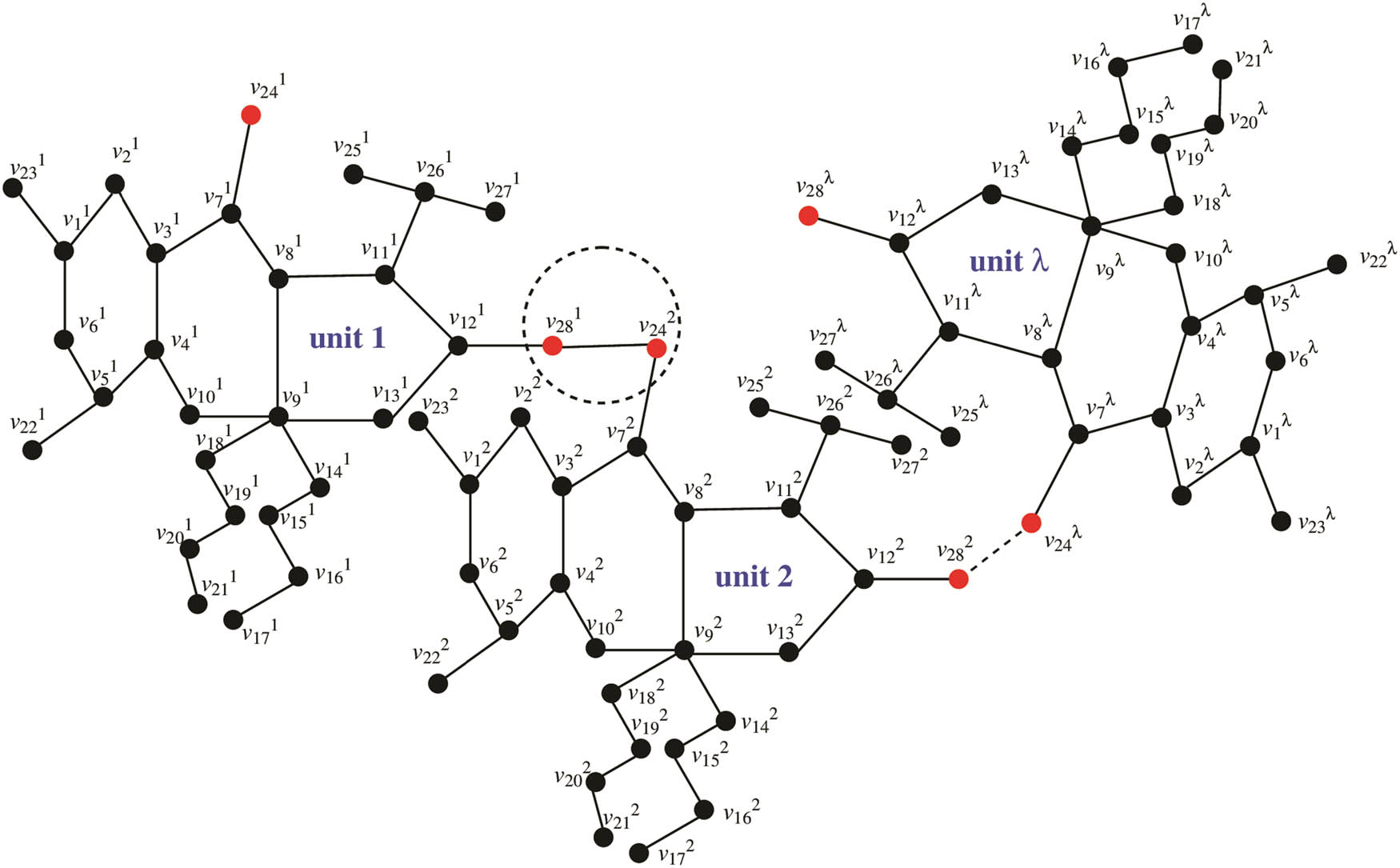
Supramolecular chain of complex-4.
Theorem 5
If
Proof. To prove that
Hence, it follows from the above arguments in the form of representation that
Now we prove that
Case 1: Let
Case 2: Let
Case 3: Let
Case 4: Let
Case 5: Let
Case 6: Let
Case 7: Let
Case 8: Let
Correspondingly, there is no single possibility from the possible cases constructed by the entire vertex of
Hence,
Theorem 6
If
Proof. To show that
Now, we assume that this assertion is true for
We will show that it is true for
Using Equations 8–10, we will get
Hence, the result is true for all the positive integer
7 Finite vertex-based resolvability of polyhedron generalized sheet of
C
28,
λ
∗
The structure of polyhedron generalized sheet of
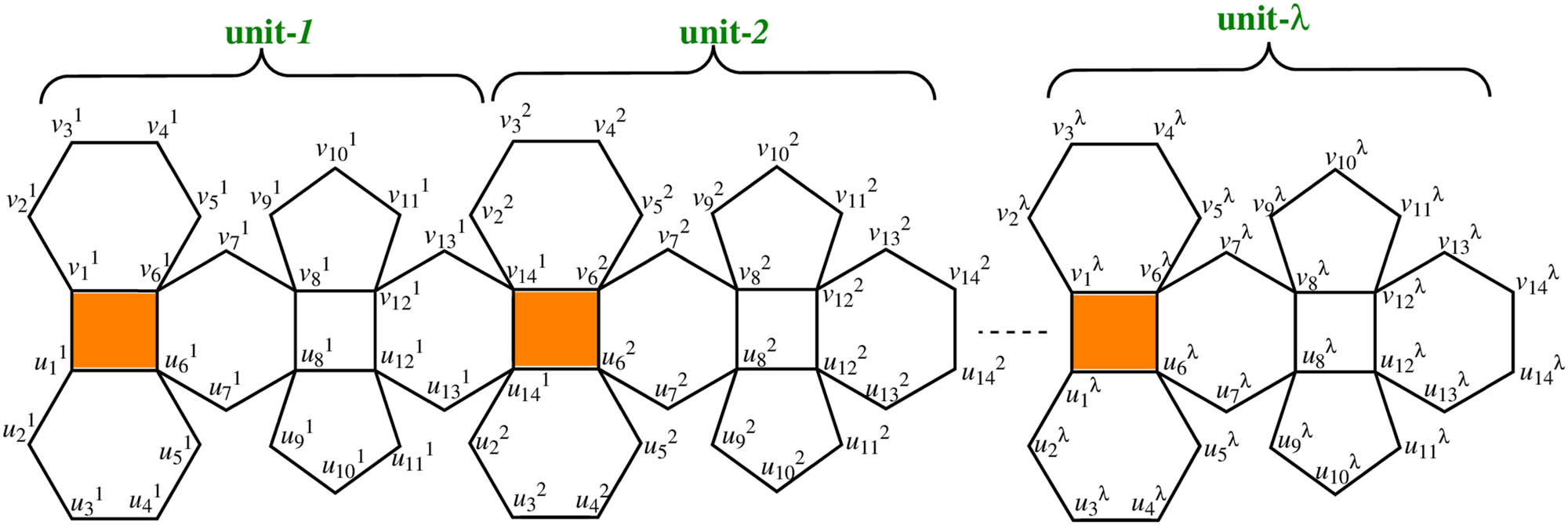
Structure of polyhedron generalized sheet of
Theorem 7
If
Proof. To prove that
Hence, it follows the above arguments in the form of representation that
Now we prove that
Case 1: Let
Case 2: Let
Case 3: Let
Case 4: Let
Case 5: Let
Case 6: Let
Case 7: Let
Case 8: Let with cardinality
Case 9: Let
Case 10 (result): Let
Case 11: Let
Case 12: Let
Case 13: Let
Case 14: Let
Case 15: Let
Case 16: Let
Case 17: Let
Case 18 (result): Let
Case 19: Let
Case 20: Let
Case 21: Let
Case 22: Let
Case 23: Let
Case 24: Let
Case 25 (result): Let
Case 26: Let
Case 27: Let
Case 28: Let
Case 29 (result): Let
Case 30: Let
Case 31: Let
Case 32: Let
Case 33: Let
Case 34: Let
Case 35: Let
Case 36: Let
Case 37: Let
Analogously, there is no single possibility from the possible cases made by the entire vertex of
Hence:
8 Conclusion
This work contributed the metric dimension of chemical complexes of supramolecular chain in dialkyltin from N-salicylidene-l-valine. We considered the complexes of 2, 3, and 4 chains, and proved that the members of resolving sets are highly dependent on the number of vertices. Moreover, We computed the metric of a polyhedron generalized sheet of
-
Funding information: This work was supported by the National Key Research and Development Program under Grant 2018YFB0904205.
-
Author contributions: Muhammad Azeem: writing – original draft; Muhammad Kamran Jamil: writing – review and editing; Muhammad Tanzeel Ali Kanwal: methodology, formal analysis; and visualization; Muzammil Mukhtar: project administration; Xiujun Zhang: resources.
-
Conflict of interest: Authors state no conflict of interest.
-
Data availabilty statement: All the data supporting the results are included in the manuscript.
References
Ahmad A., Bača M., Sultan S., Minimal doubly resolving sets of Necklace graph. Math. Rep., 2018, 20(70), 123–129.Search in Google Scholar
Ahmad A., Bača M., Sultan S., Computing the metric dimension of Kayak Paddles graph and cycles with chord. Proyecciones J. Math., 2020a, 39, 287–300. 10.22199/issn.0717-6279-2020-02-0018.Search in Google Scholar
Ahmad A., Bača M., Sultan S., On Metric Dimension and Minimal doubly resolving sets of Harary graph. Acta Math. Univ. Comen., 2020b, 89, 123–129.Search in Google Scholar
Ahmad A., Koam A.N.A., Siddiqui M.H.F., Azeem M., Resolvability of the starphene structure and applications in electronics. Ain Shams Eng. J., 2022, 13(2), 101587. 10.1016/j.asej.2021.09.014.Search in Google Scholar
Ahmad A., Sultan S., On minimal doubly resolving sets of circulant graphs. Acta Mech. Slov., 2017, 20, 6–11. 10.21496/ams.2017.002.Search in Google Scholar
Ahsan M., Zahid Z., Zafar S., Rafiq A., Sarwar Sindhu M., Umar M., Computing the edge metric dimension of convex polytopes related graphs. J. Math. Comput. Sci., 2020, 22(2), 174–188.10.22436/jmcs.022.02.08Search in Google Scholar
Anitha K., Aruna Devi R., Munir M., Nisar K.S., Metric dimension of rough graphs. Int. J. Nonlinear Anal. Appl., 2021, 12, 1793–1806. 10.22075/IJNAA.2021.5891.Search in Google Scholar
Azeem M., Imran M., Nadeem M.F., Sharp bounds on partition dimension of hexagonal Möbius ladder. J. King Saud. Univ-Sci., 2021, 34(2), 101779. 10.1016/j.jksus.2021.101779.Search in Google Scholar
Azeem M., Jamil M.K., Javed A., Ahmad A., Verification of some topological indices of Y-junction based nanostructures by M-polynomials. J. Math., June 2022, 2022, 8238651. 10.1155/2022/8238651.Search in Google Scholar
Azeem M., Nadeem M.F., Metric-based resolvability of polycyclic aromatic hydrocarbons. Eur. Phys. J. Plus, 2021, 136(4), 1–14. 10.1140/epjp/s13360-021-01399-8.Search in Google Scholar
Belokon Y.N., Maleev V.I., Kataev D.A., Saveleva T.F., North M., Chiral ion pairs in catalysis: lithium salts of chiral metallo-complex anions as catalysts for asymmetric C–C bond formation. Tetrahedron-Asymmetric., 2009, 20, 1746–1752. 10.1016/j.tetasy.2009.06.006.Search in Google Scholar
Chen C.T., Bettigeri S., Weng S.S., Pawar V.D., Lin Y.H., Liu C.Y., Asymmetric aerobic oxidation of α-hydroxy acid derivatives by C4-symmetric, vanadate-centered, tetrakisvanadyl(V) QJ;clusters derived from N-salicylidene-α-aminocarboxylates. J. Org. Chem., 2007, 72, 8175–8185. 10.1021/jo070575f.Search in Google Scholar PubMed
Chen C.T., Lin J.S., Kuo J.H., Weng S.S., Cuo T.S., Lin Y.W., Site-selective DNA photocleavage involving unusual photoinitiated tautomerization of chiral tridentate vanadyl(V) complexes derived from N-salicylidene α-amino acids. Org. Lett., 2004, 6, 4471–4474. 10.1021/ol048156h.Search in Google Scholar PubMed
Diudea M.V., Nagy C.L., Diamond and Related Nanostructures. Springer, Netherlands, 2013. 10.1007/978-94-007-6371-5.Search in Google Scholar
Harary F., Melter R.A., On the metric dimension of a graph. Ars Combinatoria, 1976, 2, 191–195.Search in Google Scholar
Imran S., Siddiqui M.K., Hussain M., Computing the upper bounds for the metric dimension of cellulose network. Appl. Math. e-notes, 2019, 19, 585–605.Search in Google Scholar
Imran S., Siddiqui M.K., Imran M., Hussain M., On metric dimensions of symmetric graphs obtained by rooted product. Mathematics, 2018, 6(10), 191. 10.3390/math6100191.Search in Google Scholar
Khuller S., Raghavachari B., Rosenfeld A. Landmarks in graphs. Discret. Appl. Math., 1996, 70(3), 217–229.10.1016/0166-218X(95)00106-2Search in Google Scholar
Koam A.N., Ahmad A., Abdelhag M.E., Azeem M., Metric and fault-tolerant metric dimension of hollow coronoid. IEEE Access., 2021, 9, 81527–81534. 10.1109/ACCESS.2021.3085584.Search in Google Scholar
Koam A.N., Ahmad A., Alatawi M.S., Nadeem M.F., Azeem M., Computation of metric-based resolvability of quartz without pendant nodes. IEEE Access., 2021a, 9, 151834–151840. 10.1109/ACCESS.2021.3126455.Search in Google Scholar
Koam A.N., Haider A., Ansari M.A., Pseudo-metric on KU-algebras. Korean J. Math., 2019, 27(1), 131–140. 10.11568/kjm.2019.27.1.131.Search in Google Scholar
Koam A.N.A., Ahmad A., Ibrahim M., Azeem M., Edge metric and fault-tolerant edge metric dimension of hollow coronoid. Mathematics, May 2021b, 9(12), 1405. 10.3390/math9121405.Search in Google Scholar
Mahapatra T., Ghorai G., Pal M., Fuzzy fractional coloring of fuzzy graph with its application. J. Ambient. Intell. Humanized Comput., 2020, 11, 5771–5784. 10.1007/s12652-020-01953-9.Search in Google Scholar
Moreno A.E., Yero I.G., Velazquez J.A.R., On the (k,t)-metric dimension of graphs. Comput. J., 2021, 64(5), 707–720. 10.1093/comjnl/bxaa009.Search in Google Scholar
Moscarini M., Computing a metric basis of a bipartite distance-hereditary graph. Theor. Comput. Sci., 2021, 900, 20–24. 10.1016/j.tcs.2021.11.015.Search in Google Scholar
Nadeem M.F., Azeem M., Khalil A., The locating number of hexagonal Möbius ladder network. J. Appl. Math. Comput., 2020, 66, 149–165. 10.1007/s12190-020-01430-8.Search in Google Scholar
Nadeem M.F., Hassan M., Azeem M., Khan S.U.D., Shaik M.R., Sharaf M.A.F., et al., Application of resolvability technique to investigate the different polyphenyl structures for polymer industry. J. Chem., 2021, 2021, 1–8. 10.1155/2021/6633227.Search in Google Scholar
Pirzada S., Aijaz M., On graphs with same metric and upper dimension. Discret. Math. Algorithms Appl., 2021, 13(2), 2150015. 10.1142/S1793830921500154.Search in Google Scholar
Raza H., Hayat S., Imran M., Pan X.F., Fault-tolerant resolvability and extremal structures of graphs. Mathematics, 2019a, 7, 78–97. 10.3390/math7010078.Search in Google Scholar
Raza H., Hayat S., Pan X.F., On the fault-tolerant metric dimension of convex polytopes. Appl. Math. Comput., 2018, 339, 172–185. 10.1016/j.amc.2018.07.010.Search in Google Scholar
Raza H., Hayat S., Pan X.F., On the fault-tolerant metric dimension of certain interconnection networks. J. Appl. Math. Comput., 2019b, 60, 517–535. 10.1109/ACCESS.2020.3014883.Search in Google Scholar
Raza H., Liu J.B., Azeem M., Nadeem M.F., Partition dimension of generalized petersen graph. Complexity, Oct. 2021. 10.1155/2021/5592476.Search in Google Scholar
Shabbir A., Azeem M., On the partition dimension of tri-hexagonal alpha-boron nanotube. IEEE Access., Apr 2021, 9, 55644–55653. 10.1109/ACCESS.2021.3071716.Search in Google Scholar
Siddiqui H.M.A., Arshad M.A., Nadeem M.F., Azeem M., Haider A., Malik M.A., Topological properties of supramolecular chain of different complexes of N-salicylidene-l-valine. Polycycl. Aromatic Compd., 2022, 42(9), 6185–6198. 10.1080/10406638.2021.1980060.Search in Google Scholar
Siddiqui M.K., Imran M., Computing the metric and partition dimension of H-Naphtalenic and VC5C7 nanotubes. J. Optoelectron. Adv. Mater., 2015, 17, 790–794.Search in Google Scholar
Siddiqui M.K., Naeem M., Rahman N.A., Imran M., Computing topological indices of certain networks. J. Optoelectron. Adv. Mater., 2016, 18, 9–10. 10.1016/j.amc.2014.04.091.Search in Google Scholar
Singh P., Sharma S., Sharma S.K., Bhat V.K., Metric dimension and edge metric dimension of windmill graphs. AIMS Math., 2021, 6(9), 9138–9153. 10.3934/math.2021531.Search in Google Scholar
Slater P.J., Leaves of trees. Proceeding of the 6th Southeastern Conference on Combinatorics, Graph Theory, and Computing, Congressus Numerantium. 1975, vol. 14, p. 549–559.Search in Google Scholar
Ucar A., Findik M., Bingol H., Guler E., Ozcan E., Organometallic chiral Schiff base for enantio-selective fluorescent recognition of methionine. Chem. Pap., 2017, 71, 1855–1862. 10.1007/s11696-017-0179-7.Search in Google Scholar
Vetrik T., Ahmad A. Computing the metric dimension of the categorial product of graphs. Int. J. Comput. Math., 2017, 94, 363–371. 10.1080/00207160.2015.1109081.Search in Google Scholar
Wang H., Azeem M., Nadeem M.F., Rehman A.U., Aslam A., On fault-tolerant resolving sets of some families of ladder networks. Complexity, May 2021, 2021, 9939559. 10.1155/2021/9939559.Search in Google Scholar
Yu J., Jiang H.J., Zhou Y., Luo S.W., Gong L.Z. Sodium salts of anionic chiral cobalt(III) complexes as catalysts of the enantioselective Povarov reaction. Angew. Chem., 2015, 54, 11209–11213. 10.1002/anie.201504790.Search in Google Scholar PubMed
© 2022 the author(s), published by De Gruyter
This work is licensed under the Creative Commons Attribution 4.0 International License.
Articles in the same Issue
- Embedded three spinel ferrite nanoparticles in PES-based nano filtration membranes with enhanced separation properties
- Research Articles
- Syntheses and crystal structures of ethyltin complexes with ferrocenecarboxylic acid
- Ultra-fast and effective ultrasonic synthesis of potassium borate: Santite
- Synthesis and structural characterization of new ladder-like organostannoxanes derived from carboxylic acid derivatives: [C5H4N(p-CO2)]2[Bu2Sn]4(μ3-O)2(μ2-OH)2, [Ph2CHCO2]4[Bu2Sn]4(μ3-O)2, and [(p-NH2)-C6H4-CO2]2[Bu2Sn]4(μ3-O)2(μ2-OH)2
- HPA-ZSM-5 nanocomposite as high-performance catalyst for the synthesis of indenopyrazolones
- Conjugation of tetracycline and penicillin with Sb(v) and Ag(i) against breast cancer cells
- Simple preparation and investigation of magnetic nanocomposites: Electrodeposition of polymeric aniline-barium ferrite and aniline-strontium ferrite thin films
- Effect of substrate temperature on structural, optical, and photoelectrochemical properties of Tl2S thin films fabricated using AACVD technique
- Core–shell structured magnetic MCM-41-type mesoporous silica-supported Cu/Fe: A novel recyclable nanocatalyst for Ullmann-type homocoupling reactions
- Synthesis and structural characterization of a novel lead coordination polymer: [Pb(L)(1,3-bdc)]·2H2O
- Comparative toxic effect of bulk zinc oxide (ZnO) and ZnO nanoparticles on human red blood cells
- In silico ADMET, molecular docking study, and nano Sb2O3-catalyzed microwave-mediated synthesis of new α-aminophosphonates as potential anti-diabetic agents
- Synthesis, structure, and cytotoxicity of some triorganotin(iv) complexes of 3-aminobenzoic acid-based Schiff bases
- Rapid Communications
- Synthesis and crystal structure of one new cadmium coordination polymer constructed by phenanthroline derivate and 1,4-naphthalenedicarboxylic acid
- A new cadmium(ii) coordination polymer with 1,4-cyclohexanedicarboxylate acid and phenanthroline derivate: Synthesis and crystal structure
- Synthesis and structural characterization of a novel lead dinuclear complex: [Pb(L)(I)(sba)0.5]2
- Special Issue: Theoretical and computational aspects of graph-theoretic methods in modern-day chemistry (Guest Editors: Muhammad Imran and Muhammad Javaid)
- Computation of edge- and vertex-degree-based topological indices for tetrahedral sheets of clay minerals
- Structures devised by the generalizations of two graph operations and their topological descriptors
- On topological indices of zinc-based metal organic frameworks
- On computation of the reduced reverse degree and neighbourhood degree sum-based topological indices for metal-organic frameworks
- An estimation of HOMO–LUMO gap for a class of molecular graphs
- On k-regular edge connectivity of chemical graphs
- On arithmetic–geometric eigenvalues of graphs
- Mostar index of graphs associated to groups
- On topological polynomials and indices for metal-organic and cuboctahedral bimetallic networks
- Finite vertex-based resolvability of supramolecular chain in dialkyltin
- Expressions for Mostar and weighted Mostar invariants in a chemical structure
Articles in the same Issue
- Embedded three spinel ferrite nanoparticles in PES-based nano filtration membranes with enhanced separation properties
- Research Articles
- Syntheses and crystal structures of ethyltin complexes with ferrocenecarboxylic acid
- Ultra-fast and effective ultrasonic synthesis of potassium borate: Santite
- Synthesis and structural characterization of new ladder-like organostannoxanes derived from carboxylic acid derivatives: [C5H4N(p-CO2)]2[Bu2Sn]4(μ3-O)2(μ2-OH)2, [Ph2CHCO2]4[Bu2Sn]4(μ3-O)2, and [(p-NH2)-C6H4-CO2]2[Bu2Sn]4(μ3-O)2(μ2-OH)2
- HPA-ZSM-5 nanocomposite as high-performance catalyst for the synthesis of indenopyrazolones
- Conjugation of tetracycline and penicillin with Sb(v) and Ag(i) against breast cancer cells
- Simple preparation and investigation of magnetic nanocomposites: Electrodeposition of polymeric aniline-barium ferrite and aniline-strontium ferrite thin films
- Effect of substrate temperature on structural, optical, and photoelectrochemical properties of Tl2S thin films fabricated using AACVD technique
- Core–shell structured magnetic MCM-41-type mesoporous silica-supported Cu/Fe: A novel recyclable nanocatalyst for Ullmann-type homocoupling reactions
- Synthesis and structural characterization of a novel lead coordination polymer: [Pb(L)(1,3-bdc)]·2H2O
- Comparative toxic effect of bulk zinc oxide (ZnO) and ZnO nanoparticles on human red blood cells
- In silico ADMET, molecular docking study, and nano Sb2O3-catalyzed microwave-mediated synthesis of new α-aminophosphonates as potential anti-diabetic agents
- Synthesis, structure, and cytotoxicity of some triorganotin(iv) complexes of 3-aminobenzoic acid-based Schiff bases
- Rapid Communications
- Synthesis and crystal structure of one new cadmium coordination polymer constructed by phenanthroline derivate and 1,4-naphthalenedicarboxylic acid
- A new cadmium(ii) coordination polymer with 1,4-cyclohexanedicarboxylate acid and phenanthroline derivate: Synthesis and crystal structure
- Synthesis and structural characterization of a novel lead dinuclear complex: [Pb(L)(I)(sba)0.5]2
- Special Issue: Theoretical and computational aspects of graph-theoretic methods in modern-day chemistry (Guest Editors: Muhammad Imran and Muhammad Javaid)
- Computation of edge- and vertex-degree-based topological indices for tetrahedral sheets of clay minerals
- Structures devised by the generalizations of two graph operations and their topological descriptors
- On topological indices of zinc-based metal organic frameworks
- On computation of the reduced reverse degree and neighbourhood degree sum-based topological indices for metal-organic frameworks
- An estimation of HOMO–LUMO gap for a class of molecular graphs
- On k-regular edge connectivity of chemical graphs
- On arithmetic–geometric eigenvalues of graphs
- Mostar index of graphs associated to groups
- On topological polynomials and indices for metal-organic and cuboctahedral bimetallic networks
- Finite vertex-based resolvability of supramolecular chain in dialkyltin
- Expressions for Mostar and weighted Mostar invariants in a chemical structure
