Technology Integration in Teacher Education Practices in Two Southern African Universities
-
Gawie Schlebusch
 ,
Sithulisiwe Bhebhe
,
Sithulisiwe Bhebhe

Abstract
The integration of digital technology into the practices of teacher education is expected to become the norm in the Fourth Industrial Revolution era. This study sought to determine how lecturers integrate technology into teacher education in two Southern African universities (one in South Africa and one in the Kingdom of Eswatini). In this study, a multiple case study design was utilised, employing a qualitative research approach within an interpretive research paradigm. The study occurred at the two universities as mentioned earlier, conveniently chosen as they were the workplaces of the researchers. Data collection involved an open-ended questionnaire completed by lecturers, and a focus group discussion consisted of purposively selected lecturers from both institutions. Thematic analysis was applied to examine the data gathered from study participants. The findings indicated that initially, lecturers from both universities had limited digital literacy as they were in the process of transitioning from traditional face-to-face teaching methods and required guidance on integrating technology into their instructional practices. The study concludes that the availability of digital tools, software, and the Internet will not automatically equip student teachers with the required competencies to include technology into their instructional methods.
1 Introduction
Integrating technology into teacher education has been validated by the demand in knowledge and skills related to Fourth Industrial Revolution (4IR) processes (Mohd & Murad, 2022). These processes embrace the ability to engage in complex decision-making, problem-solving, co-operative innovations within society, advancing creativity, critical thinking, and embracing social responsibility (Geisinger, 2016). Inevitably, higher education institutions are research laboratories for innovations in which technologies from the 4IR are used to improve operations in the current society including teacher professional development (Yusuf et al., 2020). Thus, universities, as higher education institutions, have a responsibility to guarantee that technology is integrated into the training of student teachers.
The pedagogy of teacher education centres on the concept of modelling. It is widely acknowledged that student teachers gain a deeper understanding through their own practical experiences rather than solely relying on the instructions provided by lecturers. The integration of technology into the field of teacher education, particularly in the era of the 4IR, encompasses various practices that facilitate the process of learning through imitation (Gooditis, 2022). These practices include transferring data from digital platforms and offline reality, utilising interconnected systems, and implementing them in real-world educational contexts (Mystakidis & Christopoulos, 2022).
Universities have played a significant role in conducting research and promoting innovative approaches to integrating technology into teacher education. This is driven by the urgent need to move beyond traditional educational methods and bring about transformative changes in teacher education practices (Bariu, Chun, & Boudouaia, 2022). Aligning teacher education with the advancements of the 4IR necessitates the integration of technology. However, there exists a disparity between the current practices in teacher education and the effective integration of technology. This disparity is further exacerbated by the limited knowledge, skills, and resources among lecturers, hindering their ability to effectively integrate technology into the teacher education process. Therefore, this study aims to address the gap by advocating for transformative changes in teacher education practices that enable the effective integration of technology. By doing so, it seeks to tackle the challenges posed by the 4IR and ensure that future educators are equipped with the necessary skills to navigate the evolving landscape of education.
2 Technology Integration in Teacher Education
Effective technology integration in teacher education is a process more than the attainment of the digital tools and technology with Internet access into the lecture rooms (Chen, Jong, & Tsai, 2022). Distinctly, teacher education is an intricate process encompassing the use of learning materials, theories, application of principles, engaging in appropriate communication channels, and making proper decision-making processes to resolve any problems existing in the education system (Lazarinis, Karatrantou, Panagiotakopoulos, Daloukas, & Panagiotakopoulos, 2022). Notably, the integration of technologies in teacher education increases the interest of the teacher education as well as the quality of outcomes in the education process (Akram, Abdelrady, Al-Adwan, & Ramzan, 2022). This skill to integrate technology into teacher education is the most vital element in the teacher education process this 4IR era.
According to Hoq (2020), traditional offline learning and e-learning can go hand in hand; however, the access to digital tools and Internet connectivity allows for knowledge acquisition in teacher education without the necessity of attending conventional classroom settings. Using technology can help lecturers and student teachers who are physically and geographically separated to communicate and conduct lectures remotely (Sadeghi, 2019). Therefore, integrating digital pedagogies into teacher education would expand the access that teacher trainees have to higher education. Subsequently, integrating technology pedagogies into teacher education become innovative, creative, and flexible to learning (Burron, 2022). Thus, both the lecturer and student teachers acquire the necessary skills for problem solving and survival in a digital system through technology integration in teacher education.
The integration of technology in teacher education has become a need more than just an innovation in the 4IR era (Dzinoreva & Mavunga, 2022). Lecturers in higher education institutions are expected to consider a higher level of infusion of technology as per the transforming learning environment, the demand for flexibility in teaching pedagogies, and the need to improve creativity and modernisations in teacher education (Portuguez-Castro, Hernández-Méndez, & Peña-Ortega, 2022). Furthermore, Nami (2022) in a study on the integration of technology in teacher education revealed that integrating technology into teacher education encouraged more learning outside the lecture room and also setting up of classes at any time of the day. The study by Nami (2022) focuses on teacher education. This study focuses on how lecturers and Heads of Department (HODs) in higher education institutions integrate technology into teacher education in selected universities in South Africa and Eswatini.
The results of a study conducted in China by Lai, Wang, and Huang (2022) reveal that while deciding how to employ technology, school culture, professional development, and Technological, Pedagogical, and Content Knowledge (TPACK) were more important than teaching and learning principles. It also showed how these elements had varying effects on how different forms of technology were used. In a study conducted by Chen et al. (2022), they investigated the challenges encountered by student teachers when integrating mobile technology into their lessons in the classroom. The researchers identified three types of barriers: extrinsic difficulties, intrinsic difficulties, and the absence of design thinking. The findings stated that student teachers with limited experience in the use of mobile learning faced more problems in applying mobile technology-integrated teaching. Thus, there are policies that govern the integration of technology into teacher education in higher education institutions. The next section will explore the policies on the integration of technology pedagogies.
3 Policies on the Integration of Technology Pedagogies
According to the research conducted in China, technology integration in teacher education has been found to enhance operational skills and facilitate knowledge acquisition from diverse sources (Chen et al., 2022). Further, at the regional level, Aluko, Krull, and Mhlanga (2022) mentioned that in the OECD countries, to meet the expectations of the Fourth Industrial Revolution (4IR) and prepare student teachers for the evolving challenges in technology, higher education institutions need to restructure their programs. Furthermore, Alqahtani and Alqahtani (2023) mentioned that in Australia, the integration of technology in teacher education is closely linked to the Information and Communication Technology (ICT) policies implemented at the country or institutional level. Klumpp et al. (2014) revealed that in Germany, educational institutions’ policies play a crucial role in determining how technology is integrated into teacher education. Again, Gleason (2018) stated that in Singapore, higher education institutions find it essential to produce digitally literate graduates who can effectively navigate a technologically advanced environment and contribute meaningfully to the workforce in the 4IR era. Technology integration policies in higher education institutions may be embedded in institutional ICT policies.
Higher education institutions in Africa would need to collaborate more closely with stakeholders like the industry to instil the essential skills in graduates (Mbithi et al., 2021). According to the African Union (AU) Agenda 2063, a knowledgeable society requires highly educated and talented citizens, anchored by science, technology, and innovation to bring about peace and nonviolence and global citizenship (African Union Commission, 2015). Notably, integrating technology pedagogies into higher education fosters skills like cooperation, collaboration, communication, teamwork, and sharing of knowledge of how to solve world problems through an understanding of the diversity of cultures around the globe (Fung, Su, Perry, & Garcia, 2022). Thus, integrating technology pedagogies into higher education is essential to foster the continental development agenda.
In addition, as per the African Union Commission (2015), there is a persistent obligation to initiate educational and skills innovation, along with actively promoting science, technology, research, and innovation. This seeks to advance the development of knowledge, human capital, skills, and abilities that will feed innovation and contribute to the development of Africa in the twenty-first century. This is in reference to the call-to-action steps to realise the AU Agenda 2063 goal, which includes building human capital for innovation and emphasising science and technology skills advancement in education. By integrating technology pedagogies into higher education, this can be accomplished. Once more, the primary objective outlined in the African Union Continental Education Strategy for Africa (2016–2025) is to rejuvenate the teaching profession to ensure high-quality and relevant education at the every level (Alemu, 2022). Up skilling lecturers in higher education institutions to have the necessary technology and pedagogical abilities to impart to their student teachers is one method to revitalise the teaching profession (Jagatheesaperumal, Ahmad, Al-Fuqaha, & Qadir, 2022). The regional perspective on education and training is outlined in the Southern African Development Community (SADC) protocol on Education and Training of 2022. The SADC Protocol on Education and Training of 2022 agreement specifically commits member states to increase access to education and improve the quality of education through Article 4, which is about cooperation in policy for education and training. In this regard, Haque, Bhushan, and Dhiman (2022) reveal that it is important to communicate policies properly and suggest documents and Internet publications cover a wide range. This study will establish policies that higher education institutions are currently using to integrate technology into teacher education.
In South Africa, integrating technology into teacher education brought far-reaching changes in the higher education landscape in the twenty-first century (Motala, Sayed, & de Kock, 2021). The integration of technology into teacher education offers the potential to create a more inclusive educational setting by initiating flexible delivery approaches. This approach could address disparity aspects, as it opens opportunities for individuals in rural communities and those who presently face barriers to access higher education (Knight & Crick, 2022). The South African policy framework for ICT in education has been in development since 1996 and is deeply rooted in the country’s comprehensive national government strategy for economic, social, and developmental progress (Cloete, 2014). Consequently, the present technology in the education policy framework in South Africa encompasses the integration of ICTs to foster economic growth, facilitate job creation, enhance social development, and bolster global competitiveness. It entails a comprehensive transformation of the education and skills development system at all levels, with a particular focus on leveraging ICTs to revolutionise learning and teaching practices in formal schools, universities, and Further Education and Training college sectors (Ahmad, Khan, & ul Haq, 2022). Therefore, integrating technologies into teacher education enhances the teacher education environment in higher education institutions.
In the Kingdom of Eswatini, the educational perspective from primary to tertiary level is informed by the National Education Sector Policy of 2018 (Motsamai & Alers, 2022). On the issue of integrating technology into education the policy states that the “Ministry of Education and Training (MoET) shall facilitate enabling environments for use of ICT in all education and training establishments by digitisation of information relating to curricula, mobile learning, e-learning, e-assessment and e-governance”. The commitment by the MoET to embrace technology to transform education delivery is consistent with the drive to integrate technology in training student teachers in institutions of higher learning (Al-Nuaimi, Al Sawafi, Malik, & Al-Maroof, 2022). Thus, integrating technology into teacher education has been a vehicle to transform the instructional pedagogies in teacher education.
4 Theoretical Framework
This study was guided by the Technological Pedagogical Content Knowledge (TPACK) framework. Lecturers in higher education institutions need to have a variety of knowledge types to effectively integrate technology into teacher education (Padmavathi, 2017). Instead of the emphasis on lecturers’ subject- matter expertise or material, broad pedagogical teaching approaches are now prioritised in modern teacher professional development (Mamlok-Naaman, Eilks, Bodner, & Hofstein, 2018). According to Kuhn, Alonzo, and Zlatkin-Troitschanskaia (2016), the anticipated impact of pedagogical content knowledge (PCK) on lecturers’ activities in teacher education was not singular. Instead, effective teaching relies on the integration of well-rounded information from multiple knowledge domains.
In the context of teacher education, TPACK refers to the knowledge and skills that student teachers need to effectively integrate technology into their teaching practices. TPACK in teacher education involves helping student teachers develop the knowledge and skills at the intersection of these three components. They learn how to effectively integrate technology into their teaching practices while considering the pedagogical strategies that align with the content they teach. Through the use of TPACK, student teachers are better equipped to leverage technology as a powerful tool to enhance instruction, engage students, and promote meaningful learning experiences.
Figure 1 illustrates the interconnectedness of four distinct domains: technological pedagogical knowledge (TPK), technical content knowledge (TCK), PCK, and technological PCK. These domains form the basis of the TPACK framework, which encompasses the three knowledge domains essential for higher education lecturers to effectively integrate technology into teacher education (Mishra, 2019).
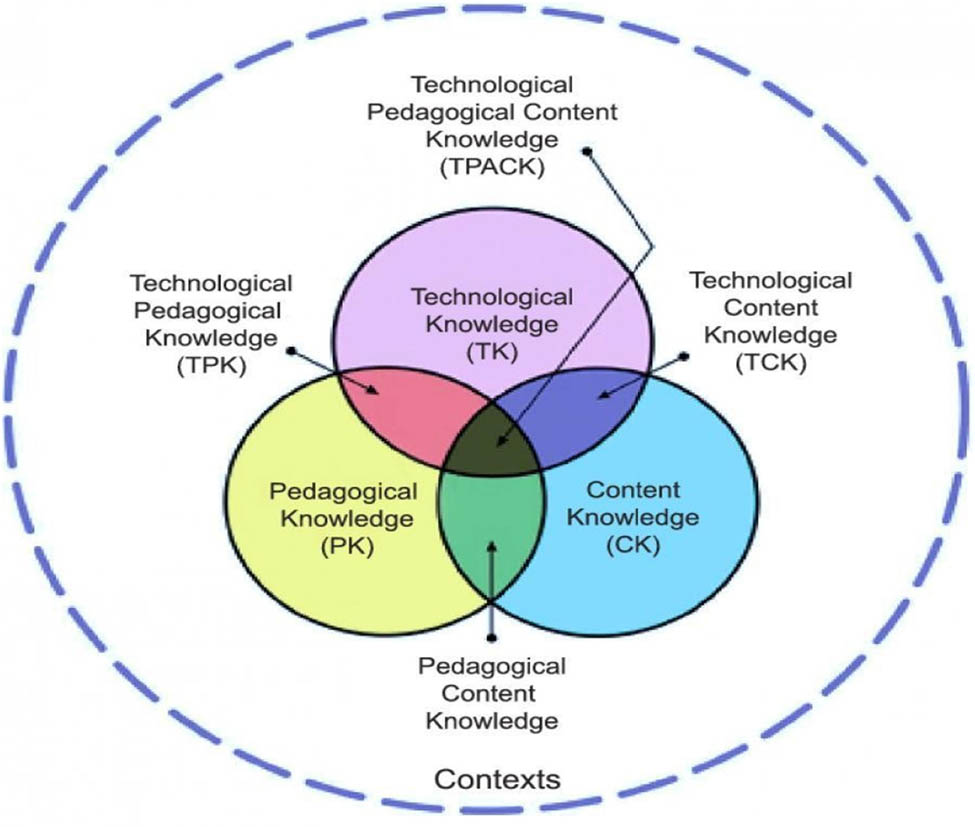
TPACK framework (Mishra, 2019).
A dotted circle was added to the TPACK diagram in 2019 by Mishra, who renamed the outer dotted circle “Contextual Knowledge.” According to Mishra (2019), contextual knowledge includes everything from a lecturer’s knowledge of current technologies to a lecturer’s understanding of the school, district, state, or education policies they must adhere to. Developing lecturers’ TPK professionally and allowing them to apply TPK to their content areas on their own initiative, like teacher education in higher education institutions, is a common strategy used in higher education to allow technology integration (Koehler et al., 2014). This study will also focus on the policies guiding technology integration in the selected higher education institutions in Southern Africa.
Technologists who have little knowledge of the content participants are teaching in different courses are frequently in charge of professional development workshops or courses for lecturers (Dysart & Weckerle, 2015). As a result, rather than using technology to teach specific material, the focus of professional development is typically on acquiring technological knowledge (TK) or understanding how digital technology works. Thus, Thyssen, Huwer, Irion, and Schaal (2023) suggest extending the TPACK model to a DPACK model to cater for digital literacy. Mishra, Warr, and Islam (2023) agree by stating that with the expansion to DPACK, it is essential to emphasise the need for young individuals in today’s digitally influenced world to possess the ability to critically contemplate the ongoing changes and contribute to them in an ethically responsible manner. Consequently, teachers must possess professional expertise to thoughtfully examine, analyse, utilise, and influence the digital transformation, as mandated by both national and international educational standards. With the narrow focus on developing only TPK, lecturers frequently work alone to apply the TPK to their disciplines, which might make it difficult for them to understand how technology can relate to their specific course content. When lecturers are adequately taught to combine their content knowledge (CK) and technological knowledge (TK), the impact that technology, pedagogy, and content have on one another may be fully acknowledged (Dysart & Weckerle, 2015). This study is set to establish how lecturers in the selected higher education institutions in Southern Africa are supported to integrate technology into teacher education.
5 Statement of the Problem
Lecturers are recruited into higher education institutions with minimal knowledge on how to integrate technology into teacher education. Notably, the Industrial Revolutions have altered both people’s lives and teacher education in higher education institutions (Chigora, Katsande, Zvavahera, Garwe, & Nyagadza, 2022). The current 4IR encourages the use of technologies to help people realise their rights, promote a culture of peace and nonviolence, cultivate global citizenship, and expose people to other cultures in order to foster an understanding of cultural diversity (Confintea VII, 2017).
In accordance with the policies of higher education institutions, lecturers are expected to integrate technology into teacher education without considering the skills and knowledge they already have or the digital tools at their disposal to do so (Guggemos & Seufert, 2021). While one might assume that higher education lecturers acquire technological and pedagogical skills throughout their educational journey, this is not always true. Prior to entering the field, lecturers may not have received formal training in integrating technology (Lehmann, 2020). This study will establish how lecturers in the selected higher education institutions integrate technology into teacher education. The following objectives are relevant:
Establish how lecturers integrate technology, pedagogies, and content into teacher education.
Determine how TPACK informs the policies guiding lecturers into integrating technology into teacher education.
Suggest what the universities in South Africa and Eswatini may do to enhance the integration of technology pedagogies in teacher education.
6 Methodology
The study used a multiple case study research strategy (Calandra, Secinaro, Massaro, Dal Mas, & Bagnoli, 2022) where two cases were used. The chosen university in the Kingdom of Eswatini is a leading organisation that advances knowledge and develops human capital. Understanding the value of integrating technology, the institution gives students access to digital tools and resources to help them develop the digital literacy skills they need to succeed in the digital age. It provides digital learning resources, computer laboratories, and lecture and student training programmes. The institution also encourages economic diversification by promoting an atmosphere of cooperation and entrepreneurship through research and innovation. The University of Eswatini is a key player in improving education, advancing technological knowledge (TK), and fostering economic prosperity in the nation through these initiatives.
The University of Technology in South Africa is an institution of higher learning that prioritises imparting knowledge that is applicable to the real world of work. The institution emphasises practical learning and the development of professional skills through a wide range of programmes offered in multiple areas. The University of Technology works to integrate TK and PK into its teaching practices because it understands the value of technology integration in education. To improve student learning results, the institution places a strong emphasis on the utilisation of digital platforms, online resources, and creative teaching techniques. The University of Technology also encourages innovation and research, which advances technology and fosters industry partnerships for practical applications.
A qualitative research approach inclined to the interpretive research paradigm was also taken in this study (Halkias & Neubert, 2020). The study was conducted in two universities located in Southern Africa, which were conveniently selected as the authors’ places of employment (Mudavanhu, 2017). Lecturers in the faculties of education involved in the training of student teachers were chosen as a purposeful sample of participants. The lecturer participants in this study were 22 (11 lecturers from each university). Open-ended questionnaires: All the lecturers involved in teacher education were given open-ended questionnaires to complete. These questionnaires were designed to gather qualitative information and insights regarding technology integration in the field. The open-ended questionnaires were sent to the participants via email. This allowed for convenient data collection and ensured the participants had sufficient time to provide thoughtful responses. A focus group discussion was organised with six lecturers from each institution. This discussion aimed to provide additional support and depth to the data collected from the open-ended questionnaires. The focus group allowed for interactive discussions and the exploration of different perspectives on technology integration. The focus group discussions were conducted online, utilising video conferencing or similar platforms. This approach facilitated collaborative discussions among the participants, overcoming geographical constraints. In addition to gathering data from the lecturers directly involved in teacher education, documents related to technology integration into teacher education were also analysed. This could include policies, curriculum materials, research papers, or any relevant written materials that provided insights into the topic.
The participants for the study, including HODs and lecturers, were purposefully selected. This means that specific individuals who had expertise or experience in technology integration and teacher education were chosen to participate. This selection ensured that the data collected would be relevant and valuable to the study. Throughout the research process, ethical considerations were taken into account. This means that the rights and well-being of the participants were protected. Ethical practices could include obtaining informed consent from participants, maintaining confidentiality and anonymity of the data, and ensuring the research process adhered to ethical guidelines and regulations. A combination of open-ended questionnaires, focus group discussions, document analysis, and ethical considerations in this study allowed for comprehensive and valuable insights into the integration of technology in teacher education.
The questions asked required an exploration of the current state of technology integration into teacher education practices within the studied universities, an examination of the existing policies, and guidelines pertaining to technology use in teacher education and perceptions of lecturers towards technology integration. In addition, the questions required an identification of the challenges and barriers faced by lecturers in integrating technology, an examination of the available technological tools and resources, and an understanding of how lecturers receive training and support in enhancing TK, PK, and CK, as well as assessing the outcomes, benefits, and evaluation methods employed in technology integration initiatives.
Data generated from the study participants and the documents studied were analysed using the thematic analysis. Researchers employ qualitative data analysis to uncover the study’s most important findings (Terry, Hayfield, Clarke, & Braun, 2017). In this study, a qualitative data analysis assisted the researchers to emphasise key issues pertinent to the current study on technology integration into teacher education. The researchers familiarised themselves with the information gathered for this study by reading the data intensively. Annotating the transcripts, which is the act of labelling the relevant key terms, phrases, sentence, or section codes, created the coding frame in this study. Coding comprises conceptualising qualitative data and organising and categorising data into essential themes then followed.
7 Findings
The findings of this study on technology integration in teacher education were presented under the following themes: Technology integration in teacher education, technology integration activities, and technology integration policies.
7.1 Theme 1: Technology Integration in Teacher Education
The participants were asked how technological pedagogies are integrated in their universities. The participants expressed that technology integration is an institutional expectation in teacher education in their institutions.
7.1.1 Sub-Theme 1.1: Uses of Technology in Higher Education Institutions
The participants were asked how technological pedagogies are integrated into their universities. The participants expressed that technology integration is an institutional expectation in teacher education in their institutions. Lecturer 5 from institution A revealed that, “The university is expecting us all to integrate technologies in all forms of teacher education as we lecture, assess and give feedback as well as facilitating discussions.” Similarly, lecturer 2 from institution B through an interview expressed that, “In our institution we expect that all lecturers integrate technology pedagogies in most activities like lecturing, assessment and in the provision of feedback…” On the same note, lecturer 4 from institution A stated that: “The faculty is integrating technology into teacher education. Teaching is done online, submission of assignments and dissemination of feedback is now done online. Even meetings or workshops for student teachers have moved from face to face, and they are now online.”
Lecturer 2 from institution B through a questionnaire indicated that technology pedagogies are integrated through, “…lecturing, assessment, receiving work from the students and providing feedback.” On another note, lecturer 3 from institution A in a focus group discussion revealed that, “Yes we do integrate technology into our teaching, but we are not yet in a position to wholly use the learning management system proposed by the institution for everything, we find ourselves falling back on social media platforms like WhatsApp especially for communication.”
The lecturers who participated in the study from the two studied institutions confirmed that the institutions expect that there be technology integrated into all forms of teacher education, in their lectures, assessments, evaluations, and giving feedback to the student teachers. The participants in this study also mentioned that through integrating technology pedagogies, they can connect with the student teachers even when they are not on campus.
7.1.2 Sub-Theme 1.2: The Blended Learning Policy
Both higher education institutions are guided by the blended learning policy in integrating technology into teacher education. According to lecturer 1 from institution A, “The university has lobbied for a blended learning policy, and we are now cultivating the policy through staff training.” Lecturer 3 from institution A, on the other hand, stated that: “Currently, the institution is using the blended learning policy and it allows for the use of face-to-face methods as well as online methods. We integrate technology in teacher education using both, but I still think we need to have sound policies that govern the integration of technological pedagogies in the instructional process as it is one’s choice to do so.”
Lecturer 1 from Institution B asserted that “…during COVID-19, the institution conducted lessons through e-learning, but there is now blended learning as lecturers can now meet with students face-to-face.” The document from University B’s Centre for Excellence in Learning and Teaching (2022) state that the centre’s mandate is to “Train and support lecturers in the development and implementation of blended and online learning.” Participants disclosed that both institutions possess and blended learning policy and are presently nurturing this policy through staff training.
7.1.3 Sub-Theme 1.3: Monitoring Policy Implementation
The policy document from institution A’s Centre for Teaching and Learning by Fowler (2020) mentions that the process of transitioning the institution to remote delivery has also begun. Lecturer 2 from institution A, on the other hand, stated that: “We also need a strategy of how to implement and that would include getting the tools ready. We need to have a committee that will look into how the policies set are implemented. We need to have proper guidance on how to integrate technology in teacher education.”
Lecturer 3 from institution A revealed that: “As an institution we need to fast track the move from blended towards online and you cannot migrate if you have difficulty migrating from face to face to blended methods of teaching. We need as an institution to have digital tools and online resources available; there must be some push factors that will compel us to move swiftly to technological pedagogical instructional approaches. We need a lot of psychosocial support services. We need to start working on people’s attitude so that they can see them often migrate into online teaching.”
Participants in this study revealed that institutions have now adopted blended learning as the policy after the COVID-19 pandemic. Institution A is actively aiming towards transitioning the institution to online learning in the field of teacher education, while institution B is motivated to integrate both blended learning and online learning approaches in certain programmes within the field of teacher education.
7.2 Theme 2: Technology Integration Activities
Participants in this study pointed to several activities involved in teacher education where technology is integrated. Lecturer 1 from institution A in an open-ended questionnaire stated that lecturers integrate technology teacher education for, “…lecturing, assessment as well as evaluation.” Lecturer 4 from institution A through a focus group discussion stated that: “It is only recently due to the advent of COVID-19 that efforts to integrate technology in lecturing student teachers took off but before the pandemic, technology was used by a few lecturers in the faculty for selected purposes like PowerPoint presentations, watching micro-teaching videos.”
Similar to the view from lecturer 3 from institution A in a focus group discussion, lecturer 2 from institution A revealed that, “I have been integrating technologies in teacher education through the LMS, when students submit assignments through Moodle and get their feedback through the platform. I have also used WhatsApp audios or videos where they need quick explanations.” On the same note, lecturer 3 from institution A stated that “Zoom and Moodle are available at the university and we normally use these platforms in integrating technological pedagogies in training student teachers. We also use WhatsApp, telegram as well as video clips.” Lecturer 1 from institution A also mentioned that, “I normally use a desktop computer to share slides, or laptop and whiteboard to display projected PowerPoint Presentations as means of integrating technological pedagogies in teacher education.” On another note, lecturer 4 from institution A indicated that, “But with regards to really training student teachers on how to integrate technological pedagogies in teaching, that is something we do not do but it is something that they just get, by the way.”
The participants who took part in this study also pointed out that through technology integration in teacher education, they can share PowerPoint Presentations and facilitate that student teachers watch video clips. Besides using the software provided by the institution, the participants indicated that they also use WhatsApp and telegram in instructing student teachers and providing short explanations whenever student teachers make requests. There was also an indication that technology is integrated through displays on whiteboards and blackboard applications in both institutions through media like desktop computers and laptops. Nonetheless, participants also asserted that student teachers develop the required skills for integrating technology pedagogies into their teaching through practical experience with technology during various tasks they embark on during their training.
7.3 Theme 3: Training How to Integrate Technology into Teacher Education
Participants in their respective institutions underwent training focused on incorporating technology into teacher preparation. Lecturer 2 from institution A revealed that: “Student teachers come out of the education system trained in computers as ICT is one of their modules.” However, this primarily results in digital literacy, and such training is not provided for individual courses or specific modules that could guide the integration of technology into the subjects they teach. While personnel acquire TK and CK, there is a lack of understanding on how to effectively integrate technology with content and pedagogy (TPACK and the digital DPACK). Lecturer 3 from institute B revealed that, “Student teachers under training can now utilise computers and have their own laptops.” Despite this, it becomes apparent that while TK is present, it remains separate from CK and PK. This highlights the necessity for additional training, which should be disseminated across departments or courses and encompass topics such as integrating technology into specific module themes.
8 Discussion of Findings
The results of the study were discussed accordingly. The study set to establish how technology was integrated into teacher education. This study revealed that lecturers in the studied higher education institutions in South Africa and Eswatini somehow integrated technology into teacher education. This result is consistent with Geisinger (2016) and Mohd and Murad (2022) who mentioned that integrating technology into teacher education is important in ensuring sound decision-making, problem-solving, collaborative innovations in society, creativity, critical thinking, and social responsibility, all of which are crucial abilities in the 4IR era.
The study revealed that participants in both institutions require comprehensive training that considers various knowledge types as identified in the TPACK theory for them to successfully integrate technology into teacher education. This finding is in line with Padmavathi (2017) who pointed out that lecturers in higher education institutions need to be trained to have a variety of knowledge types to effectively integrate technology into teacher education, and the knowledge types are indicated in the TPACK theory.
The study found that participants in one institution still view that the policy set is not really clear as to how the integration of technology in teacher education needs to be done. This finding is contrary to the view by Abel, Tondeur, and Sang (2022) who states that the policies set in educational institutions control how technology is integrated into the educational process as well as Reddy, Sharma, and Chaudhary (2022) who point out that there should be meaningful to the workforce in this 4IR. On the same note, Koehler et al. (2014) indicated that TPK should be considered when drafting policies to clarify how technology may be integrated into teacher education.
This study established that one institution has its blended policy as a draft document and not yet published. According to Haque et al. (2022), it is crucial to communicate policies clearly and suggests that documents and online publications cover a wide range. This view is in line with the findings of one university that has posted its blended learning policy on its website.
Participants from one university expressed the need to fast track the move from blended learning towards online learning but find the migration difficult as there are still other hindering factors such as availability of digital tools and a wider internet bandwidth. This finding is similar to the perspective expressed by Chen et al. (2022) and Lazarinis et al. (2022), who pointed out that effective technology integration in teacher education is a process more than the attainment of the digital tools and technology with Internet access into the lecture rooms, but encompasses learning theories, application of principles, appropriate communication channels, and making proper decision-making processes to resolve any problems existing in the education system. This perspective aligns with the concept of Technological Fluency, which emphasises not only the technical skills associated with using technology but also the ability to understand and navigate the broader implications and complexities of integrating technology into educational settings.
The participants in their respective institutes underwent training focused on the use of technology in teacher preparation. However, it was revealed that there was training in digital literacy, with ICT being one of their modules during teacher training. As a result, their training lacked specific guidance on integrating technology into the modules they would be teaching. While the personnel acquired TK and CK, they did not receive training on how to effectively combine technology with content and pedagogy (TPACK). On the other hand, according to lecturer 3 from institute B, student teachers undergoing training now have access to computers and personal laptops, indicating the recognition of the importance of TK. However, this type of training emphasises the differences between pedagogical knowledge (PK), CK, and TK, indicating the necessity for further training. The training should cover topics like incorporating technology into particular module themes and should be dispersed throughout departments and modules. This is consistent with the recommendations made by Thyssen et al. (2023) to address digital literacy by integrating digital into a DPACK model rather than only a TPACK model.
The participants in their respective educational institutions underwent training focused on incorporating technology into teacher training. However, it was disclosed that the training primarily centred on digital literacy, with ICT being one of the modules during teacher training. Consequently, their training lacked specific guidance on integrating technology into the modules they would eventually teach. Despite acquiring TK and CK, participants did not receive training on effectively combining technology with content and pedagogy (TPACK).
In contrast, student teachers in training now have access to computers and personal laptops, highlighting the acknowledgment of the importance of TK. However, this type of training highlights the distinctions among PK, CK, and TK, emphasising the need for further training. This additional training should encompass topics such as integrating technology into specific module themes and should be disseminated across departments or courses. This aligns with the recommendations put forth by Thyssen et al. (2023) to address digital literacy by incorporating digital into a DPACK model rather than only a TPACK model. Due to the limited emphasis on developing TPK alone, teachers often find themselves working independently to integrate TPK into their respective fields.
9 Conclusion and Recommendations
The research concludes that the higher education institutions investigated in South Africa and Eswatini are incorporating technology into teacher education to some extent. The study posits that integrating technology into the classroom can aid students in developing critical thinking, problem-solving skills, creativity, and social responsibility, particularly in the era of the 4IR.
Furthermore, the research suggests that participants in both institutions require comprehensive training covering various knowledge domains outlined in the TPACK theory to effectively integrate technology into teacher education. The inclusion of digital literacy (DPACK) as part of the training process is also becoming increasingly important. This emphasises the idea that successful technology integration in teaching practices demands lecturers in higher education institutions to possess diverse types of knowledge. In addition, the study reveals that one institution lacks explicit policies regarding the use of technology in teacher education. The study concludes that for a clear understanding of how technology can be effectively integrated into teacher education, policies should consider TPK.
The research also notes the existence of a draft blended learning policy in one institution that has not yet been released, emphasising the importance of transparent policy dissemination and communication. This finding reinforces the idea that effective policy implementation requires clear communication through various channels. Furthermore, participants from one university express a preference for a shift from blended to online learning. However, obstacles such as a lack of digital tools and insufficient Internet bandwidth persist. The study concluded that successful technology integration goes beyond mere access to Internet connectivity and tools.
The following recommendations are put forward:
The study’s findings provide insights for enhancing the integration of technology in teacher education. It suggests the development and implementation of comprehensive training programs based on the TPACK theory, encompassing various knowledge domains. These programs should equip teachers with the necessary pedagogical, technological, and subject knowledge to effectively incorporate technology into their lesson plans. Emphasis should be placed not only on digital literacy in training but also on integrating technology with curriculum and pedagogy.
The study recommends the establishment of clear policies guiding the integration of technology into teacher preparation. These policies, informed by the TPK framework, should provide detailed instructions on integrating technology into diverse subject areas and instructional environments. In addition, infrastructure development is advised to address issues related to Internet bandwidth and the accessibility of digital tools. Institutions should invest in providing the necessary digital tools, software, and hardware to facilitate technology integration. Initiatives ensuring reliable and fast Internet access in educational environments are also encouraged.
Collaboration and the exchange of best practices among educational institutions and teachers are recommended. Establishing forums or communities of practice where teachers can share effective techniques, materials, and ideas for integrating technology into teacher education can foster a culture of continuous learning and development. The study highlights the importance of continued professional development, urging teachers to enhance their technology expertise through programs such as workshops, conferences, seminars, and online courses focused on the use of technology in education.
Furthermore, the study suggests research and evaluation to promote studies on the effectiveness of integrating technology into teacher training. This approach can assist in identifying successful procedures, challenges, and areas for improvement. Engaging with stakeholders, including legislators, administrators, and technologists, is also recommended. Collaboration among these stakeholders can ensure that institutional processes, policy objectives, and the needs of students and teachers are effectively addressed. By implementing these guidelines, educational institutions can create a conducive environment for the integration of technology in teacher education (including DPACK), empowering teachers to proficiently use technology to enhance teaching and learning outcomes in the digital age.
-
Funding information: Project funding for the study was provided by Central University of Technology, Free State as part of a doctoral study (FRIC: 01/21/07).
-
Author contributions: G.S. revised the draft and linked the relevant literature to findings and discussions and edited all sources cited in the manuscript with the Reference List. S.B. contributed the initial draft of the manuscript. L.S. was instrumental in revising and streamlining the findings and discussion sections.
-
Conflict of interest: The authors state no conflict of interest.
-
Data availability statement: The datasets used and/or analysed during the current study are available from the corresponding author on reasonable request.
References
Abel, V., Tondeur, J., & Sang, G. (2022). Teacher perceptions about ICT integration into classroom instruction. Education Sciences, 12(9), 609. doi: 10.3390/educsci12090609.Search in Google Scholar
African Union Commission. (2015). Agenda 2063: The Africa we want. https://au.int/sites/default/files/documents/33126-doc-framework_document_book.pdf.Search in Google Scholar
Ahmad, S., Khan, D., & ul Haq, I. (2022). Assessing the role of information and communication technology in reducing the gap between rich and poor: The case of South Asia. International Journal of Social Economics, 49(11), 1663–1679. doi: 10.1108/IJSE-10-2021-0638.Search in Google Scholar
Akram, H., Abdelrady, A., Al-Adwan, A., & Ramzan, M. (2022). Teachers’ perceptions of technology integration in teaching-learning practices: A systematic review. Frontiers in Psychology, 13, 920317.10.3389/fpsyg.2022.920317Search in Google Scholar
Alemu, S. (2022). The diffusion of higher education reforms from the global north: The case of sub-Saharan Africa. In M. Klemenčič (Eds.), From actors to reforms in European higher education. Higher Education Dynamics, Vol. 58. Cham: Springer. doi: 10.1007/978-3-031-09400-2_11.Search in Google Scholar
Al-Nuaimi, M., Al Sawafi, O., Malik, S., & Al-Maroof, R. (2022). Extending the unified theory of acceptance and use of technology to investigate determinants of acceptance and adoption of learning management systems in the post-pandemic era: A structural equation modeling approach. Interactive Learning Environments. https://www.researchgate.net/publication/363932847.10.1080/10494820.2022.2127777Search in Google Scholar
Alqahtani, R., & Alqahtani, M. (2023). Heterogeneity across Australian ICT policies for education of gifted students. Heliyon, 9, e19103.10.1016/j.heliyon.2023.e19103Search in Google Scholar
Aluko, R., Krull, G., & Mhlanga, E. (2022). Shaping open, distance and e-learning in post school education and training: A call for a revised agenda. Perspectives in Education, 40(1), 1–17. doi: 10.18820/2519593X/pie.v40.i1.1.Search in Google Scholar
Bariu, T., Chun, X., & Boudouaia, A. (2022). Influence of teachers’ competencies on ICT implementation in Kenyan universities. Education Research International, 2022, 1–11. doi: 10.1155/2022/1370052.Search in Google Scholar
Burron, G. (2022). Examining active learning pedagogy and praxis in in-service teachers and teacher educators. (Doctoral dissertation). University of Toronto, Canada.Search in Google Scholar
Calandra, D., Secinaro, S., Massaro, M., Dal Mas, F., & Bagnoli, C. (2022). The link between sustainable business models and Blockchain: A multiple case study approach. Business Strategy and the Environment, 32, 1403–1417. doi: 10.1002/bse.3195.Search in Google Scholar
Centre of Excellence in Learning and Teaching (CELT). (2022). https://www.uneswa.ac.sz/research/centre-of-excellence-in-learning-and-teaching-celt/.Search in Google Scholar
Chen, C., Jong, M., & Tsai, C. (2022). A comparison of in-service teachers’ conceptions of barriers to mobile technology-integrated instruction and technology-integrated instruction. Australasian Journal of Educational Technology, 38(2), 35–50. doi: 10.14742/ajet.7299.Search in Google Scholar
Chigora, F., Katsande, C., Zvavahera, P., Garwe, E. C., & Nyagadza, B. (2022). Transferability of governance ethics in the fourth industrial revolution teaching and learning developments: A distanced higher education assessment in Zimbabwe amid COVID-19 pandemic. In Responsible management of shifts in work modes–values for a post pandemic future (Vol. 1, pp. 179–195). Leeds: Emerald Publishing Limited. doi: 10.1108/978-1-80262-719-020221015.Search in Google Scholar
Cloete, N. (2014). The South African higher education system: Performance and policy. Studies in Higher Education, 39(8), 1355–1368. doi: 10.1080/03075079.2014.949533.Search in Google Scholar
Confintea VII. (2017). Towards Confintea VII: Adult learning and education and the 2030 agenda. Confintea Mid-term review. Suwon/Osan, Republic of Korea.Search in Google Scholar
Dysart, S., & Weckerle, C. (2015). Professional development in higher education: A model for meaningful technology integration. Journal of Information Technology Education: Innovations in Practice, 14, 255-265. https://www.researchgate.net/publication/298713000_Professional_Development_in_Higher_Education_A_Model_for_Meaningful_Technology_Integration.10.28945/2326Search in Google Scholar
Dzinoreva, T., & Mavunga, G. (2022). Integrating ICTs into the Zimbabwean secondary school pre-service teachers’ curriculum. Journal of Education, 88, 53–68.10.17159/2520-9868/i88a04Search in Google Scholar
Fowler, C. (2020). The blended teaching and learning policy. Centre for Teaching and Learning (CELT). Eswatini: University of Eswatini.Search in Google Scholar
Fung, C., Su, S., Perry, E., & Garcia, M. (2022). Development of a socioeconomic inclusive assessment framework for online learning in higher education. In Socioeconomic inclusion during an era of online education (pp. 23–46). Hershey: IGI Global.10.4018/978-1-6684-4364-4.ch002Search in Google Scholar
Geisinger, K. (2016). 21st century skills: What are they and how do we assess them? Applied Measurement in Education, 29(4), 245–249. doi: 10.1080/08957347.2016.1209207.Search in Google Scholar
Gleason, N. (2018). Singapore’s higher education systems in the era of the fourth industrial revolution: Preparing lifelong learners. In N. Gleason (Ed.), Higher education in the era of the Fourth Industrial Revolution. Singapore: Palgrave Macmillan. doi: 10.1007/978-981-13-0194-0_7.Search in Google Scholar
Gooditis, L. (2022). Professional development and instructional technology: A study on Professional Development and the Implementation of Instructional Technology. (Doctoral dissertation). Ewing Township, New Jersey: The College of New Jersey.Search in Google Scholar
Guggemos, J., & Seufert, S. (2021). Teaching with and teaching about technology– Evidence for professional development of in-service teachers. Computers in Human Behavior, 115(C), 106613. doi: 10.1016/j.chb.2020.106613.Search in Google Scholar
Halkias, D., & Neubert, M. (2020). Extension of theory in leadership and management studies using the multiple case study design. SSRN Electronic Journal. doi: 10.2139/ssrn.3586256.Search in Google Scholar
Haque, A., Bhushan, B., & Dhiman, G. (2022). Conceptualizing smart city applications: Requirements, architecture, security issues, and emerging trends. Expert Systems, 39(7), 1–23. doi: 10.1111/exsy.12753.Search in Google Scholar
Hoq, M. (2020). E-Learning during the period of pandemic (COVID-19) in the kingdom of Saudi Arabia: An empirical study. American Journal of Educational Research, 8(7), 457–464.Search in Google Scholar
Jagatheesaperumal, S., Ahmad, K., Al-Fuqaha, A., & Qadir, J. (2022). Advancing education through extended reality and internet of everything enabled metaverses: Applications, challenges, and open issues. arXiv preprint. doi: 10.48550/arXiv.2207.01512.Search in Google Scholar
Klumpp, L., Pont, B., Figueroa, D., Albiser, E., Wittenberg, D., Zapata, J., & Fraccola, S. (2014). Education policy outlook. Paris: OECD Publishing.Search in Google Scholar
Knight, C., & Crick, T. (2022). Inclusive education in Wales: Interpreting discourses of values and practice using critical policy analysis. ECNU Review of Education, 5(2), 258–283. doi: 10.1177/20965311211039858.Search in Google Scholar
Koehler, M., Mishra, P., Kereluik, K., Shin, T., & Graham, C. (2014). The technological pedagogical content knowledge framework. Handbook of research on educational communications and technology. Springer. https://link.springer.com/chapter/ doi: 10.1007/978-1-4614.Search in Google Scholar
Kuhn, C., Alonzo, A., & Zlatkin-Troitschanskaia, O. (2016). Evaluating the pedagogical content knowledge of pre-and in-service teachers of business and economics to ensure quality of classroom practice in vocational education and training. Empirical Research in Vocational Education and Training, 8(1), 1–18. doi: 10.1186/s40461-016-0031-2.Search in Google Scholar
Lai, C., Wang, Q., & Huang, X. (2022). The differential interplay of TPACK, teacher beliefs, school culture and professional development with the nature of in‐ service EFL teachers’ technology adoption. British Journal of Educational Technology, 53(2), 1389–1411. doi: 10.1111/bjet.13200.Search in Google Scholar
Lazarinis, F., Karatrantou, A., Panagiotakopoulos, C., Daloukas, V., & Panagiotakopoulos, T. (2022). Strengthening the coding skills of teachers in a low dropout Python MOOC. Advances in Mobile Learning Educational Research, 2(1), 187–200.10.25082/AMLER.2022.01.003Search in Google Scholar
Lehmann, T. (2020). What is knowledge integration of multiple domains and how does it relate to teachers' professional competence? In T. Lehmann (Ed.), International perspectives on knowledge integration: Theory, research, and good practice in pre-service teacher and higher education (pp. 9–29). Leiden: Brill Sense. doi: 10.1163/9789004429499_002.Search in Google Scholar
Mamlok-Naaman, R., Eilks, I., Bodner, G., & Hofstein, A. (2018). Professional development of chemistry teachers. Royal Society of Chemistry. https://www.perlego.com/book/786742/professional-development-of-chemistry-teachers-theory-and-practice-pdf.Search in Google Scholar
Mbithi, P. M., Mbau, J., Muthama, N., Inyega, & Kalai, J. (2021). Higher education and skills development in Africa: An analytical paper on the role of higher learning institutions on sustainable development. Journal of Sustainability Environment and Peace, 4(2), 55–70. doi: 10.53537/jsep.2021.08.001.Search in Google Scholar
Mishra, P. (2019). Considering contextual knowledge: The TPACK diagram gets an upgrade. Journal of Digital Learning in Teacher Education, 35(2), 76–78. doi: 10.1080/21532974.2019.1588611.Search in Google Scholar
Mishra, P., Warr, M., & Islam, R. 2023. TPACK in the age of ChatGPT and generative AI. Journal of Digital Learning in Teacher Education, 39(2), 1–17. doi: 10.1080/21532974.2023.2247480.Search in Google Scholar
Mohd, N., & Murad, M. (2022). The usability of training management system for teachers’ professional development: A preliminary study. Malaysian Journal of Social Sciences and Humanities (MJSSH), 7(5), e001503. doi: 10.47405/mjssh.v7i5.1503.Search in Google Scholar
Motala, S., Sayed, Y & de Kock, T. (2021). Epistemic decolonisation in reconstituting higher education pedagogy in South Africa: The student perspective. Teaching in Higher Education, 26(2), 1–17. doi: 10.1080/13562517.2021.1947225.Search in Google Scholar
Motsamai, M., & Alers, C. (2022). Teachers’ perspectives on the effects of free primary education policy of the Kingdom of Eswatini on education quality in public schools. African Journal of Public Affairs, 13(1), 79–96. https://hdl.handle.net/10520/ejc-ajpa_v13_n1_a5.Search in Google Scholar
Mudavanhu, Y. (2017). Quality of literature review and discussion of findings in selected papers on integration of ICT in teaching, role of mentors, and teaching science through science, technology, engineering, and mathematics (STEM). Educational Research and Reviews, 12(4), 189–201. doi: 10.5897/ERR2016.3088.Search in Google Scholar
Mystakidis, S., & Christopoulos, A. (2022). Teacher perceptions on virtual reality escape rooms for STEM education. Information, 13(3), 136. doi: 10.3390/info13030136.Search in Google Scholar
Nami, F. (2022). Developing in-service teachers’ pedagogical knowledge of CALL through project-oriented tasks: The case of an online professional development course. ReCALL, 34(1), 110–125. doi: 10.1017/S0958344021000148.Search in Google Scholar
Padmavathi, M. (2017). Preparing teachers for technology-based teaching-learning using TPACK. Journal on School Educational Technology, 12(3), 1–9. doi: 10.26634/JSCH.12.3.10384.Search in Google Scholar
Portuguez-Castro, M., Hernández-Méndez, R. V., & Peña-Ortega, L. O. (2022). Novus projects: Innovative ideas to build new opportunities upon technology-based avenues in higher education. Education Sciences, 12(10), 695.10.3390/educsci12100695Search in Google Scholar
Reddy, P., Sharma, B., & Chaudhary, K. (2022). Digital literacy: A review in the South Pacific. Journal of Computing in Higher Education, 34(1), 83–108. doi: 10.1007/s12528-021-09280-4.Search in Google Scholar
Sadeghi, M. (2019). A shift from classroom to distance learning: Advantages and limitations. International Journal of Research in English Education, 4(1), 80–88.10.29252/ijree.4.1.80Search in Google Scholar
Terry, G., Hayfield, N., Clarke, V., & Braun, V. (2017). Thematic analysis. In C. Willig & W. Stainton Rogers (Eds.), The SAGE handbook of qualitative research in psychology (pp. 17–37). London: SAGE Publications.10.4135/9781526405555.n2Search in Google Scholar
Thyssen, C., Huwer, J., Irion, T., & Schaal, S. (2023). From TPACK to DPACK: The “Digitality-related pedagogical and content knowledge”-model in STEM-education. Education Sciences, 13(8), 769.10.3390/educsci13080769Search in Google Scholar
Yusuf, B., Walters, L., & Sailin, S. (2020). Restructuring educational institutions for growth in the Fourth Industrial Revolution (4IR): A systematic review. International Journal of Emerging Technologies in Learning, 15(3), 93–109. doi: 10.3991/ijet.v15i03.11849.Search in Google Scholar
© 2024 the author(s), published by De Gruyter
This work is licensed under the Creative Commons Attribution 4.0 International License.
Articles in the same Issue
- Special Issue: Building Bridges in STEAM Education in the 21st Century - Part II
- The Flipped Classroom Optimized Through Gamification and Team-Based Learning
- Method and New Doctorate Graduates in Science, Technology, Engineering, and Mathematics of the European Innovation Scoreboard as a Measure of Innovation Management in Subdisciplines of Management and Quality Studies
- Impact of Gamified Problem Sheets in Seppo on Self-Regulation Skills
- Special Issue: Disruptive Innovations in Education - Part I
- School-Based Education Program to Solve Bullying Cases in Primary Schools
- The Project Trauma-Informed Practice for Workers in Public Service Settings: New Strategies for the Same Old Objective
- Regular Articles
- Limits of Metacognitive Prompts for Confidence Judgments in an Interactive Learning Environment
- “Why are These Problems Still Unresolved?” Those Pending Problems, and Neglected Contradictions in Online Classroom in the Post-COVID-19 Era
- Potential Elitism in Selection to Bilingual Studies: A Case Study in Higher Education
- Predicting Time to Graduation of Open University Students: An Educational Data Mining Study
- Risks in Identifying Gifted Students in Mathematics: Case Studies
- Technology Integration in Teacher Education Practices in Two Southern African Universities
- Comparing Emergency Remote Learning with Traditional Learning in Primary Education: Primary School Student Perspectives
- Pedagogical Technologies and Cognitive Development in Secondary Education
- Sense of Belonging as a Predictor of Intentions to Drop Out Among Black and White Distance Learning Students at a South African University
- Gender Sensitivity of Teacher Education Curricula in the Republic of Croatia
- A Case Study of Biology Teaching Practices in Croatian Primary Schools
- The Impact of “Scratch” on Student Engagement and Academic Performance in Primary Schools
- Examining the Structural Relationships Between Pre-Service Science Teachers’ Intention to Teach and Perceptions of the Nature of Science and Attitudes
- Validation of the Undesirable Behavior Strategies Questionnaire: Physical Educators’ Strategies within the Classroom Ecology
- Economics Education, Decision-Making, and Entrepreneurial Intention: A Mediation Analysis of Financial Literacy
- Deconstructing Teacher Engagement Techniques for Pre-service Teachers through Explicitly Teaching and Applying “Noticing” in Video Observations
- Influencing Factors of Work–Life Balance Among Female Managers in Chinese Higher Education Institutions: A Delphi Study
- Examining the Interrelationships Among Curiosity, Creativity, and Academic Motivation Using Students in High Schools: A Multivariate Analysis Approach
- Teaching Research Methodologies in Education: Teachers’ Pedagogical Practices in Portugal
- Normrank Correlations for Testing Associations and for Use in Latent Variable Models
- “The More, the Merrier; the More Ideas, the Better Feeling”: Examining the Role of Creativity in Regulating Emotions among EFL Teachers
- Principals’ Demographic Qualities and the Misuse of School Material Capital in Secondary Schools
- Enhancing DevOps Engineering Education Through System-Based Learning Approach
- Uncertain Causality Analysis of Critical Success Factors of Special Education Mathematics Teaching
- Novel Totto-Chan by Tetsuko Kuroyanagi: A Study of Philosophy of Progressivism and Humanism and Relevance to the Merdeka Curriculum in Indonesia
- Global Education and Critical Thinking: A Necessary Symbiosis to Educate for Critical Global Citizenship
- The Mediating Effect of Optimism and Resourcefulness on the Relationship between Hardiness and Cyber Delinquent Among Adolescent Students
- Enhancing Social Skills Development in Children with Autism Spectrum Disorder: An Evaluation of the “Power of Camp Inclusion” Program
- The Influence of Student Learning, Student Expectation and Quality of Instructor on Student Perceived Satisfaction and Student Academic Performance: Under Online, Hybrid and Physical Classrooms
- Household Size and Access to Education in Rural Burundi: The Case of Mutaho Commune
- The Impact of the Madrasati Platform Experience on Acquiring Mathematical Concepts and Improving Learning Motivation from the Point of View of Mathematics Teachers
- The Ideal Path: Acquiring Education and Gaining Respect for Parents from the Perspective of Arab-Bedouin Students
- Exploring Mentor Teachers’ Experiences and Practices in Japan: Formative Intervention for Self-Directed Development of Novice Teachers
- Research Trends and Patterns on Emotional Intelligence in Education: A Bibliometric and Knowledge Mapping During 2012–2021
- Openness to Change and Academic Freedom in Jordanian Universities
- Digital Methods to Promote Inclusive and Effective Learning in Schools: A Mixed Methods Research Study
- Translation Competence in Translator Training Programs at Saudi Universities: Empirical Study
- Self-directed Learning Behavior among Communication Arts Students in a HyFlex Learning Environment at a Government University in Thailand
- Unveiling Connections between Stress, Anxiety, Depression, and Delinquency Proneness: Analysing the General Strain Theory
- The Expression of Gratitude in English and Arabic Doctoral Dissertation Acknowledgements
- Subtexts of Most Read Articles on Social Sciences Citation Index: Trends in Educational Issues
- Experiences of Adult Learners Engaged in Blended Learning beyond COVID-19 in Ghana
- The Influence of STEM-Based Digital Learning on 6C Skills of Elementary School Students
- Gender and Family Stereotypes in a Photograph: Research Using the Eye-Tracking Method
- ChatGPT in Teaching Linear Algebra: Strides Forward, Steps to Go
- Partnership Quality, Student’s Satisfaction, and Loyalty: A Study at Higher Education Legal Entities in Indonesia
- SEA’s Science Teacher Voices Through the Modified World Café
- Construction of Entrepreneurship Coaching Index: Based on a Survey of Art Design Students in Higher Vocational Colleges in Guangdong, China
- The Effect of Audio-Assisted Reading on Incidental Learning of Present Perfect by EFL Learners
- Comprehensive Approach to Training English Communicative Competence in Chemistry
- The Collaboration of Teaching at The Right Level Approach with Problem-Based Learning Model
- Effectiveness of a Pop-Up Story-Based Program for Developing Environmental Awareness and Sustainability Concepts among First-Grade Elementary Students
- Effect of Computer Simulation Integrated with Jigsaw Learning Strategy on Students’ Attitudes towards Learning Chemistry
- Unveiling the Distinctive Impact of Vocational Schools Link and Match Collaboration with Industries for Holistic Workforce Readiness
- Students’ Perceptions of PBL Usefulness
- Assessing the Outcomes of Digital Soil Science Curricula for Agricultural Undergraduates in the Global South
- The Relationship between Epistemological Beliefs and Assessment Conceptions among Pre-Service Teachers
- Review Articles
- Fostering Creativity in Higher Education Institution: A Systematic Review (2018–2022)
- The Effects of Online Continuing Education for Healthcare Professionals: A Systematic Scoping Review
- The Impact of Job Satisfaction on Teacher Mental Health: A Call to Action for Educational Policymakers
- Developing Multilingual Competence in Future Educators: Approaches, Challenges, and Best Practices
- Using Virtual Reality to Enhance Twenty-First-Century Skills in Elementary School Students: A Systematic Literature Review
- State-of-the-Art of STEAM Education in Science Classrooms: A Systematic Literature Review
- Integration of Project-Based Learning in Science, Technology, Engineering, and Mathematics to Improve Students’ Biology Practical Skills in Higher Education: A Systematic Review
- Teaching Work and Inequality in Argentina: Heterogeneity and Dynamism in Educational Research
- Case Study
- Teachers’ Perceptions of a Chatbot’s Role in School-based Professional Learning
Articles in the same Issue
- Special Issue: Building Bridges in STEAM Education in the 21st Century - Part II
- The Flipped Classroom Optimized Through Gamification and Team-Based Learning
- Method and New Doctorate Graduates in Science, Technology, Engineering, and Mathematics of the European Innovation Scoreboard as a Measure of Innovation Management in Subdisciplines of Management and Quality Studies
- Impact of Gamified Problem Sheets in Seppo on Self-Regulation Skills
- Special Issue: Disruptive Innovations in Education - Part I
- School-Based Education Program to Solve Bullying Cases in Primary Schools
- The Project Trauma-Informed Practice for Workers in Public Service Settings: New Strategies for the Same Old Objective
- Regular Articles
- Limits of Metacognitive Prompts for Confidence Judgments in an Interactive Learning Environment
- “Why are These Problems Still Unresolved?” Those Pending Problems, and Neglected Contradictions in Online Classroom in the Post-COVID-19 Era
- Potential Elitism in Selection to Bilingual Studies: A Case Study in Higher Education
- Predicting Time to Graduation of Open University Students: An Educational Data Mining Study
- Risks in Identifying Gifted Students in Mathematics: Case Studies
- Technology Integration in Teacher Education Practices in Two Southern African Universities
- Comparing Emergency Remote Learning with Traditional Learning in Primary Education: Primary School Student Perspectives
- Pedagogical Technologies and Cognitive Development in Secondary Education
- Sense of Belonging as a Predictor of Intentions to Drop Out Among Black and White Distance Learning Students at a South African University
- Gender Sensitivity of Teacher Education Curricula in the Republic of Croatia
- A Case Study of Biology Teaching Practices in Croatian Primary Schools
- The Impact of “Scratch” on Student Engagement and Academic Performance in Primary Schools
- Examining the Structural Relationships Between Pre-Service Science Teachers’ Intention to Teach and Perceptions of the Nature of Science and Attitudes
- Validation of the Undesirable Behavior Strategies Questionnaire: Physical Educators’ Strategies within the Classroom Ecology
- Economics Education, Decision-Making, and Entrepreneurial Intention: A Mediation Analysis of Financial Literacy
- Deconstructing Teacher Engagement Techniques for Pre-service Teachers through Explicitly Teaching and Applying “Noticing” in Video Observations
- Influencing Factors of Work–Life Balance Among Female Managers in Chinese Higher Education Institutions: A Delphi Study
- Examining the Interrelationships Among Curiosity, Creativity, and Academic Motivation Using Students in High Schools: A Multivariate Analysis Approach
- Teaching Research Methodologies in Education: Teachers’ Pedagogical Practices in Portugal
- Normrank Correlations for Testing Associations and for Use in Latent Variable Models
- “The More, the Merrier; the More Ideas, the Better Feeling”: Examining the Role of Creativity in Regulating Emotions among EFL Teachers
- Principals’ Demographic Qualities and the Misuse of School Material Capital in Secondary Schools
- Enhancing DevOps Engineering Education Through System-Based Learning Approach
- Uncertain Causality Analysis of Critical Success Factors of Special Education Mathematics Teaching
- Novel Totto-Chan by Tetsuko Kuroyanagi: A Study of Philosophy of Progressivism and Humanism and Relevance to the Merdeka Curriculum in Indonesia
- Global Education and Critical Thinking: A Necessary Symbiosis to Educate for Critical Global Citizenship
- The Mediating Effect of Optimism and Resourcefulness on the Relationship between Hardiness and Cyber Delinquent Among Adolescent Students
- Enhancing Social Skills Development in Children with Autism Spectrum Disorder: An Evaluation of the “Power of Camp Inclusion” Program
- The Influence of Student Learning, Student Expectation and Quality of Instructor on Student Perceived Satisfaction and Student Academic Performance: Under Online, Hybrid and Physical Classrooms
- Household Size and Access to Education in Rural Burundi: The Case of Mutaho Commune
- The Impact of the Madrasati Platform Experience on Acquiring Mathematical Concepts and Improving Learning Motivation from the Point of View of Mathematics Teachers
- The Ideal Path: Acquiring Education and Gaining Respect for Parents from the Perspective of Arab-Bedouin Students
- Exploring Mentor Teachers’ Experiences and Practices in Japan: Formative Intervention for Self-Directed Development of Novice Teachers
- Research Trends and Patterns on Emotional Intelligence in Education: A Bibliometric and Knowledge Mapping During 2012–2021
- Openness to Change and Academic Freedom in Jordanian Universities
- Digital Methods to Promote Inclusive and Effective Learning in Schools: A Mixed Methods Research Study
- Translation Competence in Translator Training Programs at Saudi Universities: Empirical Study
- Self-directed Learning Behavior among Communication Arts Students in a HyFlex Learning Environment at a Government University in Thailand
- Unveiling Connections between Stress, Anxiety, Depression, and Delinquency Proneness: Analysing the General Strain Theory
- The Expression of Gratitude in English and Arabic Doctoral Dissertation Acknowledgements
- Subtexts of Most Read Articles on Social Sciences Citation Index: Trends in Educational Issues
- Experiences of Adult Learners Engaged in Blended Learning beyond COVID-19 in Ghana
- The Influence of STEM-Based Digital Learning on 6C Skills of Elementary School Students
- Gender and Family Stereotypes in a Photograph: Research Using the Eye-Tracking Method
- ChatGPT in Teaching Linear Algebra: Strides Forward, Steps to Go
- Partnership Quality, Student’s Satisfaction, and Loyalty: A Study at Higher Education Legal Entities in Indonesia
- SEA’s Science Teacher Voices Through the Modified World Café
- Construction of Entrepreneurship Coaching Index: Based on a Survey of Art Design Students in Higher Vocational Colleges in Guangdong, China
- The Effect of Audio-Assisted Reading on Incidental Learning of Present Perfect by EFL Learners
- Comprehensive Approach to Training English Communicative Competence in Chemistry
- The Collaboration of Teaching at The Right Level Approach with Problem-Based Learning Model
- Effectiveness of a Pop-Up Story-Based Program for Developing Environmental Awareness and Sustainability Concepts among First-Grade Elementary Students
- Effect of Computer Simulation Integrated with Jigsaw Learning Strategy on Students’ Attitudes towards Learning Chemistry
- Unveiling the Distinctive Impact of Vocational Schools Link and Match Collaboration with Industries for Holistic Workforce Readiness
- Students’ Perceptions of PBL Usefulness
- Assessing the Outcomes of Digital Soil Science Curricula for Agricultural Undergraduates in the Global South
- The Relationship between Epistemological Beliefs and Assessment Conceptions among Pre-Service Teachers
- Review Articles
- Fostering Creativity in Higher Education Institution: A Systematic Review (2018–2022)
- The Effects of Online Continuing Education for Healthcare Professionals: A Systematic Scoping Review
- The Impact of Job Satisfaction on Teacher Mental Health: A Call to Action for Educational Policymakers
- Developing Multilingual Competence in Future Educators: Approaches, Challenges, and Best Practices
- Using Virtual Reality to Enhance Twenty-First-Century Skills in Elementary School Students: A Systematic Literature Review
- State-of-the-Art of STEAM Education in Science Classrooms: A Systematic Literature Review
- Integration of Project-Based Learning in Science, Technology, Engineering, and Mathematics to Improve Students’ Biology Practical Skills in Higher Education: A Systematic Review
- Teaching Work and Inequality in Argentina: Heterogeneity and Dynamism in Educational Research
- Case Study
- Teachers’ Perceptions of a Chatbot’s Role in School-based Professional Learning
